Archive
04/18/2013 – Ephemeris – The moon at first quarter
Ephemeris for Thursday, April 18th. The sun rises at 6:52. It’ll be up for 13 hours and 38 minutes, setting at 8:31. The moon, at first quarter today, will set at 3:21 tomorrow morning.
Lets take a look at the moon tonight. It’ll be about 6 hours after first quarter and we’ll see features at the terminator, the sunrise line that cuts the moon in half. In small telescopes, at the north or top end of the moon, the wide flat crater Plato is just entering sunlight. Long shadows from its crater walls will retreat across its flat floor over the evening. If you look closely you’ll notice that the floor of Plato is slightly convex to conform with the curvature of the moon itself. Nearby is the straight gash in the Alps Mountains, called the Alpine Valley. Supposedly the crater Plato formed shortly after Mare Imbrium formed throwing up the Alps and the Apennine mountains to the south. The Straight wall, can be seen on the south end of the moon.
Times are for the Traverse City/Interlochen area of Michigan. They may be different for your location.
Addendum
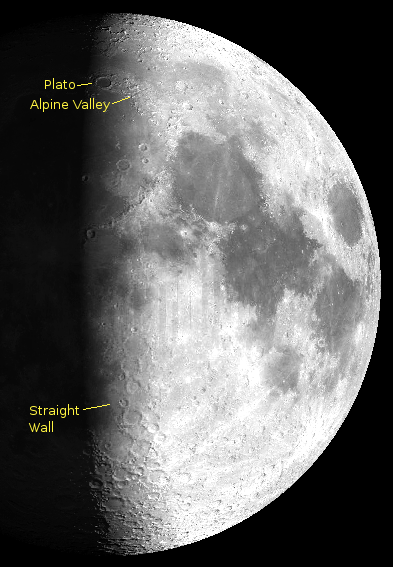
First quarter moon April 18, 2013 Created using Virtual Moon Atlas
04/16/2013 – Ephemeris – The moon’s strange orbit
Ephemeris for Tuesday, April 16th. The sun rises at 6:56. It’ll be up for 13 hours and 32 minutes, setting at 8:28. The moon, 2 days before first quarter, will set at 2:13 tomorrow morning.
The fat crescent moon appears high in the sky. It appears in a part of the sky where the sun will be in early July. The moon follows a path nearly in the plane of the earth’s orbit , but a bit tilted from it by an angle of 5 degrees. This is unusual. Most planet’s major satellites orbit their primary in it’s equatorial plane, like our geostationary communication satellites, though none them orbit in one of their planet’s days. The moon orbits the earth, but due to its great distance of 60 earth radii, or 240 thousand miles also is very much gravitationally affected by the sun. Apparently one of its effects was to pull the moon close to the the earth’s orbital plane. If you like eclipses this is a good thing. It makes eclipses much more frequent than if the moon orbited over the earth’s equator.
Times are for the Traverse City/Interlochen area of Michigan. They may be different for your location.
Addendum
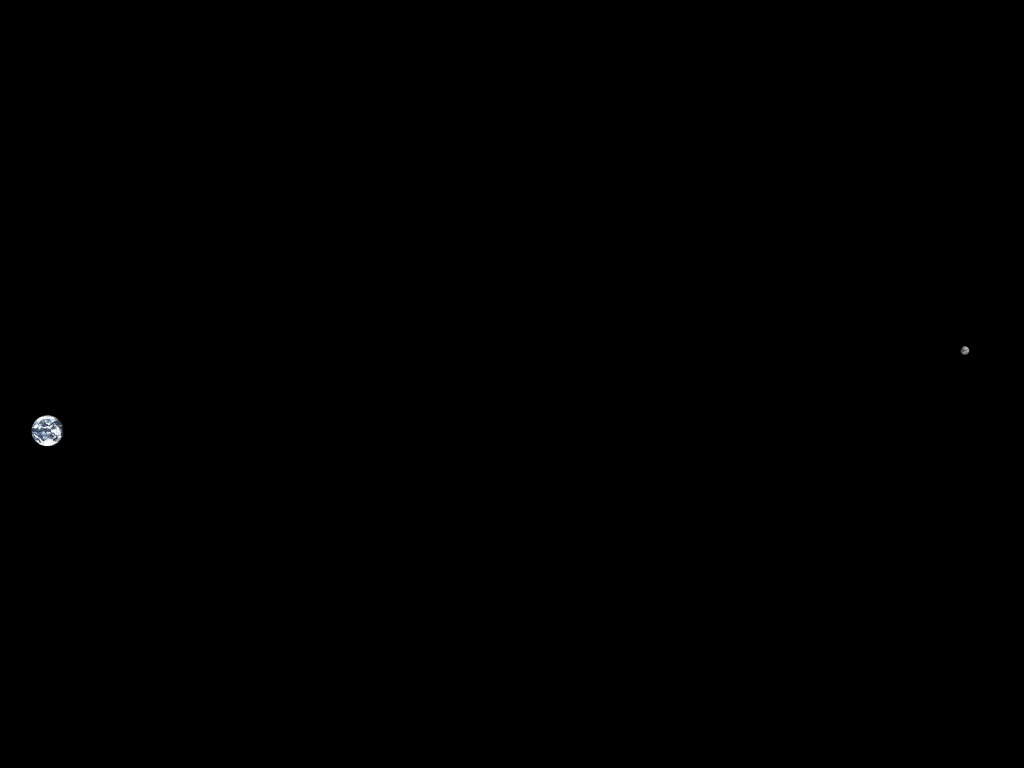
The true scale of the earth-moon system. From Traipse.com
02/18/2013 – Ephemeris – The moon appears near Jupiter tonight
Ephemeris for President’s Day, Monday, February 18th. The sun will rise at 7:37. It’ll be up for 10 hours and 38 minutes, setting at 6:15. The moon, 1 day past first quarter, will set at 3:15 tomorrow morning.
The moon will point to Jupiter tonight. The planet will be a ways to the west or right of the moon. Actually the moon was closer to Jupiter last night. It’s closest apparent approach is about now this morning. But they’re below the horizon now. My younger granddaughter Bea has made Jupiter her favorite planet because of its red spot. The Great Red Spot on Jupiter has been seen off and on ever its was discovered by a series of astronomers. It would fade for many years only to reappear again. In fact it never went away. Right now this high pressure system is more a light pastel pink. Back in the 1950’s, and 1960’s I found it hard to ignore in the smallest of telescopes. Now it takes bigger telescopes to spot.
Times are for the Traverse City/Interlochen area of Michigan. They may be different for your location.
Addendum
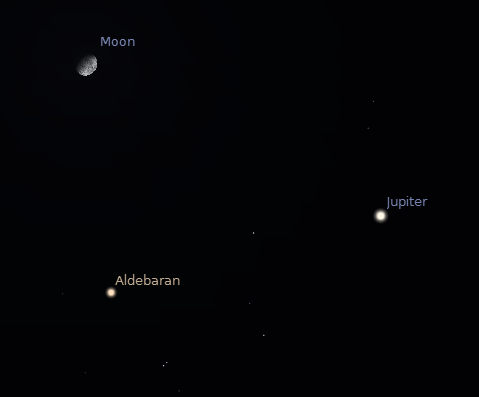
Jupiter and the moon at 9 p.m. on February 18, 2013. Created using Stellarium.
2/11/2013 – Ephemeris – The moon will appear near Mercury tonight
Ephemeris for Monday, February 11th. The sun will rise at 7:48. It’ll be up for 10 hours and 17 minutes, setting at 6:05. The moon, 1 day past new, will set at 8:09 this evening.
Mercury will appear below the skinny crescent moon tonight shortly after sunset. The best time to spot them is about 6:45 p.m. looking very low to the west southwestern horizon. Binoculars as always are a real help in picking them out of the evening twilight. Mercury will appear about 6 degrees or 12 moon widths below the moon. They will be actually at their closest appearance this afternoon, and will have separated a bit before we will get to see them. As a rule of thumb, the moon will move its diameter against the stars in an hour’s time. Mercury’s got its thing going too. In 5 days it will be at greatest elongation or apparent angle of separation from the sun of about 18.1 degrees. At about the same time Mercury will actually pass its closest to the sun.
Times are for the Traverse City/Interlochen area of Michigan. They may be different for your location.
Addendum
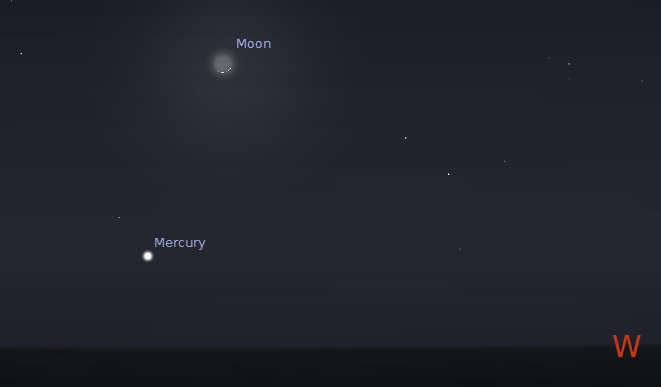
Mercury and the moon at 7:15 p.m. on February 11, 2013. Created using Stellarium. Note a one day old moon doesn’t show well in this view.
Saturn will appear above the moon on the morning of February 3rd
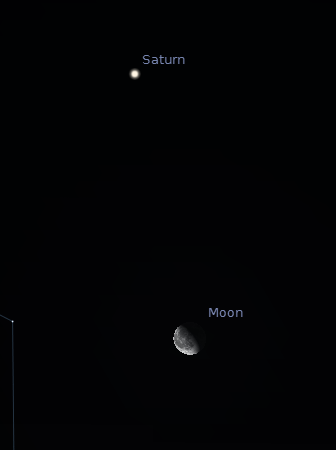
Here’s what you’ll see looking to the south at 4:55 a.m. EST. Created using Stellarium.
While you’re at it check out both with a telescopes. The two will hang out next to each other through the beginning of twilight.
01/21/2013 – Ephemeris – MLK Day, Jupiter above the Moon tonight
Ephemeris for Martin Luther King Day and Inauguration Day, Monday, January 21st. The sun will rise at 8:11. It’ll be up for 9 hours and 24 minutes, setting at 5:36. The moon, 3 days past first quarter, will set at 4:33 tomorrow morning.
Today is the holiday commemorating the life of Dr. Martin Luther King Jr., and his struggle for civil rights. Today we will have the second inauguration of the first African American President. Another chapter in the struggle for the equality of all people. Back before the Civil War, runaway slaves used the stars to steer their flight northward. The prominent pattern of northern stars that aided their journey was the Drinking Gourd. We know it as the Big Dipper. which is starting to rise higher in the northeast. Also in the sky tonight the planet Jupiter will appear above the moon, their closest approach will be at 10:30 p.m. For us closest approach will be at 2 moon diameters. A couple of thousand miles south of here the moon will cover the planet.
Times are for the Traverse City/Interlochen area of Michigan. They may be different for your location.
Addendum
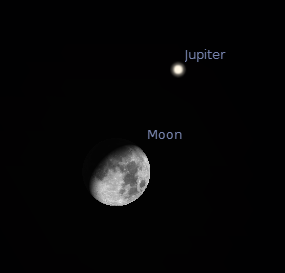
Jupiter and the moon at 10:30 p.m. January 21, 2013. Created using Stellarium.
01/10/2013 – Ephemeris – The moon passes Venus this (early) morning
Ephemeris for Thursday, January 10th. The sun will rise at 8:17. It’ll be up for 9 hours and 4 minutes, setting at 5:22. The moon, 1 day before new, will rise at 7:48 tomorrow morning.
This morning the Venus and the thin crescent moon will appear together in the growing twilight. Venus has been our morning companion since the wonderful transit of Venus last June 5th. It will stay in the morning sky until it passes behind the sun on March 28th, after which it will slowly emerge into the evening sky once again. Unlike the transit, it will not pass directly behind the sun. Venus is inside the earth’s orbit of the sun, so moves faster than the earth. It’s year is 225 of our days. However we see Venus from the moving earth, so it takes about a year and 7 months for Venus to move around the sun from our point of view, So we have about 9 ½ months with Venus as our morning star and 9 ½ months as our evening star.
Times are for the Traverse City/Interlochen area of Michigan. They may be different for your location.
Addendum
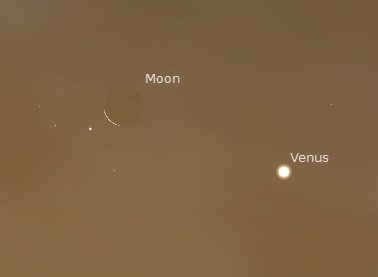
A closeup of Venus and the moon at 7:30 a.m. January 10, 2013. Created using Stellarium.
01/07/2013 – Ephemeris – Saturn is near the moon this morning
Ephemeris for Monday, January 7th. The sun will rise at 8:18. It’ll be up for 9 hours and 0 minutes, setting at 5:19. The moon, 3 days past last quarter, will rise at 4:49 tomorrow morning.
This morning the planet Saturn will appear above and right of the crescent moon. They should be visible until a bit after seven a.m. The moon will be slipping eastward morning by morning, and by Thursday it will appear near the planet Venus. The moon’s movement around the earth with respect to the sun is called the synodic month, or a lunation. It is the period between one new moon to the next of about 29 and a half days. It is the basis for lunar calendars such as the Jewish and Islamic calendars. The moon’s crescent can be waxing or waning, growing fatter or thinner. It is now waning, and next week when we see the moon in the evening its phase will be waxing. The moon is just an illuminated ball in space.
Times are for the Traverse City/Interlochen area of Michigan. They may be different for your location.
Addendum
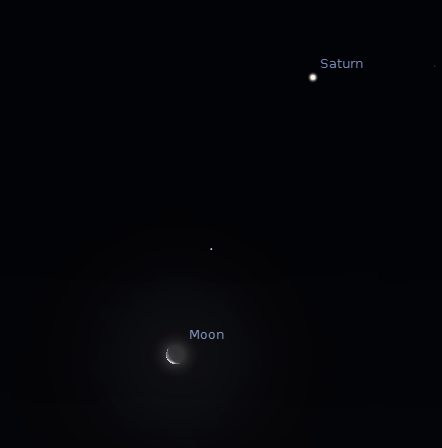
Saturn and the moon as seen at 6:30 a.m. on January 7, 2012. Created using Stellarium,
12/10/2012 – Ephemeris – Saturn will be above the moon this morning.
Ephemeris for Monday, December 10th. The sun will rise at 8:08. It’ll be up for 8 hours and 53 minutes, setting at 5:02. The moon, 3 days before new, will rise at 6:01 tomorrow morning.
This morning, if it’s clear look eastward at the moon and planets. The planet just above the moon is the planet Saturn. Farther below and to the left is the brilliant planet Venus. Those with good eyesight or binoculars might spot tiny Mercury. In the morning we get a preview in the stars of a season or two ahead from what we see in the evening. Orion, which is rising in the east in the early evening is seen setting in the west at 7 in the morning. The spring stars are now reigning in the morning sky, and a few summer are peeking above the eastern horizon, pretty much drowned out by the morning twilight. Next spring Saturn will be little moved from its current position, It takes it a bit less than 30 years to orbit the sun.
Times are for the Traverse City/Interlochen area of Michigan. They may be different for your location.
Addendum
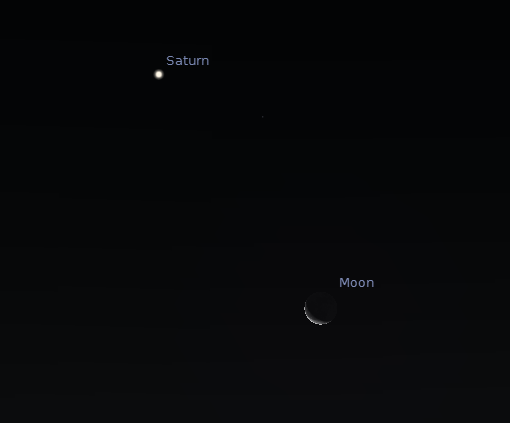
Saturn and the moon low in the southeast at 6:30 a.m. on December 10, 2012. Created using Stellarium.
Tomorrow morning the moon will pass below Venus. See this animation below.
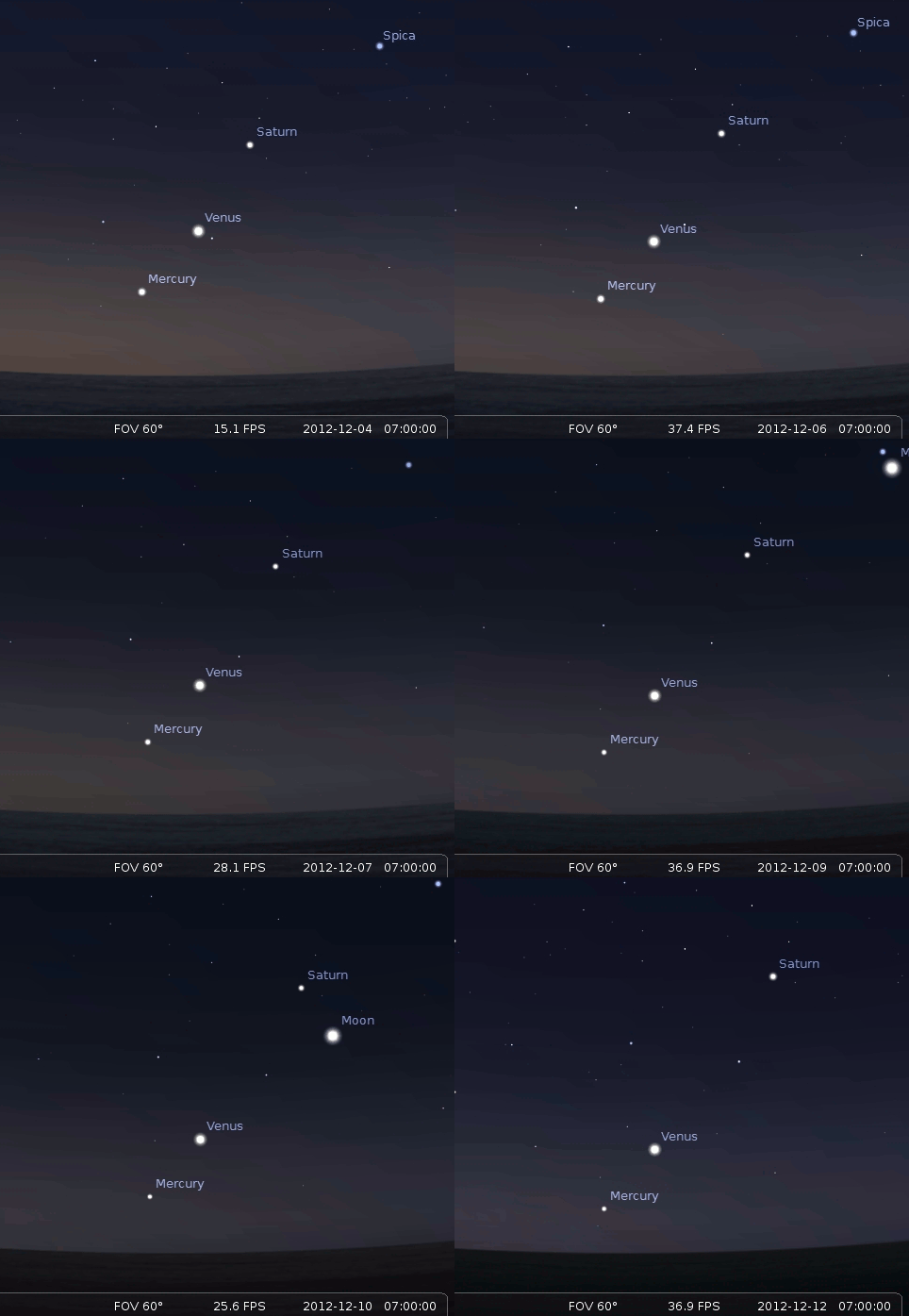
Mercury animation from December 4 to thru 12, 2012. Created using Stellarium
11/20/2012 – Ephemeris – Tides from Sandy to Galaxies
Ephemeris for Tuesday, November 20th. The sun will rise at 7:46. It’ll be up for 9 hours and 23 minutes, setting at 5:09. The moon, at first quarter today, will set at 12:50 tomorrow morning.
It was three quarters of the moon’s revolution ago or three weeks that the moon was full and adding to the storm surge of Hurricane Sandy. When the moon is full or new the moon’s greater tidal force adds to the sun’s giving us the highest tides called spring tides. Tides are caused by the difference in the gravitational pull on a body from on side to the other when two bodies are close. That’s why the moon exerts a greater tidal force than the sun, even thought its very much less massive. Tides just don’t occur in earth’s oceans. Jupiter’s tidal force tore apart Comet Shoemaker-Levy 9 two years before its more than 20 pieces plunged into Jupiter’s atmosphere in 1994. Colliding galaxies exhibit tidal tails.
Times are for the Traverse City/Interlochen area of Michigan. They may be different for your location.
Addendum
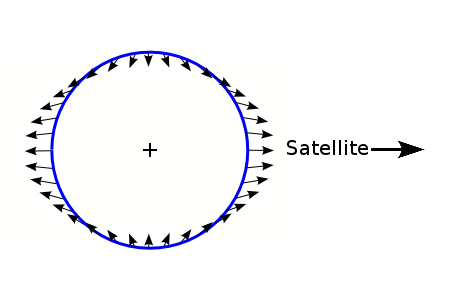
Tidal forces on a planet, the earth for instance by the moon. Source – Wikimedia.
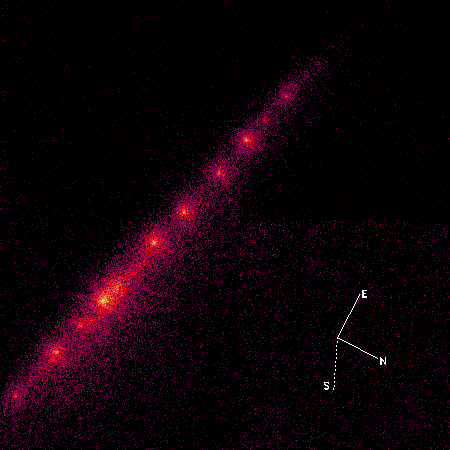
Comet Shoemaker-Levy 9 after a too close approach to Jupiter. The comet was torn into a “String of Pearls” by Jupiter,s immense tidal pull. They came back, crashing into Jupiter in July of 1994. Courtesy NASA Hubble Space Telescope.
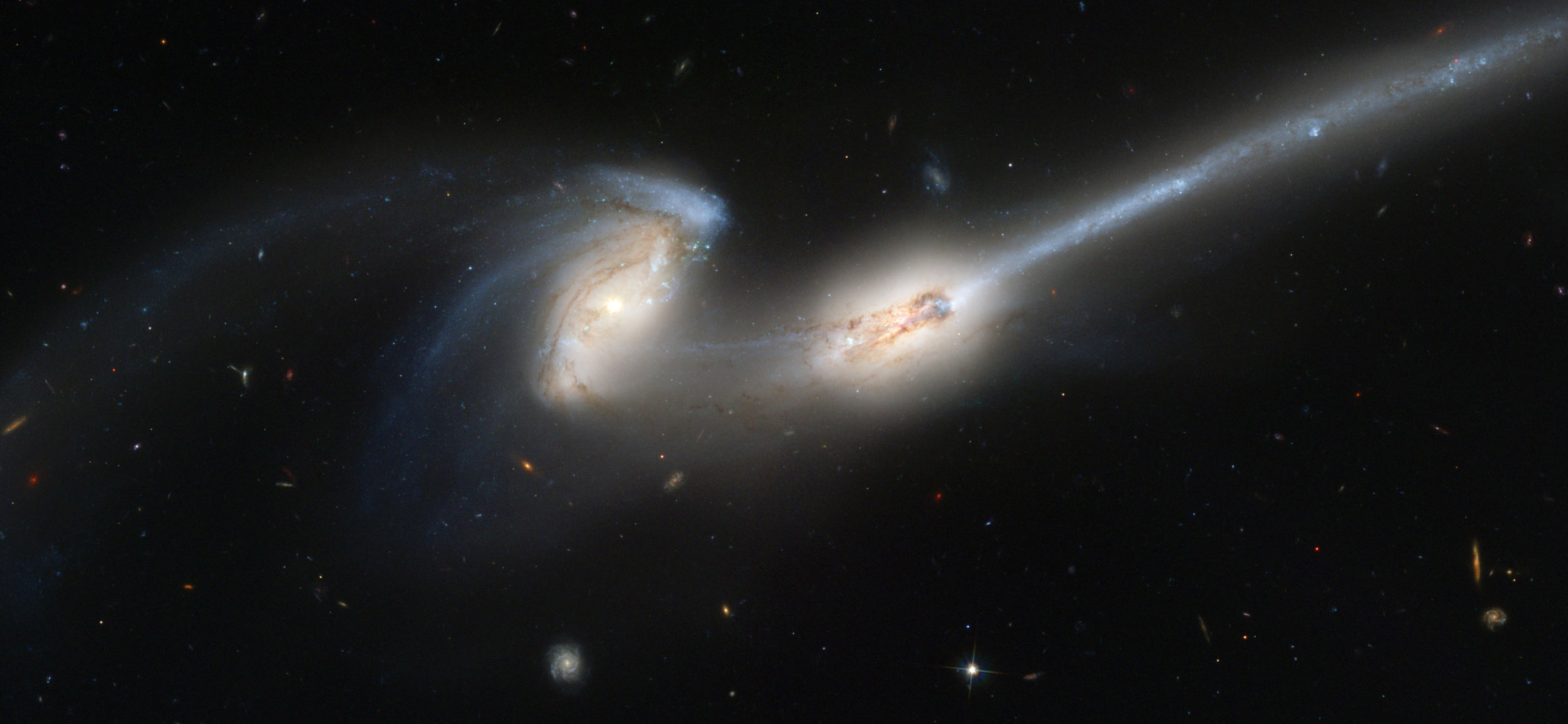
Two galaxies colliding, throwing off tidal tails as they close in. NGC4686 photo courtesy NASA and the Hubble Space Telescope.

Don’t do this at home! Spaghettification by black hole. The intense gravitational gradient near a black hole will stretch a body, be it asteroid or astronaut as they approach a black hole.
 Bob Moler's Ephemeris Blog