Archive
Ephemeris: 05/10/2024 – Earthshine
This is Ephemeris for Friday, May 10th. Today the Sun will be up for 14 hours and 39 minutes, setting at 8:59, and it will rise tomorrow at 6:18. The Moon, 3 days past new, will set at 12:37 tomorrow morning.
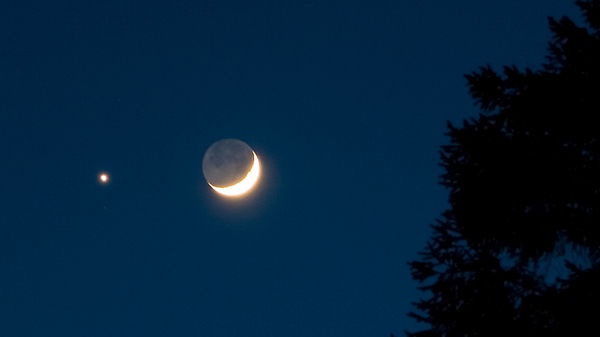
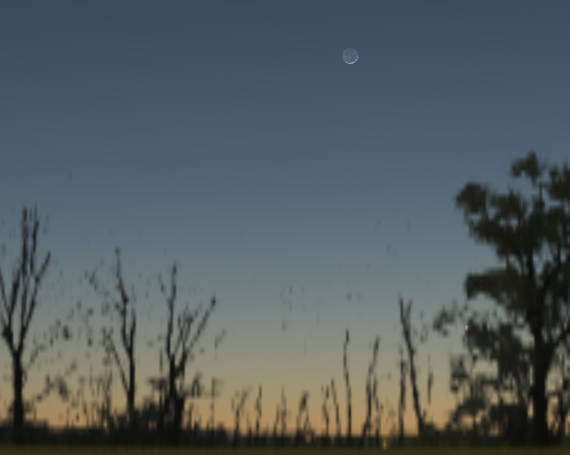
The Moon tonight will appear as a thin sliver, with not much visible on the thin illuminated portion. However, if as you look at the moon tonight you have the funny feeling that the whole moon is visible, you are right. It’s easily confirmed with a pair of binoculars or a small telescope. What is illuminating the dark part of the Moon is earthshine. The Earth is big and bright in the Moon’s sky, and a fat waning gibbous from its vantage point. From the Moon the Earth has the opposite phase that we see of the Moon from the Earth. The effect used to be called by the term “Old moon in the new moon’s arms”. The effect was first explained by Leonardo da Vinci some 500 years ago. The effect will disappear in a few days as the Moon gets brighter and the Earth less so in the Moon’s sky. Earthshine will appear again when the Moon appears as a waning crescent in the morning. But not many of us are up to see it at that hour.
The astronomical event times given are for the Traverse City/Interlochen area of Michigan (EDT, UT–4 hours). They may be different for your location.
Addendum
Ephemeris: 04/19/2024 – Moon bases
This is Ephemeris for Friday, April 19th. Today the Sun will be up for 13 hours and 42 minutes, setting at 8:33, and it will rise tomorrow at 6:49. The Moon, halfway from first quarter to full, will set at 5:39 tomorrow morning.
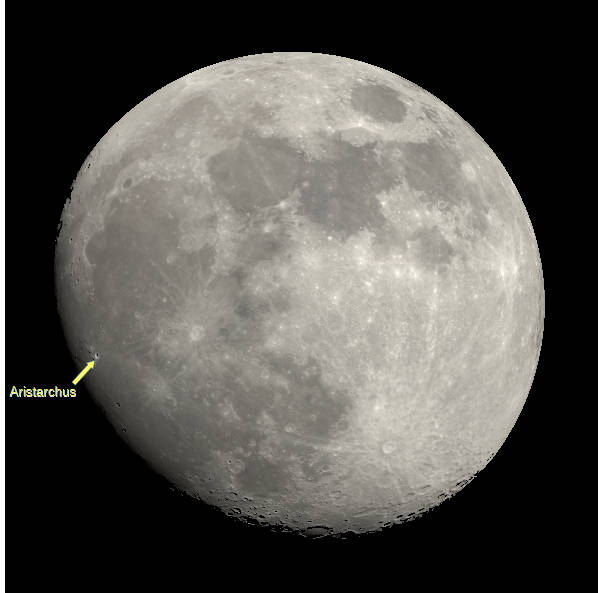
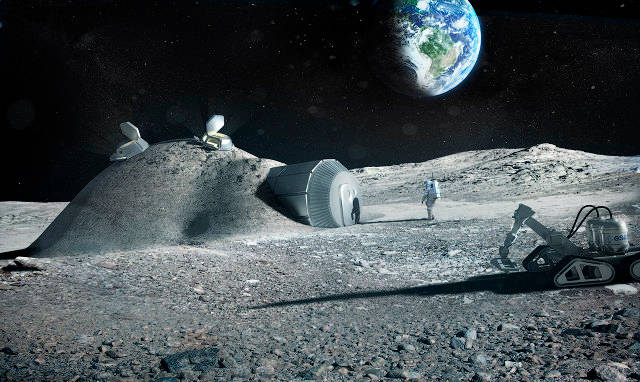
Tomorrow night’s gibbous moon will reveal perhaps the brightest spot on the Moon, the crater Aristarchus. It is left the center of the Moon near the terminator which is the sunrise line. It now doesn’t look so bright, but when the Moon becomes full it will be the brightest spot visible. The problem that astronauts will face in making a Moon base will be to survive the two week long days and two week long nights, because the Moon rotates once in its orbit of the Earth. Perhaps the best way to insulate from the very extremes of temperature, of maybe 200°F in the daytime and minus 200° at night, is to bury the Moon Base structures. The regolith should make a very good insulator and keep the base at a fairly constant temperature.
The astronomical event times given are for the Traverse City/Interlochen area of Michigan (EDT, UT–4 hours). They may be different for your location.
Addendum
Ephemeris: 04/18/2024 – Looking at the gibbous Moon tonight
This is Ephemeris for Thursday, April 18th. Today the Sun will be up for 13 hours and 39 minutes, setting at 8:32, and it will rise tomorrow at 6:50. The Moon, 3 days past first quarter, will set at 5:23 tomorrow morning.
At 10 tonight the gibbous moon will be bright. At the moon’s left edge, just coming into sunlight will be what looks like a large half crater at the edge of the lunar sea called Mare Imbrium, the Sea of Showers. That feature is Sinus Iridium, or Bay of Rainbows. The arc of its mountainous edge is rainbow shaped, but it is as colorless as the rest of the Moon. The crater Copernicus, left of the Moon’s center sports few shadows and appears mostly as a bright spot surrounded by its ray system of ejecta craters that appear bright when the sun is high in their sky. At the south end of the Moon are the lunar highlands, bright, rugged and covered by large, mostly very old craters. The largest of these craters is Clavius, named for Christophorus Clavius who helped establish our Gregorian Calendar.
The astronomical event times given are for the Traverse City/Interlochen area of Michigan (EDT, UT–4 hours). They may be different for your location.
Addendum
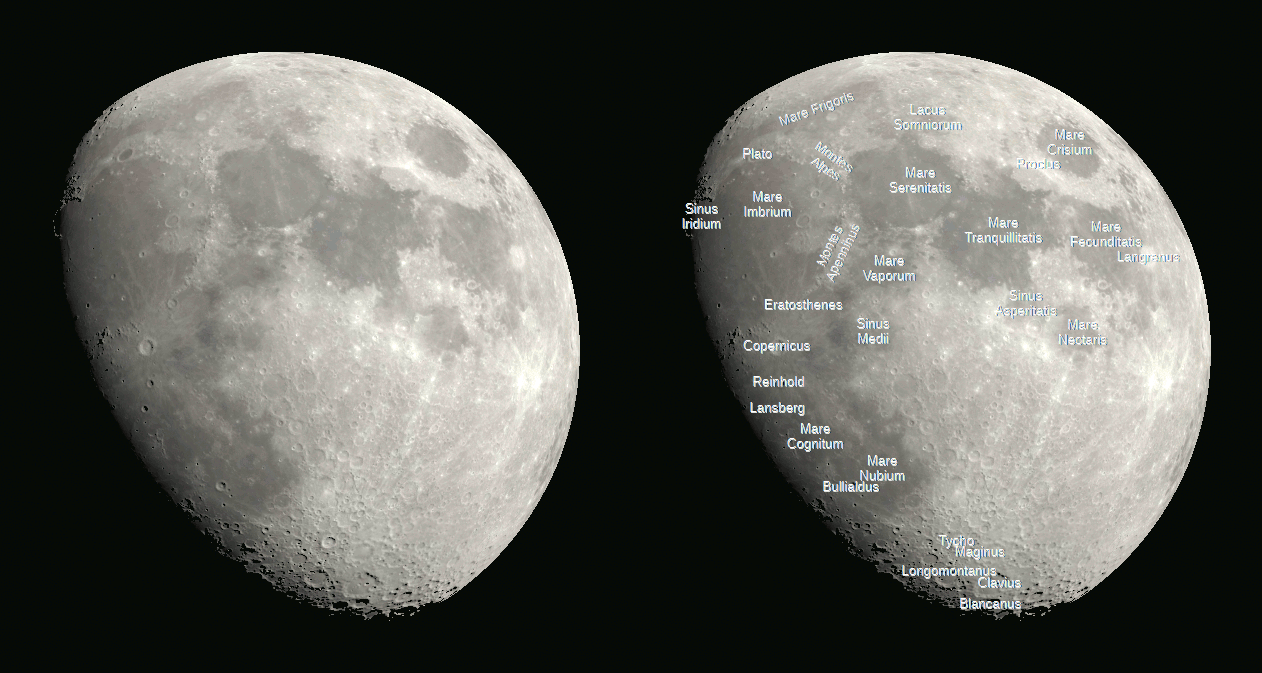
Translations of some lunar feature names according to Virtual Moon Atlas
Lacus Somniorum – Lake of Dreams
Mare Crisium – Sea of Crises
Mare Fecunditatis – Sea of Fertility
Mare Frigoris – Sea of Cold
Mare Imbrium – Sea of Showers
Mare Nectaris – Sea of Nectar
Mare Nubium – Sea of Clouds
Mare Serenitatis – Sea of Serenity
Mare Tranquillitatis – Sea of Tranquility
Mare Vaporum – Sea of Vapors
Montes Alpes – Alps Mountains
Montes Apenninus – Apennines Mountains
Sinus Asperitatis – Bay of Roughness
Sinus Iridium – Bay of Rainbows
Sinus Medii – Bay of the Center
Craters are generally named after astronomers, people of science, or explorers and are often Latinized.
Note that Mare is pronounced Mar-é.
Ephemeris: 04/11/2024 – What is the far side of the Moon good for?
This is Ephemeris for Thursday, April 11th. Today the Sun will be up for 13 hours and 19 minutes, setting at 8:23, and it will rise tomorrow at 7:02. The Moon, 3 days past new, will set at 12:40 tomorrow morning.
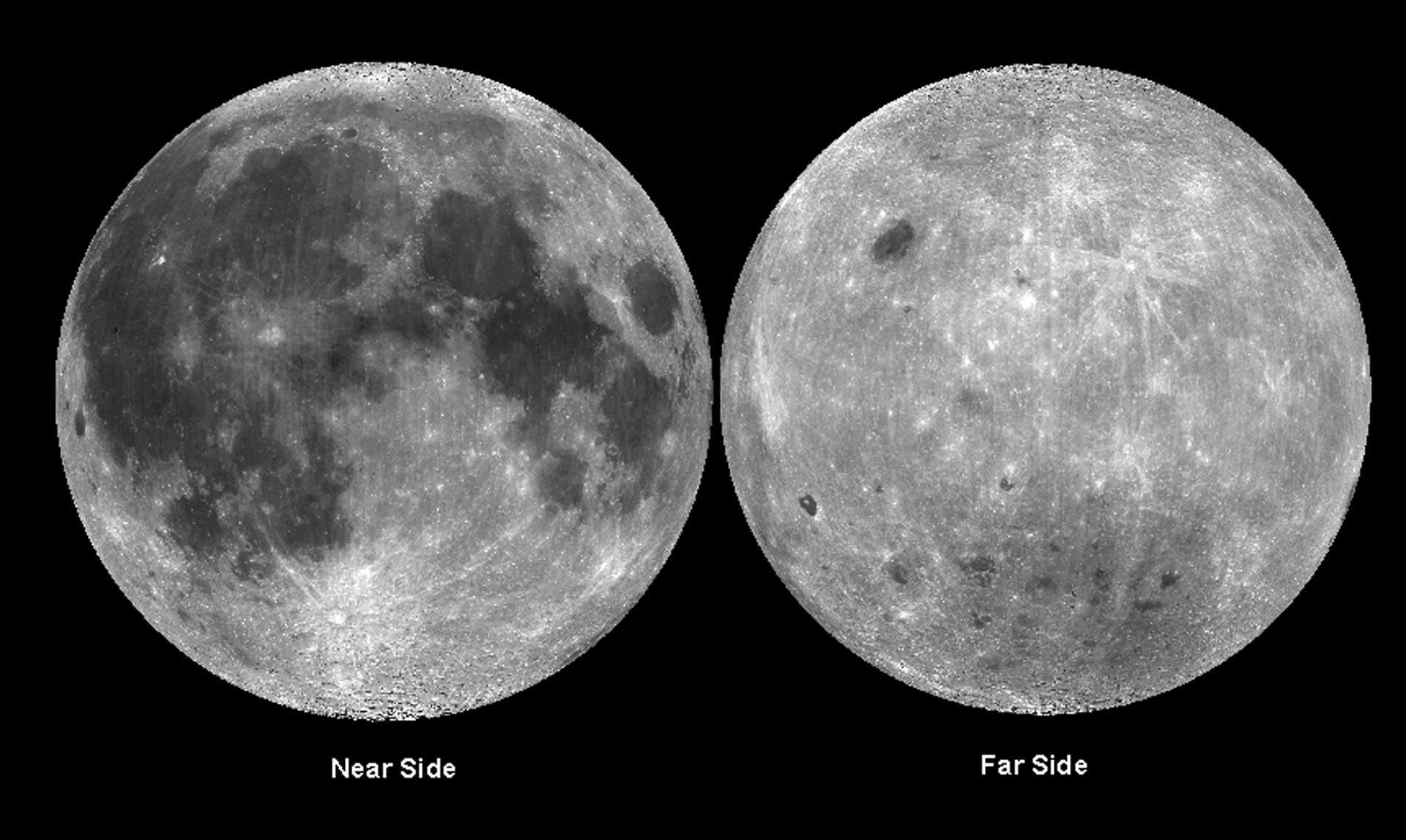
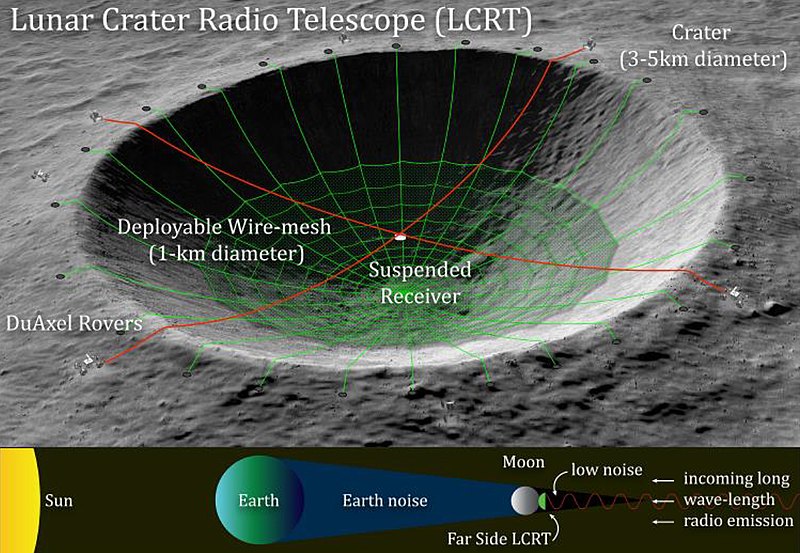
The Last Monday when we were having an eclipse of the Sun, the far side of the Moon was fully illuminated. So it can’t possibly be the dark side of the Moon, not permanently. The dark side of the Moon is the night side and Monday that was the side facing the Earth. But what’s the far side of the Moon good for? The Chinese seem to be very interested in it. They have a lander and a rover on the far side, and they’re going to go back and grab a sample from the far side and bring it back to the Earth. The far side of the Moon is one place in the whole solar system in which the cacophony of radio signals from the Earth cannot be heard so it’s a great place to set up a radio telescope. The craters on the far side of the moon might be used to place a dish antenna.
The astronomical event times given are for the Traverse City/Interlochen area of Michigan (EDT, UT–4 hours). They may be different for your location.
Addendum
Ephemeris: 03/21/2024 – Three lunar craters named for heliocentrists by a geocentrist
This is Ephemeris for Thursday, March 21st. Today the Sun will be up for 12 hours and 14 minutes, setting at 7:57, and it will rise tomorrow at 7:41. The Moon, halfway from first quarter to full, will set at 6:59 tomorrow morning.
The gibbous moon tonight is exhibiting, over the last three days, three craters named for those who promoted the heliocentric or Sun centered solar system. The largest crater of the three, Copernicus, can be seen to the lower left of the center of the Moon. The asteroid that hit it made a big splash, which can be seen in its rays of ejecta being round and full. Then about halfway between it and the terminator is a small crater named for Johannes Kepler, and then nearby and on the terminator tonight is the crater named for the Greek philosopher who first proposed the Sun centered solar system, or in his case the universe, Aristarchus. He was a contemporary of and overshadowed by Aristotle, so his ideas were never adopted.
The astronomical event times given are for the Traverse City/Interlochen area of Michigan (EDT, UT–4 hours). They may be different for your location.
Addendum
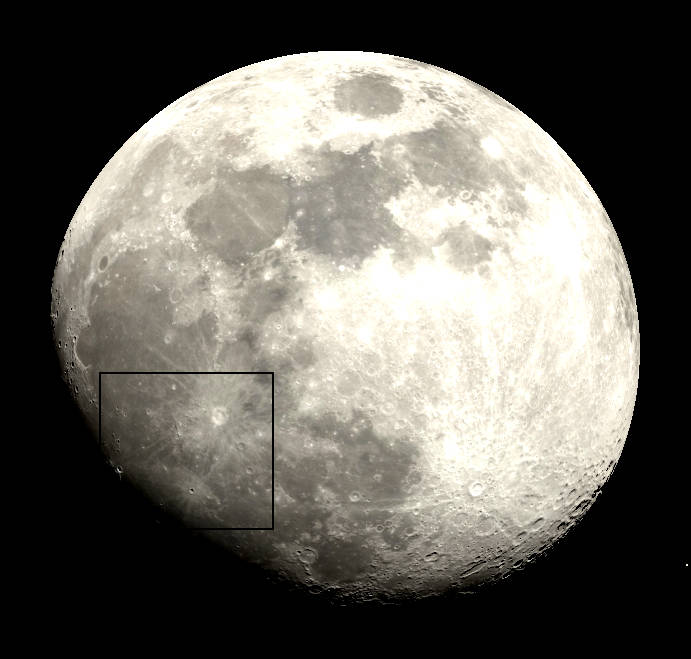
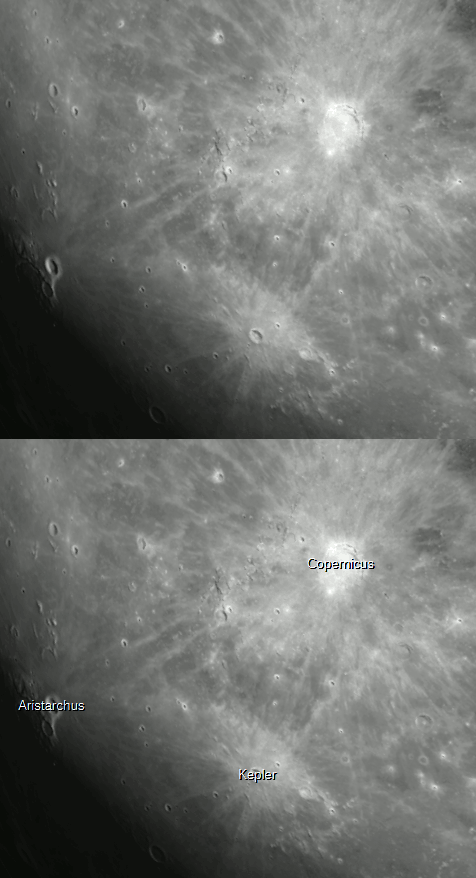
These craters were named by Giovanni Battista Riccioli, an astronomer and Jesuit priest. He established the lunar nomenclature we have today and named many of the largest craters. Being a 17th century Catholic, he bought the Roman Catholic line that the universe was geocentric, that is earth centered, yet he honored these heliocentrists with their own craters. He tended to group crater names by their relationship in life or their ideas, so the three proponents of the Sun centered solar system were given craters near each other in one section of the Moon.

Aristarchus of Samos was a Greek philosopher who lived between 310 and 230 BCE. He proposed a heliocentric solar system or universe, where Earth and all the planets revolved about the Sun. However, the work that he proposed it in has been lost. We know of his idea only referenced in the writings of others who attempted to debunk it.
Copernicus (Mikola Kopernik 1473-1543), was a Polish Catholic Canon, who was a mathematician, astronomer and translator, among other talents. He came up with the theory of the Sun centered or heliocentric solar system or in his day, universe.
Johannes Kepler (1571–1630) was an astronomer, astrologer and mathematician who discovered the laws of planetary motion. While Copernicus kept the circular orbits of the planets, they still didn’t match the motions of the planets in the sky. So he had to add some epicycles to make it all work. He actually had more epicycles than Ptolemy had. Kepler was able to figure out that he didn’t need epicycles if he assumed that the orbits were elliptical. He developed his Three Laws of Planetary Motion.
Galileo also has a crater there (Galilaei). It’s a tiny crater right on the terminator, below Kepler in the images above, and not visible. The Virtual Moon Atlas does not give an origin of the naming of the crater. Back in 1651, when Riccioli was giving craters names, Galileo was still on the outs with the Vatican, and the church.
Ephemeris: 03/11/2024 – The Moon and the month
This is Ephemeris for Monday, March 11th. Today the Sun will be up for 11 hours and 43 minutes, setting at 7:44, and it will rise tomorrow at 7:59. The Moon, 1 day past new, will set at 9:44 this evening.
Tonight’s one-day old moon can be seen in the West shortly after sunset. Astrophysicist Dr. Rebecca Smethurst has a channel on YouTube under the name Dr. Becky. She calls it a toenail moon, because it looks like a toenail clipping. If you look real close, the rest of the Moon may be there. It’s not your eyes playing tricks on you, it’s the Earth shining on the Moon, illuminating the night side of it. For those using lunar calendars this would be day one or two of the lunar month. Since astronomically the Moon was new at 4 am yesterday morning our time. Folks in Europe and Asia may have seen the Moon in the sky last night. The Islamic lunar calendar requires the actual sighting of the new moon to start the month.
The astronomical event times given are for the Traverse City/Interlochen area of Michigan (EST, UT –5 hours). They may be different for your location.
Addendum
A note: being a leap year I will have more than my normal amount of posts about the calendar and problems with the calendar.
Ephemeris: 02/23/2024 – The rabbit in the Moon
This is Bob Moler with Ephemeris for Friday, February 23rd. Today the Sun will be up for 10 hours and 50 minutes, setting at 6:21, and it will rise tomorrow at 7:29. The Moon, 1 day before full, will set at 7:52 tomorrow morning.
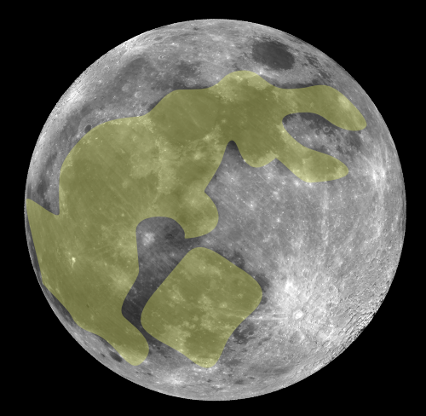
Even though it is a day before full the moon, will be full at 7:30 tomorrow morning. So tonight will be the closest that we’ll see the full moon this lunation. If one looks at the Moon most of us can see the face of the Man in the Moon. A rabbit, can also be seen. To the Chinese the rabbit here was named Yutu also known as the Jade Rabbit, the pet of the moon goddess Chang’e. To them, it was a rabbit pounding medicine with a mortar and pestle. At 8 o’clock tonight it resides along the left side of the Moon. Its head and body are seen in the dark areas of the Moon we call seas. Its ears are near the top of the moon at 8:00 with his head and body bent down on the left. Near the bottom of The moon is the mortar and pestle with which he’s pounding medicine.
The astronomical event times given are for the Traverse City/Interlochen area of Michigan (EST, UT –5 hours). They may be different for your location.
Addendum:
Ephemeris: 02/22/2024 – IM-1, the Odysseus spacecraft lunar landing is today
This is Bob Moler with Ephemeris for Thursday, February 22nd. Today the Sun will be up for 10 hours and 47 minutes, setting at 6:20, and it will rise tomorrow at 7:31. The Moon, 2 days before full, will set at 7:32 tomorrow morning.
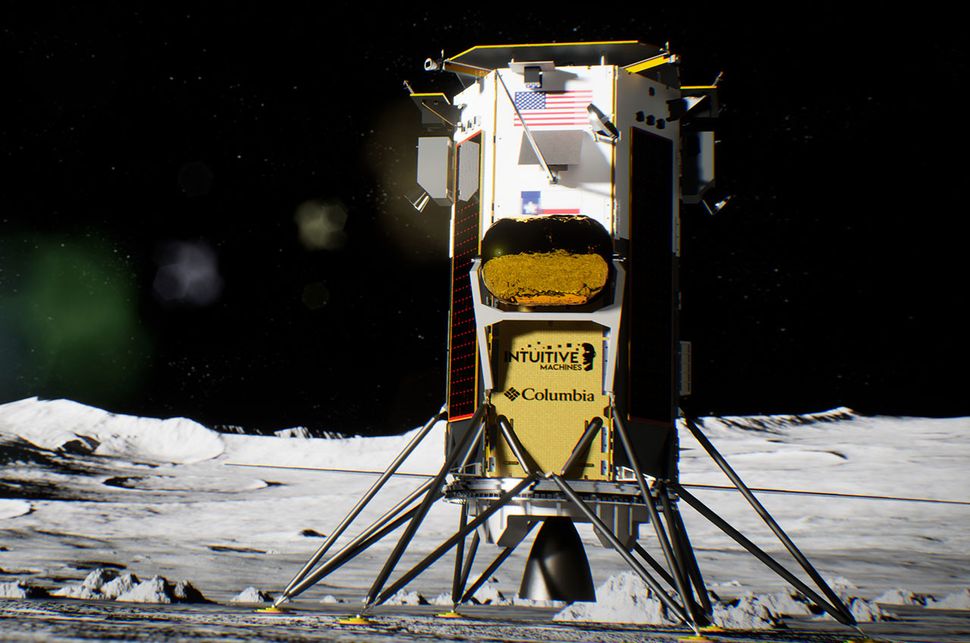
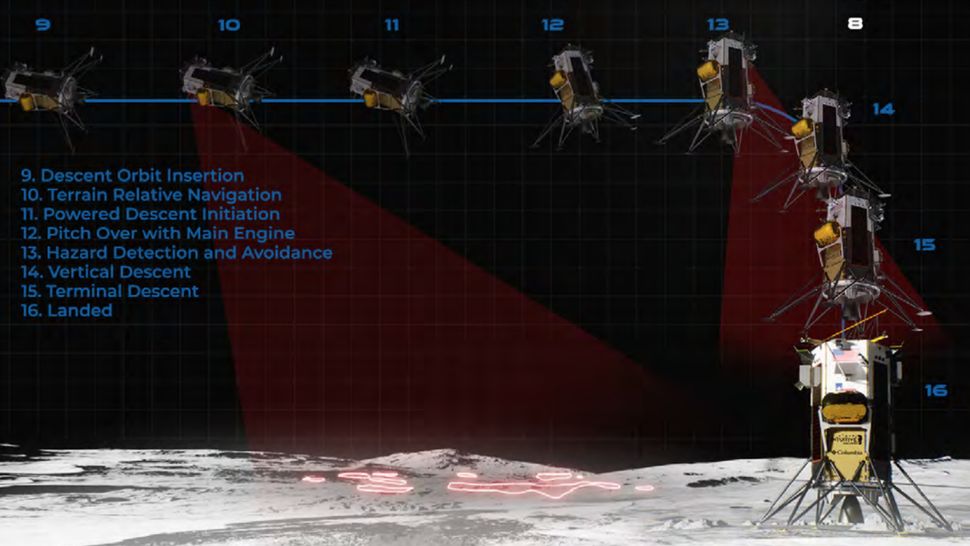
Today is the day the Intuitive Machines’ moon lander called Odysseus is slated to land on the Moon. It was launched a week ago on a SpaceX Falcon 9 rocket. And if successful it will be the first soft landing on the Moon by the United States since Apollo 17 back in 1972. I’m recording this last Sunday, so I don’t know the condition of the spacecraft and a lot can happen between launch and landing on the moon. The last spacecraft sent from the United States, last month, by the inaugural flight of United Launch Alliance’s Vulcan Centaur rocket crashed back on Earth. The spacecraft is supposed to land about 190 miles from the Moon’s South Pole, which is considerably closer to the South Pole than the Indian spacecraft landed last year.
The astronomical event times given are for the Traverse City/Interlochen area of Michigan (EST, UT –5 hours). They may be different for your location.
Addendum
Ephemeris: 02/20/2024 – Schiller, an odd lunar crater
This is Ephemeris for Tuesday, February 20th. Today the Sun will be up for 10 hours and 41 minutes, setting at 6:17, and it will rise tomorrow at 7:34. The Moon, halfway from first quarter to full, will set at 6:39 tomorrow morning.
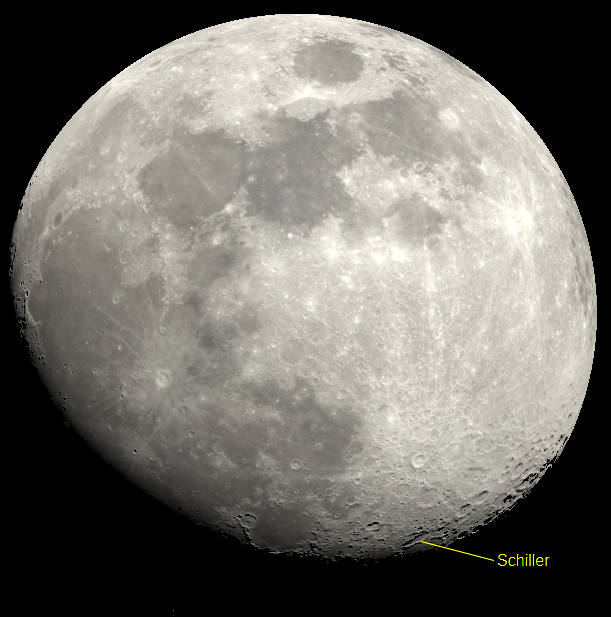
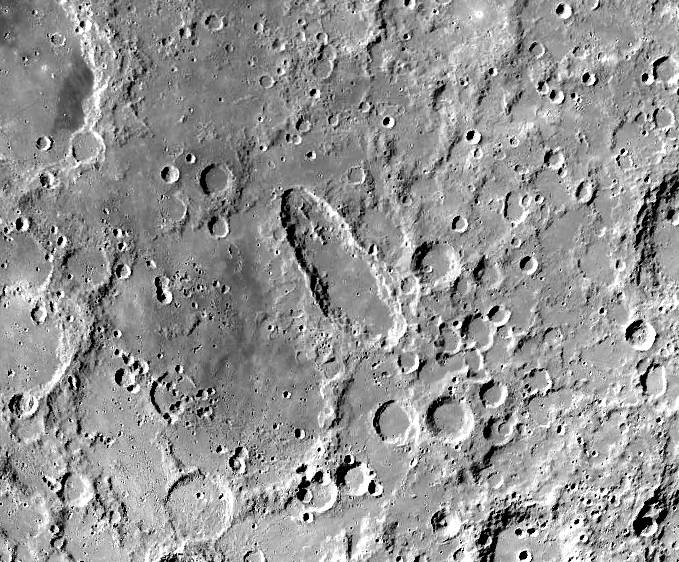
The moon tonight is in its gibbous phase, with more than half of it being illuminated by the Sun. In binoculars or a small telescope, looking at the bottom part of the moon, near the South Pole. All the craters appear to be elongated, foreshortened actually, because the moon is spherical. But one crater stands out as being more elliptical than the rest it’s called Schiller. It’s about 111 miles long, and much less in the other direction. It still appears elongated when seen from overhead by a spacecraft. It looks like the footprint of a long narrow shoe. It is either the result of a low angle hit from the asteroid or two overlapping low angle asteroid craters. I suspect the latter, though I have no expertise in the matter.
The astronomical event times given are for the Traverse City/Interlochen area of Michigan (EST, UT –5 hours). They may be different for your location.
Addendum
Ephemeris: 02/15/2024 – Viewing the Moon tonight
This is Ephemeris for Thursday, February 15th. Today the Sun will be up for 10 hours and 26 minutes, setting at 6:10, and it will rise tomorrow at 7:42. The Moon, 1 day before first quarter, will set at 1:48 tomorrow morning.
Let’s look at the Moon again this evening. The moving terminator or sunrise line on the Moon has moved westward, though it looks like eastward to us. It shows Mare Crisium, or Sea of Crises, near the Moon’s edge, which is surrounded by the bright highlands, and to the left and below is the Sea of Fertility. Above that is Mare Tranquillitatis, where the Apollo 11 spacecraft Eagle landed, and below Tranquility are two small dark areas that look like seas, but only the bottom one is, it’s the Sea of Nectar, Mare Nectaris. Between it and Tranquility is the Bay of Roughness or Sinus Asperitatis, which sounds better in the original Latin.
The astronomical event times given are for the Traverse City/Interlochen area of Michigan (EST, UT –5 hours). They may be different for your location.
Addendum
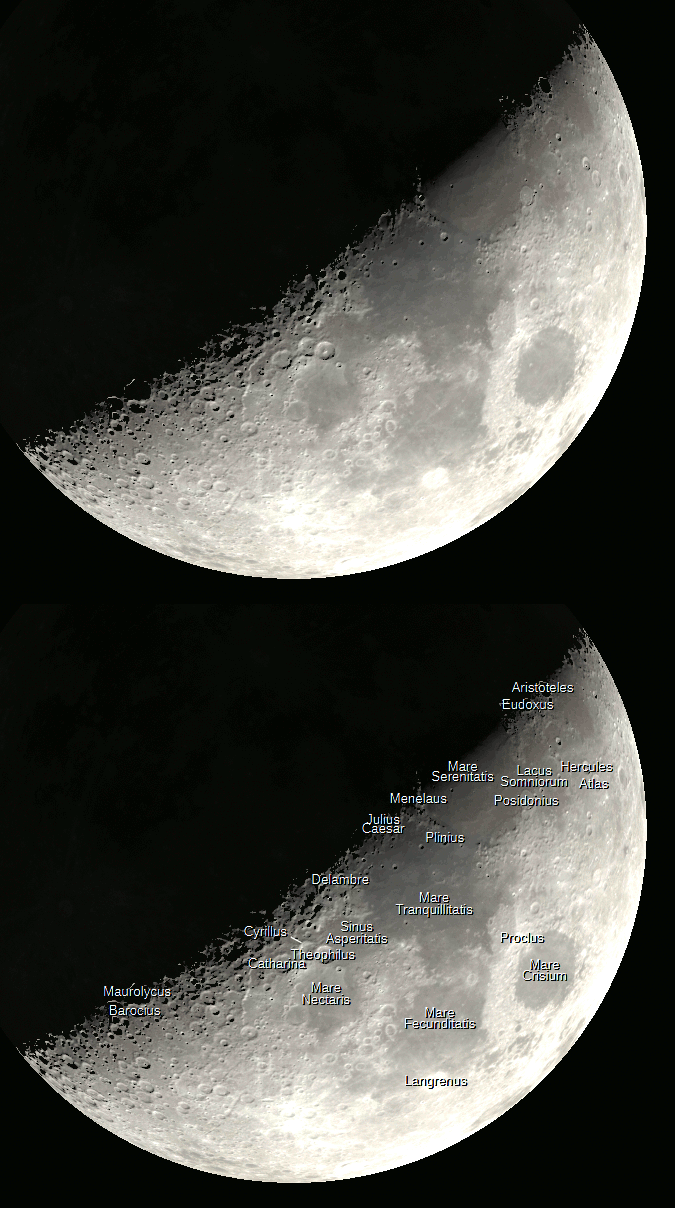
Translations of some lunar feature names according to Virtual Moon Atlas
Lacus Somniorum – Lake of Dreams
Mare Crisium – Sea of Crises
Mare Fecunditatis – Sea of Fertility
Mare Nectaris – Sea of Nectar
Mare Serenitatis – Sea of Serenity
Mare Tranquillitatis – Sea of Tranquility
Sinus Asperitatis – Bay of Roughness
 Bob Moler's Ephemeris Blog