Archive
Ephemeris: 07/27/2023 – See the Moon’s Bay of Rainbows at sunrise
This is Bob Moler with Ephemeris for Thursday, July 27th. Today the Sun will be up for 14 hours and 51 minutes, setting at 9:14, and it will rise tomorrow at 6:24. The Moon, 2 days past first quarter, will set at 1:38 tomorrow morning.
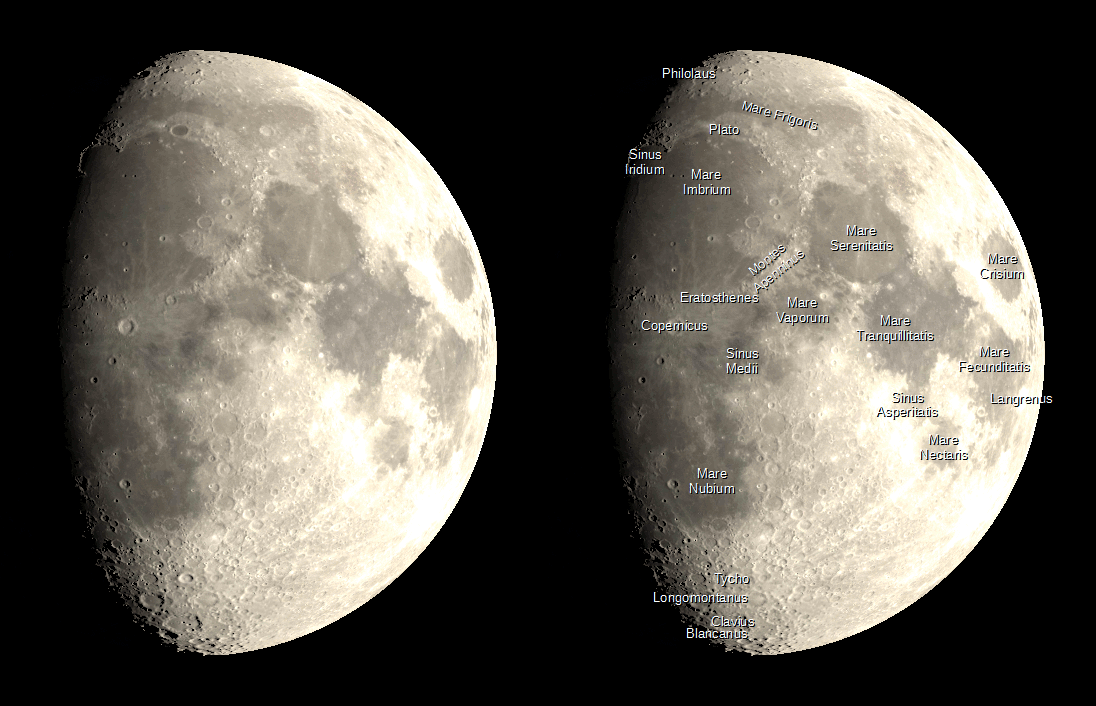
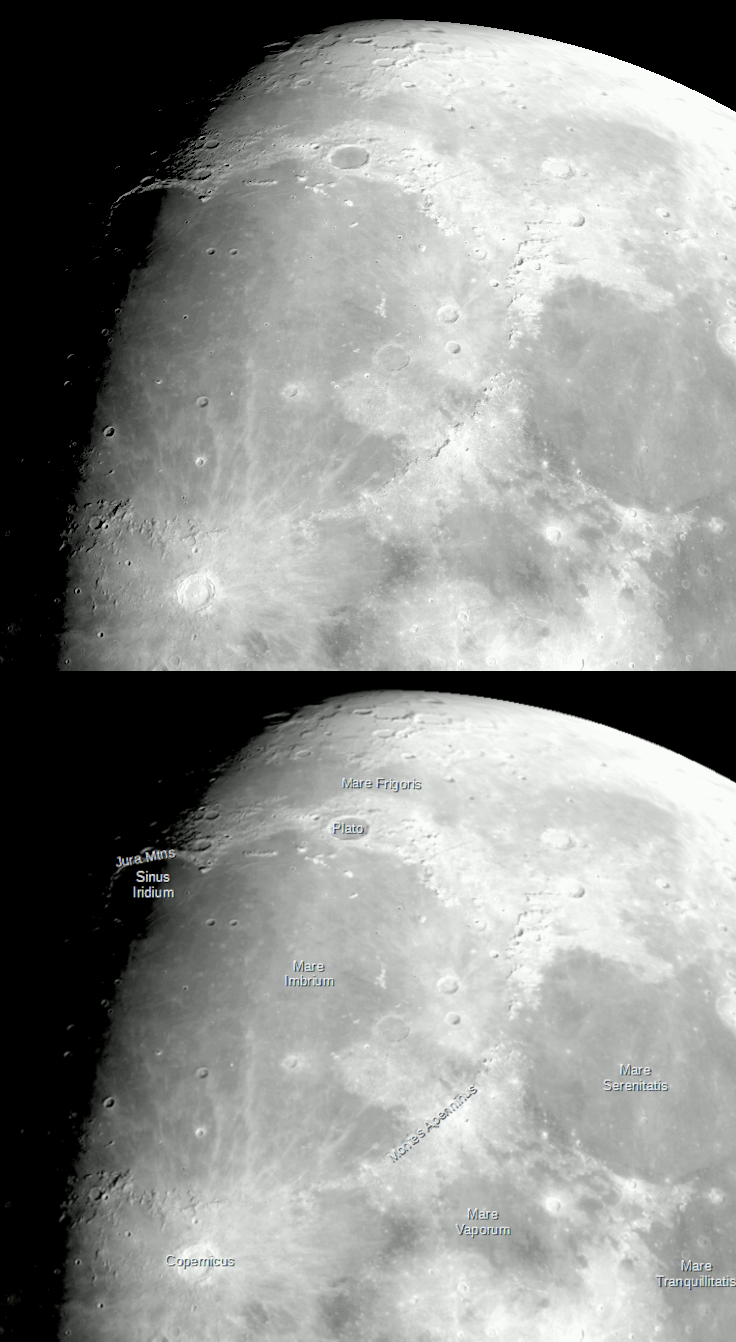
The moon tonight is a waxing gibbous phase, so it’s more than half illuminated by the Sun. The line between light and dark on the left side of the Moon is called the terminator, which before full is the sunrise line. It is where we can see the greatest detail because the Sun is low in the Moon’s sky there, and creates the longest shadows. Compare it to the right side of the Moon which is seen at nearly solar noon where no shadows are seen, so it has a very bland appearance. One of the cool features of the gibbous moon tonight is Sinus Iridium, the Bay of Rainbows, which is on the upper left part of the terminator. Part of the mountain range that partially rings it is seen in sunlight, while that floor of the bay is still in shadow.
The astronomical event times given are for the Traverse City/Interlochen area of Michigan (EDT, UT –4 hours). They may be different for your location.
Addendum
Ephemeris: 07/24/2023 – The Moon appears to wobble a bit
This is Ephemeris for Monday, July 24th. Today the Sun will be up for 14 hours and 57 minutes, setting at 9:17, and it will rise tomorrow at 6:21. The Moon, 1 day before first quarter, will set at 12:24 tomorrow morning.
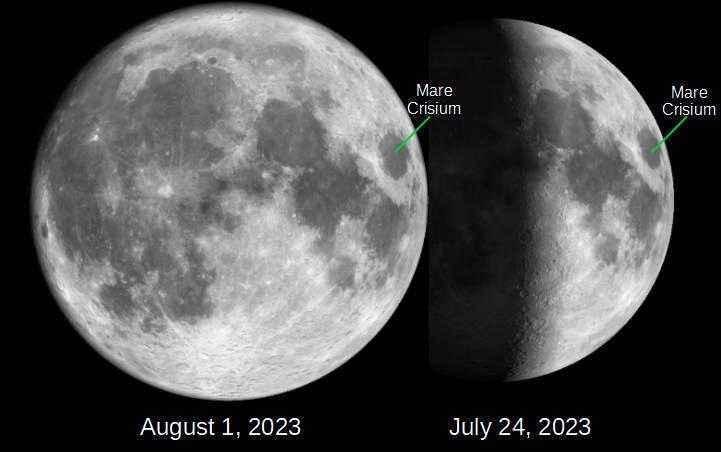
The Moon tonight is nearly half illuminated. In binoculars the dark oval spot visible on the Moon’s right edge is the Sea of Crises or Mare Crisium a small dark lava plain. The Moon’s rotation is quite uniform, however its orbit isn’t circular, so the Moon’s motion in its orbit slows as it moves farthest from the Earth, called apogee, and is sped up when closest, at perigee, So its face seems to rock a bit back and forth over the month. It’s an effect called libration. And one way to track that is to note how close the Mare Crisium (Sea of Crises) is to the edge of the Moon. It appears close to the right edge now. A week from now, that sea will appear to move away from the edge. Unfortunately, by then the Moon will be full, and night will soon fall on that little sea.
The astronomical event times given are for the Traverse City/Interlochen area of Michigan (EDT, UT –4 hours). They may be different for your location.
Addendum
06/26/2023 – Ephemeris – After the latest sunset, a look at the Moon
This is Ephemeris for Monday, June 26th. Today the Sun will be up for 15 hours and 33 minutes, setting at 9:32, and it will rise tomorrow at 5:59. The Moon, at first quarter today, will set at 2:02 tomorrow morning.
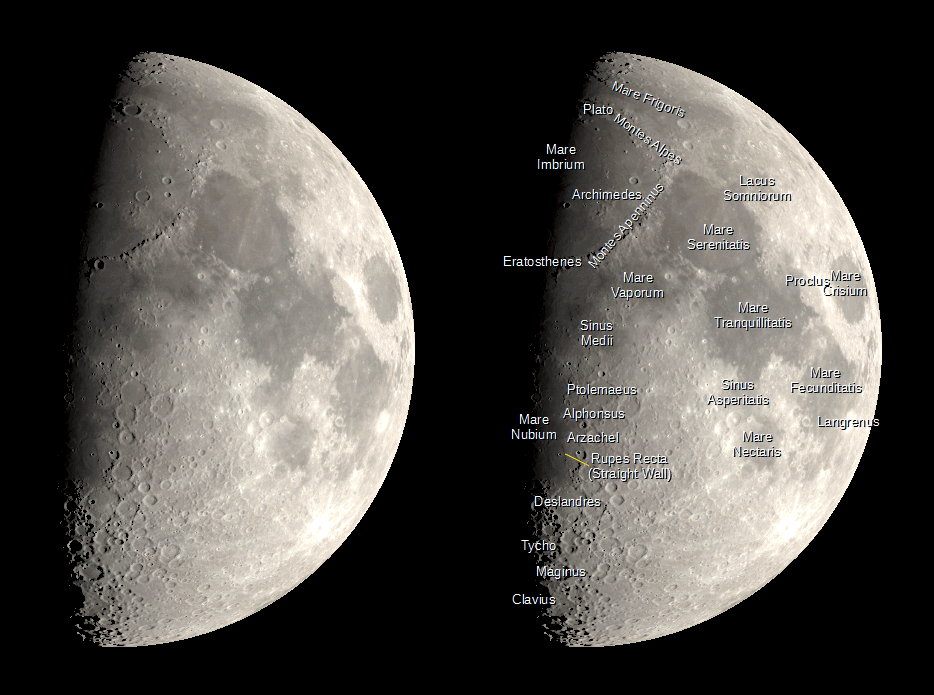
Tonight is the night of the latest sunset. From now to December 10th the Sun will be setting earlier than the night before. It won’t be noticeable at first, but the change will increase throughout the summer. The Moon actually arrived at first quarter phase early this morning, so by tonight it will appear slightly gibbous. The term gibbous actually means hump-backed, and the Moon will appear more so as it advances toward being fully illuminated a week from now. For me personally, I find that the best time to view the Moon with a telescope is within three or four days from its quarter phase, unless I’m looking at a specific feature. That’s when shadows are front and center on the moon. The Moon being gray on gray, shadows keep the Moon from appearing flat.
The astronomical event times given are for the Traverse City/Interlochen area of Michigan (EDT, UT –4 hours). They may be different for your location.
Addendum
06/22/2023 – Ephemeris – The lunar seas on tonight’s Moon
This is Ephemeris for Thursday, June 22nd. Today the Sun will be up for 15 hours and 34 minutes, setting at 9:32, and it will rise tomorrow at 5:57. The Moon, halfway from new to first quarter, will set at 12:51 tomorrow morning.
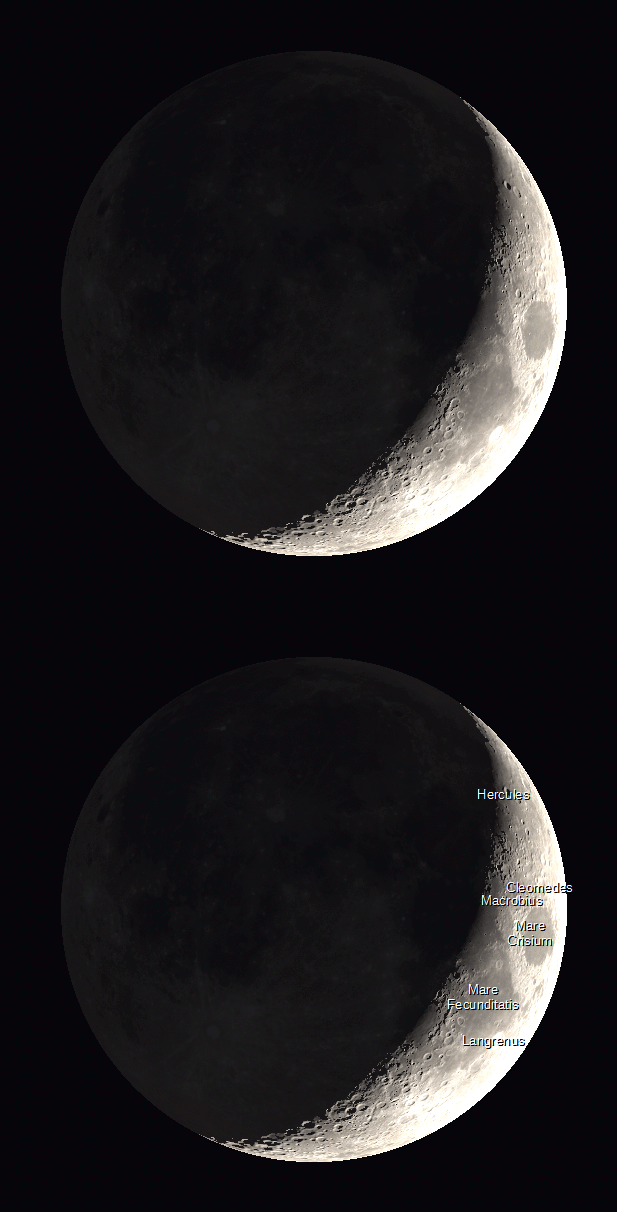
The crescent Moon tonight reveals two large seas. Astronomers using the first telescopes thought the darker flat areas on the moon may actually be filled with water. It turns out that they are flat lava plains, and since most of them are roughly circular, may be gigantic craters from impacts of asteroids. Examination of rocks brought back by the Apollo astronauts over 50 years ago suggest the age of the seas at around 4 billion years. This suggests some kind of disruption in the solar system, called the Late Heavy Bombardment. The reason the Earth does not have these scars is due to plate tectonics and the weathering of wind and water. The Moon has none of these, so it preserves the damage done to it.
The astronomical event times given are for the Traverse City/Interlochen area of Michigan (EDT, UT –4 hours). They may be different for your location.
Addendum
Late Heavy Bombardment (Based on my August 4, 2022 post)
There are even more and larger seas on the east half of the Moon, as we see it. Most were created about 3.9 billion years ago by asteroid strikes. The same thing happened to the Earth, but plate tectonics destroyed the evidence. Not so on the Moon. The result, many planetary scientists think, was the Late Heavy Bombardment, caused by the shifting orbits of mainly Saturn, Uranus and Neptune that disrupted the smaller asteroids, and sending them careening through the solar system.
05/29/2023 – Ephemeris – Sinus Iridium, a hook into night
This is Bob Moler with Ephemeris for Memorial Day, Monday, May 29th. Today the Sun will be up for 15 hours and 16 minutes, setting at 9:18, and it will rise tomorrow at 6:01. The Moon, 2 days past first quarter, will set at 3:41 tomorrow morning.
Let’s look at the Moon tonight. One of my favorite formations is coming into light. It is called Sinus Iridium or Bay of Rainbows. Sorry, there’s no color here. But if caught at right time, and tonight’s the night, this ruined crater will appear as a hook out into night off the upper left edge of the moon. Officially it’s a bay to the Sea of Showers or Mare Imbrium. The north edge of the bay are mountains called the Jura Mountains. The south edge disappears into Mare Imbrium. The floor of the Sinus Iridium is about twelve hundred feet lower than Mare Imbrium. The transition is gradual because it isn’t very noticeable. The formation is large enough to be seen in binoculars. Sinus Iridium is 242 miles wide, a good tenth the diameter of the Moon itself.
The astronomical event times given are for the Traverse City/Interlochen area of Michigan (EDT, UT –4 hours). They may be different for your location.
Addendum
05/26/2023 – Ephemeris – Sun & Star Party tomorrow at the Sleeping Bear Dunes National Lakeshore
This is Bob Moler with Ephemeris for Friday, May 26th. Today the Sun will be up for 15 hours and 11 minutes, setting at 9:15, and it will rise tomorrow at 6:03. The Moon, 1 day before first quarter, will set at 2:48 tomorrow morning.
Tomorrow, the Sleeping Bear Dunes National Lakeshore and the Grand Traverse Astronomical Society will host a Sun and Star Party at the Dune Climb area of the park. There will be a solar viewing period from 5 pm to about 7 pm. The society has two hydrogen alpha solar telescopes to view the Sun’s chromosphere and prominences. Plus, some members also have solar scopes and white light filtered telescopes to view sunspots on the face of the Sun. Night viewing will start at 9 pm, with the Moon and Venus featured, along with the brighter telescopic wonders of late spring. There will be a pass of the International Space Station from 10:11 to 10:18 pm. The rangers will have an alternate program if it’s cloudy.
The astronomical event times given are for the Traverse City/Interlochen area of Michigan (EDT, UT –4 hours). They may be different for your location.
Addendum
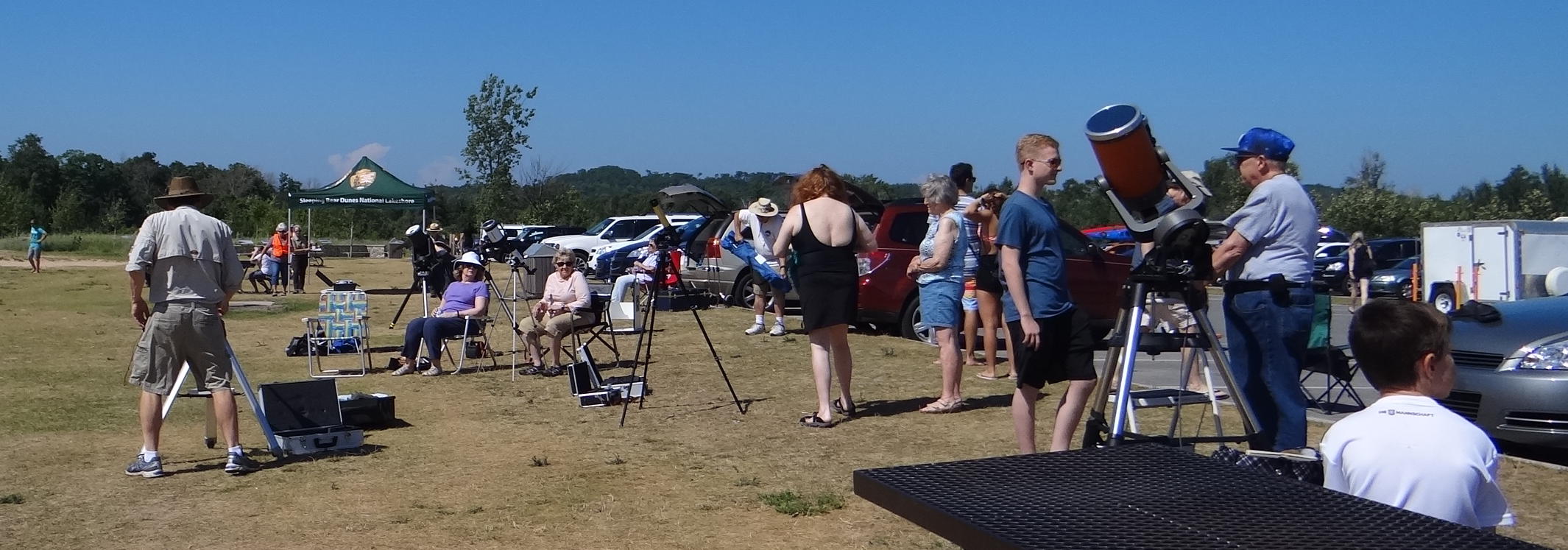
A Sun Party at the Dune Climb. Credit: Eileen Carlisle.
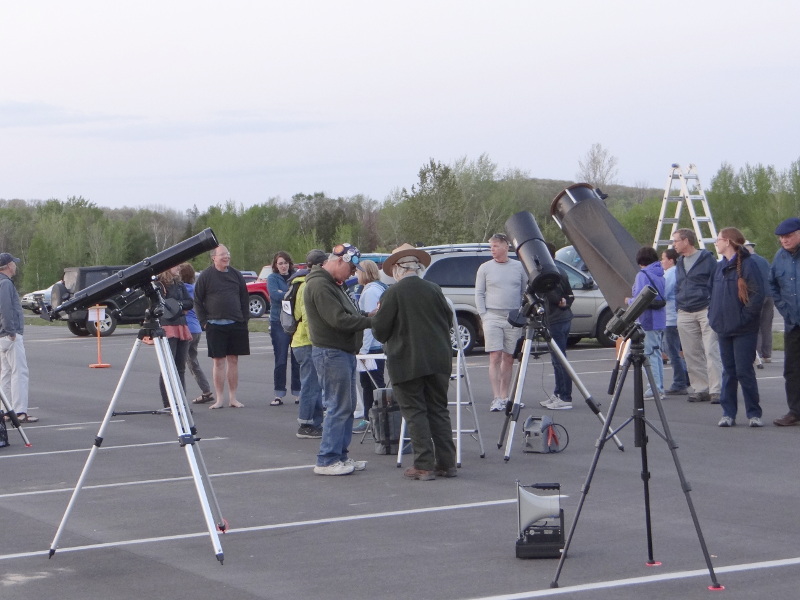
Preparing to start the May star party, several years ago at the Dune Climb. A few of the telescopes are visible, including the GTAS 25″ “Emmettron” telescope at the far right background. Credit: Eileen Carlisle.
05/25/2023 – Ephemeris – NASA awards contracts for a second lunar lander
This is Ephemeris for Thursday, May 25th. Today the Sun will be up for 15 hours and 9 minutes, setting at 9:14, and it will rise tomorrow at 6:04. The Moon, 2 days before first quarter, will set at 2:26 tomorrow morning.
A week ago, NASA announced that the contract for the second Artemis moon lander would go to a group of companies headed by Blue Origin for 3.4 billion dollars. Unlike Apollo, the rocket that sens crews to the Moon will not contain a moon landing craft. It will be sent out separately before the crew. SpaceX’s Lunar Starship will be used on the first two landings, for Artemis III and IV, while the Blue Origin lander will be used for Artemis V, sometime around 2029 or later. Little detail has been released about the lander, except for an artist’s rendering. It appears to be shorter than the Boeing lander first proposed, which would require an astronaut to climb up and down a very long ladder. SpaceX’s Starship would be taller still, but will have an elevator on the side.
The astronomical event times given are for the Traverse City/Interlochen area of Michigan (EDT, UT –4 hours). They may be different for your location.
Addendum
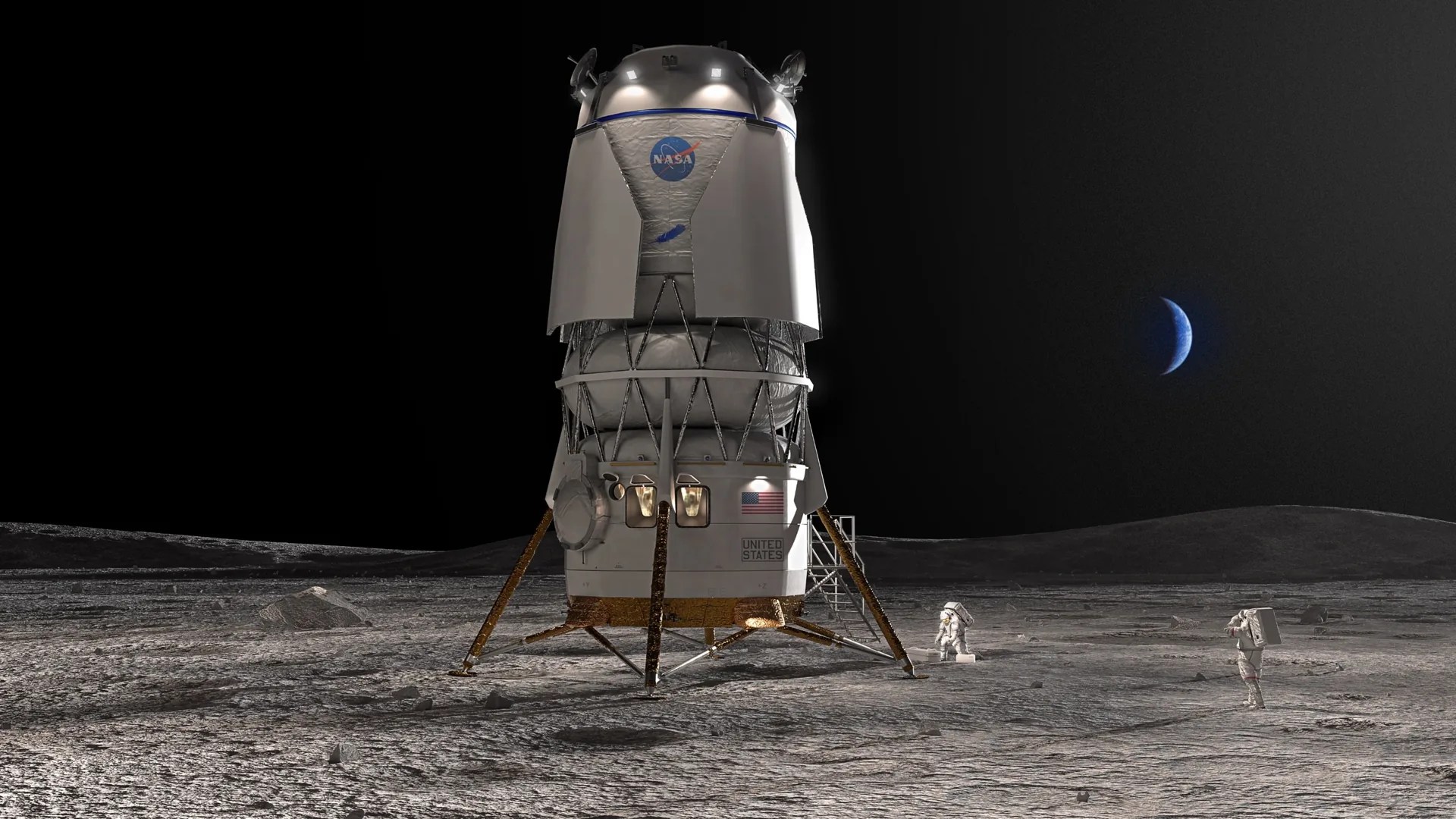
NASA picks Bezos’ Blue Origin to build second lunar lander. The crew compartment is on the bottom, allowing for a shorter ladder to the surface. The liquid oxygen (LOX) and hydrogen (LH) tanks are on top. The LH tank is on top with sun shields, with the LOX tank below. I’m guessing here, since very little information has been released. Credit: NASA.
The craft is officially known as the Human Landing System (HLS).
05/23/2023 – Ephemeris – Let’s observe the four-day-old Moon
This is Bob Moler with Ephemeris for Tuesday, May 23rd. Today the Sun will be up for 15 hours and 5 minutes, setting at 9:12, and it will rise tomorrow at 6:06. The Moon, halfway from new to first quarter, will set at 1:25 tomorrow morning.
The four-day-old Moon has uncovered a sea below Mare Crisium or Sea of Crises. It’s Mare Fecunditatis, or the Sea of Fertility. It appears to have been created in the first period of the Moon’s history from 4.55 billion years to 3.92 billion years ago, called the pre- Nectarian geological period, while Mare Crisium is a bit younger, from 3.92 to 3.85 billion years ago, the Nectarian period. Both periods were named for Mare Nectaris, or Sea of Nectar, a small sea next to the Sea of Fertility just coming into sunlight. There are two small, but remarkable craters in the Sea of Fertility called Messier and Messier A which appear to be the result of a double asteroid impact, where it looks like the Moon was struck at a low angle, sending debris out in one direction.
The astronomical event times given are for the Traverse City/Interlochen area of Michigan (EDT, UT –4 hours). They may be different for your location.
Addendum
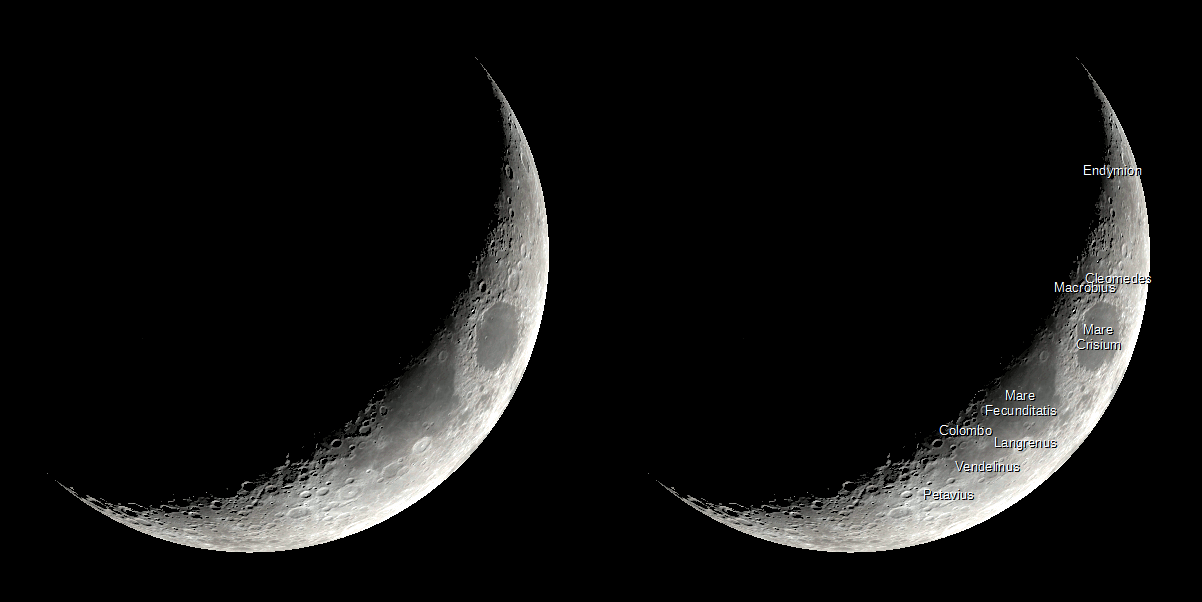
4 day old Moon with selected features labeled for May 23, 2023, at 10 pm. Created using Stellarium, LibreOffice Draw and GIMP.
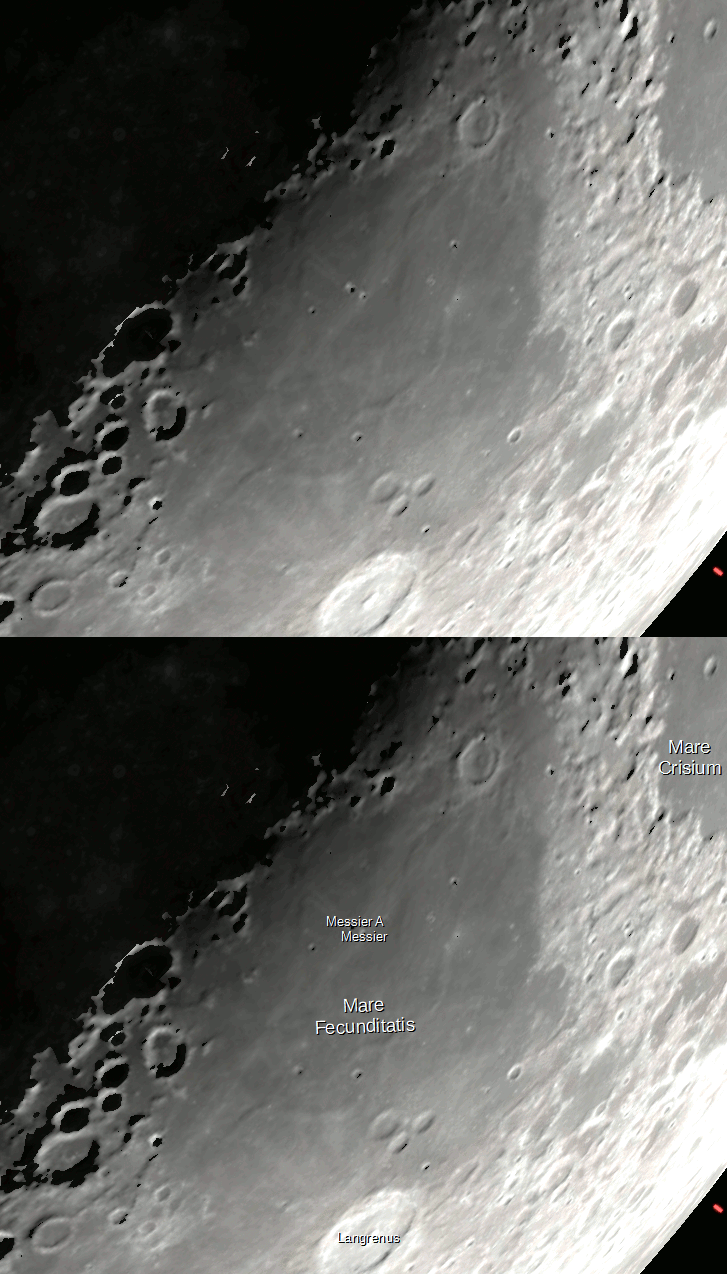
Mare Fecunditatis, 4 day old Moon with the 2 Messier craters labeled. Created using Stellarium, LibreOffice Draw and GIMP.
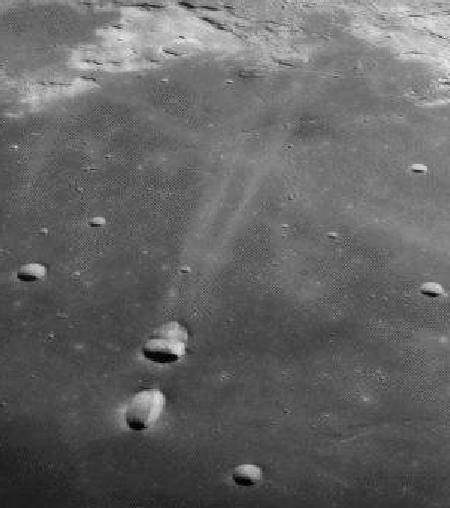
Messier craters from the Apollo astronauts. Credit NASA.
05/22/2023 – Ephemeris – Exploring the three-day-old Moon
This is Ephemeris for Monday, May 22nd. Today the Sun will be up for 15 hours and 4 minutes, setting at 9:11, and it will rise tomorrow at 6:06. The Moon, 3 days past new, will set at 12:43 tomorrow morning.
Tonight we will see the three-day-old moon low in the west. It may exhibit earthshine. That is, its night side will be illuminated by the Earth’s day side. Just as the earthly night is illuminated by moonlight, especially when the Moon is near full, the night side of the Moon, when near new, is illuminated by earthlight. In binoculars or telescope, the large dark spot, on the Moon’s right edge, is Mare Crisium, or Sea of Crises. The large crater below and a bit left of that sea is Langrenus, named after a 17th century Belgian engineer and mathematician who produced the first lunar map with nomenclature. Langrenus appears as a bright spot as the Sun rises higher for it. Also check out the south end of the cusp of the crescent for a lone mountain peak catching the Sun.
The astronomical event times given are for the Traverse City/Interlochen area of Michigan (EDT, UT –4 hours). They may be different for your location.
Addendum
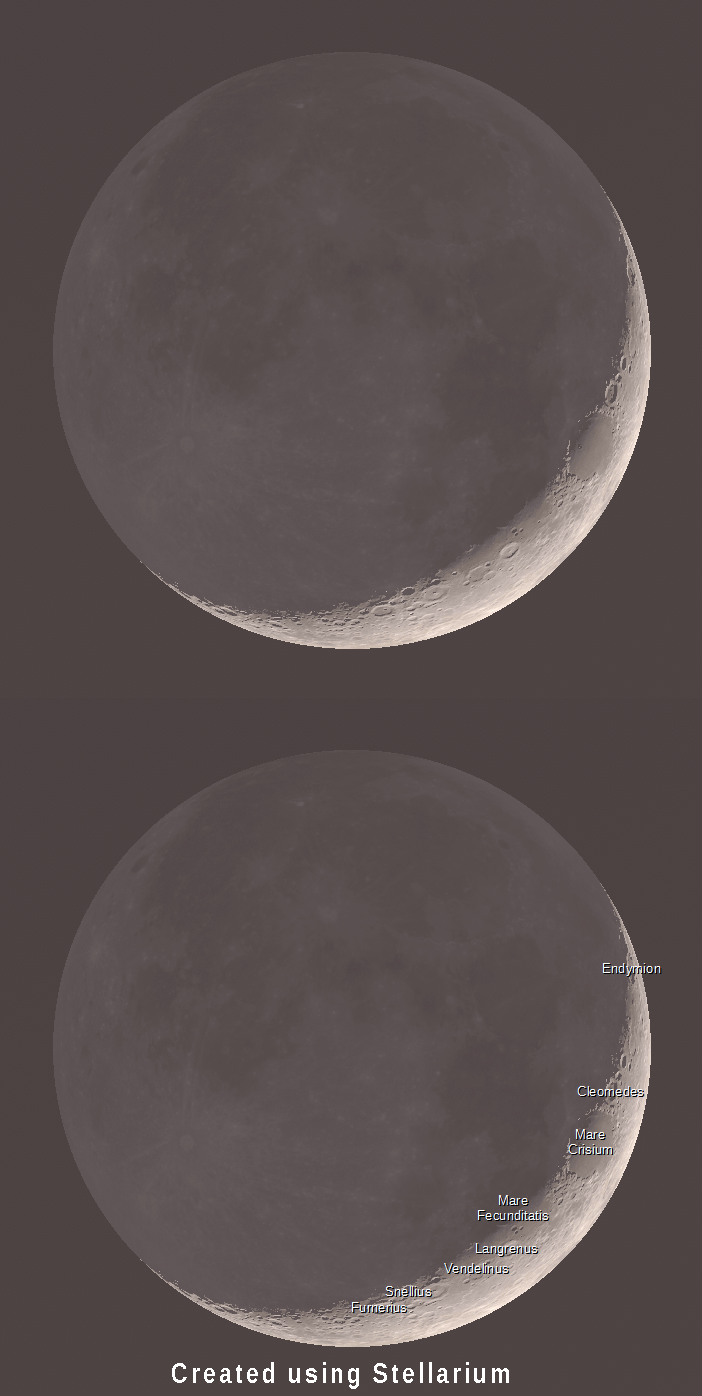
An annotated three old Moon as it might appear in binoculars or a small telescope tonight, May 22, 2023, at 10 pm. Click or tap on the image to enlarge it. Created using Stellarium, LibreOffice Draw and GIMP.
05/04/2023 – Ephemeris – The Moon is not quite as dry as we thought
This is Ephemeris for Thursday, May 4th. Today the Sun will be up for 14 hours and 22 minutes, setting at 8:51, and it will rise tomorrow at 6:27. The Moon, 1 day before full, will set at 6:18 tomorrow morning.
The Moon appears to be bone dry. The Apollo astronauts found no rocks with any water in them, or bound to them chemically. However, remote sensing satellites and an infrared flying observatory have detected hints that water does indeed exist on the Moon. Indeed, water would be worth its weight in gold if discovered there. The South Pole of the Moon has permanently shadowed craters which seem to have water ice in them. Recently the, since decommissioned, SOFIA aircraft, sporting an infrared telescope detected water on the daytime side of the Moon, in quantities, to mix units of measurement, 12 ounces of water per cubic meter of soil in the crater Clavius. It’s a large crater in the Southern Hemisphere of the Moon, and incidentally one of my favorite craters.
Also, recently, the Chinese Chang’e 5 lunar sample return mission detected water in the tiny glass beads that were part of the soil it brought back. The beads were the result of meteorite impacts. Maybe NASA might have another look at the lunar soil the Apollo astronauts brought back.
The astronomical event times given are for the Traverse City/Interlochen area of Michigan (EDT, UT –4 hours). They may be different for your location.
Addendum
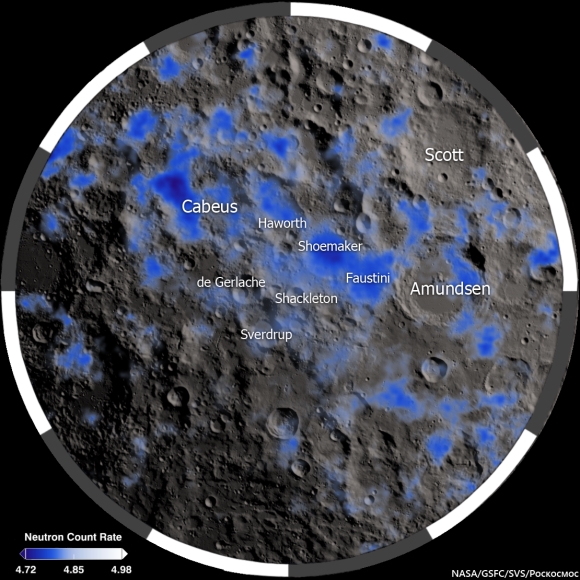
The South Pole of the Moon, where the presence of water ice is detected by the absorption of neutrons by the hydrogen atoms in the ice. Credit NASA/GSFC/SVS/Roscosmos.
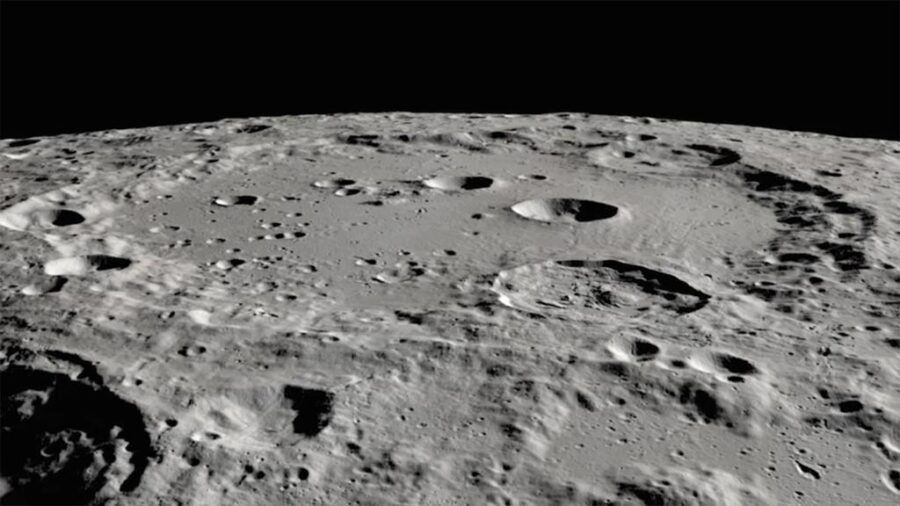
Closeup of Clavius from the Lunar Reconnaissance Orbiter. Credit: NASA/LRO.
 Bob Moler's Ephemeris Blog