Archive
04/24/2023 – Ephemeris – The reason for the Moon’s phases
This is Bob Moler with Ephemeris for Monday, April 24th. Today the Sun will be up for 13 hours and 55 minutes, setting at 8:38, and it will rise tomorrow at 6:42. The Moon, 3 days before first quarter, will set at 2:02 tomorrow morning.
The Moon’s changing appearance over the month may seem to be mysterious at first glance. Maybe because one may think that the objects in the sky are somehow different from the familiar objects we see around us on the Earth. In ancient times, especially the Greeks, thought that everything in the heavens was perfect and spotless. They explained the definite markings we see as the man-in-the-moon as a reflection of the Earth by a spotless Moon. The Moon’s phases are simply light and shadow on a ball in the sunlight. Sometime, when the Moon appears in the daytime, take a small ball, like a golf ball and hold it up to the Moon, while the ball is also in sunlight, and the small ball will exhibit the same phase as the Moon.
The astronomical event times given are for the Traverse City/Interlochen area of Michigan (EST, UT –4 hours). They may be different for your location.
Addendum
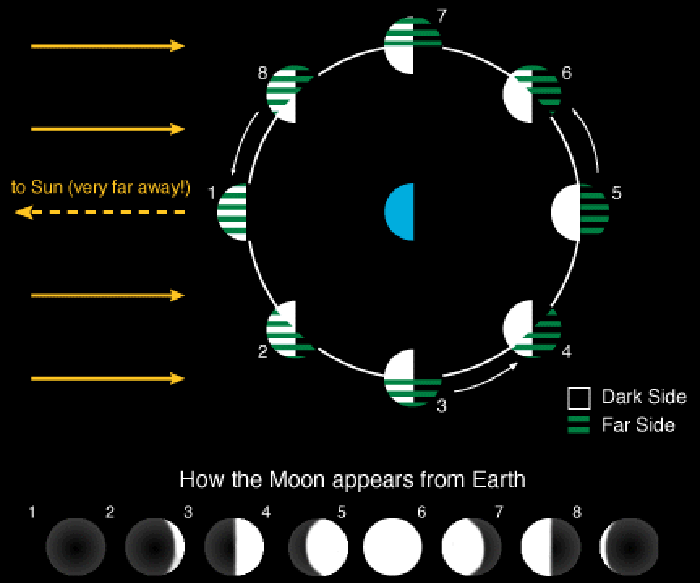
This is the best diagram of the Moon’s phases and how the it appears from the Earth. Credit http://planetfacts.org/phases-of-the-moon/ which I recommend.
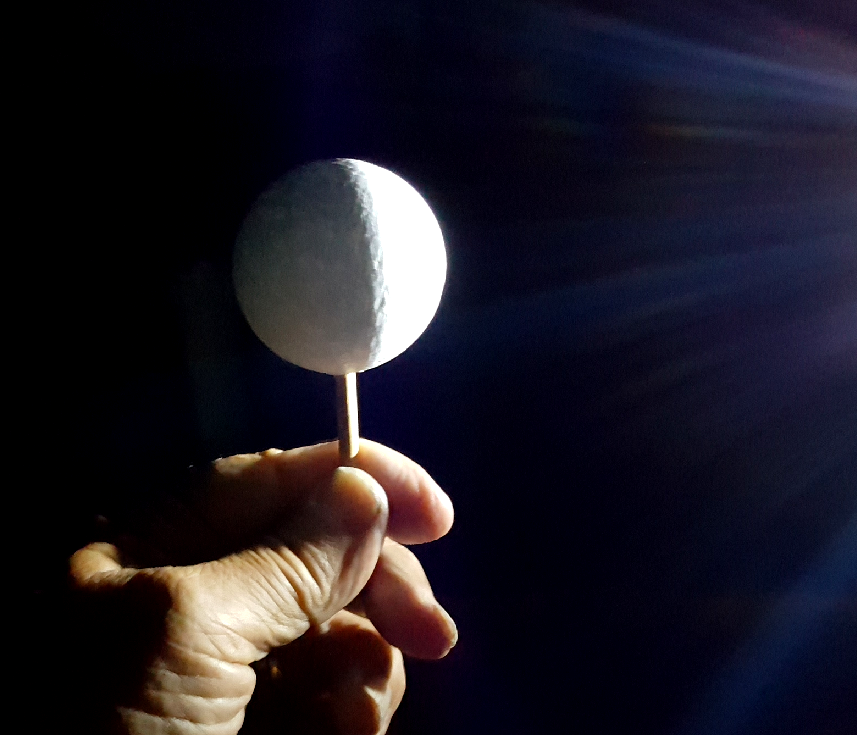
A demonstration of the Moon’s crescent phase with the styrofoam moon ball we use for Project Astro held up to a light off frame to the right. The line between the bright (day) and dark (night) side of the ball, moon or planet is called the terminator. The night side of the ball is illuminated a bit by the translucency of the ball, and the reflection off my hand. Note the roughness of the ball is visible only at the terminator, where the shadows are longest. I photographed this outside at night to minimize the ball’s nighttime illumination.
02/07/2023 – Ephemeris – A new view on the creation of our Moon
Feb 7. This is Bob Moler with Ephemeris for Tuesday, February 7th. Today the Sun will be up for 10 hours and 5 minutes, setting at 5:59, and it will rise tomorrow at 7:53. The Moon, 2 days past full, will rise at 7:58 this evening.
Is this how the Moon came to be? After the Apollo missions, NASA decided to look at the crust of the Moon which apparently is much like the Earth’s and came up to the conclusion that a Mars sized body they called Theia, after the mother of the twins Apollo and Artemis, crashed into the Earth at about a 45-degree angle, and caused a ring of debris around the Earth that would be maintained for a long time. In a newer simulation, the collision could actually create two blobs of material, a large one that became our Moon, in orbit, with about one percent of the Earth’s mass, and a smaller mass that fell back onto the Earth.
The astronomical event times given are for the Traverse City/Interlochen area of Michigan (EST, UT –5 hours). They may be different for your location.
Addendum
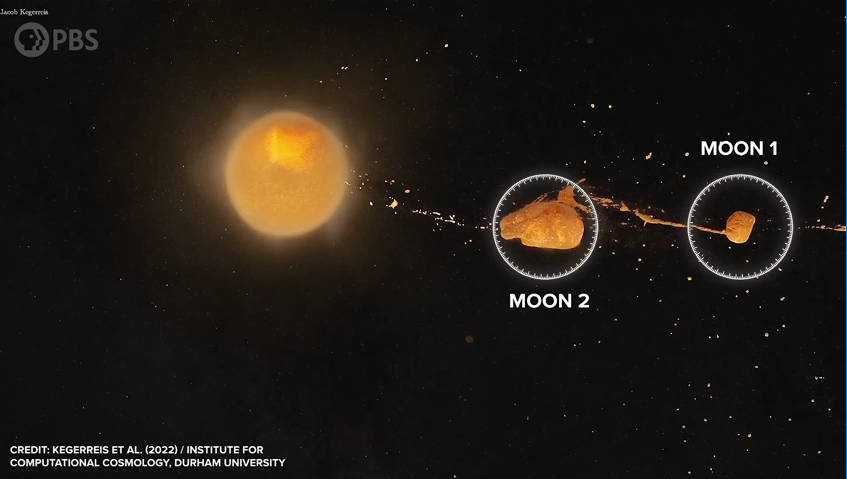
A new simulation on how the Moon formed. Credit: PBS.
01/30/2023 – Ephemeris – Two planetary events are happening today
This is Ephemeris for Monday, January 30th. Today the Sun will be up for 9 hours and 44 minutes, setting at 5:48, and it will rise tomorrow at 8:03. The Moon, 2 days past first quarter, will set at 4:34 tomorrow morning.
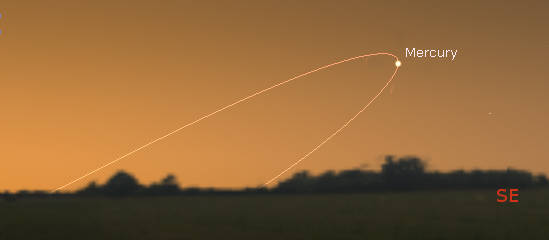
Today, the planet Mercury was seen as far away from the Sun as it can get for this time of year in the morning sky. It’s called “greatest western elongation”, and it’s distance from the sun and angle is 25 degrees. It’s going to stay pretty close to that for about the next week or so, it’ll be visible if it ever clears up. This is about the latest time one can see Mercury morning elongations this for this time of year. We’re running out of the correct angles for it. This evening, if it’s clear, the planet of Mars will appear near the waxing gibbous Moon. Early on in the evening Mars will be to the upper left of the Moon, which will be approaching it by about its own diameter every hour, until about 1 o’clock in the morning when Mars will it’s closest above the Moon it should be a striking sight.
The astronomical event times given are for the Traverse City/Interlochen area of Michigan (EST, UT –5 hours). They may be different for your location.
Addendum
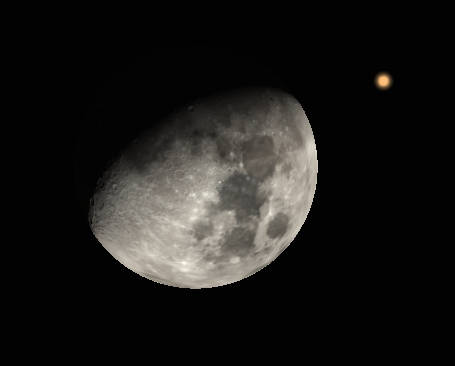
12/08/2022 – Ephemeris – Tonight’s full-ish Moon is near where the June solstice Sun was
This is Ephemeris for Thursday, December 8th. Today the Sun will be up for 8 hours and 54 minutes, setting at 5:02, and it will rise tomorrow at 8:08. The Moon, 1 day past full, will rise at 5:10 this evening.
The bright Moon near full in December rises very high in the south around midnight to 1 am. It is near where the Sun is at the summer solstice. Actually, tonight it is to the lower right of the constellation of Gemini, and to give a topical reference. Tonight, the Moon appears as a soccer ball being kicked by Castor, one of the twins. It’s right off the toe of his foot. In June, the Sun and Full Moon’s positions are reversed. The Sun rises very high in the southern sky at local noon, while the full moon stays low in the south. Or Moon is odd in that respect, Most large satellites of the other planets orbit over their primary’s equator. Our Moon’s orbit is aligned to about 5 degrees off Earth’s own orbit of the Sun, which is angled at 23 and a half degrees from Earth’s equator.
The astronomical event times given are for the Traverse City/Interlochen area of Michigan (EST, UT –5 hours). They may be different for your location.
Addendum
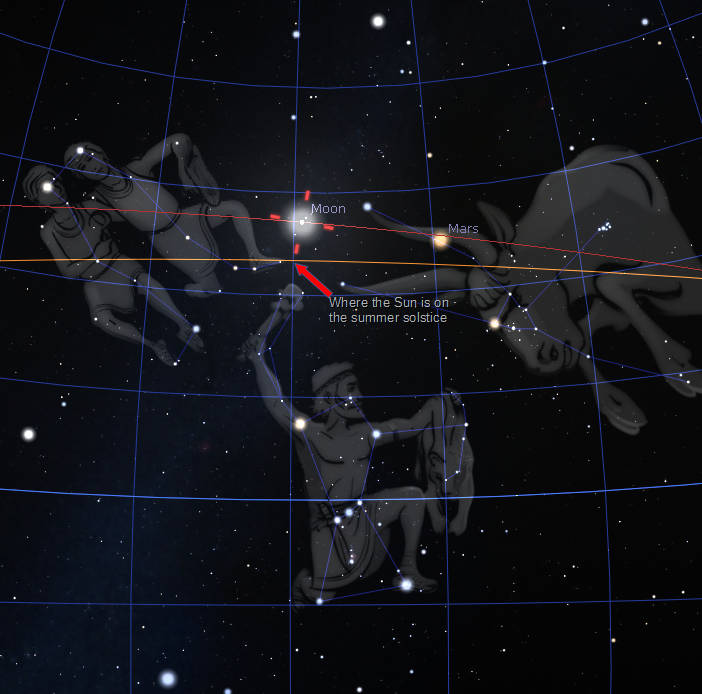
The Moon near the summer solstice point overnight tonight at 1:15 am (the 9th). The sky is overlaid with the equatorial grid. The bright blue line that runs just above Orion’s belt is the celestial equator. The declination lines match Earth’s latitude lines are 10 degrees apart. The vertical blue lines are right ascension lines, like earthly longitude lines, and are 15 degrees apart. Each one represents one hour. The orange line is the ecliptic, the path of the Sun in the sky, also the plane of the Earth’s orbit. The red line is the Moon’s orbit, which is inclined by about 5 degrees to the ecliptic. Click on the image to enlarge it. Created using Stellarium and LibreOffice Draw.
12/06/2022 – Ephemeris – The Moon will pass in front of Mars tomorrow night
This is Bob Moler with Ephemeris for Tuesday, December 6th. Today the Sun will be up for 8 hours and 57 minutes, setting at 5:02, and it will rise tomorrow at 8:06. The Moon, 1 day before full, will set at 7:45 tomorrow morning.
Late tomorrow evening we might get to view a really cool event, clouds permitting, when the full moon will cover or in astronomical lingo occult the planet Mars. In the Grand Traverse Region, this will occur for an hour between approximately 10:15 to 11:15 pm. The exact times depend on your location, and can vary by a minute or two over the IPR coverage area. Being a full moon, Mars might be difficult to spot. It may take binoculars to spot it below, left of the Moon by 9:30, and a small telescope when Mars is near the edge of the Moon. The disappearance of Mars will be at the Moon’s 7 o’clock position, and reappearance at the 4 o’clock position.
The astronomical event times given are for the Traverse City/Interlochen area of Michigan (EST, UT –5 hours). They may be different for your location.
Addendum
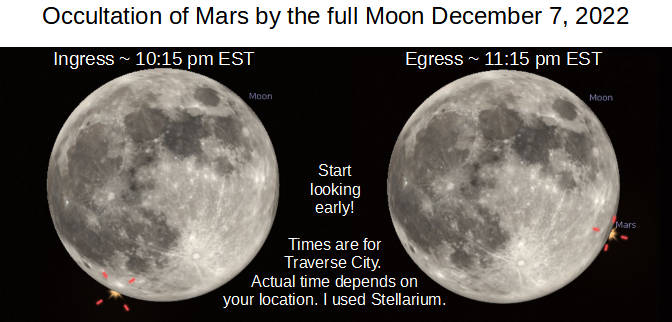
Mars ingress and egress chart and times for Traverse City, MI. The times will vary by a minute or two in the IPR listening area, ingress being earlier to the west and north and later east and south. Egress times will be earlier west and later east of Traverse City. Mars takes about a minute to completely disappear and reappear again because it’s not an unresolvable point like stars.
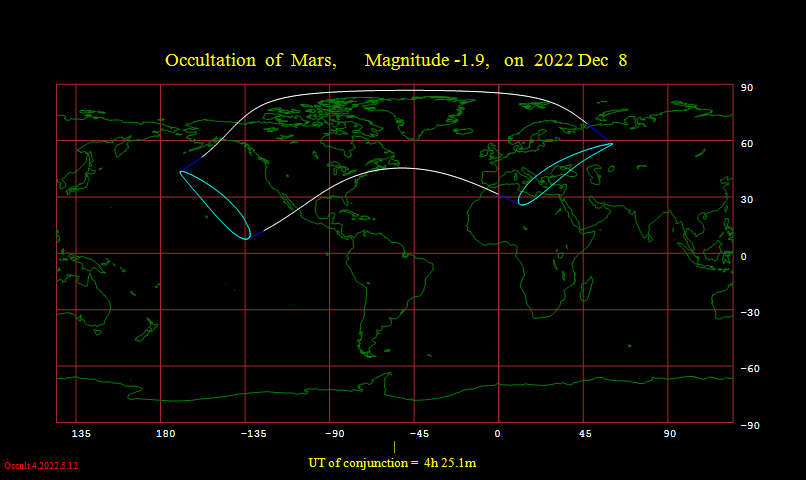
Occultation of Mars map. The occultation of Mars by the Moon will be visible from within the bounded area. For Traverse City, MI, Mars will disappear around 10:15 pm, December 7, 2022, and reappear around 11:15 pm.
In astronomical events of solar eclipses and occultations YOU are part of the event. No, not you, but your location. Whether you see the event or not or what time the contacts (ingress, egress) happen depends on your location. And will happen for that location whether you are there, or it’s clear, or not.
12/05/2022 – Ephemeris – Mars will hide behind the full Moon Wednesday night
This is Ephemeris for Monday, December 5th. Today the Sun will be up for 8 hours and 58 minutes, setting at 5:02, and it will rise tomorrow at 8:05. The Moon, 2 days before full, will set at 6:36 tomorrow morning.
Late Wednesday night we might get to view a really cool event when the full moon will cover or in astronomical lingo occult the planet Mars. In the Grand Traverse Region, this will occur for an hour between approximately 10:15 to 11:15 pm. The exact times depend on your location, and can vary by several minutes or more. Being a full moon, Mars might be difficult to spot. I’ll have more and hopefully more accurate information tomorrow. When astronomical objects line up like this, it’s called a syzygy. This time it’s a lineup of the Sun, Earth Moon and Mars in nearly a straight line, with both the Moon and Mars in opposition from the Sun on the same night. When the Moon is in opposition, we call it a full moon instead.
The astronomical event times given are for the Traverse City/Interlochen area of Michigan (EST, UT –5 hours). They may be different for your location.
Addendum
Mars ingress and egress chart and times for Traverse City, MI. The times will vary by a minute or two in the IPR listening area, ingress being earlier to the west and north and later east and south. Egress times will be earlier west and later east of Traverse City.
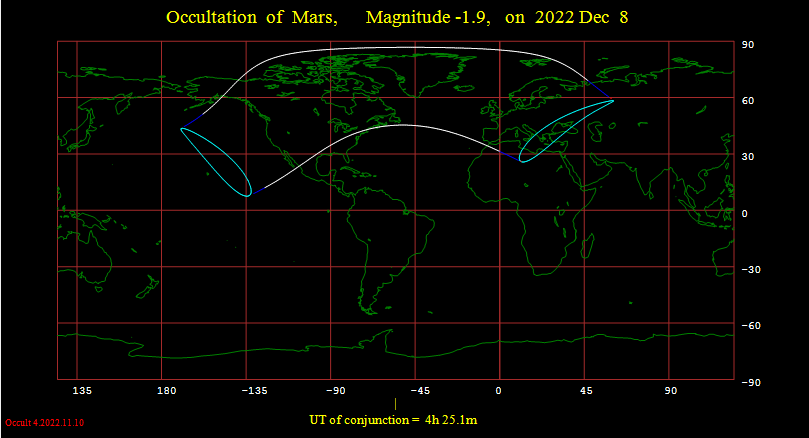
World map showing the area that the occultation of Mars will be visible. Occultation visibility will move from west to east. Credit: Occult version 4.
11/29/2022 – Ephemeris – Observing the Moon tonight
This is Ephemeris for Tuesday, November 29th. Today the Sun will be up for 9 hours and 6 minutes, setting at 5:04, and it will rise tomorrow at 7:58. The Moon, 1 day before first quarter, will set at 11:28 this evening.
The illuminated part of tonight’s Moon will be a fat crescent shape, 12 hours, give or take from first quarter. Besides the lunar seas visible there are some large craters on its terminator, or sunrise line On the upper right are two distinctive craters near each other. The larger is Aristoteles named after the Greek philosopher Aristotle which is 53 miles wide. The smaller is Eudoxus, named after an older Greek philosopher, 41 miles in diameter. Both of these should be visible in small telescopes or even binoculars. They stand out because there are only a few small craters around them in pretty much flat terrain. Meanwhile Artemis 1’s Orion capsule is continuing to make a large lazy loop around the Moon before heading back to the Earth in 12 days.
The astronomical event times given are for the Traverse City/Interlochen area of Michigan (EST, UT –5 hours). They may be different for your location.
Addendum
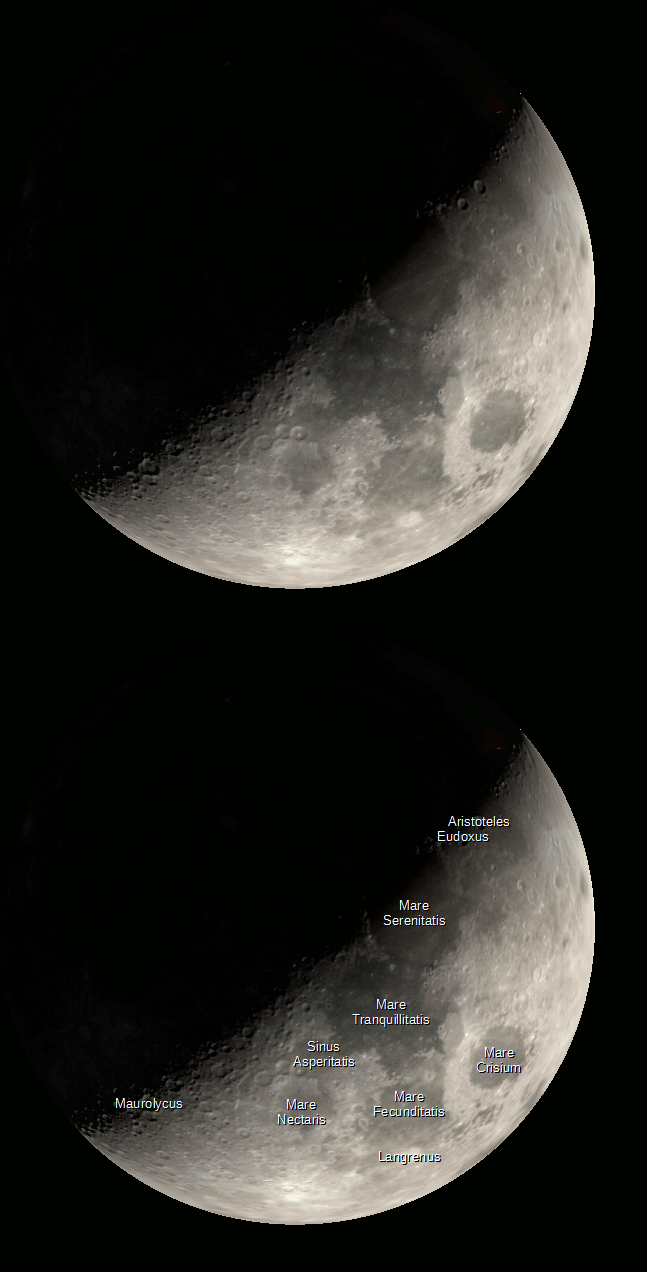
Annotated Moon animation as it might appear tonight at 8 pm, November 29, 2022. Created using Stellarium and GIMP.
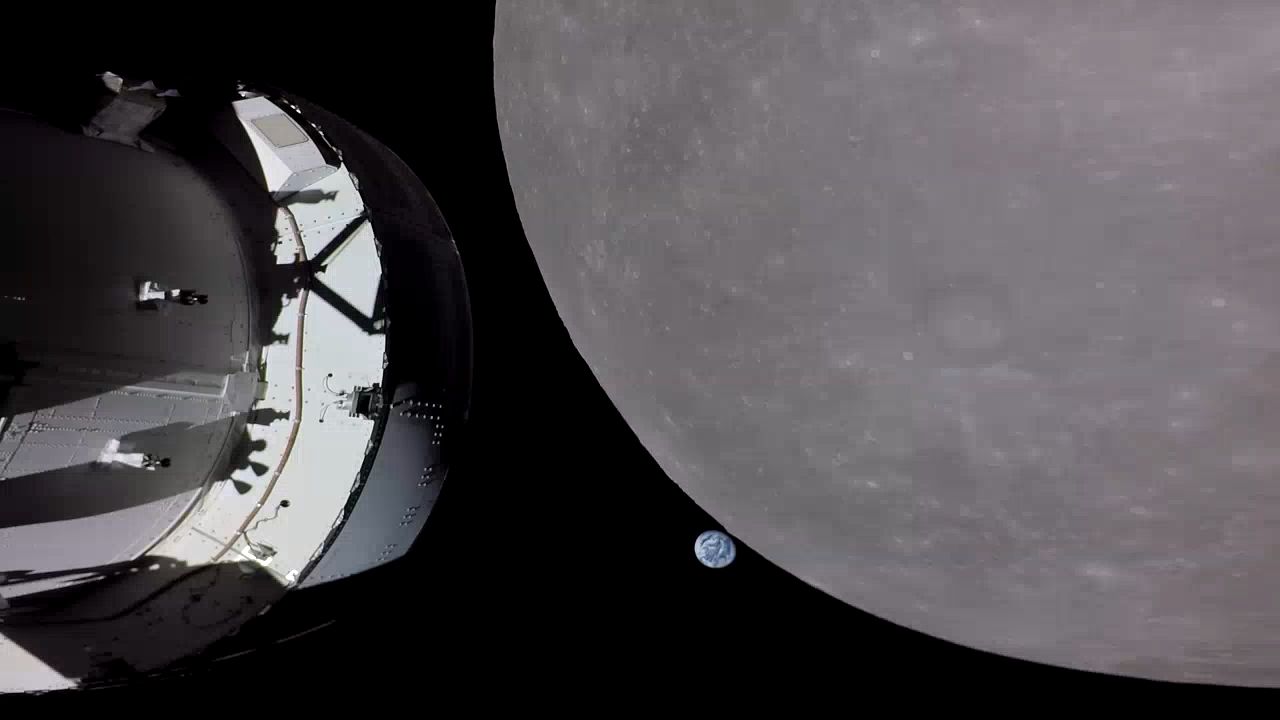
Earthset from Artemis I’s Orion spacecraft, as it moves around to the far side of the Moon. Click on the image to enlarge it. Credit: NASA
11/28/2022 – Ephemeris – The Artemis Program
This is Ephemeris for Monday, November 28th. Today the Sun will be up for 9 hours and 8 minutes, setting at 5:04, and it will rise tomorrow at 7:57. The Moon, 2 days before first quarter, will set at 10:09 this evening.
Now that the Artemis I mission is ongoing, and the spacecraft is in a large orbit of the Moon, it’s time to look at the rest of the program. In 2024 the SLS or Space Launch System, which is the name for the whole rocket, will send a four-person crew in their Orion Capsule around the Moon and back. From what I’m seeing right now, it will be a simple mission. It doesn’t appear that they will actually orbit the Moon other than a free return trajectory back to the Earth. The mission a year or so after that will be one to attempt to land on one of the few flat sites near the south pole of the Moon. Speaking of the Moon, the planet Saturn will be about eight of the Moon’s diameter’s north or above the Moon tonight.
The astronomical event times given are for the Traverse City/Interlochen area of Michigan (EST, UT –5 hours). They may be different for your location.
Addendum
Earthset from Artemis I’s Orion spacecraft, as it moves around to the far side of the Moon. Click on the image to enlarge it. Credit: NASA
10/27/2022 – Ephemeris – Trying to spot the young Moon tonight
This is Bob Moler with Ephemeris for Thursday, October 27th. Today the Sun will be up for 10 hours and 24 minutes, setting at 6:38, and it will rise tomorrow at 8:15. The Moon, 2 days past new, will set at 7:55 this evening.
The Moon is again making its appearance in the evening sky as a thin crescent. The crescent appearance is because the moon is mostly between the Earth and the Sun. So we are seeing mostly its night side, with just a sliver of it being sunlit. But the Moon has the Earth in its sky, which is quite big and bright, much brighter than the Moon in our skies. And when the Moon’s phase is thin, the Earth, having the opposite phase, will be a nearly full gibbous orb. The Earth illuminates the Moon’s night side with earthlight. We call it earthshine, when the whole Moon appears faintly inside the crescent. It’s also known more poetically as the “Old moon in the new moon’s arms.” If you’re not sure, because the effect is faint, check it out in binoculars. The effect should last another night.
The astronomical event times given are for the Traverse City/Interlochen area of Michigan (EDT, UT – 4 hours). They may be different for your location.
Addendum
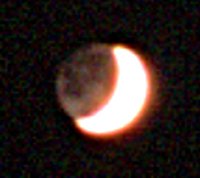
An old picture of mine overexposing the crescent Moon to bring out earthshine. The moon was a wider crescent than it will appear to be tonight.
10/06/2022 – Ephemeris – Artemis I rescheduled
This is Ephemeris for Thursday, October 6th. Today the Sun will be up for 11 hours and 27 minutes, setting at 7:14, and it will rise tomorrow at 7:48. The Moon, 3 days before full, will set at 4:52 tomorrow morning.
Artemis 1 was going to launch on September 27th, But Hurricane Ian had other plans, so the rocket was trundled back to the Vertical Assembly Building. There, a battery or components of the auto destruct mechanism had to be swapped out before they attempted to launch again. All rockets launched from the US are required to be equipped with a destruct package to blow up the rocket if it veers off course, to not endanger lives on the ground. There are other tweaks, including charging or replacing batteries in all the CubeSats that are on board. The next possible launch period runs from November 12th to the 27th, with four blackout dates within that period. The weather should be better, being the tail end of hurricane season.
The astronomical event times given are for the Traverse City/Interlochen area of Michigan (EDT, UT – 4 hours). They may be different for your location.
Addendum
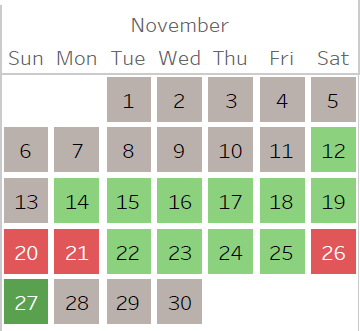
Artemis I November launch calendar. Dates in green are possible launch dates. I’m not sure, but red dates are also forbidden because the Orion Capsule will experience more than 90 minutes in shadow at a time. It’s powered by solar panels. Light green dates allow a long mission of 1 1/2 orbits of the Moon in the distant retrograde orbit (DRO). The dark green dates can only have 1/2 a DRO. Source: NASA.
 Bob Moler's Ephemeris Blog