Archive
01/12/17 – Ephemeris – Venus is at greatest eastern elongation today
Ephemeris for Thursday, January 12th. The Sun will rise at 8:17. It’ll be up for 9 hours and 7 minutes, setting at 5:25. The Moon, at full today, will rise at 6:04 this evening.
Today, around 8 a.m. the planet Venus will reach its greatest eastern elongation from the Sun. What that means in simple terms is that Venus will appear as far east of the Sun that it can get. The angle between it and the Sun will be 47.1 degrees. Venus, like Mercury orbits the Sun inside the Earth’s orbit, so is always seen close to the Sun. In telescopes Venus will look like a tiny half illuminated orb, like a first quarter Moon. That’s for the same reason. The Sun is illuminating half of the side we can see. Venus is moving directly toward us now, at a distance of 63 million miles (102 million km). As Venus approaches us, it will grow in size in telescopes, becoming larger in appearance than Jupiter the largest planet. It will leave the evening sky, passing between the Earth and the Sun, only 26 million miles away on March 25th.
Times are for the Traverse City/Interlochen area of Michigan. They may be different for your location.
Addendum
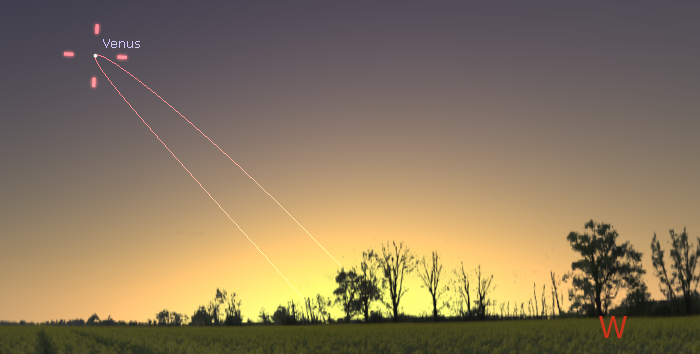
Venus at 5:30 p.m. January 12, 2017 also displaying its orbit. Created using Stellarium.
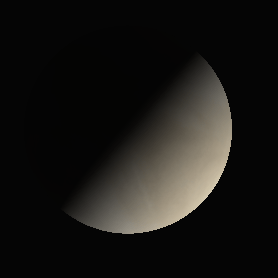
Venus in a telescope showing it half illuminated at greatest eastern elongation. Created using Stellarium.
There’s an odd phase effect called the “Venus Dichotomy” where at the instant of greatest elongation that Venus’ phase is not exactly half illuminated. Half phase may differ by several hours. The actual time of greatest eastern elongation according to NASA’s SKYCAL Calendar at https://eclipse.gsfc.nasa.gov/SKYCAL/SKYCAL.html is January 12 at 7:59 a.m. EST or 12:59 UT.
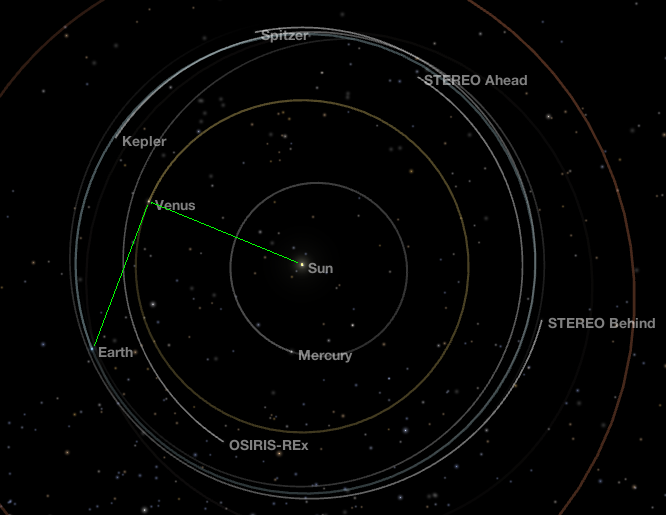
Inner solar system showing the relationship of Venus and the Earth. At greatest elongation The angle between Venus-Sun line and Venus-Earth line is 90 degrees. which is why Venus shows as half illuminated. Created using the application NASA’s Eyes.
Note that the chart above also shows NASA’s inner solar system missions. To download the app, created by the Jet Propulsion Laboratory (JPL), go to https://eyes.nasa.gov/. Use it to follow the progress of NASA solar system missions.
10/25/2016 – Ephemeris – Venus is becoming more visible after sunset
Ephemeris for Tuesday, October 25th. The Sun will rise at 8:12. It’ll be up for 10 hours and 28 minutes, setting at 6:40. The Moon, 3 days past last quarter, will rise at 4:02 tomorrow morning.
Venus is becoming quite visible low in the southwest after sunset as the Evening Star. As such it is a beautiful addition to our autumn and winter skies. As seen in telescopes it is a tiny gibbous disc, 79% illuminated by the sun. It’s beauty is only cloud-top deep. For a planet that appears to be nearly Earth’s twin at 95% the Earth’s size, it can be said to be Earth’s evil twin. Its bright white cloud-tops aren’t made of water but sulfuric acid, and it gets worse the farther down you go. The farther one goes down in Venus’ carbon dioxide atmosphere, the hotter and higher the atmospheric pressure gets. At the surface the temperature is over 850 degrees Fahrenheit (460º C) and the atmospheric pressure is nearly 100 times that of Earth. Venus’ surface temperature is actually hotter than Mercury the closest planet to the Sun, a hellish runaway greenhouse effect.
Times are for the Traverse City/Interlochen area of Michigan. They may be different for your location.
Addendum
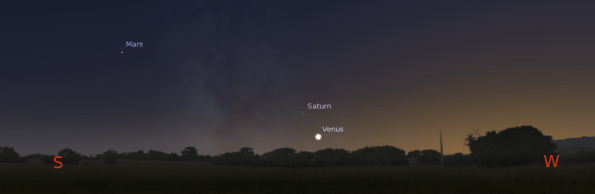
Venus and the other evening planets at 7:30 p.m. Created using Stellarium.

Venus as it might appear in a telescope minus all the atmospheric effects of being close to the horizon. It is 13.6 ‘ in diameter. Created using Stellarium.
06/06/2016 – Ephemeris – Venus passes behind the Sun today
Ephemeris for Monday, June 6th. Today the Sun will be up for 15 hours and 27 minutes, setting at 9:25, and it will rise tomorrow at 5:57. The Moon, 2 days past new, will set at 10:52 this evening.
Today the planet Venus will be in superior conjunction with the Sun, and indeed will pass directly behind the Sun. That event will be completely unobservable due to the Sun’s brilliance. Fours years ago we observed the transit of Venus across the Sun. June 6, 2012. It got me thinking. Transits of Venus occur in pairs 8 years apart followed by a very long interval of over 100 years. It turns out the Venus orbits the Sun 13 times in approximately the same time that the earth orbits the Sun 8 times. In 4 years Venus goes around the Sun 6 ½ times and put’s Venus behind the Sun 4 years after 2012. Today to be precise. In another 4 years we’ll have Venus between the Earth and the Sun again, except Venus will be a bit too far north to transit the Sun.
Times are for the Traverse City/Interlochen area of Michigan. They may be different for your location.
Addendum
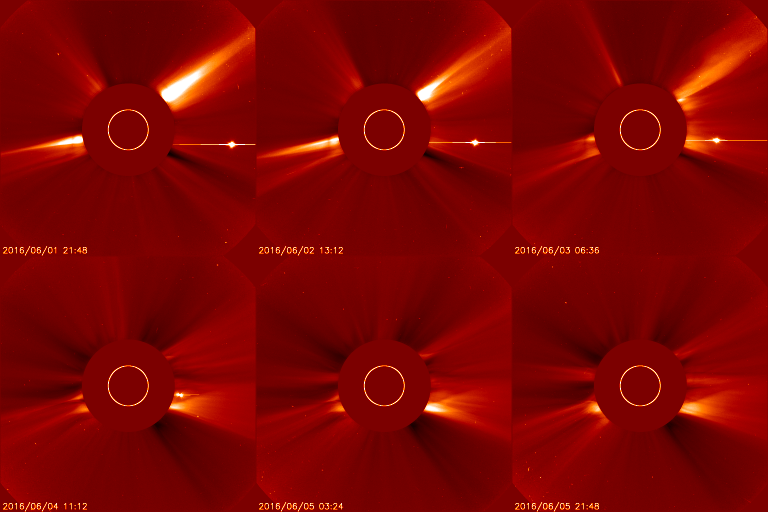
SOlar and Heliospheric Observatory (SOHO) stationed at the Earth-Sun Lagrangian point 1 (L1) a million miles sunward of the Earth. Sent back this animated GIF of Venus approaching the Sun in the last few days. In the LASCO C2 coronagraph the large disk at the center blocks the brightest part of the Sun’s image. The white circle represents the Sun’s disk size. Credit ESA/NASA.
05/13/2016 – Ephemeris – GTAS Astronomy Day tomorrow
Ephemeris for Friday, May 13th. Today the Sun will be up for 14 hours and 46 minutes, setting at 9:02. The Moon, at first quarter today, will set at 2:59 tomorrow morning. Tomorrow the Sun will rise at 6:15.
The Grand Traverse Astronomical Society will host a public viewing night for Astronomy Day tomorrow night, that’s Saturday the 14th, starting at 9 p.m. It will be at Northwestern Michigan College’s Joseph Rogers Observatory. If its clear the slightly gibbous moon will be featured along with Jupiter, Mars and the ringed planet Saturn and other wonders of the spring sky. The observatory is located south of Traverse City, on Birmley Road between Garfield and Keystone roads. For the society these, twice monthly star parties at the observatory and sidewalk astronomy outings by members, to the Sleeping Bear Dunes National Lakeshore and other locations are what they do.
Times are for the Traverse City/Interlochen area of Michigan. They may be different for your location.
Other thoughts
I was checking out the Solar and Heliospheric Observatory (SOHO) LASCO C3 animation and Venus is making an entrance from the right as it heads for superior conjunction on June 6. June 6? Hmm. Wasn’t that last transit or Venus on June 5th 2012. We and Venus should be near the line of nodes again, where the planes of our respective orbits cross. I cranked up Stellarium, and sure enough the Sun will occult Venus that day… Not that we could see it.
12/07/2015 – Ephemeris – Today the Moon will pass in front of the planet Venus
Ephemeris for Monday, December 7th. The Sun will rise at 8:06. It’ll be up for 8 hours and 56 minutes, setting at 5:02. The Moon, half way from last quarter to new, will rise at 5:04 tomorrow morning.
The Moon will pass in front of Venus between about 12:20 p.m. and 1:27 p.m. for the Interlochen, Traverse City Area. Times will vary as much as 5 minutes over the IPR listening area. Some sort of telescopic aid is needed to see Venus and the crescent Moon in daylight. The crescent Moon is quite faint, though Venus should be easier to spot because it’s brighter. I have a special post on my blog dated Saturday December 5th.. It’s titled Venus Occultation December 7, 2015 from Northern Michigan with all the details. My blog is bobmoler.wordpress.com, or do an Internet search for Bob Moler, That’s Moler spelled M-O-L-E-R, no extra letters. And hope for clear skies.
Times are for the Traverse City/Interlochen area of Michigan. They may be different for your location.
Addendum
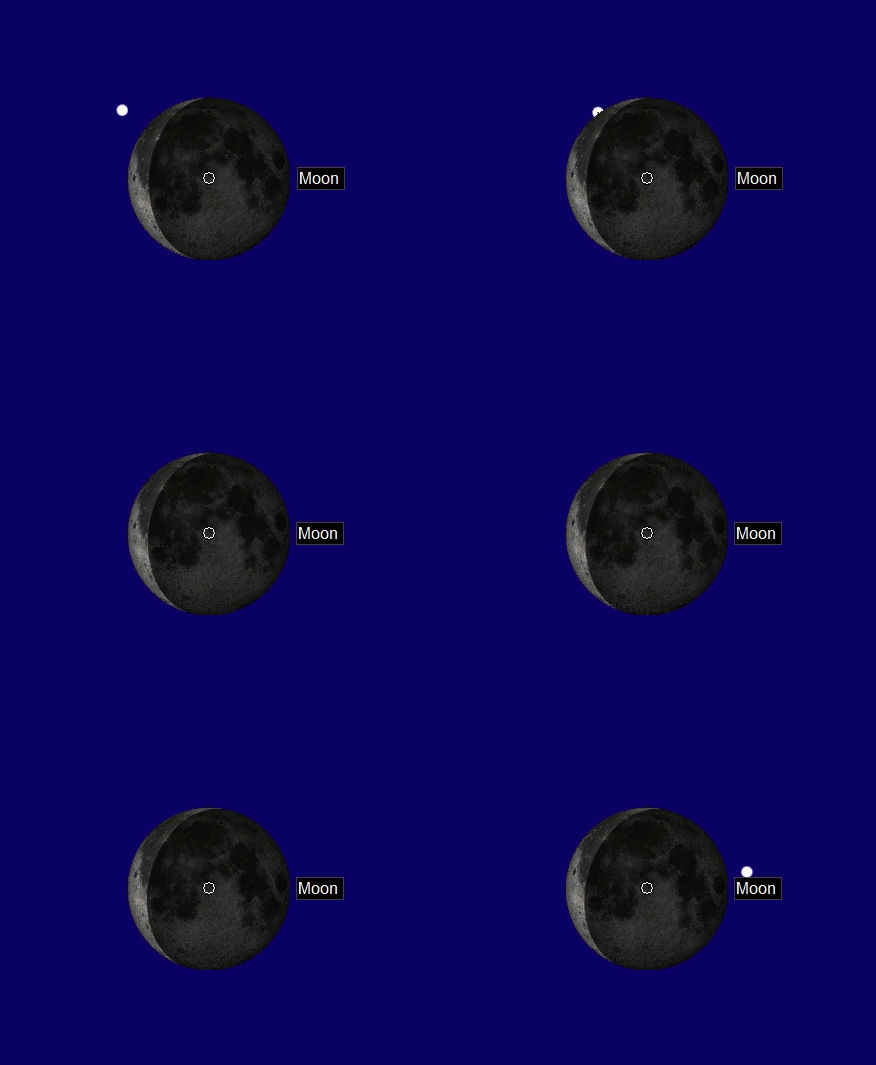
Animation of the occultation. Created using Cartes du Ciel (Sky Charts) and GIMP.
Venus Occultation December 7, 2015 from Northern Michigan
What is an occultation? An occultation is when one nearer celestial body covers or hides another, more distant body. The word occultation comes from occult which simply means hidden. No black magic is involved.
The occultation of Venus will occur on December 7, from 12:21 p.m. to 1:27 p.m. for the Grand Traverse Area, give or take a few minutes either way. The exact time depends on your location. This event would be a great sight if it occurred in the early morning skies before sunrise. Unfortunately it’s centered on 1 p.m. Venus and the Moon are visible in the daytime with a telescope and even binoculars, but are difficult to find. The Moon and Venus do make a beautiful sight in the morning in the 5 to 7 a.m. hours.
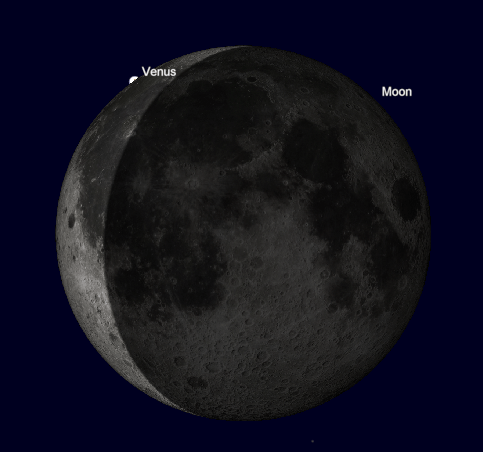
Disappearance of Venus at 12:20 p.m. Created using Cartes du Ciel (Sky Charts).
The trick to viewing this event is even finding the Moon or Venus. One could set up a telescope with tracking ability to track Venus throughout the morning. Unless you have a telescope Go To mount and can track the Moon, track Venus instead. The Moon moves about its own diameter with respect to the stars in an hour, so it will have to be constantly adjusted to keep pointed at the Moon. Actually Venus has a higher surface brightness than the Moon, so it should be easier to track, especially if the sky is hazy and the Moon isn’t visible.
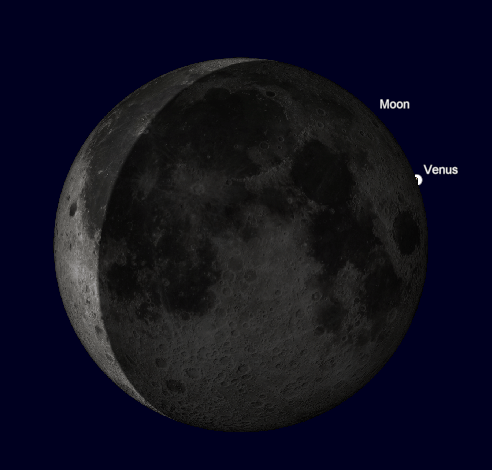
Disappearance of Venus at 1:27 p.m. Created using Cartes du Ciel (Sky Charts).
Unlike a stellar occultation Venus will disappear over several seconds. A telescope capable to seeing Venus’ gibbous phase will see the bright edge of the Moon actually pass in front it. Venus will emerge from the Moon’s dark side which will be invisible. So Venus will slowly reappear next to the crescent Moon. Hoping for clear skies, and good luck.
If you are not located near Traverse City, you can use my technique to estimate the occultation times. I used Cartes du Ciel the free software found on the Internet at http://www.ap-i.net/skychart/en/start. Make sure that the program is set for topocentric positions under Setup/Solar System. And you have entered your position under Setup/Observatory. You can find your location in Google Earth.
You can also use Stellarium (http://stellarium.org). Just make sure the Moon is normal sized.
In both programs you can lock the Moon or Aldebaran in the center of the screen Pick a time in advance of the occultation and using the set time window walk the star towards the Moon, mark the time. Then walk the star out from the Moon and record the reappearance time. That’s it.
This should work with other planetarium programs too.
Animation of the occultation. Created using Cartes du Ciel (Sky Charts) and GIMP.
For better accuracy go to the International Occultation Timing Association (IOTA) website. Download and install their Occult4 program for Windows computers. Follow the instructions. When I ran the program for my location, the location I use for Interlochen/Traverse City (Since I live approximately half-way between the two). I got results within a half-minute of the IOTA Occult4 program results. So the approximation method using planetarium programs is valid.
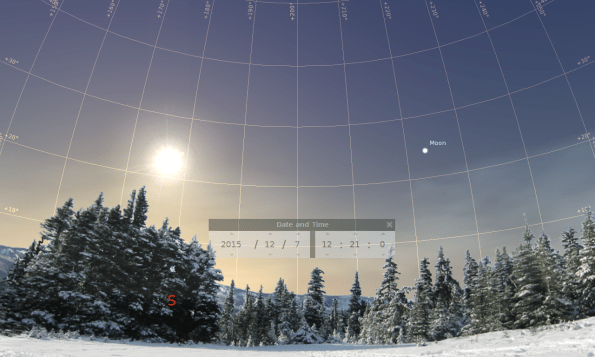
Sun and Moon’s positions at the start of the occultation from northern Michigan. Note the Moon and Venus will be invisible to the naked eye. Created using Stellarium.
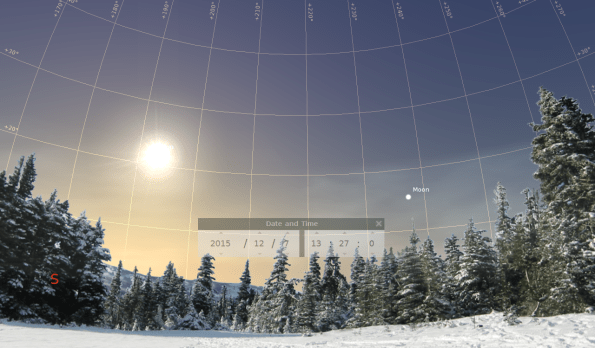
Sun and Moon’s positions at the end of the occultation from northern Michigan. Note the Moon and Venus will be invisible to the naked eye. Created using Stellarium.
When I made up the above images I really thought there would be snow on the ground by now. But what little we had has come and gone.
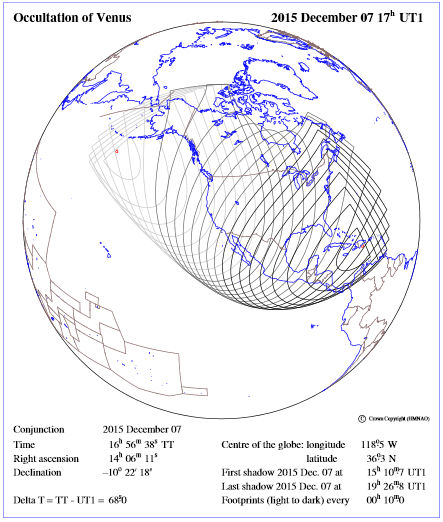
Occultation of Venus Visibility Map for North America. Credit: Astronomical Almanac Online -U.S. Nautical Almanac Office, United States Naval Observatory (USNO), in the United States and Her Majesty’s Nautical Almanac Office (HMNAO), United Kingdom Hydrographic Office (UKHO), in the United Kingdom.
12/01/2015 – Ephemeris – Previewing December skies
Ephemeris for Tuesday, December 1st. The Sun will rise at 7:59. It’ll be up for 9 hours and 4 minutes, setting at 5:03. The Moon, 2 days before last quarter, will rise at 11:13 this evening.
December is the month with the shortest daylight hours. Winter will officially arrive at the winter solstice on the 21st at 11:48 p.m. There will be little movement in the sunset times: In the Traverse City/Interlochen area this will be from 5:03 tonight, down to 5:02 and then advancing to 5:11 at the end of the month. There is more movement in the sunrise times which will advance from 7:59 today to 8:20 on the 31st. There is also little movement of daylight hours. The noontime sun will hang around 22 to 23 degrees above the southern horizon all month. We have some great events this month, from an occultation of Venus by the moon on the 7th, to the Geminid meteors on the 14th and Comet Catalina will be seen in binoculars on mornings all this month.
Times are for the Traverse City/Interlochen area of Michigan. They may be different for your location.
Addenda
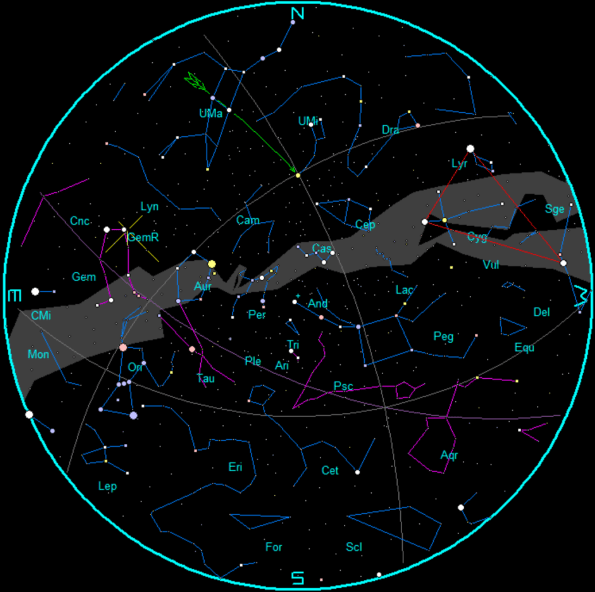
Star Chart for December 2015. Created using my LookingUp program. Click on image to enlarge.
The planets and stars are plotted for the 15th at 9 p.m. EST. That is chart time. Note, Traverse City is located 45 minutes behind our time meridian. To duplicate the star positions on a planisphere you may have to set it to 45 minutes earlier than the current time.
Evening astronomical twilight ends at 6:48 p.m. EST on December 1st, decreasing a minute 9 days later before increasing to 6:57 p.m. EST on the 31st.
Morning astronomical twilight starts at 6:15 a.m. EST on December 1st, and increasing to 6:34 a.m. EST on the 31st.
Add a half hour to the chart time every week before the 15th and subtract and hour for every week after the 15th.
For a list of constellation names to go with the abbreviations click here.
- Pointer stars at the front of the bowl of the Big Dipper point to Polaris the North Star.
- The Summer Triangle is still up and is shown in red.
- GemR is the Geminid meteor shower radiant
Calendar of Planetary Events
Credit: Sky Events Calendar by Fred Espenak and Sumit Dutta (NASA’s GSFC)
To generate your own calendar go to http://eclipse.gsfc.nasa.gov/SKYCAL/SKYCAL.html
Times are Eastern Daylight Time. Some additions made to aid clarity.
Date	   Local  Event
           Time EST
Dec 01 Tu         Venus: 43.3° W
    03 Th  2:41am Last Quarter
    04 Fr  1:21am Moon-Jupiter: 2° N
    04 Fr  1:33pm Moon Ascending Node
    05 Sa  9:56am Moon Apogee: 404800 km
    05 Sa  9:40pm Moon-Mars: 0.1° N - Occultation **
    07 Mo 11:55am Moon-Venus: 0.7° S - Occultation *
    11 Fr  5:29am New Moon
    12 Sa  3:15am Moon South Dec.: 18.4° S
    14 Mo 12:48pm Geminid Shower: ZHR = 120
    17 Th  9:32pm Saturn-Antares: 6.2° N
    18 Fr 10:13am Moon Descending Node
    18 Fr 10:14am First Quarter
    21 Mo  3:53am Moon Perigee: 368400 km
    21 Mo 11:48pm Winter Solstice
    22 Tu  9:00pm Ursid Shower: ZHR = 10
    23 We  9:16pm Mars-Spica: 3.5° N
    23 We  2:09pm Moon-Aldebaran: 0.7° S
    25 Fr  2:30am Moon North Dec.: 18.4° N
    25 Fr  6:11am Full Moon
    28 Mo  9:59pm Mercury Elongation: 19.7° E
    29 Tu  3:30pm Moon-Regulus: 2.9° N
    31 Th 12:55pm Moon-Jupiter: 1.6° N
    31 Th  3:19am Moon Ascending Node
Jan 01 Fr         Venus: 37.9° W
* The occultation will be visible in the US, except extreme southwestern Alaska and Hawai’i; and Canada down to Panama. In the Grand Traverse area of Michigan the occultation starts around 12:20 p.m. and ends around 1:27 p.m. This is a daytime event for most of the US. Note that the actual time depends on your exact location. I’ll have more information in a non Ephemeris post on Saturday the 5th. The Occultation map is here.
** On December the 5th there will be an occultation of Mars visible across the Indian Ocean and much of Australia. That occultation map is here.
Estimating occultation timings for your location
I used Cartes du Ciel the free software that I have a link to on the right. Make sure that the program is set for topocentric positions under Setup/Solar System. And you have entered your position under Setup/Observatory. You can find your location in Google Earth, or your GPS device or smart phone.
You can also use Stellarium. Just make sure the Moon is normal sized.
In both programs you can lock the Moon or Aldebaran in the center of the screen Pick a time in advance of the occultation and using the set time window walk the star towards the Moon, mark the time. Then walk the star out from the Moon and record the reappearance time. That’s it.
This should work with other planetarium programs too.
For better accuracy go to the International Occultation Timing Association (IOTA) website. Download and install their Occult4 program for Windows computers. Follow the instructions. When I ran the program for my location, the location I use for Interlochen/Traverse City (Since I live approximately half-way between the two). I got results within a half-minute of the IOTA Occult4 program results. So the approximation method using planetarium programs is valid.
Comet C/2013 US10 (Catalina)
This comet has been hiding for the last two years after its discovery, moving into the far southern hemisphere of the sky. However this month it has emerged into our morning sky. This comet is a one time visitor from the Oort Cloud to the inner solar system and will be ejected into interstellar space. It passed perihelion on November 15th, coming just inside the Earth’s orbit on the other side of the Sun from us. It’s orbit will be headed northward and a bit toward us, so it will keep its brightness steady.
The position marks in the chart have the date and the magnitude. However the comet is currently appearing one magnitude dimmer than shown. So instead of appearing as nearly 5th magnitude, it will really be 6th magnitude. It’s definitely a binocular or telescopic object.
According to the brightness graph the comet began to under perform in brightness back in September, however, according to a new brightness formula the comet may increase in brightness by a magnitude by late February when it will be well placed for viewing all night. To monitor the brightness reports from observers go to http://www.aerith.net/comet/catalog/2013US10/2013US10.html.
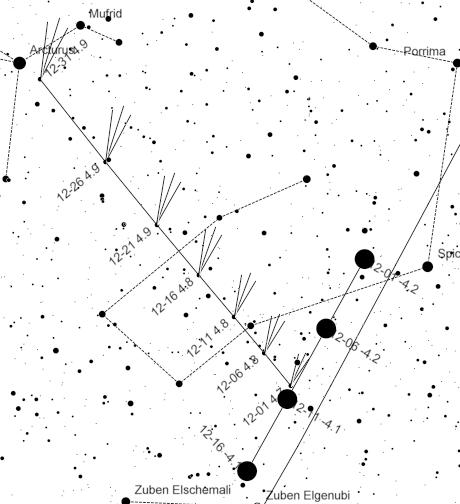
The tracks of Comet C/2013 US10 (Catalina) for December 2015 along with part of Venus’ track. Created using Cartes du Ciel (Sky Charts).
06/04/2015 – Ephemeris – Venus’ greatest eastern elongation from the Sun is Saturday
Ephemeris for Thursday, June 4th. Today the Sun will be up for 15 hours and 24 minutes, setting at 9:23. The Moon, 2 days past full, will rise at 11:06 this evening and tomorrow the Sun will rise at 5:58.
On Saturday Venus will reach its greatest eastern elongation or separation from the Sun of 45.4 degrees angle. It’s phase should be that of exactly half illuminated by the sun. The problem is that the date it is exactly half illuminated can vary from 1 to 4 days from the greatest elongation. Of course this is something that has to be seen in a telescope. Try to catch Venus in bright twilight so its bright glare is minimized. I find that a moon filter fitted to the eyepiece gets rid of the glare nicely. After that time Venus will to begin to move toward the Earth, then curve around in its orbit to pass between the Earth and the Sun. As it does so it will increase its apparent size and its phase will become a crescent.
Times are for the Traverse City/Interlochen area of Michigan. They may be different for your location.
Addendum
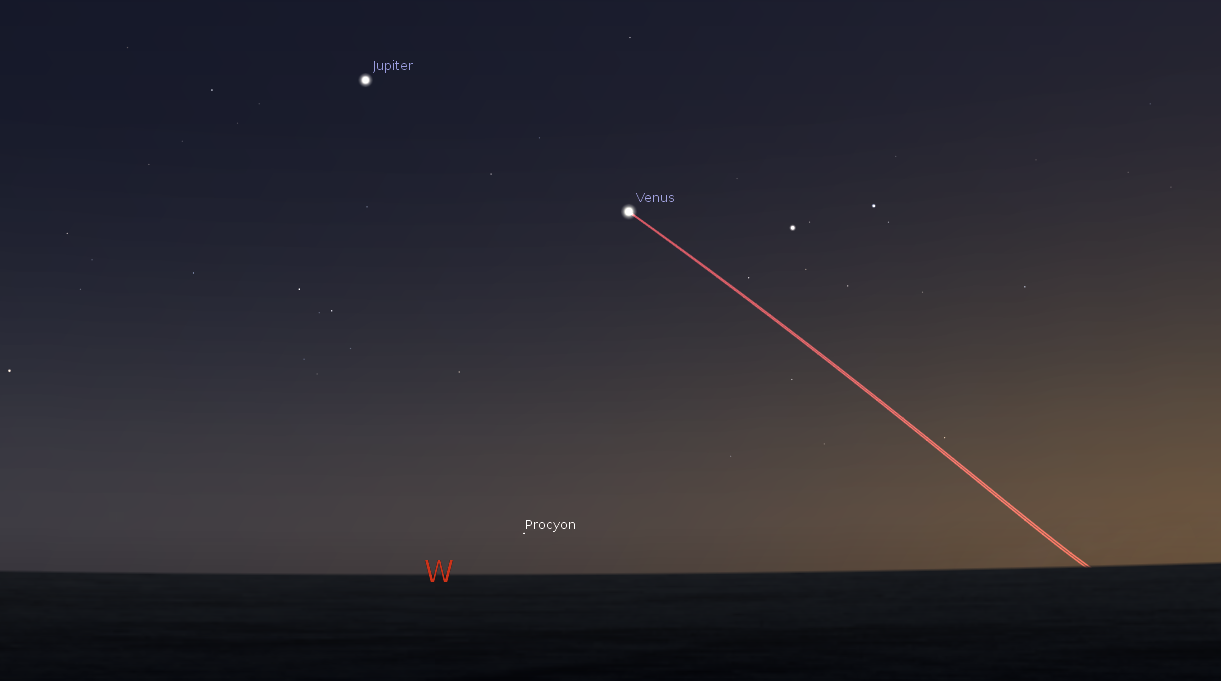
Venus at elongation with a plot of its orbit as seen from Earth at 10:30 p.m. June 6, 2015. Note that the orbit appears at a line. It is this time of year that the Earth passes through the plane of Venus’ orbit. Back in 2012 this occurred when Venus was at inferior conjunction on June 5th. It passed in front of the Sun in the rare transit of Venus. Created using Stellarium.
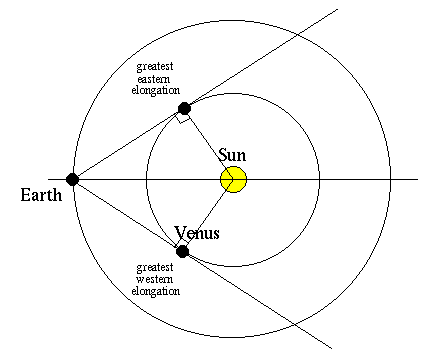
Diagram showing the geometry of a greatest elongation. Note that the sight line is perpendicular to the Venus-Sun line. So the phase should be exactly at dichotomy (half illuminated). Additional lines added to an uncredited diagram.
05/18/2015 – Ephemeris – Venus, beautiful Evening Star or Earth’s evil twin?
Ephemeris for Monday, May 18th. Today the Sun will be up for 14 hours and 55 minutes, setting at 9:07. The Moon is new today, and won’t be visible and tomorrow the Sun will rise at 6:10.
Venus has been called the Earth’s twin because it is 95 percent the size of the Earth. It is 72 percent of the Earth’s distance from the Sun, and that seems to be the thing that turned a planet, perhaps as endowed with the same amounts of water and other minerals as the Earth, into Earth’s evil twin. Those nice shiny white clouds are not the water vapor clouds of Earth, but poisonous corrosive clouds of sulfuric acid droplets. The air which is mostly carbon dioxide is dense, some 90 times the Earth’s atmospheric pressure at sea level. The carbon dioxide atmosphere creates a runaway green house effect, giving a surface temperature of over 800 degrees Fahrenheit. Hotter, even than Mercury, the closest planet to the Sun.
Times are for the Traverse City/Interlochen area of Michigan. They may be different for your location.
Addendum
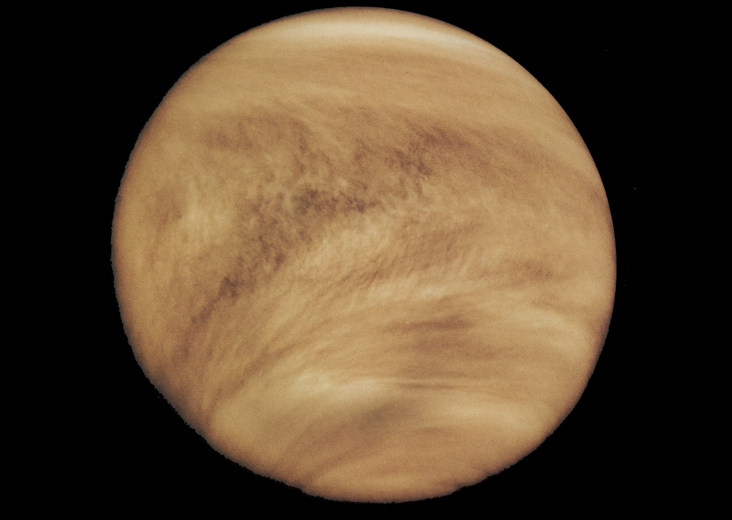
The clouds of Venus in ultraviolet light as seen by Pioneer Venus in 1979. Venus’ clouds provide a blank face in visible light. Credit: NASA.
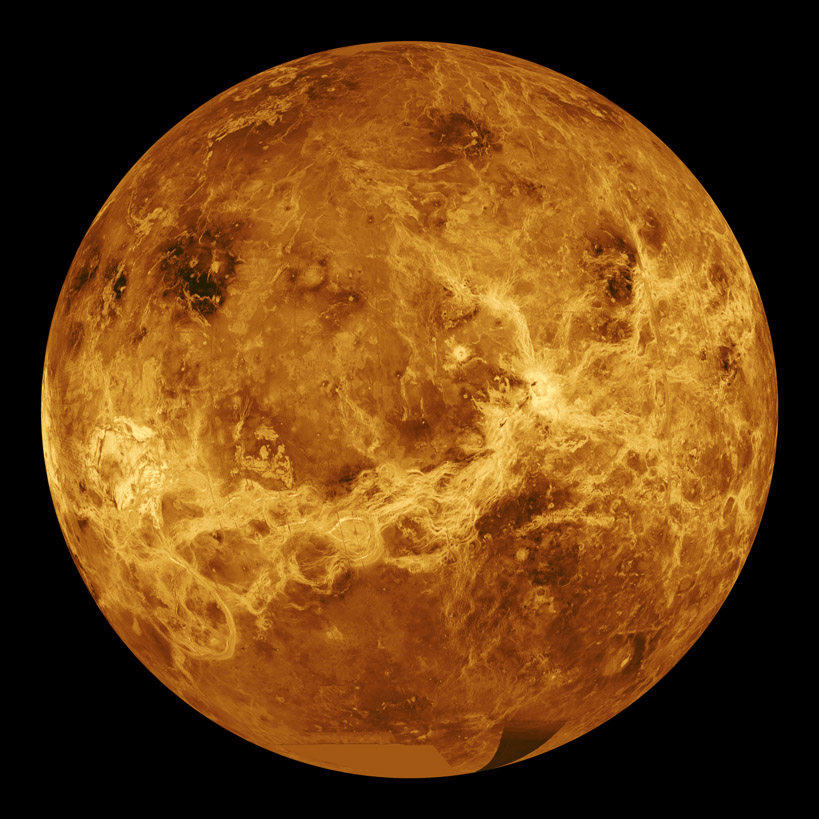
A map of Venus surface produced by NASA’s Magellan spacecraft using radar: 1990-1994. Credit NASA
05/15/2015 – Ephemeris – The Grand Traverse Astronomical Society will be at the NMC Barbecue Sunday
Ephemeris for Friday, May 15th. Today the Sun will be up for 14 hours and 49 minutes, setting at 9:04. The Moon, 3 days before new, will rise at 5:27 tomorrow morning. Tomorrow the Sun will rise at 6:13.
The Grand Traverse Astronomical Society will participate in the Northwestern Michigan College Barbecue. The society will be in front of and inside the Health and Science Building, viewing the Sun outside and inside with displays and a program about meteorites. In the evening sky, Venus is getting to be an interesting sight in telescopes. It is still way too bright, so the earlier it can be spotted the better. Magnification helps with the brightness, but as Venus sinks in the sky its image will deteriorate, undulate with the upper air currents and develop color fringes due to the prismatic effects of the thick atmosphere down low. Venus will continue to grow larger, and its phase gets thinner until it’s too close to the Sun to spot.
Times are for the Traverse City/Interlochen area of Michigan. They may be different for your location.
Addendum
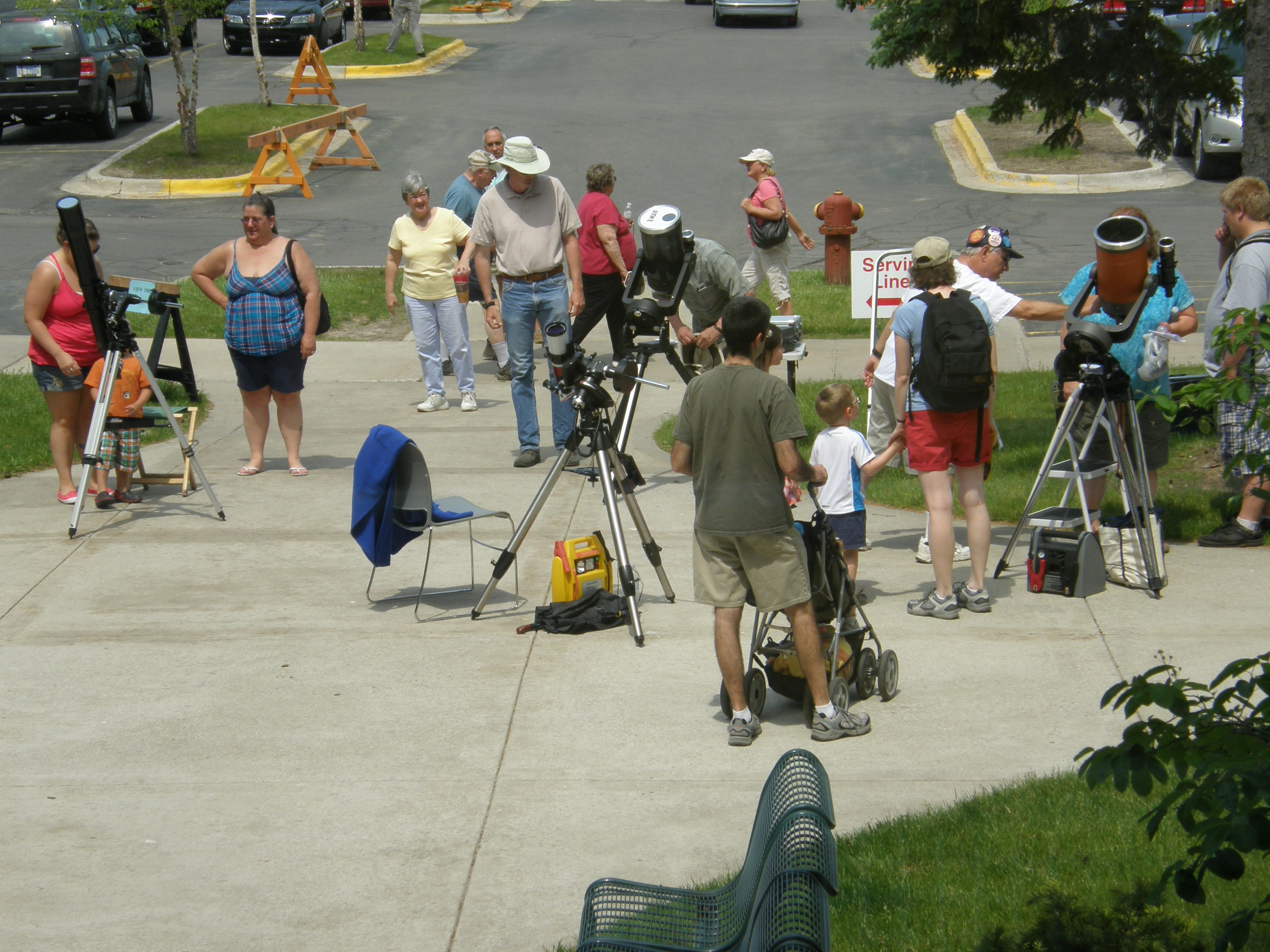
Observing the sun through GTAS members telescopes at the NMC Barbecue in 2012. Credit; Eileen Carlisle.
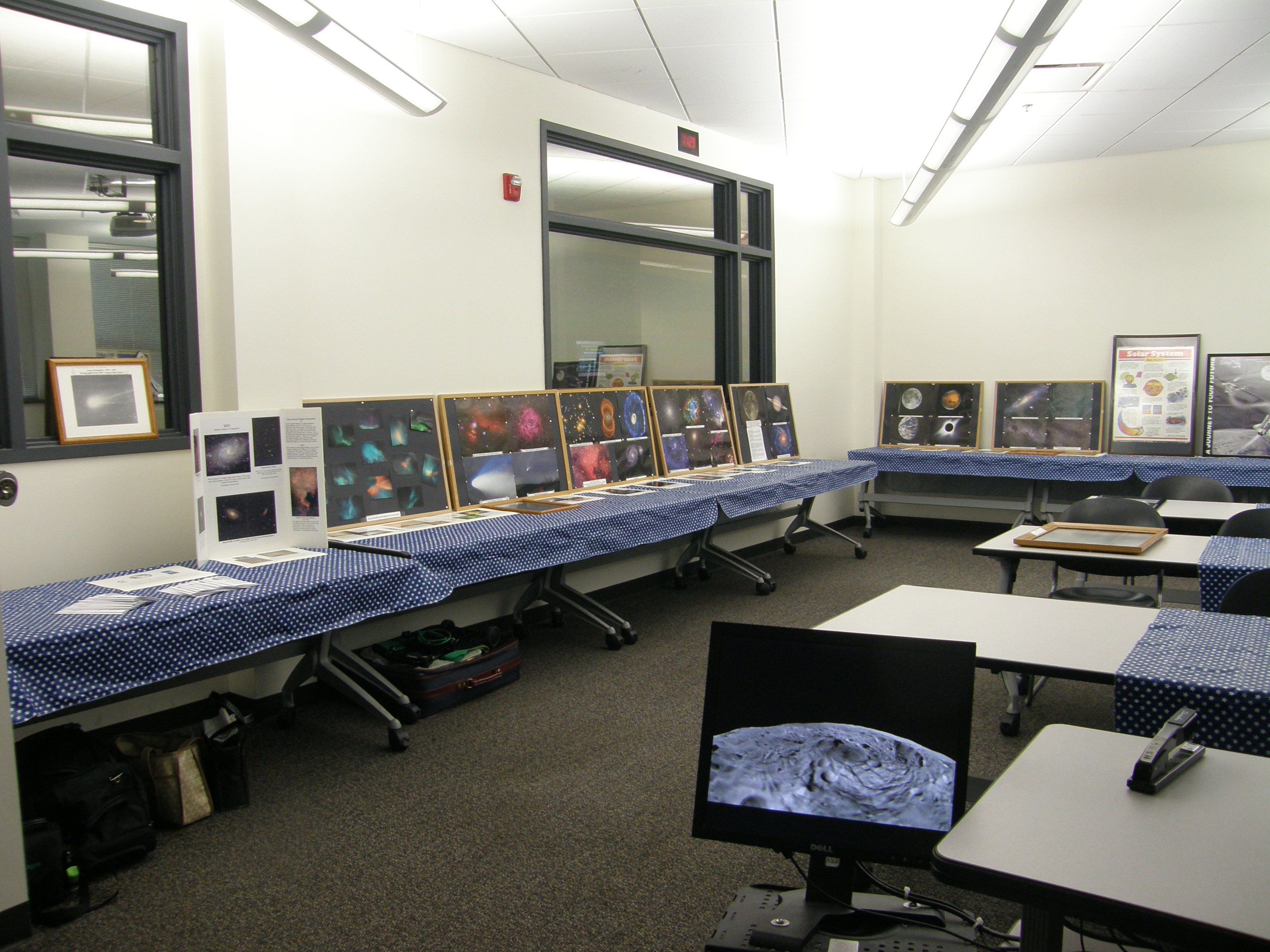
Astronomical photographs line the walls and tables of a classroom plus a series of astronomy videos are displayed at the NMC Barbecue. Credit: Eileen Carlisle.
 Bob Moler's Ephemeris Blog