Archive
05/13/2013 – Ephemeris – Evening viewing prospects for the planet Venus
Ephemeris for Monday, May 13th. Today the sun will be up for 14 hours and 45 minutes, setting at 9:01. The moon, 4 days past new, will set at 12:10 tomorrow morning. Tomorrow the sun will rise at 6:15.
For the rest of the year Venus will be in our evening sky. However it will not appear high in the west. It is making its appearance just when the path of the planets will begin to lie down south of the sun. The best time to see planets in the west after sunset is generally between December to June. The other six months they are best seen in the morning sky in the east. Since Venus lies between the earth and the sun, it never strays far from it. Right now Venus is emerging from behind the sun, and is nearly fully illuminated by the sun and far from us. The last two months of this year Venus will be close to us and exhibiting a crescent phase as it approaches and is about to pass between the earth and the sun.
03/29/2013 – Ephemeris –
Ephemeris for Thursday, March 28th. The sun will rise at 7:30. It’ll be up for 12 hours and 34 minutes, setting at 8:05. The moon, 1 day past full, will rise at 10:01 this evening.
Venus is passing superior conjunction with the sun today. Superior means Venus is passing behind, thought not directly behind the Sun. You can see it only in the images of the SOHO spacecraft. On the Internet google soho nasa to find the site. Our last inferior conjunction of Venus was the transit of Venus last June, when Venus crossed the face of the sun. Mars is about to pass in conjunction with the sun. All its conjunctions are superior. For about a month, starting April 4th. the satellites and rovers cannot receive transmissions from the earth due to the sun’s radio noise, so they are put into a passive state. The Deep Space Network on the earth can pick up their transmissions, though not well during this period due to its greater sensitivity.
Times are for the Traverse City/Interlochen area of Michigan. They may be different for your location.
Addendum
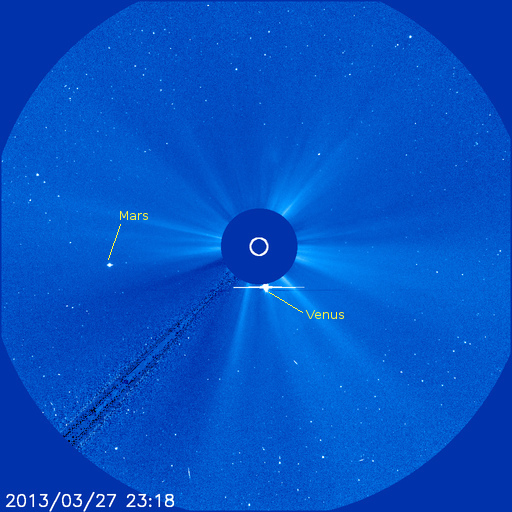
Annotated SOHO LASCO C3 image of the sun, behind the occulting disk with Venus and Mars. Image: ESA, NASA
12/04/2012 – Ephemeris – Mercury in the morning
Ephemeris for Tuesday, December 4th. The sun will rise at 8:02. It’ll be up for 8 hours and 59 minutes, setting at 5:02. The moon, 2 days before last quarter, will rise at 10:59 this evening.
The planet Mercury has joined the morning planets for a week or so. Mercury can be best spotted low in the east southeast starting about 7 a.m. It will be below and slightly left of Venus, the brightest planet, about the same distance below as Saturn is above Venus. They’re just about in straight line. Binoculars will help in the search. Once found Mercury may be tracked past 7:30. Mercury will be visible for about a week as become somewhat brighter as it does. That’s because Mercury’s phase at its half illuminated today at its greatest elongation from the sun. It will be becoming more and more full as it moves around the sun mostly away from us now. Mercury is a prise, few people have ever seen it.
Times are for the Traverse City/Interlochen area of Michigan. They may be different for your location.
Addendum
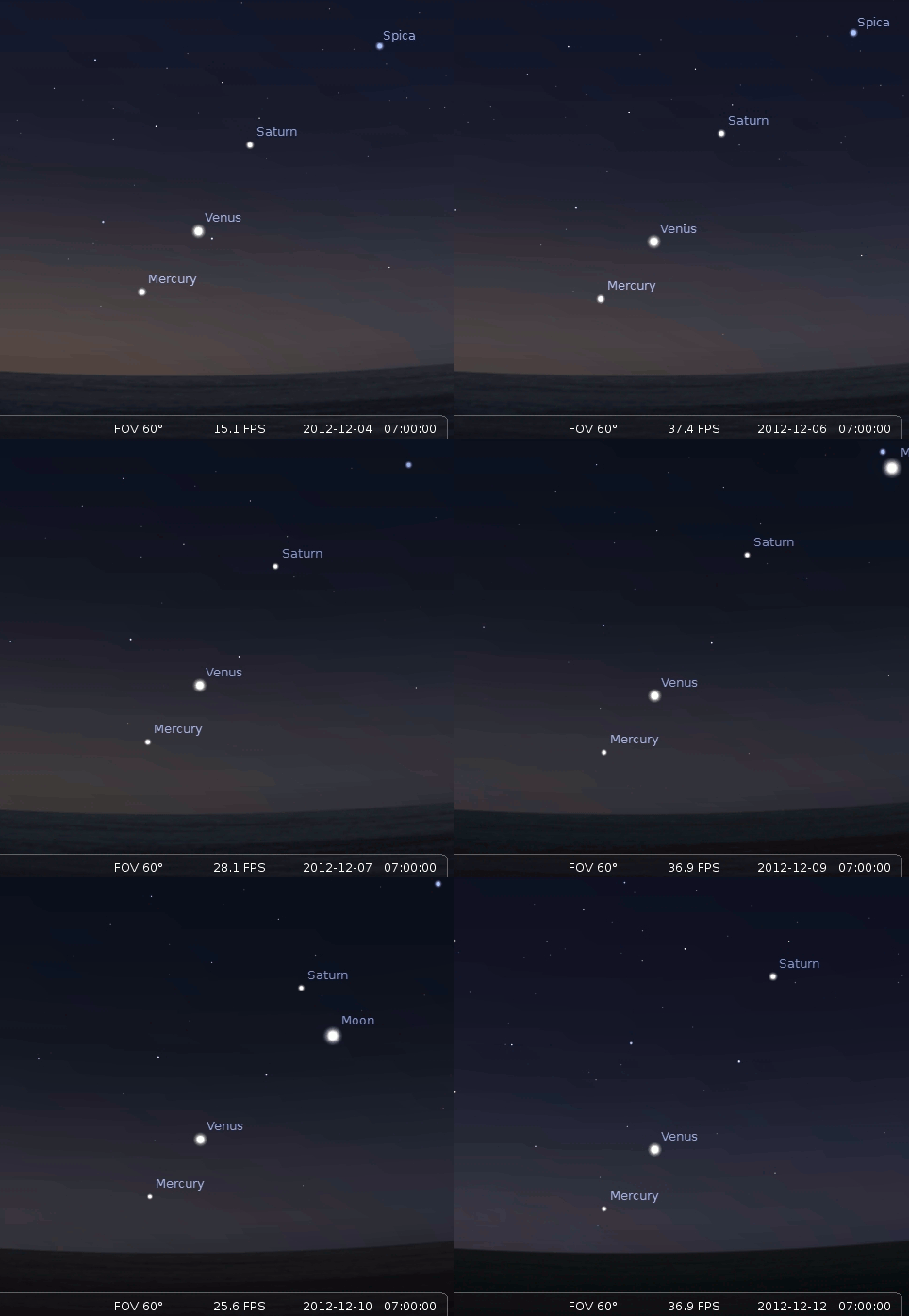
Mercury animation starting December 4, 2012. Created using Stellarium
Note the passage of the moon on the mornings of the 10th and 11th. The moon will actually be a thin crescent.
Grand Traverse Astronomical Society’s Transit of Venus Watch – What a Time!
This was a fantastic event at Traverse City’s Open Space on the bay front. The clouds that threatened all day parted and dissolved to reveal a perfect sky. Hundreds of people turned out. Here are some crowd shots I made with my Android phone, plus one of the transit.
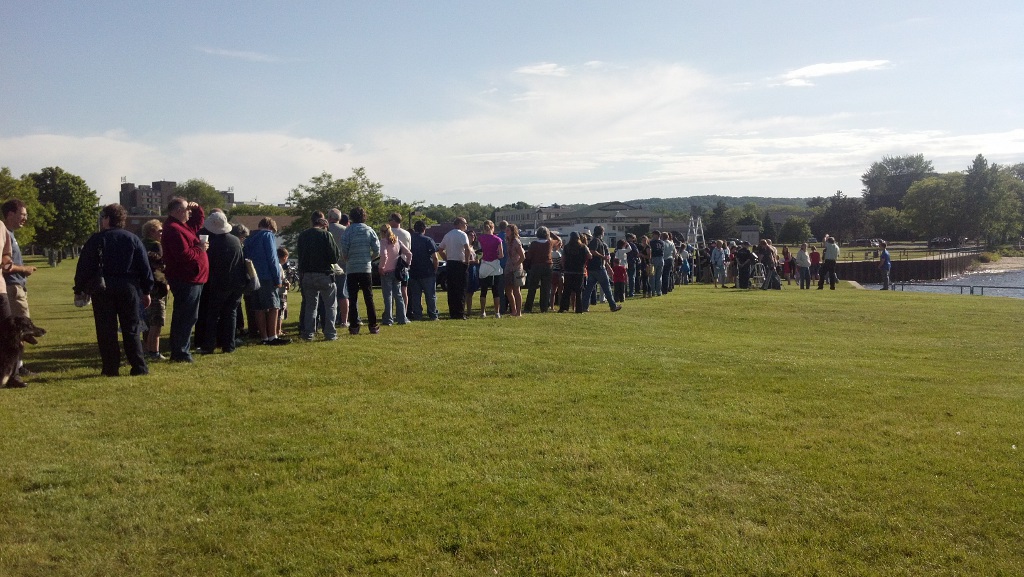
Most of a huge line to see the transit with the GTAS’ 25″ Dobsonian telescope.
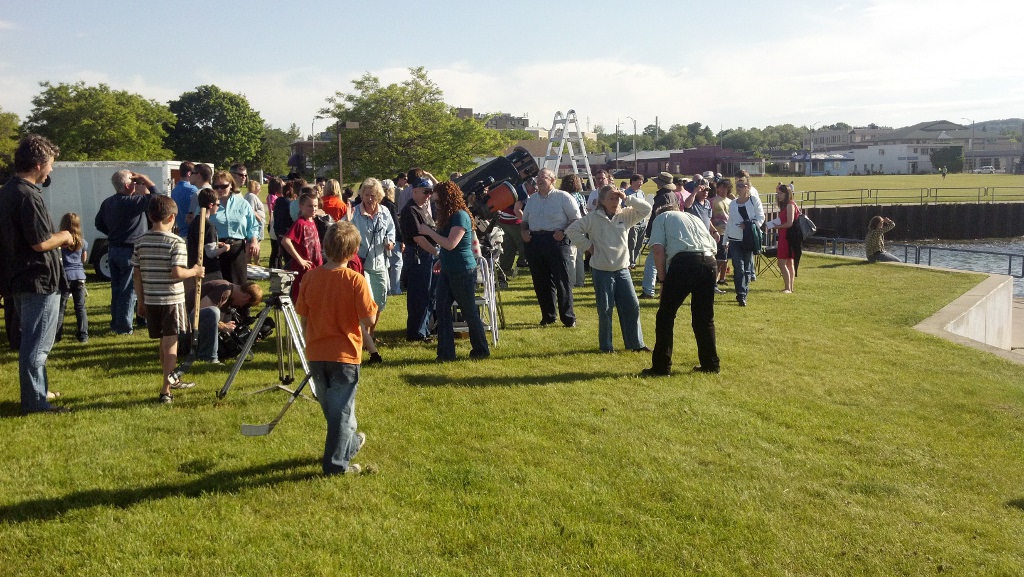
Transit Crowds near the telescopes.
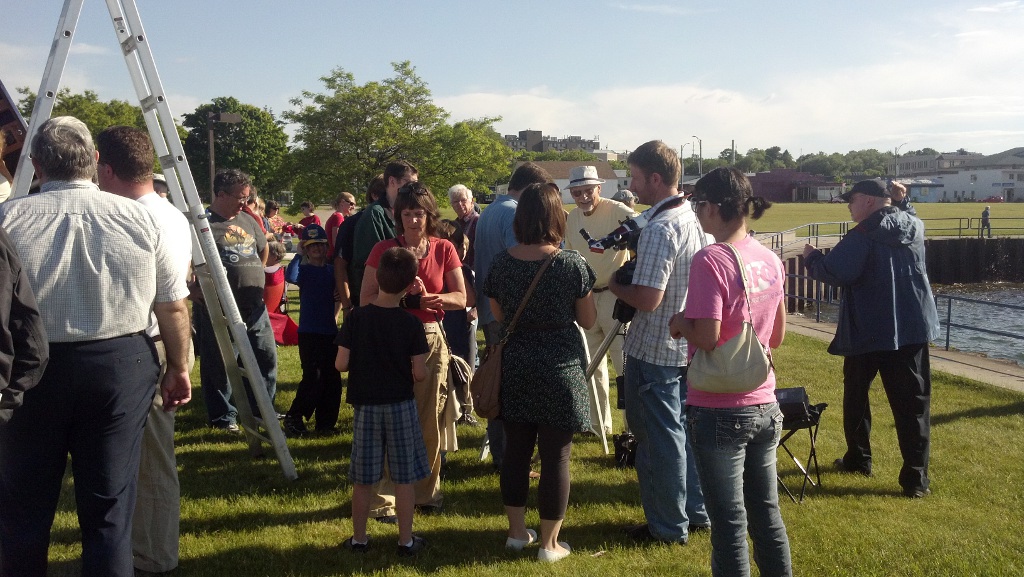
More of the Transit Crowd an Bill Renis manning our Lunt Hydrogen Alpha Solar Telescope.
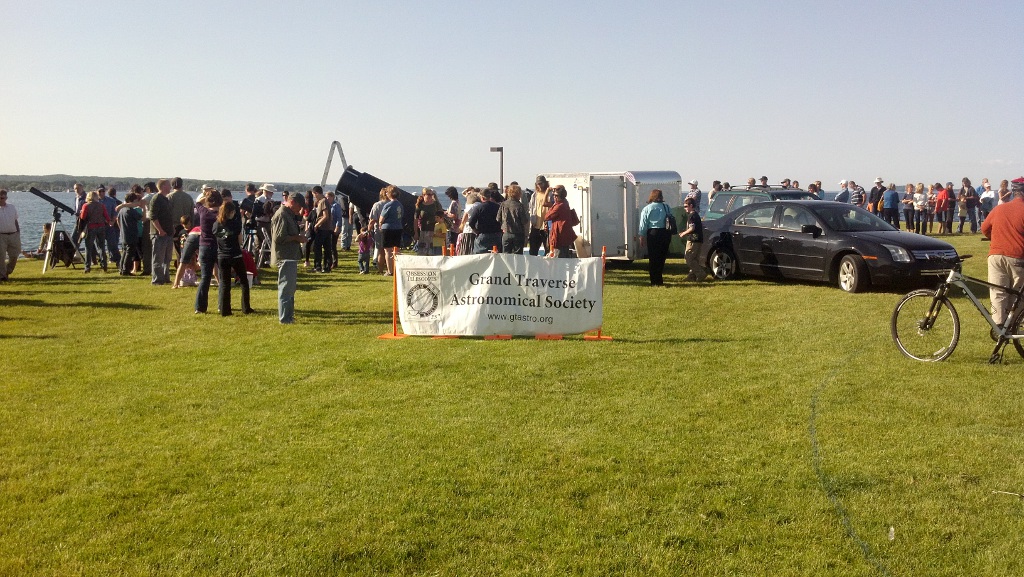
A look at the crowd and our GTAS Banner.
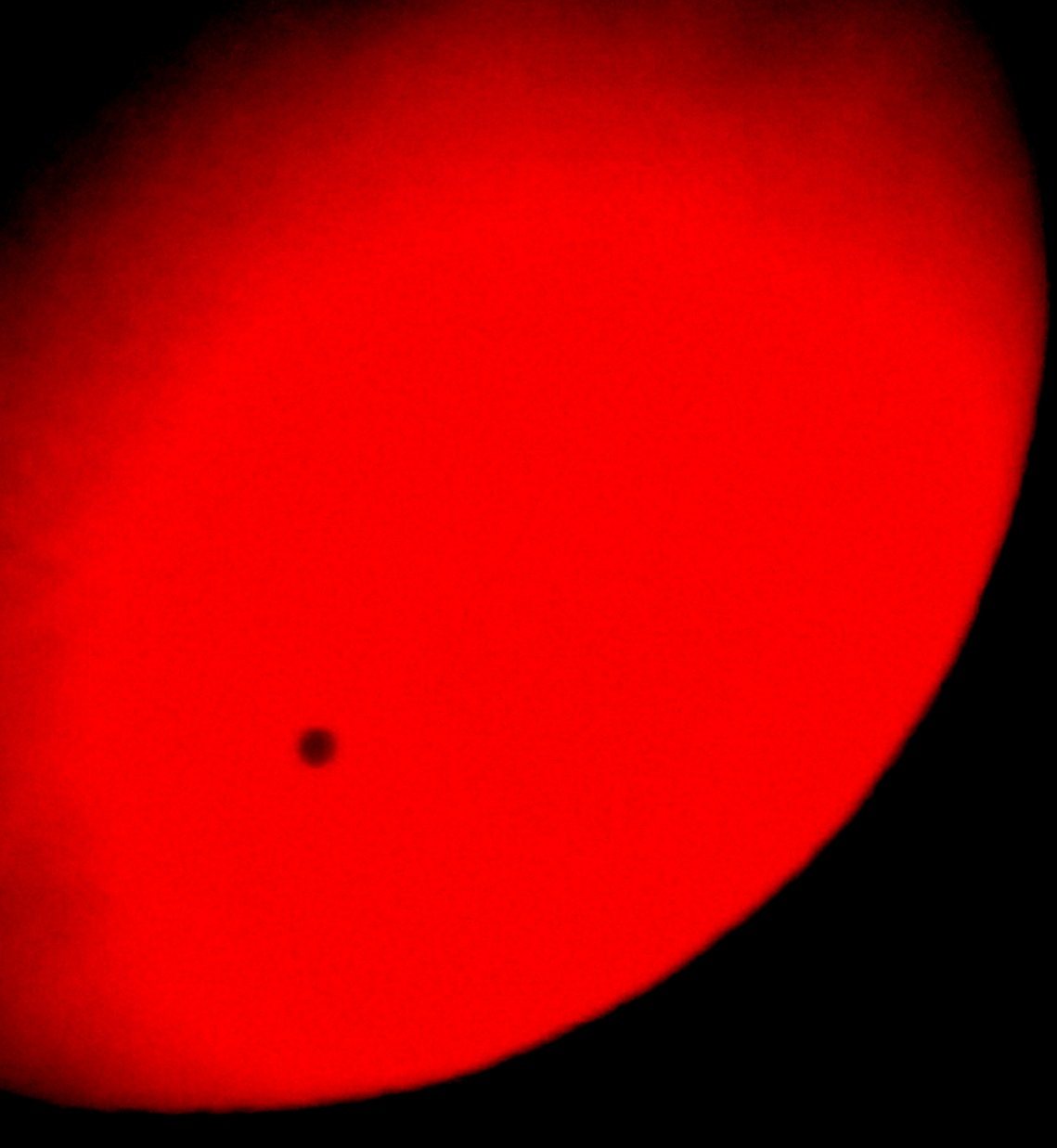
Venus against the sun taken at 8:49 p.m. through the Lunt solar telescope and a Droid Bionic phone.
Update (06/22/2012)
I received photographs from Gary and Eileen Carlisle and put them on the gtastro.org website. Here are theirs below. Eileen took the crowd shots, while Gary took the transit shot just before sunset as the crowds thinned. Gary’s crowd estimate was 500 folks.
More information: The transit started at 6:04 p.m. EDT. I spotted first contact through the Lunt. It took another minute or so to spot it in the white light telescopes. The Lunt showed the sun’s chromosphere that extends some 6,000 miles above the sun’s photosphere. The transit ended fro us as the sun set into the hills of Leelanau County across the west arm of Grand Traverse Bay.
The location we viewed from was the Open Space Park on the bay front in Traverse City, Michigan US. It is also used as the main venue of the National Cherry festival in early July and free outdoors screenings of movies at the Traverse City Film Festival in late July or early August.
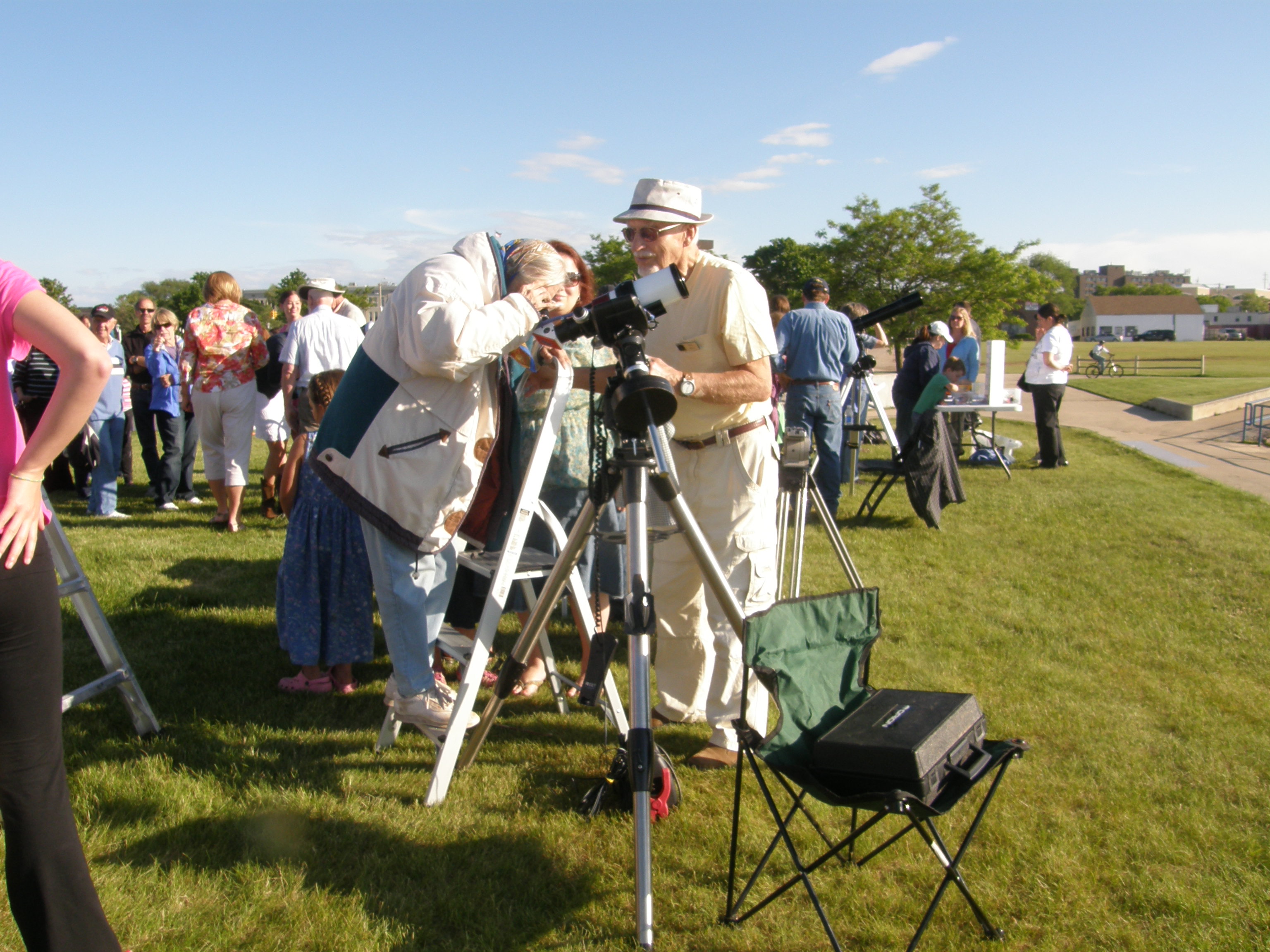
Bill Renis (yellow shirt, white hat and sunglasses) helping a person view the transit using the Lunt Solar Telescope. This was also the society’s 30th anniversary. Bill and I were the only two charter members attending.
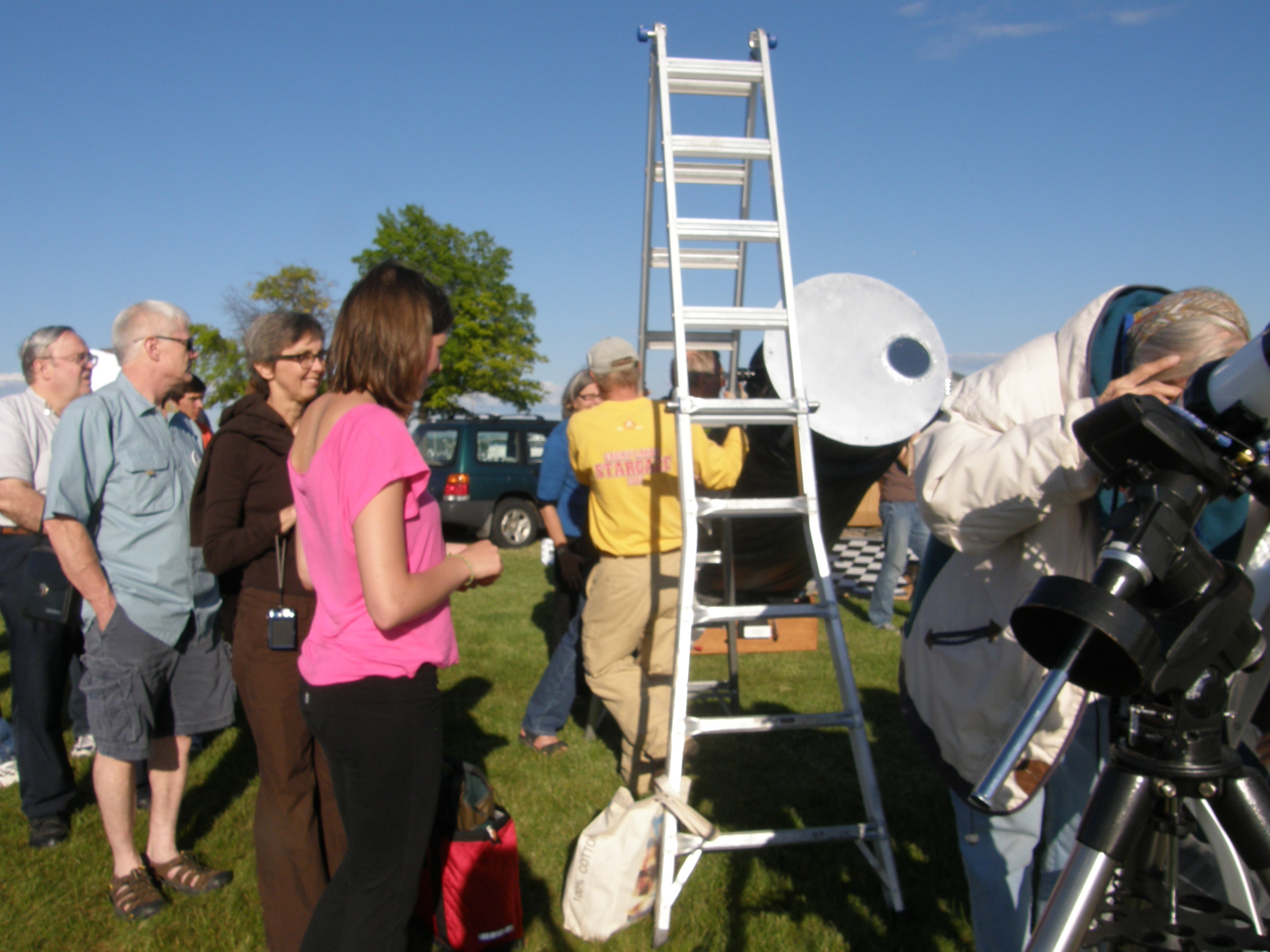
We brought out our Obsession 25″ telescope, stopped down to 8 inches with a solar filter. It gave excellent images. I saw second contact without the annoying teardrop effect.
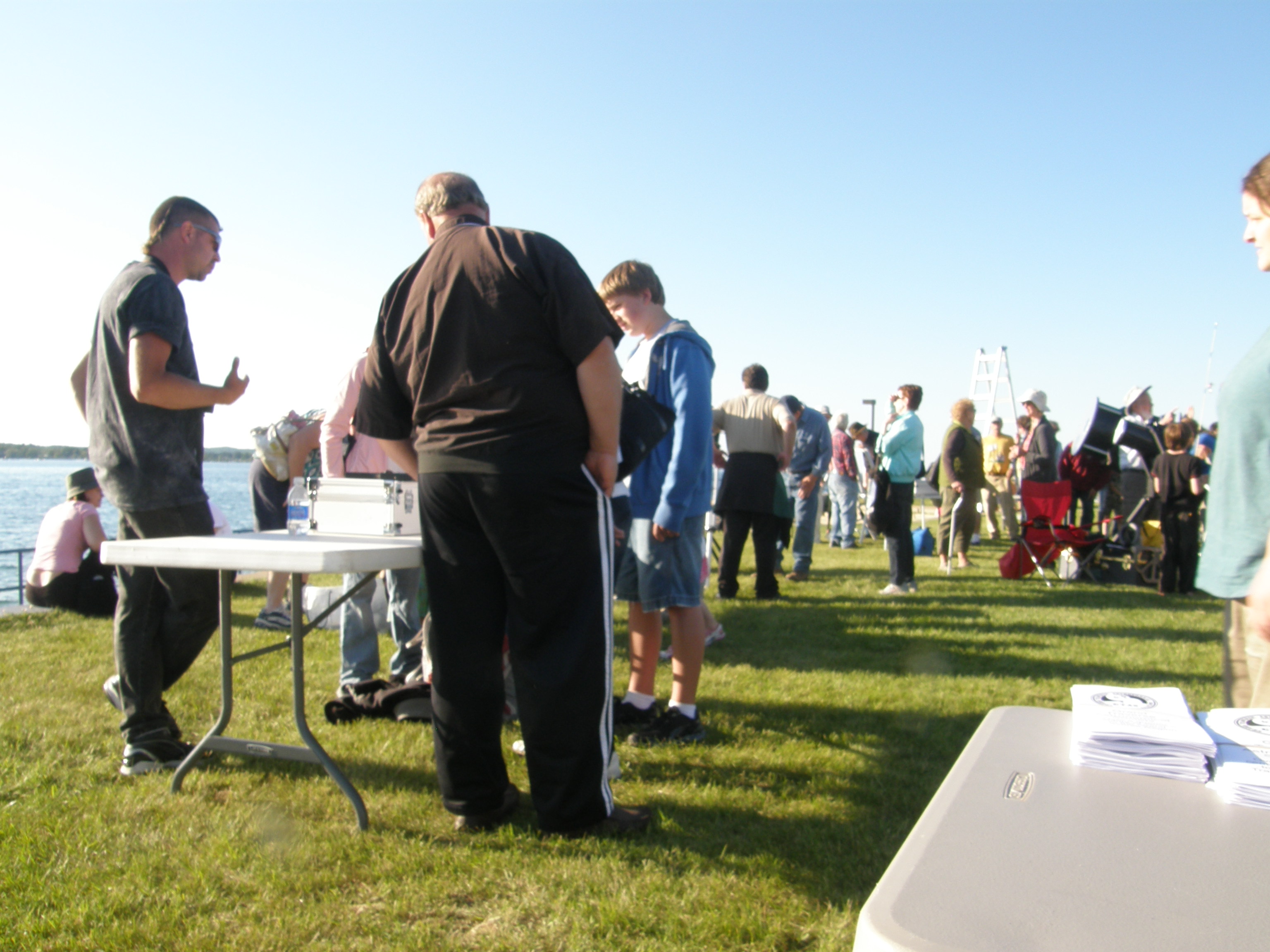
Our “Meteorite Man” Joe Brooks brings out his meteorite collection for our events.
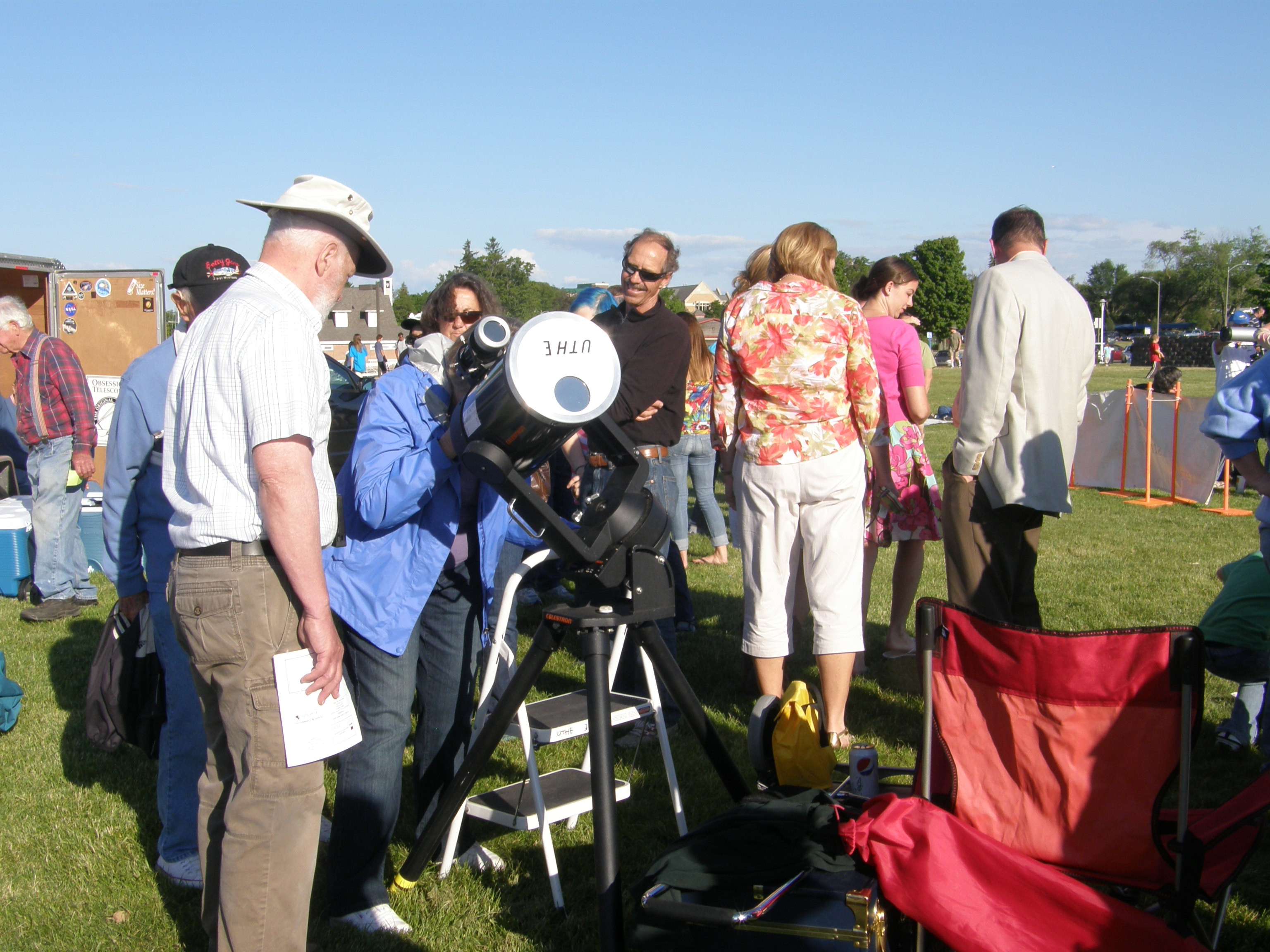
Member Ron Uthe brought his 8″ telescope to the event.
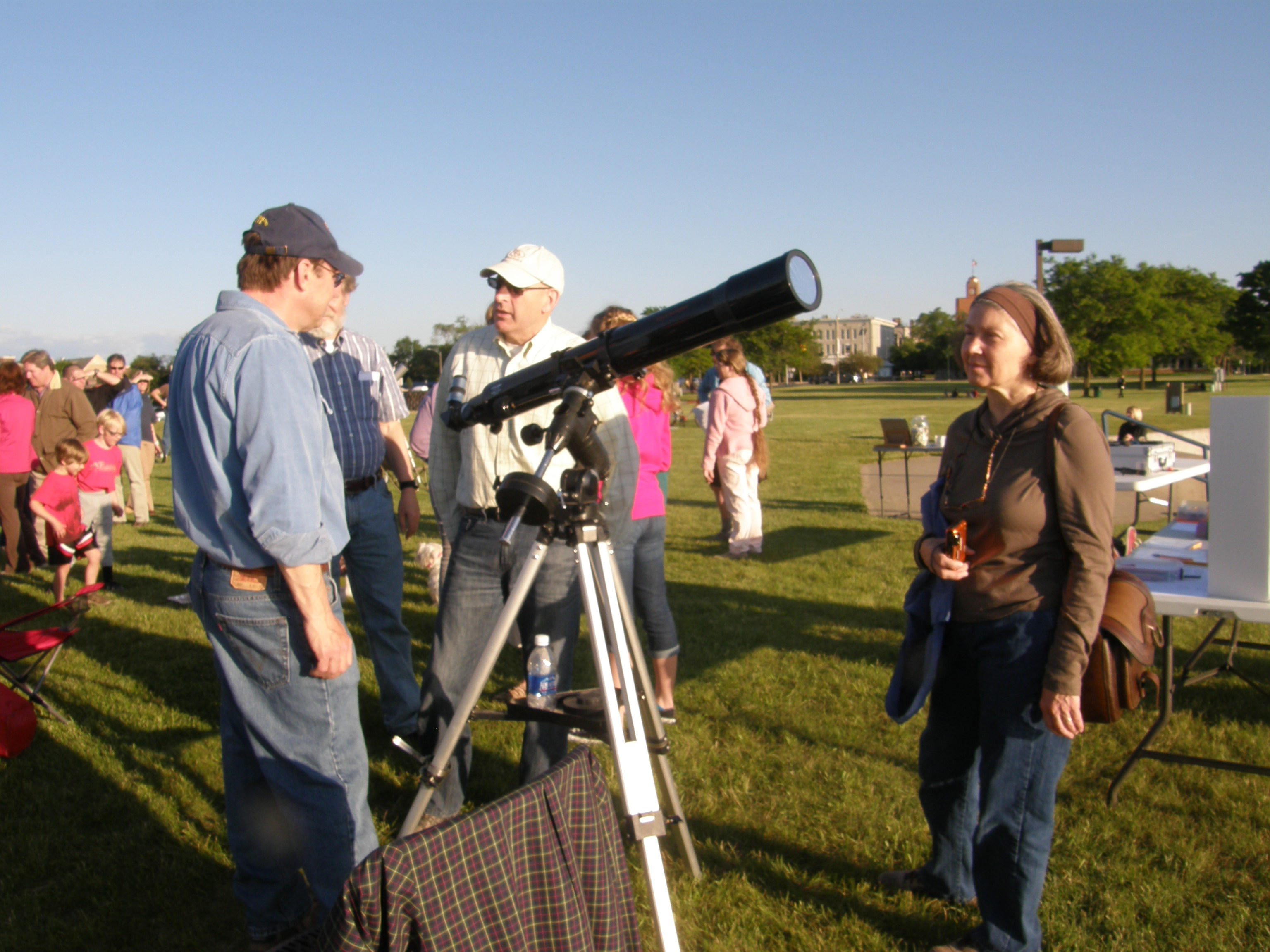
This is GTAS president Rich Kuschell’s 4″ refractor.

A little impromptu musical accompaniment.
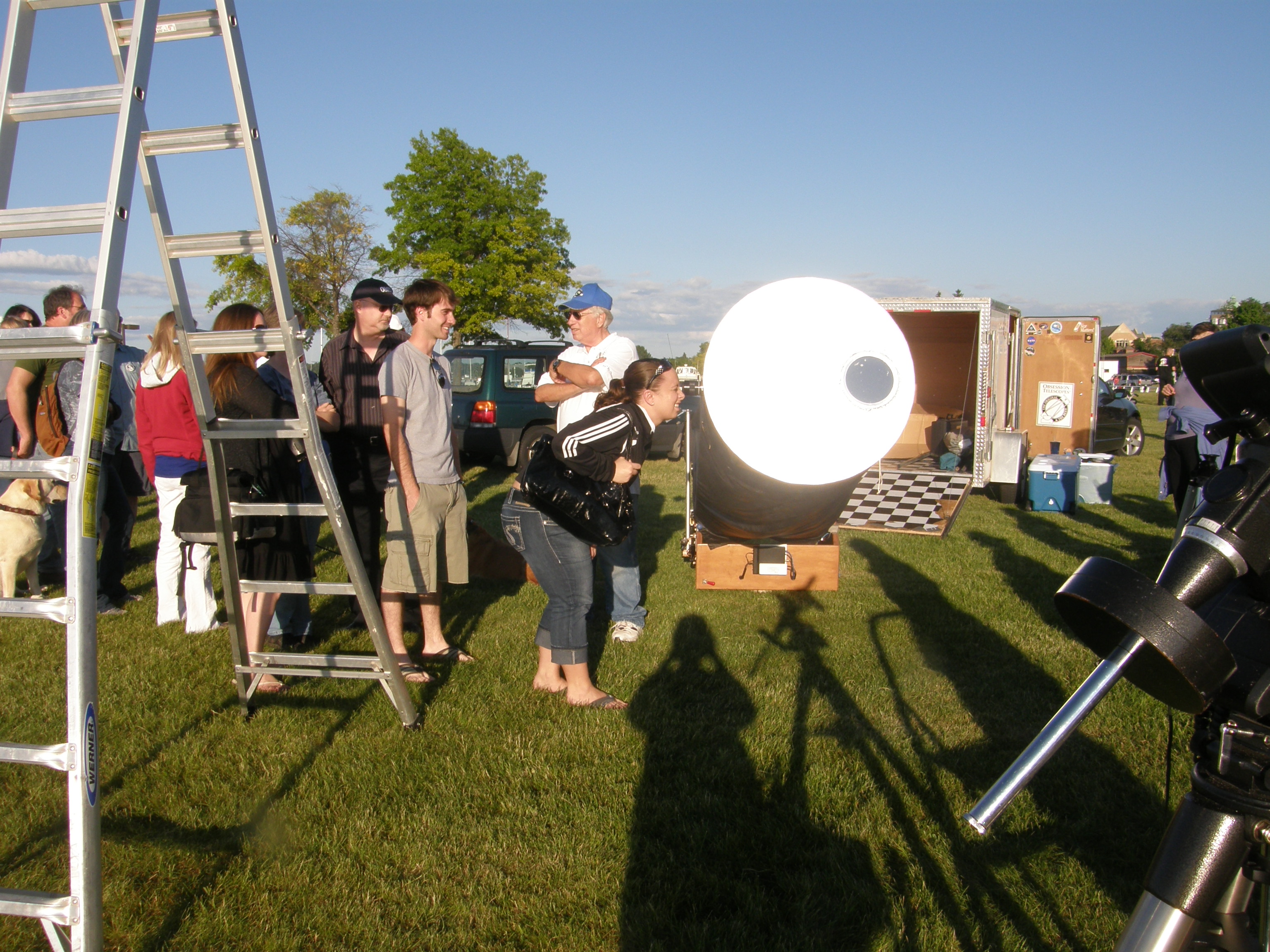
The sun’s getting low now. That’s me in the blue cap.
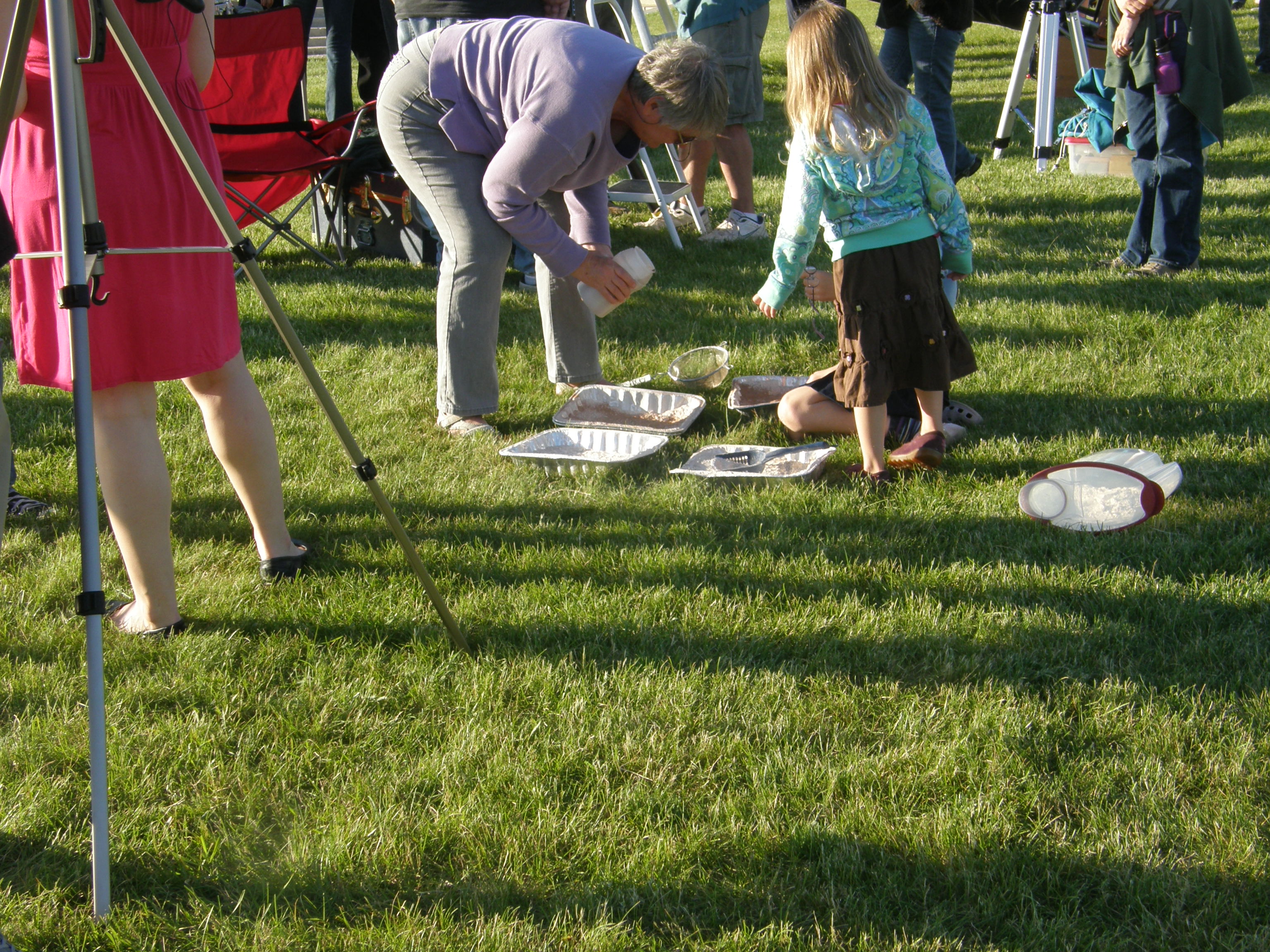
The small kids got a chance to create moon craters in pans of flour covered by chocolate drink powder.
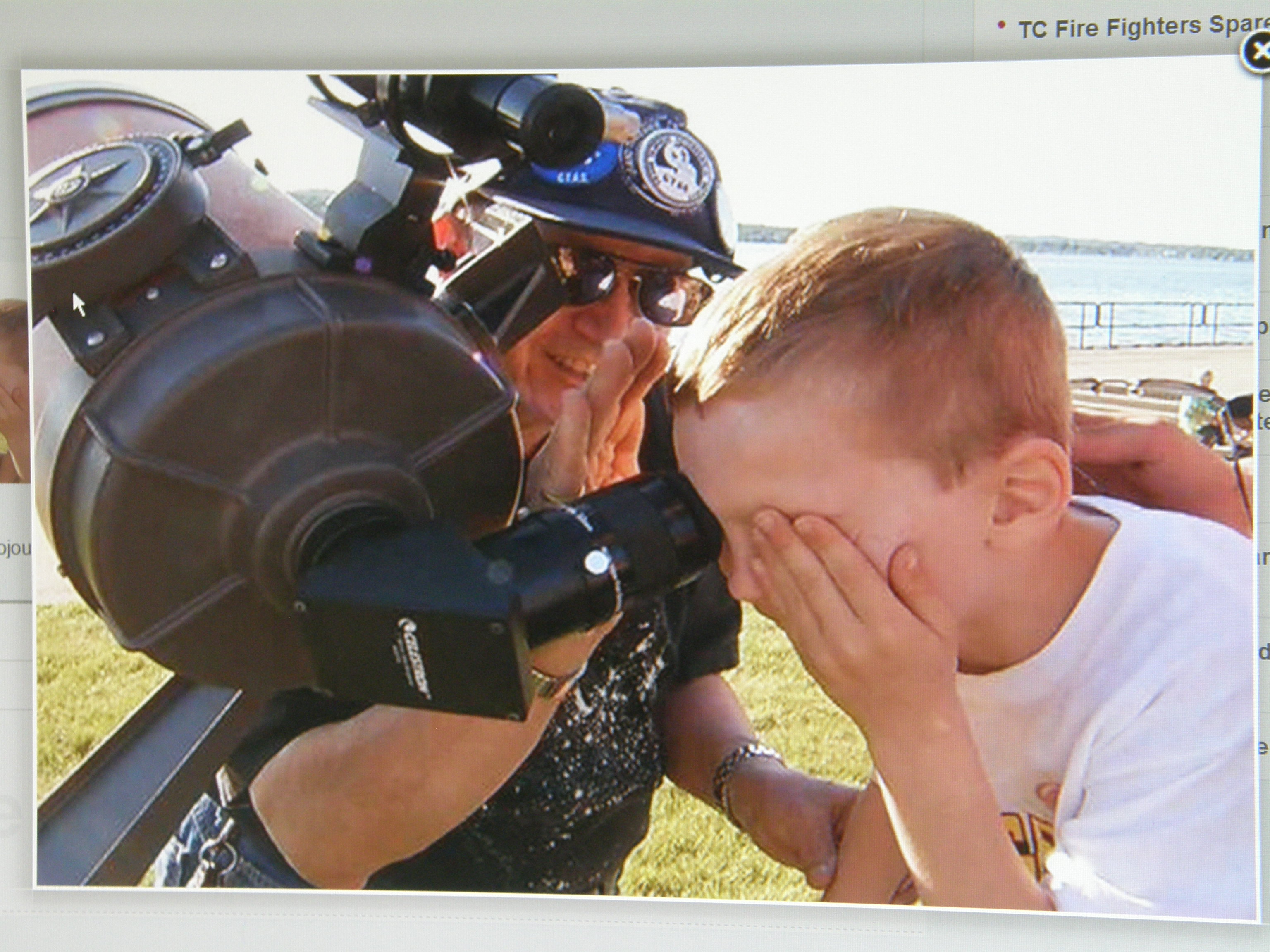
Gary Carlisle shielding the sun for a young man viewing through his 8″ telescope.
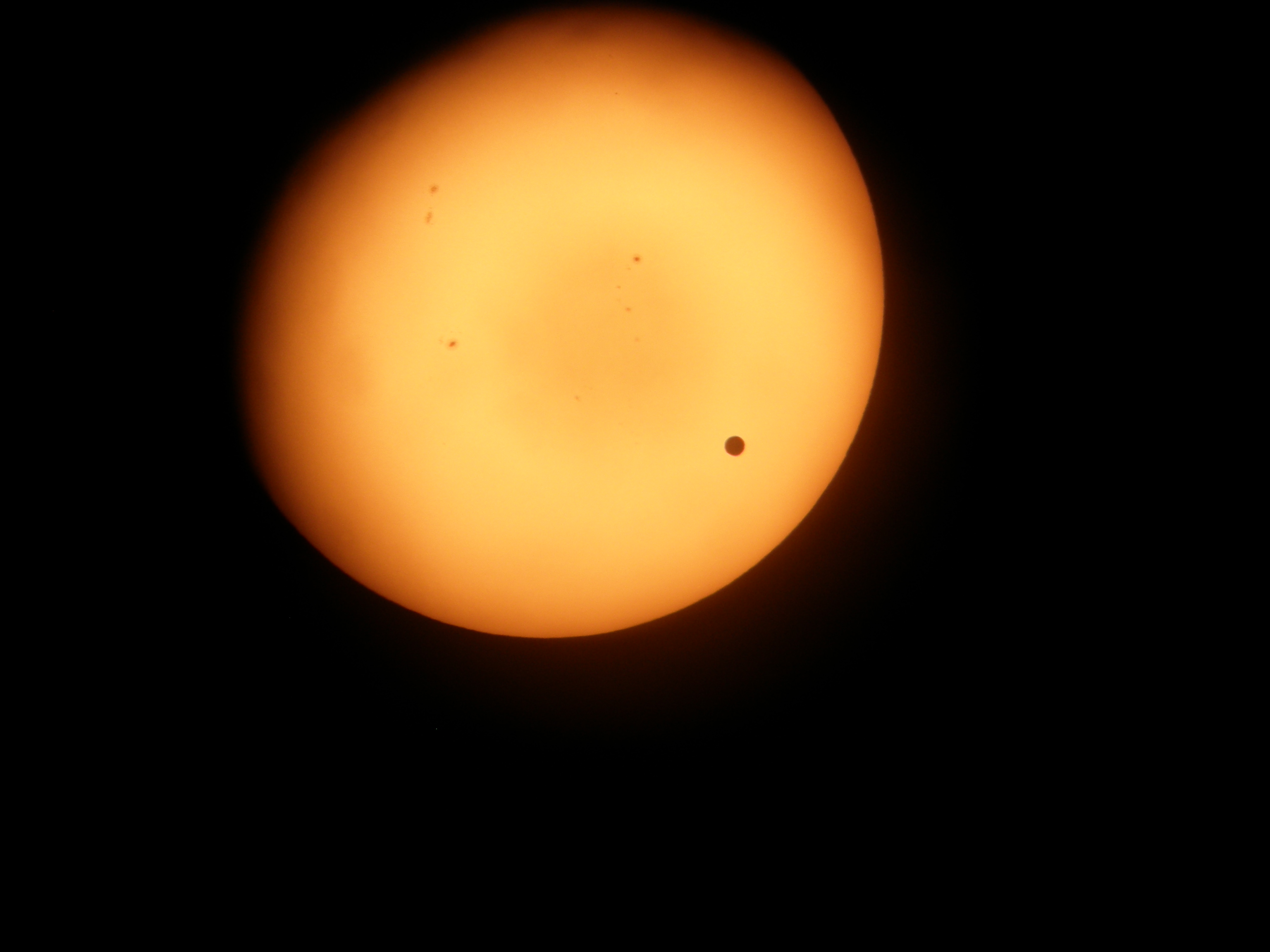
Gary’s photo of the transit.
06/05/2012 – Ephemeris – Transit of Venus is today!
Ephemeris for Tuesday, June 5th. Today the sun will be up for 15 hours and 25 minutes, setting at 9:24. The moon, 1 day past full, will rise at 10:46 this evening. Tomorrow the sun will rise at 5:58.
Early this evening we will see a rare event, the transit of the planet Venus across the sun. This will start at a few minutes after 6 p.m. When Venus will start crossing the sun from near the top. While the transit will last nearly 7 hours, we’ll see about 3 hours of it, clouds willing before the sun sets. The safety precautions are the same as viewing a solar eclipse, that is Do Not Look Directly At The Sun. Safe approved solar filters that fit in front of a telescope, projection of the sun’s image with a telescope or binoculars are the ways to view this event. The Grand Traverse Astronomical Society will be at the Open Space in Traverse City at 6 p.m. tonight for safe views of the event. The next transit of Venus will be in 2117.
Times are for the Traverse City/Interlochen area of Michigan. They may be different for your location.
Addendum
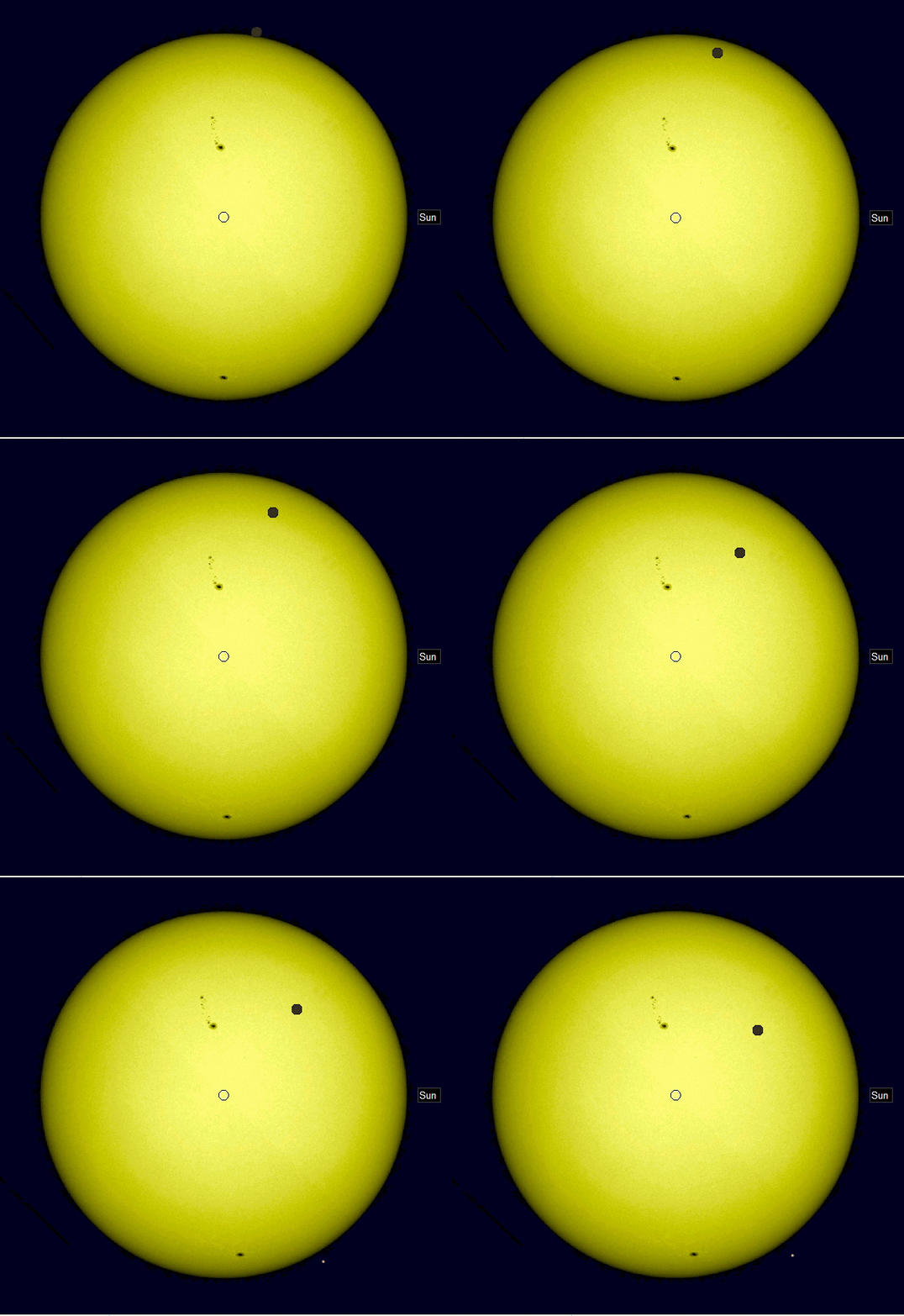
Animation of the Transit of Venus from Northern Michigan. Created using cartes du Ciel.
The Animation starts with Venus at contact 1, and every half hour until sunset. That’s why the transit ends abruptly.
For more information check out this NASA page.
How to observe the sun? The same techniques that are use to view a solar eclipse.
06/04/2012 – Ephemeris – Rare Transit of Venus is tomorrow
Ephemeris for Monday, June 4th. Today the sun will be up for 15 hours and 24 minutes, setting at 9:23. The moon, at full today, will rise at 9:51 this evening. Tomorrow the sun will rise at 5:58.
A partial eclipse of the moon is in progress this morning, but it started at moon set at 6 a.m. Tomorrow is a much rarer event, a transit of Venus across the face of the sun. This will start at a few minutes after 6 p.m. When Venus will start crossing the sun from near the top. While the transit will last nearly 7 hours, we’ll see about 3 hours of it, clouds willing. The safety precautions are the same as viewing a solar eclipse, that is Do Not Look Directly At The Sun. Safe approved solar filters that fit in front of a telescope, projection of the sun’s image with a telescope or binoculars are the ways to view this event. The Grand Traverse Astronomical Society will be at the Open Space in Traverse City at 6 p.m. Tomorrow for safe views of the event.
Times are for the Traverse City/Interlochen area of Michigan. They may be different for your location.
Addendum
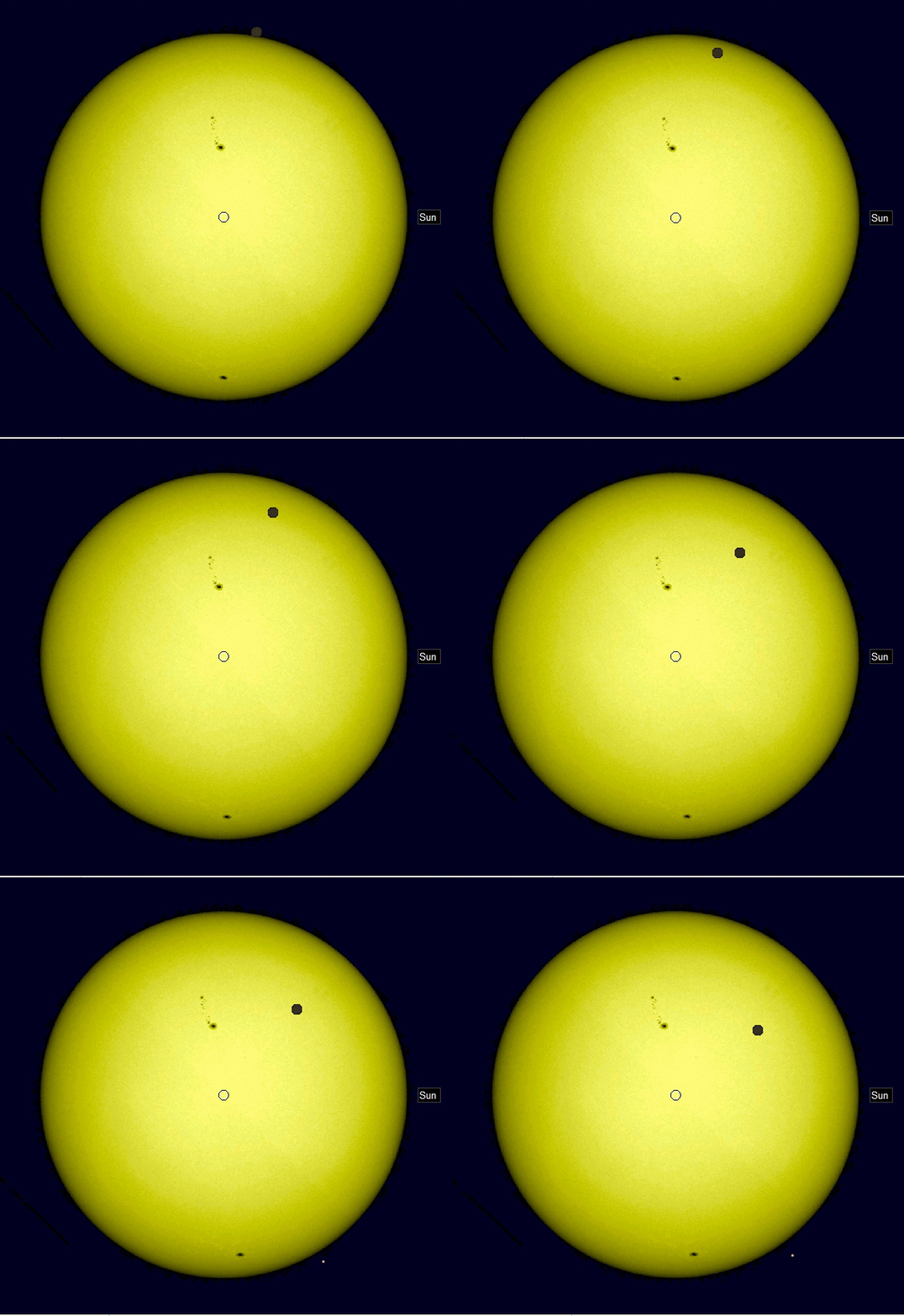
Transit of Venus as seen from the Grand Traverse Region. Created using Cartes du Ciel.
These plots are in 30 minute intervals starting around 6:10 p.m.
05/25/2012 – Ephemeris – Of conjunctions, superior and inferior
Ephemeris for Friday, May 25th. Today the sun will be up for 15 hours and 10 minutes, setting at 9:14. The moon, 3 days before first quarter, will set at 12:45 tomorrow morning. Tomorrow the sun will rise at 6:03.
The planet Mercury will pass the behind the sun this weekend, in what is called superior conjunction. It is called that because Mercury is beyond or superior to the sun. Venus and Mercury can have both superior and inferior conjunctions because they are inferior planets, not a statement of their quality, but simply because they reside in orbits between the earth and the sun. A conjunction occurs when two solar system bodies pass each other from our point of view. Anyway Mercury will slowly move into our evening sky and by July first might be glimpsed in evening twilight. Mercury can be seen near its greatest elongations or separations from the sun on spring evenings and autumn mornings. July will push it a bit.
Times are for the Traverse City/Interlochen area of Michigan. They may be different for your location.
05/22/2012 – Ephemeris – The moon appears near Venus tonight
Ephemeris for Tuesday, May 22nd. Today the sun will be up for 15 hours and 4 minutes, setting at 9:11. The moon, 2 days past new, will set at 10:50 this evening. Tomorrow the sun will rise at 6:06.
Tonight the extremely thin crescent moon will appear below and left of the planet Venus. Venus itself is an extremely thin crescent, just two weeks from passing directly in front of the sun in a rare transit part of which will be visible from here. Venus is a crescent because we are looking mostly on its night side, with just a sliver of light on its sunlit edge. Even though Venus shows such a small sunlit sliver, it’s still very bright, since its nearness to us makes it appear larger in our sky. You can even see the crescent in binoculars. Venus is so bright because it’s close to us, just slightly smaller than the earth, but socked in by while sulfuric acid clouds that reflect most of the suns light covering a runaway green house effect beneath.
Times are for the Traverse City/Interlochen area of Michigan. They may be different for your location.
Addendum
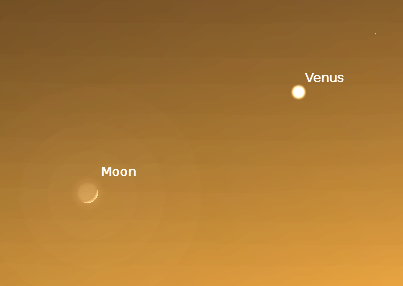
Venus with the moon on the evening of May 22, 2012. Created using Stellarium.
05/07/2012 – Ephemeris – The Crescent Venus
Ephemeris for Monday, May 7th. The sun rises at 6:23. It’ll be up for 14 hours and 31 minutes, setting at 8:54. The moon, 2 days past full, will rise at 11:10 this evening.
The planet Venus now is spectacular both to the unaided eye and through a telescope. To the eye Venus is the brilliant evening star in the west in the evening. In a telescope it appears as a bright crescent like the moon. This surprised some of the folks that came out to out star party last Friday. The dark side of Venus is the night side of the planet because Venus is now moving between us and the sun, so it’s shining mostly on the other side of the planet. This effect will get more pronounced as Venus becomes more in line with the earth and the sun over this month. When Venus crosses between the earth and the sun June 5th, our time it will actually pass in front of the sun, a rare transit of Venus that will start a little past 6 p.m. That evening.
Times are for the Traverse City/Interlochen area of Michigan. They may be different for your location.
04/24/2012 – Ephemeris – The moon appears near Venus tonight
Ephemeris for Tuesday, April 24th. The sun rises at 6:42. It’ll be up for 13 hours and 56 minutes, setting at 8:39. The moon, 3 days past new, will set at 12:05 tomorrow morning.
This evening the moon will appear near Venus with the brilliant planet above and right of the moon. The moon should still exhibit earthshine. On the 30th Venus will attain its greatest brightness of -4.6 magnitude. Only the moon and sun are brighter. In a telescope Venus has a crescent phase and as you view Venus for the next month its phase will get thinner and its size gets larger. This is as it approaches us as it moved more closely between us and the sun. It’s quite a show to watch for. Folks with a low western horizon and clear skies should be able to follow Venus to within a few days of its transit across the face of the sun. Then in bright twilight Venus will have the thinnest of crescents, and appear larger than Jupiter.
Times are for the Traverse City/Interlochen area of Michigan. They may be different for your location.
Addendum
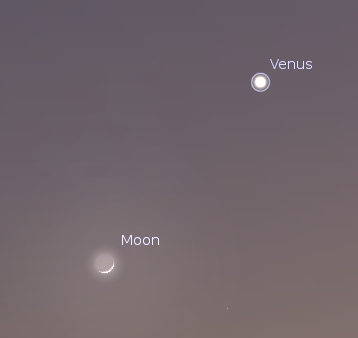
Venus and the moon at 9 p.m. April 24, 2012. Created using Stellarium.
 Bob Moler's Ephemeris Blog