Archive
01/26/2012 – Ephemeris – The moon will appear near Venus tonight
Ephemeris for Thursday, January 26th. The sun will rise at 8:08. It’ll be up for 9 hours and 34 minutes, setting at 5:42. The moon, 3 days past new, will set at 9:46 this evening.
The waxing crescent moon will appear near the bright planet Venus tonight in the southwestern sky after sunset. They were actually closer earlier today, although not that close. The moon happens to be north of the ecliptic plane, which is actually the plane of the earth’s orbit of the sun. Venus is a bit below. The moon has to be close to that plane at new or full moon for eclipses to take place. The moon’s orbit is tilted at 5 degrees to that plane, and crosses it twice a month. So we get eclipse seasons twice a year. The next eclipse is a solar eclipse May 20th, which we’ll see the start of at sunset here. Venus will be close to that plane at its inferior conjunction June 5th when it passes in front of the sun in transit. We’ll see the first 3 hours of that before sunset.
* Times, as always are for the Traverse City/Interlochen area of Michigan.
Addendum
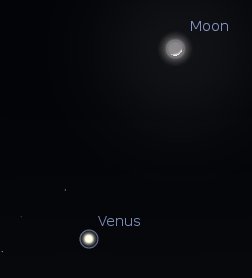
Venus and the moon on the evening January 26, 2012. Created using Stellarium.
01/18/2012 – Ephemeris – Where are the bright planets this week
Ephemeris for Wednesday, January 18th. The sun will rise at 8:14. It’ll be up for 9 hours and 17 minutes, setting at 5:31. The moon, 2 days past last quarter, will rise at 4:51 tomorrow morning.
It’s time again to take a look at the whereabouts of the bright planets. Venus is brilliant in the southwestern sky after sunset and will set at 8:44. Jupiter is the most prominent planet of the evening sky, once Venus sets. It’s located high in the south and is seen against the stars of the constellation Aries. It will pass due south at 6:49 p.m. It will set at 1:36 a.m. Mars will rise at 10:03 p.m in the east northeast and is below the hind end of the constellation Leo the lion. It is 82.4 million miles away and closing. Mars will pass due south at 4:29 a.m. Saturn will rise at 1:15 a.m. just to the left of the bright star Spica in the east southeast.
* Times, as always are for the Traverse City/Interlochen area of Michigan.
01/10/2012 – Ephemeris – Venus, the evening star
Tuesday, January 10th. The sun will rise at 8:18. It’ll be up for 9 hours and 3 minutes, setting at 5:21. The moon, 1 day past full, will rise at 7:18 this evening.
Venus is getting brighter and is appearing higher in the southwest after sunset. This is our sister planet of the earth in size only. It is now nearly 115 million miles away, but it is getting closer. Venus is in an orbit inside the earth’s and is currently 67 million miles from the sun. It orbits the sun in 225 days, compared to earth’s 365 days. Right now Venus appears as a small gibbous orb. On March 27th it will appear at its greatest separation from the sun. It then will appear as half illuminated. Thereafter as it gets closer to the earth Venus will grow in size as its crescent gets thinner and thinner. When Venus passes between the earth and sun on the evening of June 5th, it will pass directly in front of the sun, an extremely rare event.
* Times, as always are for the Traverse City/Interlochen area of Michigan.
01/05/2012 – Ephemeris – Viewing planets with that new telescope
Thursday, January 5th. The sun will rise at 8:19. It’ll be up for 8 hours
and 57 minutes, setting at 5:16. The moon, half way from first quarter to full, will set at 5:59 tomorrow morning.
Trying out that new Christmas telescope can be challenging on cold winter nights. Set it up indoors first and get used to it. The moon and planets are the easiest targets for the new telescope owner. Locate the moon first if it’s out as it is tonight and make sure that small telescope or reflex finder that pots a red dot on the object is aligned with the telescope. Then you can go off and locate the planets. Venus is nice and bright in the southwest early in the evening. A telescope will show a tiny nearly circular orb. But wait a couple of months and it will become a large crescent. Jupiter is always a great sight with its four moon shuttling from one side to the other of the planet from night to night. And don’t forget Jupiter itself with its cloud bands.
* Times, as always are for the Traverse City/Interlochen area of Michigan.
01/04/2012 – Ephemeris – The planets this week and the earth at perihelion
Wednesday, January 4th. The sun will rise at 8:19. It’ll be up for 8 hours and 56 minutes, setting at 5:15. The moon, 3 days past first quarter, will set at 5:03 tomorrow morning.
It’s the first Wednesday of 2012 and time again to take a look at the whereabouts of the bright planets. The planet Venus is brilliant in the southwestern sky after sunset setting at 8:07. Jupiter is the most prominent planet of the evening sky, once Venus sets. It’s located high in the south and is seen against the stars of the constellation Aries. It will pass due south at 7:41 p.m. It will set at 2:26 a.m.. Mars will rise at 10:52 p.m in the east northeast and is below the hind end of the constellation Leo the lion. It is 92.4 million miles away and closing. Saturn will rise at 2:07 a.m. just to the left of the bright star Spica in the east southeast. The sun is its closest to earth of the entire year today. Only 91.3 million miles away.
* Times, as always are for the Traverse City/Interlochen area of Michigan.
12/23/11 – Ephemeris – This year’s Christmas stars
Friday, December 23rd. The sun will rise at 8:17. It’ll be up for 8 hours and 48 minutes, setting at 5:06. The moon, 1 day before new, will rise at 8:04 tomorrow morning.
We have two bright planets and the brightest nighttime star out to be our Christmas stars this year. The planet Venus appears in the southwest in the evening and in seen higher and higher each evening, leading the sun in its slow climb as we move through winter into spring. Jupiter holds forth high in the south, the brightest star-like object once Venus sets. The brightest of all the night-time stars is Sirius, whose name means “Dazzling One” rising higher in the southeast, whiter than any planet with a tinge of blue, especially when seen in binoculars or a telescope.. It is accompanied by the rest of the bright stars of winter, including those of the great constellation Orion the hunter, whose three stars of his belt point down and to the left at Sirius.
* Times, as always are for the Traverse City/Interlochen area of Michigan.
12/21/11 – Ephemeris – Where are the bright planets this week?
Wednesday, December 21st. The sun will rise at 8:16. It’ll be up for 8 hours and 48 minutes, setting at 5:04. The moon, 3 days before new, will rise at 5:58 tomorrow morning.
It’s Wednesday and time again to take a look at the whereabouts of the bright planets. The planet Venus is prominent in the southwestern twilit sky after sunset setting at 7:30. Jupiter is now the most prominent planet of the evening sky located in the high in the south and is seen against the stars of the constellation Aries. It will pass due south at 8:36 p.m. It will set at 3:20 a.m.. Mars will rise at 11:25 p.m in the east northeast and will be in the constellation Leo. Mars will be due south at 6:01 a.m. It is 105 million miles away and closing. Saturn will rise at 2:57 a.m. just to the left of the bright star Spica in the east southeast. Winter starts at 12:30 tomorrow morning. I’ll have more on that tomorrow.
* Times, as always are for the Traverse City/Interlochen area of Michigan.
12/14/11 – Ephemeris – Where are the bright planets this week?
Wednesday, December 14th. The sun will rise at 8:11. It’ll be up for 8 hours and 51 minutes, setting at 5:02. The moon, 3 days before last quarter, will rise at 9:29 this evening.
It’s Wednesday and time again to take a look at the whereabouts of the bright planets. The planet Venus is prominent in the southwestern twilit sky after sunset setting at 7:12[, and should be visible by 5:45]. Jupiter is now the most prominent planet of the evening sky located in the high in the southeast to south and is seen against the stars of the constellation Aries. It will pass due south at 9:04 p.m. It will set at 3:48 a.m.. Mars will rise at 11:41 p.m in the east northeast and will be in the constellation Leo. [Mars will be due south at 6:17 a.m.] It is 111 million miles away and closing. Saturn will rise at 3:22 a.m. just to the left of the bright star Spica in the east southeast. Remember Comet Lovejoy will enter SOHO’s LASCO C3 frame today.
* Times, as always are for the Traverse City/Interlochen area of Michigan. Text in brackets deleted from the program due to time constraints.
Update 6:16 a.m.
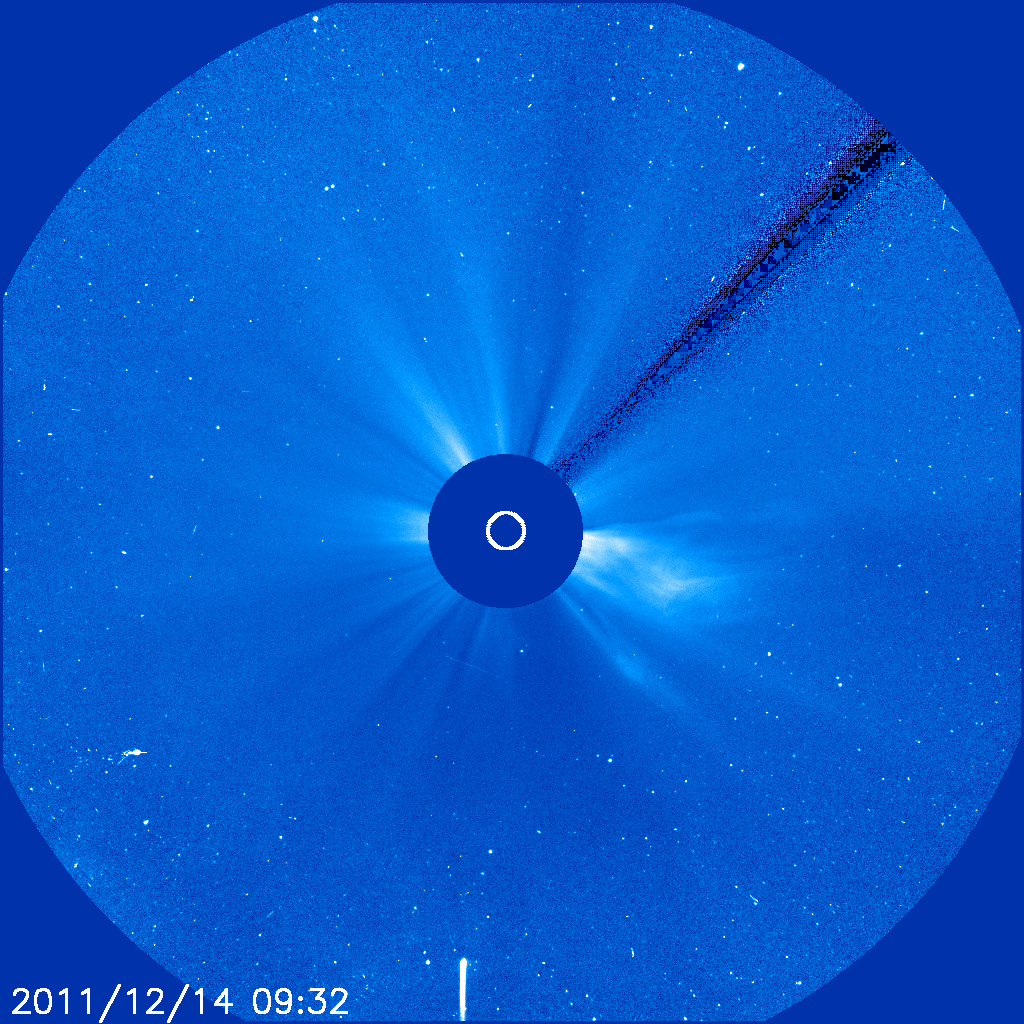
Comet Lovejoy entering at the bottom of the LASCO C3 frame. Courtesy SOHO, ESA, NASA. Timestamp on image.
Click to enlarge.
12/07/11 – Ephemeris – Where are the planets this week?
Wednesday, December 7th. The sun will rise at 8:05. It’ll be up for 8 hours and 57 minutes, setting at 5:02. The moon, 3 days before full, will set at 6:16 tomorrow morning.
It’s Wednesday and time again to take a look at the whereabouts of the bright planets. The planet Venus is low in the southwestern twilit sky sunset setting at 6:57, and should be visible by 5:45. Jupiter is now the most prominent planet of the evening sky located in the high in the southeast and is seen against the stars of the constellation Aries. It will pass due south at 9:33 p.m. In a telescope it will be accompanied by its 4 brightest moons. It will set at 4:18 a.m.. Mars will rise at 11:55 p.m in the east northeast and will be in the constellation Leo. Mars will be due south at 6:34 a.m. It is 117 million miles away and closing. Saturn will rise at 3:46 a.m. just to the left of the bright star Spica in the east southeast.
* Times, as always are for the Traverse City/Interlochen area of Michigan.
11/30/11 – Ephermeris – The location of the planets tonight
Wednesday, November 30th. The sun will rise at 7:57. It’ll be up for 9 hours and 6 minutes, setting at 5:04. The moon, 2 days before first quarter, will set at 11:08 this evening.
It’s Wednesday and time again to take a look at the whereabouts of the bright planets. The planet Venus is low in the southwestern sky just after sunset setting at 6:44, and should be visible by 5:45. Jupiter is now the prominent planet of the evening sky located in the southeast and is seen against the stars of the constellation Aries. It will pass due south at 10:33 p.m. In a telescope it will be accompanied by its 4 brightest moons. It will set at 4:48 a.m.. Mars will rise at 12:07 a.m in the east northeast and will be left of the star Regulus in the constellation Leo tomorrow morning.. It is 122 million miles away and closing. Saturn will rise at 4:10 a.m. just to the left of the bright star Spica in the east southeast.
* Times, as always are for the Traverse City/Interlochen area of Michigan.
 Bob Moler's Ephemeris Blog