09/08/2021 – Ephemeris – Let’s search for the naked-eye planets for this week
This is Ephemeris for Wednesday, September 8th. Today the Sun will be up for 12 hours and 52 minutes, setting at 8:06, and it will rise tomorrow at 7:14. The Moon, 2 days past new, will set at 9:16 this evening.
Let’s search for the naked-eye planets for this week. Venus should be visible in the western evening twilight before 8:30 tonight. It will set at 9:41 pm. By 8:30 pm, Jupiter and Saturn will be seen low in the southeastern sky. The brighter Jupiter will be easy to spot at that hour. Saturn will be dimmer, but a bit higher and to its right. Both these planets will be visible for most of the night, with Saturn setting first at 3:53 am, with Jupiter setting at 5:21 tomorrow morning. Saturn’s rings can be seen in a spotting scope of about 20 power magnification. Though at that power, the rings won’t appear separated from the planet, so Saturn will look like an elliptical spot. Most of Jupiter’s 4 brightest moons can even be spotted in binoculars.
The astronomical event times given are for the Traverse City/Interlochen area of Michigan (EDT, UT – 4 hr). They may be different for your location.
Addendum
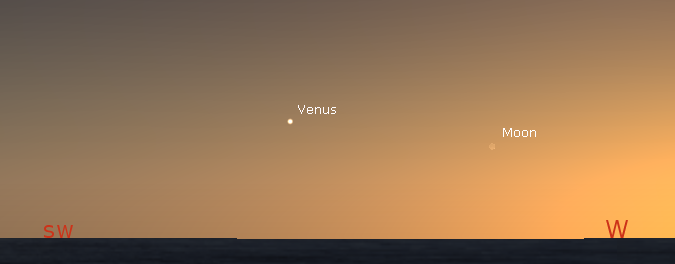
Venus and the Moon in evening twilight at 8:30 pm tonight, September 8, 2021. This is about 25 minutes after sunset. Created using Stellarium.
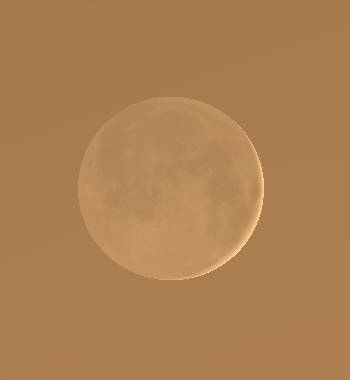
The thin crescent Moon as it might appear with earth shine in binoculars at 8:30 pm tonight, September 8, 2021. Created using Stellarium.
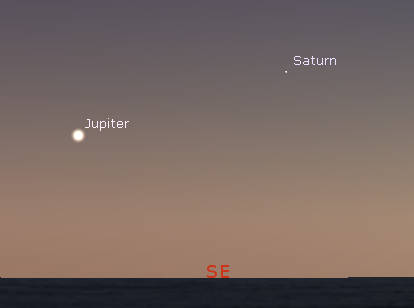
Jupiter and Saturn in the southeast at 8:30 pm, about a half hour after sunset tonight, September 8, 2021. Created using Stellarium.
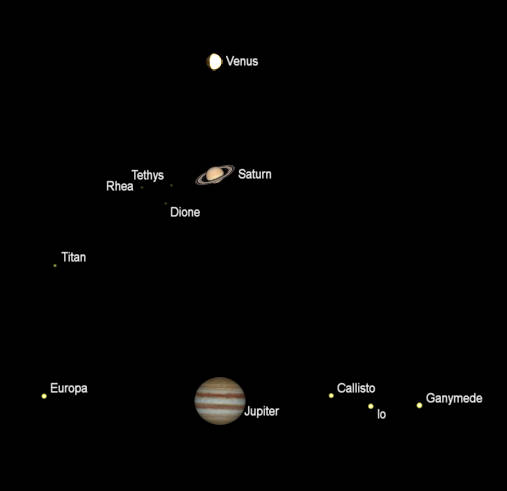
Telescopic view of the bright planets (north up) as they would be seen in a small telescope, with the same magnification, this evening. Venus at 8:30 pm, and the other two at 10 pm, September 8, 2021. Apparent diameters: Venus, 15.88″ 70% illuminated; Saturn 18.19″, its rings 42.36″; Jupiter, 48.43″. Jupiter’s moons will slowly approach the planet from our viewpoint overnight. The ” symbol means seconds of arc (1/3600th of a degree.) Created using Cartes du Ciel (Sky Charts).
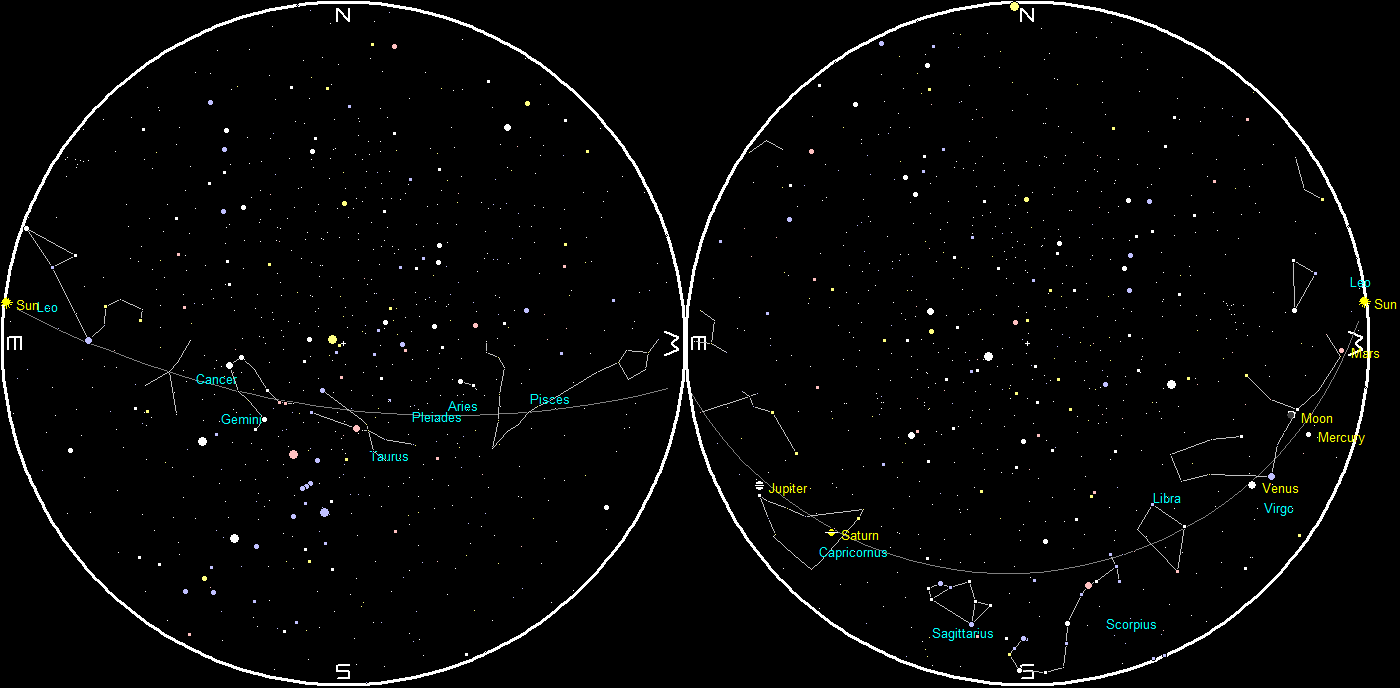
Planets and the Moon at sunset and sunrise of a single night, starting with sunset on the right on September 8, 2021. The night ends on the left with sunrise on the 9th. Click on the image to enlarge it. Created using my LookingUp program.
09/07/2021 – Ephemeris – The constellation of Cepheus the king
This is Bob Moler with Ephemeris for Tuesday, September 7th. Today the Sun will be up for 12 hours and 55 minutes, setting at 8:07, and it will rise tomorrow at 7:13. The Moon, 1 day past new, will set at 8:53 this evening.
There’s a faint constellation in the northeast above the W shaped constellation of Cassiopeia. It’s a nearly upside down church steeple of a constellation called Cepheus the king, and husband of queen Cassiopeia. Cepheus’ claim to modern astronomical fame is that one of its stars, Delta (δ) Cephei, is the archetype for the important Cepheid variable stars. Delta is the bottom most of a trio of stars at the right corner of the constellation. In the early 20th century, Henrietta Leavitt discovered that Cepheids in the nearby galaxy the Large Magellanic Cloud varied in brightness with a period that was related to their average brightness. This meant that Cepheids could be used as standard candles to measure the great distances to other galaxies.
The astronomical event times given are for the Traverse City/Interlochen area of Michigan (EDT, UT – 4 hr). They may be different for your location.
Addendum
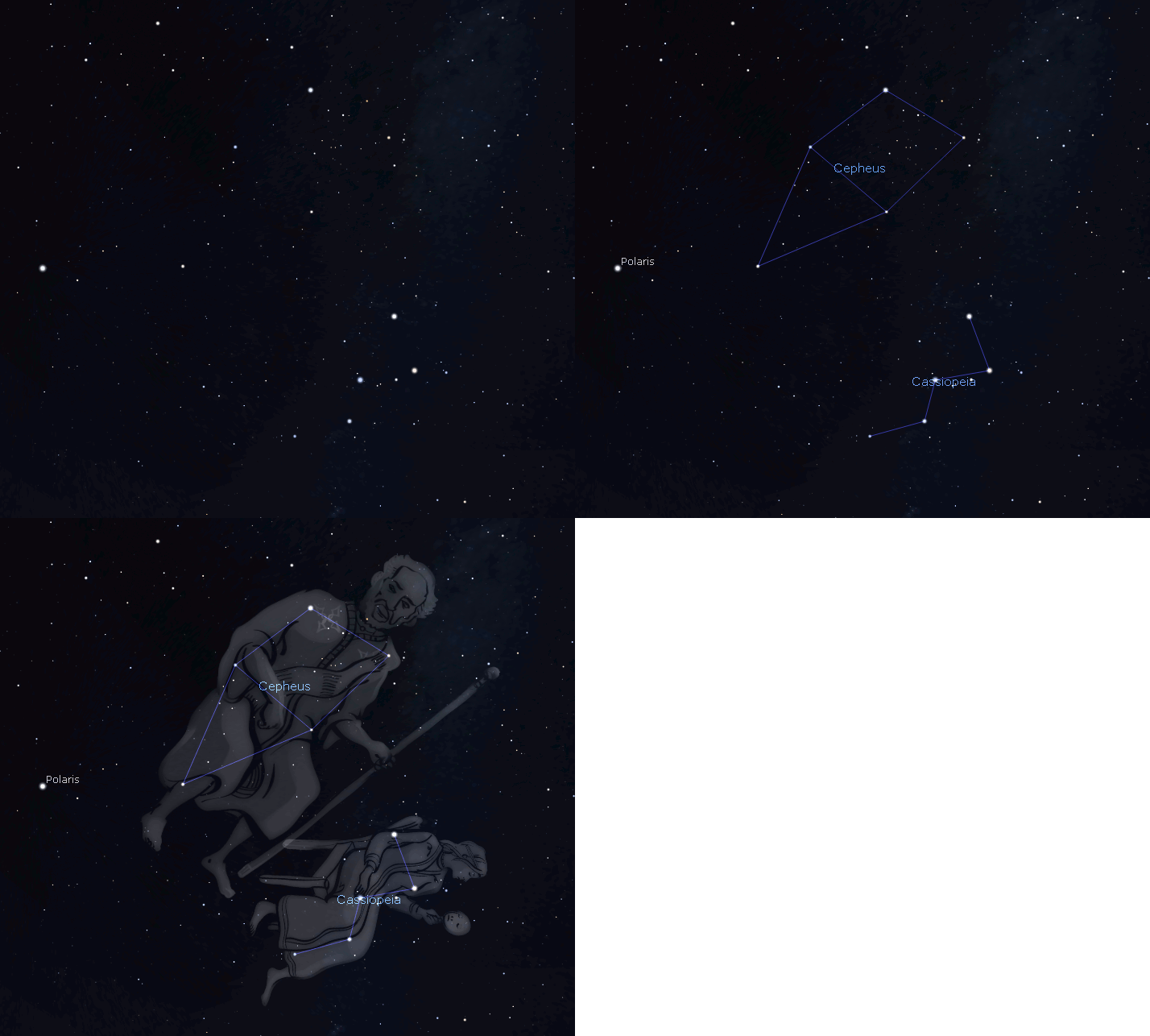
Cassiopeia and Cepheus finder animation looking in the northeast at 9-10 pm or about an hour after sunset. Created using Stellarium and GIMP.
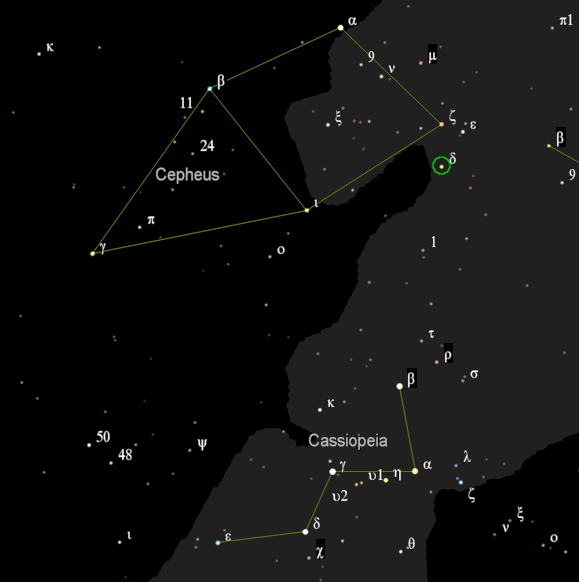
Delta Cephei finder for September at 9-10 pm, looking northeast. Created using Cartes du Ciel (Sky Chart).
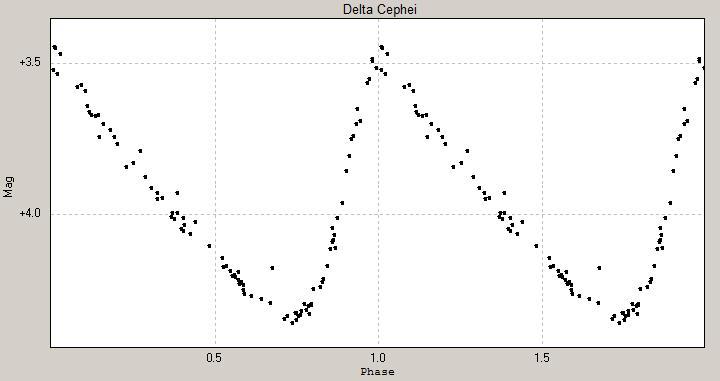
Light Curve of Delta Cephei. The pulsation period is 5.367 days. Note the Magnitude vertical axis, the lower the magnitude the brighter the star is. Blame that on the Greek astronomer Hipparchus, 2nd century BC. It’s like golf scores, the lower the score, the better the golfer. Credit: Thomas K Vbg – Own work, CC BY-SA 3.0, https://commons.wikimedia.org/w/index.php?curid=13887639.
09/03/2021 – Ephemeris – Tonight: Virtual Star Party via Zoom with the Sleeping Bear Dunes National Lakeshore
This is Ephemeris for Friday, September 3rd. Today the Sun will be up for 13 hours and 7 minutes, setting at 8:15, and it will rise tomorrow at 7:09. The Moon, 3 days before new, will rise at 4:01 tomorrow morning.
Tonight the Sleeping Bear Dunes National Lakeshore and the Grand Traverse Astronomical Society will host an online star party this evening starting around 9 pm via the Zoom app available for Android smartphones, iPhones and computers. Instructions for joining are on the society’s website, gtastro.org. Images will be captured live, if it’s clear, from Northwestern Michigan College’s Joseph H Rogers Observatory. The images will be pretty much what is seen at the telescope eyepiece, and definitely not Hubble Space Telescope quality, which take weeks to process. Visible will be the Venus, Jupiter, Saturn and wonders of the Milky Way, some really neat star clusters, and nebulae, that is clouds of gas and dust in the Milky Way.
The astronomical event times given are for the Traverse City/Interlochen area of Michigan (EDT, UT – 4 hr). They may be different for your location.
Addendum
Also, the planets Venus, Saturn and Jupiter will be visible during the session.
This post is going out at Midnight the night before, and the forecast is for clouds. It is possible that we will reschedule for Friday the 10th. If so, I’ll have a post about it then.
09/02/2021 – Ephemeris – Finding the Little Dipper
This is Bob Moler with Ephemeris for Thursday, September 2nd. Today the Sun will be up for 13 hours and 10 minutes, setting at 8:17, and it will rise tomorrow at 7:07. The Moon, 3 days past last quarter, will rise at 2:55 tomorrow morning.
10 p.m. is the best time now to spot the Little Dipper. It is difficult to spot, being much smaller and dimmer than the Big Dipper. However, it is the Big Dipper that points to it, by the two stars at the front of the bowl which point to the North Star, Polaris, the star that doesn’t appear to move. That star is the tip of the handle of the Little Dipper. The handle is seen as a curve of stars upward and to the left to a small box of stars that is its bowl. The two brighter stars at the front of the bowl are called the Guard Stars because in the past they were thought to be guardians of the pole. The Little Dipper is not an official constellation, but is Ursa Minor the lesser bear. To the Anishinaabe native peoples of this area, it represents Maang the loon.
The astronomical event times given are for the Traverse City/Interlochen area of Michigan (EDT, UT – 4 hr). They may be different for your location.
Addendum
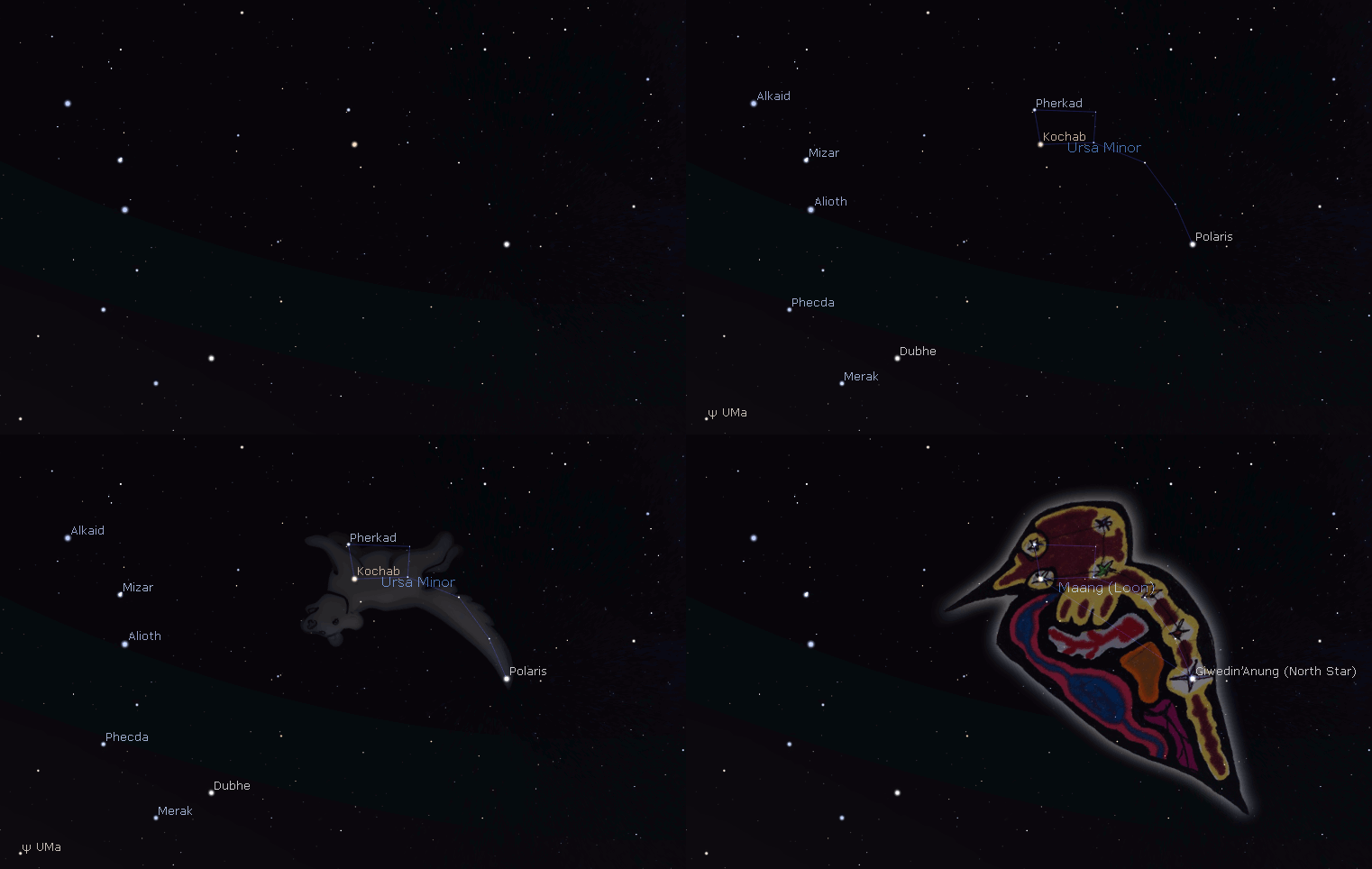
Little Dipper finder animation. The Little Dipper is also Ursa Major and the Loon. Polaris is the Pole Star and North Star. The Guard Stars are Kochab and Pherkad. Except for the named stars, the Little Dipper stars are quite faint and require moonless skies away from the city to spot. Created using Stellarium and GIMP.
09/01/2021 – Ephemeris – Let’s search for the naked-eye planets for this week
This is Ephemeris for Wednesday, September 1st. Today the Sun will be up for 13 hours and 13 minutes, setting at 8:18, and it will rise tomorrow at 7:06. The Moon, 2 days past last quarter, will rise at 1:57 tomorrow morning.
Let’s search for the naked-eye planets for this week. Venus should be visible in the western evening twilight before 9 tonight. It will set at 9:41 pm. By 9 pm, Jupiter and Saturn will be seen low in the southeastern sky. The brighter Jupiter will be easy to spot at that hour. Saturn will be dimmer, but a bit higher and to its right. Both these planets will be visible for most of the night, with Saturn setting first at 4:22 am, with Jupiter setting at 5:53 tomorrow morning. Saturn’s rings can be seen in a spotting scope of about 20 power magnification. Though at that power, the rings won’t appear separated from the planet, so Saturn will look like an elliptical spot. Most of Jupiter’s 4 brightest moons can be spotted in binoculars.
The astronomical event times given are for the Traverse City/Interlochen area of Michigan (EDT, UT – 4 hr). They may be different for your location.
Addendum
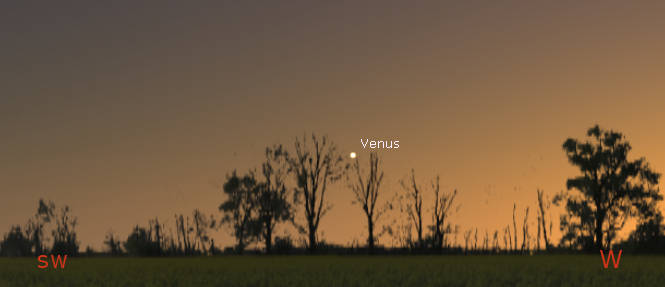
Venus in twilight at 8:45 pm, about 1/2 hour after sunset tonight, September 1, 2021. Created with Stellarium.
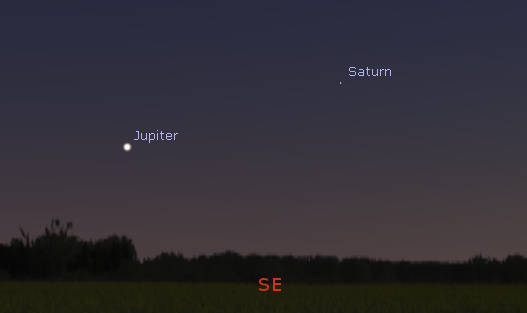
Jupiter and Saturn in the southeast about three quarters of an hour after sunset. Created using Stellarium.
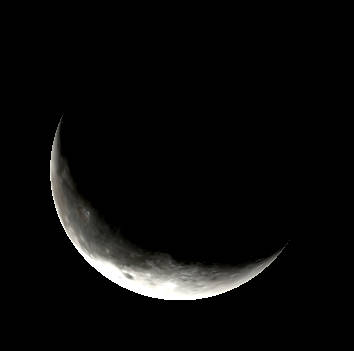
The waning crescent Moon as it might be seen in binoculars or low magnification telescope at 6 am tomorrow morning, September 2, 2021.
Created using Stellarium.
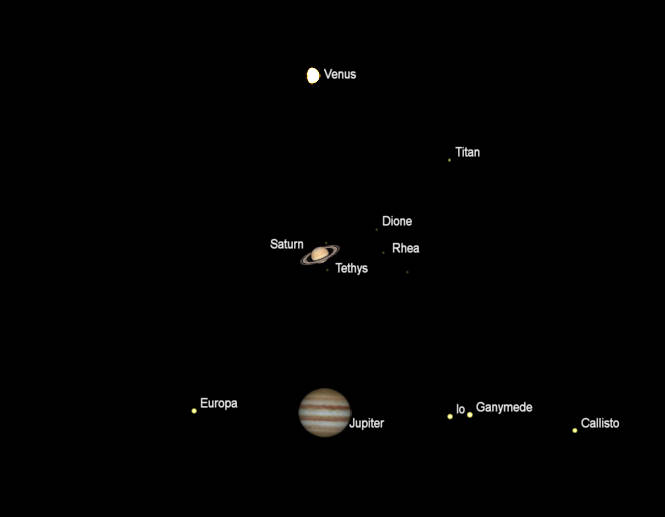
Telescopic view of the bright planets (north up) as they would be seen in a small telescope, with the same magnification, this evening. Venus at 9 pm, and the other two at 11 pm, September 1, 2021. Apparent diameters: Venus, 15.16″, 73% illuminated; Saturn 18.32″, its rings 42.67″; Jupiter, 48.83″. Jupiter’s moons Io and Europa will slowly approach the planet over the morning hours. Io will be occulted by the planet around 4:05 am (08:05 UT). Europa will begin its transit across the face of the planet around 5:04 am (09:04 UT). The ” symbol means seconds of arc (1/3600th of a degree.) Click on the image to enlarge it. Created using Cartes du Ciel (Sky Charts). Jovian satellite event times determined from Stellarium.
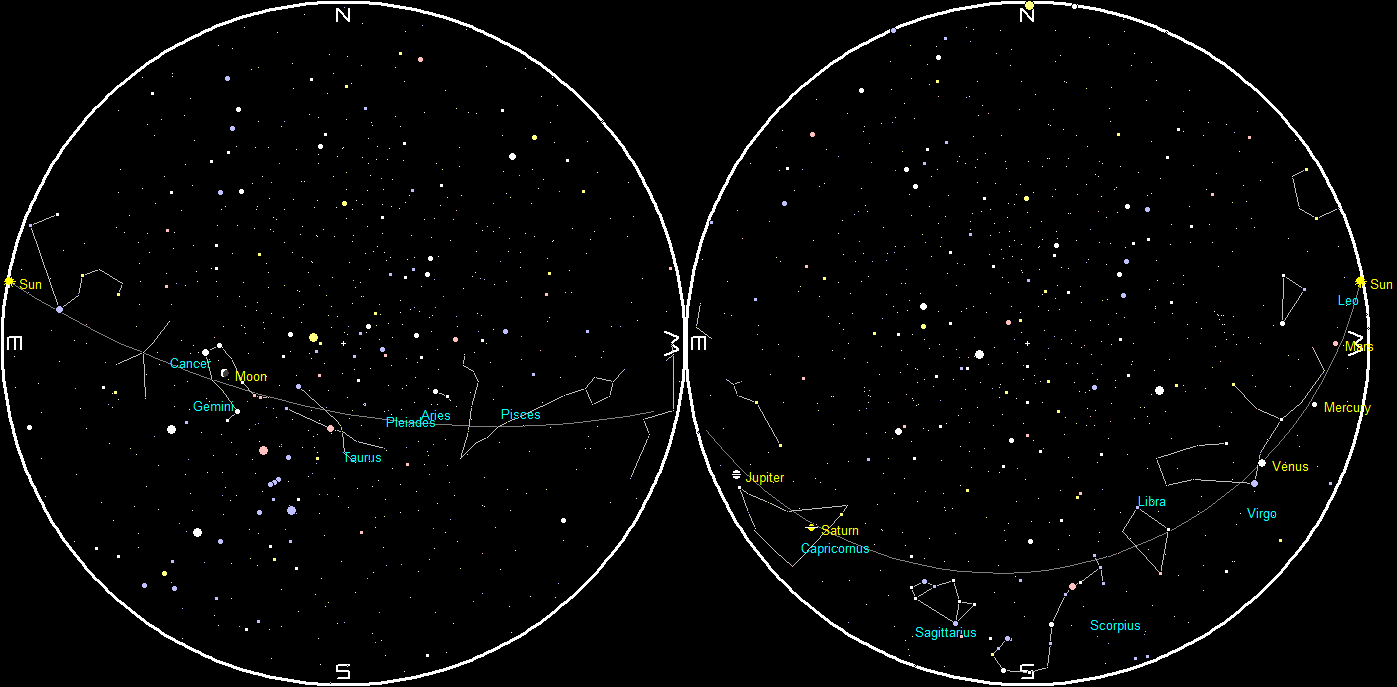
Planets and the Moon at sunset and sunrise of a single night, starting with sunset on the right on September 1, 2021. The night ends on the left with sunrise on the 2nd. Click on the image to enlarge. Created using my LookingUp program.
Note: Mars and Mercury are too close to the direction of the Sun to be visible from Northern Michigan. However, Mercury will be easily visible far south of here and into the Southern Hemisphere.
08/31/2021 – Ephemeris – Previewing September skies
This is Bob Moler with Ephemeris for Tuesday, August 31st. Today the Sun will be up for 13 hours and 16 minutes, setting at 8:20, and it will rise tomorrow at 7:05. The Moon, 1 day past last quarter, will rise at 1:07 tomorrow morning.
Let’s look at the skies for the month of September. The sun will be moving at its greatest speed in its retreat to the south. Daylight hours in the Interlochen/Traverse City area and will drop from 13 hours and 13 minutes tomorrow to 11 hours and 44 minutes on the 30th. The altitude of the Sun above the southern horizon at local noon will be 54 degrees tomorrow, and will descend to 42 degrees on the 30th. Local noon at mid-month will be around 1:37 pm. The season of summer is getting short, so enjoy it while you can. Summer ends and autumn begins at 3:21 p.m. on September 22nd, the autumnal equinox. This year the Harvest Moon, the nearest full moon to the equinox, will fall two days before it on the 20th.
The astronomical event times given are for the Traverse City/Interlochen area of Michigan (EDT, UT – 4 hr). They may be different for your location.
Addendum
September Star Chart
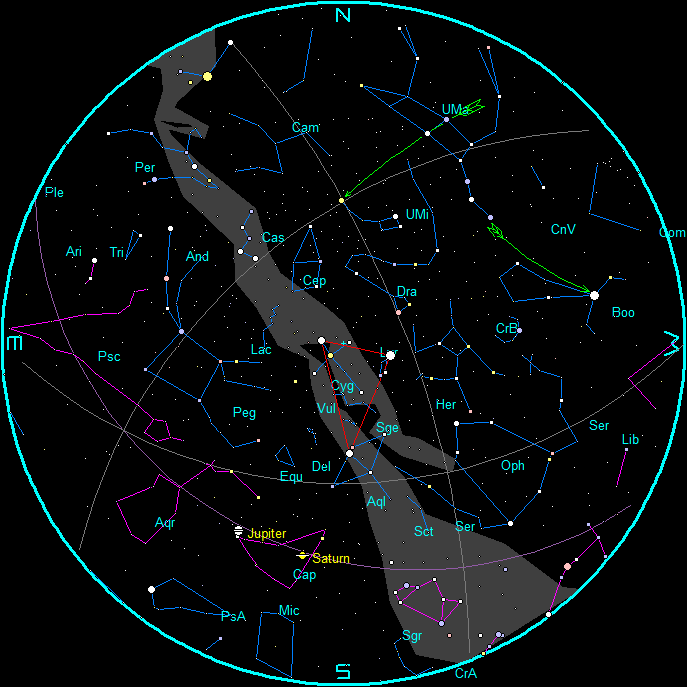
Star Chart for September 2021. Created using my LookingUp program. Click on the image to enlarge it. Created using my LookingUp program.
September Morning Star Chart
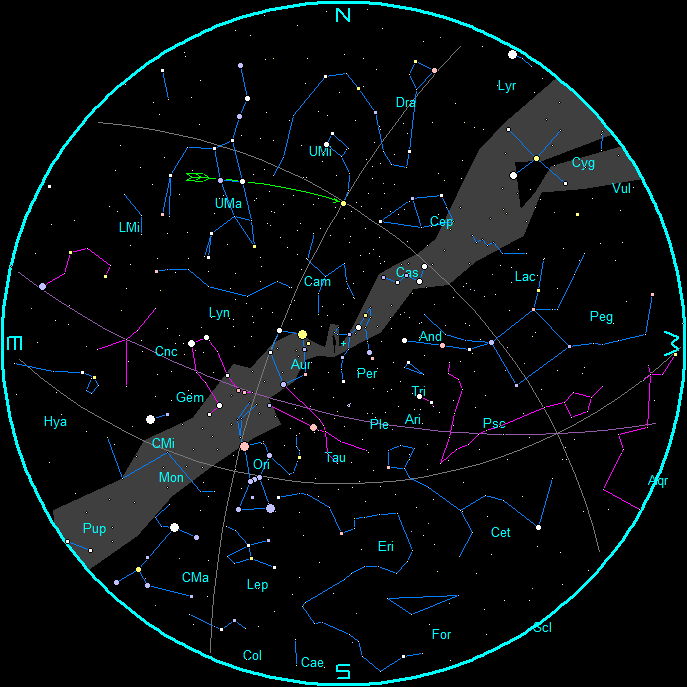
Star Chart for September 2021 (10 p.m. EDT, September 15, 2021). Click on the image to enlarge it. Created using my LookingUp program.
For a list of constellation names to go with the abbreviations, click here.
- Pointer stars at the front of the bowl of the Big Dipper point to Polaris, the North Star.
- Leaky dipper drips on Leo.
- Follow the arc of the handle of the Big Dipper to the star Arcturus.
- The Summer Triangle is in red.
Twilight Limits, Nautical and Astronomical
| EDT | |||||||
| Morning | Twilight | Evening | Twilight | Dark | Night | Moon | |
| Date | Astro. | Nautical | Nautical | Astro. | Start | End | Illum. |
| 2021-09-01 | 5h26m | 6h04m | 21h28m | 22h06m | 22h06m | 1h07m | 0.24 |
| 2021-09-02 | 5h28m | 6h06m | 21h26m | 22h04m | 22h04m | 1h57m | 0.16 |
| 2021-09-03 | 5h29m | 6h07m | 21h24m | 22h02m | 22h02m | 2h55m | 0.09 |
| 2021-09-04 | 5h31m | 6h08m | 21h22m | 22h00m | 22h00m | 4h01m | 0.04 |
| 2021-09-05 | 5h32m | 6h10m | 21h20m | 21h57m | 21h57m | 5h11m | 0.01 |
| 2021-09-06 | 5h34m | 6h11m | 21h18m | 21h55m | 21h55m | 5h34m | 0 |
| 2021-09-07 | 5h35m | 6h12m | 21h16m | 21h53m | 21h53m | 5h35m | 0.02 |
| 2021-09-08 | 5h37m | 6h14m | 21h14m | 21h51m | 21h51m | 5h37m | 0.06 |
| 2021-09-09 | 5h38m | 6h15m | 21h12m | 21h49m | 21h49m | 5h38m | 0.13 |
| 2021-09-10 | 5h40m | 6h16m | 21h10m | 21h46m | 22h06m | 5h40m | 0.21 |
| 2021-09-11 | 5h41m | 6h18m | 21h08m | 21h44m | 22h35m | 5h41m | 0.32 |
| 2021-09-12 | 5h43m | 6h19m | 21h06m | 21h42m | 23h12m | 5h43m | 0.43 |
| 2021-09-13 | 5h44m | 6h20m | 21h04m | 21h40m | 23h57m | 5h44m | 0.54 |
| 2021-09-14 | 5h46m | 6h22m | 21h02m | 21h38m | – | 5h46m | 0.65 |
| 2021-09-15 | 5h47m | 6h23m | 21h00m | 21h36m | 0h53m | 5h47m | 0.76 |
| 2021-09-16 | 5h48m | 6h24m | 20h58m | 21h34m | 1h59m | 5h48m | 0.84 |
| 2021-09-17 | 5h50m | 6h25m | 20h56m | 21h31m | 3h10m | 5h50m | 0.91 |
| 2021-09-18 | 5h51m | 6h27m | 20h54m | 21h29m | 4h24m | 5h51m | 0.96 |
| 2021-09-19 | 5h53m | 6h28m | 20h52m | 21h27m | 5h37m | 5h53m | 0.99 |
| 2021-09-20 | 5h54m | 6h29m | 20h50m | 21h25m | – | – | 1 |
| 2021-09-21 | 5h55m | 6h31m | 20h48m | 21h23m | – | – | 0.99 |
| 2021-09-22 | 5h57m | 6h32m | 20h46m | 21h21m | – | – | 0.95 |
| 2021-09-23 | 5h58m | 6h33m | 20h44m | 21h19m | – | – | 0.9 |
| 2021-09-24 | 6h00m | 6h34m | 20h42m | 21h17m | 21h17m | 21h26m | 0.84 |
| 2021-09-25 | 6h01m | 6h36m | 20h40m | 21h15m | 21h15m | 21h52m | 0.76 |
| 2021-09-26 | 6h02m | 6h37m | 20h38m | 21h13m | 21h13m | 22h23m | 0.67 |
| 2021-09-27 | 6h04m | 6h38m | 20h36m | 21h11m | 21h11m | 23h00m | 0.58 |
| 2021-09-28 | 6h05m | 6h39m | 20h34m | 21h09m | 21h09m | 23h46m | 0.49 |
| 2021-09-29 | 6h06m | 6h41m | 20h32m | 21h07m | 21h07m | – | 0.39 |
| 2021-09-30 | 6h07m | 6h42m | 20h31m | 21h05m | 21h05m | 0h40m | 0.3 |
Twilight calendar was generated using Cartes du Ciel (Sky Charts).
See my blog post: Twilight Zone for the definitions of the different periods of twilight here: https://bobmoler.wordpress.com/2018/09/27/.
NASA Calendar of Planetary Events
Sep  1  We            Venus: 39.9° E
     1  We   8:23 pm  Moon North Dec.: 25.9° N
     4  Sa  12:07 am  Moon-Beehive: 3.1° S
     5  Su  10:32 am  Venus-Spica: 1.6° N
     6  Mo   8:52 pm  New Moon
     9  Th  10:09 pm  Moon-Venus: 4.1° S
    11  Sa   6:06 am  Moon Perigee: 368500 km
    12  Su  12:35 pm  Moon Descending Node
    13  Mo   4:39 pm  First Quarter
    13  Mo  11:59 pm  Mercury Elongation: 26.8° E
    14  Tu   4:10 am  Neptune Opposition
    14  Tu  11:48 pm  Moon South Dec.: 26° S
    16  Th  10:37 pm  Moon-Saturn: 3.9° N
    18  Sa   2:50 am  Moon-Jupiter: 4.1° N
    20  Mo   7:55 pm  Full Moon, Harvest Moon
    20  Mo  10:03 pm  Mercury-Spica: 1.4° S
    22  We   3:21 pm  Autumnal Equinox
    26  Su   3:33 am  Moon Ascending Node
    26  Su   5:44 pm  Moon Apogee: 404600 km
    28  Tu   9:57 pm  Last Quarter
    29  We   4:26 am  Moon North Dec.: 26.1° N
Oct  1  Fr            Venus: 44.9° E
All event times are given for UTC-4 hr: Eastern Daylight Saving Time.
Sky Events Calendar by Fred Espenak and Sumit Dutta (NASA’s GSFC),
http://eclipse.gsfc.nasa.gov/SKYCAL/SKYCAL.html.
If you go to the above site, you can print out a list like the above for the entire year or calendar pages for your time zone.
Sun and Moon Rising and Setting Events
LU                  Ephemeris of Sky Events for Interlochen/TC
September, 2021    Local time zone: EDT
+-----------------------------------------------------------------------+
| DATE |  SUN     SUN  DAYLIGHT|   TWILIGHT*    |MOON  RISE OR    ILLUM |
|      |  RISE    SET    HOURS |  END    START  |PHASE SET** TIME FRACTN|
+=======================================================================+
|Wed  1| 07:05a  08:18p  13:13 | 09:25p  05:59a |      Rise 01:57a   25%|
|Thu  2| 07:06a  08:17p  13:10 | 09:23p  06:00a |      Rise 02:55a   17%|
|Fri  3| 07:07a  08:15p  13:07 | 09:21p  06:01a |      Rise 04:01a   10%|
|Sat  4| 07:09a  08:13p  13:04 | 09:18p  06:03a |      Rise 05:11a    5%|
+------+-----------------------+----------------+-----------------------+
|Sun  5| 07:10a  08:11p  13:01 | 09:16p  06:04a |      Rise 06:24a    1%|
|Mon  6| 07:11a  08:09p  12:58 | 09:14p  06:06a |New   Set  08:30p    0%|
|Tue  7| 07:12a  08:07p  12:55 | 09:12p  06:07a |      Set  08:53p    1%|
|Wed  8| 07:13a  08:06p  12:52 | 09:10p  06:08a |      Set  09:16p    5%|
|Thu  9| 07:14a  08:04p  12:49 | 09:08p  06:10a |      Set  09:40p   11%|
|Fri 10| 07:16a  08:02p  12:46 | 09:06p  06:11a |      Set  10:05p   19%|
|Sat 11| 07:17a  08:00p  12:43 | 09:04p  06:12a |      Set  10:35p   29%|
+------+-----------------------+----------------+-----------------------+
|Sun 12| 07:18a  07:58p  12:40 | 09:02p  06:13a |      Set  11:12p   40%|
|Mon 13| 07:19a  07:56p  12:37 | 09:00p  06:15a |F Qtr Set  11:57p   52%|
|Tue 14| 07:20a  07:54p  12:33 | 08:58p  06:16a |      Set  12:53a   63%|
|Wed 15| 07:21a  07:52p  12:30 | 08:56p  06:17a |      Set  01:59a   73%|
|Thu 16| 07:23a  07:51p  12:27 | 08:54p  06:19a |      Set  03:10a   82%|
|Fri 17| 07:24a  07:49p  12:24 | 08:52p  06:20a |      Set  04:24a   90%|
|Sat 18| 07:25a  07:47p  12:21 | 08:50p  06:21a |      Set  05:37a   95%|
+------+-----------------------+----------------+-----------------------+
|Sun 19| 07:26a  07:45p  12:18 | 08:48p  06:23a |      Set  06:47a   99%|
|Mon 20| 07:27a  07:43p  12:15 | 08:46p  06:24a |Full  Rise 08:03p  100%|
|Tue 21| 07:29a  07:41p  12:12 | 08:44p  06:25a |      Rise 08:23p   99%|
|Wed 22| 07:30a  07:39p  12:09 | 08:42p  06:26a |      Rise 08:43p   96%|
|Thu 23| 07:31a  07:37p  12:06 | 08:40p  06:28a |      Rise 09:03p   91%|
|Fri 24| 07:32a  07:35p  12:03 | 08:39p  06:29a |      Rise 09:26p   85%|
|Sat 25| 07:33a  07:33p  12:00 | 08:37p  06:30a |      Rise 09:52p   78%|
+------+-----------------------+----------------+-----------------------+
|Sun 26| 07:35a  07:32p  11:57 | 08:35p  06:31a |      Rise 10:23p   69%|
|Mon 27| 07:36a  07:30p  11:53 | 08:33p  06:33a |      Rise 11:00p   60%|
|Tue 28| 07:37a  07:28p  11:50 | 08:31p  06:34a |L Qtr Rise 11:46p   51%|
|Wed 29| 07:38a  07:26p  11:47 | 08:29p  06:35a |      Rise 12:40a   41%|
|Thu 30| 07:39a  07:24p  11:44 | 08:27p  06:36a |      Rise 01:42a   32%|
+-----------------------------------------------------------------------+
* Nautical Twilight
** Moonrise or moonset, whichever occurs between sunrise and sunset
Generated using my LookingUp for DOS program.
08/30/2021 – Ephemeris – “W”
This is Bob Moler with Ephemeris for Monday, August 30th. Today the Sun will be up for 13 hours and 19 minutes, setting at 8:22, and it will rise tomorrow at 7:04. The Moon, at last quarter today, will rise at 12:26 tomorrow morning.
Rising higher each evening in the northeastern sky is a group of stars that make the pattern of the letter W. It is the constellation of Cassiopeia the queen. It is one of the more recognizable star patterns. From our latitude here in Northern Michigan, it is circumpolar, meaning that it never sets. Though, the best time to see it is in the autumn and winter, when it’s highest in the sky. It is opposite the Big Dipper from Polaris, the north star. In fact, a line drawn from any of the handle stars of the Big Dipper through Polaris will reach Cassiopeia. So as the Big Dipper descends in the northwestern sky now, Cassiopeia ascends in the northeast. They change places in winter and spring as the Big Dipper ascends in the northeast.
The astronomical event times given are for the Traverse City/Interlochen area of Michigan (EDT, UT – 4 hr). They may be different for your location.
Addendum
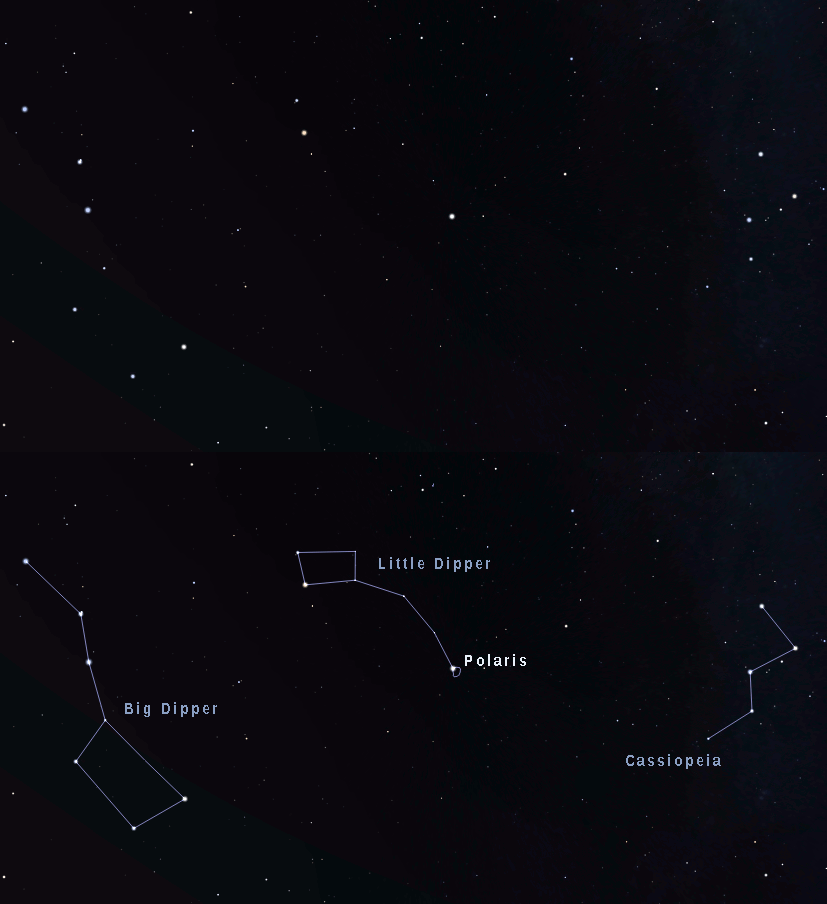
Animation showing the juxtaposition of Cassiopeia and the Big Dipper from Polaris, the North Star. Click on the image to enlarge it. Created using Stellarium and GIMP.
08/27/2021 – Ephemeris – As Labor Day approaches, so do the autumn constellations
This is Bob Moler with Ephemeris for Friday, August 27th. Today the Sun will be up for 13 hours and 28 minutes, setting at 8:27, and it will rise tomorrow at 7:00. The Moon, 3 days before last quarter, will rise at 11:01 this evening.
Rising in the east at as it gets dark around 9:30 p.m. we can preview one of the great autumn constellations: Pegasus the flying horse of Greek myth. Its most visible feature is a large square of four stars, now standing on one corner. This feature, called the Great Square of Pegasus, represents the front part of the horse’s body. The horse is quite aerobatic because it is seen flying upside down. Remembering that fact, the neck and head is a bent line of stars extending from the right corner star of the square. Its front legs can be seen in a gallop extending to the upper right from the top star of the square. From the left star extend, not hind legs but the constellation of Andromeda, an important constellation in its own right. The Anishinaabe peoples native to this region saw a right side up Moose (Mooz) in the stars here.
The astronomical event times given are for the Traverse City/Interlochen area of Michigan (EDT, UT – 4 hr). They may be different for your location.
Addendum
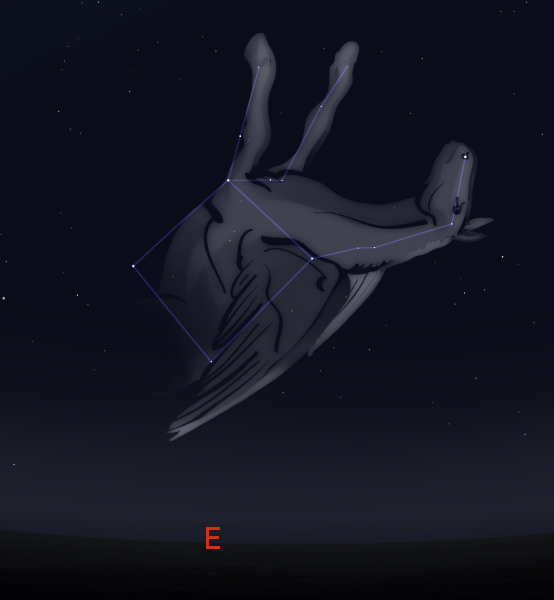
Pegasus image in the stars at 10 pm. Created using Stellarium. Drawing by Johan Meuris.
08/26/2021 – Ephemeris – Two tiny summer constellations
This is Ephemeris for Thursday, August 26th. Today the Sun will be up for 13 hours and 31 minutes, setting at 8:29, and it will rise tomorrow at 6:59. The Moon, half-way from full to last quarter, will rise at 10:40 this evening. | Located below the eastern edge of the Summer Triangle of three of the brightest stars in the sky, which is nearly overhead in our sky at 10 p.m., is the tiny constellation of Delphinus the dolphin. Delphinus’ 6 stars, in a small parallelogram with a tail, really does look like a dolphin leaping out of the water. The parallelogram itself has the name Job’s Coffin. The origin of this asterism or informal constellation is unknown. Of the dolphin itself: the ancient Greeks appreciated this aquatic mammal as we do, and told stories of dolphins rescuing shipwrecked sailors. There’s another tiny constellation to the right of Delphinus, Sagitta the arrow a small thin group of 5 stars, which represents Cupid’s dart.
The astronomical event times given are for the Traverse City/Interlochen area of Michigan (EDT, UT – 4 hr). They may be different for your location.
Addendum
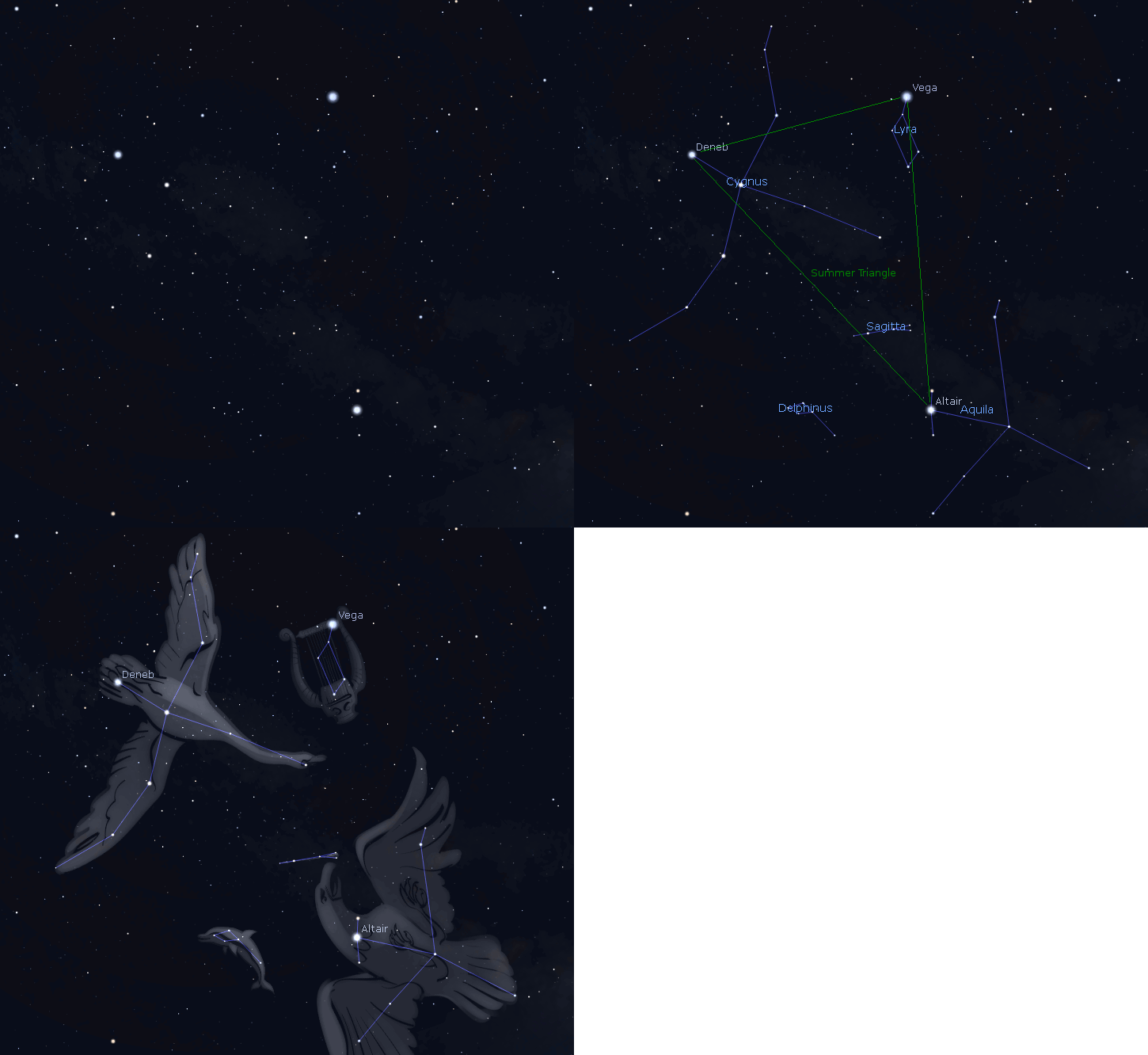
Delphinus and Sagitta finder animation. Created using Stellarium and GIMP.
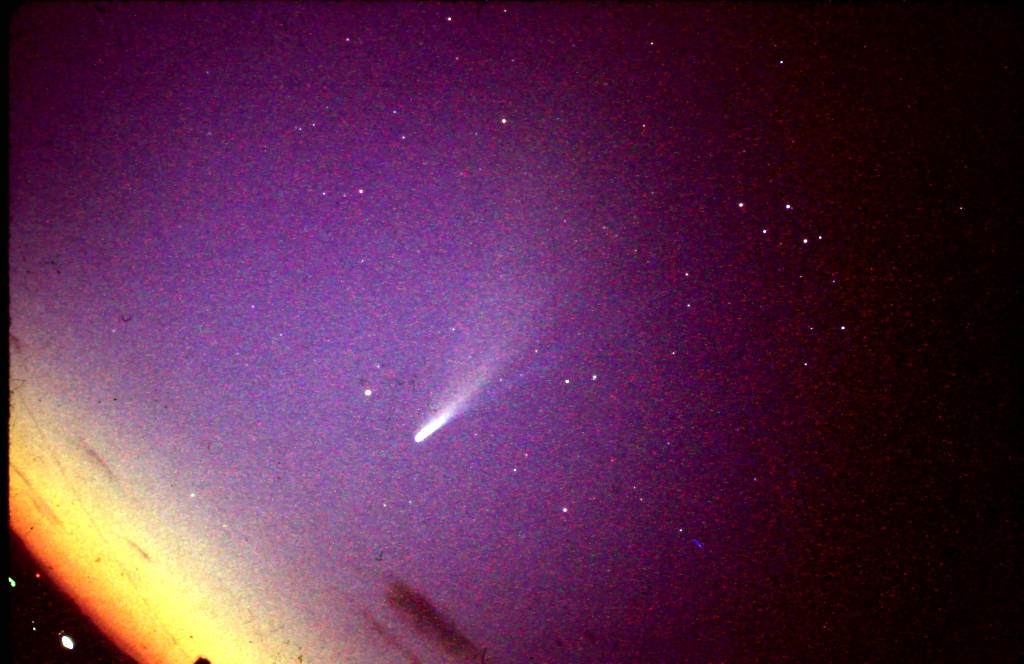
Comet West, C/1975 V1, as photographed by me at about 6 am, March 8, 1976. The wide, curved dust tail is most prominent, with the narrow blue ion tail streaming more directly away from the rising Sun. The small summer constellation of Delphinus the dolphin is to the upper right. The diamond shape of stars at the front of the dolphin’s body is an asterism called Job’s Coffin.
08/25/2021 – Ephemeris – Let’s search for the naked-eye planets for this week
This is Ephemeris for Wednesday, August 25th. Today the Sun will be up for 13 hours and 34 minutes, setting at 8:31, and it will rise tomorrow at 6:58. The Moon, 3 days past full, will rise at 10:20 this evening.
Let’s search for the naked-eye planets for this week. Venus should be visible in the western evening twilight before 9 tonight. It will set at 9:53 pm. By 9 pm, Jupiter and Saturn will be seen low in the southeastern sky. The brighter Jupiter will be easy to spot at that hour. Saturn will be dimmer, but a bit higher and to its right. Both these planets will be visible for most of the night, with Saturn setting first at 4:52 am, with Jupiter setting at 6:26 tomorrow morning. Saturn’s rings can be seen in a spotting scope of about 20 power magnification. Though at that power, the rings won’t appear separated from the planet, so Saturn will look like an elliptical spot. Most of Jupiter’s 4 brightest moon can be spotted in binoculars.
The astronomical event times given are for the Traverse City/Interlochen area of Michigan (EDT, UT – 4 hr). They may be different for your location.
Addendum
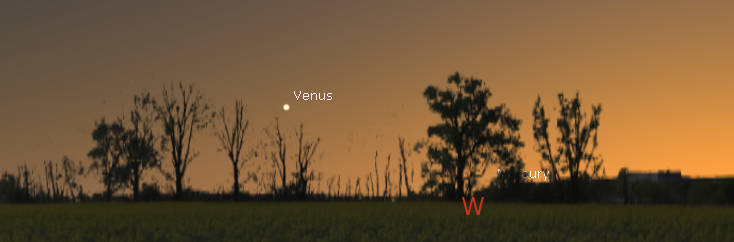
Venus in evening twilight tonight, August 25, 2021 at 9 pm, about 1/2 hour after sunset. Created using Stellarium.
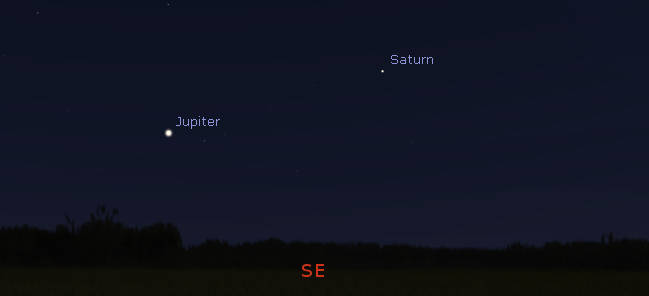
Jupiter and Saturn in the southeast at 9:30 pm tonight, August 25, 2021, about 45 minutes after sunset. Created using Stellarium.
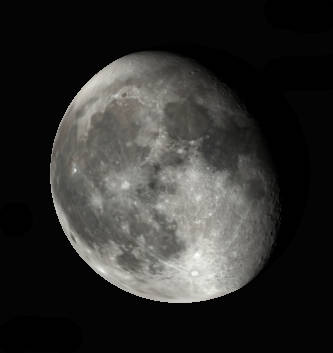
The Moon as it might appear tonight in binoculars or a small telescope at 11:30 pm, about an hour after it rises tonight, August 25, 2021. Created using Stellarium.
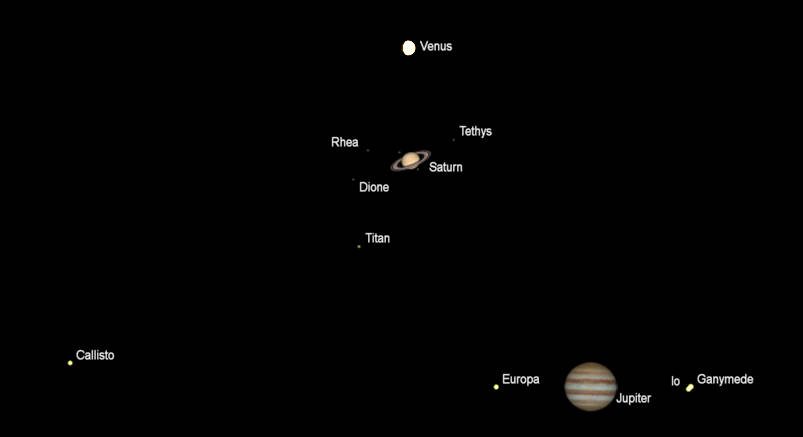
Telescopic view of the bright planets (north up) as they would be seen in a small telescope, with the same magnification, this evening. Venus at 9:15 pm, and the other two at 11 pm, August 25, 2021. Apparent diameters: Venus, 14.51″ 75% illuminated; Saturn 18.43″, its rings 42.93″; Jupiter, 49.06″. Jupiter’s moons Io and Ganymede will slowly separate after 11 pm. The ” symbol means seconds of arc (1/3600th of a degree.) Click on the image to enlarge it. Created using Cartes du Ciel (Sky Charts).
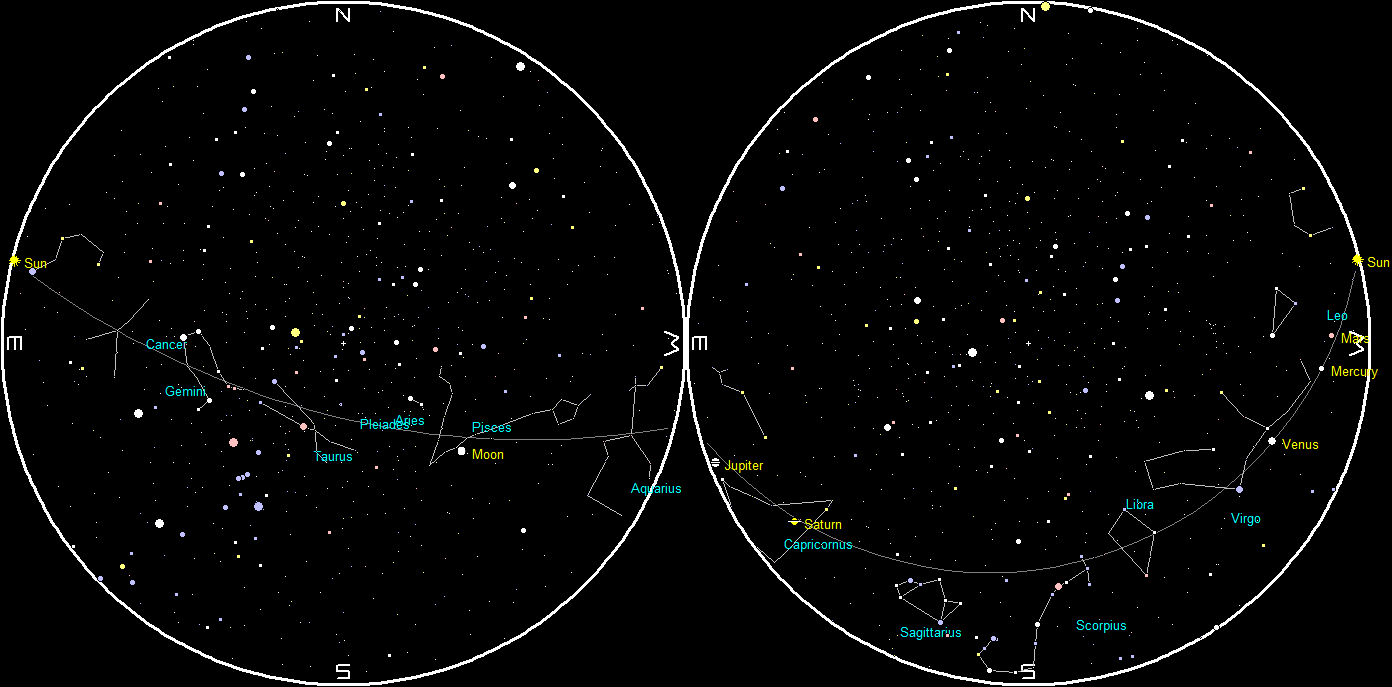
Planets and the Moon at sunset and sunrise of a single night, starting with sunset on the right on August 25, 2021. The night ends on the left with sunrise on the 26th. Click on the image to enlarge. Created using my LookingUp program.
 Bob Moler's Ephemeris Blog