08/10/2021 – Ephemeris – Tomorrow night, all night, will see the peak of the Perseid Meteor Shower.
This is Bob Moler with Ephemeris for Tuesday, August 10th. Today the Sun will be up for 14 hours and 16 minutes, setting at 8:55, and it will rise tomorrow at 6:40. The Moon, 2 days past new, will set at 10:27 this evening.
Back before astronomers recognized the major meteor shower that occurs at this time of year, the streaks of light in the sky of “falling” or “shooting” stars were called, by Christians, the Tears of Saint Lawrence, who was martyred on this day in the year 258. The bits of comet debris ranging in size from the size of sand grains to that of a pea hit our atmosphere at 38 miles (59 kilometers) per second and quickly vaporize due to friction, causing the streak of light we call meteors. They are called the Perseids since they appear to come from the constellation of Perseus, located in the northeastern sky. They will be best seen tomorrow night and into Thursday morning, with rates of up to one a minute, on average, in the early morning hours.
The astronomical event times given are for the Traverse City/Interlochen area of Michigan (EDT, UT – 4 hr). They may be different for your location.
Addendum
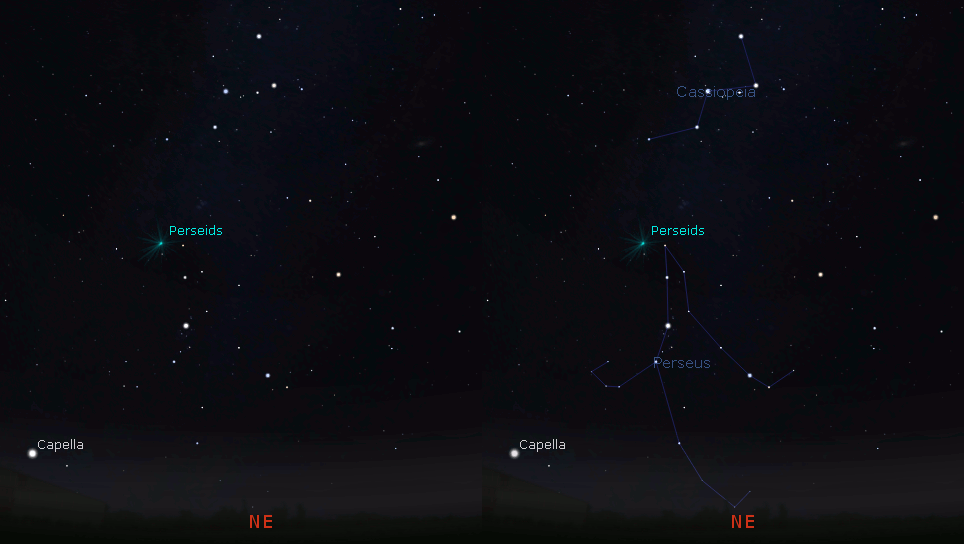
Perseid Radiant finder automation for midnight, August 11th. Created using Stellarium and GIMP.
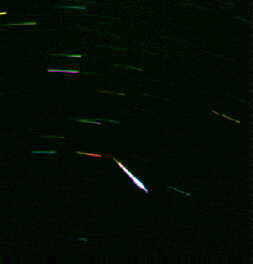
My best Perseid photo. From the 70s. The stars are trailed because this is a time exposure of perhaps 15 minutes and the camera is on a fixed tripod which rotates with the Earth.
08/09/2021 – Ephemeris – The Perseid Meteors are coming!
This is Ephemeris for Monday, August 9th. Today the Sun will be up for 14 hours and 18 minutes, setting at 8:57, and it will rise tomorrow at 6:39. The Moon, 1 day past new, will set at 10:03 this evening.
If you’ve been out and about under the dark night skies in the last week or so, you may have spotted a few, what are sometimes called, falling or shooting stars. If these could be traced back to the northeastern sky, those were advance members of the Perseid Meteor Shower. The peak of the shower will be on the afternoon of Thursday the 12th, so actually the best time to see them will be in the early hours of that morning. With few exceptions, the best time to view meteors in general or a meteor shower is in the wee morning hours. The Perseids however favor us, because the point from which they seem to come, called the radiant, is so far north that it never sets for us, so they can be seen all night. In the evening, there are just fewer of them.
The astronomical event times given are for the Traverse City/Interlochen area of Michigan (EDT, UT – 4 hr). They may be different for your location.
Addendum
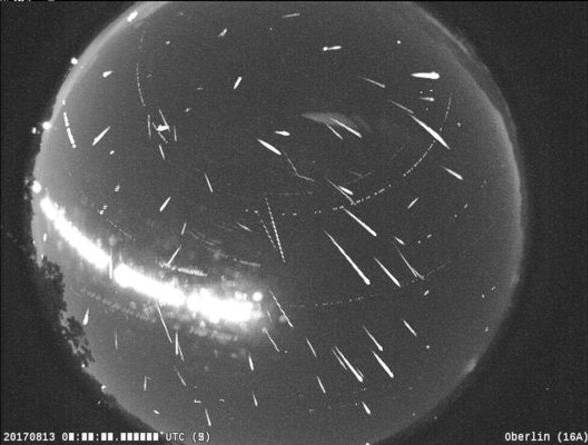
Perseid fireballs in one of NASA’s all sky cameras during the morning hours of August 13, 2017. This is a long time exposure. The bright swath in the image is the Moon that morning. Since it is a time exposure, the radiant is also moving with the earth’s rotation, so the meteors only seem to come from the northeastern sky. North is at the top, and East is to the left. Credit NASA.
08/06/2021 – Ephemeris – Virtual Star Party tonight if it’s clear in Traverse City
This is Ephemeris for Friday, August 6th. Today the Sun will be up for 14 hours and 26 minutes, setting at 9:01, and it will rise tomorrow at 6:36. The Moon, 2 days before new, will rise at 5:11 tomorrow morning.
The Grand Traverse Astronomical Society will hold a virtual star party starting at 10 pm tonight via the Zoom app on the Internet. Jerry Dobek, professor of astronomy at Northwestern Michigan College, will host the event with the 16-inch telescope and an imager, but only if it’s clear in Traverse City. It should feature a look at Venus to start. Saturn and Jupiter will be up by then, but they’re quite low in the sky. We might take another look at them later on when their images are steadier. The wonders of the Milky Way are all available, clouds willing: nebulae where stars are forming, nebulae caused by dying stars, and all kinds of star clusters. Instructions to join the meeting and a link can be found on the society’s website, www.gtastro.org.
Addendum
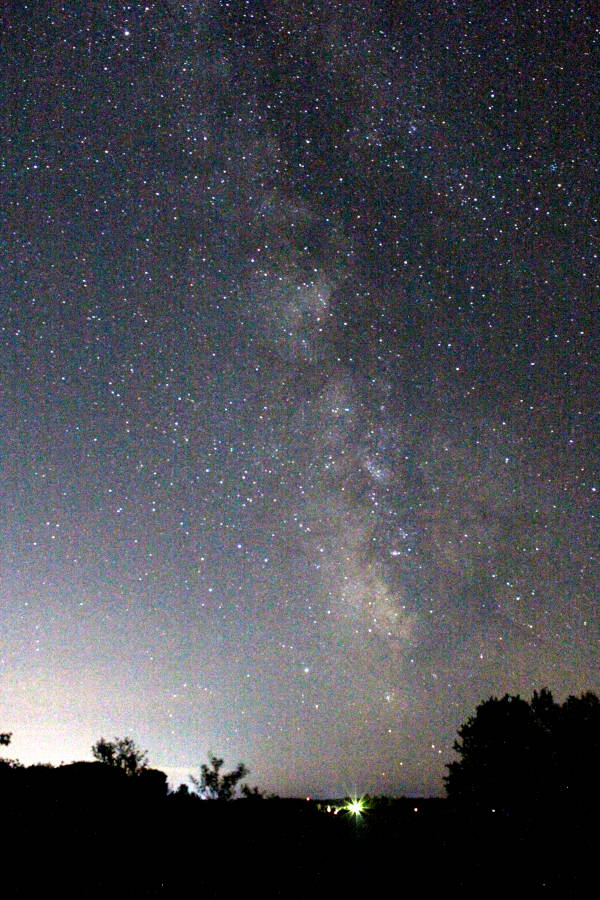
The Milky Way from Aquila to Sagittarius taken from my backyard with light pollution south of me. The summer southern Milky Way is the reason I love the dark nights of August and September. It’s the best time of year for a star party. I’m 7 miles west of Northwestern Michigan College’s Joseph H. Rogers Observatory, from which the images for tonight’s star party will be captured.
08/05/2021 – Ephemeris – Looking toward the center of the Milky Way in Sagittarius
This is Ephemeris for Thursday, August 5th. Today the Sun will be up for 14 hours and 29 minutes, setting at 9:02, and it will rise tomorrow at 6:35. The Moon, 3 days before new, will rise at 4:09 tomorrow morning.
Let’s look around the Teapot shape of stars that is the constellation of Sagittarius. A pair of binoculars or a telescope with a very low magnifying power is all that’s needed. The purpose here is not so much to make things bigger, but make them brighter. Right off the tip of the teapot’s spout is a large and bright patch of light. This is the farthest we can see, in visible light that is, toward the center of our galaxy, part of the central bulge. Astronomer Walter Baade discovered that fact in the mid 1940s. The center of the galaxy is 4 moon-widths or 2 degrees to the right of it, but obscured by a cloud of interstellar dust. It is called the Large Sagittarius Star Cloud or Baade’s Window. The glow there comes from 25 thousand light years away.
The astronomical event times given are for the Traverse City/Interlochen area of Michigan (EDT, UT – 4 hr). They may be different for your location.
Addendum
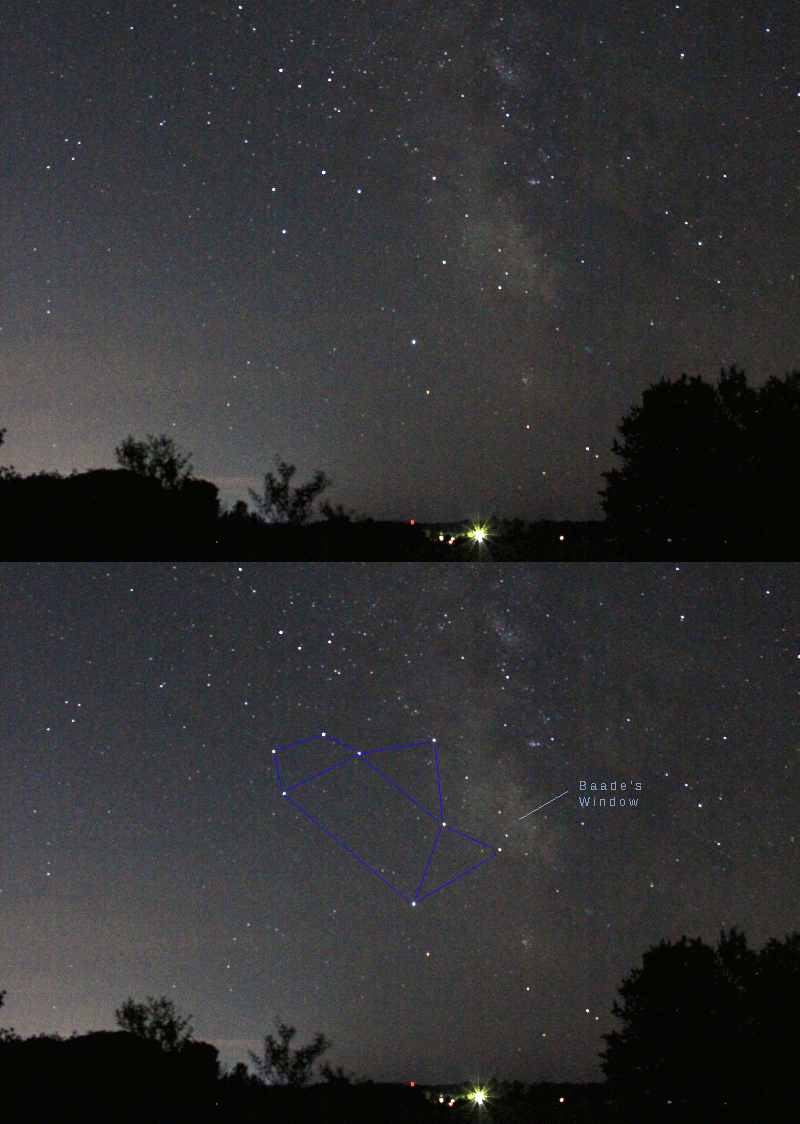
Baade’s Window, aka Large Sagittarius Star Cloud. A finder animation created from my photograph taken August 23, 2016, at 11:23 pm. Click on the image to enlarge it.
08/04/2021 – Ephemeris – Let’s search for the naked-eye planets for this week
This is Bob Moler with Ephemeris for Wednesday, August 4th. Today the Sun will be up for 14 hours and 31 minutes, setting at 9:04, and it will rise tomorrow at 6:33. The Moon, halfway from last quarter to new, will rise at 3:16 tomorrow morning.
Let’s search for the naked-eye planets for this week. Venus can be spotted low in the western twilight by 9:45 pm. It will set at 10:29 pm. Venus will be spending the rest of summer low in the western sky, and not be as conspicuous as it usually is as the Evening Star. Mars is to faint and close to the Sun to be seen from northern latitudes. Saturn, now officially an evening planet, rises before sunset. It will be seen low in the southeast in the evening. Brighter Jupiter will rise at 9:38 pm in the east-southeast and will be seen thereafter trailing Saturn to it’s left or east. Jupiter will join Saturn as an evening planet on the 19th when it too reaches opposition from the Sun.
The astronomical event times given are for the Traverse City/Interlochen area of Michigan (EDT, UT – 4 hr). They may be different for your location.
Addendum
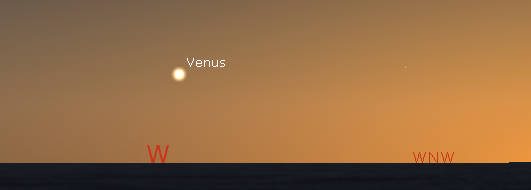
Venus in evening twilight at 9:45 pm, or about 40 minutes after sunset tonight, August 4, 2021. Created using Stellarium.
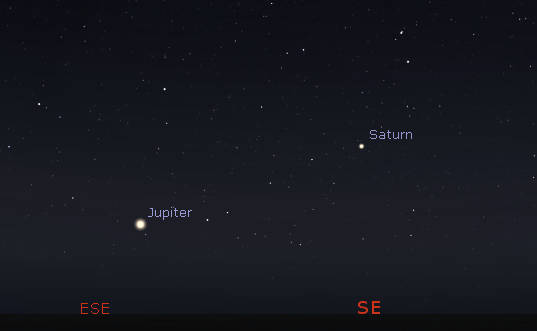
Jupiter and Saturn in the Southeastern sky at 10;30 pm tonight, August 4, 2021. Created using Stellarium.
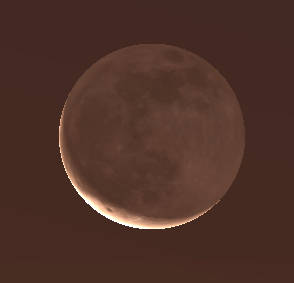
The waning crescent Moon as it might be seen in binoculars tomorrow morning at 6 am, about an half an hour before sunrise. Created using Stellarium.
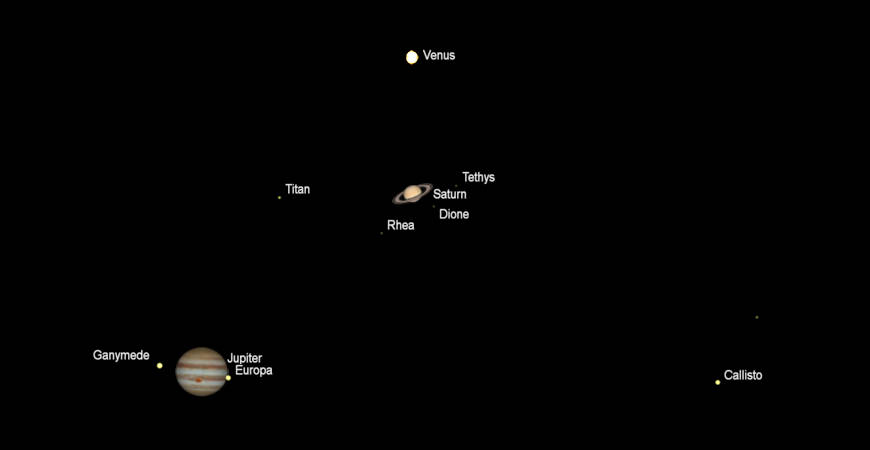
Telescopic view of the bright planets (north up) as they would be seen in a small telescope, with the same magnification, this evening, August 4, 2021. Apparent diameters: Venus, 12.93″; Saturn 18.60″, its rings 43.32″; Jupiter, 48.71″. The ” symbol means seconds of arc (1/3600th of a degree.) Click on the image to enlarge it. Created using Cartes du Ciel (Sky Charts).
Note on Jupiter and its moons. The Great Red Spot will be visible on the face of Jupiter. Europa will end its transit of the planet around 11:00 pm (03:00 UT on the 5th) Io will be occulted by Jupiter (behind the planet) in the early evening until about 11:27 pm (03:27 UT on the 5th) and will appear to the east of the planet.
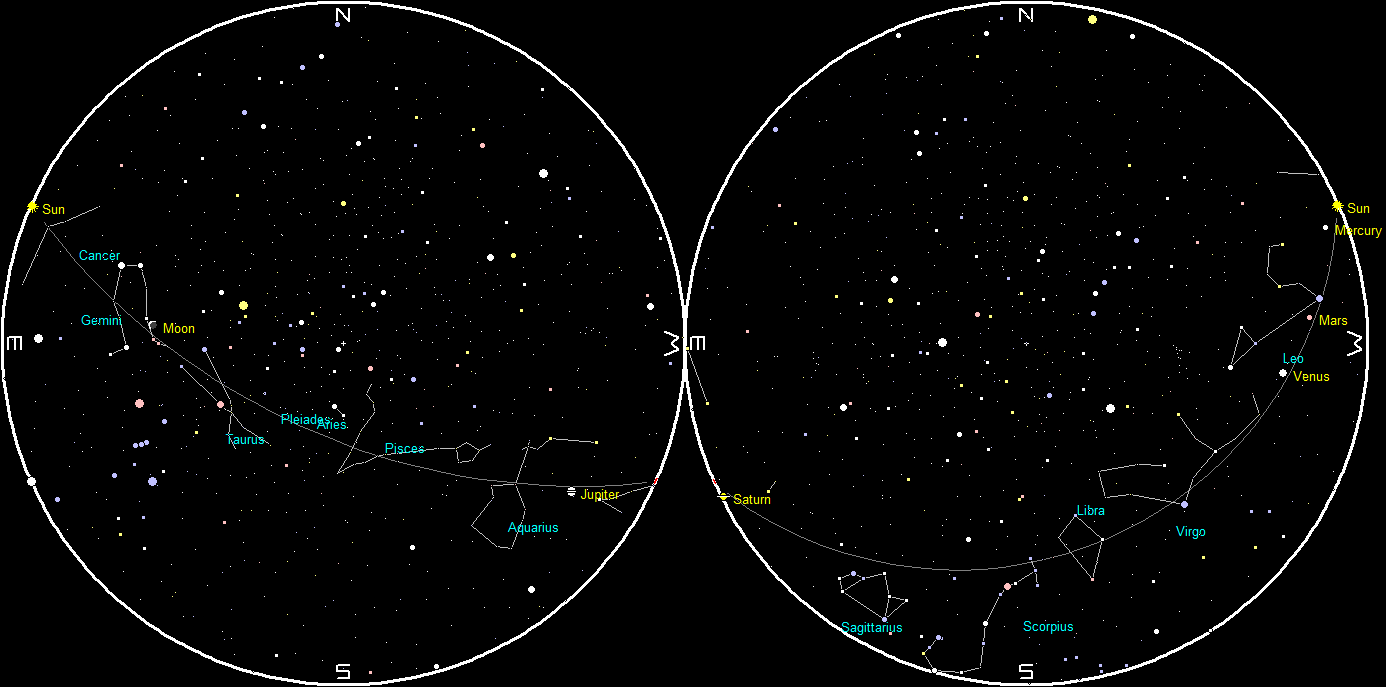
Planets and the Moon at sunset and sunrise of a single night, starting with sunset on the right on August 4, 2021. The night ends on the left with sunrise on the 5th. Click on the image to enlarge. Created using my LookingUp program.
08/03/2021 – Ephemeris – Centaur or Teapot?
This is Ephemeris for Tuesday, August 3rd. Today the Sun will be up for 14 hours and 33 minutes, setting at 9:05, and it will rise tomorrow at 6:32. The Moon, 3 days past last quarter, will rise at 2:31 tomorrow morning.
In the south and low in the sky at 10:30 p.m. is one of my favorite asterisms the Teapot of the constellation Sagittarius. Sagittarius classically represents a centaur with a bow and arrow aimed at the heart of the constellation Scorpius to its west. I can find the bow and arrow here, but the half man, half horse figure of the centaur eludes me. However, the stout little teapot of the children’s song is quite obvious, with its base, lid on top, handle to the left and the spout to the right. To make things more realistic, the bright Milky Way seems to rise like steam from its spout. As the night goes on, the Teapot slides westward and appears to tilt, pouring its tea on the southwestern horizon. Its appearance in the south is an invitation to explore the milky band with binoculars.
The astronomical event times given are for the Traverse City/Interlochen area of Michigan (EDT, UT – 4 hr). They may be different for your location.
Addendum
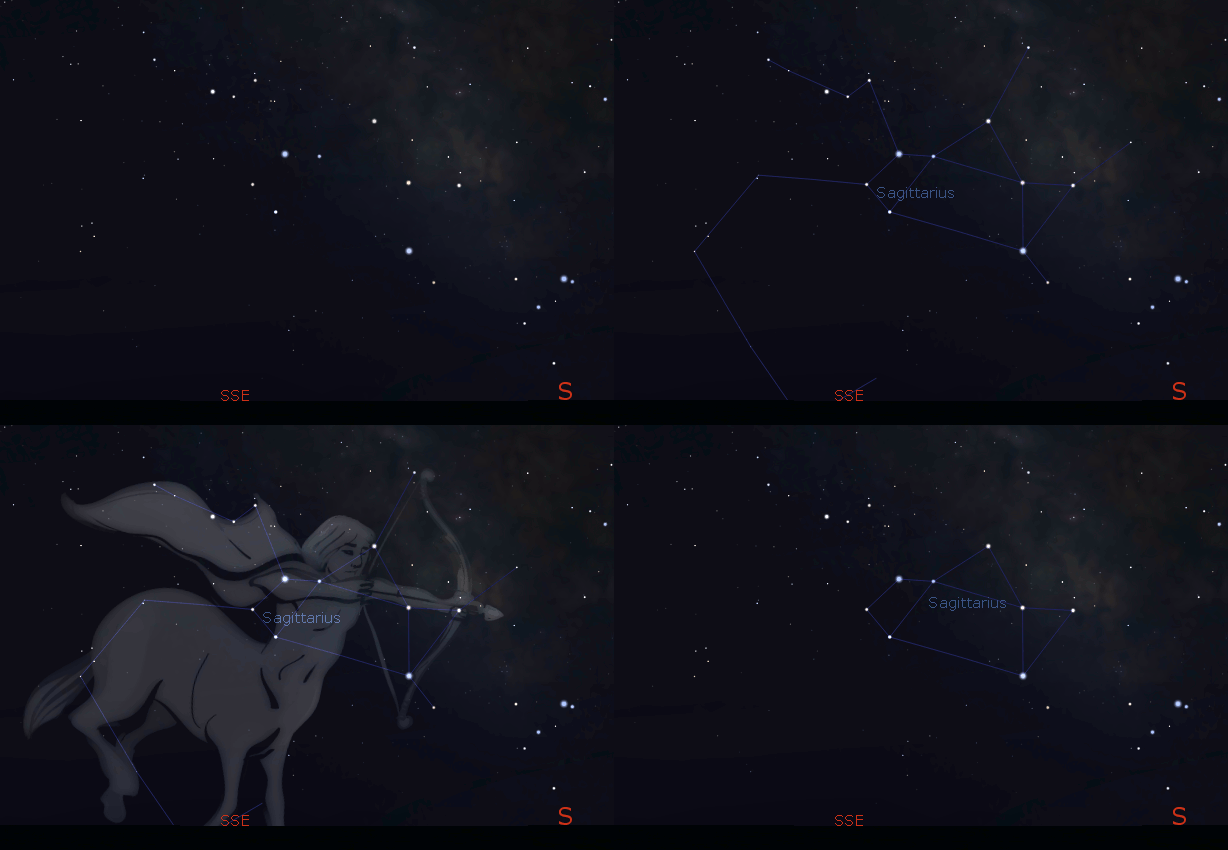
Sagittarius and the Teapot finder animation for tonight, August 3rd. Created using Stellarium.
08/02/2021 – Ephemeris – Saturn is closest to us and enters the evening sky today
This is Bob Moler with Ephemeris for Monday, August 2nd. Today the Sun will be up for 14 hours and 36 minutes, setting at 9:06, and it will rise tomorrow at 6:31. The Moon, 2 days past last quarter, will rise at 1:55 tomorrow morning.
Today the ringed planet Saturn is at opposition, that is, opposite the Sun in our sky, rising at sunset and setting at sunrise. Saturn, then, is as close to us as it can get at 832 million miles (1,339 billion kilometers). Its rings are getting noticeably thinner now. Their narrow dimension is less than the planet’s diameter. Saturn’s axis and rings, which orbit over its equator, keep the same orientation in space as it orbits the Sun, just as the Earth’s axis does, giving us our seasons. Saturn’s seasons last nearly seven and a half of our years. Since about 2017, the rings have been closing, imperceptibly at first, but by March 2025 they will be edge-on, and will disappear, since for their great breadth of 175,000 or so miles (282,000 kilometers), they are less than 100 feet thick.
The astronomical event times given are for the Traverse City/Interlochen area of Michigan (EDT, UT – 4 hr). They may be different for your location.
Addendum
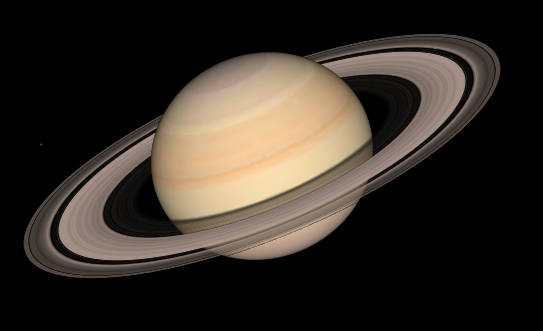
An enlarged view of Saturn and its rings as created by the program Cartes du Ceil (Sky Charts). Note that the globe of Saturn now extends past the narrow dimension of the rings. The rings will continue to narrow until March 23, 2025.
07/30/2021 – Ephemeris – Previewing August skies
This is Bob Moler with Ephemeris for Friday, July 30th. Today the Sun will be up for 14 hours and 43 minutes, setting at 9:10, and it will rise tomorrow at 6:28. The Moon, 1 day before last quarter, will rise at 12:38 tomorrow morning.
Let’s look ahead at the month of August in the skies. Daylight hours will decrease from 14 hours and 38 minutes on the 1st to 13 hours 16 minutes on the 31st. The altitude of the Sun at local noon, that is, degrees of angle above the horizon, will decrease from 63 degrees Sunday to just over 53 degrees on the 31st. Straits area listeners can subtract one more degree from those angles, but their daylight hours will be a few minutes longer. Local noon, when the Sun is due south, is about 1:43 p.m. The Perseid meteor shower will reach its peak at between 3 and 6 p.m. on the 12th. That means that more than likely the early mornings of the 12th and 13th will be equally good for viewing them. I tend to prefer viewing before the peak, if given a choice.
The astronomical event times given are for the Traverse City/Interlochen area of Michigan (EDT, UT – 4 hr). They may be different for your location.
Addendum
August Evening Star Chart
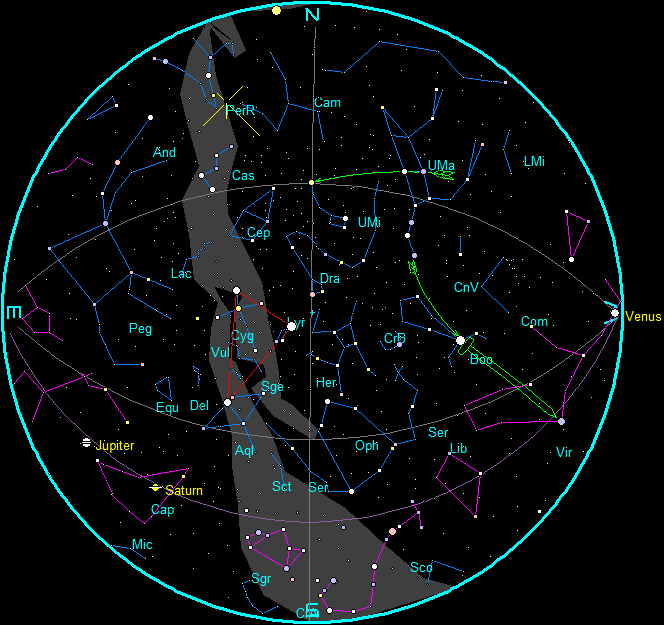
Star Chart for August 2020 (10 pm EDT, August 15, 2021). Click on image to enlarge it. Created using my LookingUp program.
The planets and stars are plotted for the 15th at 10 p.m. EDT in the evening and 5 a.m. for the morning chart. These are the chart times. Note that Traverse City is located approximately 45 minutes behind our time meridian, West 75° longitude. (An hour 45 minutes behind our daylight saving time meridian during EDT). To duplicate the star positions on a planisphere you may have to set it to 1 hour 45 minutes earlier than the current time.
Note the chart times are for the 15th. For each week before the 15th, add ½ hour (28 minutes if you’re picky). For each week after the 15th, subtract ½ hour. The planet positions are updated each Wednesday on this blog. For planet positions on dates other than the 15th.
August Morning Star Chart
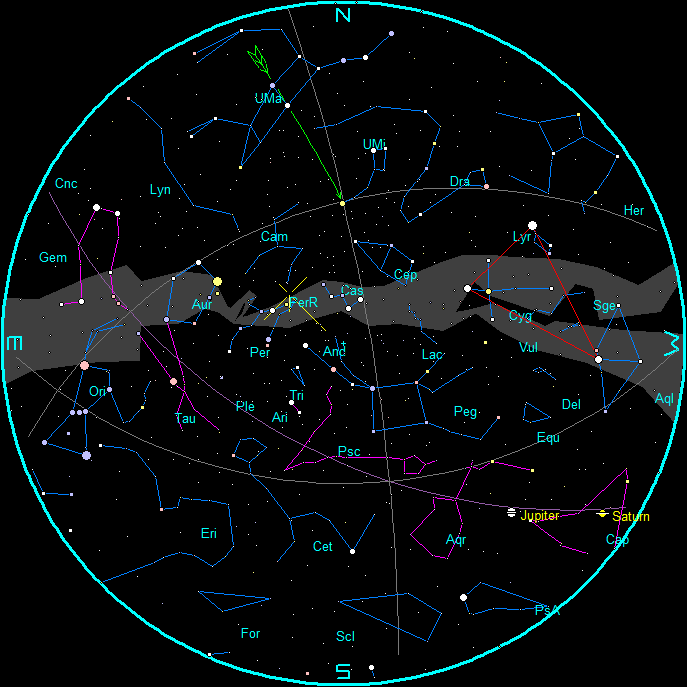
Star Chart for August mornings, (5 a.m. EDT, August 15, 2021). Click on image to enlarge. Created using my LookingUp program.
For a list of constellation names to go with the abbreviations click here.
- Pointer stars at the front of the bowl of the Big Dipper point to Polaris the North Star.
- Leaky dipper drips on Leo.
- Follow the arc of the handle of the Big Dipper to the star Arcturus, and
- Extend like a spike to Spica.
- The Summer Triangle is in red.
- PerR is the radiant of the Perseid meteor shower (Peaks on the 12th)
Twilight Limits, Nautical and Astronomical
| EDT | |||||||
| Morning | Twilight | Evening | Twilight | Dark | Night | Moon | |
| Date | Astro. | Nautical | Nautical | Astro. | Start | End | Illum. |
| 2021-08-01 | 4h31m | 5h19m | 22h26m | 23h15m | 23h15m | 1h00m | 0.35 |
| 2021-08-02 | 4h32m | 5h20m | 22h25m | 23h13m | 23h13m | 1h25m | 0.26 |
| 2021-08-03 | 4h34m | 5h22m | 22h23m | 23h11m | 23h11m | 1h55m | 0.18 |
| 2021-08-04 | 4h36m | 5h23m | 22h21m | 23h08m | 23h08m | 2h31m | 0.11 |
| 2021-08-05 | 4h38m | 5h25m | 22h20m | 23h06m | 23h06m | 3h16m | 0.06 |
| 2021-08-06 | 4h40m | 5h26m | 22h18m | 23h04m | 23h04m | 4h09m | 0.02 |
| 2021-08-07 | 4h42m | 5h28m | 22h16m | 23h02m | 23h02m | 4h42m | 0 |
| 2021-08-08 | 4h44m | 5h29m | 22h14m | 23h00m | 23h00m | 4h44m | 0 |
| 2021-08-09 | 4h46m | 5h31m | 22h13m | 22h58m | 22h58m | 4h46m | 0.03 |
| 2021-08-10 | 4h48m | 5h32m | 22h11m | 22h55m | 22h55m | 4h48m | 0.08 |
| 2021-08-11 | 4h50m | 5h34m | 22h09m | 22h53m | 22h53m | 4h50m | 0.15 |
| 2021-08-12 | 4h51m | 5h35m | 22h07m | 22h51m | 23h13m | 4h51m | 0.24 |
| 2021-08-13 | 4h53m | 5h37m | 22h05m | 22h49m | 23h36m | 4h53m | 0.34 |
| 2021-08-14 | 4h55m | 5h38m | 22h03m | 22h47m | – | 4h55m | 0.45 |
| 2021-08-15 | 4h57m | 5h40m | 22h02m | 22h44m | 0h03m | 4h57m | 0.57 |
| 2021-08-16 | 4h59m | 5h41m | 22h00m | 22h42m | 0h34m | 4h59m | 0.68 |
| 2021-08-17 | 5h01m | 5h43m | 21h58m | 22h40m | 1h13m | 5h01m | 0.78 |
| 2021-08-18 | 5h02m | 5h44m | 21h56m | 22h38m | 2h02m | 5h02m | 0.87 |
| 2021-08-19 | 5h04m | 5h46m | 21h54m | 22h36m | 3h02m | 5h04m | 0.94 |
| 2021-08-20 | 5h06m | 5h47m | 21h52m | 22h33m | 4h12m | 5h06m | 0.98 |
| 2021-08-21 | 5h08m | 5h49m | 21h50m | 22h31m | – | – | 1 |
| 2021-08-22 | 5h09m | 5h50m | 21h48m | 22h29m | – | – | 0.99 |
| 2021-08-23 | 5h11m | 5h52m | 21h46m | 22h27m | – | – | 0.97 |
| 2021-08-24 | 5h13m | 5h53m | 21h44m | 22h24m | – | – | 0.92 |
| 2021-08-25 | 5h15m | 5h54m | 21h42m | 22h22m | – | – | 0.86 |
| 2021-08-26 | 5h16m | 5h56m | 21h40m | 22h20m | 22h20m | 22h40m | 0.78 |
| 2021-08-27 | 5h18m | 5h57m | 21h38m | 22h18m | 22h18m | 23h01m | 0.69 |
| 2021-08-28 | 5h20m | 5h59m | 21h36m | 22h15m | 22h15m | 23h25m | 0.6 |
| 2021-08-29 | 5h21m | 6h00m | 21h34m | 22h13m | 22h13m | 23h53m | 0.51 |
| 2021-08-30 | 5h23m | 6h01m | 21h32m | 22h11m | 22h11m | – | 0.42 |
| 2021-08-31 | 5h24m | 6h03m | 21h30m | 22h09m | 22h09m | 0h26m | 0.32 |
Twilight calendar was generated using Cartes du Ciel (Sky Charts).
See my blog post: Twilight Zone for the definitions of the different periods of twilight here: https://bobmoler.wordpress.com/2018/09/27/.
NASA Calendar of Planetary Events
    Date     Time    Event
Aug  1  Su            Venus: 33.1° E
     1  Su  10:00 am  Mercury Superior Conj.
     2  Mo   1:24 am  Saturn Opposition
     2  Mo   3:35 am  Moon Apogee: 404400 km
     2  Mo  10:51 pm  Moon Ascending Node
     5  Th  12:46 pm  Moon North Dec.: 25.7° N
     8  Su   9:50 am  New Moon
    11  We   3:00 am  Moon-Venus: 4.4° S
    12  Th   3:11 pm  Perseid Shower: ZHR = 90
    15  Su  11:20 am  First Quarter
    16  Mo  12:04 pm  Moon Descending Node
    17  Tu   5:23 am  Moon Perigee: 369100 km
    18  We   6:24 pm  Moon South Dec.: 25.8° S
    18  We  11:03 pm  Mercury-Mars: 0.1° N
    19  Th   7:05 pm  Jupiter Opposition
    20  Fr   6:19 pm  Moon-Saturn: 3.8° N
    22  Su  12:52 am  Moon-Jupiter: 4.1° N
    22  Su   8:02 am  Full Moon
    29  Su  10:22 pm  Moon Apogee: 404100 km
    30  Mo   1:13 am  Moon Ascending Node
    30  Mo   3:13 am  Last Quarter
Sep  1  We            Venus: 39.9° E
Sky Events Calendar by Fred Espenak and Sumit Dutta (NASA’s GSFC),
http://eclipse.gsfc.nasa.gov/SKYCAL/SKYCAL.html.
If you go to the above site you can print out a list like the above for the entire year or calendar pages for your time zone.
Sun and Moon Rising and Setting Events
                  Ephemeris of Sky Events for Interlochen/TC
August, 2021    Local time zone: EDT
+-----------------------------------------------------------------------+
| DATE |  SUN     SUN  DAYLIGHT|   TWILIGHT*    |MOON  RISE OR    ILLUM |
|      |  RISE    SET    HOURS |  END    START  |PHASE SET** TIME FRACTN|
+=======================================================================+
|Sun  1| 06:29a  09:08p  14:38 | 10:23p  05:13a |      Rise 01:25a   36%|
|Mon  2| 06:30a  09:06p  14:36 | 10:21p  05:15a |      Rise 01:55a   28%|
|Tue  3| 06:31a  09:05p  14:33 | 10:20p  05:16a |      Rise 02:31a   20%|
|Wed  4| 06:32a  09:04p  14:31 | 10:18p  05:18a |      Rise 03:16a   13%|
|Thu  5| 06:33a  09:02p  14:29 | 10:16p  05:19a |      Rise 04:09a    7%|
|Fri  6| 06:35a  09:01p  14:26 | 10:14p  05:21a |      Rise 05:11a    3%|
|Sat  7| 06:36a  09:00p  14:23 | 10:13p  05:22a |      Rise 06:18a    1%|
+------+-----------------------+----------------+-----------------------+
|Sun  8| 06:37a  08:58p  14:21 | 10:11p  05:24a |New   Set  09:35p    0%|
|Mon  9| 06:38a  08:57p  14:18 | 10:09p  05:25a |      Set  10:03p    2%|
|Tue 10| 06:39a  08:55p  14:16 | 10:07p  05:27a |      Set  10:27p    7%|
|Wed 11| 06:40a  08:54p  14:13 | 10:05p  05:28a |      Set  10:50p   13%|
|Thu 12| 06:42a  08:52p  14:10 | 10:04p  05:30a |      Set  11:13p   22%|
|Fri 13| 06:43a  08:51p  14:08 | 10:02p  05:31a |      Set  11:36p   32%|
|Sat 14| 06:44a  08:49p  14:05 | 10:00p  05:33a |      Set  12:03a   43%|
+------+-----------------------+----------------+-----------------------+
|Sun 15| 06:45a  08:48p  14:02 | 09:58p  05:34a |F Qtr Set  12:34a   54%|
|Mon 16| 06:46a  08:46p  13:59 | 09:56p  05:36a |      Set  01:13a   65%|
|Tue 17| 06:47a  08:44p  13:56 | 09:54p  05:37a |      Set  02:02a   76%|
|Wed 18| 06:49a  08:43p  13:54 | 09:52p  05:39a |      Set  03:02a   85%|
|Thu 19| 06:50a  08:41p  13:51 | 09:50p  05:40a |      Set  04:11a   92%|
|Fri 20| 06:51a  08:39p  13:48 | 09:48p  05:42a |      Set  05:26a   97%|
|Sat 21| 06:52a  08:38p  13:45 | 09:46p  05:43a |      Set  06:40a  100%|
+------+-----------------------+----------------+-----------------------+
|Sun 22| 06:53a  08:36p  13:42 | 09:45p  05:44a |Full  Rise 09:15p  100%|
|Mon 23| 06:54a  08:34p  13:39 | 09:43p  05:46a |      Rise 09:39p   97%|
|Tue 24| 06:56a  08:33p  13:36 | 09:41p  05:47a |      Rise 10:00p   93%|
|Wed 25| 06:57a  08:31p  13:34 | 09:39p  05:49a |      Rise 10:20p   87%|
|Thu 26| 06:58a  08:29p  13:31 | 09:37p  05:50a |      Rise 10:40p   79%|
|Fri 27| 06:59a  08:27p  13:28 | 09:35p  05:52a |      Rise 11:01p   71%|
|Sat 28| 07:00a  08:26p  13:25 | 09:33p  05:53a |      Rise 11:25p   62%|
+------+-----------------------+----------------+-----------------------+
|Sun 29| 07:02a  08:24p  13:22 | 09:31p  05:54a |      Rise 11:53p   53%|
|Mon 30| 07:03a  08:22p  13:19 | 09:29p  05:56a |L Qtr Rise 12:26a   43%|
|Tue 31| 07:04a  08:20p  13:16 | 09:27p  05:57a |      Rise 01:07a   34%|
+-----------------------------------------------------------------------+
* Nautical Twilight
** Moonrise or moonset, whichever occurs between sunrise and sunset
Generated using my LookingUp for DOS program.
07/29/2021 – Ephemeris – Anishinaabe constellation of their hero
This is Bob Moler with Ephemeris for Thursday, July 29th. Today the Sun will be up for 14 hours and 45 minutes, setting at 9:11, and it will rise tomorrow at 6:27. The Moon, 2 days before last quarter, will rise at 12:17 tomorrow morning. | Tuesday I talked about the constellation Scorpius the scorpion now seen low in the southern sky in the evening. To me, the stars here make a very good scorpion. Scorpius was invented by people of the Middle East, where scorpions are plentiful. The Anishinaabe native peoples of our area, however, saw one of their legendary hero figures, Nenabozho*. In the sky, the arc of three stars at the front of the scorpion and to the right of the bright star Antares is his bow. He is shooting an arrow toward the receding Great Panther or Curly Tail a constellation of spring whose curl of a tail is the head of the constellation Leo, now lost in the evening twilight in the west. Nenabozho was a hero in their creation stories, a trickster who was often seen as a rabbit.
The astronomical event times given are for the Traverse City/Interlochen area of Michigan (EDT, UT – 4 hr). They may be different for your location.
Addenda
* Nenabozho is pronounced like Nana-bouz-hou, though different tribes pronounced it differently. I could not find Nenabozho and its various other transliterations, one of which was Nanaboozhoo in the Ojibwe People’s Dictionary (https://ojibwe.lib.umn.edu/). However, since he occasionally shape-shifted into being a rabbit his name includes a part of the name for rabbit, waabooz. That entry had several audio examples. That’s how I got the pronunciation for the radio program.
Finder chart
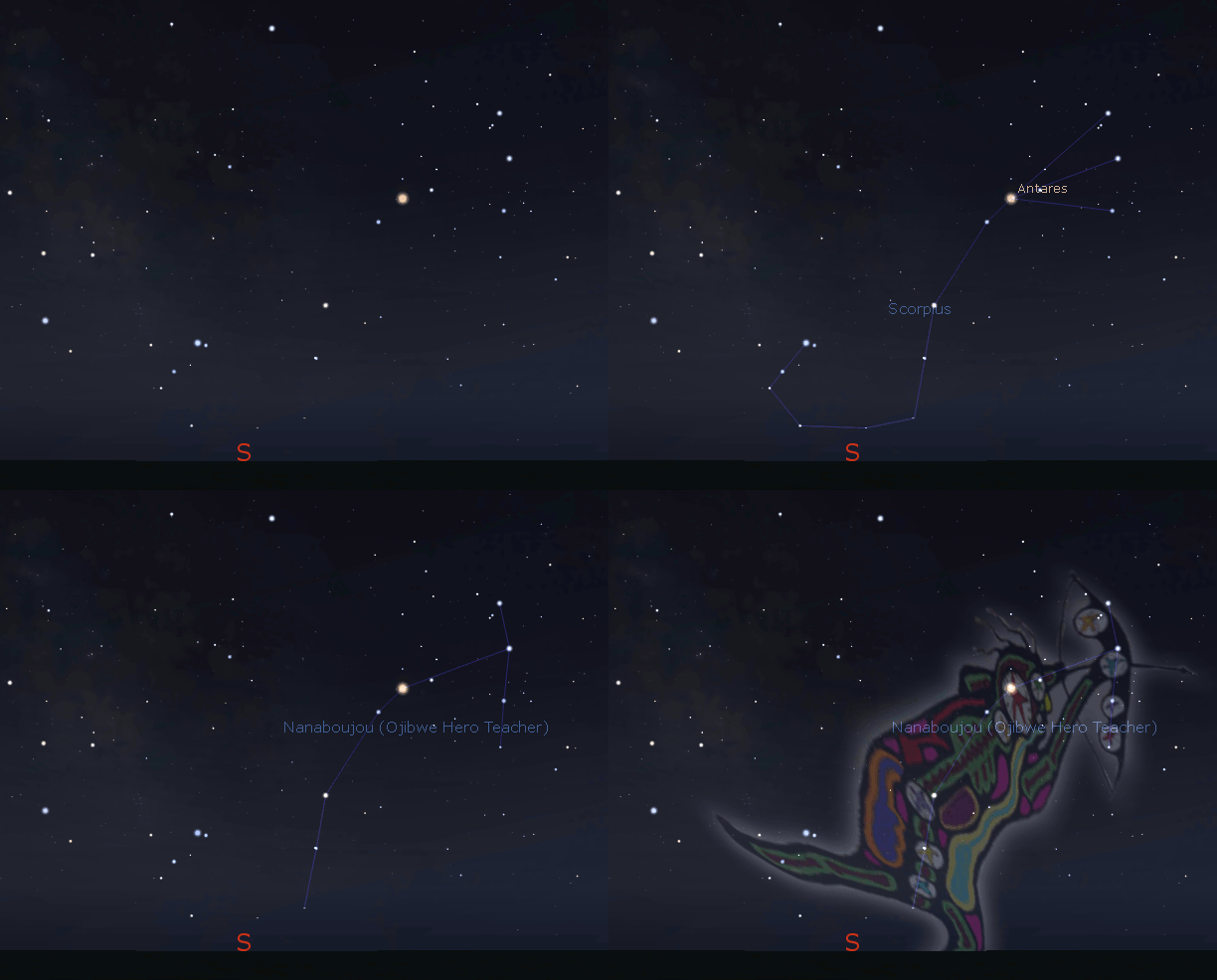
Animated finder for the Anishinaabe constellation of Nenabozho showing the unannotated star field, the Western constellation of Scorpius and Nenabozho. Created using Stellarium (both star lore images are embedded in Stellarium). The Anishinaabe image is embedded in Stellarium and is from Ojibwe Giizhig Anung Masinaaigan – Ojibiwe Sky Star Map created by A. Lee, W. Wilson, and C. Gawboy.
07/28/2021 – Ephemeris – Searching for the naked-eye planets on the last Wednesday in July
This is Ephemeris for Wednesday, July 28th. Today the Sun will be up for 14 hours and 48 minutes, setting at 9:13, and it will rise tomorrow at 6:25. The Moon, 3 days before last quarter, will rise at 11:58 this evening.
Let’s search for the naked-eye planets for this week. Venus can be spotted low in the west-northwest twilight by 9:45 pm. It will set at 10:39 pm. Venus will be spending the rest of summer low in the western sky, and not be as conspicuous as it usually is as the Evening Star. Mars, I believe, is too faint and close to the Sun to be seen from northern latitudes. Saturn will be seen low in the southeast in the evening, with Jupiter rising later. Saturn, 5 days from opposition, that is being opposite the Sun in the sky and closest to Earth, will rise at 9:21 pm. Brighter Jupiter will rise at 10:12 pm, both planets will rise in the east-southeast. By 5:30 am, these two planets will be in the southwestern sky in the morning twilight.
The astronomical event times given are for the Traverse City/Interlochen area of Michigan (EDT, UT – 4 hr). They may be different for your location.
Addendum

Venus in evening twilight in the west at 10 pm, July 28, 2021. Created using Stellarium.
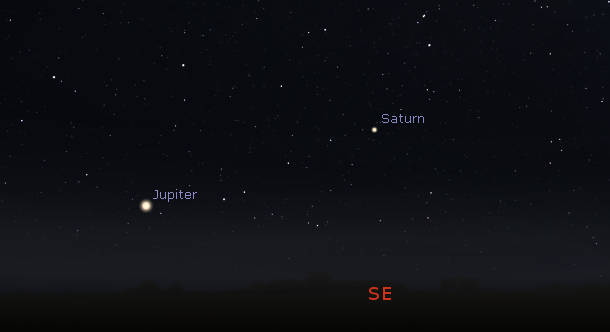
Jupiter and Saturn low in the southeast at 11 pm. Created using Stellarium.
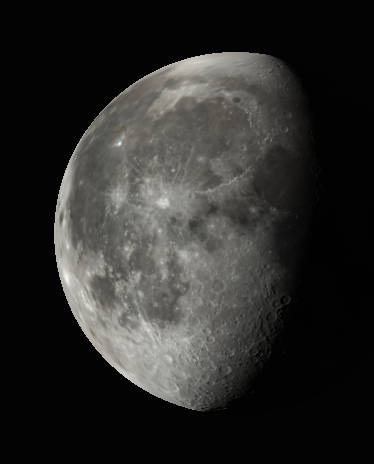
The waning gibbous Moon as it might be seen in binoculars or small telescope at 5:30 am, July 29, 2021. Created using Stellarium.
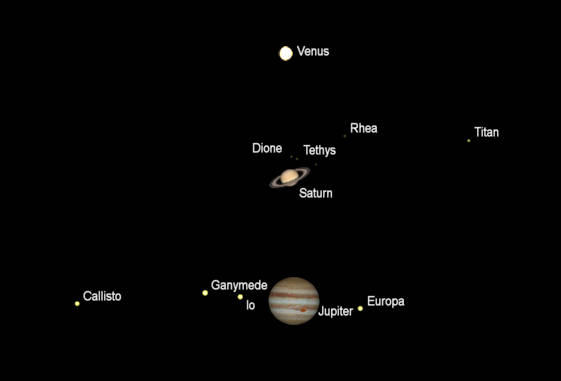
Telescopic view of the bright planets (north up) as they would be seen in a small telescope, with the same magnification, this evening, July 28, 2021. Apparent diameters: Venus, 12.58″; Saturn 18.59″, its rings 43.31″; Jupiter, 48.28″. The ” symbol means seconds of arc (1/3600th of a degree.) Click on the image to enlarge it. Created using Cartes du Ciel (Sky Charts).
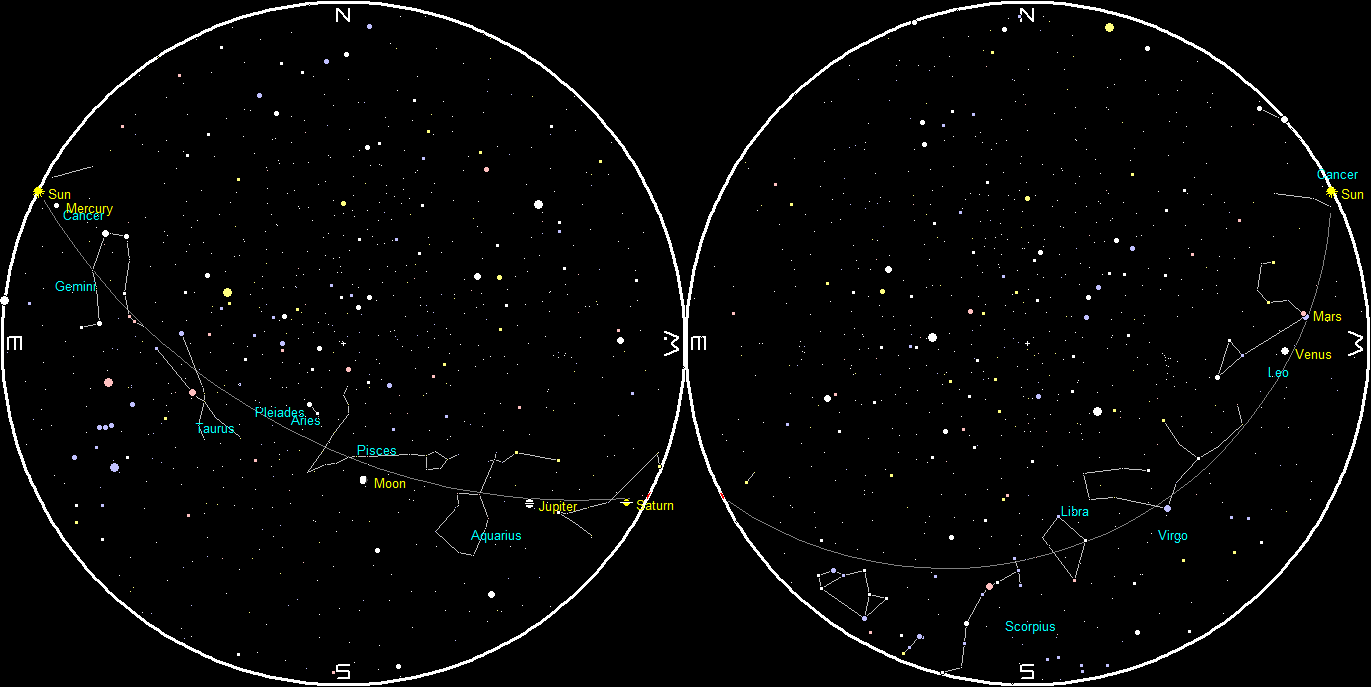
Planets and the Moon at sunset and sunrise of a single night, starting with sunset on the right on July 28, 2021. The night ends on the left with sunrise on the 29th. Click on the image to enlarge. Created using my LookingUp program.
 Bob Moler's Ephemeris Blog