01/12/2021 – Ephemeris – The celestial river Eridanus
This is Bob Moler with Ephemeris for Tuesday, January 12th. Today the Sun will be up for 9 hours and 7 minutes, setting at 5:25, and it will rise tomorrow at 8:17. The Moon, 1 day before new, will rise at 8:58 tomorrow morning.
One of the more obscure constellations around is Eridanus, which depicts a river. The river starts near the lower right corner of Orion, near the bright star Rigel and flows to the right then down near the southwestern horizon, then it meanders along the horizon to the south before turning below the horizon. One has to travel to the far south to see the southern terminus of the river, the bright star Achernar. Writers over the ages have seen here the Nile and the Earth circling river Ocean of the flat earth days. Achernar is actually two stars, the brightest was discovered to be the flattest star known, due to its rapid spin. The dimensions of Achernar A has been determined to be twice as wide across its equator than from pole to pole. It’s 139 light years away.
The event times given are for the Traverse City/Interlochen area of Michigan. They may be different for your location.
Addendum
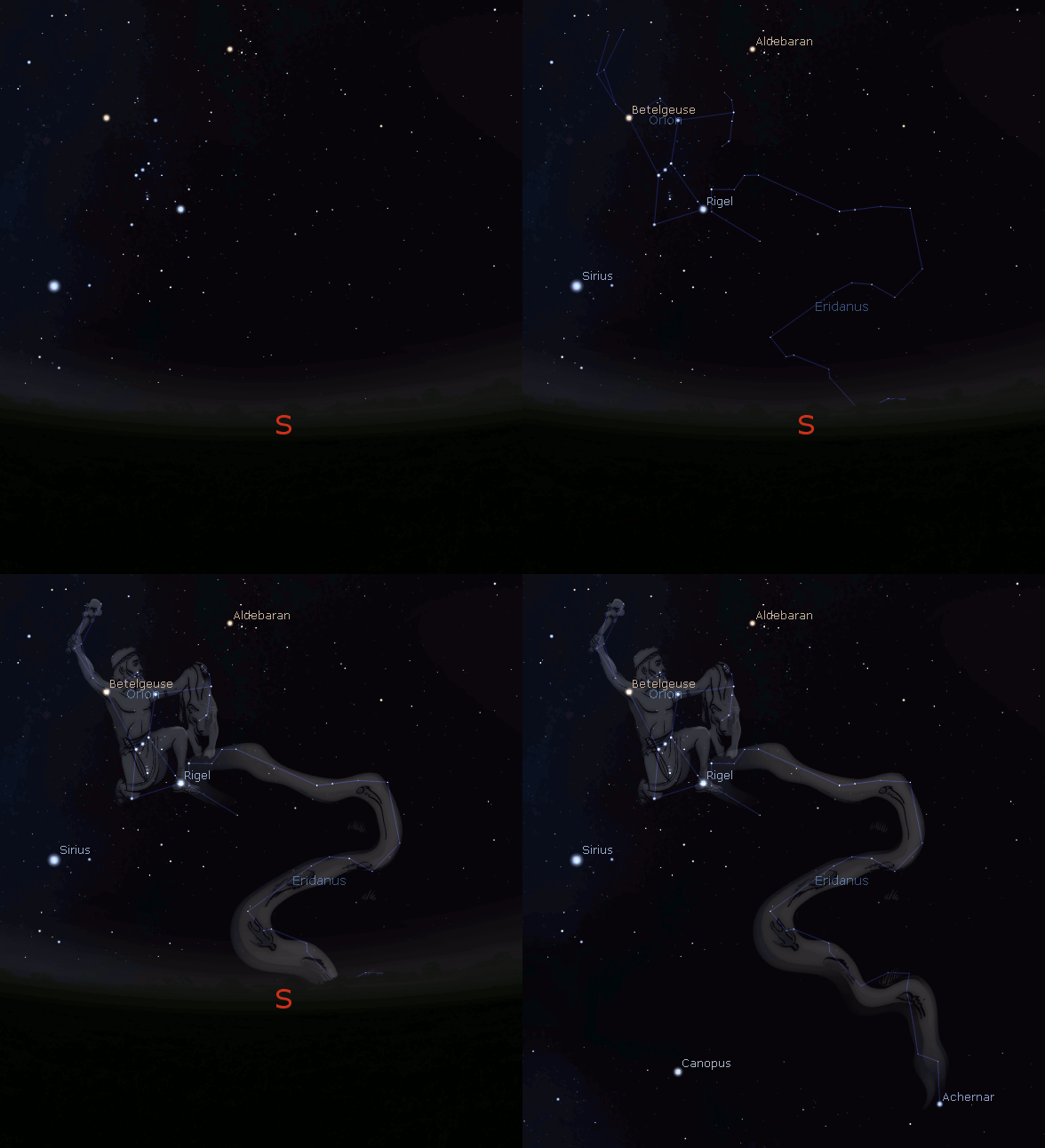
An animation of the constellation Eridanus which is a river that flows from Rigel in Orion to the star Achernar below our southern horizon at latitude 45 degrees north. Create using Stellarium and GIMP.
01/11/2021 – Ephemeris – Procyon, the before the Dog Star
This is Bob Moler with Ephemeris for Monday, January 11th. Today the Sun will be up for 9 hours and 5 minutes, setting at 5:23 pm, and it will rise tomorrow at 8:17 am. The Moon, 2 days before new, will rise at 8:05 tomorrow morning.
Visible low in the east at 8 p.m. appears the star Procyon. To its right and below is Sirius the brightest night-time star. Procyon is the bright star in the constellation Canis Minor, or lesser dog. I can find only one other star in Canis Minor. Perhaps it’s a hot dog. If Sirius, in Canis major is the Dog Star then Procyon should be the Little Dog Star. However, Procyon is an interesting name. It means “Before the dog”, which is an allusion to the fact that Procyon, though east of Sirius actually rises before it. This is due to Procyon’s more northerly position. This effect doesn’t work south of the equator, however. Sirius will rise at about 7:30 tonight. Procyon is a star much like Sirius but is 32% farther away. It’s 11.4 to Sirius’ 8.6 light years away.
The event times given are for the Traverse City/Interlochen area of Michigan. They may be different for your location.
Addendum
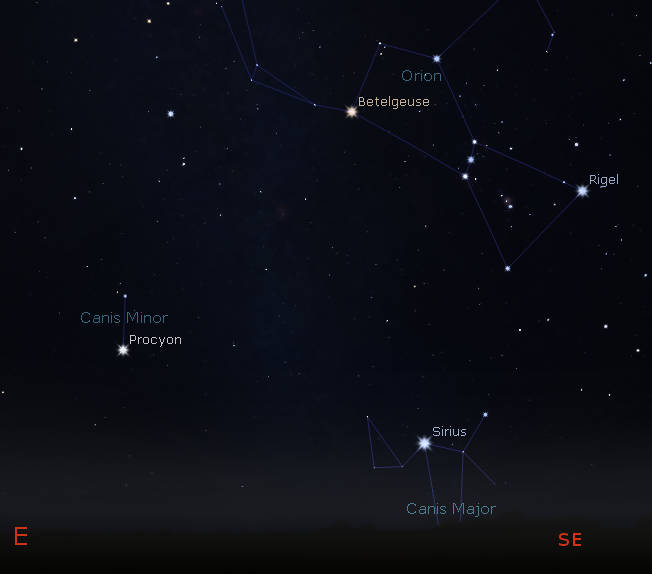
Orion and his hunting dogs in early winter (8 pm, January 11, 2021) showing that Procyon does rise before Sirius.
01/08/2021 – Ephemeris – There will be a virtual star party tonight
This is Ephemeris for Friday, January 8th. Today the Sun will be up for 9 hours and 1 minute, setting at 5:20, and it will rise tomorrow at 8:19. The Moon, 2 days past last quarter, will rise at 4:31 tomorrow morning.
The Grand Traverse Astronomical Society will host a virtual star party at 8 pm tonight. It is via the Zoom app for smartphones, tablets or computers. Instructions and a link can be found on the society’s website gtastro.org. It will be hosted by Dr. Jerry Dobek, astronomy professor at Northwestern Michigan College. During a virtual star party the images are produced real time or near real time using a telescope mounted CCD camera. That is if it’s clear. If cloudy we’ll have a virtual, virtual star party using recently acquired images captured for his astronomy students. A couple of months ago we got a tantalizing look at the Great Orion Nebula as it rose in moonlight. Now it’s higher in the sky with no Moon. It should be spectacular!
The event times given are for the Traverse City/Interlochen area of Michigan. They may be different for your location.
01/07/2021 – Ephemeris – The constellations Orion and Taurus interact
This is Bob Moler with Ephemeris for Thursday, January 7th. Today the Sun will be up for 8 hours and 59 minutes, setting at 5:19, and it will rise tomorrow at 8:19. The Moon, 1 day past last quarter, will rise at 3:13 tomorrow morning.
There are several instances in the Greek heavens where constellations appear to interact with one another. This is true with Orion the hunter and Taurus the bull. Taurus, whose face is the letter V of stars with orangish Aldebaran as his angry bloodshot eye is charging down on Orion, who has raised a lion skin shield on one arm and an upraised club in the other, ready to strike. They have been frozen in this pose for millennia. Stars below and right of the letter V of the Bull’s face suggest the front part of his body and his front legs charging at Orion. Orion also has two hunting dogs, Canis Major and Canis Minor. Canis Major with its dazzling star Sirius will rise around 7:30 on a line extended down from Orion’s belt.
The event times given are for the Traverse City/Interlochen area of Michigan. They may be different for your location.
Addendum
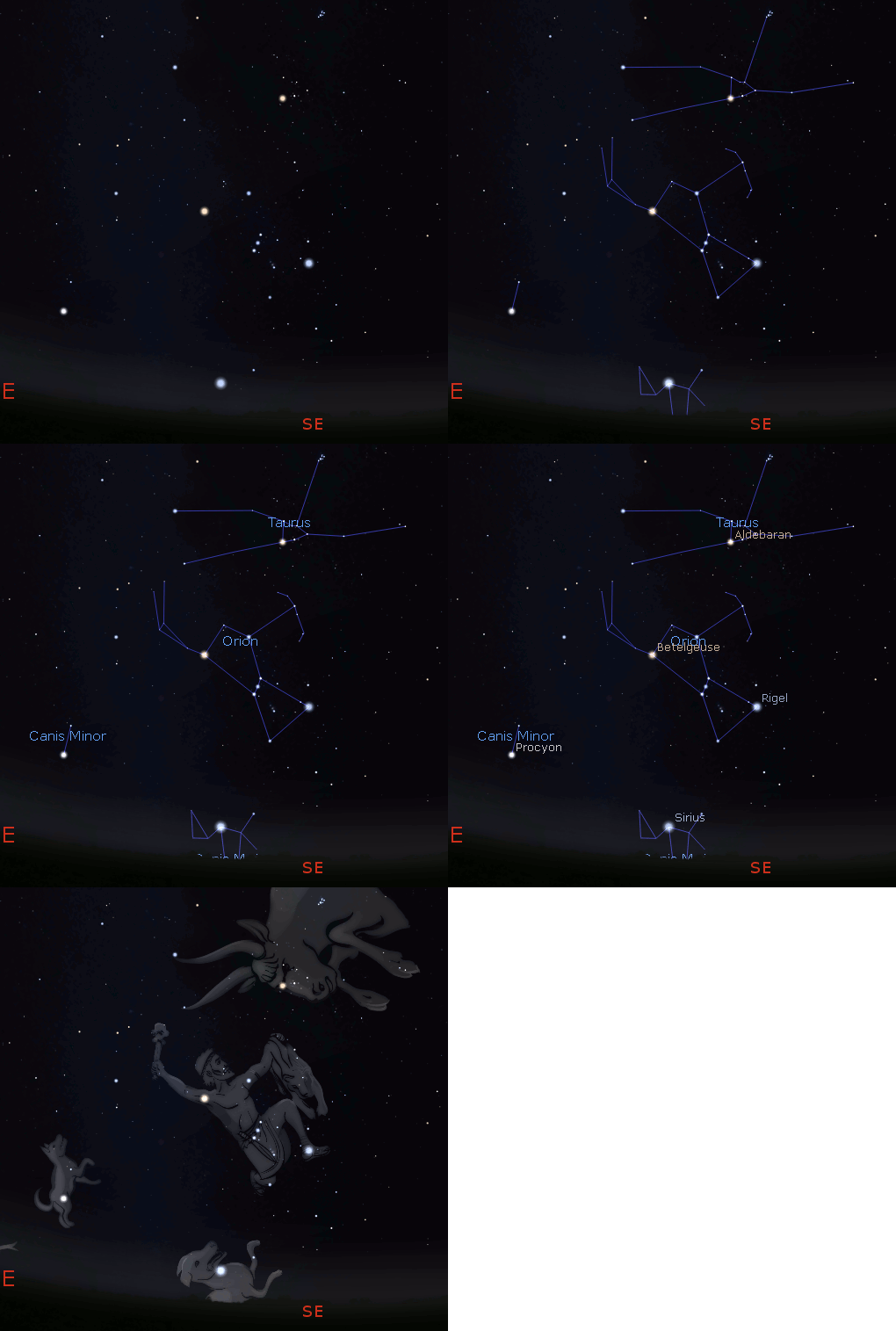
The Orion-Taurus Tableau. Seen around 8 pm, January 7, 2021. Created using Stellarium.
01/06/2021 – Ephemeris – Let’s take our first look at the naked-eye planets for 2021
This is Bob Moler with Ephemeris for Wednesday, January 6th. Today the Sun will be up for 8 hours and 58 minutes, setting at 5:18, and it will rise tomorrow at 8:19. The Moon, at last quarter today, will rise at 1:57 tomorrow morning.
Let’s take our first look at the naked-eye planets for 2021. Jupiter and Saturn are both extremely low in the southwestern sky around 6 pm. Jupiter is the very bright one. Below and right of it is the dimmer Saturn it by two degrees or four moon widths. They crossed paths for us 16 nights ago. They can still be seen in the same binocular field. Saturn will set first tonight at 6:33 pm with Jupiter following nine minutes later. Quite high in the southeast at that hour will be Mars, still in Pisces. It will pass due south at 7:25 tonight. Mars’ distance is increasing to 88 million miles (141 million km) away. It will set at 2:19 tomorrow morning. Venus, our brilliant morning star will rise at 7:03 am in the east-southeast as it seems to retreat slowly toward the Sun, but actually it’s heading way around behind the Sun.
The event times given are for the Traverse City/Interlochen area of Michigan. They may be different for your location.
Addendum
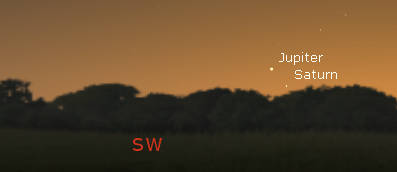
Jupiter and Saturn just above the distant trees at 6 pm January 6, 2021. We might lose them in twilight next week. We’ll have to move to a Lake Michigan horizon to try to spot them. Created using Stellarium.
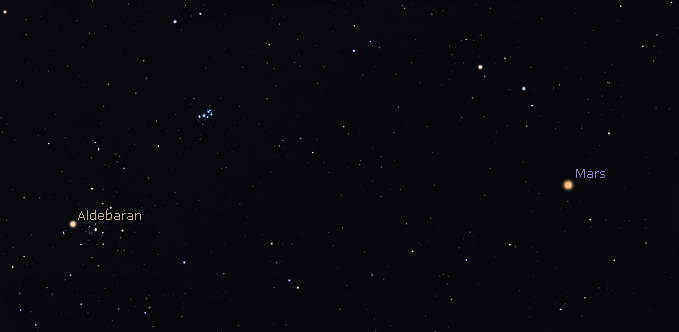
Mars in the evening sky at 8 pm January 6, 2021 looking southward. Mars is on the boarder between Pisces on the right and Aries above and left. Also seen on the left is the tiny dipper shape of the Pleiades or Seven Sisters star cluster and farther to the left the letter V of stars that is the face of Taurus the bull with the bright star Aldebaran. Created using Stellarium.
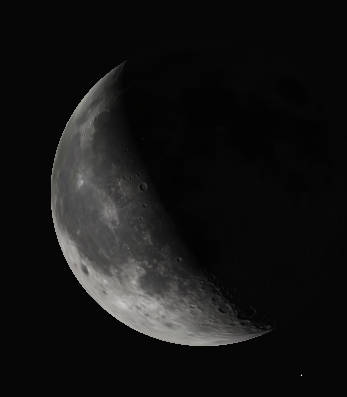
The waning crescent Moon at around 7 am January 7, 2021 as it might be seen in binoculars or a small telescope. Created using Stellarium.
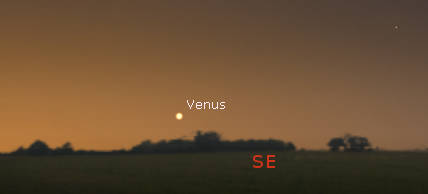
Venus seen low on the southeastern horizon at 7:30 in the morning on January 7, 2021. Created using Stellarium.
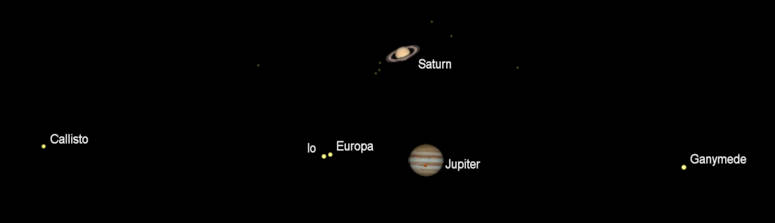
The planets Jupiter and Saturn as they might be seen in a small telescope at 6 pm, January 6, 2021. These planets are seen in twilight so Saturn’s moons will be invisible, and Jupiter’s moons nearly so. Mars is not shown because its apparent size is less than 10″ (seconds of arc in diameter), and Venus, nearly so. Apparent diameters: Jupiter, 32.73″; Saturn, 15.20″, rings, 35.42″; Mars, 9.82″, and Venus, 10.55″ 95% full.
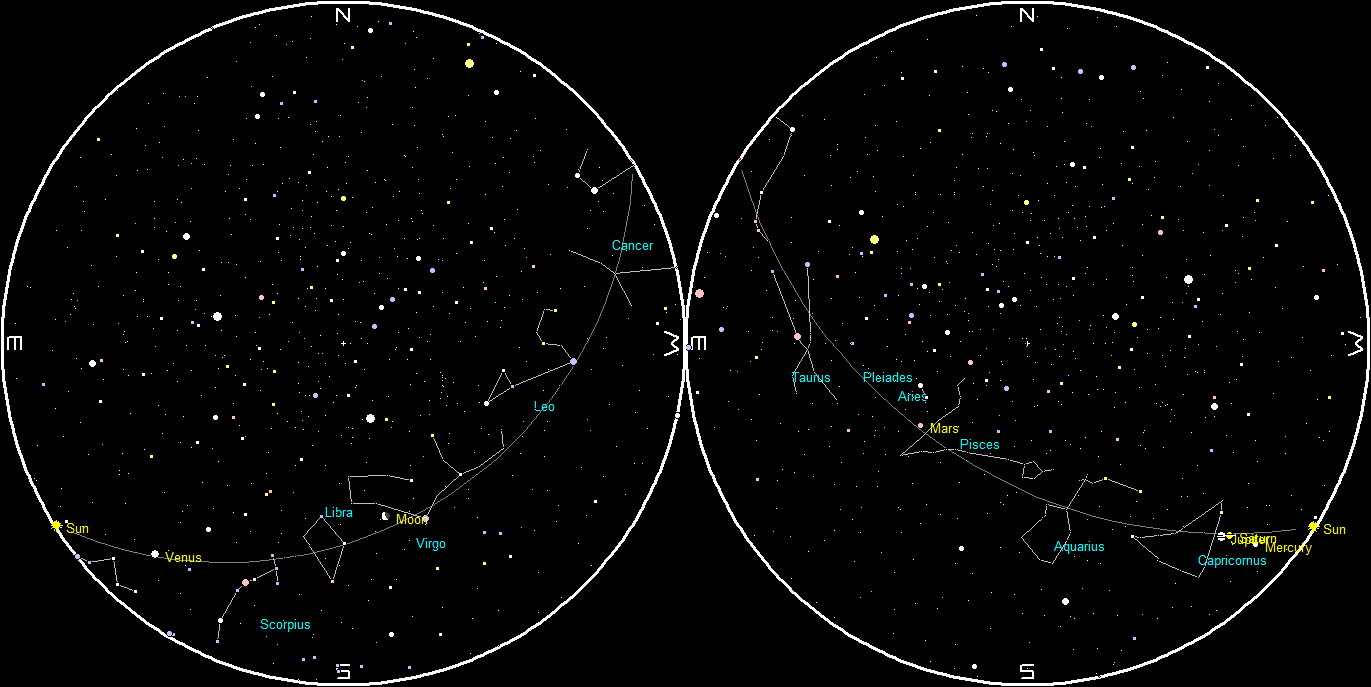
Planets and the Moon at sunset and sunrise of a single night starting with sunset on the right on January 6, 2021. The night ends on the left with sunrise on the 7th. I’m afraid that the labels for Jupiter and Saturn overlap, since the planets are very close. Click on the image to enlarge. Created using my LookingUp program.
01/05/2021 – Ephemeris – Orion’s named stars and their meanings
This is Ephemeris for Tuesday, January 5th. Today the Sun will be up for 8 hours and 57 minutes, setting at 5:17, and it will rise tomorrow at 8:19. The Moon, 1 day before last quarter, will rise at 12:42 tomorrow morning.
The constellation of Orion the hunter is visible in the southeast at 8 p.m. The names of the stars of Orion are interesting in themselves. Starting at the top left of the seven bright stars of Orion’s torso is Betelgeuse the bright red star, whose name means something like “Armpit of the Giant”. The star in Orion’s other shoulder is Bellatrix the “Amazon Star”. Below are the three stars of Orion’s belt, from left to right; Alnitak, Alnilam and Mintaka. Their names mean “Girdle”, “Belt of Pearls”, and “Belt” respectively. Down to Orion’s knees we look on the left to the star Saiph pronounced “Safe”* which means “Sword”, though it is a star in his knee. Finally, there’s the bright blue-white star Rigel whose name means “Left Leg of the Giant” in Orion’s other knee. These are the important stars that make up the figure of Orion in the sky. [BTW. most star names are Arabic, and what survives of them is just a part of the original Arabic phrases.]
* In the radio program I pronounced the word then spelled it out.
The event times given are for the Traverse City/Interlochen area of Michigan. They may be different for your location.
Addendum
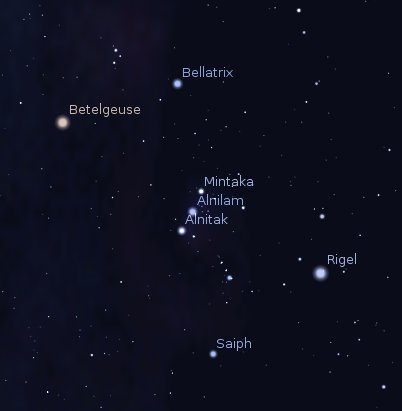
The named stars of Orion. Created using Stellarium.
01/04/2021 – Ephemeris – A belated preview of January skies
This is Ephemeris for Monday, January 4th. The Sun will rise at 8:20. It’ll be up for 8 hours and 56 minutes, setting at 5:16. The Moon, 2 days before last quarter, will rise at 11:29 this evening.
Let’s look ahead at the rest of January. Daylight hours will increase from 8 hours 56 minutes a day today to 9 hours 47 minutes on the 31st. The Sun’s noontime altitude above the southern horizon will increase from 22 ½ degrees today to 28 degrees on the 31st. The time of local noon, when the Sun is due south will be 12:52 pm on the 15th. The Straits area will have the Sun lower by a degree, and slightly shorter daytime hours. This month we’ll get into the heart of winter, and it’s going to be cold. This is moderated or intensified by the weather, which is always a wild card. In the night skies the winter stars, and Orion will make a bright display. Only Mars of all the naked-eye planets will be visible after twilight in the evening.
The event times given are for the Traverse City/Interlochen area of Michigan. They may be different for your location.
Note: The addendum of information about the month ahead has been added to my January 1st post here.
01/01/2021 – Ephemeris – The first few day of January have two annual astronomical events
Note: With New Year’s Day followed by the weekend I’m postponing the January preview program to Monday the 4th, however, the Month Preview addendum will be added to the post today.
Happy New Year, this is Bob Moler with Ephemeris for New Year’s Day, Friday, January 1st 2021. The Sun will rise at 8:20. It’ll be up for 8 hours and 53 minutes, setting at 5:13. The Moon, 3 days past full, will rise at 7:51 this evening.
It happens that a lot of astronomical events occur in the first few days of January, that I’ll cover these now and talk about the rest of the month on Monday. Tomorrow, the second, at 3:59 am the Earth will be its closest to the Sun at 91.4 million miles (147.0 million kilometers). The only real effect is that it makes winter the shortest season, four days shorter than summer because the Earth moves fastest when closest to the Sun. On Saturday evening the 2nd will see the peak of the Quadrantid meteor shower for a short time before the bright Moon rises at 9 p.m. the radiant point for this shower is low in the north, from an obsolete constellation of the Mural Quadrant located off the handle of the Big Dipper. The bright waning gibbous Moon will curtail the morning display of the shower when the radiant is higher. January 2nd also the latest sunrise. Later in January we will have brighter early mornings again.
The event times given are for the Traverse City/Interlochen area of Michigan. They may be different for your location.
Addendum
January Evening Star Chart
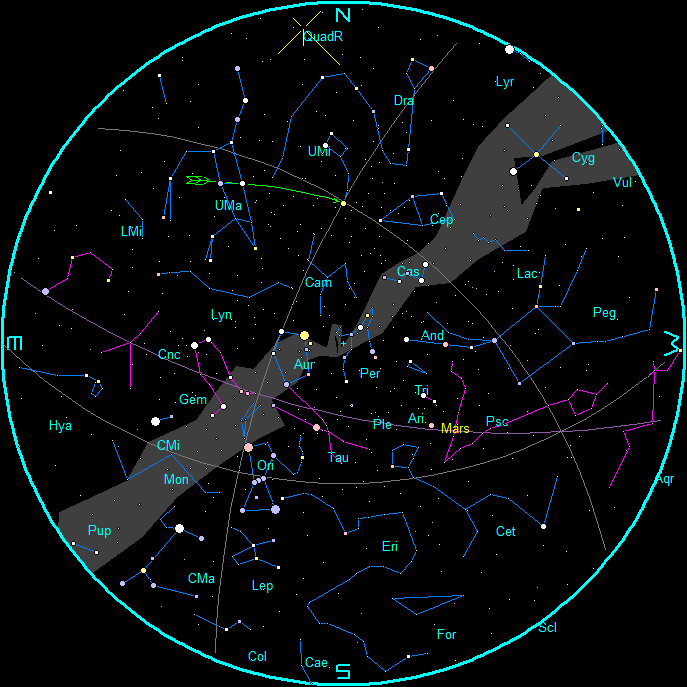
Star Chart for January 2021 (9 p.m. EST January 15, 2021). Click on image to enlarge. Created using my LookingUp program.
The planets and stars are plotted for the 15th at 9 p.m. EST in the evening and 6 a.m. for the morning chart. These are the chart times. The brilliant planet Venus will enter the sky at the chart time during the latter half of the month in the southwest. Note that Traverse City is located approximately 45 minutes behind our time meridian, West 75° longitude. (An hour 45 minutes behind our daylight saving time meridian during EDT).
January Morning Star Chart
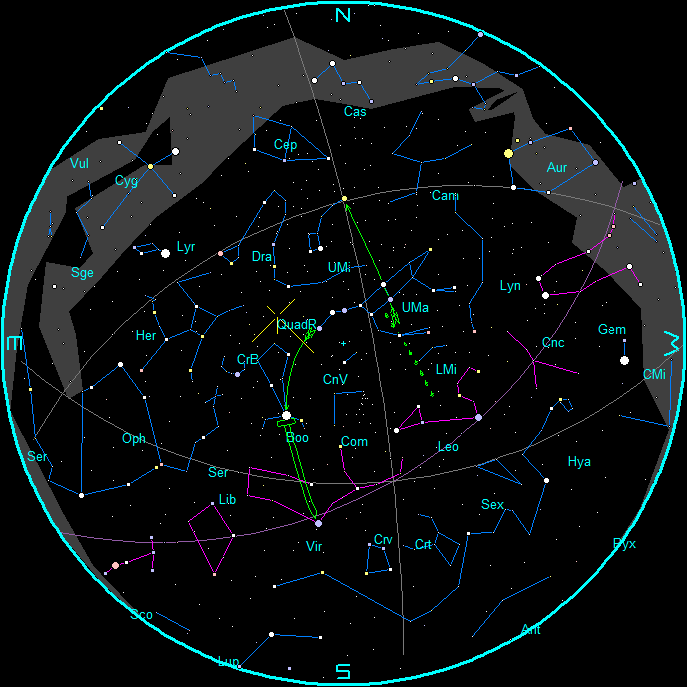
Star Chart for January mornings 2021 (6 a.m. EST January 15, 2021). Click on image to enlarge. Created using my LookingUp program.
For a list of constellation names to go with the abbreviations click here.
- Pointer stars at the front of the bowl of the Big Dipper point to Polaris the North Star.
- The leaky bowl of the Big Dipper drips on Leo.
- Follow the arc of the handle of the Big Dipper to the star Arcturus, then
- Follow the spike to Spica.
- QuadR on the star charts is the radiant of the Quadrantid meteor shower which peaks on the 3rd, but is best seen in the early evening hours of the 2nd before the Moon rises.
Twilight Limits, Nautical and Astronomical
| EST | |||||||
| Morning twilight | Evening twilight | Dark night | Moon | ||||
| Date | Astro. | Nautical | Nautical | Astro. | Start | End | Illum. |
| 2021-01-01 | 6h35m | 7h10m | 18h22m | 18h57m | 18h57m | 19h51m | 0.9 |
| 2021-01-02 | 6h35m | 7h11m | 18h23m | 18h58m | 18h58m | 21h03m | 0.83 |
| 2021-01-03 | 6h35m | 7h11m | 18h24m | 18h59m | 18h59m | 22h16m | 0.74 |
| 2021-01-04 | 6h35m | 7h11m | 18h24m | 19h00m | 19h00m | 23h29m | 0.64 |
| 2021-01-05 | 6h35m | 7h11m | 18h25m | 19h01m | 19h01m | – | 0.52 |
| 2021-01-06 | 6h35m | 7h10m | 18h26m | 19h02m | 19h02m | 0h42m | 0.41 |
| 2021-01-07 | 6h35m | 7h10m | 18h27m | 19h02m | 19h02m | 1h57m | 0.3 |
| 2021-01-08 | 6h35m | 7h10m | 18h28m | 19h03m | 19h03m | 3h13m | 0.2 |
| 2021-01-09 | 6h35m | 7h10m | 18h29m | 19h04m | 19h04m | 4h31m | 0.11 |
| 2021-01-10 | 6h35m | 7h10m | 18h30m | 19h05m | 19h05m | 5h48m | 0.05 |
| 2021-01-11 | 6h35m | 7h10m | 18h31m | 19h06m | 19h06m | 6h35m | 0.01 |
| 2021-01-12 | 6h34m | 7h09m | 18h32m | 19h07m | 19h07m | 6h34m | 0 |
| 2021-01-13 | 6h34m | 7h09m | 18h33m | 19h08m | 19h08m | 6h34m | 0.01 |
| 2021-01-14 | 6h34m | 7h09m | 18h35m | 19h09m | 19h09m | 6h34m | 0.05 |
| 2021-01-15 | 6h33m | 7h08m | 18h36m | 19h11m | 20h17m | 6h33m | 0.1 |
| 2021-01-16 | 6h33m | 7h08m | 18h37m | 19h12m | 21h25m | 6h33m | 0.17 |
| 2021-01-17 | 6h32m | 7h07m | 18h38m | 19h13m | 22h31m | 6h32m | 0.26 |
| 2021-01-18 | 6h32m | 7h07m | 18h39m | 19h14m | 23h34m | 6h32m | 0.34 |
| 2021-01-19 | 6h31m | 7h06m | 18h40m | 19h15m | – | 6h31m | 0.44 |
| 2021-01-20 | 6h31m | 7h06m | 18h41m | 19h16m | 0h36m | 6h31m | 0.53 |
| 2021-01-21 | 6h30m | 7h05m | 18h43m | 19h17m | 1h38m | 6h30m | 0.62 |
| 2021-01-22 | 6h30m | 7h04m | 18h44m | 19h18m | 2h40m | 6h30m | 0.71 |
| 2021-01-23 | 6h29m | 7h04m | 18h45m | 19h20m | 3h43m | 6h29m | 0.8 |
| 2021-01-24 | 6h28m | 7h03m | 18h46m | 19h21m | 4h47m | 6h28m | 0.87 |
| 2021-01-25 | 6h28m | 7h02m | 18h47m | 19h22m | 5h48m | 6h28m | 0.93 |
| 2021-01-26 | 6h27m | 7h01m | 18h49m | 19h23m | – | – | 0.97 |
| 2021-01-27 | 6h26m | 7h01m | 18h50m | 19h24m | – | – | 1 |
| 2021-01-28 | 6h25m | 7h00m | 18h51m | 19h25m | – | – | 1 |
| 2021-01-29 | 6h24m | 6h59m | 18h52m | 19h27m | – | – | 0.98 |
| 2021-01-30 | 6h24m | 6h58m | 18h54m | 19h28m | 19h28m | 20h04m | 0.93 |
| 2021-01-31 | 6h23m | 6h57m | 18h55m | 19h29m | 19h29m | 21h18m | 0.86 |
Twilight calendar was generated using Cartes du Ciel (Sky Charts).
See my blog post: Twilight Zone for the definitions of the different periods of twilight here: https://bobmoler.wordpress.com/2018/09/27/.
NASA Calendar of Planetary Events
Jan  1  Fr            Venus: 20.2° W
     1  Fr   2:05 am  Moon-Beehive: 2.5° S
     2  Sa   3:59 am  Perihelion: 0.9833 AU
     3  Su   9:47 am  Quadrantid Shower: ZHR = 120
     6  We   4:37 am  Last Quarter
     9  Sa  10:39 am  Moon Perigee: 367400 km
    10  Su   3:14 pm  Moon Descending Node
    11  Mo   3:11 pm  Moon-Venus: 1.5° N
    12  Tu   3:18 am  Moon South Dec.: 24.9° S
    13  We  12:00 am  New Moon
    20  We   4:02 pm  First Quarter
    21  Th   8:11 am  Moon Apogee: 404400 km
    23  Sa   8:59 pm  Mercury Elongation: 18.6° E
    23  Sa   9:26 pm  Saturn Conjunction with the Sun
    24  Su   4:47 pm  Moon Ascending Node
    26  Tu  10:39 am  Moon North Dec.: 24.9° N
    28  Th   9:50 am  Moon-Beehive: 2.4° S
    28  Th   2:16 pm  Full Moon
    28  Th   7:51 pm  Jupiter Conjunction with the Sun
Feb  1  Mo            Venus: 13° W
All event times are given for UTC-5 Eastern Standard Time.
Sky Events Calendar by Fred Espenak and Sumit Dutta (NASA’s GSFC),
http://eclipse.gsfc.nasa.gov/SKYCAL/SKYCAL.html.
If you go to the above site you can print out a list like the above for the entire year or calendar pages for your time zone.
Sun and Moon Rising and Setting Events
LU                  Ephemeris of Sky Events for Interlochen/TC
January, 2021    Local time zone: EST
+-----------------------------------------------------------------------+
| DATE |  SUN     SUN  DAYLIGHT|   TWILIGHT*    |MOON  RISE OR    ILLUM |
|      |  RISE    SET    HOURS |  END    START  |PHASE SET** TIME FRACTN|
+=======================================================================+
|Fri  1| 08:20a  05:13p  08:53 | 06:23p  07:09a |      Rise 07:51p   91%|
|Sat  2| 08:20a  05:14p  08:54 | 06:24p  07:09a |      Rise 09:03p   84%|
+------+-----------------------+----------------+-----------------------+
|Sun  3| 08:20a  05:15p  08:55 | 06:25p  07:10a |      Rise 10:16p   76%|
|Mon  4| 08:20a  05:16p  08:56 | 06:26p  07:10a |      Rise 11:29p   66%|
|Tue  5| 08:19a  05:17p  08:57 | 06:27p  07:10a |      Rise 12:42a   55%|
|Wed  6| 08:19a  05:18p  08:58 | 06:28p  07:09a |L Qtr Rise 01:57a   43%|
|Thu  7| 08:19a  05:19p  08:59 | 06:29p  07:09a |      Rise 03:13a   32%|
|Fri  8| 08:19a  05:20p  09:01 | 06:30p  07:09a |      Rise 04:31a   22%|
|Sat  9| 08:19a  05:21p  09:02 | 06:31p  07:09a |      Rise 05:48a   13%|
+------+-----------------------+----------------+-----------------------+
|Sun 10| 08:18a  05:22p  09:04 | 06:32p  07:09a |      Rise 07:01a    6%|
|Mon 11| 08:18a  05:23p  09:05 | 06:33p  07:09a |      Rise 08:05a    2%|
|Tue 12| 08:17a  05:25p  09:07 | 06:34p  07:08a |      Rise 08:58a    0%|
|Wed 13| 08:17a  05:26p  09:08 | 06:35p  07:08a |New   Set  05:55p    1%|
|Thu 14| 08:16a  05:27p  09:10 | 06:36p  07:08a |      Set  07:06p    4%|
|Fri 15| 08:16a  05:28p  09:12 | 06:37p  07:07a |      Set  08:17p    9%|
|Sat 16| 08:15a  05:30p  09:14 | 06:38p  07:07a |      Set  09:25p   16%|
+------+-----------------------+----------------+-----------------------+
|Sun 17| 08:15a  05:31p  09:16 | 06:39p  07:06a |      Set  10:30p   24%|
|Mon 18| 08:14a  05:32p  09:18 | 06:40p  07:06a |      Set  11:34p   33%|
|Tue 19| 08:13a  05:33p  09:20 | 06:42p  07:05a |      Set  12:36a   42%|
|Wed 20| 08:13a  05:35p  09:22 | 06:43p  07:05a |F Qtr Set  01:38a   51%|
|Thu 21| 08:12a  05:36p  09:24 | 06:44p  07:04a |      Set  02:40a   60%|
|Fri 22| 08:11a  05:37p  09:26 | 06:45p  07:03a |      Set  03:43a   69%|
|Sat 23| 08:10a  05:39p  09:28 | 06:46p  07:03a |      Set  04:46a   78%|
+------+-----------------------+----------------+-----------------------+
|Sun 24| 08:09a  05:40p  09:30 | 06:48p  07:02a |      Set  05:48a   85%|
|Mon 25| 08:08a  05:42p  09:33 | 06:49p  07:01a |      Set  06:46a   92%|
|Tue 26| 08:07a  05:43p  09:35 | 06:50p  07:00a |      Set  07:38a   96%|
|Wed 27| 08:06a  05:44p  09:37 | 06:51p  07:00a |      Set  08:23a   99%|
|Thu 28| 08:05a  05:46p  09:40 | 06:52p  06:59a |Full  Rise 05:37p  100%|
|Fri 29| 08:04a  05:47p  09:42 | 06:54p  06:58a |      Rise 06:49p   98%|
|Sat 30| 08:03a  05:49p  09:45 | 06:55p  06:57a |      Rise 08:04p   94%|
+------+-----------------------+----------------+-----------------------+
|Sun 31| 08:02a  05:50p  09:47 | 06:56p  06:56a |      Rise 09:18p   88%|
+-----------------------------------------------------------------------+
* Nautical Twilight
** Moonrise or moonset, whichever occurs between sunrise and sunset
Generated using my LookingUp for DOS program.
12/31/2020 – Ephemeris – Looking ahead at the eclipses of 2021
This is Ephemeris for New Year’s Eve, Thursday, December 31st. The Sun will rise at 8:20. It’ll be up for 8 hours and 52 minutes, setting at 5:12. The Moon, 2 days past full, will rise at 6:43 this evening.
I’ve had enough of 2020, and I hope in 2021 that we’ll break the grip of this pandemic. Looking up next year we will get glimpses of three of the four eclipses that will occur in 2021. We will get a chance to see the beginning of an eclipse of the Moon at sunrise as it sets on May 26th. Fifteen days later, on June 10th we will be able to see the Sun rise while being partially eclipsed by the Moon. People in western Ontario, up through northern Canada, then across the North Pole and into Siberia will get to see an annular or ring of fire eclipse of the Sun. On November 19th, clouds willing, we will get to see an almost total eclipse of the Moon that morning with over 97 percent of the Moon covered by the Earth’s inner shadow.
The event times given are for the Traverse City/Interlochen area of Michigan. They may be different for your location.
Addendum
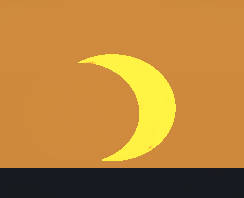
What might it look like when the Sun will rise in eclipse for the Grand Traverse region of Michigan at about 6:10 am June 10, 2021. Note that you, or actually your location, is involved in what you can see of a solar eclipse. Created using Stellarium.
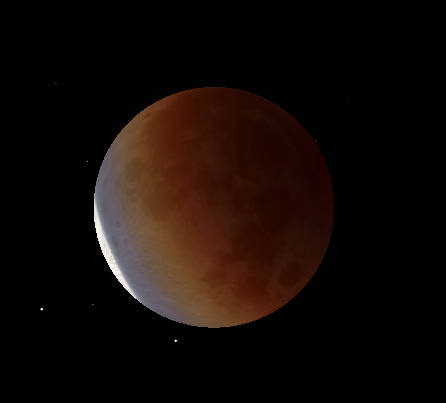
What the lunar eclipse maximum might look like at 4:04 am (9:04 UT), November 19, 2021. Created using Stellarium.
There is a fourth eclipse in 2021, a total solar eclipse that is mainly visible in the Southern Ocean and Antarctica on December 4, 2021.
12/30/2020 – Ephemeris – Let’s take our last look at the naked-eye planets for this year
This is Bob Moler with Ephemeris for Wednesday, December 30th. Today the Sun will be up for 8 hours and 51 minutes, setting at 5:11, and it will rise tomorrow at 8:20. The Moon, 1 day past full, will rise at 5:40 this evening.
Let’s take our last look at the naked-eye planets for this year. Jupiter and Saturn are both low in the southwestern sky around 6 pm. Jupiter is the very bright one. Below and right of it is the dimmer Saturn it by a degree or two moon widths. They crossed paths for us nine nights ago. They can still be seen in the same binocular field. Saturn will set first tonight at 6:57 pm with Jupiter following four minutes later. Quite high in the southeast will be Mars, still in Pisces. Mars’ distance is increasing to 82 million miles (132 million km) away. It will set at 2:29 tomorrow morning. Brilliant Venus will rise at 6:49 am in the east-southeast as it seems to retreat slowly toward the Sun, but actually it’s heading way around behind the Sun.
The event times given are for the Traverse City/Interlochen area of Michigan. They may be different for your location.
Addendum

Jupiter and Saturn low on the southwestern horizon at 6 pm. Created using Stellarium.
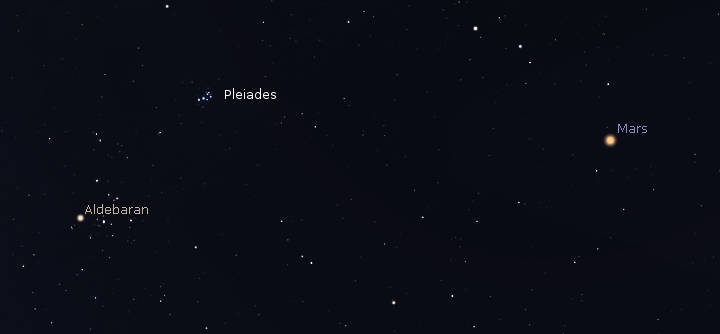
Mars with the stars of Taurus the Bull including Aldebaran with the “V” of stars that are the Hyades that mark the bull’s face and the Pleiades. Seen at 8 pm, December 30, 2020. Created using Stellarium.
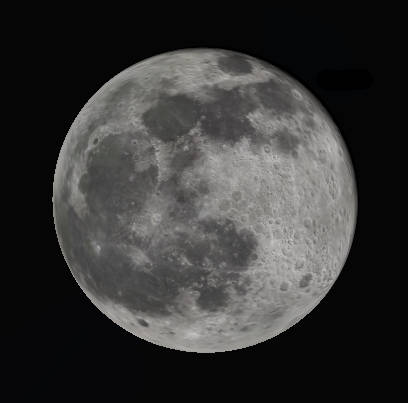
The Moon as it might be seen tonight at 8 pm, December 30, 2020. Created using Stellarium.
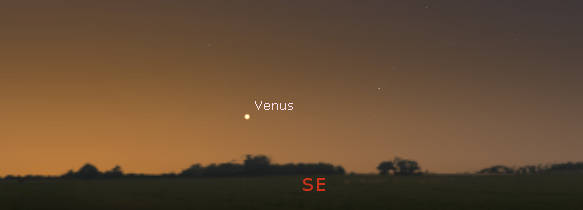
Venus in the southeast at 7:30 am. Created using Stellarium.
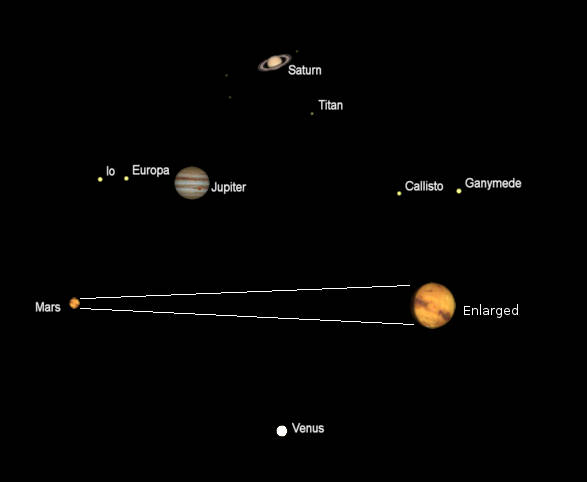
The planets as seen in a telescope (north up) with the same magnification for the night of December 30/31, 2020. Times of the display are: Jupiter and Saturn, 6 pm; Mars, 8 pm; Venus, 7:30 am. Apparent diameters: Jupiter, 32.92″; Saturn, 15.26″, rings, 35.54″; Mars, 10.52″, and Venus 10.71″. Mars also displays an enlargement showing surface detail. Mars was closest to the Earth this go-a-round on October 6. The ” symbol means seconds of arc (1/3600th of a degree.) Planets whose diameters drop below 10″, or are too close to the direction of the Sun to observe will not be shown. Created using Cartes du Ciel (Sky Charts).
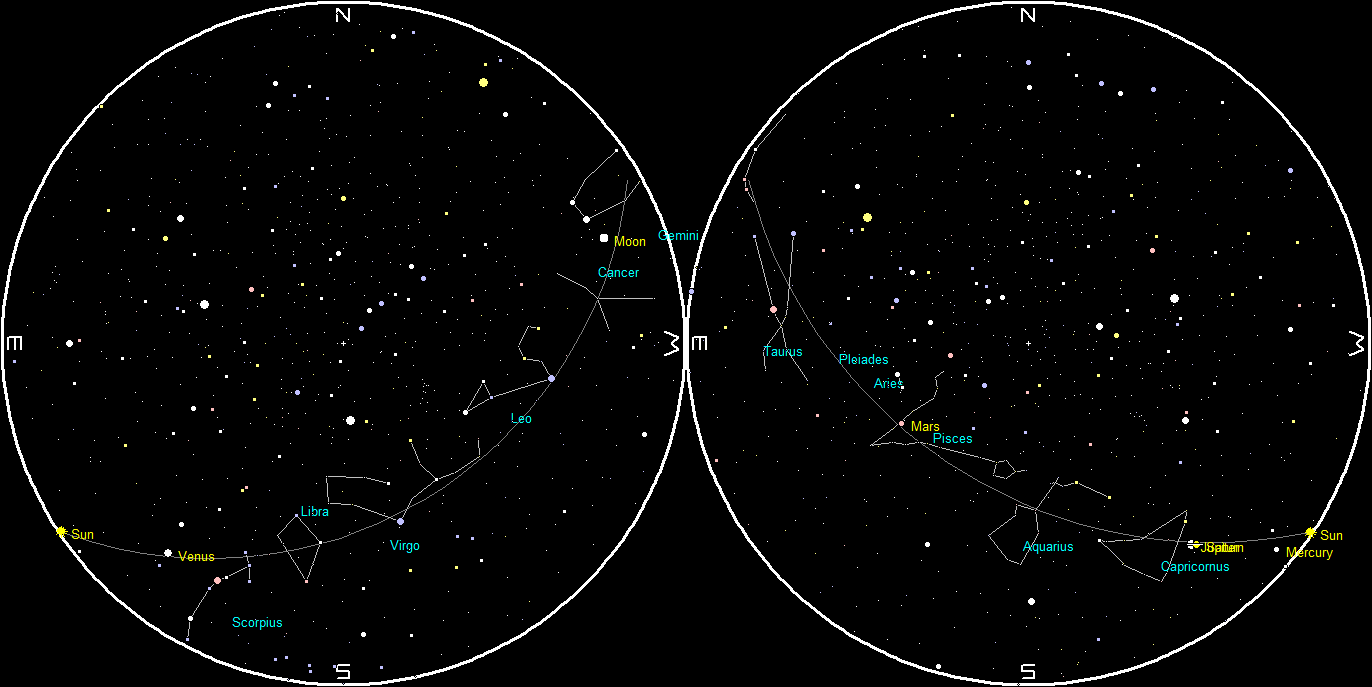
Planets and the Moon at sunset and sunrise of a single night starting with sunset on the right on December 30, 2020. The night ends on the left with sunrise on the 31st. I’m afraid that the labels for Jupiter and Saturn will overlap, since the planets are very close. Click on the image to enlarge. Created using my LookingUp program.
 Bob Moler's Ephemeris Blog