01/26/2021 – Ephemeris – A look at the bright red giant star Betelgeuse
This is Ephemeris for Tuesday, January 26th. Today the Sun will be up for 9 hours and 35 minutes, setting at 5:43, and it will rise tomorrow at 8:06. The Moon, 2 days before full, will set at 7:38 tomorrow morning.
At 8 pm the constellation of Orion the hunter is in the southeastern sky. The bright reddish star at the top left of Orion’s distinctive seven-star pattern is Betelgeuse a star near the end of its life. Being a single bright star, its distance is not well determined and is estimated to be about 550 light years away with an uncertainty of up to 20 percent, which make other estimates that uncertain too, like its mass and diameter. It’s somewhat less than 20 times the mass of the Sun, and a diameter possibly as large as Jupiter’s orbit of the Sun. It is old for a star of its mass, probably 8 million years old, with up to a million years to go on the outside before it will probably explode as a supernova and grace our skies as bright as the Moon for the better part of the better part of a year.
The event times given are for the Traverse City/Interlochen area of Michigan. They may be different for your location.
Addendum
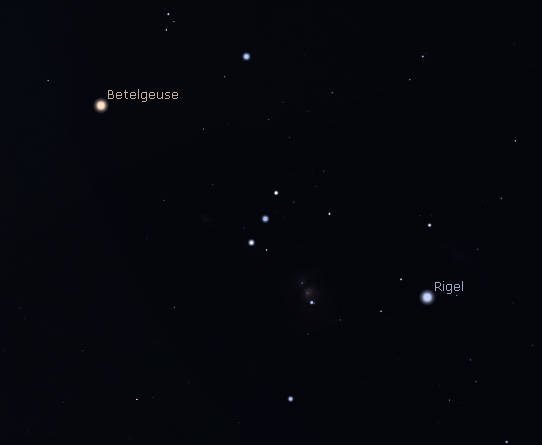
The seven brightest stars of Orion in the south-southeast at 8 p. in late January.
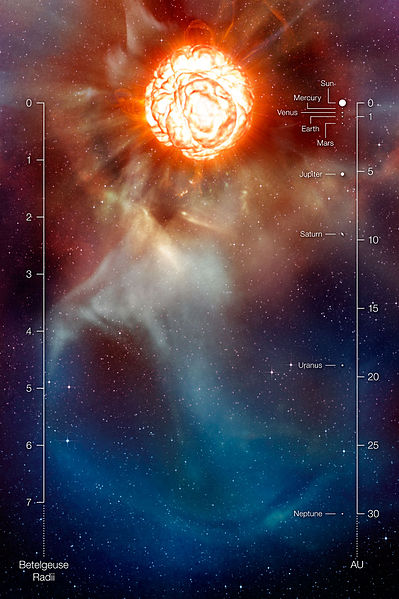
“This artist’s impression shows the supergiant star Betelgeuse as it was revealed thanks to different state-of-the-art techniques on ESO’s Very Large Telescope, which allowed two independent teams of astronomers to obtain the sharpest ever views of the supergiant star Betelgeuse. They show that the star has a vast plume of gas almost as large as our Solar System and a gigantic bubble boiling on its surface. These discoveries provide important clues to help explain how these mammoths shed material at such a tremendous rate. The scale in units of the radius of Betelgeuse as well as a comparison with the Solar System is also provided.” Credit: ESO/L. Calçada (ESO is the European Southern Observatory)
01/25/2021 – Ephemeris – Why is the sky with the full moon gray?
This is Bob Moler with Ephemeris for Monday, January 25th. Today the Sun will be up for 9 hours and 33 minutes, setting at 5:42, and it will rise tomorrow at 8:07. The Moon, 3 days before full, will set at 6:46 tomorrow morning.
The bright Moon is dominating the night sky now. Only the brighter stars are visible, with the fainter stars and constellations overwhelmed by the bright moonlit sky. It seems odd, but the gray clear moonlit sky that we see with our eyes is as blue as the daytime sky. Only it’s too dim to register on the cones in our retinas that can see color. The rods in our retinas can pick up light much better, especially if it is in the green part of the spectrum. We are pretty much insensitive to red at low light levels and color-blind as well. Star color is also subtle, and can be seen only in brighter stars. The colors run, from the hottest stars to the coolest: blue, white, yellow, orange and red. Also, there is a color shift at night. Stars with the same temperature as the Sun appear yellowish.
The event times given are for the Traverse City/Interlochen area of Michigan. They may be different for your location.
01/22/2021 – Ephemeris – Mercury will be at it’s greatest angular distance from the Sun in the evening tomorrow
This is Ephemeris for Friday, January 22nd. Today the Sun will be up for 9 hours and 26 minutes, setting at 5:37, and it will rise tomorrow at 8:10. The Moon, 2 days past first quarter, will set at 3:43 tomorrow morning.
The planet Mercury, tomorrow night, will reach its greatest elongation or separation east of the Sun. It will be visible low in the southwestern sky around and for a half hour or so after 6 pm. Mercury, being the closest planet to the Sun, never strays far from it. Here in the Northern Hemisphere never see it outside of twilight. It’s apparent angular separation from the Sun will be 18.6 degrees. We will have a somewhat better view of an evening appearance of Mercury in May when Venus will again be in our evening sky and near Mercury. Mercury takes 88 days on to orbit the Sun. However, we are viewing it from another moving planet. So it takes about 116 days for Mercury to appear to orbit the Sun from our vantage point.
The event times given are for the Traverse City/Interlochen area of Michigan. They may be different for your location.
Addendum
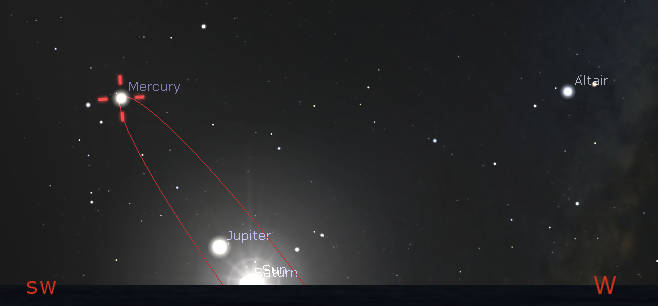
Mercury at greatest elongation at sunset January 23, 2021. It also shows Mercury’s orbit that evening plus Jupiter. Saturn is actually behind the Sun that evening as can be seen by the over display of the labels for Saturn and the Sun. Created using Stellarium by removing Earth’s atmosphere.
01/21/2021 -Ephemeris – The Perseverance rover is less than a month from landing on Mars
This is Ephemeris for Thursday, January 21st. Today the Sun will be up for 9 hours and 24 minutes, setting at 5:36, and it will rise tomorrow at 8:11. The Moon, 1 day past first quarter, will set at 2:40 tomorrow morning.
The Mars Perseverance Rover is approaching the Red Planet. In a bit less than a month, on February 18th it will plunge into the martian atmosphere to land near an ancient river delta in the 28 mile (45 kilometer) wide crater Jezero. The dramatic entry-descent-and-landing or EDL is what the Jet Propulsion Laboratory, that built and manages the rover, calls Seven Minutes of Terror due to the complexity of the landing process and the fact that they will be bystanders at that point. By the time they receive confirmation that the encapsulated rover has hit the top of the martian atmosphere it would have already landed, or crashed on the martian surface. It will take over 11 minutes for signals to reach us from Mars that day.
The event times given are for the Traverse City/Interlochen area of Michigan. They may be different for your location.
Addendum

Delta of ancient river that flowed into a lake in the Jezero crater. This is a false color imaging highlighting mineral types. Credit NASA.

Mars Perseverance Rover’s planned landing ellipse partially overlapping the dried up river delta. Credit: NASA/JPL.

Mars 2020 Rover “Perseverance” destined for the martian crater Jezero.
01/20/2021 – Ephemeris – Let’s have a lookout for the naked-eye planets for this week
This is Ephemeris for Inauguration Day, Wednesday, January 20th. Today the Sun will be up for 9 hours and 22 minutes, setting at 5:35, and it will rise tomorrow at 8:12. The Moon, at first quarter today, will set at 1:38 tomorrow morning.
Let’s have a lookout for the naked-eye planets for this week. Mercury has joined Jupiter and Saturn extremely low in the southwestern sky. I’m afraid Saturn will be lost in the twilight, but Jupiter, with Mercury above it might be visible. Both are extremely low in the southwestern sky around 6 pm or a bit earlier. Jupiter will set at 6:04 pm and Mercury will set at 7:06 pm. Mercury might be the only one that can be spotted. Quite high in the south at 7 pm Mars can be found. It will actually be due south at 6:56 pm tonight, and above the Moon. Mars is increasing its speed eastward against the constellations and will set at 2 am. Venus will be hard to spot in the morning twilight after it rises at 7:22 tomorrow morning.
The event times given are for the Traverse City/Interlochen area of Michigan. They may be different for your location.
Addendum
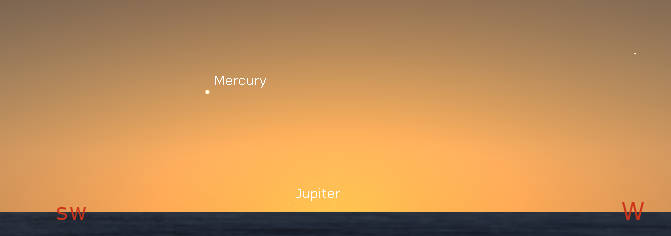
Mercury in the evening twilight at 6 pm January 20, 2021. Though Jupiter is just above the horizon it should not be visible. Created using Stellarium.
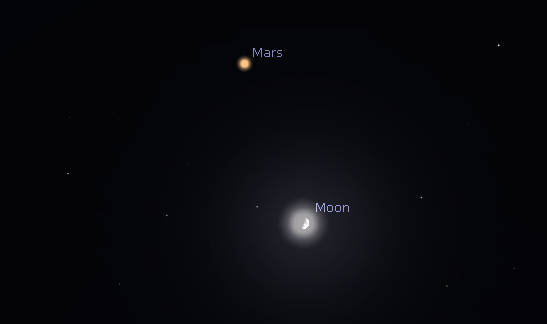
Mars and the first quarter Moon at 7 pm tonight, January 20, 2021. Created using Stellarium.
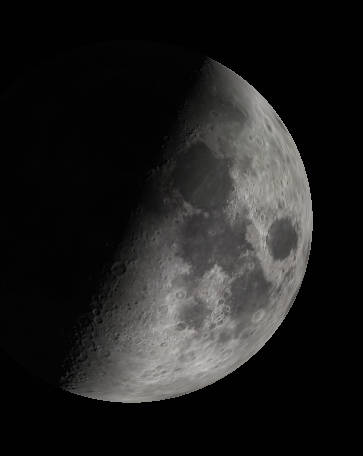
Binocular or low power telescope view of the first quarter Moon. Created using Stellarium.
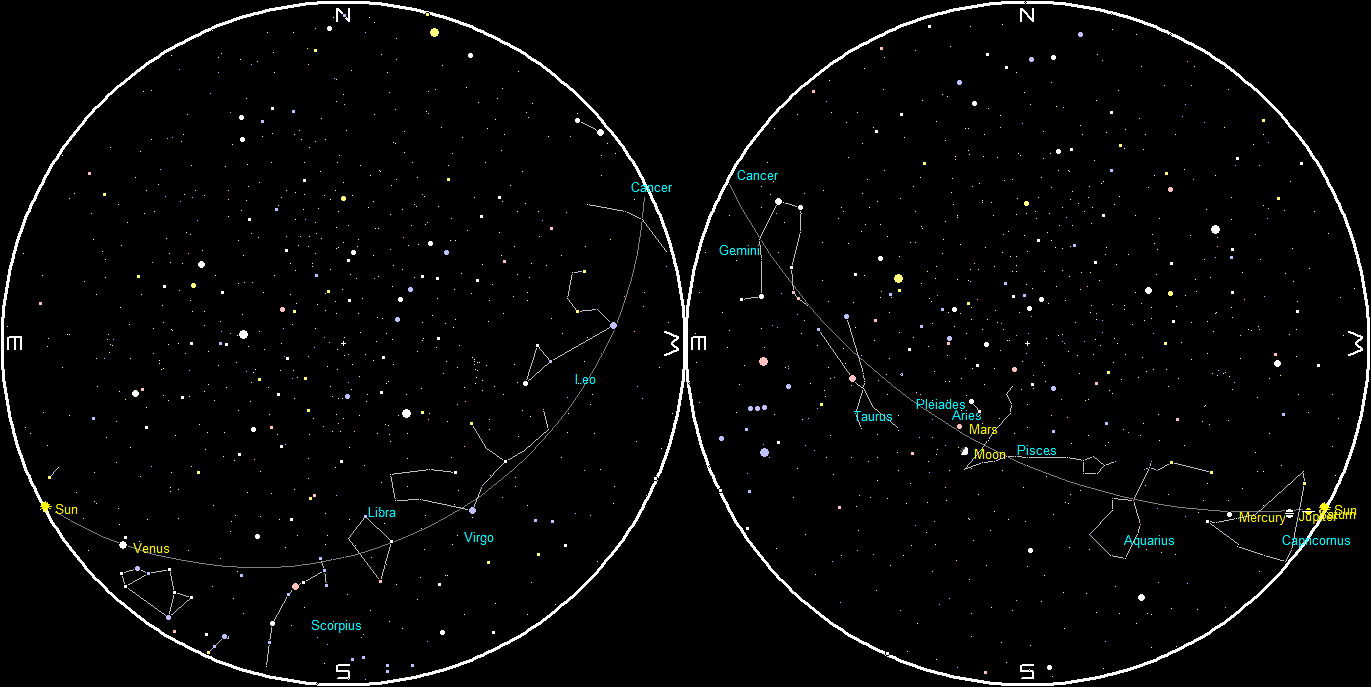
Planets and the Moon at sunset and sunrise of a single night starting with sunset on the right on January 20, 2021. The night ends on the left with sunrise on the 21st. I’m afraid that the labels for Jupiter, Saturn and now the Sun overlap, since the planets and Sun are very close. Click on the image to enlarge. Created using my LookingUp program.
01/19/2021 – Ephemeris – The Moon is a pretty straight up orb
This is Ephemeris for Tuesday, January 19th. Today the Sun will be up for 9 hours and 20 minutes, setting at 5:33, and it will rise tomorrow at 8:13. The Moon, 1 day before first quarter, will set at 12:36 tomorrow morning.
The Earth has an axial tilt to its orbit of the Sun of 23 ½ degrees. So the Earth has seasons, the cycle of which last one orbit of the Sun, or one year. Our Moon on the other hand has a 5 ½ degree axial tilt to its orbit of the Earth, but more importantly for future moon colonists, has only a degree and a half tilt compared to the Earth’s own orbit of the Sun. So there are spots at the north and south poles that never get the Sun’s heat or light. The Moon’s south polar region is more rugged with more and smaller craters than the north, so has collected, over the eons, what seems to be a great amount of water ice that is cold enough to be stable in the vacuum of space. That makes it an ideal place to build a sustainable lunar base.
The event times given are for the Traverse City/Interlochen area of Michigan. They may be different for your location.
Addendum
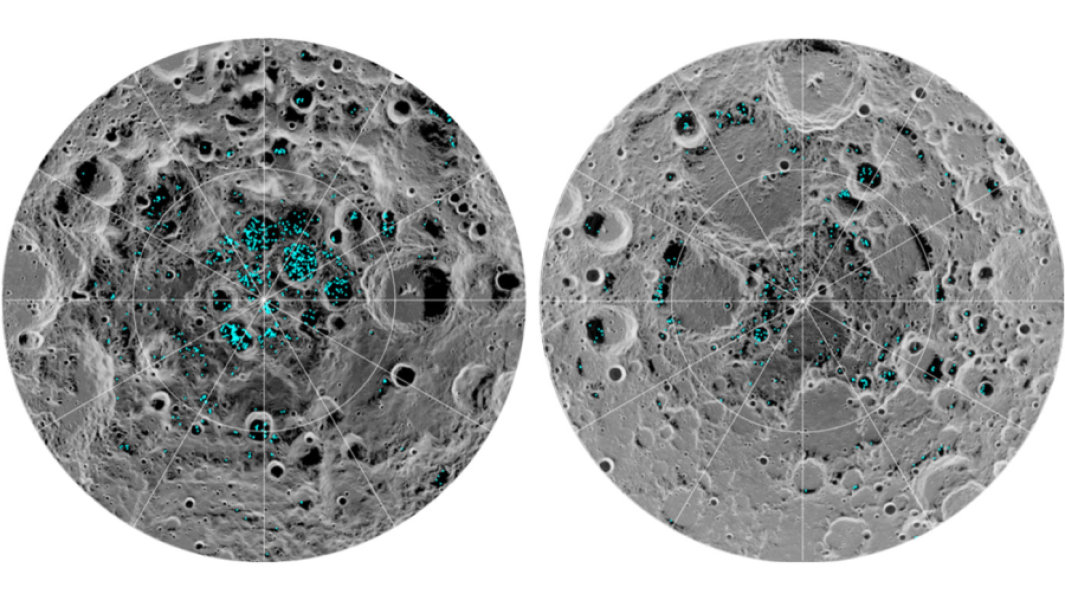
The Moon’s south pole area on the left and north pole on the right. The cyan color shows shadowed areas where ice is located. Credit NASA
01/18/2021 – Ephemeris – The Drinking Gourd
This is Bob Moler with Ephemeris for Martin Luther King Jr. Day, Monday, January 18th. Today the Sun will be up for 9 hours and 18 minutes, setting at 5:32, and it will rise tomorrow at 8:13. The Moon, 2 days before first quarter, will set at 11:34 this evening.
This day is set aside to honor the Reverend Dr. Martin Luther King Jr. who gave his life for the struggle for equality for blacks and other minorities and to end segregation. A struggle that continues to this day. In the decades before the Civil War runaway slaves would travel, often at night, northward from the slave states of the south to the northern free states and Canada over the metaphorical Underground Railroad following the Drinking Gourd, the Big Dipper as their compass. Over the last several millennia the Great Bear, Ursa Major has been that northward pointer. For much of that time the North Pole of the sky had been passing near the handle of the Big Dipper or bear’s tail.
The event times given are for the Traverse City/Interlochen area of Michigan. They may be different for your location.
Addendum
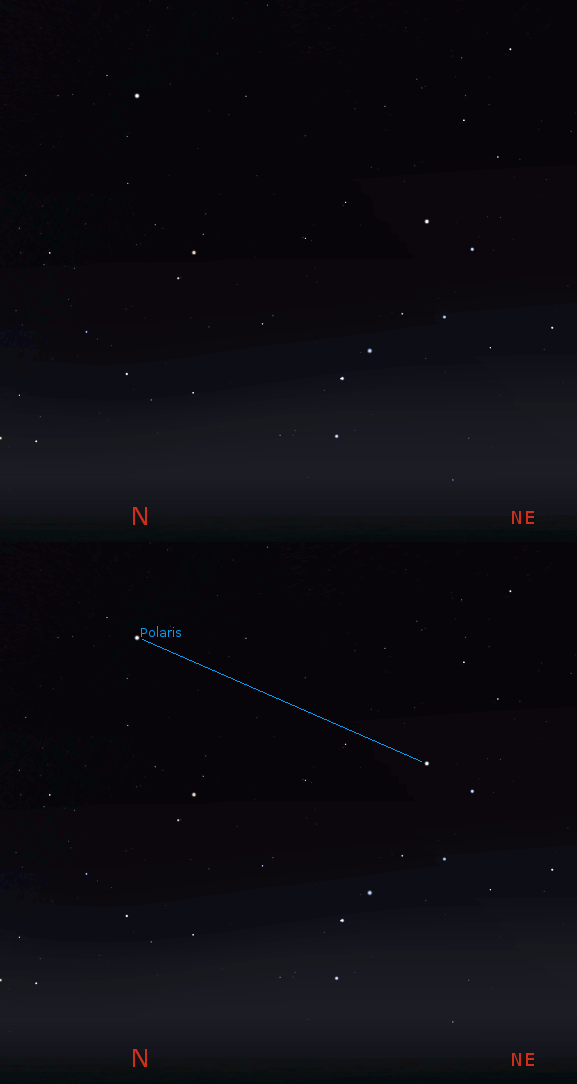
An animation showing the Big Dipper, also known as the Drinking Gourd pointing to Polaris, the North Star which is just about due north. This is for 9 pm January 18th, about 3 1/2 hours after sunset. Created using Stellarium with additional annotations.
01/15/2021 – Ephemeris – The constellation Lepus the hare
This is Bob Moler with Ephemeris for Friday, January 15th. Today the Sun will be up for 9 hours and 12 minutes, setting at 5:28, and it will rise tomorrow at 8:15. The Moon, 2 days past new, will set at 8:17 this evening.
Orion, the central winter constellation is seen in the southern sky this evening. He is a hunter, as artists depict him, he is preoccupied with the charge of Taurus the bull from the upper right. At Orion’s feet, and unnoticed by him is the small constellation of Lepus the hare. It’s very hard to see a rabbit in its eight dim stars: however, I can see a rabbit’s head ears and shoulders. A misshapen box is the head and face of this critter facing to the left. His ears extend upwards from the upper right star of the box, and the bend forward a bit. Two stars to the right of the box and a bit farther apart hint at the front part of the body. In Lepus telescopes can find M79, a distant globular star cluster, one of the few visible in the winter sky.
The event times given are for the Traverse City/Interlochen area of Michigan. They may be different for your location.
Addendum
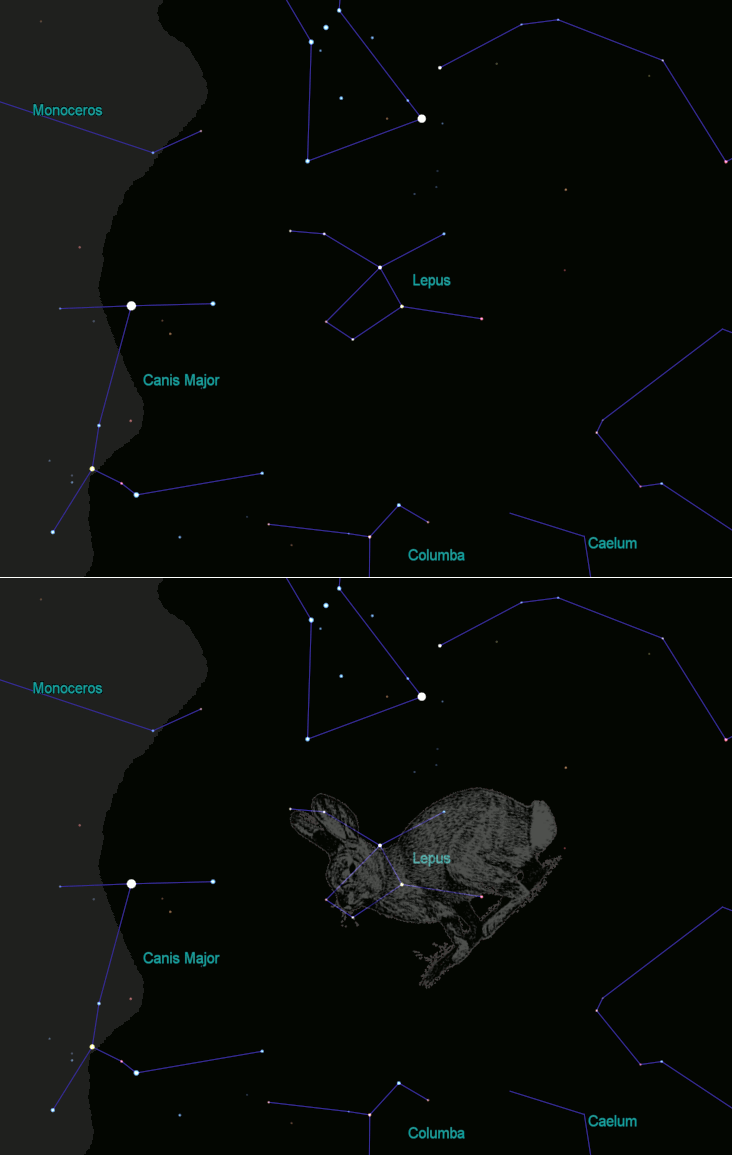
My view of Lepus the hare. Star field from Cartes du Ciel. Desert Cottontail drawing from Arizona-Senora Desert Museum website. Superimposed with GIMP.

An animation showing the stars, constellations and artwork of Lepus, Orion and Taurus from Stellarium. The constellation lines suggest a rabbit ears TV antenna. Created using Stellarium and GIMP.
01/14/2021 – Ephemeris – The constellation of Auriga the charioteer
This is Bob Moler with Ephemeris for Thursday, January 14th. Today the Sun will be up for 9 hours and 10 minutes, setting at 5:27, and it will rise tomorrow at 8:16. The Moon, 1 day past new, will set at 7:06 this evening.
The constellation Auriga the charioteer is nearly overhead at 9 p.m. It is a pentagon of stars, with the brilliant star Capella at one of its corners. Capella represents a she-goat he’s carrying. A narrow triangle of stars nearby Capella are her kids. The Kids is an informal constellation or asterism. Within and near that pentagon, binoculars and telescopes will find several star clusters, groups of hundreds of stars born in the clump we still see them in. These star clusters will appear as fuzzy spots in binoculars. One called M38 is near the center of the pentagon. Another, M36 is to the east of it. Still another star cluster, M37, is farther east, just outside the pentagon. The M designations come from Charles Messier who 250 years ago ran into them while looking for comets.
The event times given are for the Traverse City/Interlochen area of Michigan. They may be different for your location.
Addendum
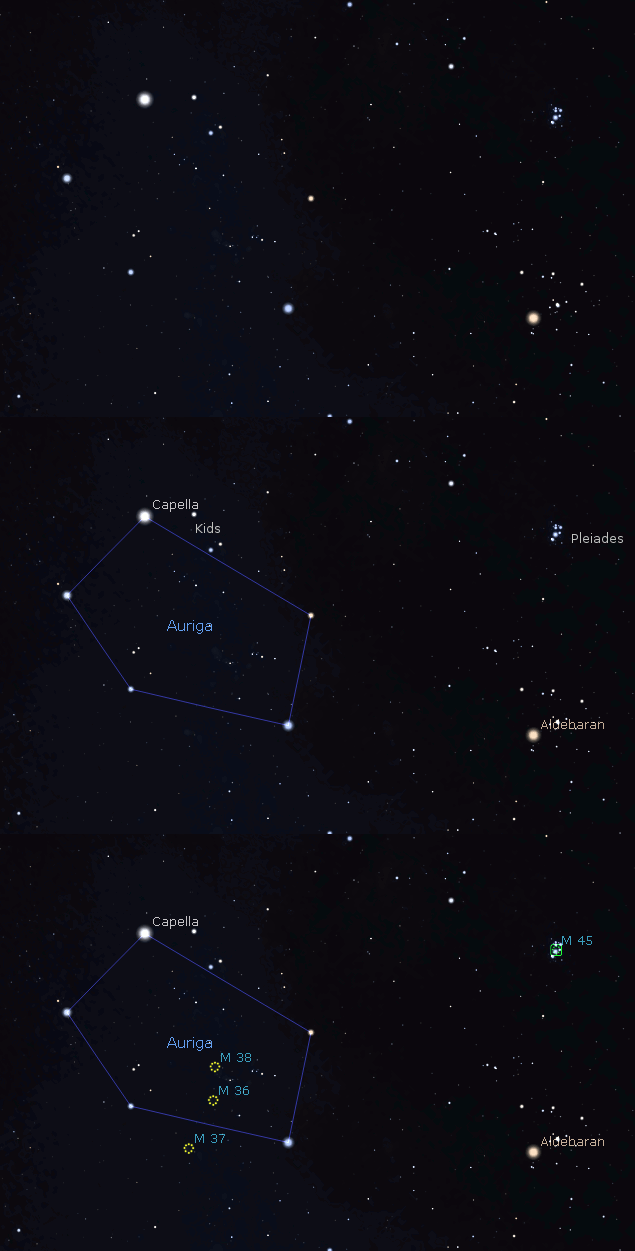
Auriga finder animation showing the Kids, nearby stars including Aldebaran and the sideways V shape of the Hyades (unlabeled) of Taurus the bull and the Pleiades AKA M 45. Created using Stellarium and GIMP.
01/13/2021 – Ephemeris – Let’s take a look for the naked-eye planets for this week
This is Bob Moler with Ephemeris for Wednesday, January 13th. Today the Sun will be up for 9 hours and 8 minutes, setting at 5:26, and it will rise tomorrow at 8:16. The Moon is new today, and won’t be visible.
Let’s take a look for the naked-eye planets for this week. Mercury has joined Jupiter and Saturn extremely low in the southwestern sky. I’m afraid Saturn will be lost in the twilight, but Jupiter, with Mercury above it might be visible. They are both extremely low in the southwestern sky around 6 pm. Jupiter will set at 6:20 pm with Mercury following 20 minutes later. Quite high in the south at 7 pm Mars can be found. It will be actually due south on the meridian at 7:10 pm tonight. The meridian is an imaginary line that runs from the north compass point on one’s horizon, through the zenith to the south compass point. Mars is beginning to increase its speed eastward and will set at 2:09 am. Venus, our brilliant morning star will rise at 7:15 am in the east-southeast.
Addendum
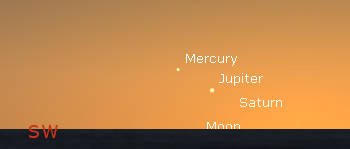
Jupiter and Mercury in evening twilight st 6 pm, about a half hour after sunset over the Lake Michigan horizon. Saturn, though present can’t compete with the bright twilight. The less than one day old moon is setting. Created using Stellarium.
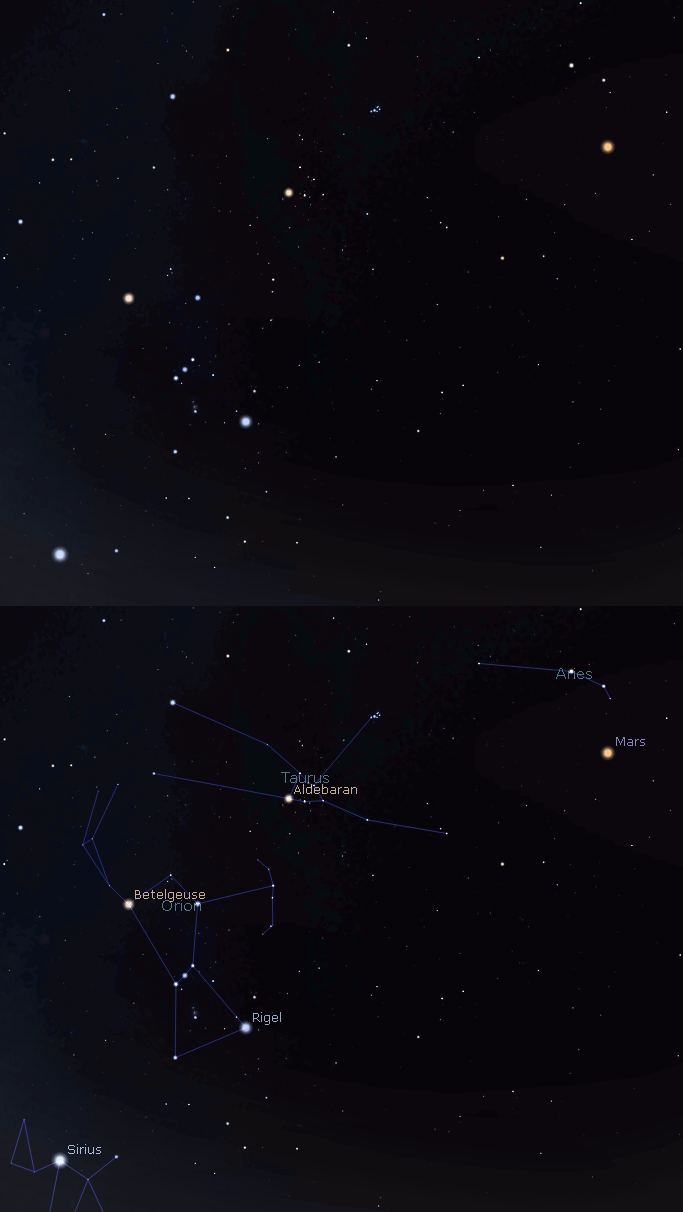
Mars finder animation for 8 pm tonight, January 13, 2021 (about 2 1/2 hours after sunset. Looking southward. Created using Stellarium and GIMP.

Venus in the morning twilight at 7:45 am tomorrow morning January 14, 2021 (about 1/2 hour before sunrise). Created using Stellarium.
The graphic that shows the planets as seen in small telescopes has been discontinued because Jupiter and Saturn are too close to the horizon and Venus and Mars are too small (less than 10 seconds of arc in diameter). It will be resumed in a couple of months when Jupiter and Saturn become visible in the morning sky.
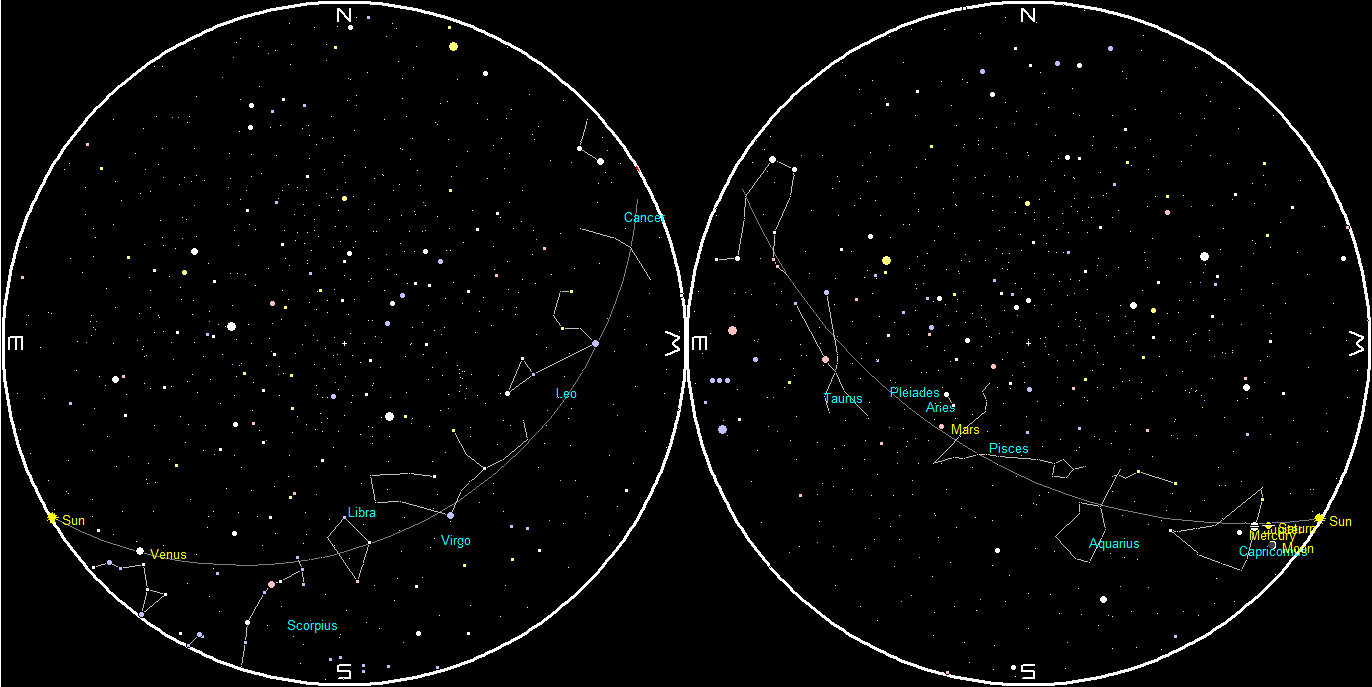
Planets and the Moon at sunset and sunrise of a single night starting with sunset on the right on January 13, 2021. The night ends on the left with sunrise on the 14th. I’m afraid that the labels for Jupiter and Saturn will overlap, since the planets are very close. Click on the image to enlarge. Created using my LookingUp program.
 Bob Moler's Ephemeris Blog