03/30/2020 – Ephemeris – Following the Moon night to night
Ephemeris for Monday, March 30th. Today the Sun will be up for 12 hours and 42 minutes, setting at 8:08, and it will rise tomorrow at 7:24. The Moon, 2 days before first quarter, will set at 2:32 tomorrow morning.
Now that clear skies are mostly back we can follow, night by night the progress of the Moon, now as its phase waxes and moves eastward at the same time each night. With the naked-eye the large darker lunar seas slowly reveal the face of the Man in the Moon, or the Chinese upside down Jade Rabbit pounding medicine with his mortar and pestle. With binoculars or telescope, more detail is revealed every night as the terminator, the sunrise line before full moon uncovers more lunar territory, with their long morning shadows. It’s the shadows that show the detail on the Moon, which is dark gray on darker gray. For the most part the surface of the Moon has been worn down by eons of meteoroid impacts and their ejecta.
The event times given are for the Traverse City/Interlochen area of Michigan. They may be different for your location.
Addendum
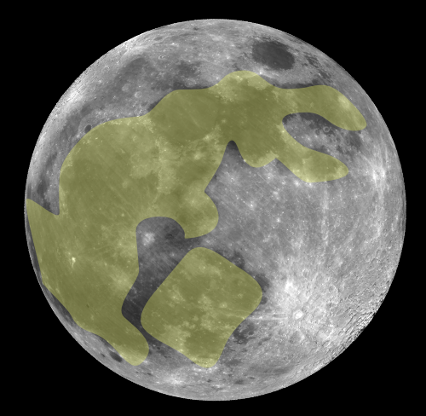
Jade Rabbit and Mortar on the Moon. Credit: Zeimusu, Creative Commons.

Craters near the Moon’s terminator showing how the low Sun brings out the detail. Credit Bob Moler, the author on 06/11/2011.
03/27/2020 – Ephemeris – Enjoying astronomy when sheltering at home
Ephemeris for Friday, March 27th. Today the Sun will be up for 12 hours and 32 minutes, setting at 8:04, and it will rise tomorrow at 7:30. The Moon, 3 days past new, will set at 11:25 this evening.
With the coronavirus or COVID-19 pandemic hitting our area many of us are stuck in our homes waiting it out. It may be awhile. That’s OK for some of us. That’s because astronomical observation is in many ways a solitary pursuit. My mother taught me the first two constellations. She could never wake me to view the Perseid meteors of August. After that I learned the rest on my own, the first batch on a morning paper route in winter, previewing the spring and summer skies. Staying at home doesn’t mean staying indoors. Going out in the back yard or dark area alone also counts. It’s proximity to other people that’s the problem. I find that being alone out under the stars makes me feel that the Earth and its worries are a trillion miles away.
The event times given are for the Traverse City/Interlochen area of Michigan. They may be different for your location.
Addendum
Some constellation star fields guaranteed to be trillions of miles away:
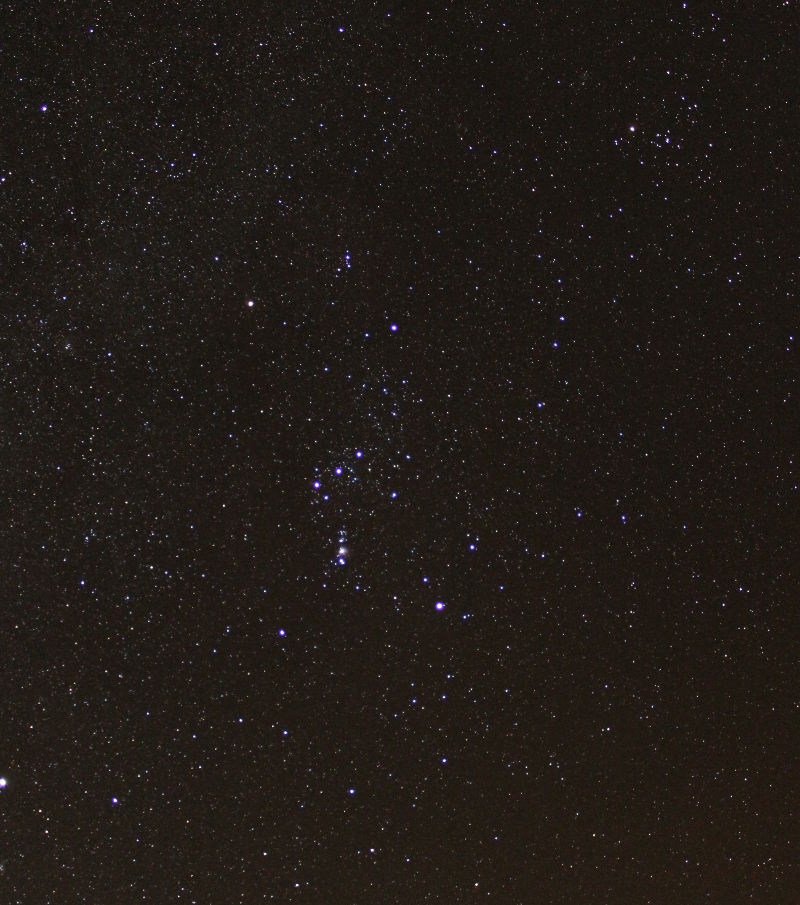
Orion in a 30 second exposure taken at the Sleeping Bear Dunes National Lakeshore Dune Climb February, 18, 2017 by Bob Moler. Click on image to enlarge a bit.
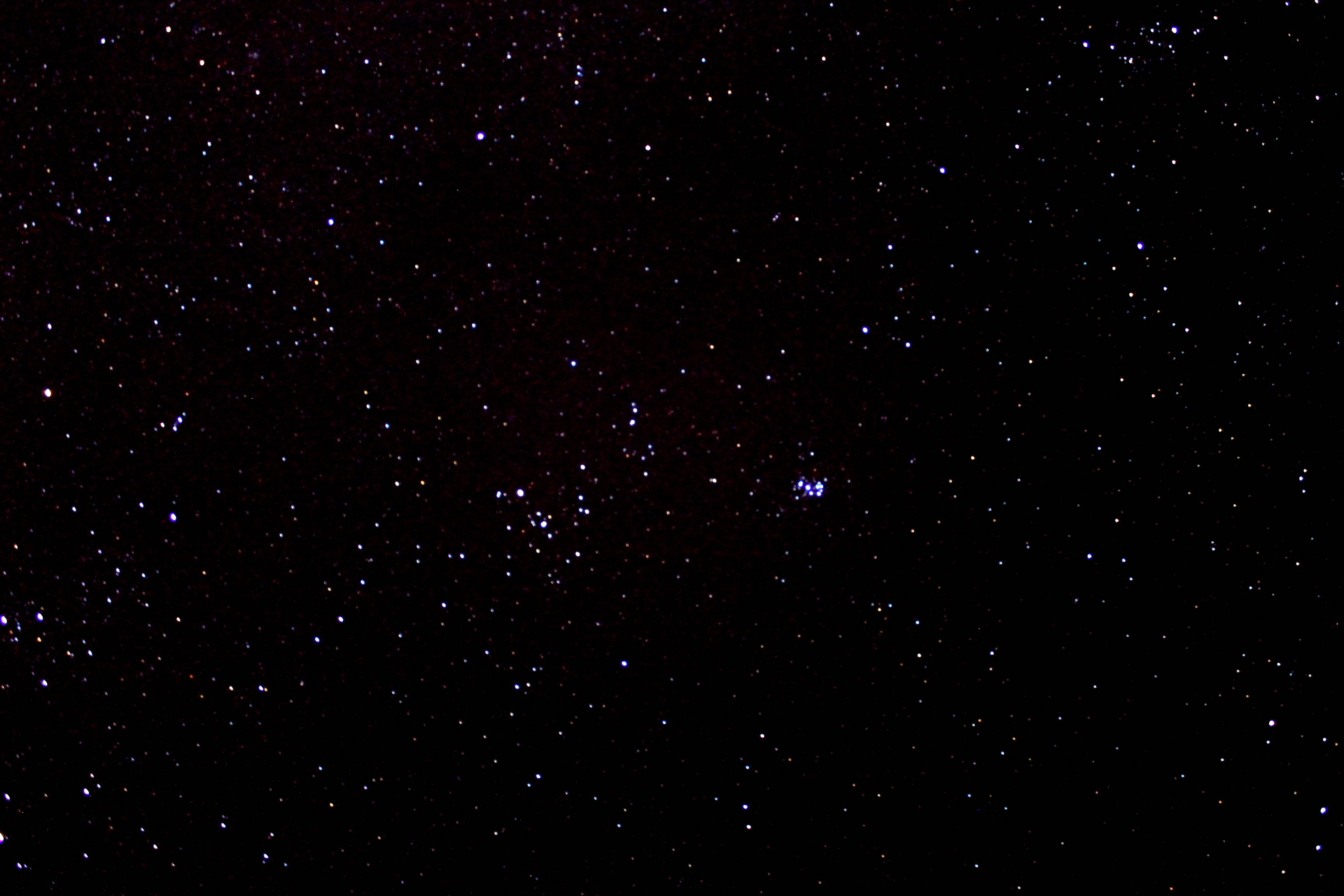
Actual photo of the Pleiades to the right of the Hyades, the face of Taurus the bull. Credit Bob Moler
03/26/2020 – Ephemeris – A spring warning about thin ice in the sky
Ephemeris for Thursday, March 26th. Today the Sun will be up for 12 hours and 29 minutes, setting at 8:03, and it will rise tomorrow at 7:31. The Moon, 2 days past new, will set at 10:22 this evening.
The Anishinaabe peoples of the Great Lakes Region, which includes the Ottawa, Chippewa and Ojibwe Indians have one constellation of winter. It is The Winter Maker which uses many of Orion’s stars and whose arms stretch from Aldebaran in Taurus the bull to Procyon the Little Dog Star, embracing the whole of the winter sky. Now that spring is here he is sinking into the west. The first constellation of spring is Curly Tail, or the Great Underwater Panther. Which uses the stars of Leo the lion’s backward question mark as its tail and the small knot of stars that are the head of Hydra the water snake below Cancer the crab as its head. The warning: Keep off the thinning ice or break through and be snatched by the panther that lives below.
The event times given are for the Traverse City/Interlochen area of Michigan. They may be different for your location.
Addendum
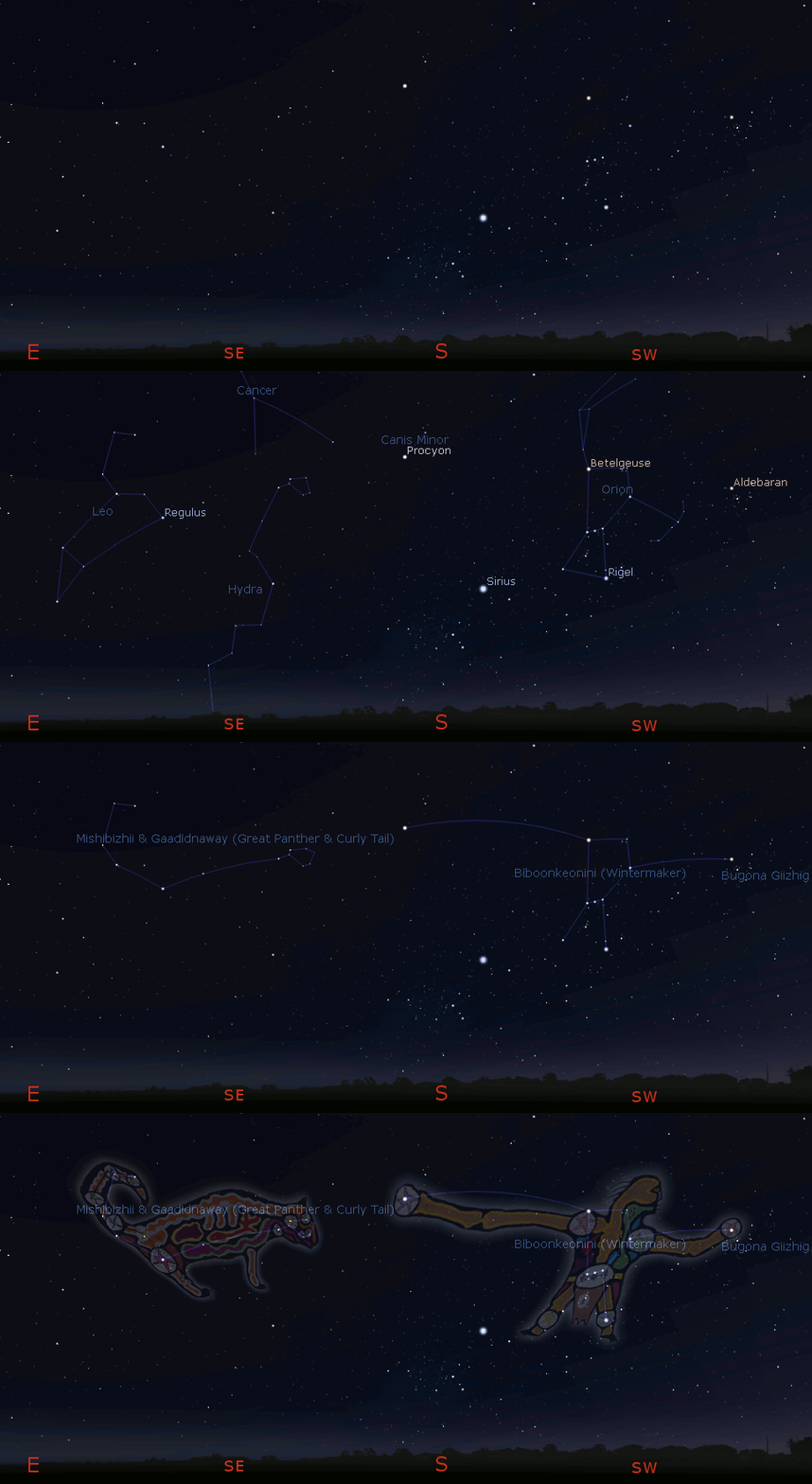
Great Underwater Panther finder animation relating western to Anishinaabe constellations for 9 p.m. in late March. Click on image to enlarge. Created using Stellarium.
03/25/2020 – Ephemeris – Let’s look at the naked-eye planets for this week
Ephemeris for Wednesday, March 25th. Today the Sun will be up for 12 hours and 26 minutes, setting at 8:02, and it will rise tomorrow at 7:33. The Moon, 1 day past new, will set at 9:21 this evening.
Let’s look at the naked-eye planets for this week. Venus is our evening star shining brightly in the west. It will set at 12:14 a.m. The rest of the planet action is in the morning sky where there are three planets close together in the southeast. Bright Jupiter will rise first at 4:35 a.m. Followed by Mars, left and below, rising at 4:50 a.m. It’s now as bright as a first magnitude star because it’s down to 140 million (226 million km) miles away, as the Earth slowly overtakes it at the rate of about 5 million miles (8 million km) a week. It’s brighter than the star Antares in the south-southwest. And lastly, Saturn will rise at 5:01 a.m. Mars is about half way between Jupiter and Saturn. It will pass Saturn next Tuesday.
The event times given are for the Traverse City/Interlochen area of Michigan. They may be different for your location.
Addendum
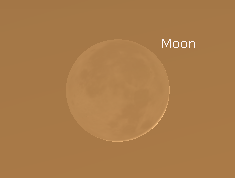
Day and a half old Moon low over a Lake Michigan horizon tonight at 8:30 p.m. March 25, 2020. The bright edge of the Moon will be a sit brighter, and the earthshine on the night side of the Moon a bit dimmer. Created using Stellarium.
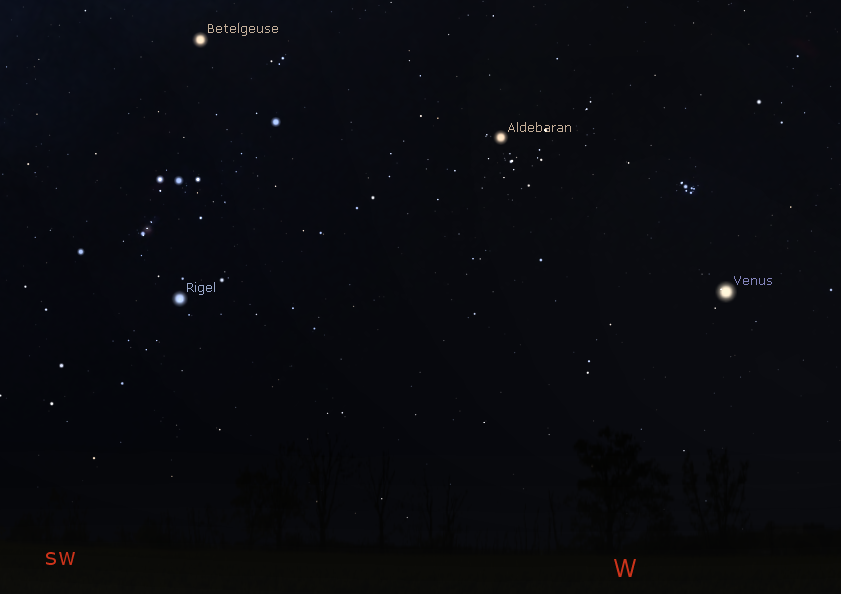
Venus and the setting winter stars tonight at 10 p.m. March 25, 2020. Click on the image to enlarge. Created using Stellarium.
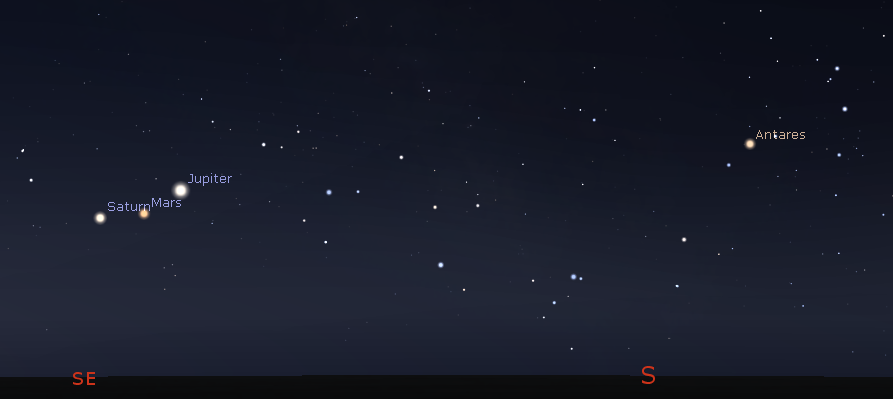
Saturn, Mars and Jupiter with the southern summer stars at 6:30 a.m. tomorrow March 26, 2020. Mars will pass Saturn on the 31st. Click on the image to enlarge. Created using Stellarium.
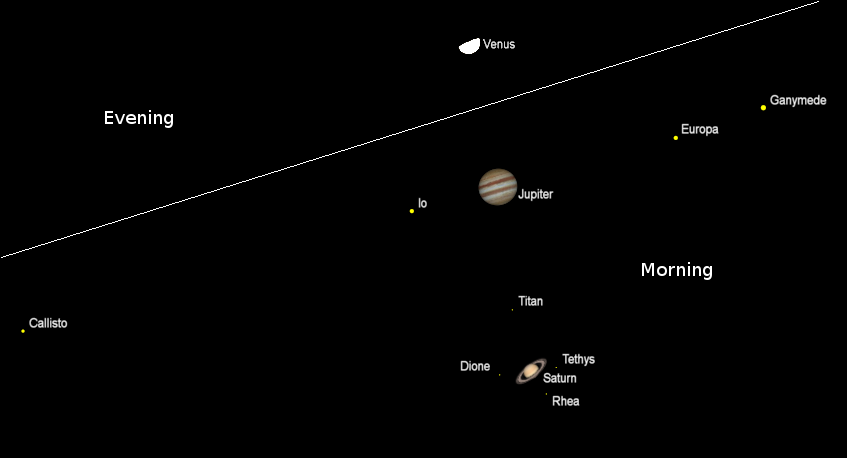
The planets as seen in a telescope with the same magnification. Venus in the evening and Jupiter and Saturn in the morning on the night of March 25/26, 2020. Apparent diameters: Venus, 23.85″; Jupiter, 36.46″; Saturn, 15.99″, rings, 37.26″. Mars at 6.22″ won’t be added until it reaches 10″. The ” symbol means seconds of arc (1/3600th of a degree.) Click on the image to enlarge. Created using Cartes du Ciel (Sky Charts).
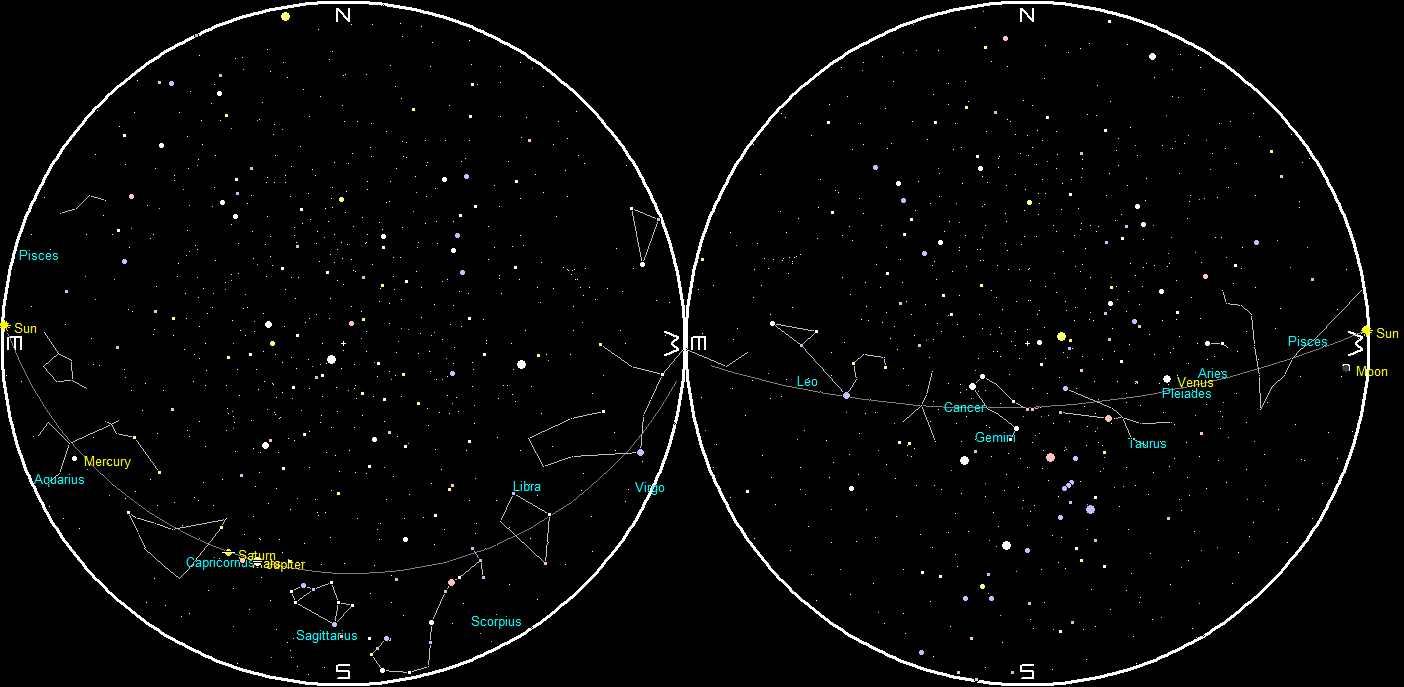
Planets and the Moon at sunset and sunrise of a single night starting with sunset on the right on March 25, 2020. The night ends on the left with sunrise on the 26th. Click on the image to enlarge. Created using my LookingUp program.
03/24/2020 – Ephemeris – Venus reaches greatest eastern elongation from the Sun today
Ephemeris for Tuesday, March 24th. Today the Sun will be up for 12 hours and 23 minutes, setting at 8:01, and it will rise tomorrow at 7:35. The Moon is new today, and won’t be visible.
Today, around 6 p.m. the planet Venus will reach its greatest eastern elongation from the Sun. That means Venus will appear as far east of the Sun that it can get at an angle of 46.1 degrees. Venus, like Mercury orbits the Sun inside the Earth’s orbit, so is always seen close to the Sun. In telescopes Venus will look like a tiny first quarter Moon. That’s for the same reason. The Sun is illuminating half of the side we can see. Venus is moving directly toward us now, at a distance of 66.5 million miles (117 million km). As Venus approaches us, it will grow in size in telescopes, becoming larger in appearance than Jupiter the largest planet and a thinner and thinner crescent. It will leave the evening sky, passing between the Earth and the Sun, only 27 million miles (43 million km) away on June 3rd.
The event times given are for the Traverse City/Interlochen area of Michigan. They may be different for your location.
Addendum
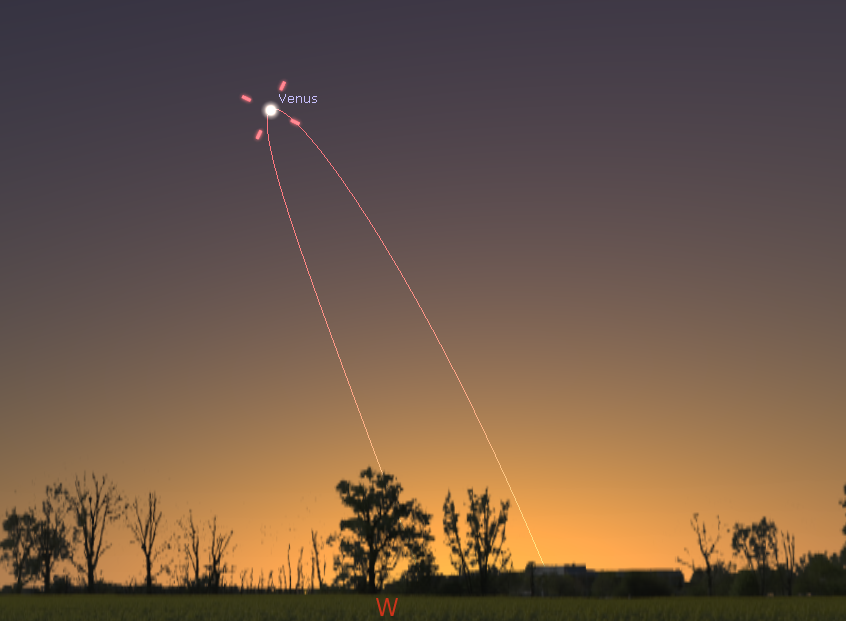
Venus at greatest eastern elongation seen tonight at 8:20 p.m. The red line its orbit if we could see it tonight. Venus will be moving to the right and down in the coming days. Created using Stellarium.
03/23/2020 – Ephemeris – See zodiacal light in the evening
Ephemeris for Monday, March 23rd. Today the Sun will be up for 12 hours and 20 minutes, setting at 7:59, and it will rise tomorrow at 7:37. The Moon, 1 day before new, will rise at 8:11 tomorrow morning.
With the bright moon out of the sky for a few more nights it’s time to look for the zodiacal light in the evening. It’s is a faint but towering glow that can be seen after the end of astronomical twilight on moonless nights. It is seen in the west in the evening in late winter and early spring and in the east in the morning in late summer and early autumn. The axis of the glow is the ecliptic, the apparent annual path of the Sun in the sky, along which lie the constellations of the zodiac. Right now the end of astronomical twilight is about 9:41 p.m. and advancing at a rate of a minute or two each night. Go to a spot with a dark western sky, no big cities or towns out that way. Zodiacal light is caused by dust spread out around the Sun.
The event times given are for the Traverse City/Interlochen area of Michigan. They may be different for your location.
Addendum
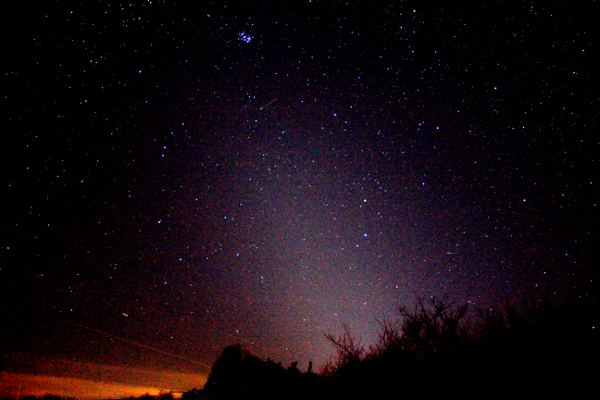
Much enhanced Zodiacal Light from the my back yard at 9:31 p.m. March 16, 2018, 5 minutes after the official end of astronomical twilight. Canon EOS Rebel T5 18mm f.l., f/3.5, 6 sec. ISO 12,800 . The clouds on the left appear to be illuminated by the lights of the towns of Beulah and Frankfort 20+ miles away.
03/20/2020 – Ephemeris – The first full day of spring
Ephemeris for Friday, March 20th. Today the Sun will be up for 12 hours and 11 minutes, setting at 7:55, and it will rise tomorrow at 7:43. The Moon, half way from last quarter to new, will rise at 7:00 tomorrow morning.
Spring snuck up on us at 11:50 p.m. last night, so this is the first full day of spring. That point in time and the point in the sky where the Sun crossed the celestial equator the imaginary line in the sky above the Earth’s equator heading northward is called the vernal equinox. Vernal means spring and equinox means equal night, meaning that day and night are equal. Since western civilization has spread south of the equator where seasons are reversed, our northern hemisphere spring equinox is the southern hemisphere’s autumnal equinox, so to be fair to both hemispheres we generally say March or September equinox instead. However the point in the sky the Sun crossed last night will always be known as the vernal equinox.
The event times given are for the Traverse City/Interlochen area of Michigan. They may be different for your location.
Addendum
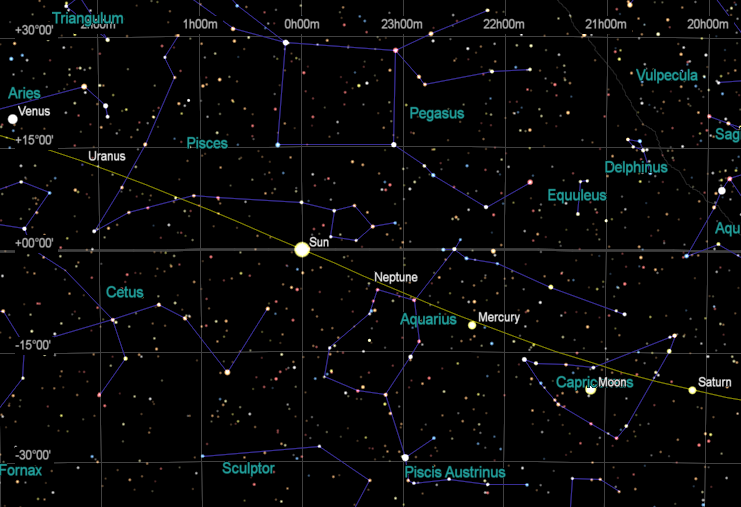
The Sun at the vernal equinox point on the celestial sphere at 11;50 p.m. EDT last night (March 19, 2020). The diagonal yellow line in the ecliptic, the Sun’s path in the sky. The vertical lines marked in hours at the top are lines of right ascension, the analog of earthly longitude. The horizontal lines are lines of declination, the same as latitude on the Earth. I referenced this point in yesterday’s program. Created using Cartes du Ciel *Sky Charts).
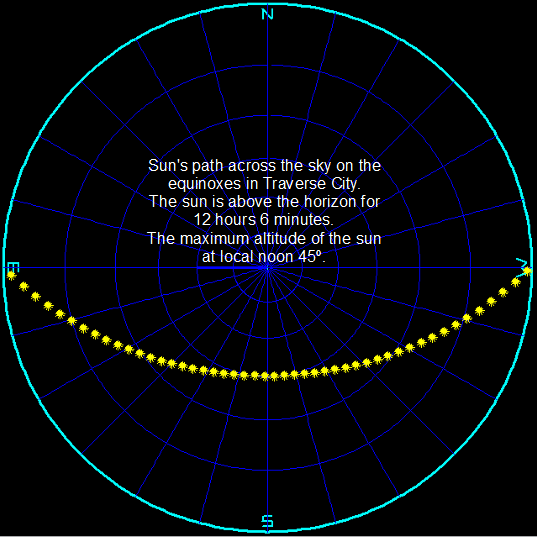
The Sun’s path through the sky on the equinox day from Traverse City, MI. Note that the Sun rises due east and sets due west. Created using my LookingUp program.
03/19/2020 – Ephemeris – Mars will pass Jupiter tomorrow morning
Ephemeris for Thursday, March 19th. Today the Sun will be up for 12 hours and 7 minutes, setting at 7:54, and it will rise tomorrow at 7:44. The Moon, 3 days past last quarter, will rise at 6:31 tomorrow morning.
Spring will start today, or rather this evening 10 minutes before midnight. But today I’d like to talk about something more immediately visible than the vernal equinox, that is the conjunction of Mars passing Jupiter tomorrow morning. In astronomy a conjunction means that the two planets pass north and south of each other. On Earth we’d say that they had the same longitude. In the sky that would be the same right ascension. The term longitude in the sky is given to measurements along the ecliptic or Sun’s path in the sky, which were more important to ancient astrologers interested more in the motions of the planets, which hung close to the ecliptic. On Earth, measurement of longitude is made from Greenwich Observatory in England, in the sky right ascension is reckoned from the point in the sky where the Sun will be at 11:50 this evening.
The event times given are for the Traverse City/Interlochen area of Michigan. They may be different for your location.
Addendum
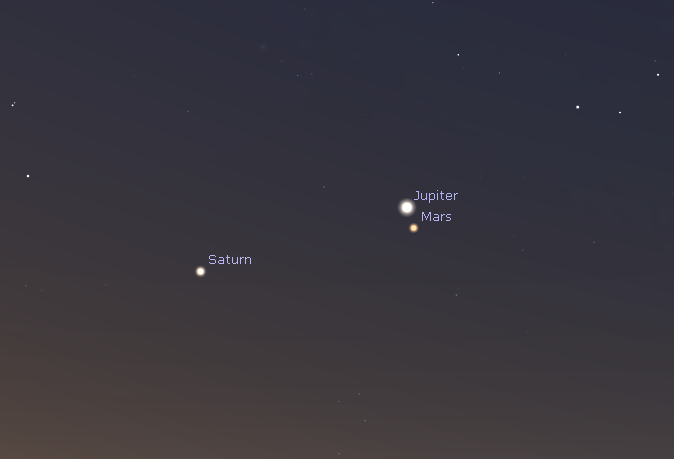
The three morning planets in the southeast at 7 a.m. Friday March 20, 2020. Appearing in the southeast means that Mars being south of Jupiter does not mean that it is not directly below Jupiter. See the chart below. Created using Stellarium.
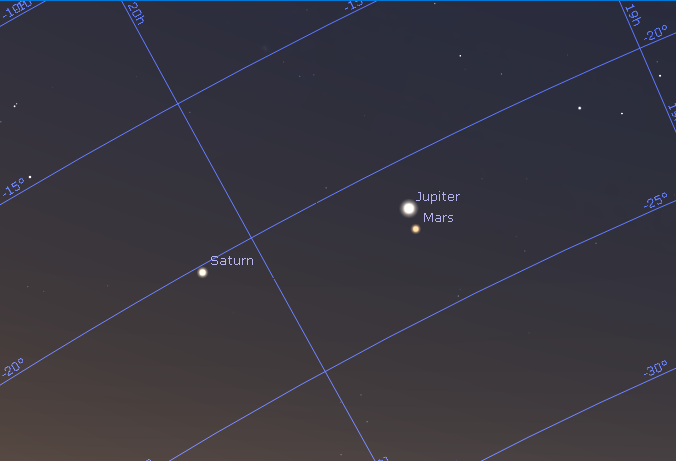
The same chart as above with celestial equatorial coordinates. The lines labeled 19h and 20h near the top are right ascension lines. The lines crossing them are lines of declination which are analogous to latitude on the Earth. Created using Stellarium.
Slightly off topic
Right ascension is measured in hours, minutes and seconds. Because the Earth revolves within the starry sky in 23 hours, 56 minutes and 4 seconds, special clocks can be made to run fast by that amount. These are sidereal clocks, and tell sidereal time or star time for one’s location on the Earth, which is the right ascension of the sky or celestial sphere on that’s due south or more properly on the meridian.
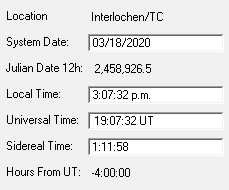
The time panel from my LookingUp program showing date, time and the sidereal time that corresponds to it for my location.
03/18/2020 – Ephemeris – Let’s look at the naked-eye planets for this week
Ephemeris for Wednesday, March 18th. Today the Sun will be up for 12 hours and 4 minutes, setting at 7:53, and it will rise tomorrow at 7:46. The Moon, 2 days past last quarter, will rise at 5:55 tomorrow morning.
Let’s look at the naked-eye planets for this week. Venus is our evening star shining brightly in the west. It will set at 12:07 a.m. The rest of the planet action is in the morning sky where there are three planets close together in the southeast. Mars will rise first at 5:01 a.m. It’s now as bright as a first magnitude star because it’s down to 145 million (234 million km) miles away, as the Earth slowly overtakes it at the rate of about 6 million miles (9 million km) a week. It’s brighter than the star Antares in the southwest. Bright Jupiter will rise at 5:03 a.m. And lastly, Saturn will rise at 5:27 a.m. Mars is catching up to Jupiter and Saturn. It will pass south of Jupiter in two days, and Saturn on the 31st.
The event times given are for the Traverse City/Interlochen area of Michigan. They may be different for your location.
Addendum
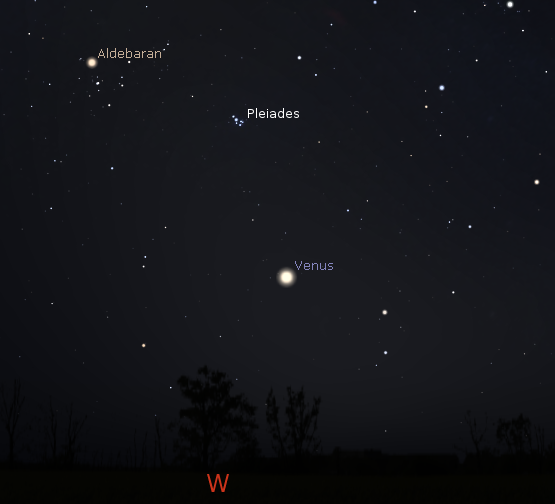
Venus in a very faint zodiacal light at 10 p.m. March 18, 2020. Created using Stellarium.
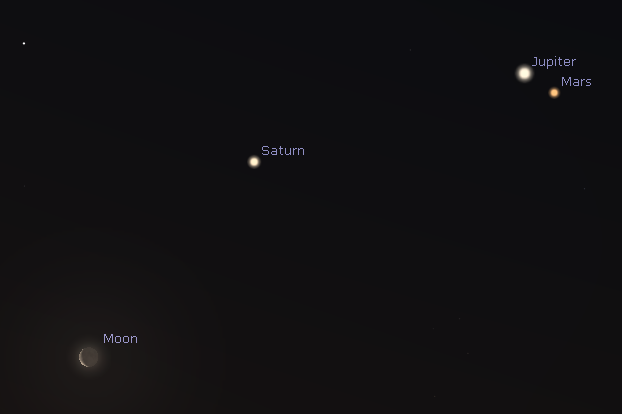
Morning planets and the Moon for 7 a.m. Thursday, March 19, 2020. Created using Stellarium.
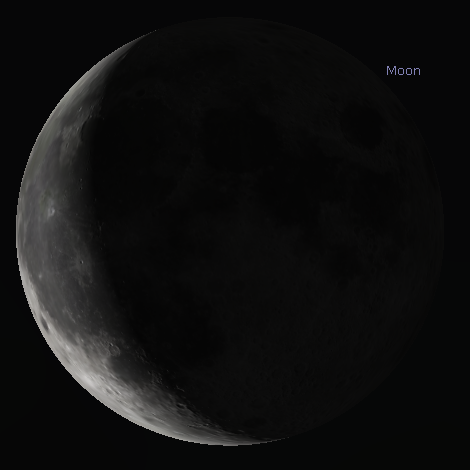
The Moon as it might be seen in binoculars at 7 a.m. tomorrow March 19, 2020. Created using Stellarium.
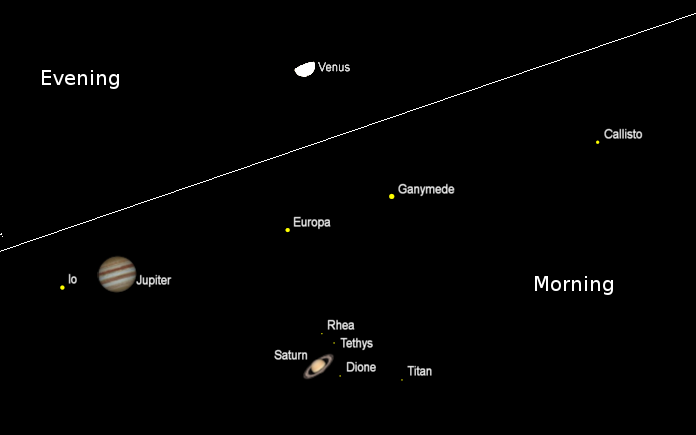
The planets as seen in a telescope with the same magnification. Venus in the evening and Jupiter and Saturn in the morning on the night of March 18/19, 2020. Apparent diameters: Venus, 22.2″; Jupiter, 35.8″; Saturn, 15.8″, rings, 36.9″. Mars at 6.0″ won’t be added until it reaches 10″. The ” symbol means seconds of arc (1/3600th of a degree.) Created using Cartes du Ciel (Sky Charts).
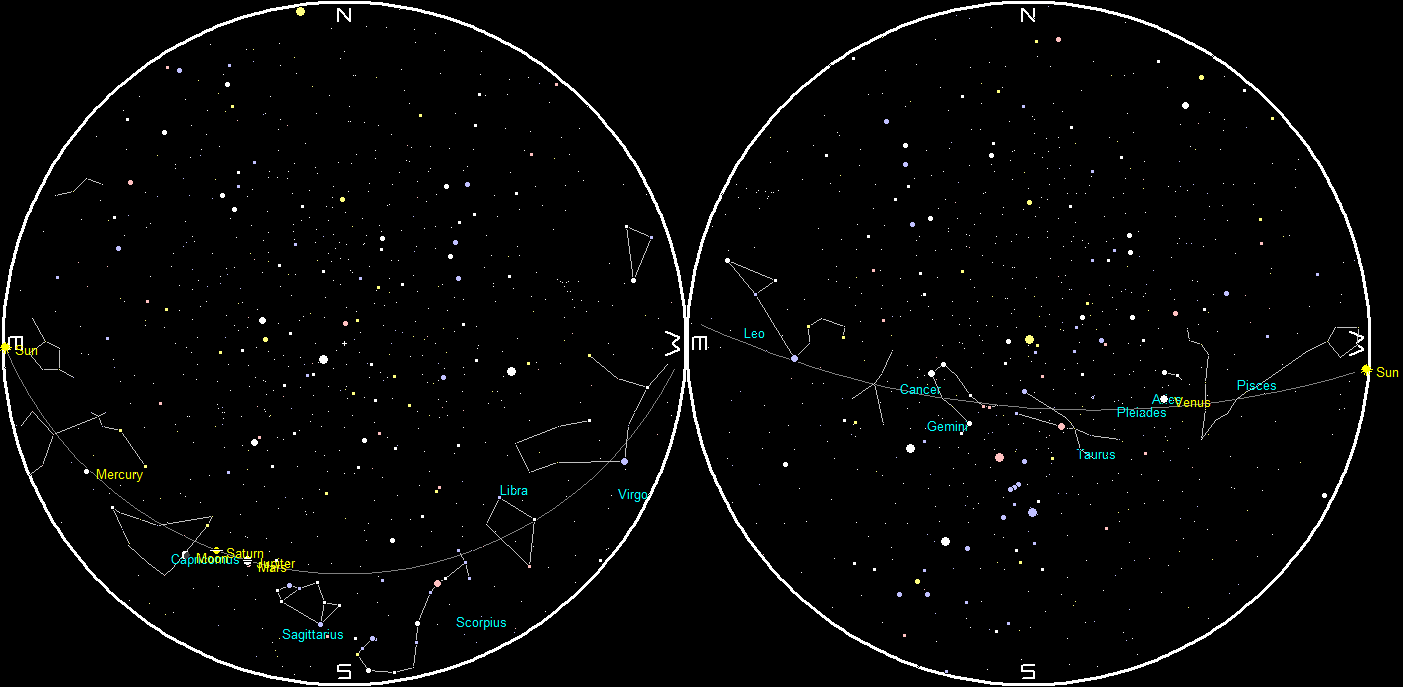
Planets and the Moon at sunset and sunrise of a single night starting with sunset on the right on March 18, 2020. The night ends on the left with sunrise on the 19th. Click on the image to enlarge. Created using my LookingUp program.
03/17/2020 – Ephemeris – A planetary traffic jam tomorrow morning
Ephemeris for St. Patrick’s Day, Tuesday, March 17th. Today the Sun will be up for 12 hours and 1 minute, setting at 7:52, and it will rise tomorrow at 7:48. The Moon, 1 day past last quarter, will rise at 5:12 tomorrow morning.
What I’m going to talk about today is the confluence of the Moon and planets, none of which is green for St. Patrick’s day. The event actually takes place tomorrow morning, which looks like a real planet traffic jam. Of course it just looks like it. The Moon is about 240 thousand miles (390 thousand km) away, Mars is 146 million miles (235 million km), and Jupiter is three and a half times farther away than Mars, and Saturn is twice as far away as Jupiter. These are seen in the southeast, from right to left are Mars, and Jupiter, close together and Saturn a bit farther away. The crescent Moon will pass south of Mars at 4:19 a.m., and Jupiter at 6:18 a.m. The Moon will pass south of Saturn at 8 p.m. tomorrow night while they are below the horizon. By the time they rise Thursday morning the Moon will be a ways left and below Saturn.
The event times given are for the Traverse City/Interlochen area of Michigan. They may be different for your location.
Addendum
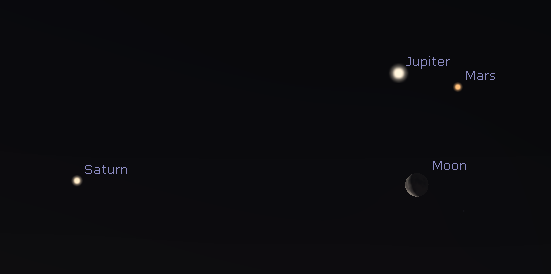
Mars, Jupiter, Saturn and Moon traffic Jam as it will appear in the southeast at 7 a.m. March 18, 2020. Created using Stellarium.

