04/22/2016 – Ephemeris – Hitting on Jupiter
Ephemeris for Earth Day, Friday, April 22nd. The Sun rises at 6:45. It’ll be up for 13 hours and 51 minutes, setting at 8:37. The Moon, at full today, will rise at 9:08 this evening.
The first time anyone had spotted anything hitting Jupiter was in 1994, when over 20 pieces of Comet Shoemaker-Levy 9 hit the planet over an exciting week in July. Jupiter gets hit maybe once a year by a small asteroid making a flash or a scar visible from the Earth. Except for Shoemaker-Levy 9, all the rest of the impacts have been discovered by amateur astronomers who create videos of Jupiter through their modest, by professional standards, telescopes. Generally the reason for the videos is to stack the images to produce super detailed images of the planet, like my friend Scott Anttila, whose images I occasional post with these program transcripts on my blog bobmoler.wordpress.com. Amateurs have even discovered exoplanets.
Times are for the Traverse City/Interlochen area of Michigan. They may be different for your location.
Addendum
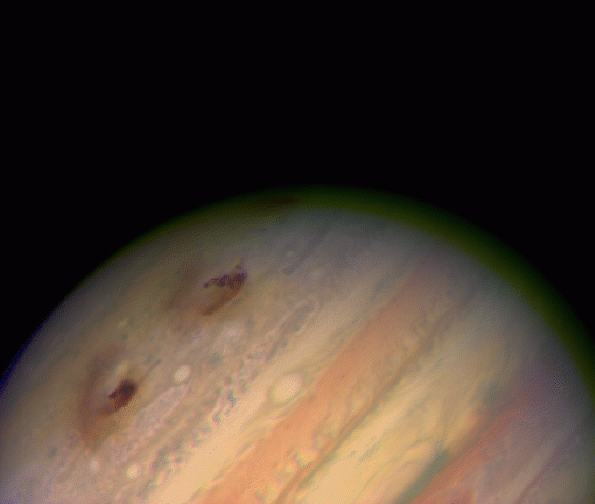
Two of the impact sites of the over 20 bits of Comet Shoemaker-Levy 9 photographed on July 18, 1994. Credit NASA/ESA Hubble Space Telescope.
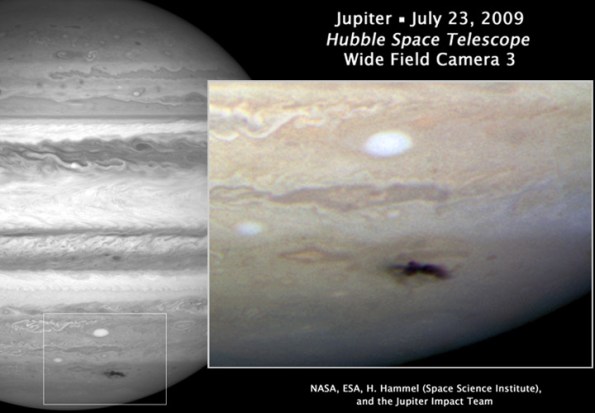
Blemish from an impact discovered by amateur astronomer Anthony Wesley on July 17, 2009. Credit NASA/ESA Hubble Space Telescope.
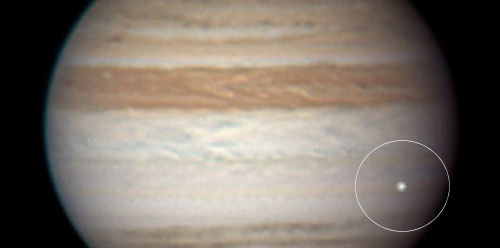
Impact June 3, 2010 photographed by Anthony Wesley. Credit Anthony Wesley.
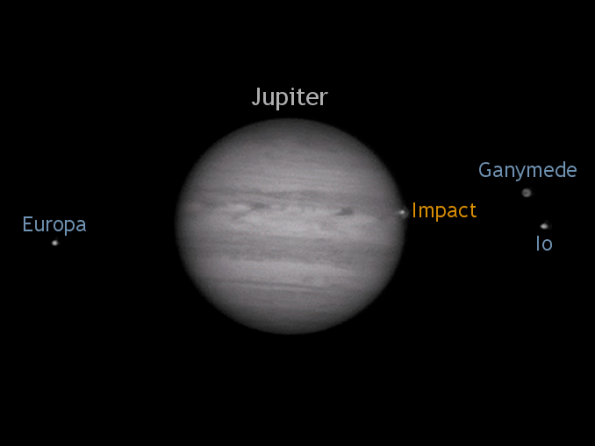
Processed image by John McKeon of the impact of March 17, 2017. The impact was first noticed by Gerrit Kernbauer. Both were amateur astronomers.
Universe Today and more information and videos of the most recent event.
04/21/2016 – Ephemeris – Up up and a way my beautiful balloon*
Ephemeris for Thursday, April 21st. The Sun rises at 6:47. It’ll be up for 13 hours and 48 minutes, setting at 8:36. The Moon, 1 day before full, will set at 7:16 tomorrow morning.
The successful launch of the SpaceX Falcon 9 spacecraft and the Dragon module marked the returned SpaceX to supplying the International Space Station after its failure last June. Besides the great achievement of landing the first stage of the Falcon on a barge, it delivered the Bigelow Aerospace BEAM inflatable module to the ISS. It’s already been attached to the station and will be inflated next month. Bigelow already has two inflatable satellites in orbit: Genesis I and II launched in 2006 and 2007 and though retired, are still in orbit. Inflatable spacecraft offer maximum volume for minimum weight. If the tests on the space station prove the concept, the Mars manned spacecraft may feature an inflatable living module.
Times are for the Traverse City/Interlochen area of Michigan. They may be different for your location.
*Apologies to the 5th Dimension and Bigelow Aerospace.
Addendum
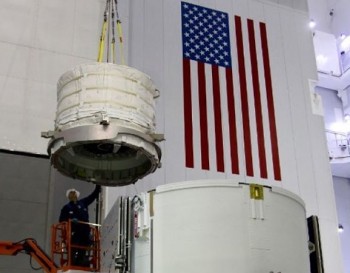
The BEAM module being loaded in the Dragon Trunk. Credit NASA / SpaceX.
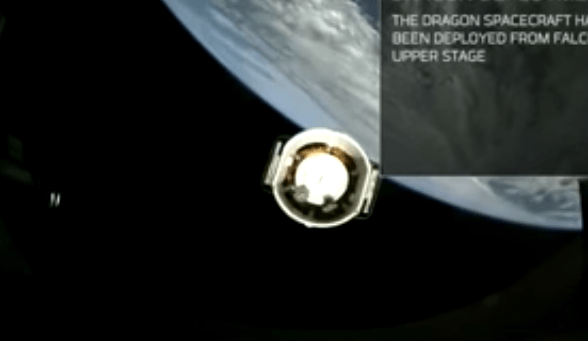
Dragon separating from the Falcon second stage with the BEAM module seen in the Dragon trunk. From a SpaceX/NASA video.
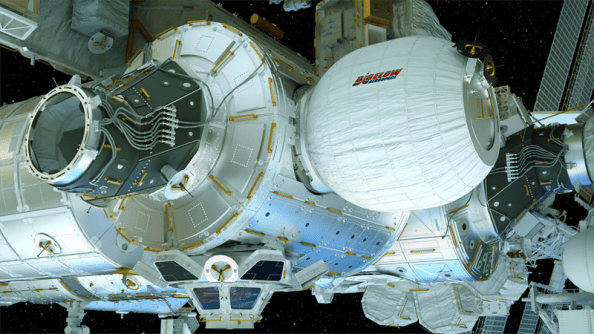
What the BEAM module will look like when attached to the ISS and inflated. Credit NASA.
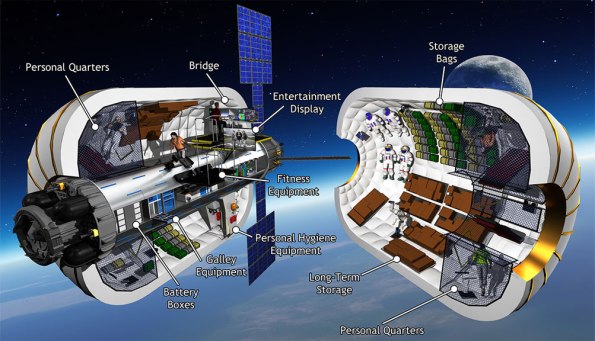
Cutaway view of the Bigelow Aerospace B330 Expandable Space Habitat. They are contracting with United Launch Alliance to send it into orbit. It will have 330 cubic meters of volume. Credit Bigelow Aerospace.
04/20/2016 – Ephemeris – Two bright planets in the evening, and two in the morning
Ephemeris for Wednesday, April 20th. The Sun rises at 6:49. It’ll be up for 13 hours and 45 minutes, setting at 8:34. The Moon, 2 days before full, will set at 6:47 tomorrow morning.
Let’s see what the bright naked eye planets are up to. Mercury is in the west-northwest, very low to the horizon, setting at 10:26 p.m. Mercury is fading now. Jupiter is in the southeast in the evening, and will pass due south at 10:46 p.m., and will set at 5:19 a.m. It’s below the stars of Leo this year. Binoculars can make out some of Jupiter’s moons, but a telescope is required to see all four bright moons and Jupiter’s cloud features. Mars will rise at 11:40 p.m. in the east-southeast. It’s above Scorpius but is actually in western Ophiuchus now. Saturn will rise at 12:09 a.m. in the east-southeast. It’s just left of Mars. Its rings are a telescopic treat. Venus will rise at 6:28 a.m. and not visible in the bright twilight.
Times are for the Traverse City/Interlochen area of Michigan. They may be different for your location.
Addendum
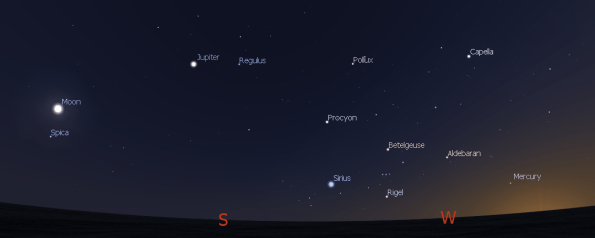
Mercury, Jupiter, the Moon and bright stars visible at 9:30 p.m. April 20, 2016.. Created using Stellarium.
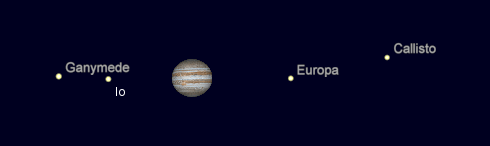
Jupiter and its moons as they might be seen through a telescope at 9:30 p.m. April 20, 2016. It’s 42.0″ in diameter. Created using Cartes du Ciel (Sky Charts).
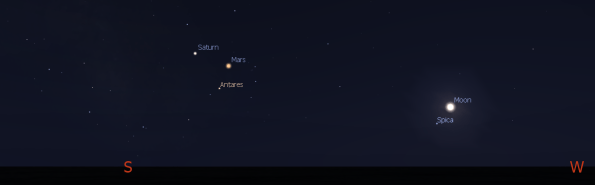
The Moon, Mars and Saturn and the bright stars at 5:30 a.m. April 21, 2016. Created using Stellarium.
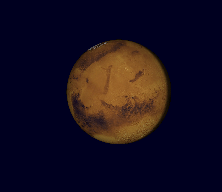
Mars as it might be seen in a large telescope with high power at 5:30 a.m., April 21 2016. Mars apparent diameter is 14.6″. The central meridian will be 233.11 degrees. Syrtis Major is at the extreme left of the planet. Created using Cartes du Ciel (Sky Charts).
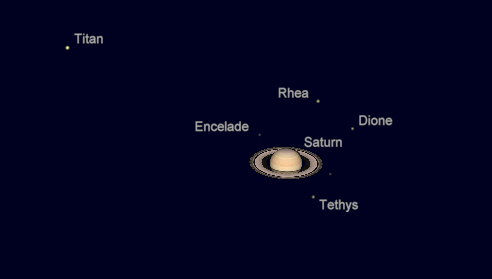
Saturn and its moons at 5:30 a.m., April 21, 2016. The apparent diameter of the planet is 17.9″. The rings span 41.7″, almost the apparent diameter of Jupiter. Created using Cartes du Ciel (Sky Charts).
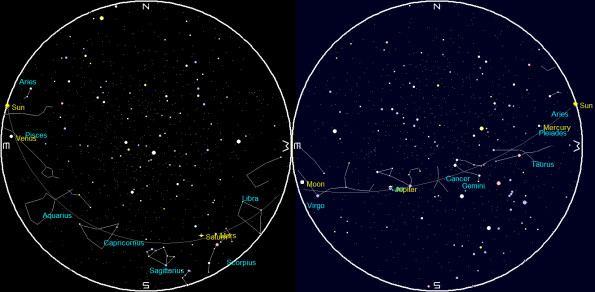
Planets at Sunrise and Sunset on April 20, 2016. If you are using Firefox right-click on the image and select View Image to enlarge the image.
04/19/2016 – Ephemeris – Sending postcards to Alpha Centauri
Ephemeris for Tuesday, April 19th. The Sun rises at 6:50. It’ll be up for 13 hours and 42 minutes, setting at 8:33. The Moon, 3 days before full, will set at 6:19 tomorrow morning.
Here’s an idea.., How about sending postcards to Alpha Centauri. That’s the idea backed by Yuri Milner, Russian Billionaire and Mark Zuckerburg, Facebook Millionaire and supported by Steven Hawking, the most famous physicist of our age. Thousands of small computers on cards with a small solar sail would be pushed by Earth bound lasers to 20% the speed of light to the Alpha Centauri star system, the closest to our own which is 4.3 light years away. At 20% the speed of light these craft would take a bit over 20 years to reach their target. As they passed through they would photograph the system looking for planets. The results would be transmitted to Earth at the speed of light, in 4.3 years. It seems fantastic.
Times are for the Traverse City/Interlochen area of Michigan. They may be different for your location.
Addendum
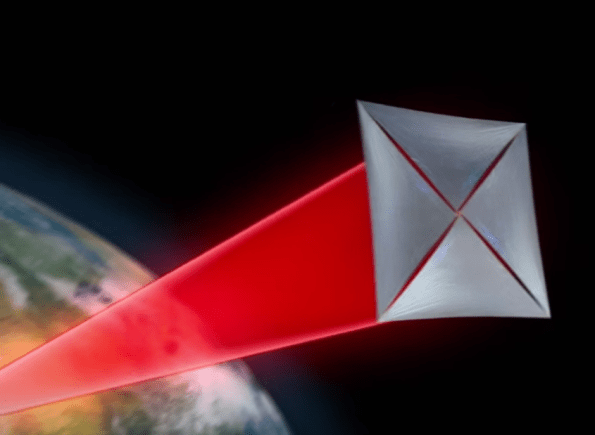
From a YouTube video showing how these tiny spacecraft will be launched.
The video is located at: https://youtu.be/wMkWGN1G6Kg
Video of the announcement: https://youtu.be/0cVQwDdYF4w
04/18/2016 – Ephemeris – A lunar crater that celebrates the first known proponent of a Sun centered solar system
Ephemeris for Monday, April 18th. The Sun rises at 6:52. It’ll be up for 13 hours and 39 minutes, setting at 8:32. The Moon, 4 days before full, will set at 5:52 tomorrow morning.
The Moon slipped past Jupiter at 1:30 this morning so this evening the planet is to the right of the Moon. The brightest spot on the Moon will appear to the upper left of it tonight in binoculars or a small telescope. It is the crater Aristarchus, named after the Greek philosopher who first proposed a Sun centered solar system in the 3rd century BC. Nobody else bought the idea until 19 centuries later. The crater Aristarchus is a relatively new crater, which on the Moon means it was formed probably less than 1.1 billion years ago, after most cratering had subsided. Mysteriously there have been reports over the years from amateur astronomers and even professionals of seeing transient bright spots or glows emanating from the crater.
Times are for the Traverse City/Interlochen area of Michigan. They may be different for your location.
Addendum
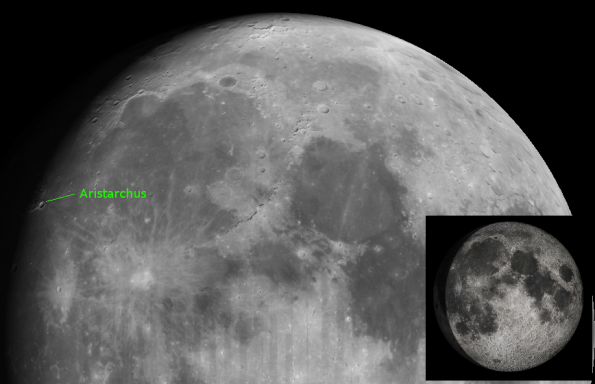
The sun rose on Aristarchus at the upper left side fo the Moon . Image from 10 p.m. April 18, 2016.
04/14/2016 – Ephemeris – It’s always a cloudy day on Jupiter, worse than Traverse City in winter.
Ephemeris for Thursday, April 14th. The Sun will rise at 6:59. It’ll be up for 13 hours and 27 minutes, setting at 8:27. The Moon, 1 day past first quarter, will set at 3:50 tomorrow morning.
If one has a large enough telescope, possibly 100 millimeters diameter or larger Jupiter’s cloud detail can be studied. At first appearance the clouds appear simple light and dark stripes. They are caused by Jupiter’s rapid rotation of a bit less than 10 hours. The dark stripes are called belts. The darkest and broadest of these is the North Equatorial Belt. The next darkest belt is the South Equatorial Belt, which actually disappeared for a time in 2010. On the belt’s south side is found the Great Red Spot an anticyclone. The white stripes are called zones. There are more belts and zones at higher latitudes. The Great Red Spot is kinda pink now. In my youth in the 1950s it could be easily spotted in a small telescope and it was brick-red!
Times are for the Traverse City/Interlochen area of Michigan. They may be different for your location.
Addendum
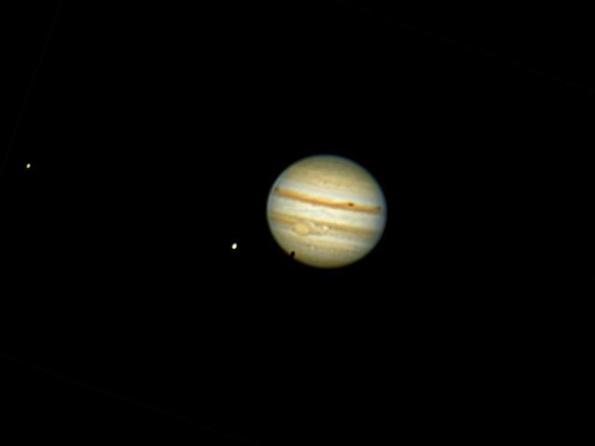
Scott Anttila image of Jupiter from November 14, 2011.
Note how faded the Great Red Spot was.
04/13/2016 – Ephemeris – What’s up with the bright planets this week?
Ephemeris for Wednesday, April 13th. The Sun will rise at 7:01. It’ll be up for 13 hours and 24 minutes, setting at 8:26. The Moon, at first quarter today, will set at 3:09 tomorrow morning.
Let’s see what the bright naked eye planets are up to. Mercury is in the west-northwest, very low to the horizon, setting at 10:12 p.m. The next 7 days will be the best time to spot it. Jupiter is in the southeast in the evening, and will pass due south at 11:15 p.m., and will set at 5:48 a.m. It’s below the stars of Leo this year. Binoculars can make out some of Jupiter’s moons, but a telescope is required to see all four bright moons and Jupiter’s cloud features. Mars will rise at 12:08 a.m. in the east-southeast. It’s above Scorpius but is actually in western Ophiuchus now. Saturn will rise at 12:38 a.m. in the east-southeast. It’s just left of Mars. Its rings are a telescopic treat. Venus will rise at 6:37 a.m. and not really visible in the bright twilight.
Times are for the Traverse City/Interlochen area of Michigan. They may be different for your location.
Addendum
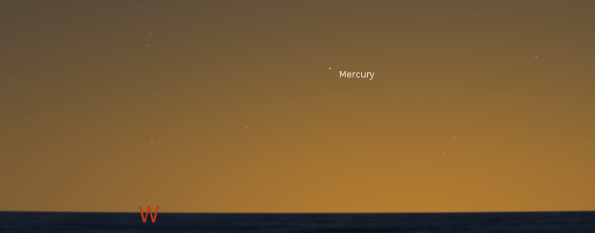
Mercury at 9 p.m. April 13, 2016. At this time Mercury will be located at 284° azimuth and 11.5° altitude. Created using Stellarium.
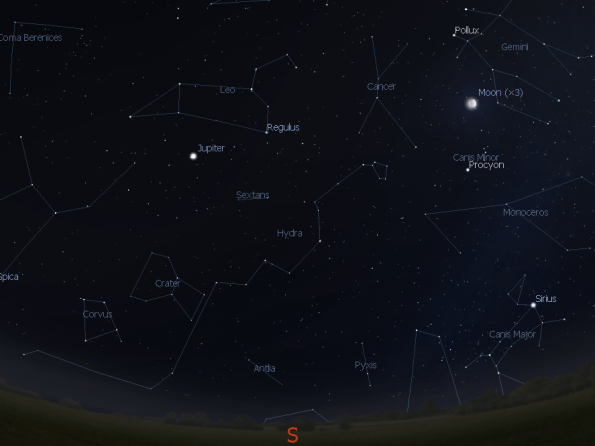
Jupiter, the Moon and the constellations visible at 10 p.m. April 13, 2016.. Created using Stellarium.
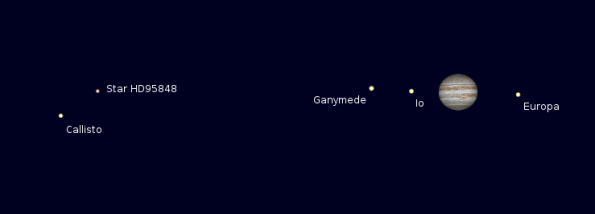
Jupiter and its moons at 10 p.m. April 13, 2016. Jupiter has an apparent diameter of 42.7″ Created using Cartes du Ciel (Sky Charts).
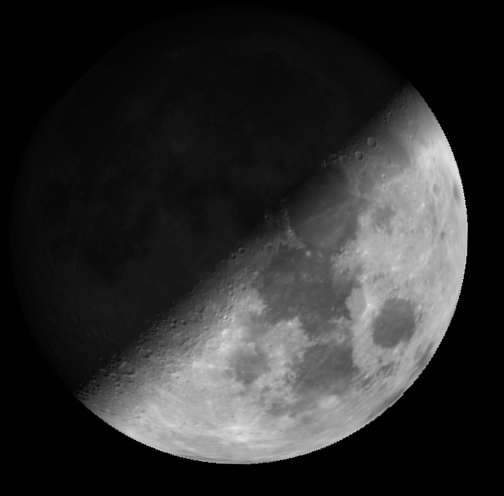
The Moon as it would appear tonight at 9 p.m. April 13, 2016. Created using Virtual Moon Atlas.
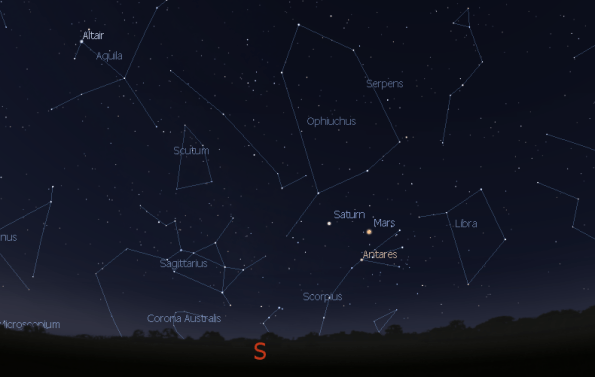
Mars and Saturn with a preview of the summer constellations at 6 a.m., April 14, 2016. Created using Stellarium.
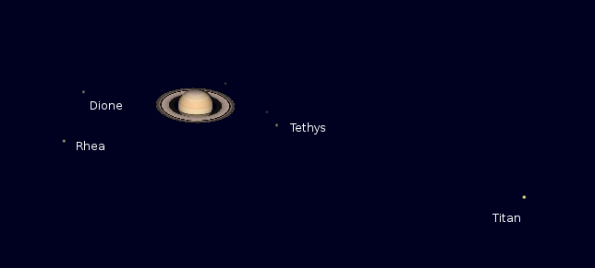
Saturn and its moons at 6 a.m., April 14, 2016. Saturn’s apparent diameter is 17.7″ and the rings span 41.3″ Created using Cartes du Ciel (Sky Charts).
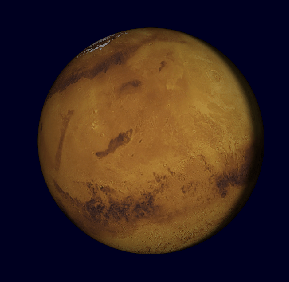
Mars as seen in a large telescope with high power at 6 a.m., April 14 2016. Mars apparent diameter 13.5″. The central meridian will be 202° Created using Cartes du Ciel (Sky Charts).
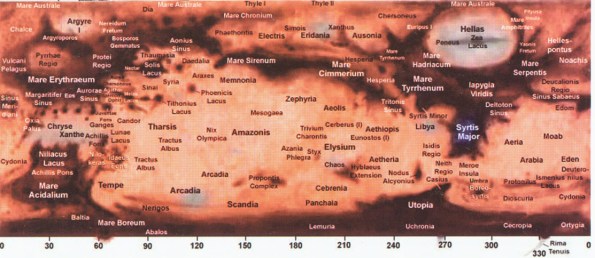
Mars map – North up.
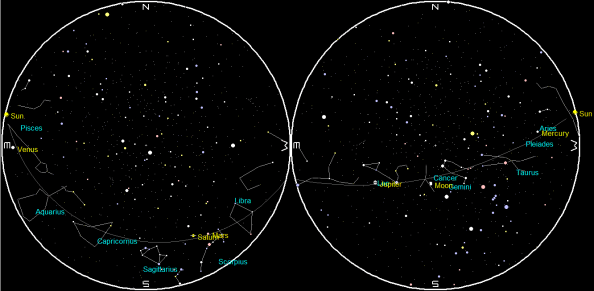
Planets at Sunrise and Sunset on April 13, 2016. If you are using Firefox right-click on the image and select View Image to enlarge the image.
04/12/2016 – Ephemeris – Can you tell the Jovian moons apart without a program?
Ephemeris for Yuri’s Night, Tuesday, April 12th. The Sun will rise at 7:02. It’ll be up for 13 hours and 21 minutes, setting at 8:24. The Moon, 1 day before first quarter, will set at 2:22 tomorrow morning.
It’s the 55th anniversary of Yuri Gagarin’s flight as first human to orbit the Earth. Speaking of orbits, we can see Jupiter’s 4 largest moons orbit that planet in small telescopes. Their orbits are nearly edge on to us, so they seem to move back and forth from one side to the other of the planet in pretty much a straight line. So how can you tell them apart without a reference? The four moons from Jupiter in order are Io, Europa, Ganymede, and Callisto. They are not normally arranged like that. Ganymede is the brightest and Callisto the dimmest, and is usually the farthest away. Io is usually the closest appearing and has a slight reddish hue due to its sulfurous volcanic surface, and Europa is the dimmer moon close in to Jupiter. Io also can be seen to noticeably move in an hour.
Times are for the Traverse City/Interlochen area of Michigan. They may be different for your location.
Addendum
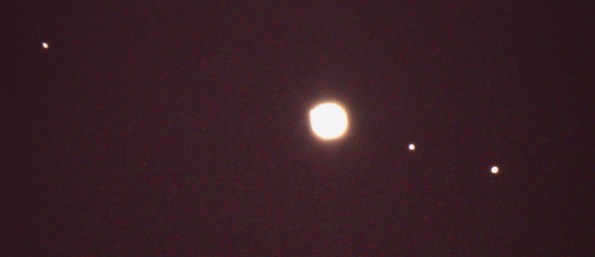
One of my old pictures of Jupiter. Callisto is obvious from its far left position and dimmer brightness. On the right, the farthest is Ganymede due to its brightness and position. Inside of it is Europa, again, dimmer than Ganymede and inside position is probably Europa. That leaves Io, which may be trying to duck behind Jupiter, as a bump in the left edge of the planet.
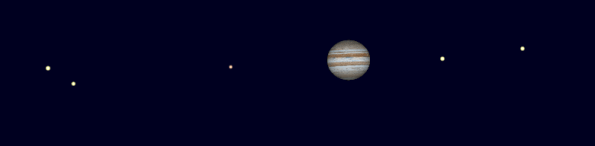
Jupiter and its moons as simulated by Cartes du Ciel for tonight, 10 p.m. April 12, 2016. The bodies, from let to right are Ganymede, Callisto. a background star, Jupiter, Io, and Europa.
04/11/2016 – Ephemeris – The margins of the Moon
Ephemeris for Monday, April 11th. The Sun will rise at 7:04. It’ll be up for 13 hours and 18 minutes, setting at 8:23. The Moon, 2 days before first quarter, will set at 1:28 tomorrow morning.
Lets check out the Moon tonight. The Moon’s terminator, now the sunrise line traversing the Moon is beginning to uncover the dark Mare Tranquillitatis or Sea if Tranquility on the equator of the Moon. The small round prominent sea on the right side of the Moon is Mare Crisium, or Sea of Crises. At the limb beyond Crisium is Mare Marginis or sea at the Margin, and below it also at the edge is Mare Smythii, or Smith’s Sea, named after William Henry Smith a 19th century British astronomer. These last two seas are only visible when the Moon appears to rock to the left and reveals them. This is called libration caused by the fact the Moon rotates at a constant rate and it orbits the Earth in an ellipse, changing it’s speed.
Times are for the Traverse City/Interlochen area of Michigan. They may be different for your location.
Addendum
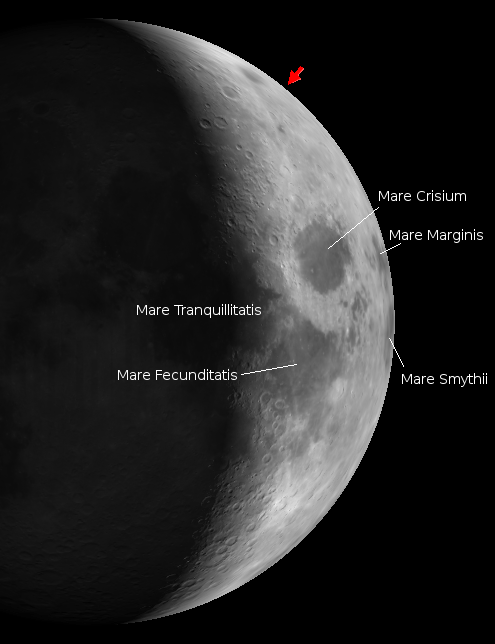
Map of the Moon for April 11, 2016. The arrow shows the point of maximum libration for that date. Created using Virtual Moon Atlas.
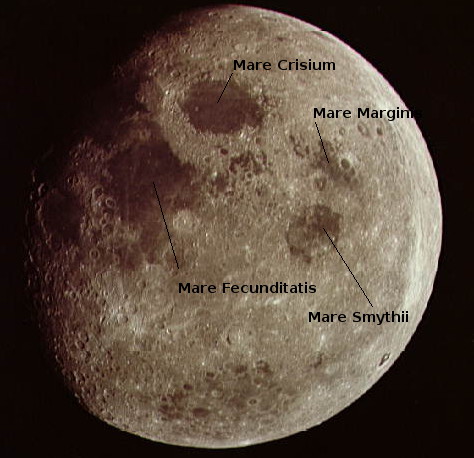
Photo of the receding Moon taken by the Crew of Apollo 8 as they started to head home showing the near side on the left and the far side on the right. I’ve annotated the seas which I’ve described above. Credit NASA.
04/08/2016 – Ephemeris – Daytime occultation of Aldebaran Sunday the 10th
Apr 8. This is Bob Moler with Ephemeris for Friday, April 8th. The Sun will rise at 7:09. It’ll be up for 13 hours and 9 minutes, setting at 8:19. The Moon, 1 day past new, will set at 10:03 this evening.
The Moon will pass in front of the bright star Aldebaran Sunday evening. However it will still be daylight out. So this will be a challenge for the observer with binoculars, or better yet, telescope. The moon will appear as a washed out crescent in the blue sky. It will require an exceptionally clear sky to see Aldebaran, which once the Sun sets will appear just below the Moon and is part of the Face of Taurus the bull. For the IPR listening area Aldebaran will disappear at the Moon’s dark upper left edge at 6:29 p.m. plus or minus a minute, depending on your location. The star will reappear at 7:38 p.m., give or take a minute, on the right edge of the Moon, just below the dark oval of the Sea of Crises. This is second of 4 Aldebaran occultations visible from here this year.
Times are for the Traverse City/Interlochen area of Michigan. They may be different for your location.
Addendum
Ingress: 6:29 p.m.
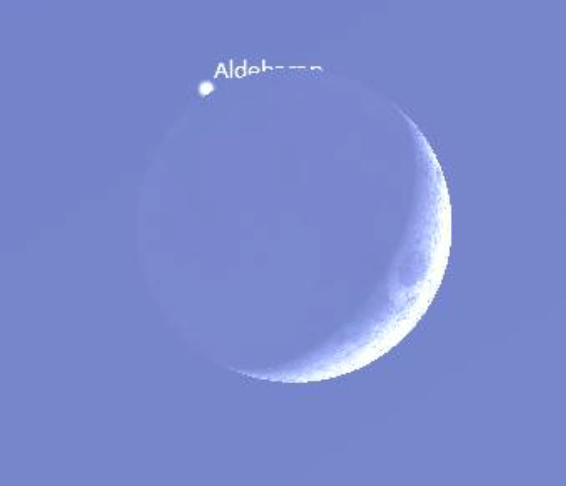
Aldebaran ingress at approximately 6:29 p.m. April 10, 2016. Created using Stellarium.
Egress: 7:38 p.m.
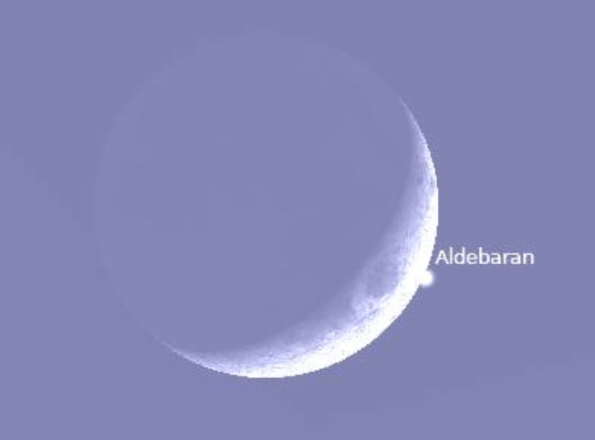
Aldebaran egress at approximately 7:38 p.m. April 10, 2016. Created using Stellarium.
Occultation Visibility Map
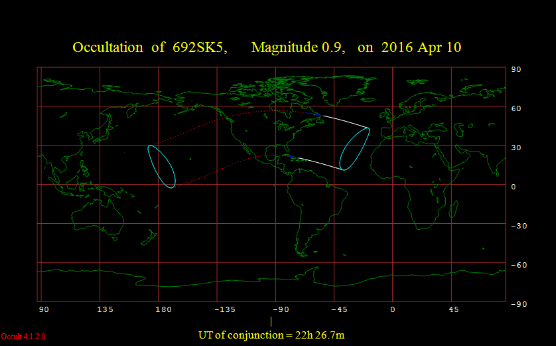
Occultation Map for Aldebaran. Bright outline of occultation path is where it occurs at night. Credit IOTA program Occult 4.
Aldebaran will most likely need a telescope to spot once the Moon is located. The representations above via Stellarium will show the star as being too bright. It will be quite dim in relation to the sky brightness. The Moon too will be washed out. Start searching before the occultation start to make sure the star can be located. Even a little haze will make seeing the event impossible.
The actual time of the ingress and egress will vary by several minutes depending on your location in Michigan. Stellarium or other planetarium programs can be used to predict the timings to within a minute. IOTA the http://www.lunar-occultations.com/iota/iotandx.htm has a free Windows program Occult 4 which will give accurate occultation and transit of Mercury predictions.

