04/07/2016 – Ephemeris – The Big Dipper, the Great Bear and the Fisher Star
Ephemeris for Thursday, April 7th. The Sun will rise at 7:11. It’ll be up for 13 hours and 6 minutes, setting at 8:18. The Moon is new today, and won’t be visible.
The constellation of Ursa Major, or great bear was well-known to the ancient Greeks and Native Americans. Today, however, many of us can recognize only part of it as the Big Dipper. The bear can be easily seen only in a dark sky, at 10 p.m. it’s high just north of the zenith with feet to the south. The stars in front of the bowl are the front part of his body and head. The bowl of the Big Dipper is his rump, and the handle his long tail. The Native Americans, saw those three stars as three hunters following the bear. The tribes of the Great Lakes region saw it as the Fisher Star, who brought summer to the Earth. These stars here do make a convincing bear, except for the tail, when seen on a dark night. The weasel-like Fisher Star fits the stars completely.
Times are for the Traverse City/Interlochen area of Michigan. They may be different for your location.
Addendum
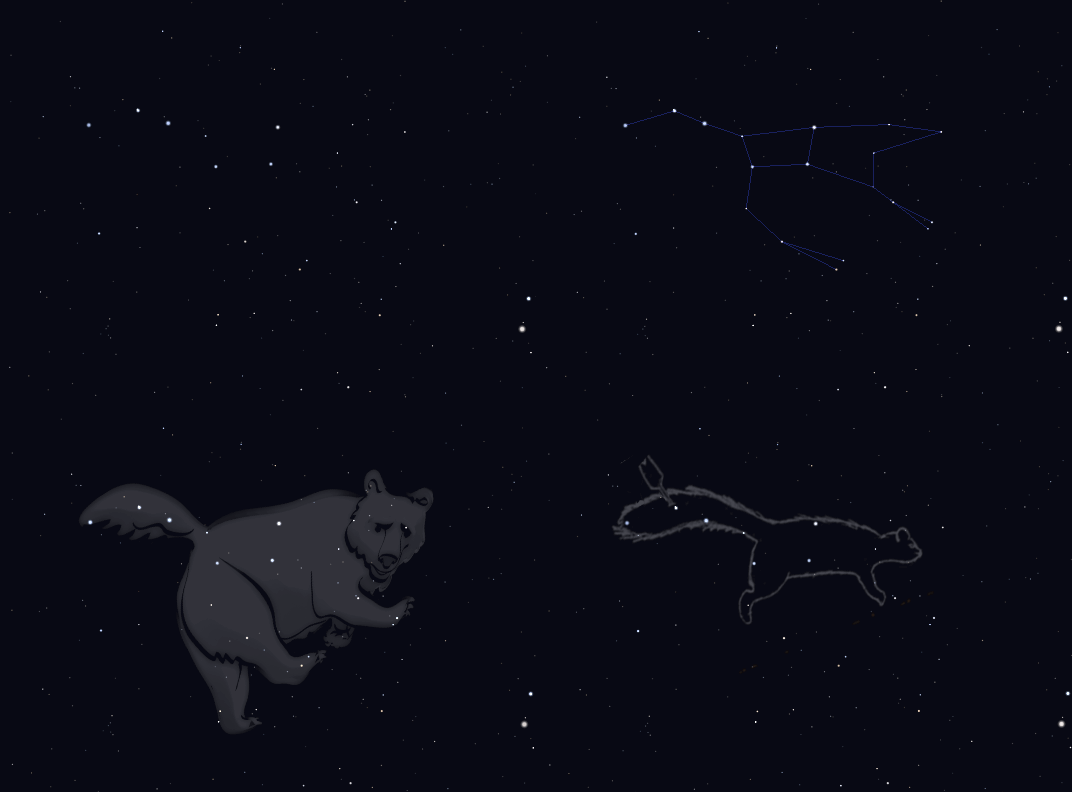
Animation of 4 views of Ursa Major. 1. with no added imagery, emphasizing the Big Dipper, 2. added lines for Ursa Major, 3. image of the bear, 4. image of Fisher Star. Created using Stellarium and GIMP.
Note: The Fisher Star illustration is an unattributed drawing from the Internet with a minor change.
04/06/2016 – Ephemeris – Mercury makes its spring appearance in the west – Plus Jovian moon hijinx
Ephemeris for Wednesday, April 6th. The Sun will rise at 7:13. It’ll be up for 13 hours and 3 minutes, setting at 8:17. The Moon, 1 day before new, will rise at 7:30 tomorrow morning.
Let’s check out the whereabouts of the bright naked eye planets. Mercury is in the west-northwest, very low to the horizon, setting at 9:35 p.m. Jupiter is in the southeast in the evening, and will pass due south, astronomers call it a transit, at 11:45 p.m., and will set at 6:16 a.m. It’s below the stars of Leo this year. Binoculars can make out some of Jupiter’s moons, but a telescope is required to see all four bright moons and Jupiter’s cloud formations. Mars will rise next at 12:31 a.m. in the east-southeast. It’s above Scorpius but moved into western Ophiuchus now. Saturn will rise at 1:06 a.m. in the east-southeast. It’s just left of Mars. Its rings are a telescopic treat. Venus will rise at 6:47 a.m. due east.
Times are for the Traverse City/Interlochen area of Michigan. They may be different for your location.
Addendum
Evening sky
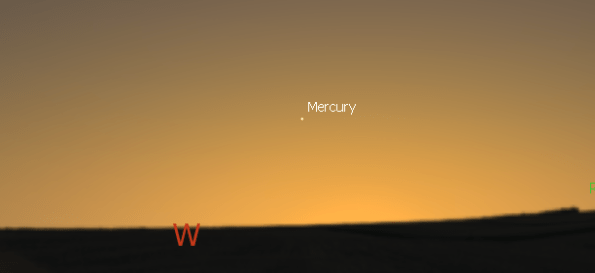
Mercury appears low in the sky in the west at 8:40 p.m. April 6, 2016. Created using Stellarium.
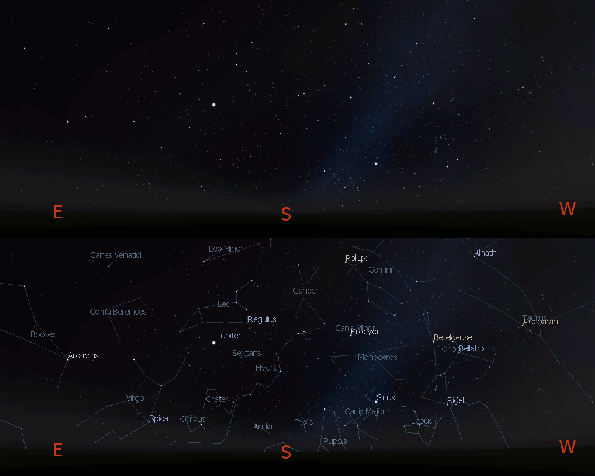
An animation of Jupiter in the night sky with and without lines and captions at 10 p.m., April 6, 2016. Created using Stellarium and GIMP.
If you are using Firefox right-click on the image and select View image to enlarge.
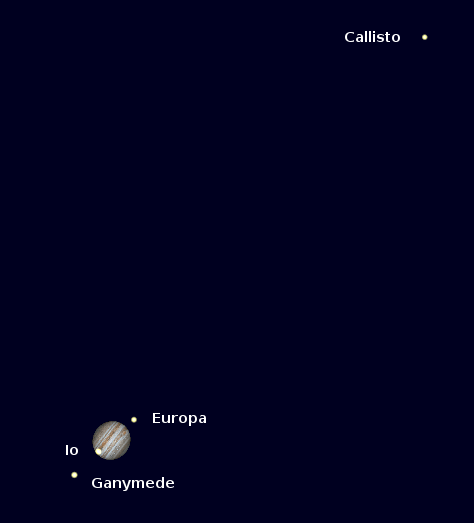
Jupiter and its moons at 10 p.m. April 6, 2016. It’s going to be busy night with the three closest moons playing tag with Jupiter. See the table of events below. Jupiter appears 43.2″ in diameter. Created with Cartes du Ciel (Sky Charts).
Jovian satellite events overnight
Io and Ganymede will pass in front (transit) the face of Jupiter, while Europa pass behind and be occulted by Jupiter.
| Event | Date/Time EDT | Date/Time UT | ||
| Io Transit Starts | 6 | 9:52 p.m. | 7 | 01:52 |
| Io Shadow Crossing Starts | 6 | 10:30 p.m. | 7 | 02:32 |
| Europa Occultation Starts | 6 | 10:48 p.m. | 7 | 02:48 |
| Io Transit Ends | 7 | 12:06 a.m. | 7 | 04:06 |
| Io Shadow Crossing Ends | 7 | 12:47 a.m. | 7 | 04:47 |
| Ganymede Transit Starts | 7 | 1:00 a.m. | 7 | 05:00 |
| Europa Eclipse Ends* | 7 | 2:53 a.m. | 7 | 06:53 |
| Ganymede Shadow Crossing Starts | 7 | 3:44 a.m. | 7 | 07:44 |
| Ganymede Transit Ends | 7 | 4:15 a.m. | 7 | 08:15 |
| Ganymede Shadow Crossing Ends | 7 | Not up | 7 | 11:00 |
| * When Europa’s occultation ends it will still be in Jupiter’s shadow and will enter sunlight a bit away from the planet. | ||||
Timings are from Project Pluto.
Morning sky
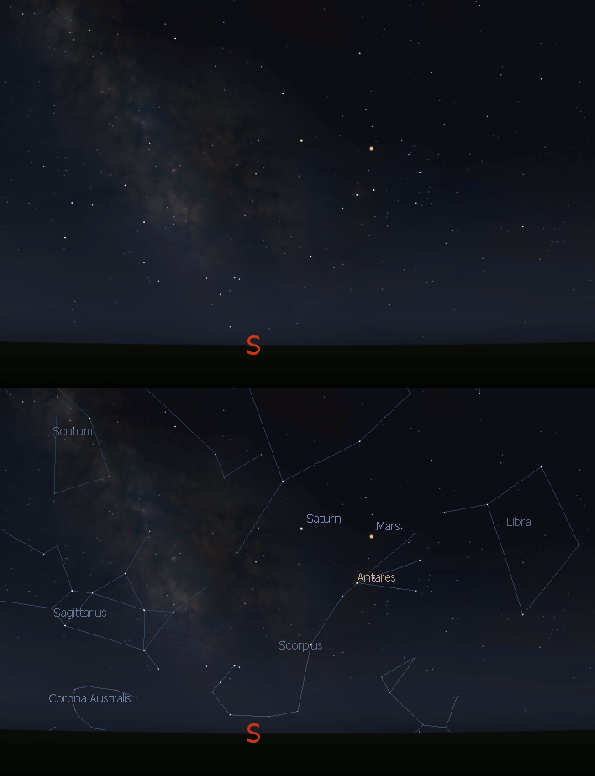
Looking south at 6 a.m. at Mars and Saturn in an animation with and without annotations. 6 a.m. April 7, 2017. Created using Stellarium and GIMP.
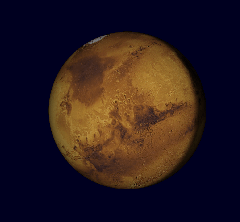
Mars as seen in a large telescope with high power at 6 a.m., April 7, 2016. Mars apparent diameter 12.7″. Created using Cartes du Ciel (Sky Charts).
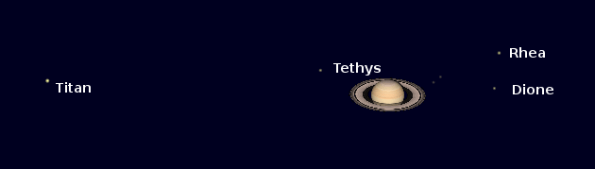
Saturn with some of its satellites. Normally only Titan is visible. The disk of Saturn has the apparent diameter of 17.6″ while the rings span 40.9″. Created using Cartes du Ciel (Sky Charts).
The planets at sunrise and sunset
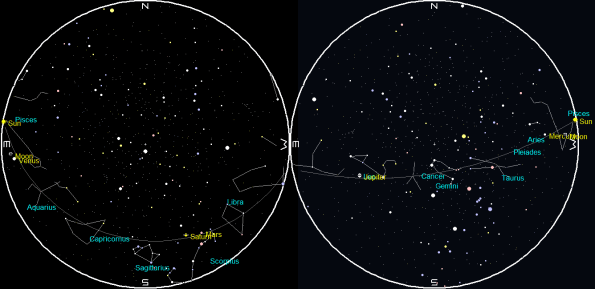
This is a chart showing the sunrise and sunset skies for April 6, 2016 showing the location of the planets and the Moon at that time. Created using my LookingUp program.
04/05/2016 – Ephemeris – Coma Berenices, the second closest star cluster
Ephemeris for Tuesday, April 5th. The Sun will rise at 7:15. It’ll be up for 13 hours and 1 minute, setting at 8:16. The Moon, 2 days before new, will rise at 6:53 tomorrow morning.
Midway up the sky in the east at 10 p.m. is a tiny sprinkle of faint stars arrayed to look like several strands of hair. It’s the constellation of Coma Berenices, or Berenice’s hair. The whole group will fit in the field of a pair of binoculars, which is the best way to see it, and will also show more stars. The cluster contains about 50 stars and lies at a distance of 280 light years from us, which makes it the second closest star cluster. The closest being the Hyades, that is the face of Taurus the bull now about to set in the west. The star cluster appears to be about 480 million years old. It is an open or galactic star cluster, born along the plane of the Milky Way. It appears away from the milky band due to its proximity to us.
Times are for the Traverse City/Interlochen area of Michigan. They may be different for your location.
Addendum
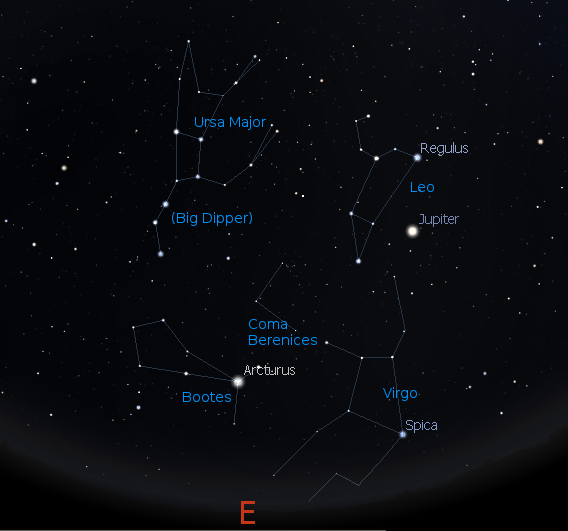
Coma Berenices finder chart 10 p.m., April 5, 2016. Created using Stellarium.
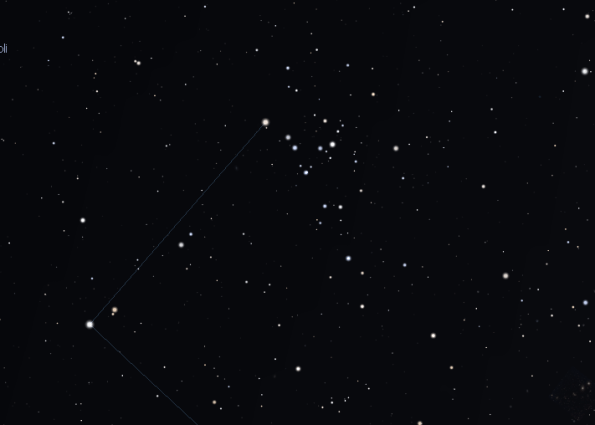
Coma Berenices as it might look in a pair of binoculars. Telescopes are too powerful. Created using Stellarium.
04/04/2016 – Ephemeris – Hydra the water snake will slither along the southern horizon this spring
Ephemeris for Monday, April 4th. The Sun will rise at 7:17. It’ll be up for 12 hours and 57 minutes, setting at 8:14. The Moon, 3 days before new, will rise at 6:18 tomorrow morning.
In the southeastern evening sky can be found the constellation of Hydra the water snake. Unlike the monster of the same name this Hydra has but one head, which is its most distinctive part. At 10 p.m. look to the south-southeast. The head of Hydra is located below a line from the constellation Leo the Lion in the southeast and Gemini high in the southwest. It is directly below Cancer the crab in the south. Hydra’s head is a small but distinctive group of 6 stars that make a loop and the snake’s slightly drooping head. The rest of Hydra wends its way to the southeastern horizon, and eventually ends near the late spring constellation Libra the scales. Over the next few months the rest of Hydra will slither across the southern horizon.
Times are for the Traverse City/Interlochen area of Michigan. They may be different for your location.
Addendum
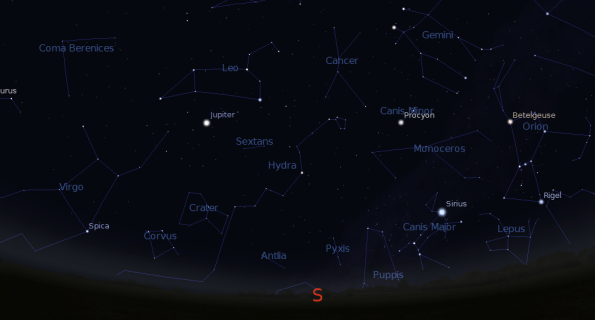
Hydra the water snake raising its head below Cancer at 10 p.m. April 4, 2016. Created using Stellarium.
04/01/2016 – Ephemeris – Let’s preview April skies
Ephemeris for April Fools Day, Friday, April 1st. The Sun will rise at 7:22. It’ll be up for 12 hours and 48 minutes, setting at 8:11. The Moon, 1 day past last quarter, will rise at 4:23 tomorrow morning.
The 4th month of the year begins today. Daylight hours in the Interlochen/Traverse City area and will increase from 12 hours and 48 minutes today to 14 hours 13 minutes on the 30th. The altitude, or angle, of the sun above the southern horizon at local noon will be 50 degrees today and will ascend to 60 degrees on the 30th. The altitude of the sun in the Straits area will be a degree lower. The actual time of local apparent noon this month for the Interlochen/Traverse City area, when the sun passes due south, will be about 1:43 p.m. Jupiter and Mercury are the evening planets this month, with Mercury making its brief appearance away from the Sun’s sunset glow around mid-month.
Times are for the Traverse City/Interlochen area of Michigan. They may be different for your location.
Addendum
April Star Chart
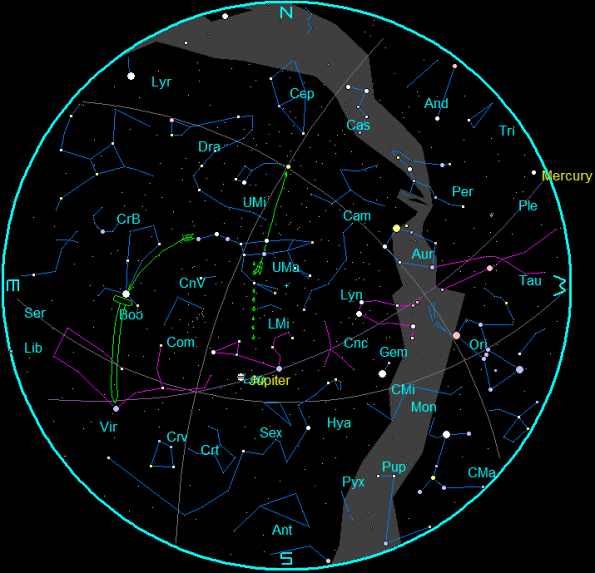
Star Chart for April 2016. Created using my LookingUp program. To enlarge in Firefox Right-click on image then click View image.
Star Chart for April 2016. Created using my LookingUp program. To enlarge in Firefox Right-click on image then click View image.
The planets and stars are plotted for the 15th at 10 p.m. EDT. That is chart time. Note, Traverse City is located approximately 45 minutes behind our time meridian. (An hour 45 minutes behind our daylight saving time meridian.) To duplicate the star positions on a planisphere you may have to set it to 1:45 earlier than the current time.
Evening nautical twilight ends at 9:15 p.m. EDT on the 1st, increasing to 9:59 p.m. EDT on the 30th.
Morning nautical twilight starts at 5:21 a.m. EDT on the 1st, and decreasing to 4:37 a.m. EDT on the 31st.
Add a half hour to the chart time every week before the 15th and subtract a half hour for every week after the 15th. Before the 13th also subtract an hour for Standard Time.
For a list of constellation names to go with the abbreviations click here.
- Pointer stars at the front of the bowl of the Big Dipper point to Polaris the North Star
- A leaky Big Dipper drips on Leo
- Follow the arc of the handle of the Big Dipper to the star Arcturus
- Extend the ac to a spike to point to Spica
Calendar of Planetary Events
Credit: Sky Events Calendar by Fred Espenak and Sumit Dutta (NASA’s GSFC)
To generate your own calendar go to http://eclipse.gsfc.nasa.gov/SKYCAL/SKYCAL.html
Times are Eastern Time. Some additions made to aid clarity.
    Date    Time(EDT) Event
Apr 01  Fr            Venus: 17.4° W
    05  Tu  1:27 p.m. Moon Descending Node
    06  We  4:30 a.m. Moon-Venus: 0.7° S
    07  Th  7:24 a.m. New Moon
    07  Th  1:36 p.m. Moon Perigee: 357200 km
    09  Sa  5:28 p.m. Uranus Conjunction
    10  Su  6:05 p.m. Moon-Aldebaran: 0.4° S Occultation*
    12  Tu  8:12 a.m. Moon North Dec.: 18.3° N
    13  We 11:59 p.m. First Quarter
    16  Sa  8:46 p.m. Moon-Regulus: 2.7° N
    18  Mo 12:42 a.m. Moon-Jupiter: 2.4° N
    18  Mo  9:59 a.m. Mercury Elongation: 19.9° E
    18  Mo  2:04 a.m. Moon Ascending Node
    21  Th 12:05 p.m. Moon Apogee: 406400 km
    22  Fr  1:24 a.m. Full Moon
    22  Fr  1:30 a.m. Lyrid Shower: ZHR = 20
    25  Mo  3:28 p.m. Moon-Saturn: 3.7° S
    27  We 12:44 a.m. Moon South Dec.: 18.4° S
    27  We 12:33 p.m. Mars-Antares: 4.9° N
    28  Th  4:32 a.m. Mercury-Pleiades: 6.5° S
    29  Fr 11:29 p.m. Last Quarter
May 01  Su            Venus: 9.8° W
* Occultation 6:29 - 7:38 p.m. In daylight - Grand Traverse Area
  See Friday April 9th post.
03/31/2016 – Ephemeris – Tomorrow night’s Astronomy Society meeting
Ephemeris for Thursday, March 31st. The Sun will rise at 7:24. It’ll be up for 12 hours and 45 minutes, setting at 8:09. The Moon, at last quarter today, will rise at 3:39 tomorrow morning.
Tomorrow night the Grand Traverse Astronomical Society will hold it’s monthly meeting with a program featuring a graduate from Northwestern Michigan College and the astronomy program: Becky Shaw who will present a talk on Women in Astronomy. This is a third presentation of female astronomers, who have made important breakthroughs in astronomy. I especially recommend this for girls interested in the STEM fields, that is Science, Technology, Engineering and Math to find out the wonderful contributions these women have made. Astronomy, by the way encompasses all the STEM fields. The meeting starts at 8 p.m. and the observatory is located on Birmley Road, south of Traverse City. At 9 p.m. there will also be star party if it’s clear, viewing the planet Jupiter, the Great Orion Nebula, and other wonders of the heavens.
Times are for the Traverse City/Interlochen area of Michigan. They may be different for your location.
03/30/2016 – Ephemeris – The planets tonight – corrected to March 31-April 1
Note: I’ve been under the weather (bad cold) and have been sleeping a lot. The times for the planet phenomena in the second paragraph have been adjusted to the night of March 31st – April 1st.
Ephemeris for Wednesday, March 30th. The Sun will rise at 7:26. It’ll be up for 12 hours and 42 minutes, setting at 8:08. The Moon, 1 day before last quarter, will rise at 2:51 tomorrow morning.
Let’s check out the whereabouts of the bright naked eye planets for the nigh of March 31-April 1, 2016. Jupiter is up at sunset, and will pass due south, astronomers call it a transit, at 12:11 a.m., and will set at 6:41 a.m. It’s below the stars of Leo now. Binoculars can make out some of Jupiter’s moons, but a telescope is required to see Jupiter’s cloud formations. Mars will rise next at 12:49 a.m. in the east-southeast. It’s seen in western Scorpius now. Saturn will rise at 1:30 a.m. in the east-southeast. It’s above the stars of Scorpius, actually in Ophiuchus. Its rings are a telescopic treat. Venus will rise at 6:55 a.m. again in the east-southeast. Mercury is now in the evening sky but is too close to the Sun to be seen, it will be visible after sunset by mid-month.
Times are for the Traverse City/Interlochen area of Michigan. They may be different for your location.
Addendum
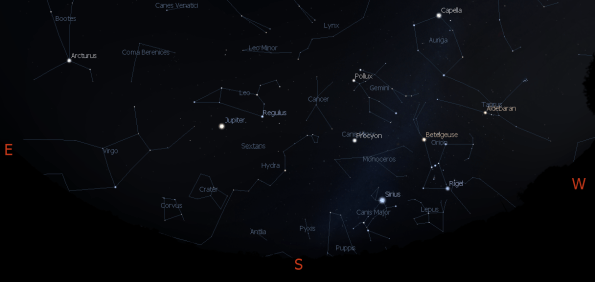
Jupiter and the evening constellations at 10 p.m. March 31, 2016. Created using Stellarium.
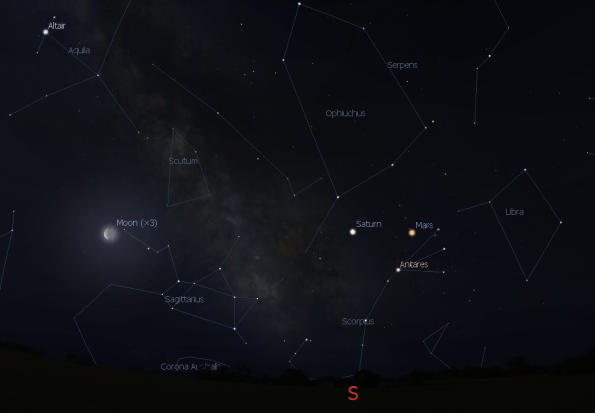
Mars, Saturn and the Moon with the summer constellations at 6 a.m., April 1, 2016. Created using Stellarium.
03/29/2016 – Ephemeris – The Little King Star, Regulus
Ephemeris for Tuesday, March 29th. The Sun will rise at 7:28. It’ll be up for 12 hours and 39 minutes, setting at 8:07. The Moon, 2 days before last quarter, will rise at 2:00 tomorrow morning.
Regulus is the brightest star in the constellation of Leo the lion at the bottom of the backward question mark that is the head and mane of Leo. It’s in the southeast at 9 p.m. above the much brighter Planet Jupiter. Alluding to the lion’s status in the animal kingdom, Regulus is the little king star. It is dead last in order of brightness of the 21 brightest first magnitude stars, 1/13th the brightness of Sirius the brightest star low in the southwest at the same time. To the Babylonians it was the king, the 15th of their constellations that marked the passage of the sun. Regulus is about 79 light years away, and 288 times the brightness of the sun. It is a rapidly spinning ellipsoid 3 times the sun’s diameter, rotating in just under 16 hours.
Times are for the Traverse City/Interlochen area of Michigan. They may be different for your location.
Addendum
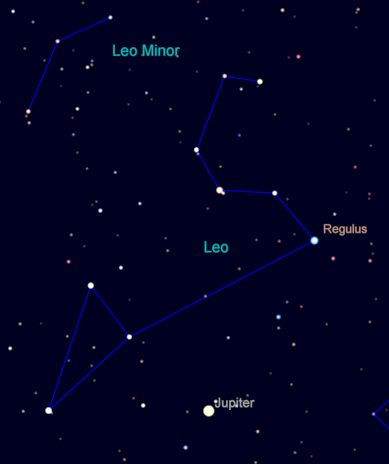
Regulus and Jupiter in the constellation of Leo at 10 p.m., March 29, 2016. Created using Cartes du Ciel (Sky Charts).
03/28/2016 – Ephemeris – The brightest spring star is now rising in the east
Ephemeris for Monday, March 28th. The Sun will rise at 7:30. It’ll be up for 12 hours and 35 minutes, setting at 8:06. The Moon, 3 days before last quarter, will rise at 1:07 tomorrow morning.
Rising in the eastern sky at 10 p.m. is the 4th brightest night-time star. It’s found off the curve of the handle of the Big Dipper above it in the northeast. It’s the tail end of a kite shaped constellation of Boötes the herdsman. Arcturus is an orange-colored giant star, 37 light years away. Its light was used open the 1933 Chicago Worlds Fair believing its light left the star in 1893 the year of the previous Chicago Worlds Fair. It turns out that Arcturus is 3 light years closer than what they thought. Arcturus is a rapidly moving star. It’s velocity is about 76 miles (122 km) per second. It’s at its nearest to the sun now. Arcturus is thought to be close to the sun’s mass, and much older. It may be a glimpse of what the sun will look like in 5 billion years.
Times are for the Traverse City/Interlochen area of Michigan. They may be different for your location.
Addendum
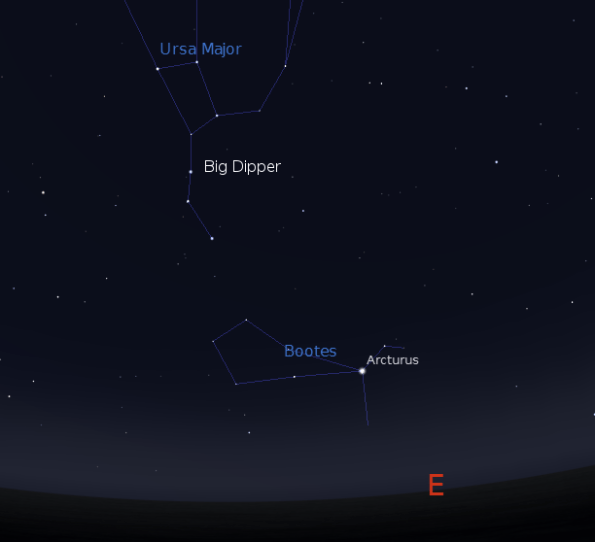
Arcturus off the handle of the Big Dipper rising. Created using Stellarium.
03/25/2016 – Ephemeris – Easter, the reason for our calendar
Ephemeris for Good Friday, Friday, March 25th. The Sun will rise at 7:35. It’ll be up for 12 hours and 26 minutes, setting at 8:02. The Moon, 2 days past full, will rise at 10:17 this evening.
The so-called movable feasts of the church calendar are based on the date Easter falls on. They span from Ash Wednesday to Pentecost. And Easter is determined by astronomical events. In 1582 the fact that the actual vernal equinox had fallen 10 days behind the Julian calendar then in use which was decreed by Julius Caesar in 45 BC. Pope Gregory XIII in the 1580’s resolved to fix the situation and commissioned some astronomers to work on the problem. The solution was to fix the 10 day problem by eliminating the days October 5th through 14th of the October 1582 calendar and modifying the leap year rule to keep February 29th in calendars whose years were evenly divisible by 4, except those century years not also divisible by 400. Thus the year 2000 was a leap year, but 1900 and 2100 was and will not be.
Times are for the Traverse City/Interlochen area of Michigan. They may be different for your location.
Addendum
The Gregorian Calendar in essence decoupled Easter from Passover by keeping the formula first Sunday after the first full moon after March 21st, as a marker for the vernal equinox, and keeping March 21st on or near the vernal equinox. Passover this year starts sunset on April 22nd, while Orthodox Easter will occur on May 1st. The reason is the relationship between the Jewish lunar calendar and the Julian Calendar I mentioned in yesterday’s post. The difference between the Julian and Gregorian Calendars is now 13 days.
The error in the Gregorian calendar is at most 1 day in 3,300 years, in relation to the seasonal year. But the Gregorian Calendar makes calculating the date of Easter more complicated. It introduces something called Epact to the list of chronological cycles in an almanac. The quantity called Epact is the age of the moon on January 1st, and still has a relationship with the Metonic Cycle and the Golden Number which I discussed yesterday. This year the value is 21.
As I’ve admitted before, the first paragraph of these posts are generated by a computer program. Part of that program is a list of holidays, and those designated as movable feasts use the date of Easter as a starting point. I use the 10 step method from Astronomical Algorithms by Jean Meeus. Easter for the Julian Calendar is a simpler 6 step method.

