06/26/2015 -Ephemeris – The latest sunset of the year
Ephemeris for Friday, June 26th. Today the Sun will be up for 15 hours and 33 minutes, setting at 9:32. The Moon, 2 days past first quarter, will set at 2:57 tomorrow morning and tomorrow the Sun will rise at 5:59.
This evening we will experience the latest sunset of the year. The sun has been setting within the same minute for a few days now. Now the Sun will begin to set earlier and earlier, at first imperceptibly, but soon with greater speed. By the middle of August the Sun will set 45 minutes earlier. Just in time to enjoy the summer Milky Way at a semi-decent hour. The shorter days, or actually daylight hours, and the diminishing altitude of the Sun at noon will cause a decrease in the heat we receive from the Sun. Still, right now we’re still warming up. However there is a tipping point around mid to late July, when we will not get enough heat to keep getting warmer and we’ll start to cool.
Times are for the Traverse City/Interlochen area of Michigan. They may be different for your location.
Addendum
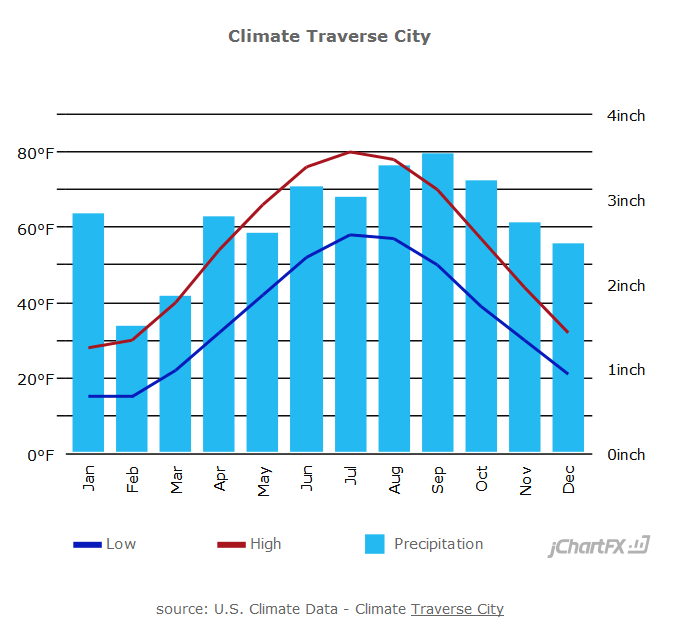
Traverse City Climate Chart. The hottest day is around July 15, and coldest day is around January 20. Credit: http://www.usclimatedata.com
www.usclimatedata.com has monthly and daily average data for many locations in the United States. They have code to embed this chart on your website. However it didn’t embed properly in the blog, so I took a screen shot.
06/25/2015 – Ephemeris – Lunar seas and highlands tell the story of the Moon’s history
Ephemeris for Thursday, June 25th. Today the Sun will be up for 15 hours and 34 minutes, setting at 9:32. The Moon, 1 day past first quarter, will set at 2:26 tomorrow morning and tomorrow the Sun will rise at 5:58.
Tuesday I talked about the brightness variation on the Moon, the bright and ancient highlands and the darker areas called seas, but a large asteroid impact areas that welled up magma from the moon’s interior erasing prior craters. The dark seas were created after most cratering had ended, or they’d be heavily cratered too. They seem to have occurred about 4 billion years ago, about 500 million years after the Moon formed. This appeared to be a period when the giant planets came closer to the Sun than they are now, before retreating again. This period is called the late heavy bombardment. Not all astronomers give it credence, but it bears out what we see in planetary systems around other stars.
Times are for the Traverse City/Interlochen area of Michigan. They may be different for your location.
Addendum
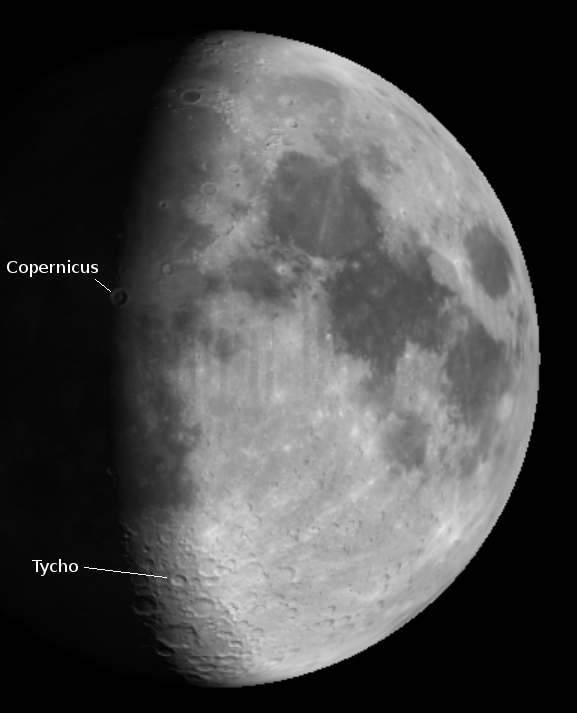
The Moon tonight with pointers to seas near the crater Copernicus and the highlands near the crater Tycho. 10:30 p.m. June 25, 2015. Created using Virtual Moon Atlas.
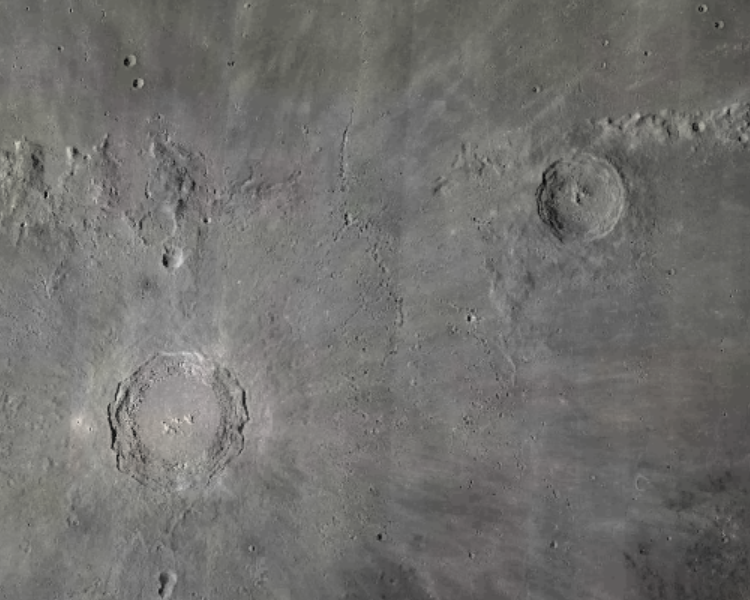
The Lunar seas near the crater Copernicus showing the smooth surface with relatively few craters. Credit: Virtual Moon Atlas with the texture from NASA’s Lunar Reconnaissance Orbiter. The lunar phase was omitted.
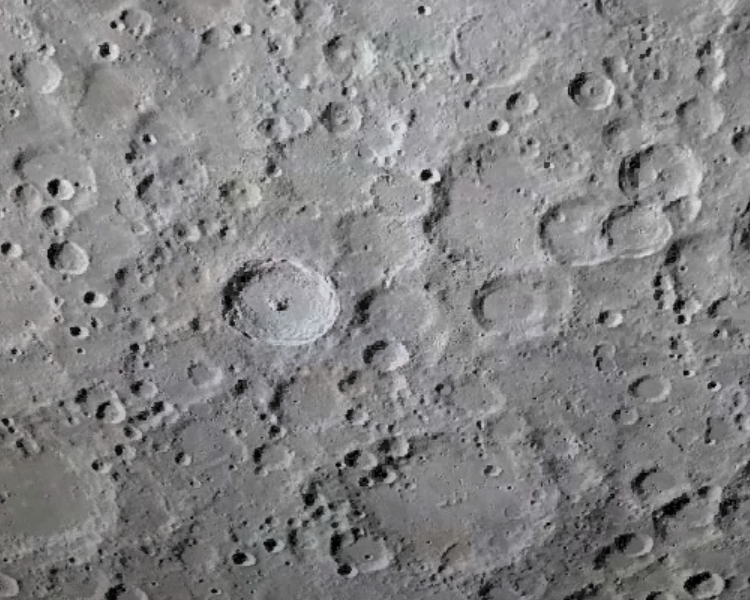
The Lunar highlands near the crater Tycho showing a surface saturated with craters. Credit: Virtual Moon Atlas with the texture from NASA’s Lunar Reconnaissance Orbiter. The lunar phase was omitted. Both images are shown to the same scale.
06/24/2015 – Ephemeris – Jupiter and Venus inch closer while Saturn keeps its distance
Ephemeris for Wednesday, June 24th. Today the Sun will be up for 15 hours and 34 minutes, setting at 9:32. The Moon, at first quarter today, will set at 1:58 tomorrow morning and tomorrow the Sun will rise at 5:58.
Lets take a look at the bright planets for this week. Our brilliant evening star Venus is in the west by 9:45 p.m. It will set around midnight. Venus’ will slide down to the Sun faster and faster in the coming weeks. It will take a bit less than 2 months. Jupiter will appear western sky to the left of and slightly above Venus at about 10 p.m. It will set at 12:09 a.m. It seems to approach Venus, and now appears about 3 and a half degrees away. That’s about three finger widths held at arm’s length. They will cross paths in 6 days, on the 30th. Saturn is in the southeast in evening twilight. It will pass due south at 11:22 p.m. and will set at 4:10 a.m. Even small telescopes can see Saturn’s rings.
Times are for the Traverse City/Interlochen area of Michigan. They may be different for your location.
Addendum
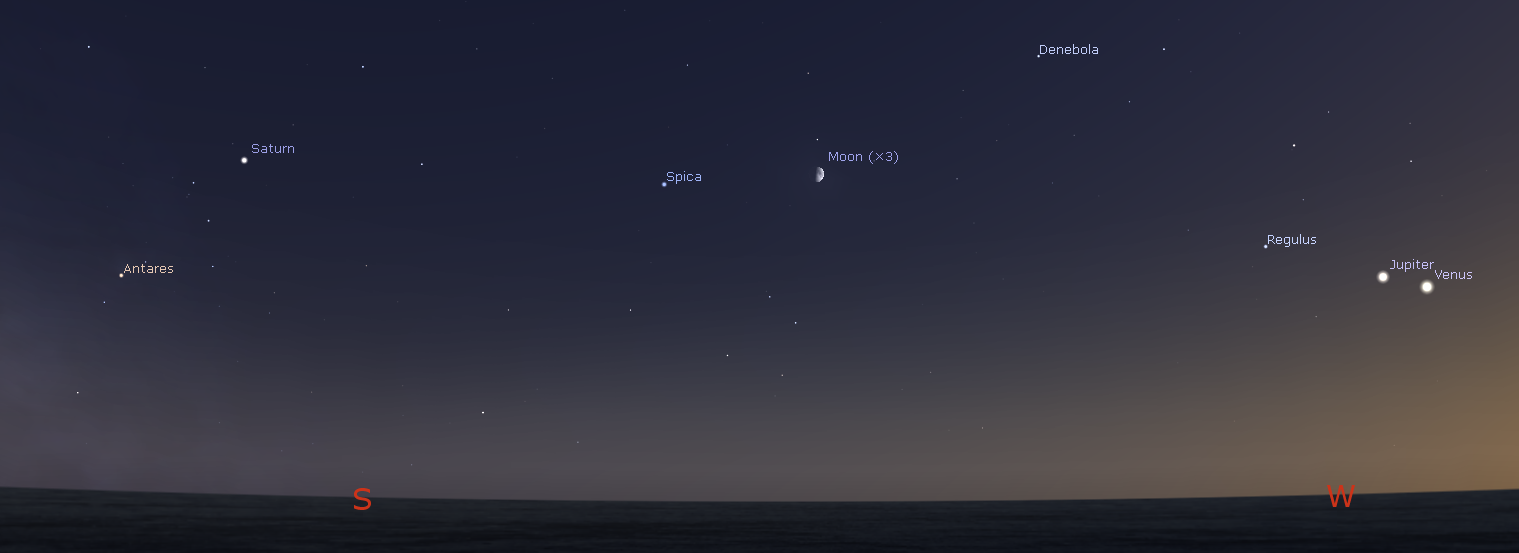
Jupiter and Venus converge in the west while the Moon and Saturn look on. 10:30 p.m., June 24, 2015. Created using Stellarium. Click to enlarge.
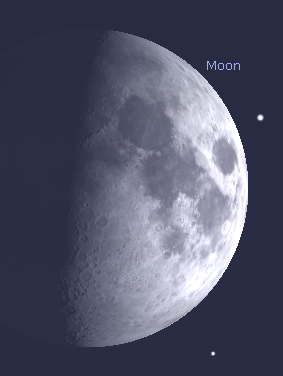
Closeup of the Moon at 10:30 p.m. June 24, 2015. Created using Stellarium.
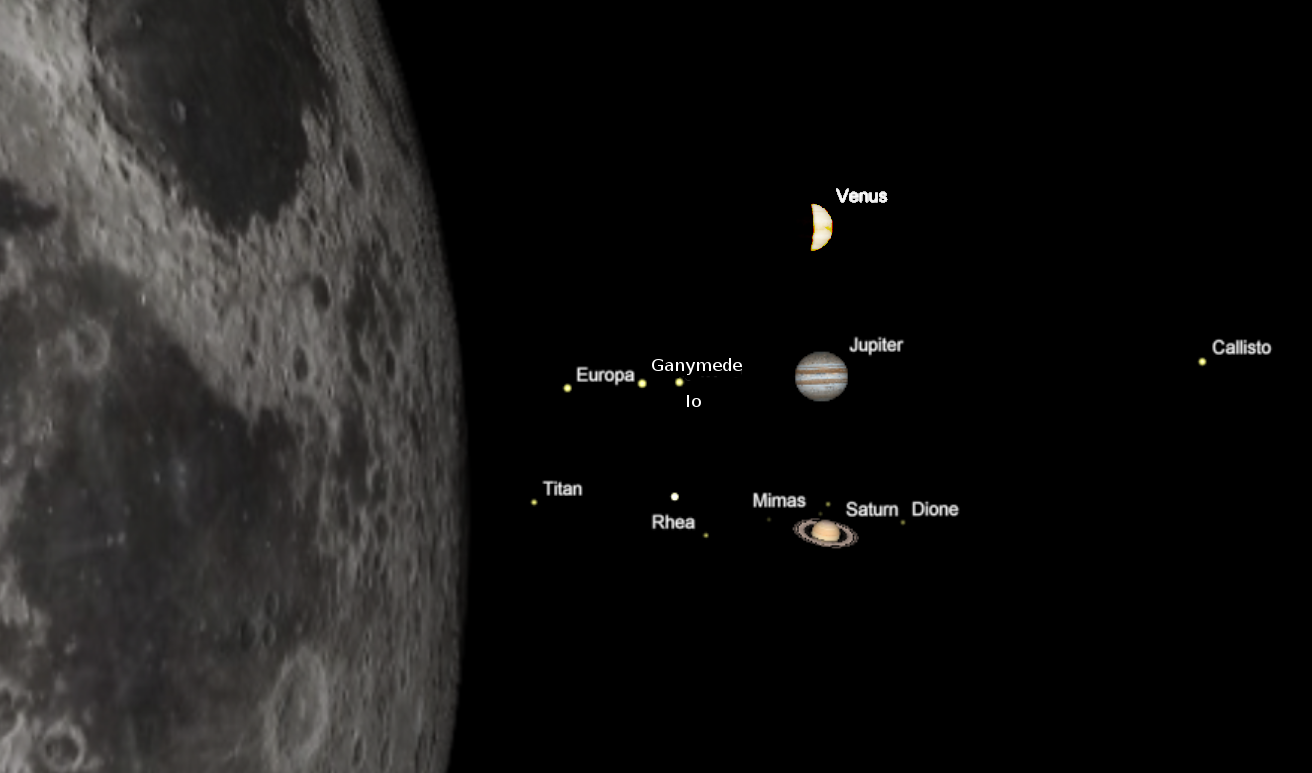
The evening planets and the Moon using the same magnification at 10:30 p.m., June 24, 2015. Created using Cartes du Ciel (Sky Charts). Click on image to enlarge.
Note that over the last few Wednesdays that I’ve portrayed the planets at the same scale that Venus has been getting larger with respect to Jupiter as it approaches the Earth and Jupiter moves away.
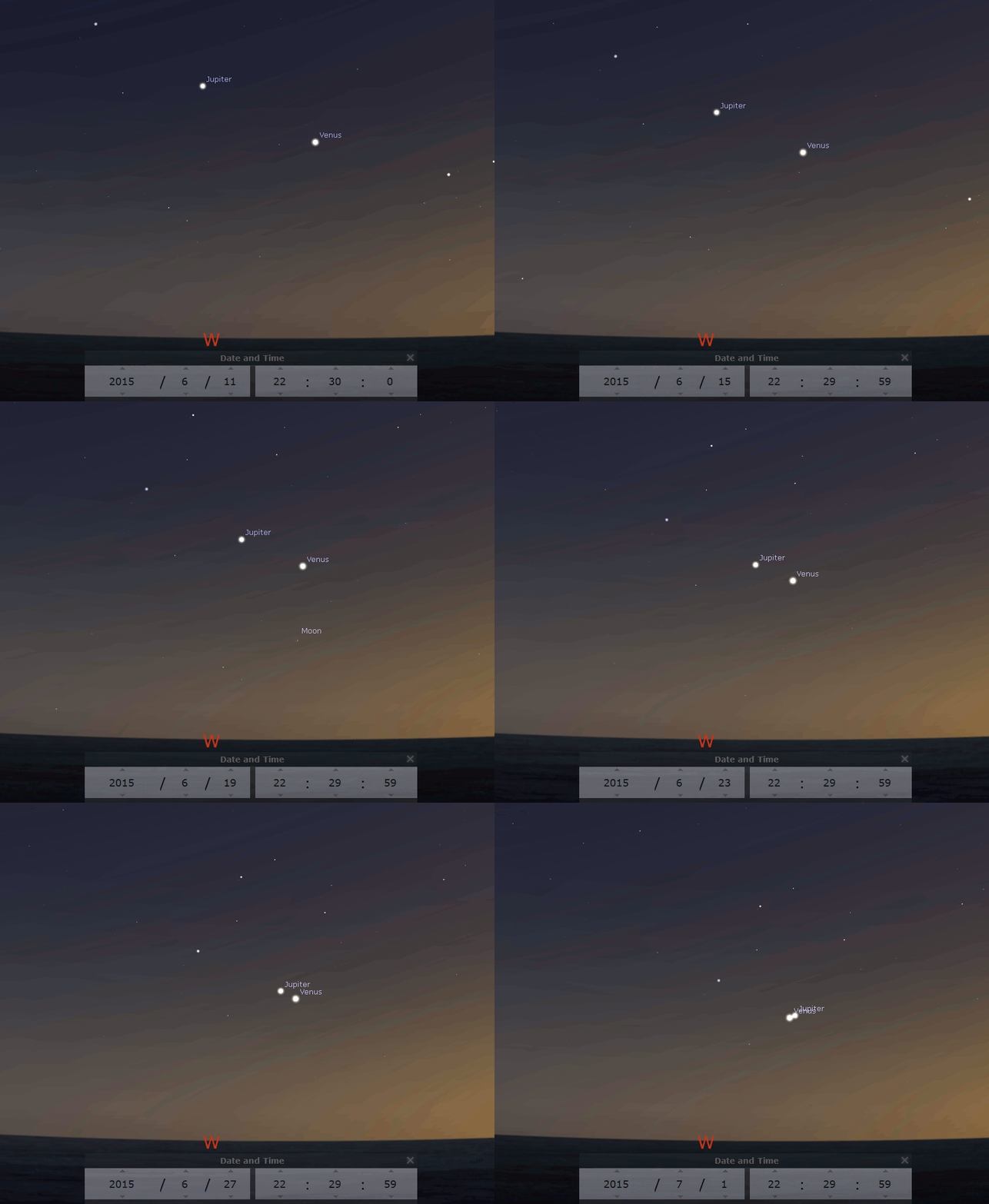
Jupiter-Venus approach animation June 11 to July 1, 2015 at 10:30 p.m. Created using Stellarium and GIMP. Click on image to enlarge.
06/23/2015 – Ephemeris – What can you tell about the appearance of the Moon to the naked eye?
Ephemeris for Tuesday, June 23rd. Today the Sun will be up for 15 hours and 34 minutes, setting at 9:32. The Moon, 1 day before first quarter, will set at 1:31 tomorrow morning and tomorrow the Sun will rise at 5:57.
The Moon is at nearly half phase or first quarter. The unaided eye can see that the Moon has darker and lighter areas. The Greeks, who thought the objects in the heavens were perfect thought that the Moon was a silvery sphere. They never quite figured out why the moon had this mottled appearance. So why are the bright parts different from the darker parts? The bright parts are called the highlands and are the oldest part of the Moon’s surface. It’s saturated with craters from impacts since the Moon formed. The dark areas are roughly circular, and are really vast craters that penetrated through the Moon’s crust to bring up molten lava that repaved the surface of the Moon some 500 million years after it formed.
Times are for the Traverse City/Interlochen area of Michigan. They may be different for your location.
Addendum
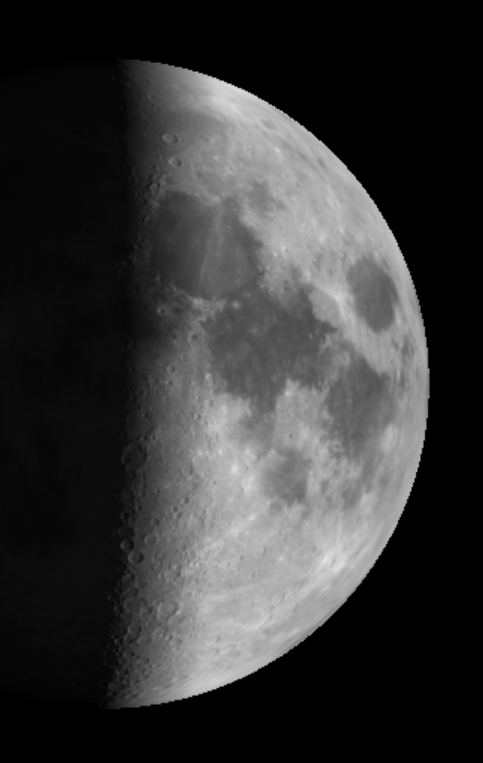
The Moon tonight (June 23, 2015). Look at the difference in the surface albedo (reflectance) between the light and dark areas and wonder about their origins. Created using Virtual Moon Atlas.
There’s a severe geomagnetic storm in progress at 7 p.m. EDT (23:00 UT) June 22, 2015
There’s a good chance for auroras (northern/southern lights) tonight at moderate latitudes. In Michigan: we’re under clouds now. Skies may clear by midnight for the west side of the lower peninsula of Michigan according to Anttilla Danko’s Clear Sky Charts, such as this for the Lanphier Observatory in Glen Arbor. Also check spaceweather.com
06/22/2015 – Ephemeris – The summer full moon and the winter Sun trade places
Ephemeris for Monday, June 22nd. Today the Sun will be up for 15 hours and 34 minutes, setting at 9:32. The Moon, 2 days before first quarter, will set at 1:04 tomorrow morning. Tomorrow the Sun will rise at 5:57.
Summer’s here, and it’s a few days before the latest sunset and latest end of twilight. It might be instructive to check out the height of the moon over the next two weeks or so. The moon is heading south in front of the Sun. The Sun besides its apparent westward motion during the day caused by the Earth’s rotation also moves about twice its diameter each day eastward against the stars caused by the earth’s motion in its orbit of the Sun. Around July 1st, the moon will be about where the Sun will be next winter solstice, 4 days before Christmas. Actually it will be about 8 moon widths above where the Sun will be because its orbit is tilted a bit to the Earth’s. But it will serve as an illustration of the seasonal difference.
Times are for the Traverse City/Interlochen area of Michigan. They may be different for your location.
Addendum
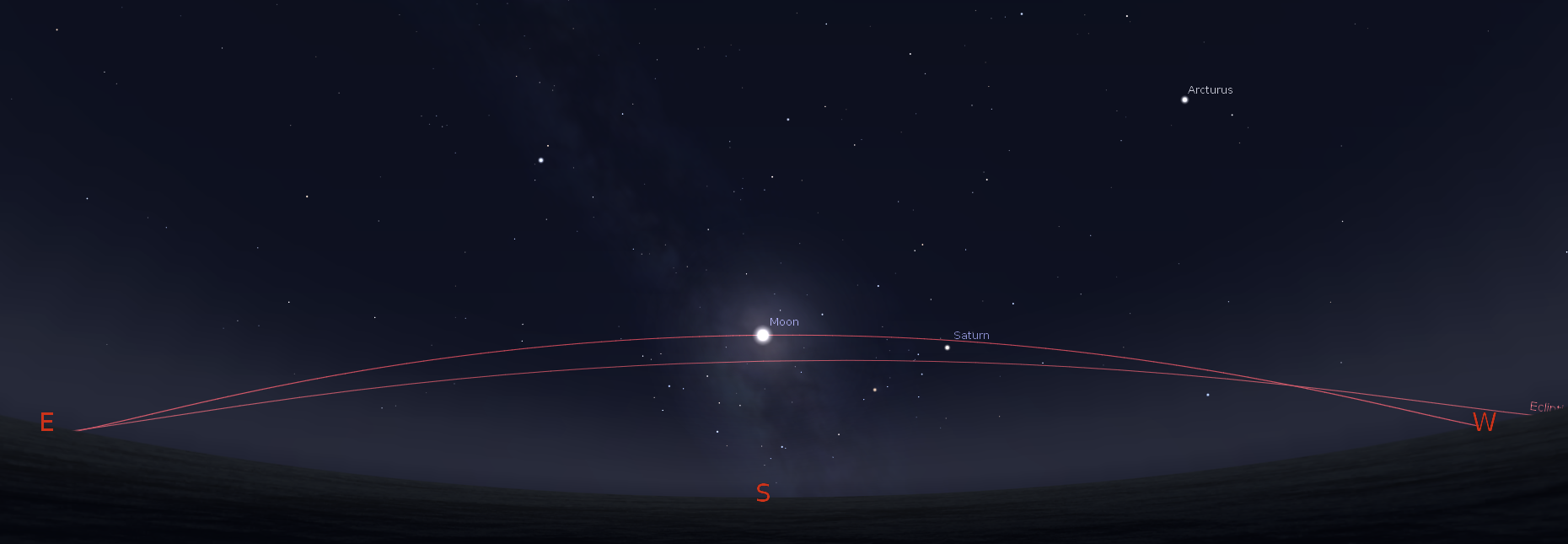
The full moon nearest the summer solstice. The full moon appears near where the sun would appear low in the south at the winter solstice. The bottom red line is the ecliptic, the path of the Sun. Created using Stellarium.
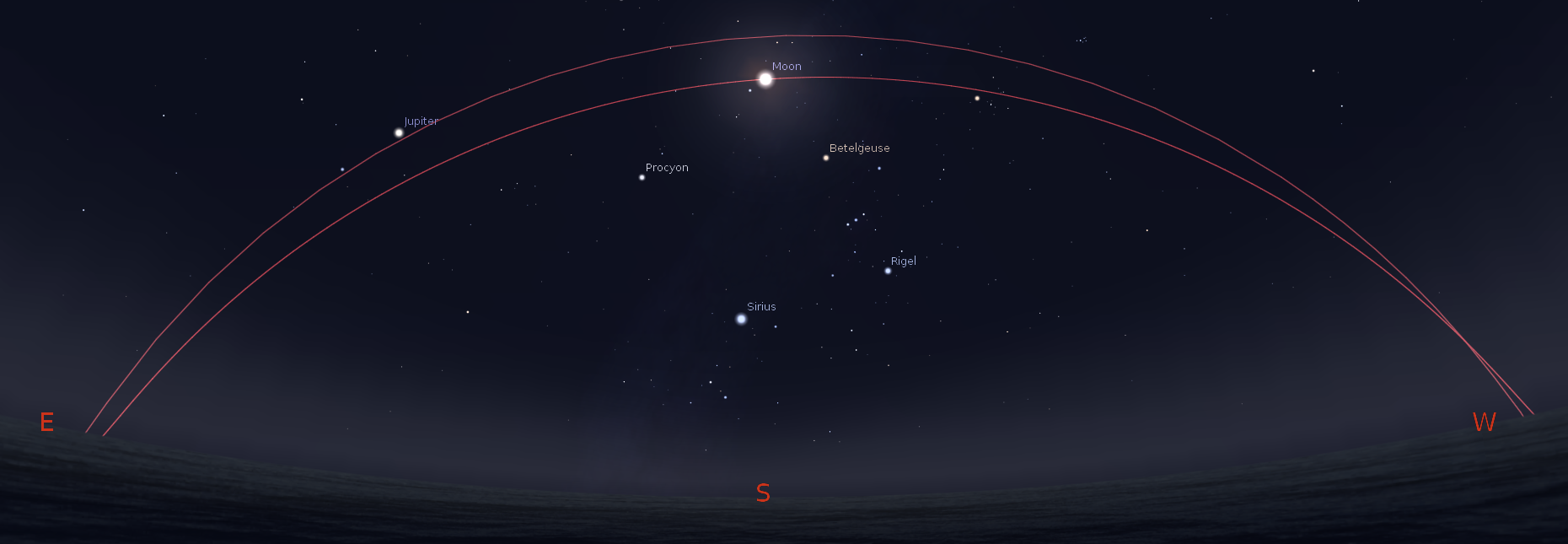
The full moon nearest the winter solstice. The full moon appears near where the sun would appear high in the south at the summer solstice. The top red line is the ecliptic, the path of the Sun. Created using Stellarium.
The Moon’s orbit has a slight tilt of a bit more than 5 degrees from the ecliptic, or plane of the Earth’s orbit of the sun. The crossing point is called a node. In the bottom image the node near the western horizon is called the descending node due to the fact that the Moon is heading south of the ecliptic. When the Sun and Moon are near the same node the Moon will be new and we have a chance for a solar eclipse. When at opposite nodes, a lunar eclipse. The nodes slowly slide westward slowly one revolution in about 18.6 years, which causes eclipse seasons, about 6 months apart to occur a bit earlier each year.
06/19/2015 – Ephemeris – Two events this weekend: one local, one global
Ephemeris for Friday, June 19th. Today the Sun will be up for 15 hours and 34 minutes, setting at 9:31. The Moon, 3 days past new, will set at 11:34 this evening. Tomorrow the Sun will rise at 5:56.
There’s a couple of astronomical events coming up this weekend. On Saturday there will be another Sun ‘n Star Party at the Sleeping Bear Dunes National Lakeshore if weather cooperates. This time the telescopes will be set up at the Pierce Stocking Scenic Drive, Stop 3, the Dunes Overlook from 4 to 6 p.m. and from 9 to 11 p.m. The best place to park is Picnic Mountain, just before the Dunes Overlook. On Sunday a truly global event, the Summer solstice will occur at 12:38 p.m. (16:38 UT), when the Sun will reach its farthest north signaling the start of summer in the northern hemisphere. For folks south of the equator it will be the winter solstice signaling the start of winter for them.
Times are for the Traverse City/Interlochen area of Michigan. They may be different for your location.
Addendum
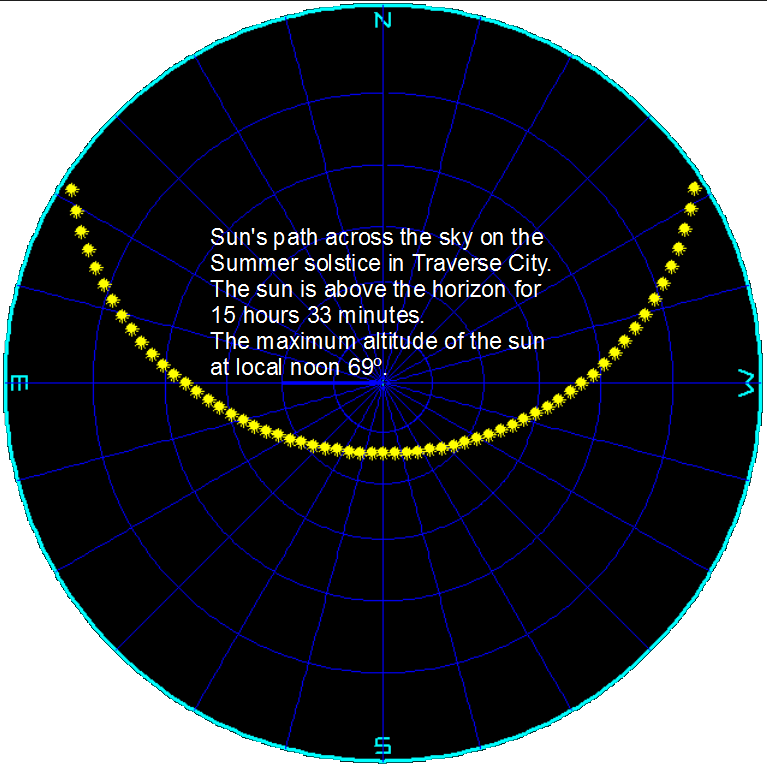
The Sun’s apparent path in the sky on the summer solstice. The cyan circle is the horizon and the Sun is plotted every 15 minutes throughout the day. Created by Bob Moler using LookingUp. This is a slide from his school program on the cause of the seasons.
06/18/2015 – Ephemeris – 26 days to Pluto!
Ephemeris for Thursday, June 18th. Today the Sun will be up for 15 hours and 34 minutes, setting at 9:31. The Moon, 2 days past new, will set at 10:57 this evening. Tomorrow the Sun will rise at 5:56.
I hope everyone’s been following the progress of the New Horizons spacecraft as it nears the Pluto system. It will reach and pass through the Pluto system on July 14th, only 26 days from now after a journey of 9 years. Now, Pluto is more than a dot in the probe’s cameras, which are used to look for possible hazardous rings of debris, more moons and for navigational purposes. New Horizons is aimed for a window less than a hundred miles on a side, and a few minutes in time. All its moves to study Pluto and its moons have been pre-programmed in and actually tested two years ago to make sure everything works. We will not hear from the spacecraft on encounter day, it will be too busy.
Times are for the Traverse City/Interlochen area of Michigan. They may be different for your location.
Addendum
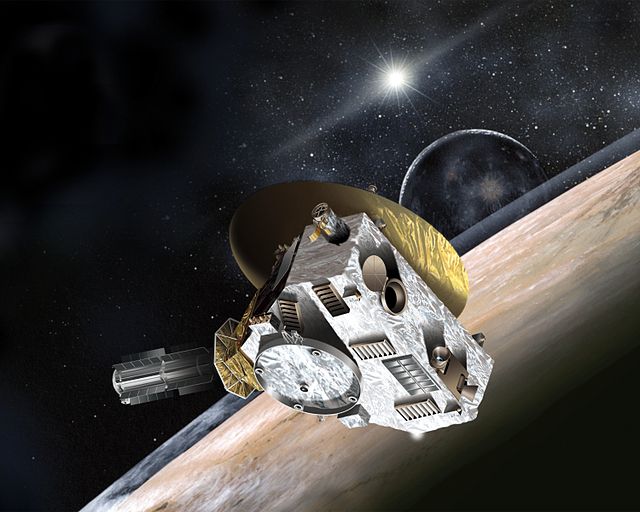
Artist conception of the New Horizons spacecraft at Pluto. Credit: NASA/Johns Hopkins University Applied Physics Laboratory/Southwest Research Institute
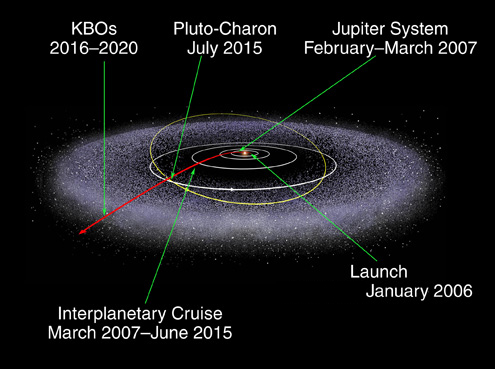
New Horizon’s trajectory through the solar system. Credit: NASA/APL.
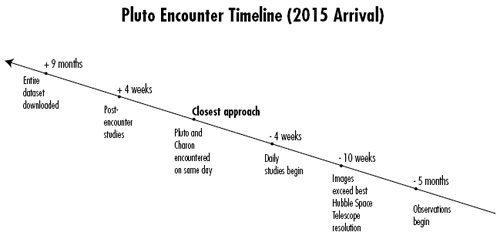
New Horizons Encounter Timeline. Credit: NASA/JHAPL.
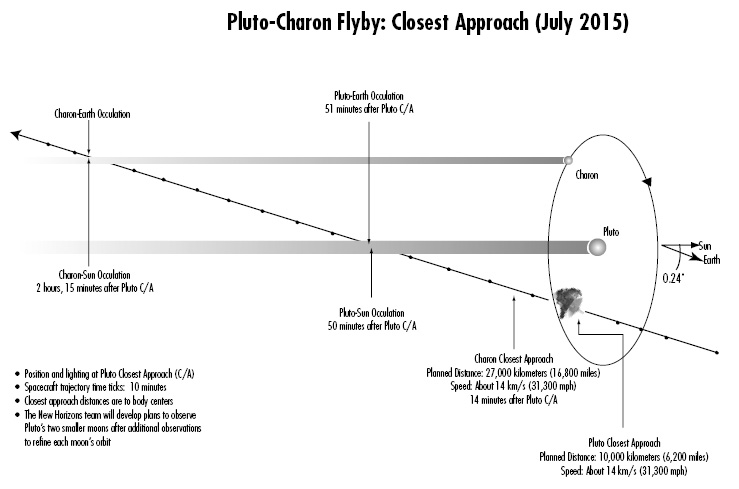
New Horizons at closest approach to Pluto. Credit: NASA/JHAPL.
06/17/2015 – Ephemeris – Jupiter and Venus approach each other while Saturn looks on
Ephemeris for Wednesday, June 17th. Today the Sun will be up for 15 hours and 34 minutes, setting at 9:30. The Moon, 1 day past new, will set at 10:14 this evening. Tomorrow the Sun will rise at 5:56.
Lets take a look at the bright planets for this week. Our brilliant evening star Venus is in the west by 9:45 p.m. It will set at 12:19 a.m. Venus’ will slide down to the Sun faster and faster in the coming weeks. It will take a bit less than 2 months. Jupiter will appear western sky to the left of and slightly above Venus at about 10 p.m. It will set at 12:34 a.m. It seems to approach Venus, and now appears about 8 degrees away. That’s somewhat less than the width of your fist held at arm’s length. They will cross paths in 13 days, on the 30th. Saturn is in the southeast in evening twilight. It will pass due south at 11:51 p.m. and will set at 4:39 a.m. Check out Saturn’s rings in any small telescope.
Times are for the Traverse City/Interlochen area of Michigan. They may be different for your location.
Addendum
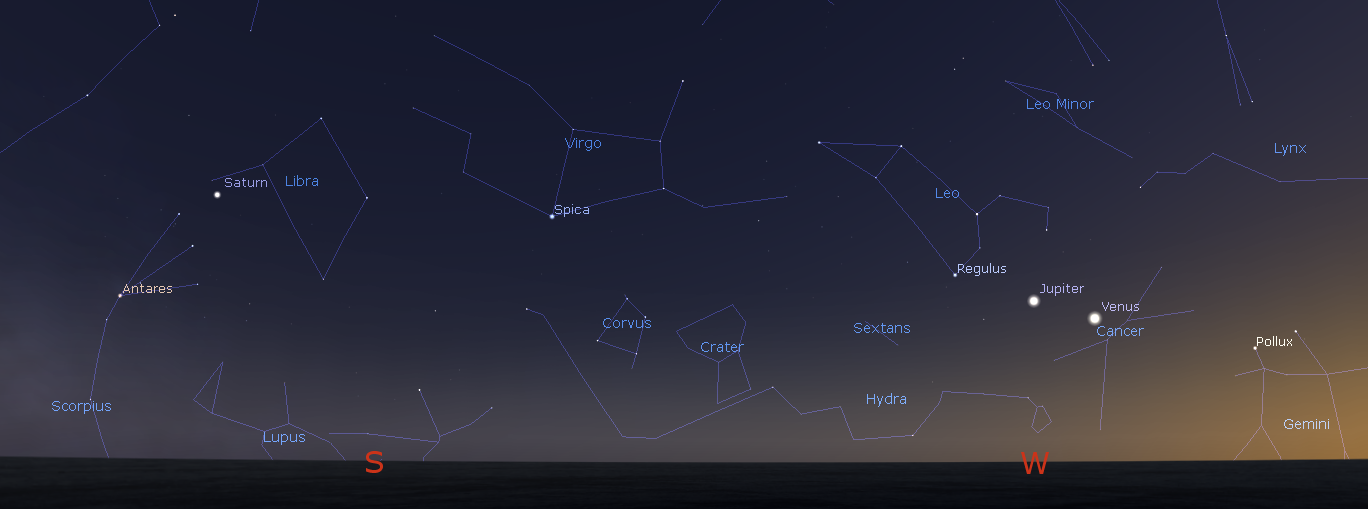
Venus, Jupiter and Saturn with the late spring southern constellations at 10:30 p.m., June 17, 2015. Created using Stellarium. Click on image to enlarge.
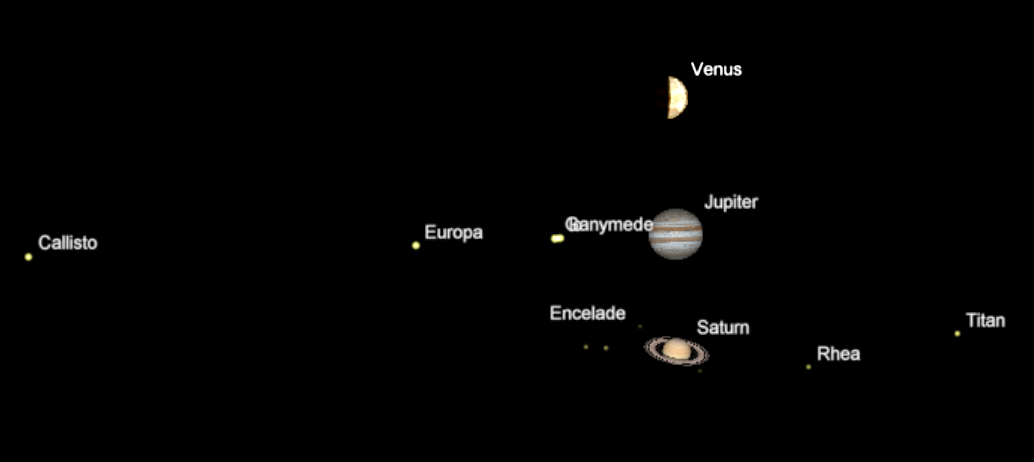
The evening planets using the same magnification at 10:30 p.m., June 17, 2015. Created using Cartes du Ciel (Sky Charts). Click on image to enlarge. Note that Jupiter’s moons Ganymede and Io are so close their labels overlap.
06/16/2015 – Ephemeris – Philae phones home
Ephemeris for Tuesday, June 16th. Today the Sun will be up for 15 hours and 33 minutes, setting at 9:30. The Moon is new today, and won’t be visible.
Tomorrow the Sun will rise at 5:56. | As Comet 67P/Churyumov-Gerasimenko (Comet 67P for short, or the Rubber Duckie Comet) nears the orbit of Mars a couple of months from perihelion, its closest to the Sun, the Rosetta spacecraft, which has been orbiting it received welcome news from its lander Philae which fell silent 5 months ago. The lander woke up and has enough power to take measurements and transmit data to the Rosetta spacecraft. This is something the folks at the European Space Agency had hoped for. The comet has moved in its orbit around the Sun, so the Sun’s light now can fall on Philae’s solar panels long enough during the comet’s daily rotation to recharge its batteries. They are hoping that Philae can resume its surface mission. This is just amazing!
Times are for the Traverse City/Interlochen area of Michigan. They may be different for your location.
Addendum
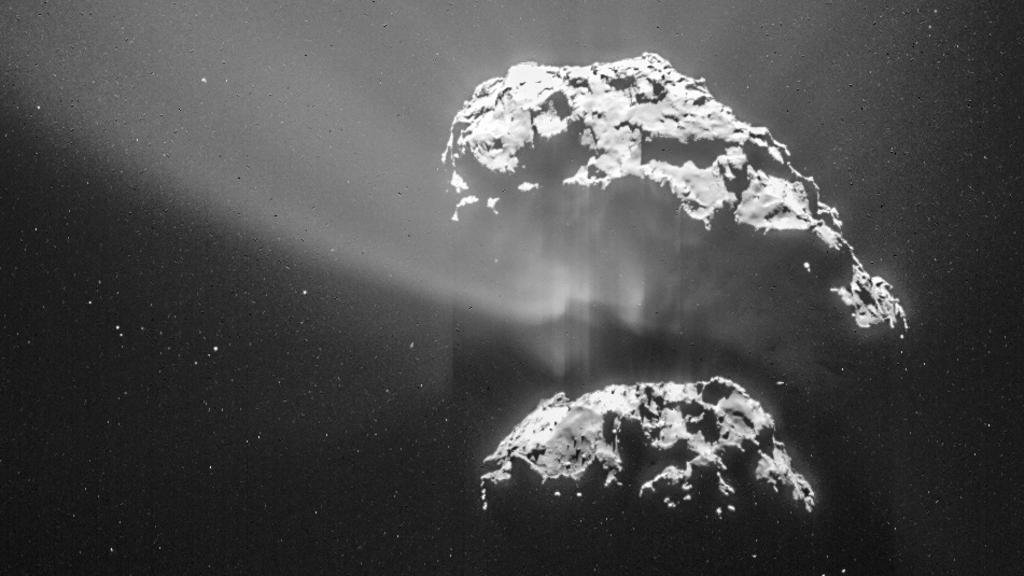
Comet 67P and jets of dust, carried by sublimating ices. Credit: ESA/Rosetta
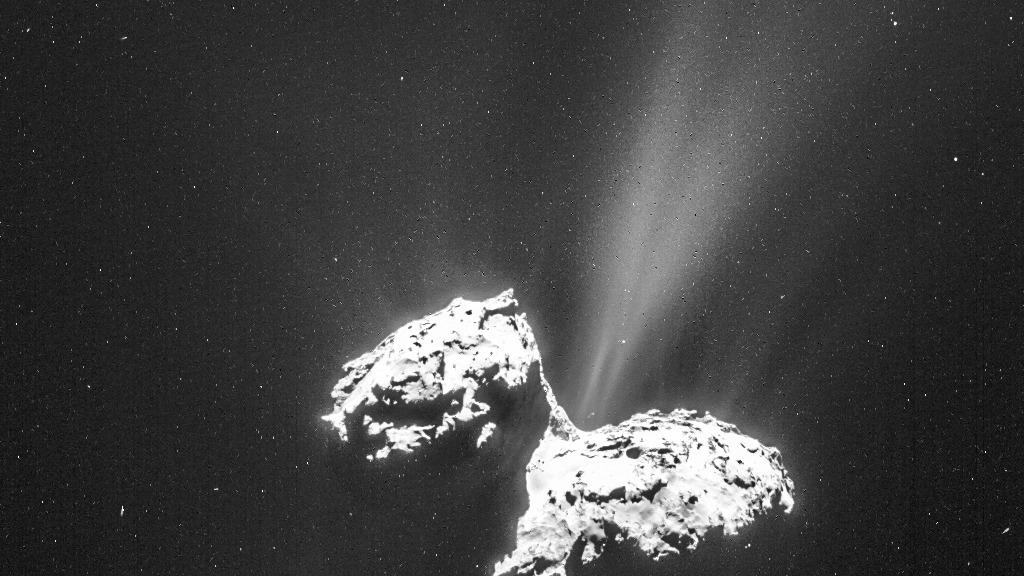
Comet 67P and jets of dust, carried by sublimating ices from another angle. Credit: ESA/Rosetta
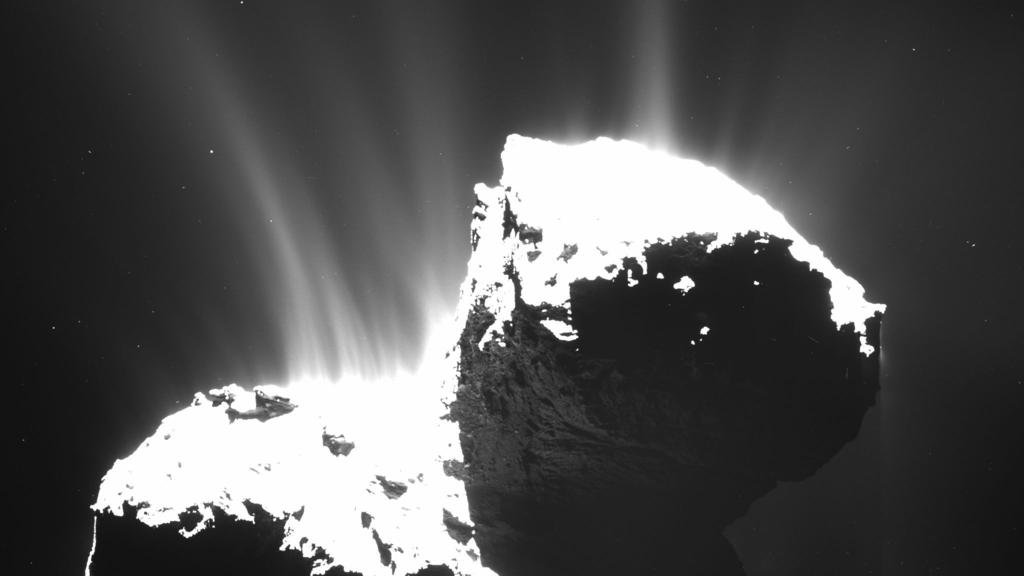
Comet 67P and jets of dust, carried by sublimating ices from yet another angle. Credit: ESA/Rosetta
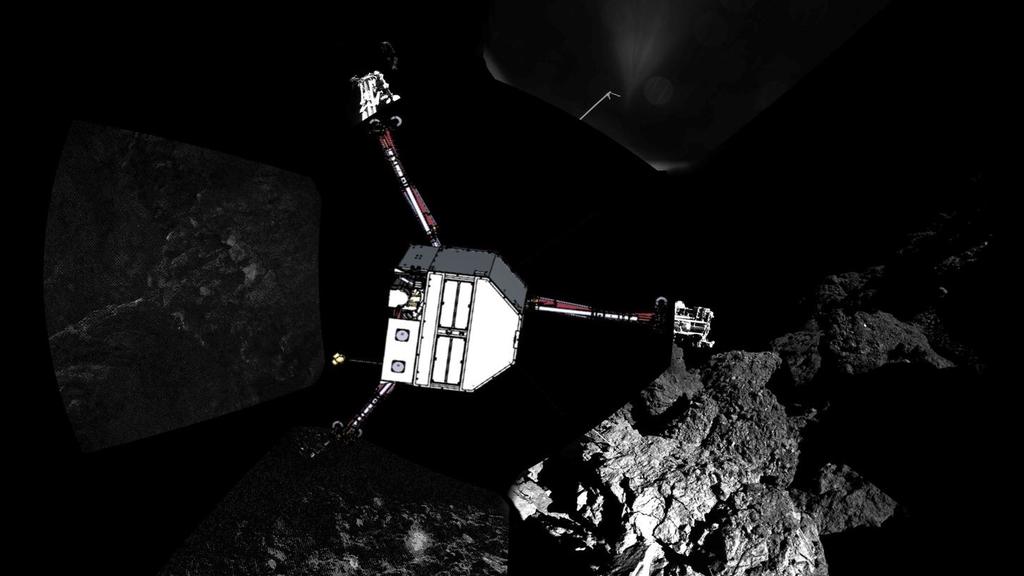
An image of the Philae lander superimposed on its panorama photographs where it was wedged between ice and a hard place in the shadows last November. Credit: ESA/Rosetta.

