Ephemeris: 04/22/2025 – Earth Day
This is Ephemeris for Earth Day, Tuesday, April 22nd. Today the Sun will be up for 13 hours and 50 minutes, setting at 8:37, and it will rise tomorrow at 6:44. The Moon, 2 days past last quarter, will rise at 4:48 tomorrow morning.
Earth Day was established in 1970, 2 years after William Anders in Apollo 8 took a picture of the Earth rising over the desolate moon, the Earth, a blue white oasis, in a hostile universe. I say support your local planet, there is no Planet B in case you messed this one up. Elon Musk wants to make the human race multi-planetary, which is a fine idea over time. It may take over a century to make any kind of Mars Base self-sustaining, if ever. I can’t see how we can terraform Mars, that is make Mars earth-like, because of lack of material. Mars was more earth-like in its first billion years, but it has no magnetic field. Any large atmosphere it had when it had oceans has long been stripped away by the solar wind.
The astronomical event times given are for the Traverse City/Interlochen area of Michigan (EDT, UT – 4 hours). Times will be different for other locations.
Addendum
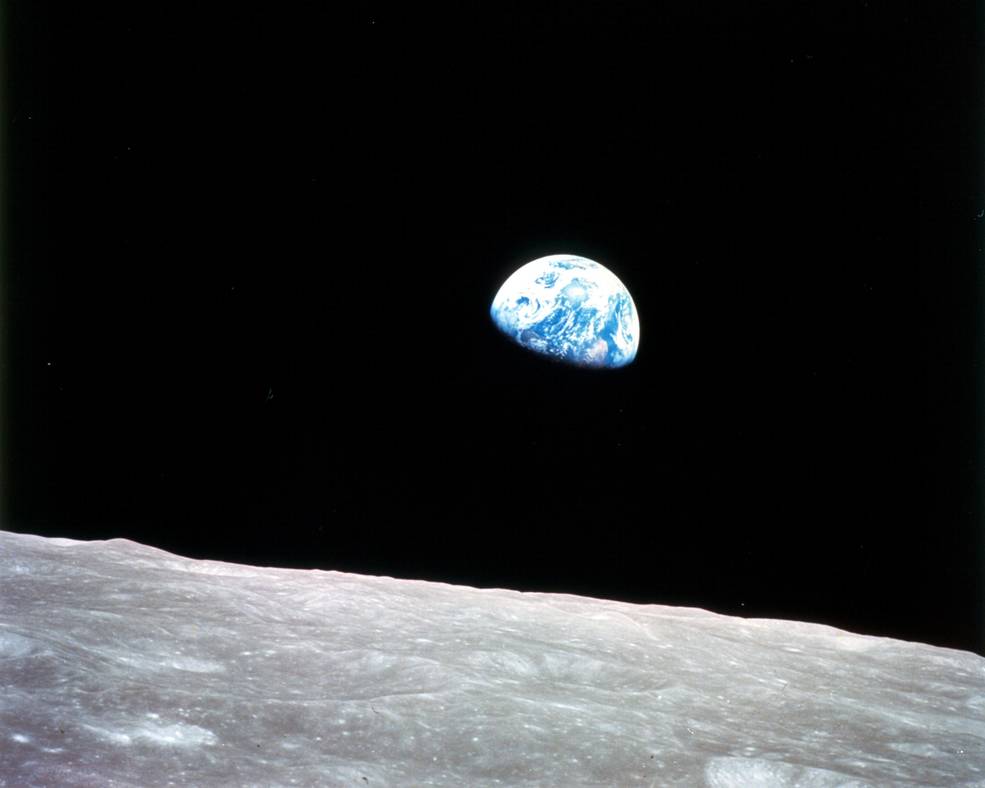

Look again at that dot. That’s here. That’s home. That’s us. On it everyone you love, everyone you know, everyone you ever heard of, every human being who ever was, lived out their lives. The aggregate of our joy and suffering, thousands of confident religions, ideologies, and economic doctrines, every hunter and forager, every hero and coward, every creator and destroyer of civilization, every king and peasant, every young couple in love, every mother and father, hopeful child, inventor and explorer, every teacher of morals, every corrupt politician, every “superstar,” every “supreme leader,” every saint and sinner in the history of our species lived there-on a mote of dust suspended in a sunbeam.
― Carl Sagan, Pale Blue Dot: A Vision of the Human Future in Space
The Earth is a very small stage in a vast cosmic arena. Think of the endless cruelties visited by the inhabitants of one corner of this pixel on the scarcely distinguishable inhabitants of some other corner, how frequent their misunderstandings, how eager they are to kill one another, how fervent their hatreds. Think of the rivers of blood spilled by all those generals and emperors so that, in glory and triumph, they could become the momentary masters of a fraction of a dot.
Our posturings, our imagined self-importance, the delusion that we have some privileged position in the Universe, are challenged by this point of pale light. Our planet is a lonely speck in the great enveloping cosmic dark. In our obscurity, in all this vastness, there is no hint that help will come from elsewhere to save us from ourselves.
The Earth is the only world known so far to harbor life. There is nowhere else, at least in the near future, to which our species could migrate. Visit, yes. Settle, not yet. Like it or not, for the moment the Earth is where we make our stand.
It has been said that astronomy is a humbling and character-building experience. There is perhaps no better demonstration of the folly of human conceits than this distant image of our tiny world. To me, it underscores our responsibility to deal more kindly with one another, and to preserve and cherish the pale blue dot, the only home we’ve ever known.
Ephemeris: 04/21/2025 – Follow the spike to Spica
This is Ephemeris for Monday, April 21st. Today the Sun will be up for 13 hours and 47 minutes, setting at 8:35, and it will rise tomorrow at 6:46. The Moon, 1 day past last quarter, will rise at 4:25 tomorrow morning.
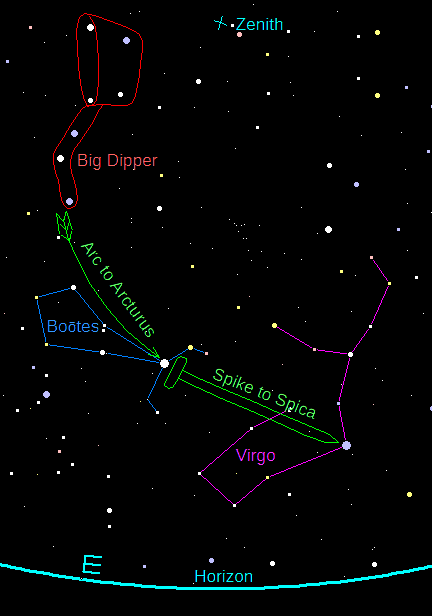
In the south-southeast at 10:30 p.m. is the bright star Spica, which can be found from all the way back overhead to the Big Dipper. Follow the arc of the handle of the Big Dipper to the bright star Arcturus below it in the east-southeast. Then straighten the curve of the arc to a straight spike which points to Spica, the brightest star in Virgo the virgin. Arcturus is much brighter than Spica and has an orange tint to Spica’s bluish hue. In fact, Spica is the bluest of the 21 first magnitude stars. That means that it has a really hot surface temperature. Actually, Spica is really two blue-white stars orbiting each other in 4 days. Spica is 250 light years away. It also was an important star to the ancient Greeks. One temple was built and aligned to its setting point. The astronomical event times given are for the Traverse City/Interlochen area of Michigan (EDT, UT – 4 hours). Times will be different for other locations.
The astronomical event times given are for the Traverse City/Interlochen area of Michigan (EDT, UT – 4 hours). Times will be different for other locations.
Addendum

Ephemeris: 04/18/2025 – How the date of Easter is calculated
This is Ephemeris for Good Friday, Friday, April 18th. Today the Sun will be up for 13 hours and 39 minutes, setting at 8:32, and it will rise tomorrow at 6:51. The Moon, 2 days before last quarter, will rise at 2:40 tomorrow morning.
Easter will be celebrated by all Christian churches this Sunday. Easter is a movable feast in that it falls on a different date each year following the first full moon of spring. It’s an attempt to follow the Jewish Passover, which starts on the 15th of the month of Nisan. The Jewish calendar being a lunar calendar, the 15th is generally the night of the full moon. And since the Last Supper was a Seder, according to at least one Gospel, the Christian church wanted to link Easter with Passover as closely as possible using the Roman solar based (Julian) calendar. The months didn’t follow the cycle of the Moon anymore and where the year was 365.25 days long. Passover started at sunset last Sunday. The western churches adopted the Gregorian calendar to keep in sync with the seasons. The Orthodox churches didn’t, but Easter is so late that they match this year. They kept the old Julian Calendar and other considerations to calculate the date of Easter.
The astronomical event times given are for the Traverse City/Interlochen area of Michigan (EDT, UT – 4 hours). Times will be different for other locations.
Addendum

Ephemeris: 04/17/2025 – Finding the celestial crow
This is Ephemeris for Thursday, April 17th. Today the Sun will be up for 13 hours and 36 minutes, setting at 8:30, and it will rise tomorrow at 6:52. The Moon, 3 days before last quarter, will rise at 1:48 tomorrow morning.
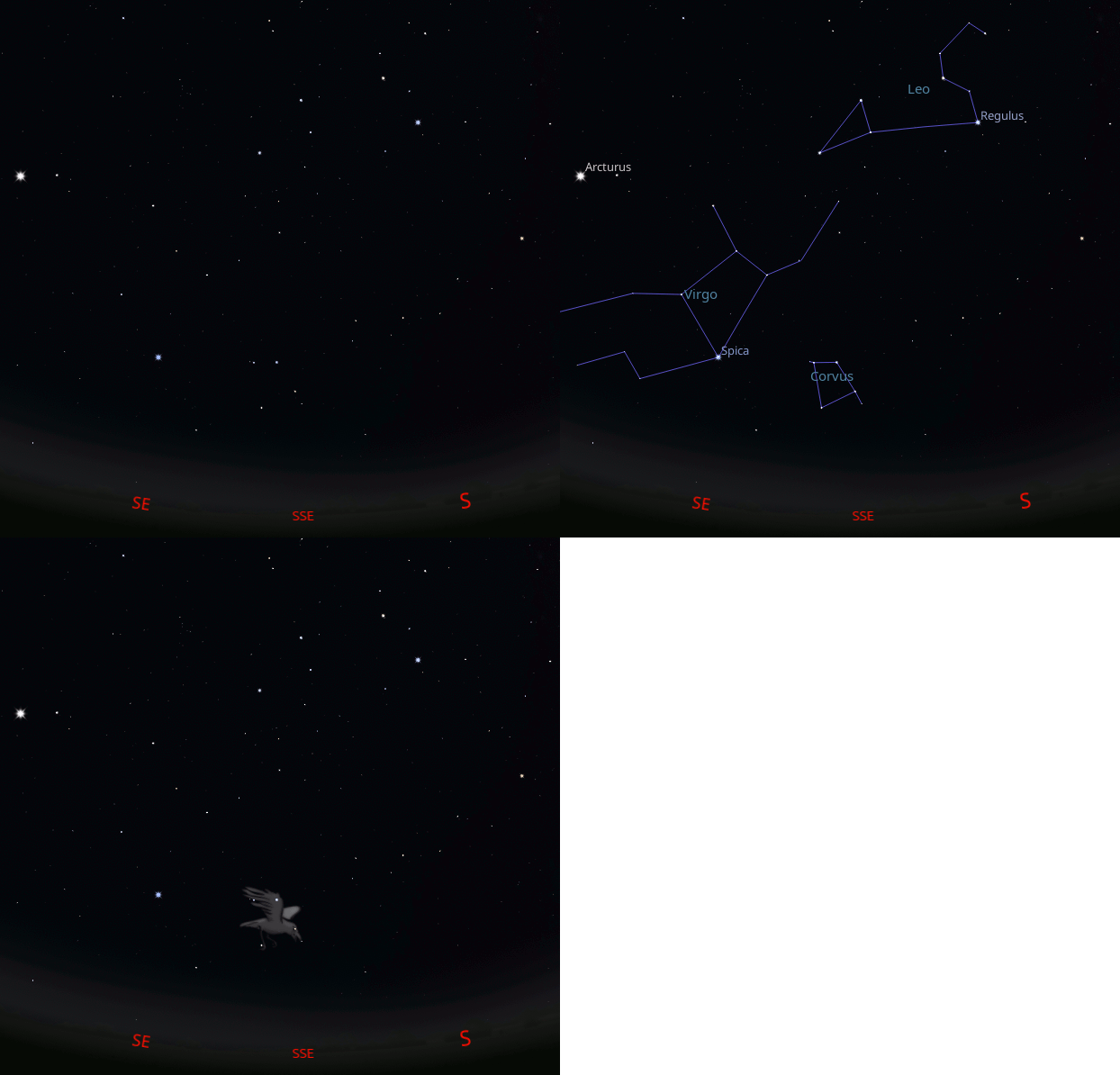
The small constellation of Corvus the crow is located low in the south-southeast at 10:30 this evening. It’s made of 6 dim stars, but the pattern is a distinctive but distorted box with two stars at the upper left marking that corner, and another two marking the lower right corner. I usually don’t notice the extra star at these corners. To me the box stands out enough. It’s pretty much alone below Virgo and its bright star Spica, left an above it. I don’t see a crow here, but the box is distinctive in that no two sides are parallel. In the US we call the shape a trapezium. The British call it a trapezoid. Anyway it is a very interesting shape, at least to me.
The astronomical event times given are for the Traverse City/Interlochen area of Michigan (EDT, UT – 4 hours). Times will be different for other locations.
Addendum
Ephemeris: 04/16/2025 – Taking our weekly look at the naked-eye planets
This is Ephemeris for Wednesday, April 16th. Today the Sun will be up for 13 hours and 33 minutes, setting at 8:29, and it will rise tomorrow at 6:54. The Moon, halfway from full to last quarter, will rise at 12:48 tomorrow morning.
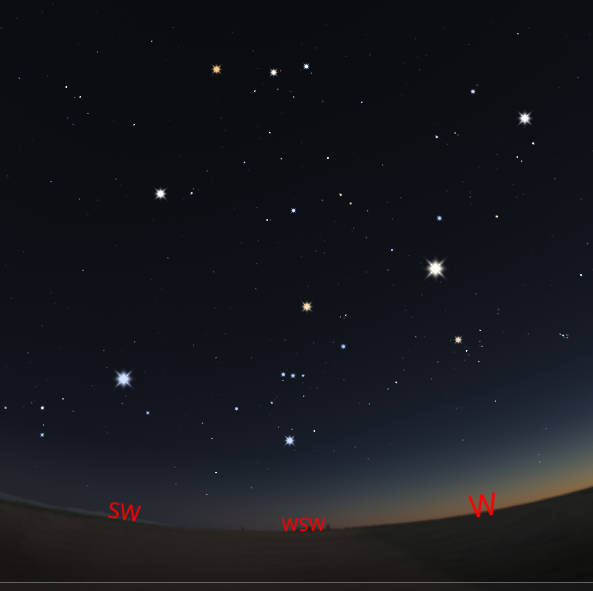
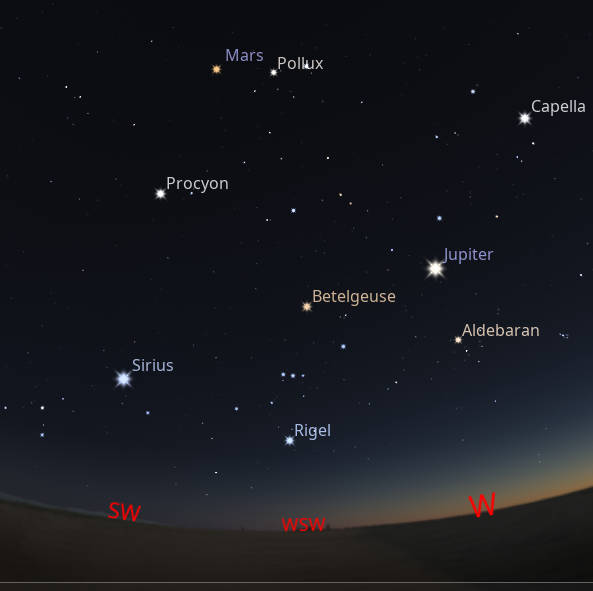
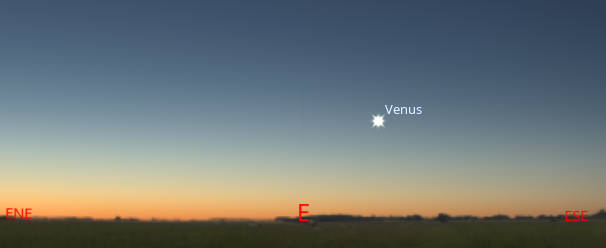
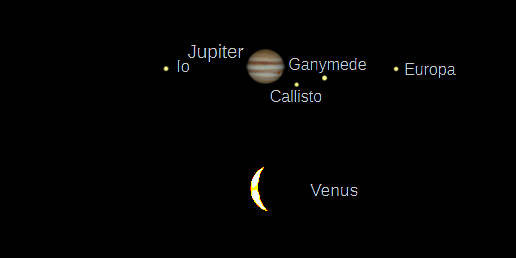
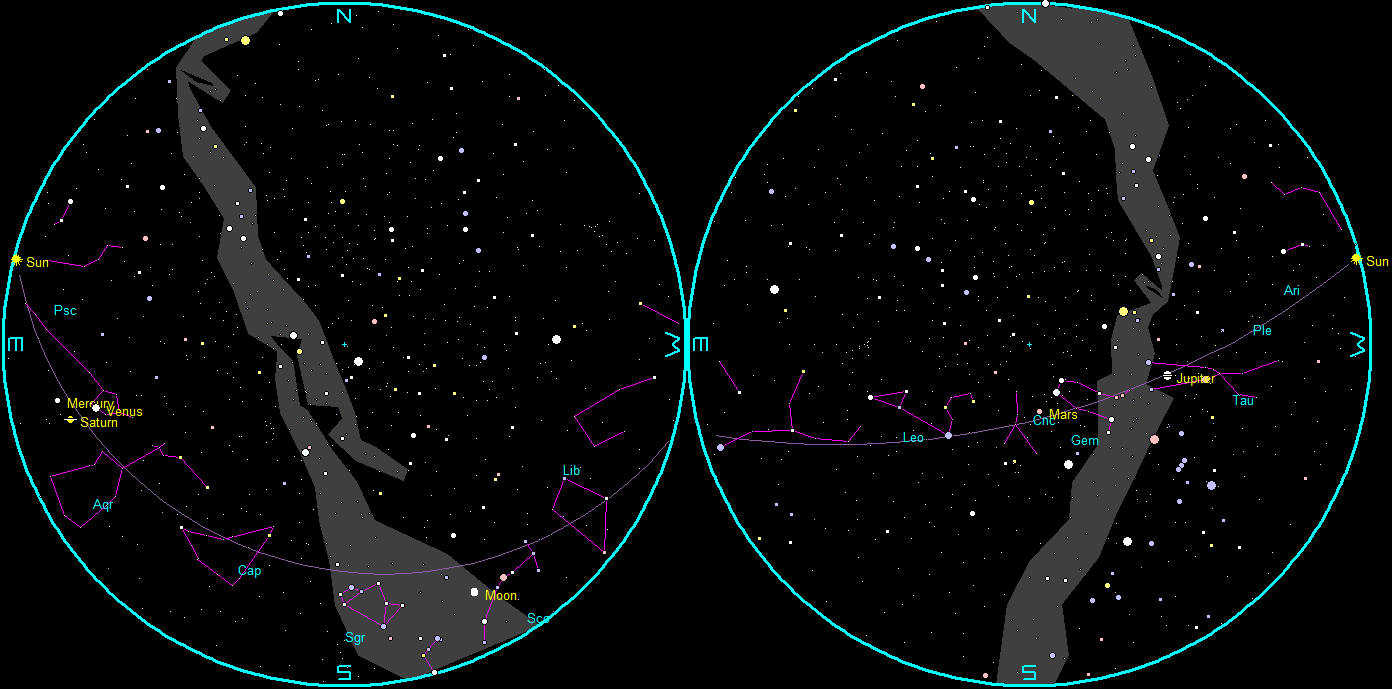
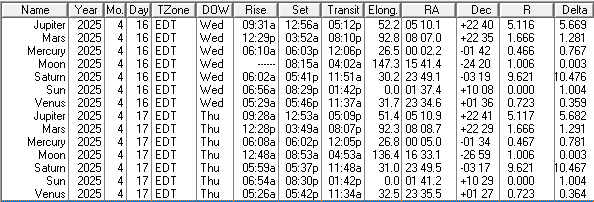
Let’s take our weekly look at the whereabouts of the naked-eye planets. At 9:30 PM this evening just two of the five naked eye planets will be out. Jupiter, now becomes the brightest evening planet, our substitute evening star if you will. It will be high in the west. Below it is the bright star Aldebaran. To its lower left, the great constellation of Orion. The rapidly fading Mars, with its distinctive reddish hue, is high in the south-southwest, with the stars Castor and Pollux in Gemini to the right of it. By 6 AM Venus will be seen very low in the east, as the Morning Star. It will require a low eastern horizon. It should be visible until a bit after 6:30. Saturn should be visible in the morning by the end of the month.
The astronomical event times given are for the Traverse City/Interlochen area of Michigan (EDT, UT – 4 hours). Times will be different for other locations.
Addendum
Ephemeris: 04/15/2025 – Hydra the water snake spans the spring skies
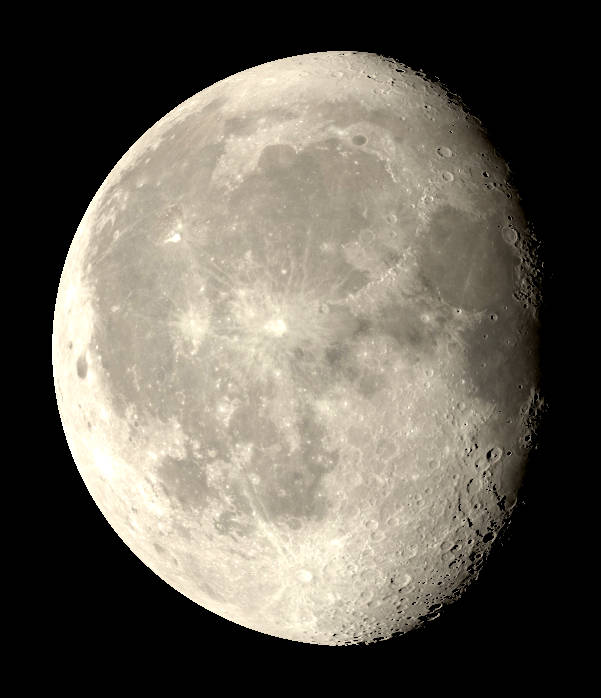
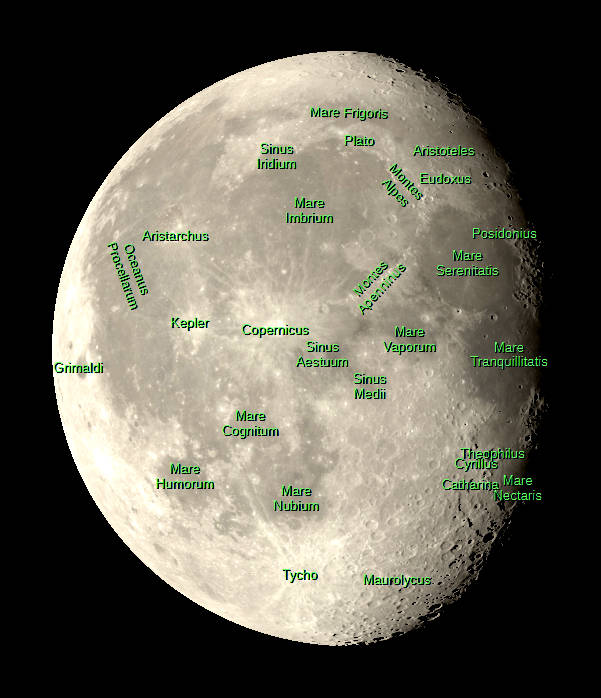
This is Ephemeris for Tuesday, April 15th. Today the Sun will be up for 13 hours and 30 minutes, setting at 8:28, and it will rise tomorrow at 6:56. The Moon, 3 days past full, will rise at 11:43 this evening.
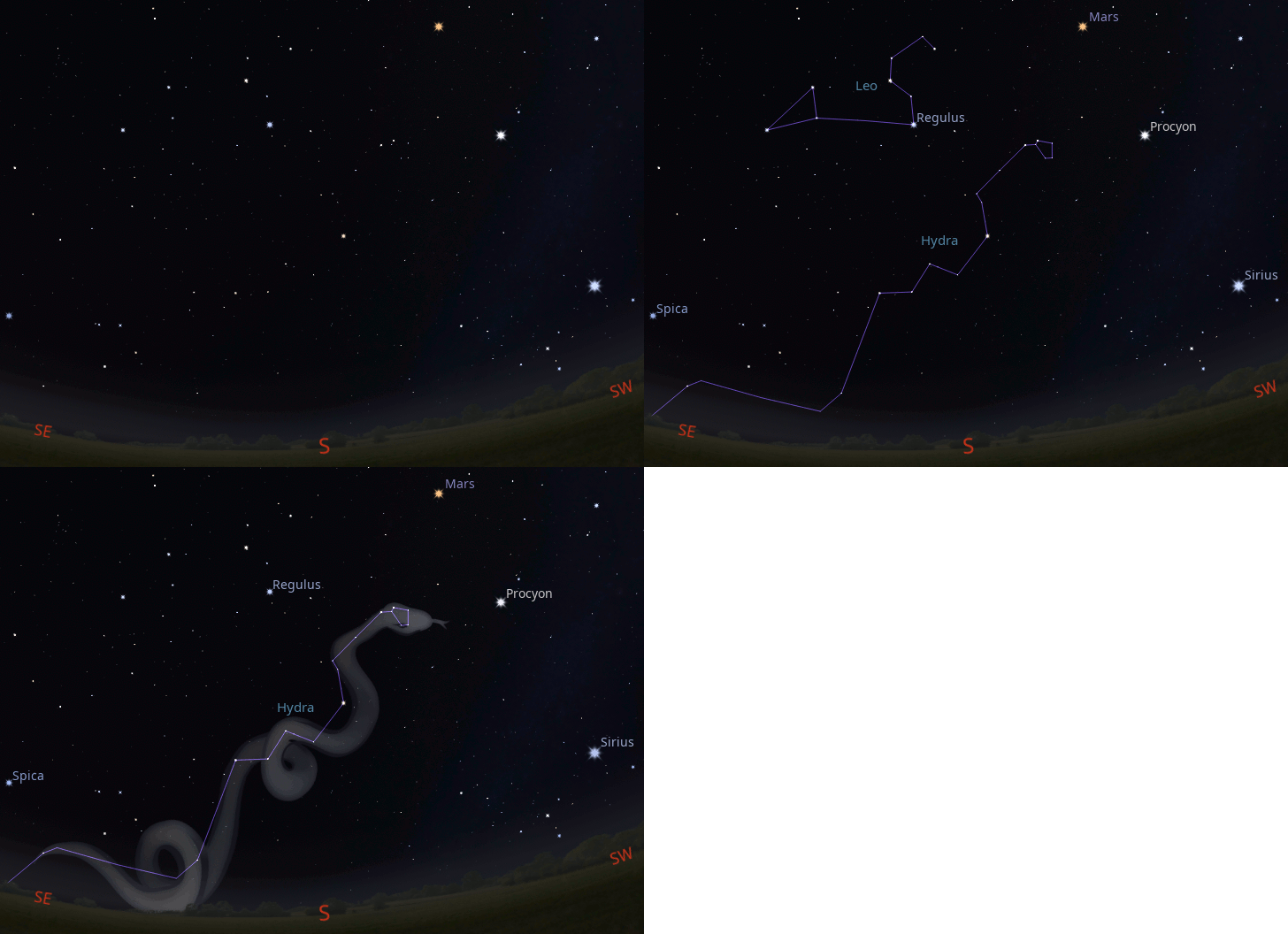
Stretching from midway up the sky in the south-southwest to low in the southeast at 10 p.m. can be found the constellation of Hydra the water snake, the longest constellation of all. Unlike the monster of the same name that Hercules slew, this Hydra has but one head, which is its most distinctive part. The head of Hydra is located between the bright stars Procyon in the southwest, which is above the brighter star Sirius low in the sky, and Regulus in Leo the lion, higher in the south. Hydra’s head is a small but distinctive group of 6 stars that make a drooping loop to the right. The rest of Hydra wends its way in a crooked line from star to star, but within a reasonably straight path down to the southeastern horizon.
The astronomical event times given are for the Traverse City/Interlochen area of Michigan (EDT, UT – 4 hours). Times will be different for other locations.
Addendum
Ephemeris: 04/14/2025 – Follow the arc to Arcturus
This is Ephemeris for Monday, April 14th. Today the Sun will be up for 13 hours and 27 minutes, setting at 8:27, and it will rise tomorrow at 6:57. The Moon, 2 days past full, will rise at 10:36 this evening.
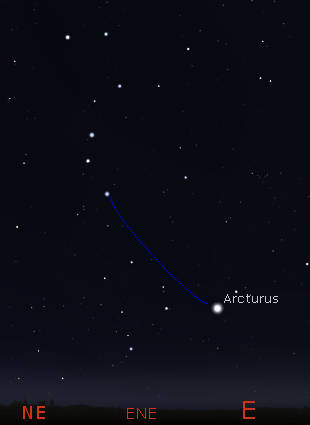
The fourth or fifth-brightest nighttime star, depending on whose list you see, is now up in the east in the evening. It is Arcturus, a bright star with an orange hue. It can be found otherwise by finding the Big Dipper and tracing out and extending the curve of the handle and “Follow the arc of the handle to Arcturus”, to remember the name of the star and how to find it. Arcturus is about 37 light years from us and is moving quite rapidly across the sky, compared to most stars, though one would not notice it to the naked eye in one’s lifetime. Arcturus is slightly more massive than our Sun, and about 7 billion years old, and is entering its red giant stage of life after using all the hydrogen fuel in its core. Our Sun, being slightly less massive will survive on hydrogen a bit longer.
The astronomical event times given are for the Traverse City/Interlochen area of Michigan (EDT, UT – 4 hours). Times will be different for other locations.
Addendum

Ephemeris: 04/11/2025 – Thoughts on Starliner and Artemis problems
This is Ephemeris for Friday, April 11th. Today the Sun will be up for 13 hours and 18 minutes, setting at 8:23, and it will rise tomorrow at 7:03. The Moon, 1 day before full, will set at 6:44 tomorrow morning.
As someone who has watched the Apollo program progress, back in the 1960s, and the race to get to the Moon before the Russkies, the Artemis program seems rather sluggish. Most of the reason of course, is because it isn’t enough of a high priority, and we’re trying to do it on the cheap, reusing as much of the ill-fated space shuttle hardware as possible. NASA is gun shy about putting astronauts into danger, when they don’t have to. The Apollo 1, and two Space Shuttle accidents is the main reason that Butch and Suni didn’t ride back to Earth in their ailing Starliner capsule. The Starliner capsule is built by the same company, Boeing, who is prime contractor on the main stage of the moon rocket. Both have experienced long delays, and quality issues.
The astronomical event times given are for the Traverse City/Interlochen area of Michigan (EDT, UT – 4 hours). Times will be different for other locations.
Addendum


Ephemeris: 04/10/2025 – Saturn is soon going to emerge from the morning twilight
This is Ephemeris for Thursday, April 10th. Today the Sun will be up for 13 hours and 15 minutes, setting at 8:22, and it will rise tomorrow at 7:04. The Moon, 2 days before full, will set at 6:29 tomorrow morning.
The planets that have transitioned from the evening sky to the morning sky are beginning to show up in the morning now as they separate themselves from the Sun. Venus is the first to appear low in the east starting about 6:00 in the morning. Saturn will be very near Venus and below right of it on the 28th of this month. Saturn will separate itself more and more from the Sun over the spring and summer months until in late September when it becomes, officially, an evening planet again. Venus will increase its separation from the Sun until May 31st, its greatest separation from the sun of 46°. Then it will slowly head back towards the direction of the Sun. However, it will stay in the morning sky for the rest of the year.
The astronomical event times given are for the Traverse City/Interlochen area of Michigan (EDT, UT – 4 hours). Times will be different for other locations.
Addendum
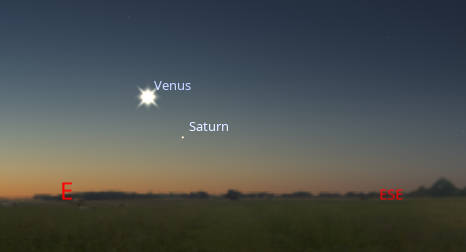
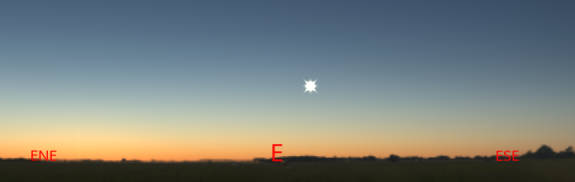
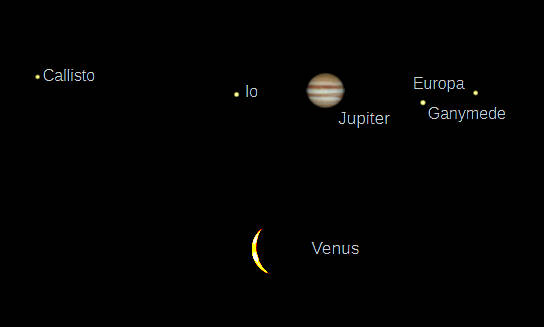
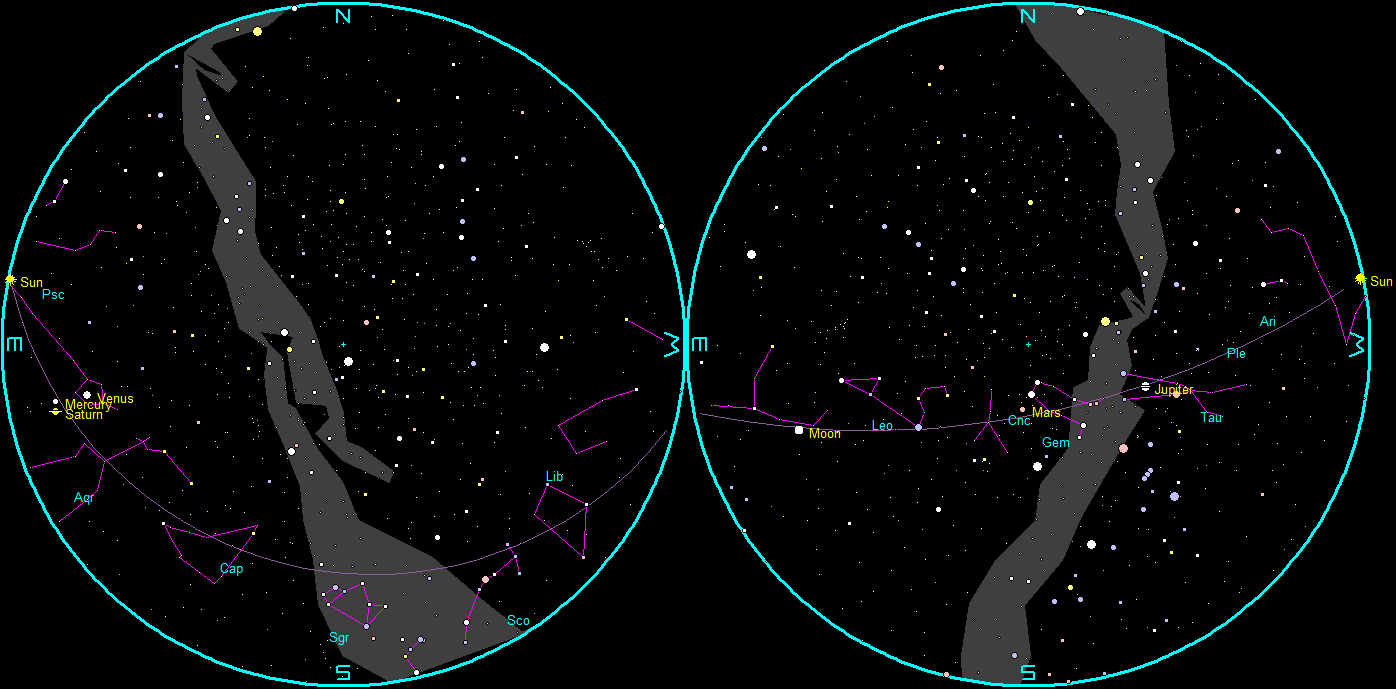
On the 28th, both planets will be at the same distance west of the sun in right ascension, which is the same as longitude in the Earth’s coordinate system. The two planets were a bit closer on the 25th. Saturn is just a little bit less than three degrees above the horizon in the above image. One needs a low eastern horizon to spot it. Saturn may be visible a few days before that, however it is lacking a bright ring right now. The Earth passed through the Saturn’s ring plane on March 23rd, and we are now looking at, probably, a thin line through the planet. The ring should be fairly dim because the Sun is shining on the other side of the rings, and will until its crossover on May 6th.
Ephemeris: 04/09/2025 – Taking our weekly look at the whereabouts of the naked-eye planets
This is Ephemeris for Wednesday, April 9th. Today the Sun will be up for 13 hours and 12 minutes, setting at 8:20, and it will rise tomorrow at 7:06. The Moon, 3 days before full, will set at 6:13 tomorrow morning.
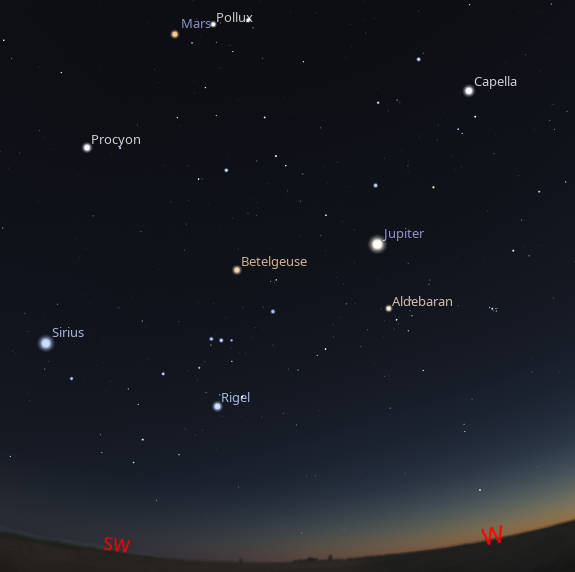
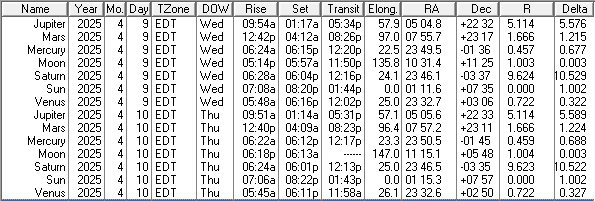
Let’s take our weekly look at the whereabouts of the naked-eye planets. At 9 PM this evening just two of the five naked eye planets will be out. Jupiter, now becomes the brightest evening planet, our substitute evening star if you will. It will be high in the west at 9 PM. Below it is the bright star Aldebaran. To its lower left, the great constellation of Orion. The rapidly fading Mars, with its distinctive reddish hue, is high in the south-southwest, in line with the stars Castor and Pollux in Gemini above right of it. By 6 AM Venus will be seen very low in the east, as the Morning Star,. It will require a low eastern horizon. It should be visible until about 6:45. Saturn should be visible in the morning by the end of the month.
The astronomical event times given are for the Traverse City/Interlochen area of Michigan (EDT, UT – 4 hours). Times will be different for other locations.
Addendum
 Bob Moler's Ephemeris Blog