01/07/2013 – Ephemeris – Saturn is near the moon this morning
Ephemeris for Monday, January 7th. The sun will rise at 8:18. It’ll be up for 9 hours and 0 minutes, setting at 5:19. The moon, 3 days past last quarter, will rise at 4:49 tomorrow morning.
This morning the planet Saturn will appear above and right of the crescent moon. They should be visible until a bit after seven a.m. The moon will be slipping eastward morning by morning, and by Thursday it will appear near the planet Venus. The moon’s movement around the earth with respect to the sun is called the synodic month, or a lunation. It is the period between one new moon to the next of about 29 and a half days. It is the basis for lunar calendars such as the Jewish and Islamic calendars. The moon’s crescent can be waxing or waning, growing fatter or thinner. It is now waning, and next week when we see the moon in the evening its phase will be waxing. The moon is just an illuminated ball in space.
Times are for the Traverse City/Interlochen area of Michigan. They may be different for your location.
Addendum
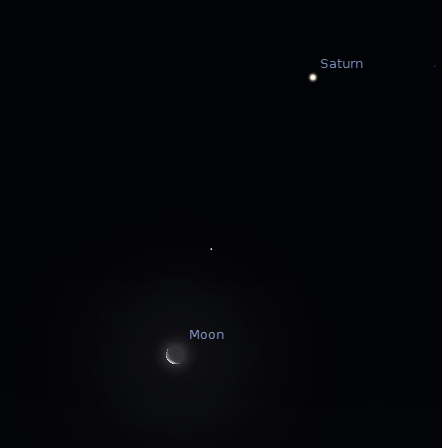
Saturn and the moon as seen at 6:30 a.m. on January 7, 2012. Created using Stellarium,
01/04/2013 – Ephemeris – Astronomical fun tonight
Ephemeris for Friday, January 4th. The sun will rise at 8:19. It’ll be up for 8 hours and 56 minutes, setting at 5:16. The moon, at last quarter today, will rise at 1:15 tomorrow morning.
Susan Kuschell, wife of the GTAS president will be present a talk at this evening’s meeting of the Grand Traverse Astronomical Society at Northwestern Michigan College’s Rogers Observatory starting at 8 p.m. Susan hasn’t revealed the topic of her talk. Could it be the travails of an astronomy widow? Actually Susan has been an active organizer in the community and is head of the children’s garden located behind the TC district Library, and has given invaluable assistance to the society in out funding and outreach efforts. Starting at 9 p.m. is our January star party at the observatory. Highlights, if its clear will be the planet Jupiter and the wonders of the winter sky including the Great Orion Nebula. All are welcome.
Times are for the Traverse City/Interlochen area of Michigan. They may be different for your location.
01/03/2013 – Ephemeris – The Quadrantid meteor shower will peak this morning.
Ephemeris for Thursday, January 3rd. The sun will rise at 8:19. It’ll be up for 8 hours and 55 minutes, setting at 5:15. The moon, 1 day before last quarter, will rise at 12:06 tomorrow morning.
This morning will see the peak of the Quadrantid meteor shower. There’s still time to spot them before the sky brightens too much. It’s one of the better meteor showers of the year, except it occurs in the cold and not very clear skies of January. Meteor showers are generally named for the constellation from which they seem to come. Trouble is, there’s no such constellation of the Quadrant. Now, that is. There is a sextant and an octant, but no quadrant. All these instruments were used by navigators and astronomers to measure the altitude of stars and planets. The obsolete constellation of the quadrant was located near the handle of the Big Dipper and north of the kite shaped spring constellation of Boötes. The Quadrantids will be around for the next few mornings.
Times are for the Traverse City/Interlochen area of Michigan. They may be different for your location.
Addendum
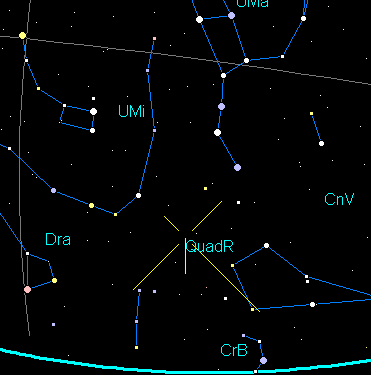
Quadrantid meteor shower radiant at 1:30 a.m.
01/02/2013 – Ephemeris – Where are the bright planets this week?
Ephemeris for Wednesday, January 2nd. The sun will rise at 8:19. It’ll be up for 8 hours and 54 minutes, setting at 5:14. The moon, 2 days before last quarter, will rise at 11:00 this evening.
Let’s check out the planets for this week. Mars can be seen low in the southwest. It will set at 7:07 p.m, two minutes later than last week because sunset times are increasing and Mars is starting to move northward. The sun will eventually catch up with it. Even before you can spot Mars, bright Jupiter will be visible in the east. Jupiter is located in the constellation of Taurus in the southeast in the evening. It will transit or pass due south at 10:14 p.m, and will set at 5:45 a.m. Jupiter is a wonderful sight in telescopes with its cloud bands and its moons which change positions each night. Saturn will be the next planet to rise at 3:10 a.m. in the east southeast. It’s located in eastern Virgo. Venus will rise at 6:52.
Times are for the Traverse City/Interlochen area of Michigan. They may be different for your location.
Note: The Quadrantid meteor shower will reach peak tomorrow morning. I will release tomorrow’s program about the meteor shower at noon today.
Addendum
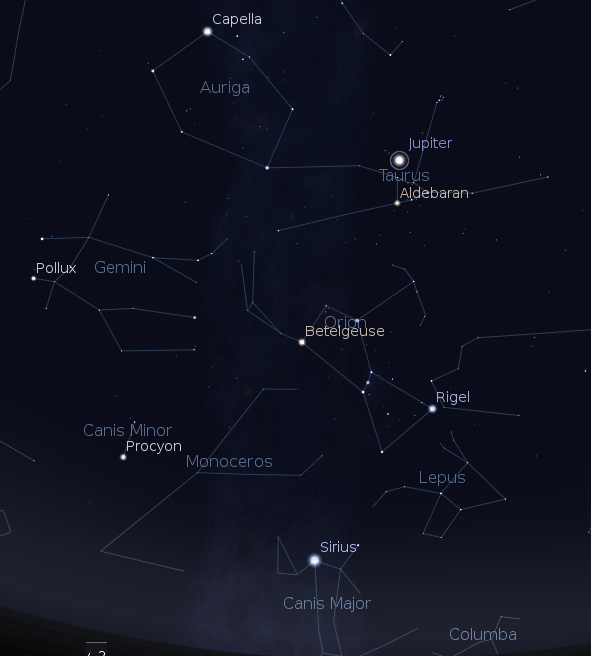
Jupiter and the winter stars and constellations as seen at 9 p.m. on January 2, 2013. Created using Stellarium.
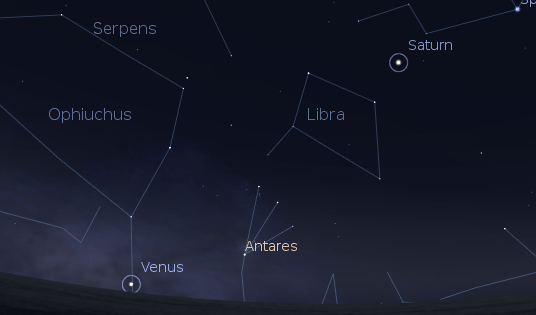
Jupiter and the winter stars and constellations at 7 a.m. on January 3, 2013. Created using Stellarium.
01/01/2013 – Ephemeris – We start the year with the sun closest to us.
Ephemeris for New Years Day, Tuesday, January 1st 2013. The sun will rise at 8:19. It’ll be up for 8 hours and 53 minutes, setting at 5:13. The moon, 3 days before last quarter, will rise at 9:55 this evening.
Happy New Year and happy perihelion Day. What’s a perihelion? Well. It’s not two helions, whatever they are. Perihelion is the point in an orbit of the sun that is nearest to the sun. This evening the earth will reach that point in its travels around the sun. Since its winter time, the sun’s distance apparently doesn’t cause the seasons. Actually the sun now as about a million and a half miles closer than mean, which isn’t much out of 93 million miles. But, although we don’t notice it in northern Michigan, it makes winter the shortest season at 89 days. The real cause of the seasons is the tilt of the earth’s axis. Now the sun appears highest over the southern hemisphere. The sun’s up less than 9 hours here and hangs low over the southern horizon at noon.
Times are for the Traverse City/Interlochen area of Michigan. They may be different for your location.
12/31/2012 – Ephemeris – Looking at the prospective comets of 2013
Ephemeris for New Years Eve, Monday, December 31st. The sun will rise at 8:19. It’ll be up for 8 hours and 53 minutes, setting at 5:12. The moon, 3 days past full, will rise at 8:51 this evening.
As we enter a new year tonight, let\s look ahead at what we expect to see in the skies in 2013. The big events next year will be two comets that could be quite bright. Mid-March will bring Comet PanSTARRS to the evening sky. This is a first time comet for astronomers, so its behavior may be unpredictable, but it is currently sticking to brightness projections and may be as bright as the brightest stars at its brightest. The second comet is Comet ISON. This will fly close to the sun on November 28th. It could disintegrate, its nucleus could split into multiple pieces, or it could survive intact. The last two scenarios will give us a bright morning comet in early December. So may we have a happy comet new year.
Times are for the Traverse City/Interlochen area of Michigan. They may be different for your location.
Addendum
Here are two links to the website of Seiichi Yoshida for each of the comets. Most revealing at this point are the magnitudes graphs showing the actual brightness measurements as black dots with the predicted magnitudes as an orange line, The vertical line is the perihelion date, the date the comet is closest to the sun. Comet ISON has a second magnitude graph for when the comet is closest the sun and may become bright enough to be seen in the daytime.
Magnitudes are like golf scores, the lower the number the better, or in this case brighter the comet is. the Faintest star visible to the naked eye is 6th magnitude. Jupiter is usually around -2, Venus -4, and the sun -26. As you can see from the scatter of the actual brightness estimates, pinning down the brightness of a fuzzy comet is rather difficult. Comets generally appear dimmer than their magnitudes would suggest.
Here are the ;inks:
Our Past and Future in Space – A Personal View
This is a piece I wrote for the Grand Traverse Astronomical Society’s Stellar Sentinel in the January
I’ve witnessed the space program since before Sputnik. I watched the United States Vanguard program from its inception to attempt the launch the first satellite. It turns out that the Russians and the US Army beat Vanguard for the first successful US satellite. The three and a quarter pound satellite Vanguard 1 launched in 1958, with the first solar cell power is the only satellite from the early days still in orbit. Though silent it is still being tracked.
Back to Sputnik. It was a real surprise one October evening, while watching TV a news flash came over the TV announcing that the USSR (Russians for you younger folk) had launched a satellite. They showed a dot crossing the screen and the beep beep beep it emitted as if to say: “We’re in orbit and you’re not!” It turned out that it’s not nice to mess with America’s pride. We beefed up our science teaching, and math. I was old enough to miss most of the new math. Now helping my youngest granddaughter with her 4th grade math homework I’m learning a newer math, and as an old computer programmer I’m seeing how they now break problems into manageable bits, just like I do now, but wasn’t taught to me in school.
Back to the past. The 1960s were a heady time for space buffs. The manned Mercury, Gemini programs leading to the magnificent Apollo lunar landings. Along the way we sent spacecraft beyond the moon to Venus and then to Mars. After the Apollo 11 landing the will to proceed with the last three Apollo landing died in Congress, and the general public had the “been there done that” attitude, while scientists and we astronomers amateur and otherwise though it was just getting interesting. The first and last geologist who went to the moon did so on the last flight.
The next big NASA project was the Space Shuttle, which was supposed to save money and make access to space routine. Unfortunately it was built on a starvation budget which ultimately drew out its development time and weakened the spacecraft due to the shortcuts that were taken to keep it almost within budget. It was built to hopefully make trips to a space station that it didn’t begin to construct until the latter third of its lifetime. After the fiery demise of the second shuttle with its seven person crew it was finally determined that the shuttle was indeed too fragile to fly, and the program was abandoned after the International Space Station (ISS) was completed.
Without the space shuttle we have to bum rides to the ISS from the Russians whose 1960’s technology Soyuz space capsules are still perfectly capable vehicles. The Soyuz capsules also serve as life boats for the ISS. Maybe in a few years one of the commercial space companies will have a manned spacecraft ready to go. The three contenders that have received NASA grants are SpaceX, Boeing, and Sierra Nevada. NASA’s working on the Orion Capsule, to take astronauts past the moon, to the asteroids and to Mars.
Whatever we send to these destinations the Orion capsule will not be the living quarters. It’s for launch and reentry. The rest of the spacecraft will most likely be much larger with a rotating component to provide artificial gravity. The actual manned mission would be preceded by cargo missions to establish a habitat and a martian launch vehicle. It’s possible that the martian moon Phobos would be a staging area for a possible martian landing. This seems to be the thinking of the Russians who have sent, or tried to send spacecraft to Phobos, including the failed Phobos Grunt (Soil) mission of a year ago. The Russians found out that you can’t do this stuff on the cheap. That and that fact that Russia has had miserable luck with Mars.
The current guesstimate on the time of a manned landing on Mars is the 2030s. Back in the late 90’s after the successful Mars Pathfinder mission, I answered a Planetary Society member questionnaire as to my opinion as to when a manned landing on Mars would happen. I guessed 2030. It may be optimistic by a decade or two. The first man or woman to set foot on Mars is probably in grade school right now.
A good dress rehearsal for landing on Phobos or Mars would be a trip to a near earth asteroid. These will be a shorter trip than to Mars. As it happens one docks with an asteroid rather than lands on it. Other than that, we must learn a lot more about asteroids if we are able to defend the earth from them. So asteroid missions are not only good practice, but vital in learning how to defend ourselves from one on an intercept course.
The current China’s Chang’e 2 mission started as a photo mission to the moon, It was then sent to the earth-sun Lagrangian 2 or L2 location, One million miles directly opposite the sun from the earth. From there it was sent to fly by the asteroid Toutatis, which it did in December 2012. Maybe the Chinese have something. Maybe L2 might be a place to hold in reserve asteroid defense rockets. They’re outside the gravity well of the earth, so can be pre-positioned to launch to intercept an asteroid.
To practice living off the land on Mars, a lunar mission to the poles of the moon may be necessary. The moon’s low angular tilt means that lunar craters at the poles contain water ice and other frozen volatile compounds. South polar permanently shadowed craters are known to contain water ice. Also with permanent sunlight at the crater rims, solar power can be readily available. Problem is the lunar poles are part of the lunar highlands, some very rugged terrain. It makes landing there way more than exciting.
Mars has water, lots of it, either at the polar caps, and/or located as permafrost below the surface and possible methane good for rocket fuel. If water in sufficient quantities is found, then hydrogen and oxygen can be made for breathable oxygen and again rocket fuel. A manned martian population will have to be much more self-sufficient than a lunar one. Care packages to Mars can only be sent at 26 month intervals, while the moon is only 3 days away by rocket.
One of the big questions with space exploration is manned versus robotic missions. Actually I’m in favor of both. First must come the robotic missions to survey the lay of the land, the atmosphere and determine the feasibility of even sending astronauts. That’s what we’re doing to Mars. We will have to determine what life Mars has or had before we send people who will bring their own biological contamination. Even the Curiosity rover may have brought organic contamination to Mars. It may have been sterile but it came from a planet loaded with the stuff.
Robots can go to places humans can never go: Deep inside the radiation fields of Jupiter, onto the surface of Saturn’s moon Titan. Suicide plunges into the atmosphere’s of the gas giant planets. Other than that they don’t need the care and feeding of humans, and are much cheaper than a human mission, humans are much more adaptable, able to thing on the spot. Of course the humans that operate the robots are pretty good at improvising with their charges too.
Currently NASA is doing all its current and future missions with one half of one percent of the federal budget. Recent events in the Congress of the United Stated don’t give me much hope that that will improve. Congress is still starving NASA. They want all these great things, like the Space Launch System, but won’t finance it well enough to do it right. I fear the cutting of corners and eliminating science programs to finance their big rocket that currently has no manifest.
The climate scientists are quite positive that the climate is warming and 90% sure that humans are causing it. The last and next chairmen of the House Science, Space and Technology Committee are climate change deniers. What’s the chance of anything positive coming out of that committee?
12/28/2012 – Ephemeris – Using that new telescope
Ephemeris for Friday, December 28th. The sun will rise at 8:18. It’ll be up for 8 hours and 51 minutes, setting at 5:09. The moon, at full today, will rise at 5:48 this evening.
If you gotten a new telescope for Christmas, I’ve got a few tips. Always start out using your lowest power eyepiece. It has the largest field of view to help you find what you want. Once found you may use a higher power eyepiece. Higher powers may make the image larger, but will not make it sharper. The wider the telescope the sharper the image, and the higher powers that can be used. But note that amateur astronomers use their lowest power 90 percent of the time. The images are sharper and brighter. And besides most things in the sky don’t need that much magnification. We mostly need to make them brighter. That’s why telescopes are sometimes called light buckets. Good telescope companions are computer programs that show the sky and books on observing.
Times are for the Traverse City/Interlochen area of Michigan. They may be different for your location.
Addendum – Links for more information on telescopes and observing
Advice for First Time Telescope Buyers by Joe Roberts. It’s part of his Amateur Astronomers Notebook, whose link is at the top of the page.
Stargazing Basics from Sky and Telescope magazine.
Equipment How To from Astronomy magazine.
Your local astronomy club: In the Grand Traverse Area gtastro.org (Grand Traverse Astronomical Society) which meets at 8 p.m. on the first Friday of the month.
Also check out both Sky and Telescope and Astronomy web sites above for links to other astronomy clubs. They are all welcoming of beginners and a great source of telescope expertise.
12/27/2012 – Ephemeris – That was the year that was.
Ephemeris for Thursday, December 27th. The sun will rise at 8:18. It’ll be up for 8 hours and 50 minutes, setting at 5:09. The moon, 1 day before full, will set at 8:10 tomorrow morning.
The end of the year is the perfect time to look back at the astronomical events of the year. There was a partial solar eclipse in May and the rare transit of Venus across the sun in June. You’ll have to wait until 2117 for the next one. In July came news that the Large Hadron Collider had detected something that sure looked like the long sought Higgs Boson. August brought the spectacular landing of the Mars Science laboratory, aka: The Curiosity rover, on Mars to begin an at least one martian year exploration. In September the Dawn spacecraft bid farewell to the asteroid Vesta after a year exploring that remarkable asteroid, cranking up its ion engine for a three year journey to the dwarf planet Ceres. The satellites Ebb and Flow completed their mission to map the moon’s interior.
Times are for the Traverse City/Interlochen area of Michigan. They may be different for your location.
Addendum
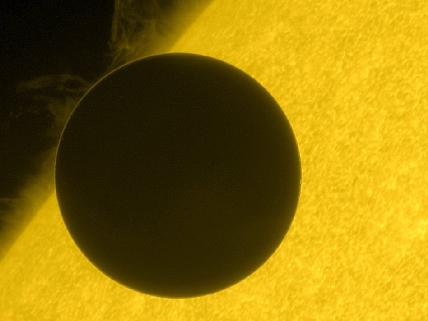
Hinode Views the 2012 Venus Transit. Credit: JAXA/NASA/Lockheed Martin
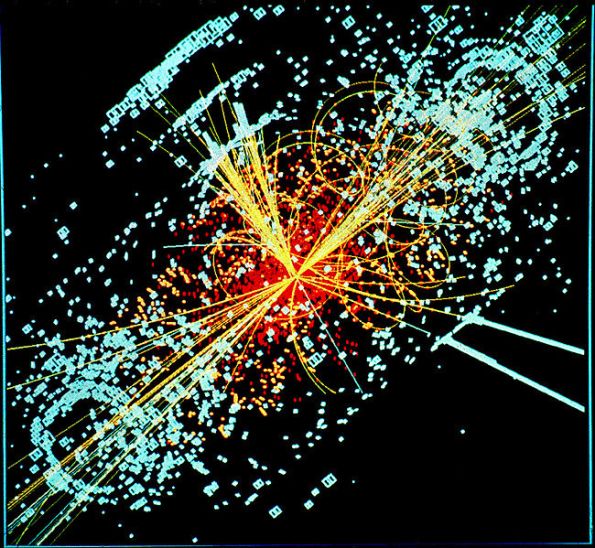
An example of simulated data modeled for the CMS particle detector on the Large Hadron Collider (LHC) at CERN. Here, following a collision of two protons, a Higgs boson is produced which decays into two jets of hadrons and two electrons. The lines represent the possible paths of particles produced by the proton-proton collision in the detector while the energy these particles deposit is shown in blue. Credit CERN.
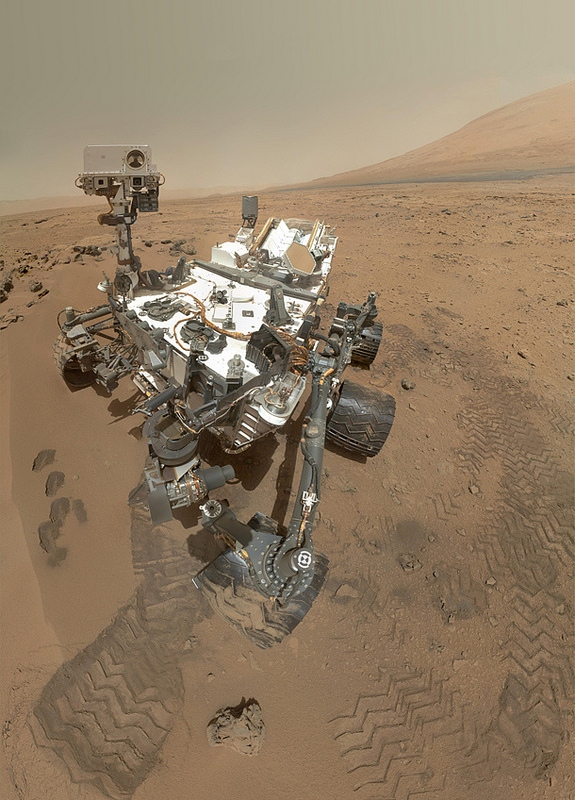
Curiosity rover self portrait. Credit: NASA/JPL-Caltech/Malin Space Science Systems
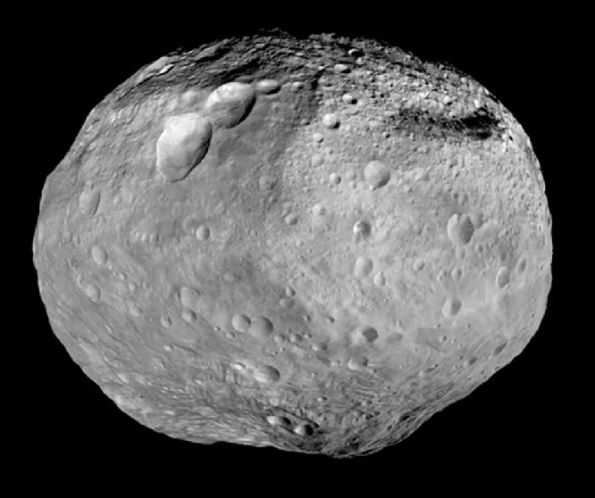
Looking back at Vesta as Dawn headed off to Ceres. Credit: NASA/JPL-Caltech/UCAL/MPS/DLR/IDA
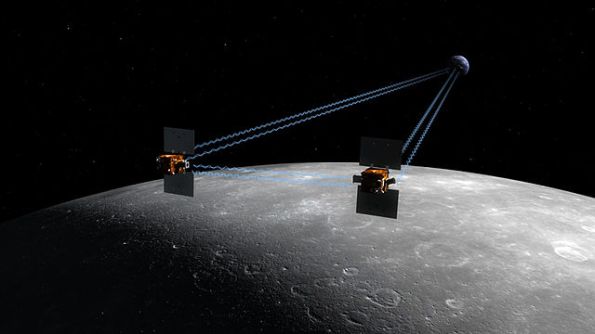
The Grail Spacecraft Ebb and Flow made the most detailed gravitational map of the moon to map its interior; orbiting as close as 15 miles above the surface. They were intentionally crashed into a crater wall on December 17th. Artist conception credit: NASA.
12/26/2012 – Ephemeris – Where are the bright planets this week?
Ephemeris for Wednesday, December 26th. The sun will rise at 8:18. It’ll be up for 8 hours and 50 minutes, setting at 5:08. The moon, 2 days before full, will set at 7:27 tomorrow morning.
Let’s check out the planets for this week. Mars can be seen low in the southwest. It will set at 7:05 p.m, one minute later than last week because sunset times are increasing and Mars is starting to move northward. The sun will eventually catch up with it. Even before you can spot Mars, bright Jupiter will be visible in the east. Jupiter is located in the constellation of Taurus in the southeast in the evening. It will transit or pass due south at 10:44 p.m, and will set at 6:16 a.m. Jupiter is a wonderful sight in telescopes with its cloud bands and its moons which change positions each night. Saturn will be the next planet to rise at 3:35 a.m. in the east southeast. It’s located in eastern Virgo. Venus will rise at 6:37 and is below and left of Saturn.
Times are for the Traverse City/Interlochen area of Michigan. They may be different for your location.
Addendum
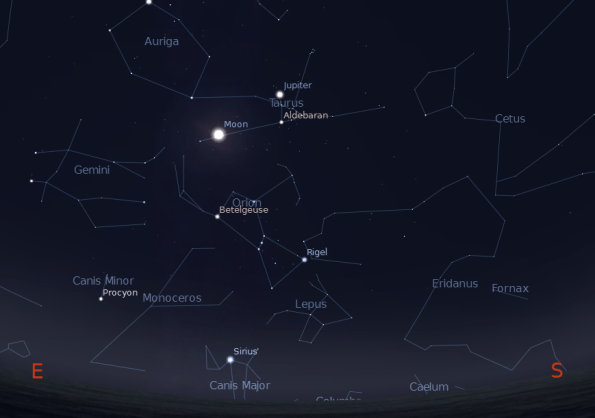
Jupiter, the bright moon and the winter stars and constellations at 9 p.m. on December 26, 2012. Created using Stellarium.
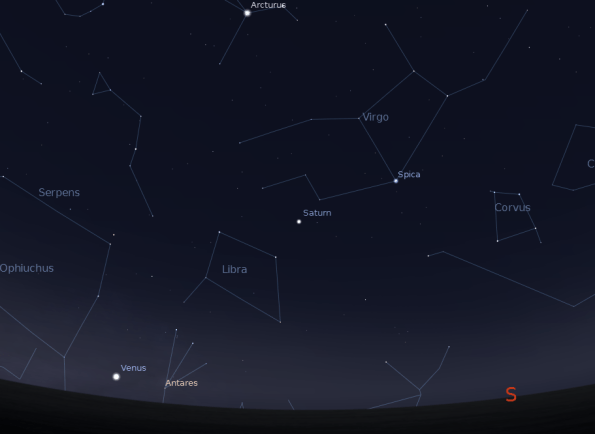
Saturn, Venus and the constellations of morning at 7 a.m. on December 27, 2012. Created using Stellarium.

