05/24/2012 – Ephemeris – Phases and shadows on the moon
Ephemeris for Thursday, May 24th. Today the sun will be up for 15 hours and 8 minutes, setting at 9:13. The moon, half way from new to first quarter, will set at 12:11 tomorrow morning. Tomorrow the sun will rise at 6:04.
The fat crescent moon tonight is like the crescent Venus, with the sun shining on mostly the far side. I notice that some folks think that the earth is casting its shadow on the moon to cause the crescent. That isn’t correct. The earth does cast its shadow on the moon sometimes, but only at full moon, but only about one in 6 full moons, and we usually don’t see many of these. The phases of the moon are simply the light and shadow of a ball in the sunlight. In fact, if before sunset you can see the moon, and you are in sunlight also. Hold the ball up next to the moon. You will see that the ball will have the same phase as the moon. This is because the moon is close to the earth.
05/23/2012 – Ephemeris – Where are the bright planets this week?
Ephemeris for Wednesday, May 23rd. Today the sun will be up for 15 hours and 6 minutes, setting at 9:12. The moon, 3 days past new, will set at 11:33 this evening. Tomorrow the sun will rise at 6:05.
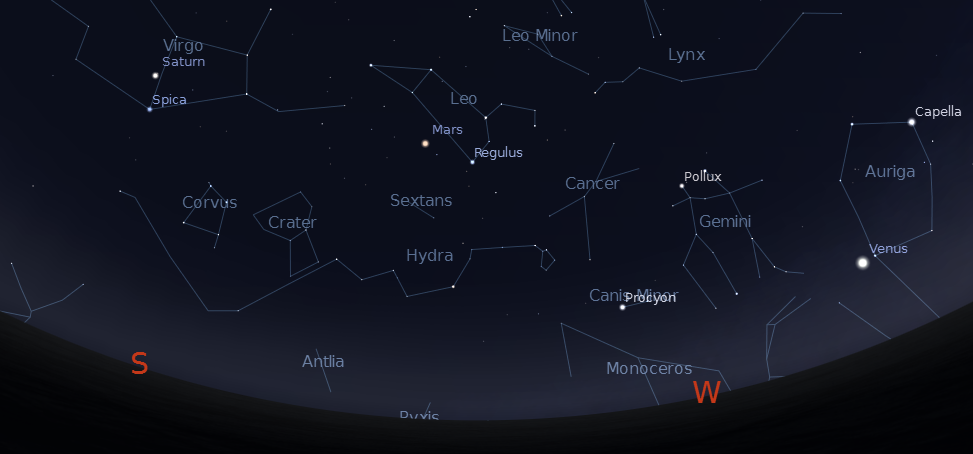
Let’s see what’s happening with the bright planets for this week. Venus is in the west as it gets dark. Enjoy it now, because it will be gone in less than 2 weeks. Venus will set at 11:07 p.m. in the west northwest. That’s 33 minutes earlier than last week, so it appears to be drawing closer to the sun. Venus is 29.5 million miles away and closing slowly. It is a beautiful brilliant growing crescent in telescopes. Mars is high in the south southwest in the evening in the constellation of Leo with its unmistakable bright reddish color. It’s beginning to resume its eastward motion toward Virgo. Mars will be setting in the west at 3:05 a.m. Saturn will be in the southeast moving above above the bright star Spica.
Times are for the Traverse City/Interlochen area of Michigan. They may be different for your location.
Addendum

The evening sky with the remaining bright planets at 10 p.m. tonight. Created using Stellarium.
05/22/2012 – Ephemeris – The moon appears near Venus tonight
Ephemeris for Tuesday, May 22nd. Today the sun will be up for 15 hours and 4 minutes, setting at 9:11. The moon, 2 days past new, will set at 10:50 this evening. Tomorrow the sun will rise at 6:06.
Tonight the extremely thin crescent moon will appear below and left of the planet Venus. Venus itself is an extremely thin crescent, just two weeks from passing directly in front of the sun in a rare transit part of which will be visible from here. Venus is a crescent because we are looking mostly on its night side, with just a sliver of light on its sunlit edge. Even though Venus shows such a small sunlit sliver, it’s still very bright, since its nearness to us makes it appear larger in our sky. You can even see the crescent in binoculars. Venus is so bright because it’s close to us, just slightly smaller than the earth, but socked in by while sulfuric acid clouds that reflect most of the suns light covering a runaway green house effect beneath.
Times are for the Traverse City/Interlochen area of Michigan. They may be different for your location.
Addendum
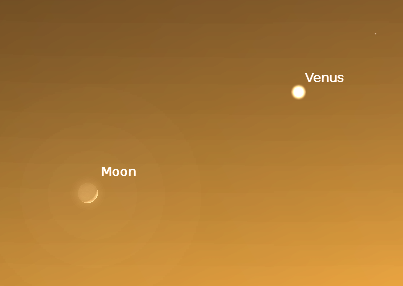
Venus with the moon on the evening of May 22, 2012. Created using Stellarium.
Our May 20th, 2012 solar eclipse experiences
We knew seeing the eclipse would be a close thing. We members of the Grand Traverse Astronomical Society had a full day of events. It started with a full day at Northwestern Michigan College at their annual fund raising Barbecue. Gary and Eileen Carlisle, Ron and Jan Uthe, Richard Kuschell, and myself had telescopes aimed at the sun. Joe Brooks our meteor man was holding forth in one of the classrooms with his meteorite collection. This went from 10 a.m. setup to 5 p.m. take down.
I immediately headed 30 miles westward to the Sleeping Bear Dunes National Lakeshore, and Pierce Stocking Scenic Drive and the Lake Michigan Overlook and our planned eclipse viewing party with the park rangers. The rest of our group except Joe followed a bit later. The sky was milky all day, and we had puffy clouds in Traverse City at the barbecue. Watching the cloud animations on weatherunderground.com gave me some hope that the cloud bank we knew was over Wisconsin might just hold off so we could get the major part of what we projected would be the first 50 minutes of the eclipse before sunset. There was also a spear of thunderstorms coming northward up the lake from the south. The sky was so milky that we had no idea how high the cloud bank we knew was there actually was.
When I arrived at the entrance to the scenic drive the rangers told me that they may change our location due to blowing sand. When I got to the overlook the sand was indeed being blown by gusts of wind coming from the southwest.

Lake Michigan Overlook Looking South
The above picture is from my scouting trip the week before. We set up near that dune, which sheltered us pretty well from the wind. However when I got home, I was full of sand, especially my hair.
It wasn’t until about 10 minutes before the start of the eclipse that the cloud bank was revealed. It then was a race between the moon and the cloud bank. The moon won by about 5 minutes. My old friend John Russell, a professional photographer, was there and has posted an eclipse image on his Facebook page.
About 10 minutes later we found that the clouds were getting ugly, and approaching rapidly.

Looking in vain for the sun. Isn’t that a thunderhead on the left?
That was it for the eclipse. The rangers counted about 200 people who attended.
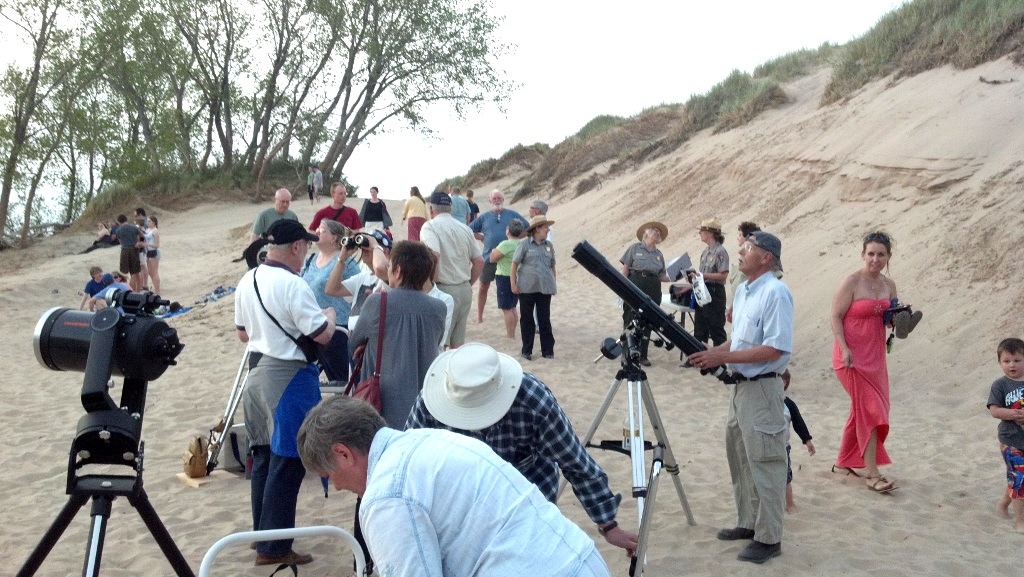
Gary Carlisle with binoculars and Richard Kuschell look for Venus above the cloud bank.
Gary Carlisle, who has a knack for finding planets in twilight, spotted Venus above the cloud bank and pointed his Celestron 8 telescope toward it. Richard Kuschell located it too with his 4″ refractor to give the folks remaining a bonus view of the thin crescent of Venus.
We then packed up and headed back home with lightning to the south and a smattering of rain.
05/21/2012 – Ephemeris – What are the next solar eclipses to be visile from Northern Michigan?
Ephemeris for Monday, May 21st. Today the sun will be up for 15 hours and 2 minutes, setting at 9:10. The moon, 1 day past new, will set at 10:01 this evening. Tomorrow the sun will rise at 6:07.
With yesterday’s solar eclipse now history, when will we see the next one? The next solar eclipse visible from northern Michigan is another partial eclipse interrupted by sunset. That one’s on October 24, 2014, about two and a half years from now. It will be a partial eclipse for anyone able to see it. The central part of the moon’s shadow will miss earth to the north. In three years after that is a total eclipse whose path of totality crosses the United States from Oregon to South Carolina. That one is special to me. It will be the third saros periods of the first total eclipse I saw, back on July 20, 1963. Eclipses repeat in 18 years 10 or 11 1/3 days called a saros. The August 21, 2017 is that eclipse.
Times are for the Traverse City/Interlochen area of Michigan. They may be different for your location.
05/18/2012 – Ephemeris – Eclipse viewing from the Sleeping Bear Dunes this Sunday
Ephemeris for Friday, May 18th. Today the sun will be up for 14 hours and 56 minutes, setting at 9:07. The moon, 2 days before new, will rise at 5:14 tomorrow morning. Tomorrow the sun will rise at 6:09.
For Sunday’s solar eclipse the Grand Traverse Astronomical Society will team up with the National Park Service for eclipse viewing at sunset on Pierce Stocking Scenic Drive at Sleeping Bear Dunes National Lakeshore. We’ll be stationed at either stop 3, the Dunes overlook, or stop 9 the Lake Michigan Overlook. There we will have telescopes for safe viewing of the eclipse, and the park service will have a number of eclipse viewer glasses that are safe to use. Our telescopes have special solar filters that fit in front of the telescope, and another special solar telescope to see the gasses above the bright ball of the sun. The eclipse will start at 8:19 p.m. And last until sunset at 9:10 p.m. If it’s overcast, the viewing will be canceled.
Times are for the Traverse City/Interlochen area of Michigan. They may be different for your location.
Addendum
Views from the observation points. I took these shots May 12th.
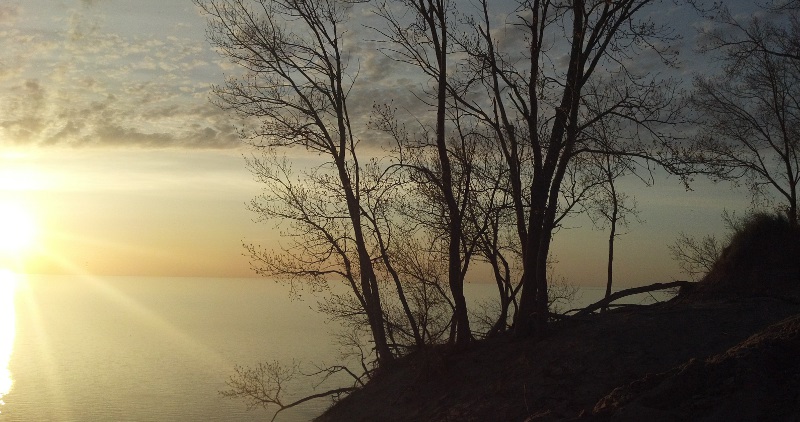
View from the Lake Michigan Overlook. The trees won’t interfere.
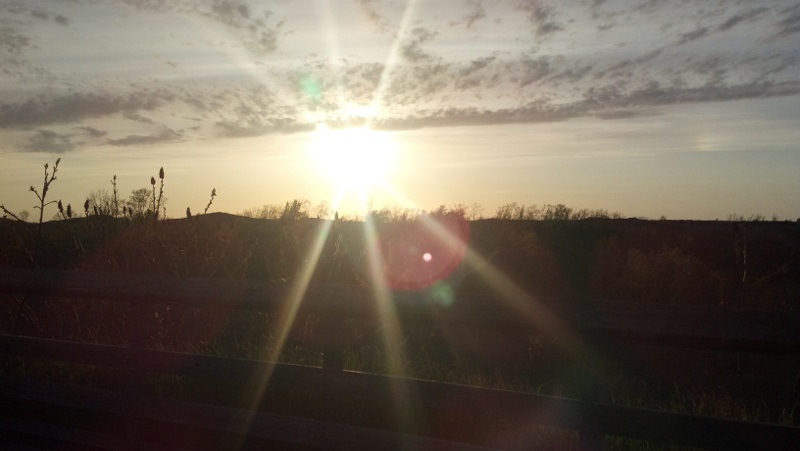
Sunset from the dune Overlook. The dunes and scrub will cause the sunset at that point up to 5 minutes before the Lake Michigan Overlook.
05/17/2012 – Ephemeris – A safe way to view this Sunday’s solar eclipse
Ephemeris for Thursday, May 17th. Today the sun will be up for 14 hours and 54 minutes, setting at 9:06. The moon, 3 days before new, will rise at 4:44 tomorrow morning. Tomorrow the sun will rise at 6:10.
Lets talk about a safe viewing method for viewing the sun, for Sunday’s solar eclipse, which starts about 8:19 p.m. Never look directly at the sun, eclipse or no. Pinhole projection is a cool method to watch the eclipse without hurting your eyes. Get a cardboard box, the longer the better. On one narrow end poke a hole, no larger than an 8th of an inch in diameter. You can poke several holes an inch apart of varying sizes to get multiple images of the sun of different brightnesses and sharpness. On the inside of the other end paste a piece of white paper. Point the holey end at the sun and its image will be projected on the white sheet. Tomorrow I’ll tell you where to go to get the best view of the eclipse.
Times are for the Traverse City/Interlochen area of Michigan. They may be different for your location.
Addendum
There’s more information on my blog here.
Pinhole projection:

Pinhole Projection of the sun.
Note the brightness of the sun was augmented and moon shadow added to give an idea what the solar image would look like. The box is 39 inches long. it gives an image 1/3 of an inch in diameter.
05/16/2012 – Ephemeris – Where the bright planets this week?
Ephemeris for Wednesday, May 16th. Today the sun will be up for 14 hours and 52 minutes, setting at 9:05. The moon, half way from last quarter to new, will rise at 4:16 tomorrow morning. Tomorrow the sun will rise at 6:11.
Let’s see what’s happening with the bright planets for this week. Venus is in the west as it gets dark. Enjoy it now, because it will be gone in less than 3 weeks. Venus will set at 11:40 p.m. in the west northwest. That’s 29 minutes earlier than last week, so it’s drawing closer to the sun. Venus is 32.1 million miles away and closing. It is a beautiful brilliant growing crescent in telescopes. Mars is high in the south southwest in the evening in the constellation of Leo with its unmistakable bright reddish color. It’s up to 99 million miles from us and moving away. Mars will be setting in the west at 3:28 a.m. Saturn will be in the southeast just to the left of the bright star Spica this evening.
Times are for the Traverse City/Interlochen area of Michigan. They may be different for your location.
Addendum
The Planets move westward at 10:30 p.m. May 16, 2012. Created using Stellarium
05/15/2012 – Ephemeris – Viewing prospects of Sunday’s solar eclipse viewed from northern lower Michigan
Ephemeris for Tuesday, May 15th. Today the sun will be up for 14 hours and 50 minutes, setting at 9:04. The moon, 3 days past last quarter, will rise at 3:51 tomorrow morning. Tomorrow the sun will rise at 6:13.
Sunday evening’s partial eclipse will begin within a minute of 8:19 p.m. for most locations in the IPR listening area. The sun will be only about a 7 degree angle above the horizon at that time. That’s slightly less than the width of your fist held at arm’s length. At sunset, at about 9:10 p.m., with the flat horizon of Lake Michigan about 50% of the sun will be covered. The farther inland you are, or east from the shore, the start of the eclipse will be about the same time, but sunset will be earlier one minute every 12 miles east you are. An obstructed horizon will make sunset earlier. Thursday and Friday I’ll have safe eclipse observing tips. Or go to my May 8th entry at bobmoler.wordpress.com for an illustrated entry.
Times are for the Traverse City/Interlochen area of Michigan. They may be different for your location.
Addendum

May 20, 2012 eclipse from northern Michigan just before sunset. Created using Stellarium.
05/14/2012 – Ephemeris – Next Sunday’s annular solar eclipse
Ephemeris for Monday, May 14th. Today the sun will be up for 14 hours and 47 minutes, setting at 9:03. The moon, 2 days past last quarter, will rise at 3:27 tomorrow morning. Tomorrow the sun will rise at 6:14. | This Sunday evening we will, clouds willing, be able to see a piece of a solar eclipse before the sun sets. In northwest lower Michigan, we’ll see about 50 minutes tops at the Lake Michigan shore. This eclipse is an annular eclipse, where the moon isn’t big enough to completely cover the sun leaving a ring or annulus. The area affected by the partial eclipse stretches from east Asia to North America, from the Arctic Ocean to the South Pacific. The path of where the annular phase can be seen, stretches from south China to Texas. In the United States the annular shadow will cross from southern Oregon, and northern California, to Texas at sunset. We’ll see the very end of the partial eclipse.
Times are for the Traverse City/Interlochen area of Michigan. They may be different for your location.
Addendum

Eclipse map of the May 20, 2012 annular solar eclipse. Credit: NASA

