10/26/10 – Ephemeris – New LCROSS results
Tuesday, October 26th. The sun will rise at 8:12. It’ll be up for 10 hours and 28 minutes, setting at 6:40. The moon, half way from full to last quarter, will rise at 8:51 this evening. | There are now more results from the LCROSS spacecraft collision in an eternally shadowed crater on the moon a bit more than a year ago. These came from the Wall Street Journal. I’ll assume that these results are preliminary too. Despite the disappointing show for TV viewers of this event including yours truly, there was a measurable plume that resulted in the discovery of the hoped for water plus hydrogen, ammonia, methane, plus the metals mercury, sodium and silver. The percentage of the soil kicked up was nearly 6 percent water or rather ice. If the astronauts can get to the rugged south pole of the moon to process the soil into water they will save the approximately $50,000 a pound to haul it up from the earth.
10/25/10 – Ephemeris – Most distant galaxy
Monday, October 25th. The sun will rise at 8:10. It’ll be up for 10 hours and 30 minutes, setting at 6:41. The moon, 3 days past full, will rise at 8:00 this evening. | The European Southern Observatory has announced the discovery of a new most distance galaxy. I prefer to think of as the earliest galaxy found after the Big Bang itself. Astronomers are very sure the Big Bang occurred 13.7 billion years ago plus or minus 200 million years. We can only see back to about 13.4 billion years ago when the universe became transparent. The distance of a particular faint galaxy, discovered on a Hubble Ultra Deep Field image was investigated using ESO’s Very large Telescope and it was learned that using its velocity of recession that it was found to come from an infant galaxy that existed 600 million years after the Big Bang. Very early indeed. The Universe’s dark ages lasted only perhaps 200 million years.
10/22/10 – Ephemeris – The Full Hunter’s Moon
Friday, October 22nd. The sun will rise at 8:06. It’ll be up for 10 hours and 39 minutes, setting at 6:46. The moon, is the full Hunter’s Moon, and will rise at 6:12 this evening.
The full moon is blinding in telescopes and binoculars. Well it is daylight there, and the moon is essentially the same distance from the sun as the earth. The face of the man in the moon is at its best visibility now. In binoculars or low power in telescopes the best feature to view is the ray system radiating out of the bright southern crater Tycho which is relatively fresh. Fresh on the moon is less than a billion years old, how much less is not known. Maybe the Lunar Reconnaissance Orbiter can help pinpoint the age or a visit by astronauts in the future. My general feeling is that the only good full moon is an eclipsed one. On the second full moon from now, on the morning of December 21st we will be able to witness total lunar eclipse, if it’s clear.
10/21/10 – Ephemeris – The Orionid meteors
Thursday, October 21st. The sun will rise at 8:05. It’ll be up for 10 hours and 42 minutes, setting at 6:48. The moon, 1 day before full, will set at 7:47 tomorrow morning.
We are now at the best time to see the Orionid meteor shower, but unfortunately the moon is near full and out all night.. However the brightest of the meteors will be visible. Like most meteor showers, this is best seen just before dawn. As the name suggests the so-called shooting stars will seem to come from the constellation Orion the hunter. Actually they will appear to come from above the rectangular torso of the giant. These meteors actually have nothing to do with Orion, but they are the light flashes from bits of rock that were once part of Halley’s comet, as they burn up in the earth’s atmosphere. In Halley’s many passes close to the sun, much of its solid material has been liberated by the evaporating gases, leaving a trail of litter in its orbit.
10/20/10 – Ephemeris – The planets and Comet hartley 2 for this week
Wednesday, October 20th. The sun will rise at 8:04. It’ll be up for 10 hours and 45 minutes, setting at 6:49. The moon, 2 days before full, will set at 6:44 tomorrow morning.
Lets take a look at the bright planets for this week. Venus and Mars are very low and lost in the evening twilight. Venus has a bit more than a week to be officially in the evening sky before it passes between the earth and the sun. It will then enter the morning sky where it appear quite suddenly a couple of weeks later. The planet Jupiter is up at sunset appearing in the southeastern sky in the early evening. It will move due south at 11:28 p.m.. It is the brightest starlight object in the sky. It’s located in Pisces this year and will set at 5:16 a.m. Comet Hartley 2 may be just visible in binoculars as a fuzzy spot in the pentagonal constellation of Auriga, below and right of the bright star Capella in the northeastern sky.
10/19/10 – Ephemeris – China’s Chang’E-2 lunar orbiter
Tuesday, October 19th. The sun will rise at 8:02. It’ll be up for 10 hours and 48 minutes, setting at 6:51. The moon, 3 days before full, will set at 5:42 tomorrow morning.
China launched their second Lunar orbited on October 1st. It arrived in lunar orbit 4 days later. China’s Chang’E spacecraft are named after an ancient legend if a young fairy who flew to the moon. This one is Chang’E-2 which follows after three years Chang’E-1. It has improved cameras over the first spacecraft. It is in a elliptical orbit of 62 miles at its farthest and only 9.3 miles at its closest. The Chang’E series are in preparation for the eventual Chinese landing of humans on the moon. Next for China is Chang’E-3 a lander and rover, and Chang’E-4 a sample return mission. [The manned landing on the moon is expected in the 2025 to 2030 range.]* The Chinese are also setting their sights on Mars and will piggyback a satellite on Russia’s next Mars mission.
*Text in brackets was dropped due to time constraints. I only have 59 seconds.
10/18/10 – Ephemeris – The moon’s orientation in a telescope
Monday, October 18th. The sun will rise at 8:01. It’ll be up for 10 hours and 51 minutes, setting at 6:52. The moon, half way from first quarter to full, will set at 4:41 tomorrow morning.
This evening the moon will be inviting to the telescope. Depending on your optical arrangement, you will see the moon in different orientations. When I describe the moon is describe it as seen in binoculars, right side up. The Feature that looks like an arc of mountains called the Jura mountains that contain the Bay of Rainbows or Sinus Iridium will appear to the upper left of the moon. In a Newtonian reflecting telescope the moon appears upside down so Sinus Iridium appears to the lower right. A printed moon map may only have to be turned upside down to match what you see. In a telescope with a diagonal mirror by the eyepiece gives a mirror image. Whether it is upside down or not depends on the orientation of the eyepiece.
10/15/10 – Ephemeris – GTAS Weekend Events
Friday, October 15th. The sun will rise at 7:57. It’ll be up for 11 hours and 1 minute, setting at 6:58. The moon, 1 day past first quarter, will set at 1:35 tomorrow morning.
There’s an event to be held this Sunday evening at the Sleeping Bear Dunes National Lake Shore. It’s sponsored by Families United in Nature. They’ve invited the Grand Traverse Astronomical Society to participate. If it’s good weather it will be held at stop #3 of the Pierce Stocking Scenic Drive from 6 to 8 p.m. Since it won’t get too dark observing will include the sun, moon and the planet Jupiter. If inclement weather it will be held at the park headquarters in Empire. On Thursday the 21st there will be a celebration of the park’s 40th anniversary. We’ll be there again at the same locations though the end time will be at 9 p.m. giving us darker skies. Details of the society’s outreach program can be found at www.gtastro.org.
10/14/10 – Ephemeris – The star Capella
Thursday, October 14th. The sun will rise at 7:56. It’ll be up for 11 hours and 3 minutes, setting at 6:59. The moon, at first quarter today, will set at 12:32 tomorrow morning.
A bright star called Capella has slowly been rising in the northeastern sky in the evenings for the past few months. At 9 p.m. now it is low in the north northeast far below the letter “W” shaped constellation of Cassiopeia. This winter Capella will be overhead the highest of winter’s seven brilliant first magnitude stars. Capella never quite sets for anyone north of Ludington. Due to its brightness, and being the closest first magnitude star to the pole, Capella appears to move slowly as the earth rotates, and spends summer and autumn evenings close to the horizon, and has in years past elicited a few phone calls and other queries about that ‘bright object in the northeast’. Capella belongs to the pentagonal constellation of Auriga the Charioteer.
Astronomy Cruise – Day 1
October 1st.
I got up about 6 a.m. and got on deck. Orion was shining in the south, with the nearly last quarter moon high above. Fellow passenger Chris, who is another amateur astronomer from Dayton, Ohio was also up drinking in the winter sky preview.
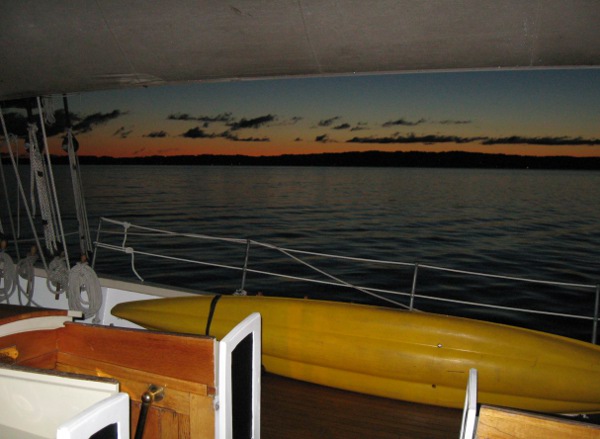
Daybreak from the deck of the Manitou at 6:56 a.m.
The twilight showed a line of clouds just above the eastern horizon. It looked like the day was going to be great for sailing. At 7 a.m. Brent of the galley crew brought out coffee and scones.
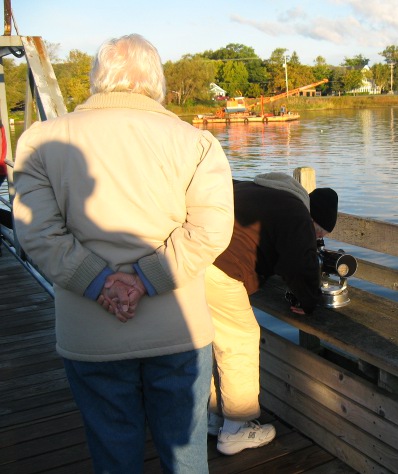
A passenger looking at the sun through the Questar
Not knowing how long it was going to be brfore we sailed, I brought out the Questar with it’s solar filter and set it up on a bench on the dock. There was one good sunspot visible.
8 a.m. was breakfast. All 20 plus passengers squeezed into the galley. Chief cook Lulu fed us some wonderful meals during the trip, including this breakfast.
Captain Dave came aboard before breakfast and after breakfast gave us our morning briefing. We would cast off at 10 a.m. so some of us could go ashore to get some last minute items.
We had a deck crew of 4 headed by Cheyenne who was also a certified captain. She captained by earlier 2 hour cruise Labor Day weekend that I was on. Also in the crew were Neil, who grew up in Suttons Bay, Matt who really looked like a old fashoned deck hand with his beard, and Ann a crewman from a prior year who volunteered for the cruise.
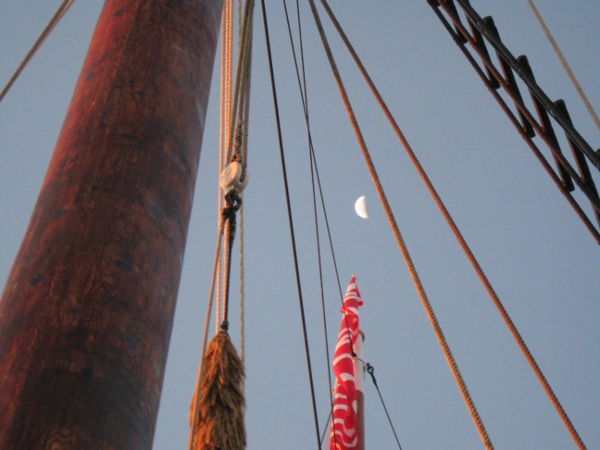
The moon through the rigging
Besides 6 sails, the Manitou has a diesel engine and we motored away from the dock. After a bit Captain Dave headed the Manitou into the wind to begin the process of raising the sails. The crew got at least 6 of us passengers lined on either side of the deck forward of the main mast to raise the mainsail. The Manitou is a gaff-rigged schooner in that its main and fore sails are trapezoidal in shape being stretched between the boom on the bottom and the gaff at the top. The port line raised the throat of the gaff next to the mast, while the line on the starboard side raised the peak of the gaff. I was on the port side when the time cane our side shouted to the captain “Ready on the throat!” The other side shouted “Ready on the peak!” At the signal we hauled away. As we were raising more and more canvas the task grew harder. Near the end we end we gave some mighty pulls with commands of 2-6-Heave.
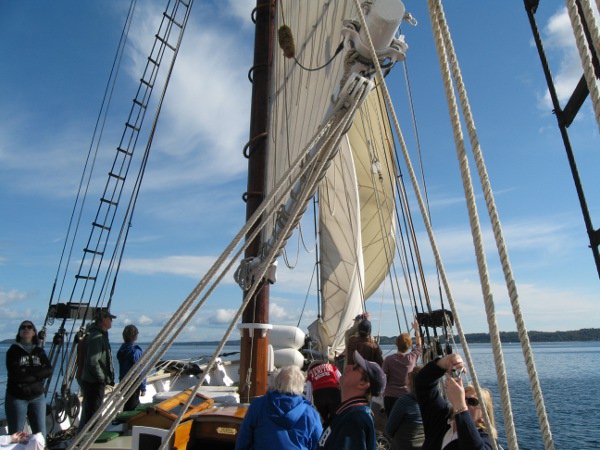
The crew unfurls the staysails
The foresail was easier taking only three on a side and pulling vertically. The crew then unfurled the three stay sails attached between the foremast and the bowsprit.
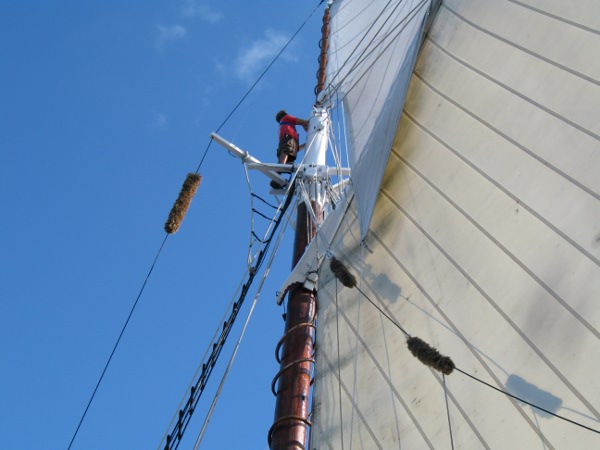
Matt unfurls the topsail
Last to go up was the topsail. Matt climbed up to set that sail.

The Manitou under full sail (From the Traverse Tall Ship Co. Website)
We headed northward from the southwest shore of the west arm of Grand Traverse bay under a light westerly breeze. That breeze died just as we tacked to the west to clear the shoals off Power Island. The map below shows it as Marion Island. I recall that it was even named Ford Island being once owned by Henry Ford, but I can’t find anything on the Internet about it.
Captain Dave resorted to starting the diesel engine to make up some time. The wind came up in the early afternoon, but this time from the north which put Omena and Northport out of range for the day. Also it was becoming overcast. Lulu fixed us lunch including French onion soup. It was delicious!
We tacked back and forth in West Bay (the west arm of the Grand Traverse Bay) in order to clear the Old Mission Light and so to enter East Bay and head south with the wind to anchor in Old Mission Harbor. Along the way we saw rain showers in the distance. I may be wrong but I’d say they were lake effect showers from the cold air blowing over the warm waters of Lake Michigan.
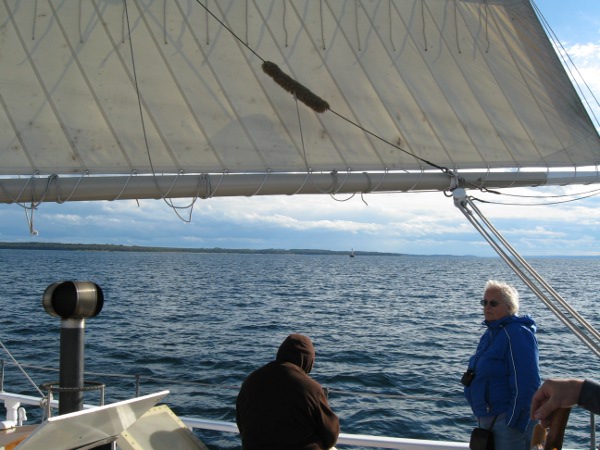
We're passing Old Mission Light to enter East Bay
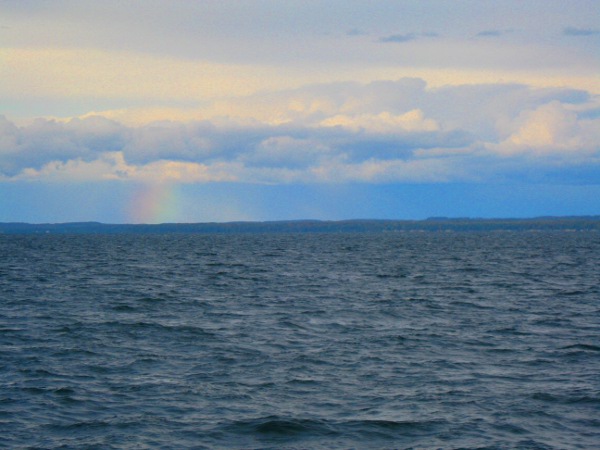
Rainbow spotted in the late afternoon
Toward the end of our sail that day we saw a rainbow in the distance. It was truncated because it was in the distance and the clouds were low. After we anchored in Old Mission Bay we had dinner and the Zodiac boat was lowered from the davits at the stern of the Manitou to let those who wanted to go ashore.
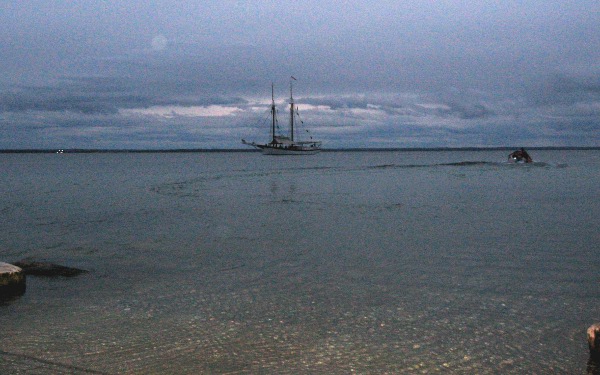
The Manitou in Old Mission Harbor with the Zodiac returning for more passengers
Old Mission was actually the oldest continuous settlement in the Grand Traverse Bay area, even older than Traverse City. It was founded in 1839 by the Rev. Dougherty who started a mission there to convert the local Native Americans. Some of headed to the Old Mission General Store for ice cream. That place is all decked out as a depression era store. It is run by a cranky old guy who forbids the taking of photographs inside. But the Moomers ice cream was worth the visit. After this we headed back to the dock in the dark, and our warm beds aboard the Manitou..
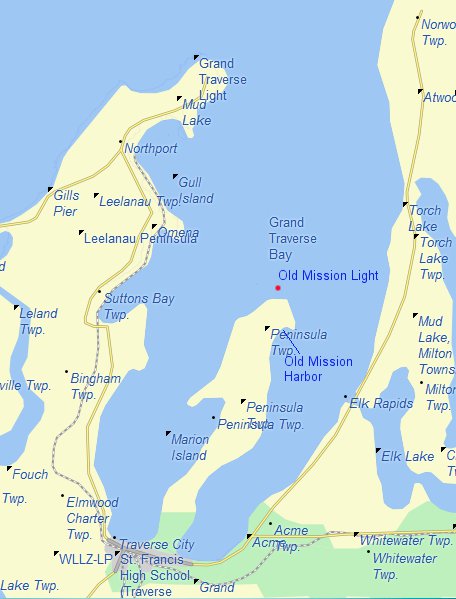
Map of Grand Traverse Bay from Wiki Mini Atlas

