Archive
11/24/2016 – Ephemeris – The little constellation that used to start the seasonal year
Ephemeris for Thanksgiving Day, Thursday, November 24th. The Sun will rise at 7:52. It’ll be up for 9 hours and 14 minutes, setting at 5:06. The Moon, 3 days past last quarter, will rise at 3:54 tomorrow morning.
From antiquity, the first constellation of the Zodiac has been Aries the ram. That’s the constellation the Sun entered on the first day of spring, or the vernal equinox. Well that was a couple of thousand years ago. Currently the vernal equinox point is in western Pisces. This is due to the wobbling of the Earth’s axis called precession. The spinning Earth like and top or gyroscope wobbles when force is applied to it. In this case the Sun and Moon. One wobble takes 26,000 years to complete. Anyway, Aries is a small constellation of four stars in a bent line, below the triangular constellation of Triangulum, which is itself below Andromeda. It’s a bit west or right of the Pleiades or Seven Sisters star cluster.
Times are for the Traverse City/Interlochen area of Michigan. They may be different for your location.
Addendum
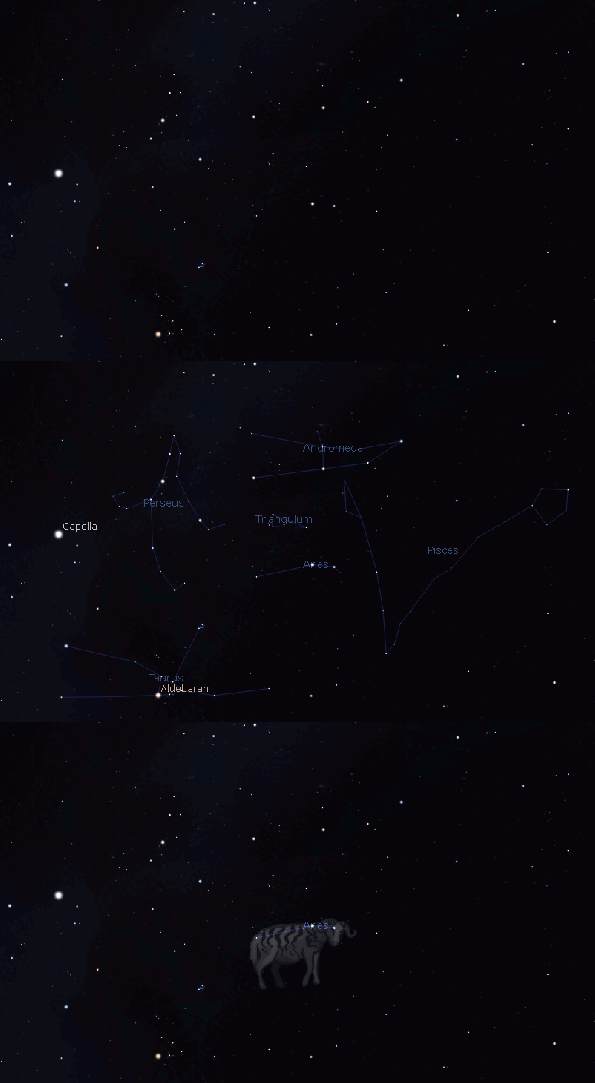
Aries the ram animated finder chart for 9 p.m. November 24, 2016. Created using Stellarium and GIMP.
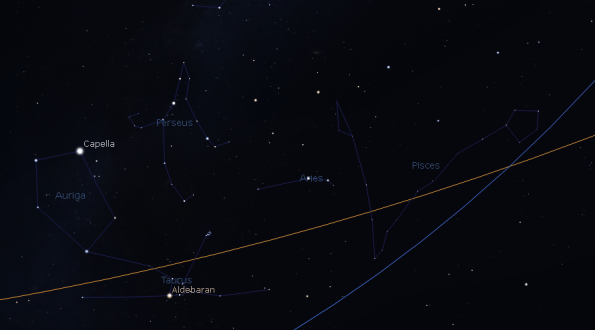
The vernal equinox today, where the blue line, the celestial equator and the orange line, the ecliptic or path of the Sun cross. The Sun is where these lines cross on the first day of spring (March 20th around here). Note that the vernal equinox is now in western Pisces. Created using Stellarium.
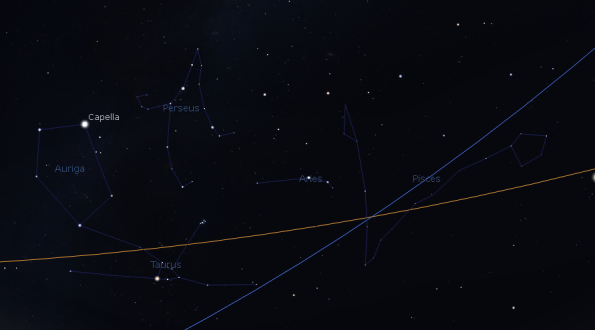
The vernal equinox back in AD 100, where the blue line, the celestial equator and the orange line, the ecliptic or path of the Sun cross. The Sun is where these lines cross on the first day of spring. Note that the vernal equinox was at the east edge of Pisces. Created using Stellarium.
10/27/2016 – Ephemeris – Finding the Great Andromeda Galaxy
Ephemeris for Thursday, October 27th. The Sun will rise at 8:14. It’ll be up for 10 hours and 23 minutes, setting at 6:37. The Moon, 3 days before new, will rise at 6:02 tomorrow morning.
The closest large galaxy to our Milky Way galaxy is the Great Andromeda Galaxy seen in the eastern sky when it gets dark. It is barely visible to the naked eye. To locate it first find the Great Square of Pegasus high in the east, standing on one corner. The left star of the square is the head of the constellation Andromeda. Follow two stars to the left and a bit downward, then two stars straight up. The galaxy is near that last star as a small smudge of light. Binoculars are the best way to see it as a thin spindle of light. A telescope can see only the bright nucleus of the galaxy, that spans 6 Moon diameters in photographs. M31 is its first catalog designation and it is two and a half million light years away.
Times are for the Traverse City/Interlochen area of Michigan. They may be different for your location.
Addendum
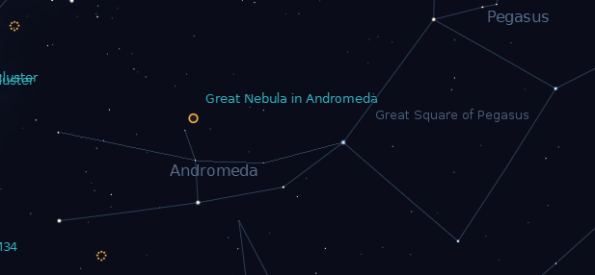
Andromeda in the evening with the Great Andromeda Galaxy. Astronomers called it a nebula before the discovered it was a galaxy like the Milky Way. Created using Stellarium.
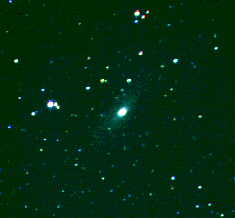
The Great Andromeda Galaxy (M31) as seen in binoculars. Visually even in a telescope the hub of this galaxy is all that is seen. However it also can be seen with the naked eye. My photograph.
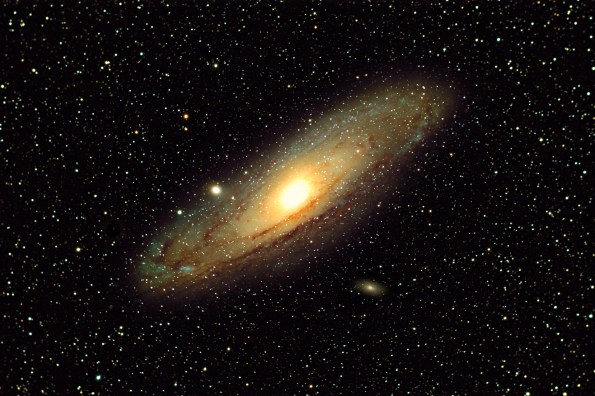
The Great Andromeda Galaxy (M31). Image taken by Scott Anttila.
10/20/2016 – Ephemeris – Perseus: Is it a hero or a chicken?
Ephemeris for Thursday, October 20th. The Sun will rise at 8:05. It’ll be up for 10 hours and 43 minutes, setting at 6:48. The Moon, 2 days before last quarter, will rise at 10:54 this evening.
Positioned below the W shaped constellation of Cassiopeia half way up the sky in the northeast at 9 p.m. is the constellation of Perseus the hero of Greek myth who slew Medusa and rescued and married Andromeda represented in the constellation above and right of him. Rather than a hero the star pattern seems to look like a chicken or perhaps Big Bird. At least, that’s how I see it. In the back of the chicken is its brightest star Mirfak (Mirphak). Binoculars will show a beautiful group of stars near Mirfak just below unaided eye visibility called the Alpha Persei Association. Tomorrow morning will see the peak of the Orionid meteor shower, though all but the brightest meteors will be overwhelmed by waning gibbous Moon.
Times are for the Traverse City/Interlochen area of Michigan. They may be different for your location.
Addendum
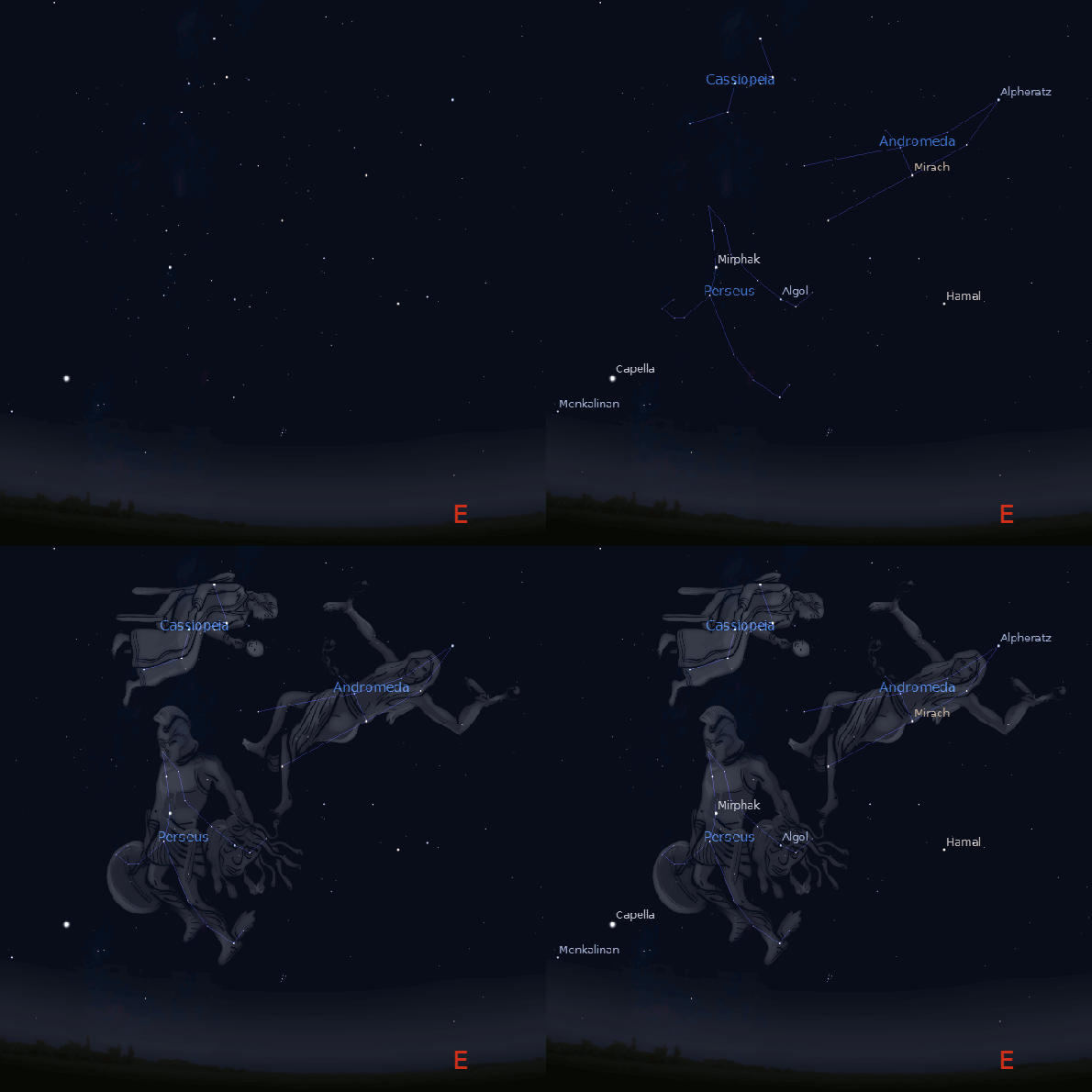
Perseus with Cassiopeia and Andromeda in the northeast at 9 p.m. October 20, 2016. Created using Stellarium and GIMP.
09/27/2016 – Ephemeris – The princess Pegasus helped save
Ephemeris for Tuesday, September 27th. The Sun will rise at 7:36. It’ll be up for 11 hours and 53 minutes, setting at 7:29. The Moon, 3 days before new, will rise at 5:08 tomorrow morning.
In the east at 9 this evening can be found a large square of stars standing on one corner, the Great Square of Pegasus the flying horse. What look like its hind legs stretching to the left from the left corner star is another constellation, Andromeda the chained princess. She is seen in the sky as two diverging upward curving strings of three stars each. She was rescued by the hero Perseus, a nearby constellation, riding Pegasus. Andromeda’s claim to astronomical fame is the large galaxy seen with the unaided eye just above the upper line of stars, the Great Andromeda Galaxy, 2.5 million light years away. To the unaided eye the galaxy appears as a small smudge of light. In binoculars the galaxy is a delicate spindle of light.
Times are for the Traverse City/Interlochen area of Michigan. They may be different for your location.
Addendum
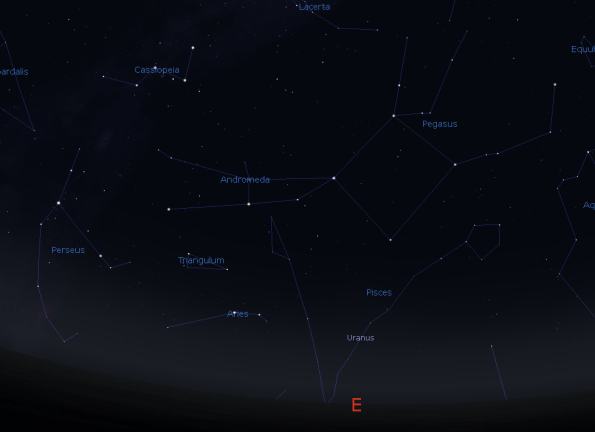
Andromeda, Pegasus and Perseus in the east. Created using Stellarium.
I added some constellation lines to Andromeda since yesterday to match the transcript and how I see her. Looks like I have some work to do with Perseus, before I talk about him later on. He doesn’t look like a chicken enough. I’m going for laughs here.
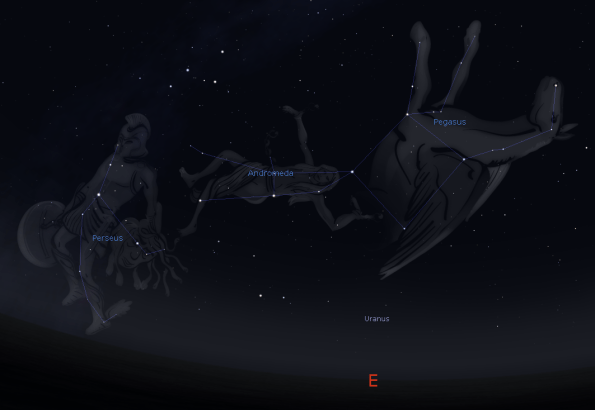
Andromeda. Pegasus and Perseus in the east. Created using Stellarium, art by Johan Meuris.
09/26/2016 – Ephemeris – Pegasus flies through autumn skies
Ephemeris for Monday, September 26th. The Sun will rise at 7:35. It’ll be up for 11 hours and 56 minutes, setting at 7:31. The Moon, 3 days past last quarter, will rise at 4:05 tomorrow morning.
Rising and almost half way up the sky in the east at as it gets dark around 9 p.m. can be found one of the great autumn constellations: Pegasus the flying horse of Greek myth. Its most visible feature is a large square of four stars, now standing on one corner. This feature, called the Great Square of Pegasus, represents the front part of the horse’s body. The horse is quite aerobatic, because it is seen flying upside down. Remembering that fact, the neck and head is a bent line of stars emanating from the right corner star of the square. Its front legs can be seen in a gallop extending to the upper right from the top star of the square. From the left star extend, not hind legs but the constellation of Andromeda, rescued with the help of Pegasus.
Times are for the Traverse City/Interlochen area of Michigan. They may be different for your location.
Addendum
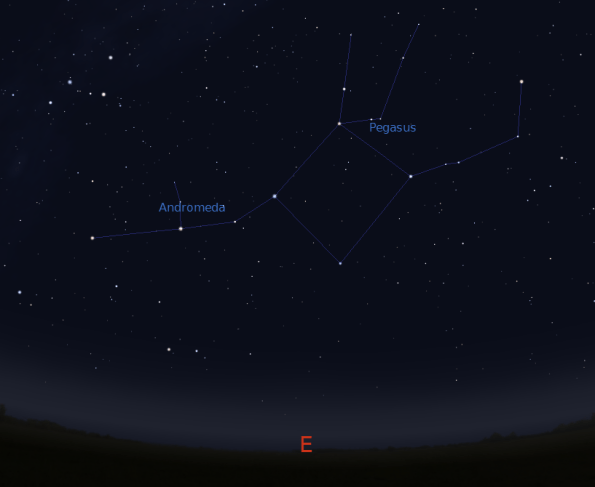
Pegasus and Andromeda in the east. Created using Stellarium.
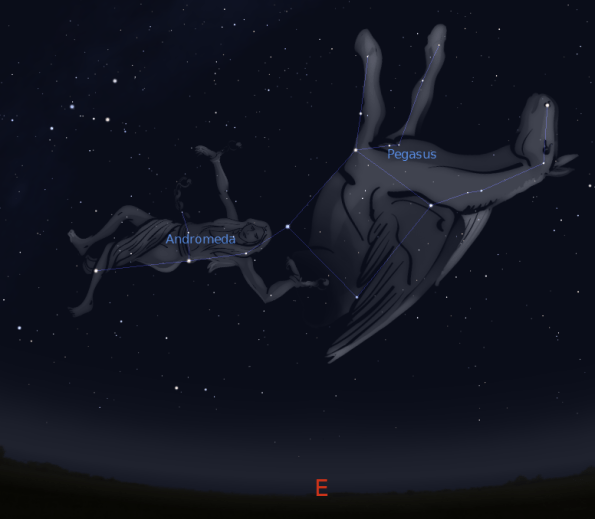
Pegasus and Andromeda in the east. Created using Stellarium, art by Johan Meuris.
09/10/2015 – Ephemeris – Andromeda the chained maiden
Ephemeris for Thursday, September 10th. The Sun will rise at 7:15. It’ll be up for 12 hours and 47 minutes, setting at 8:03. The Moon, 3 days before new, will rise at 5:40 tomorrow morning.
In the east at 10 this evening can be found a large square of stars, the Great Square of Pegasus the flying horse. The square is standing on one corner. What look like its hind legs stretching to the left from the left corner star is another constellation, Andromeda the chained maiden. She is seen in the sky as two diverging curved strings of stars that curve upward. She was rescued by the hero Perseus, a nearby constellation, riding his steed Pegasus. Andromeda’s claim to astronomical fame is the large galaxy seen with the unaided eye just above the upper line of stars. The Great Andromeda Galaxy is two and a half million light years away. To the unaided eye the galaxy appears as a small smudge of light. In binoculars the galaxy is a delicate spindle of light. The galaxy is known as M31, the 31st object on Charles Messier’s list of fuzzy objects that aren’t comets.
Times are for the Traverse City/Interlochen area of Michigan. They may be different for your location.
Addendum
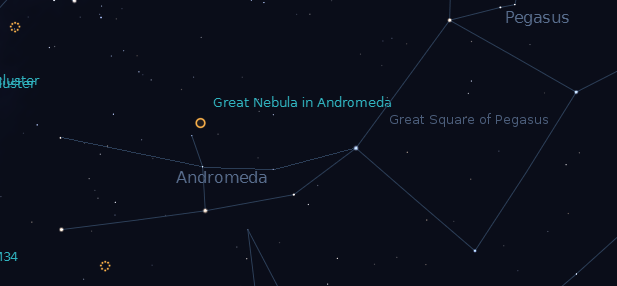
Andromeda at 10 p.m. with the Great Andromeda Galaxy. Created using Stellarium.
09/18/2014 – Ephemeris – The constellation Pegasus the aerobatic horse
Ephemeris for Thursday, September 18th. The sun will rise at 7:24. It’ll be up for 12 hours and 22 minutes, setting at 7:47. The moon, 3 days past last quarter, will rise at 3:02 tomorrow morning.
Rising in the east at as it gets dark around 9 p.m. can be found one of the great autumn constellations: Pegasus the flying horse of Greek myth. Its most visible feature is a large square of four stars, now standing on one corner. This feature, called the Great Square of Pegasus, represents the front part of the horse’s body. The horse is quite aerobatic, because it is seen flying upside down. Remembering that fact, the neck and head is a bent line of stars emanating from the right corner star of the square. Its front legs can be seen in a gallop extending to the upper right from the top star of the square. From the left star extend, not hind legs but the constellation of Andromeda, a fascinating constellation in its own right.
Times are for the Traverse City/Interlochen area of Michigan. They may be different for your location.
Addendum
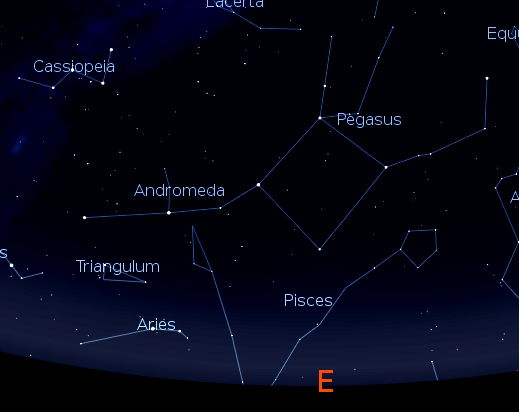
Pegasus at 9 p.m. Chart created using Stellarium.
09/05/2013 – Ephemeris – The constellation of Andromeda, the chained maiden
Ephemeris for Thursday, September 5th. The sun will rise at 7:09. It’ll be up for 13 hours and 1 minute, setting at 8:11. The moon is new today, and won’t be visible.
In the east at 10 this evening can be found a large square of stars, the Great Square of Pegasus the flying horse. The square is standing on one corner. What look like its hind legs stretching to the left from the left corner star is another constellation, Andromeda the chained maiden. She is seen in the sky as two diverging curved strings of stars that curve upward. She was rescued by the hero Perseus, a nearby constellation, riding his steed Pegasus. Andromeda’s claim to astronomical fame is the large galaxy seen with the unaided eye just above the upper line of stars, the Great Andromeda Galaxy, two and a half million light years away. To the unaided eye the galaxy appears as a small smudge of light. In binoculars the galaxy is a delicate spindle of light.
Times are for the Traverse City/Interlochen area of Michigan. They may be different for your location.
Addendum
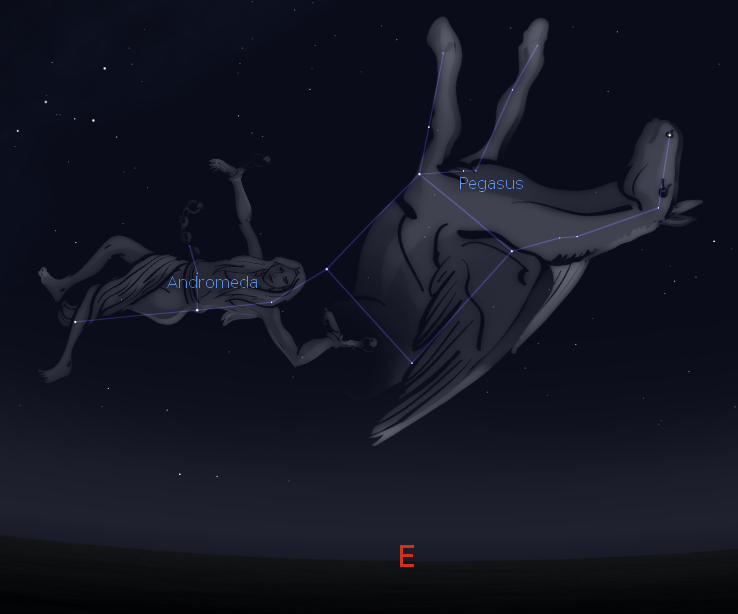
Andromeda and Pegasus images in the stars at 10 p.m. September 5, 2013. Created using Stellarium. Drawing by Johan Meuris.
The constellation lines in Stellarium omit the top strong of stars I see in Andromeda. I’m working on changing that.
10/12/2012 – Ephemeris – The constellation of Andromeda and its great galaxy
Ephemeris for Friday, October 12th. The sun will rise at 7:54. It’ll be up for 11 hours and 7 minutes, setting at 7:02. The moon, 3 days before new, will rise at 5:42 tomorrow morning.
In the east at 9 this evening can be found a large square of stars, the Great Square of Pegasus the flying horse. The square is standing on one corner. What look like its hind legs stretching to the left from the left corner star is another constellation, Andromeda the chained maiden. She is seen in the sky as two diverging curved strings of stars that curve upward. She was rescued by the hero Perseus, a nearby constellation, riding his steed Pegasus. Andromeda’s claim to astronomical fame is the large galaxy seen with the unaided eye just above the upper line of stars, the Great Andromeda Galaxy, nearly 2 and a half million light years away. To the unaided eye the galaxy appears as a small smudge of light. In binoculars the galaxy is a delicate spindle of light.
Times are for the Traverse City/Interlochen area of Michigan. They may be different for your location.
Addendum
Andromeda at 9 p.m. with the Great Andromeda Galaxy. Created using Stellarium.
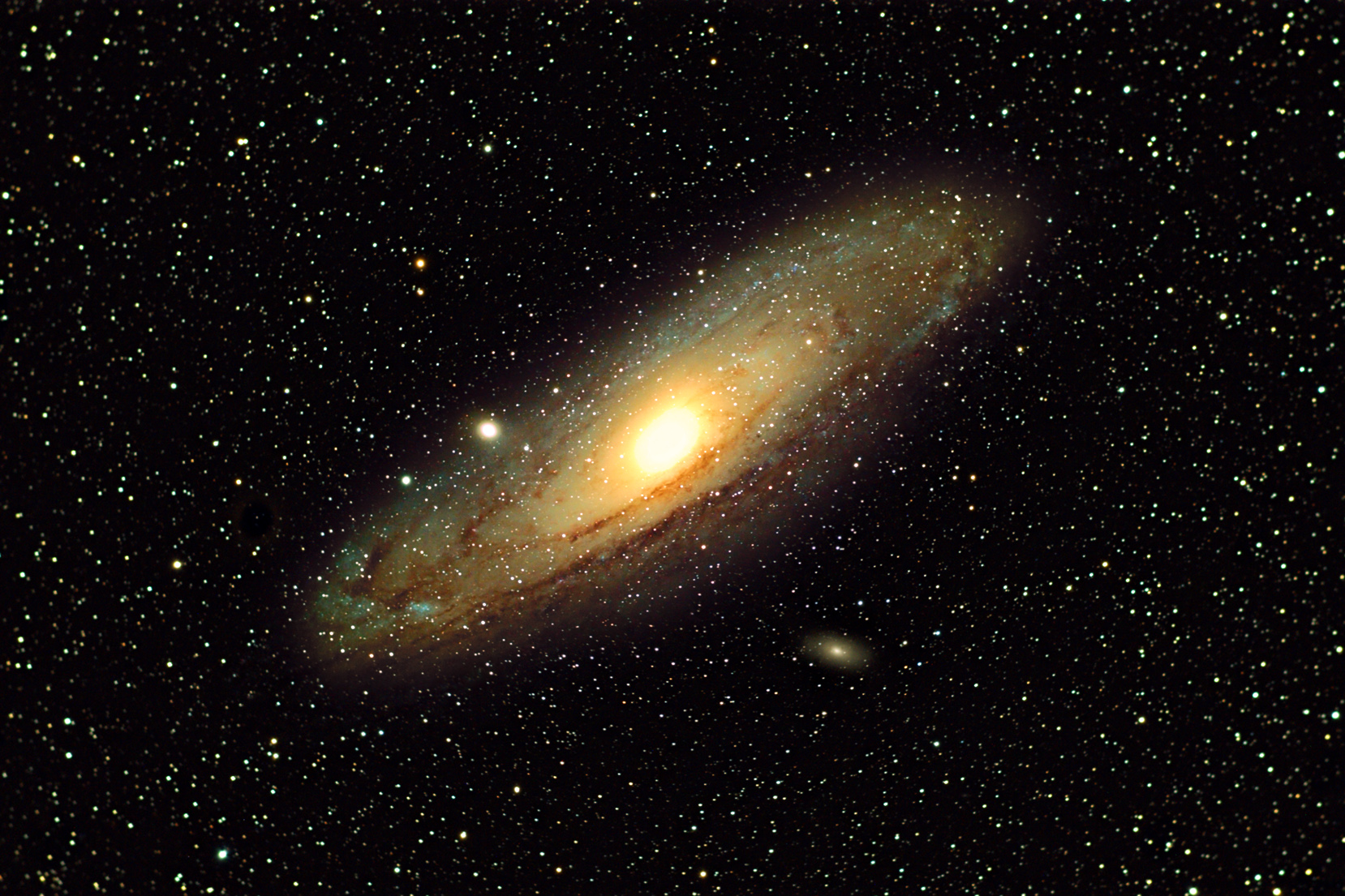
The Great Andromeda Galaxy (M31). Image taken by Scott Anttila.
09/20/11 – Ephemeris – The constellation Andromeda
Tuesday, September 20th. The sun will rise at 7:26. It’ll be up for 12 hours and 17 minutes, setting at 7:44. The moon, at last quarter today, will rise at 12:33 tomorrow morning.
In the east southeast at 9 this evening can be found a large square of stars, the Great Square of Pegasus the flying horse. The square is standing on one corner. What look like its hind legs stretching to the left from the left corner star is another constellation, Andromeda the chained maiden. She is seen in the sky as two diverging curved strings of stars that curve upward. She was rescued by the hero Perseus, a nearby constellation, riding his steed Pegasus. Andromeda’s claim to astronomical fame is the large galaxy seen with the unaided eye just above the upper line of stars. The Great Andromeda Galaxy is two and a half million light years away. To the unaided eye the galaxy appears a a small smudge of light. In binoculars the galaxy is a delicate spindle of light.
* Times are for the Traverse City/Interlochen area of Michigan. They may be different for your location.
Addendum
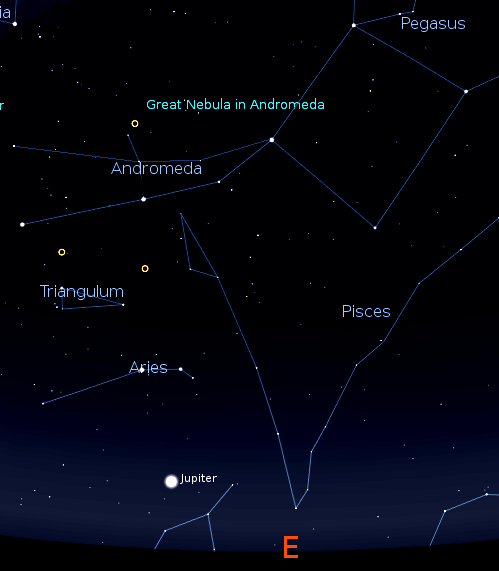
The Constellation Andromeda. Created using Stellarium.
The Great Andromeda Galaxy (M31). Image taken by Scott Anttila.
Click on image for full size version.
Stellarium has it by its old name the Great Andromeda Nebula, before it was reclassified as an island universe (obsolete) or galaxy.

