Archive
01/19/2012 – Ephemeris – The moon will pass the bright star Antares this morning
Ephemeris for Thursday, January 19th. The sun will rise at 8:13. It’ll be up for 9 hours and 19 minutes, setting at 5:32. The moon, 3 days past last quarter, will rise at 5:52 tomorrow morning.
This morning, you might want to take a quick peek outside to the southeast and see, if you can spot the crescent moon. If you can below and a bit right of it is a bright red star. That star is Antares in the constellation Scorpius, one of the first constellations of summer to appear in the evening sky. I thought you’d like the encouragement that summer is coming now that winter has finally come in earnest. The moon passes Antares every month, but this morning it appears especially close, since their actual closest approach was about 2 this morning. The entire moon may be faintly visible this morning as earthshine. Antares itself may be twinkling merrily due to earth’s atmosphere. It sometimes looks like a sparkler in binoculars.
* Times, as always are for the Traverse City/Interlochen area of Michigan.
Addendum
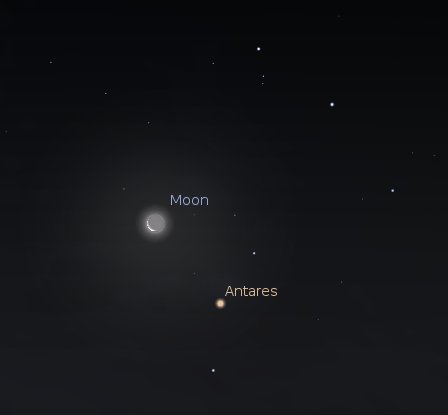
The Moon passes Antares in the morning hours of January 19, 2012. Created using Stellarium.
08/29/11 – Ephemeris – The twinkly red star Antares
Monday, August 29th. The sun will rise at 7:01. It’ll be up for 13 hours and 23 minutes, setting at 8:24. The moon, 1 day past new, will set at 8:19 this evening.
As it gets dark this evening a bright reddish star will appear low in the south. It will appear to twinkle mightily. It is not the planet Mars, which is now in the morning sky, but its rival the star Antares in Scorpius the scorpion. The star’s name, Antares, notes the rivalry. “Ant” means anti, while “Ares” is the Greek name for the Roman god Mars. Antares literally means “Rival of Mars”. Antares appears red due to its cool surface temperature of 3,600 Kelvin, much cooler than the sun’s 6,000 Kelvin, while Mars is red due to rust. As Antares starts to set later in the evening its light will mass through more of earth’s turbulent atmosphere making it sparkle like a multicolored sparkler. Antares spectacular twinkling has sparked more than a few calls about a strange light in the sky.
* Times are for the Traverse City/Interlochen area of Michigan. They may be different for your location
07/19/11 – Ephemeris – The brightest stars visible now in the evening
Tuesday, July 19th. Today the sun will be up for 15 hours and 6 minutes, setting at 9:21. The moon, half way from full to last quarter, will rise at 11:11 this evening. Tomorrow the sun will rise at 6:15.
Let’s check out all the bright stars in the evening sky, as it gets dark tonight. High in the west is the bright yellow-orange star Arcturus. In the northwest is the Big Dipper, whose curved handle points to Arcturus. Straightening that curve to a spike will point to Spica a blue-white star low in the southwest. The bright star to its right isn’t. It’s the planet Saturn. In the south is the red star Antares which usually twinkles merrily. High in the east is the bright white star Vega. To its lower right is Altair, and to its lower left the star Deneb. Vega, Altair and Deneb make the Summer Triangle, whose rising in the east signals the coming of summer. Always present for us in northern Michigan is Capella very low in the north.
* Times are for the Traverse City/Interlochen area of Michigan. They may be different for your location.
Addendum
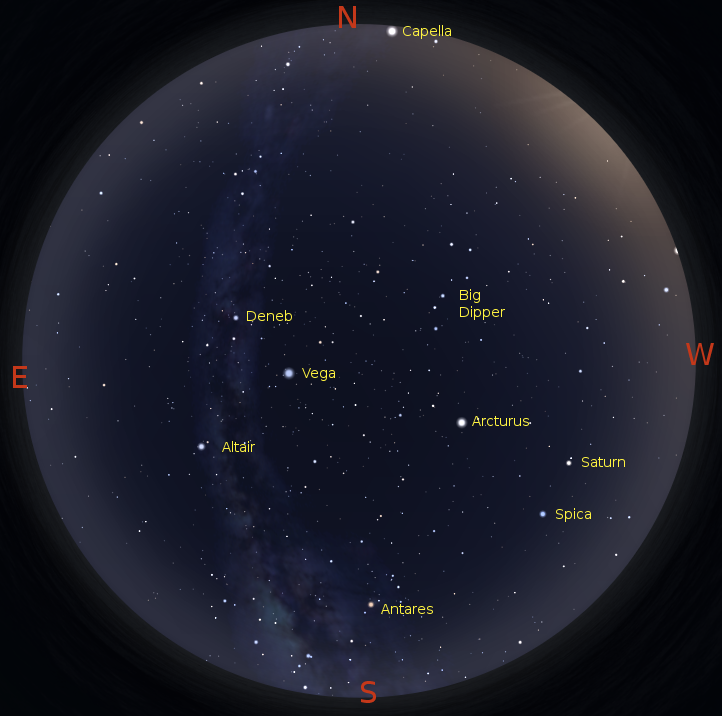
Bright Summer Stars. Created using Stellarium.
Click on the image to enlarge. This is a whole sky chart. The round edge is the horizon. BTW the star Capella, very low in the north, is a winter star, but it’s visible all year round for folks north of 44 degrees north latitude.
07/04/11 – Ephemeris – Red, white and blue stars
Independence Day, Monday, July 4th. Today the sun will be up for 15 hours and 27 minutes, setting at 9:30. The moon, 3 days past new, will set at 11:22 this evening. Tomorrow the sun will rise at 6:03.
Today’s Independence Day so let’s look for some red, white, and blue stars. Red is easy, the red star Antares is seen in the south at 11 p.m. White is easy too, the official white calibration star Vega high in the east at 11 p.m. The blue star is really blue-white. The brightest of these out at 11 p.m. is Spica, low in the southwest. The color is best seen in binoculars. Star colors are quite subtle, and are an indicator of the temperature of their outer gaseous layers. The temperature of a stars outer layers, in order of their increasing temperatures, red, white and blue, is not related to the temperature in their cores. Of these three the coolest on the outside, Antares is really the hottest inside, using helium as fuel.
* Times are for the Traverse City/Interlochen area of Michigan. They may be different for your location.
 Bob Moler's Ephemeris Blog