Archive
07/04/2014 – Ephemeris – Find patriotic red, white and blue stars
Ephemeris for Independence Day, Friday, July 4th. Today the sun will be up for 15 hours and 27 minutes, setting at 9:30. The moon, 1 day before first quarter, will set at 1:03 tomorrow morning. Tomorrow the sun will rise at 6:03.
On this patriotic day let’s look for some red, white, and blue stars. Red is easy, the red star Antares is seen in the south at 11 p.m. Mars, the red planet, in the southwest, can be added even though it’s not technically a star. White is easy too, the official white calibration star Vega high in the east at 11 p.m. The blue star is really blue-white. The brightest of these out at 11 p.m. is Spica, low in the southwest. The color is best seen in binoculars. Star colors are quite subtle, and are an indicator of the temperature of their outer gaseous layers. The temperature of a stars outer layers, in order of their increasing temperatures, red, white and blue, is not related to the temperature in their cores. Of these three the coolest on the outside, Antares is really the hottest inside, using helium as fuel.
Times are for the Traverse City/Interlochen area of Michigan. They may be different for your location.
Addendum
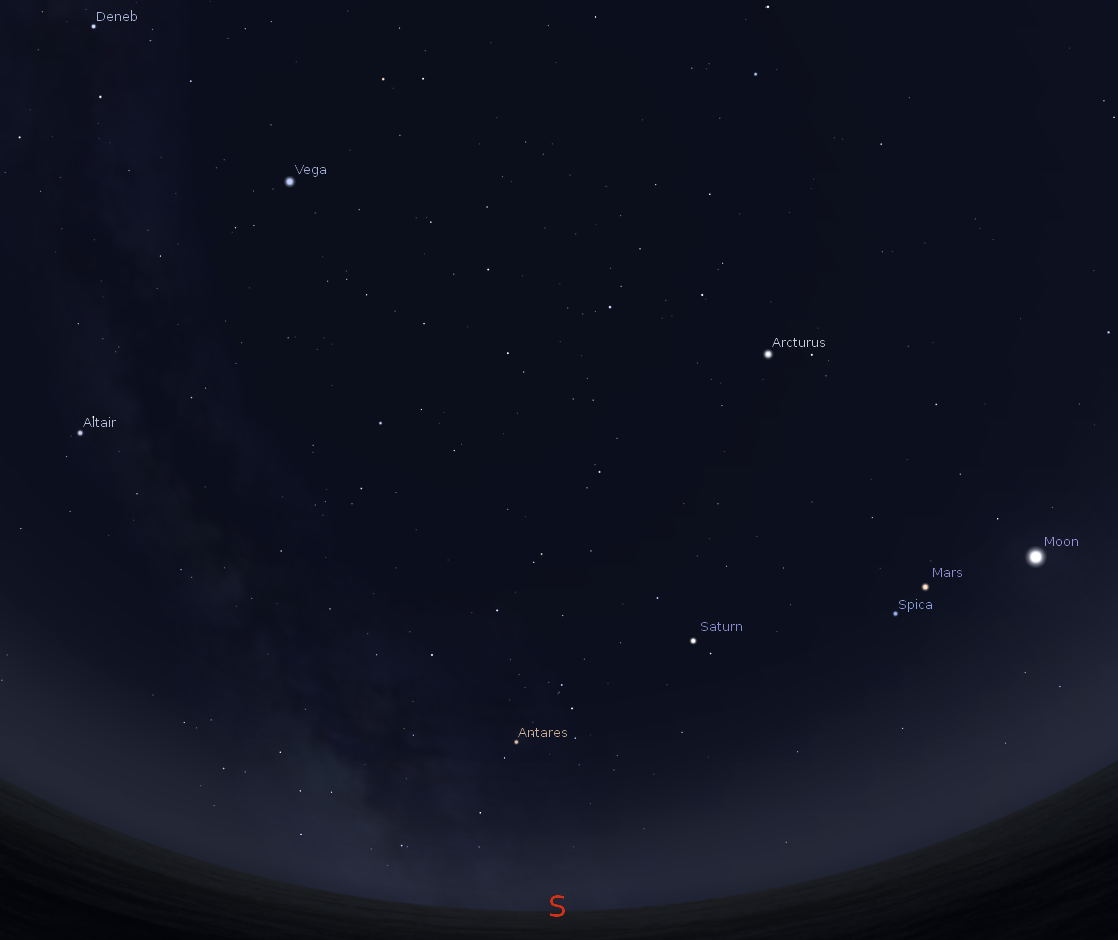
Red white and blue stars for Independence Day at 11 p.m. on July 4, 2014. Created using Stellarium.
06/30/2014 – Ephemeris – The celestial snake handler
Ephemeris for Monday, June 30th. Today the sun will be up for 15 hours and 30 minutes, setting at 9:31. The moon, 3 days past new, will set at 11:14 this evening. Tomorrow the sun will rise at 6:01. | The red star Antares shines in the south at 11 p.m. In the constellation of Scorpius. In the area of sky above and a little to the left lies a large constellation of faint stars called Ophiuchus, the serpent bearer. The constellation shape is like a large bell, which reminds me of the head, shoulders and arms of a fellow that’s holding the snake-like a weight lifter pulling up a heavy bar bell. The serpent he’s holding is Serpens, the only two-part constellation in the heavens. The head rises to Ophiuchus’ right and the tail extends up to the left. In legend Ophiuchus was a great physician, educated by the god Apollo, and the centaur Chiron, also found in the stars as Sagittarius, now rising below and left of him.
Times are for the Traverse City/Interlochen area of Michigan. They may be different for your location.
Addendum
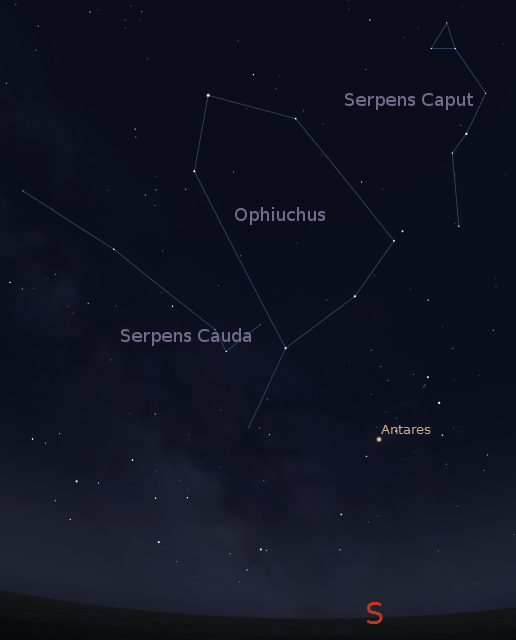
Ophiuchus and Serpens at 11 p.m.. Created using Stellarium.
07/16/2013 – Ephemeris – The red giant star Antares
Ephemeris for Tuesday, July 16th. Today the sun will be up for 15 hours and 11 minutes, setting at 9:23. The moon, 1 day past first quarter, will set at 1:24 tomorrow morning. Tomorrow the sun will rise at 6:13.
Low in the south is the red giant star Antares. It lies at the heart of Scorpius the scorpion. Its name means Rival of Mars, because it has the same hue as the red planet. In Mars case the color comes from iron oxide, rust. In Antares case it has a cool surface temperature, relatively speaking of 5,700 degrees Fahrenheit. As a red giant star Antares is near the end of its life, though for a star Antares is young, possibly 12 million years old. That that age the sun was just getting started. But Antares with around 15 to 17 the sun’s mass has already run out of fusible hydrogen in its core and bloated out to over Mars orbit in size. Antares is 450 light years away and has a companion star in its system that looks greenish in contrast to Antares red. However when Antares A, the red giant’s light is blocked, the companion looks bluish.
Times are for the Traverse City/Interlochen area of Michigan. They may be different for your location.
Addendum
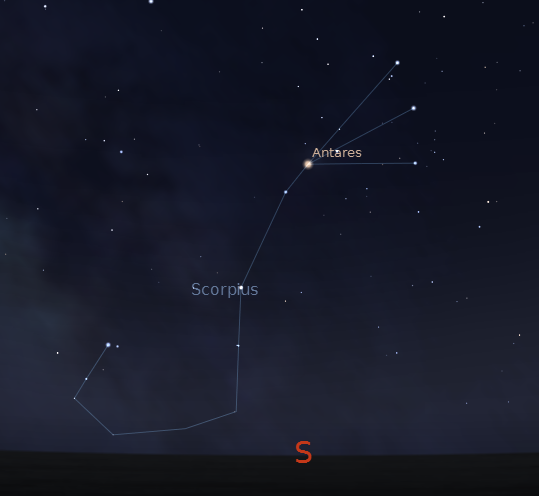
The constellation Scorpius and the star Antares. Created using Stellarium.
07/04/2013 – Ephemeris – Patriotic Stars: Red, White and Blue
Ephemeris for Independence Day in the United States, Thursday, July 4th. Today the sun will be up for 15 hours and 27 minutes, setting at 9:30. The moon, half way from last quarter to new, will rise at 4:05 tomorrow morning. Tomorrow the sun will rise at 6:03.
Today is Independence Day so let’s look for some red, white, and blue stars. Red is easy, the red star Antares is seen in the south at 11 p.m. White is easy too, the official white calibration star Vega high in the east at 11 p.m. The blue star is really blue-white. The brightest of these out at 11 p.m. is Spica, low in the southwest to the right of the brighter Saturn. The color is best seen in binoculars. Star colors are quite subtle, and are an indicator of the temperature of their outer gaseous layers. The temperature of a stars outer layers, in order of their increasing temperatures are red, white and blue. Of these three the coolest on the outside, Antares is really the hottest inside, using helium as fuel.
Times are for the Traverse City/Interlochen area of Michigan. They may be different for your location.
Addendum
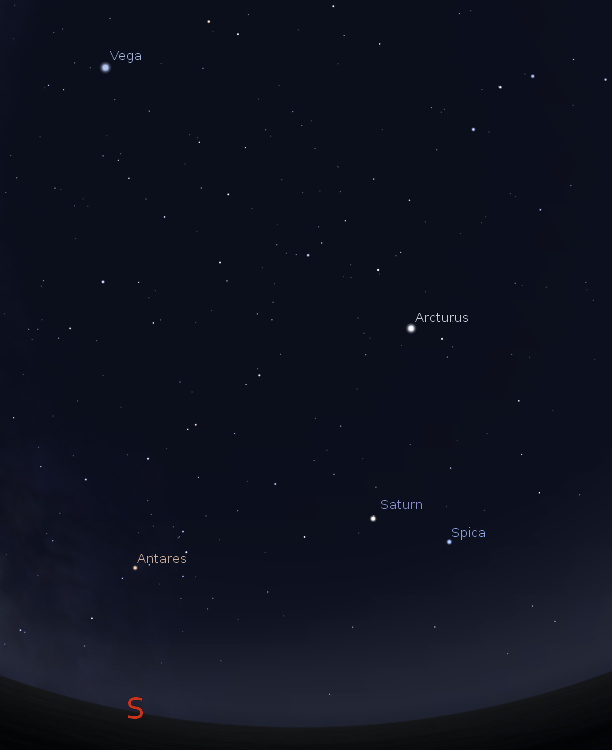
Red Antares, white Vega and blue Spica. Patriotic Stars this evening. Created using Stellarium.
06/06/2013 – Ephemeris – Star colors
Ephemeris for Thursday, June 6th. Today the sun will be up for 15 hours and 26 minutes, setting at 9:24. The moon, 2 days before new, will rise at 5:22 tomorrow morning. Tomorrow the sun will rise at 5:57.
Star and planets colors are quite subtle. This is partly due to the fact that we are color blind at very low light levels. Only the brightest stars show color at all. Telescopes however aid our color perception because it makes the stars brighter. The planet Saturn, now in the south at night has a distinct yellowish hue, caused by the color of its atmosphere. The star Spica to its right is the bluest of the bright first magnitude stars, and shows as a bright arc light. Arcturus, above both Saturn and Spica has a yellow to orange hue. Antares low in the southeast has a definite reddish hue. In a telescope it also looks like a sparkler due to our turbulent atmosphere. Red stars are the coolest stars (temperature wise) while blue-white stars are the hottest.
Times are for the Traverse City/Interlochen area of Michigan. They may be different for your location.
Addendum
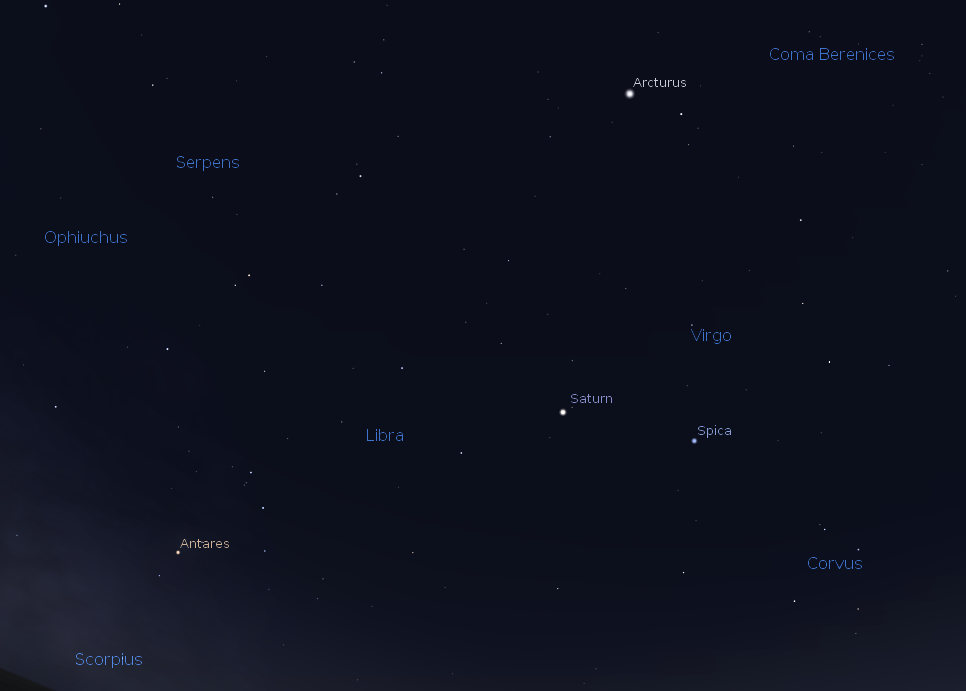
Stellarium does a pretty good job of showing the subtle colors of stars, which is also reflected in the color of the star labels. Click on the image to enlarge.
10/17/2012 – Ephemeris – Autumn wonders for binoculars or small telescope: The Alpha Persei Association
Ephemeris for Wednesday, October 17th. The sun will rise at 8:00. It’ll be up for 10 hours and 52 minutes, setting at 6:53. The moon, 2 days past new, will set at 8:21 this evening.
Let’s see how many bright planets we can find this week. At 8 p.m. Mars can be seen low in the southwest approaching another red star Antares, whose name means rival of Mars. They will be closest in a few days. The moon will be nearby too. Mars will set at 8:45. The planetary action moves to later in the evening and the morning. Jupiter, will rise at 9:17 p.m. in the east northeast. It is located in the constellation of Taurus. It will transit or pass due south at 4:52 a.m. The last bright planet of the night is the morning star Venus which will rise at 4:44 a.m. also in the east. Venus is now below the hind end of Leo. The planets Venus and Jupiter and the winter constellations are a great sight for early risers. You can enjoy for a few more weeks without danger of frost bite.
Times are for the Traverse City/Interlochen area of Michigan. They may be different for your location.
Addendum
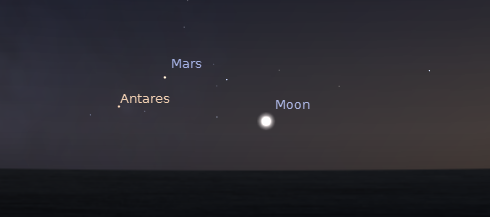
Mars, Antares, and the moon at 7:50 p.m. on October 17, 2012. Created using Stellarium.
The moon at this scale is over exposed.
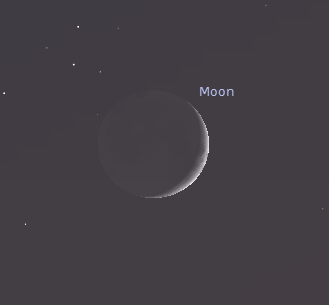
The actual phase of the moon in the chart above. Created using Stellarium.
The morning sky.
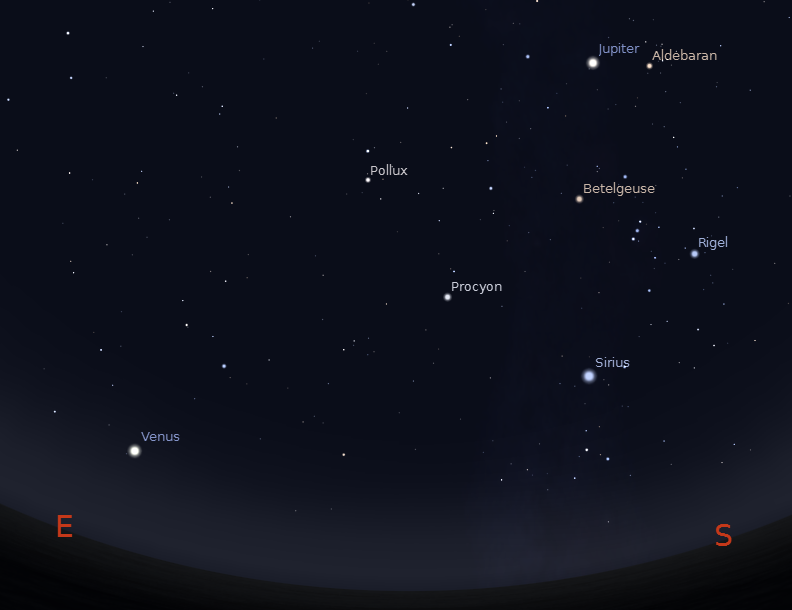
The morning skies including Jupiter and Venus at 6 a.m. on October 18, 2012. Created using Stellarium.
10/10/2012 – Ephemeris – Where are the bright planets this week?
Oct 10. This is Bob Moler with Ephemeris for Wednesday, October 10th. The sun will rise at 7:52. It’ll be up for 11 hours and 13 minutes, setting at 7:05. The moon, 2 days past last quarter, will rise at 3:22 tomorrow morning.
Let’s see how many bright planets we can find this week. Mars and Saturn now set too close to the sun to be easily seen in the evening sky. Both are in the west southwestern sky and very low in twilight. Saturn will set at 7:45 p.m., while Mars will set at 8:56. The planetary action moves to later in the evening and the morning. Jupiter, will rise at 9:45 p.m. in the east northeast. It is located in the constellation of Taurus. The last bright planet of the night is the morning star Venus which will rise at 4:28 a.m. also in the east northeast. Venus is now in Leo outshining the star Regulus next to it. The planets Venus and Jupiter and the winter constellations are a great sight for early risers. You can enjoy for a few more weeks without danger of frost bite.
Times are for the Traverse City/Interlochen area of Michigan. They may be different for your location.
Addendum
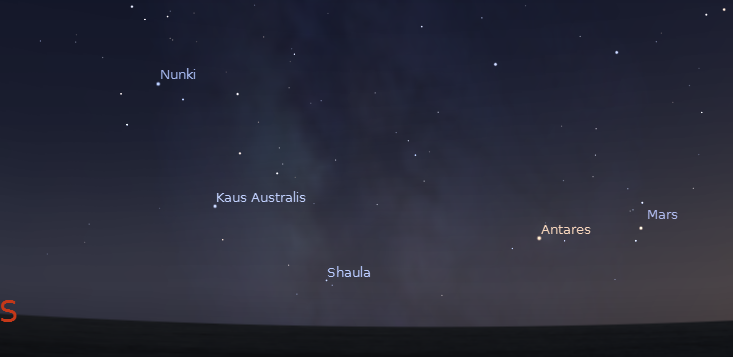
Mars is approaching Antares at 8 p.m. on October 10, 2012. Created using Stellarium.
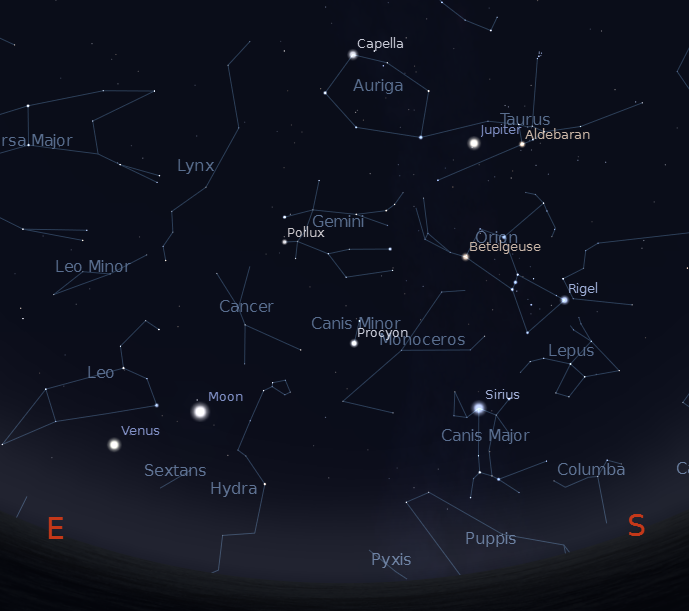
Morning Sky at 6 a.m. with Jupiter and Venus on October 11, 2012. Created using Stellarium.
Note that the moon is really a thin crescent and is over blown at this scale.
10/03/2012 – Ephemeris – Where are the bright planets this week?
Wednesday, October 3rd. The sun will rise at 7:43. It’ll be up for 11 hours and 35 minutes, setting at 7:18. The moon, 4 days past full, will rise at 8:59 this evening.
Let’s see how many bright planets we can find this week. Mars and Saturn now set too close to the sun to be easily seen in the evening sky. Both are in the west southwestern sky and very low in twilight. Saturn sets at 8:10 p.m., while Mars sets at 9:08. The planetary action moves to later in the evening and the morning. Jupiter, will rise at 10:09 p.m. in the east northeast. It is located in the constellation of Taurus. The last bright planet of the night is the morning star Venus which will rise at 4:13 a.m. also in the east northeast. Venus is now in Leo outshining the star Regulus next to it. The planets Venus and Jupiter and the winter constellations are a great sight for early risers. You can enjoy them without danger of frost bite.
Times are for the Traverse City/Interlochen area of Michigan. They may be different for your location.
Addendum
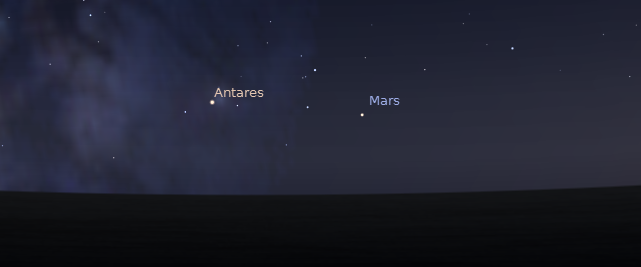
Mars and Antares low in the southwest at 8:20 p.m. on October 3, 2012. Created using Stellarium.
Mars is moving towards Antares, whose name means Rival of Mars. They have the same color. Mars, though will be dimmed and will pass north of the red giant star.
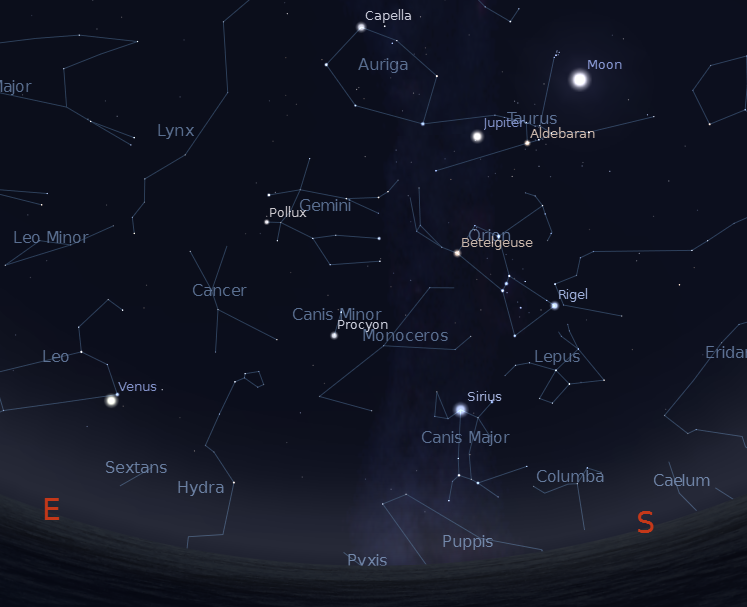
Morning skies including Jupiter and Venus at 6 a.m. on October 4, 2012. Created using Stellarium.
Click on the image to enlarge.
07/24/2012 – Ephemeris – The star Antares up close
The constellation Scorpius with Antares. Created using Stellarium.
Ephemeris for Tuesday, July 24th. The sun rises at 6:20. It’ll be up for 14 hours and 55 minutes, setting at 9:16. The moon, 2 days before first quarter, will set at 11:44 this evening.
Antares is a most interesting star. It’s low in the south and red in color. Its the heart of the Scorpius the scorpion. Its name means Rival of Mars with which it shares its color. Antares is a huge star, a red giant star. Its mass is 12 times the mass of the sun, but it’s bloated out to a diameter somewhat larger than the orbit of Mars, over 300 million miles. This what happens to a star that has exhausted hydrogen in its core and is now fusing helium to produce energy and even more massive elements. Its surface temperature is close to the temperature of the filament of an incandescent light bulb, about 2/3rds the temperature of the sun. Antares also has a dim companion star.
Times are for the Traverse City/Interlochen area of Michigan. They may be different for your location.
07/17/2012 – Ephemeris – Scorpius and Orion
Ephemeris for Tuesday, July 17th. Today the sun will be up for 15 hours and 9 minutes, setting at 9:22. The moon, 2 days before new, will rise at 5:50 tomorrow morning. Tomorrow the sun will rise at 6:14.
Crawling just above the southern horizon at 11 p.m. is the zodiacal constellation of Scorpius the scorpion. His heart is the red giant star Antares. Its facing the west or right with a short arc of three stars as its head. His body and tail drop to the left and scrape the horizon before curving up to the critter’s poisonous stinger of two stars. One story of the scorpion concerns Orion the hunter the great winter constellation. In that story Orion was supposedly killed by the sting of a scorpion. Therefore Orion and Scorpius are never seen in the sky at the same time. That is certainly true around here and for the Greeks, whose legend it is. However if one travels far enough south that is no longer true.
Times are for the Traverse City/Interlochen area of Michigan. They may be different for your location.
Addendum
The constellation Scorpius at 10:30 p.m. on July 17, 2012. Created using Stellarium.
 Bob Moler's Ephemeris Blog