Archive
Ephemeris: 09/22/2025 – Autumn befalls us today
This is Bob Moler with Ephemeris for Monday, September 22nd. Today the Sun will be up for 12 hours and 9 minutes, setting at 7:39, and it will rise tomorrow at 7:31. The Moon, 1 day past new, will set at 7:50 this evening.
This is it! Summer will end at 2:20 this afternoon, when the center of the Sun will cross the celestial equator, an imaginary line above the Earth’s equator, heading southward. At that instant, autumn will begin. Shortly after, the Sun will be up less than half the day. The day and the point in the sky that the Sun crosses is called the autumnal equinox. The word equinox means equal night, implying that day and night are of equal length. Geometrically that’s true, but the Earth’s atmosphere and the definition of sunrise and sunset, prolong daylight by a few minutes. The amount of heat we are getting and will get from the Sun cannot sustain our current temperatures, and it will get a lot colder on average before it gets warmer again.
The astronomical event times given in this blog are for the Traverse City/Interlochen area of Michigan (Lat 44.7° N, Long 85.7° W; EDT, UT – 4 hours) unless stated otherwise. Times will be different for other locations.
Addendum
Ephemeris: 09/08/2025 – Previewing the Harvest Moon Effect
This is Ephemeris for Monday, September 8th. Today the Sun will be up for 12 hours and 52 minutes, setting at 8:05, and it will rise tomorrow at 7:14. The Moon, 1 day past full, will rise at 8:30 this evening.
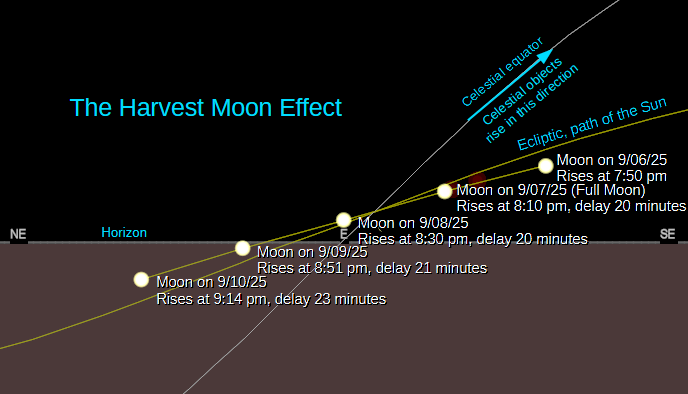
Last night’s full moon was not the Harvest Moon. We normally expect the Harvest Moon to come in September, but this year it does not because it is not the closest full moon to the autumnal equinox. The full moon of October 6th, this year, is the nearest full moon to the autumnal equinox. So it this month’s full moon is called the Corn Moon. But the effects of this full moon are the same as the Harvest Moon, in that the Moon rises only slightly later each evening for about a week or so. The Moon tonight will rise only 20 minutes later than it rose last night. The average day-to-day interval of moon rising is about 50 minutes. This earlier rising time had the effect of extending twilight which helped early farmers with an extra hour to gather in their crops.
The astronomical event times given in this blog are for the Traverse City/Interlochen area of Michigan (Lat 44.7° N, Long 85.7° W; EDT, UT – 4 hours) unless stated otherwise. Times will be different for other locations.
Addendum
Ephemeris: 09/20/2024 – Fall will fall upon us Sunday
This is Ephemeris for Friday, September 20th. Today the Sun will be up for 12 hours and 14 minutes, setting at 7:42, and it will rise tomorrow at 7:29. The Moon, 3 days past full, will rise at 8:55 this evening.
The season of fall is about to, well, fall upon us and in a few weeks so will the leaves. At 8:44 Sunday morning (12:44 UT Sunday) the Sun will cross the celestial equator heading southward. The celestial equator is an imaginary line in the sky above the earth’s equator. At that point, the Sun will theoretically set at the North Pole and rise at the South Pole. The day is called the autumnal equinox and the daylight hours of Sunday will be 12 hours and 8 minutes instead of 12 hours exactly. That’s due to our atmosphere and our definition of sunrise and sunset. The reason for the cooler weather we are heading into is that the length of daylight is shortening, and the Sun rides lower in the sky, spreading its heat over a larger area, thus diluting its intensity.
The astronomical event times given are for the Traverse City/Interlochen area of Michigan (EDT, UT – 4 hours). Times will be different for other locations.
Addendum
Ephemeris: 09/25/2023 – Now that autumn has set in, what does that mean?
This is Bob Moler with Ephemeris for Monday, September 25th. Today the Sun will be up for 12 hours and 1 minute, setting at 7:34, and it will rise tomorrow at 7:34. The Moon, 3 days past first quarter, will set at 3:34 tomorrow morning.
Now that autumn has set in, what does that mean? The latitude on the Earth where the Sun passes overhead is now south of the equator, and will stay south of the equator until March 19th, our time, next year. The North Pole of the Earth is experiencing a prolonged sunset, starting six months of night, while the South Pole is enjoying an equally long sunrise, for their six months of daylight. The Earth’s seasons are not caused by our distance from the Sun. We’re closer to the Sun now than we were in early July, and will continue to move closer to the Sun until early January. The Earth’s average distance of 93 million miles only varies by a million and a half miles either way. It’s the Earth’s axial tilt that causes the seasons.
The astronomical event times given are for the Traverse City/Interlochen area of Michigan (EDT, UT –4 hours). They may be different for your location.
Addendum
Ephemeris: 09/22/2023 – Star party tonight in Thompsonville
This is Ephemeris for Friday, September 22nd. Today the Sun will be up for 12 hours and 10 minutes, setting at 7:40, and it will rise tomorrow at 7:30. The Moon, at first quarter today, will set at 11:45 this evening. | Tonight, if it’s clear, members of the Grand Traverse Astronomical Society will hold a twilight talk and a star party at the Betsie Valley District Library in Thompsonville, MI. It starts at 7 p.m. with a talk about the upcoming solar eclipses by member Dan Dall’Olmo. There will be a minor partial solar eclipse next month on the 14th, and a much greater partial eclipse April 8th for our area. The total part of the April eclipse can be seen less than a day’s drive away in mid-Indiana and northern Ohio. If tonight is cloudy the star party will be postponed to tomorrow. Featured will be the Moon and some of the stars of the waning nights of summer. (It’s looking like Saturday night might be the better night, but we’ll see. A decision can be made as late as 5 pm the day of the event) The season of fall starts tomorrow at 2:50 am with the autumnal equinox.
The astronomical event times given are for the Traverse City/Interlochen area of Michigan (EDT, UT –4 hours). They may be different for your location. I’ll have more on the autumnal equinox and its effects on Monday.
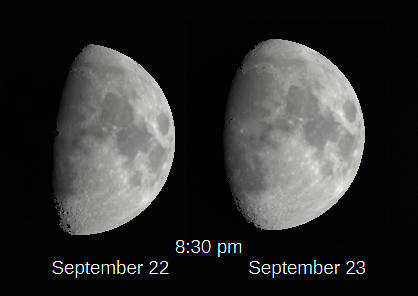
09/22/2022 – Ephemeris – Autumn will begin this evening
This is Ephemeris for Thursday, September 22nd. Today the Sun will be up for 12 hours and 10 minutes, setting at 7:40, and it will rise tomorrow at 7:31. The Moon, 3 days before new, will rise at 4:46 tomorrow morning.
The season of fall is about to, ah well, fall upon us and in a few weeks so will the leaves. At 9:04 this evening (1:04 UT tomorrow) the Sun will cross the celestial equator heading south. The celestial equator is an imaginary line in the sky above the earth’s equator. At that point, the Sun will theoretically set at the North Pole and rise at the South Pole. The day is called the autumnal equinox and the daylight hours today is 12 hours and 10 minutes instead of 12 hours exactly. That’s due to our atmosphere and our definition of sunrise and sunset. The reason for the cooler weather now and the cold weather this winter is that the length of daylight is shortening, and the Sun rides lower in the sky, spreading its heat over a larger area, thus diluting its intensity.
The astronomical event times given are for the Traverse City/Interlochen area of Michigan (EDT, UT – 4 hours). They may be different for your location.
Addendum
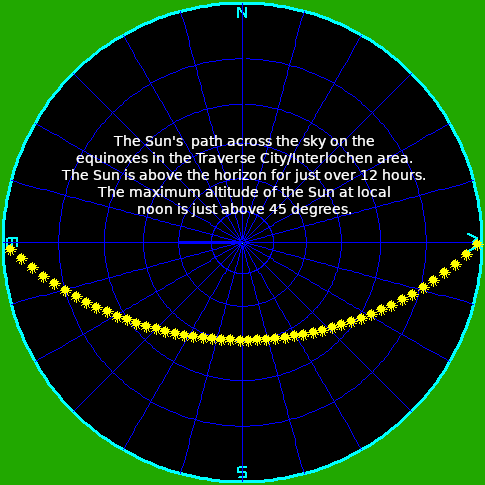
The Sun’s path through the sky on an equinox day from the Traverse City/Interlochen area in Michigan. The Sun is plotted every 15 minutes. This is a stereographic projection which compresses the image near the zenith and enlarges the image towards the horizon. Note that the Sun rises due east and sets due west. Created using my LookingUp program.
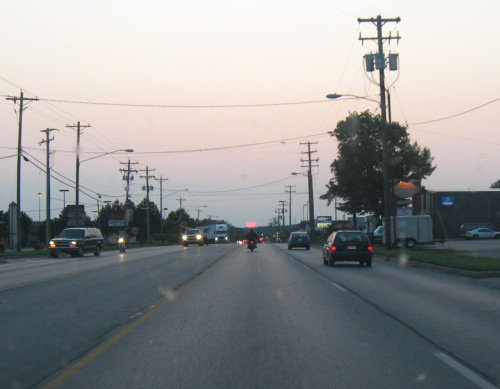
That is not a pumpkin on the head of the motorcyclist. That’s the Sun rising as I’m traveling east on South Airport Road south of Traverse City, MI on the autumnal equinox. This is the east-west section of the road. The Sun is rising over the hills some 6 miles to the east. When the Sun is on the celestial equator, it rises due east and sets due west. Credit: Bob Moler.
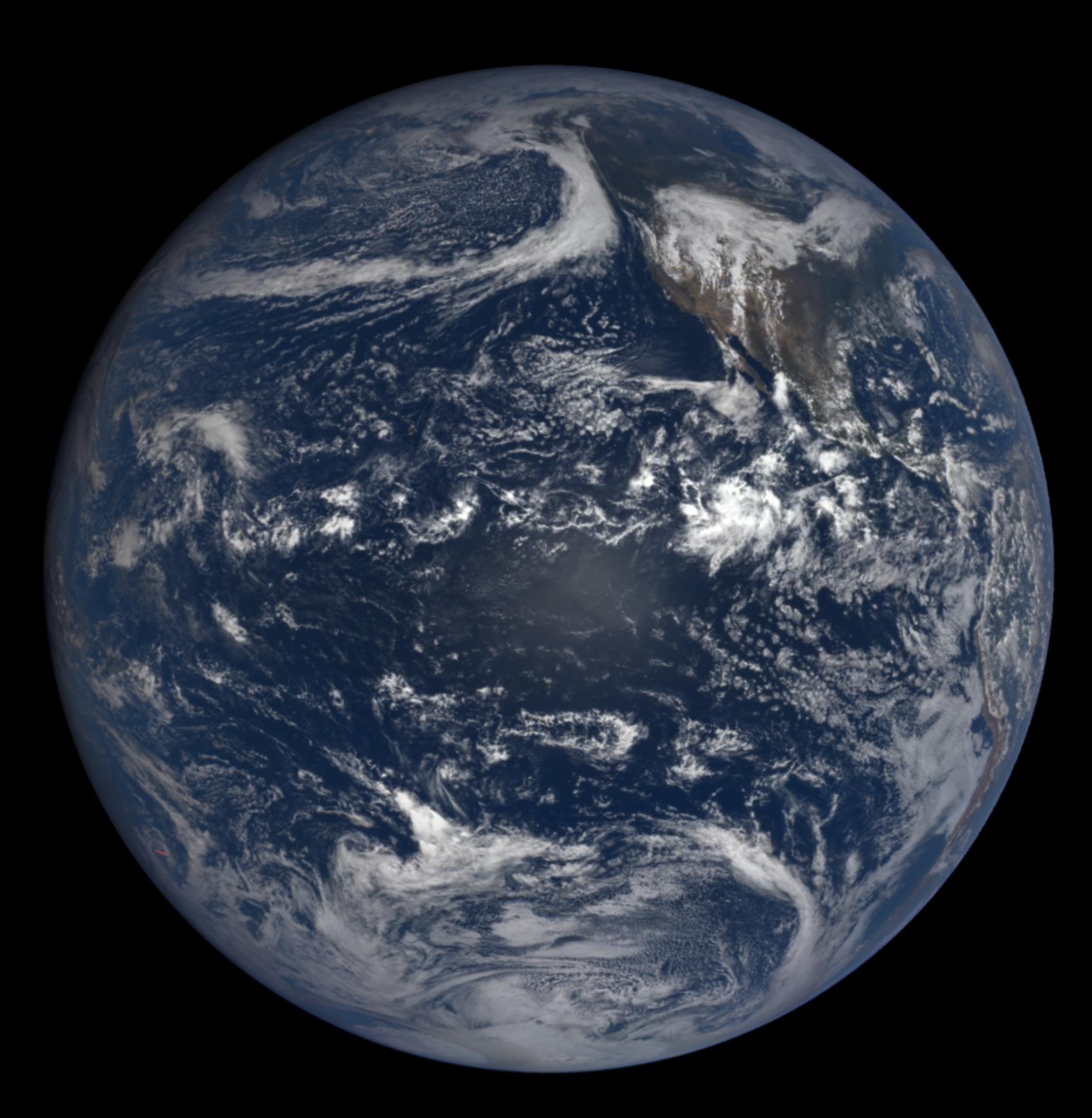
Image from the Earth Polychromatic Imaging Camera (EPIC) on NOAA’s DSCOVR satellite in halo orbit around the Earth-Sun L-1 point 1 million miles sunward from the Earth on the autumnal equinox of 2016. North America is in the upper right of the globe.
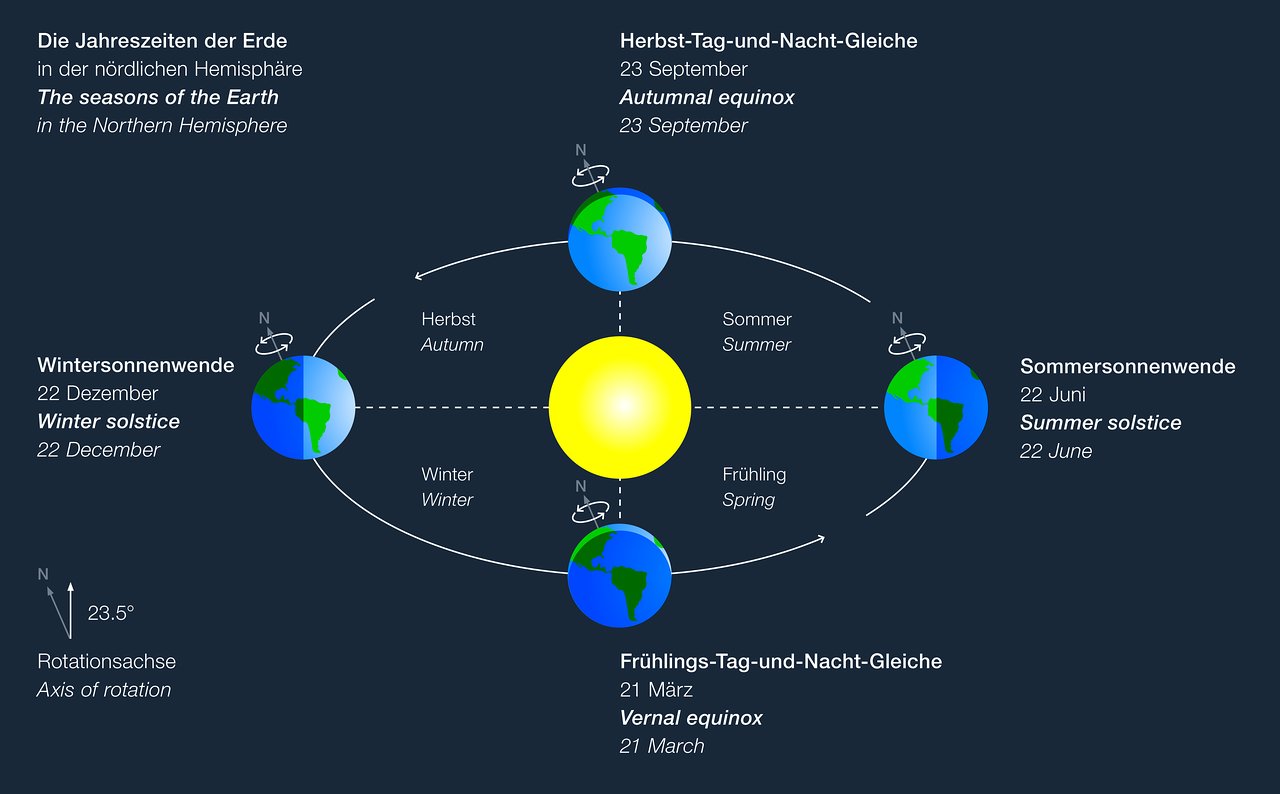
Earth’s position at the solstices and equinoxes. This is an not to scale oblique look at the Earth’s orbit, which is nearly circular. The Earth is actually farthest from the Sun on July 4th. Click on the image to enlarge. Credit: ESO (European Southern Observatory), which explains the captions in German and English.
09/22/2021 – Ephemeris – Autumn starts this afternoon and a look at the naked-eye planets
This is Bob Moler with Ephemeris for Wednesday, September 22nd. Today the Sun will be up for 12 hours and 9 minutes, setting at 7:39, and it will rise tomorrow at 7:31. The Moon, 2 days past full, will rise at 8:43 this evening.
Here on Earth, the season of fall will begin at 3:21 this afternoon. Let’s search for rest of the naked-eye planets for this week. Venus should be visible in the southwestern evening twilight by 8 o’clock tonight. It will set at 9:08 pm. By 8:15 pm, Jupiter and Saturn will be seen low in the southeastern sky. The brighter Jupiter will be easy to spot at that hour. Saturn will be dimmer, but a bit higher and to its right. They will be visible into the morning hours, with Saturn setting first at 2:55 am, with Jupiter following at 4:19. Saturn’s rings can be seen in a spotting scope of about 20 power magnification. Though at that power the rings won’t appear separated from the planet, so Saturn will look like an elliptical disk.
The astronomical event times given are for the Traverse City/Interlochen area of Michigan (EDT, UT-4 hours). They may be different for your location.
Addendum
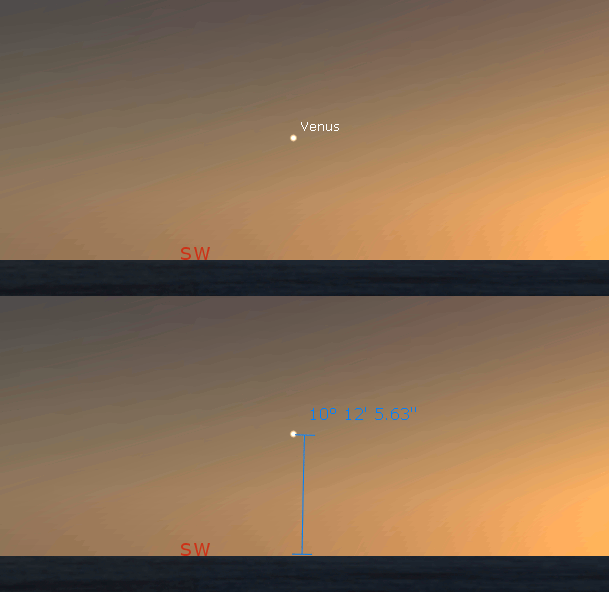
Venus in twilight at 8 pm, or about 20 minutes after sunset, tonight, September 22, 2021. An animation showing its altitude at that time of 10 degrees (about the width of your fist held at arm’s length). Created using Stellarium and GIMP.
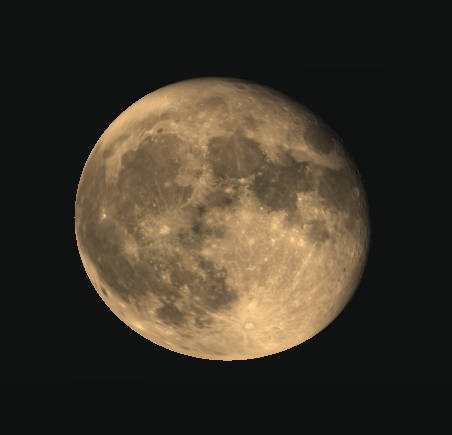
Waning gibbous Moon, about 15 minutes after rising as it might be visible in binoculars or small telescope. Created using Stellarium.
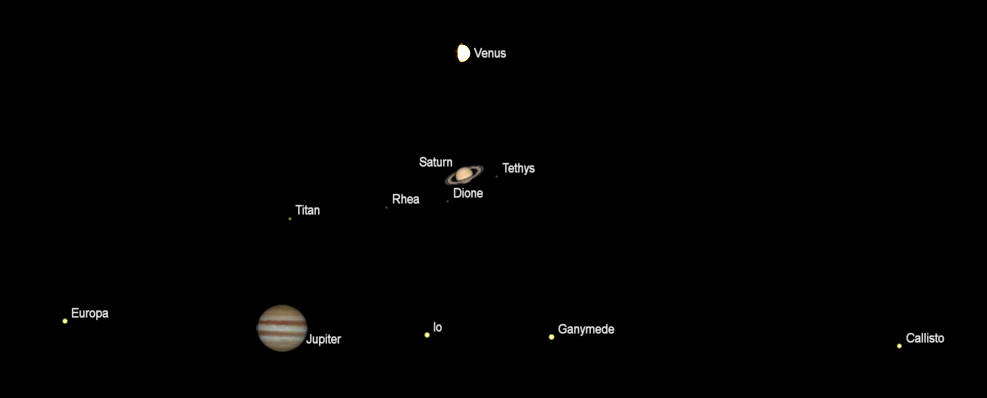
Telescopic views of the bright planets (north up) as they would be seen in a small telescope, with the same magnification, this evening. Venus at 8 pm, Jupiter and Saturn at 10 pm, September 22, 2021. Apparent diameters: Venus, 17.61″, and 65.3% illuminated; Saturn 17.86″, its rings 41.61″; Jupiter, 47.20″. The ” symbol means seconds of arc (1/3600th of a degree.) Click on the image to enlarge it. Created using Cartes du Ciel (Sky Charts).
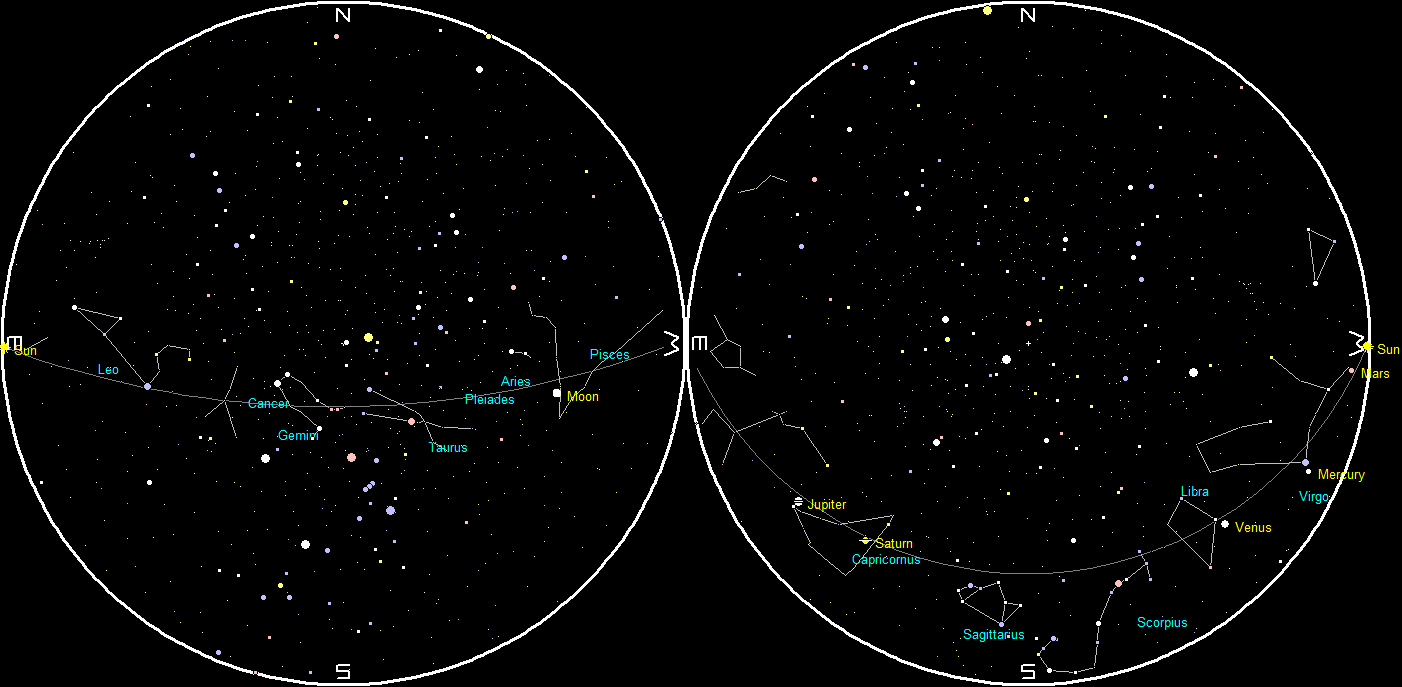
Planets and the Moon at sunset and sunrise of a single night, starting with sunset on the right on September 22, 2021. The night ends on the left with sunrise on the 23rd. Click on the image to enlarge it. Created using my LookingUp program.
09/21/2021 – Ephemeris – Autumn starts tomorrow
This is Bob Moler with Ephemeris for Tuesday, September 21st. Today the Sun will be up for 12 hours and 12 minutes, setting at 7:41, and it will rise tomorrow at 7:30. The Moon, 1 day past full, will rise at 8:23 this evening.
Enjoy the last full day of summer. Summer will last until 3:21 pm (19:21 UTC) tomorrow, when the center of the Sun will cross the celestial equator, an imaginary line above the Earth’s equator, heading southward. At that instant, autumn will begin. Shortly after, the Sun will be up less than half the day. The day and the point in the sky that the Sun crosses is called the autumnal equinox. The word equinox means equal night, implying that day and light are of equal length. Geometrically that’s true, but the Earth’s atmosphere and the definition of sunrise and sunset, prolong daylight by a few minutes. The amount of heat we are getting and will get from the Sun cannot sustain our current temperatures, and it will get a lot colder on average before it gets warmer again.
The astronomical event times given are for the Traverse City/Interlochen area of Michigan (EDT, UT-4 hours). They may be different for your location.
Addendum
That is not a pumpkin on the head of the motorcyclist. That’s the Sun rising as I’m traveling east on South Airport Road south of Traverse City, MI on the autumnal equinox. This is the east-west section of the road. The Sun is rising over the hills some 6 miles to the east. When the Sun is on the celestial equator, it rises due east and sets due west. Credit: Bob Moler.
The Sun’s path through the sky on an equinox day from the Traverse City/Interlochen area in Michigan. The Sun is plotted every 15 minutes. This is a stereographic projection which compresses the image near the zenith and enlarges the image towards the horizon. Created using my LookingUp program.
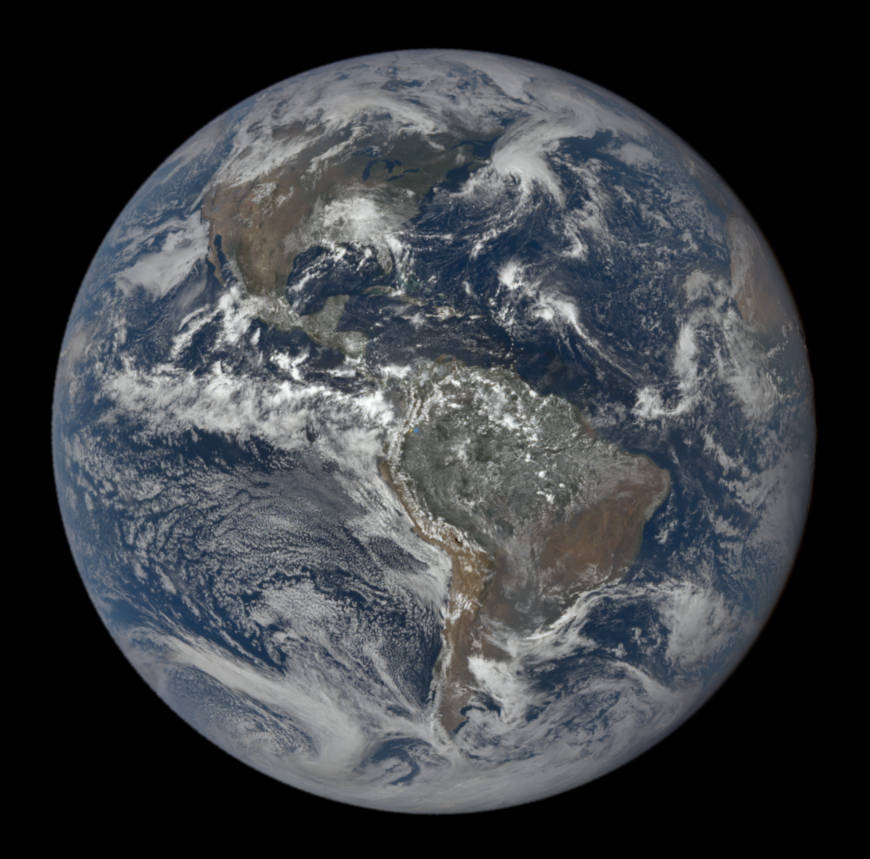
Earth 3 days before autumnal equinox, 1:17 pm EDT, September 19, 2021. The mitten shape of Michigan was in the clear that day and is visible above center of the image. The image taken by the Earth Polychromatic Imaging Camera (EPIC) on the DSCOVR satellite in halo orbit around the Earth-Sun L1 Lagrange point, about a million miles sunward of the Earth. At the time, DSCOVR was 892,682 miles (1,436,797 kilometers) from Earth.
09/22/2020 – Ephemeris – Autumn starts this morning
This is Bob Moler with Ephemeris for Tuesday, September 22nd. Today the Sun will be up for 12 hours and 8 minutes, setting at 7:39, and it will rise tomorrow at 7:31. The Moon, 1 day before first quarter, will set at 11:05 this evening.
Fall is about to a, well… fall upon us and in a few weeks so will the leaves. At 9:31 this morning (13:31 UTC*) the Sun will cross the celestial equator heading south. The celestial equator is an imaginary line in the sky above the earth’s equator. At that point the Sun will theoretically set at the north pole and rise at the south pole. The day is called the autumnal equinox and the daylight hours today is 12 hours and 8 minutes instead of 12 hours exactly. That’s due to our atmosphere and our definition of sunrise and sunset. The reason for the cooler weather now and the cold weather this winter is that the length of daylight is shortening, and the Sun rides lower in the sky, spreading its heat over a larger area, thus diluting its intensity.
The event times given are for the Traverse City/Interlochen area of Michigan. They may be different for your location.
Addendum
* UTC – Coordinated Universal Time. Greenwich Mean Time if you haven’t kept up. Zulu if you’re in the military.
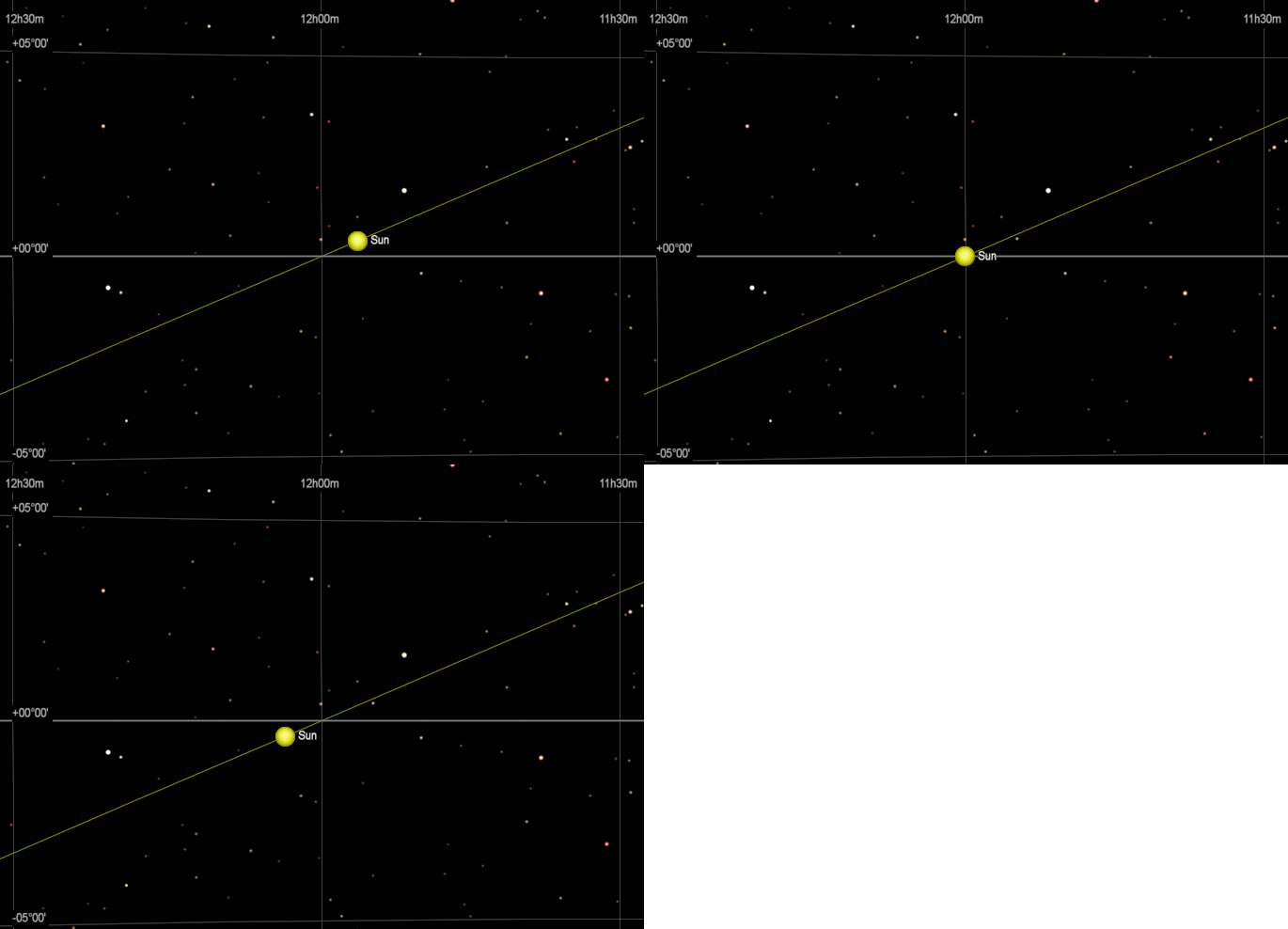
The Sun crossing the celestial equator in three steps: 9:31 am Sept 21, 22, and 23 2020. Created using Stellarium and GIMP.
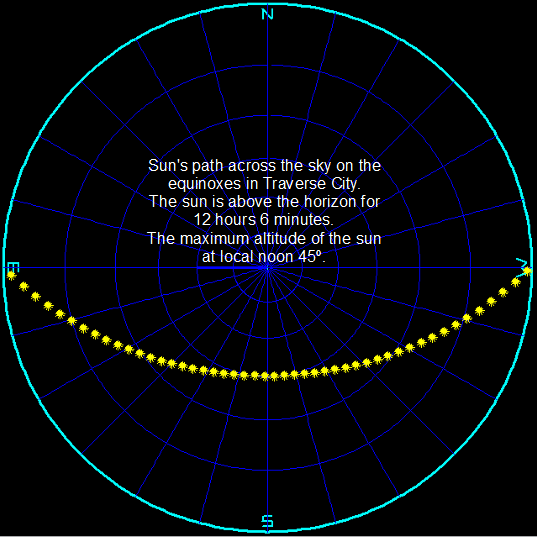
The Sun’s path through the sky on the equinox day from Traverse City, MI. Created using my LookingUp program.
That is not a pumpkin on the head of the motorcyclist. That’s the Sun rising as I’m traveling east on South Airport Road south of Traverse City Mi. on the autumnal equinox. This is the east-west section of the road. The Sun is rising over the hills some 6 miles to the east. Credit: Bob Moler.
09/21/2020 – Ephemeris – This is the last full day of summer
This is Ephemeris for Monday, September 21st. Today the Sun will be up for 12 hours and 11 minutes, setting at 7:41, and it will rise tomorrow at 7:30. The Moon, 2 days before first quarter, will set at 10:24 this evening.
Enjoy the last full day of summer. Summer will last until 9:31 am (05:31 UTC) tomorrow when the center of the Sun will cross the celestial equator, an imaginary line above the Earth’s equator, heading southward. At that instant autumn will begin for Earth’s northern hemisphere and spring will begin in the southern hemisphere. Shortly, for us, the Sun will be up less than half the day. The day and the point in the sky that the Sun crosses is called the autumnal or September equinox. The word equinox means equal night, implying the equality of day and night. Geometrically that’s true, but the Earth’s atmosphere and the definition of sunrise and sunset, prolong daylight by a few more minutes. The amount of heat we are getting and will get from the Sun cannot sustain our current temperatures, and it will get a lot colder on average before it gets warmer again.
The event times given are for the Traverse City/Interlochen area of Michigan. They may be different for your location.
Addendum
The Sun crossing the celestial equator in the sky moving southward in three steps: 9:31 am Sept 21, 22, and 23 2020. The vertical axis is declination, the exact match to latitude on the Earth. The horizontal line at 00°00′ is the celestial equator, a projection of the Earth’s equator on the sky. The diagonal line that the Sun appears to travel on is the ecliptic, the plane of the Earth’s orbit. Due to the tilt of the Earth’s axis it is inclined by 23.5° to the celestial equator. The horizontal values mark right ascension, the celestial analog of longitude. One hour equals 15°. Since the Earth rotates, the right ascension that is on one’s meridian, the north-south line passing through the zenith, is best kept track of by using a clock. A clock that runs 3 minutes 56 seconds fast a day. We call that a sidereal clock. Created using Cartes du Ciel (Sky Chart) and GIMP.
 Bob Moler's Ephemeris Blog