Archive
08/18/2015 – Ephemeris – The autumn queen is rising
Ephemeris for Tuesday, August 18th. The Sun rises at 6:48. It’ll be up for 13 hours and 55 minutes, setting at 8:44. The Moon, half way from new to first quarter, will set at 10:31 this evening.
A look to the northeast at 10 p.m. or later will reveal a letter W pattern of stars. This is the constellation of Cassiopeia the queen. Cassiopeia is so far north that it never sets for us in Michigan. It is opposite the pole star Polaris from the Big Dipper. So as the Big Dipper is rotating down the sky in the northwest, Cassiopeia is rotating up in the northeast. The pivot is the star Polaris, the north star. There’s a dim star that appears above the middle star of the W which turns the W into a very crooked backed chair. Above Cassiopeia is a dim church steeple shaped constellation of Cepheus the king. The Milky Way flows through Cassiopeia and a corner of Cepheus and up through Cygnus, and on to the south.
Times are for the Traverse City/Interlochen area of Michigan. They may be different for your location.
Addendum
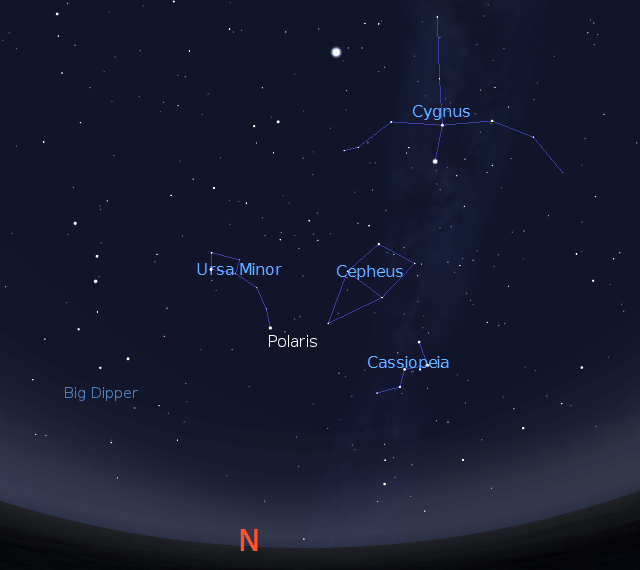
Cassiopeia and nearby constellations mentioned in the above program. Created using Stellarium.
07/09/2015 – Ephemeris – The first stars to appear at night
Ephemeris for Thursday, July 9th. Today the Sun will be up for 15 hours and 23 minutes, setting at 9:29. The Moon, 1 day past last quarter, will rise at 2:05 tomorrow morning, and tomorrow the Sun will rise at 6:07.
Let’s check out all the bright stars in the evening sky, as it gets dark tonight. Low in the west are the planets Venus and Jupiter. High in the west is the bright yellow-orange star Arcturus. In the northwest is the Big Dipper, whose curved handle points to Arcturus. Straightening that curve to a spike will point to Spica a blue-white star low in the southwest. The planet Saturn is located in the south. Below and left of it is the red star Antares which usually twinkles merrily. High in the east is the bright white star Vega. To its lower right is Altair, and to its lower left the star Deneb. Vega, Altair and Deneb make the Summer Triangle, whose rising in the east signals the coming of summer.
Times are for the Traverse City/Interlochen area of Michigan. They may be different for your location.
Addendum
I talked about seeing the first stars a month ago. It seems that in holding star parties this time of year we spend a lot of time watching the first stars appear. I wanted to discuss the Summer Triangle, but it wandered off to what you see above. I’ll get there next week, I promise.
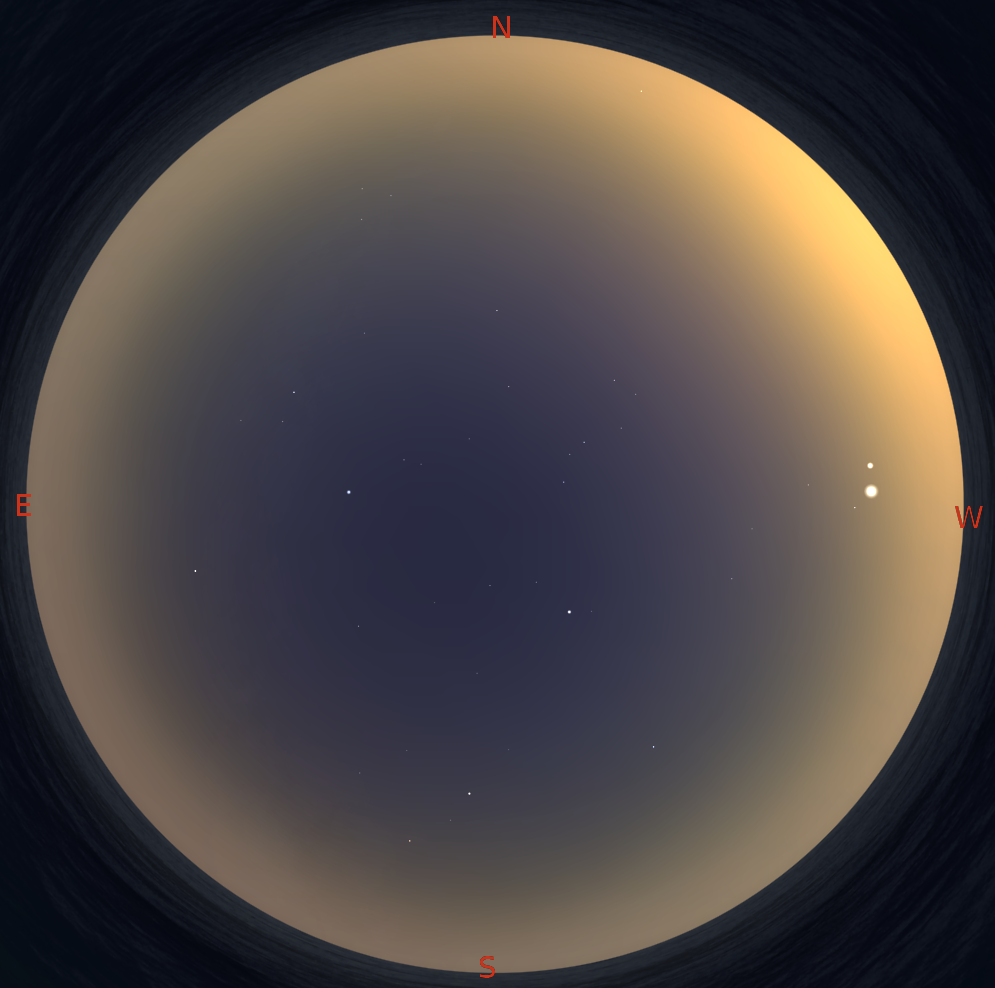
The first stars and planets to appear. See if you can located them from the text. Created using Stellarium for about 10 p.m., July 9, 2015.
05/11/2015 – Ephemeris – How to find the constellation Virgo
Ephemeris for Monday, May 11th. Today the Sun will be up for 14 hours and 39 minutes, setting at 8:59. The Moon, at last quarter today, will rise at 3:08 tomorrow morning. Tomorrow the Sun will rise at 6:18.
Friday I talked about that in spring we are looking out the thin side of our Milky Way galaxy’s disk. One of the large constellations we see in the south at 11 p.m. can be found using the Big Dipper overhead, follow the arc of the handle to the bright star Arcturus, the straighten the arc to a spike to reach Spica, a bright blue-white star in the south. Spica is the brightest star in the constellation Virgo the virgin. She represents the goddess of the harvest, Virgo is holding a sheaf of wheat in depictions of her, and Spica is placed at the head of the sheaf. In the space between Spica and Leo the lion to her right is, a great cluster just below naked eye visibility. The Virgo cluster of galaxies.
Times are for the Traverse City/Interlochen area of Michigan. They may be different for your location.
Addendum
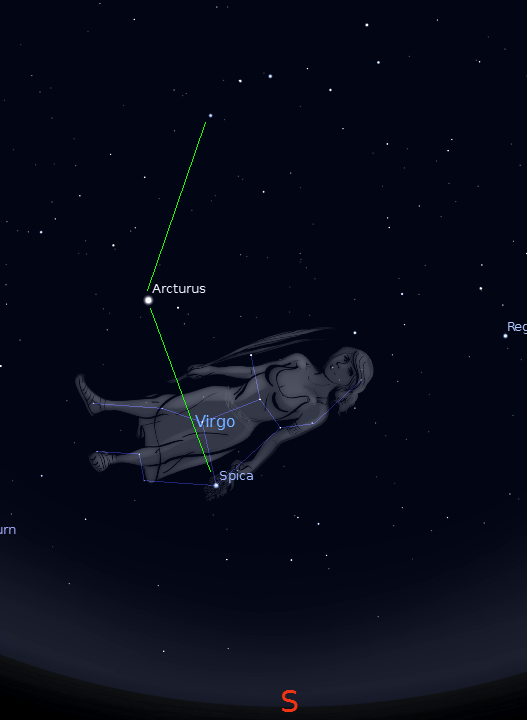
Star hop from the Big Dipper through Arcturus to Spica and Virgo. Orientation for 11 p.m. on May 11, 2015. Created using Stellarium.
04/13/2015 – Ephemeris – The Big Dipper as seen from many lands
Ephemeris for Monday, April 13th. The Sun will rise at 7:02. It’ll be up for 13 hours and 22 minutes, setting at 8:25. The Moon, 2 days past last quarter, will rise at 4:31 tomorrow morning.
The Big Dipper will be high in the east, nearly overhead at 10 p.m. It is officially part of Ursa Major, the Great Bear. Other cultures have different representations for this star group. It’s the plough (plow), Charles’ Wain (Charlemagne’s Wagon), the Saucepan, or the Cleaver depending on the country. It performs an invaluable service in pointing out other stars and constellations, especially the star Polaris the north star. That star, which seems to hover over the north pole of the Earth can be found by using the two stars at the front of the bowl of the dipper to point to it. And at our latitude of around 45 degrees north, the Big Dipper is always in the sky. It is one of the circumpolar star groups that can be seen in any season.
Times are for the Traverse City/Interlochen area of Michigan. They may be different for your location.
Addendum
Right now in the spring the Big Dipper is nearly overhead pointing down to Polaris. I’ve turned these upside down so the images make more sense.
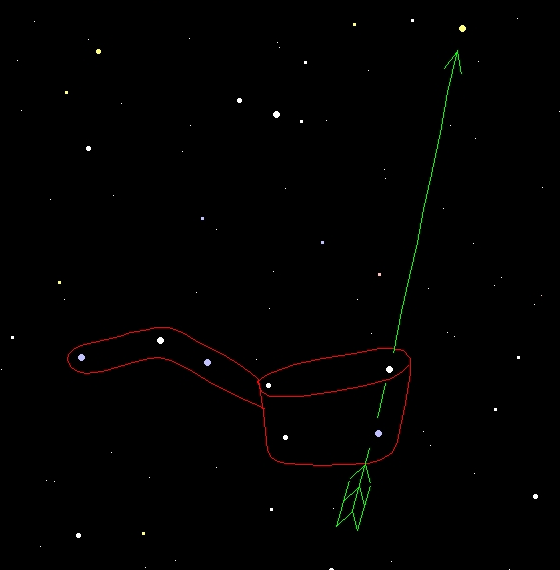
The Big Dipper or Sauce Pan. Credit: Bob Moler’s LookingUp program.
For runaway slaves fleeing northward at night it was their compass… “Follow the Drinking Gourd”
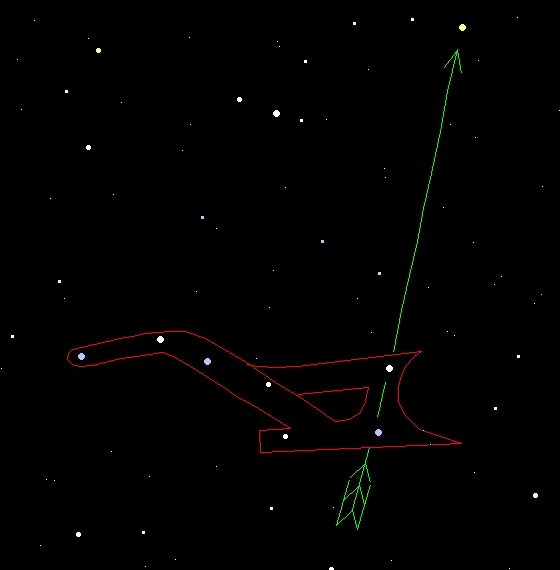
The Plough or plow in American. Credit: Bob Moler’s LookingUp program.
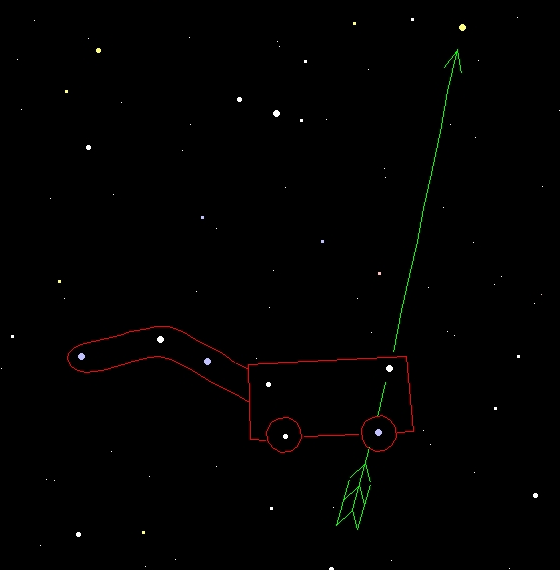
Charles’ Wain. Credit: Bob Moler’s LookingUp program.
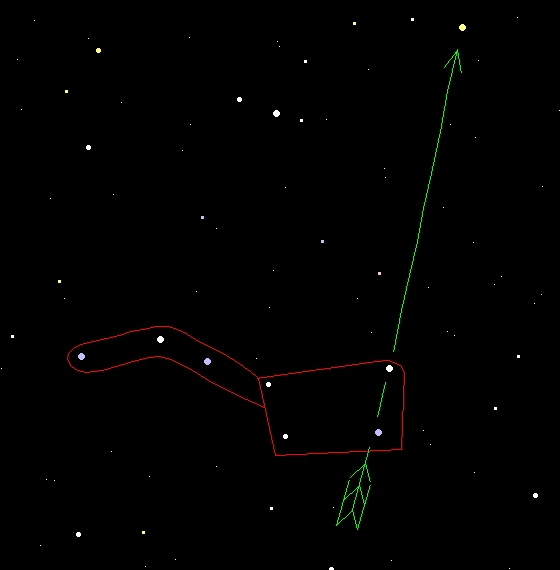
The Cleaver. Credit: Bob Moler’s LookingUp program.
Do you know any others?


04/06/2015 – Ephemeris – Arcturus the 4th brightest star
Ephemeris for Monday, April 6th. The Sun will rise at 7:14. It’ll be up for 13 hours and 1 minute, setting at 8:16. The Moon, 2 days past full, will rise at 10:37 this evening.
One of the stars that stays up most of the year, except late autumn and most of winter is Arcturus. Now in the evening Arcturus is low in the east. It’s a bright star, officially the 4th brightest star in the night sky, and the 4th brightest star-like object in our night sky after Venus, Jupiter, and Sirius. Arcturus can be found by following the arc of the handle of the Big Dipper to it. Remember, follow the arc to Arcturus. Arcturus belongs to the kite shaped constellation of Boötes, which we’ll visit in greater detail when it’s higher in the sky. Arcturus is an interesting star. It’s 37 light years away, and moving quite rapidly at 75 miles per second (122km/s), mostly across the sky. Some astronomers think that it
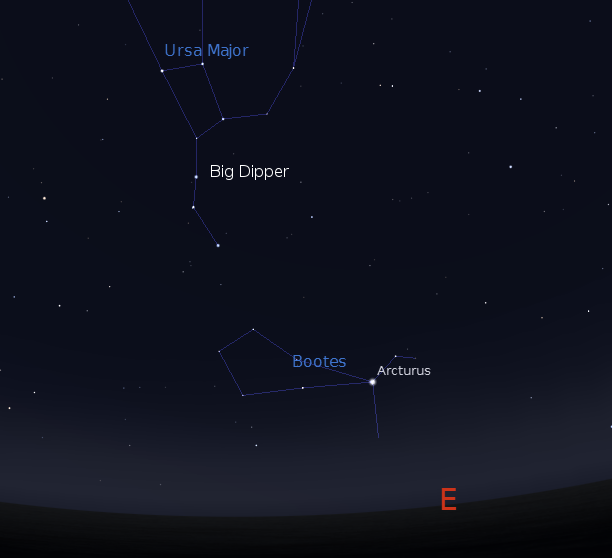
Arcturus off the handle of the Big Dipper at 9:30 p.m. April 6, 2015. Created using Stellarium.
may be part of a captured dwarf galaxy.
Times are for the Traverse City/Interlochen area of Michigan. They may be different for your location.
Addendum
03/27/2015 – Ephemeris – The North Star, Polaris
Ephemeris for Friday, March 27th. The Sun will rise at 7:33. It’ll be up for 12 hours and 30 minutes, setting at 8:03. The Moon, at first quarter today, will set at 3:49 tomorrow morning.
Tonight we turn our eyes northward to Polaris, the North Star. It is the closest bright star to the north pole of the sky. It appears nearly stationary as all the other stars appear to revolve around it as the Earth rotates. Some folks, think that Polaris is the brightest star in the sky. It’s not. It is a good solid second magnitude star, about the brightness of a Big Dipper star. The Big Dipper can be used to point to it, by using the two stars at the front of the bowl. Polaris is at the end of the handle of the Little Dipper. The Little Dipper has four dim stars in its rather oddly bent handle and back of its bowl. The two stars at the front of the bowl of the Little Dipper are Kochab and the dimmer Pherkad, which are also called the Guard Stars or the Guardians of the Pole.
Times are for the Traverse City/Interlochen area of Michigan. They may be different for your location.
Addendum
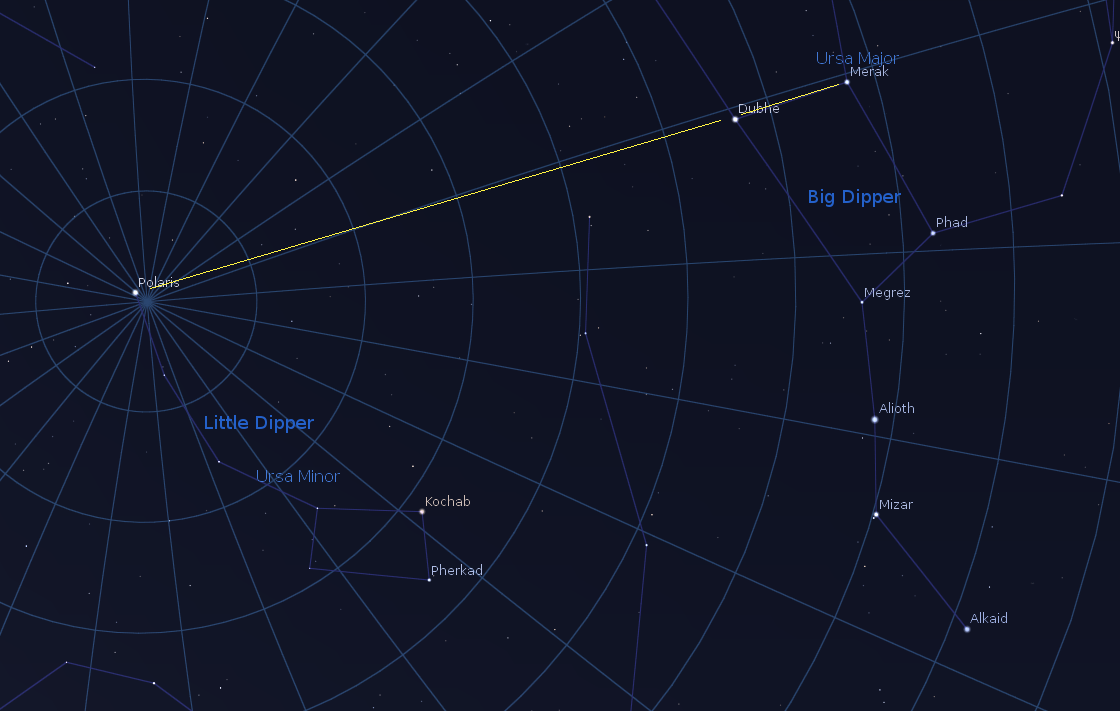
How to find Polaris. The grid is the equatorial grid showing the proximity to the pole. Created using Stellarium.
03/09/2015 – Ephemeris – The Big Dipper, a sign of spring
Ephemeris for Monday, March 9th. The Sun will rise at 8:06. It’ll be up for 11 hours and 34 minutes, setting at 7:40. The Moon, 4 days before last quarter, will rise at 11:43 this evening.
There’s a sign of spring appearing in the sky, rising high in the northeast. It’s the Big Dipper standing on its handle. In the native story of the Fisher Star, it’s the sign that it’s time for the maple sugar season. The Big Dipper is part of Ursa Major the great bear or a weasel-like creature called Fisher or Fisher Star. Draw a line through the bottom of the bowl of the dipper as if it leaks, and it will drip on the back of Leo the lion in the southeast. The handle of the Big Dipper will arc to Arcturus after 10 p.m. when that star rises. The most important guide that the Big Dipper provides is to point to Polaris, the north star. The two stars at the front of the bowl of the dipper point to Polaris, that alone of all the stars appears fixed in the north.
Times are for the Traverse City/Interlochen area of Michigan. They may be different for your location.
Addendum
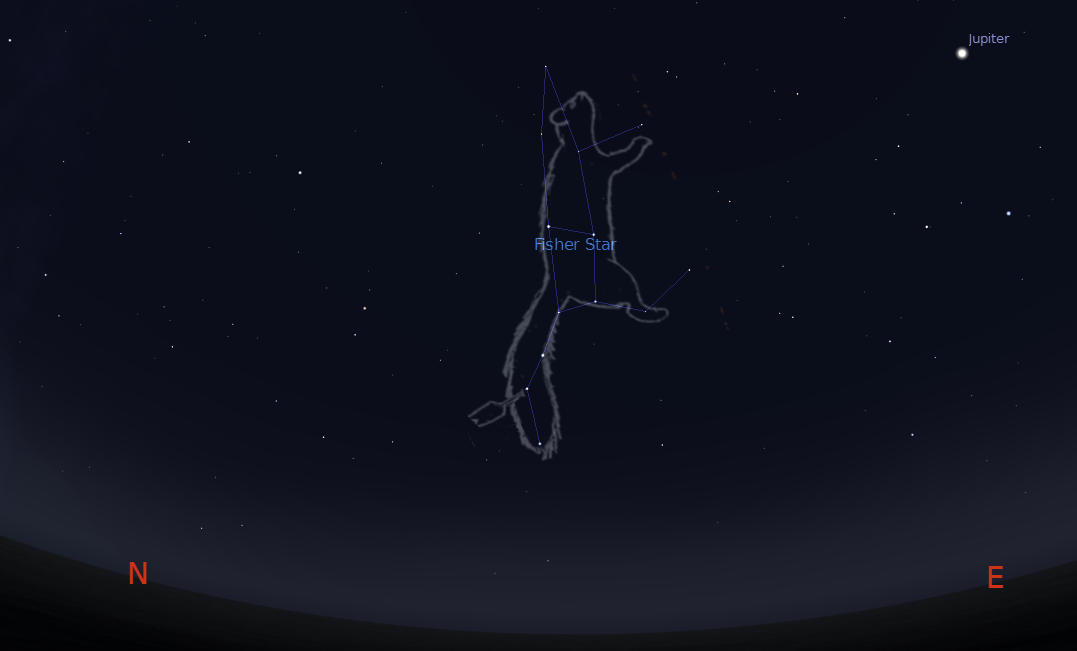
The Big Dipper, part of Ursa Major and also part of Fisher Star in the northeastern sky at 9 p.m. March 9, 2015
For the story of Fisher Star follow this link.
01/12/2015 – Ephemeris – The world’s faorite constellation: Orion
Ephemeris for Monday, January 12th. The sun will rise at 8:18. It’ll be up for 9 hours and 6 minutes, setting at 5:24. The moon, 1 day before last quarter, will rise at 1:02 tomorrow morning.
For people the world over who look up and recognize the brighter constellations Orion is perhaps the odd on favorite. The Big Dipper, a favorite in the northern hemisphere, cannot be easily seen south of the equator. The Southern Cross cannot be easily be seen north of the equator. Orion, or parts of him can be seen from pole to pole because he straddles the equator of the sky. It has 7 bright stars like the Big Dipper, but those seven are brighter than those in the big Dipper. In the early evening Orion is seen is the southeast. The three stars of his belt now tipped diagonally from upper right to lower left. They are in the center of a left leaning rectangle of stars with bright red Betelgeuse to the upper left and bright blue-white Rigel to the lower right.
Times are for the Traverse City/Interlochen area of Michigan. They may be different for your location.
Addendum
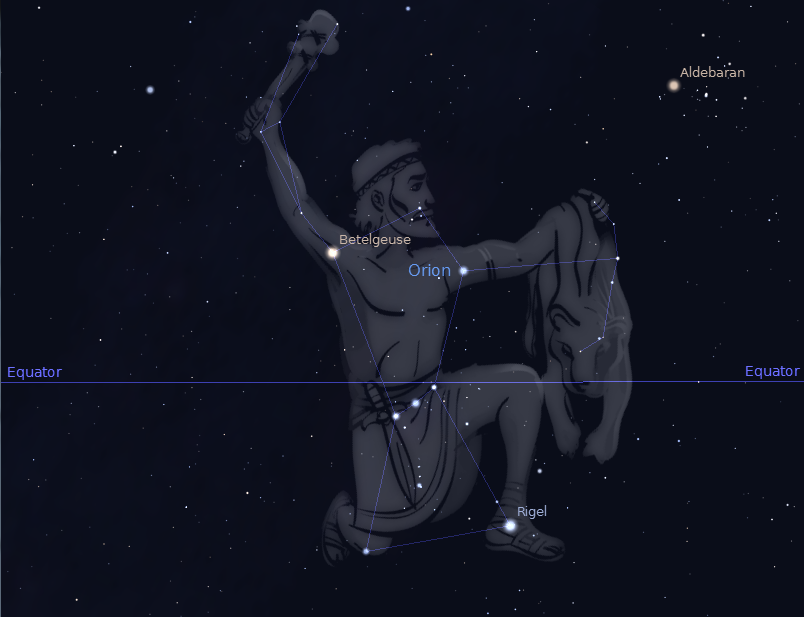
Orion from mid latitudes north of the equator. Orion would be upside down if viewed south of the equator. Created using Stellarium.
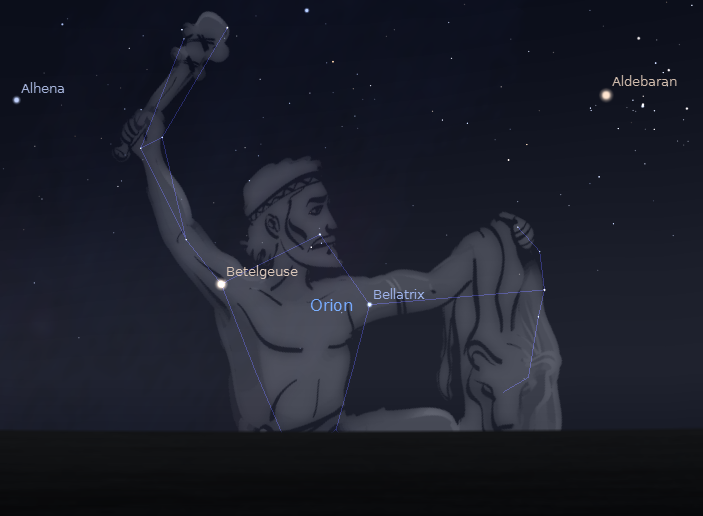
Orion from near the north pole. Created using Stellarium.
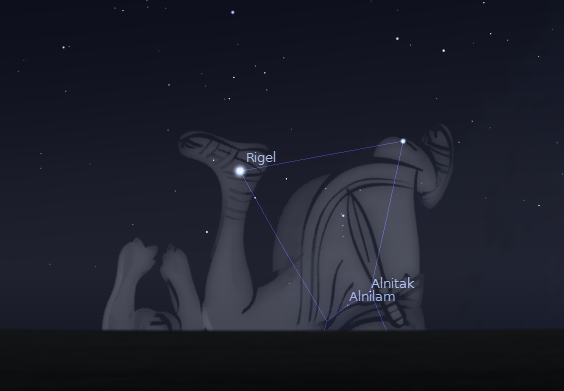
Orion from near the south pole. Created using Stellarium.
08/22/2014 – Ephemeris – Cassiopeia Rising
Ephemeris for Friday, August 22nd. The sun rises at 6:53. It’ll be up for 13 hours and 43 minutes, setting at 8:36. The moon, 3 days before new, will rise at 5:08 tomorrow morning.
Now in the northeastern sky at 10 p.m. or later is the constellation of Cassiopeia the queen, which looks like, in its current orientation like the letter W. The Milky Way runs through it, if you trace the Milky Way from the zenith back to the northeast. The milky band isn’t as bright here as it is in the teapot shaped Sagittarius to the south. That’s because in looking to the south we are looking toward the star clouds of the dense spiral arm toward the center of the galaxy. In Cassiopeia, and in the winter sky, we are looking out to the less populated galactic arms farther out from the center of the Milky Way. Cassiopeia can be found using the Big Dipper. A line from the star Mizar at the bend of the handle of the dipper through Polaris points to Cassiopeia. Cassiopeia doesn’t set for us in northern Michigan.
Times are for the Traverse City/Interlochen area of Michigan. They may be different for your location.
Addendum
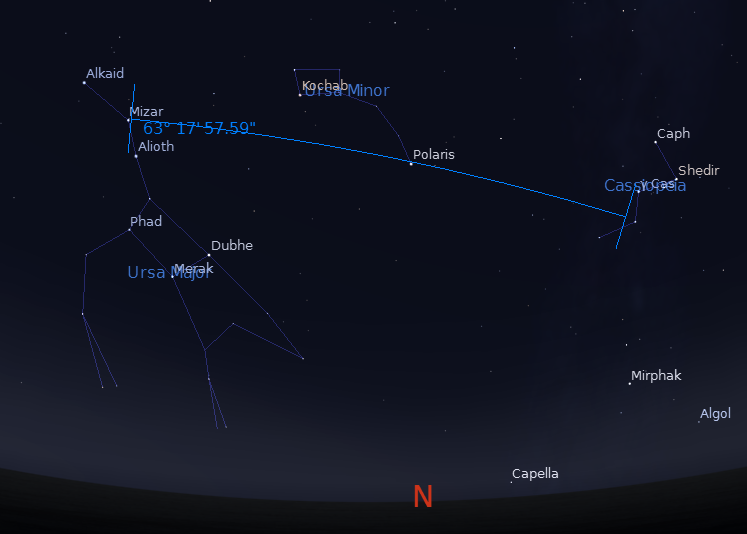
Finding Cassiopeia using the Big Dipper or Ursa Major at 10 p.m. August 22, 2014 using the angle measurement tool as a pointer. Created using Stellarium.
06/26/2014 – Ephemeris – Draco the dragon is twisted around the pole of the sky
Ephemeris for Thursday, June 26th. Today the sun will be up for 15 hours and 32 minutes, setting at 9:31, the latest sunset. The moon, 1 day before new, will rise at 6:32 tomorrow morning. Tomorrow the sun will rise at 5:59.
High in the northern sky at 11 p.m. lies the twisted constellation, that of Draco the dragon. This dragon is more like the snakelike Chinese dragon than the dinosaur like dragon of European legend. I find it better to start at the tail of Draco, to trace him out in the stars. Draco’s tail starts between the bowl of the Big Dipper and the Little Dipper. The Dragon is seen in a line of stars that extends parallel to the handle of the Big Dipper before curving around the bowl of the Little Dipper then bends back toward the south. The head of Draco is an odd box of stars near the bright star Vega, high in the east. Though not made up of very bright stars, Draco has an easy shape to trace.
Times are for the Traverse City/Interlochen area of Michigan. They may be different for your location.
Addendum
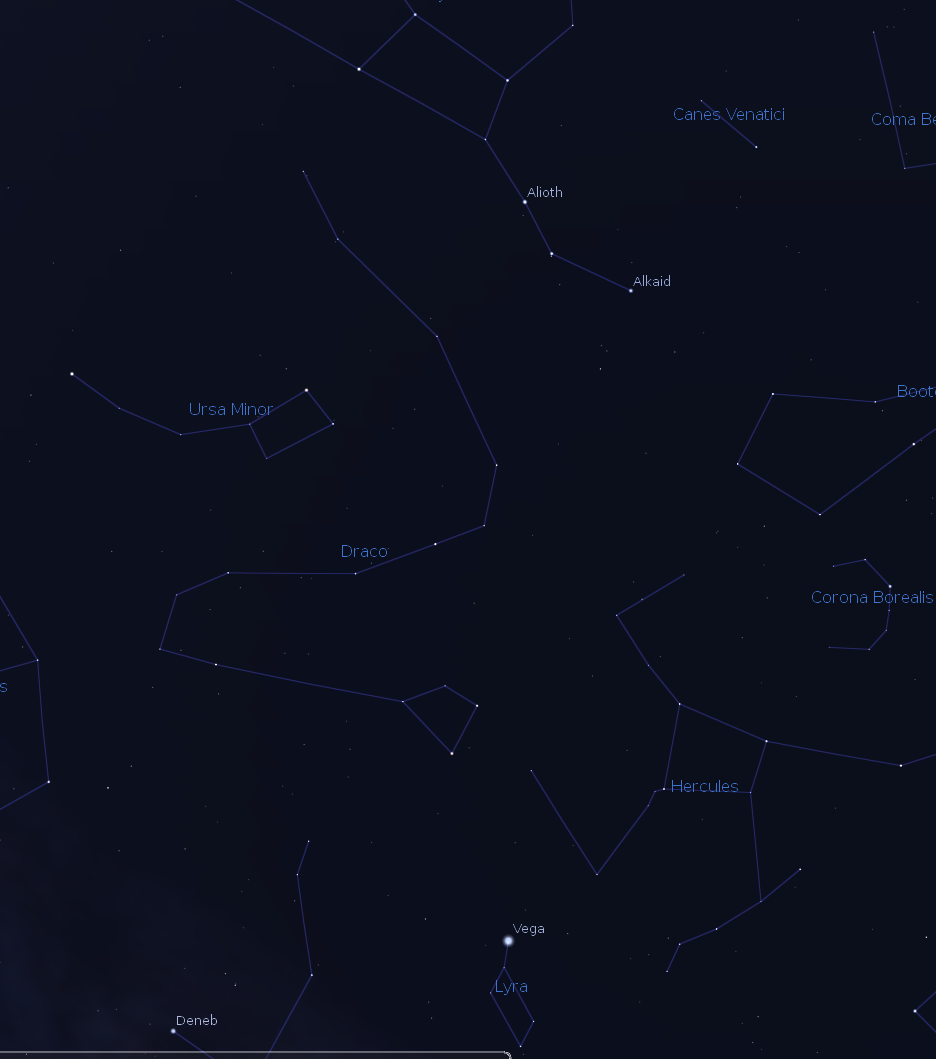
Draco via Stellarium in approximately the same orientation as the Jamieson atlas below. You’s have to face southeast and bend over backward to see this orientation in the sky.
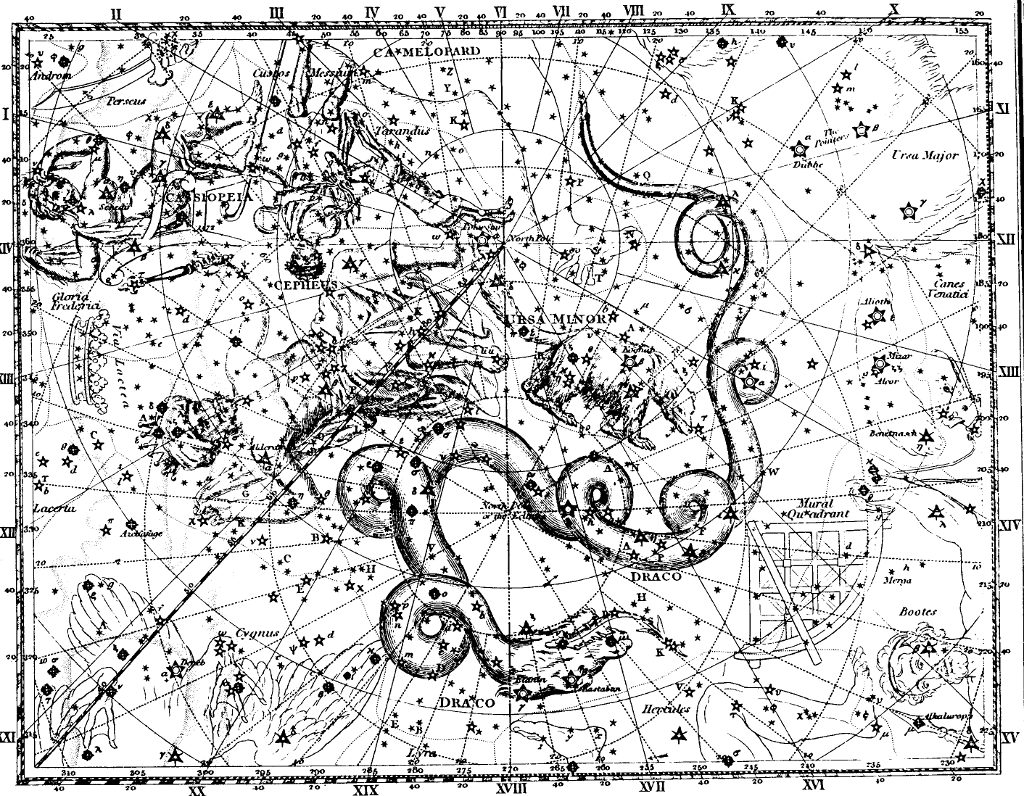
Draco the Dragon as drawn in Alexander Jamieson’s 1820 Celestial Atlas as printer in Men, Monsters and the Modern Universe by George Lovi and Wil Tirion, 1989, Willmann-Bell, Richmond, VA
 Bob Moler's Ephemeris Blog