Archive
01/01/2015 – Ephemeris – Happy New Year – a look at January
Ephemeris for New Years Day, Thursday, January 1st. The sun will rise at 8:20. It’ll be up for 8 hours and 52 minutes, setting at 5:12. The moon, 3 days before full, will set at 5:43 tomorrow morning.
Happy New Year. Let’s preview the month of January. We’re a day from the latest sunrise at about the same time as today, 8:20 a.m. and will back down to 8:02 by the 31st. Sunset times are currently increasing by a minute a day from 5:12 p.m. today to 5:49 at month’s end. Listeners near the shore of Lake Michigan will have about the same sunrise time in Ludington, Interlochen/Traverse City, Petoskey and Mackinaw City, but the sunset times will vary markedly. The Quadrantid meteor shower whose radiant is near the end of the Big Dipper’s handle will reach peak on the 3rd, but it will have interference from the full moon,. On the 4th the Earth will be its closest to the sun of the entire year.
Times are for the Traverse City/Interlochen area of Michigan. They may be different for your location.
Addenda
Monthly Star Chart
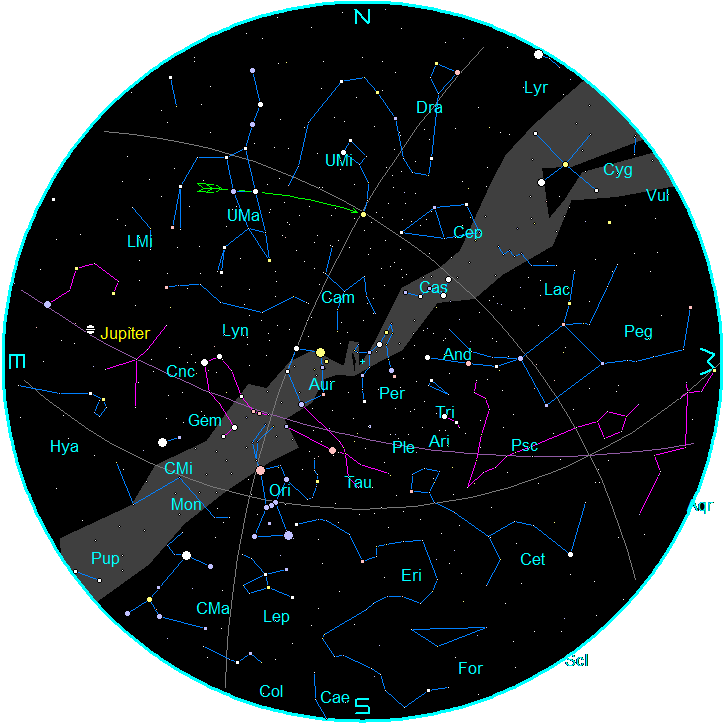
Star Chart for January 2015. Created using my LookingUp program.
The Moon is not plotted. The planets and stars are plotted for the 15th at 9 p.m. That is chart time.
Evening astronomical twilight ends at 6:58 p.m. on January 1st, and increasing to 7:30 p.m. on the 31st.
Morning astronomical twilight starts at 6:34 a.m. on January 1st, and decreasing to 6:22 a.m. on the 31st.
Add a half hour to the chart time every week before the 15th and subtract and hour for every week after the 15th.
For a list of constellation names to go with the abbreviations click here.
The green pointer from the Big Dipper is the pointer stars at the front of the bowl of the Big Dipper that point to Polaris the North Star.
The Quadrantid meteor shower
The moon will interfere with the meteor shower, so only the brightest will be visible. The radiant will rise from the northeast. The radiant will be nearly overhead at the start of twilight. On a dark night up to 120 meteors per hour may be seen according to the International Meteor Organization.
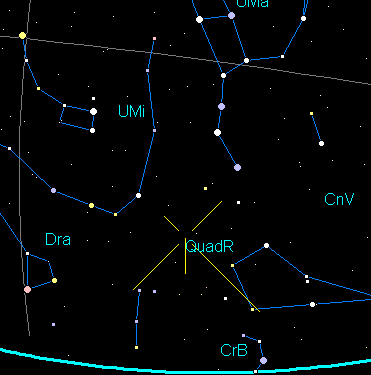
Quadrantid meteor shower radiant at 1:30 a.m.
The Earth at Perihelion
This is the closest the Earth gets to the Sun in its orbit this year. The Sun will be 91,402,000 miles or 147,096,000 kilometers away at around 1 a.m. January 4th, 2015 EST or 6 hr UT January 5th 2015. It makes winter the shortest season because the Earth is moving its fastest during perihelion. It’s only by a few days. And in northern Michigan where it seems that winter overlaps half of fall and spring besides, that few days difference is buried under snow.
Quasi-conjunction between Venus and Mercury on the evening of January 10th.
A quasi-conjunction. Conjunctions occur when two solar system bodies have the same right ascension. Mercury will get to within 0.6 degrees of Venus before retreating back sun-ward.
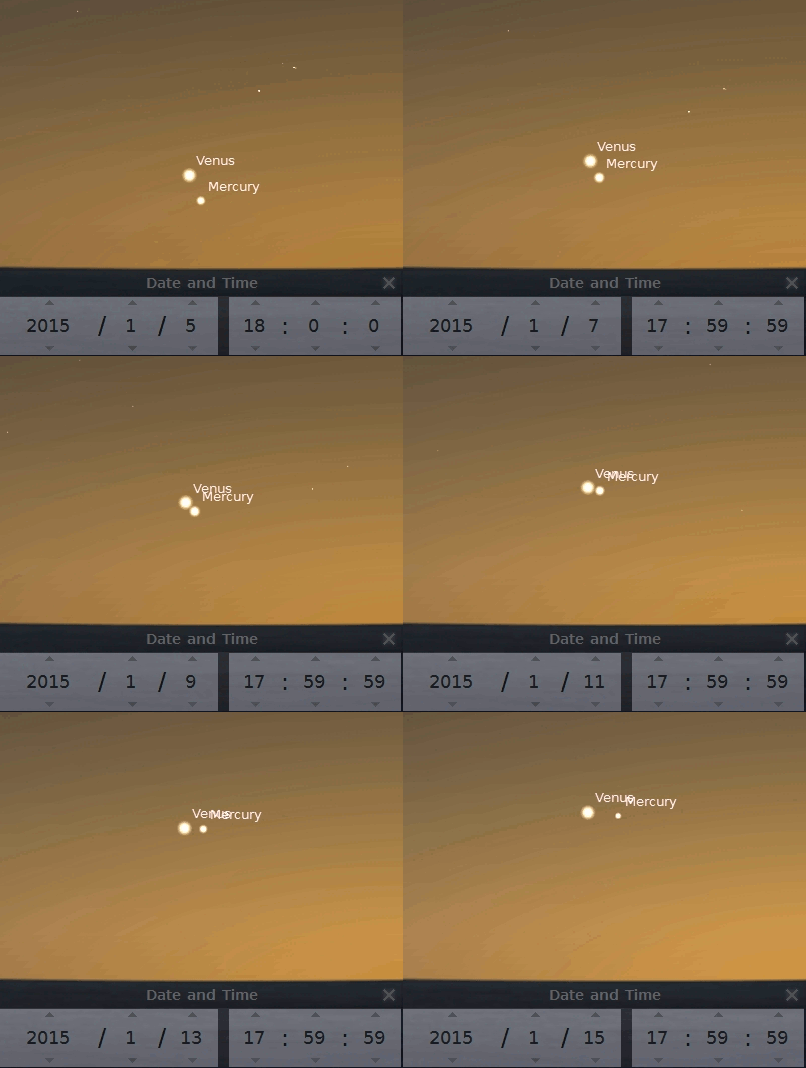
Animation of the Quasi-conjunction of Venus and Mercury. Time span 1/05/2015 to 1/15/2015 at 7 p.m. Created by Bob Moler using Stellarium and GIMP.
Comet C/2014 Q2 (Lovejoy)
Here is a finder chart for 9 p.m. for January. Every other position is marked with the month-day and predicted magnitude. Recently the comet has shown to be brighter than predicted by up to one magnitude. Note that magnitudes in astronomy are like golf scores – the lower the number, the brighter the object. So the comet should reach 4th magnitude.
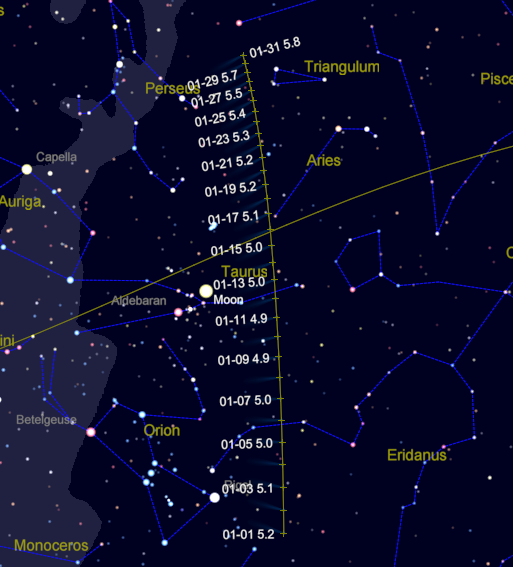
Nightly plot of Comet Lovejoy (C/2014 Q2) for the month of January, 2015 at 9 p.m.
Created using Cartes du Ceil (Sky Charts).
12/31/2014 – Ephemeris – A New Year’s look at the bright planets and a comet
Ephemeris for New Years Eve, Wednesday, December 31st. The sun will rise at 8:19. It’ll be up for 8 hours and 52 minutes, setting at 5:11. The moon, 3 days past first quarter, will set at 4:42 tomorrow morning.
Lets take a last look at the bright planets for 2014. Mercury joins Venus low in the southwest. It will be below and right of Venus and will set at 6:07 p.m. Venus is low in the southwest shortly after sunset. It now sets at 6:26 p.m., an hour and 15 minutes after the sun. It will be seen low in the southwestern twilight by 5:55 p.m. Mars is low in the southwest at 7 p.m. and is in the constellation of Capricornus. The Red Planet will set tonight at 8:36 p.m. Jupiter will rise in the east at 8:33 p.m. It’s near the sickle-shaped head of Leo. Jupiter is now moving slowly westward. This is an effect that happens because the Earth is passing Jupiter, a motion shared by all the planets that baffled the ancients who thought the Earth to be motionless. Early risers will be able to spot Saturn which will rise in the east-southeast at 5:10 a.m.
Times are for the Traverse City/Interlochen area of Michigan. They may be different for your location.
Addendum
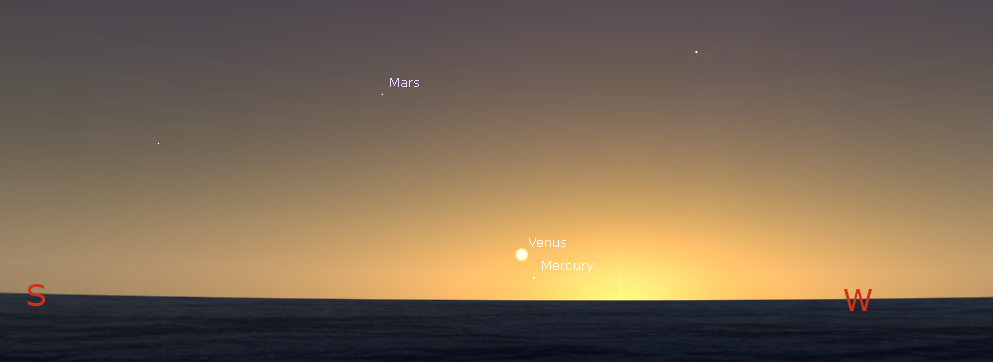
Mercury, Venus and Mars are seen in the southwestern sky shortly after sunset. In this case 5:45 p.m. December 31, 2014, only 34 minutes after sunset. Created using Stellarium.
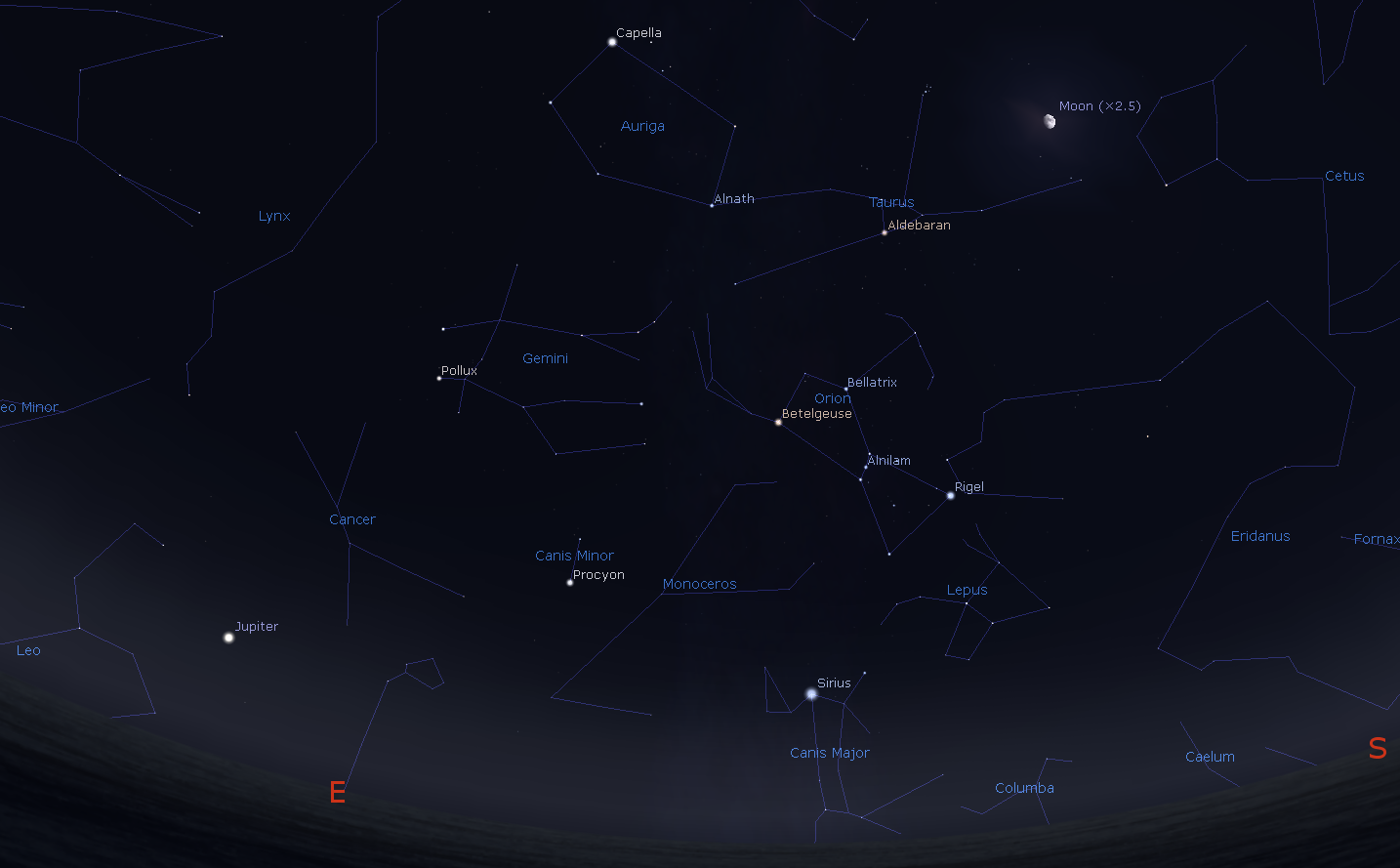
Jupiter, the Moon and the winter constellations at 9:30 p.m. December 31, 2014. Created using Stellarium.
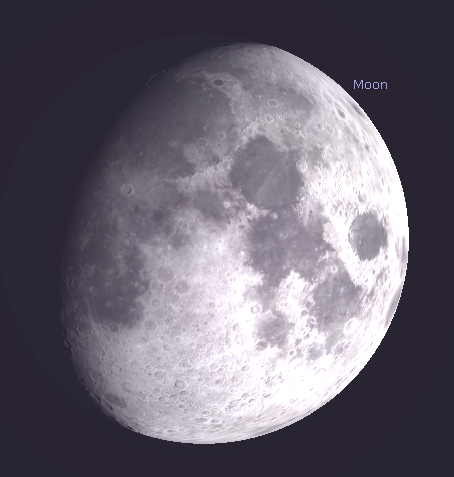
The Moon as it will appear in binoculars at 9:30 p.m. December 31, 2014. Created using Stellarium.
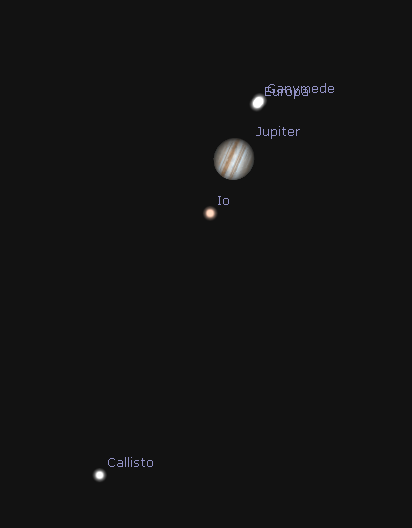
Jupiter seen through a telescope at 9:30 p.m. December 31, 2014. Note that Ganymede and Europa will appear very close to each other. Created using Stellarium.
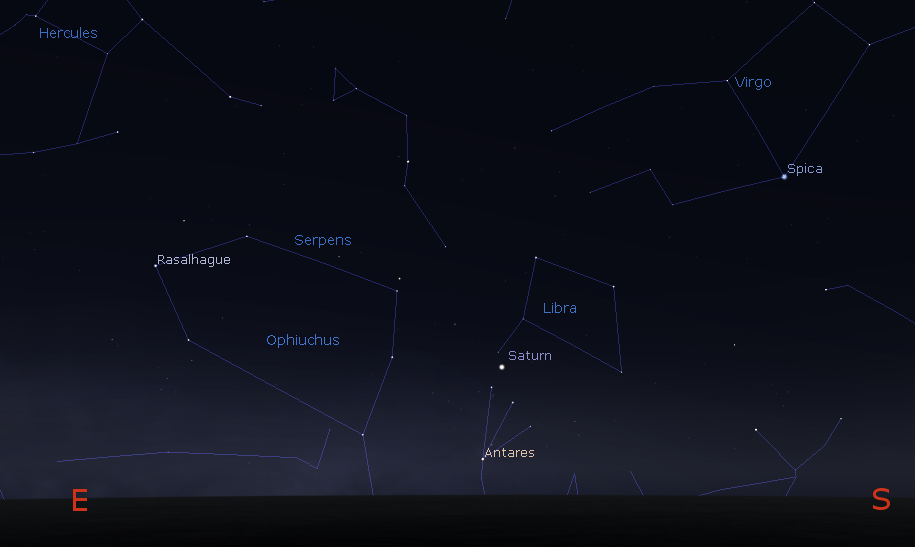
Saturn and the late spring and early summer constellations at 7 a.m. New Year’s Day 2015. Created using Stellarium.
Comet Lovejoy
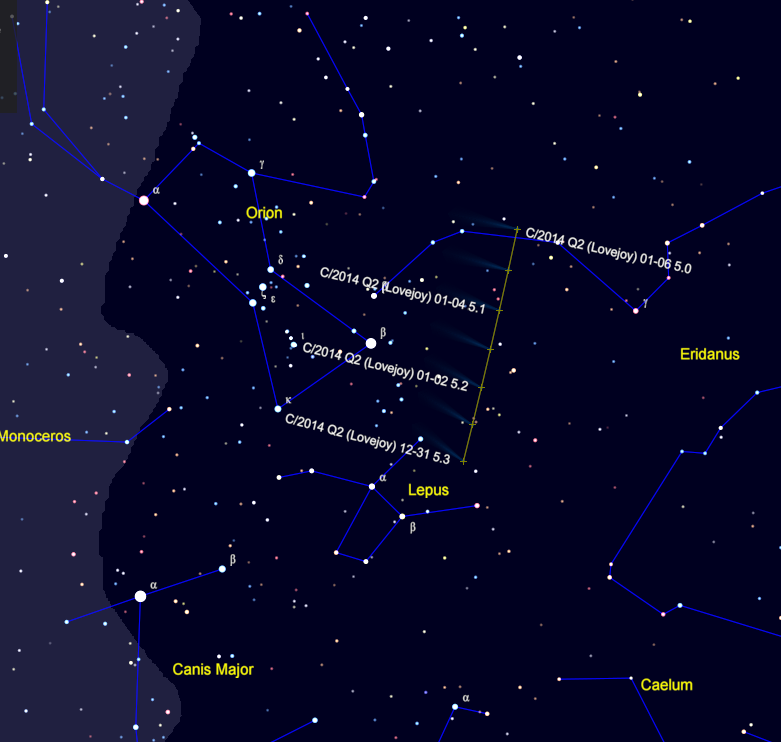
Comet Lovejoy (C/2014 Q2) plotted for 9 p.m. from 12/31/2014 to 1/06/2015. Created using Cartes du Ceil (Sky Charts).
12/24/2014 – Ephemeris – Twas the night before Christmas and only the planets and a comet were stirring
Ephemeris for Christmas Eve, Wednesday, December 24th. The sun will rise at 8:17. It’ll be up for 8 hours and 49 minutes, setting at 5:06. The moon, 3 days past new, will set at 8:37 this evening.
Twas the night before Christmas and only the planets were stirring. Venus is low in the southwest shortly after sunset. It now sets at 6:09 p.m., 63 minutes after the sun. It will be tough to spot at all. New Year’s Eve might be a good time to start to see it. Mars, low in the southwest at 7 p.m. has the Moon just to the right of it tonight. Mars will set tonight at 8:34 p.m. Jupiter, which will be our Christmas Star this year will rise in the east at 8:59 p.m. It’s near the sickle shaped head of Leo. Jupiter is now moving slowly westward. This is an effect that happens because the Earth is passing Jupiter, a motion shared by all the planets that baffled the ancients who thought the Earth to be motionless. Saturn will rise in the east-southeast at 5:34 a.m.
Times are for the Traverse City/Interlochen area of Michigan. They may be different for your location.
Addenda
The Planets tonight
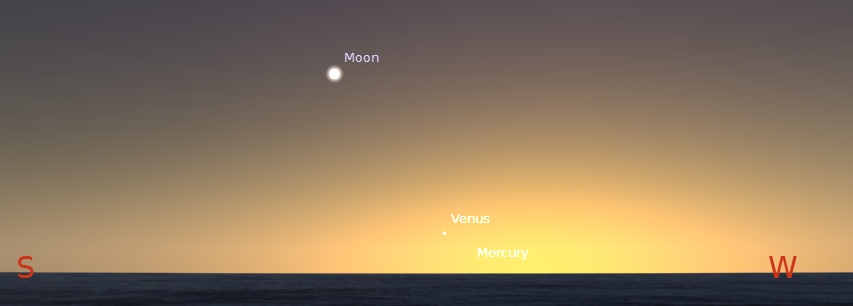
Venus low on the horizon, and the Moon, at 5 30 p.m. on December 24, 2014. Created using Stellarium.
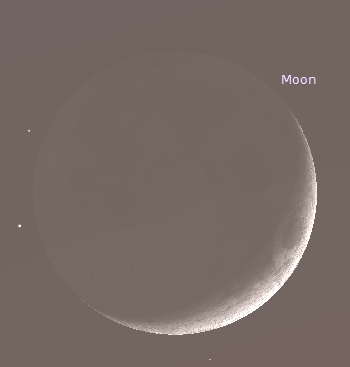
The crescent Moon through binoculars, at 5 30 p.m. on December 24, 2014. Created using Stellarium.
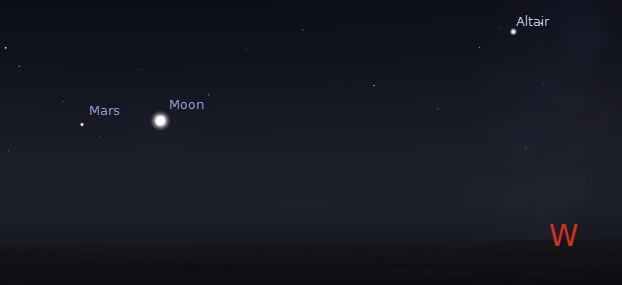
Mars and the Moon at 7:30 p.m. on December 24, 2014. Created using Stellarium.
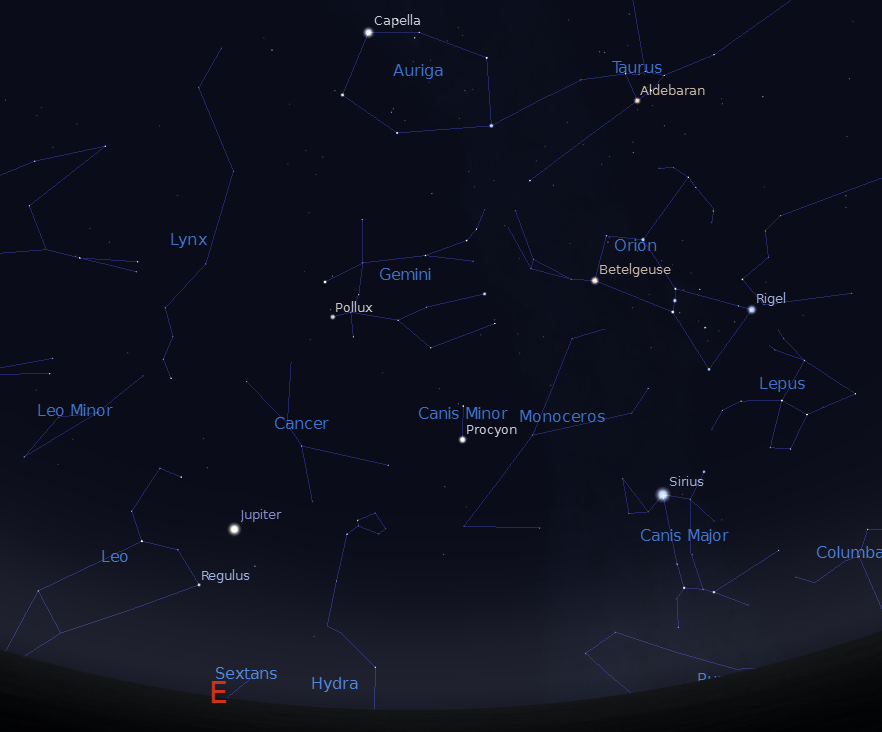
Jupiter and the winter constellations at 11 p.m. on December 24, 2014. Created using Stellarium.
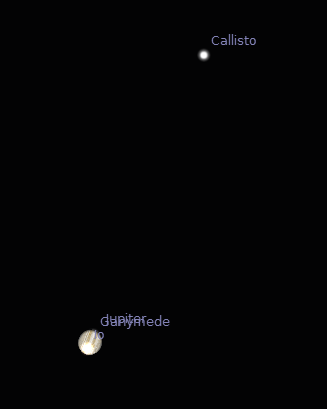
Jupiter with three hidden satellites, with only Callisto showing at 11 p.m. on December 24, 2014. See blow by blow of the satellite disappearances below. Created using Stellarium.
Jovian satellite events of the night of December 24-25, 2014
Ganymede starts eclipse (enters Jupiter’s shadow) 6:20 p.m.
Europa starts eclipse 8:27p.m.
Io’s shadow starts crossing Jupiter 9:32 p.m.
Ganymede leaves Jupiter’s shadow 10:00 p.m.
Ganymede starts being occulted by Jupiter 10:11 p.m.
Io’s transit across the face of Jupiter starts 10:29 p.m.
Io’s shadow leaves the face of Jupiter 11:50 p.m.
Io’s transit of Jupiter ends 12:46 a.m.
Europa’s occultation by Jupiter ends 1:10 a.m.
Ganymede’s occultation by Jupiter ends 1:50 a.m.
Note that Europa’s occultation by Jupiter starts before its eclipse ends, so unlike the more distant Ganymede there isn’t an interval of visibility between the two.
Jovian satellite event timings provided by Project Pluto www.projectpluto.com
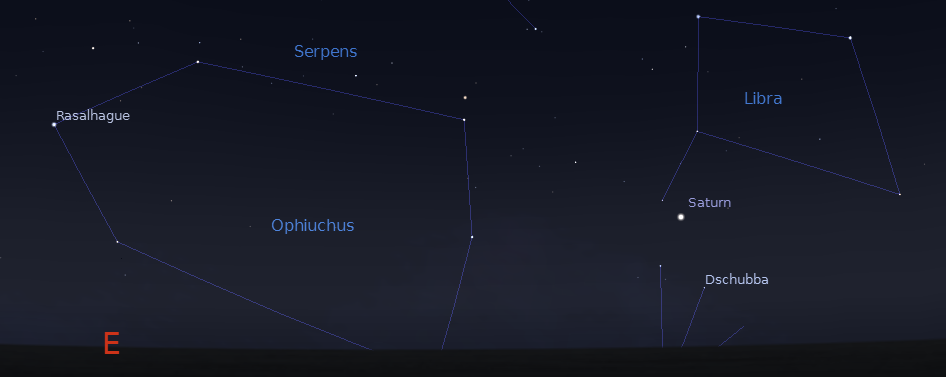
Saturn low in the east-southeast among the constellations of late spring and early summer at 6:30 a.m. on Christmas morning 2014 . Created using Stellarium.
Comet C/2014 Q2 (Lovejoy)
Normally my Ephemeris program deals with celestial objects that are visible to the naked eye. While Comet Lovejoy will, for a few weeks become brighter than 6th magnitude the normal limit for the unaided human eye, a comet is a diffuse object and always looks dimmer than a star of the same magnitude. This comet was discovered August 17, 2014 by Australian amateur astronomer Terry Lovejoy. He has discovered 5 comets. His most famous find was C/2011 W3 (Lovejoy) that buzzed the Sun and survived becoming a magnificent comet for southern hemisphere observers.
Recently Comet Lovejoy became brighter than expected. The data for the charts below are from Minor Planet Center and do not include new brightness estimates that include the outburst. They have the comet reaching magnitude 4.9. The aerith.net website gives the maximum brightness next month of 4. (Magnitudes are like golf scores the lower the magnitude the brighter the object). Each magnitude step is a brightness difference of about 2 and a half times. To check on the comet go to http://www.aerith.net/comet/weekly/current.html. Currently Comet Lovejoy is the brightest comet now visible and is the first comet on the list. Clicking on the comet ‘s name will give you the comet’s page. The last chart on the page is a chart tracking the comet’s brightness from reports vs. prediction. That chart predicts a magnitude of 4 just after the first of the year.
Photographs of the comet show a gaseous coma (head) and a very faint ion tail, which may not be visible visually in binoculars and telescopes. Right now the comet is highest around midnight.
The finder charts below designate the comet by month-day and the predicted magnitude
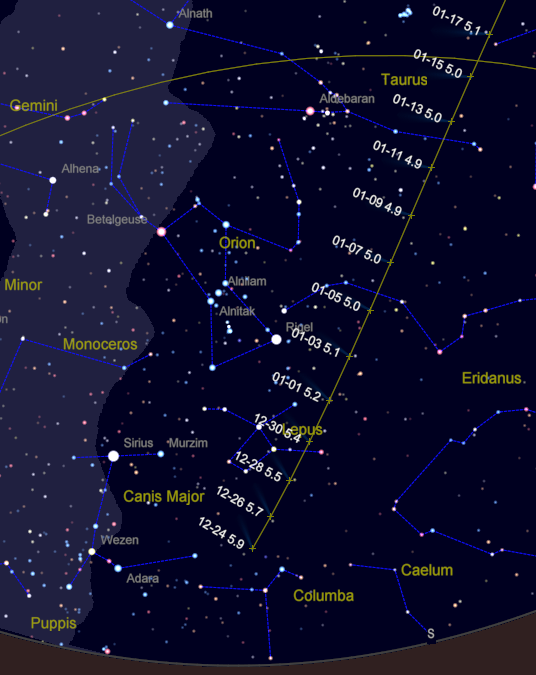
Comet C/2014 Q2 (Lovejoy) at 11 p.m. at 2 day intervals from tonight 12/24/2014 to 1/17/2015. Created using Cartes du Ceil (Sky Charts).
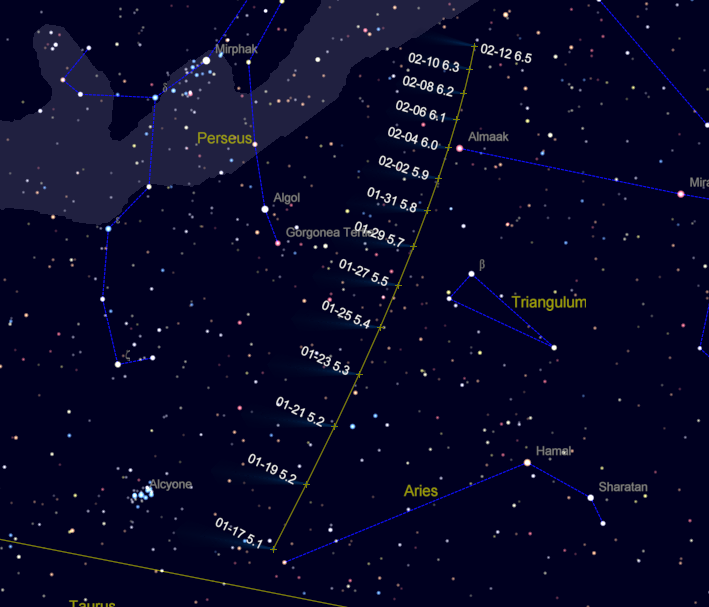
Comet C/2014 Q2 (Lovejoy) at 8 p.m. at 2 day intervals from tonight 1/17/2015 to 2/12/2015. Created using Cartes du Ceil (Sky Charts).
On December 28th Comet Lovejoy will appear to pass the globular cluster M79.
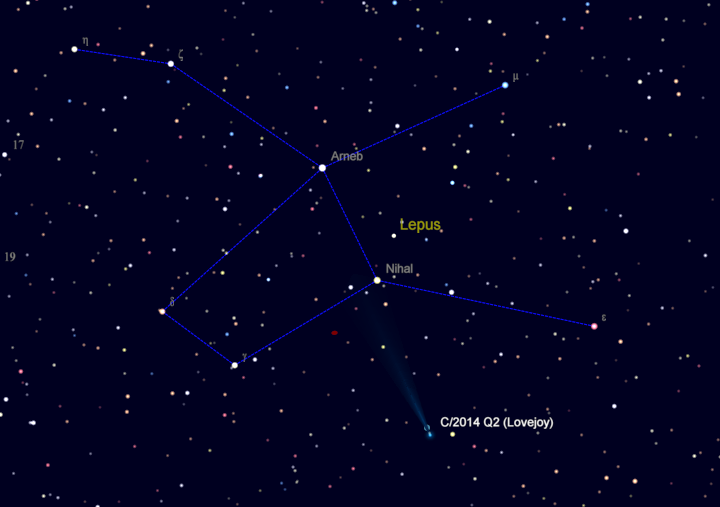
Comet Lovejoy and M79 a distant globular star cluster, in the constellation of Lepus the hare, will appear together at 11 p.m. December 28th, 2014. Note the that M79 is the unlabeled blue dot in the tail of the comet, next to the head. Created using Cartes du Ceil (Sky Charts).
01/01/2014 – Ephemeris – A look at events the month and for the next few days and the planets
Note: The two paragraphs below were aired on IPR. They are not my usual Wednesday feature on the planets which is in the addendum. The first few days of January are busy with astronomical happenings. I’ll have a preview of this year’s eclipses on Monday the 6th with the daily and an extra post.
Ephemeris for New Years Day, Wednesday, January 1st, 2014. The sun will rise at 8:19. It’ll be up for 8 hours and 53 minutes, setting at 5:13. The moon is new today, and won’t be visible.
Happy New Year. We’re too busy with astronomical events to preview the year. Today and tomorrow we’ll cover the highlights of this month. We’re a day from the latest sunrise at about the same time as today and will back down to 8:02 by the 31st. Sunset is current increasing by a minute a day and will set at 5:50 at month’s end. Listeners on the shore of Lake Michigan will have about the same sunrise time from Ludington to Mackinaw City, but the sunset times will vary markedly. Jupiter will be in opposition from the sun and rise at sunset on the 4th. This is your last week to see Venus in the evening sky. It will leave the evening sky on the 11th and enter the morning sky. Start looking for the Quadrantid meteor shower that will peak on the 3rd.
Times are for the Traverse City/Interlochen area of Michigan. They may be different for your location.
Addendum
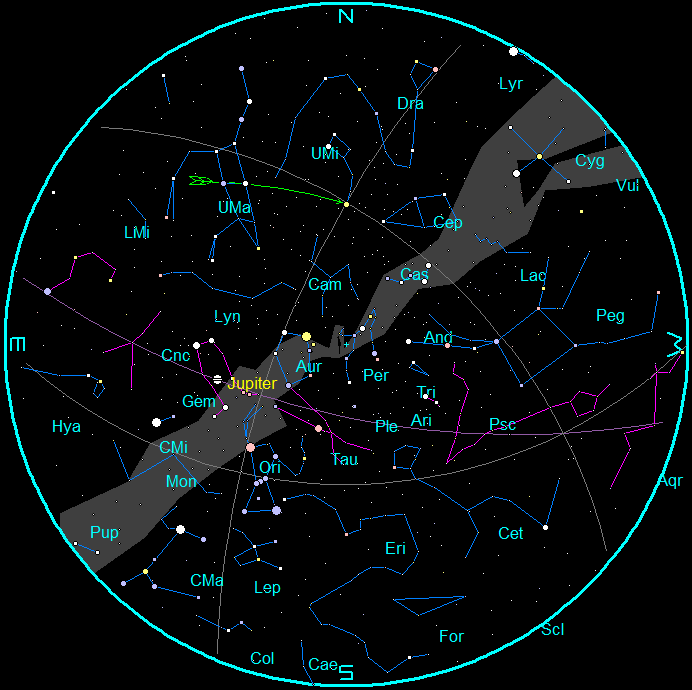
A star chart for January 15th at 9 p.m. Add a half hour to every week before the 15th and subtract and hour for every week after the 15th. Created using my LookingUp program.
For a list of constellation names to go with the abbreviations click here
This is our weekly look at the planets. Venus is brilliant in the southwest after sunset. It will set at 6:36 p.m. Venus is noticeably closing with the sun. It will be lost in the glare of the sun in less than a week. Venus is a thin crescent, and we’re at the point where the crescent can be visible in binoculars. The giant planet Jupiter will rise at 5:24 p.m. in the east northeast. It’s cruising against the stars of Gemini now. It will pass due south at 1:04 a.m. It will be in opposition from the sun on the 4th, where it will rise at sunset and set at sunrise. Mars will rise at 12:51 a.m. in the east. Reddish Mars is to the upper right of the bright star Spica in Virgo. Saturn will rise at 4:12 a.m. in the east southeast. It will be in Libra this year. The ringed planet will best be seen in the evening next summer. There is a comet visible in binoculars in the morning sky. It’s Comet Lovejoy (C/2013R1).
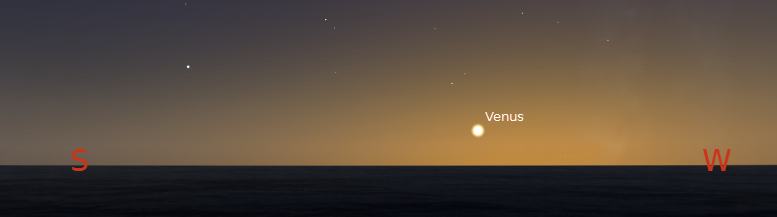
Venus in the west southwest at 6 p.m. on January 1, 2014. Venus will be harder and harder to spot between now and its inferior conjunction with the sun on the 11th. Created using Stellarium.
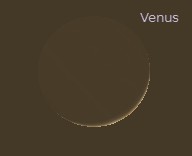
Venus’ thin crescent on January 1, 2014 at 6 p.m. The crescent will be bright but the night side will not be visible as Stellarium suggests. Created using Stellarium.
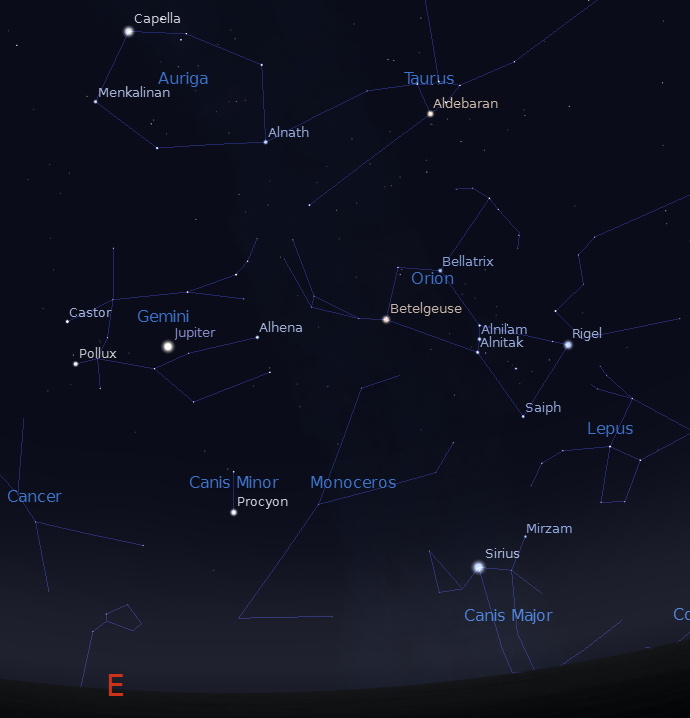
Jupiter and the constellations of winter at 9 p.m. on January 1, 2014. Created using Stellarium.
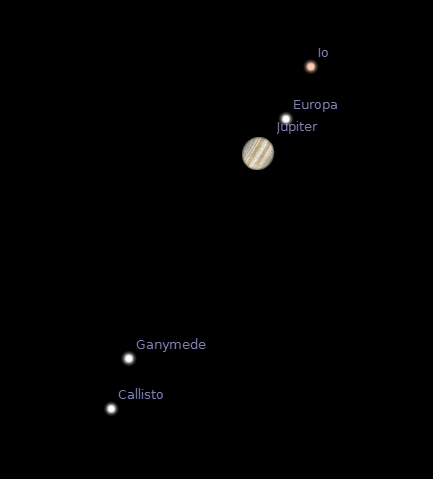
Jupiter and its satellites as seen in a telescope at 9 p.m. on January 1, 2014. That actual rotation of the image depends on the telescope. Created using Stellarium.
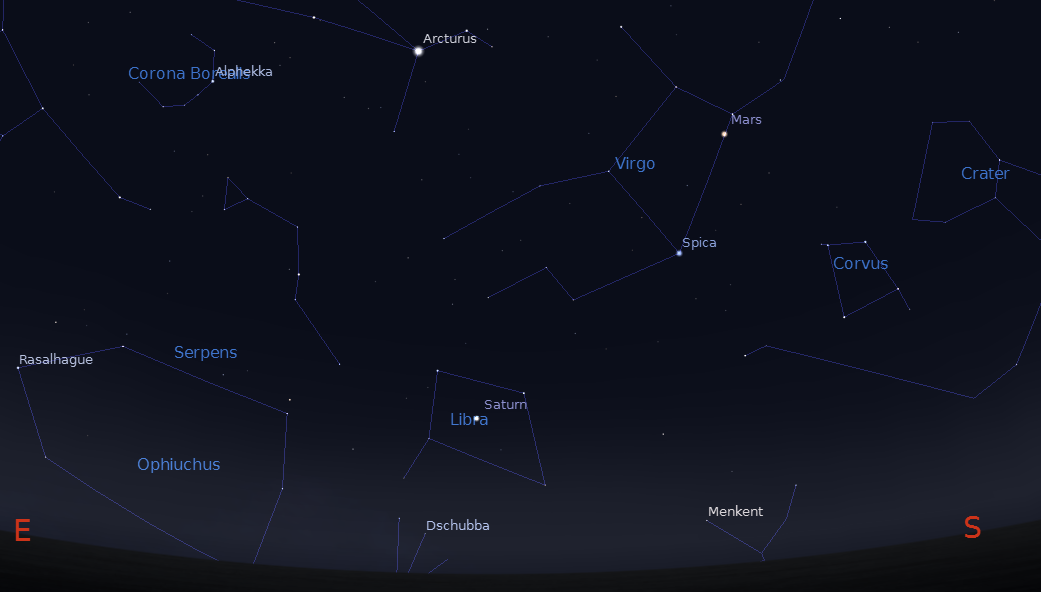
Mars and Saturn among the spring constellations at 6 a.m. January 2, 2014. Created using Stellarium.
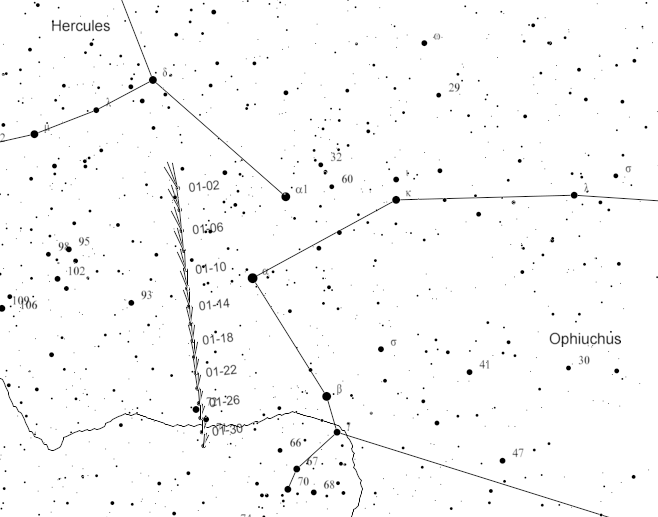
The track of Comet Lovejoy, which still should be visible in binoculars from 01/02/14 to 01/31/14 at 6:30 a.m. Created using Cartes du Ciel (Sky Charts).
12/25/2015 – Ephemeris – Where are the bright planets and Comet Lovejoy this week?
Ephemeris for Christmas Day, Wednesday, December 25th. The sun will rise at 8:18. It’ll be up for 8 hours and 49 minutes, setting at 5:07. The moon, at last quarter today, will rise at 1:34 tomorrow morning.
This is our weekly look at the planets. Venus is brilliant in the southwest after sunset. It will set at 7:08 p.m. Venus is noticeably closing with the sun. It will be lost in the glare of the sun in less than 2 weeks. Venus is a thin crescent, and we’re at the point where the crescent can be visible in binoculars. The giant planet Jupiter will rise at 5:56 p.m. in the east northeast. It’s cruising against the stars of Gemini now. It will pass due south at 1:35 a.m. Mars will rise at 1:02 a.m. in the east. Reddish Mars is to the upper right of the bright star Spica. It will be above the moon tomorrow morning. Saturn will rise at 4:36 a.m. in the east southeast. The ringed planet will best be seen in the evening next summer. There is a comet visible in binoculars in the morning sky. It’s Comet Lovejoy.
Times are for the Traverse City/Interlochen area of Michigan. They may be different for your location.
Addendum

Venus in the southwest at 6 p.m. on December 25, 2013. Created using Stellarium.
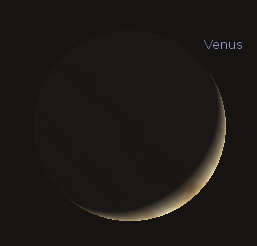
The thin crescent of Venus seen in a telescope. December 25, 2013. Created using Stellarium.
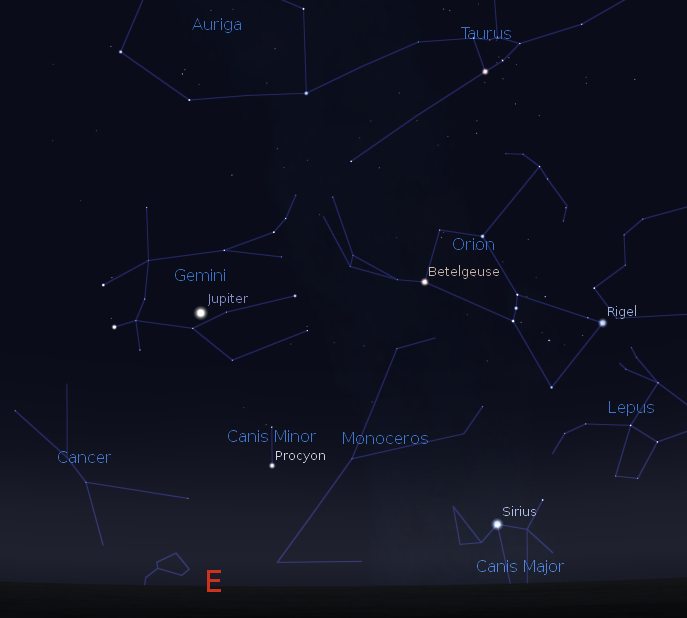
Jupiter and the constellations of winter at 9 p.m. on December 25, 2013. Created using Stellarium.
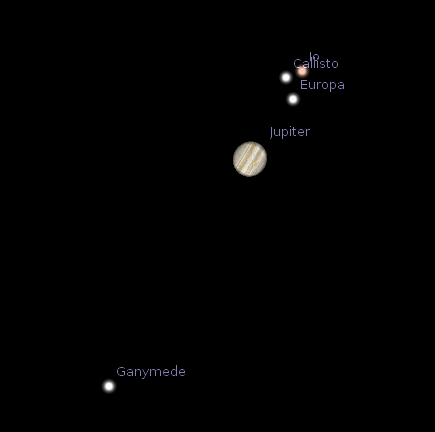
Apparent traffic jam of Jovian satellites as seen in a telescope at 9 p.m. on December 25, 2013. That actual rotation of the image depends on the telescope. Created using Stellarium.
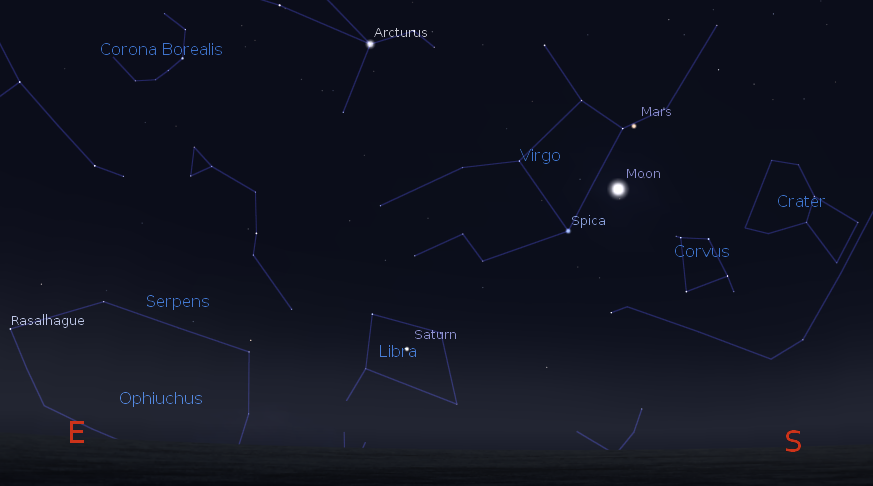
Mars and Saturn among the spring constellations at 6 a.m. December 26, 2013. Created using Stellarium.
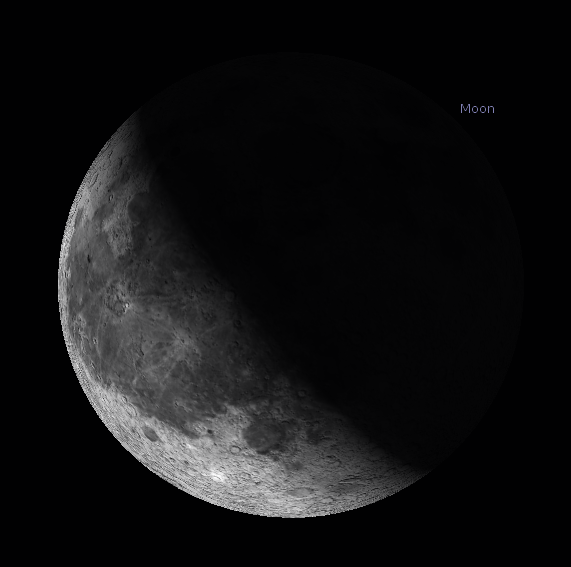
The Moon as seen in binoculars or telescope at 6 a.m. December 26, 2013. Created using Stellarium.
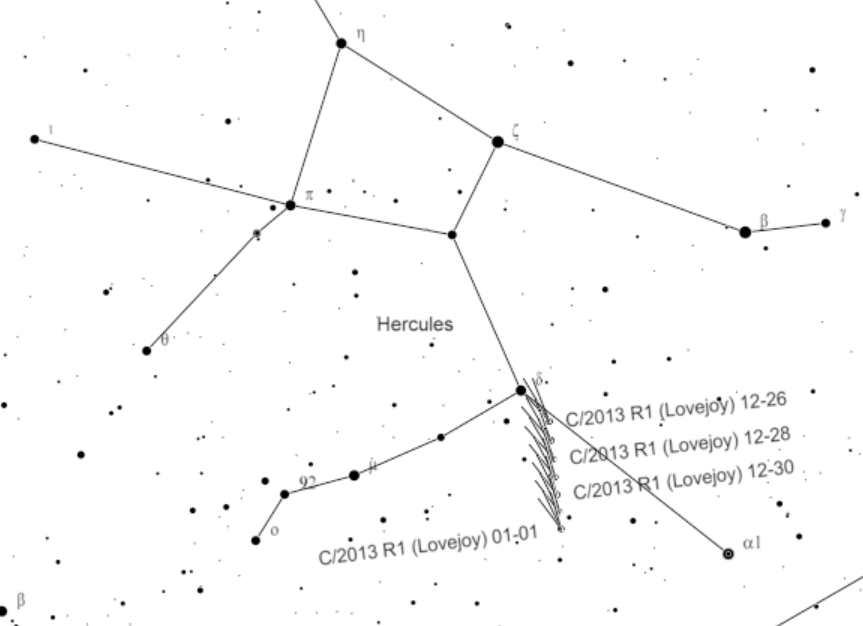
The track of Comet Lovejoy, which still should be visible in binoculars from 12/26/2013 to 01/01/2014 at 6 a.m. Created using Cartes du Ciel (Sky Charts).
Note that Stellarium and Cartes du Ciel as free programs. Links to them can be found at the right under Free Astronomical Programs.
12/18/2013 – Ephemeris – Where are the bright planets and Comet Lovejoy?
Ephemeris for Wednesday, December 18th. The sun will rise at 8:14. It’ll be up for 8 hours and 49 minutes, setting at 5:03. The moon, 1 day past full, will rise at 6:38 this evening.
This is our weekly look at the planets. Venus is brilliant in the southwest after sunset. It will set at 7:30 p.m. Venus us beginning to noticeably close with the sun. It will be gone from our evening sky in a month. Venus is a crescent, and we’re coming to the point where the crescent can be visible in binoculars. The giant planet Jupiter will rise at 6:28 p.m. in the east northeast. It’s cruising against the stars of Gemini now. It will pass due south at 2:07 a.m. Mars will rise at 1:13 a.m. in the east. Reddish Mars is closer to Spica in Virgo than to Regulus in Leo. Saturn will rise at 5 a.m. in the east southeast. There is a comet visible in binoculars in the morning sky. It’s Comet Lovejoy. A finder chart for the next week will be at bobmoler.wordpress.com with today’s transcript.
Times are for the Traverse City/Interlochen area of Michigan. They may be different for your location.
Addendum
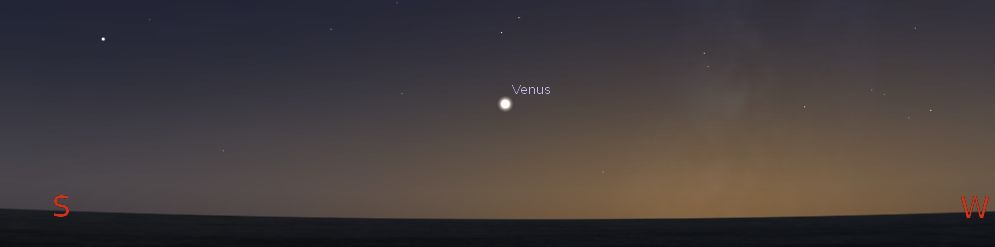
Venus in the southwest at 6 p.m. on December 18, 2013. Created using Stellarium.
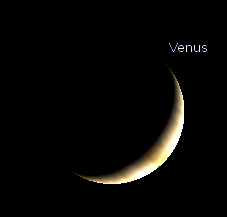
Venus as seen in a telescope at 6 p.m. December 18, 2013. The disk will be blindingly bright with no detail. Created using Stellarium.
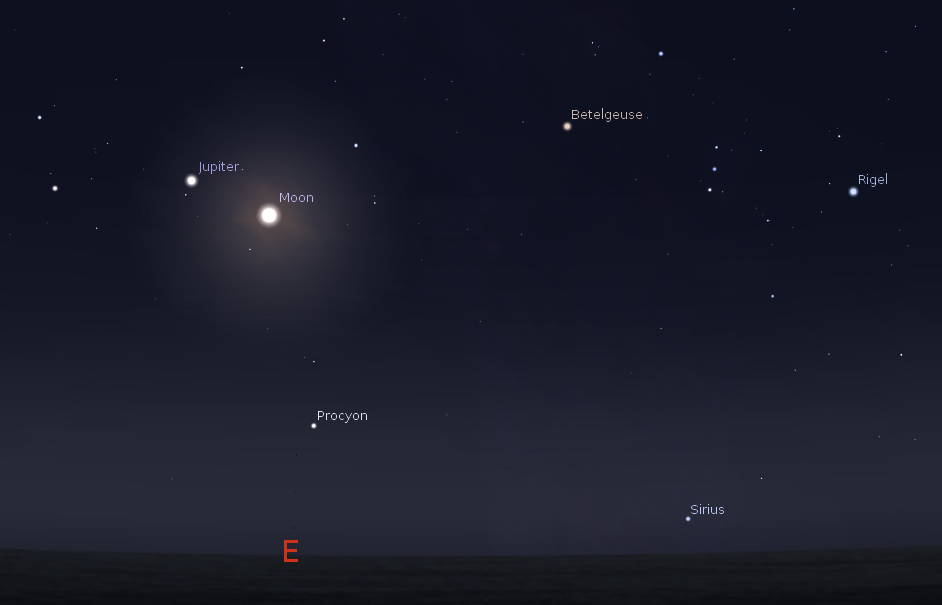
Jupiter and the Moon at 9 p.m. on December 18, 2013. Created using Stellarium.
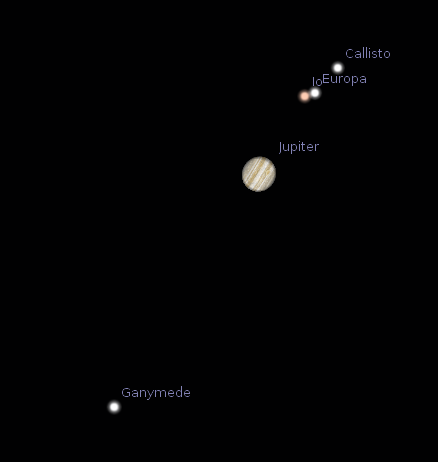
Jupiter and its moons as seen in a telescope at 9 p.m. December 18, 2013. The orientation may be rotated or even mirror image. Created using Stellarium.
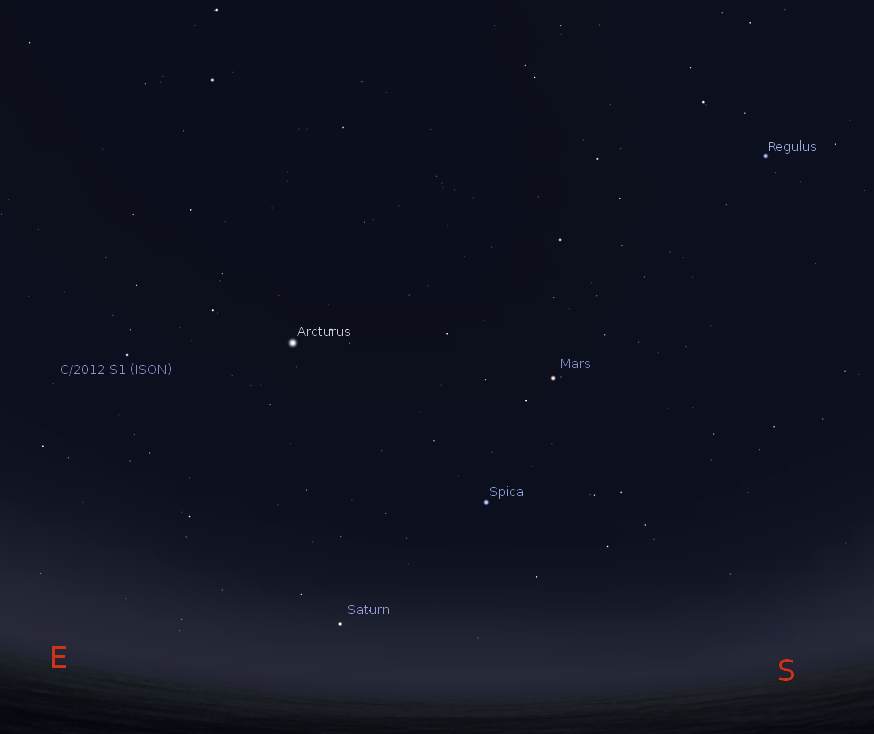
Mars, Saturn and the ghost of Comet ISON at 6 a.m. on December 19, 2013. Created using Stellarium.
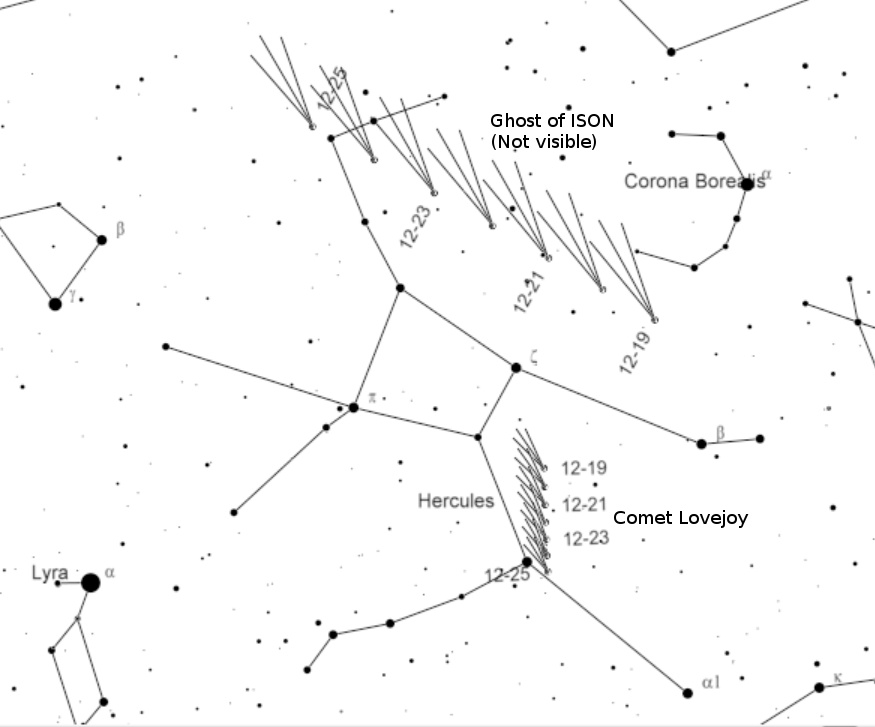
Comet Lovejoy finder chart for the next week at 6 a.m. We’re stuck also with the ghost of Comet ISON. Look in the northeast at the constellation Hercules. Created using Cartes du Ciel.
12/11/2013 – Ephemeris – Where are the bright planets this week, plus a consolation comet
Ephemeris for Wednesday, December 11th. The sun will rise at 8:09. It’ll be up for 8 hours and 52 minutes, setting at 5:02. The moon, 2 days past first quarter, will set at 3:23 tomorrow morning.
Let’s see where the bright planets are this week. Venus is brilliant in the southwest after sunset. It will set at 7:44 p.m. Venus has a crescent appearance because it is between the Earth and Sun which is easily seen in telescopes and can be detected in binoculars now. Venus is 57 million kilometers away from us now or 35.4 million miles. The giant planet Jupiter will rise at 7 p.m.. in the east northeast. It’s cruising against the stars of Gemini now. It will pass due south at 2:37 a.m. Mars will rise at 1:22 a.m. in the east. Mars is a bit closer to Spica in Virgo than Regulus in Leo, and can be distinguished by its yellow-orange color. Saturn will rise at 5:24 a.m. and should be visible low in the east south east by 6 a.m.
Times are for the Traverse City/Interlochen area of Michigan. They may be different for your location.
Addendum
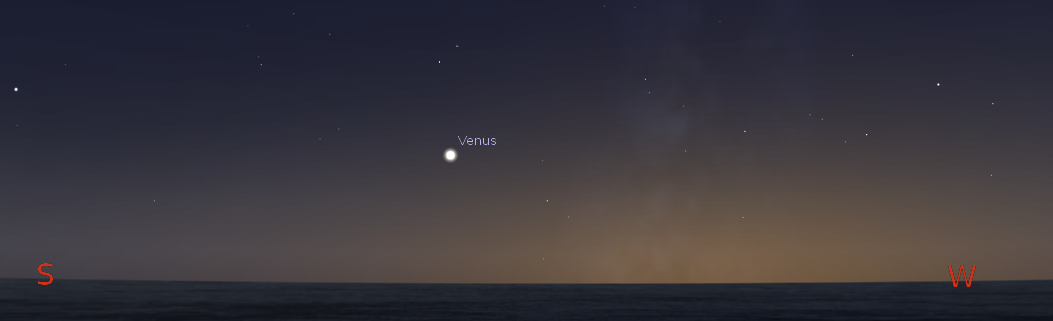
Venus in the southwest at 6 p.m. on December 11, 2013. Created using Stellarium.
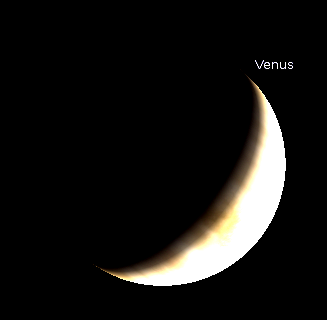
Venus as seen in a telescope at 6 p.m. December 11, 2013. The disk will be blindingly bright with no detail. Created using Stellarium.
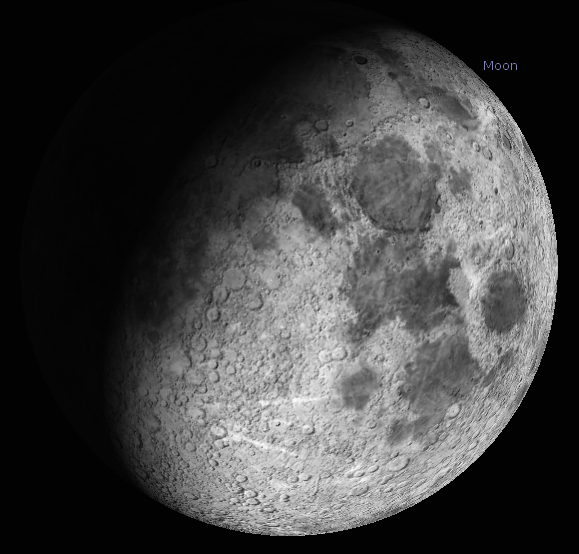
The gibbous Moon magnified at 9 p.m. on December 11, 2013. Created using Stellarium.
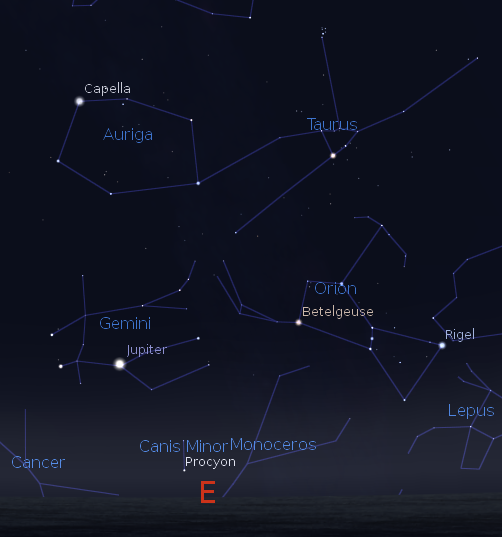
Jupiter and some winter constellations at 9 p.m. on December 11, 2013. Created using Stellarium.
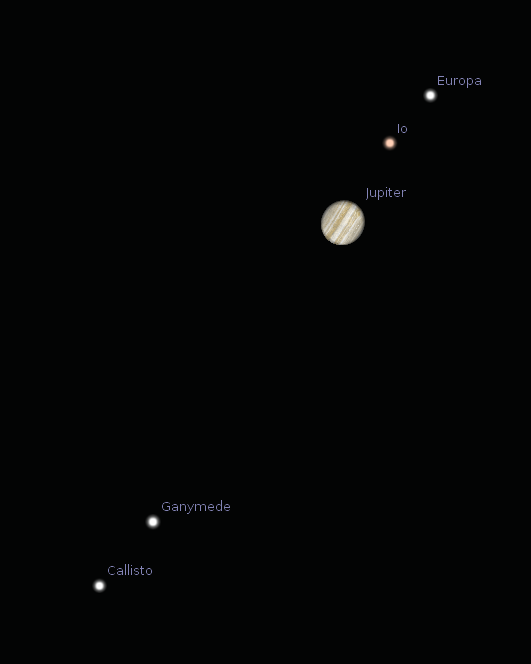
Jupiter and its moons as seen in a telescope at 9 p.m. December 11, 2013. The orientation may be rotated or even mirror image. Created using Stellarium.
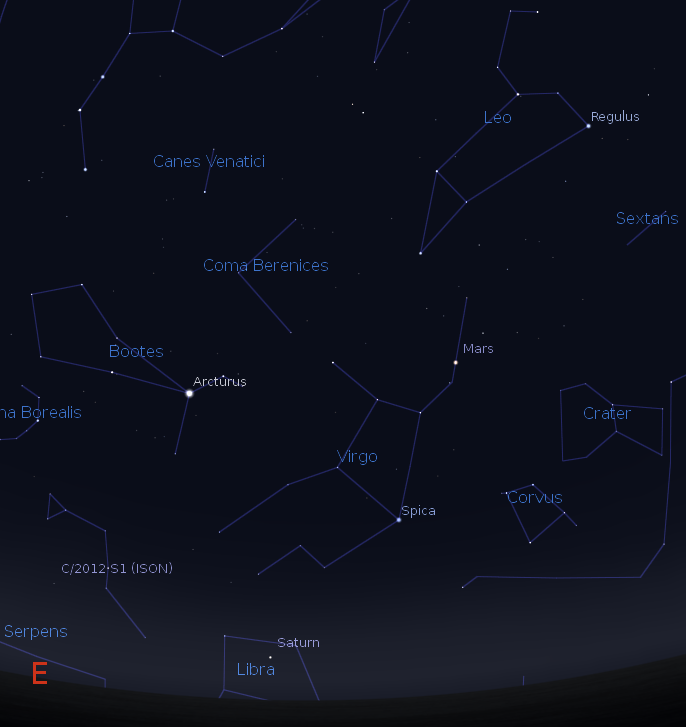
Mars, Saturn and the ghost of Comet ISON at 6 a.m. on December 12, 2013. Created using Stellarium.
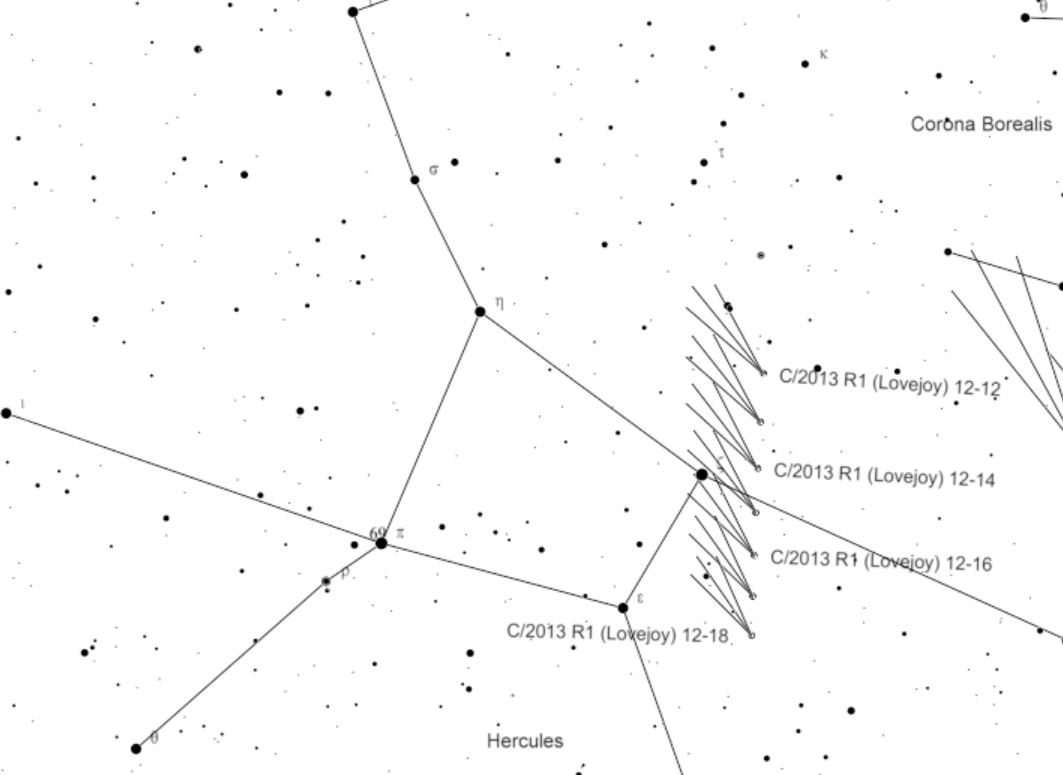
Comet Lovejoy finder chart for the next week at 6 a.m. There a bit of a tail at the right edge from the ghost of ISON (It’s not visible). Look in the northeast at the constellation Hercules with binoculars. Created using Cartes du Ciel.
Comet Lovejoy is an easy binocular object. It’s brighter than Comet ISON was in dark skies.
12/29/11 – Ephemeris – Astronomical highlights from 2011
Thursday, December 29th. The sun will rise at 8:18. It’ll be up for 8 hours and 51 minutes, setting at 5:10. The moon, 3 days before first quarter, will set at 11:00 this evening.
Let’s look at the best astronomical events of 2011. To my mind Comet Lovejoy’s survival near the sun is one. The announcements from the Kepler satellite keep coming in. Over 2000 planets in other solar systems suspected including a planet 2.4 times the size of the earth in its star’s habitable zone, two planets of another star about the size of the earth and a planet with two suns. A fourth moon of Pluto was discovered, worrying scientists operating the New Horizons spacecraft that will reach Pluto in 3 and a half years that there may be a debris field around the dwarf planet. This year the MESSENGER satellite gained orbit of the innermost planet Mercury, and the Dawn spacecraft began orbiting the asteroid Vesta. Those are just a sample.
* Times, as always are for the Traverse City/Interlochen area of Michigan.
Planetary Society Blog has animation of Comet Lovejoy (C/2011W3) entering SOHO’s LASCO C3 field.
Emily Lakdawalla has the scoop. http://www.planetary.org/blog/article/00003301/
The comet should be closest to the sun (100,000 miles from the surface) tomorrow about 7 p.m. EST (0h U.T. December 16th). Supposedly about 600 feet in diameter. Do you think it’s got a snowball’s chance in hell of surviving? The sun’s surface (photosphere) is about 10,000 degrees F.
—
Bob Moler
12/12/11 – Ephemeris – The Solar and Heliospheric Observatory (SOHO)
Monday, December 12th. The sun will rise at 8:09. It’ll be up for 8 hours and 52 minutes, setting at 5:02. The moon, 2 days past full, will rise at 7:15 this evening.
Most of this week will be on the topic of Comet Lovejoy which will pass a hundred thousand moles of the sun’s surface Thursday evening our time. It should be visible to the SOHO spacecraft orbiting the sun a million miles sunward of the earth starting Wednesday. Normally a spacecraft inside the earth’s orbit will orbit the sun in less time than the earth and move away from the earth. However SOHO is placed at a unique spot called L1, kind of a equilibrium point between the earth and sun SOHO means Solar and Heliospheric Observatory was launched in 1995 and has served as an early warning sentinel for solar storms approaching the earth pretty much ever since. It is with SOHO that we’ll see if Comet Lovejoy survives its plunge near the sun.
* Times, as always are for the Traverse City/Interlochen area of Michigan.
 Bob Moler's Ephemeris Blog