Archive
10/06/2015 – Ephemeris – Deneb our home-town star
Ephemeris for Tuesday, October 6th. The Sun will rise at 7:46. It’ll be up for 11 hours and 27 minutes, setting at 7:14. The Moon, 2 days past last quarter, will rise at 2:36 tomorrow morning.
We, here in Traverse City, Michigan have a pretty unique relation to the bright star Deneb, as is any location near 45 degrees north latitude. Tonight at 9:23 Deneb will be three-quarters of a degree due north of the zenith. Due north means that it’s on our meridian, a line you may remember from your school days. For astronomers it passes from the north point on the horizon, through the overhead point or zenith to the south point on the horizon. Also due to our latitude Deneb is circumpolar, meaning that it doesn’t quite set on a clean northern horizon. Deneb and 56 other stars are used for celestial navigation, which is still taught in case the GPS system goes down due to solar or enemy action.
Times are for the Traverse City/Interlochen area of Michigan. They may be different for your location.
Addendum
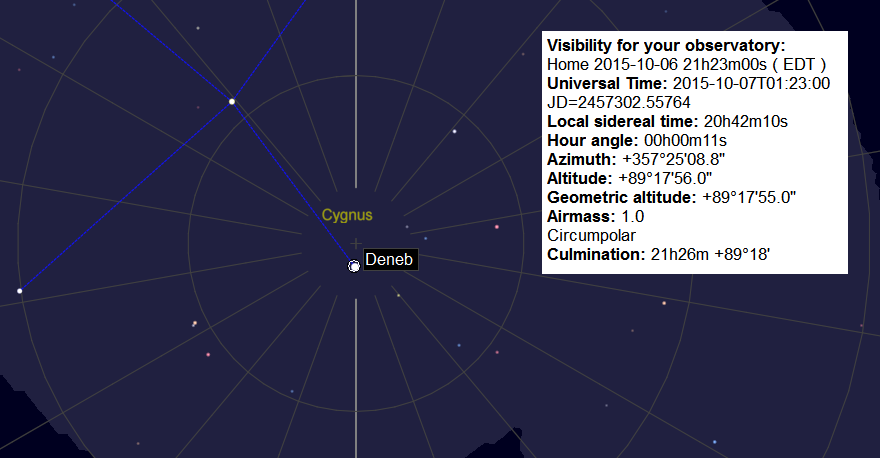
Deneb nearly at the zenith from Traverse City. Created using Cartes du Ciel.
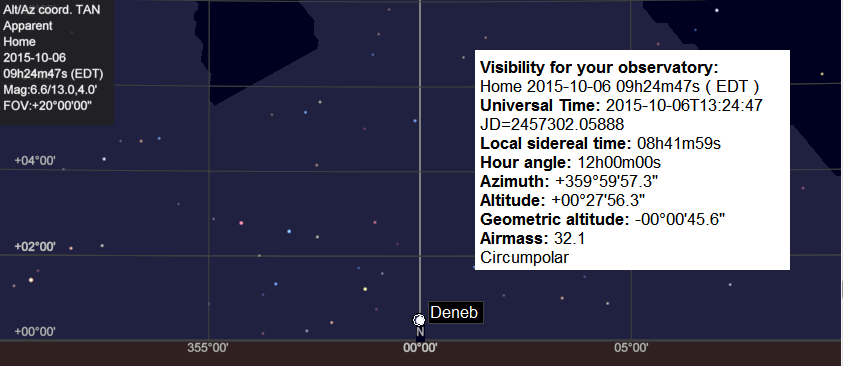
Deneb is close to the horizon due north. Created using Cartes du Ciel.
08/04/2015 – Ephemeris – Is it a swan or a cross?
Ephemeris for Tuesday, August 4th. The Sun rises at 6:32. It’ll be up for 14 hours and 32 minutes, setting at 9:04. The Moon, 2 days before last quarter, will rise at 11:33 this evening.
High in the east northeast as it gets dark flies the constellation of Cygnus the swan. This constellation is also known as the Northern Cross. The cross is seen lying on its side with the bright star Deneb at the head of the cross to the left. The rest of the cross is delineated in the stars to the right. As a swan, Deneb is the tail, the stars of the crosspiece of the cross are part of the leading edges of the wings as Cygnus flies south through the Milky Way. There are faint stars that also define the tips and trailing edges of its wings. It is a very good portrayal of a flying swan, like the mute swans we see on the wing in our area. This is the form the Greek god Zeus took to seduce the maiden Leda in the Leda and the swan affair, out of whose union Pollux was born, who was the twin of Castor, both of whom are also in the stars as the constellation Gemini. In Cygnus we are looking toward the direction that the Sun and the Earth are traveling as we orbit the center of the Milky Way.
Times are for the Traverse City/Interlochen area of Michigan. They may be different for your location.
Addendum
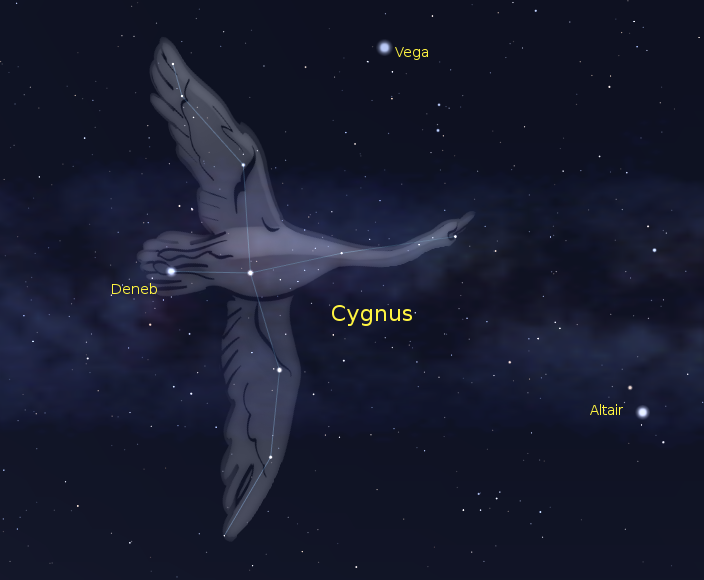
Cygnus The Swan Created using Stellarium.
Note for telescope owners: The star that appears in the eye of the swan image above is Alberio (β Cygni), which splits into a beautiful binary star, whose component stars are blue and gold. It takes a bit more magnification than a pair of binoculars provides.
Note also the mythological citation in the program was omitted from the broadcast version due to time constraints.
07/27/2015 – Ephemeris – Deneb, the dimmest of the Summer Triangle stars. But is it really?
Ephemeris for Monday, July 27th. The Sun rises at 6:23. It’ll be up for 14 hours and 51 minutes, setting at 9:14. The Moon, 3 days past first quarter, will set at 3:36 tomorrow morning.
This evening when it gets dark the bright star Deneb in Cygnus the swan will be high in the east northeast. Deneb is the dimmest star of the summer triangle. Of the other stars of the triangle, Vega is very high in the east, while Altair is lower in the southeast. While Deneb’s apparent magnitude, or brightness as seen from earth, makes it the dimmest of the three bright stars, Deneb’s vast distance of possibly 2,600 light years makes it over 100 times the distance of Vega. If brought as close as Vega, Deneb would be almost as bright as the full moon. It is as bright as two hundred thousand suns. It apparently has run out of hydrogen in its core. Once a blue super giant star, it’s currently evolving through the white supergiant stage.
Times are for the Traverse City/Interlochen area of Michigan. They may be different for your location.
Addendum
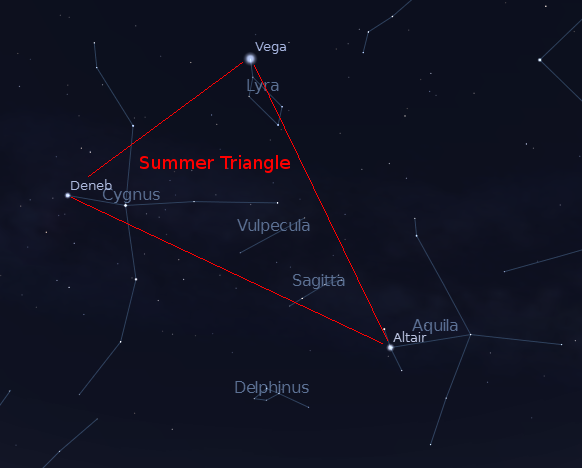
The Summer Triangle. Created using Stellarium and The Gimp.
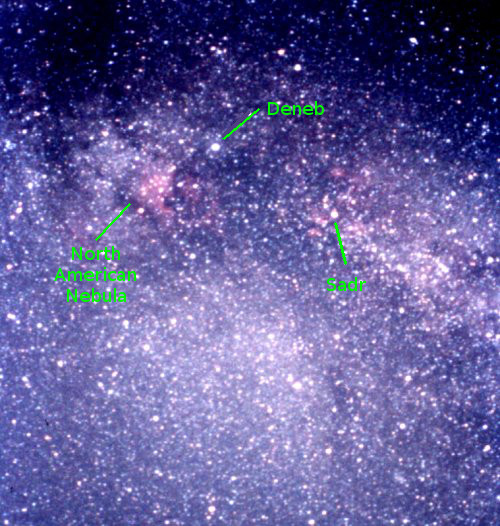
One of my old photographs of Deneb and the North American Nebula digitized from a slide.
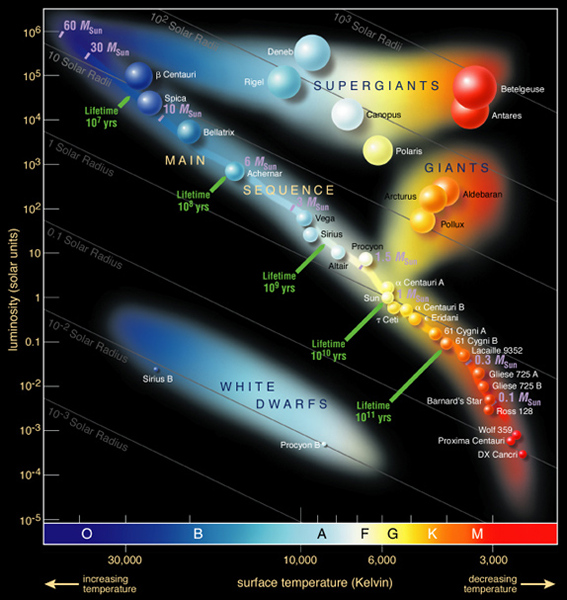
The Hertzsprung-Russell diagram of star luminosity vs. surface temperature. Note that Deneb is at the top center, while the Sun is lower on the main sequence. Credit: European Southern Observatory (ESO).
07/16/2015 – Ephemeris – The Summer Triangle is the sign of the season
Ephemeris for Thursday, July 16th. Today the Sun will be up for 15 hours and 12 minutes, setting at 9:25. The Moon, 1 day past new, will set at 9:32 this evening, and tomorrow the Sun will rise at 6:13.
We’re almost a month into summer, and the asterism or informal constellation called the Summer Triangle can be seen midway up the sky in the east as it gets dark. Highest of the three bright stars is Vega in the constellation Lyra the harp, whose body is seen in a narrow parallelogram nearby. The second star of the triangle is Deneb lower and left of Vega, It appears dimmer than Vega because it is by far the most distant of the three. The third star of the Summer Triangle is seen farther below and a right of Vega. It is Altair in Aquila the eagle, and the closest. Altair is 16.5 light years away, Vega is 27 light years while Deneb is so far away that it’s distance is in some doubt and may be 2,600 light years away.
Times are for the Traverse City/Interlochen area of Michigan. They may be different for your location.
Addendum
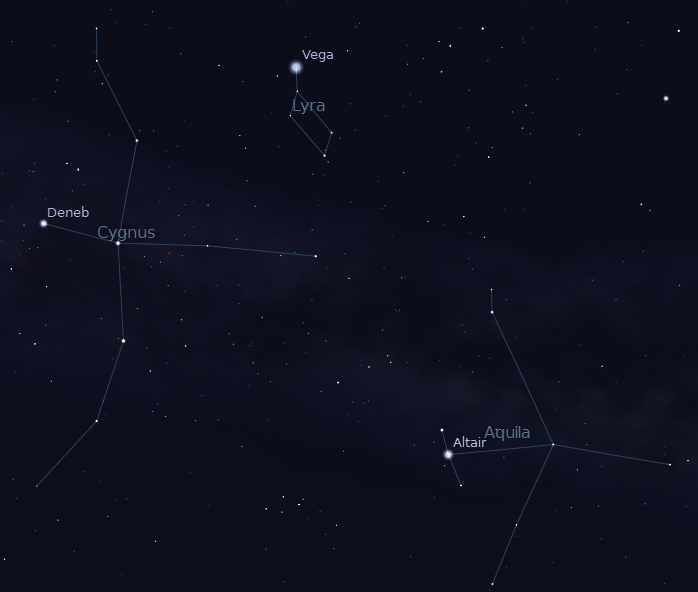
Summer Triangle. Created using Stellarium.
07/09/2015 – Ephemeris – The first stars to appear at night
Ephemeris for Thursday, July 9th. Today the Sun will be up for 15 hours and 23 minutes, setting at 9:29. The Moon, 1 day past last quarter, will rise at 2:05 tomorrow morning, and tomorrow the Sun will rise at 6:07.
Let’s check out all the bright stars in the evening sky, as it gets dark tonight. Low in the west are the planets Venus and Jupiter. High in the west is the bright yellow-orange star Arcturus. In the northwest is the Big Dipper, whose curved handle points to Arcturus. Straightening that curve to a spike will point to Spica a blue-white star low in the southwest. The planet Saturn is located in the south. Below and left of it is the red star Antares which usually twinkles merrily. High in the east is the bright white star Vega. To its lower right is Altair, and to its lower left the star Deneb. Vega, Altair and Deneb make the Summer Triangle, whose rising in the east signals the coming of summer.
Times are for the Traverse City/Interlochen area of Michigan. They may be different for your location.
Addendum
I talked about seeing the first stars a month ago. It seems that in holding star parties this time of year we spend a lot of time watching the first stars appear. I wanted to discuss the Summer Triangle, but it wandered off to what you see above. I’ll get there next week, I promise.
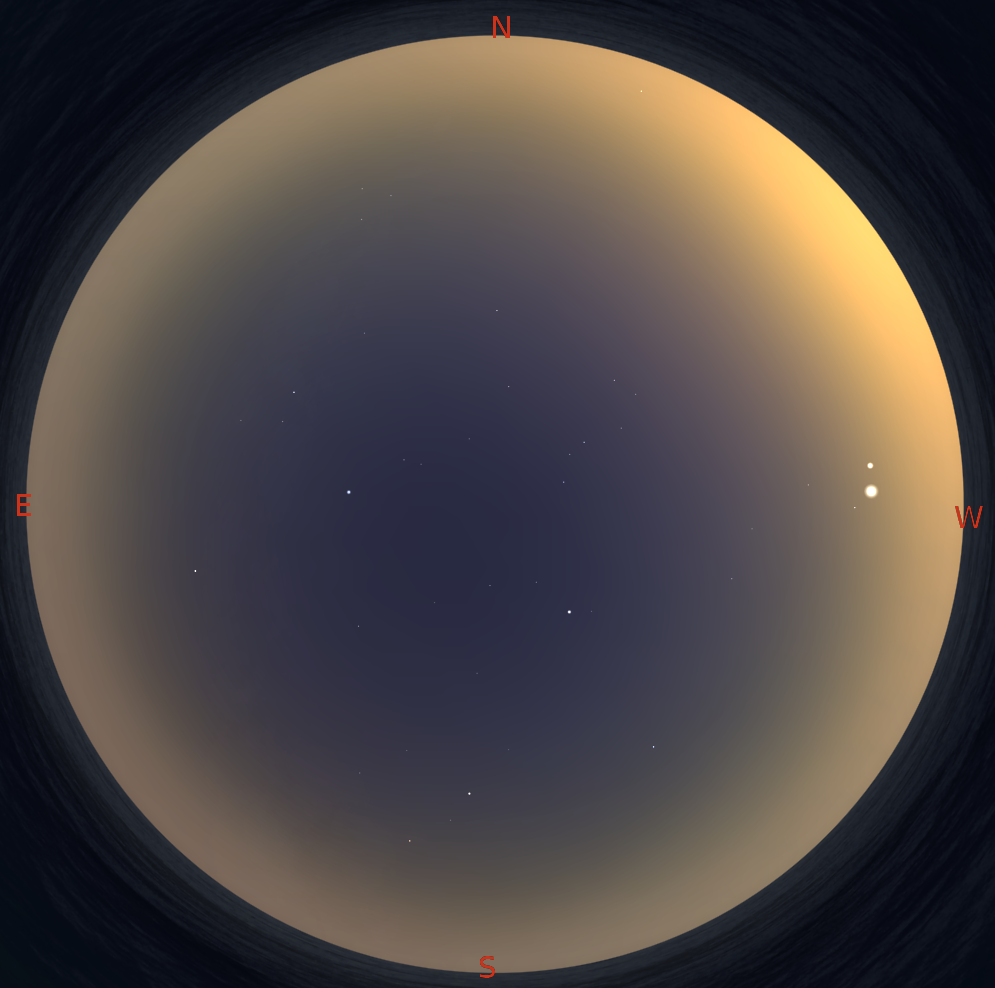
The first stars and planets to appear. See if you can located them from the text. Created using Stellarium for about 10 p.m., July 9, 2015.
11/24/2014 – Ephemeris – The Summer Triangle is still with us
Ephemeris for Monday, November 24th. The sun will rise at 7:50. It’ll be up for 9 hours and 16 minutes, setting at 5:07. The moon, 2 days past new, will set at 7:29 this evening.
Well it’s almost Thanksgiving and about time that the Summer Triangle of bright summer stars finally set. Except it won’t go just yet. The stars Vega, Altair and Deneb are still hanging around in the west. The bright summer part of the Milky Way is gone. The constellations the three stars are in are Altair in Aquila the Eagle, now flying vertically up, Deneb in Cygnus the swan flying vertically down, and Vega in Lyre the harp, lying on its side. Altair the southernmost of these three will set first, later Vega will also set. What happens to Deneb depends on your location in the Interlochen Public Radio area. It you are north of Traverse City, Deneb will not actually set over Lake Michigan’s northern horizon.
Times are for the Traverse City/Interlochen area of Michigan. They may be different for your location.
Addendum
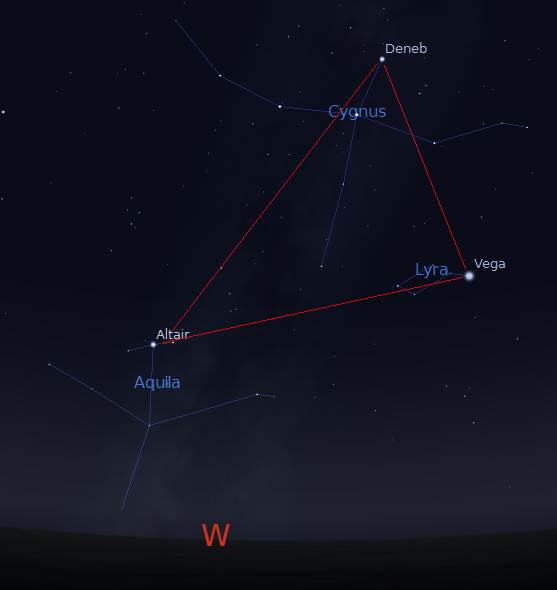
The Summer Triangle at 9 p.m. on November 24, 2014. Created using Stellarium.
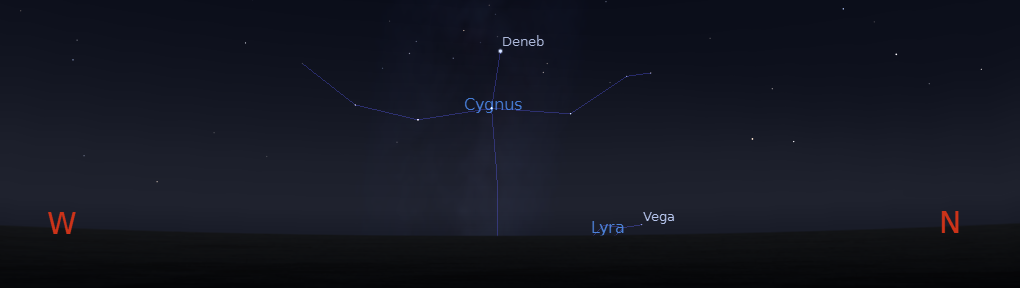
Vega near its setting point at 11:07 p.m. p.m. on November 24, 2014. Created using Stellarium.
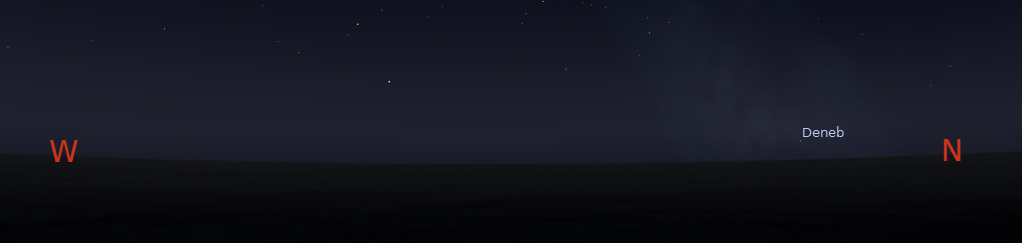
Deneb near its setting point at 5:05 a.m. p.m. on November 25, 2014. Created using Stellarium.
But will Deneb really set for Traverse City. Geometrically it will. However with a flat northern horizon looking northward over the bays to a clean Lake Michigan horizon, atmospheric refraction will bend the light from Deneb making it appear higher in the sky than it really is, so it won’t actually set. On the other side atmospheric extinction, the dimming of stars close to the horizon due to the filtering effect of looking through so much atmosphere would make Deneb impossible to see without a telescope. It might be an interesting challenge to spot.
07/18/2014 – Ephemeris – Deneb is the brightest star of the Summer Triangle… Really
Ephemeris for Friday, July 18th. Today the sun will be up for 15 hours and 8 minutes, setting at 9:22. The moon, at last quarter today, will rise at 12:58 tomorrow morning. Tomorrow the sun will rise at 6:15.
At 11 this evening the bright star Deneb in Cygnus the swan will be moderately high in the east northeast. Deneb is the dimmest star of the summer triangle. Of the other stars of the triangle, Vega is nearly overhead, and Altair to the southeast. While Deneb’s apparent magnitude, or brightness as seen from Earth, makes it the dimmest of the three bright stars, Deneb has a vast distance of possibly 1,550 light years. If brought as close as Vega, Deneb would be several times brighter than Venus. For all this it is only 13-20 times the mass of the sun. It will have an extremely short life and will explode, go supernova, in perhaps a few million years. Closer to home, check out the Sun at Kingsley Heritage Days This Saturday and Sunday.
Times are for the Traverse City/Interlochen area of Michigan. They may be different for your location.
Addendum
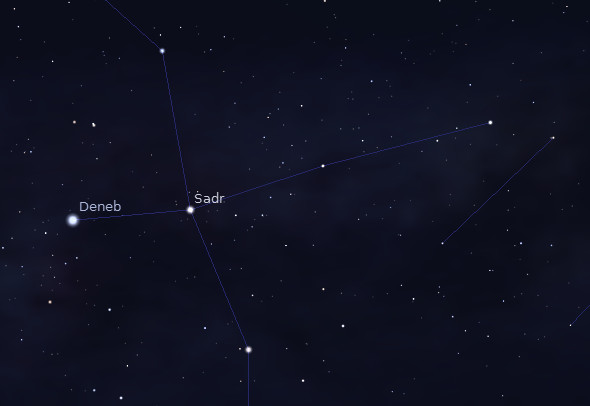
Deneb and the Northern Cross section of Cygnus the swan. Created using Stellarium.
One of my old photographs of Deneb and the North American Nebula digitized from a slide.
The North American Nebula, visible as a faint smudge in binoculars or the naked eye may be ionized and illuminated by Deneb. It’s distance appears to be comparable to that of Deneb.
You may note that previous postings about Deneb over the years have given different distances of Deneb. That just denotes how difficult it is to pin down its distance.
07/17/2014 – Ephemeris – The constellation Cygnus the swan
Ephemeris for Thursday, July 17th. Today the sun will be up for 15 hours and 10 minutes, setting at 9:23. The moon, 1 day before last quarter, will rise at 12:25 tomorrow morning. Tomorrow the sun will rise at 6:14. | Fairly high in the east at 11 p.m. Is the constellation of Cygnus the swan, flying south through the Milky Way. It is also called the Northern Cross. At the left, the tail of the swan or the head of the cross is the bright star Deneb, one of the stars of the Summer Triangle. The next star right is Sadr the intersection of the body and the wings of the swan seen in flight, or the intersection of the two pieces of the cross. There are two or three stars farther to the right that delineate the swan’s long neck or upright of the cross, that ends with the star Alberio in the beak of the swan or foot of the cross. The crosspiece of the cross extends to the stars on either side of the intersection star Sadr, while the swan’s wings extend to a couple more stars each.
Times are for the Traverse City/Interlochen area of Michigan. They may be different for your location.
Addendum
CygnusTheSwan Created using Stellarium.
06/23/2014 – Ephemeris – It’s summer, so where is the Summer Triangle?
Ephemeris for Monday, June 23rd. Today the sun will be up for 15 hours and 33 minutes, setting at 9:31. The moon, half way from last quarter to new, will rise at 4:09 tomorrow morning. Tomorrow the sun will rise at 5:58.
Now that it’s summer it’s time to look for the Summer Triangle in the sky. It’s seen rising in the east as it gets dark. Highest of the three bright stars is Vega in the constellation Lyra the harp, whose body is seen in a narrow parallelogram nearby. The second star of the triangle is Deneb lower and left of Vega, It appears dimmer than Vega because it is by far the most distant of the three. The third star of the Summer Triangle is seen farther below and a right of Vega. It is Altair in Aquila the eagle, and the closest. Altair is 16.5 light years away, Vega is 27 light years while Deneb actually one of the brighter stars known, is a whopping 2600 light years away, give or take. It’s distance is not well-known. (24 08:54 Venus 1.3°N of Moon)
Times are for the Traverse City/Interlochen area of Michigan. They may be different for your location.
Addendum
The Summer Triangle. Created using Stellarium and The Gimp.
09/26/2013 – Ephemeris – The Milky Way is crossing overhead
Ephemeris for Thursday, September 26th. The sun will rise at 7:34. It’ll be up for 11 hours and 57 minutes, setting at 7:31. The moon, at last quarter today, will rise at 12:17 tomorrow morning. | At 10 this evening the Milky Way will pass directly overhead. The bright star Deneb of the Summer Triangle and at the head of the Northern Cross is directly overhead at that time. Deneb is incidentally the tail of Cygnus the swan. The Milky Way stretches from the northeast to the southwest where the Teapot of Sagittarius is tipping, pouring out its tea on the horizon. The Milky Way can be enjoyed with the naked eye, binoculars or telescope. With the naked eye, we see it as the pre-scientific cultures did. The Milky way was a pathway of milk, the path that the American Indian warriors journeyed to the hereafter, the stars their camp fires shining in the night. In reality it is what we can see of our galaxy.
Times are for the Traverse City/Interlochen area of Michigan. They may be different for your location.
Addendum
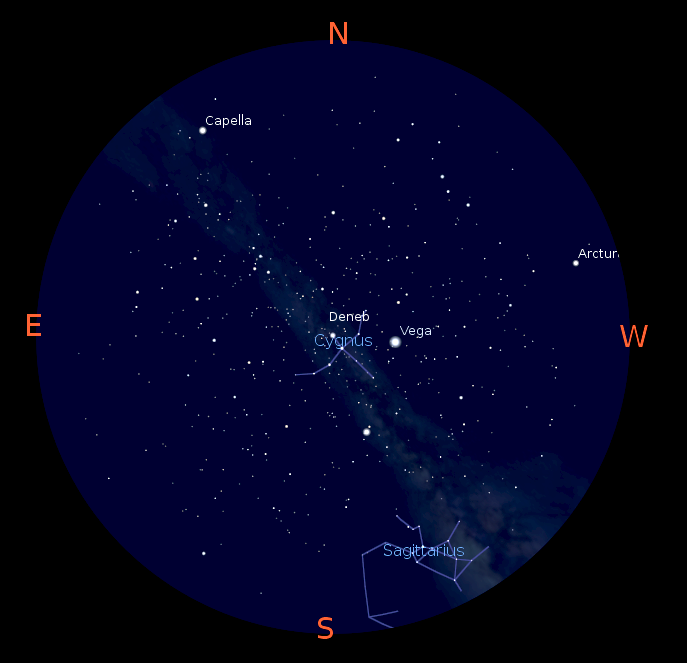
The Milky Way crosses the sky overhead at 10 p.m., September 26, 2013. Horizon to horizon view. Created using Stellarium.
 Bob Moler's Ephemeris Blog