Archive
Ephemeris: 12/04/2025 – Orion survives a full moon
This is Ephemeris for Thursday, December 4th. Today the Sun will be up for 8 hours and 59 minutes, setting at 5:02, and it will rise tomorrow at 8:04. The Moon, at full today, will rise at 4:24 this evening.
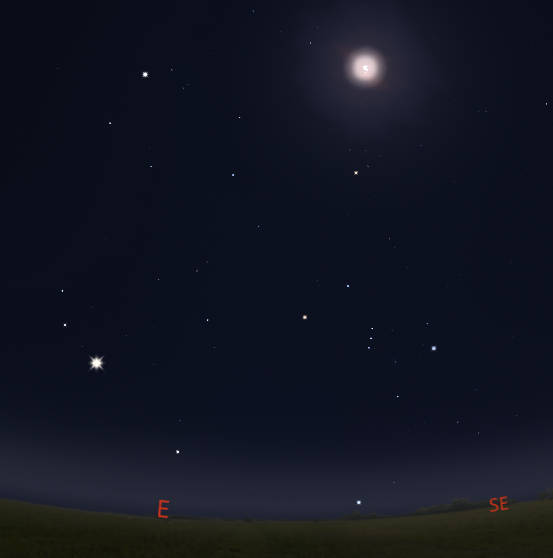
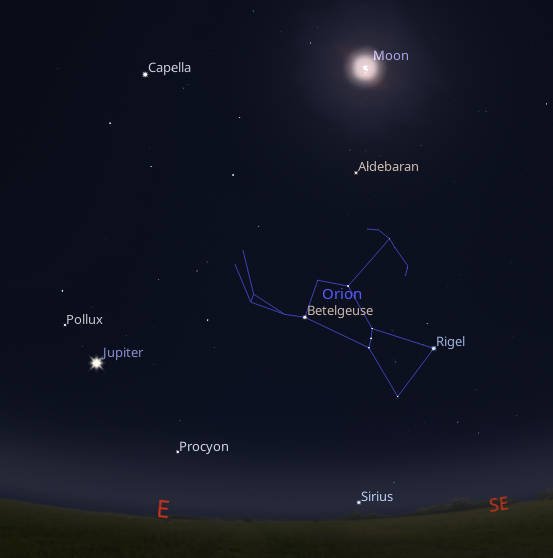
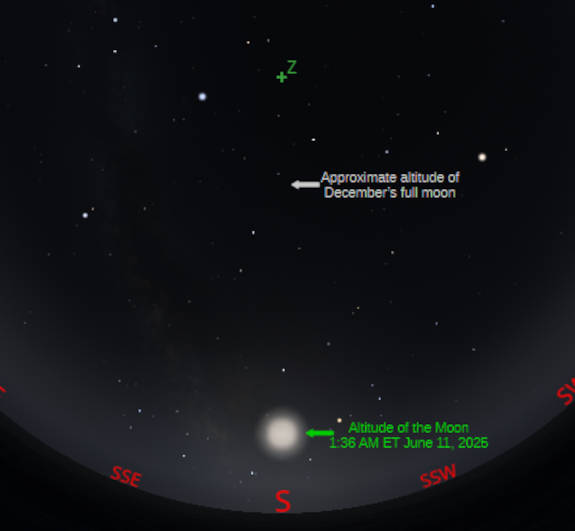
While the full moon overpowers most stars, the bright stars of winter persist. This is even true with tonight’s supermoon, a bit larger and brighter than average. Nowhere in the sky is there a concentration of bright stars as there is in the winter sky. I know it’s not winter yet, but if you stay up late enough, say 10 PM, all the winter stars will be in the sky. Last to rise is the brightest star of all, Sirius. And by 10 o’clock will be low in the southeast. Jupiter has joined the winter stars this year, outshining them all. As a constellation the mighty hunter Orion is easiest to spot on a full moon night, containing seven very bright stars, with three bright stars in a straight line as his belt, which most folks find as his most distinctive feature.
The astronomical event times given in this blog are for the Traverse City/Interlochen area of Michigan (Lat 44.7° N, Long 85.7° W; EDT, UT – 4 hours) unless stated otherwise. Times will be different for other locations.
Addendum
Ephemeris: 06/10/2025 – Tonight’s Strawberry Moon
This is Ephemeris for Tuesday, June 10th. Today the Sun will be up for 15 hours and 30 minutes, setting at 9:27, and it will rise tomorrow at 5:56. The Moon, 1 day before full, will set at 5:36 tomorrow morning.
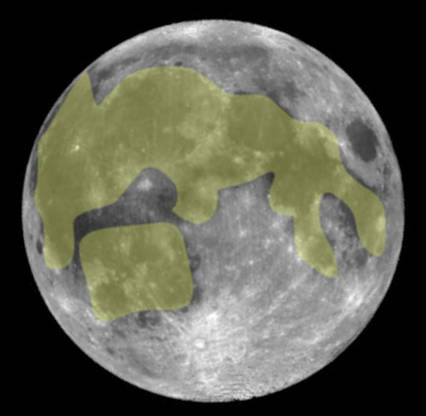
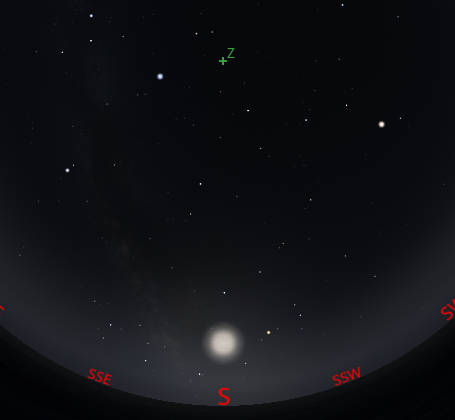
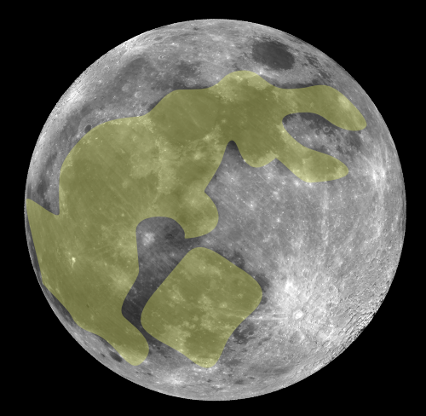
The actual instant that the Moon will be full, that is opposite the Sun in the sky, will be 3:44 tomorrow morning. So tonight’s full moon will be fuller than tomorrow night’s Moon. This month’s full moon is also called the Strawberry Moon by Native Americans, because this is the month that strawberries ripen. Also, the term honeymoon comes from the fact that many weddings are in June, when the full moon is low in the sky in the south and has a yellowish or honey color due to haze and atmospheric preferential scattering of blue light. The darker areas of the Moon give the effect of a face called the Man in the Moon. There is also a rabbit in the Moon, curled around the upper edge, with head and ears to the right and body to the left.
The astronomical event times given in this blog are for the Traverse City/Interlochen area of Michigan (Lat 44.7° N, Long 85.7° W; EDT, UT – 4 hours) unless stated otherwise. Times will be different for other locations.
Addendum
Ephemeris: 09/17/2024 – Super Harvest Moon Eclipse tonight
Note: the eclipse isn’t that super, however tonight’s full moon is a supermoon, and the Harvest Moon to boot. On with the program.
This is Ephemeris for Tuesday, September 17th. Today the Sun will be up for 12 hours and 23 minutes, setting at 7:48, and it will rise tomorrow at 7:25. The Moon, at full today, will rise at 7:47 this evening.
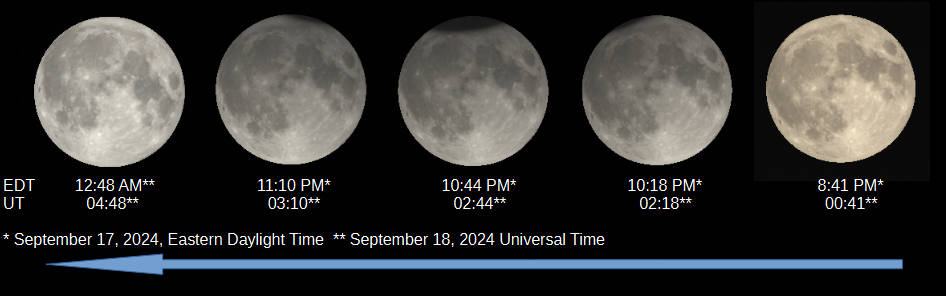
Tonight’s full Harvest Moon* is also a supermoon and on top of that it will be partially eclipsed in Earth’s shadow. The Moon will just clip the bottom or south part of the Earth’s inner shadow called the umbra between 10:13 PM and 11:15 PM. Only 8% of the Moon’s diameter will be covered by the umbra at maximum eclipse at 10:44 PM. However, the Moon will spend a fair amount of time in the Earth’s penumbra, the outer part of the shadow, where the Sun is only partially blocked. So the moon will appear dimmer than normal at its upper parts from about 9:45 to 11:45 PM or so. Viewing the moon through a pair of sunglasses will enhance the effects of the dimming of the penumbra, cutting down the Moon’s glare.
The astronomical event times given are for the Traverse City/Interlochen area of Michigan (EDT, UT – 4 hours). Times will be different for other locations.
* The Harvest Moon is the full moon nearest the date of the autumnal equinox which this year is on the 22nd of September. What makes the Harvest Moon special is the Harvest Moon Effect. Check it out this previous post where I explained more about it: Here
Addendum
Ephemeris: 09/16/2024 – Quadruple lunar events tomorrow night!
This is Ephemeris for Monday, September 16th. Today the Sun will be up for 12 hours and 26 minutes, setting at 7:50, and it will rise tomorrow at 7:24. The Moon, 1 day before full, will set at 6:34 tomorrow morning.
Tomorrow night there will be 4 lunar events occurring at the same time. Coincidence? I think not. The Moon will be full. The other events can only occur at full moon. It’s the Harvest Moon, the closest full moon to the autumnal equinox. It also happens to be a supermoon with the Moon reaching perigee, it’s closest to the Earth of the month a few hours later. Finally, the Moon will be partially eclipsed. By 9:45 PM the Moon may appear somewhat duller to the upper left than to the lower right. This is the Moon deep inside the Earth’s outer shadow called the penumbra. The actual partial phase of the eclipse will occur from 10:13 PM to 11:16 PM with the maximum occurring at 10:44 PM. With only 8 1/2 % of the Moon’s diameter covered.
The astronomical event times given are for the Traverse City/Interlochen area of Michigan (EDT, UT – 4 hours). Times will be different for other locations.
Addendum
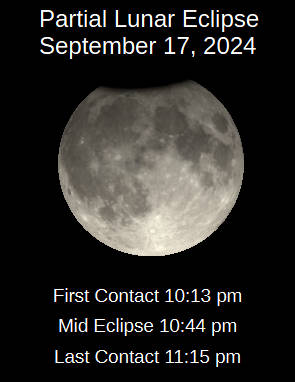
The eclipse will be visible in whole or in part for North America except for extreme western Alaska, also South America, Europe, Africa, and Western Asia. The times in Universal Time (UT): September 18, 2024, first contact 02:13, mid-eclipse 02:44, last contact 03:15.
Ephemeris: 06/06/2024 – 80 years ago, D-Day’s astronomical connection
This is Ephemeris for Thursday, June 6th. Today the Sun will be up for 15 hours and 27 minutes, setting at 9:25, and it will rise tomorrow at 5:57. The Moon is new today, and won’t be visible.
Today is the 80th anniversary of the greatest battle of World War II was the Allied invasion of Mainland Europe at Normandy on D-Day, a date governed by the phase of the Moon. The full moon on June the 6th, 1944 gave light for the gliders and paratroopers to carry out their operations at midnight. Plus the high tides were near noon and midnight and the low tides near dawn. The idea was to hit the beach at low tide to enable the landing craft to operate without hitting the obstacles the Germans had planted in the tidal zone. It was great for the landing craft, but the troops had a lot of open beach to run through to get to any sort of shelter. The best days for the invasion were the 5th, 6th and 7th of June. Bad weather on the 5th caused a one day postponement.
The astronomical event times given are for the Traverse City/Interlochen area of Michigan (EDT, UT–4 hours). They may be different for your location.
Addendum

Ephemeris: 02/23/2024 – The rabbit in the Moon
This is Bob Moler with Ephemeris for Friday, February 23rd. Today the Sun will be up for 10 hours and 50 minutes, setting at 6:21, and it will rise tomorrow at 7:29. The Moon, 1 day before full, will set at 7:52 tomorrow morning.
Even though it is a day before full the moon, will be full at 7:30 tomorrow morning. So tonight will be the closest that we’ll see the full moon this lunation. If one looks at the Moon most of us can see the face of the Man in the Moon. A rabbit, can also be seen. To the Chinese the rabbit here was named Yutu also known as the Jade Rabbit, the pet of the moon goddess Chang’e. To them, it was a rabbit pounding medicine with a mortar and pestle. At 8 o’clock tonight it resides along the left side of the Moon. Its head and body are seen in the dark areas of the Moon we call seas. Its ears are near the top of the moon at 8:00 with his head and body bent down on the left. Near the bottom of The moon is the mortar and pestle with which he’s pounding medicine.
The astronomical event times given are for the Traverse City/Interlochen area of Michigan (EST, UT –5 hours). They may be different for your location.
Addendum:
Ephemeris: 01/25/2024 – Where is the full moon in winter?
This is Ephemeris for Thursday, January 25th. Today the Sun will be up for 9 hours and 31 minutes, setting at 5:41, and it will rise tomorrow at 8:08. The Moon, at full today, will rise at 5:30 this evening.
The exact time that the Moon will be full, at least to the nearest minute is 12:54 this afternoon. Have you ever noticed the placement of the full moon in the sky between winter and summer? The full moon near the winter solstice moves very high at midnight, while the full moon near the summer solstice is seen quite low in the south. For the Moon to be full, it must be nearly opposite the Sun in the sky, so we see it fully illuminated as the Sun does. The Moon’s orbit is close to the Sun’s apparent path in the sky, the ecliptic, which is the projection of the Earth’s orbit of the Sun. So the Moon now is near, and actually a bit north of, where the Sun will be 6 months from now in mid to late July.
The astronomical event times given are for the Traverse City/Interlochen area of Michigan (EST, UT –5 hours). They may be different for your location.
Addendum
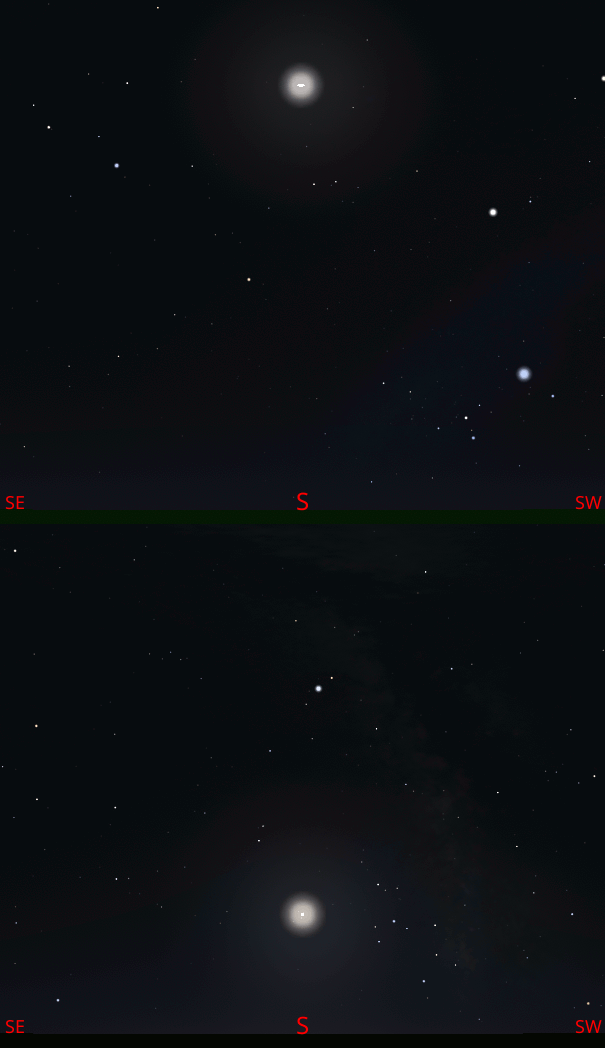
06/14/2022 – Ephemeris – All about tonight’s full moon
This is Bob Moler with Ephemeris for Flag Day, Tuesday, June 14th. Today the Sun will be up for 15 hours and 33 minutes, setting at 9:29, and it will rise tomorrow at 5:56. The Moon, at full today, will rise at 10:22 this evening.
The actual instant that the Moon was full, that is opposite the Sun in the sky, is 7:52 this morning. That’s why the Moon will rise nearly an hour after the Sun sets tonight. It’s also a supermoon, though I dare anyone to be able to tell it apart from any other rising full Moon, since there is nothing to compare its size too. Both the Sun and Moon appear larger than normal when seen on the horizon. The Moon’s perigee or closest point in its orbit of the Earth occurs at 7:52 this evening. This month’s full Moon is also called the Strawberry Moon by Native Americans, because this is the month that strawberries ripen. Also, the term honeymoon comes from the fact that many weddings are in June, when the full moon is low in the sky in the south and has a yellowish or honey color due to haze and atmospheric preferential scattering of blue light.
The astronomical event times given are for the Traverse City/Interlochen area of Michigan (EDT, UT – 4 hours). They may be different for your location.
Addendum
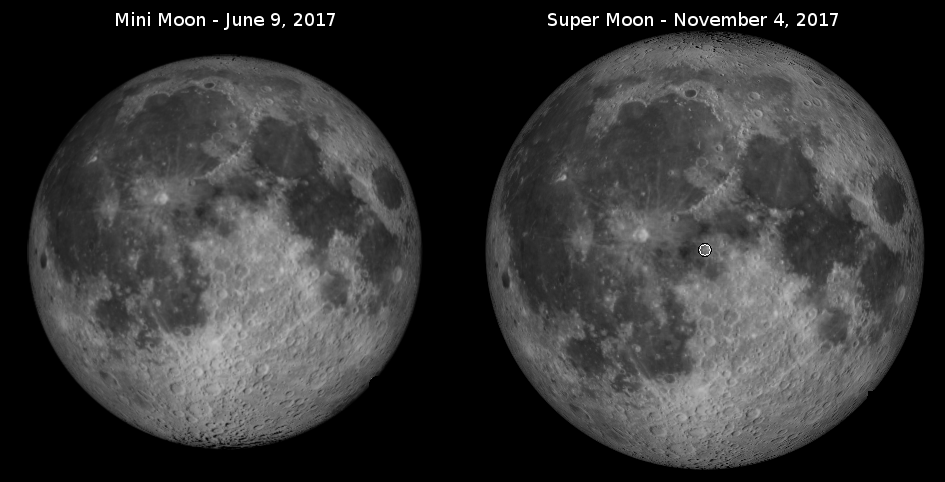
Mini Moon (Moon at apogee) and Super Moon (moon at perigee) for 2017. Created using Cartes du Ciel (Sky Charts).
The distance of the Moon at perigee this month, at 7:21 pm June 14th is 357,400 kilometers, or 222,100 miles. The Moon reaches apogee twice this month: On the 1st at 406,200 kilometers, or 252,400 miles, and again on the 29th at 406,600 kilometers or 252,600 miles. The reason for the differences in aphelion distances, which also occur with perigee distances, is the additional gravitational influences of the Sun, Jupiter and Venus, plus all the other planets to a lesser degree.
02/15/2022 – Ephemeris – The Moon’s splashiest crater
This is Ephemeris for Tuesday, February 15th. Today the Sun will be up for 10 hours and 28 minutes, setting at 6:11, and it will rise tomorrow at 7:41. The Moon, 1 day before full, will set at 8:09 tomorrow morning.
The Moon at 8 pm tonight will be only 16 hours before being full. As down as I am about full moons due to the fact that they light up the sky and flood out the dimmer objects, I once in a while stop and view it. Being less than a day from full, we see it tonight from very nearly the direction of the Sun, so there will be few shadows to be had. The crater Tycho is near the bottom or south end of the moon and has long rays of tiny ejecta craters. The full moon is the best time to see these rays, which are easily visible in binoculars, through which Tycho itself looks like a bright dot. In telescopes, Tycho looks like a small, bright crater with a dark ring around it. The full moon is super bright. It’s daytime over there.
The astronomical event times given are for the Traverse City/Interlochen area of Michigan (EST, UT – 5 hours). They may be different for your location.
Addendum
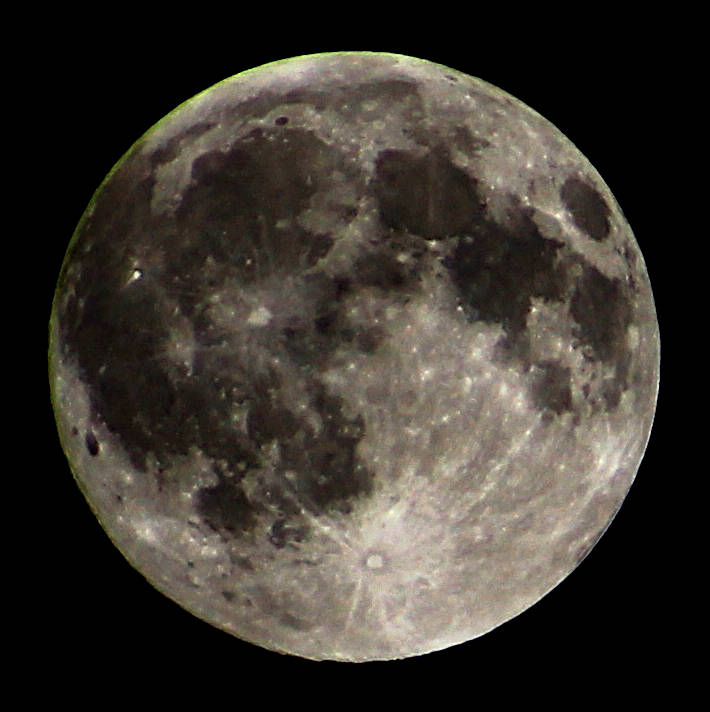
An image I took of the full moon in August 2016 and processed for maximum contrast to show the crater Tycho with its dark ring, near the bottom (south) of the Moon and its rays that stretch for hundreds of miles across the face of the Moon. The image is fairly low resolution, taken with a 300 mm telephoto lens. Click on the image to enlarge it a bit.
04/26/2021 – Ephemeris – There’s a full supermoon tonight
This is Ephemeris for Monday, April 26th. Today the Sun will be up for 14 hours and 2 minutes, setting at 8:41, and it will rise tomorrow at 6:38. The Moon, at full today, will rise at 8:19 this evening.
The full moon tonight is the full Pink Moon, and a supermoon. As down as I am about full moons due to the fact that they light up the sky and flood out the dimmer objects in the sky, I once in a while stop and view it. The time of the full moon is 11:31 tonight, so when it rises tonight we will be looking at the moon from very nearly the direction of the Sun, so there will be few shadows to be had. The crater Tycho is near the bottom or south end of the moon and has long rays of tiny ejecta craters. The full moon is the best time to see these rays, which are easily visible in binoculars, through which Tycho itself looks like a bright dot. In telescopes Tycho looks like a small bright crater with a dark ring around it. The full moon is super bright. It’s daytime over there.
The astronomical event times given are for the Traverse City/Interlochen area of Michigan. They may be different for your location.
Addendum
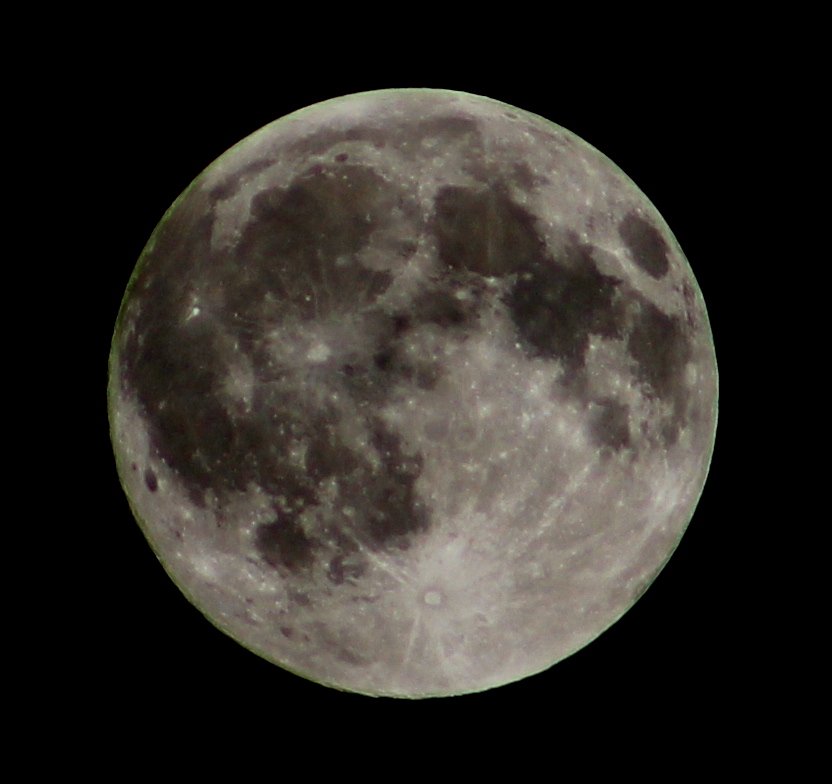
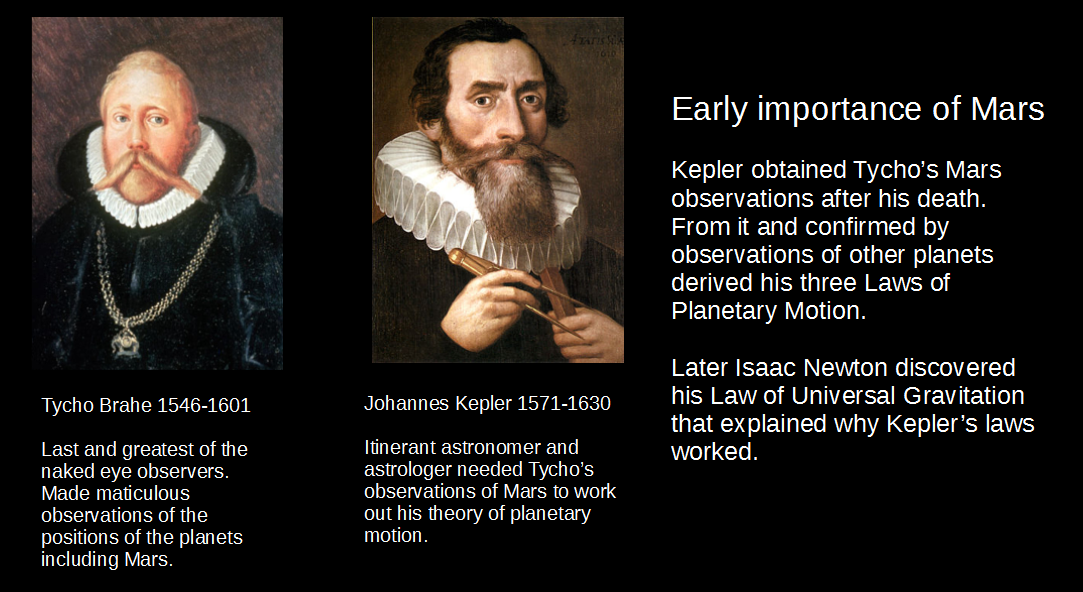
Tycho Brahe and Johannes Kepler are inexorably linked in astronomical history. Tycho was famously stingy with the results of his observations. It was only after his death that Kepler was able to have access to them. Mars was the planet that was hardest to model in both the Ptolemaic geocentric and Copernican heliocentric universes, since both assumed the planetary orbits were circular. So both resorted to epicycles in an attempt to tweak their models in an attempt to fit with observational reality.
Both Tycho and Kepler have craters named for them on the Moon. Tycho gets a splashy crater on the southern part of the Moon. Kepler, however, gets a small crater on the plains of Oceanus Procellarum west of the crater Copernicus on the left side of the Moon, as we see it
 Bob Moler's Ephemeris Blog