Archive
11/28/2016 – Ephemeris – The Hyades the star cluster in the face of Taurus the bull
Ephemeris for Monday, November 28th. The Sun will rise at 7:57. It’ll be up for 9 hours and 7 minutes, setting at 5:04. The Moon, 1 day before new, will rise at 7:45 tomorrow morning.
Rising in the east now is the bright star Aldebaran an orange star that’s at one end of the sideways letter V of stars that is the head of Taurus the bull. Above it is the jewel-like Pleiades or Seven Sisters star cluster. There’s more to Taurus, like it’s freakishly long horns and front part of its body. But you can say you’ve seem Taurus, if you can spot his face. That V of stars is actually a star cluster called the Hyades, and in Greek Myth were the half-sisters of the Pleiades, also fathered by the god Atlas. Both the Hyades and Pleiades are being pursued by Orion, which as Robert Frost put it is throwing a leg over the eastern horizon at 8 to 9 pm. He isn’t the only one following the Pleiades, the name Aldebaran means “The Follower”.
Times are for the Traverse City/Interlochen area of Michigan. They may be different for your location.
Addendum
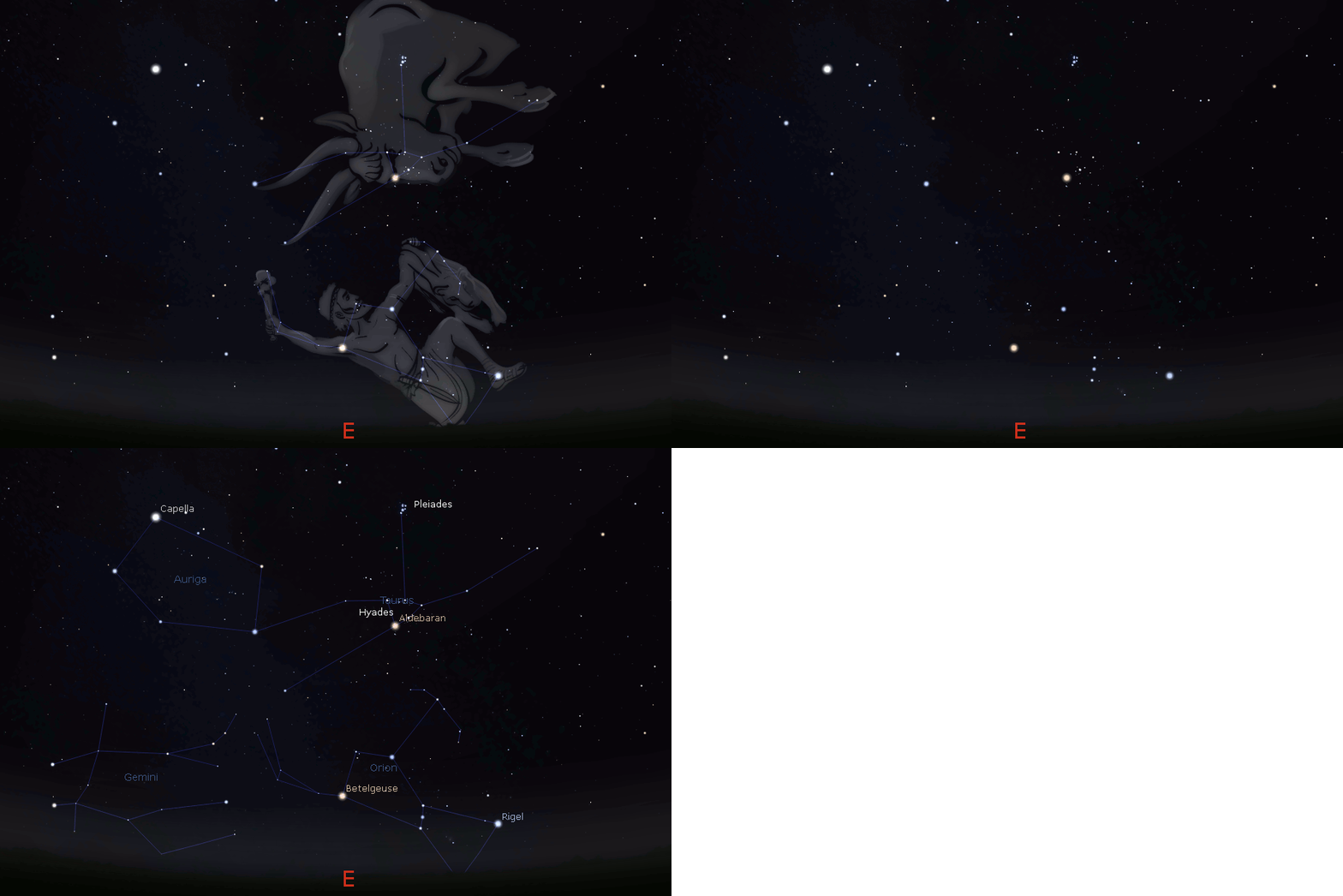
An animation showing the Hyades, Taurus, Orion and the Pleiades. Created using Stellarium and GIMP. Click on image to enlarge.
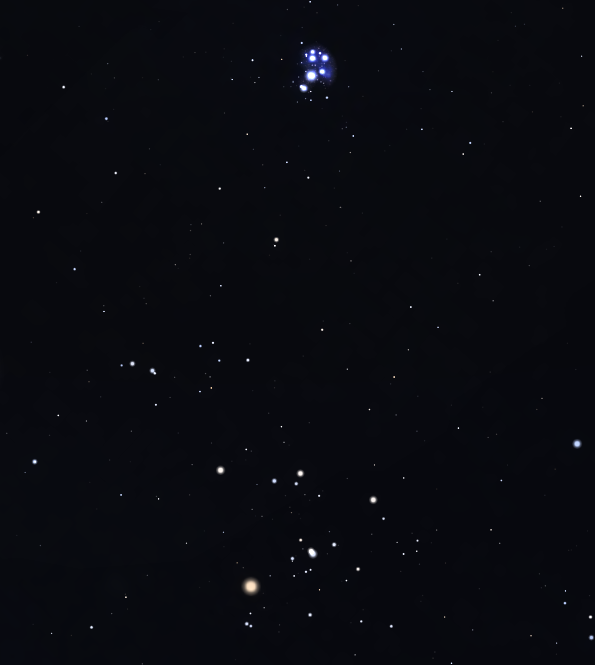
Closeup of the Hyades and the Pleiades. Created using Stellarium.
04/05/2016 – Ephemeris – Coma Berenices, the second closest star cluster
Ephemeris for Tuesday, April 5th. The Sun will rise at 7:15. It’ll be up for 13 hours and 1 minute, setting at 8:16. The Moon, 2 days before new, will rise at 6:53 tomorrow morning.
Midway up the sky in the east at 10 p.m. is a tiny sprinkle of faint stars arrayed to look like several strands of hair. It’s the constellation of Coma Berenices, or Berenice’s hair. The whole group will fit in the field of a pair of binoculars, which is the best way to see it, and will also show more stars. The cluster contains about 50 stars and lies at a distance of 280 light years from us, which makes it the second closest star cluster. The closest being the Hyades, that is the face of Taurus the bull now about to set in the west. The star cluster appears to be about 480 million years old. It is an open or galactic star cluster, born along the plane of the Milky Way. It appears away from the milky band due to its proximity to us.
Times are for the Traverse City/Interlochen area of Michigan. They may be different for your location.
Addendum
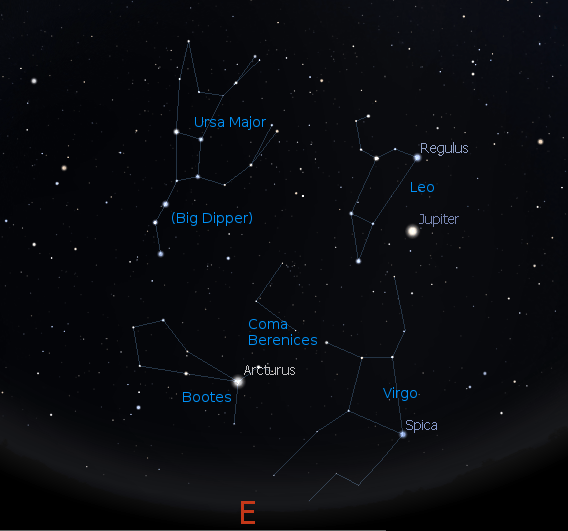
Coma Berenices finder chart 10 p.m., April 5, 2016. Created using Stellarium.
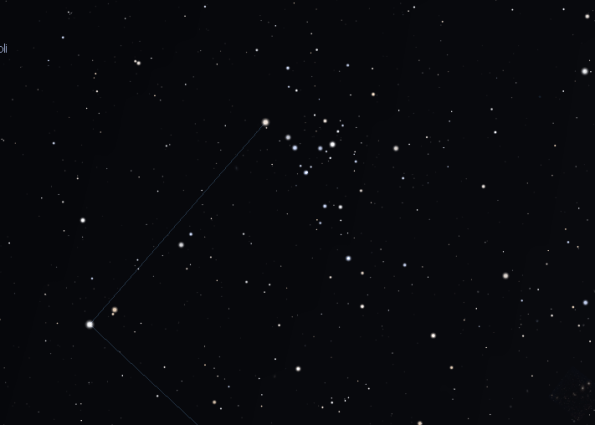
Coma Berenices as it might look in a pair of binoculars. Telescopes are too powerful. Created using Stellarium.
12/17/2015 – Ephemeris – The bright star Aldebaran the “follower”
Ephemeris for Thursday, December 17th. The Sun will rise at 8:14. It’ll be up for 8 hours and 48 minutes, setting at 5:03. The Moon, 1 day before first quarter, will set at 12:07 tomorrow morning.
The central constellation of winter Orion, will be rising the east-southeast at 9 p.m. Above it is Taurus the bull. The bright orange star in Taurus is Aldebaran. Aldebaran appears at the lower left tip of a letter V group of stars that is the face of the bull. Aldebaran isn’t actually part of the group, called the Hyades star cluster. The cluster is about 151 light years away, while Aldebaran is 65. The star has an orange hue because its surface is cooler than the sun’s. However Aldebaran is 44 times larger in diameter, and shines 425 times brighter than the sun, if you include the infrared which our eyes can’t detect, or 150 times brighter in visible light. The name Aldebaran means “Follower” because it follows the Pleiades star cluster above through the night.
Times are for the Traverse City/Interlochen area of Michigan. They may be different for your location.
Addendum
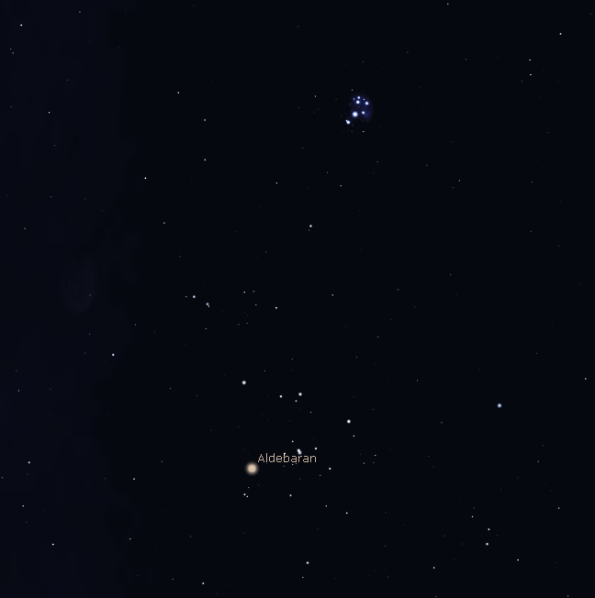
Aldebaran, the Hyades and Pleiades star clusters. Created using Stellarium.
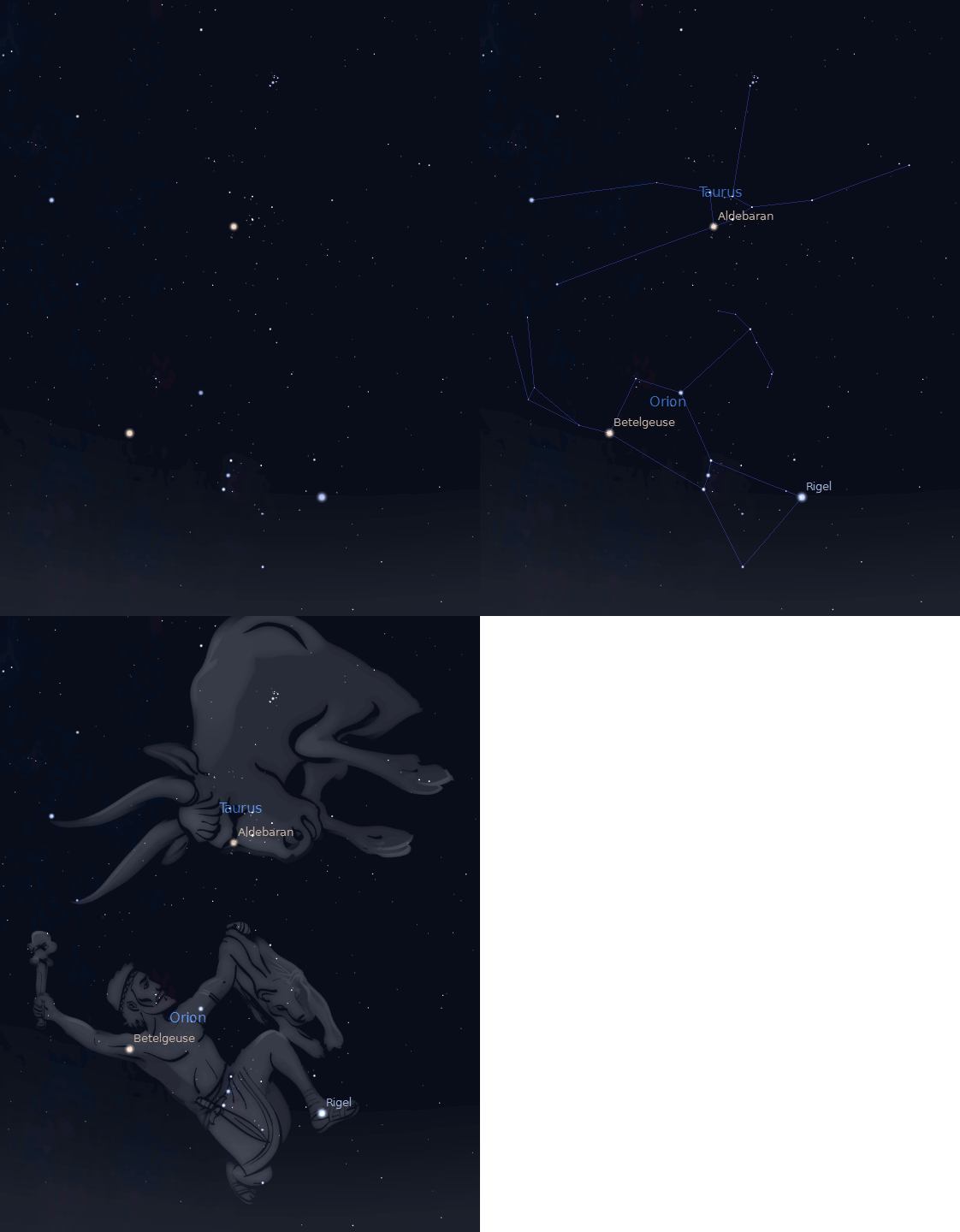
Three views of Taurus the bull and Orion the hunter for 9 p.m. on December 8, 2015. Created using Stellarium and GIMP.
04/21/2015 – Ephemeris – The Moon will pass the Hyades star cluster today to pass near Venus tonight
Apr 21. This is Bob Moler with Ephemeris for Tuesday, April 21st. Today the Sun will be up for 13 hours and 46 minutes, setting at 8:35. The Moon, 3 days past new, will set at midnight. Tomorrow the Sun will rise at 6:47.
The moon, which was new last Saturday passed the face of the constellation Taurus the bull earlier today. The face of Taurus is a letter V shape of stars which is the star cluster called the Hyades. There’s a bright orange star that appears at the left tip of the V called Aldebaran, which actually doesn’t belong to the cluster. At 9:30 the crescent Moon will have also just passed the brilliant planet Venus. By then they will be nearly 8 degrees apart, which is a bit less than the width of a fist held at arm’s length. The Moon, Venus and all the planets move very close along the path of the Sun in the sky, called the ecliptic. Even so the Moon is now about 5 degrees south of the ecliptic and Venus about 2 degrees north of it.
Times are for the Traverse City/Interlochen area of Michigan. They may be different for your location.
Addendum
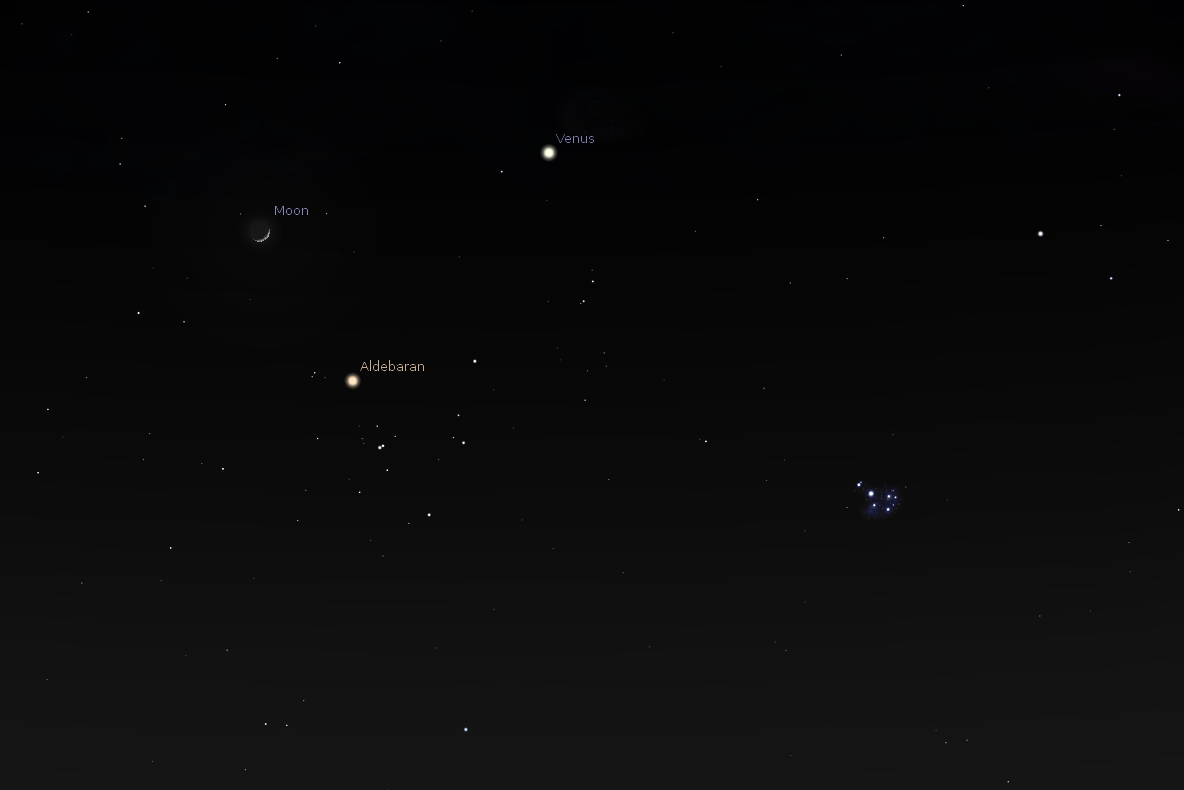
The Moon with Venus and the Hyades at 9:30 p.m. April 21, 2015. Note the Pleiades on the right. Created using Stellarium.
03/24/2015 – Ephemeris – The Moon will be passing in front of the Hyades tonight
Ephemeris for Tuesday, March 24th. The Sun will rise at 7:38. It’ll be up for 12 hours and 21 minutes, setting at 8:00. The Moon, 3 days before first quarter, will set at 1:16 tomorrow morning.
Tonight he Moon will be crossing in front of the Hyades star cluster, otherwise known as the face of the constellation Taurus the bull. The Moon will make it about half way across by the time it sets. The Moon is 2160 miles in diameter and moves about the same distance in an hour as it orbits the Earth. The International Space Station and other satellites in low Earth orbit have to travel 17,500 miles an hour to stay in orbit. But since the Earth’s gravity, or the gravitational force of any body diminishes with the square of the distance. Double the distance and the gravitational force diminishes by a factor of four. This inverse square law as it is known also works with the diminution of light with distance from its source.
Times are for the Traverse City/Interlochen area of Michigan. They may be different for your location.
Addendum
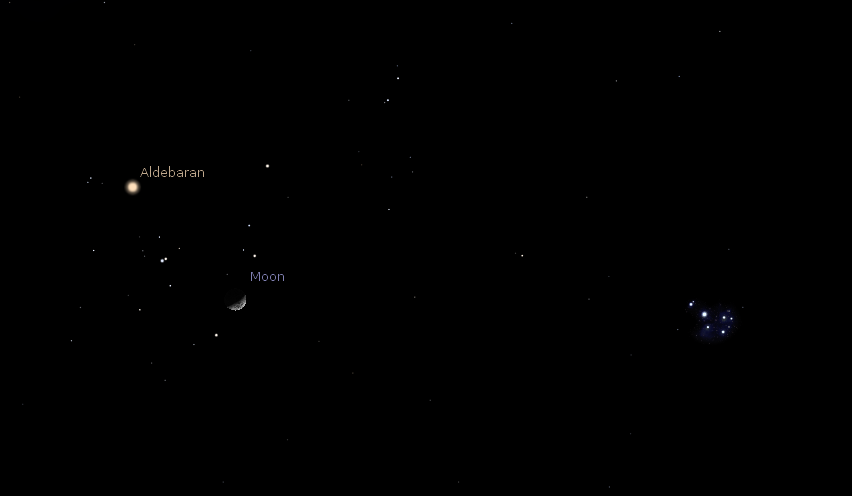
The Moon is travelling in front of the Hyades at 10 p.m. March 24, 2015. Created using Stellarium.
11/21/2014 – Ephemeris – The Hyades a very important star cluster
Ephemeris for Friday, November 21st. The sun will rise at 7:47. It’ll be up for 9 hours and 22 minutes, setting at 5:09. The moon, 1 day before new, will rise at 7:42 tomorrow morning.
The face of the constellation Taurus the bull looks like the letter V sideways above the rising Orion the Hunter in the east at 9 p.m. The bright star at the tip of a letter V of stars is Aldebaran. Look with binoculars at the letter V shape and you will see the stars of the Hyades star cluster The Hyades is the closest star cluster to us, at about 151 light years. And is important for that reason. Before satellites like Hipparcos. The Hyades were the only star cluster to be directly measured by a technique called parallax, using the radius of the earth’s orbit as one side of a surveyors enormous triangle. Its many stars at the same distance were used to determine distances of star clusters even farther away. Additional techniques based on the distance of the Hyades allow us to measure distances to the galaxies.
Times are for the Traverse City/Interlochen area of Michigan. They may be different for your location.
Addendum
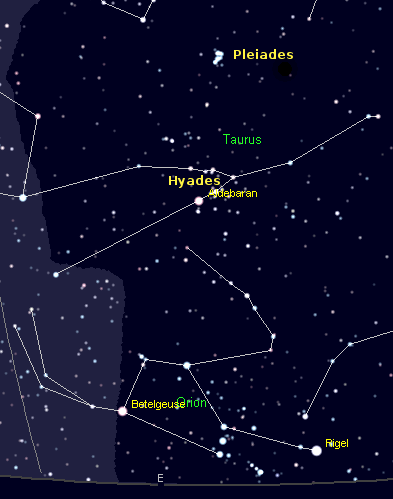
Orion and the Hyades.
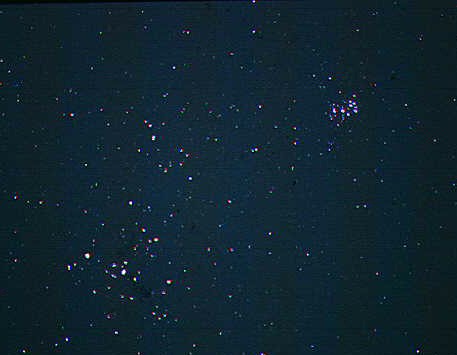
The Hyades (lower left) and the Pleiades (upper right). My photograph from many years ago.
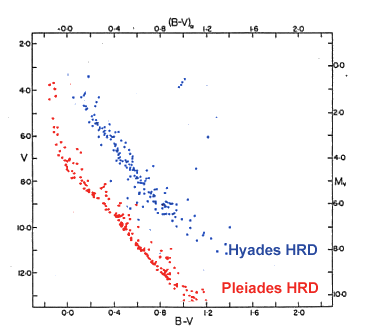
H-R diagram showing the Hyades and Pleiades. Credit: European Southern Observatory.
The Hertzsprung-Russell diagram or H-R diagram plots stars by brightness on the vertical axis versus surface temperature on the horizontal axis, hot to the left to cool on the right. The plot of stars for open or galactic star clusters, where the stars are burning hydrogen in their cores lie on a diagonal line called the main sequence. When matching the plots of two star clusters based on apparent magnitude the main sequence plot for the more distant star cluster will be dimmer by a certain magnitude difference. Since the brightness of and light source diminishes by the inverse square of the distance. The difference in brightness equates to a difference in distance.
For more information on the H-R diagram check out the Wikipedia article. It’s more than about distance.
12/10/2013 – Ephemeris – The bright star Aldebaran, the Follower
Ephemeris for Tuesday, December 10th. The sun will rise at 8:08. It’ll be up for 8 hours and 53 minutes, setting at 5:02. The moon, 1 day past first quarter, will set at 2:18 tomorrow morning.
The central constellation of winter, Orion, is in the east southeast at 9 p.m. Above it is Taurus the bull. The bright orange star in Taurus is Aldebaran. Aldebaran appears at the lower left tip of a letter V group of stars lying on its side that is the face of the bull. Aldebaran isn’t actually part of the group, called the Hyades star cluster. The cluster is about 153 light years away, while Aldebaran is 65. The star has an orange hue because its surface is cooler than the sun’s. However Aldebaran is 44 times larger in diameter, and shines 465 times brighter than the sun. The name Aldebaran means “Follower” because it follows the Pleiades star cluster through the skies. The Pleiades is above right of Aldebaran.
Times are for the Traverse City/Interlochen area of Michigan. They may be different for your location.
Addendum
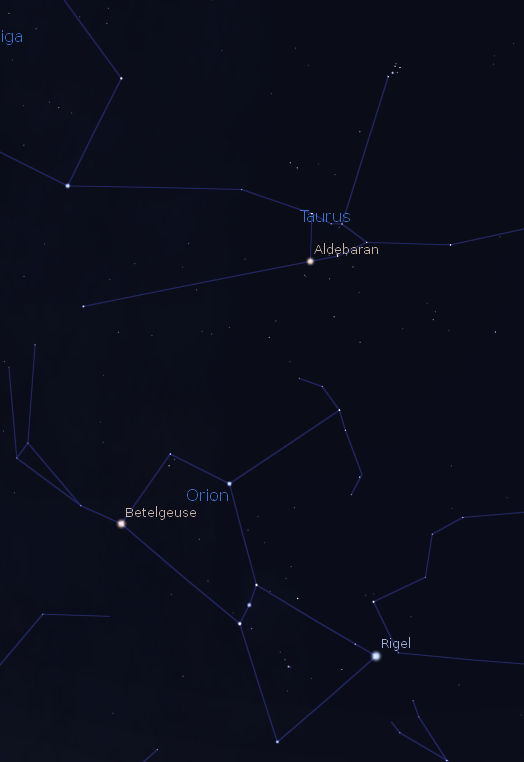
Aldebaran, the Hyades, of Taurus, Orion and the Pleiades at 10 p.m. December 10, 2013. Created using Stellarium.
12/05/2013 – Ephemeris – The constellation Taurus the bull
Ephemeris for Thursday, December 5th. The sun will rise at 8:03. It’ll be up for 8 hours and 58 minutes, setting at 5:02. The moon, 3 days past new, will set at 8:27 this evening.
Early in the evening the moon will appear above the bright planet Venus in the southwest. Low in the east at 9 p.m. is the constellation of Orion the giant hunter. Above him is Taurus the bull. His face is a letter V shape of stars lying on its side with the bright orange-red star Aldebaran at the bottom tip of the V as its angry blood-shot eye. Orion is depicted in the sky facing with club in one hand and a shield in the other the approaching and in some depictions charging Taurus. The V of stars is a star cluster called the Hyades. The Pleiades are in his shoulder above. Taurus in Greek mythology was the guise the god Zeus when he carried off the maiden Europa. Europa’s still with him, sort of, as the intriguing satellite orbiting Zeus’ Roman equivalent Jupiter.
Times are for the Traverse City/Interlochen area of Michigan. They may be different for your location.
Addendum
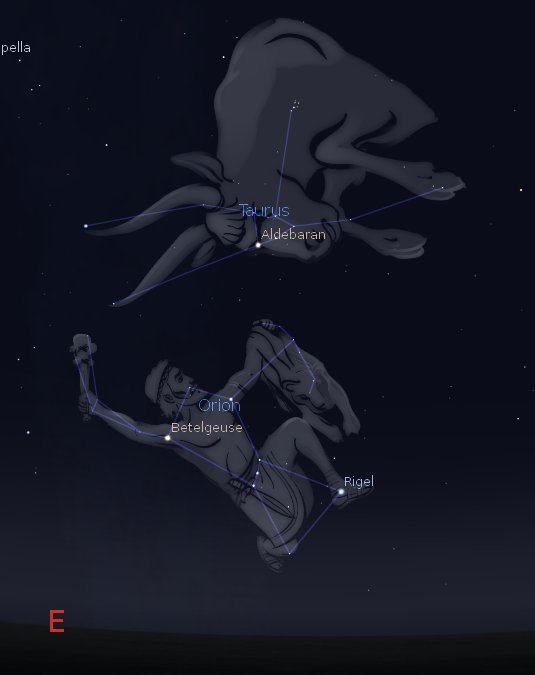
Taurus and Orion in the east at 9 p.m, December 5, 2013. Created using Stellarium.
05/20/2013 – Ephemeris – Silicon rings around old stars in the Hyades
Ephemeris for Monday, May 20th. Today the sun will be up for 15 hours and 0 minutes, setting at 9:09. The moon, 2 days past first quarter, will set at 3:45 tomorrow morning. Tomorrow the sun will rise at 6:08. | I found this item at Universe Today, an astronomical news website, universetoday.com. The Hubble Space telescope has found evidence of rings of mainly silicon around two white dwarf stars in the Hyades star cluster. The Hyades is the V-shaped star cluster just below the setting Jupiter these nights. White dwarf stars are old stars in their last stage of life and usually don’t show the absorption of heavy elements in their spectrum. These two stars must have pulverized rings of silicon plus a little carbon orbiting them, suggesting the formation of earth-like planets. Astronomers usually don’t see this in cluster stars, which are generally young and too active to show planet forming material close to them.
Times are for the Traverse City/Interlochen area of Michigan. They may be different for your location.
01/18/2013 – Ephemeris – Aldebaran, Taurus’ angry read eye
Ephemeris for Friday, January 18th. The sun will rise at 8:13. It’ll be up for 9 hours and 18 minutes, setting at 5:32. The moon, at first quarter today, will set at 1:42 tomorrow morning.
The bright orange star Aldebaran is the most westerly bright star of winter Aldebaran appears at the upper left tip of a letter V group of stars that is the face of the bull, his angry red eye. Aldebaran isn’t actually part of the group, called the Hyades star cluster. Aldebaran is 65 light years away, less than half the distance of the Hyades. The name Aldebaran means “The Follower” because it follows the Pleiades across the skies. The Pleiades is the brightest star cluster in Taurus, also known as the Seven Sisters. Aldebaran has an orange hue because its surface is cooler than the sun’s. However Aldebaran is 44 times larger in diameter, and shines 500 times brighter than the sun. It’s the type of star that’s in the red giant phase of life.
Times are for the Traverse City/Interlochen area of Michigan. They may be different for your location.
Addendum
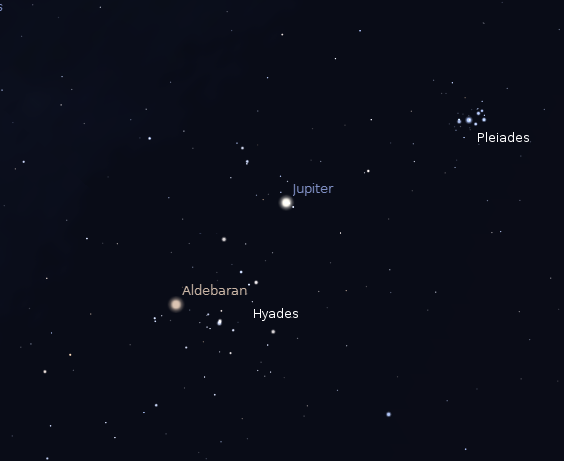
Aldebaran,Jupiter, the Hyades, and the Pleiades on January 18 2913. Created using Stellarium.
 Bob Moler's Ephemeris Blog