Archive
Ephemeris Extra: Taurus and its two bright star clusters
Based on an article published in the November 2023 issue of the Stellar Sentinel the newsletter of the Grand Traverse Astronomical Society.
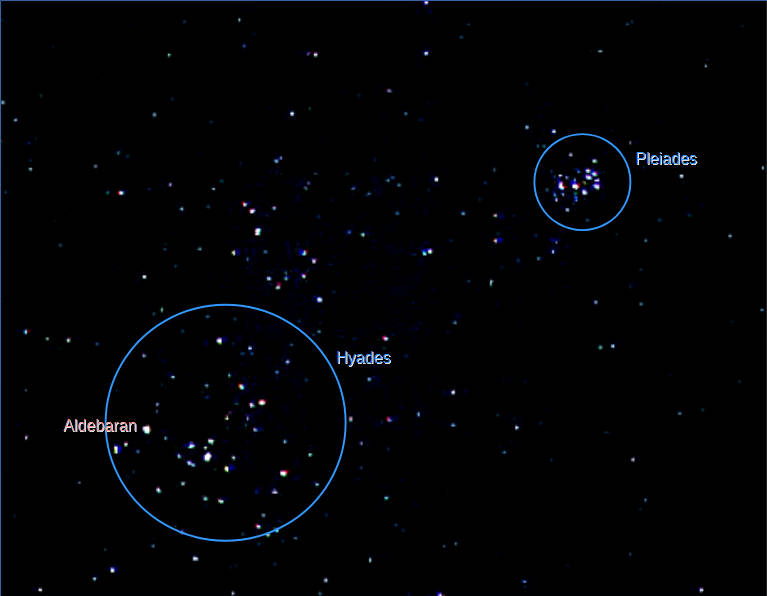
In my October presentation to the society I talked about the stars of autumn, moving generally from the constellations close to summer and ending pretty much against the constellations of winter ending with the constellation of Taurus and with the wonderful Pleiades or Seven Sisters. In this article I’ll take a little bit closer look at the Pleiades and especially the Hyades, the face of Taurus the bull.
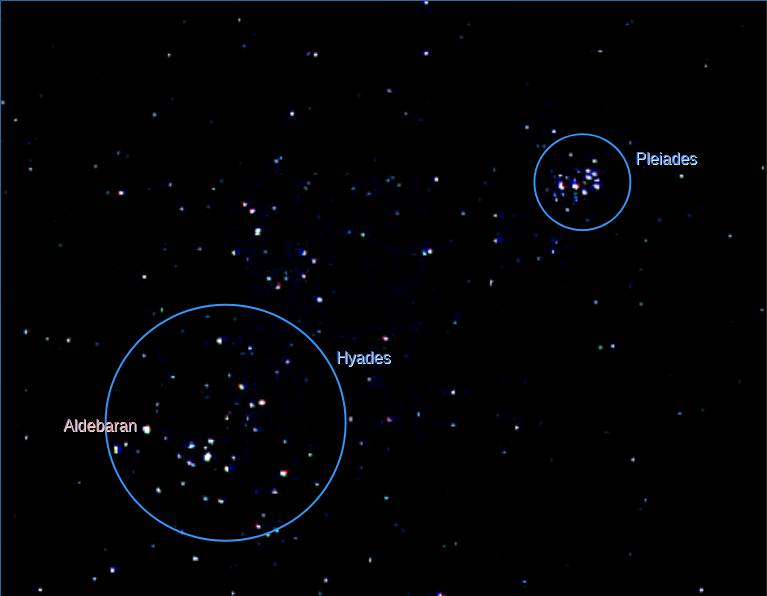
On the previous page is a family portrait of the Pleiades and Hyades. Yes, family portrait. In Greek mythology, the Hyades are the half sisters of the Pleiades. The god Atlas is their father, Pleione seems to be the mother of the Pleiades, and Aethra is the mother of the Hyades. In astronomical terms the Hyades would then be the older sisters of the Pleiades.
The Hyades is a star cluster that is 153 light years away. It is the closest star cluster to us and somewhat over 6 times the age of the Pleiades. The younger and splashier Pleiades are around 444 light years away, and only 100 million years old. Whereas the Hyades are over 600 million years old. The Pleiades still contain hot blue-white stars which have died out by the time of the age of the Hyades. The brightest star of the letter V of stars is Aldebaran, Taurus’ angry bloodshot eye. It doesn’t belong to the Hyades, being about half the distance.
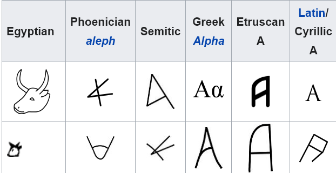
While the Hyades is not as splashy as the Pleiades are and has less of a role in mythology. However, it did play an important part in history when Taurus was the first constellation of the Zodiac some 4,000 years ago, due to precession of the equinoxes. This is because the letter A, the first letter of our alphabet is taken from the stars of the face of Taurus the bull in what looks to us like a V. But it was turned around to be the A we have today. Back then it was called Aleph the first letter of the alphabet for middle eastern cultures.
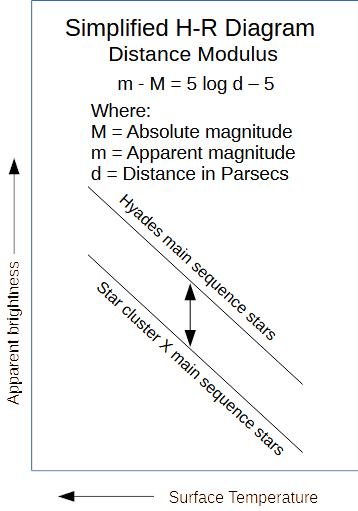
The Hyades is also important in astronomical history in that it helps us measure distances to more distant star clusters. The Hyades was the only star cluster close enough to measure its distance by the parallax method before the advent of the European Space Agency’s Hipparcos and Gaia satellites. If one matches stars on the Hertzsprung-Russell diagram of intrinsic brightness versus surface temperature with other star clusters the stars of the main sequence, where stars spend most of their lives burning hydrogen. The difference in the brightness of the main sequence stars gives the measure of how other star clusters measure up as far as distance since the main sequence is a relatively narrow distribution of stars. This works only with star clusters because there are many stars at the same distance which happen to be about the same age. And enough stars to establish the main sequence since stars at later stages of life may have the same temperature, but vastly different brightnesses.
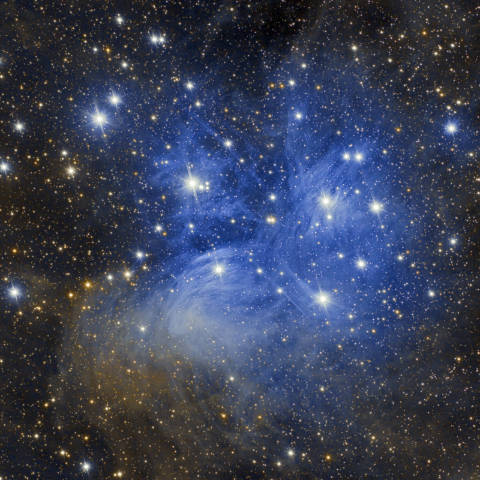
The Pleiades are so large that most telescopes will not allow one to see all the brighter stars at once, so binoculars are the best way to view them. At a dunes star party a few years ago, before COVID, I used my 11-inch (279 mm) Newtonian telescope, which has a 55 inch (1,397 mm) focal length, with a 40 millimeter eyepiece to view the Pleiades. A 40 millimeter eyepiece in that scope gives too low a magnification to use the entire diameter of the primary mirror. All the light doesn’t make it into the eye. That eyepiece gave me about 35 times magnification, so the main stars of the cluster fit into the field of view. The photograph above is nice and all that, but looking with the eye visually at the Pleiades, even with binoculars, you’ll notice something quite different from the photographs. In photographs to make a star brighter you make it bigger. But the eye has a much greater dynamic range. The stars are incredibly brilliant blue white-points of light in the case of the Pleiades. Absolutely beautiful, much more beautiful than any photograph. Not to disparage photographs, but photographs can do what the eye cannot. That is, store light to bring out very faint objects and details. So, let’s take a final look at the Pleiades in a photograph by GTAS member Dan Dall’Olmo.
Ephemeris: 11/06/2023 – The Pleiades or Seven Sisters
This is Ephemeris for Monday, November 6th. Today the Sun will be up for 9 hours and 57 minutes, setting at 5:25, and it will rise tomorrow at 7:28. The Moon, 1 day past last quarter, will rise at 1:18 tomorrow morning.
A marvelous member of the autumn skies can be found low in the east after 8 in the evening. It is the famous star cluster called the Pleiades or the Seven Sisters. I might also add the ‘Tiny Dipper’. Many people can spot a tiny dipper shape in its six or seven stars, and mistake it for the Little Dipper. With binoculars, one can see over a hundred stars appear, along with the dipper shape of the brightest. In photographs, the Pleiades actually contain wisps of the dust they are currently passing through. In Greek mythology, the sisters were daughters of the god Atlas and Pleione.
The astronomical event times given are for the Traverse City/Interlochen area of Michigan (EST, UT –5 hours). They may be different for your location.
Addendum
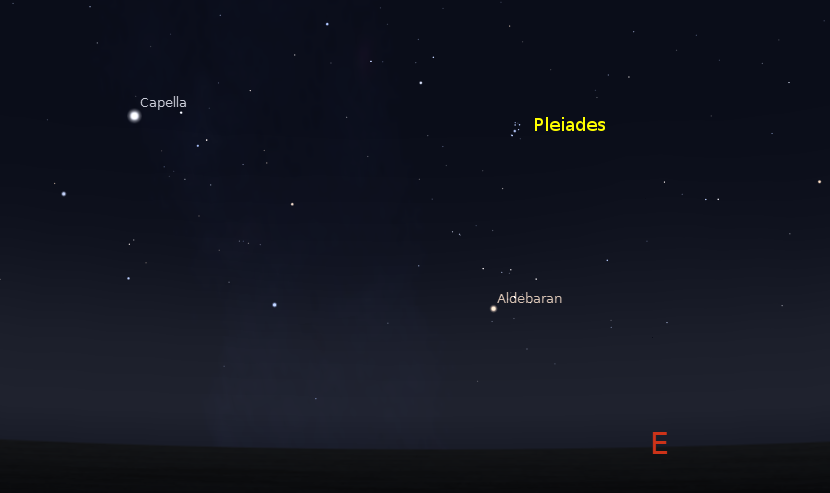
I’ll be coming back to the Pleiades from time to time over the autumn and winter months to cover, especially, the mythology of the Pleiades from different cultures.
11/21/2022 – Ephemeris – The Pleiades or the Seven Sisters
This is Ephemeris for Monday, November 21st. Today the Sun will be up for 9 hours and 21 minutes, setting at 5:09, and it will rise tomorrow at 7:49. The Moon, 2 days before new, will rise at 6:10 tomorrow morning.
A marvelous member of the autumn skies can be found low in the east after 8 in the evening. It is the famous star cluster called the Pleiades or the Seven Sisters. I might also add the ‘Tiny Dipper’. Many people can spot a tiny dipper shape in its six or seven stars, and mistake it for the Little Dipper. With binoculars, one can see over a hundred stars appear, along with the dipper shape of the brightest. In photographs, the Pleiades actually contain wisps of the dust they are currently passing through. In Greek mythology, the sisters were daughters of the god Atlas. I’ll be revisiting the Pleiades several times this autumn, winter, and before they disappear in the west in evening twilight next spring.
The astronomical event times given are for the Traverse City/Interlochen area of Michigan (EST, UT – 5 hours). They may be different for your location.
Addendum
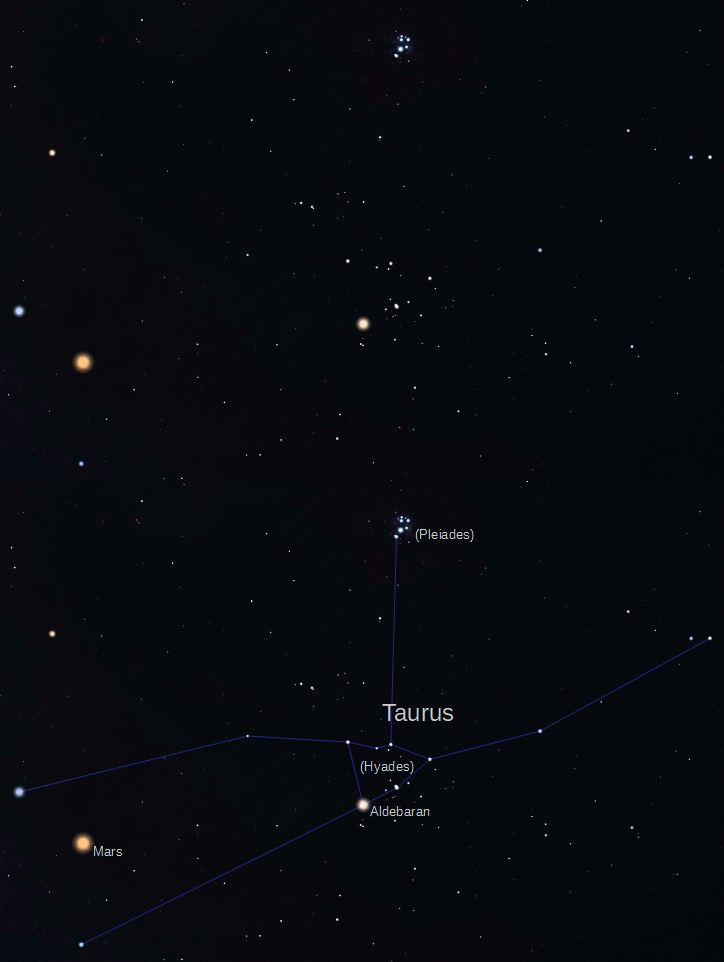
Pleiades finder animation for 8:30 pm tonight, November 21, 2022. Mars is the interloper this year, seen between the horns of Taurus the Bull. The V of stars that make up the face of Taurus the bull is a star cluster of stars called the Hyades. In Greek mythology, they are the half-sisters of the Pleiades. Created using Stellarium, LibreOffice Draw, and GIMP.
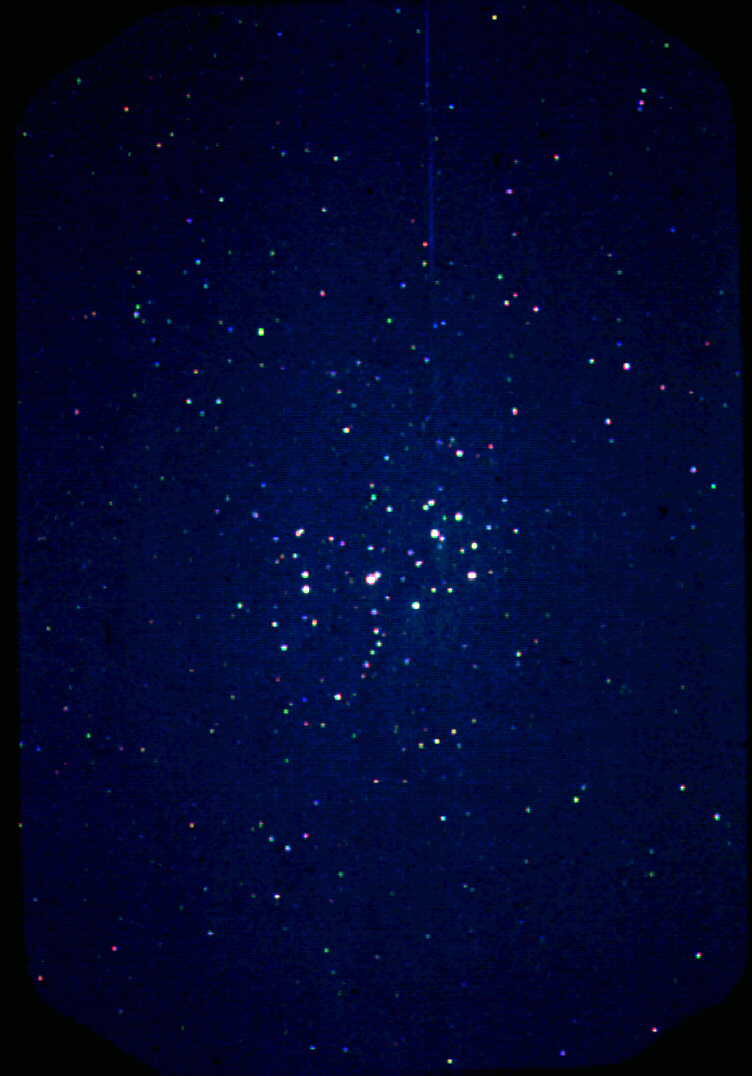
The Pleiades, about what you’d see in binoculars. To the naked eye, six or seven stars might be glimpsed. As star clusters go, it might seem small and unremarkable, but the Pleiades is nearby, and the brightest star cluster visible. Its stars are regarded by cultures around the world as female stars, generally sisters. Credit: Mine.
01/20/2022 – Ephemeris – Taurus and the half sisters of the Pleiades
This is Bob Moler with Ephemeris for Thursday, January 20th. Today the Sun will be up for 9 hours and 21 minutes, setting at 5:34, and it will rise tomorrow at 8:12. The Moon, 3 days past full, will rise at 8:23 this evening.
High in the south-southeastern sky, and above-right of Orion, is the bright star Aldebaran. It’s at one tip of a letter V of fainter stars. The group of stars is the face of the constellation of Taurus the bull. Aldebaran is the angry bloodshot eye of the bull that’s charging Orion, whose defending himself with a lion skin shield and an upraised club. The stars in the V, and many more visible in binoculars, except for Aldebaran, belong to a star cluster called the Hyades. In Greek mythology, these are the half sisters of the Pleiades, visible as a tight group of stars above them. The V of stars is actually an upside down letter A, or Aleph, the first letter of the Hebrew and Mesopotamian alphabets. This was invented when Taurus, not Aries, was host to the Sun at the spring equinox.
The astronomical event times given are for the Traverse City/Interlochen area of Michigan (EST, UT – 5 hours). They may be different for your location.
Addendum
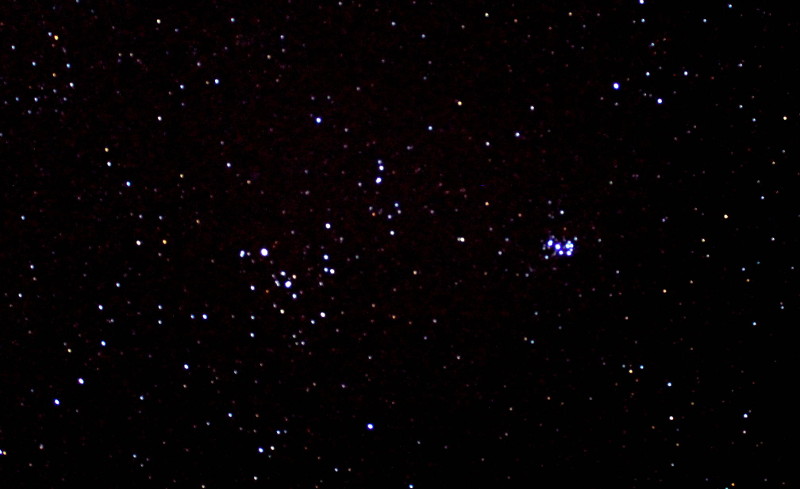
The Hyades (left) and the Pleiades (right) in this photograph I took January 4, 2016. Aldebaran is the bright star at the left tip of the Pleiades (right) of the Hyades.
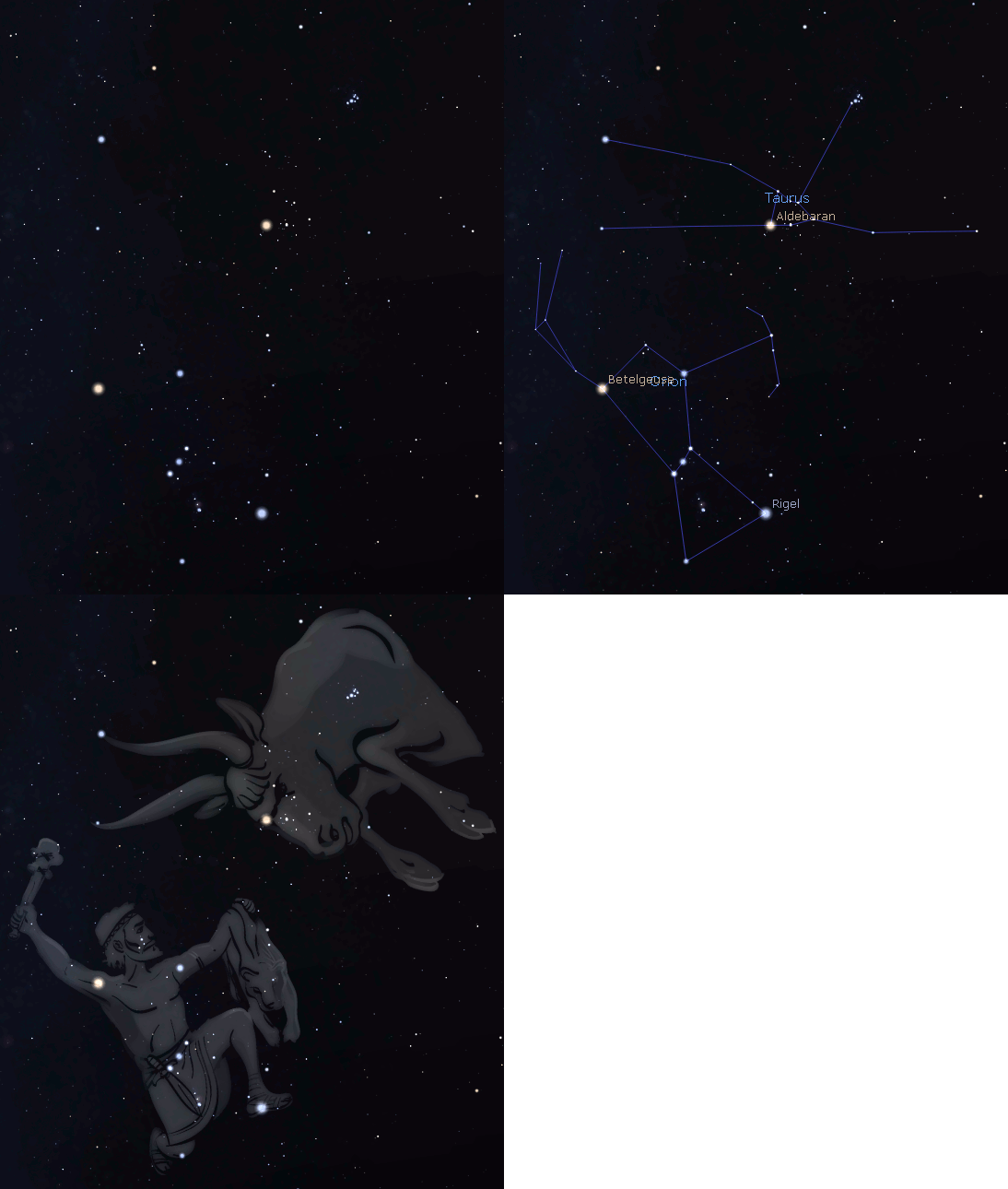
Orion and Taurus finder animation for mid-January. Created using Stellarium
12/15/2020 – Ephemeris – Hyades, the face of Taurus the bull
This is Ephemeris for Tuesday, December 15th. Today the Sun will be up for 8 hours and 49 minutes, setting at 5:02, and it will rise tomorrow at 8:14. The Moon, 1 day past new, will set at 6:03 this evening.
The face of the constellation Taurus the bull looks like the letter V sideways above the rising Orion the Hunter in the east at 9 p.m. The bright star at the tip of a letter V of stars is Aldebaran. Look with binoculars at the letter V shape and you will see the stars of the Hyades star cluster The Hyades is the closest star cluster to us, at about 153 light years. And is important for that reason. Before satellites like Hipparcos and Gaia the Hyades was the only star cluster that could be directly measured by a technique called parallax, using the radius of the Earth’s orbit as one side of a surveyors enormous triangle. Its many stars at the same distance were used to determine distances of star clusters even farther away. Additional techniques based on the distance of the Hyades allowed us to measure distances to the nearest galaxies.
The event times given are for the Traverse City/Interlochen area of Michigan. They may be different for your location.
Addendum
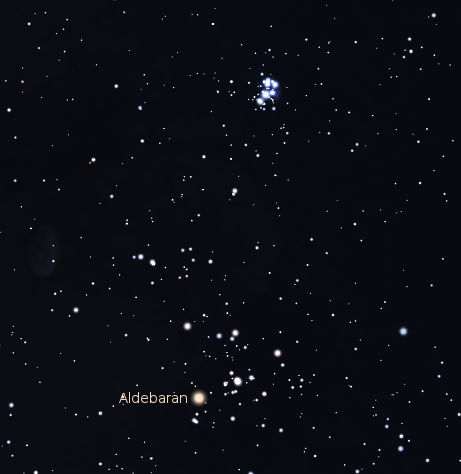
Aldebaran in the ‘V’ shape of the Hyades (The face of Taurus the bull) with the Pleiades above. Aldebaran is not part of the Hyades, being about halfway between us and the cluster. Created using Stellarium.
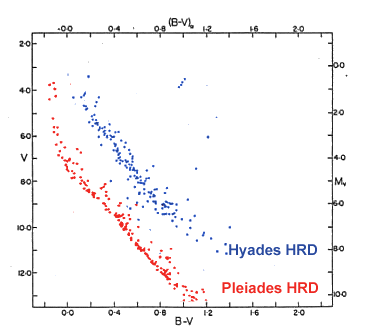
HR diagram showing the Hyades and Pleiades. Credit: European Southern Observatory.
The Hertzsprung–Russell diagram or HR diagram is one of the great astronomical tools developed in the early 20th century by plotting stars by surface temperature horizontally (hot to cool, left to right) and brightness vertically. It turns out that stars in the prime of life and shining via converting hydrogen to helium lie on a diagonal line from hot and bright from the upper left to cool and dim to the lower right. The line is called the main sequence. In plotting the Hyades stars against other star cluster stars the vertical displacement of the main sequence line is a function of the relative distances of the two star clusters from us. This is just one of the uses of the HR diagram.
12/08/2020 – Ephemeris – Finding Taurus the bull
This is Ephemeris for Tuesday, December 8th. Today the Sun will be up for 8 hours and 54 minutes, setting at 5:02, and it will rise tomorrow at 8:08. The Moon, 1 day past last quarter, will rise at 1:39 tomorrow morning.
Orion is the big splashy constellation in the east southeast by 9 in the evening. Above it is another famous constellation Taurus the bull. Its face is a letter V shape of stars on its side with the open end of the V to the left. The bright star at the lower left end of the sideways V is the ruddy star Aldebaran, the Bull’s angry bloodshot eye. The bull is charging down at Orion. The Pleiades, also known as the seven sisters, is the cluster of stars in his shoulder, above the V. The stars in the face of Taurus, except for Aldebaran belong to a star cluster like the Pleiades, but closer and older, called the Hyades. In Greek mythology the Hyades are half sisters to the Pleiades, all fathered by the god Atlas.
The event times given are for the Traverse City/Interlochen area of Michigan. They may be different for your location.
Addendum
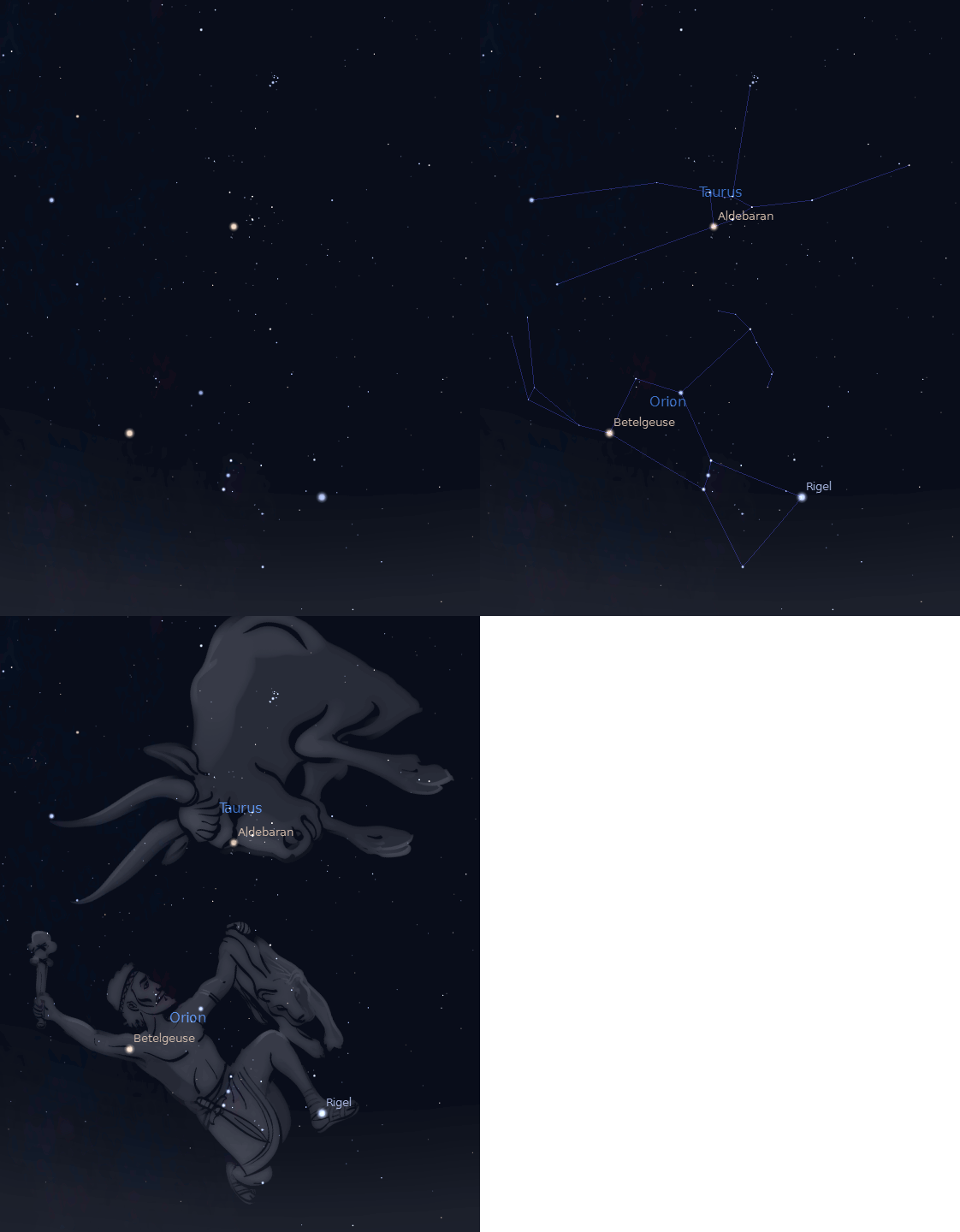
Three views of Taurus the bull and Orion the hunter for 9 p.m. on December 8th. Created using Stellarium and GIMP.
The Pleiades (right) and the Hyades (left) in this photograph I took January 4, 2016. The orientation is a bit different from how it appears in early December.
12/17/2019 – Ephemeris – Hyades, the face of Taurus the Bull
Ephemeris for Tuesday, December 17th. Today the Sun will be up for 8 hours and 48 minutes, setting at 5:03, and it will rise tomorrow at 8:15. The Moon, 2 days before last quarter, will rise at 11:14 this evening.
The face of the constellation Taurus the bull looks like the letter V sideways above the rising Orion the Hunter in the east at 9 p.m. The bright star at the tip of a letter V of stars is Aldebaran. Look with binoculars at the letter V shape and you will see the stars of the Hyades star cluster The Hyades is the closest star cluster to us, at about 153 light years. And is important for that reason. Before satellites like Hipparcos and Gaia. The Hyades was the only star cluster to be directly measured by a technique called parallax, using the radius of the Earth’s orbit as one side of a surveyors enormous triangle. Its many stars at the same distance were used to determine distances of star clusters even farther away. Additional techniques based on the distance of the Hyades allowed us to measure distances to the galaxies.
The times given are for the Traverse City/Interlochen area of Michigan. They may be different for your location.
Addendum
Aldebaran in the ‘V’ shape of the Hyades (The face of Taurus the bull) with the Pleiades above. Created using Stellarium.
12/16/2019 – Ephemeris – Taurus Treasures
Ephemeris for Monday, December 16th. Today the Sun will be up for 8 hours and 49 minutes, setting at 5:03, and it will rise tomorrow at 8:14. The Moon, 3 days before last quarter, will rise at 9:59 this evening.
Rising in the east-southeast now is the bright star Aldebaran an orange star that’s at one end of the sideways letter V of stars that is the head of Taurus the bull. Above it is the jewel-like Pleiades or Seven Sisters star cluster. There’s more to Taurus, like it’s freakishly long horns and front part of its body. But you can say you’ve seem Taurus, if you can spot his face. That V of stars is actually a star cluster called the Hyades, the closest to the Earth, and in Greek Myth were the half-sisters of the Pleiades, also fathered by the god Atlas. Both the Hyades and Pleiades are being pursued by Orion, which is below it. He isn’t the only one following the Pleiades, the name Aldebaran means “The Follower”.
The times given are for the Traverse City/Interlochen area of Michigan. They may be different for your location.
Addendum
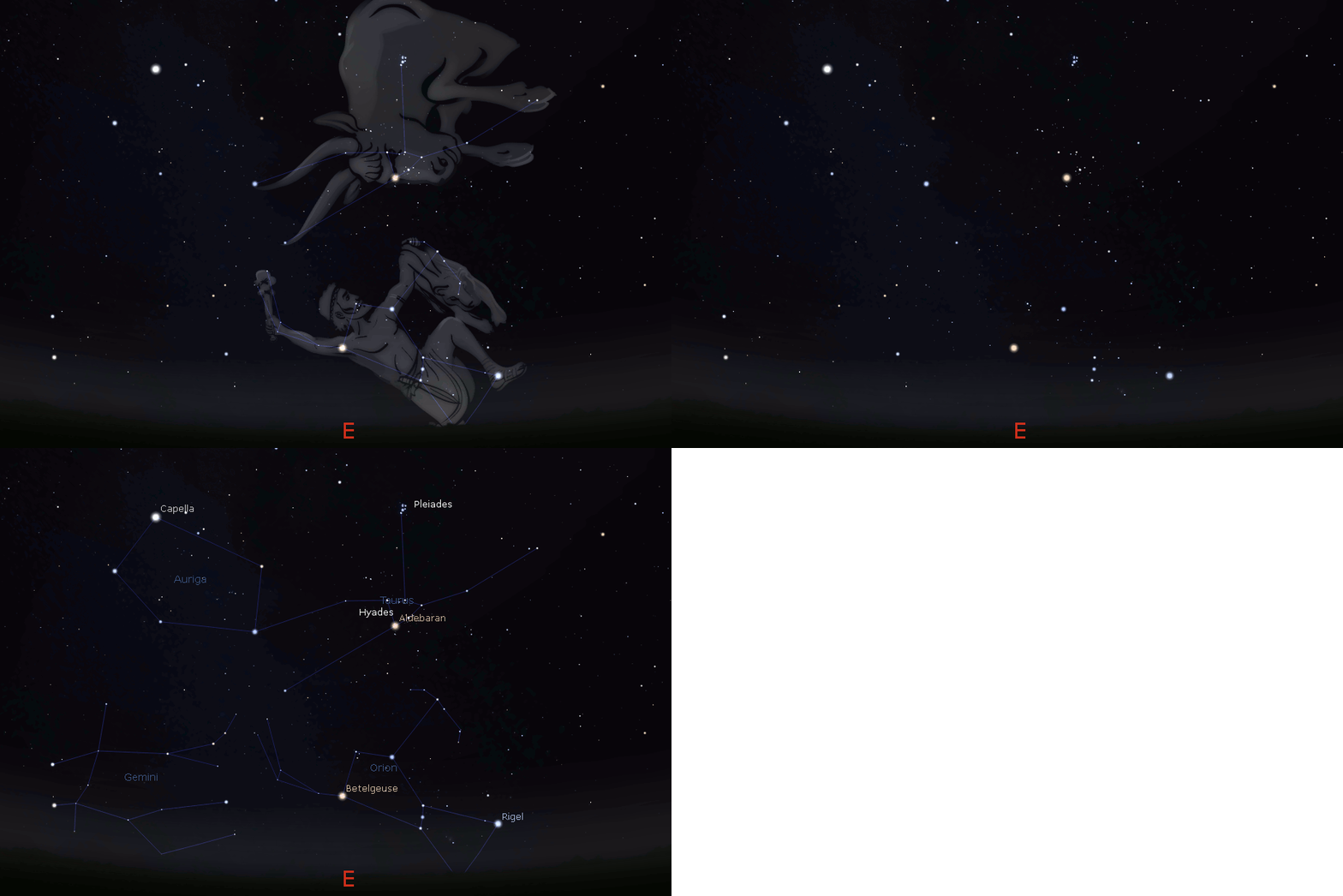
An animation showing the Hyades, Taurus, Orion and the Pleiades. Click on the image to enlarge. Created using Stellarium and GIMP.
The Pleiades (right) and the Hyades (left) in this photograph I took January 4, 2016.
10/29/2019 – Ephemeris – Finding the Pleiades or Seven Sisters
Ephemeris for Tuesday, October 29th. Today the Sun will be up for 10 hours and 19 minutes, setting at 6:36, and it will rise tomorrow at 8:17. The Moon, 2 days past new, will set at 7:57 this evening.
A marvelous member of the autumn skies can be found low in the east northeast after 9 in the evening. It is the famous star cluster called the Pleiades or the Seven Sisters. I might also add the ‘Tiny Dipper’. Many people can spot a tiny dipper shape in its six or seven stars, and mistake it for the Little Dipper. When I was nearsighted, though corrected, I never had been able to see more than a few stars and a bit of fuzz. However with binoculars, even I can see over a hundred stars appear along with the dipper shape of the brightest. The fuzz I saw was unresolved stars, but in photographs the Pleiades actually contain wisps of the gas they are passing through currently. In Greek mythology the sisters were daughters of the god Atlas.
The times given are for the Traverse City/Interlochen area of Michigan. They may be different for your location.
Addendum
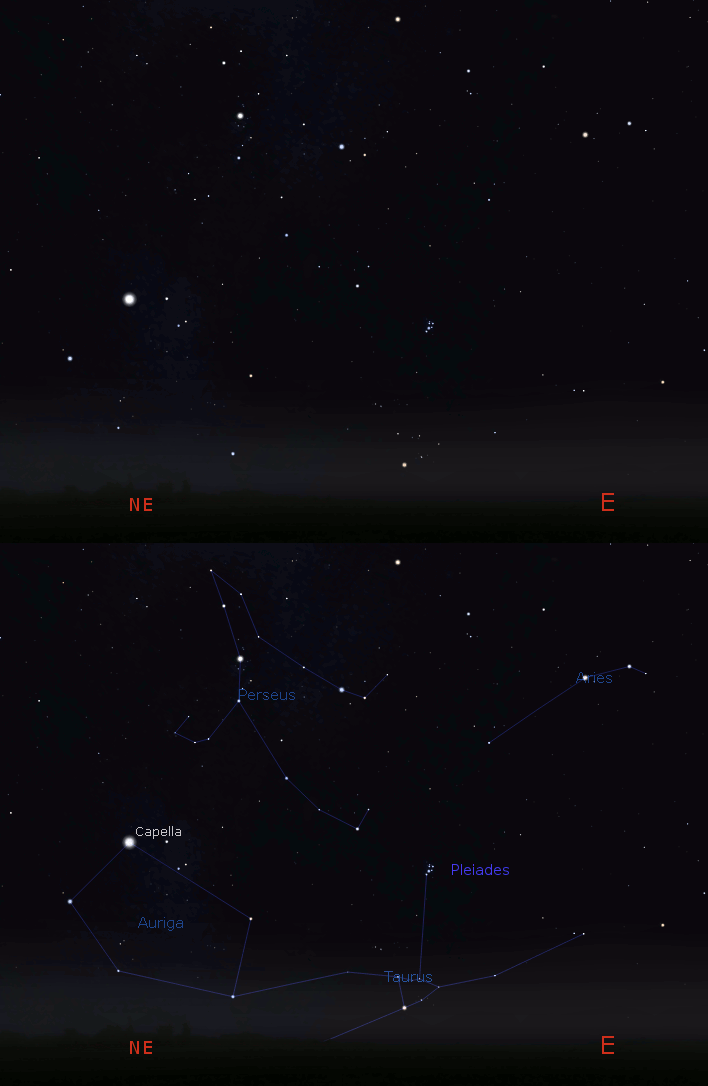
Finding the Pleiades animation for 9 p.m. October 29, 2019. The Pleiades is surrounded by constellations I’ve described earlier this year and one yet to be described, Taurus the bull of which the cluster is a part. The V of stars near the horizon is Taurus’ head and is another star cluster, the Hyades, the half sisters to the Pleiades. Created using Stellarium and GIMP.
The Pleiades, about what you’d see in binoculars, though not as brilliant. One of my old photographs. With my 11 inch f/4.5 Dobsonian using a 40mm eyepiece that gives a field of view that encompasses the Pleiades, all I can say is Wow!
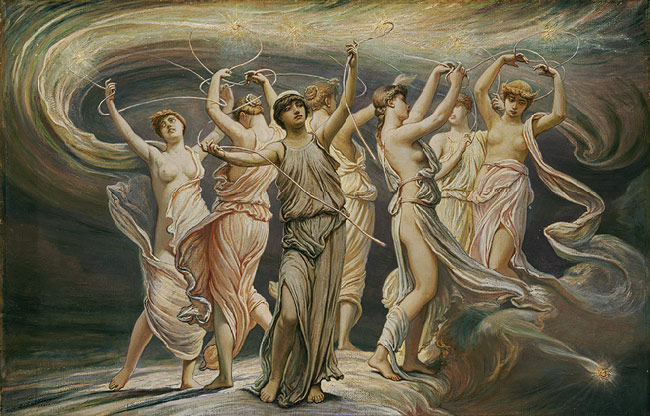
The Greek Pleiades a painting by Elihu Vedder in the Metropolitan Museum of Art, New York City. Public Domain.
03/26/2019 – Ephemeris – Mars is approaching the Pleiades this week
Ephemeris for Tuesday, March 26th. Today the Sun will be up for 12 hours and 27 minutes, setting at 8:02, and it will rise tomorrow at 7:33. The Moon, 2 days before last quarter, will rise at 2:38 tomorrow morning.
Daylight time and spring time are catching up with us with the Sun setting now just after 8 p.m. By 9 p.m. tonight the brighter stars appear and most of the well known constellations will be recognizable. Looking off to the west at that time the famous star group of the Pleiades, or Seven Sisters will appear. Folks with good eyesight can see six or maybe even seven of its stars. Tonight, right below the Pleiades is a bright reddish star. It would be the 22nd of the first magnitude stars, except it’s not a star. It’s a wanderer, according to the ancient Greeks, one of seven*. They called it Ares the god of war. The Romans turned it into Mars. Over the week Mars will be closing in and passing by the Pleiades this weekend.
The times given are for the Traverse City/Interlochen area of Michigan. They may be different for your location.
Addendum
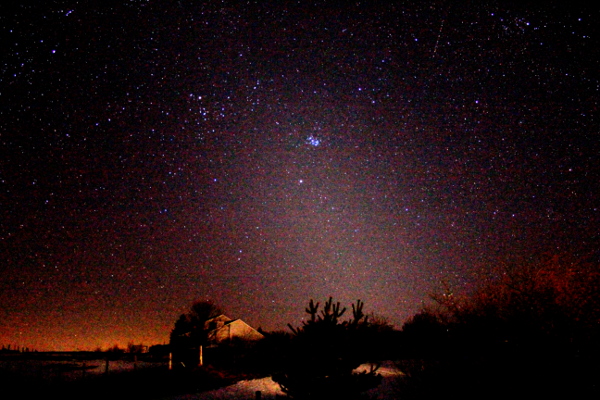
The western sky at 10:22 last night March 25, 2019. Mars appears below the Pleiades in zodiacal light. Credit, mine – Canon EOS Rebel T5 18mm f.l., f/3.5, 8 sec. ISO 12,800.
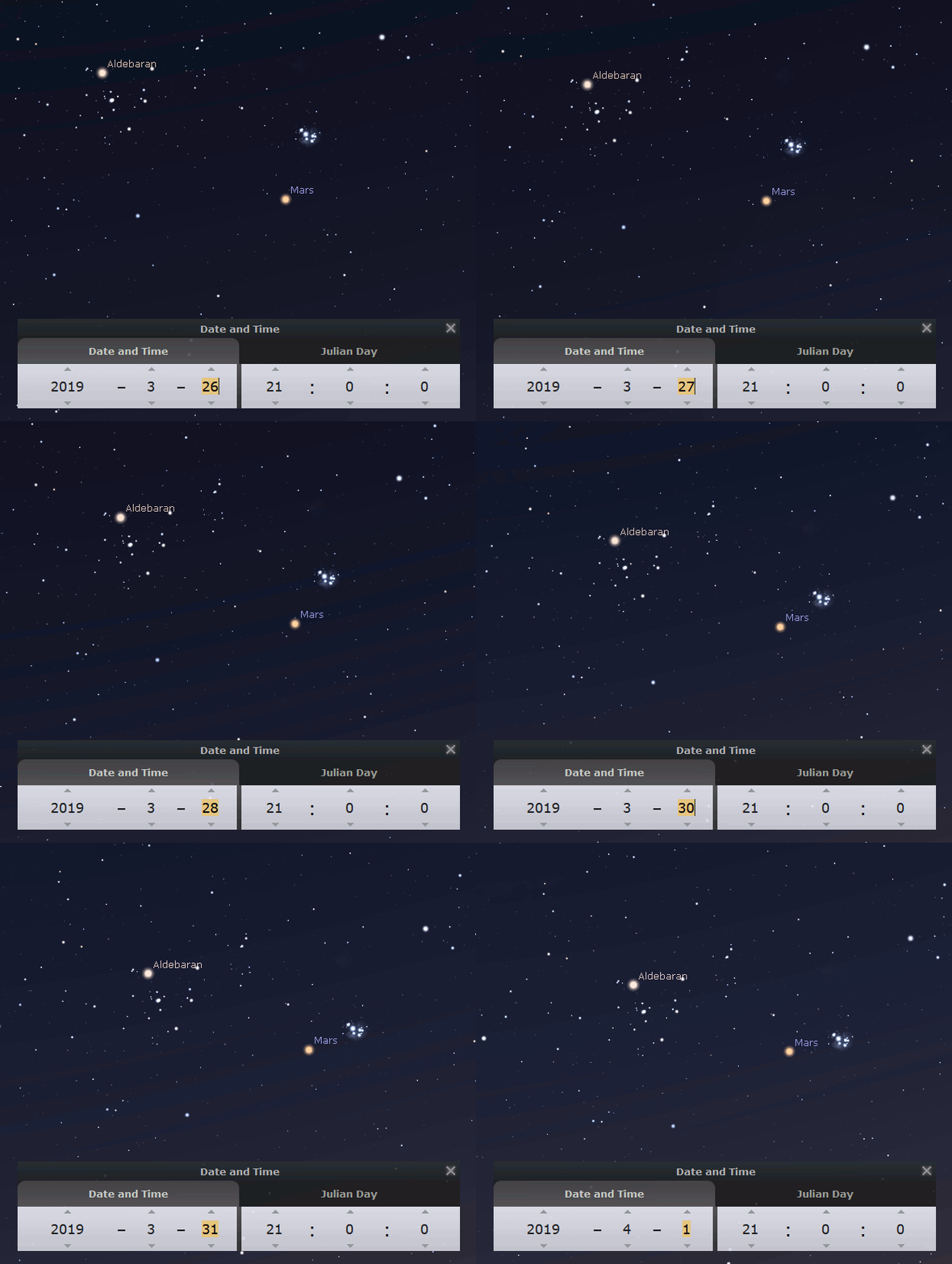
Mars tiptoeing past the Pleiades nightly from March 26th to April 1st, 2019 at 9 p.m. Looking west. Created using Stellarium and GIMP.
The letter V of stars to the left of the Pleiades is the Hyades, in mythology the half sisters to the Pleiades. It is also the face of Taurus the bull.
* We get the word planet from the Greek planētes meaning wander. Five are the classical planets, Mercury, Venus, Mars, Jupiter, and Saturn. The other two are the Sun and Moon. The other celestial objects were the fixed stars. Other things that appear in the sky, like comets, novae and meteors were thought to be in the Earth’s atmosphere.

