Archive
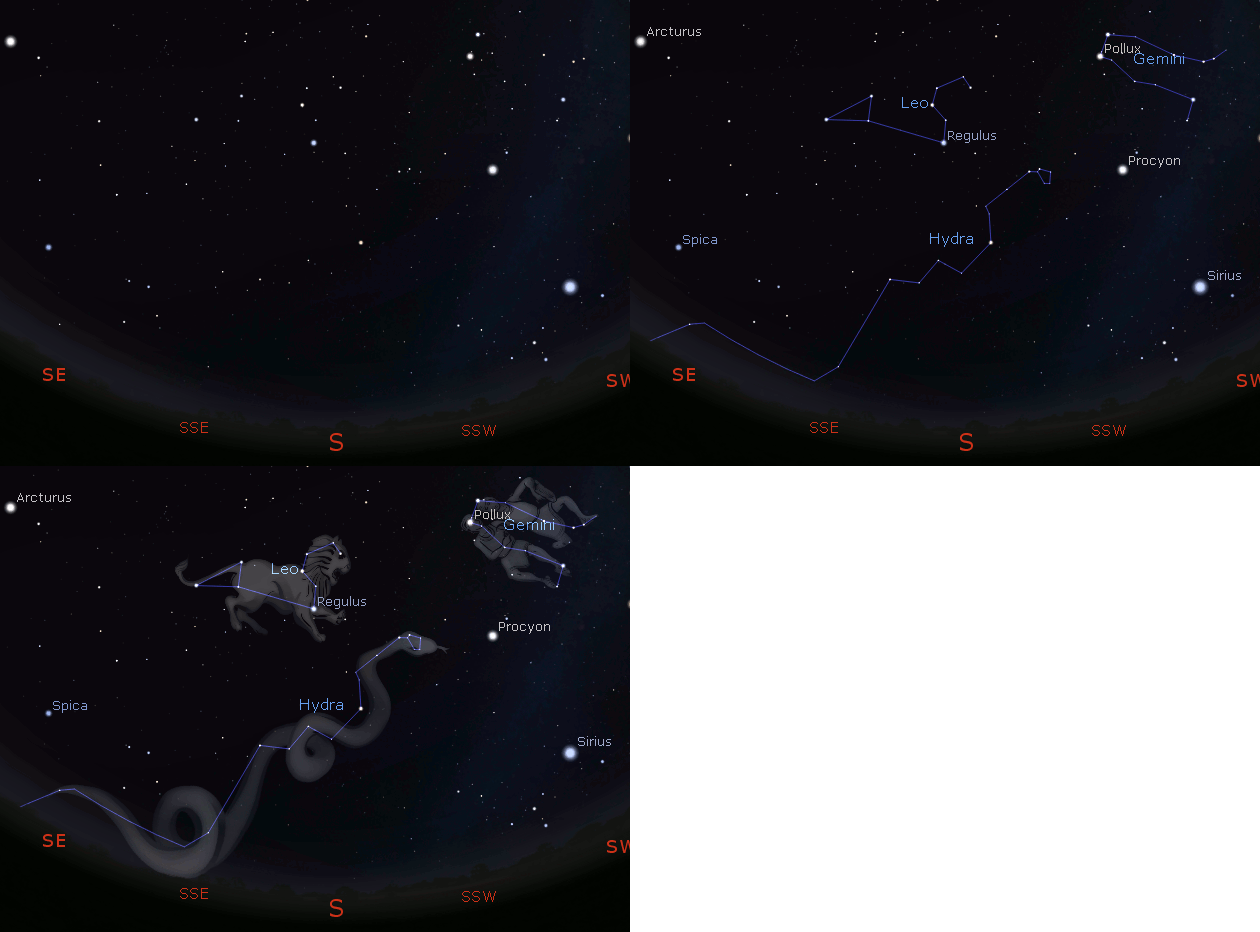
04/13/2021 – Ephemeris – Hydra slithers across the southern sky
This is Bob Moler with Ephemeris for Tuesday, April 13th. Today the Sun will be up for 13 hours and 24 minutes, setting at 8:25, and it will rise tomorrow at 6:59. The Moon, 2 days past new, will set at 10:08 this evening.
In the southern evening sky can be found the constellation of Hydra the water snake. Unlike the monster of the same name this Hydra has but one head, which is its most distinctive part. At 10 p.m. look midway up the sky in the south-southwest. The head of Hydra is located below a line from the constellation Leo the Lion in the south and Gemini high in the west-southwest. Its head is directly below Cancer the crab in the southwest. Hydra’s head is a small but distinctive group of 6 stars that make a loop and the snake’s slightly drooping head. The rest of Hydra wends its way to the southeastern horizon, and eventually ends near the late spring constellation of Libra the scales. Over the next few hours Hydra will be seen slithering across the southern sky.
The astronomical event times given are for the Traverse City/Interlochen area of Michigan. They may be different for your location.
Addendum
04/06/2021 – Ephemeris – The spring constellation of Leo
This is Bob Moler with Ephemeris for Tuesday, April 6th. Today the Sun will be up for 13 hours and 3 minutes, setting at 8:17, and it will rise tomorrow at 7:12. The Moon, 2 days past last quarter, will rise at 5:48 tomorrow morning.
Tomorrow morning early risers will see the Moon near the planets Saturn and Jupiter. Specifically Jupiter, left of Saturn will be right above the waning crescent Moon.
Tonight however, will be a good time to check out Leo the celestial lion high in the southeast. His distinctive pattern of stars is a backward question mark, with the bright star Regulus as the dot on the bottom of it. It delineates the male lion’s head and mane. That pattern is also called the Sickle. While Leo is one of the official 88 constellations, the Sickle is an asterism, or informal constellation. Completing Leo is a triangle of stars below left of Regulus, his rump ending with the star Denebola, at the root of Leo’s tail. Leo is rich in mythology.
The astronomical event times given are for the Traverse City/Interlochen area of Michigan. They may be different for your location.
Addenda
Jupiter and the Moon tomorrow morning
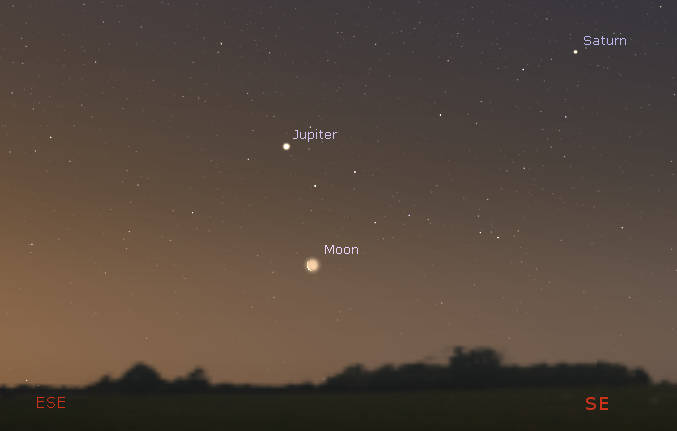
Leo tonight

03/09/2021 – Ephemeris – A celestial warning to keep off thin ice
This is Ephemeris for Tuesday, March 9th. Today the Sun will be up for 11 hours and 35 minutes, setting at 6:41, and it will rise tomorrow at 7:03. The Moon, halfway from last quarter to new, will rise at 6:12 tomorrow morning.
The native Anishinaabe peoples of the Great Lakes Region, which includes the tribes of our area, have one constellation of winter I know of. It is The Wintermaker which uses many of Orion’s stars and whose arms stretch from Aldebaran in Taurus the bull to Procyon the Little Dog Star, embracing the whole of the winter sky. Now that spring is nearly here he is sinking into the west, losing to the heat of the Sun. The first constellation of spring is Curly Tail, or the Great Underwater Panther. It uses the stars of Leo the lion’s backward question mark as its curly tail and the small knot of stars that are the head of Hydra the water snake below Cancer the crab as its head. His warning: Keep off the thinning ice or break through and be snatched by the great panther that lives below.
The astronomical event times given are for the Traverse City/Interlochen area of Michigan. They may be different for your location.
Addendum
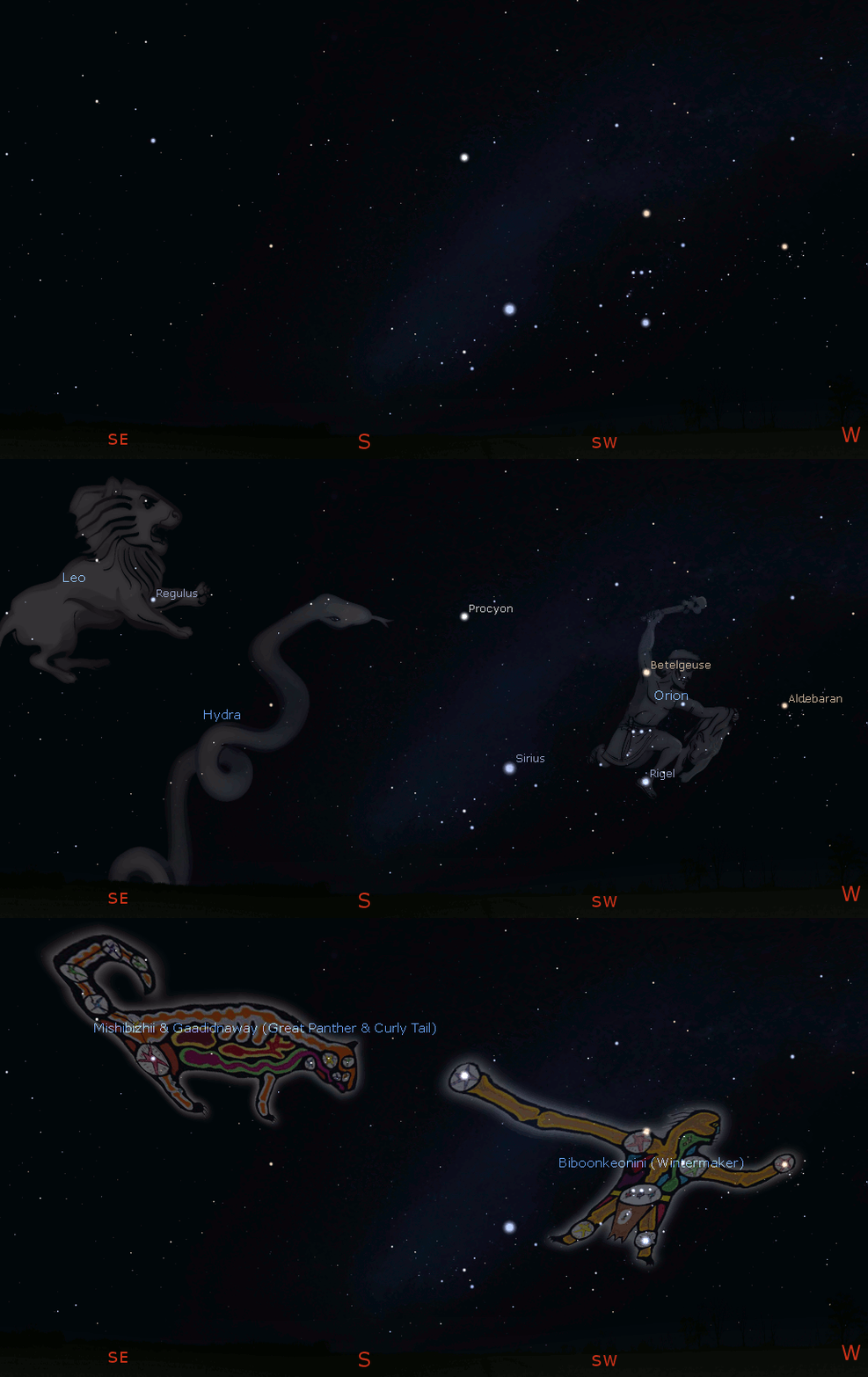
The Great Underwater Panther finder animation. Three frame animation of Unannotated sky, International Astronomical Union constellations, and Anishinaabe (Ojibwe) constellations of Curly Tail and Wintermaker. Click on the image to enlarge. Created using Stellarium and GIMP. Additional credits below.
The time is set for the above image is 10 pm on March 9th.
The constellation art is part of the latest versions of Stellarium. Ojibwe (Anishinaabe) constellation art by Annette S Lee and William Wilson from Ojibwe Sky Star Map Constellation Guide, ISBN 978-0-615-98678-4. There is also an Ojibwe Sky Star Map poster suitable for framing.
04/24/2020 – Ephemeris – The Big Dipper can be used to point to other stars and constellations
This is Bob Moler with Ephemeris for Arbor Day, Friday, April 24th. Today the Sun will be up for 13 hours and 57 minutes, setting at 8:39, and it will rise tomorrow at 6:41. The Moon, 2 days past new, will set at 10:21 this evening.
The Big Dipper can be used to point to other stars and constellations. Right now the Big Dipper is nearly overhead. The front bowl stars point to Polaris, the North Star which never seems to move in the sky. The handle can be used to find two stars. First follow the arc of the handle away from the bowl to find the fourth brightest night-time star Arcturus in the base of the kite shaped constellation of Boötes. Straighten the arc to a spike and continue to the south and you will come to the bright blue-white star Spica in Virgo the virgin. You can remember these stars with the phrase “Follow the arc of the handle to Arcturus and then spike to Spica” or if you prefer the alternate pronunciation of the latter star “Speak to Speeka”.
The event times given are for the Traverse City/Interlochen area of Michigan. They may be different for your location.
Addendum
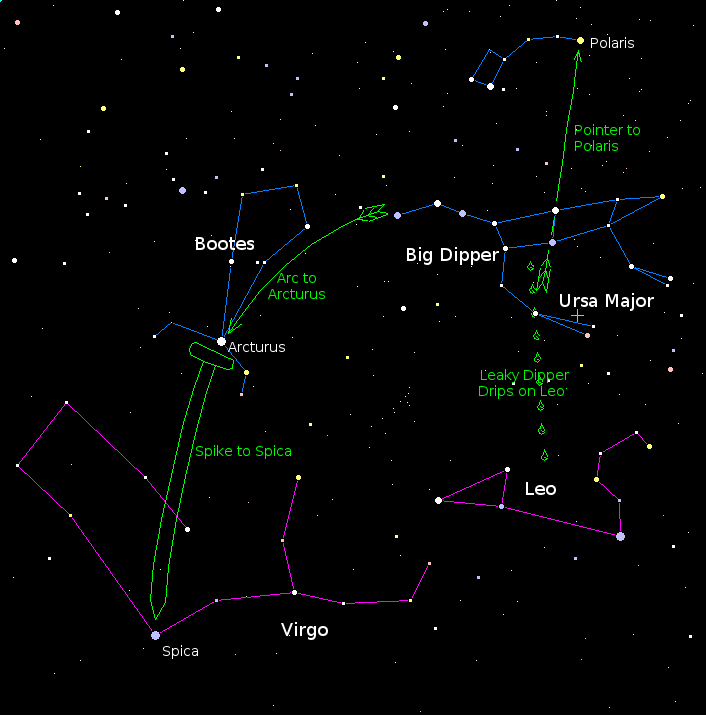
Finding stars and constellations using the Big Dipper. Click on the image to enlarge. Created using my LookingUp program for Windows.
03/26/2020 – Ephemeris – A spring warning about thin ice in the sky
Ephemeris for Thursday, March 26th. Today the Sun will be up for 12 hours and 29 minutes, setting at 8:03, and it will rise tomorrow at 7:31. The Moon, 2 days past new, will set at 10:22 this evening.
The Anishinaabe peoples of the Great Lakes Region, which includes the Ottawa, Chippewa and Ojibwe Indians have one constellation of winter. It is The Winter Maker which uses many of Orion’s stars and whose arms stretch from Aldebaran in Taurus the bull to Procyon the Little Dog Star, embracing the whole of the winter sky. Now that spring is here he is sinking into the west. The first constellation of spring is Curly Tail, or the Great Underwater Panther. Which uses the stars of Leo the lion’s backward question mark as its tail and the small knot of stars that are the head of Hydra the water snake below Cancer the crab as its head. The warning: Keep off the thinning ice or break through and be snatched by the panther that lives below.
The event times given are for the Traverse City/Interlochen area of Michigan. They may be different for your location.
Addendum
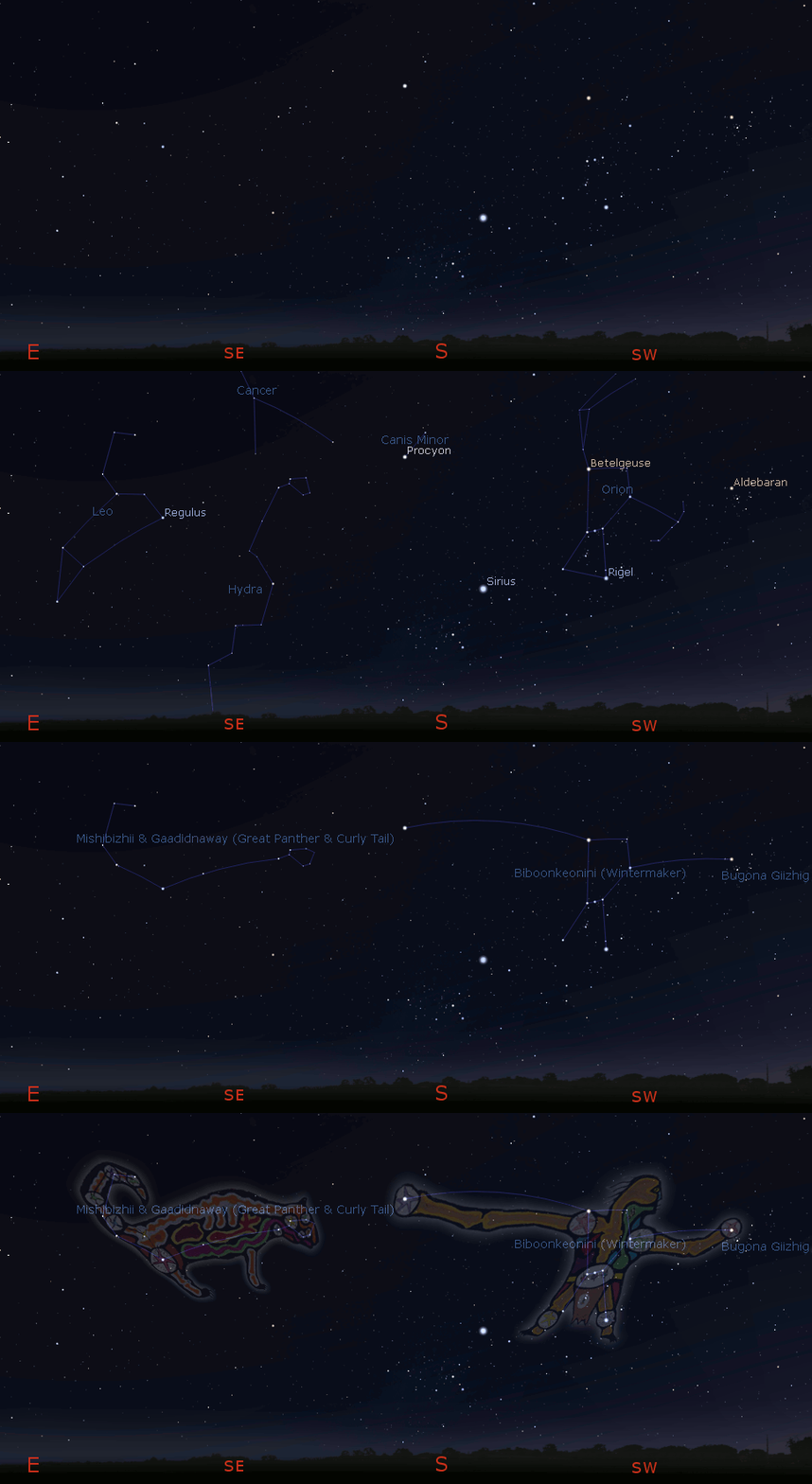
Great Underwater Panther finder animation relating western to Anishinaabe constellations for 9 p.m. in late March. Click on image to enlarge. Created using Stellarium.
04/02/2019 – Ephemeris – Hydra the longest constellation
Ephemeris for Tuesday, April 2nd. Today the Sun will be up for 12 hours and 49 minutes, setting at 8:11, and it will rise tomorrow at 7:20. The Moon, 3 days before new, will rise at 7:03 tomorrow morning.
In the south and southeastern sky at 10 p.m. can be found the constellation of Hydra the water snake. Unlike the monster of the same name this Hydra has but one head, which is its most distinctive part. At 10 p.m. look to the south. The head of Hydra is located below a line from the constellation Leo the Lion in the south and Gemini high in the west-southwest, and directly below Cancer the crab. Hydra’s head is a small but distinctive group of 6 stars that make a drooping loop to the right. The rest of Hydra wends its way diagonally to the southeastern horizon below the bright blue star Spica in Virgo. Some delineations of Hydra have the tail tickling the constellation Libra which is just about to rise at that time.
The times given are for the Traverse City/Interlochen area of Michigan. They may be different for your location.
Addendum
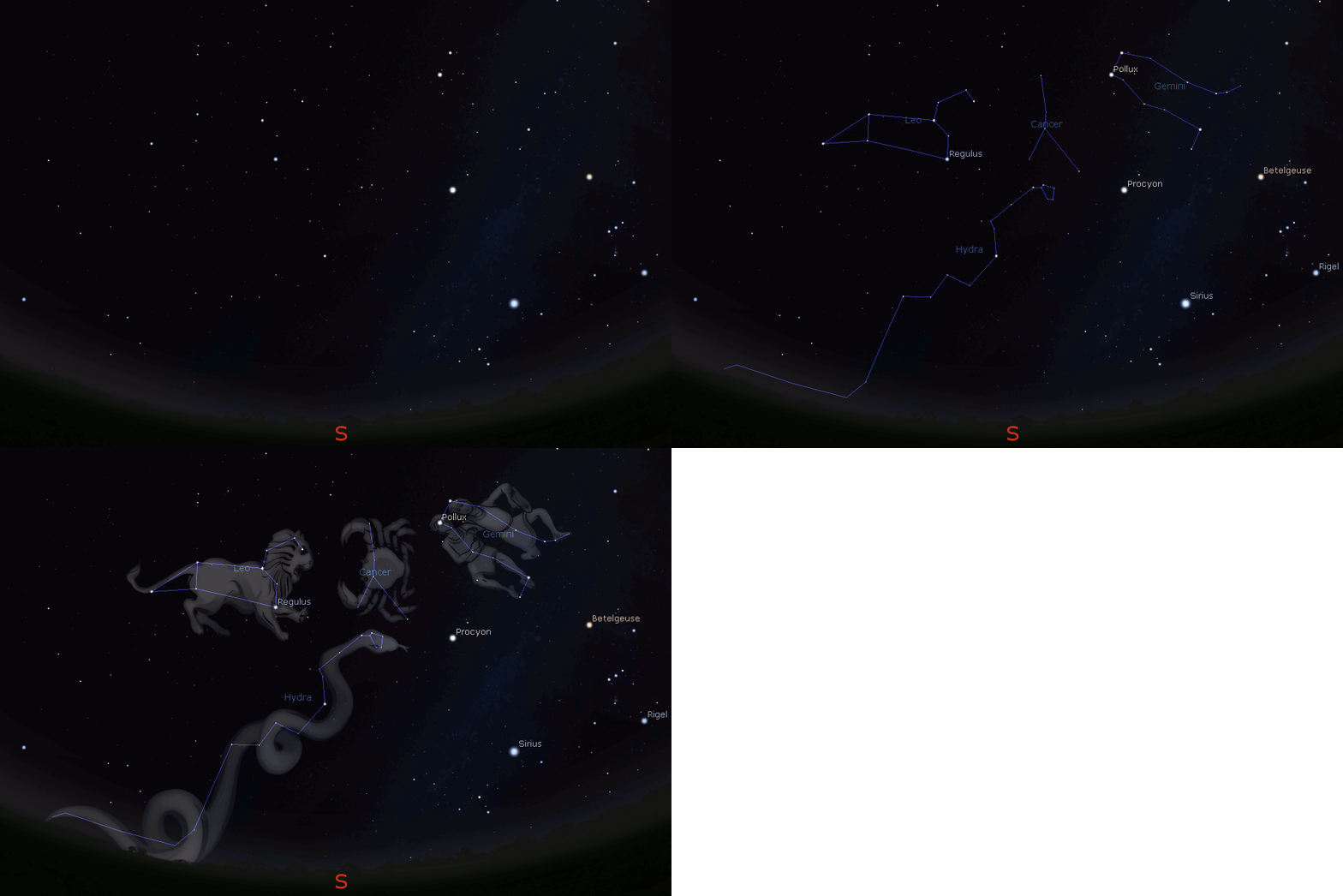
Hydra the water snake finder animation for 10 p.m. April 2nd.. Hydra is the longest of all the constellations. Click on the image to enlarge. Created using Stellarium and GIMP.
03/07/2019 – Ephemeris – Leo the lion rising
Ephemeris for Thursday, March 7th. Today the Sun will be up for 11 hours and 28 minutes, setting at 6:38, and it will rise tomorrow at 7:08. The Moon, 1 day past new, will set at 7:42 this evening.
Tonight as twilight fades around 8 p.m. the constellation of Leo the lion can be seen rising in the east. The head and mane of a male lion is seen as a backward question mark. This pattern of stars is also called the sickle. The bright star that is the dot at the bottom is Regulus, the “Little King Star”. To the lower left is a triangle of stars that is the lion’s hind end with the star Denebola at the far end. It is said that the reason the figure of a lion came to be seen in the stars here is because lions came from the desert, driven by the heat, to drink from the river Nile the time of the year that the sun was in this part of the sky. Leo can also be found by first locating the Big Dipper high in the northeast, a hole in its bowl drips on Leo.
The times given are for the Traverse City/Interlochen area of Michigan. They may be different for your location.
Addendum
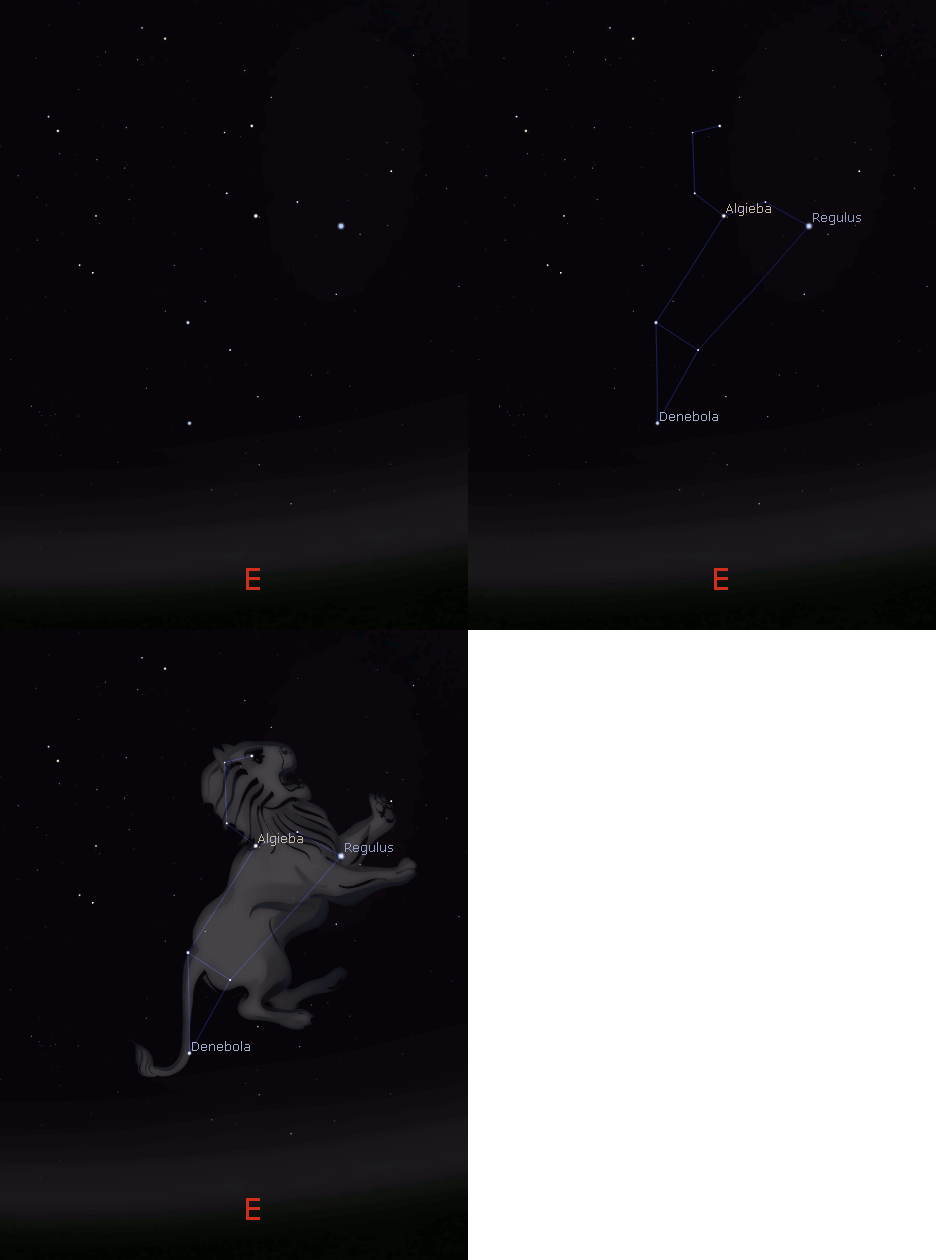
The constellation Leo rising animation. Created using Stellarium and GIMP.
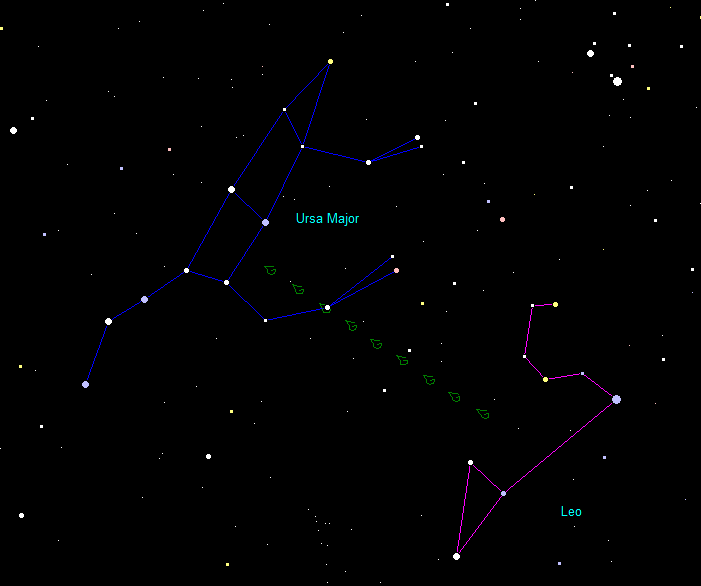
Finding Leo from the Big Dipper: Leaky Big Dipper drips on Leo. Created using my LookingUp program.
02/25/2019 – Ephemeris – Cancer the crab
Ephemeris for Monday, February 25th. Today the Sun will be up for 10 hours and 57 minutes, setting at 6:24, and it will rise tomorrow at 7:25. The Moon, 1 day before last quarter, will rise at 1:46 tomorrow morning.
Between the stars Castor and Pollux in Gemini high in the southeast and the star Regulus in Leo the Lion in the east-southeast lies the dimmest constellation of the zodiac, Cancer the crab. To me its 5 brightest stars make an upside down Y. There’s the stars in the center of the constellation Asellus Borealis and Asellus Australis, the north and south donkeys. There’s a fuzzy spot between and just west of them called Praesepe, the manger. In binoculars it resolves into a cluster of stars called the Beehive cluster. We amateur astronomers also know it as M44, the 44th object on comet hunter Charles Messier’s list of objects that might be mistaken for comets.
The times given are for the Traverse City/Interlochen area of Michigan. They may be different for your location.
Addendum
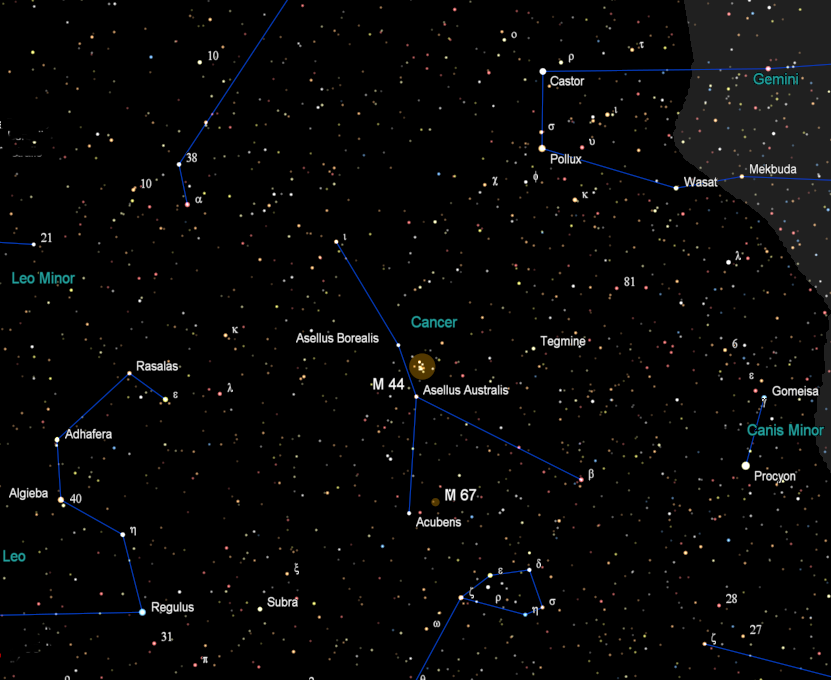
The constellation Cancer finder chart. Click on image to enlarge. Created using Cartes du Ciel (Sky Charts).
05/14/2018 – Ephemeris – Big Dipper: Pointer to the Stars
Ephemeris for Monday, May 14th. Today the Sun will be up for 14 hours and 47 minutes, setting at 9:03, and it will rise tomorrow at 6:14. The Moon, 1 day before new, will rise at 6:45 tomorrow morning.
The Big Dipper points to other stars and constellations. Right now the Big Dipper is nearly overhead. The front bowl stars point to Polaris, the North Star which never seems to move in the sky. The handle can be used to find two stars. First follow the arc of the handle away from the bowl to find the fourth brightest night-time star Arcturus in the base of the kite shaped constellation of Boötes. Straighten the arc to a spike and continue to the south and you will come to the bright blue-white star Spica in Virgo the virgin. You can remember these stars with the phrase “Follow the arc of the handle to Arcturus and then spike to Spica” or if you prefer the alternate pronunciation of the latter star “Speak to Speeka”.
The times given are for the Traverse City/Interlochen area of Michigan. They may be different for your location.
Addendum
As can be seen below, there was one pointer function that didn’t make it into the program: A leaky dipper drips on Leo.
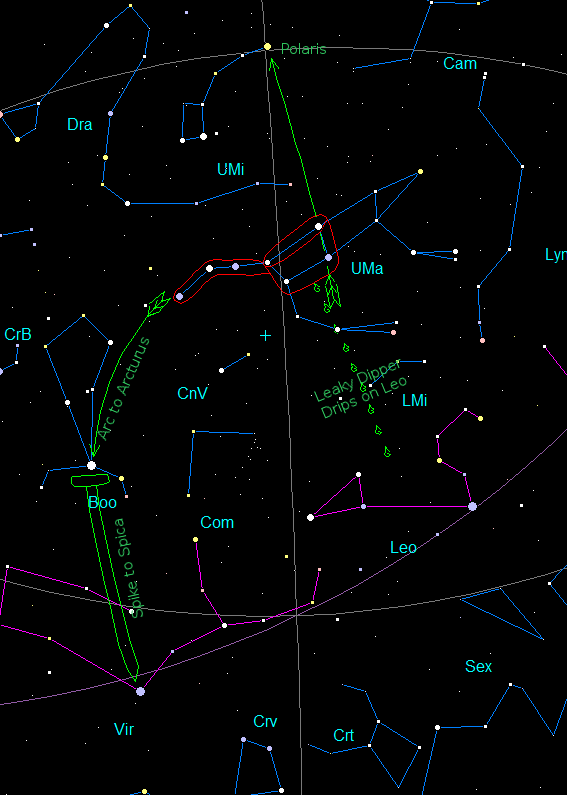
Using the Big Dipper as a pointer to other stars. The pointers to Polaris could be life saving, since it is always north. The view is southward. The cross displayed near the center is the zenith. One might want to lay down to take all this in. Created using my LookingUp program.
02/13/2018 – Ephemeris – The Big Dipper as a pointer to other stars and constellations
Ephemeris for Tuesday, March 13th. The Sun will rise at 7:58. It’ll be up for 11 hours and 47 minutes, setting at 7:46. The Moon, 4 days before new, will rise at 6:42 tomorrow morning.
With the Big Dipper up in the northeastern sky it is a sign that spring is coming. At 9 p.m. The Big Dipper can be used to find other stars and constellations. The Big Dipper’s most famous function is in locating Polaris the North Star. It’s a good way of finding directions at night. The altitude of Polaris, that is angle above the horizon, will give one’s approximate latitude north of the equator. Another constellation that can be found is Leo the lion. It is rising in the east in the evening, but it can also be found from the Big Dipper by imagining that a hole were drilled in the bottom of the bowl to let the water leak out. It would fall on Leo’s back. The Big Dipper can be used to find two more stars, but they have not yet risen.
The times given are for the Traverse City/Interlochen area of Michigan. They may be different for your location.
Addendum
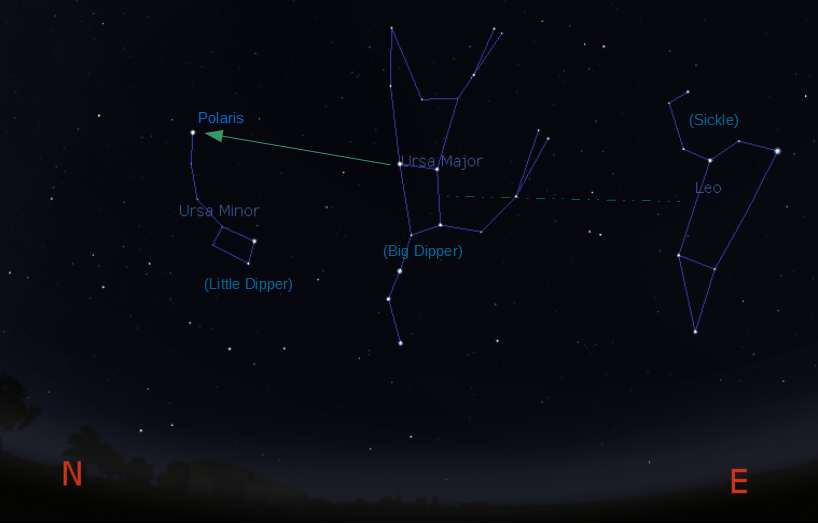
The Big Dipper points to Polaris, the, North Star, and to Leo the lion at 9 p.m., March 13th. In another hour the 4th brightest night-time star Arcturus will appear above the eastern horizon pointed to by the arc of the handle of the Big Dipper. We’ll revisit the Big Dipper next month when Arcturus and Spica will also be found by the use of the Big Dipper. Created using Stellarium and Libre Office.
 Bob Moler's Ephemeris Blog