Archive
05/14/2015 – Ephemeris – The constellation Virgo in mythology
Ephemeris for Thursday, May 14th. Today the Sun will be up for 14 hours and 46 minutes, setting at 9:02. The Moon, 3 days past last quarter, will rise at 4:51 tomorrow morning. Tomorrow the Sun will rise at 6:14.
Tonight in the sky: to the left of the constellation of Leo the lion, which lies in the west-southwest at 11 p.m. is the next constellation of the zodiac: Virgo the virgin, is seen in the south. Virgo is a large constellation of a reclining woman holding a stalk of wheat. The bright star in the center of the constellation, Spica, is the head of that spike of wheat; and as such ruled over the harvest in two of Virgo’s guises as the goddesses Persephone and Ceres. Virgo is also identified as Astraea the goddess of justice. The constellation of Libra, the scales, is found just east of her. Early Christians saw Virgo as the Virgin Mary. Virgo is the home of the Virgo Cluster of thousands of galaxies.
Times are for the Traverse City/Interlochen area of Michigan. They may be different for your location.
Addendum
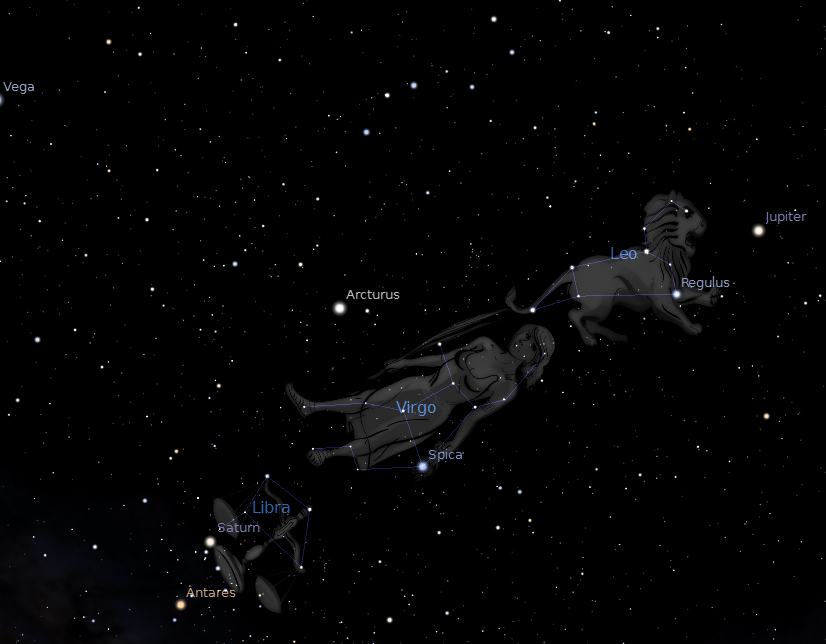
Virgo with the also mentioned constellations of Leo and Libra for 11 p.m., May 14, 2015. Created using Stellarium.
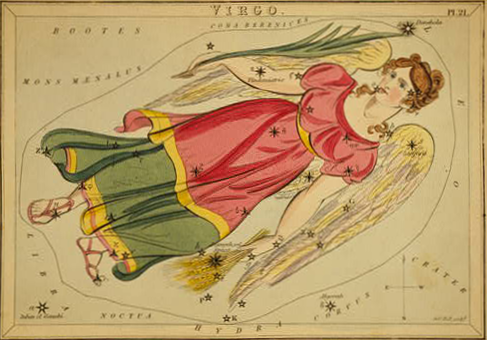
Virgo as depicted in Urania’s Mirror, a set of constellation cards published in London c.1825. From the Library of Congress. H/T Wikipedia.
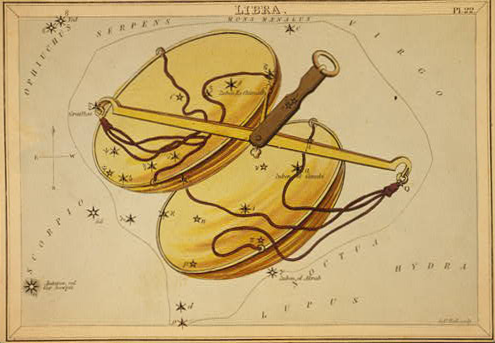
Libra as depicted in Urania’s Mirror, a set of constellation cards published in London c.1825. From the Library of Congress. H/T Wikipedia.
03/26/2015 – Ephemeris – Regulus the 21st brightest of the 21 brightest “First Magnitude” stars
Ephemeris for Thursday, March 26th. The Sun will rise at 7:35. It’ll be up for 12 hours and 27 minutes, setting at 8:02. The Moon, 1 day before first quarter, will set at 3:04 tomorrow morning.
The bright star below and left of Jupiter as it shines in the southeast in the evening is the star Regulus in Leo the lion. It’s at the base of the backward question mark of stars that make up the head and mane of Leo. It is also an asterism or informal constellation of the Sickle. Regulus is the dimmest of the 21 brightest stars which are called First Magnitude Stars. It is a quadruple star system with two pairs of stars. Regulus is a blue-white star which is rapidly spinning with a period of something like 16 hours, orbited by a possible white dwarf star every 40 days. The star system is 79 light years away. The name Regulus translates to something like Little King Star, befitting its location in the King of the beasts.
Times are for the Traverse City/Interlochen area of Michigan. They may be different for your location.
Addendum
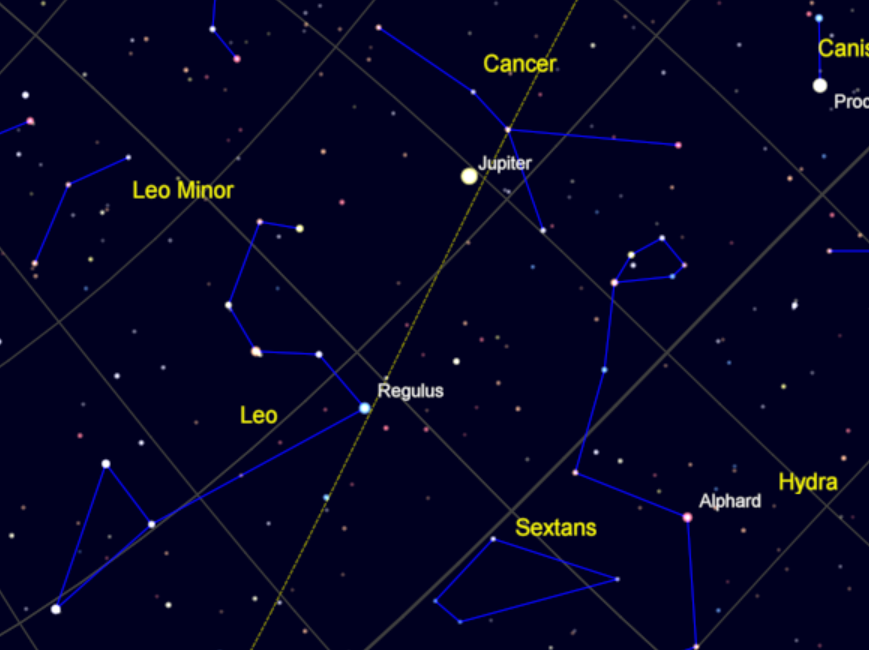
Leo, Regulus and nearby constellations as seen in the east-southeast at 9 p.m. March 26, 2015. Created using Cartes du Ceil (Sky Charts).
Below, zooming in to Regulus BC, the second pair of stars of the Regulus system, which is about 3 minutes of arc northwest of Regulus. It consists of an 8th magnitude and a 14th magnitude star with the same proper motion (motion against the sky) as Regulus.
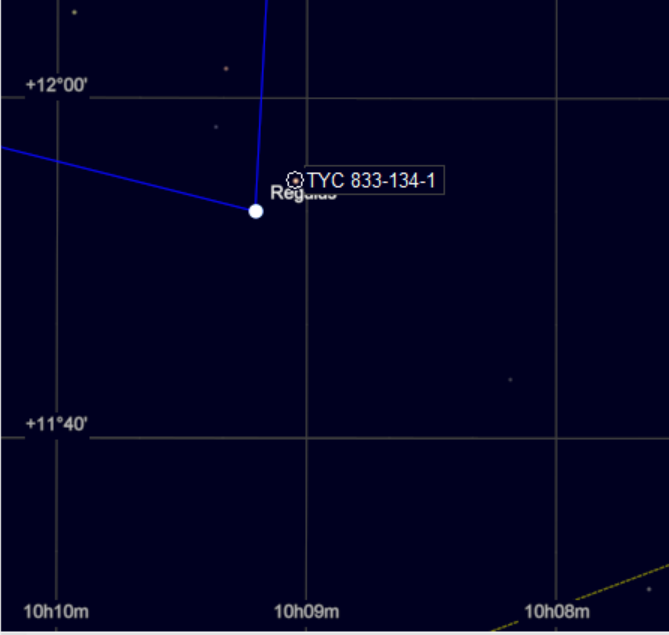
The star TYC 833-134-1 is Regulus B, which is easily visible in telescopes at magnitude 8.1. The star is also listed as HD 87844. The first designation is from the Tycho catalog and is how it’s referenced in Cartes du Ceil. The star is shown, but not named in Stellarium. The is equatorial orientation is created using Cartes du Ceil (Sky Charts).
03/13/2015 – Ephemeris – Leo rising
Ephemeris for Friday, March 13th. The Sun will rise at 7:59. It’ll be up for 11 hours and 46 minutes, setting at 7:46. The Moon, at last quarter today, will rise at 3:35 tomorrow morning.
The constellation Leo the lion is now rising in the east at 9 pm. It’s below and left of the Big Dipper higher up in the east-northeast. Leo is marked by two sets of easily recognizable stars. The front of him is a backward question mark of stars, also known as the Sickle that mark his head and mane, along with the front part of his body. Regulus is the star at the bottom of that backwards question mark. It’s the Little King Star. Jupiter this year is above right if it. The hind end of him is a triangle of stars ending with another bright star, but not as bright as Regulus. It’s Denebola which means Lion’s tail. It is thought when the sun was in this constellation long ago that the lions were driven by the heat to quench their thirst in the Nile river. Ancients physicians thought medicines were poison when the sun was here too.
Times are for the Traverse City/Interlochen area of Michigan. They may be different for your location.
Addendum
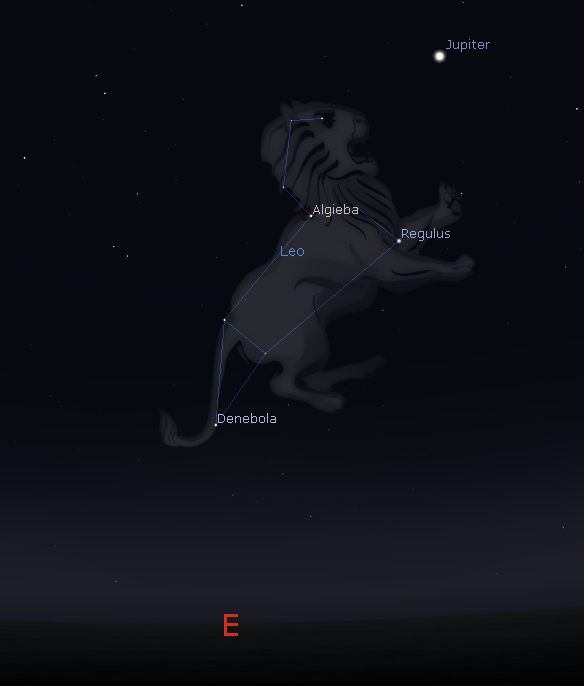
Leo rising in the east behind Jupiter at 9 p.m. on March 13, 2015. Created using Stellarium.
02/09/2015 – Ephemeris – How to find the constellation of Cancer the crab
Ephemeris for Monday, February 9th. The sun will rise at 7:52. It’ll be up for 10 hours and 10 minutes, setting at 6:02. The moon, 2 days before last quarter, will rise at 11:51 this evening.
A small, dim member of the zodiac is Cancer the crab. It’s dim stars make to my eyes and upside down letter Y. It lies between Gemini to the upper right and Leo to the lower left, especially as it is still rising in the southeastern sky at 9 p.m. Right now the bright planet Jupiter is about half way between it and Leo. It does have a relatively bright fuzzy object to the naked eye amongst it’s stars, positioned roughly in the center. It was discovered as a fuzzy spot before the invention of the telescope and called Praesepe, the manger. With the invention of the telescope it was discovered to be a loose group of stars in an open or galactic star cluster. This easy binocular object is best known now as the Beehive cluster or M44.
Times are for the Traverse City/Interlochen area of Michigan. They may be different for your location.
Addendum
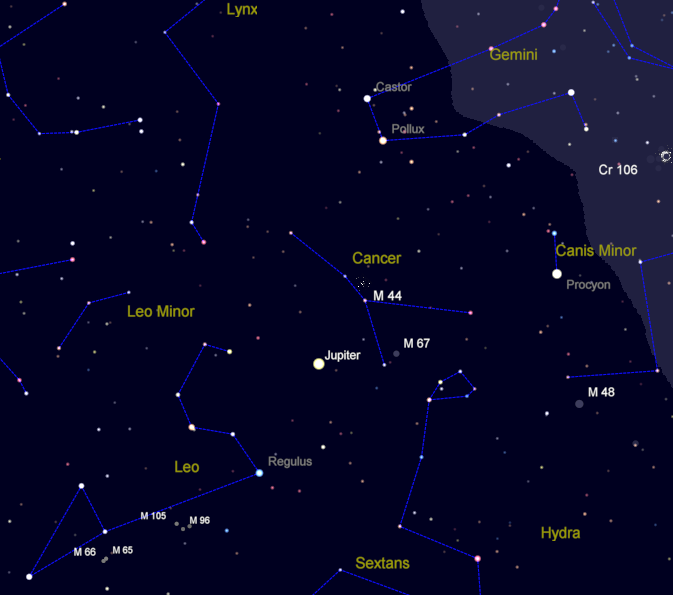
The zodiacal constellation Cancer with Jupiter nearby in the southeast at 9 p.m. February 9, 2015. Created using Cartes du Ceil (Sky Charts).
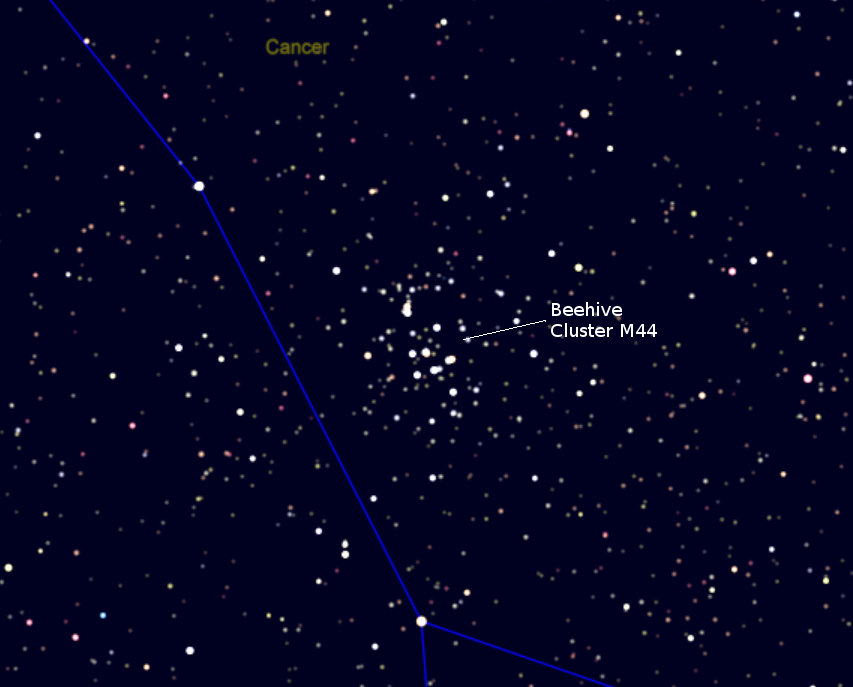
The Beehive star cluster, M44. Its ancient name was the Praesepe or manger when glimpsed by the naked eye. Created using Cartes du Ciel (Sky Charts).
M44 is a young star cluster, perhaps 600-700 million years old and only 577 light years away. It is an open or galactic star cluster. It only appears outside the band of the Milky Way because it’s close to us. The same cannot be said for M67.
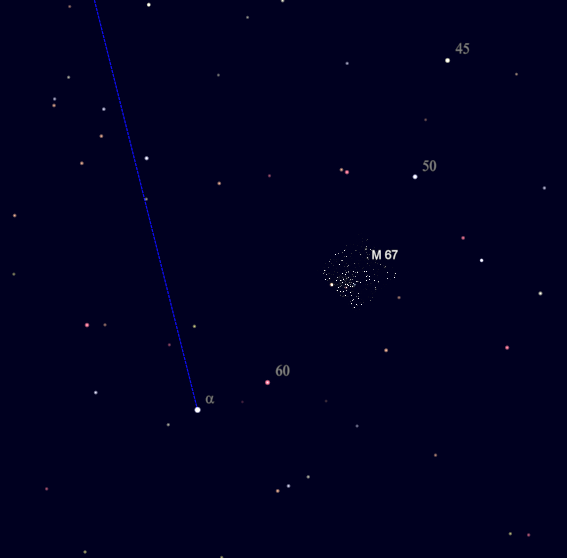
Finder Chart for open cluster M67, found just west of α Cancri, or Acubens. Created using Cartes du Ceil (Sky Charts).
M67 is a fuzzy spot in binoculars but really shows its beauty in telescopes. M67 is pretty old for an open star cluster, one of the oldest known, at about the age of the Sun or a bit younger. It’s nearly 3,000 light years away, so it really is out of the plane of the galaxy.
06/12/2014 – Ephemeris – Jupiter is making up for lost time and is heading rapidly eastward
Ephemeris for Thursday, June 12th. Today the sun will be up for 15 hours and 31 minutes, setting at 9:28. The moon, 1 day before full, will set at 6:38 tomorrow morning. Tomorrow the sun will rise at 5:56.
The planet Jupiter which is the brilliant star-like object in the west is starting to pick up its eastward motion in the stars. Several months ago as the earth was passing Jupiter when it was rising in the east at sunset, it had stopped its eastward motion against the stars and headed westward. This retrograde motion was due to Earth in essence passing the slower moving Jupiter. Now that it’s on the other side of the sun Jupiter is making up for lost time because it and Earth are now moving in opposite directions. This I see in the week to week setting times of Jupiter. Stars rise and set 4 minutes earlier each night. For Jupiter its down to three minutes, meaning it’s moving eastward. When we see it again in December it will have blown past Cancer to Leo, but it will later backtrack into Cancer.
Times are for the Traverse City/Interlochen area of Michigan. They may be different for your location.
Addendum
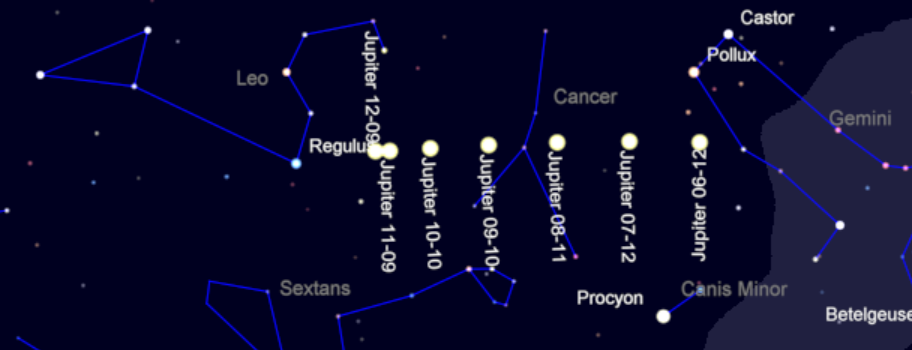
Jupiter’s apparent motion over the next 180 days. Note by December Jupiter will slow and will begin its retrograde loop as the Earth catches up with it again. Created using Cartes du Ciel (Sky Charts).
06/02/2014 – Ephemeris – The Big Dipper points to other stars and constellations
Ephemeris for Monday, June 2nd. Today the sun will be up for 15 hours and 21 minutes, setting at 9:21. The moon, 3 days before first quarter, will set at 12:41 tomorrow morning. Tomorrow the sun will rise at 5:59.
The Big Dipper points to other stars and constellations. Right now the Big Dipper is nearly overhead. The front bowl stars point to Polaris, the North Star which never seems to move in the sky. The handle can be used to find two stars. First follow the arc of the handle away from the bowl to find the fourth brightest night time star Arcturus in the base of the kite shaped constellation of Boötes. Straighten the arc to a spike and continue to the south and you will come to the bright blue-white star Spica in Virgo the virgin. Don’t confuse it with reddish Mars to the right of it now. You can remember these stars with the phrase “Follow the arc of the handle to Arcturus and then spike to Spica”
Times are for the Traverse City/Interlochen area of Michigan. They may be different for your location.
Addendum
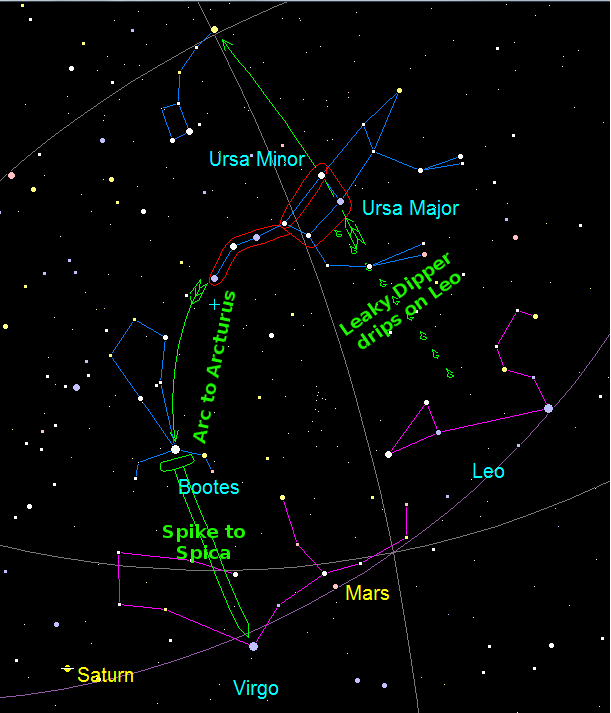
The Big Dipper can be used to point to other stars and constellations in the spring sky. Credit: My LookingUp program.
03/27/2014 – Ephemeris – Hydra and the Great Underwater Panther
Ephemeris for Thursday, March 27th. The sun will rise at 7:32. It’ll be up for 12 hours and 31 minutes, setting at 8:03. The moon, 3 days before new, will rise at 6:06 tomorrow morning.
Today I will take a fresh, for me at least look at the constellation of Hydra the water snake of Greek origin and the Great Underwater Panther of our local Anishinabek people. Between the bright star Regulus in Leo the lion and Procyon in Canis Minor, Orion’s small hunting dog is a drooping group of 6 stars that makes up the head of Hydra. The rest of his stars trail snakily to the southeastern horizon at 10 p.m. He won’t be fully risen until 1 a.m. In the mythology of the Anishinabek people The head of Hydra is the head of the Great Underwater Panther, his back and tail run to Regulus and the front of Leo. In the spring of thinning ice when someone broke through it was credited to this panther, who pulled the person underwater.
Times are for the Traverse City/Interlochen area of Michigan. They may be different for your location.
Addendum
The Anishinabek people contain the Ojibwe or Chippewa, Ottawa or Odawa, and Algonquin peoples. The Chippewa and Ottawa are indigenous to much of northern Michigan.
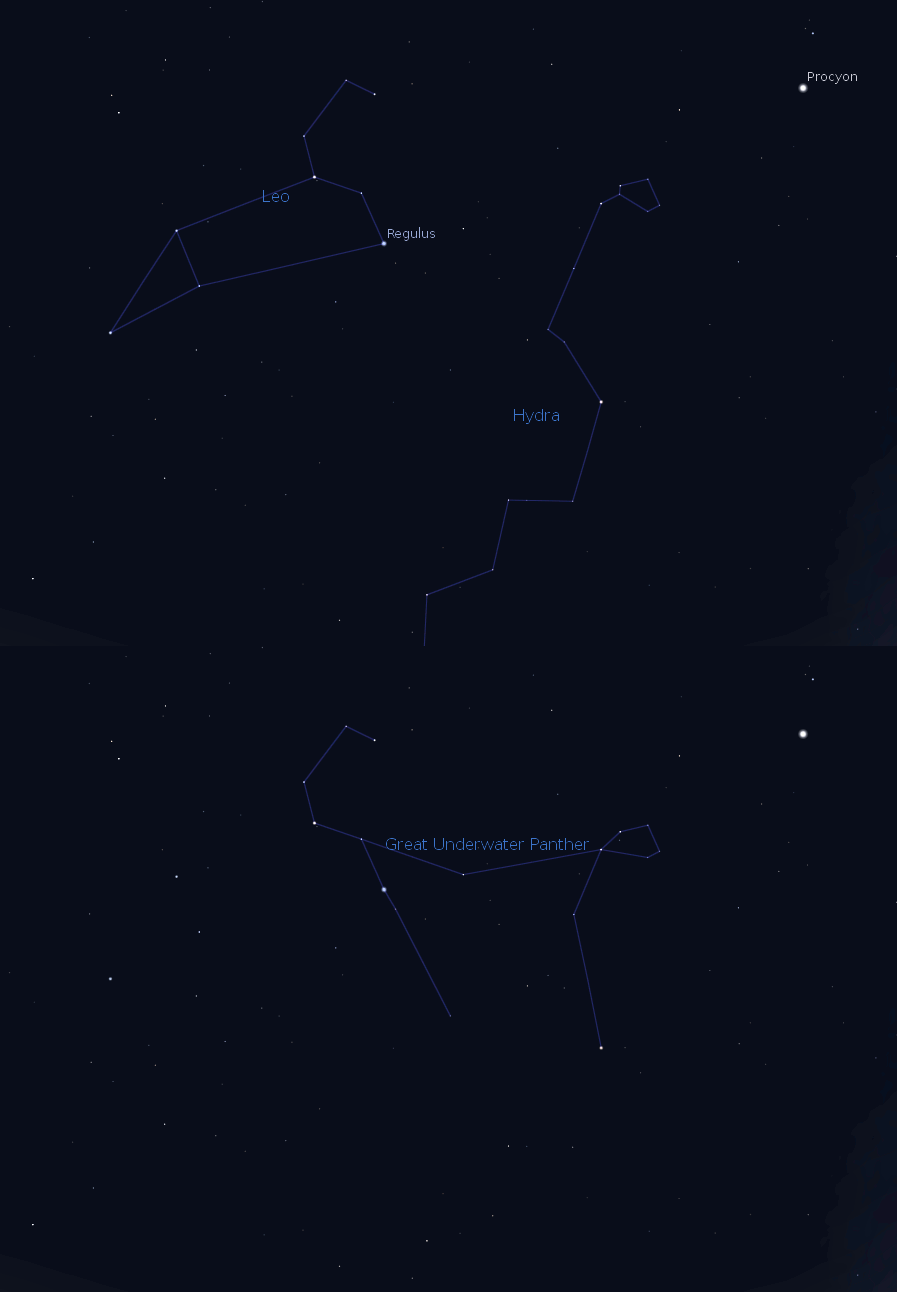
Alternately showing Leo and Hydra of our “Western” constellations and the Anishinabek constellation of the Great Underwater Panther. Created using Stellarium. The constellation drawing of the panther is mine after Michael Wassegijig Price.

The constellation Great Underwater Panther screen shot taken from the YouTube video “Stellar Connections: Explorations in Cultural Astronomy – Pt. 2” by Michael Wassegijig Price.
Below is the video source for the above image.
Here is a link to the video.
03/03/2014 – Ephemeris – The dim zodiacal constellation of Cancer the Crab
Ephemeris for Monday, March 3rd. The sun will rise at 7:16. It’ll be up for 11 hours and 16 minutes, setting at 6:33. The moon, 2 days past new, will set at 9:44 this evening.
At 9 this evening, the faint constellation, and member of the Zodiac, Cancer the crab is located in the south-southeast half way between the bright stars Castor and Pollux of the constellation Gemini, high in the south and the bright star Regulus in Leo the lion in the east Cancer is very dim, looking like an upside-down Y. In the center of Cancer is a fuzzy spot to the unaided eye. In binoculars or a low power telescope this fuzzy spot becomes a cluster of stars. It is the Beehive cluster. At 525 light years away, it is one of the closest star clusters, but more distant than the Pleiades and Hyades the face of Taurus the bull. Back a few thousand years ago Cancer was the farthest north of the constellations, Gemini has that honor today.
Times are for the Traverse City/Interlochen area of Michigan. They may be different for your location.
Addendum
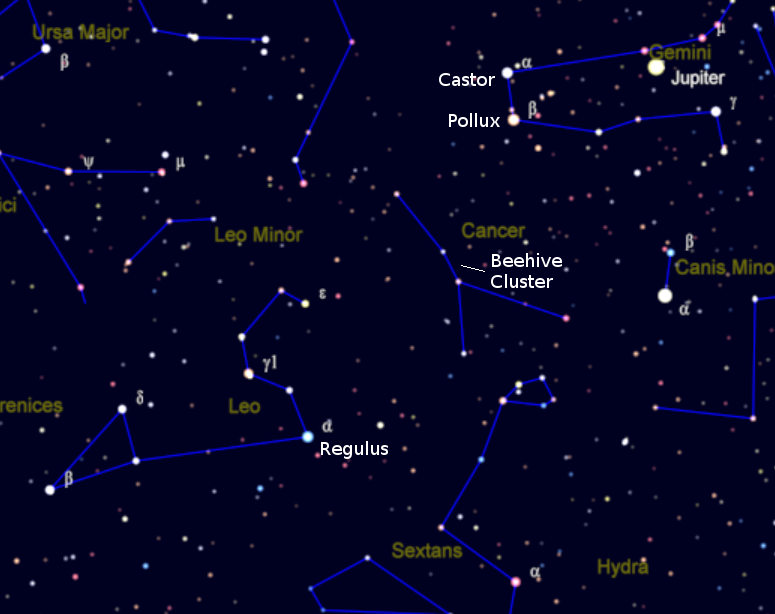
The constellation Cancer the crab at 9 p.m. March 3, 2014. Created using Cartes du Ciel (Skycharts).
The Beehive star cluster, M44. Its ancient name was the Praesepe or manger when glimpsed by the naked eye. Created using Cartes du Ciel (Skycharts)
04/19/2012 – Ephemeris – Stories of Leo the lion
Ephemeris for Thursday, April 19th. The sun rises at 6:50. It’ll be up for 13 hours and 42 minutes, setting at 8:32. The moon, 2 days before new, will rise at 6:13 tomorrow morning.
The constellation of Leo the lion is seen in the south at 10 p.m. Mars lies on its underside just left of Leo’s brightest star Regulus. Regulus lies at the bottom of a backwards question mark of stars that are his head and mane. To the left beyond Mars is a triangle of stars that are his haunches. As the lion is the kink of beasts it is fitting that its brightest star Regulus means “Little King Star”. It was thought in ancient Egypt that the heat of summer, when the sun was in Leo drove the lions to drink the waters of the Nile. The lion was also the symbol of the Israelite tribe of Judah, from Jacob’s prophesy in Genesis, and may have played a part in the origin of the Star of Bethlehem. One Egyptian philosopher thought the sun was in Leo at the creation of the world.
* Times are for the Traverse City/Interlochen area of Michigan. They may be different for your location.
Addendum
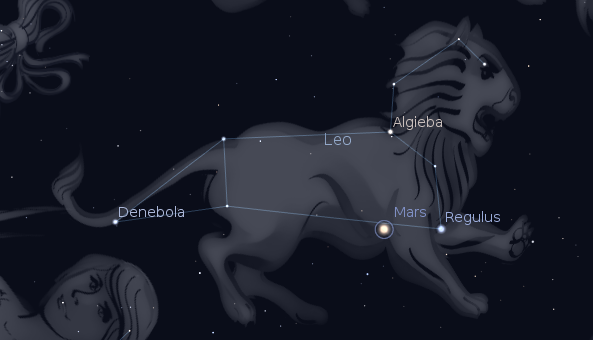
Leo and Mars at 10 p.m. on April 19, 2012 Created using Stellarium.
03/22/2012 – Ephemeris – Leo the lion and Mars
Ephemeris for Thursday, March 22nd. The sun will rise at 7:41. It’ll be up for 12 hours and 17 minutes, setting at 7:58. The moon is new today, and won’t be visible.
One of the great constellations of spring is up in the southeastern sky. This month Leo can be found by the bright planet Mars which adds a bright red star to the constellation. The head and mane of this beast is a backward question mark. It’s also known as the sickle. The bright star Regulus is at the bottom of this figure. It is now dimmer than Mars. To the east or left of Regulus and Mars is the triangle of stars that is his rump. The lion is special for several ancient cultures. Another way to find him when Mars isn’t around is to use the Bug Dipper, now soaring high in the northeast. Drill a hole in the bottom of the bowl of the dipper and imagine the water flowing out to the south and it will fall on the back of Leo the lion.
* Times are for the Traverse City/Interlochen area of Michigan. They may be different for your location.
Addendum
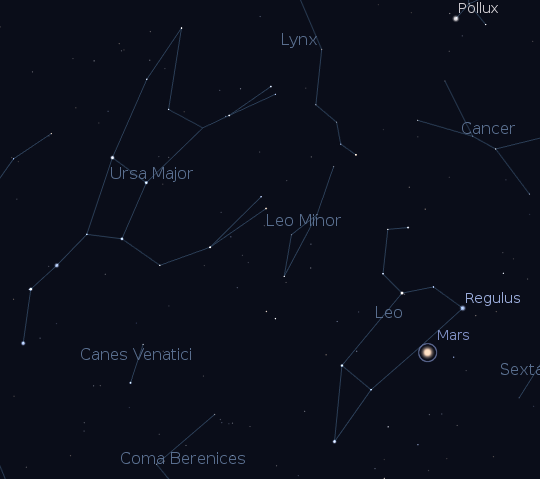
Mars and the constellation of Leo the lion March 22, 2012. Created using Stellarium.
 Bob Moler's Ephemeris Blog