Archive
Ephemeris: 6/24/2025 – Lyra, the heavenly harp
This is Ephemeris for Tuesday, June 24th. Today the Sun will be up for 15 hours and 34 minutes, setting at 9:32, and it will rise tomorrow at 5:58. The Moon, 1 day before new, will rise at 5:36 tomorrow morning.
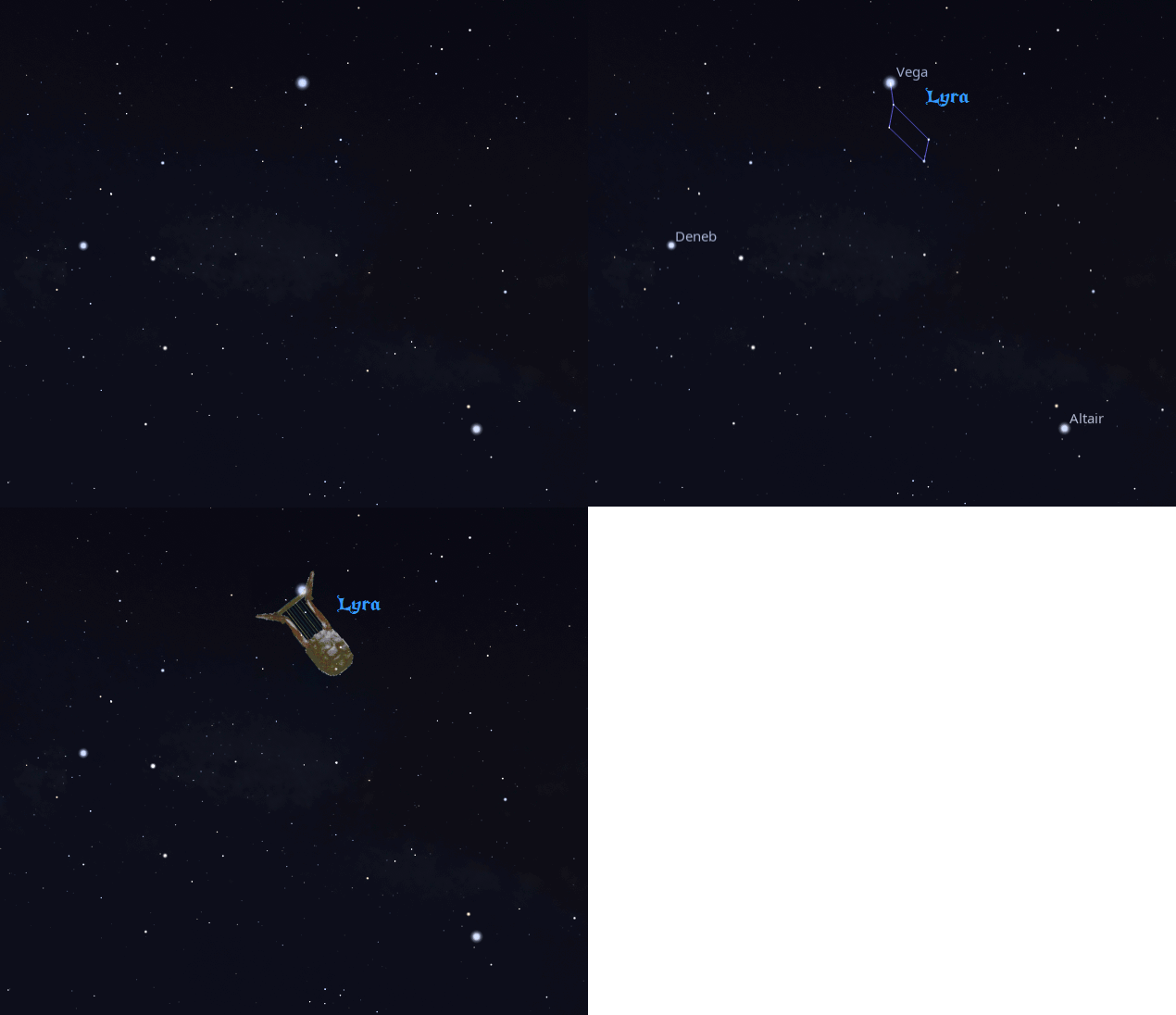
Fairly high in the east at 11 p.m. can be found a bright star just above a small, narrow, but very distinctive parallelogram of stars. They are the stars of the constellation Lyra the harp. The bright star is Vega, the 5th brightest nighttime star. To the Romans, the star Vega represented a falling eagle or vulture. Apparently they never made the distinction between the two species. It is a pure white star and serves as a calibration star for color and brightness. In the evening, it is the top-most star of the Summer Triangle. The harp, according to Greek mythology, was invented by the god Hermes. The form of the harp, in the sky, is as he had invented it: by stretching strings across a tortoise shell. Hermes gave it to his half-brother Apollo, who in turn gave it to the legendary musician Orpheus.
The astronomical event times given in this blog are for the Traverse City/Interlochen area of Michigan (Lat 44.7° N, Long 85.7° W; EDT, UT – 4 hours) unless stated otherwise. Times will be different for other locations.
Addendum
04/21/2023 – Ephemeris – The first major meteor shower of spring reaches peak this weekend
This is Ephemeris for Friday, April 21st. Today the Sun will be up for 13 hours and 46 minutes, setting at 8:35, and it will rise tomorrow at 6:47. The Moon, 1 day past new, will set at 10:44 this evening.
Saturday night and Sunday morning will see the peak of the Lyrid meteor shower. This is the first of two major meteor showers of spring. The other one in two weeks will have to compete with a full Moon. This meteor shower will be visible all night. At the end of twilight the radiant of the shower, where the meteors will seem to come from, will be low in the northeast, to the right of the bright star Vega in the constellation of Lyra the harp, for which the meteor shower is named. The radiant point is actually between the constellations of Lyra and Hercules. Only 15 to 20 meteors an hour will be expected when the radiant is nearly overhead as morning twilight starts in the 5 am hour. The most famous meteor shower, for us, is the Perseids of August reaching peak on the morning of the 13th of August which will be seen in dark skies for most of the night.
The astronomical event times given are for the Traverse City/Interlochen area of Michigan (EST, UT –4 hours). They may be different for your location.
Addendum
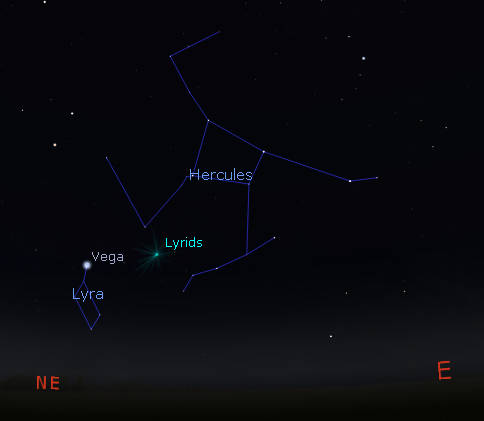
Lyrid radiant at 11 pm, looking to the east-northeast. The meteors will be seen all over the sky, but their tracks can be traced back to the radiant point, like the parallel rails of a train track recede to a point in the distance. Created using Stellarium.
07/17/2015 – Ephemeris – The constellation of the harp now and Venus and the Moon tomorrow night.
Ephemeris for Friday, July 17th. Today the Sun will be up for 15 hours and 11 minutes, setting at 9:24. The Moon, 2 days past new, will set at 10:07 this evening, and tomorrow the Sun will rise at 6:14.
High in the east at 11 p.m. can be found a bright star just above a small, narrow, but very distinctive parallelogram of stars. They are the stars of the constellation Lyra the harp. The bright star is Vega, one of the twenty one brightest stars, called first magnitude stars. Vega is actually the 5th brightest night time star. The harp, according to Greek mythology, was invented by the god Hermes. The form of the harp in the sky, is as he had invented it: by stretching strings across a tortoise-shell. Hermes gave it to his half-brother Apollo, who in turn gave it to the great musician Orpheus.
Looking westward tomorrow night the planet Venus will appear about 2 moon widths above the crescent Moon.
Times are for the Traverse City/Interlochen area of Michigan. They may be different for your location.
Addendum
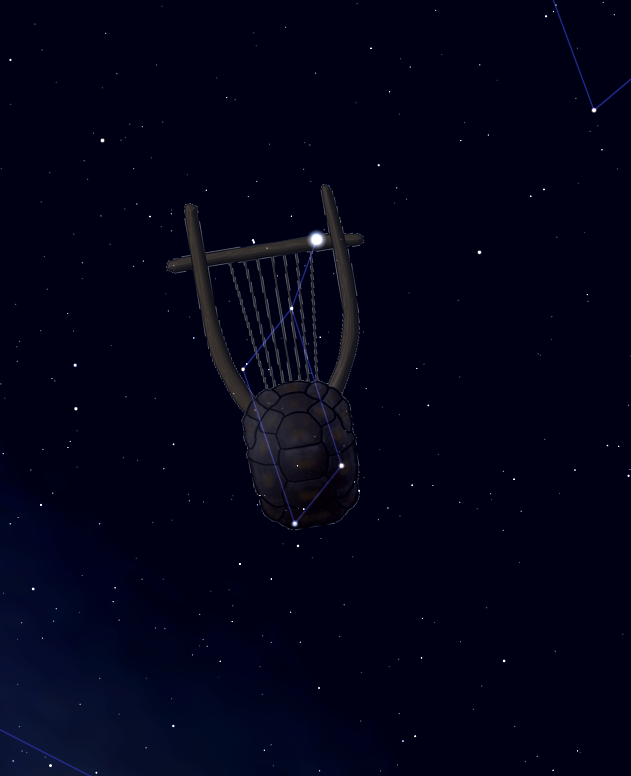
Lyra as a tortoise-shell harp. Created using Stellarium and free clip art.
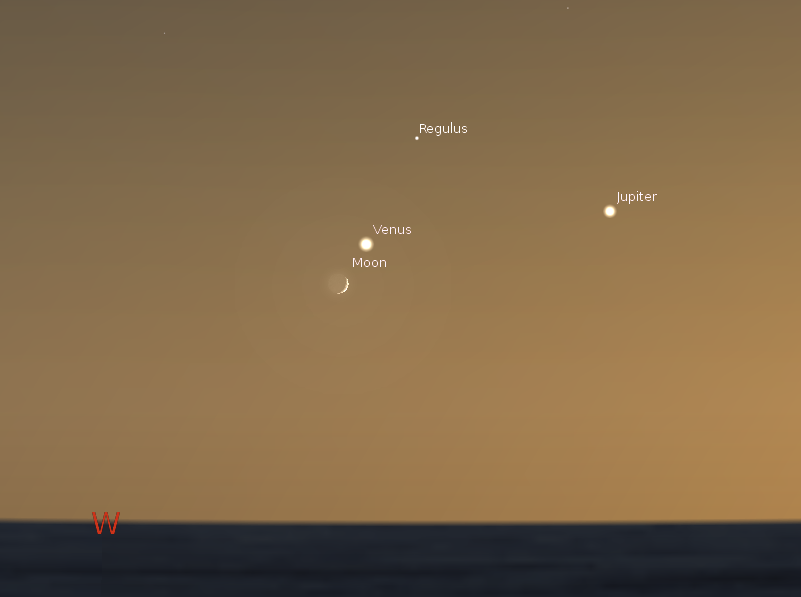
Venus appears above the thin crescent moon with Jupiter to the right at 10 p.m. Saturday July 18, 2015. Created using Stellarium.
 Bob Moler's Ephemeris Blog