Archive
12/21/2022 – Ephemeris – Winter starts today plus our weekly look at the bright planets
This is Bob Moler with Ephemeris for Wednesday, December 21st. Today the Sun will be up for 8 hours and 48 minutes, setting at 5:05, and it will rise tomorrow at 8:17. The Moon, 2 days before new, will rise at 7:41 tomorrow morning.
Winter begins today at 4:48 pm, just before sunset, from then on until next June the 21st, the Sun, being its farthest south in our skies, will be heading northward again. Let’s see where the naked-eye planets have wandered off to this week. Mars, Jupiter and Saturn will be visible this evening, in the east to southwestern sky at 6 pm. Jupiter is the brightest of the three in the south-southeast, while dimmer Saturn is low in the south-southwest at that hour. Mars is above Orion in the east. Saturn, the westernmost of the bright planets, will set around 9:16 this evening. Venus and Mercury are also in the evening sky, but too close to the setting Sun to be easily spotted. At 6 pm, both will be very low on the southwestern horizon.
The astronomical event times given are for the Traverse City/Interlochen area of Michigan (EST, UT –5 hours). They may be different for your location.
Addenda
Winter solstice today
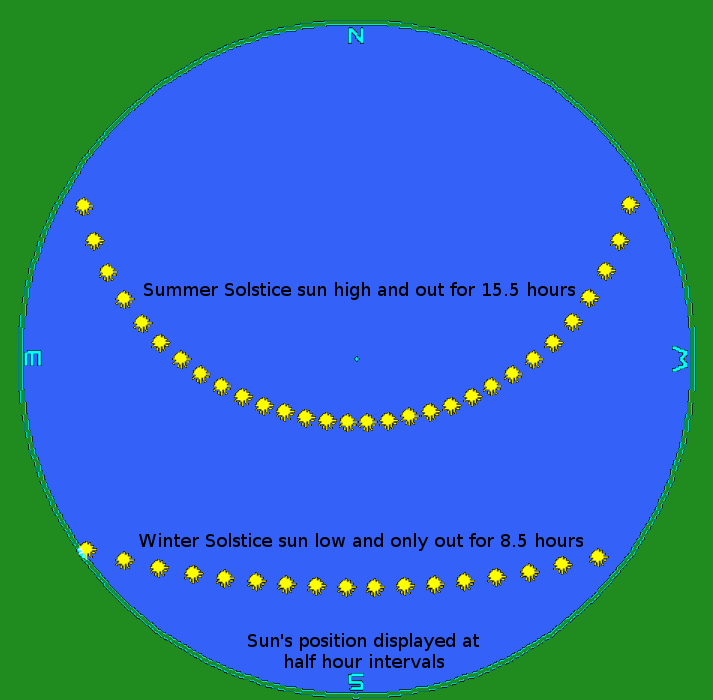
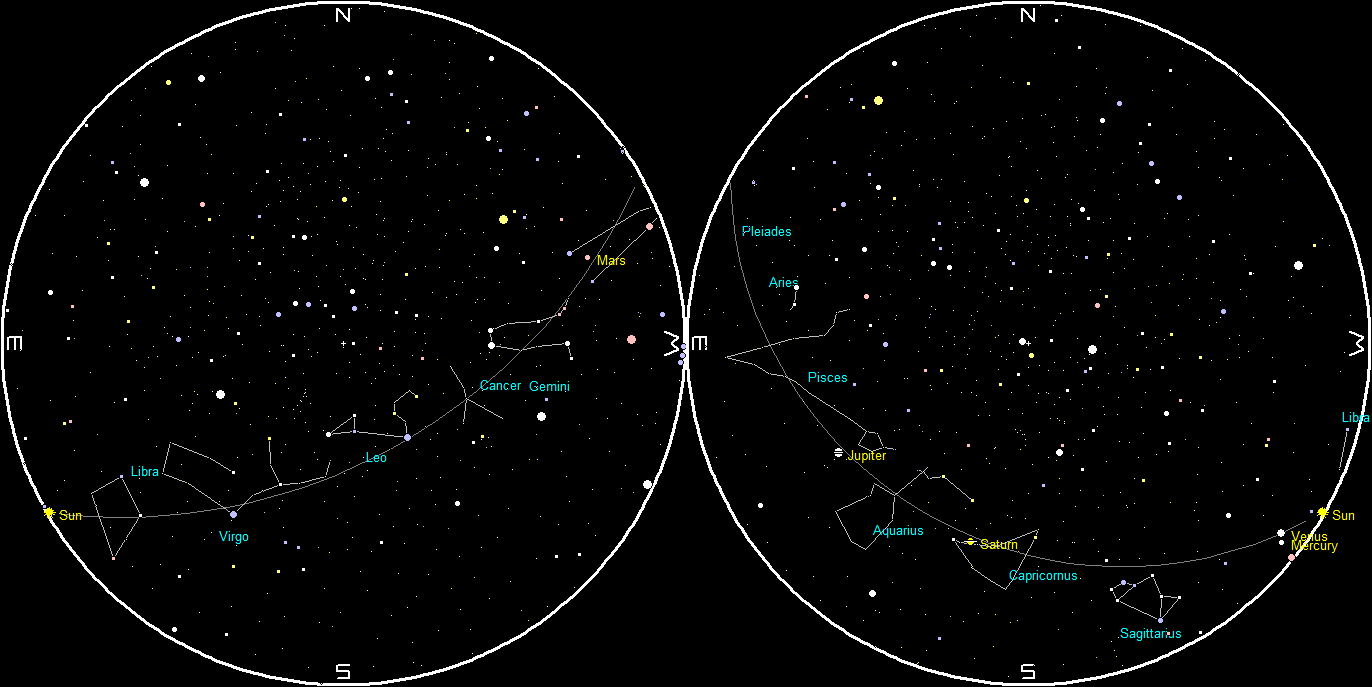
Comparing the sun’s path at the summer and winter solstices. This is a stereographic representation of the whole sky, which distorts the sky and magnifies the size of the sun’s path near the horizon. This chart is for Traverse City, Michigan, about a third of a degree south of 45º north latitude. Created using my LookingUp app.
The bright planets this week
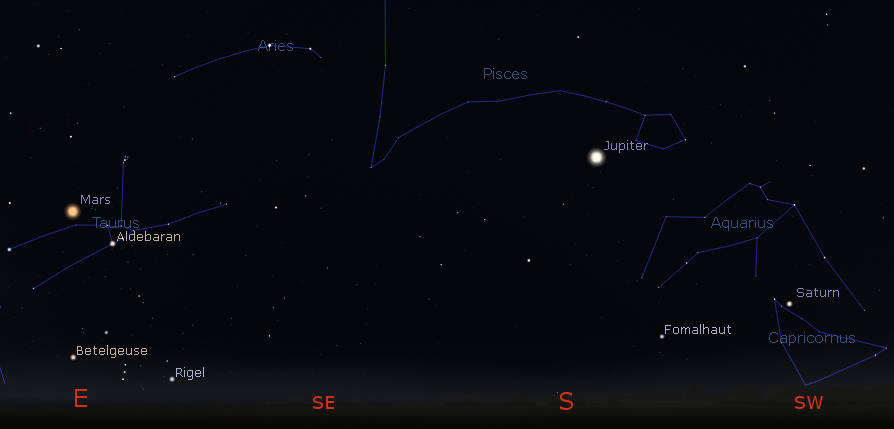
Panoramic view of planets this evening at 7 pm, December 21, 2022. Click on the image to enlarge it. Created using Stellarium.
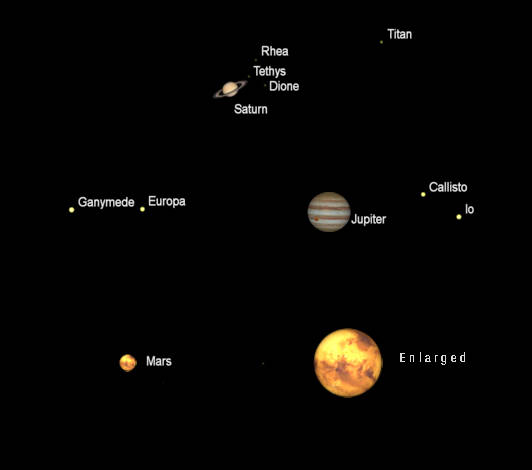
Telescopic views of Saturn Jupiter and Mars (north up) as they would be seen in a small telescope, with the same magnification. The image of Mars doesn’t show it, but the white north polar cap will appear at the top or north limb of Mars. The planets are shown at 7 pm tonight, December 21, 2022. Apparent diameters: Saturn 15.95″, its rings 37.15″; Jupiter 40.64″. Mars 15.92″. Mars’ distance is 54.6 million miles (88.0 million kilometers). The ” symbol means seconds of arc (1/3600th of a degree.) Click on the image to enlarge it. Created using Cartes du Ciel (Sky Charts).
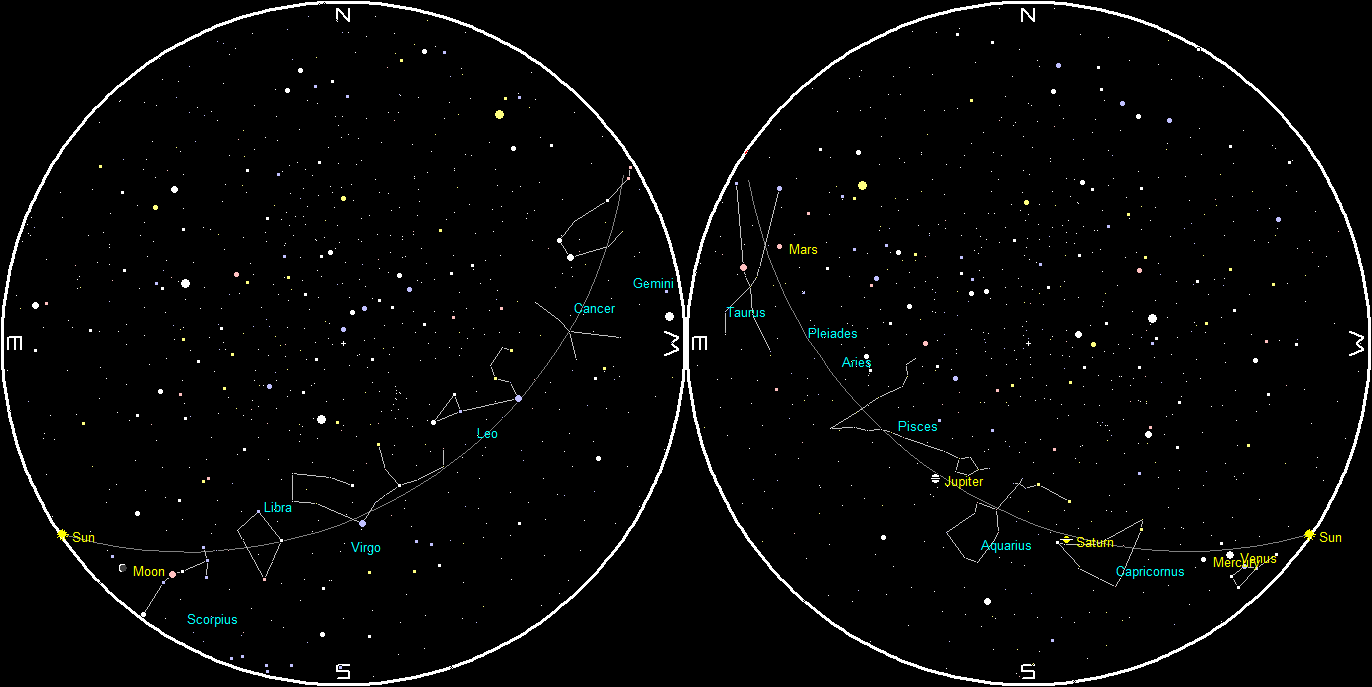
The naked-eye planets and the Moon at sunset and sunrise on a single night, starting with sunset on the right on December 21, 2022. The night ends on the left with sunrise on the 22nd. Click on the image to enlarge it. Created using my LookingUp app and GIMP.
12/14/2022 – Ephemeris – Let’s see where the naked-eye planets have wandered off to this week, and a second look at the Geminid meteor shower near its peak
This is Ephemeris for Wednesday, December 14th. Today the Sun will be up for 8 hours and 50 minutes, setting at 5:02, and it will rise tomorrow at 8:13. The Moon, 2 days before last quarter, will rise at 11:10 this evening.
Let’s see where the naked-eye planets have wandered off to this week. The Geminid meteor shower will be near peak again this evening, and the Moon will not interfere with it until just after 11 pm. The meteors will appear all over the sky, but will be seen to come from the constellation Gemini, high above Orion the hunter. Mars, Jupiter and Saturn will be visible from east to south-southwest this evening by 6 pm. Jupiter is the brightest of the three in the southeast, while dimmer Saturn is in the south-southwest at that hour. Mars will end up being above and to the right of Orion later on this evening. They will be shifting westward throughout the evening. Saturn, the westernmost of the bright planets, will set around 9:41 this evening. Venus and Mercury are also in the evening sky, but too close to the setting Sun to be easily spotted.
The astronomical event times given are for the Traverse City/Interlochen area of Michigan (EST, UT –5 hours). They may be different for your location.
Addendum
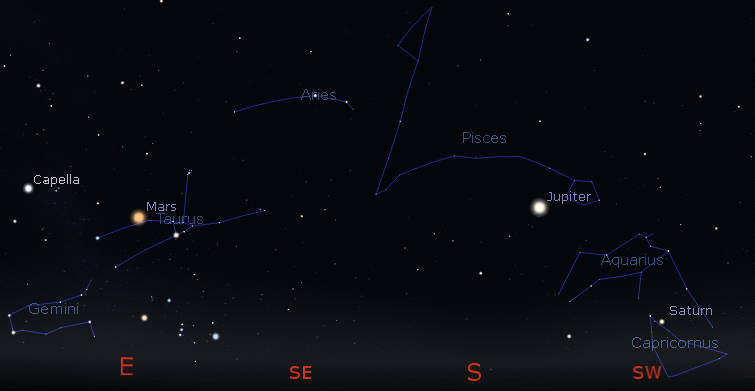
Evening planets at 8 pm in this panorama from east to southwest with the zodiacal constellations. Click on the image to enlarge. Created using Stellarium.
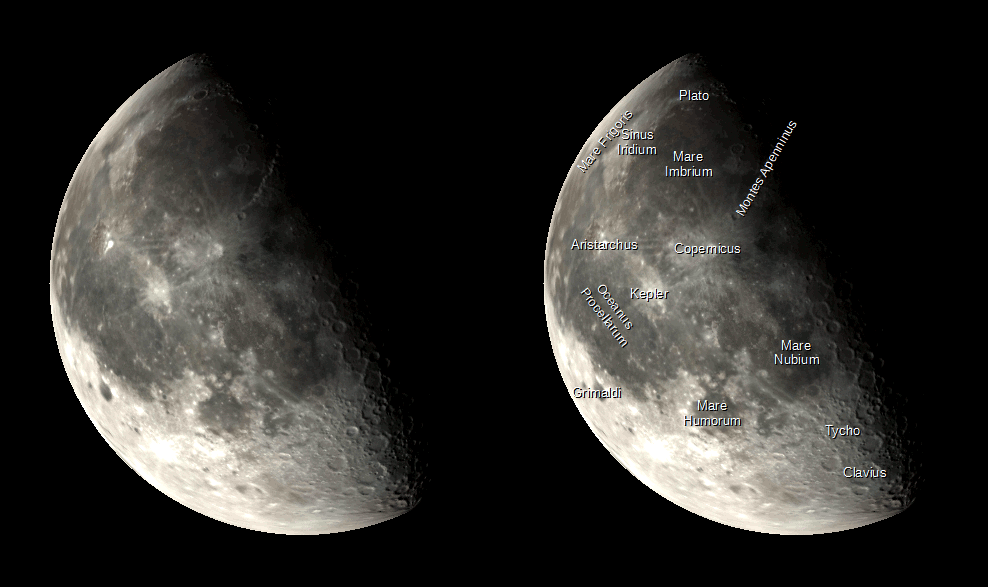
The waning gibbous Moon in as it might look like in binoculars or a telescope at low power at 6 am, Thursday, December 15, 2022. Created using Stellarium, LibreOffice Draw and GIMP.
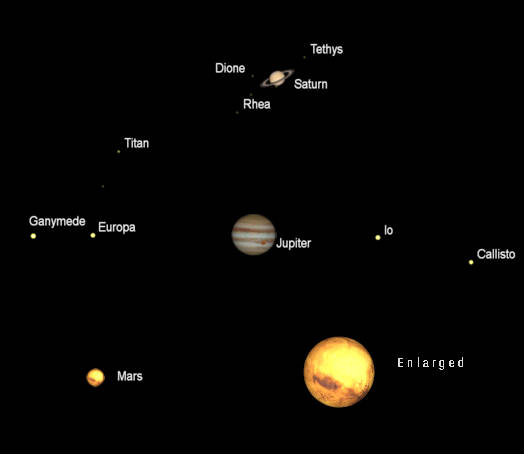
Telescopic views of Saturn Jupiter and Mars (north up) as they would be seen in a small telescope, with the same magnification. The image of Mars doesn’t show it, but the white north polar cap will appear at the top or north limb of Mars. The planets are shown at 8 pm tonight, December 14, 2022. Apparent diameters: Saturn 16.09″, its rings 37.49″; Jupiter 41.58″. Mars 16.61″. Mars’ distance is 52.4 million miles (84.4 million kilometers). The ” symbol means seconds of arc (1/3600th of a degree.) Click on the image to enlarge it. Created using Cartes du Ciel (Sky Charts).
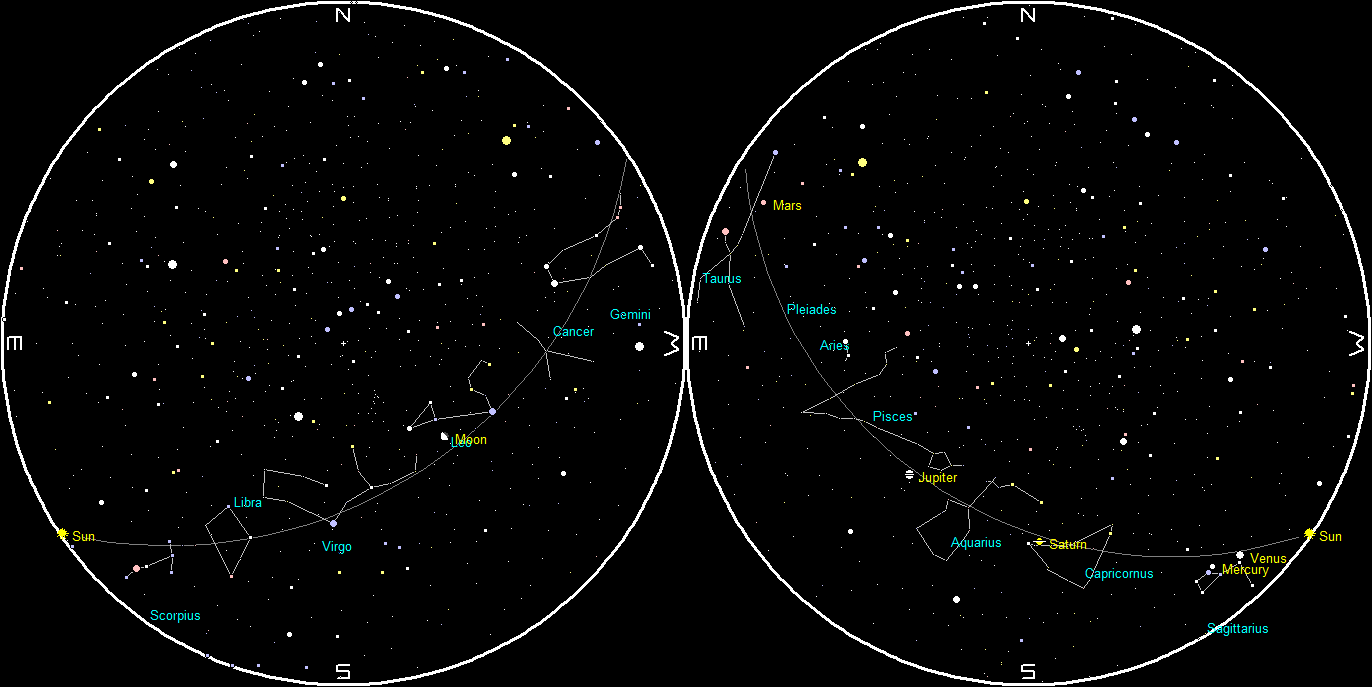
The naked-eye planets and the Moon at sunset and sunrise on a single night, starting with sunset on the right on December 14, 2022. The night ends on the left with sunrise on the 15th. Click on the image to enlarge it. Created using my LookingUp app and GIMP.
12/07/2022 – Ephemeris – An occultation of Mars and a look at the other naked eye planets.
This is Bob Moler with Ephemeris for Wednesday, December 7th. Today the Sun will be up for 8 hours and 55 minutes, setting at 5:02, and it will rise tomorrow at 8:07. The Moon, at full today, will rise at 4:31 this evening.
Let’s see where the naked-eye planets have wandered off to this week. Mars, Jupiter and Saturn will be visible this evening, in the southeastern sky by 6 pm. At that time, Mars will be below, left of the bright full Moon. Jupiter is the brightest of the three in the southeast, while dimmer Saturn is in the south-southeast at that hour. Mars will be hidden behind the Moon from about 10:15 to 11:15 pm tonight for the IPR area. Being a full moon, Mars might be difficult to spot. It may take binoculars to spot it below, left of the Moon by 9:30, and a small telescope when Mars is near the edge of the Moon. The disappearance of Mars will be at the Moon’s 7 o’clock position, and reappearance at the 4 o’clock position. Bobmoler.wordpress.com (you are already here) has more information.
The astronomical event times given are for the Traverse City/Interlochen area of Michigan (EST, UT –5 hours). They may be different for your location.
Addendum
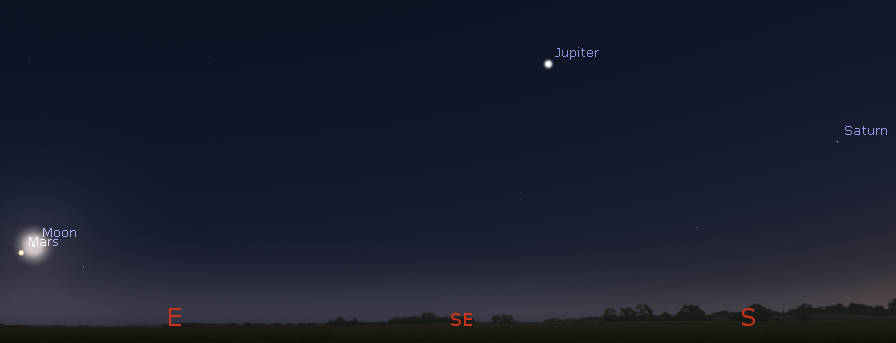
Panoramic view of planets and Moon this evening at 7 pm tonight, December 7, 2022. Click on the image to enlarge it. Created using Stellarium.
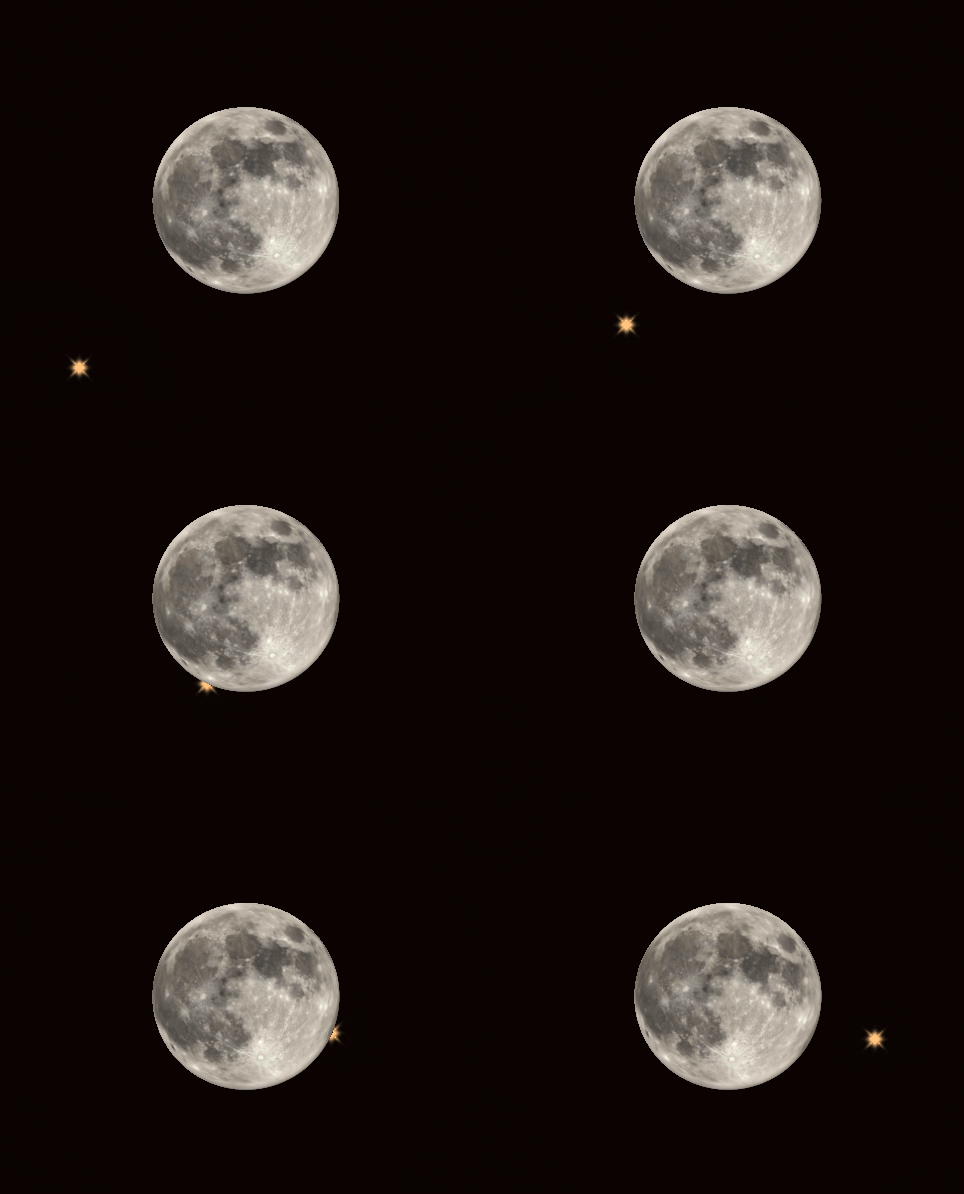
Mars occultation animation in half hour steps for 9:15 pm, 9:45 pm, 10:15 pm (Ingress), 10:45 pm (mid-occultation), 11:15 pm (egress), 11:45 pm. The Moon and the apparent path of Mars rotates as they cross the sky from east to west. In actuality, the Moon is much brighter than Mars, so picking the planet out tonight will be a challenge. It will take the Moon almost a minute to completely cover Mars, and nearly another minute to uncover it. The plot is centered on the Moon here, but the Moon provides most of the motion here. On average, the Moon moves 12 degrees a day, while Mars moves less than a degree against the starry background. Created using Stellarium and GIMP.
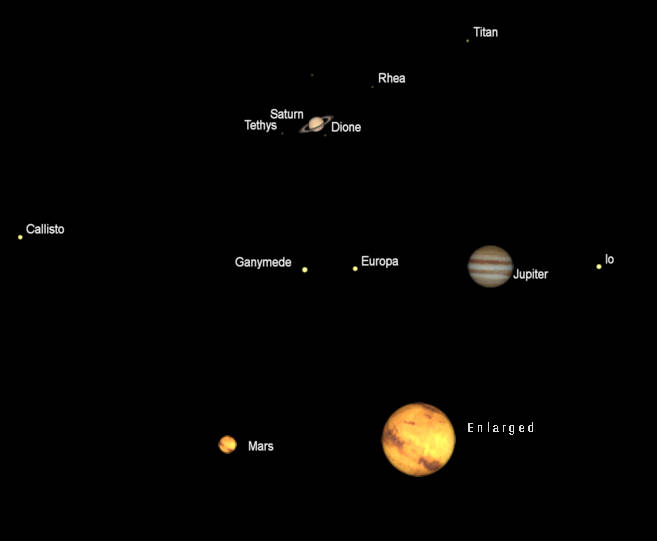
Telescopic views of Saturn Jupiter and Mars (north up) as they would be seen in a small telescope, with the same magnification. The image of Mars doesn’t show it, but the white north polar cap will appear at the top or north limb of Mars. The planets are shown at 8 pm tonight, December 7, 2022. Apparent diameters: Saturn 16.25″, its rings 37.86″; Jupiter 42.55″. Mars 17.05″. Mars’ distance is 51.0 million miles (82.1 million kilometers). This is the closest it comes to the Earth this orbit. The ” symbol means seconds of arc (1/3600th of a degree.) Click on the image to enlarge it. Created using Cartes du Ciel (Sky Charts).
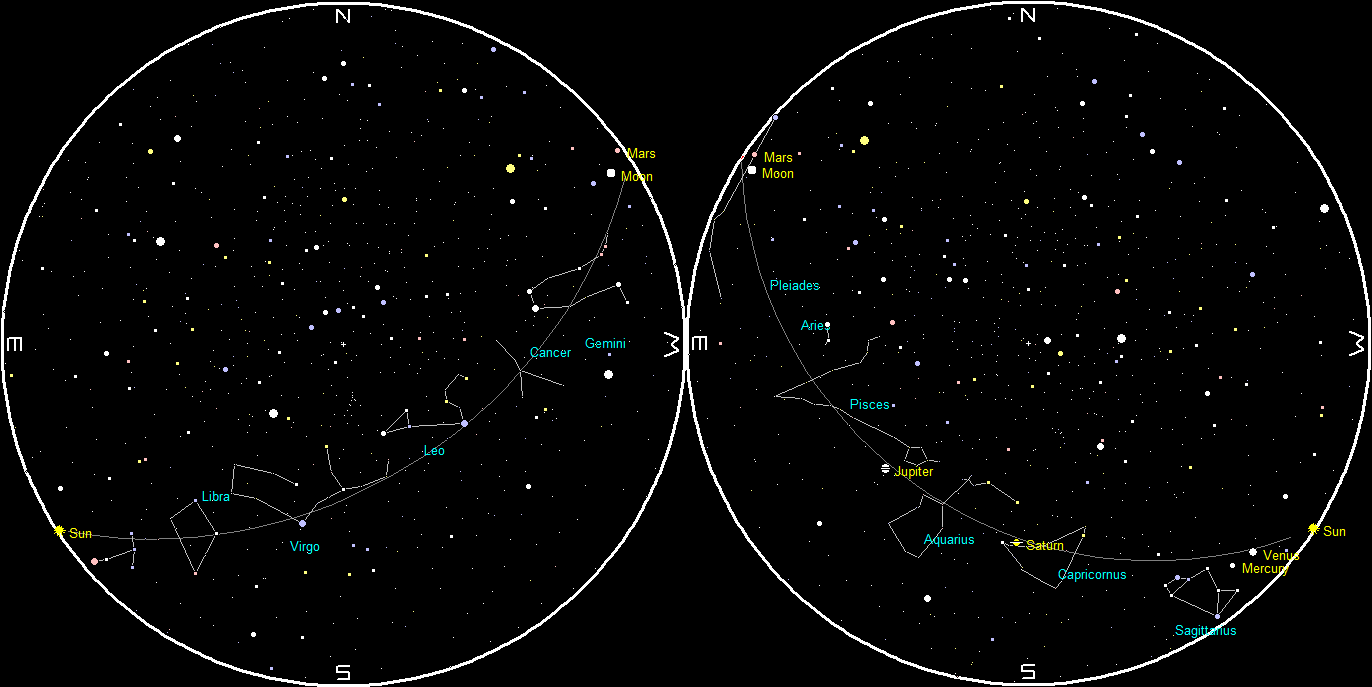
The naked-eye planets and the Moon at sunset and sunrise on a single night, starting with sunset on the right on December 7, 2022. The night ends on the left with sunrise on the 8th. Click on the image to enlarge it. Created using my LookingUp app and GIMP.
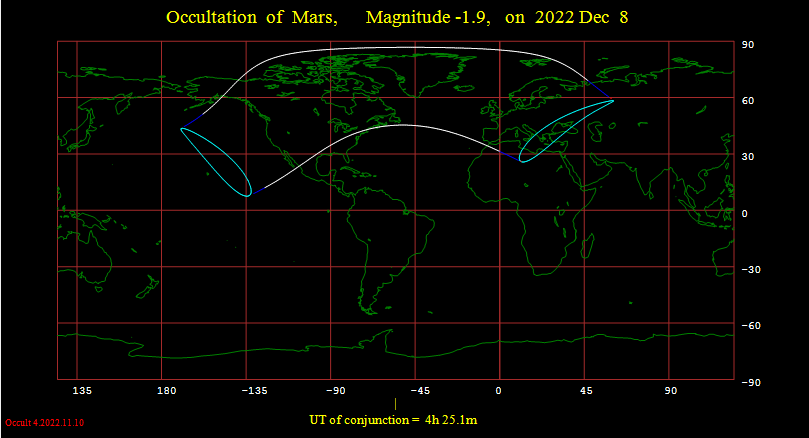
World map showing the area that the occultation of Mars will be visible. Occultation visibility will move from west to east. Credit: Occult version 4. This evening in the EST zone is the 8th for Universal Time (UT), or GMT (Greenwich Mean Time) if you’re older.
11/30/2022 – Ephemeris – Let’s see where the naked-eye planets have wandered off to this week
This is Bob Moler with Ephemeris for Wednesday, November 30th. Today the Sun will be up for 9 hours and 5 minutes, setting at 5:04, and it will rise tomorrow at 7:59. The Moon, at first quarter today, will set at 12:44 tomorrow morning.
Let’s see where the naked-eye planets have wandered off to this week. Jupiter and Saturn will be visible this evening, in the southeastern sky, by 6 pm. Jupiter is the brighter of the two to the left, in the southeast, while dimmer Saturn is in the south at that hour. The Moon will be between them. The red planet Mars, though a morning planet for six more days, will be seen low on the east-northeast horizon at that hour. It’s located between the long horns of Taurus the bull. Mars is moving westward in its retrograde motion as the Earth will pass it a week from now. This evening, Mars will be as close as it can get to the Earth this close approach, 50.61 million miles (81.45 million kilometers). That same night, the full Moon will pass in front of it for an hour. So on the same night, in our area, we will have Mars opposition from the Sun and it being occulted by the Moon.
The astronomical event times given are for the Traverse City/Interlochen area of Michigan (EST, UT –5 hours). They may be different for your location.
Addendum
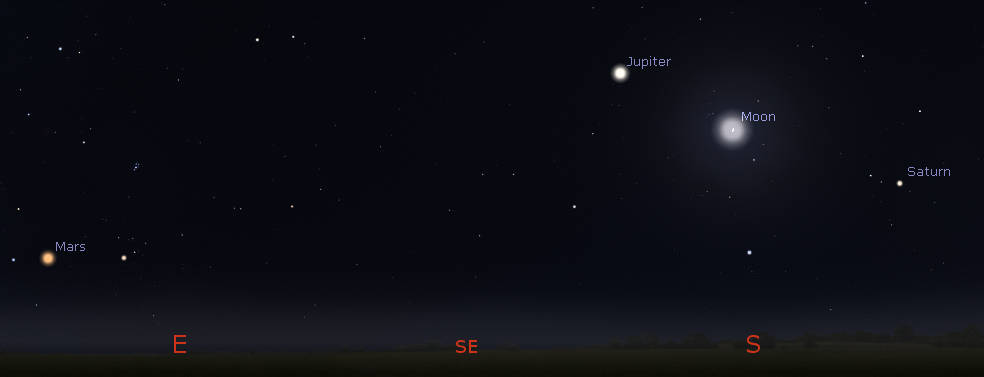
Panoramic view of planets and Moon this evening at 7 pm tonight, November 30, 2022. Click on the image to enlarge it. Created using Stellarium.
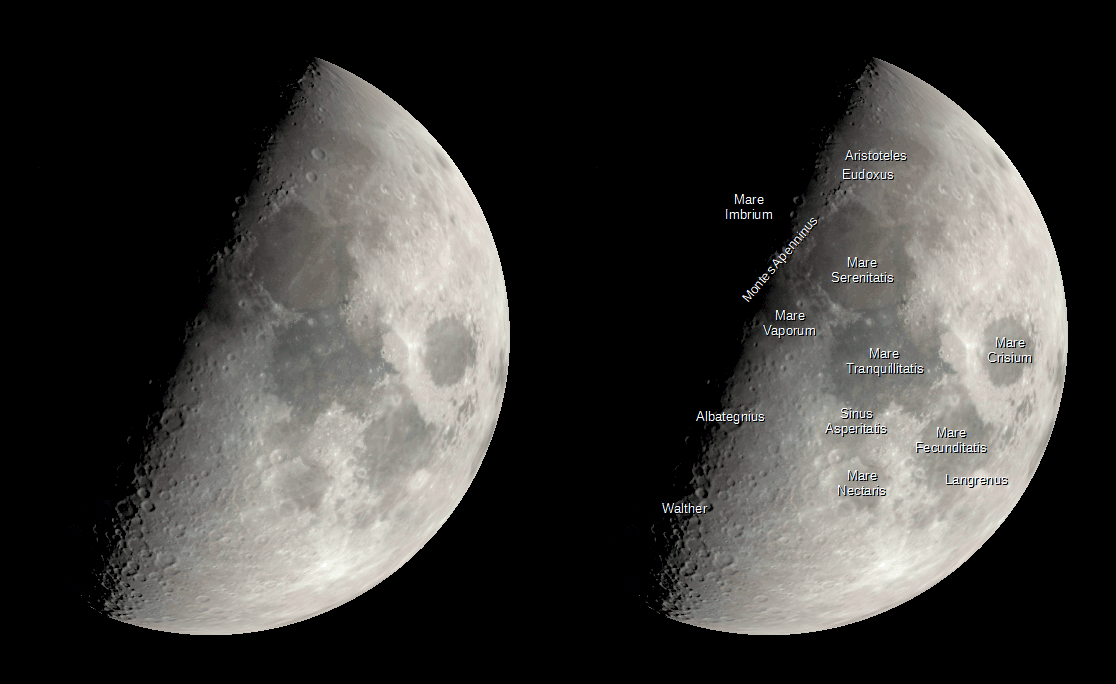
First Quarter Moon as it might be seen tonight in binoculars or low power telescope with labels for tonight, November 30, 2022. Created using Stellarium, LibreOffice Draw and GIMP.
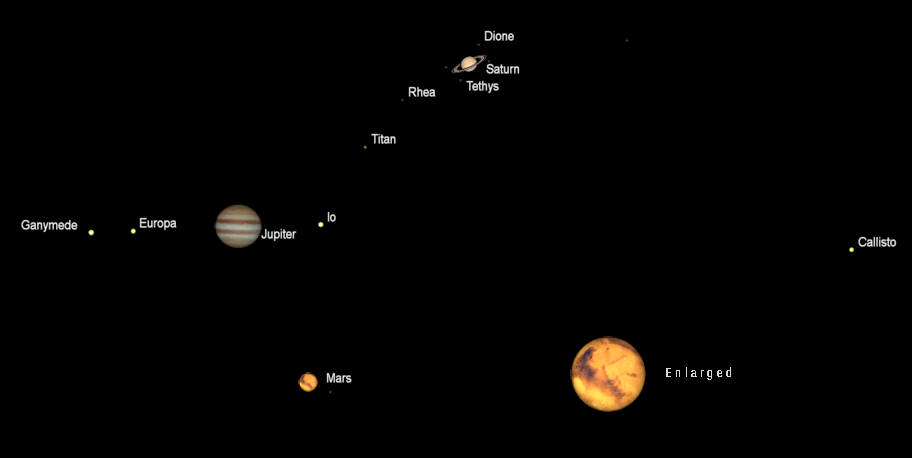
Telescopic views of Saturn Jupiter and Mars (north up) as they would be seen in a small telescope, with the same magnification. The image of Mars doesn’t show it, but the white north polar cap will appear at the top or north limb of Mars. The planets are shown at 8 pm tonight, November 30, 2022. Apparent diameters: Saturn 16.43″, its rings 38.26″; Jupiter 43.56″. Mars 17.20″. Mars’ distance is 50.5 million miles (81.4 million kilometers). This is the closest it comes to the Earth this orbit. The ” symbol means seconds of arc (1/3600th of a degree.) Click on the image to enlarge it. Created using Cartes du Ciel (Sky Charts).
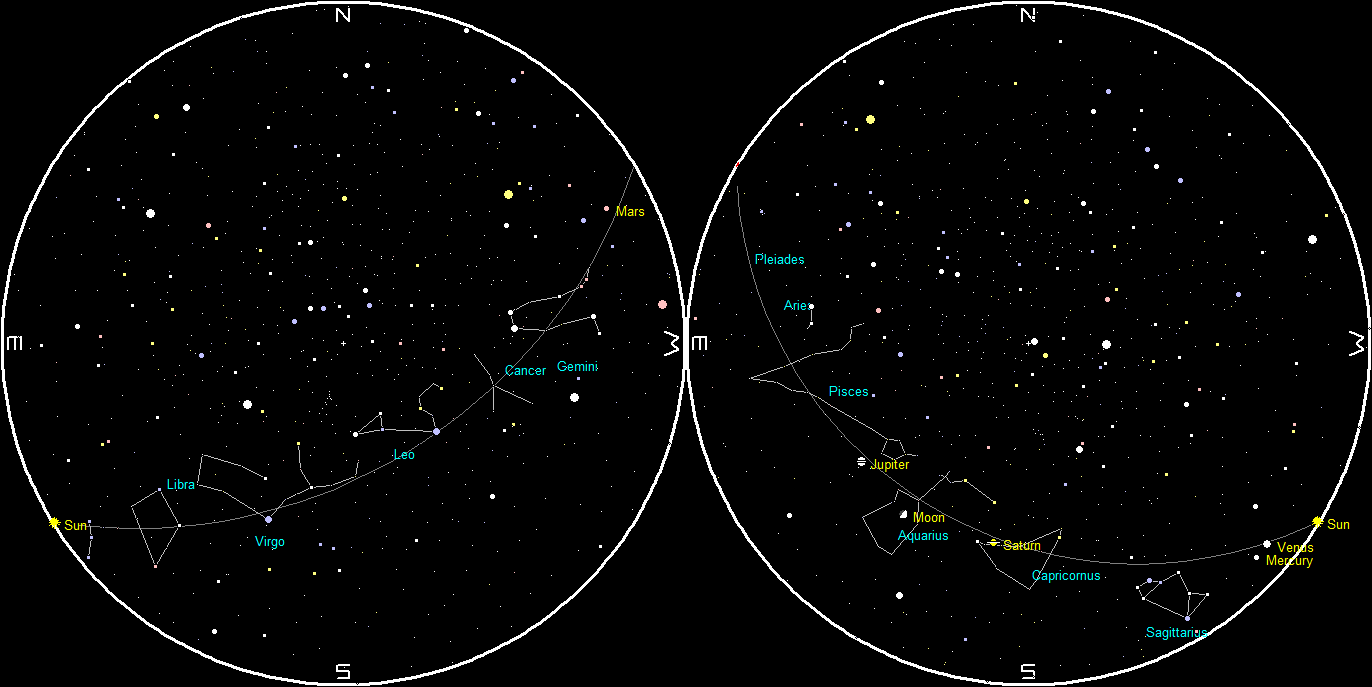
The naked-eye planets and the Moon at sunset and sunrise on a single night, starting with sunset on the right on November 30, 2022. The night ends on the left with sunrise on December 1st. Click on the image to enlarge it. Created using my LookingUp app and GIMP.
11/24/2022 – Ephemeris – Finding Auriga the charioteer
This is Bob Moler with Ephemeris for Thanksgiving Day, Thursday, November 24th. Today the Sun will be up for 9 hours and 15 minutes, setting at 5:07, and it will rise tomorrow at 7:52. The Moon, 1 day past new, will set at 5:31 this evening.
The constellation Auriga the charioteer is halfway up the sky in the east northeast at 9 p.m. It is a pentagon of stars, with the brilliant star Capella at the upper left of its corners. Capella represents a mama goat he’s carrying. A narrow triangle of stars just right of Capella are her kids, that is her baby goats. The Kids is an informal constellation or asterism. The Milky Way runs through Auriga, but it’s not very bright here. We are looking away from the center of the Milky Way to the more sparse outer parts of our galaxy. Within and near that pentagon, one can sweep with binoculars and low power telescopes to find several star clusters, groups of hundreds of stars born in the clump we still see them in. These star clusters will appear as fuzzy spots in binoculars.
The astronomical event times given are for the Traverse City/Interlochen area of Michigan (EST, UT –5 hours). They may be different for your location.
Addendum
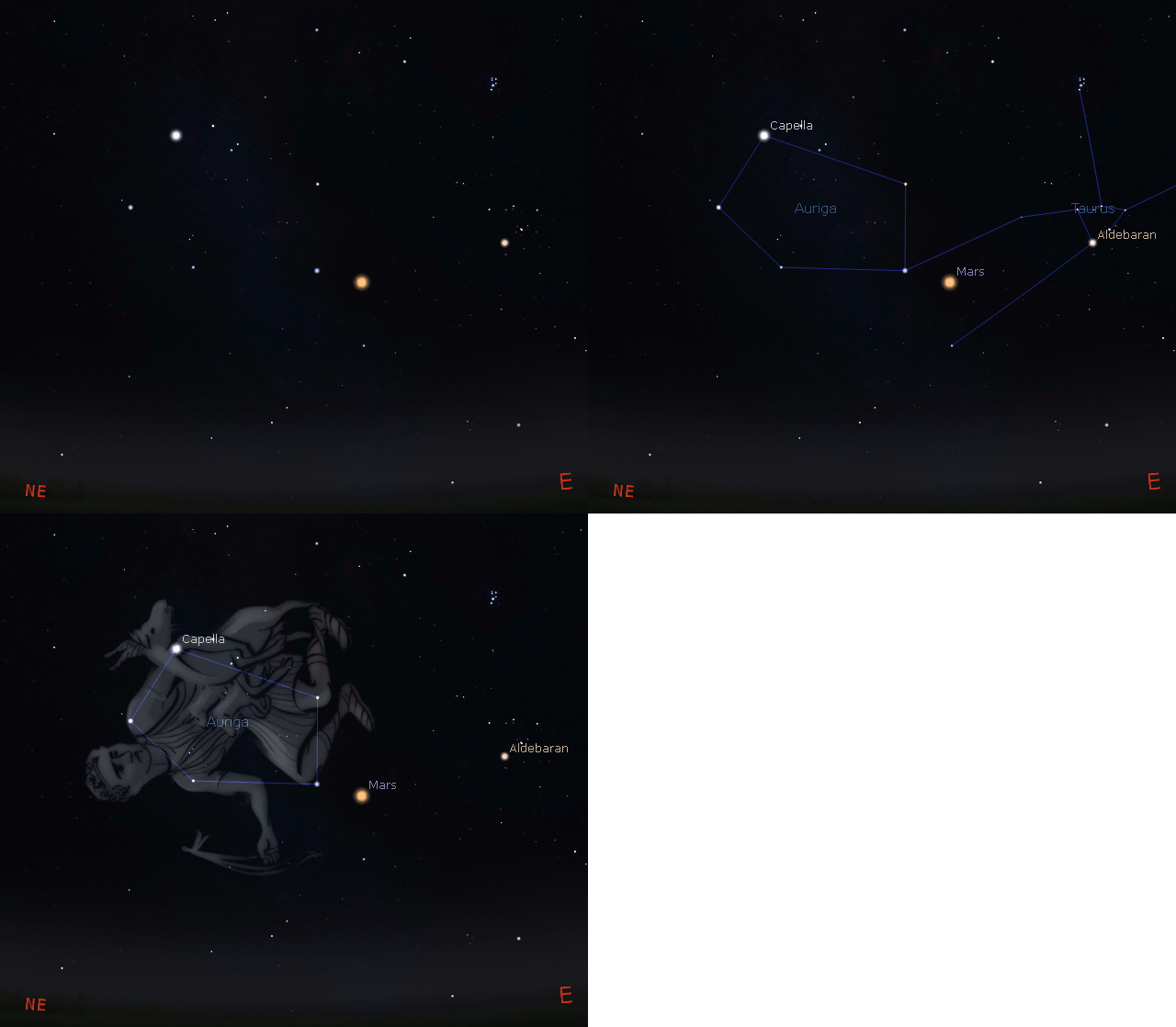
Auriga the charioteer finder animation. Mars is nearby between the horns of Taurus for the next week and a half as it works its way to the upper right. The Kids asterism is best seen in the frame without markings because the Capella label covers one of its stars. Created using Stellarium and GIMP.
11/23/2022 – Ephemeris – Let’s see where the naked-eye planets have wandered off to this week
This is Bob Moler with Ephemeris for Wednesday, November 23rd. Today the Sun will be up for 9 hours and 17 minutes, setting at 5:07, and it will rise tomorrow at 7:51. The Moon is new today, and won’t be visible.
Let’s see where the naked-eye planets have wandered off to this week. Jupiter and Saturn will be visible this evening, in the southeastern sky, as soon after sunset as it will be dark enough to see them, which would be by 6 pm. Jupiter is the brighter of the two to the left, in the southeast, while dimmer Saturn is in the south at that hour. The red planet Mars, though a morning planet, will rise tonight at 6:05 pm in the northeast. It’s located nearly between the tips of the long horns of Taurus the bull, but toward the letter V of stars that is the face of Taurus. Mars is moving westward in its retrograde motion as the Earth will pass it in a couple of weeks. Venus and Mercury, though in the evening sky, are too close to the Sun to be seen.
The astronomical event times given are for the Traverse City/Interlochen area of Michigan (EST, UT -5 hours). They may be different for your location.
Addendum
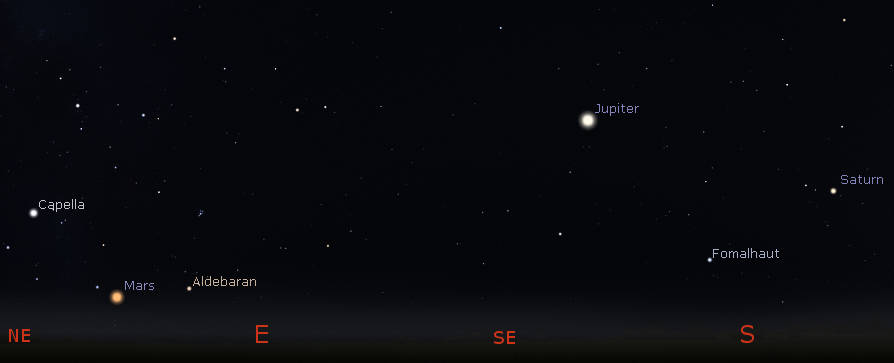
A panorama from northeast to southwest of the planets Mars, Jupiter and Saturn at 7 pm tonight, November 23, 2022. Click on the image to enlarge it. Created using Stellarium and GIMP.
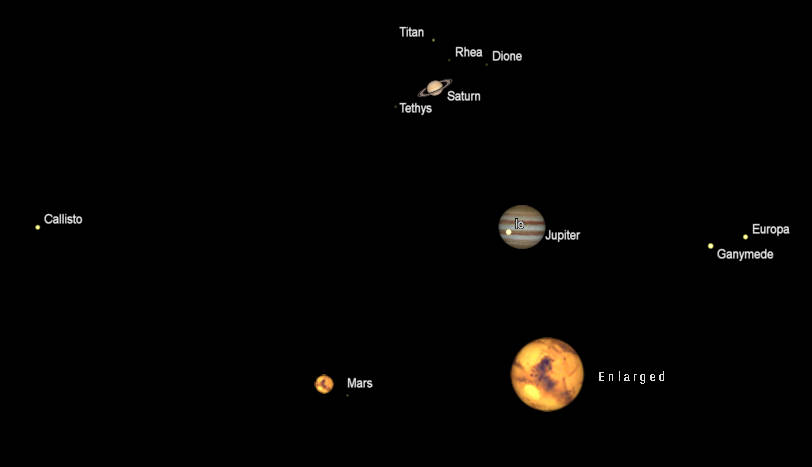
Telescopic views of Saturn Jupiter and Mars (north up) as they would be seen in a small telescope, with the same magnification. The image of Mars doesn’t show it, but the white north polar cap will appear at the top or north limb of Mars. The planets are shown at 7 pm on the 23rd. Apparent diameters: Saturn 16.61″, its rings 38.69″; Jupiter 44.57″. Mars 17.05″. Mars’ distance is 51.0 million miles (82.1 million kilometers). The ” symbol means seconds of arc (1/3600th of a degree.) Click on the image to enlarge it. Created using Cartes du Ciel (Sky Charts).
The naked-eye planets and the Moon at sunset and sunrise on a single night, starting with sunset on the right on November 23, 2022. The night ends on the left with sunrise on the 24th. Click on the image to enlarge it. Created using my LookingUp app and GIMP.
11/21/2022 – Ephemeris – The Pleiades or the Seven Sisters
This is Ephemeris for Monday, November 21st. Today the Sun will be up for 9 hours and 21 minutes, setting at 5:09, and it will rise tomorrow at 7:49. The Moon, 2 days before new, will rise at 6:10 tomorrow morning.
A marvelous member of the autumn skies can be found low in the east after 8 in the evening. It is the famous star cluster called the Pleiades or the Seven Sisters. I might also add the ‘Tiny Dipper’. Many people can spot a tiny dipper shape in its six or seven stars, and mistake it for the Little Dipper. With binoculars, one can see over a hundred stars appear, along with the dipper shape of the brightest. In photographs, the Pleiades actually contain wisps of the dust they are currently passing through. In Greek mythology, the sisters were daughters of the god Atlas. I’ll be revisiting the Pleiades several times this autumn, winter, and before they disappear in the west in evening twilight next spring.
The astronomical event times given are for the Traverse City/Interlochen area of Michigan (EST, UT – 5 hours). They may be different for your location.
Addendum
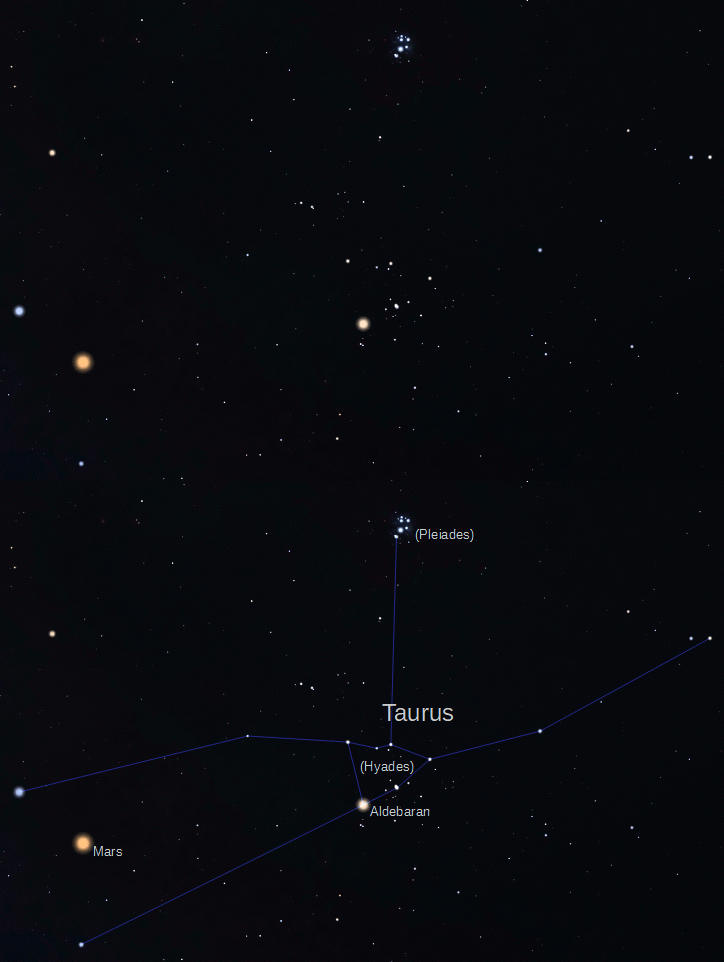
Pleiades finder animation for 8:30 pm tonight, November 21, 2022. Mars is the interloper this year, seen between the horns of Taurus the Bull. The V of stars that make up the face of Taurus the bull is a star cluster of stars called the Hyades. In Greek mythology, they are the half-sisters of the Pleiades. Created using Stellarium, LibreOffice Draw, and GIMP.
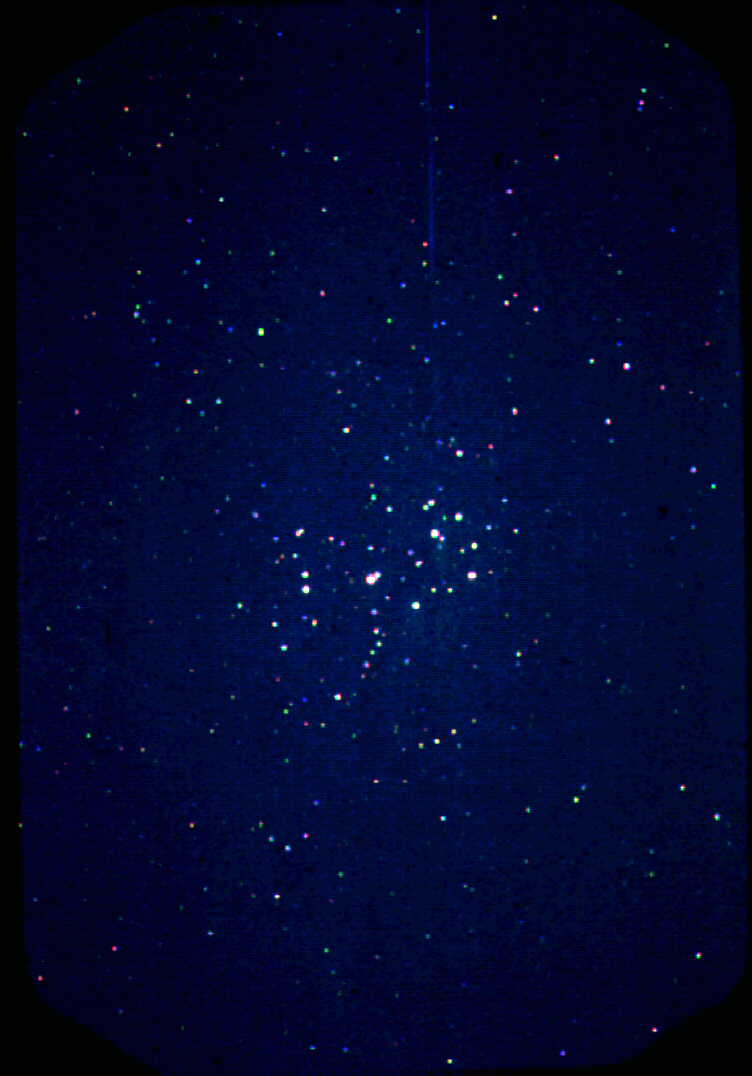
The Pleiades, about what you’d see in binoculars. To the naked eye, six or seven stars might be glimpsed. As star clusters go, it might seem small and unremarkable, but the Pleiades is nearby, and the brightest star cluster visible. Its stars are regarded by cultures around the world as female stars, generally sisters. Credit: Mine.
11/16/2022 – Ephemeris – Let’s see where the naked-eye planets have wandered off to this week
This is Bob Moler with Ephemeris for Wednesday, November 16th. Today the Sun will be up for 9 hours and 32 minutes, setting at 5:13, and it will rise tomorrow at 7:42. The Moon, at last quarter today, will rise at 12:19 tomorrow morning.
Let’s see where the naked-eye planets have wandered off to this week. Jupiter and Saturn will be visible this evening, in the southeastern sky, as soon after sunset as it will be dark enough to see them, which would be by 6 pm. Jupiter is the brighter of the two to the left, in the southeast, while dimmer Saturn is in the south. The red planet Mars, though a morning planet, will rise tonight at 6:43 pm in the east-northeast. It’s located between the tips of the long horns of Taurus the bull. Mars is beginning to move westward in its retrograde motion as the Earth is starting to pass it. Which it will do in three weeks time. Venus and Mercury, though in the evening sky, are too close to the Sun to be seen.
The astronomical event times given are for the Traverse City/Interlochen area of Michigan (EST, UT -5 hours). They may be different for your location.
Addendum
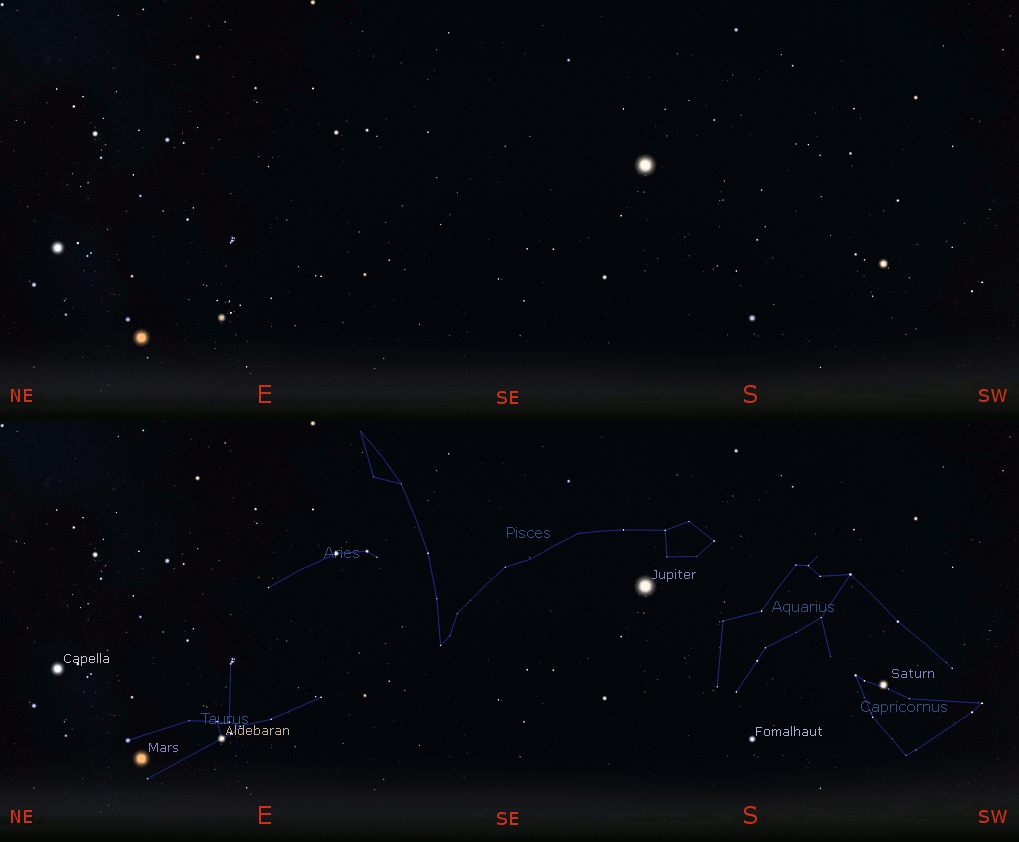
A panorama from northeast to southwest of planets and Zodiac constellations in the evening. Showing between just the sky and constellation lines and labels alternately. For tonight at 8 pm, November 16, 2022. Click on the image to enlarge it. Created using Stellarium and GIMP.
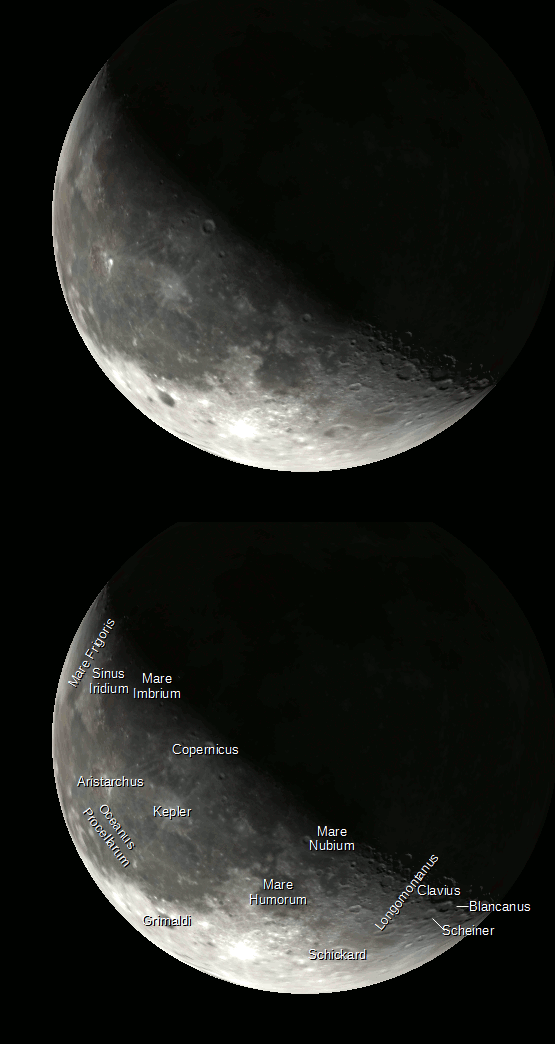
Fat waning crescent Moon with labels showing alternately for 6 am tomorrow, November 17, 2022. Labels are centered on their features, unless a pointer is used in congested areas. Created using Stellarium, LibreOffice Draw, and GIMP.
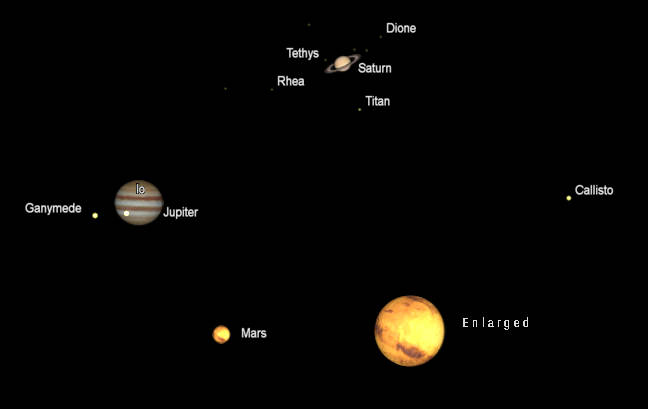
Telescopic views of Saturn Jupiter and Mars (north up) as they would be seen in a small telescope, with the same magnification. The image of Mars doesn’t show it, but the white north polar cap will appear at the top or north limb of Mars. Saturn and Jupiter are shown at 9 pm on the 16th, Mars at 6 am on the 17th. Apparent diameters: Saturn 16.80″, its rings 39.14″; Jupiter 45.55″. Mars 16.67″. Mars’ distance is 52.0 million miles (83.8 million kilometers). The ” symbol means seconds of arc (1/3600th of a degree.) Click on the image to enlarge it. Created using Cartes du Ciel (Sky Charts).
At 9 pm, only two of Jupiter’s moons will be visible next to the planet. They are Ganymede and Callisto. Io is behind the planet, while Europa is transiting the planet. In actuality, a transiting moon is very difficult to spot. However, its shadow crossing the planet is easier to spot. Europa’s shadow will start to cross the face of Jupiter at 11:42 pm EST, with Io popping out from Jupiter’s shadow 5 minutes later. The phenomena of Jupiter’s moons are printed each month in Sky and Telescope Magazine.
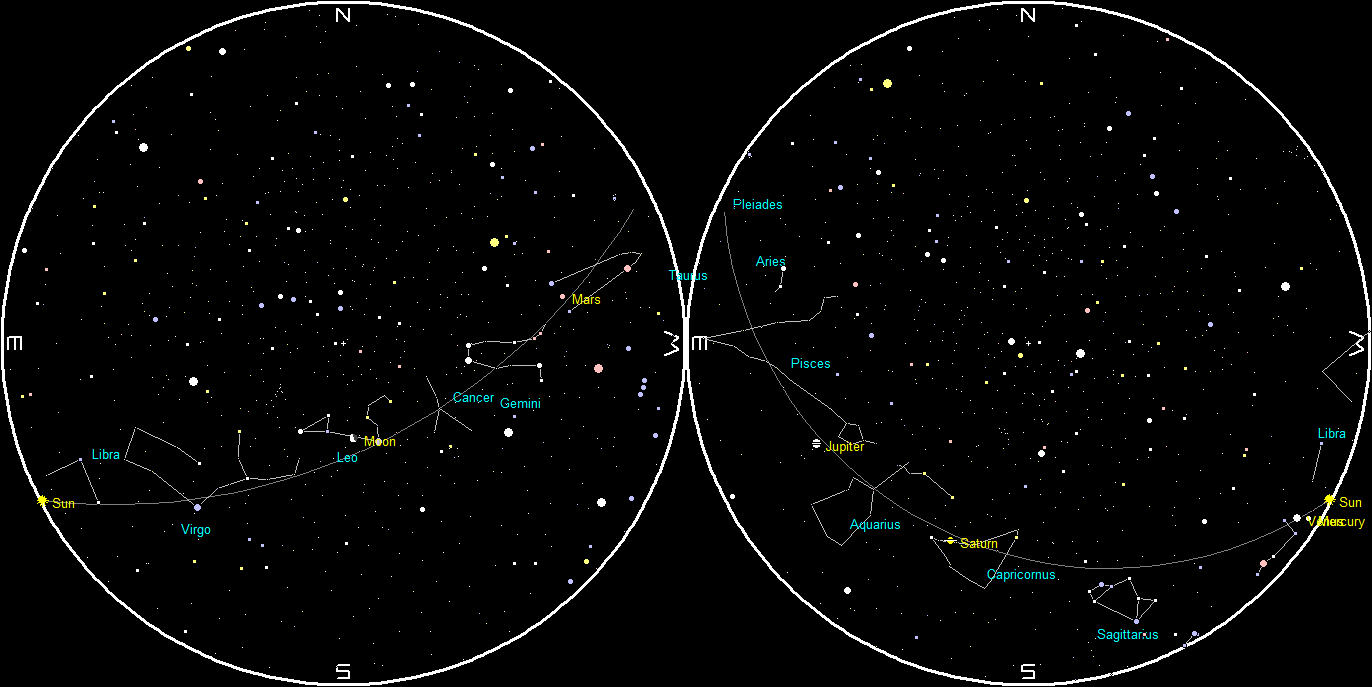
The naked-eye planets and the Moon at sunset and sunrise on a single night, starting with sunset on the right on November 16, 2022. The night ends on the left with sunrise on the 17th. Click on the image to enlarge it. Created using my LookingUp app and GIMP.
11/11/2022 – Ephemeris – Family Night at the Rogers Observatory tomorrow night
This is Bob Moler with Ephemeris for Veterans Day, Friday, November 11th. Today the Sun will be up for 9 hours and 44 minutes, setting at 5:18, and it will rise tomorrow at 7:35. The Moon, 3 days past full, will rise at 7:15 this evening.
Tomorrow evening the 12th, the Northwestern Michigan College’s Rogers Observatory will hold a Family Night starting at 8 pm, but only if it’s clear or mostly clear. Visible in telescopes will be the waning gibbous Moon, and the planets Jupiter, its cloud bands and four of its moons, and Saturn with its rings and its large moon Titan. The observatory is on Birmley road, south of Traverse City. It can be reached from either Garfield or Keystone roads. This is in celebration of the NASA Kiosk that’s at the Dennos Museum Center through December. There will also be a special Family Day with activities at the Museum Center on December 3rd.
The astronomical event times given are for the Traverse City/Interlochen area of Michigan (EST, UT – 5 hours). They may be different for your location.
Addendum
One of the problems of scheduling an observing event is the inability to guarantee clear skies. And looking at the family night, 48 hours away from when I’m writing this, the weather forecast is for snow, and temperatures near freezing for Saturday, and Saturday and for the next few days. It looks like we’re getting our first real taste of winter. I will post the status of the event on the gtastro.org website several hours before the event on Saturday, and also on this blog as an Ephemeris Extra post.
11/09/2022 – Ephemeris – Let’s see where the naked-eye planets have wandered off to this week
This is Bob Moler with Ephemeris for Wednesday, November 9th. Today the Sun will be up for 9 hours and 49 minutes, setting at 5:21, and it will rise tomorrow at 7:33. The Moon, 1 day past full, will rise at 5:57 this evening.
Let’s see where the naked-eye planets have wandered off to this week. Jupiter and Saturn will be visible this evening, in the southeastern sky, as soon after sunset as it will be dark enough to see them, which would be by 6:30 pm, now that we’re back on standard time. Jupiter is the brighter of the two to the left, in the southeast, while dimmer Saturn is in the south. The red planet Mars, though a morning planet, will rise tonight at 7:13 pm in the east-northeast. It’s located between the tips of the long horns of Taurus the bull. Those stars may be hard to spot with the bright Moon nearby. Mars is beginning to move westward in its retrograde motion as the Earth is beginning to pass it. Which it will do in a month’s time.
The astronomical event times given are for the Traverse City/Interlochen area of Michigan (EDT, UT – 5 hours). They may be different for your location.
Addendum
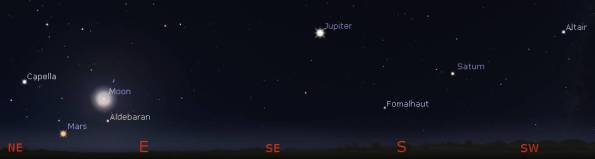
Planets and the Moon visible at 8 pm this evening. Jupiter and Saturn in the south with Mars, rising in the east-northeast. Mars is not yet an evening planet. It’s a month away from rising before sunset and becoming one. Created using Stellarium.
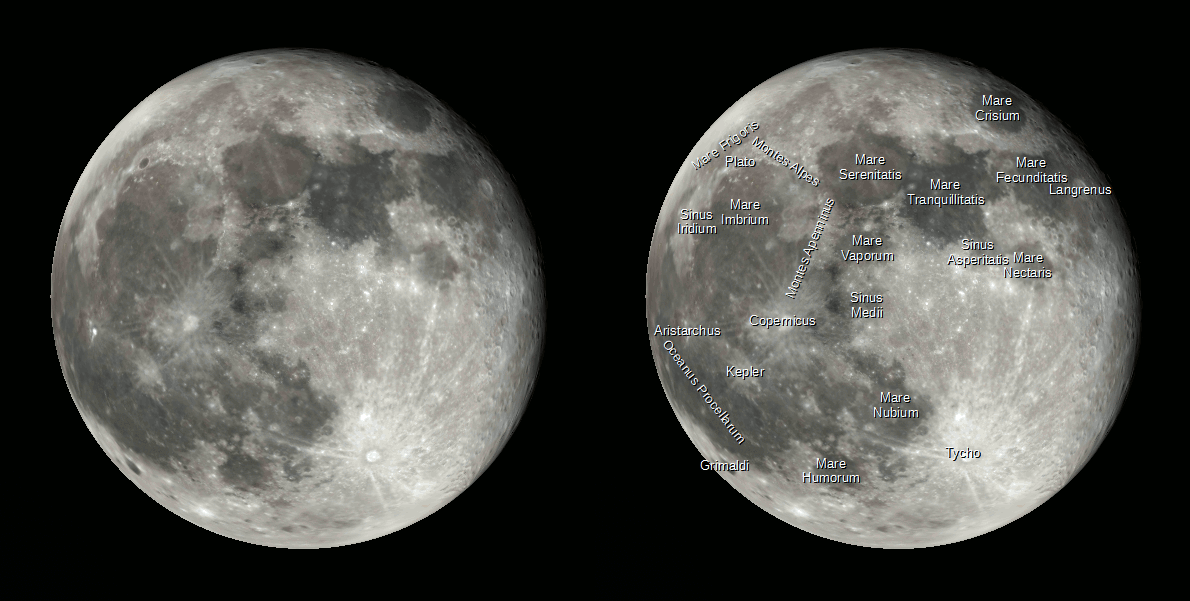
Annotated waning Gibbous Moon Animation for tonight, November 9, 2022, as it might look like in binoculars or a small telescope. Created using Stellarium, LibreOffice Draw and GIMP.
Translations of some lunar feature names according to Virtual Moon Atlas
Mare Crisium – Sea of Crises
Mare Frigoris – Sea of Cold
Mare Humorum – Sea of Moisture
Mare Imbrium – Sea of Showers
Mare Nubium – Sea of Clouds
Mare Serenitatis – Sea of Serenity
Mare Tranquillitatis – Sea of Tranquility
Mare Vaporum – Sea of Vapors
Montes Alpes – Alps Mountains
Montes Apenninus – Apennines Mountains
Oceanus Procellarum – Ocean of Storms
Sinus Asperitatis – Golfe des Asperites
Sinus Iridium – Bay of Rainbows
Sinus Medii – Central Bay
Craters are generally named after astronomers, people of science, or explorers
Note that Mare is pronounced Mar-é
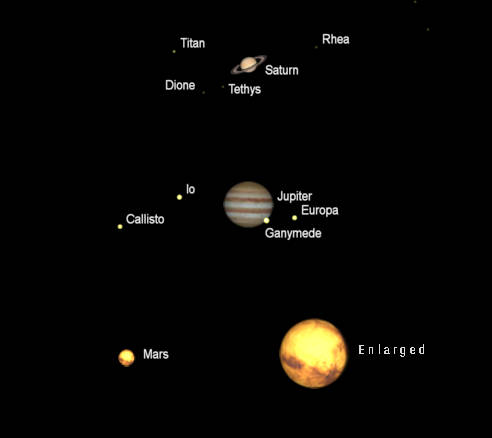
Telescopic views of Saturn Jupiter and Mars (north up) as they would be seen in a small telescope, with the same magnification. The image of Mars doesn’t show it, but the white north polar cap will appear at the top or north limb of Mars. The planets are shown at 10 pm. Apparent diameters: Saturn 17.00″, its rings 39.60″; Jupiter 46.50″; Mars 16.04″. Mars’ distance is 54.3 million miles (87.4 million kilometers). The ” symbol means seconds of arc (1/3600th of a degree.) Click on the image to enlarge it. Created using Cartes du Ciel (Sky Charts).
A note on Jupiter’s moon Ganymede: It will end its transit of the face of Jupiter at 10:04 pm.
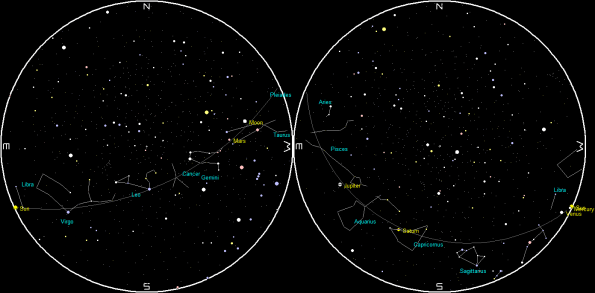
The naked-eye planets and the Moon at sunset and sunrise on a single night, starting with sunset on the right on November 9, 2022. The night ends on the left with sunrise on the 10th. Click on the image to enlarge it. Created using my LookingUp app and GIMP.
 Bob Moler's Ephemeris Blog