Archive
02/01/2012 – Ephemeris – Where are the bright planets this week?
Ephemeris for Wednesday, February 1st. The sun will rise at 8:01. It’ll be up for 9 hours and 48 minutes, setting at 5:50. The moon, 2 days past first quarter, will set at 3:46 tomorrow morning.
Let’s see what’s happening with the bright planets for this week. Venus is brilliant in the southwestern sky after sunset and will set at 9:19 in the west. Jupiter is the most prominent planet of the evening sky, once Venus sets. It’s located high in the southwest as it gets dark and is seen against the stars of the constellation Aries. It will set at 12:48 a.m.. Mars is the up and coming planet. It will rise at 9:05 p.m in the east and is below the hind end of the constellation Leo the lion. It is 73 million miles away and closing and is getting brighter. It’s now as bright as most first magnitude stars. Mars will pass due south at 3:33 a.m. Saturn will rise at 12:22 a.m. just to the left of the bright star Spica in the east southeast.
* Times, as always are for the Traverse City/Interlochen area of Michigan.
01/25/2012 – Ephemeris – Where are the planets this week?
Ephemeris for Wednesday, January 25th. The sun will rise at 8:08. It’ll be up for 9 hours and 31 minutes, setting at 5:40. The moon, 2 days past new, will set at 8:42 this evening.
It’s time again to take a look at the whereabouts of the bright planets. Venus is brilliant in the southwestern sky after sunset and will set at 9:01 in the west. Jupiter is the most prominent planet of the evening sky, once Venus sets. It’s located high in the south southeast as it gets dark and is seen against the stars of the constellation Aries. It will pass due south at 6:21 p.m. and it will set at 1:08 a.m.. Mars will rise at 9:36 p.m in the east northeast and is below the hind end of the constellation Leo the lion. It is 76.7 million miles away and closing and has been getting brighter. It’s now as bright as most first magnitude stars. Mars will pass due south at 4:02 a.m. Saturn will rise at 12:49 a.m. just to the left of the bright star Spica in the east southeast.
* Times, as always are for the Traverse City/Interlochen area of Michigan.
Addendum
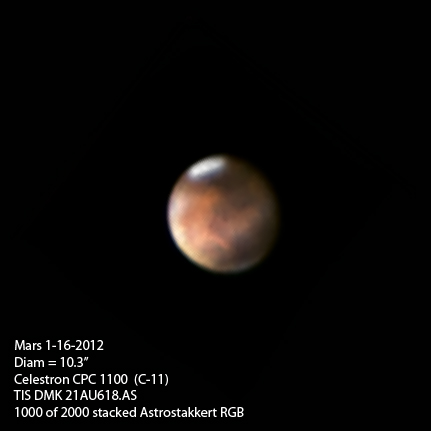
Mars 9 days ago. Photograph by Scott Anttila
Another gorgeous shot of Mars by Scott Anttila. At the time Mars appeared 10.3 seconds of arc in diameter. By comparison the moon and sun appear about 1,800 seconds of arc in diameter. Note that Mars appears slightly gibbous in shape. It will appear full on March 3rd. when it will be in opposition from the sun. It will be closest to us on March 5th. at about 62.6 million miles. At that time it will have an apparent diameter of 13.9 seconds of arc.
01/18/2012 – Ephemeris – Where are the bright planets this week
Ephemeris for Wednesday, January 18th. The sun will rise at 8:14. It’ll be up for 9 hours and 17 minutes, setting at 5:31. The moon, 2 days past last quarter, will rise at 4:51 tomorrow morning.
It’s time again to take a look at the whereabouts of the bright planets. Venus is brilliant in the southwestern sky after sunset and will set at 8:44. Jupiter is the most prominent planet of the evening sky, once Venus sets. It’s located high in the south and is seen against the stars of the constellation Aries. It will pass due south at 6:49 p.m. It will set at 1:36 a.m. Mars will rise at 10:03 p.m in the east northeast and is below the hind end of the constellation Leo the lion. It is 82.4 million miles away and closing. Mars will pass due south at 4:29 a.m. Saturn will rise at 1:15 a.m. just to the left of the bright star Spica in the east southeast.
* Times, as always are for the Traverse City/Interlochen area of Michigan.
01/13/2012 – Ephemeris – The moon passes Mars tonight
Friday, January 13th. The sun will rise at 8:17. It’ll be up for 9 hours and 8 minutes, setting at 5:25. The moon, 3 days before last quarter, will rise at 10:52 this evening.
This evening the moon will pass below the planet Mars after the moon rises near 11 p.m. Mars is rather distant now, and it won’t be really near in its next close approach to us on March 5th when it will be slightly under 63 million miles away. In telescopes Mars is and will remain a tiny disk with a hint of a white polar cap on one end. Photographers with large telescopes and CCD cameras can capture Mars even better and show some surface detail. We have even closer views of Mars. Of course there is an operating rover called Opportunity still active on the planet and the Curiosity rover on its way plus three orbiting satellites, two US and one European. The satellites will be cruising overhead as Curiosity lands August 5th.
* Times, as always are for the Traverse City/Interlochen area of Michigan.
Addendum
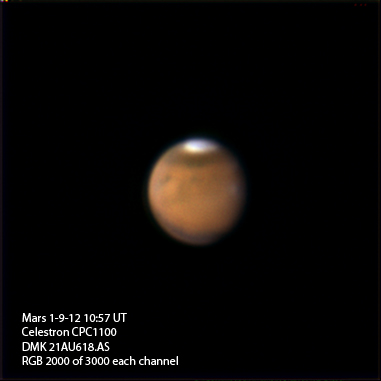
Mars on the morning of January 9, 2012. By Scott Anttila
Here’s Scott Anttila’a image of Mars from Monday morning, the 9th. Note Mar’s gibbous phase. Mars will become full when it’s at opposition from the sun March 3rd. It is only 9.7 seconds of arc in diameter. Also note, beside the northern polar cap that’s quite obvious, there is a hazy patch near the right edge of Mars. It is what telescopic astronomers of a hundred years ago called Nix Olympica, the Snows of Olympus. When the Mariner 9 spacecraft reached Mars in 1971 it found that there was a real mountain there. So the feature was renamed Olympus Mons or Mount Olympus. The white haze isn’t snow but water ice clouds that condense over the mountain peak. Mount Olympus is 14 miles high, three times taller than Mt Everest. The closest earth analog to it is the volcanic peak Mauna Kea on the island of Hawaii. Actually you’d have to throw in the entire island of Hawaii itself from the sea floor on up.
01/11/2012 – Ephemeris – Where are the planets tonight?
Wednesday, January 11th. The sun will rise at 8:17. It’ll be up for 9 hours and 5 minutes, setting at 5:22. The moon, 2 days past full, will rise at 8:29 this evening.
It’s time again to take a look at the whereabouts of the bright planets. Venus is brilliant in the southwestern sky after sunset and will set at 8:25. Jupiter is the most prominent planet of the evening sky, once Venus sets. It’s located high in the south and is seen against the stars of the constellation Aries. It will pass due south at 7:15 p.m. It will set at 2:00 a.m.. Jupiter is a great sight in a small telescope with its four moons which change position from night to night. Mars will rise at 10:27 p.m in the east northeast and is below the hind end of the constellation Leo the lion. It is 88 million miles away and closing. Mars will pass due south at 4:54 a.m. Saturn will rise at 1:41 a.m. just to the left of the bright star Spica in the east southeast.
* Times, as always are for the Traverse City/Interlochen area of Michigan.
Addendum
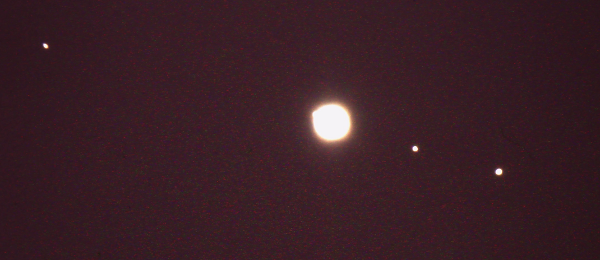
Overexposed Jupiter and its moons. My archival image.
The four Galilean satellites or moons of Jupiter are in order of distance from Jupiter Io, Europa, Ganymede and Callisto. They all orbit near Jupiter’s equator, and Jupiter itself has a very small axial tilt of about 3 degrees so the satellites seem to shuffle from one side to the other of Jupiter. The pattern is different night.
The programs Stellarium, Cartes du Ciel, and other sources including http://www.calsky.com can be used to determine the positions of the satellites. But there are clues by just looking at them.
- Io is closest to Jupiter and generally appears so. In the photograph above it appears as a bump on the left edge of Jupiter. It has a slight reddish tinge.
- Europa is dimmer than Io and also is usually close to Jupiter.
- Ganymede is easy. It’s the brightest.
- Callisto is usually found the farthest from Jupiter and is also the dimmest of the four.
Based on the photograph alone, which is undated, I’d guess that from left to right we have Callisto and Io to the left of Jupiter, Europa and Ganymede to the right.
Sometimes fewer than four satellites can be seen. They can hide in front of Jupiter, usually casting their shadow on the planet, behind Jupiter or in its shadow. Calsky will give you the times for your location.
Update
I located the date of the above image. It was taken the evening of March 17, 1989. A check with Cartes du Ciel (Sky Charts) confirm the satellite’s locations and order. Io was just ending a transit (passing in front ) of Jupiter.
01/04/2012 – Ephemeris – The planets this week and the earth at perihelion
Wednesday, January 4th. The sun will rise at 8:19. It’ll be up for 8 hours and 56 minutes, setting at 5:15. The moon, 3 days past first quarter, will set at 5:03 tomorrow morning.
It’s the first Wednesday of 2012 and time again to take a look at the whereabouts of the bright planets. The planet Venus is brilliant in the southwestern sky after sunset setting at 8:07. Jupiter is the most prominent planet of the evening sky, once Venus sets. It’s located high in the south and is seen against the stars of the constellation Aries. It will pass due south at 7:41 p.m. It will set at 2:26 a.m.. Mars will rise at 10:52 p.m in the east northeast and is below the hind end of the constellation Leo the lion. It is 92.4 million miles away and closing. Saturn will rise at 2:07 a.m. just to the left of the bright star Spica in the east southeast. The sun is its closest to earth of the entire year today. Only 91.3 million miles away.
* Times, as always are for the Traverse City/Interlochen area of Michigan.
12/28/11 – Ephemeris – Where are the planets this week?
Wednesday, December 28th. The sun will rise at 8:18. It’ll be up for 8 hours and 50 minutes, setting at 5:09. The moon, half way from new to first quarter, will set at 9:56 this evening.
It’s Wednesday and time again to take a look at the whereabouts of the bright planets. The planet Venus is prominent in the southwestern twilit sky after sunset setting at 7:48 after the end of twilight. Jupiter is the most prominent planet of the evening sky, once Venus sets. It’s located high in the south and is seen against the stars of the constellation Aries. It will pass due south at 8:08 p.m. It will set at 2:53 a.m.. Mars will rise at 11:08 p.m in the east northeast and will be in the constellation Leo. Mars will be due south at 5:38 a.m. It is 98.4 million miles away and closing. Saturn will rise at 2:32 a.m. just to the left of the bright star Spica in the east southeast. Of all the planets, Jupiter and Saturn look best in that new Christmas telescope.
* Times, as always are for the Traverse City/Interlochen area of Michigan.
12/21/11 – Ephemeris – Where are the bright planets this week?
Wednesday, December 21st. The sun will rise at 8:16. It’ll be up for 8 hours and 48 minutes, setting at 5:04. The moon, 3 days before new, will rise at 5:58 tomorrow morning.
It’s Wednesday and time again to take a look at the whereabouts of the bright planets. The planet Venus is prominent in the southwestern twilit sky after sunset setting at 7:30. Jupiter is now the most prominent planet of the evening sky located in the high in the south and is seen against the stars of the constellation Aries. It will pass due south at 8:36 p.m. It will set at 3:20 a.m.. Mars will rise at 11:25 p.m in the east northeast and will be in the constellation Leo. Mars will be due south at 6:01 a.m. It is 105 million miles away and closing. Saturn will rise at 2:57 a.m. just to the left of the bright star Spica in the east southeast. Winter starts at 12:30 tomorrow morning. I’ll have more on that tomorrow.
* Times, as always are for the Traverse City/Interlochen area of Michigan.
12/14/11 – Ephemeris – Where are the bright planets this week?
Wednesday, December 14th. The sun will rise at 8:11. It’ll be up for 8 hours and 51 minutes, setting at 5:02. The moon, 3 days before last quarter, will rise at 9:29 this evening.
It’s Wednesday and time again to take a look at the whereabouts of the bright planets. The planet Venus is prominent in the southwestern twilit sky after sunset setting at 7:12[, and should be visible by 5:45]. Jupiter is now the most prominent planet of the evening sky located in the high in the southeast to south and is seen against the stars of the constellation Aries. It will pass due south at 9:04 p.m. It will set at 3:48 a.m.. Mars will rise at 11:41 p.m in the east northeast and will be in the constellation Leo. [Mars will be due south at 6:17 a.m.] It is 111 million miles away and closing. Saturn will rise at 3:22 a.m. just to the left of the bright star Spica in the east southeast. Remember Comet Lovejoy will enter SOHO’s LASCO C3 frame today.
* Times, as always are for the Traverse City/Interlochen area of Michigan. Text in brackets deleted from the program due to time constraints.
Update 6:16 a.m.
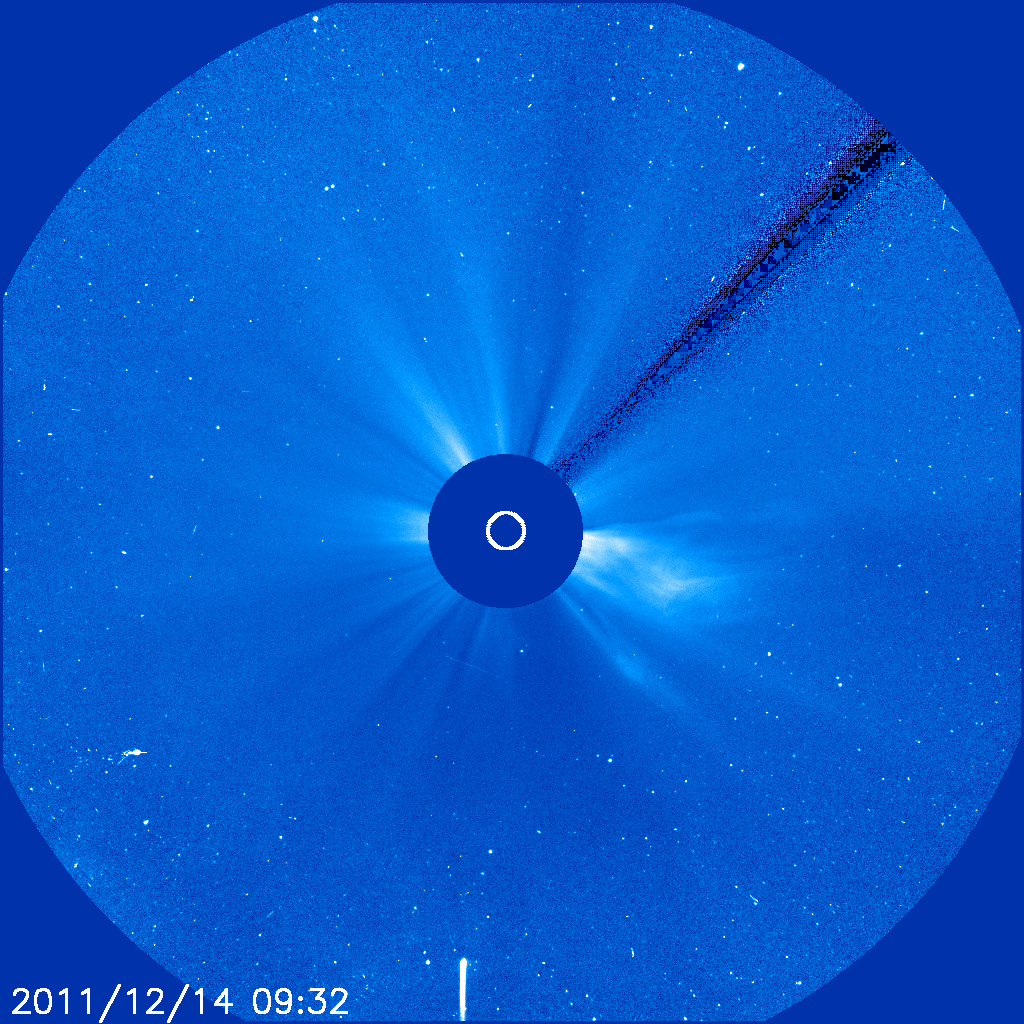
Comet Lovejoy entering at the bottom of the LASCO C3 frame. Courtesy SOHO, ESA, NASA. Timestamp on image.
Click to enlarge.
12/07/11 – Ephemeris – Where are the planets this week?
Wednesday, December 7th. The sun will rise at 8:05. It’ll be up for 8 hours and 57 minutes, setting at 5:02. The moon, 3 days before full, will set at 6:16 tomorrow morning.
It’s Wednesday and time again to take a look at the whereabouts of the bright planets. The planet Venus is low in the southwestern twilit sky sunset setting at 6:57, and should be visible by 5:45. Jupiter is now the most prominent planet of the evening sky located in the high in the southeast and is seen against the stars of the constellation Aries. It will pass due south at 9:33 p.m. In a telescope it will be accompanied by its 4 brightest moons. It will set at 4:18 a.m.. Mars will rise at 11:55 p.m in the east northeast and will be in the constellation Leo. Mars will be due south at 6:34 a.m. It is 117 million miles away and closing. Saturn will rise at 3:46 a.m. just to the left of the bright star Spica in the east southeast.
* Times, as always are for the Traverse City/Interlochen area of Michigan.
 Bob Moler's Ephemeris Blog