Archive
08/05/2015 – Ephemeris – Down to one easily visible evening planet
Ephemeris for Wednesday, August 5th. The Sun rises at 6:33. It’ll be up for 14 hours and 30 minutes, setting at 9:03. The Moon, 1 day before last quarter, will rise at 12:08 tomorrow morning.
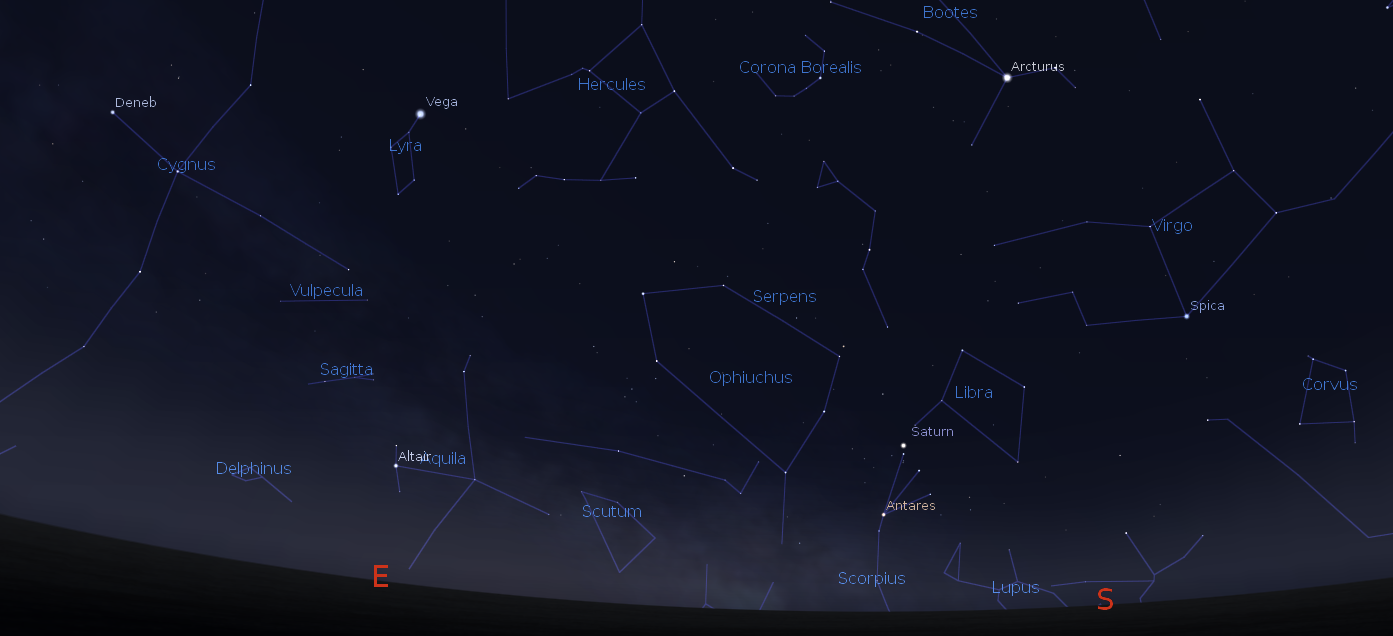
Lets take a look at the bright planets for this week. Our evening stars Venus and Jupiter leaving the evening sky in the west. Venus will set 2 minutes after the Sun, so the only hope to spot it is before sunset, a dangerous prospect with the Sun so close. Jupiter is just too faint in the twilight to pick up. Venus is 10 days from inferior conjunction with the Sun. Saturn is in the south in the evening twilight. Saturn can be spotted just to the right of the constellation of Scorpius the scorpion and its bright red star Antares below and right of it. Even small telescopes can see Saturn’s rings. A spotting scope of 20 power magnification can show that Saturn has a ring. Antares though is star-like, scintillating like a sparkler.
Times are for the Traverse City/Interlochen area of Michigan. They may be different for your location.
Addendum
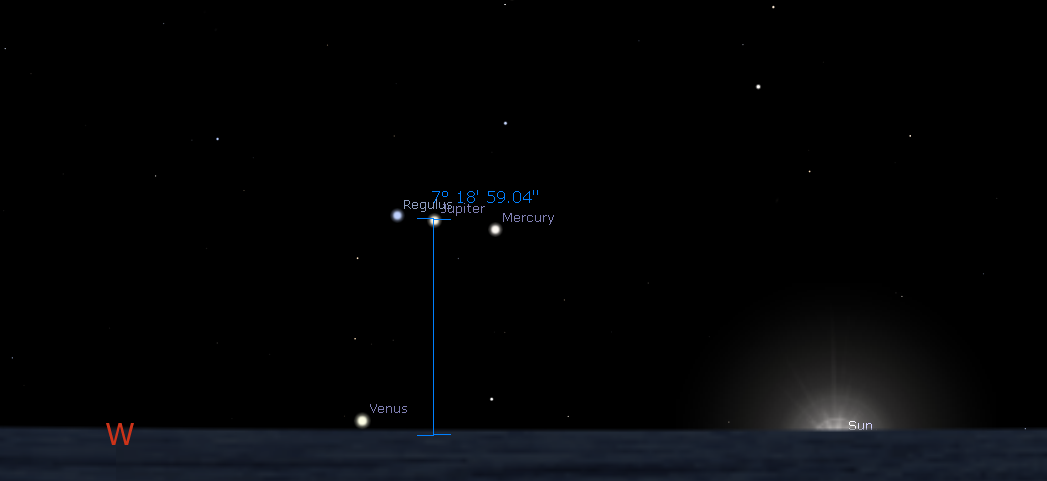
Venus, Jupiter, and Mercury plus the star Regulus together at 9 p.m. August 5, 2015 with the bright Earth’s atmosphere removed. Created using Stellarium.
The reason I don’t discuss Mercury is that This will not be a good apparition of that planet. Apparitions (appearances) of Mercury are best seen in the evening in late winter and spring. Morning apparitions are best seen in late summer and autumn.
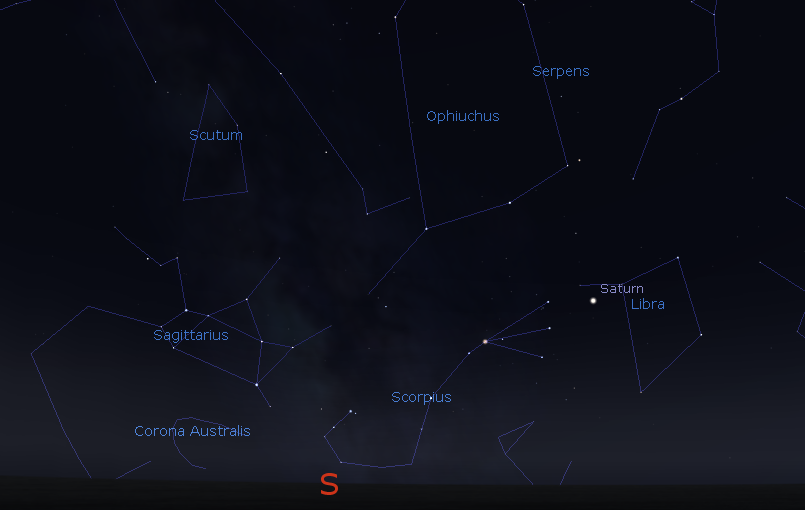
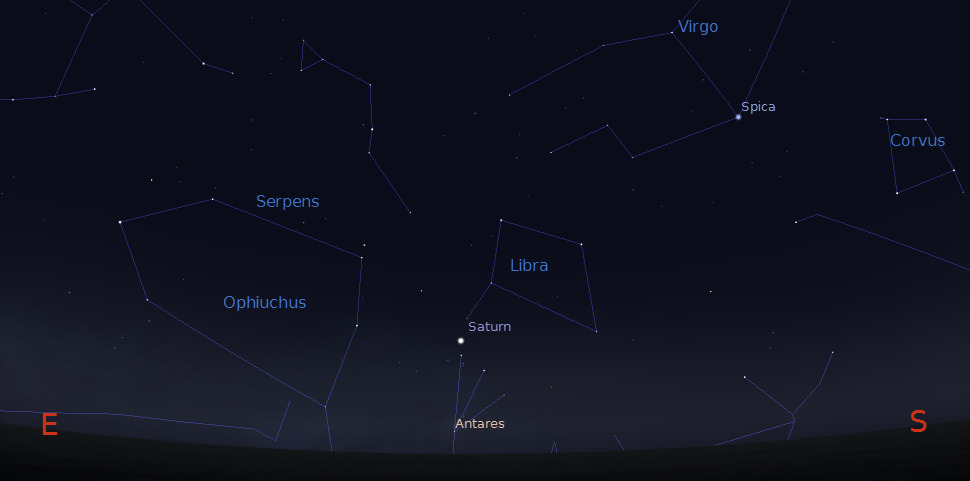
Saturn and the southern Milky Way and stars of summer at 10:30 p.m. August 5, 2015. Created using Stellarium.
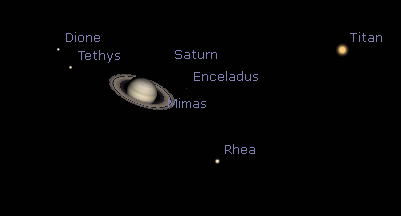
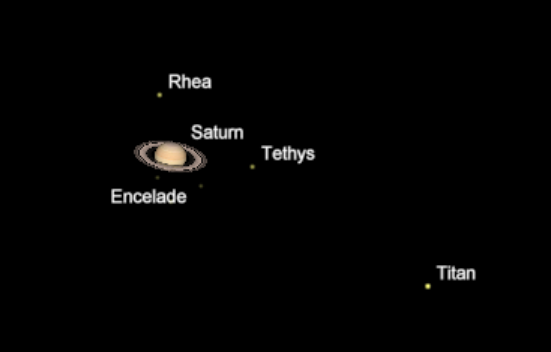
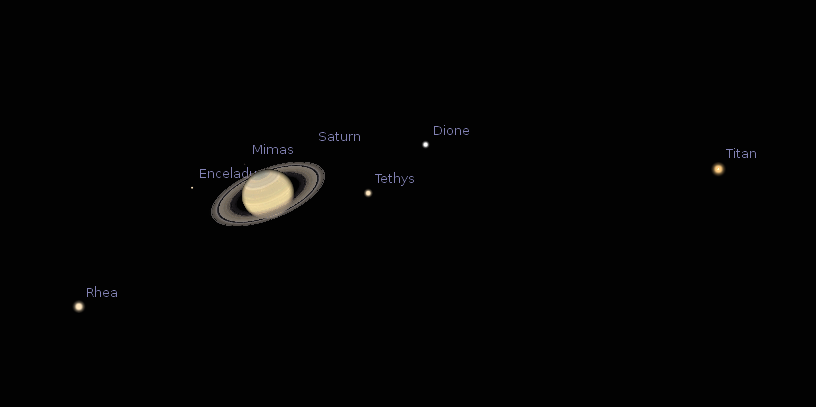
What Saturn and its moons might appear like in a telescope at 10:30 p.m., August 5, 2015. Small telescopes will show only the moon Titan. Created using Stellarium.
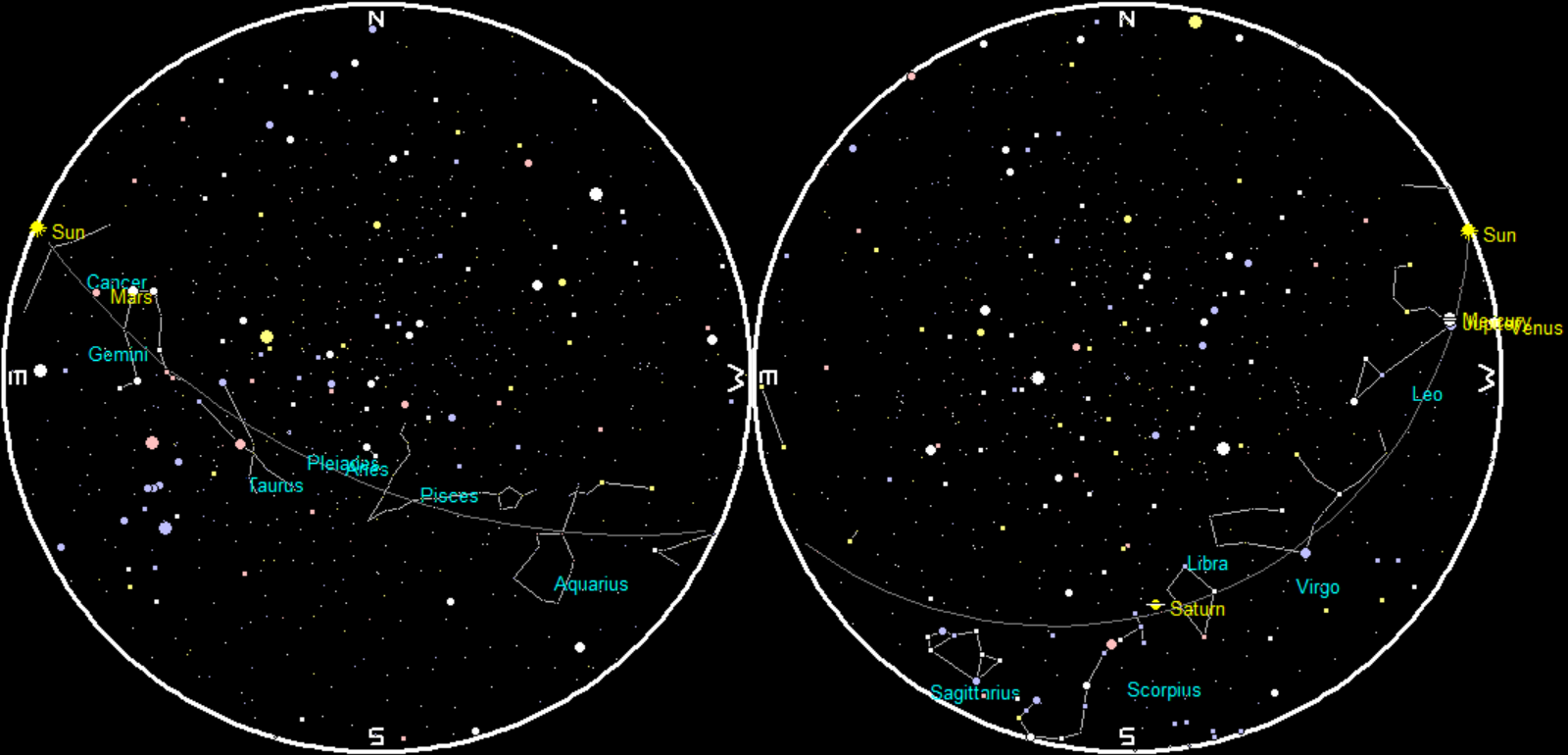
This is a chart showing the sunrise and sunset skies for August 5, 2015 showing the location of the planets at that time. The traffic jam of planets near the western horizon at sunset is best seen in the first image above. Created using my LookingUp program. Click on the image to enlarge.
05/19/2015 – Ephemeris – The crescent Moon reappears in the west
Ephemeris for Tuesday, May 19th. Today the Sun will be up for 14 hours and 57 minutes, setting at 9:08. The Moon, 1 day past new, will set at 10:42 this evening, and tomorrow the Sun will rise at 6:09.
The Moon is again making its appearance in the evening sky as a thin crescent. The crescent appearance is because the moon is mostly between the Earth and the Sun. , so we are looking at just a sliver of it is sunlit, and most is unlit by the sun. But the Moon has the Earth in its sky, which is quite bright, and when the moon’s phase is thin, the Earth illuminates its night side with Earth light. We call it Earthshine, when the whole Moon appears faintly inside the crescent. It’s also known more poetically as the “Old moon in the new moon’s arms.” The planets Venus and Mercury also exhibit crescent phases because they can be positioned between the Earth and the Sun, as Mercury is now and Venus will be next month.
Times are for the Traverse City/Interlochen area of Michigan. They may be different for your location.
Addendum
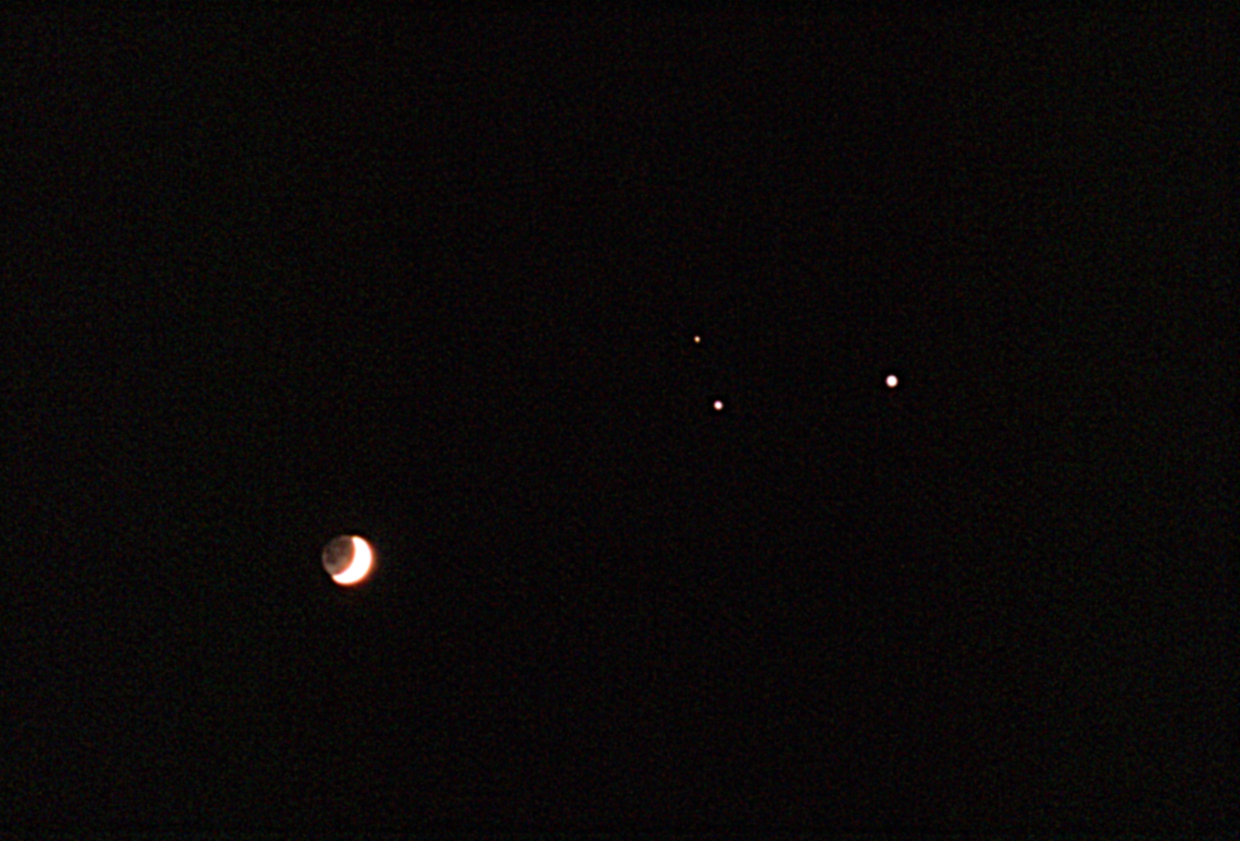
Close grouping of, from right to left, Venus, Jupiter, Venus and the overexposed crescent Moon showing Earthshine on June 15, 1991. Credit: Bob Moler.
05/18/2015 – Ephemeris – Venus, beautiful Evening Star or Earth’s evil twin?
Ephemeris for Monday, May 18th. Today the Sun will be up for 14 hours and 55 minutes, setting at 9:07. The Moon is new today, and won’t be visible and tomorrow the Sun will rise at 6:10.
Venus has been called the Earth’s twin because it is 95 percent the size of the Earth. It is 72 percent of the Earth’s distance from the Sun, and that seems to be the thing that turned a planet, perhaps as endowed with the same amounts of water and other minerals as the Earth, into Earth’s evil twin. Those nice shiny white clouds are not the water vapor clouds of Earth, but poisonous corrosive clouds of sulfuric acid droplets. The air which is mostly carbon dioxide is dense, some 90 times the Earth’s atmospheric pressure at sea level. The carbon dioxide atmosphere creates a runaway green house effect, giving a surface temperature of over 800 degrees Fahrenheit. Hotter, even than Mercury, the closest planet to the Sun.
Times are for the Traverse City/Interlochen area of Michigan. They may be different for your location.
Addendum
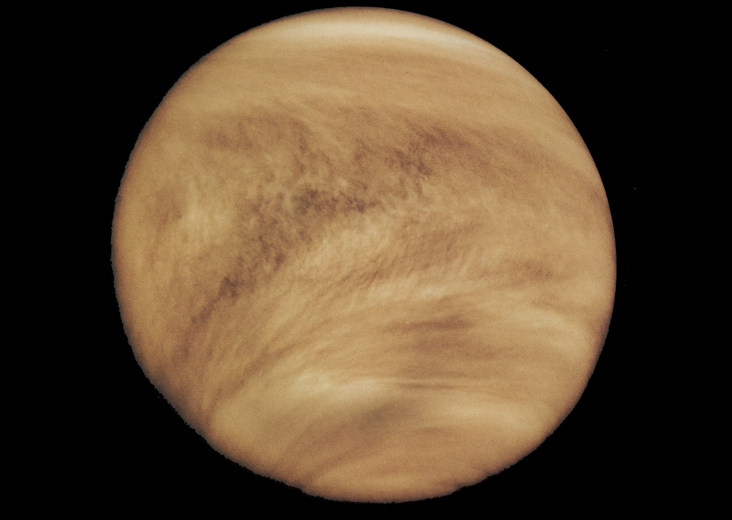
The clouds of Venus in ultraviolet light as seen by Pioneer Venus in 1979. Venus’ clouds provide a blank face in visible light. Credit: NASA.
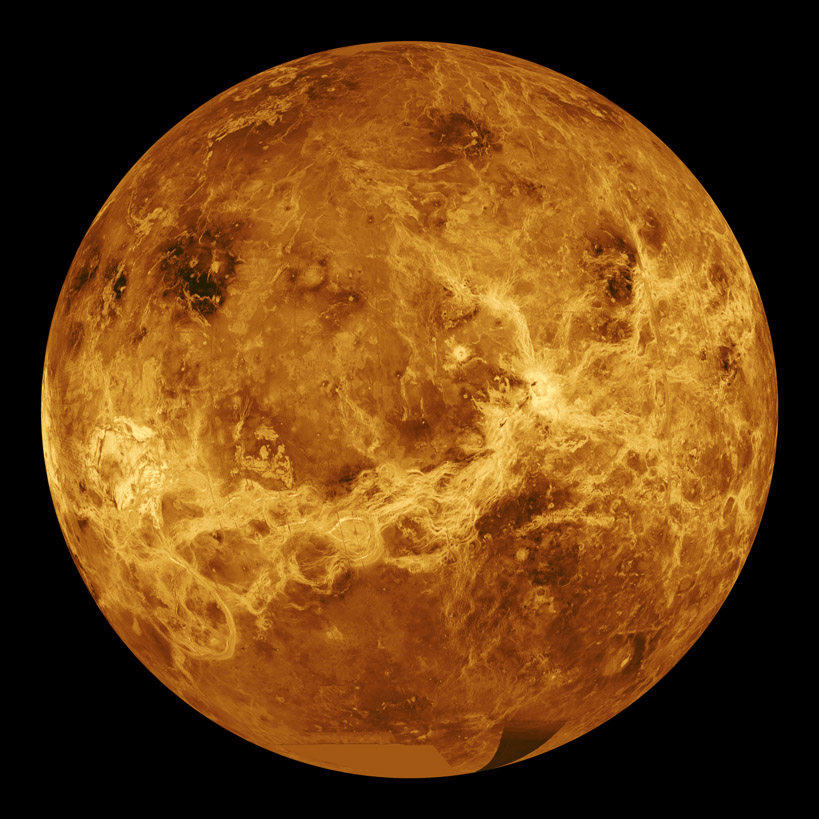
A map of Venus surface produced by NASA’s Magellan spacecraft using radar: 1990-1994. Credit NASA
05/13/2015 – Ephemeris – The bright planets including a last look at Mercury for a while
Ephemeris for Wednesday, May 13th. Today the Sun will be up for 14 hours and 44 minutes, setting at 9:01. The Moon, 2 days past last quarter, will rise at 4:17 tomorrow morning. Tomorrow the Sun will rise at 6:16.
Lets take a look at the bright planets for this week. Mercury is low in the west-northwestern sky after sunset. It’s at a 19 degrees angle from the sun and will set at 10:47. Mercury is getting dimmer as its phase becomes a decreasingly thin crescent. Our brilliant evening star Venus is in the west by 9:30 p.m. It will set at 12:44 a.m. Jupiter will appear high in the west-southwestern sky before 10 p.m. It will set at 2:43 a.m. It’s near the sickle-shaped head of Leo the lion, and it’s the second brightest star-like object in the sky after Venus. Saturn will rise in the east-southeast at 9:33 p.m. It will be low in the southwest as morning twilight brightens. It’s rings and the moon Titan can be seen in small telescopes.
Times are for the Traverse City/Interlochen area of Michigan. They may be different for your location.
Addendum
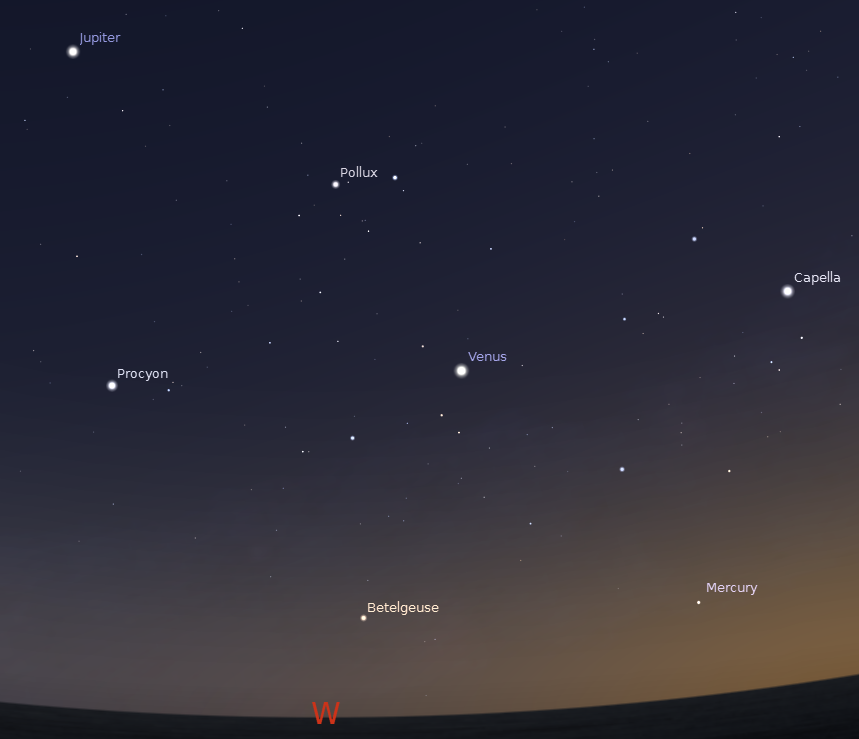
Mercury, Venus, Jupiter and the setting stars of winter at 10 p.m., May 13, 2015. Created using Stellarium.
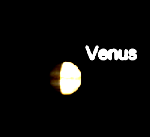
Venus through a telescope, over exposed to match the brilliant orb of Venus, on May 13, 2015. Created using Carted du Ceil (Sky Charts).
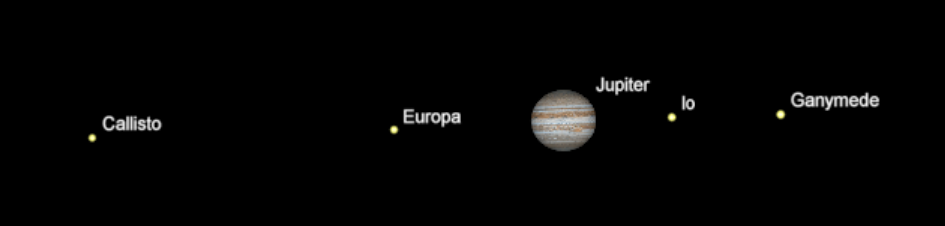
Jupiter and its moons at 10 p.m. May 13, 2015. Created using Cartes du Ciel (Sky Charts).
Saturn above the southeastern horizon with the stars of late spring at 11 p.m. May 13, 2015. Created using Stellarium.
What Saturn and its moons might appear like in a telescope the night of May 6-7, 2015. Small telescopes will show only the moon Titan. Same scale/magnification as Jupiter and Venus. Created using Cartes du Ceil (Sky Charts).
05/07/2015 – Ephemeris – Mercury is at greatest eastern elongation today
Ephemeris for Thursday, May 7th. Today the Sun will be up for 14 hours and 30 minutes, setting at 8:54. The Moon, half way from full to last quarter, will rise at 12:20 tomorrow morning. Tomorrow the Sun will rise at 6:23.
The tiny planet Mercury has been in the news lately because the MESSENGER spacecraft plunged onto its surface a week ago, after having mapped and studied chemical composition of this planet for four years. Today, for Mercury watchers from the Earth, it reached its greatest angular separation from the sun in its orbit, of 21 degrees just before 1 a.m. Mercury has always been a tough planet to study, low to the horizon in twilight. It’s also a tough planet to get to with a spacecraft, being far down the Sun’s gravity well. MESSENGER took 7 years to get there, bleeding off energy by passing Earth, Venus and Mercury itself to fall into orbit of this little world that was full of surprises.
Times are for the Traverse City/Interlochen area of Michigan. They may be different for your location.
Addendum
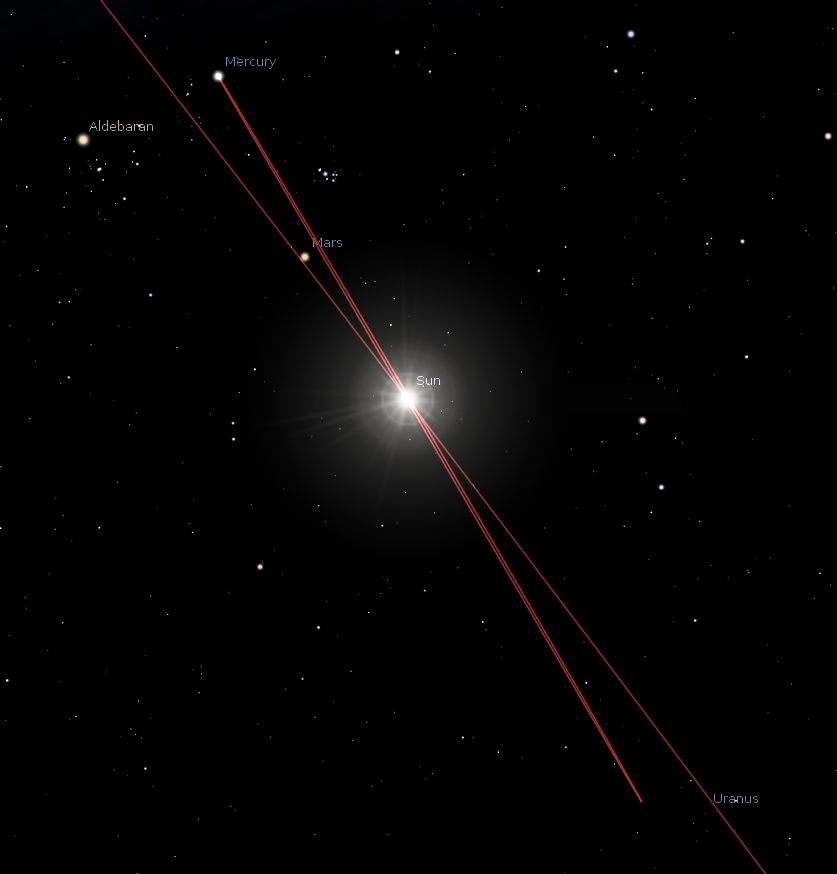
Mercury’s orbit as seen from about 45 degrees north latitude Earth at the greatest eastern elongation at sunset on May 7, 2015. Created using Stellarium.
°
The other red line is the plane of the Earth’s orbit. In the spring at sunset it is much closer to vertical than in autumn. The angle of the ecliptic to the horizon at sunset on the vernal equinox is 90° – (your latitude) + 23.5°. Here near 45° north latitude it’s 68.5°. For the sunset at the autumnal equinox the formula is 90° – (your latitude) – 23.5° or 21.5°. The ecliptic will really lay down making planets close to the direction of the Sun hard to spot. In the morning sky the ecliptic will be steep at the autumnal equinox and lay down at the vernal equinox. Thus the best time to spot Mercury, which never strays far from the sun is on late winter and spring evenings and late summer and autumn mornings. Also note that Mercury’s 7 degree inclination to the ecliptic helps it now.
Also note that we are seeing Mercury’s orbit nearly edge on. It will be edge-on in a couple of days. It so happens that a year from now, the morning of May 9th, 2016, for us in the United States, Mercury will transit, or cross in front of, the Sun. Three years ago this June we witnessed the extremely rare transit of Venus. The transit of Mercury isn’t as spectacular or rare, but it’s rare enough.
05/06/2015 – Ephemeris – Wednesday is planet day or night on Ephemeris
Ephemeris for Wednesday, May 6th. Today the Sun will be up for 14 hours and 27 minutes, setting at 8:53. The Moon, 3 days past full, will rise at 11:26 this evening. Tomorrow the Sun will rise at 6:24.
Lets take a look at the bright planets for this week. Mercury is low in the west-northwestern sky after sunset. It’s at a 21 degrees angle from the sun and will set at 10:52. Our brilliant evening star Venus is high in the west by 9:30 p.m. It will set at 12:37 a.m. Jupiter will appear high in the west-southwestern sky before 10 p.m. It will set at 3:05 a.m. It’s near the sickle-shaped head of Leo the lion, and it’s the second brightest star-like object in the sky after Venus. In telescopes, Jupiter’s moon Europa will pass in front of Jupiter starting at 1:43 a.m. Saturn will rise in the east-southeast at 10:33 p.m. It will be low in the south as morning twilight brightens. It’s rings and the moon Titan can be seen in small telescopes.
Times are for the Traverse City/Interlochen area of Michigan. They may be different for your location.
Addendum
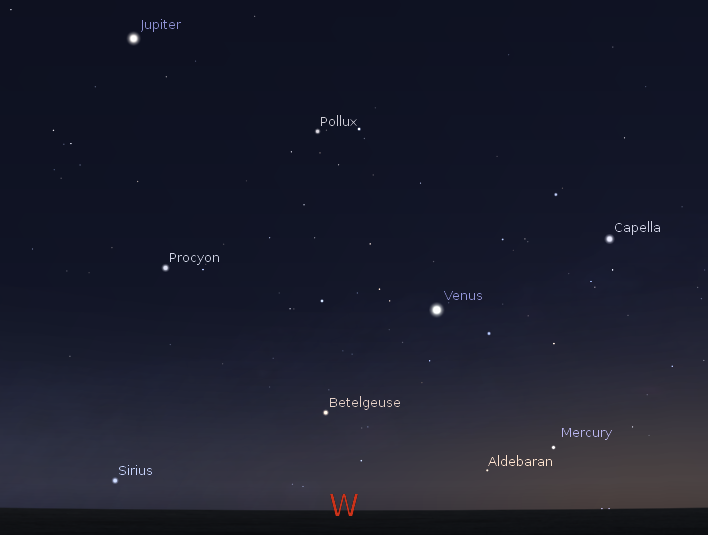
Mercury, Venus, Jupiter and the setting stars of winter at 10 p.m., May 6, 2015. Created using Stellarium.
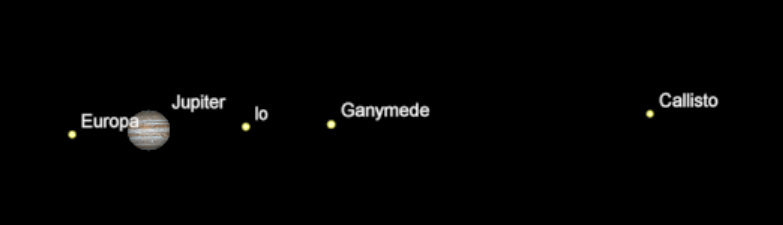
Jupiter and its moons at 10 p.m. May 6, 2015. Created using Cartes du Ciel (Sky Charts).
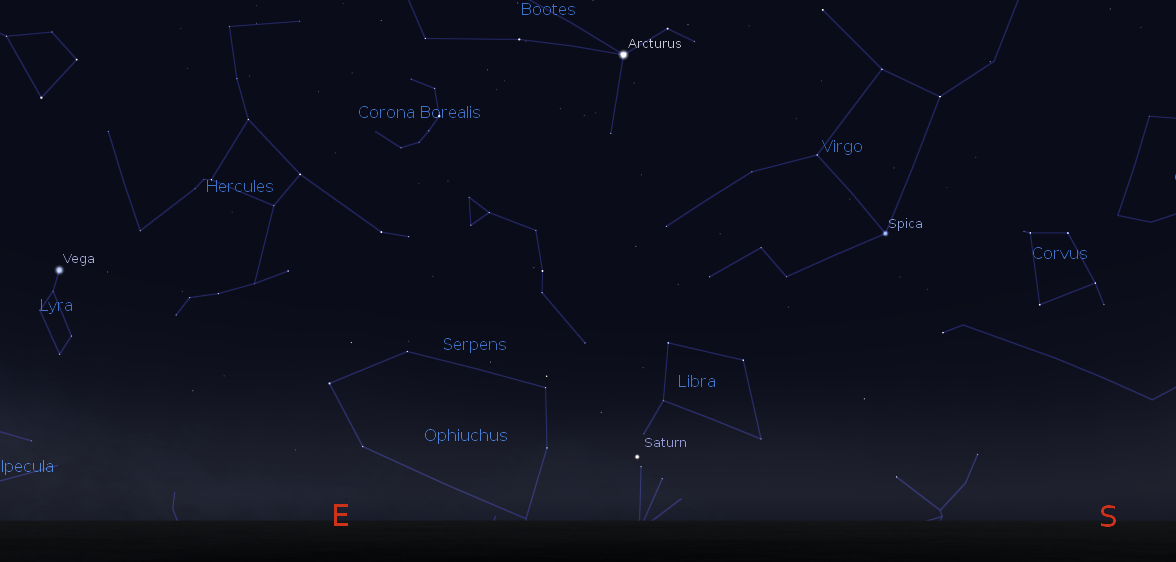
Saturn above the southeastern horizon with the stars of late spring at 11 p.m. May 6, 2015. Created using Stellarium.
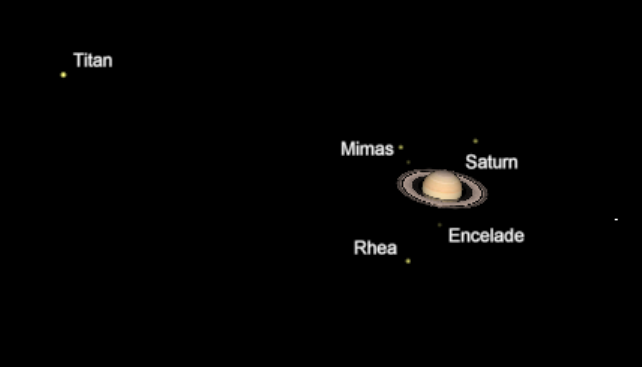
What Saturn and its moons might appear like in a telescope the night of May 6-7, 2015. Small telescopes will show only the moon Titan. Created using Cartes du Ceil (Sky Charts).
05/04/2015 – Ephemeris – Last good evening appearance of Mercury for the year*
Note: This program was recorded before the MESSENGER spacecraft crashed into Mercury.
Ephemeris for Monday, May 4th. Today the Sun will be up for 14 hours and 22 minutes, setting at 8:51. The Moon, 1 day past full, will rise at 9:29 this evening. Tomorrow the Sun will rise at 6:27.
The tiny and elusive planet Mercury will be making its final easily observable evening appearance of the year. For the next week or so. Not that Mercury is ever easy to spot. The MESSENGER spacecraft, which has been orbiting Mercury for the past four years is out of fuel and is descending to an impact any day now. It may already have. Mercury is the smallest planet only 50% larger than the diameter of our Moon. There are two planetary satellites larger than it: Jupiter’s Ganymede and Saturn’s Titan. It is a whole lot larger than Pluto, which was demoted to dwarf planet 9 years ago. Mercury is the second densest planet after the Earth. And even Venus with its greenhouse effect is hotter.
Times are for the Traverse City/Interlochen area of Michigan. They may be different for your location.
*For northern hemisphere viewers.
Addendum
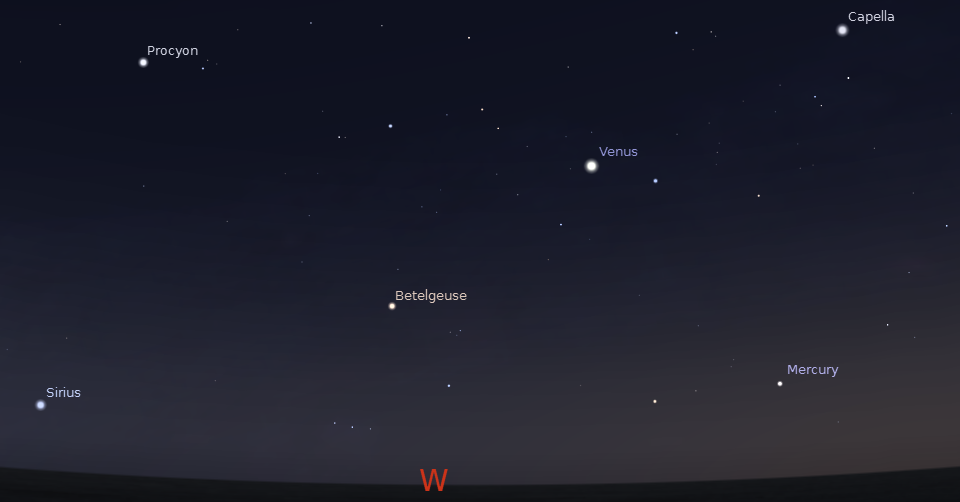
Mercury, Venus and the setting stars of winter at 10 p.m., May 4, 2015. Created using Stellarium.
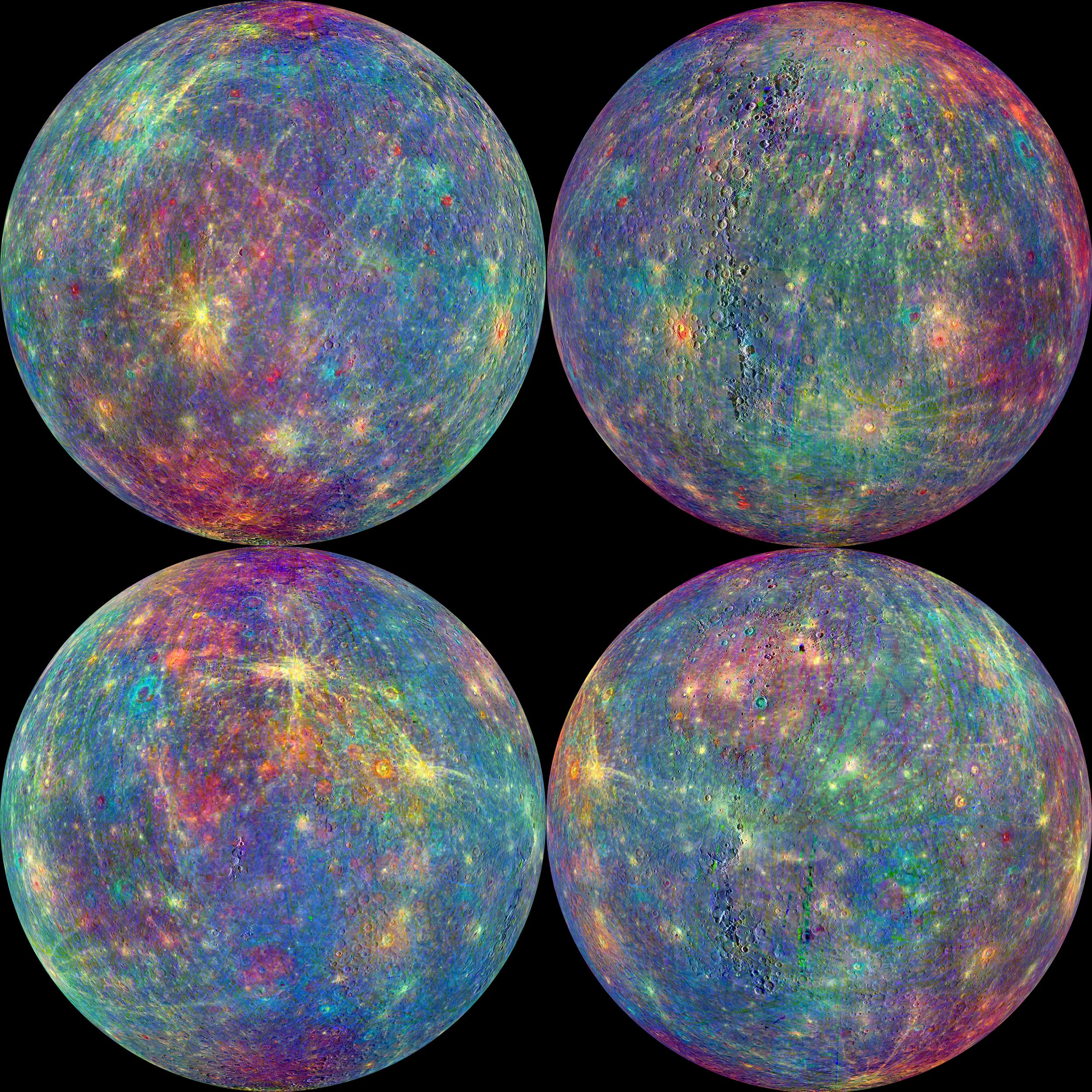
Four views of Mercury with colors based on the mineralogy seen. Credit: NASA/Johns Hopkins University Applied Physics Laboratory/Carnegie Institution of Washington. Click on image to enlarge.
04/29/2015 – Ephemeris – Last look at the bright planets for April
Ephemeris for Wednesday, April 29th. Today the Sun will be up for 14 hours and 8 minutes, setting at 8:45. The Moon, half way from first quarter to full, will set at 4:59 tomorrow morning. Tomorrow the Sun will rise at 6:34.
Lets take a look at the bright planets for this week. Mercury is low in the western sky after sunset. It’s 19 degrees angle from the sun and will set at 10:32. Our brilliant evening star Venus is high in the west by 9:30 p.m. It will set at 12:27 a.m. Jupiter will appear high in the southwestern sky in the evening. It will set at 3:31 a.m. It’s near the sickle-shaped head of Leo the lion, and it’s the second brightest star-like object in the sky after Venus. In telescopes, Jupiter’s moon Europa will pass in front of Jupiter starting at 11:07 p.m. and its shadow will start across at 1:40 a.m.Saturn will rise in the east-southeast at 10:33 p.m. It will be low in the south as morning twilight brightens.
Times are for the Traverse City/Interlochen area of Michigan. They may be different for your location.
Addendum
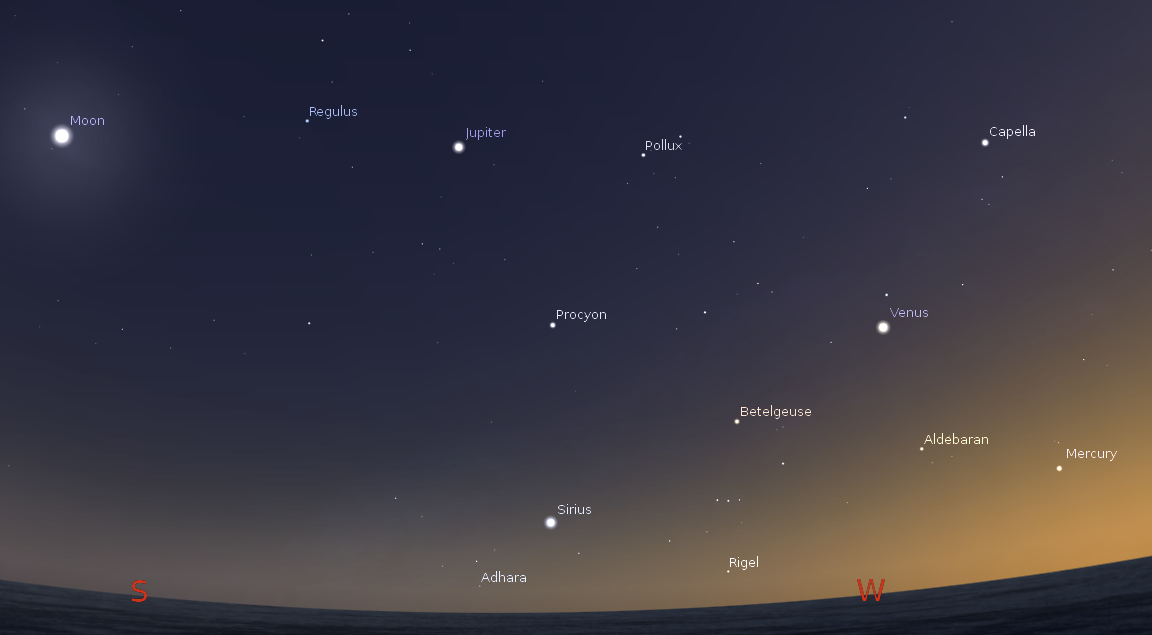
Mercury, Venus, Jupiter and the Moon at 9:30 p.m. April 29, 2015. Created using Stellarium.
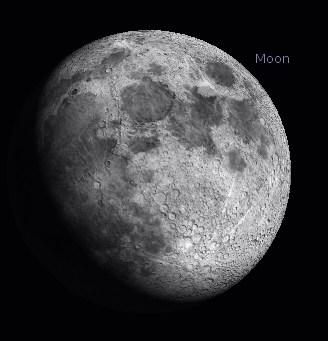
The Moon as it might be seen in binoculars at 10 p.m., April 29, 2015. Created using Stellarium.
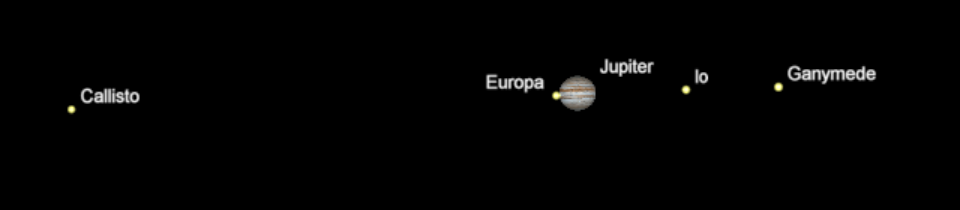
Jupiter at 10:58 p.m. April 29, 2015 with Europa about to transit the planet. Created using Cartes du Ciel (Sky Charts).
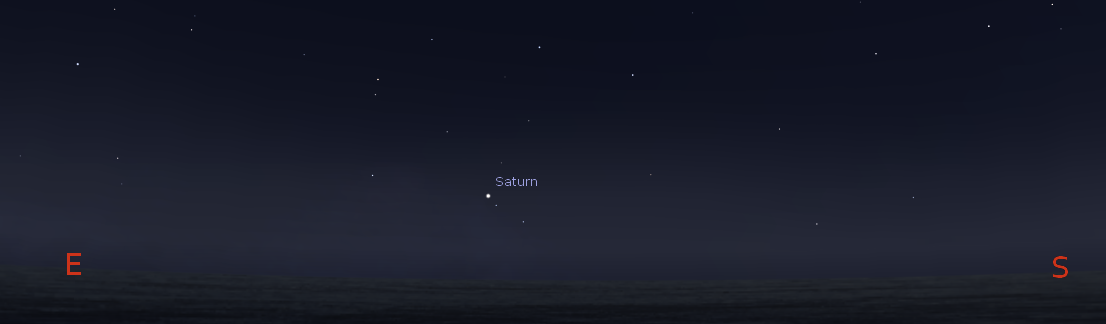
Saturn alone above the southeastern horizon at 11:30 p.m. April 29, 2015. Created using Stellarium.
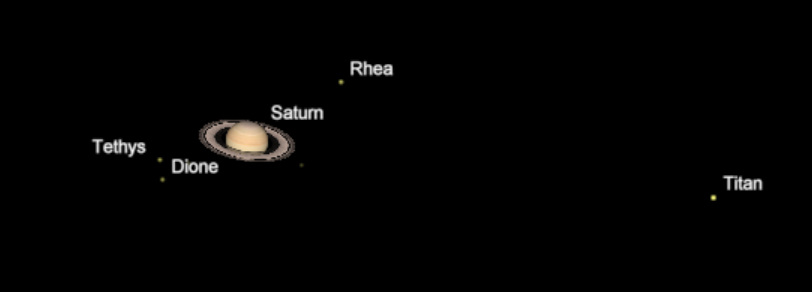
What Saturn and its moons might appear like in a telescope the night of April 29-30, 2015. Small telescopes will show only the moon Titan. Created using Cartes du Ceil (Sky Charts).
04/22/2015 – Ephemeris – All the bright planets are back now
Ephemeris for Earth Day, Wednesday, April 22nd. Today the Sun will be up for 13 hours and 49 minutes, setting at 8:36. The Moon, 3 days before first quarter, will set at 12:55 tomorrow morning. Tomorrow the Sun will rise at 6:45.
Lets take a look at the bright planets for this week. Mars and Mercury are in conjunction, that is close to each other low in the west just after sunset. Mars appears a bit lower and left of the brighter Mercury. Mars will set tonight at 9:47 with Mercury 5 minutes later. Our brilliant evening star Venus is high in the west by 9 p.m. It will set at 12:15 a.m. Jupiter will appear high in the southwestern sky in the evening. It will set at 3:58 a.m. It’s near the sickle-shaped head of Leo the lion, and it’s the second brightest star-like object in the sky after Venus. Saturn will rise in the east-southeast at 11:03 p.m. It will be low in the south at 5 to 6 a.m.
Times are for the Traverse City/Interlochen area of Michigan. They may be different for your location.
Addendum
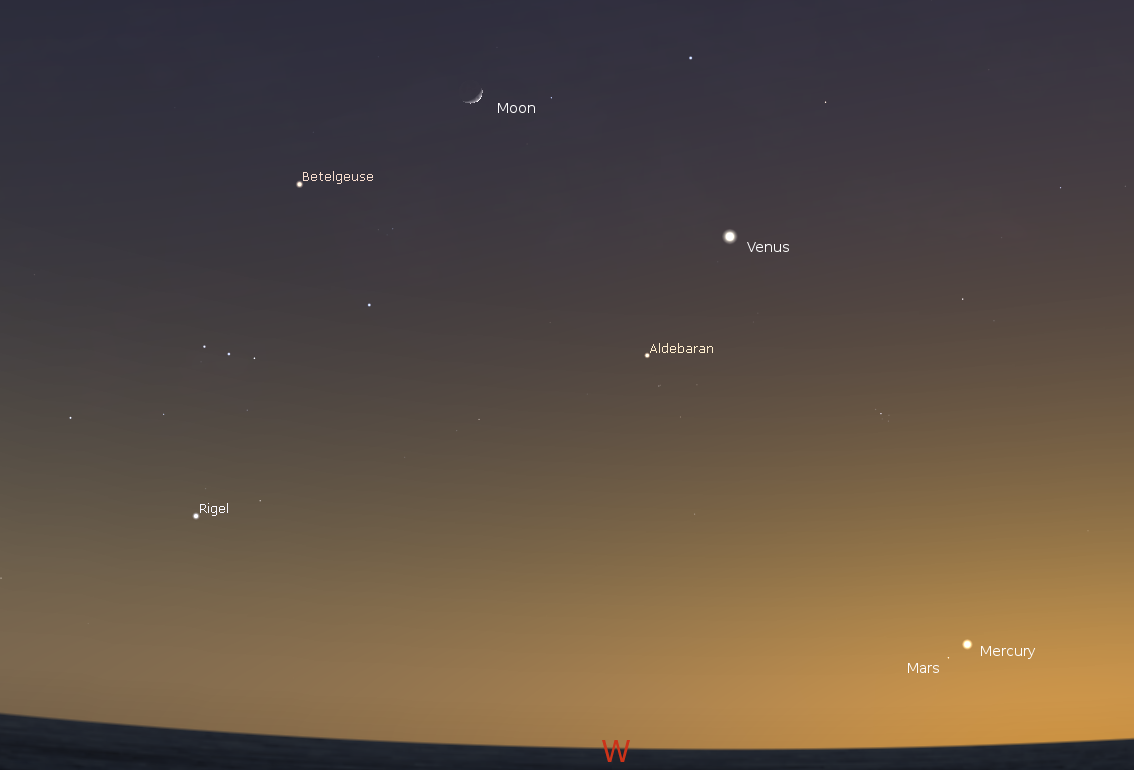
View to the west with Mars, Mercury, Venus and the Moon at 9:15 p.m. April 22, 2015. Created using Stellarium.
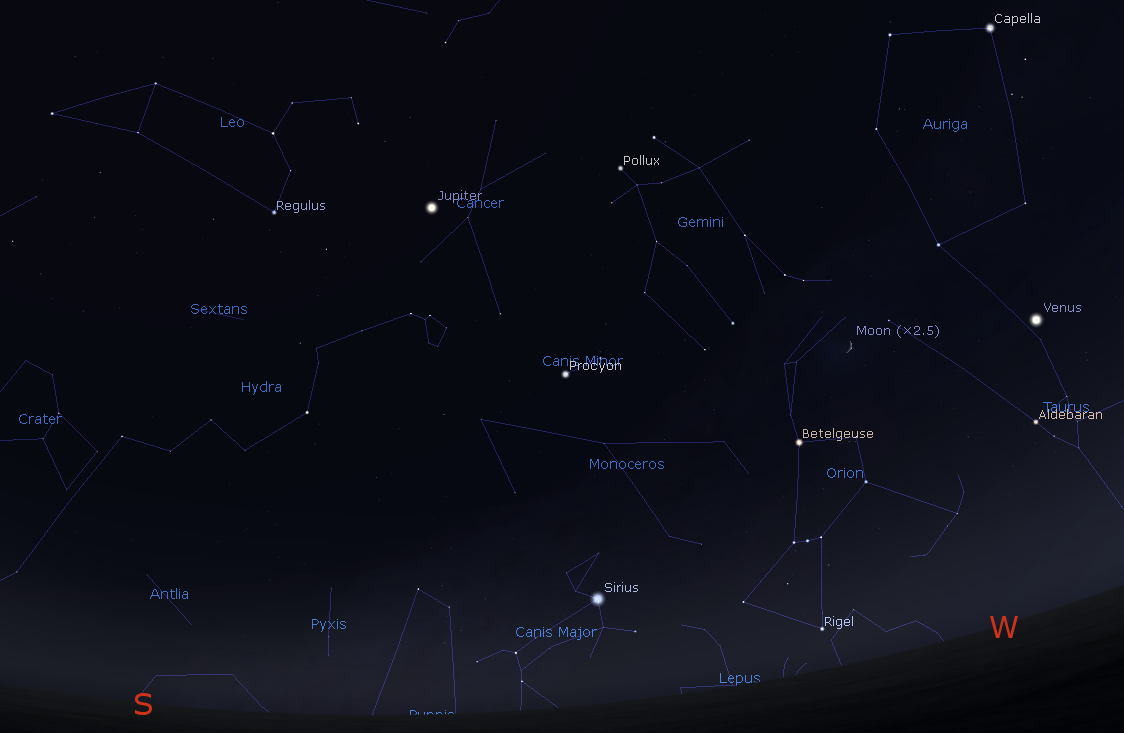
Jupiter, the Moon and the setting winter constellations at 10 p.m. April 22, 2015. Created using Stellarium.
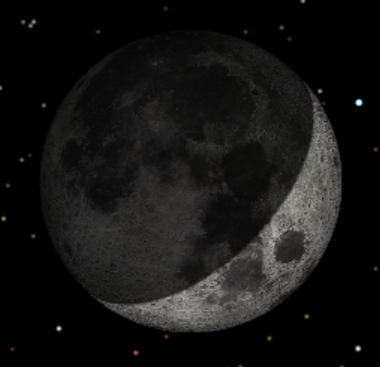
The visibility of the Moon at 10 p.m. on April 22, 2015. Created using Cartes du Ciel (Sky Charts).
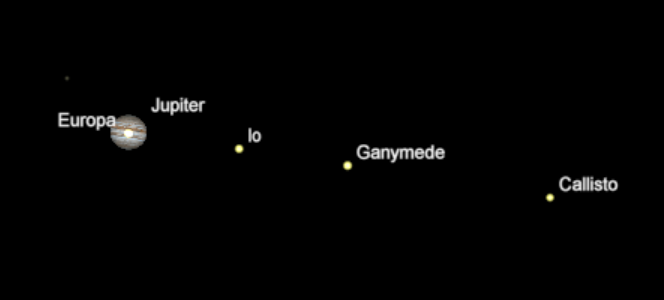
Jupiter and its moons at 10 p.m. Europa will be transiting the face of Jupiter. It’s shadow will start to cross the face of Jupiter at 11:04 p.m.. The transit will end at 11:27 p.m. and the shadow will leave the face of Jupiter at 1:58 a.m. Created using Cartes du Ciel (Sky Charts).
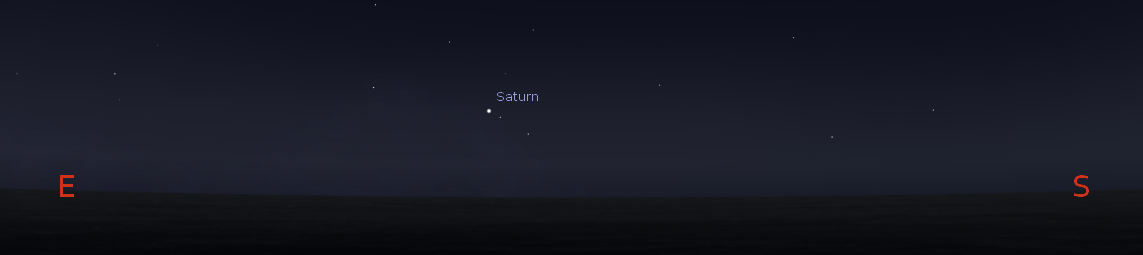
Saturn rising. Shown at midnight, April 22-23 2015. Created using Stellarium.
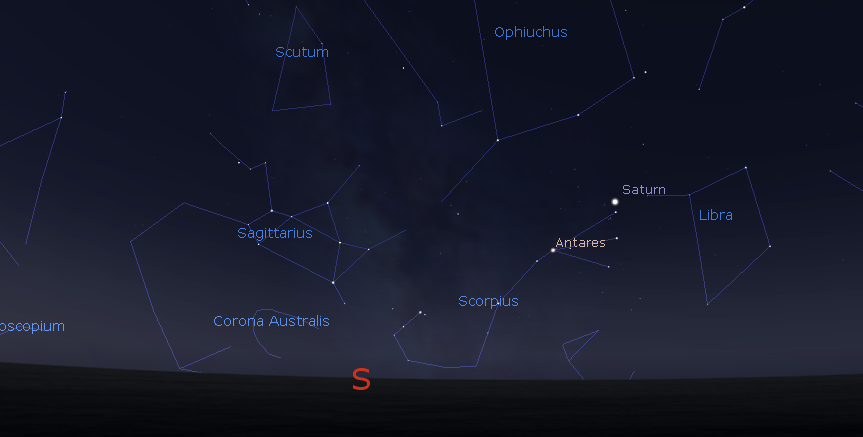
Saturn and the summer constellations at 5:45 a.m. April 23, 2015. Created using Stellarium.
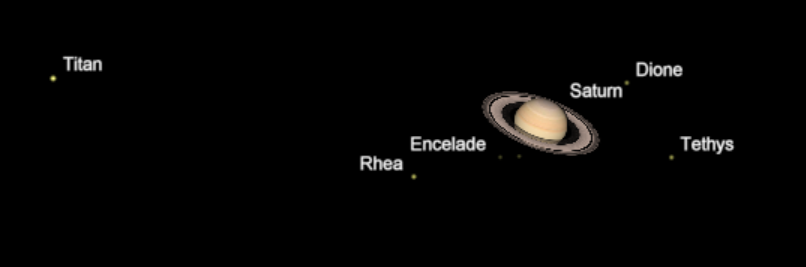
What Saturn and its moons might appear like in a telescope at 5:45 a.m., April 23, 2015. Small telescopes will show only the moon Titan. Created using Cartes du Ceil (Sky Charts).
01/21/2015 – Ephemeris – Our weekly look at the bright planets and a comet
Ephemeris for Wednesday, January 21st. The sun will rise at 8:12. It’ll be up for 9 hours and 23 minutes, setting at 5:35. The moon, 1 day past new, will set at 7:29 this evening.
Lets take a look at the bright planets and a pretty bright comet for this week. Venus and Mercury are close low in the southwest by 6:30 p.m.. Mercury is about 8 moon widths at about 4 o’clock angle from the brighter Venus. Tonight the Noon will be above and between them. Mercury will set at 6:59, while Venus will set at 7:22 p.m. Mars appear above and left of Venus in the southwest, and is in the constellation of Aquarius. The Red Planet will set tonight at 8:41 p.m. Jupiter will rise in the east at 6:59 p.m. It’s near the sickle-shaped head of Leo the lion. Early risers will be able to spot Saturn which will rise in the east-southeast at 3:57 a.m. Comet Lovejoy, visible in binoculars, is a bit more than the width of a fist to the right of the Pleiades.
Times are for the Traverse City/Interlochen area of Michigan. They may be different for your location.
Addendum
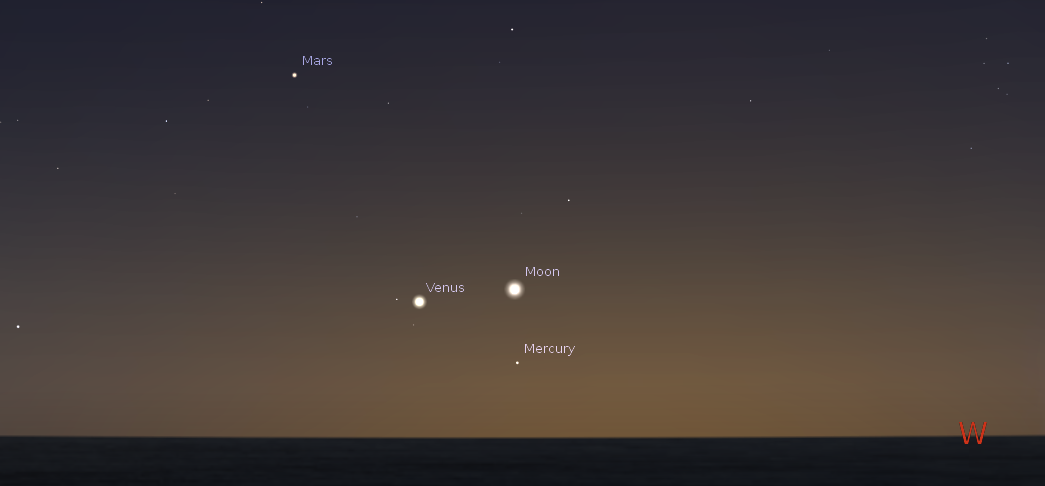
Venus, Mercury and the crescent Moon, which will be a lot dimmer than seen here, with Mars at 6:30 p.m. January 21, 2015. Created using Stellarium.
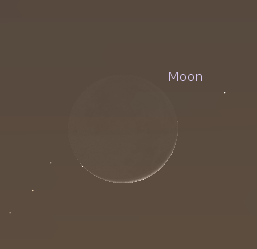
One day old Moon at 6:30 p.m., January 21, 2015. Created using Stellarium.
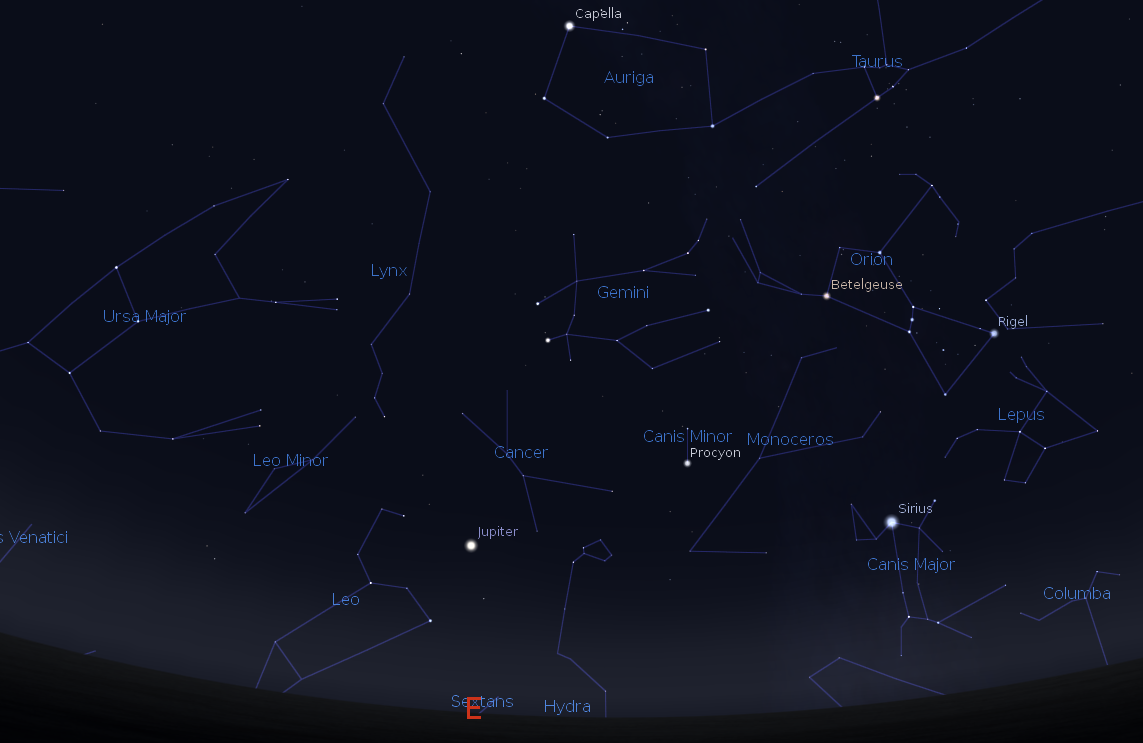
Jupiter and the winter constellations at 9 p.m., January 21, 2015. Created using Stellarium.
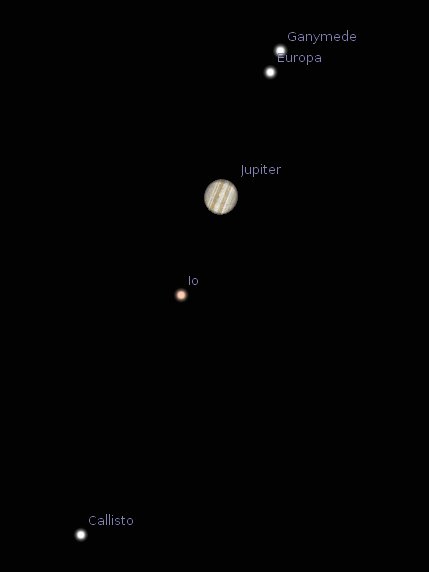
Jupiter and 4 Galilean moons through a telescope. The moon’s aren’t really that bright compared to Jupiter. The time for this observation will be 9 p.m. January 21, 2015. Created using Stellarium.
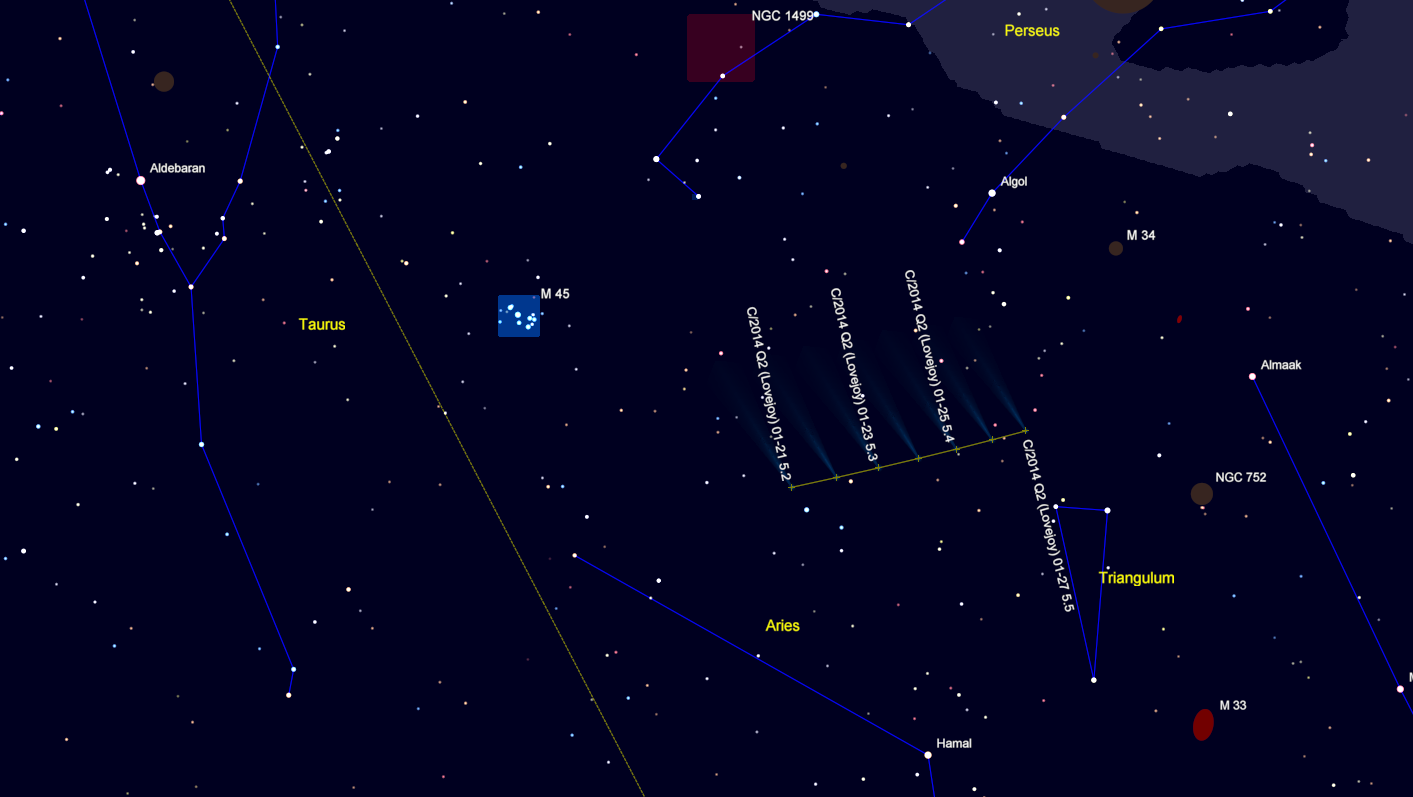
The track of Comet Lovejoy for the next week (from 1/21/2015 to 1/27/2015 at 9 p.m.) Created using Cartes du Ceil (Sky Charts).
What we need in the depths of winter, a preview of the summer stars, 5 months hence, but at 7 a.m. January 22, 2015. Saturn is visible in Scorpius. Created using Stellarium.
Saturn and its moons at 7 a.m., January 22, 2015. Actually only Titan would be visible in small telescopes. Created using Stellarium.

