Archive
01/14/2015 – Ephemeris – Five bright planets and Comet Lovejoy are visible now
Ephemeris for Wednesday, January 14th. The sun will rise at 8:17. It’ll be up for 9 hours and 9 minutes, setting at 5:26. The moon, 1 day past last quarter, will rise at 3:05 tomorrow morning.
Lets take a look at the bright planets and a pretty bright comet for this week. Venus and Mercury are side by side low in the southwest by 6 p.m. Mercury is about 2 and a half moon widths to the right of the much brighter Venus. Mercury will set at 7:02, while Venus will set at 7:03 p.m. Mars is low in the southwest at 7 p.m. and is in the constellation of Aquarius. The Red Planet will set tonight at 8:39 p.m. Jupiter will rise in the east at 7:31 p.m. It’s near the sickle shaped head of Leo the lion. Early risers will be able to spot Saturn which will rise in the east-southeast at 4:21 a.m. Comet Lovejoy, visible in binoculars, makes an equilateral triangle with the V shaped head of Taurus and the Pleiades, to the right of both.
Times are for the Traverse City/Interlochen area of Michigan. They may be different for your location.
Addendum
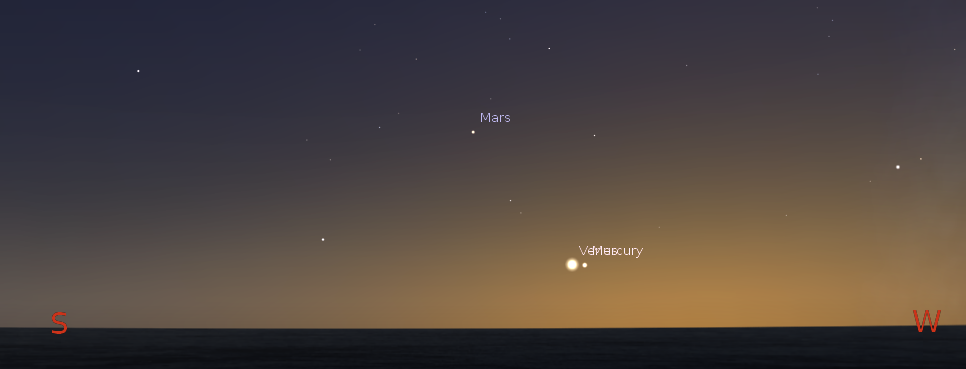
Venus, Mercury and Mars at 6:15 p.m. on January 14, 2015. Note that Mercury is getting dimmer, and Venus is overtaking Mars which is a bit more than a month away. Created using Stellarium.
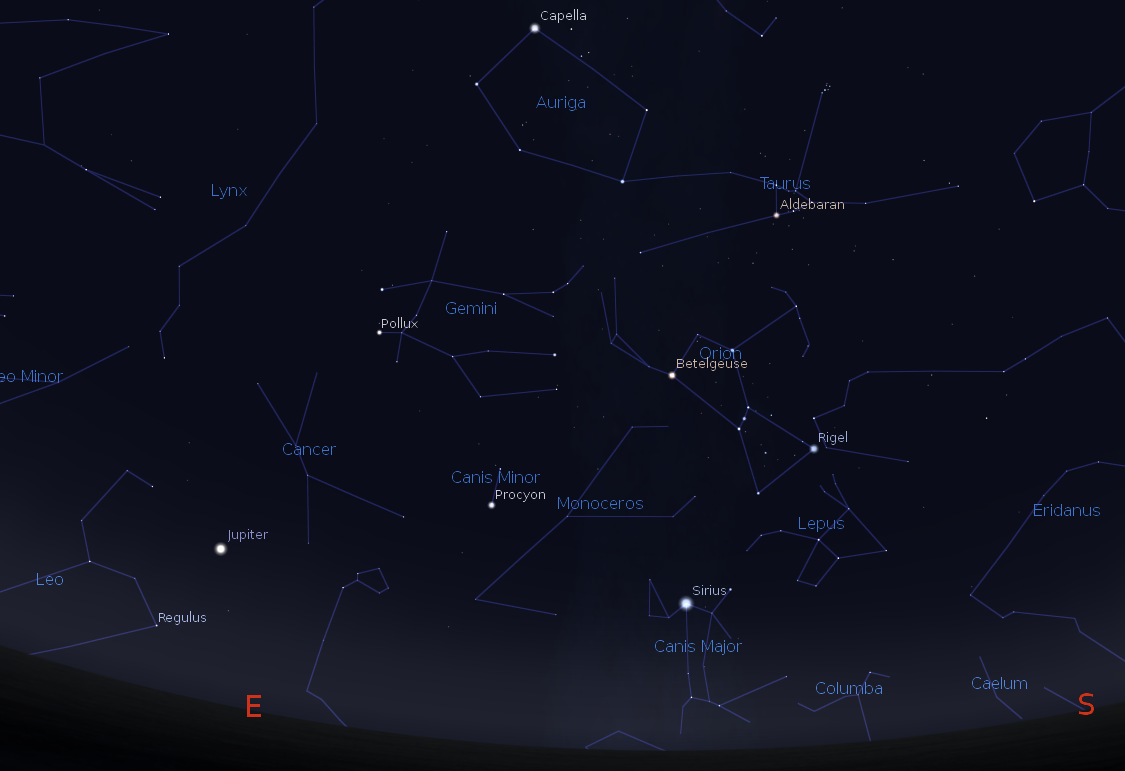
Jupiter and the winter constellations at 9 p.m. on January 14, 2015. Comet Lovejoy is not shown. Created using Stellarium.
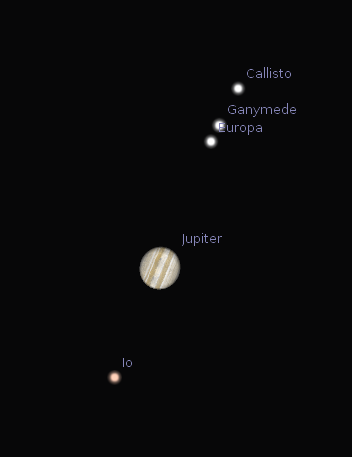
Jupiter and it’s Galilean satellites as seen in a telescope at 9 p.m. on January 14, 2015. Created using Stellarium.
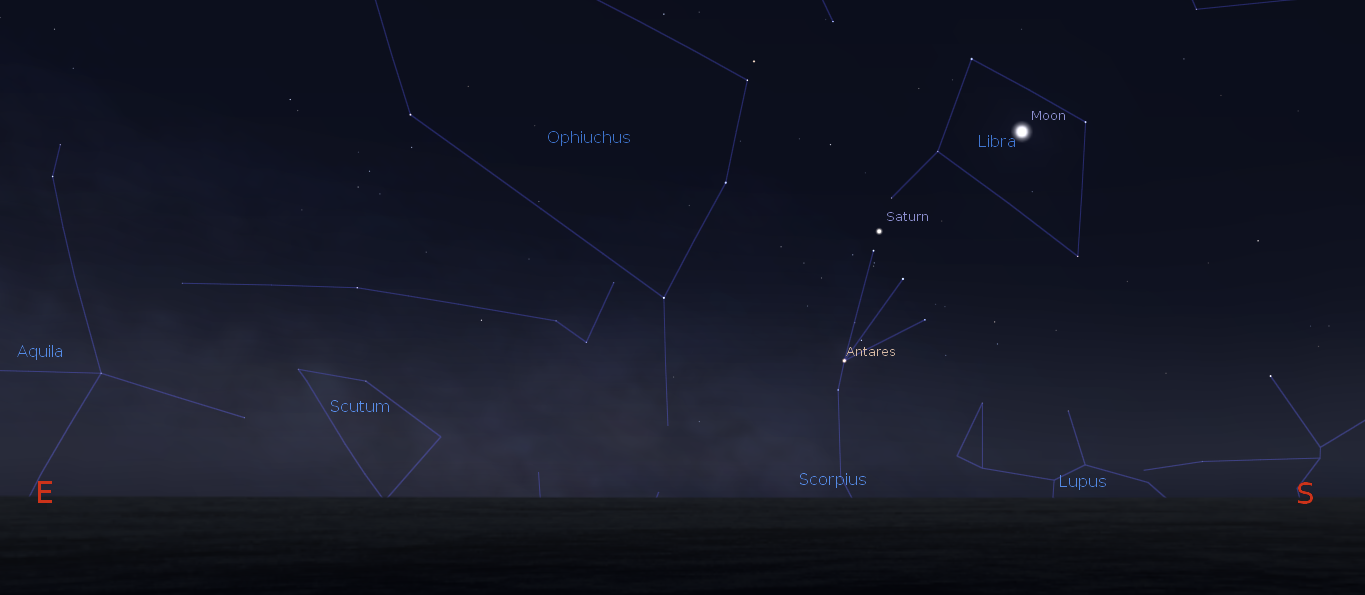
Saturn and the Moon at 7 a.m., January 15, 2015. Created using Stellarium.
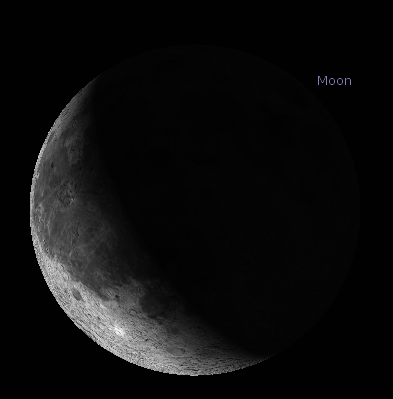
The Moon as it would be seen in binoculars at 7 a.m., January 15, 2015. Created using Stellarium.
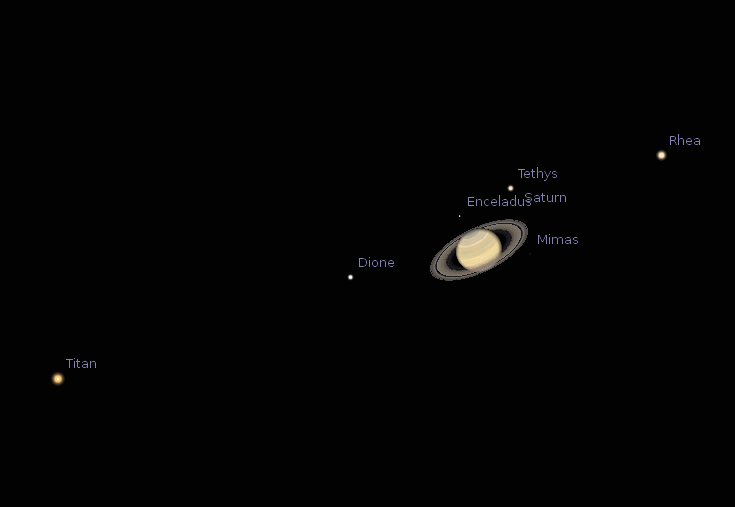
Saturn as seen with a telescope at 7 a.m., January 15, 2015. Titan is visible in most small telescopes. Created using Stellarium.
Comet Lovejoy
We finally had a clear night. Comet Lovejoy was not visible to me to the naked eye last night. But I thing an observer far from city lights and perfectly dark adapted might be able to spot it. It was a great sight in 10X50 binoculars. it was a bright featureless round blob of light. I couldn’t spot a tail, which I expected. My friend Scott Anttila, an excellent astrophotographer unfortunately has moved down to the Detroit area and is hindered by the lights down there. However he was able to get this image of the comet sans tail. But the green color of the come shows wonderfully. Unfortunately our eyes don’t register color at low light levels.
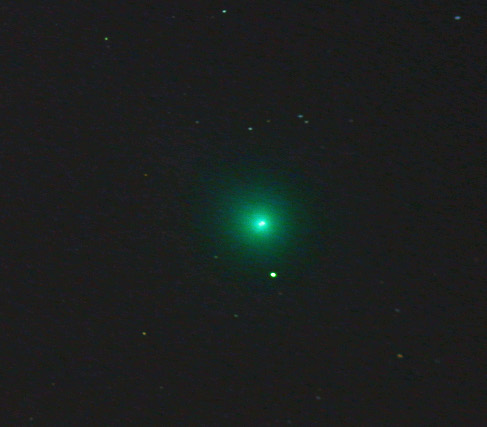
Scott Anttila’s photo of Comet Lovejoy from the light polluted skies of the Detroit area.
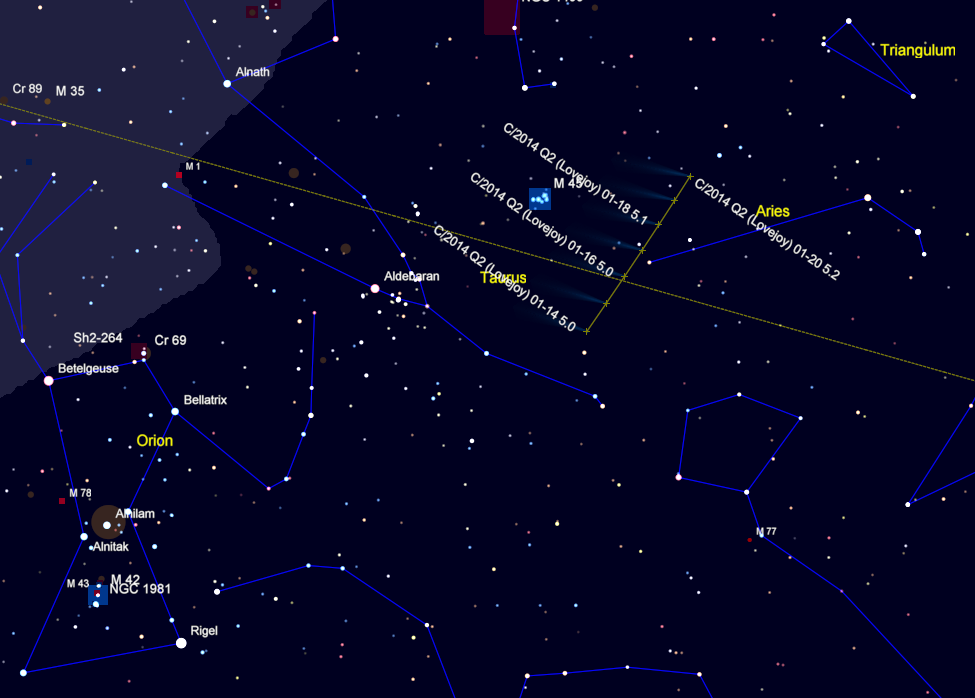
The track of Comet Lovejoy for the next week (from 1/14/2015 to 1/20/2015 at 9 p.m.) Created using Cartes du Ceil (Sky Charts).
01/09/2015 – Ephemeris – Tomorrow Mercury almost makes a conjunction with Venus but falls back
Ephemeris for Friday, January 9th. The sun will rise at 8:19. It’ll be up for 9 hours and 1 minute, setting at 5:20. The Moon, 4 days before last quarter, will rise at 10:06 this evening.
Low in the southwest just after sunset, say around 6 to 6:15 in the evening Venus and Mercury can be seen seeming to flirt with one another. Venus has been moving away from the Sun in the evening sky for a couple of month’s not, but hasn’t been all that visible. Mercury, named after the messenger of the gods is fleet of orbit and is almost about to catch up with Venus. Except it can’t, not this time. Tomorrow evening Mercury will appear closest to Venus about 0.6 angular degrees away, a bit more than the width of the Moon. So for another day the two planets will appear close. But after tomorrow night they will separate with Mercury not able to keep up. Next Tuesday it will reach its greatest elongation or separation from the sun and fall back.
Times are for the Traverse City/Interlochen area of Michigan. They may be different for your location.
Addendum
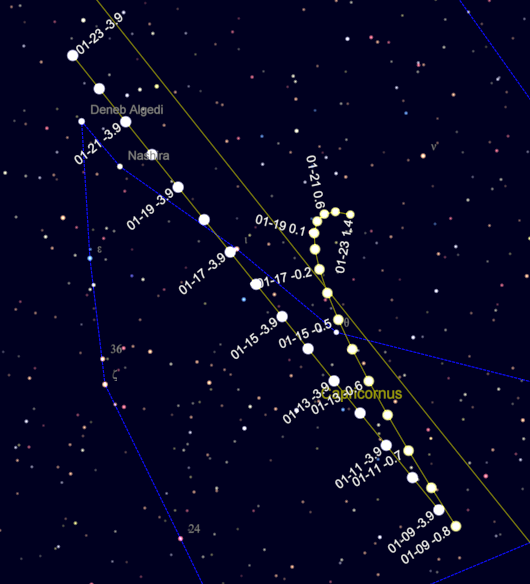
Venus, the straight track, and Mercury are shown for every evening from yesterday 1/08/15 to 01/23/15. The planets are marked for every night at 6 p.m. and tagged every other day. with month-day and magnitude. The higher the magnitude value the dimmer it is. Created using Cartes du Ceil (Sky Charts).
01/08/2015 – Ephemeris -Venus and Mercury quasi-conjunction Saturday – I
Ephemeris for Thursday, January 8th. The sun will rise at 8:19. It’ll be up for 9 hours even, setting at 5:19. The moon, 4 days past full, will rise at 9:08 this evening.
The planets Venus and Mercury are closing their positions in the southwest in the early evening. They will appear their closest Saturday. For the last few years these two planets without natural satellites have hosted an artificial satellite each. Venus is orbited by the European Space Agency’s Venus Express spacecraft since 2006. Just a few weeks ago it’s fuel tanks ran dry, so it could no longer point its solar panels toward the sun and antenna toward the earth. It will soon plunge into Venus’ thick atmosphere. A like fate will also befall the MESSENGER spacecraft now orbiting close to Mercury. It took 7 years to get to Mercury and so far orbited it for nearly 4 years. It too is running out of fuel and will soon crash on the planet.
Times are for the Traverse City/Interlochen area of Michigan. They may be different for your location.
Addendum
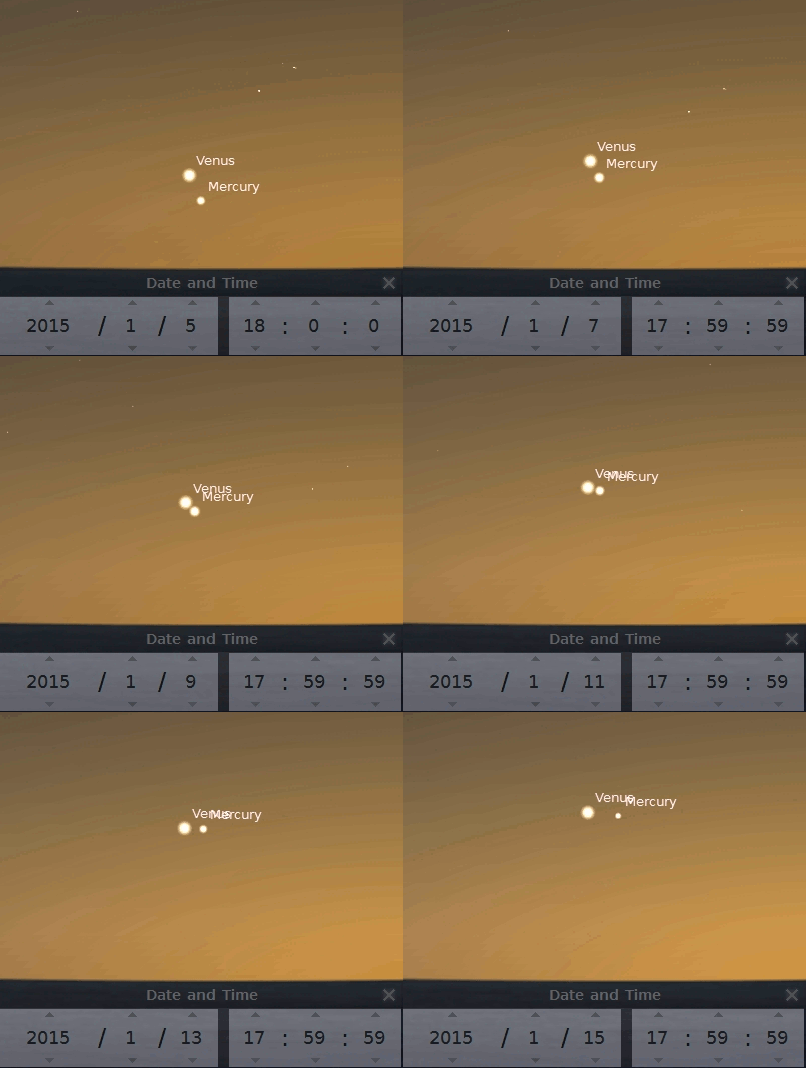
Animation of the Quasi-conjunction of Venus and Mercury. Time span 1/05/2015 to 1/15/2015 at 7 p.m. Created by Bob Moler using Stellarium and GIMP.
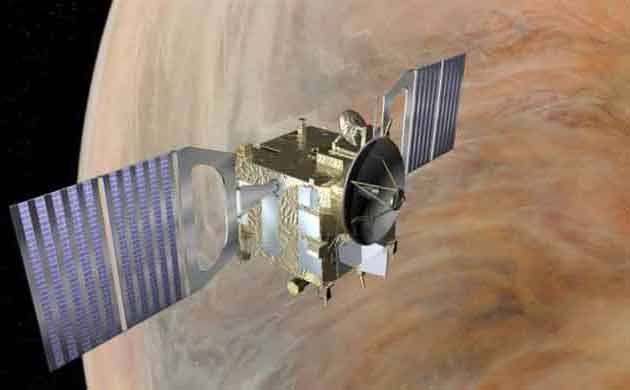
Artist rendition of Venus Express at Venus. Credit: ESA/AP.
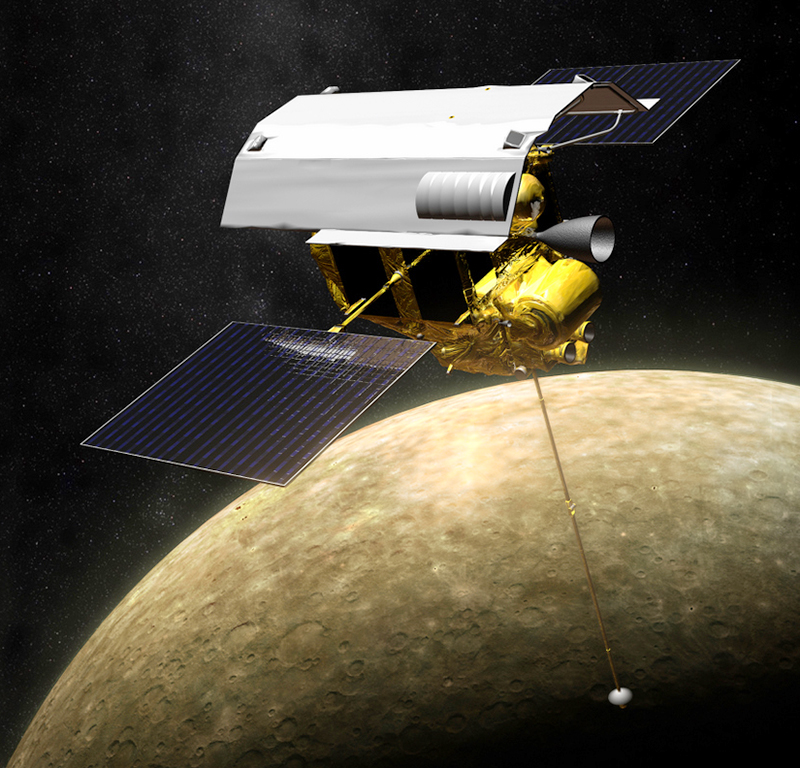
MESSENGER spacecraft at Mercury an artist’s concept. Credit NASA/JPL/APL.
01/07/2015 – Ephemeris – Lets take our first looks at the bright planets and a pretty bright comet
Ephemeris for Wednesday, January 7th. The sun will rise at 8:19. It’ll be up for 8 hours and 59 minutes, setting at 5:18. The moon, 3 days past full, will rise at 8:10 this evening.
Lets take our first look at the bright planets for 2015. Mercury is visible below right of Venus by about 2 moon widths low in the southwest shortly after sunset. On Saturday Mercury will be its closest to Venus. Mercury will set at 6:38, while Venus will set at 6:44 p.m. They will be visible low in the southwestern twilight by 6 p.m. Mars is low in the southwest at 7 p.m. and is in the constellation of Capricornus and will cross the boundary into Aquarius tomorrow. The Red Planet will set tonight at 8:37 p.m. Jupiter will rise in the east at 8:02 p.m. It’s near the sickle-shaped head of Leo the lion. Early risers will be able to spot Saturn which will rise in the east-southeast at 4:46 a.m. On the 18th it will cross the border from Libra to Scorpius.
Times are for the Traverse City/Interlochen area of Michigan. They may be different for your location.
Addendum
Animation of the Quasi-conjunction of Venus and Mercury. Time span 1/05/2015 to 1/15/2015 at 7 p.m. Created by Bob Moler using Stellarium and GIMP.
Note that Mercury gets dimmer as the days go by. This is because its phase moves from gibbous to half illuminated on the 14th at its greatest elongation from the Sun.
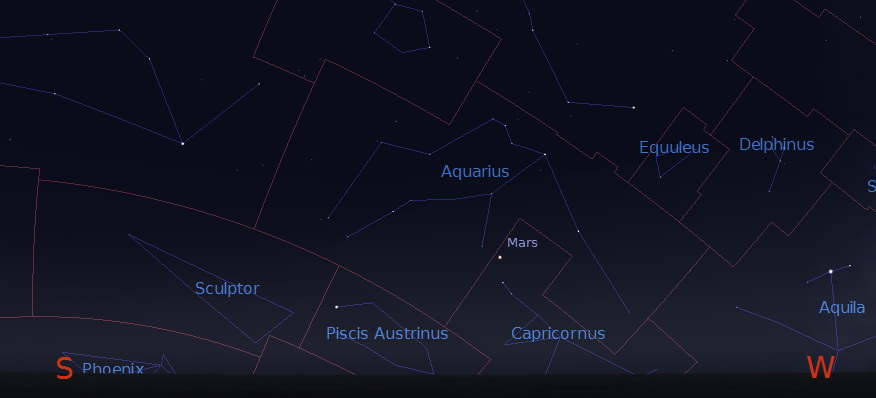
Mars and the setting constellations, with constellation boundaries in red. at 7 p.m. on January 7, 2015. Created using Stellarium.
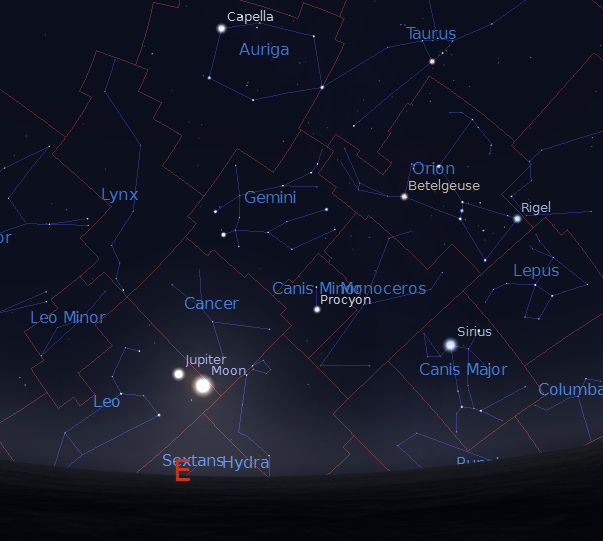
Jupiter, the Moon and the winter constellations at 10 p.m. on January 7, 2015. Created using Stellarium.
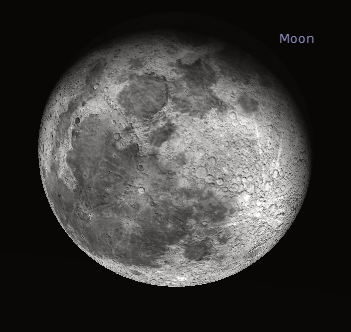
The Moon as seen through binoculars at 10 p.m. on January 7, 2015. Created using Stellarium.
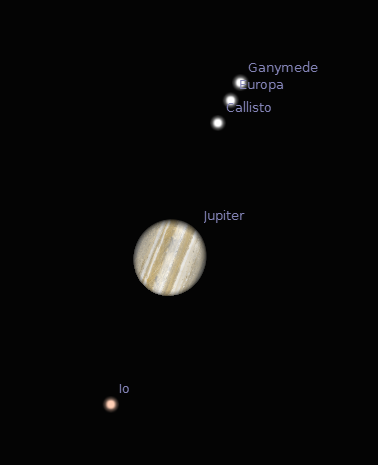
Jupiter and its satellites as seen through a telescope at 10 p.m. on January 7, 2015. Created using Stellarium.
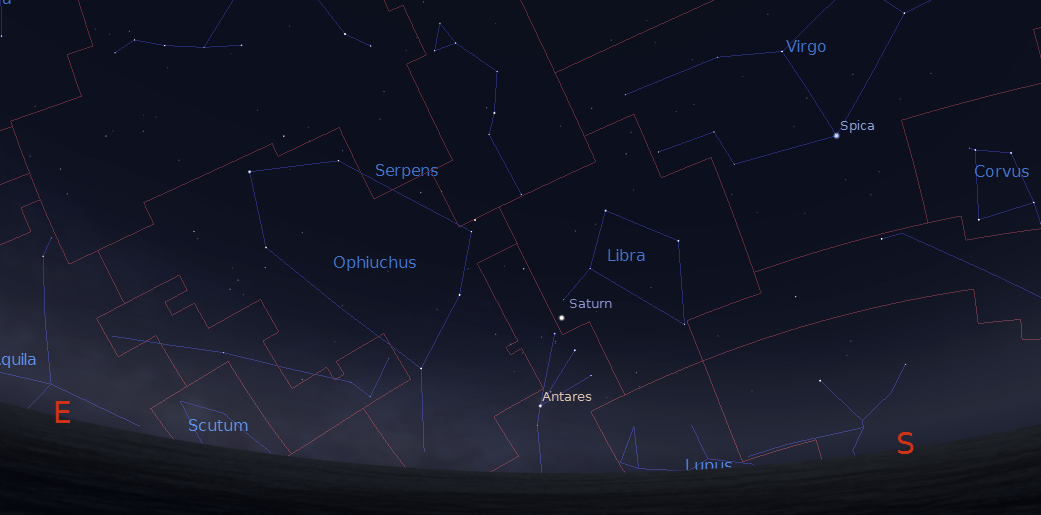
Saturn and the spring constellations at 7 p.m. on January 8, 2015. Created using Stellarium.
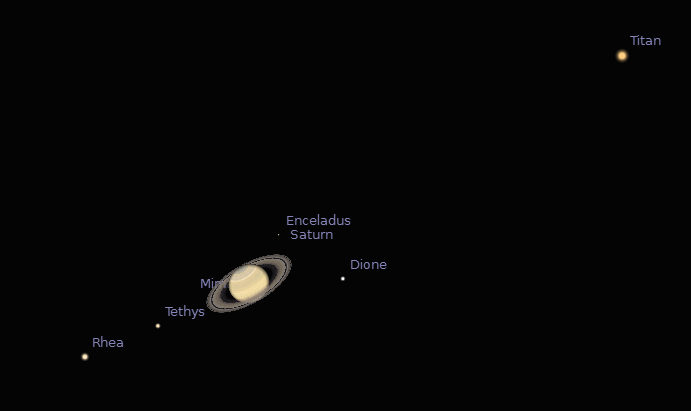
Saturn and satellites through a telescope at 7 a.m. January 8, 2015. Note that the moons other than Titan will be difficult to spot. Created using Stellarium.
Comet C/2014 Q2 (Lovejoy)
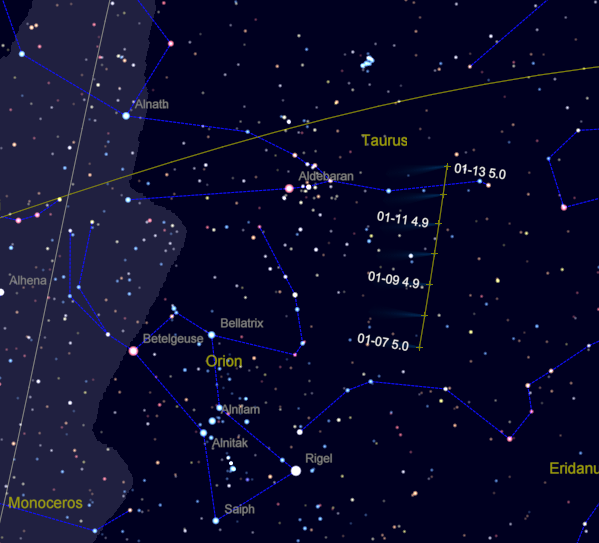
Comet Lovejoy track for January 7 to January 13, 2015. Despite the magnitudes being less than 6, binoculars will, most likely, be needed to spot it. Every other day is marked with month-day and magnitude of the comet.
01/01/2015 – Ephemeris – Happy New Year – a look at January
Ephemeris for New Years Day, Thursday, January 1st. The sun will rise at 8:20. It’ll be up for 8 hours and 52 minutes, setting at 5:12. The moon, 3 days before full, will set at 5:43 tomorrow morning.
Happy New Year. Let’s preview the month of January. We’re a day from the latest sunrise at about the same time as today, 8:20 a.m. and will back down to 8:02 by the 31st. Sunset times are currently increasing by a minute a day from 5:12 p.m. today to 5:49 at month’s end. Listeners near the shore of Lake Michigan will have about the same sunrise time in Ludington, Interlochen/Traverse City, Petoskey and Mackinaw City, but the sunset times will vary markedly. The Quadrantid meteor shower whose radiant is near the end of the Big Dipper’s handle will reach peak on the 3rd, but it will have interference from the full moon,. On the 4th the Earth will be its closest to the sun of the entire year.
Times are for the Traverse City/Interlochen area of Michigan. They may be different for your location.
Addenda
Monthly Star Chart
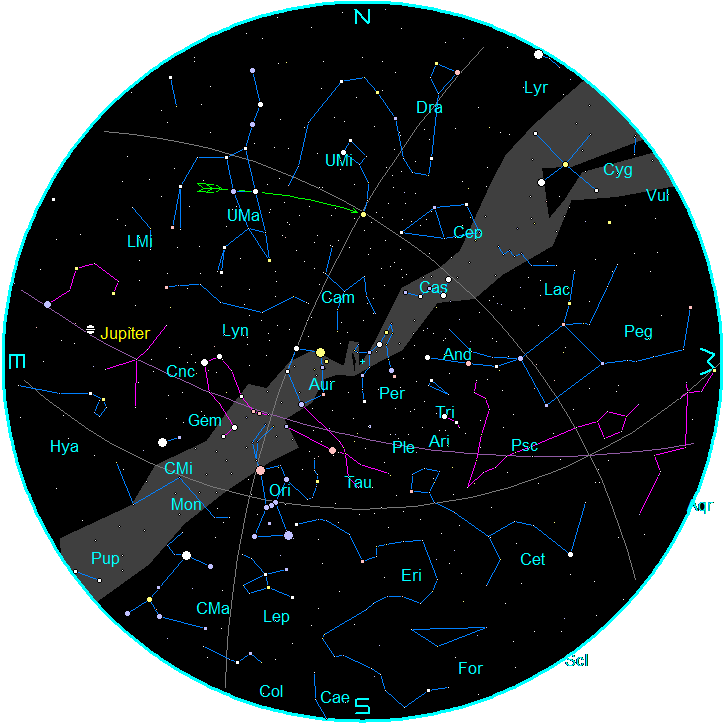
Star Chart for January 2015. Created using my LookingUp program.
The Moon is not plotted. The planets and stars are plotted for the 15th at 9 p.m. That is chart time.
Evening astronomical twilight ends at 6:58 p.m. on January 1st, and increasing to 7:30 p.m. on the 31st.
Morning astronomical twilight starts at 6:34 a.m. on January 1st, and decreasing to 6:22 a.m. on the 31st.
Add a half hour to the chart time every week before the 15th and subtract and hour for every week after the 15th.
For a list of constellation names to go with the abbreviations click here.
The green pointer from the Big Dipper is the pointer stars at the front of the bowl of the Big Dipper that point to Polaris the North Star.
The Quadrantid meteor shower
The moon will interfere with the meteor shower, so only the brightest will be visible. The radiant will rise from the northeast. The radiant will be nearly overhead at the start of twilight. On a dark night up to 120 meteors per hour may be seen according to the International Meteor Organization.
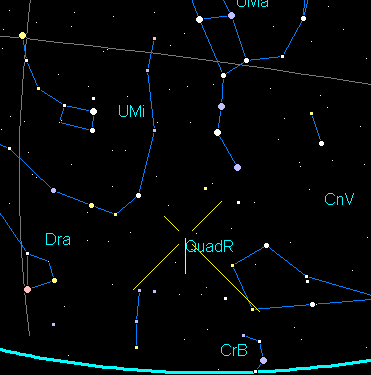
Quadrantid meteor shower radiant at 1:30 a.m.
The Earth at Perihelion
This is the closest the Earth gets to the Sun in its orbit this year. The Sun will be 91,402,000 miles or 147,096,000 kilometers away at around 1 a.m. January 4th, 2015 EST or 6 hr UT January 5th 2015. It makes winter the shortest season because the Earth is moving its fastest during perihelion. It’s only by a few days. And in northern Michigan where it seems that winter overlaps half of fall and spring besides, that few days difference is buried under snow.
Quasi-conjunction between Venus and Mercury on the evening of January 10th.
A quasi-conjunction. Conjunctions occur when two solar system bodies have the same right ascension. Mercury will get to within 0.6 degrees of Venus before retreating back sun-ward.
Animation of the Quasi-conjunction of Venus and Mercury. Time span 1/05/2015 to 1/15/2015 at 7 p.m. Created by Bob Moler using Stellarium and GIMP.
Comet C/2014 Q2 (Lovejoy)
Here is a finder chart for 9 p.m. for January. Every other position is marked with the month-day and predicted magnitude. Recently the comet has shown to be brighter than predicted by up to one magnitude. Note that magnitudes in astronomy are like golf scores – the lower the number, the brighter the object. So the comet should reach 4th magnitude.
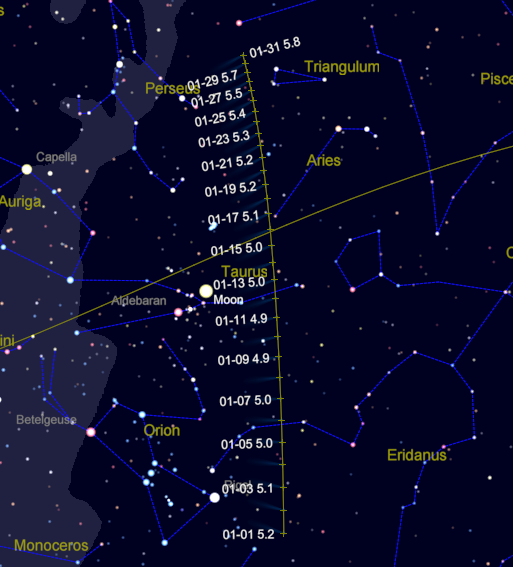
Nightly plot of Comet Lovejoy (C/2014 Q2) for the month of January, 2015 at 9 p.m.
Created using Cartes du Ceil (Sky Charts).
12/31/2014 – Ephemeris – A New Year’s look at the bright planets and a comet
Ephemeris for New Years Eve, Wednesday, December 31st. The sun will rise at 8:19. It’ll be up for 8 hours and 52 minutes, setting at 5:11. The moon, 3 days past first quarter, will set at 4:42 tomorrow morning.
Lets take a last look at the bright planets for 2014. Mercury joins Venus low in the southwest. It will be below and right of Venus and will set at 6:07 p.m. Venus is low in the southwest shortly after sunset. It now sets at 6:26 p.m., an hour and 15 minutes after the sun. It will be seen low in the southwestern twilight by 5:55 p.m. Mars is low in the southwest at 7 p.m. and is in the constellation of Capricornus. The Red Planet will set tonight at 8:36 p.m. Jupiter will rise in the east at 8:33 p.m. It’s near the sickle-shaped head of Leo. Jupiter is now moving slowly westward. This is an effect that happens because the Earth is passing Jupiter, a motion shared by all the planets that baffled the ancients who thought the Earth to be motionless. Early risers will be able to spot Saturn which will rise in the east-southeast at 5:10 a.m.
Times are for the Traverse City/Interlochen area of Michigan. They may be different for your location.
Addendum
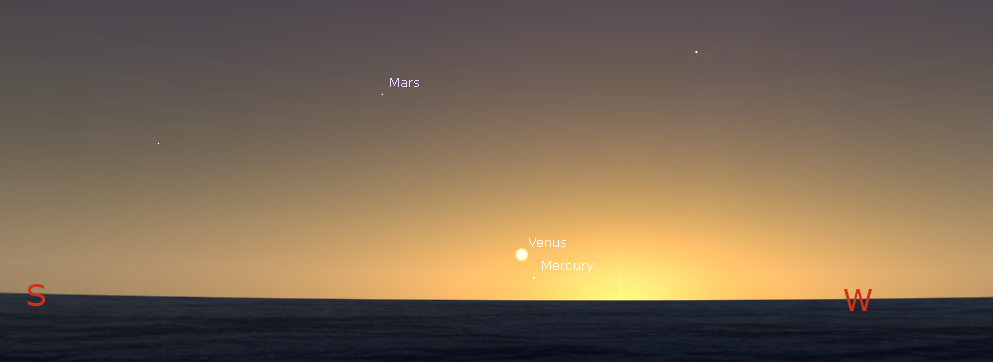
Mercury, Venus and Mars are seen in the southwestern sky shortly after sunset. In this case 5:45 p.m. December 31, 2014, only 34 minutes after sunset. Created using Stellarium.
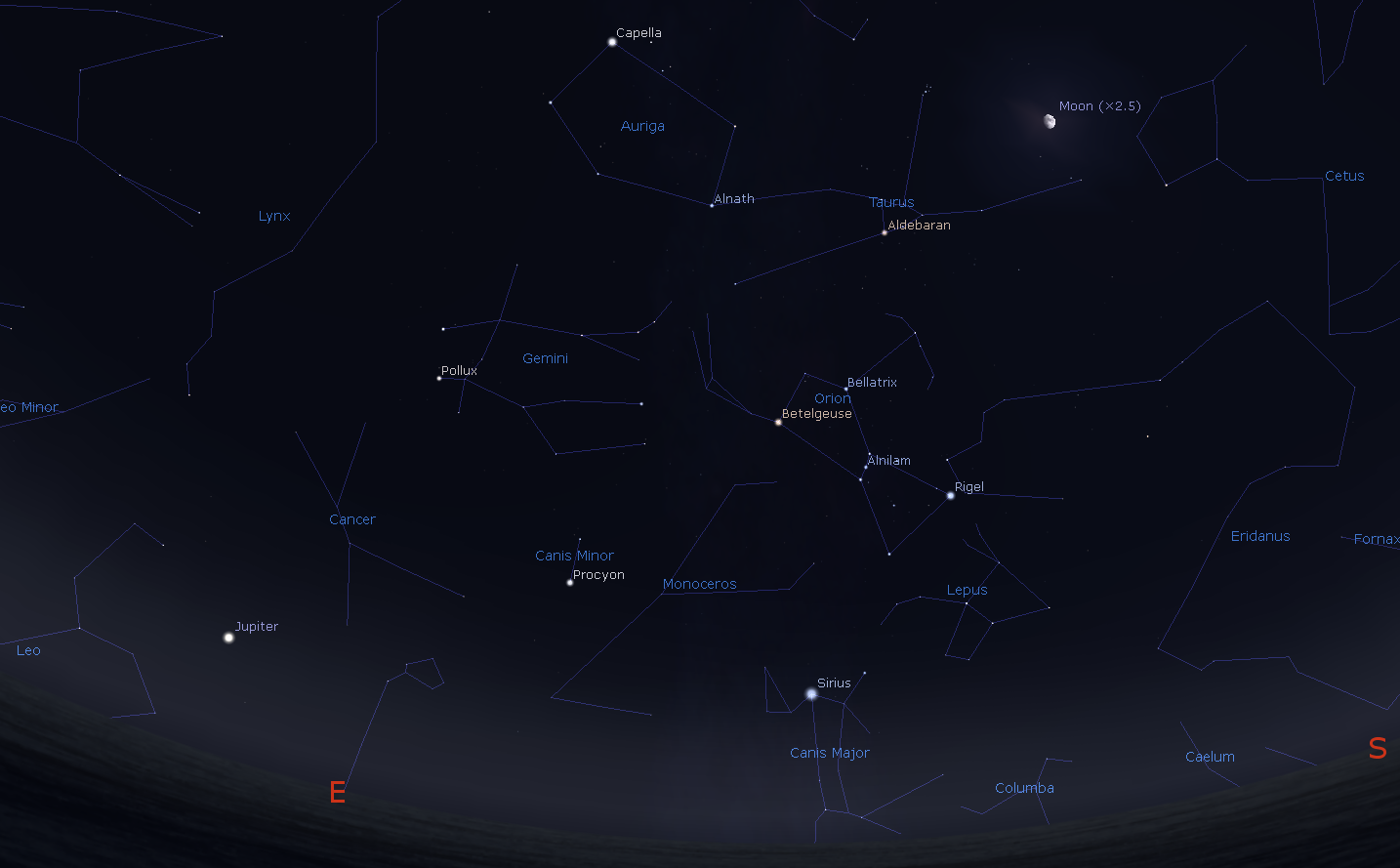
Jupiter, the Moon and the winter constellations at 9:30 p.m. December 31, 2014. Created using Stellarium.
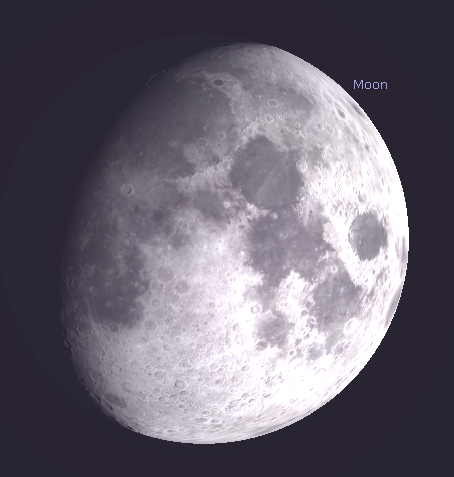
The Moon as it will appear in binoculars at 9:30 p.m. December 31, 2014. Created using Stellarium.
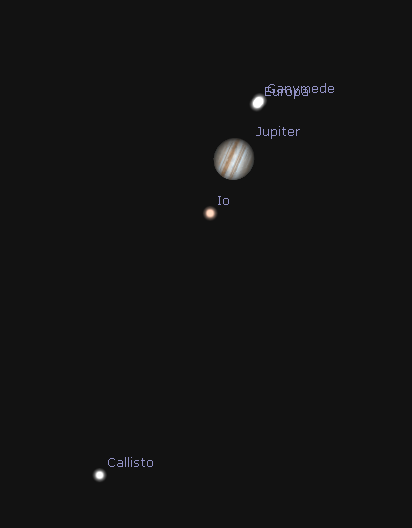
Jupiter seen through a telescope at 9:30 p.m. December 31, 2014. Note that Ganymede and Europa will appear very close to each other. Created using Stellarium.
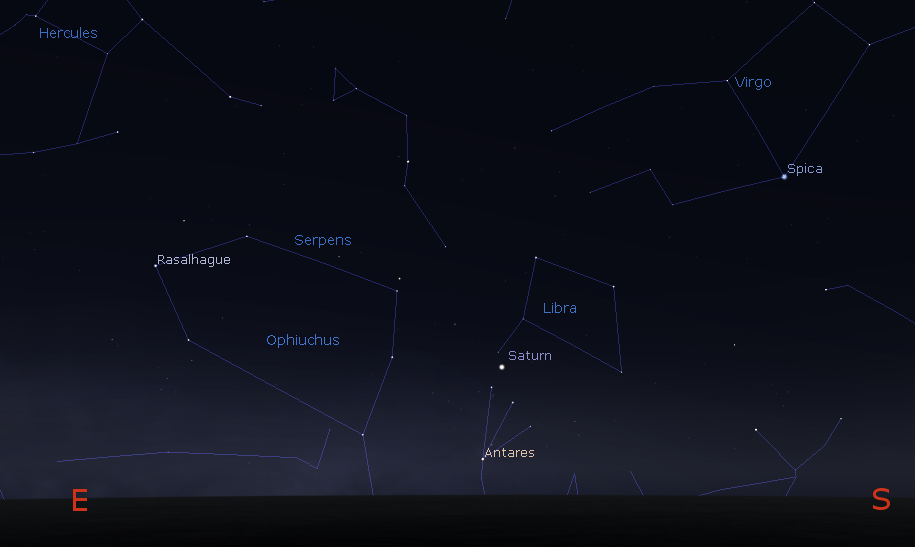
Saturn and the late spring and early summer constellations at 7 a.m. New Year’s Day 2015. Created using Stellarium.
Comet Lovejoy
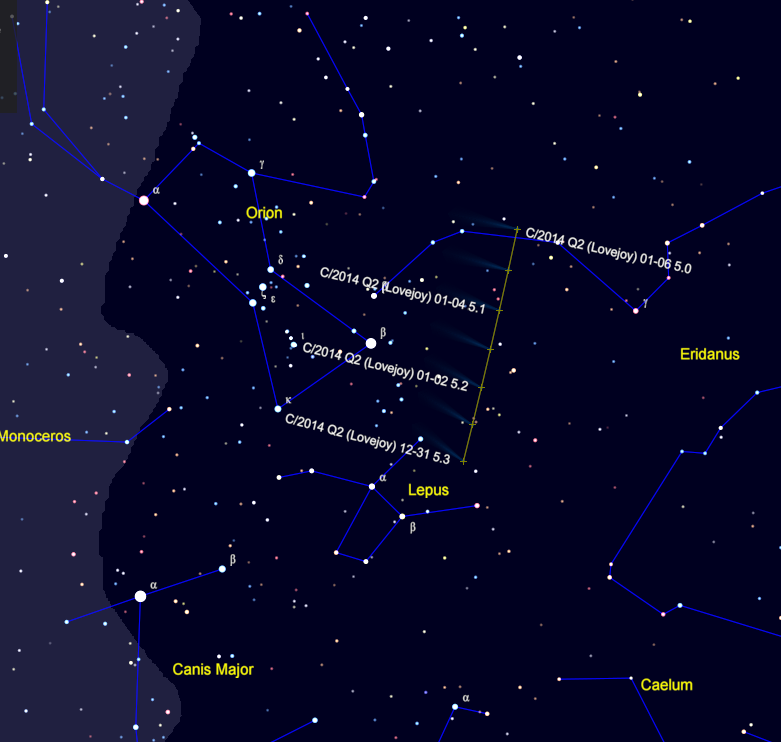
Comet Lovejoy (C/2014 Q2) plotted for 9 p.m. from 12/31/2014 to 1/06/2015. Created using Cartes du Ceil (Sky Charts).
12/03/2014 – Ephemeris – Bright planets: One early and one late
Ephemeris for Wednesday, December 3rd. The sun will rise at 8:01. It’ll be up for 9 hours and 1 minute, setting at 5:03. The moon, 3 days before full, will set at 5:48 tomorrow morning.
In reviewing which planets are visible tonight, it looks like we’re still down to two. Venus, Saturn and Mercury are hanging around near the direction of the Sun. It will be a little while before we see them again. However we can see Mars, which will be low in the southwest at 7 p.m. It will set at 8:29 p.m. Mars’ setting time will slowly advance only 6 minutes between now and the end of the year. Jupiter will rise at 10:28 p.m. in the east-northeast. The best telescopic views will have to wait a couple of hours after that. So if you’re more of an early bird rather than a night owl it might be better to view Jupiter with a telescope in the morning. Jupiter has those four bright moons that change position daily, and sometimes while you watch.
Times are for the Traverse City/Interlochen area of Michigan. They may be different for your location.
Addendum
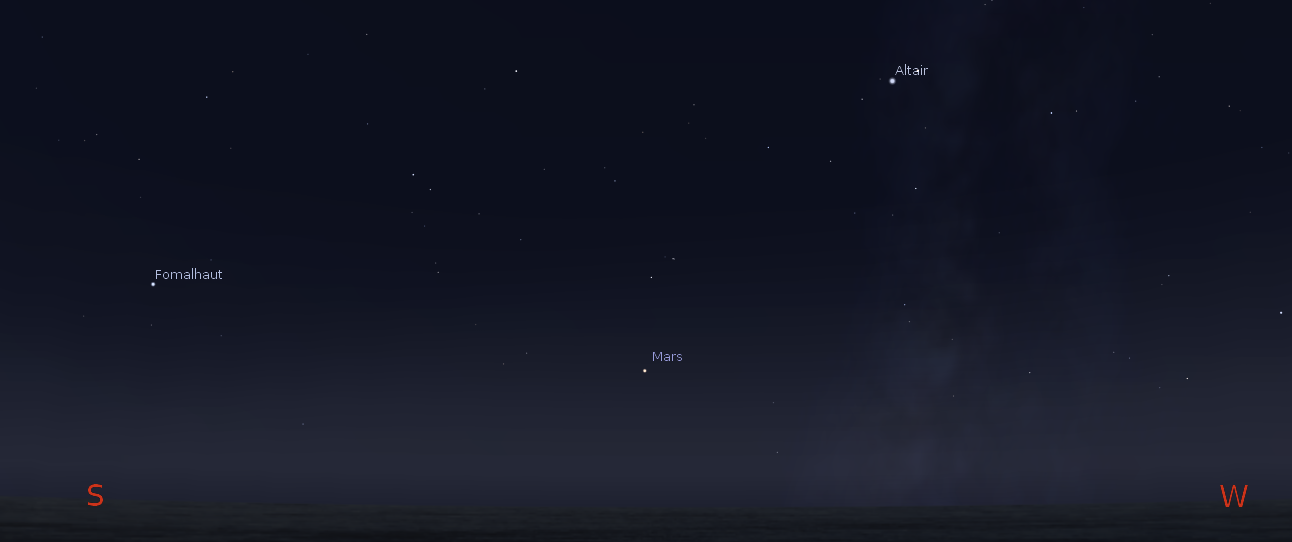
Mars in the southwest at 7 p.m. December 3, 2014. Created using Stellarium.
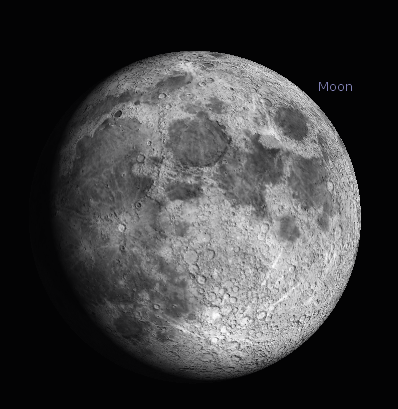
A binocular view of what the moon will look like at 7 p.m. December 3, 2014. Created using Stellarium.
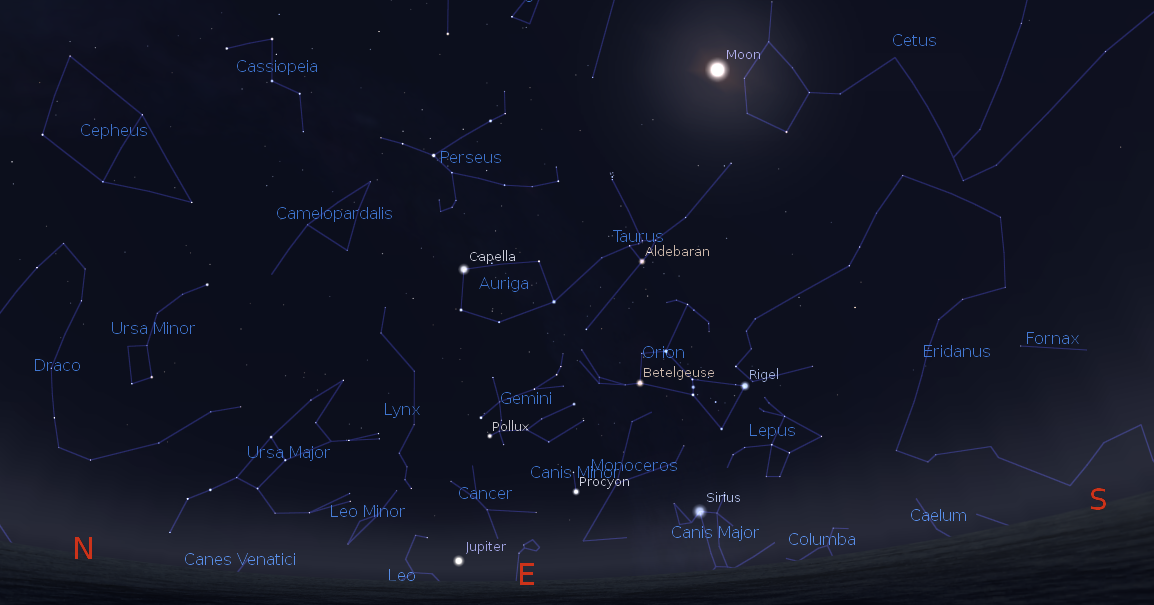
Jupiter rising with the winter constellations at 11 p.m., December 3, 2014. We’re actually looking at the eastern half of the sky. Created using Stellarium.
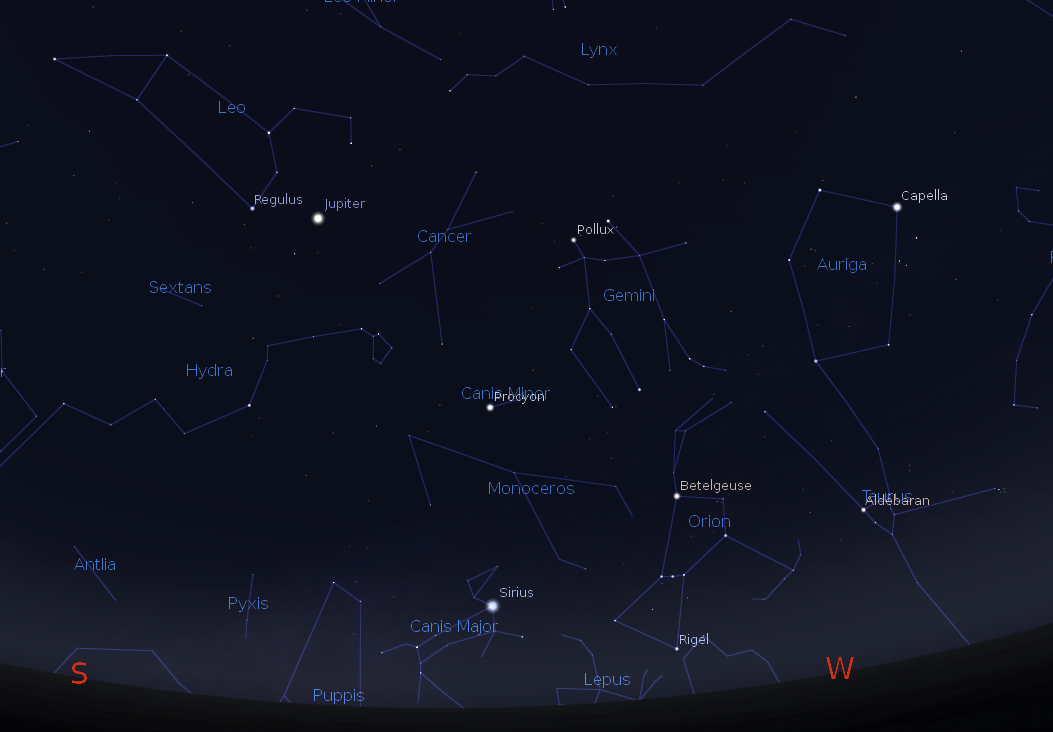
At 6 a.m. December 4, 2014 Jupiter and the winter constellations will swing into the southwest while out of the view the spring and early summer stars take over the eastern sky. Created using Stellarium.
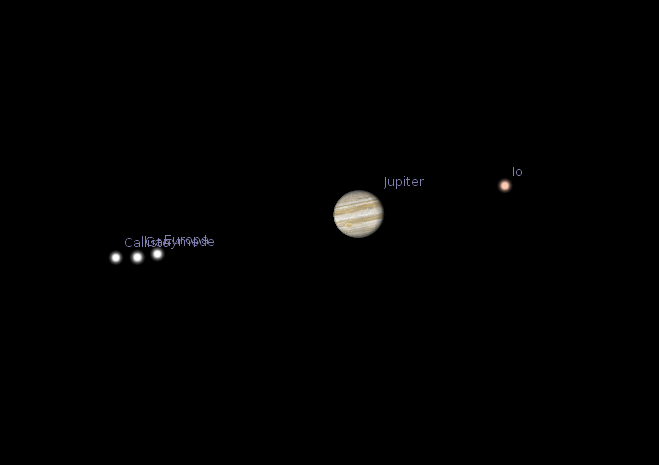
Telescopic view of Jupiter at 6 a.m. December 4, 2014. The moons on the left in order from left to right are Callisto, Ganymede and Europa. In the next hour the moons will appear to get even closer together, especially Ganymede and Callisto. Created using Stellarium.
11/26/2014 – Ephemeris – Where did all the planets go?
Ephemeris for Wednesday, November 26th. The sun will rise at 7:53. It’ll be up for 9 hours and 12 minutes, setting at 5:06. The moon, 3 days before first quarter, will set at 9:41 this evening.
In reviewing which planets are visible tonight, it looks like we’re down to two. Venus, Saturn and Mercury are hanging around near the direction of the Sun. It will be a while before we see them again. However we can see Mars, which will be low in the southwest at 7 p.m. It will set at 8:29 p.m. Mars’ setting time will slowly advance only 6 minutes between now and the end of the year. Jupiter will rise at 10:54 p.m. in the east-northeast. The best telescopic views will have to wait a couple of hours after that. So if you’re more of an early bird rather than a night owl it might be better to view Jupiter with a telescope in the morning. Jupiter has those four bright moons that change position daily, and sometimes while you watch.
Times are for the Traverse City/Interlochen area of Michigan. They may be different for your location.
Addendum
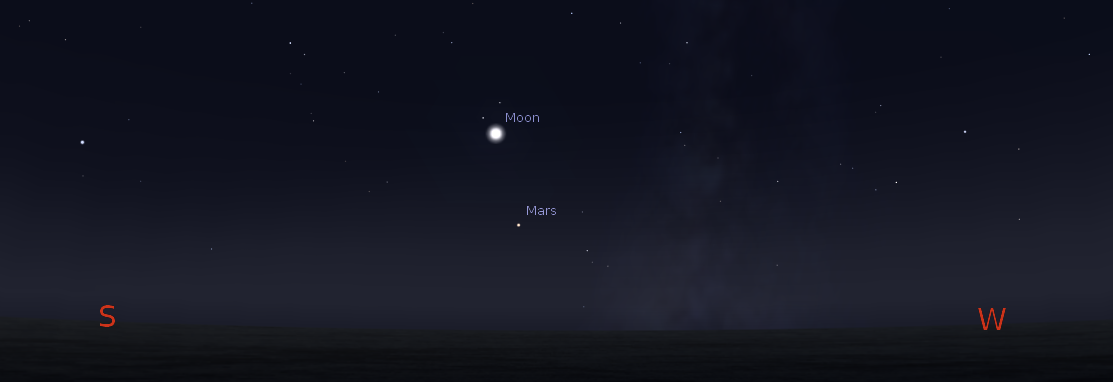
Mars with the crescent Moon at 7 p.m. on November 26, 2014. Created using Stellarium.
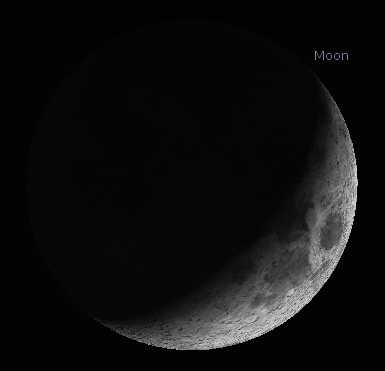
The crescent moon as it would appear in binoculars at 7 p.m. on November 26, 2014. Created using Stellarium.
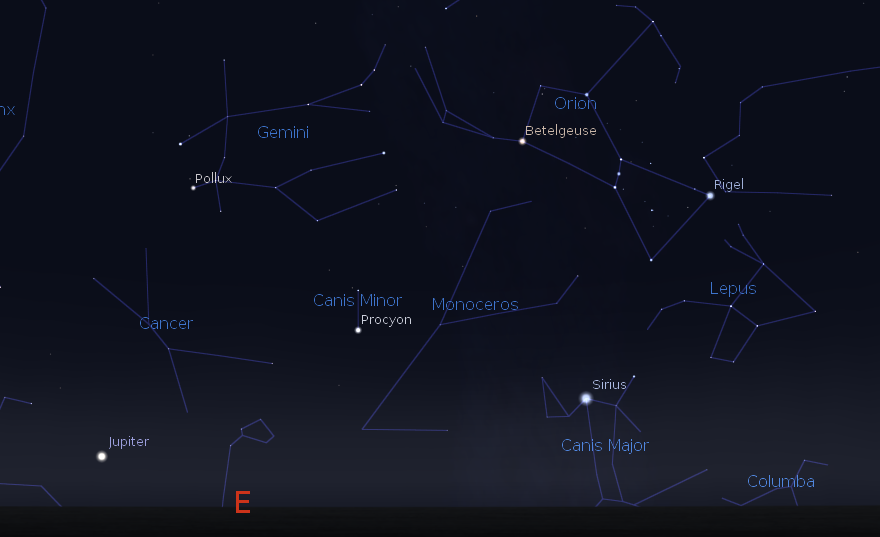
Jupiter rising with the winter constellations at 11:30 p.m. on November 26, 2014. Created using Stellarium.
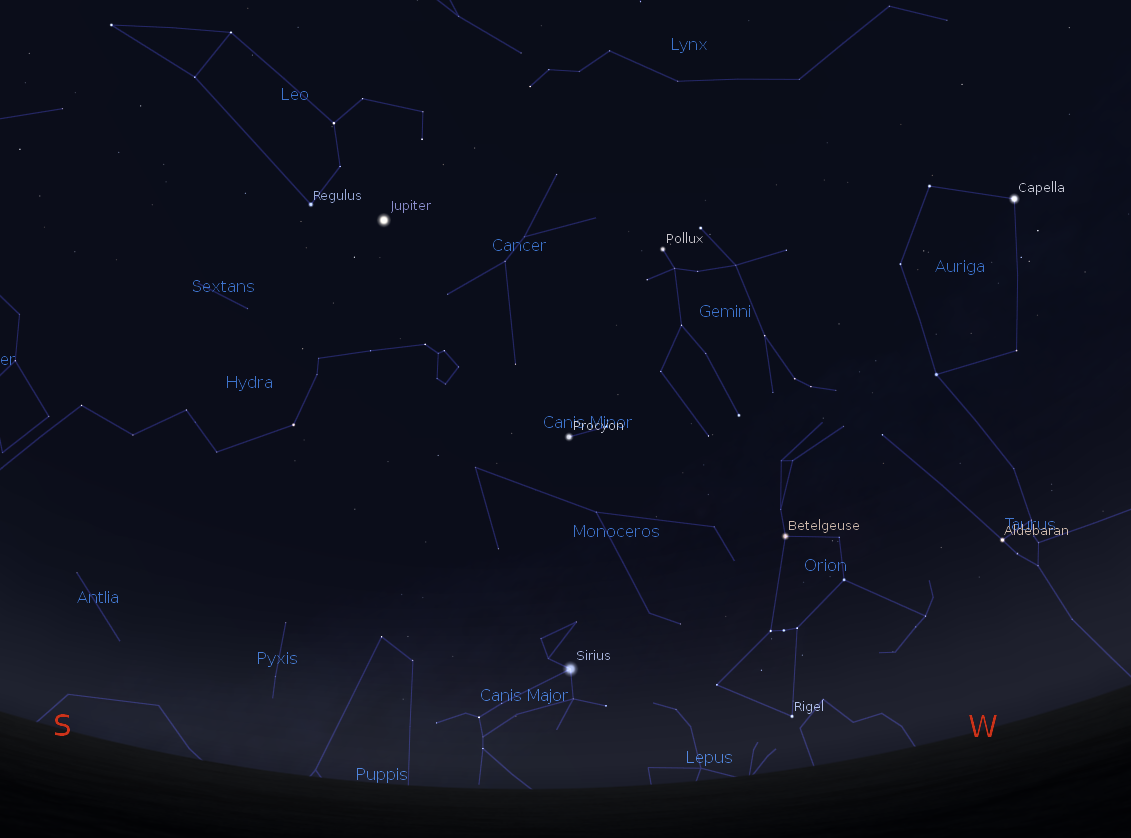
Jupiter with the winter constellations at 6:30 a.m. on November 27, 2014. Created using Stellarium.
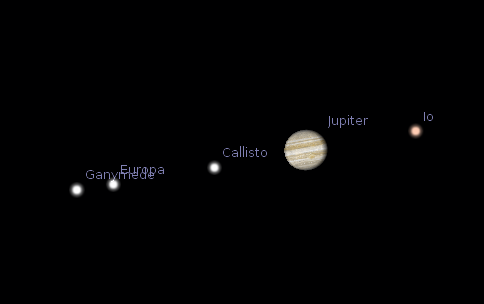
Jupiter as seen in a telescope at 6:30 a.m. on November 27, 2014. Created using Stellarium.
11/19/2014 – Ephemeris – Where did all the bright planets go?
Ephemeris for Wednesday, November 19th. The sun will rise at 7:44. It’ll be up for 9 hours and 26 minutes, setting at 5:10. The moon, 3 days before new, will rise at 5:34 tomorrow morning.
In reviewing which planets are visible tonight, it looks like we’re down to two. Venus, Saturn and Mercury are hanging around near the direction of the Sun. It will be a while before we see them again. However we can see Mars, which will be low in the southwest at 7 p.m. It will set at 8:29 p.m. Jupiter will rise at 11:20 p.m. in the east-northeast. The best telescopic views will have to wait a couple of hours after that. So if you’re more of an early bird rather than a night owl it might be better to view Jupiter with a telescope in the morning. Jupiter has those four bright moons that change position daily, and sometimes while you watch if they appear close enough to each other. On the planet are cloud bands and the elusive Great Red Spot.
Times are for the Traverse City/Interlochen area of Michigan. They may be different for your location.
Addendum
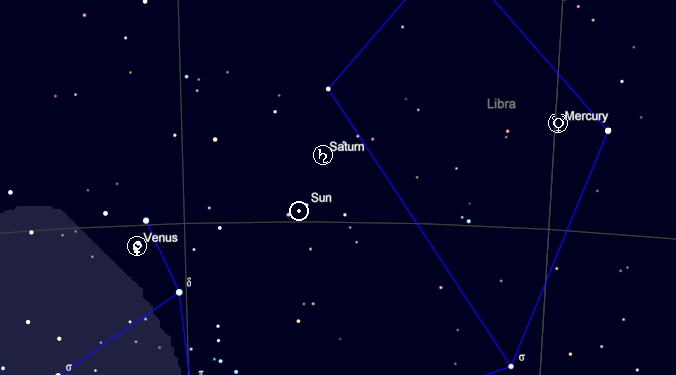
Mercury, Saturn and Venus appear near the Sun near sunset at 5 p.m. on November 19, 2014. Displayed planets as their symbols. Created using Cartes du Ciel (Sky Charts).
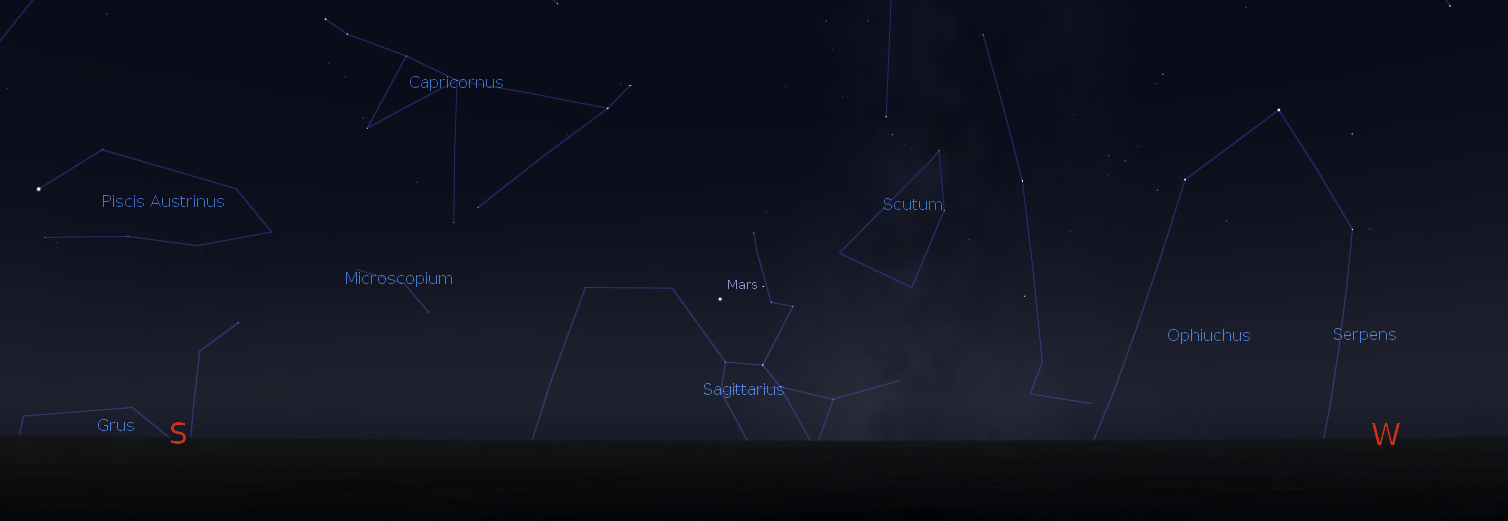
Mars and the setting summer constellations at 7 p.m. on November 19, 2014. Created using Stellarium.
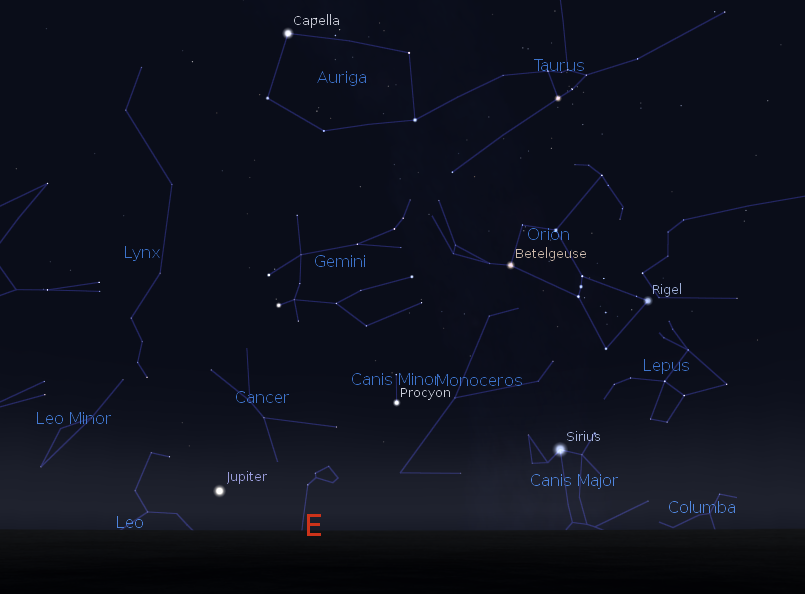
Jupiter and the rising winter constellations at midnight November 20, 2014. Created using Stellarium.
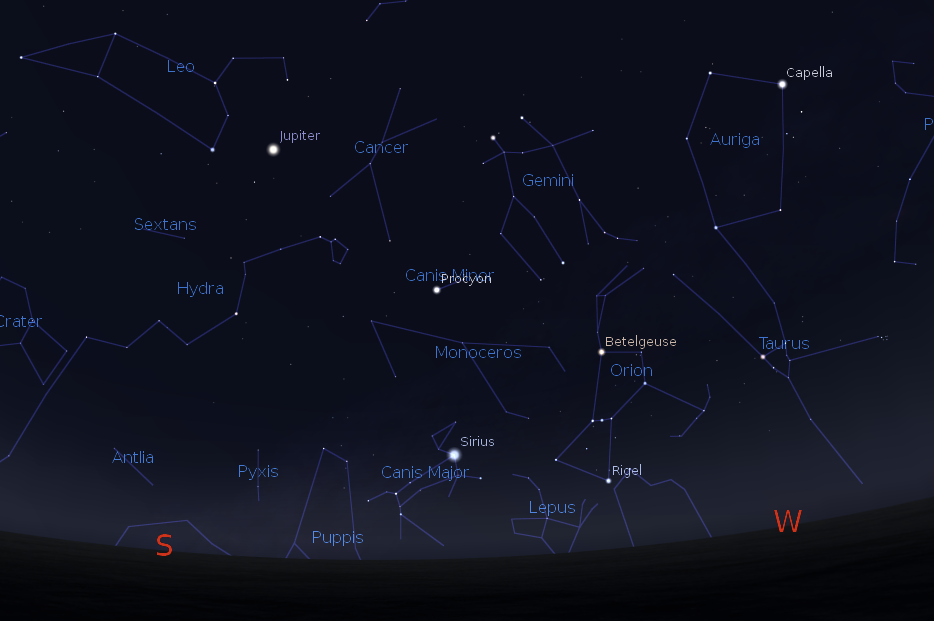
Jupiter with winter and spring constellations at 6:30 a.m. on November 20, 2014. Created using Stellarium.
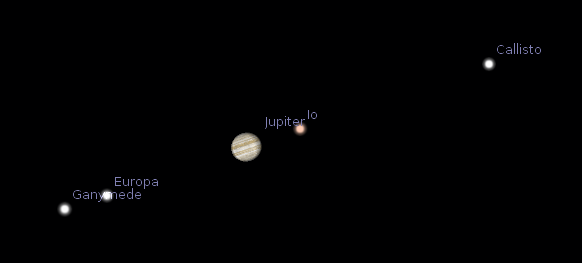
Jupiter and moons through a telescope at 6:30 a.m. on November 20, 2014. Created using Stellarium.
11/12/2014 – Ephemeris – A look at the bright planets for this week.
Ephemeris for Wednesday, November 12th. The sun will rise at 7:35. It’ll be up for 9 hours and 42 minutes, setting at 5:17. The moon, 2 days before last quarter, will rise at 10:38 this evening.
Tonight Mars will be low in the southwest at 7 p.m. It will set at 8:30 p.m. Jupiter now rises before midnight at 11:45 p.m. The best telescopic views will have to wait a couple of hours. Better to view Jupiter in the morning. The planet Mercury is making its autumn morning appearance now, rising in the east-southeast at 6:19 a.m. By 6:45 or so it should be visible low in the eastern sky, below and left of the star Spica, of about the same brightness, but has a bluish tinge in binoculars. Mercury is brightening as moves away from us and its phase appears fuller. Being close in to the sun its distance doesn’t vary by much so its brightness is governed more by its phase. Its separation from the sun is now down to 14.5 degrees.
Times are for the Traverse City/Interlochen area of Michigan. They may be different for your location.
Addendum
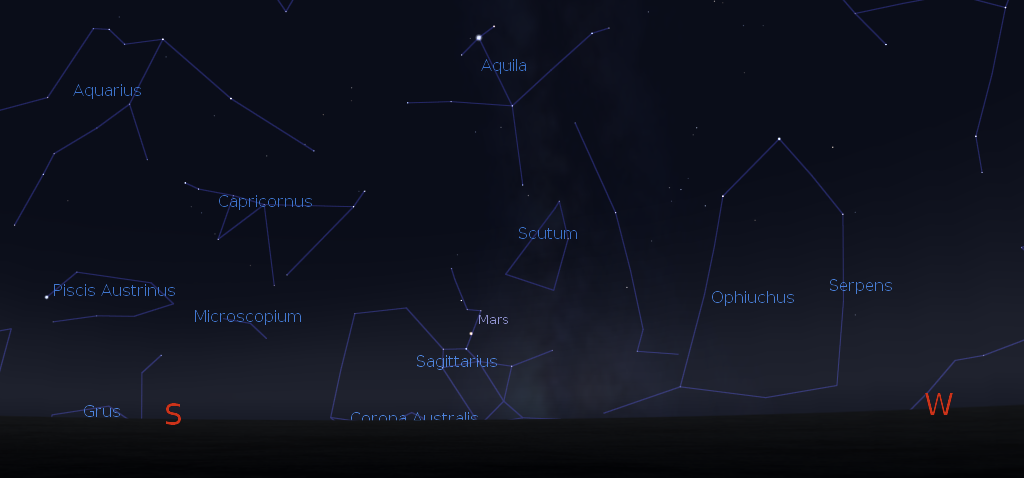
Mars and setting summer constellations at 7 p.m. on November 12, 2014. Created using Stellarium.
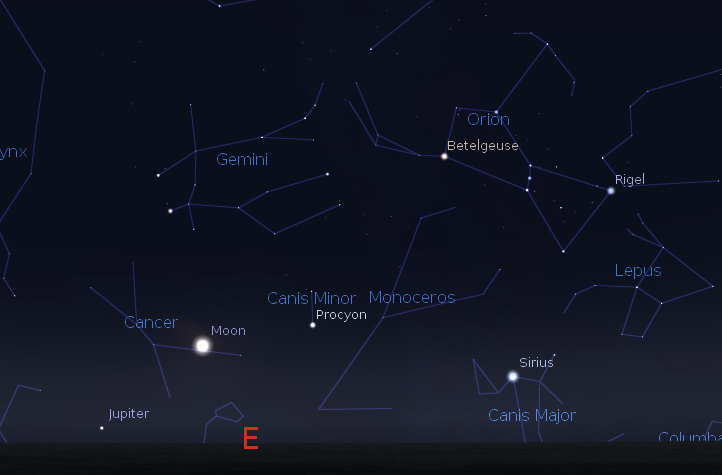
Jupiter and the Moon rising at midnight on November 13, 2014. Created using Stellarium.
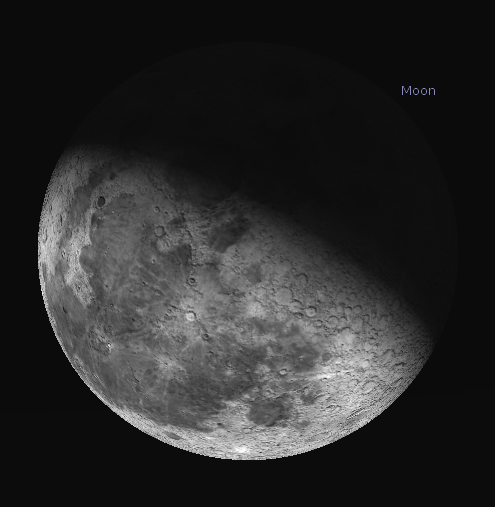
The Moon as seen in binoculars at midnight November 13, 2014. Created using Stellarium.
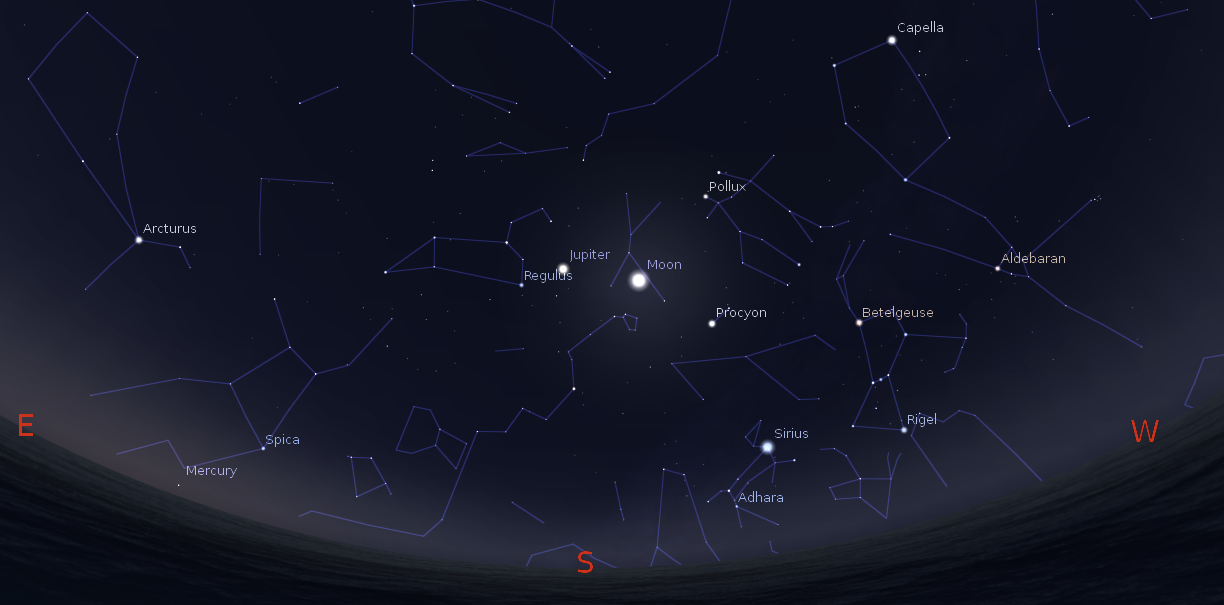
The morning sky including the Moon, Jupiter and Mercury at 6:30 a.m. on November 13, 2014.
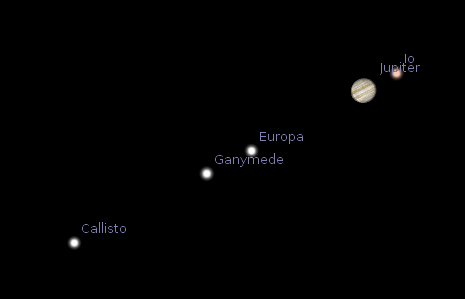
Jupiter and moons through a telescope at 6:30 a.m. November 13, 2014. Created using Stellarium.
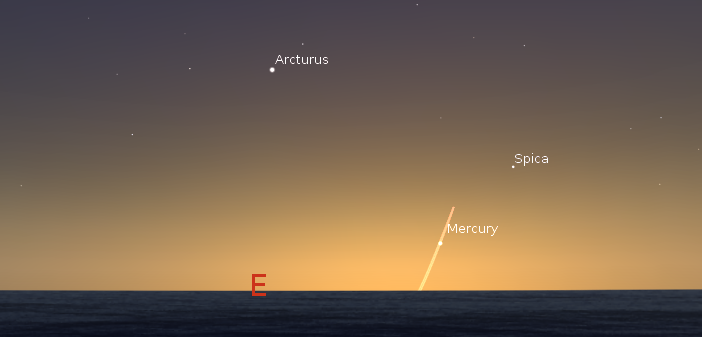
Mercury in twilight showing also its orbit. No, you won’t see that in the real sky. Mercury is sliding back from its peak a couple of weeks ago. 7 a.m. on November 13, 2014. Created using Stellarium.

