Archive
11/05/2014 – Ephemeris – This week there’s one bright planet in the early evening and two in the morningf
Ephemeris for Wednesday, November 5th. The sun will rise at 7:25. It’ll be up for 10 hours and 1 minute, setting at 5:26. The moon, 1 day before full, will set at 6:56 tomorrow morning.
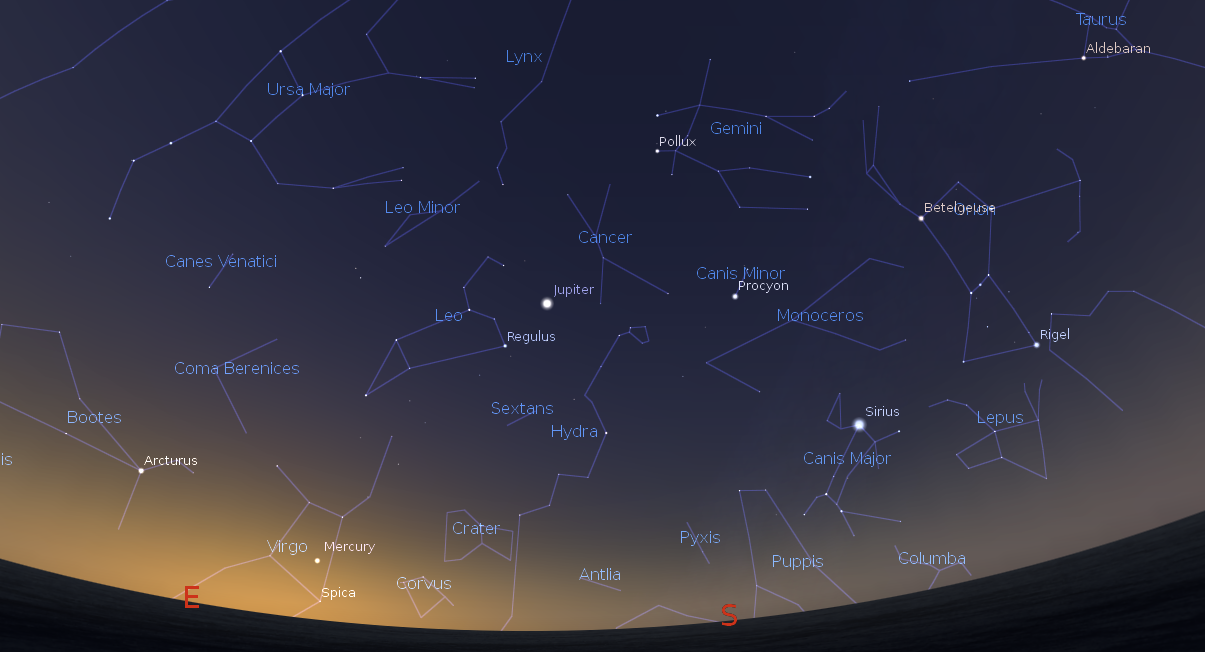
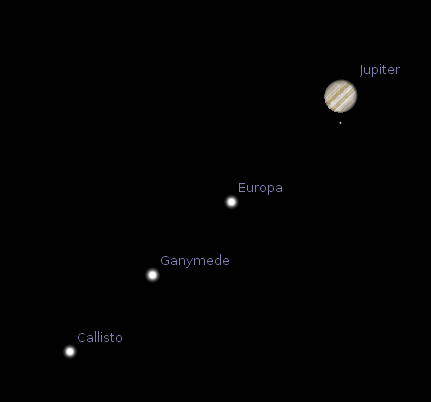
Tonight Mars will be low in the southwest at 7 p.m. It will set at 8:32 p.m. The sky will stay devoid of bright planets until Jupiter rises at 12:13 a.m. Jupiter is visible this morning in twilight an hour earlier than last week, in the south-southeast along with the brighter stars of winter, a preview of colder evenings to come. The planet Mercury is making its autumn morning appearance now, rising in the east-southeast at 5:48 a.m. By 6:20 or so it should be visible low in the sky. Mercury is brightening as moves away from us and its phase becomes fuller. Being close in to the sun its distance doesn’t vary by much so its brightness is governed more by its phase. Its separation from the sun is now an 18 degree angle and slowly decreasing.
Times are for the Traverse City/Interlochen area of Michigan. They may be different for your location.
Addendum
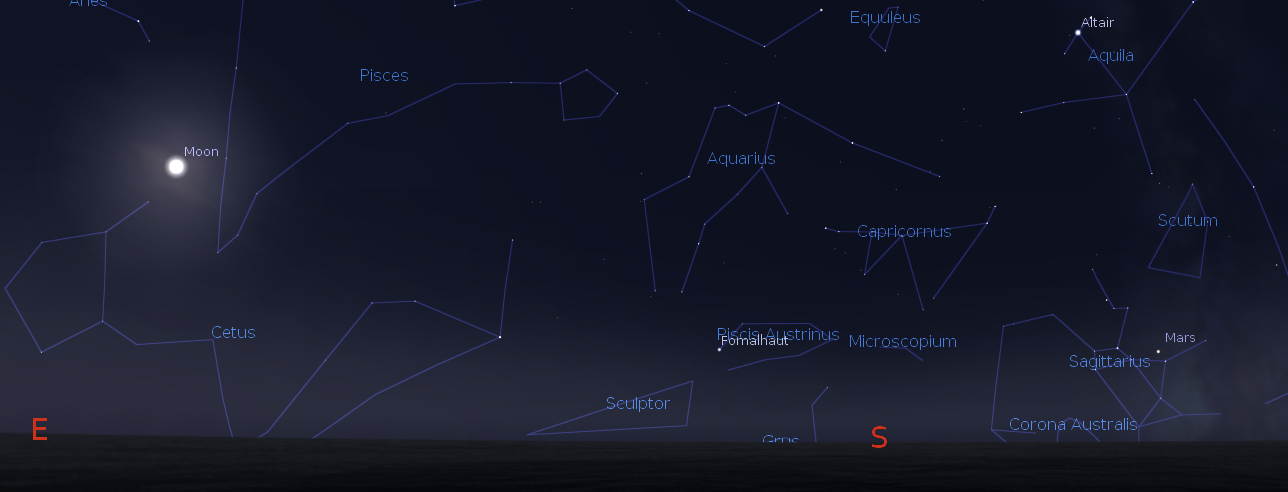
Mars and the bright Moon at 7 p.m. on November 5, 2014. Created using Stellarium.
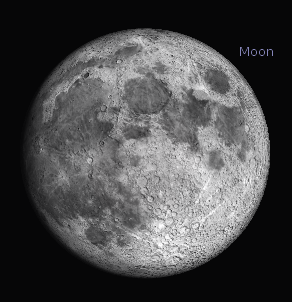
The nearly full Moon as it would be seen in binoculars at 7 p.m. on November 5, 2014. Created using Stellarium.
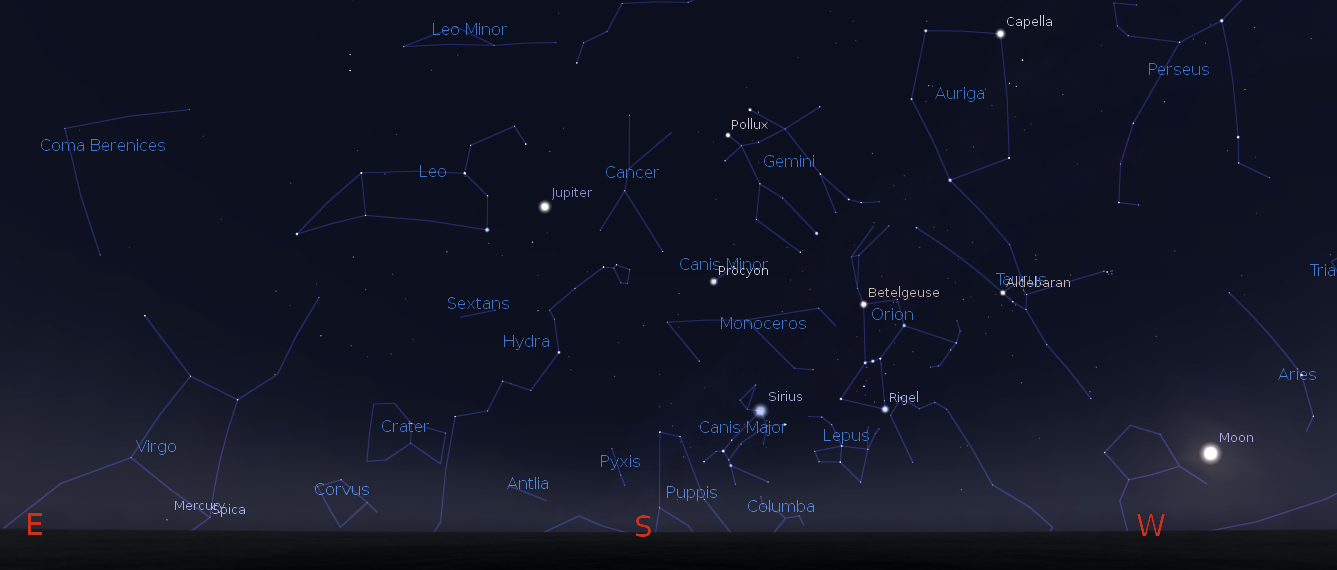
Panorama of the morning sky at 6 a.m. with Jupiter and the just risen Mercury, with the Moon hanging on in the west. Created using Stellarium.
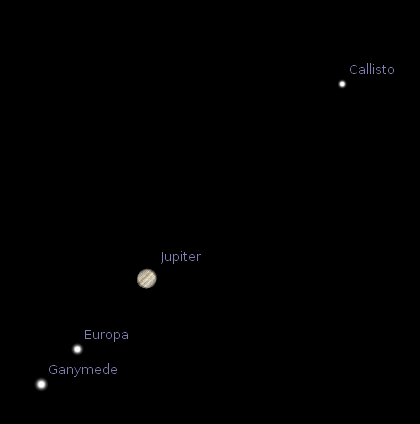
Jupiter and moons as seen in a telescope at 6 a.m., November 6, 2014. The moon Io, visible earlier in the morning, is hiding behind the planet. Created using Stellarium.
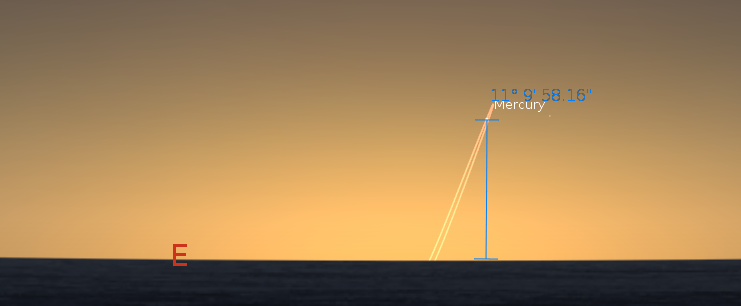
Mercury low in the east at 7 a.m., November 6, 2014. Note its altitude is 11 degrees above the flat horizon. Also shown is Mercury’s orbit. Created using Stellarium.
11/03/2014 – Ephemeris – Mercury is now visible in the morning
Ephemeris for Monday, November 3rd. The sun will rise at 7:22. It’ll be up for 10 hours and 5 minutes, setting at 5:28. The moon, 3 days before full, will set at 4:35 tomorrow morning.
When I talk about the planet Mercury I usually use the adjective elusive. There’s a good reason for that. Mercury is always close to the sun, being the innermost planet, and it has the most eccentric orbit of all the planets. Due to our location on the northern hemisphere of the Earth Mercury is best visible on autumn mornings and spring evenings. These two views, 6 months apart, means that we, at both times are looking at the same part of Mercury’s orbit, but from opposite sides. The part of Mercury’s orbit we see is the part of its orbit closest to the sun, so the angular separation is not very wide, 19 degrees this elongation. Observers in the southern hemisphere whose seasons are opposite ours have a much better view. For them Mercury is at its farthest from the sun, and they get elongations of over 25 degrees.
Times are for the Traverse City/Interlochen area of Michigan. They may be different for your location.
Addendum
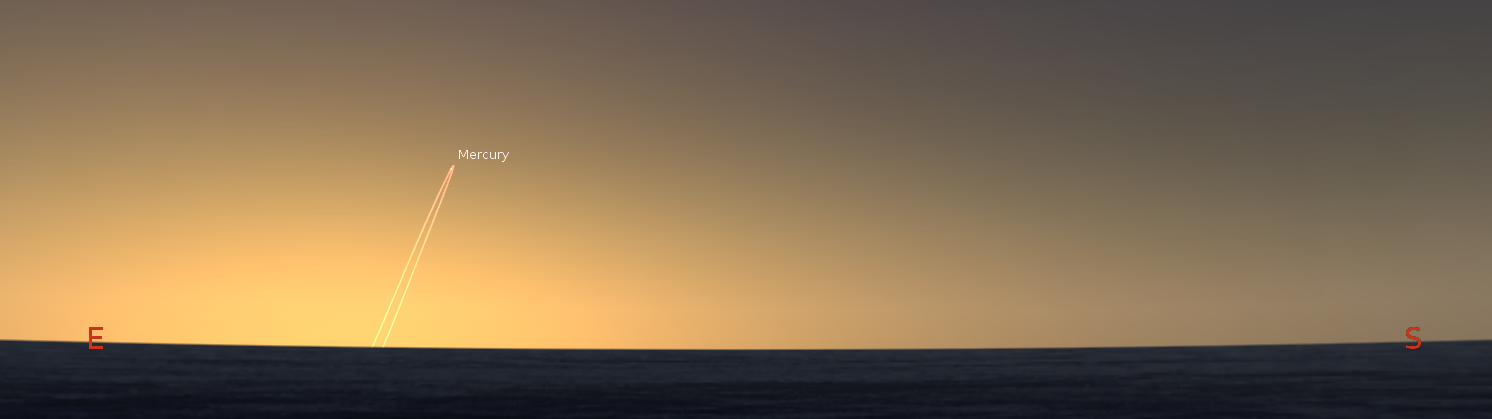
Mercury at 7 a.m. November 3, 2014 showing its orbit. Created using Stellarium.
10/29/2014 – Ephemeris – A last look at the bright planets for October
Ephemeris for Wednesday, October 29th. The sun will rise at 8:16. It’ll be up for 10 hours and 19 minutes, setting at 6:35. The moon, 1 day before first quarter, will set at 11:41 this evening.
Tonight Mars will be low in the southwest at 8 p.m. below and right of the Moon in the constellation of Sagittarius, and will set at 9:35 p.m. The sky will stay devoid of bright planets until Jupiter rises at 1:33 a.m. Jupiter is visible this morning in twilight in the south-southeast along with the brighter stars of winter, a preview of colder evenings to come. The planet Mercury makes its autumn morning appearance for the next week or so, rising in the east-southeast at 6:38. By 7:20 or so it should be visible low in the sky. It’s greatest western elongation will be this Saturday, and it will pass perihelion, its closest to the Sun, this Sunday, so despite its greatest elongation, it’s less than a 19 degree angle from the Sun.
Times are for the Traverse City/Interlochen area of Michigan. They may be different for your location.
Ephemeris
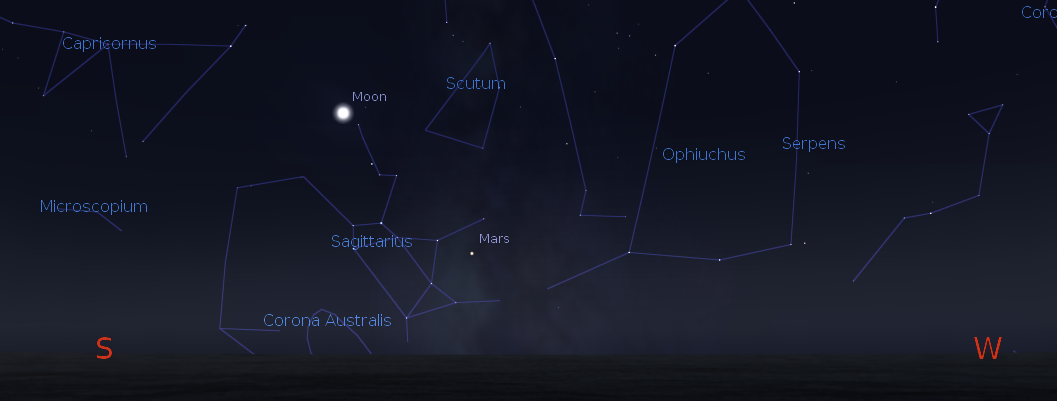
Mars, the Moon and the setting stars of summer at 8 p.m. on October 29, 2014. Created using Stellarium.
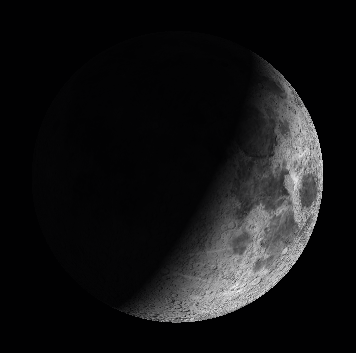
The Moon as it would appear in binoculars at 8 p.m. October 29, 2014. Created using Stellarium.
The morning planets and constellations at 7:30 a.m. October 30, 2014. Created using Stellarium.
Jupiter and its moons as seen in a telescope at 7:30 a.m. October 30, 2014. Io is behind Jupiter. Created using Stellarium.
07/30/2014 – Ephemeris – Wednesday is classic planet day on Ephemeris
Ephemeris for Wednesday, July 30th. The sun rises at 6:26. It’ll be up for 14 hours and 43 minutes, setting at 9:10. The moon, half way from new to first quarter, will set at 10:40 this evening.
It’s Wednesday and once again time to look at the bright planets for this week. Reddish Mars is in Virgo in the southwest as darkness falls. It’s 109 million miles (176 million km) away now, over twice as far as it was last April, and will set at 12:17 a.m. Saturn will be low in the south-southwest as darkness falls, in the faint constellation of Libra the scales. It will set at 1:11 a.m. Saturn’s in perfect position for viewing with a small or large telescopes to see those fabulous rings and its large moon Titan. Somewhat larger telescopes can spot some smaller moons closer in. Brilliant Venus will rise in the east northeast
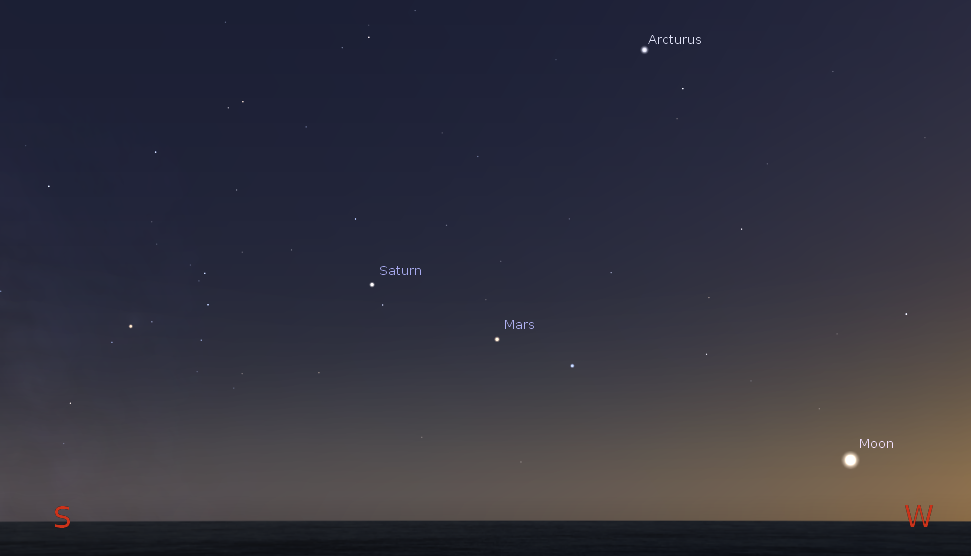
The Moon, Mars and Saturn at 10 p.m. on July 30, 2014. The bright star right of Mars is Spica, and the bright star left of Saturn is Antares. Created using Stellarium.
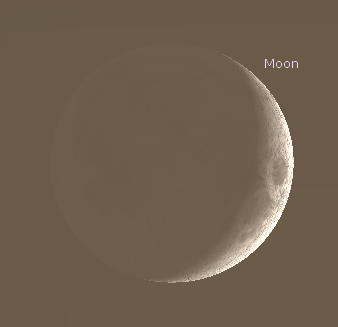
The Moon as seen in binoculars at 10 p.m. on July 30, 2014. Created using Stellarium.
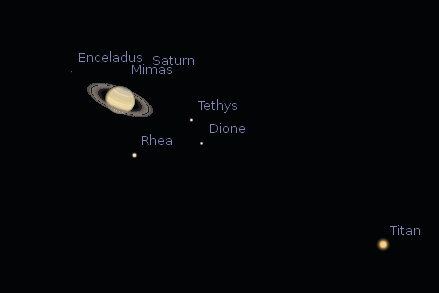
Saturn and its moons on the evening of July 30, 2014. Created using Stellarium.
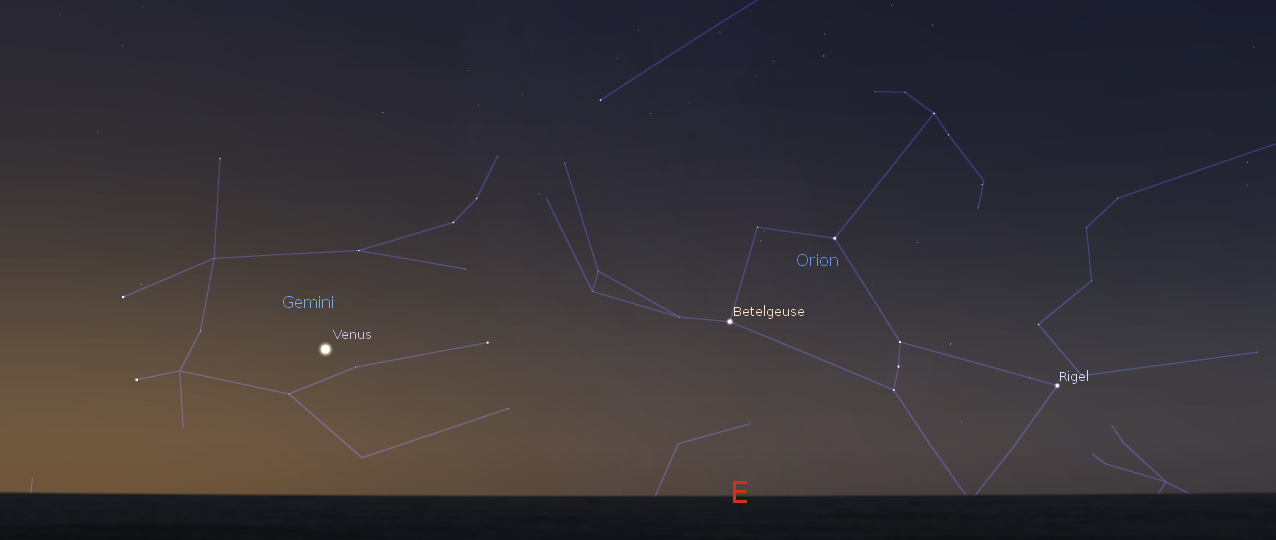
Venus and the winter constellations rising at 5:30 a.m. on July 31, 2014. Created using Stellarium.
at 4:33 a.m. in morning twilight. Mercury will rise at 5:36 and be nearly impossible to spot below Venus.
Times are for the Traverse City/Interlochen area of Michigan. They may be different for your location.
Addendum
07/23/2014 – Ephemeris – It’s Wednesday. Do you know where the bright planets are?
Ephemeris for Wednesday, July 23rd. The sun rises at 6:19. It’ll be up for 14 hours and 58 minutes, setting at 9:18. The moon, 3 days before new, will rise at 4:28 tomorrow morning.
It’s Wednesday and once again time to locate the bright planets for this week. Reddish Mars is in Virgo in the southwest as darkness falls. It’s 105 million miles (169 million km) away now, nearly 3 times farther away than it was last April, and will set at 12:39 a.m. Saturn will be low in the south-southwest as darkness falls, in the faint constellation of Libra the scales. It will set at 1:38 a.m. Saturn’s in perfect position for viewing with a small or large telescopes to see those fabulous rings and its large moon Titan. Somewhat larger telescopes can spot some smaller moons closer in. Brilliant Venus will rise in the east at 4:22 a.m. in morning twilight. Mercury will rise at 4:46 and be barely visible below Venus. The crescent moon will be right of Venus tomorrow morning.
Times are for the Traverse City/Interlochen area of Michigan. They may be different for your location.
Addendum
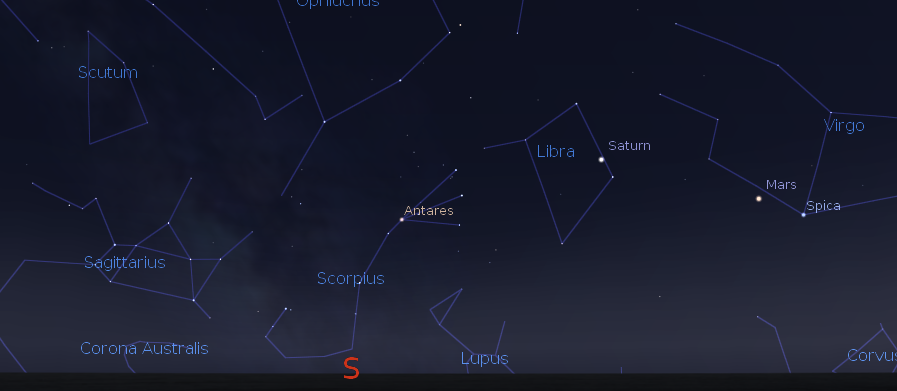
The evening planets Mars and Saturn with the zodiacal constellations at 10:30 p.m. on July 23, 2014. Created using Stellarium.
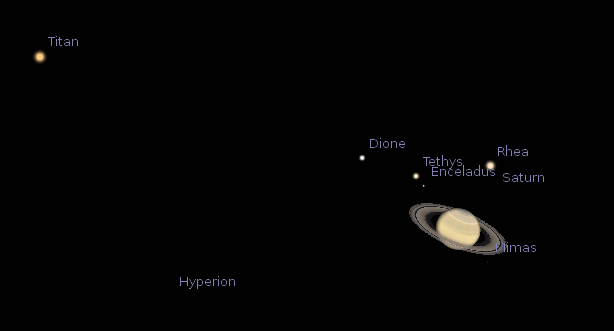
Saturn through a telescope. In small telescopes of the moons only Titan will be visible. July 23, 2014. Created using Stellarium.
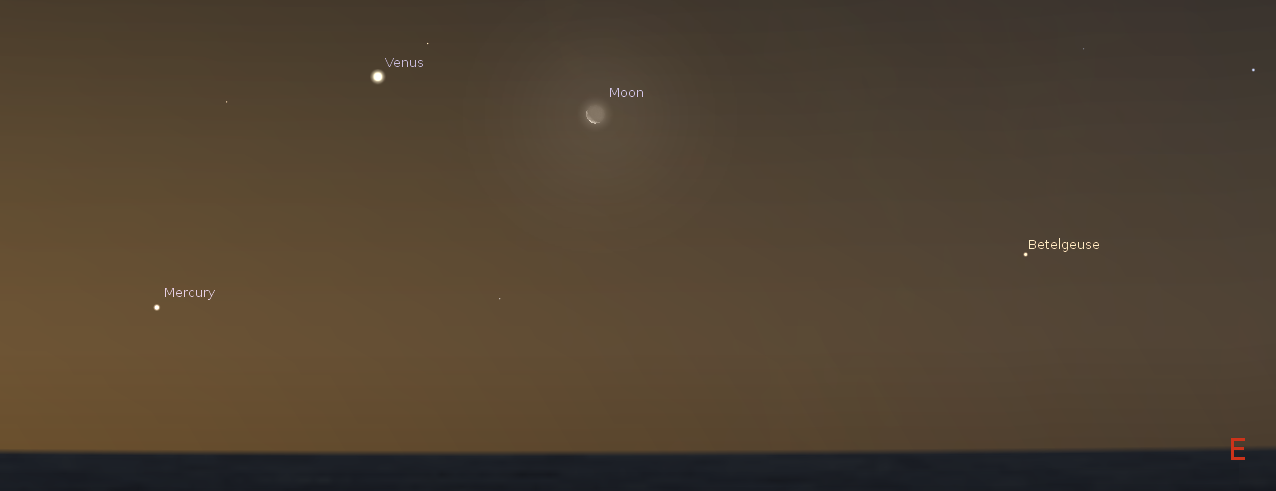
Venus, Mercury, and the crescent Moon at 5:30 a.m. on July 24, 2014. Created using Stellarium.
07/16/2014 – Ephemeris – A late post for the planet day
Ephemeris for Wednesday, July 16th. Today the sun will be up for 15 hours and 11 minutes, setting at 9:24. The moon, 2 days before last quarter, will rise at 11:52 this evening. Tomorrow the sun will rise at 6:13.
It’s Wednesday and once again time to locate the bright planets for this week. Reddish Mars is in Virgo in the southwest as darkness falls. It’s 101 million miles (163 million km) away now, nearly 2 and a half times farther away than last April, and will set at 12:56 a.m. Saturn will be low in the south-southwest as darkness falls, in the faint constellation of Libra the scales. It will set at 2:06 a.m. Saturn’s in perfect position for viewing with a small or large telescopes to see those fabulous rings and its large moon Titan. Somewhat larger telescopes can spot some smaller moons closer in. Brilliant Venus will rise in the east at 4:14 a.m. in morning twilight. Mercury will rise at 4:46 and be barely visible below Venus.
Times are for the Traverse City/Interlochen area of Michigan. They may be different for your location.
Addendum
I’m late on this one, so the planet positions below are for Thursday evening and Friday Morning.
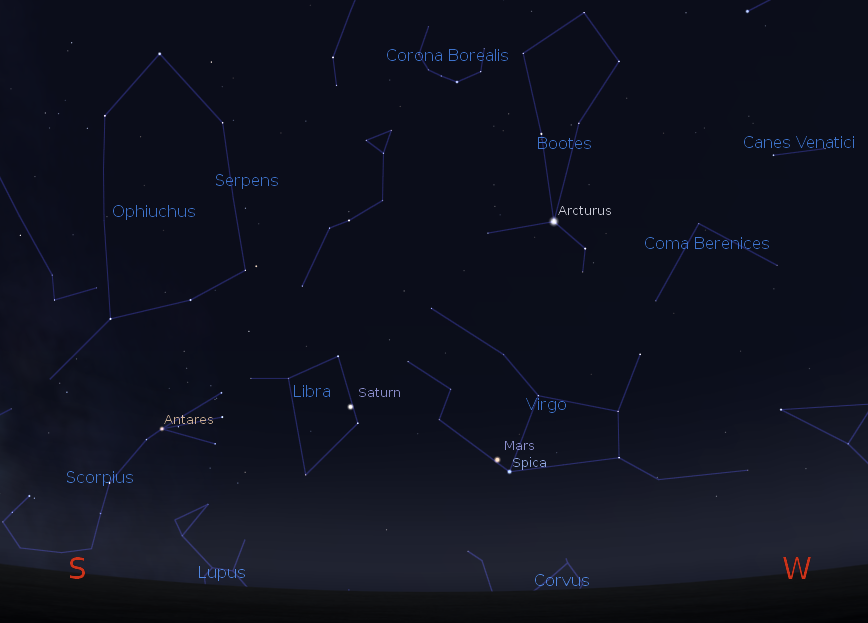
Mars and Saturn with the evening stars and constellations at 11 p.m. Thursday July 17, 2014. Created using Stellarium.
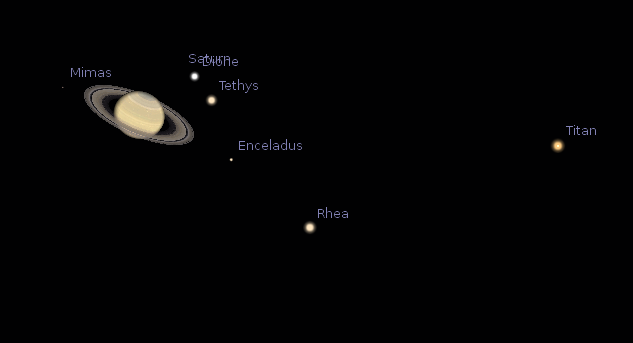
Saturn through a telescope. In small telescopes of the moons only Titan will be visible. July 17, 2014. Created using Stellarium.
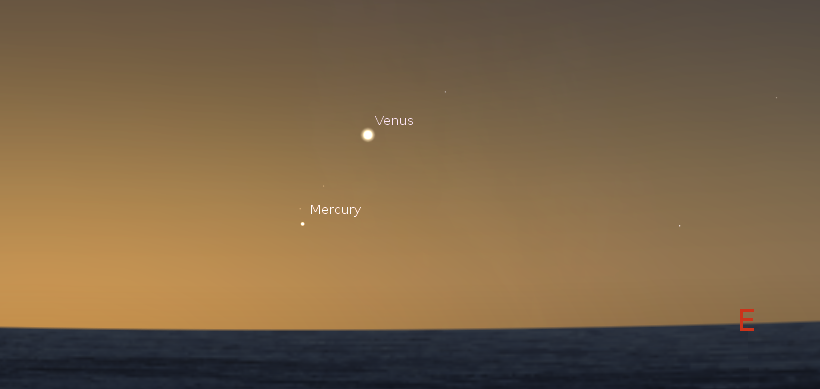
Venus and Mercury at 5:30 a.m. July 18, 2014. Created using Stellarium.
06/04/2014 – Ephemeris – Last week for all 5 pre-telescopic planets to be visible for a while
Ephemeris for Wednesday, June 4th. Today the sun will be up for 15 hours and 23 minutes, setting at 9:22. The moon, 1 day before first quarter, will set at 1:39 tomorrow morning. Tomorrow the sun will rise at 5:58.
It’s Wednesday and once again time to locate the bright planets for this week. Mercury is showing up in the west shortly after sunset, It is getting dimmer (magnitude 1.6) as it is becoming a thin crescent. It will set at 10:47. Brilliant Jupiter will be in the western sky in Gemini as darkness falls tonight. It will set at 11:59 p.m. Reddish Mars is in Virgo in the south-southwest as darkness falls. It’s 76 million miles (122 million km) away now, and moving away, and will set at 3:14 a.m. Saturn will be low in the southeast as darkness falls. It’s in the faint constellation of Libra the scales this year. It will pass due south at 11:55 p.m. Brilliant Venus will rise in the east at 4:21 a.m. in morning twilight.
Times are for the Traverse City/Interlochen area of Michigan. They may be different for your location.
Addendum
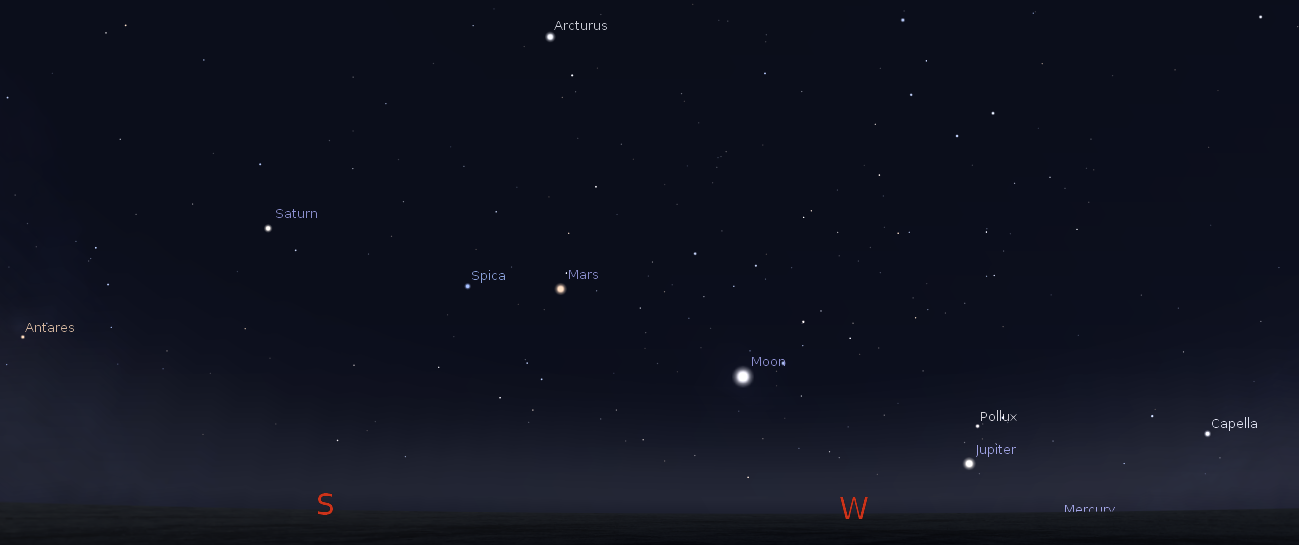
Jupiter, Mars, Saturn and the Moon seen at 11 p.m. June 4, 2014. Created using Stellarium.
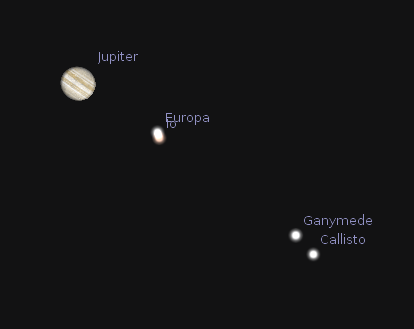
Jupiter and moons in a telescope at 11 p.m. June 4, 2014. Created using Stellarium.
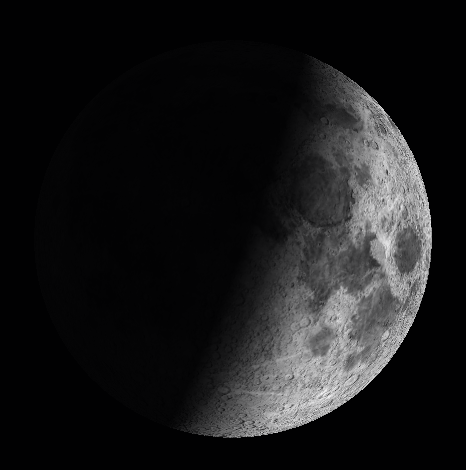
The Moon as it might appear in binoculars at 11 p.m. on June 4, 2014. Created using Stellarium.
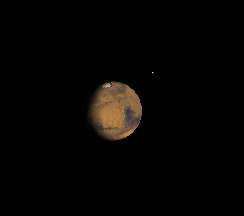
Mars, probably a bit better than it will appear in a small telescope at 11 p.m. June 4, 2014. Created using Stellarium.
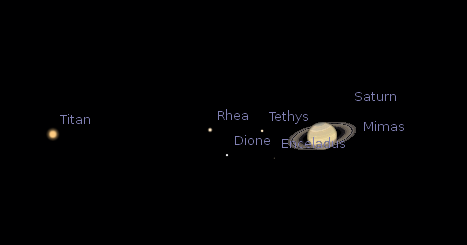
Saturn with some of its moons, not all of them will be visible in a small telescope, at 11 p.m. on June 4, 2014. Created using Stellarium.
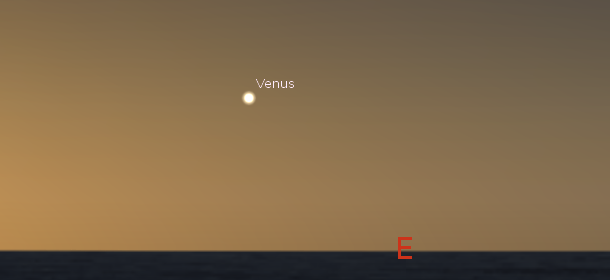
Venus in morning twilight in the east at 5:15, June 5, 2014. Created using Stellarium.
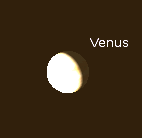
Venus showing its gibbous phase in a telescope at 5:15 a.m. on June 5, 2014. Created using Stellarium.
05/28/2014 – Ephemeris – Wednesday is planet day on Ephemeris
Ephemeris for Wednesday, May 28th. Today the sun will be up for 15 hours and 14 minutes, setting at 9:17. The moon is new today, and won’t be visible. Tomorrow the sun will rise at 6:02.
It’s Wednesday and once again time to locate the bright planets for this week. Mercury is showing up in the west shortly after sunset, It was at its farthest from the Sun 3 days ago. It will set at 11:09. Brilliant Jupiter will be in the western sky in Gemini as darkness falls tonight. It will set at 12:25 a.m. Reddish Mars is in Virgo in the south as darkness falls. It will pass due south at 9:52 p.m. It’s 72 million miles (115 million km) away now, and moving away, and will set at 3:41 a.m. Saturn will be low in the southeast as darkness falls. It’s in the faint constellation of Libra the scales this year. It will pass due south at 12:24 a.m. Brilliant Venus will rise in the east at 4:29 a.m. in morning twilight.
Times are for the Traverse City/Interlochen area of Michigan. They may be different for your location.
Addendum
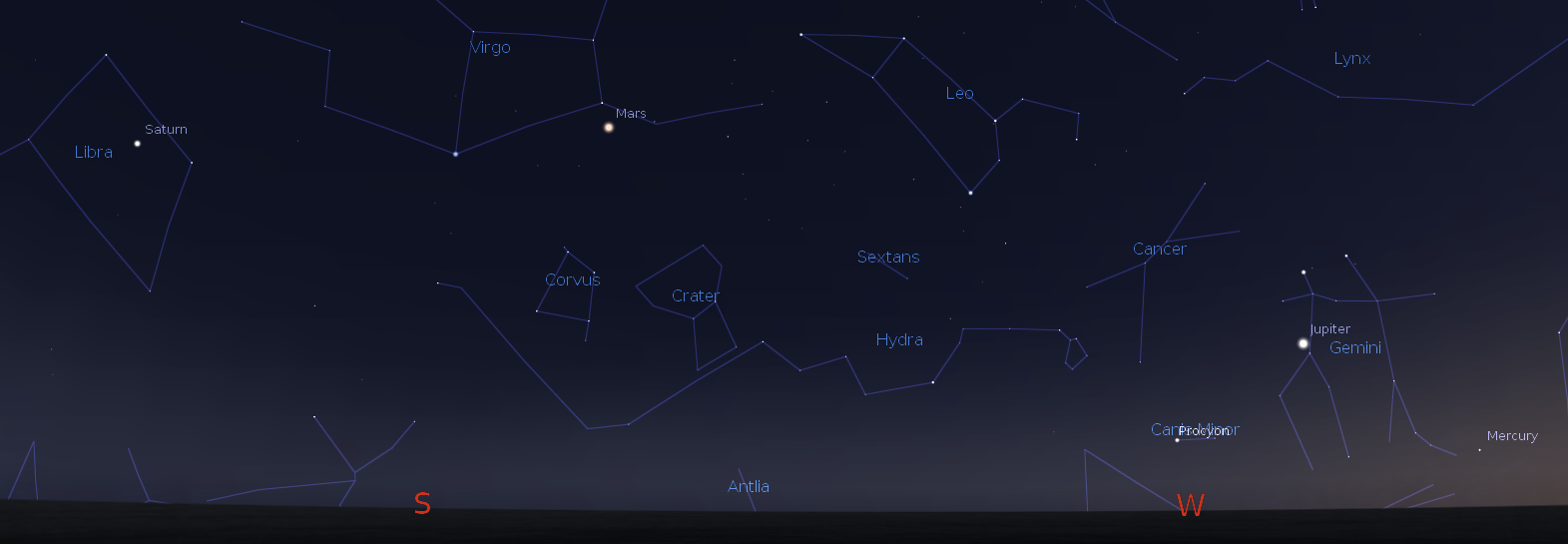
The planets Mercury, Jupiter, Mars and Saturn at 10:30 p.m. on May 28, 2014. Created using Stellarium.
Mercury barely shows a disc in telescopes.
In the planetary images below the scale is the same. It is the same as using the same magnifying power for each planet.
Jupiter is definitely the largest appearing planet.
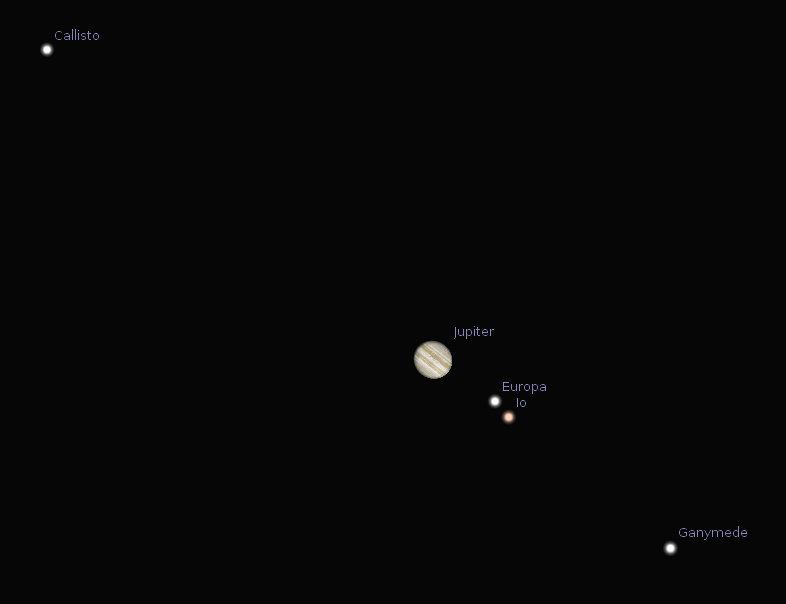
Jupiter and its four moons Galilean moons at 10:30 p.m. May 28, 2014. Created using Stellarium.

Mars at 10:30 p.m. May 28, 2014. Detail is difficult to see. Created using Stellarium.
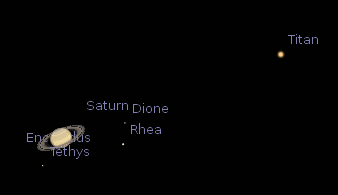
Saturn and moons as seen through a telescope at 10:30 p.m. on May 28, 2014. Created using Stellarium.
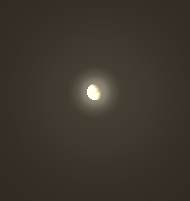
Venus in a telescope at 5:30 a.m. May 29, 2014. Created using Stellarium.
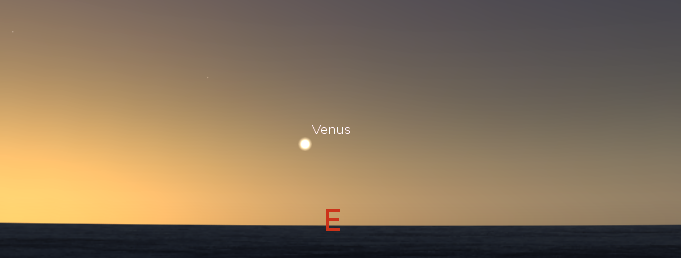
Venus in the eastern twilight at 5:30 a.m. May 29, 2014. Created using Stellarium.
05/21/2014 – Ephemeris – All the classical naked eye planets are visible this week
Ephemeris for Wednesday, May 21st. Today the sun will be up for 15 hours and 1 minute, setting at 9:10. The moon, at last quarter today, will rise at 2:42 tomorrow morning. Tomorrow the sun will rise at 6:07.
It’s Wednesday and once again time to locate the bright planets for this week. Mercury is showing up in the west shortly after sunset, It will be at its farthest from the Sun on the 25th. It will set at 11:10. Brilliant Jupiter will be in the western sky in Gemini as darkness falls tonight. It will set at 12:44 a.m. Reddish Mars is in Virgo in the southeast as darkness falls. It will pass due south at 10:18 p.m. It’s 68 million miles (109 million km) away now, and moving away, and will set at 4:09 a.m. Saturn will be low in the southeast as darkness falls. It’s in the faint constellation of Libra the scales this year. It will pass due south at 12:54 a.m. Brilliant Venus will rise in the east at 4:37 a.m. in morning twilight.
Times are for the Traverse City/Interlochen area of Michigan. They may be different for your location.
Addendum
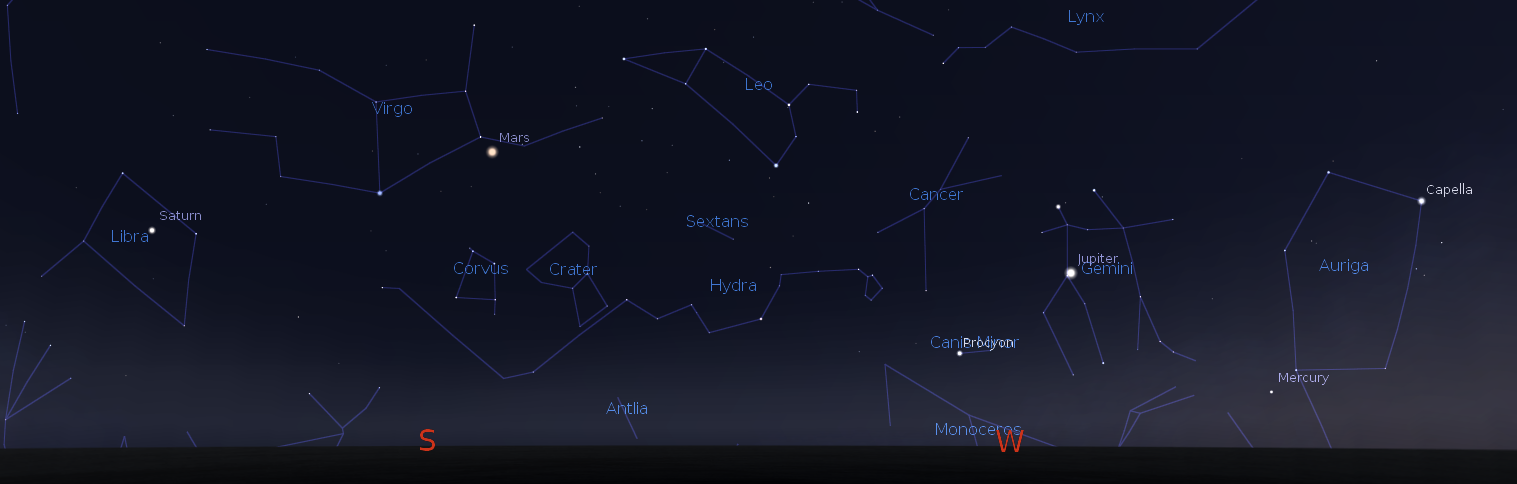
All the evening planets from Mercury to Saturn at 10:30 p.m. May 21, 2014. Created using Stellarium.
Telescopic images of the moon and planets are not to scale.
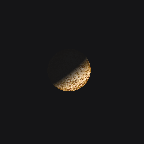
Mercury in a telescope 10:30 p.m. May 21, 2014. Created using Stellarium.
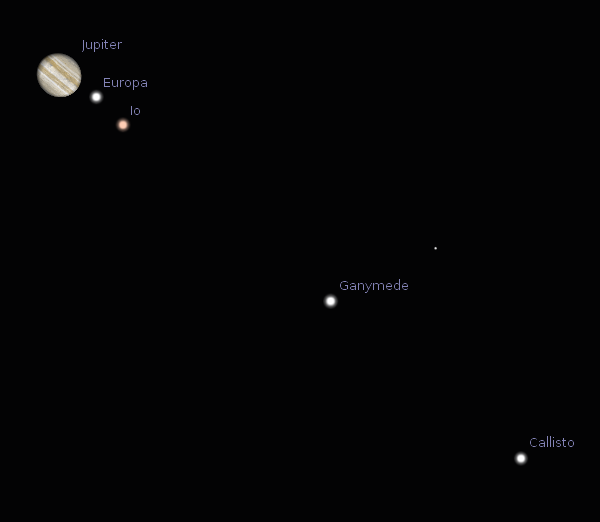
Jupiter and moons in a telescope 10:30 p.m. May 21, 2014. Created using Stellarium.
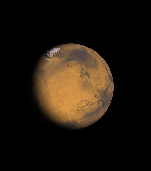
Mars in a telescope 10:30 p.m. May 21, 2014. Created using Stellarium.
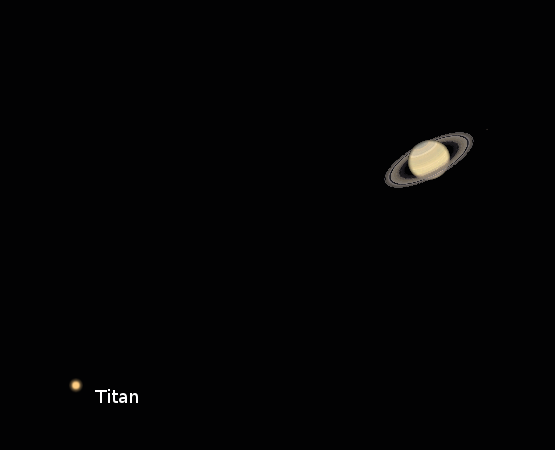
Saturn and its moon Titan in a telescope 10:30 p.m. May 21, 2014. Created using Stellarium.
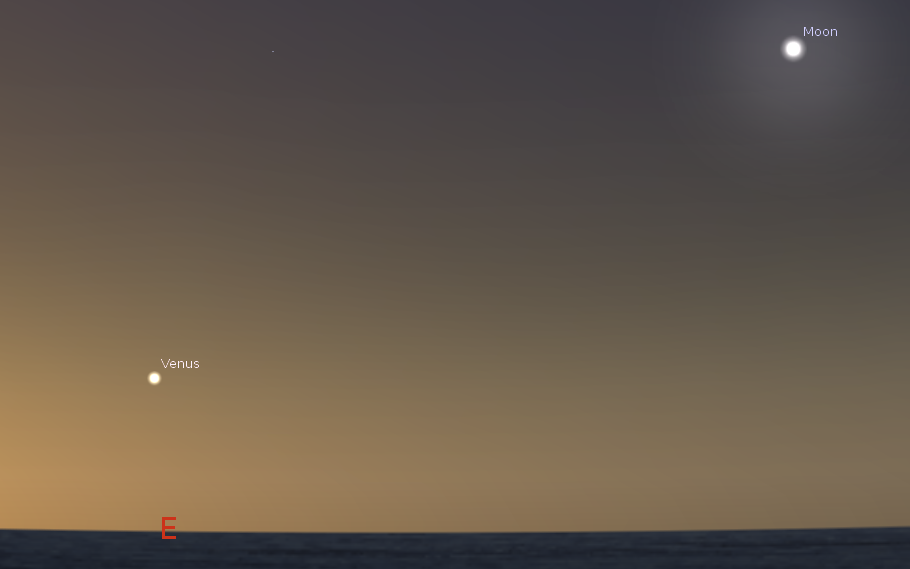
Venus and the Moon looking east at 5:30 a.m. May 22, 2014. Created using Stellarium.
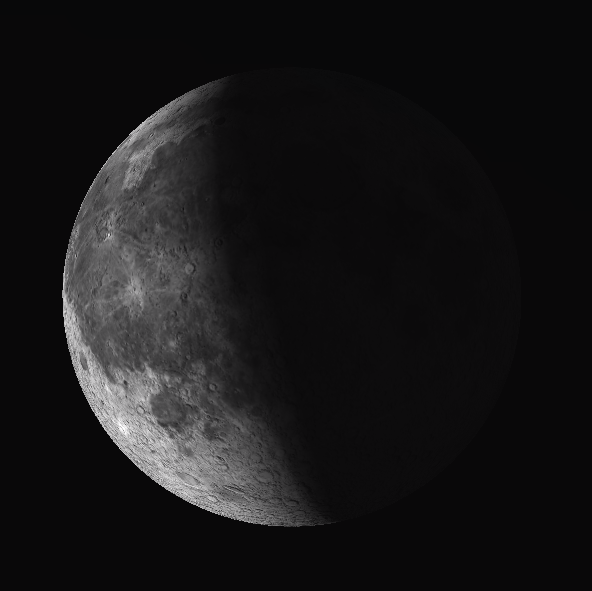
The Moon in a telescope at 5:30 a.m. May 22, 2014. Created using Stellarium.

Venus in a telescope at 5:30 a.m. May 22, 2014. Created using Stellarium.
05/14/2014 – Ephemeris – All 5 bright planets are visible this week
Ephemeris for Wednesday, May 14th. Today the sun will be up for 14 hours and 46 minutes, setting at 9:02. The moon, at full today, will rise at 9:05 this evening. Tomorrow the sun will rise at 6:14.
It’s Wednesday and once again time to locate the bright planets for this week. Mercury is beginning to show up in the west shortly after sunset, It will be at its farthest from the Sun on the 25th. It will set at 10:51. Brilliant Jupiter will be in the western sky as darkness falls tonight. It will set at 1:07 a.m. Reddish Mars is in Virgo in the southeast as darkness falls. It will pass due south at 10:47 p.m. It’s 64.6 million miles away now, and moving away, and will set at 4:38 a.m. Saturn will be low in the southeast as darkness falls. It’s in the faint constellation of Libra the scales this year. It will pass due south at 1:23 a.m. Brilliant Venus will rise in the east at 4:46 a.m. in twilight.
Times are for the Traverse City/Interlochen area of Michigan. They may be different for your location.
Addendum
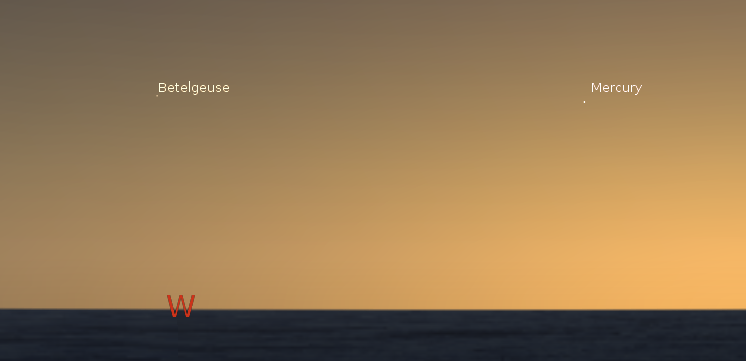
Mercury low in the west at 9:30 p.m. May 14, 2014. Created using Stellarium.
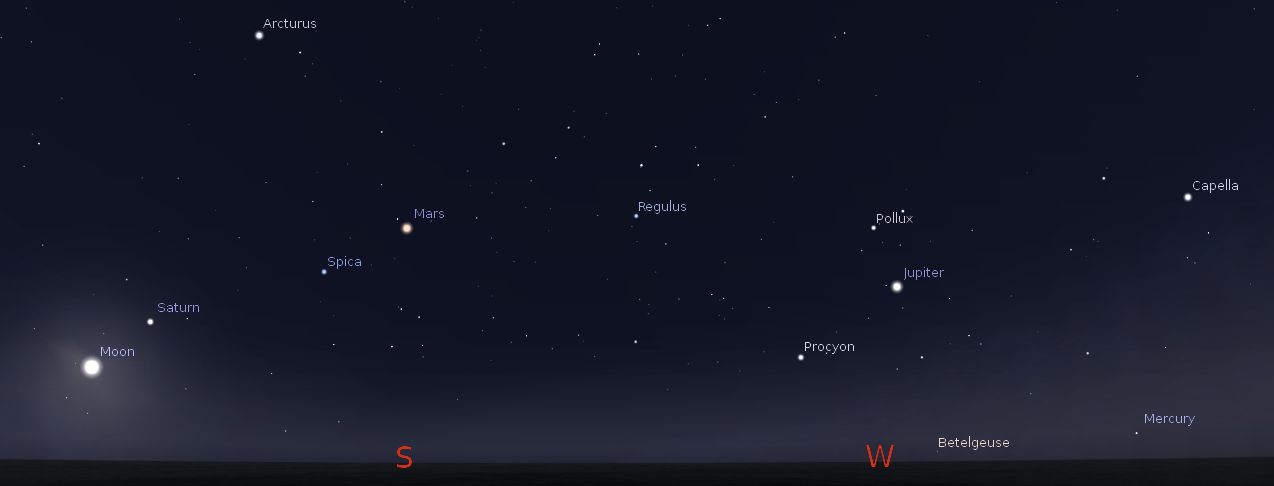
All the evening planets from Mercury to Saturn plus the moon at 10:30 p.m. May 14, 2014. Created using Stellarium.
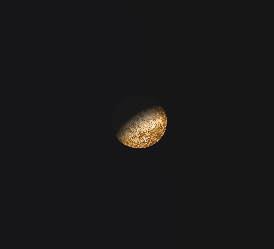
Mercury through a telescope on May 14, 2014. Created using Stellarium.
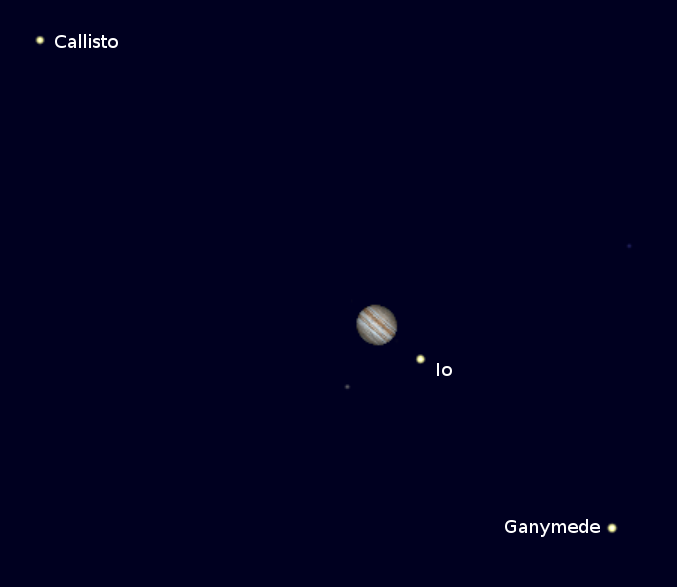
Jupiter and its moons at 10:30 p.m. May 14, 2014. Europa is being occulted by Jupiter. Created using Cartes du Ciel (Sky Charts).
Europa will disappear behind the moon at 9:48 p.m, and will reappear after Jupiter sets for northern Michigan. Places west of here will see Europa reappear before Jupiter sets.
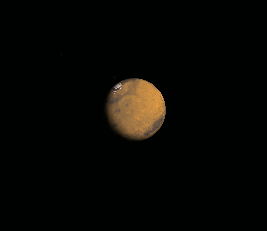
Mars through a telescope at 10:30 p.m. on May 14, 2014. Created using Stellarium.
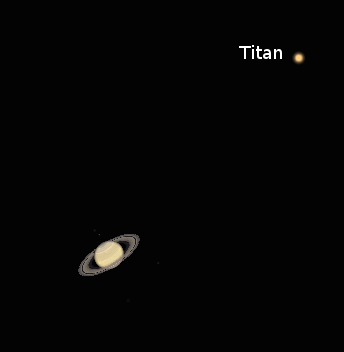
Saturn through a telescope. on May 14, 2014. Created using Stellarium.
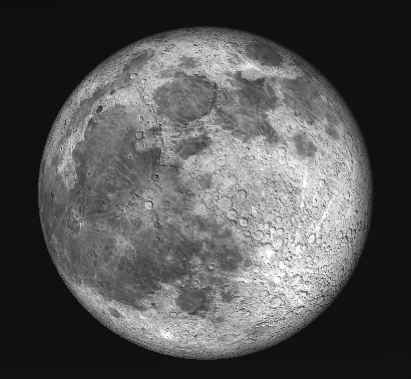
The Moon as it would appear through binoculars at 10:30 p.m. May 14, 2014. Created using Stellarium.
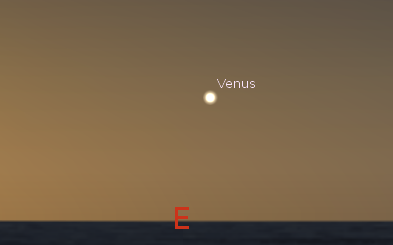
Venus in the east at 5:30 a.m. on May 15, 2014. Created using Stellarium.
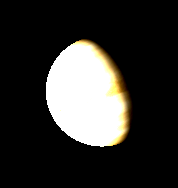
Venus through a telescope on May 15, 2014. Created using Stellarium.

