Archive
12/22/2021 – Ephemeris – Let’s search for the naked-eye planets for this week
This is Ephemeris for Wednesday, December 22nd. Today the Sun will be up for 8 hours and 48 minutes, setting at 5:05, and it will rise tomorrow at 8:18. The Moon, halfway from full to last quarter, will rise at 8:16 this evening.
Let’s search for the naked-eye planets for this week. Venus will be visible in the southwestern evening twilight by 5:30 tonight. It’s a crescent in telescopes, and even binoculars now. It is moving closer to us, and now appears larger than Jupiter in telescopes. Venus will set at 7:06 pm, 21 minutes earlier than it set a week ago, which means that the Sun is catching up with it faster and faster. It has only 17 days left in the evening sky, It’s now pulling away from Jupiter and Saturn. By 5:45 pm, both Jupiter and Saturn should be able to be spotted in the southwestern sky. Saturn will be dimmer, and to its lower right, halfway between it and Venus. Saturn will set at 8:17 pm, with Jupiter following an hour and a half later at 9:51 pm.
The astronomical event times given are for the Traverse City/Interlochen area of Michigan (EST, UT – 5 hours). They may be different for your location.
Addendum
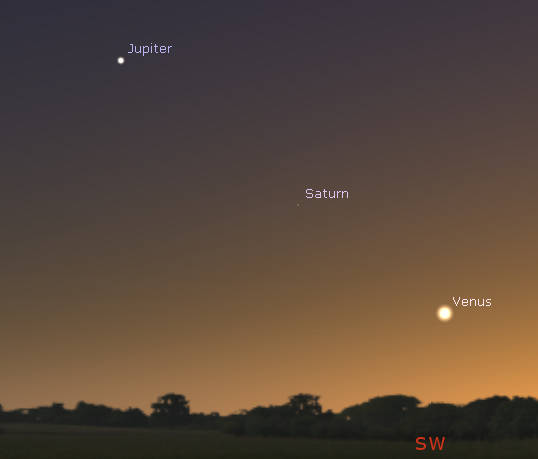
The evening planets, Venus, Saturn and Jupiter in the southwestern at 5:45 pm Tonight, December 22, 2021. Created using Stellarium.
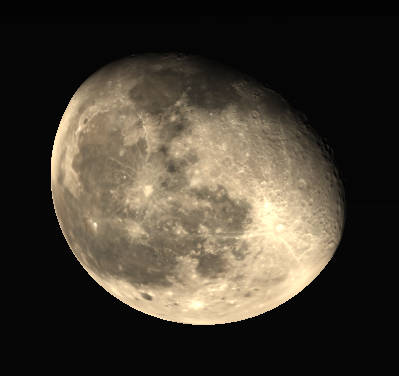
The Moon as it might appear in binoculars or small telescope low in the east northeast, tonight at 9 pm, December 22, 2021. Created using Stellarium.
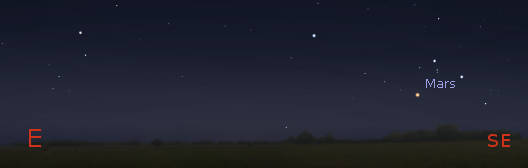
Mars, low in the southeast at 7 am tomorrow morning, December 22, 2021. Created using Stellarium.
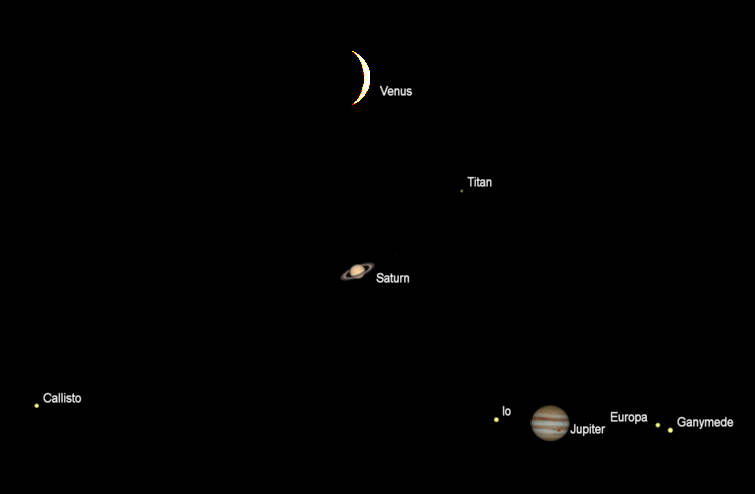
Telescopic views of the bright planets and their brighter moons (north up) as they would be seen in a small telescope, with the same magnification, this evening at 7 pm, December 22, 2021. Apparent diameters: Venus, 55.10″, 9.1% illuminated; Saturn 15.59″, its rings 36.32″; Jupiter, 36.16″. Mars is not shown, its apparent diameter is 3.93″. The ” symbol means seconds of arc (1/3600th of a degree.) Created using Cartes du Ciel (Sky Charts).
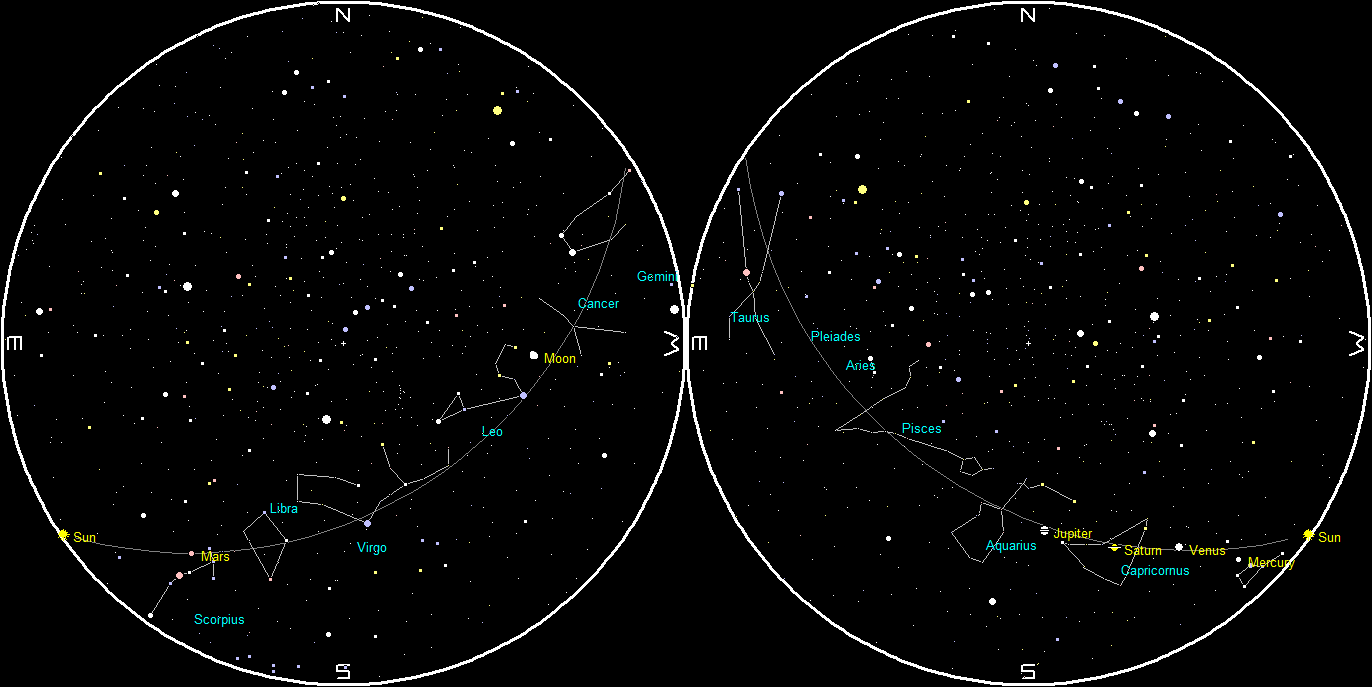
The naked-eye planets and the Moon at sunset and sunrise on a single night, starting with sunset on the right on December 22, 2021. The night ends on the left with sunrise on the 23rd. Click on the image to enlarge it. Created using my LookingUp program.
12/15/2021 – Ephemeris – Let’s search for the naked-eye planets for this week
This is Ephemeris for Wednesday, December 15th. Today the Sun will be up for 8 hours and 49 minutes, setting at 5:02, and it will rise tomorrow at 8:14. The Moon, 3 days before full, will set at 5:50 tomorrow morning.
Let’s search for the naked-eye planets for this week. Venus will be visible in the southwestern evening twilight by 5:30 tonight. It’s a crescent in telescopes, and even binoculars now. It is moving closer to us, and now appears larger than Jupiter in telescopes. Venus will set at 7:27 pm, 14 minutes earlier than it set a week ago, which means that the Sun is catching up with it faster and faster. It has only 24 days left in the evening sky, though it might be hard to spot by the end of the month. By 5:45 pm, both Jupiter and Saturn should be able to be spotted in the southwestern sky. Saturn will be dimmer, and to its lower right, halfway between it and Venus. Saturn will set at 8:41 pm, with Jupiter following an hour and a half later at 10:12 pm.
The astronomical event times given are for the Traverse City/Interlochen area of Michigan (EST, UT – 5 hours). They may be different for your location.
Addendum
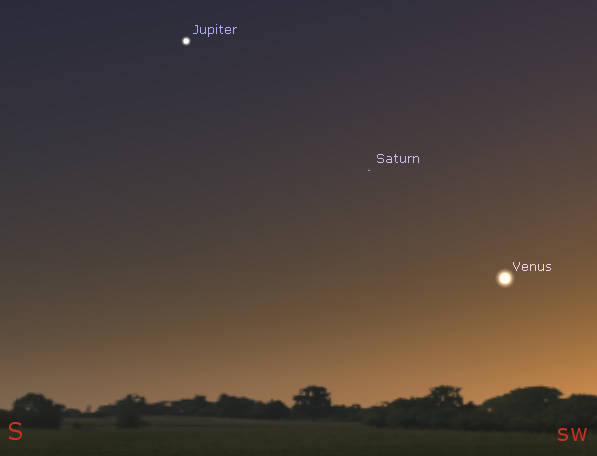
The evening planets, Venus, Saturn and Jupiter in the southwestern at 5:45 pm Tonight, December 15, 2021. Created using Stellarium.
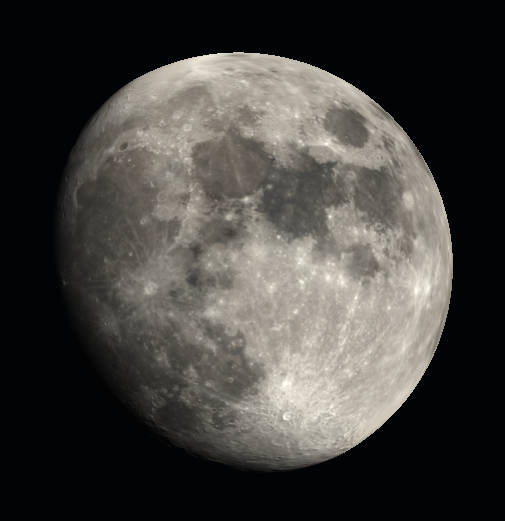
The waxing gibbous Moon, seen at 6 pm tonight, December 15, 2021. Created using Stellarium.
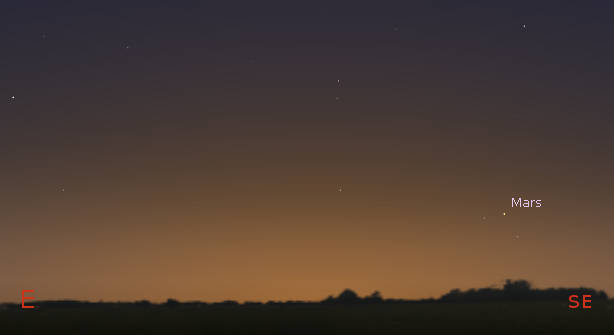
Mars, seen low in the southeast at 7:20 am tomorrow morning, December 16, 2021. Mars was not covered in the recorded program due to time constraints and the fact that Mars, still far away on the other side of the Sun, is only second magnitude and difficult to spot. It will rise at 6:25 am. Created using Stellarium.
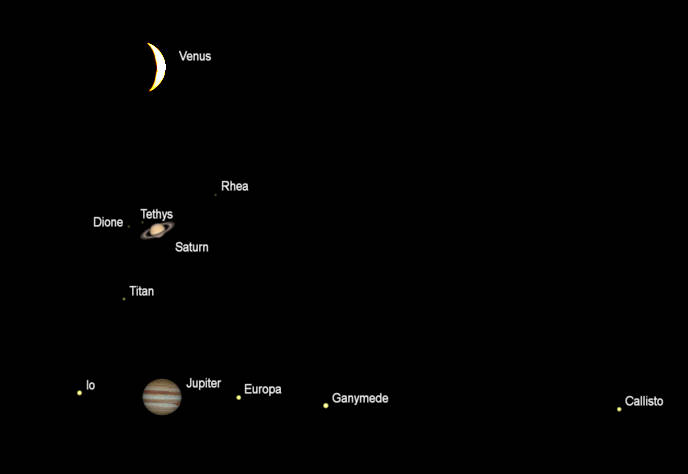
Telescopic views of the bright planets and their brighter moons (north up) as they would be seen in a small telescope, with the same magnification, this evening at 7 pm, December 15, 2021. Apparent diameters: Venus, 49.50″, 15.5% illuminated; Saturn 15.71″, its rings 36.59″; Jupiter, 36.80″. Mars is not shown, its apparent diameter is 3.87″. The ” symbol means seconds of arc (1/3600th of a degree.) Created using Cartes du Ciel (Sky Charts).
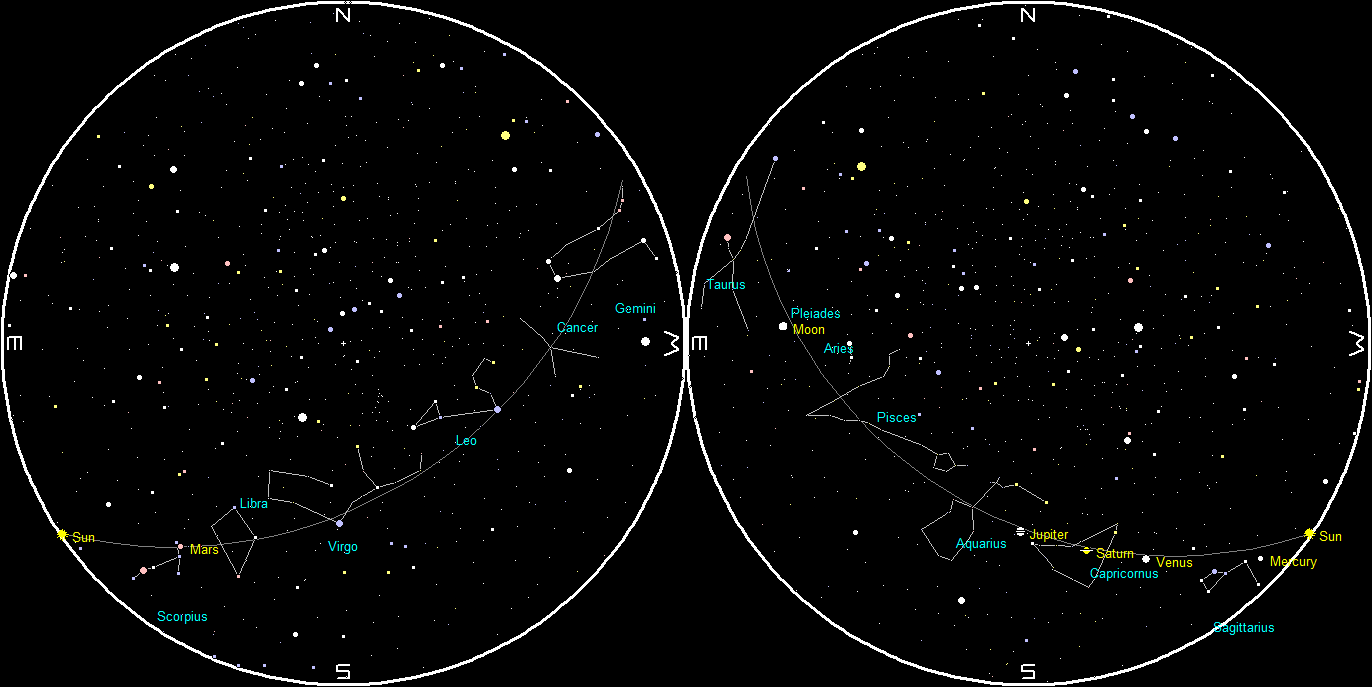
The naked-eye planets and the Moon at sunset and sunrise on a single night, starting with sunset on the right on December 15, 2021. The night ends on the left with sunrise on the 16th. Click on the image to enlarge it. Created using my LookingUp program.
12/08/2021 – Ephemeris – Let’s search for the naked-eye planets and a comet for this week
This is Ephemeris for Wednesday, December 8th. Today the Sun will be up for 8 hours and 54 minutes, setting at 5:02, and it will rise tomorrow at 8:08. The Moon, 2 days before first quarter, will set at 10:00 this evening.
Let’s search for the naked-eye planets for this week. Venus will be visible in the southwestern evening twilight by 5:30 tonight. It’s a crescent in telescopes. It is moving closer to us, and now appears larger than Jupiter in telescopes. Venus will set at 7:41 pm. By 5:45 pm, both Jupiter and Saturn should be able to be spotted in the southwestern sky. Saturn will be dimmer, and to its lower right, between it and Venus. It will set at 9:05 pm, with Jupiter following an hour and a half later at 10:34 pm. Comet Leonard can be spotted with binoculars about 19 degrees below and a bit left of the bright star Arcturus in the east from 6 to 7am tomorrow morning. 19 degrees is a bit less than two widths of a fist held at arm’s length. The comet will move lower each morning.
The astronomical event times given are for the Traverse City/Interlochen area of Michigan (EST, UT – 5 hours). They may be different for your location.
Addendum
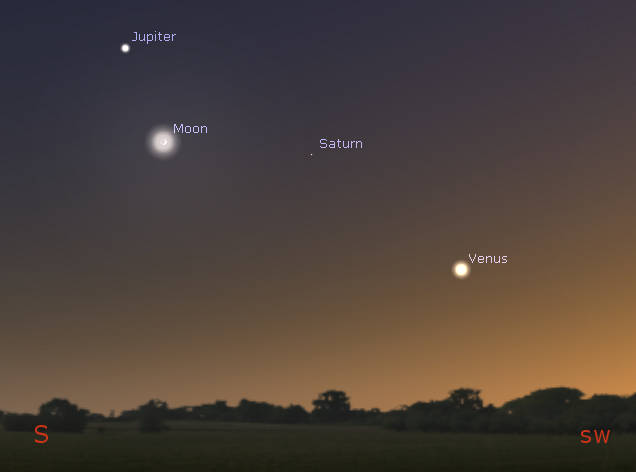
The evening planets Venus, Saturn, the Moon and Jupiter at 5:45 pm this evening, December 8, 2021. Created using Stellarium.
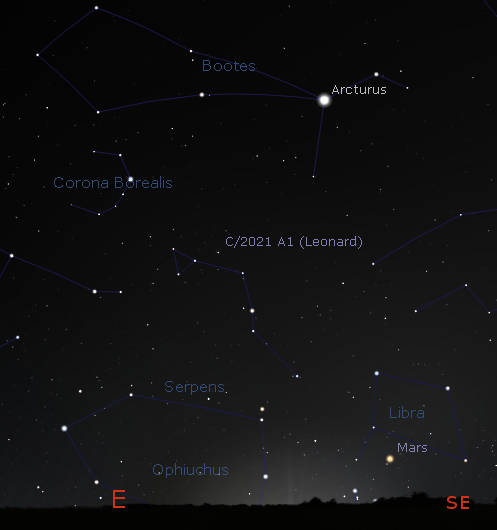
Comet Leonard and Mars at 7:15 am tomorrow morning, December 9, 2021. Though technically visible to the naked eye, binoculars will be needed for most of us. Mars is now visible low in the southeast at that time. Created using Stellarium.
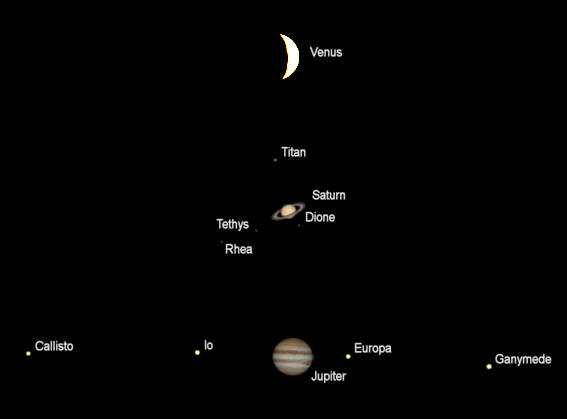
Telescopic views of the bright planets (north up) as they would be seen in a small telescope, with the same magnification, this evening at 6 pm, December 8, 2021. Apparent diameters: Venus, 44.08″, 21.5% illuminated; Saturn 15.84″, its rings 36.90″; Jupiter, 37.51″. Mars is not shown, its apparent diameter is 3.82″. The ” symbol means seconds of arc (1/3600th of a degree.) Created using Cartes du Ciel (Sky Charts).
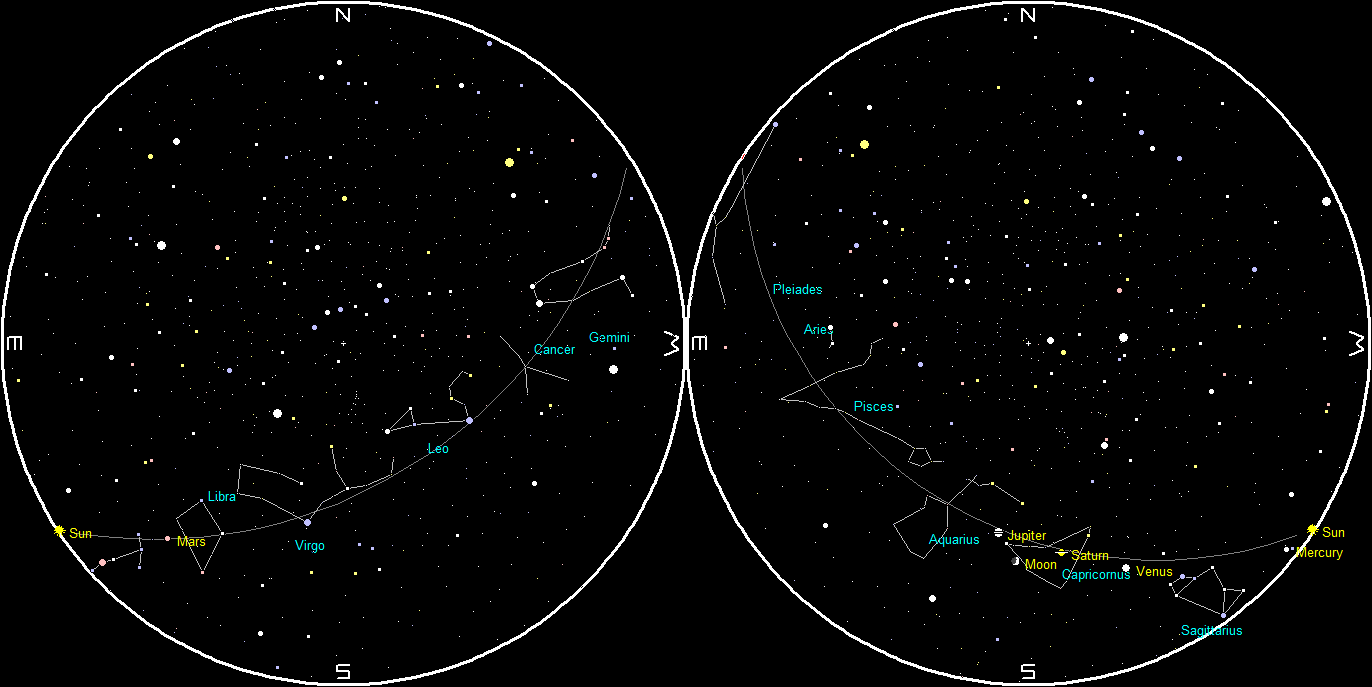
The naked-eye planets and the Moon at sunset and sunrise on a single night, starting with sunset on the right on December 8, 2021. The night ends on the left with sunrise on the 9th. Click on the image to enlarge it. Created using my LookingUp program.
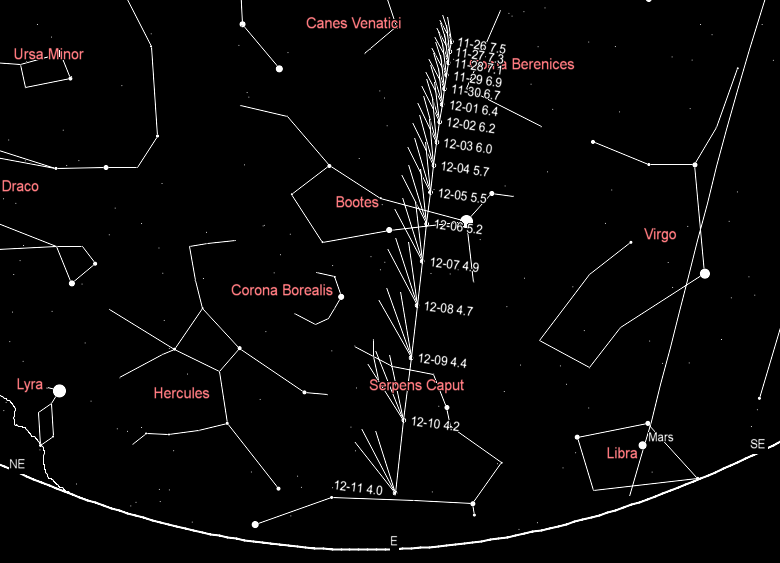
Comet Leonard’s positions at 6:30 am on the dates indicated. The labels are Month-Day Total Magnitude. The star’s position relative to the horizon and the position of Mars are for November 27th. The star field will be shifting to the upper right each morning at 6:30 from the November 27th date at 6:30. Comets always appear dimmer than their magnitude suggests because they are extended objects, not points like stars. Also, comet magnitudes can be unpredictable. Created using Cartes du Ciel (Sky Charts). I’ve reversed the colors from previous printings of this image. Reprinted from my article in the Stellar Sentinel, the newsletter for the Grand Traverse Astronomical Society.
12/01/2021 – Ephemeris – Let’s search for the naked-eye planets and a comet for this week
This is Bob Moler with Ephemeris for Wednesday, December 1st. Today the Sun will be up for 9 hours and 3 minutes, setting at 5:03, and it will rise tomorrow at 8:01. The Moon, 3 days before new, will rise at 5:45 tomorrow morning.
Let’s search for the naked-eye planets for this week. Venus will be visible in the southwestern evening twilight by 5:30 tonight. It’s a crescent in telescopes. It is moving closer to us, and now appears a bit larger than Jupiter in telescopes. Venus will set at 7:47 pm. By 5:45 pm, both Jupiter and Saturn should be able to be spotted in the southern sky. Saturn will be dimmer, and to its right. It will set first at 9:30 pm, with Jupiter following at 10:56 pm. A new comet named Leonard can be spotted with binoculars about 14 degrees above the bright star Arcturus in the east before 6:30 or 7am tomorrow morning. The spread of your fingers at arm’s length is about 15 degrees. The comet will move lower each morning.
The astronomical event times given are for the Traverse City/Interlochen area of Michigan (EST, UT – 5 hours). They may be different for your location. That also applies to the times in the addendum below.
Addendum
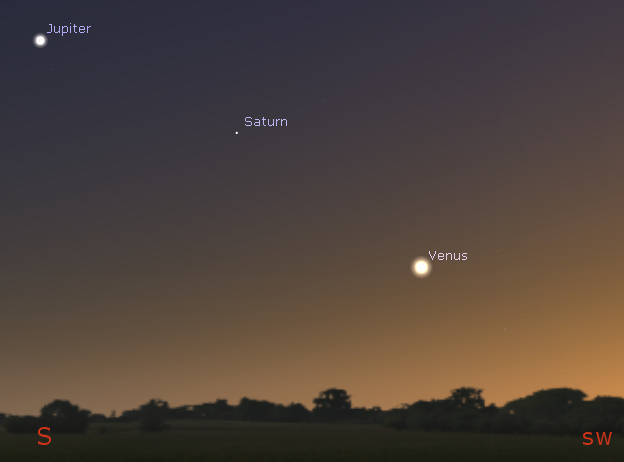
The evening planets Venus, Saturn and Jupiter at 5:45 pm this evening, December 1, 2021. Created using Stellarium.
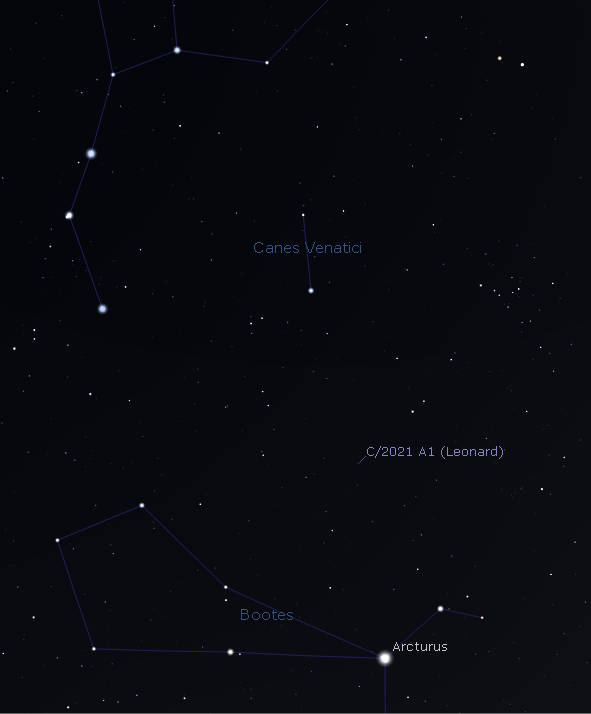
Comet Leonard, designation C/2021 A1, Finder chart looking East at 6:30 am. Arcturus is the brightest star in that direction. The handle of the Big Dipper is above and right of it. The comet is expected to be 7th magnitude, requiring binoculars or a telescope. It is expected to brighten to possibly be visible to the naked eye by the end of next week. No promises though. Created using Stellarium.
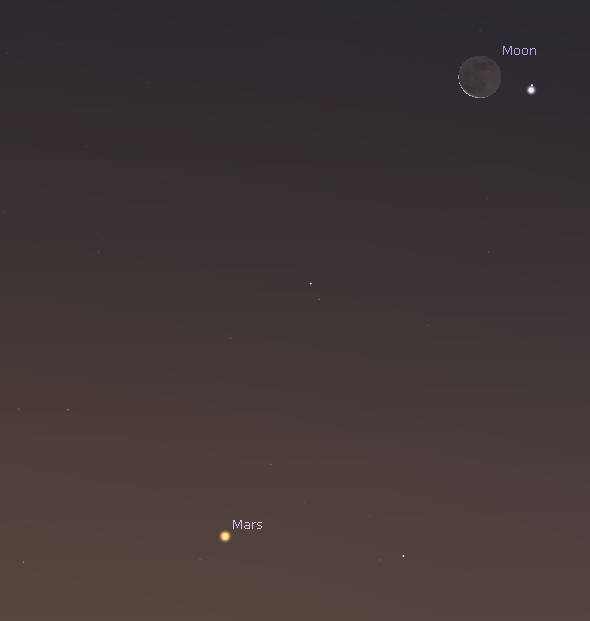
A closeup of the Moon and Mars at 7 am tomorrow morning, December 2, 2021. The star next to the Moon is Zubenelgenubi (south claw of the scorpion), in Libra. The Arabs, who named this star and most others, saw this star as part of Scorpius, to the left and yet to rise.
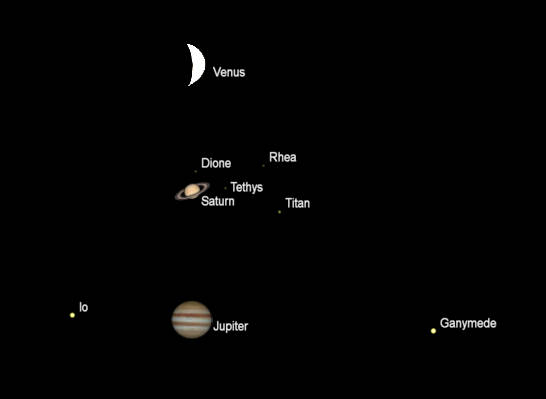
Telescopic views of the bright planets (north up) as they would be seen in a small telescope, with the same magnification, this evening at 7 pm, December 1, 2021. Apparent diameters: Venus, 39.41″, 27.9% illuminated; Saturn 15.99″, its rings 37.24″; Jupiter, 38.25″. The ” symbol means seconds of arc (1/3600th of a degree.) Jupiter’s other bright moons are behind the planet at 7 pm. Callisto will reappear on the eastern edge of Jupiter (Io’s side) at 9:13 pm. Created using Cartes du Ciel (Sky Charts).
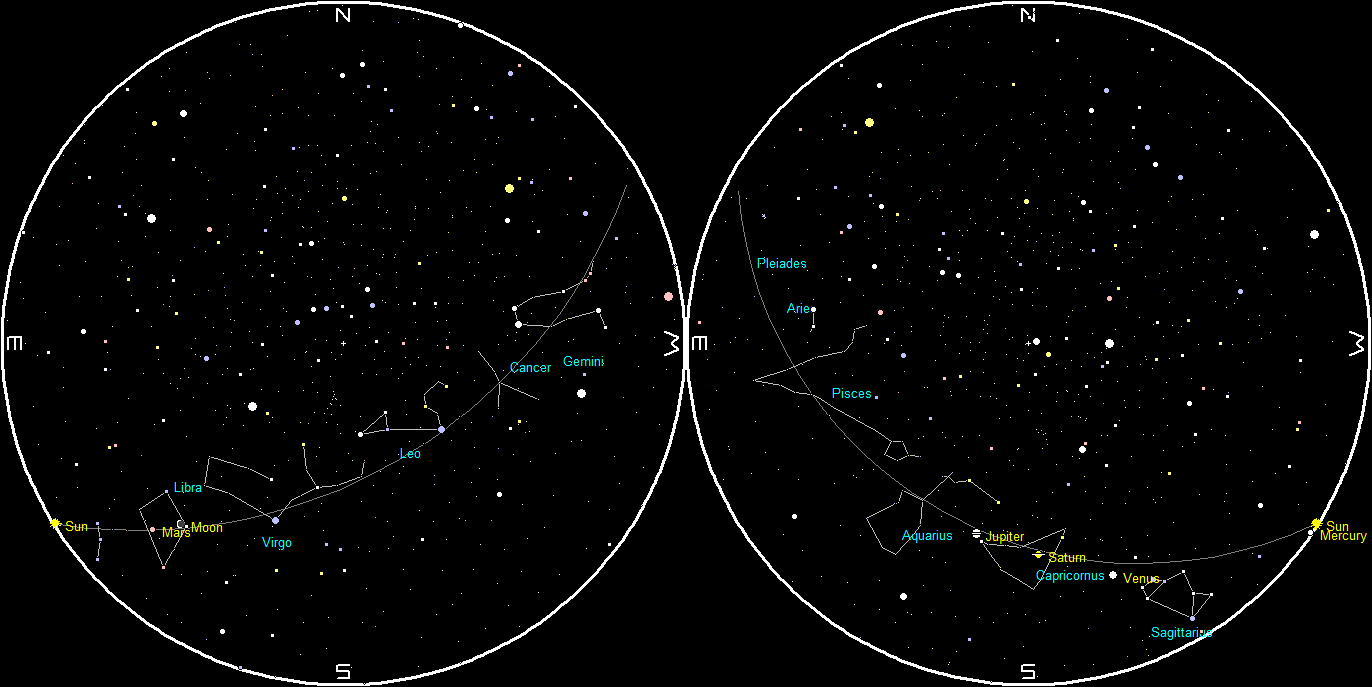
The naked-eye planets and the Moon at sunset and sunrise on a single night, starting with sunset on the right on December 1, 2021. The night ends on the left with sunrise on the 2nd. Click on the image to enlarge it. Created using my LookingUp program.
11/24/2021 – Ephemeris – Let’s search for the naked-eye planets for this week
This is Ephemeris for Wednesday, November 24th. Today the Sun will be up for 9 hours and 15 minutes, setting at 5:07, and it will rise tomorrow at 7:53. The Moon, 3 days before last quarter, will rise at 9:19 this evening.
Let’s search for the naked-eye planets for this week. Venus will be visible in the southwestern evening twilight by 5:30 tonight. It’s a fat crescent in telescopes. Venus will set at 7:49 pm. By 5:45 pm, both Jupiter and Saturn should be able to be spotted in the southern sky. Saturn will be dimmer, and to its right. It will set first at 9:54 pm, with Jupiter following at 11:19 pm. Saturn’s rings are a beautiful sight in a telescope of even modest power, but the planet will appear tiny. Jupiter, however, is still quite large, in binoculars it might seem that it only has two moons tonight, since Io and Europa are together on one side, and Ganymede and Callisto are together on the other side.
The astronomical event times given above and below are for the Traverse City/Interlochen area of Michigan (EST, UT – 5 hours). They may be different for your location.
Addendum
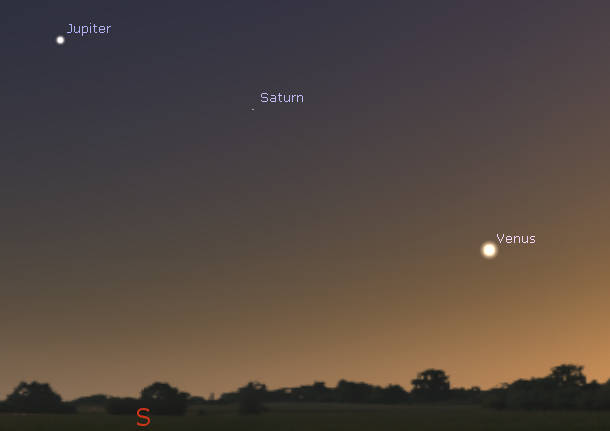
The evening planets Venus, Saturn and Jupiter at 5:45 pm this evening, November 24, 2021. Created using Stellarium.
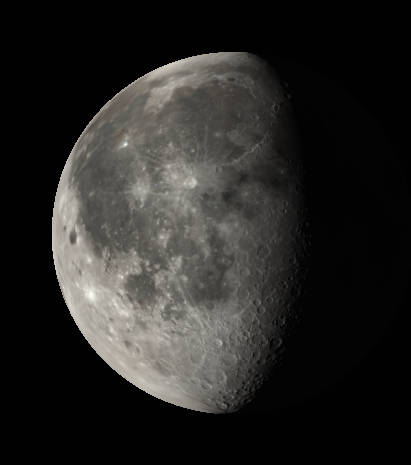
The Moon as it might appear in binoculars or small telescope, tomorrow morning, November 25, 2021. Created using Stellarium.
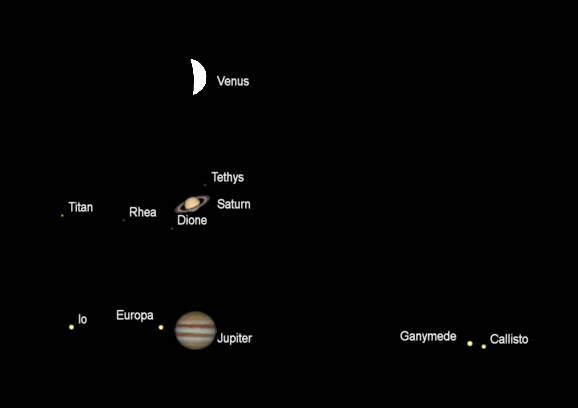
Telescopic views of the bright planets (north up) as they would be seen in a small telescope, with the same magnification, this evening at 7 pm, November 24, 2021. Apparent diameters: Venus, 35.32″, 33.4% illuminated; Saturn 16.15″, its rings 37.61″; Jupiter, 39.07″. The ” symbol means seconds of arc (1/3600th of a degree.) Click on the image to enlarge it. Created using Cartes du Ciel (Sky Charts).
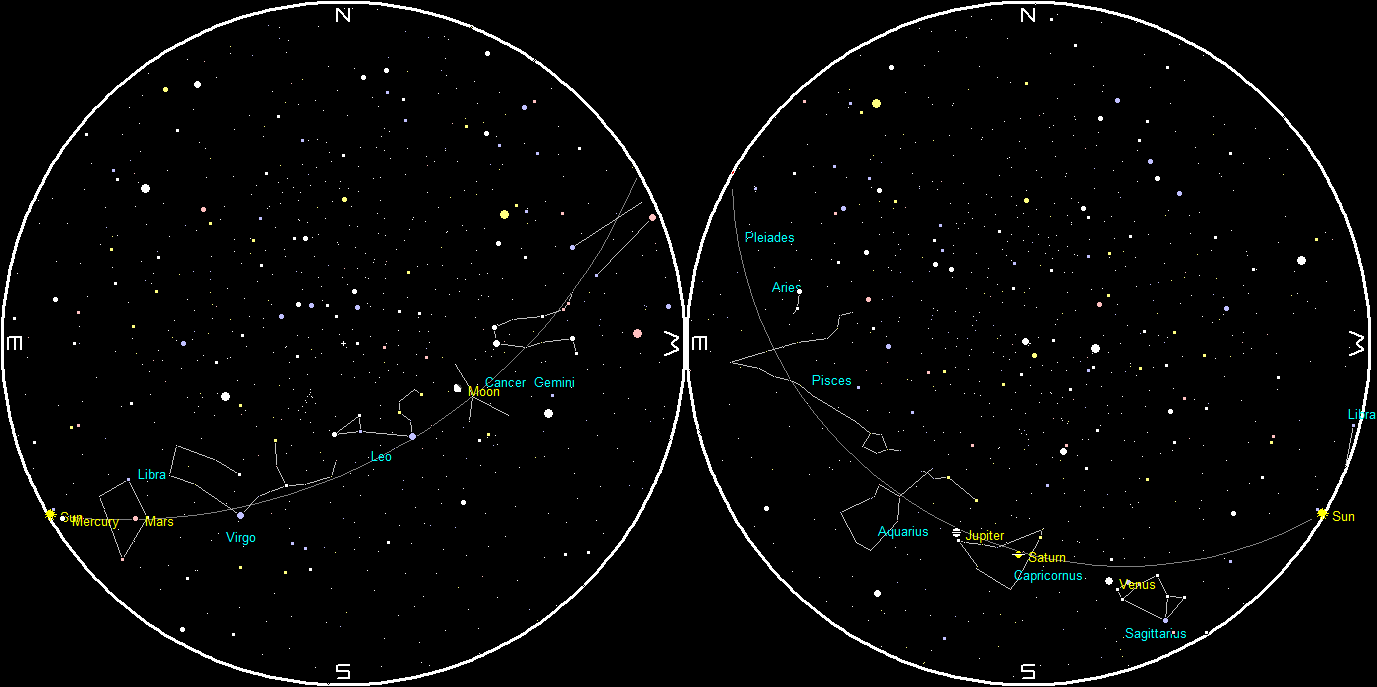
The naked-eye planets and the Moon at sunset and sunrise on a single night, starting with sunset on the right on November 24, 2021. The night ends on the left with sunrise on the 25th. Click on the image to enlarge it. Created using my LookingUp program.
11/17/2021 – Ephemeris – Let’s search for the naked-eye planets for this week
This is Ephemeris for Wednesday, November 17th. Today the Sun will be up for 9 hours and 29 minutes, setting at 5:12, and it will rise tomorrow at 7:44. The Moon, 2 days before full, will set at 6:54 tomorrow morning.
Let’s search for the naked-eye planets for this week. Venus will be visible in the southwestern evening twilight by 5:30 tonight. It’s a fat crescent in telescopes. Venus will set at 7:48 pm. By 5:45 pm, both Jupiter and Saturn should be able to be spotted in the southern sky. Saturn will be dimmer, and to its right. It will set first at 10:19 pm, with Jupiter following at 11:42 pm. Saturn’s rings are a beautiful sight in a telescope of even modest power, but the planet will appear tiny. Jupiter, however, is still quite large, and its four biggest moons are spread out and might all be glimpsed in binoculars. In the morning sky, Mars is starting to make its appearance, rising at 6:33. Binoculars might be able to pick it out low in the east-southeast until 7:15 am.
The astronomical event times given are for the Traverse City/Interlochen area of Michigan (EST, UT – 5 hours). They may be different for your location.
Addendum
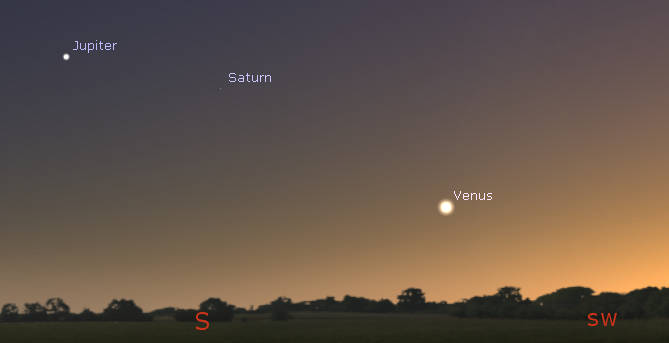
The evening planets Venus, Saturn and Jupiter at 5:45 pm this evening, November 17, 2021. Created using Stellarium.
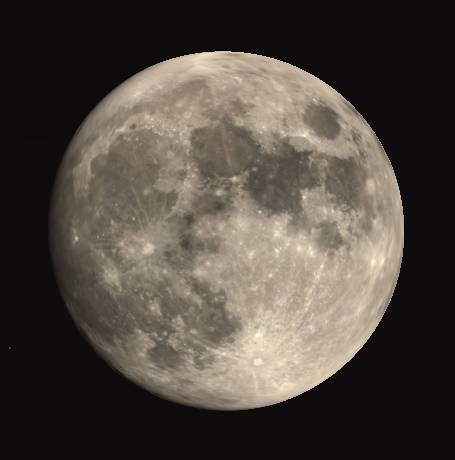
The Moon in binoculars or small telescope as it might appear tonight, November 17, 2021. Created using Stellarium.
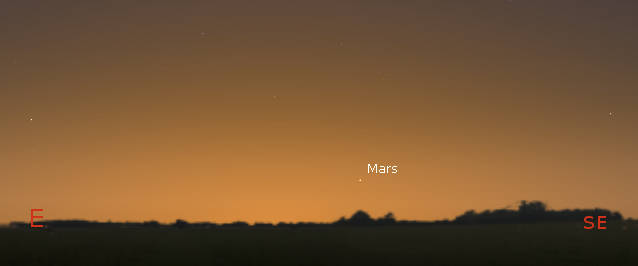
Mars in twilight, tomorrow morning at 7 am, November 18, 2021. Create using Stellarium.
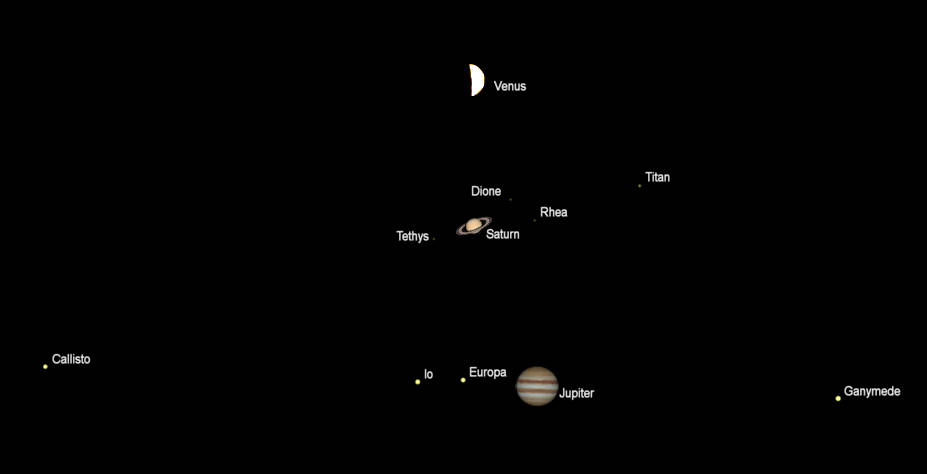
Telescopic views of the bright planets (north up) as they would be seen in a small telescope, with the same magnification, this evening at 7 pm, November 17, 2021. Apparent diameters: Venus, 31.89″, 38.3% illuminated; Saturn 16.32″, its rings 38.01″; Jupiter, 39.95″. Mars in the morning is not shown, but is 3.70″ in diameter. The ” symbol means seconds of arc (1/3600th of a degree.) Click on the image to enlarge it. Created using Cartes du Ciel (Sky Charts).
In the image above, Jupiter’s moon Europa is shown. Actually, before 7:03 pm, it will be hidden in Jupiter’s shadow. Watching it appear is kind of cool. Eclipses of Jupiter’s moons happen all the time. The information for the satellite events is published in Sky and Telescope Magazine. Also tonight, farther to the west, farther out than Ganymede, is the star 45 Capricorni, about the same brightness as the Jovian moons, and nearly in line with them. Don’t mistake it for one of the moons, especially before Europa appears.
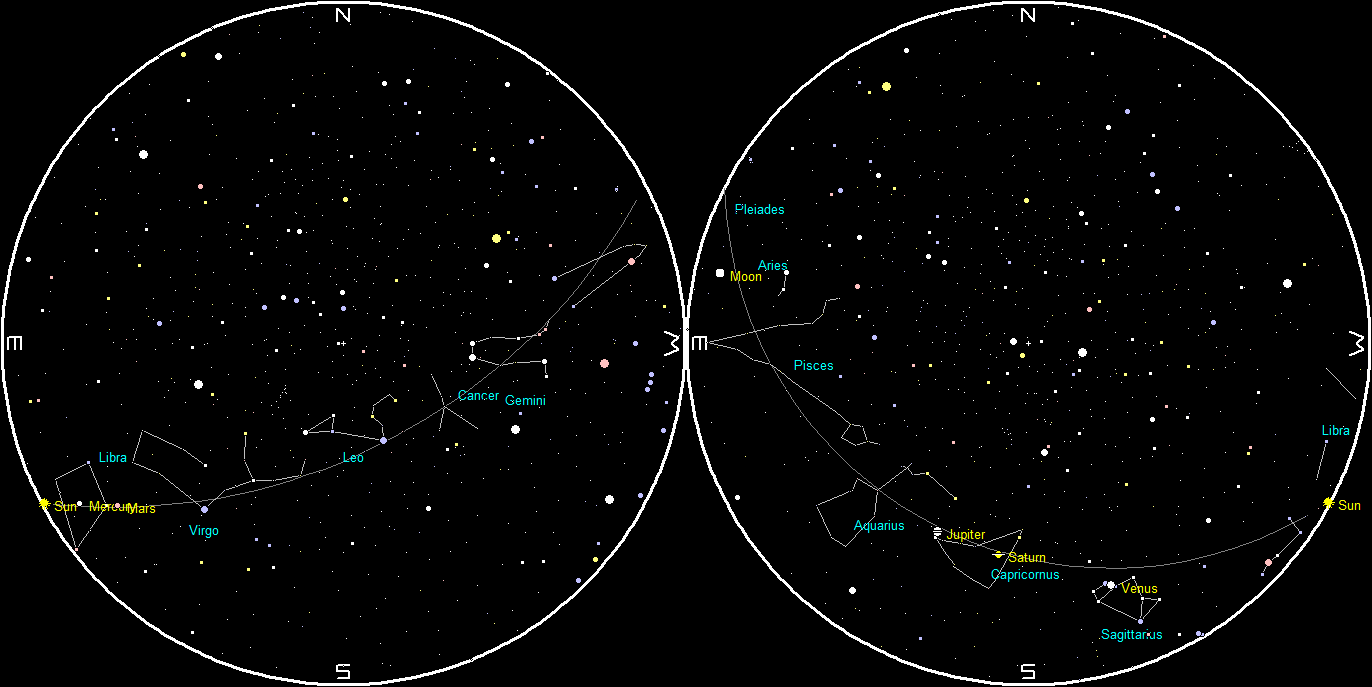
The naked-eye planets and the Moon at sunset and sunrise on a single night, starting with sunset on the right on November 17, 2021. The night ends on the left with sunrise on the 18th. Click on the image to enlarge it. Created using my LookingUp program.
11/11/2021 – Ephemeris – The Moon passes Jupiter and a minor meteor shower tonight.
This is Bob Moler with Ephemeris for Veterans Day, Thursday, November 11th. Today the Sun will be up for 9 hours and 43 minutes, setting at 5:18, and it will rise tomorrow at 7:36. The Moon, at first quarter today, will set at 12:16 tomorrow morning.
By tonight, the Moon will have moved over and just passed Jupiter. The bright planet will be to the right and above the first quarter Moon. There is also a meteor shower occurring, well actually two. They are minor, with maybe 5 to 15 meteors per hour at peak. With both showers, the radiants, that is where the meteors seem to come from, is in Taurus the Bull near the Pleiades star cluster. The notes I have for the Northern Taurids is that they are slow and bright, not bothered by a bright Moon. So if a meteor is spotted in the evening coming from the east, it’s probably a North Taurid meteor. As the night progresses the radiant will move westward, higher in the sky and begin to set in the west as morning twilight starts.
The astronomical event times given are for the Traverse City/Interlochen area of Michigan (EST, UT – 5 hours). They may be different for your location.
Addendum
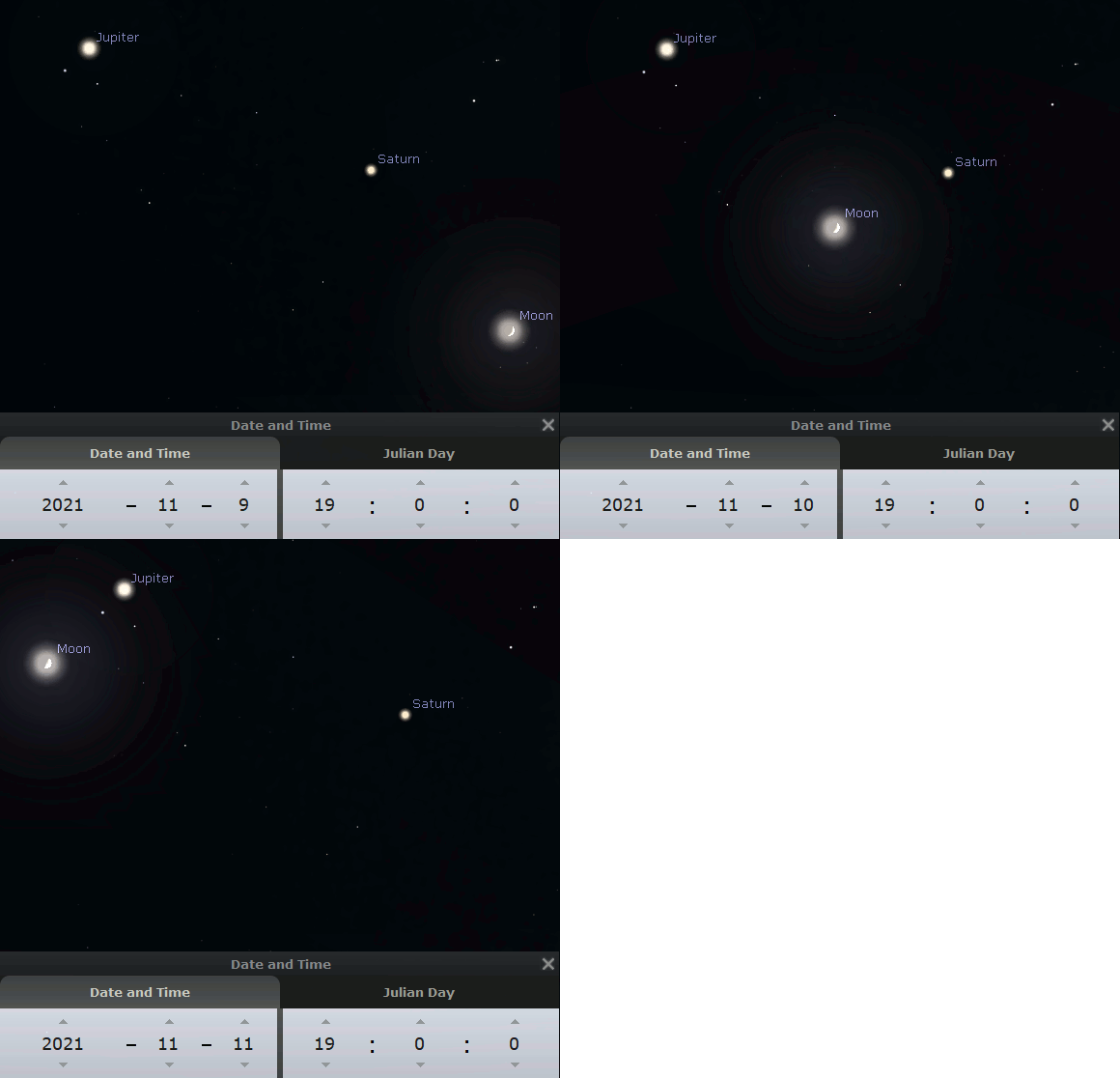
Viewing the Moon’s passage by Saturn and Jupiter for three nights, November 9, 10 and 11 2021. Note that while the Moon is jumping eastward, to the left, the planets and stars are moving the other way, but much more slowly. The Moon moves 360° around the sky in about 29 1/2 days, so it moves about 12° or 24 of its diameters every day. The movement of the stars and planets in the other direction is because we are staying at the same solar time, 7 pm. However, the Earth is orbiting the Sun at a little less than a degree a solar day. To keep the stars stationary, our daily interval should be one sidereal day, the time it takes the earth to rotate with respect to the stars, which is 23 hours 3 minutes and 56 seconds. Should we have stepped at the sidereal rate, the very slight eastward motion of these outer planets may have been noticeable. Created using Stellarium, and GIMP.
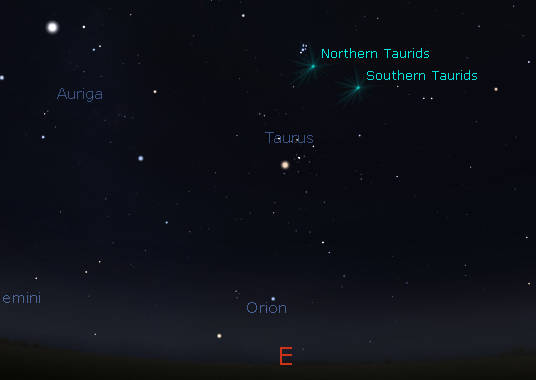
North and South Taurid radiants seen in the east at 9 pm on November 11th. The Northern Taurid radiant is the most active now. Note the Pleiades just to the upper left of the Northern Taurid radiant. The face of Taurus the bull is below as a sideways V where Taurus is displayed. However, since the meteors are seen all over the sky, it might be difficult to trace them back to a specific radiant. Created using Stellarium.
As a side note, about the face of Taurus. The stars, except the brightest one, Aldebaran, belong to a star cluster called the Hyades. They are, mythologically, the half-sisters of the Pleiades. Also, the V can be an upside down A. I am currently working on a program I’m going to present at the December Zoom meeting of the Grand Traverse Astronomical Society about astronomy in ancient times. Back when the alphabet was developed in the Middle East 4000-4500 years ago, Taurus, not Aries was the first sign of the zodiac, so apparently the first letter of the alphabet “Aleph” was modeled after the face of Taurus.
Other tidbits are: the reason there are 24 hours in a day, and 60 minutes in an hour. There are lots of others. We can handle up to 100 people joining the meeting. It’s at 8 pm EST (UT – 5 hours), December 3rd [01:00 UT, December 4th]. To join the meeting, go to www.gtastro.org for instructions and a link.
11/10/2021 – Ephemeris – Let’s search for the naked-eye planets for this week
This is Bob Moler with Ephemeris for Wednesday, November 10th. Today the Sun will be up for 9 hours and 46 minutes, setting at 5:19, and it will rise tomorrow at 7:34. The Moon, 1 day before first quarter, will set at 11:02 this evening.
Let’s search for the naked-eye planets for this week. Venus should be visible in the southwestern evening twilight by 5:40 tonight. It’s a fat crescent in telescopes. Venus will set at 7:46 pm. By 6 pm, Both Jupiter and Saturn should be able to be spotted in the southern sky. Saturn will be dimmer, and to its right. Saturn will be above and right of the Moon tonight. It will set first at 10:45 pm, with Jupiter following at 12:07 am. Saturn’s rings are a beautiful sight in a telescope of even modest power, but the planet will appear tiny. In the morning sky, Mercury now can only be spotted in a telescope, so its appearance in the morning sky is, for all practical purposes, over.
The astronomical event times given are for the Traverse City/Interlochen area of Michigan (EST, UT – 5 hours). They may be different for your location.
Addendum
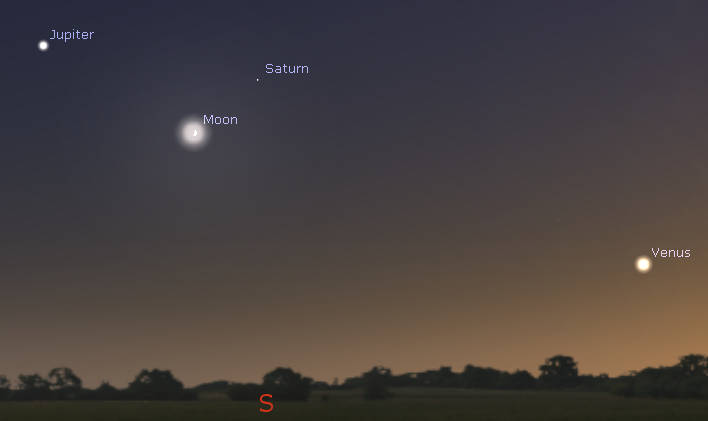
Evening planets and the Moon in twilight at 6 pm tonight, November 10, 2021. Click on the image to enlarge it. Created using Stellarium.
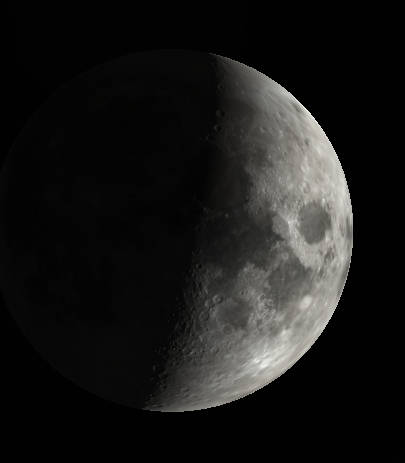
The crescent Moon as it might appear tonight in binoculars or small telescope. It appears here right side up as it would appear in the sky at 6 pm tonight, November 10, 2021. Created using Stellarium.
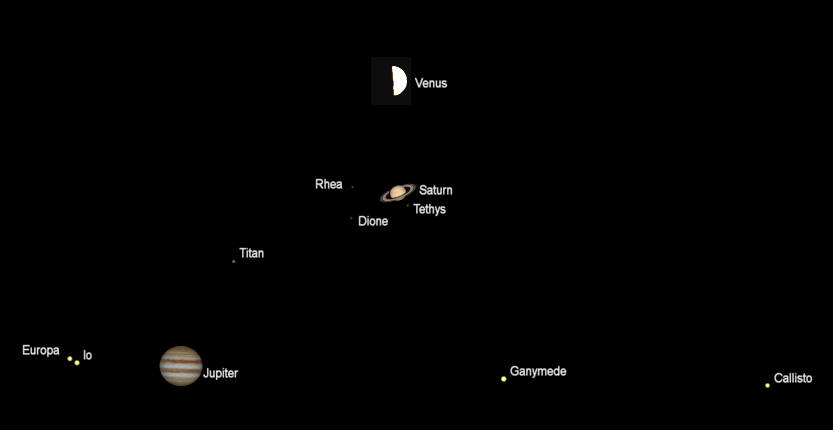
Telescopic views of the bright planets (north up) as they would be seen in a small telescope, with the same magnification, this evening at 7 pm, November 10, 2021. Apparent diameters: Venus, 28.99″, 42.7% illuminated; Saturn 16.50″, its rings 38.44″; Jupiter, 40.94″. The ” symbol means seconds of arc (1/3600th of a degree.) Click on the image to enlarge it. Created using Cartes du Ciel (Sky Charts).
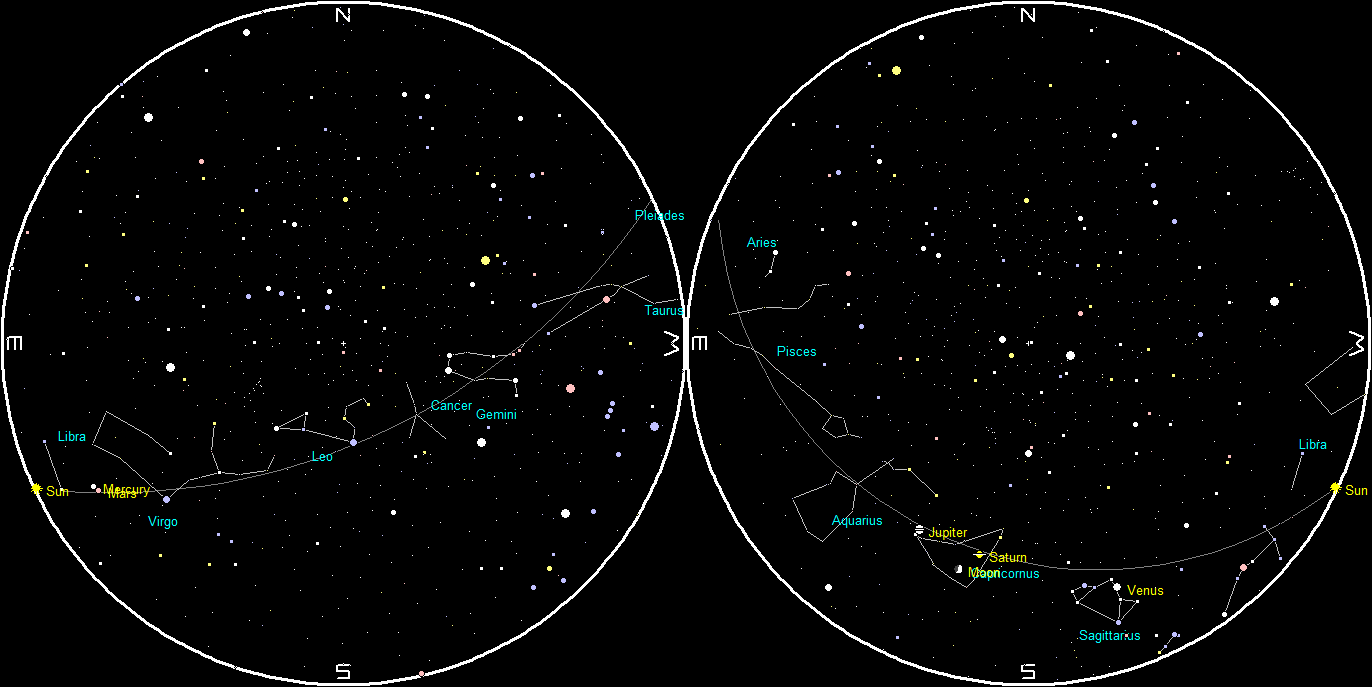
The naked-eye planets and the Moon at sunset and sunrise on a single night, starting with sunset on the right on November 10, 2021. The night ends on the left with sunrise on the 11th. Click on the image to enlarge it. Created using my LookingUp program.
11/09/2021 – Ephemeris – The Moon, Saturn and the return to standard time
This is Bob Moler with Ephemeris for Tuesday, November 9th. Today the Sun will be up for 9 hours and 48 minutes, setting at 5:20, and it will rise tomorrow at 7:33. The Moon, 2 days before first quarter, will set at 9:48 this evening.
Ever since new moon, the Moon has been moving eastward each night. It will be approaching Saturn tonight, and pass south or below Saturn at mid-morning tomorrow. By tomorrow night, the Moon will have moved just past Saturn, on its way toward Jupiter. The return to standard time since Sunday has darkened our evenings and lightened our mornings. We are about 30 days from the earliest sunset on December 9th, just 18 minute earlier than tonight’s sunset. Our sunrise has a longer time to go to reach last week’s late sunrise times, all the way to January second. Thanks to Congress’s messing around with it, we are on daylight saving time for a longer part of the year than standard time. Don’t get me started.
The astronomical event times given are for the Traverse City/Interlochen area of Michigan (EST, UT – 5 hours). They may be different for your location.
Addendum
Viewing the Moon’s passage by Saturn and Jupiter for three nights, November 9, 10 and 11, 2021. Created using Stellarium, and GIMP.
10/27/2021 – Ephemeris – Let’s search for the naked-eye planets for this week
This is Bob Moler with Ephemeris for Wednesday, October 27th. Today the Sun will be up for 10 hours and 23 minutes, setting at 6:38, and it will rise tomorrow at 8:15. The Moon, 1 day before last quarter, will rise at 11:27 this evening.
Let’s search for the naked-eye planets for this week. Venus should be visible in the southwestern evening twilight by 7 tonight. It will set at 8:43 pm. By 7:15 pm, Jupiter will be spotted in the south-southeastern sky. Jupiter should be easy to spot at that hour. Saturn will be dimmer, and to its right. They will be visible for a while after midnight in the southwest, with Saturn setting first at 12:37 am, and Jupiter following at 1:57. Saturn’s rings are a beautiful sight in a telescope of even modest power, but the planet will appear tiny. In the morning sky, Mercury will be visible and low in the east-southeast for most of the 7 am hour. All four of Jupiter’s brightest moons will be visible in binoculars early in the evening tonight.
The astronomical event times given are for the Traverse City/Interlochen area of Michigan (EDT, UT – 4 hours). They may be different for your location.
Addendum
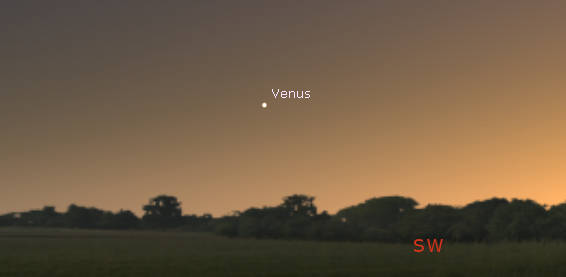
Venus will appear low in the southwest by 7 pm tonight, October 27, 2021. Created using Stellarium.
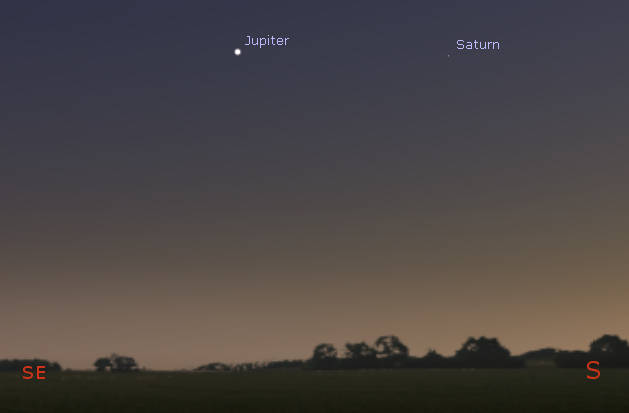
Jupiter and Saturn in evening twilight at 7:15 pm tonight, October 27, 2021. Created using Stellarium.
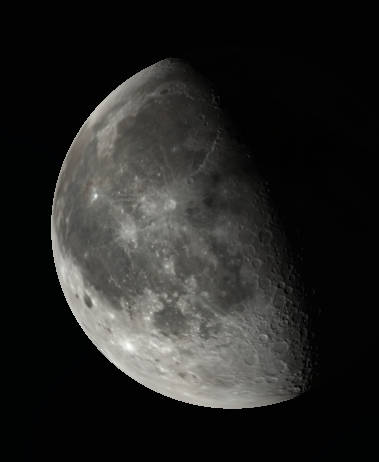
The Moon as it might appear in binoculars or a small telescope tomorrow morning, October 28, 2021. Created using Stellarium.
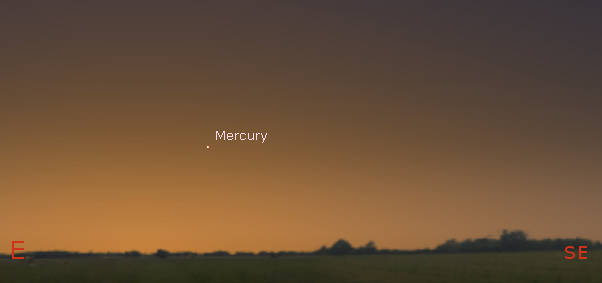
Mercury in morning twilight finder for 7:30 am tomorrow, October 28, 2021. Created using Stellarium.
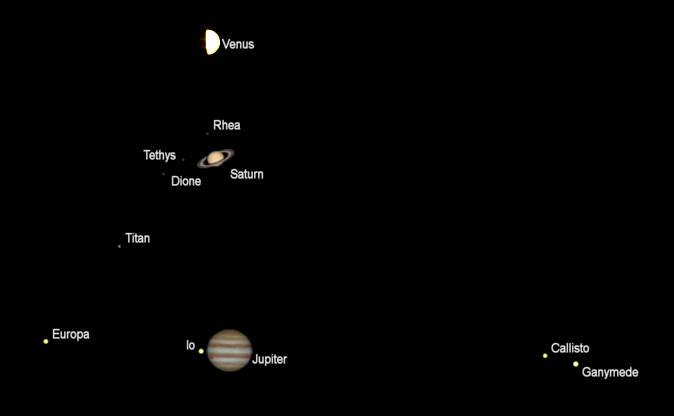
Telescopic views of the bright planets (north up) as they would be seen in a small telescope, with the same magnification, this evening at 9 pm, October 27, 2021. Apparent diameters: Venus at 7 pm, 24.19″, 50.8% illuminated; Saturn 16.92″, its rings 39.41″; Jupiter, 42.87″. Mercury at 7:30 am on the 28th and not plotted, 6.47″, 64.9% illuminated. The Jovian moon Io will begin transiting the face of the planet at 9:20 pm. Its shadow will start to cross at 10:37 pm. Io’s transit will end at 11:37 pm. The ” symbol means seconds of arc (1/3600th of a degree.) Click on the image to enlarge it. Created using Cartes du Ciel (Sky Charts).
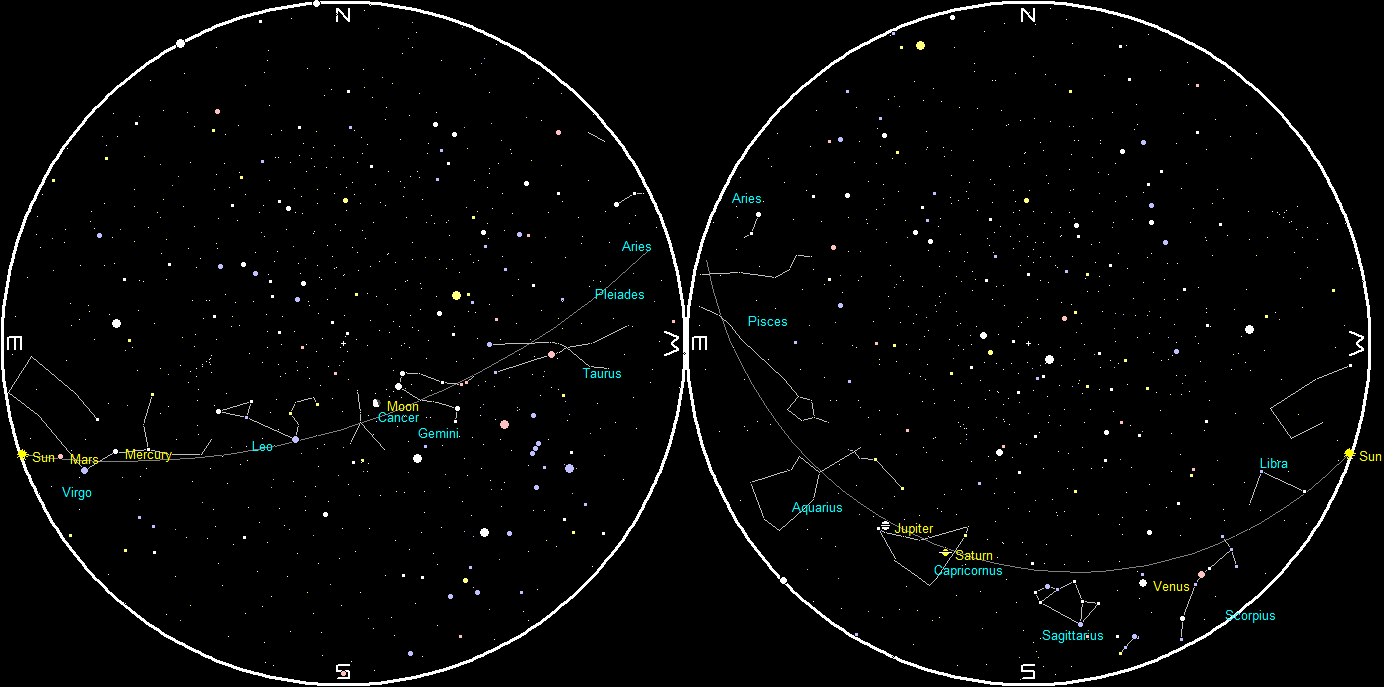
The naked-eye planets and the Moon at sunset and sunrise on a single night, starting with sunset on the right on October 27, 2021. The night ends on the left with sunrise on the 28th. Click on the image to enlarge it. Created using my LookingUp program.
 Bob Moler's Ephemeris Blog