Archive
03/24/2015 – Ephemeris – The Moon will be passing in front of the Hyades tonight
Ephemeris for Tuesday, March 24th. The Sun will rise at 7:38. It’ll be up for 12 hours and 21 minutes, setting at 8:00. The Moon, 3 days before first quarter, will set at 1:16 tomorrow morning.
Tonight he Moon will be crossing in front of the Hyades star cluster, otherwise known as the face of the constellation Taurus the bull. The Moon will make it about half way across by the time it sets. The Moon is 2160 miles in diameter and moves about the same distance in an hour as it orbits the Earth. The International Space Station and other satellites in low Earth orbit have to travel 17,500 miles an hour to stay in orbit. But since the Earth’s gravity, or the gravitational force of any body diminishes with the square of the distance. Double the distance and the gravitational force diminishes by a factor of four. This inverse square law as it is known also works with the diminution of light with distance from its source.
Times are for the Traverse City/Interlochen area of Michigan. They may be different for your location.
Addendum
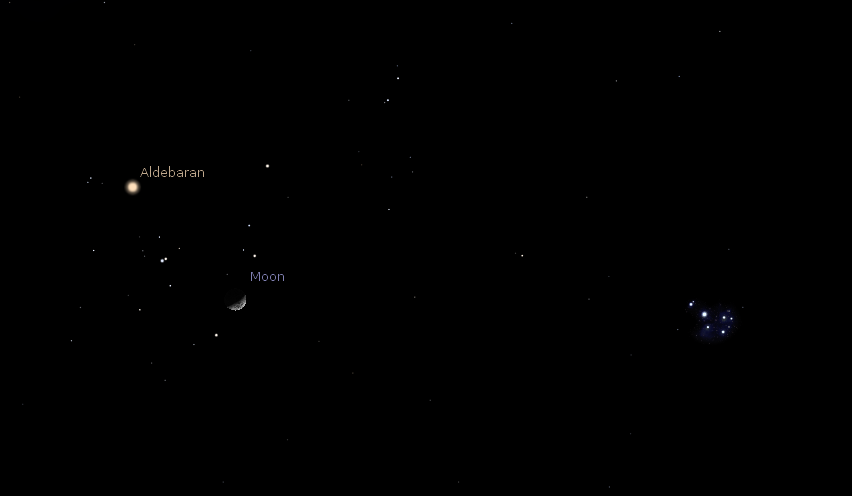
The Moon is travelling in front of the Hyades at 10 p.m. March 24, 2015. Created using Stellarium.
03/11/2015 – Ephemeris – On Wednesday we look at the bright planets
Ephemeris for Wednesday, March 11th. The Sun will rise at 8:02. It’ll be up for 11 hours and 40 minutes, setting at 7:43. The Moon, 2 days before last quarter, will rise at 1:42 tomorrow morning.
Lets take a look at the bright planets for this week. Brilliant Venus is in the west by 8:30 p.m. It will set at 10:31 p.m. Mars appears below and right of it. The Red Planet will set tonight at 9:47. Jupiter will appear In the southeastern sky in the evening. It will set at 6:41 a.m. It’s near the sickle-shaped head of Leo the lion, and it’s the brightest star-like object in the sky after Venus sets. In telescopes tonight the moon Io duck behind Jupiter at 9:29 early, but will pop into sunlight a bit away from the planet on the other side at 12:33 a.m. because it also will be hidden in Jupiter’s shadow. Early risers will be able to spot Saturn which will rise in the east-southeast at 1:54 a.m. It will appear below the Moon tomorrow morning.
Times are for the Traverse City/Interlochen area of Michigan. They may be different for your location.
Addendum
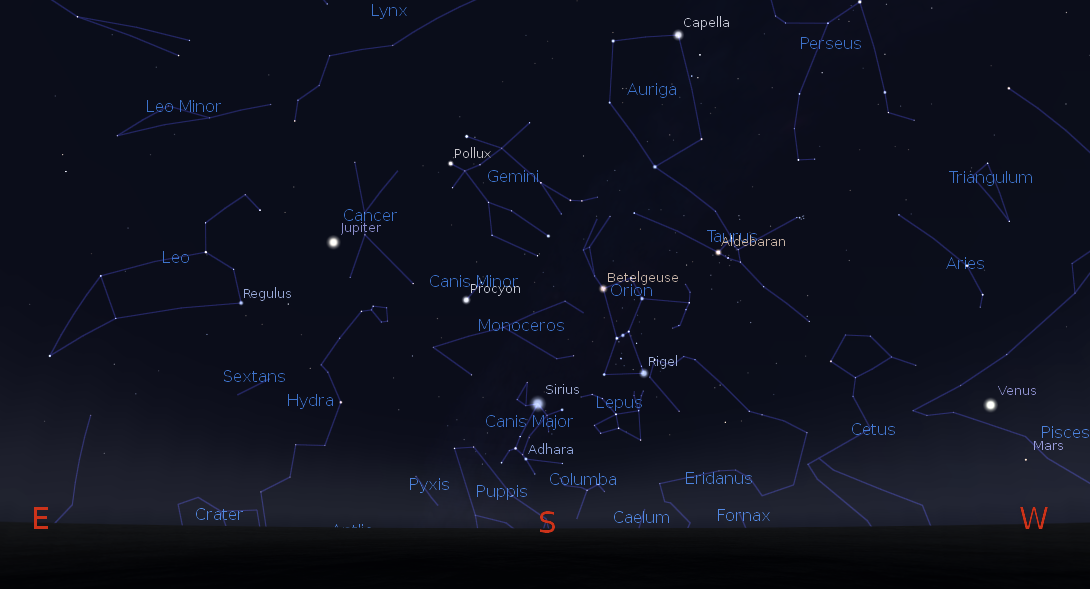
The evening planets Mars, Venus, and Jupiter with the winter constellations at 9 p.m. March 11, 2015. Created using Stellarium.
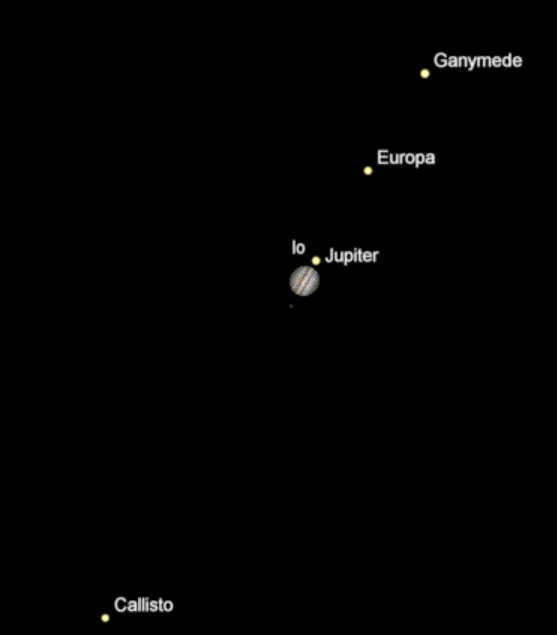
Jupiter and moons at 9 p.m. March 11, 2015, about 29 minutes before Io moves behind Jupiter. Created using Cartes du Ceil (Sky Charts).
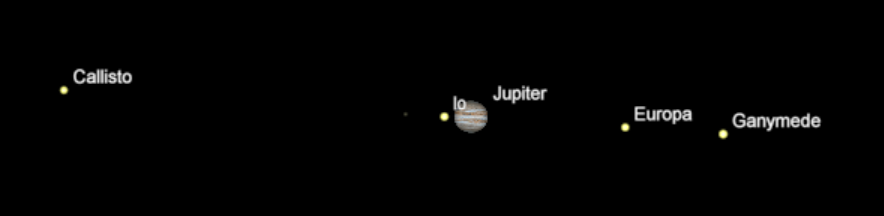
Jupiter and moons at 12:33 a.m. March 12, 2015, about when Io emerges into sunlight from Jupiter’s shadow. Created using Cartes du Ceil (Sky Charts).
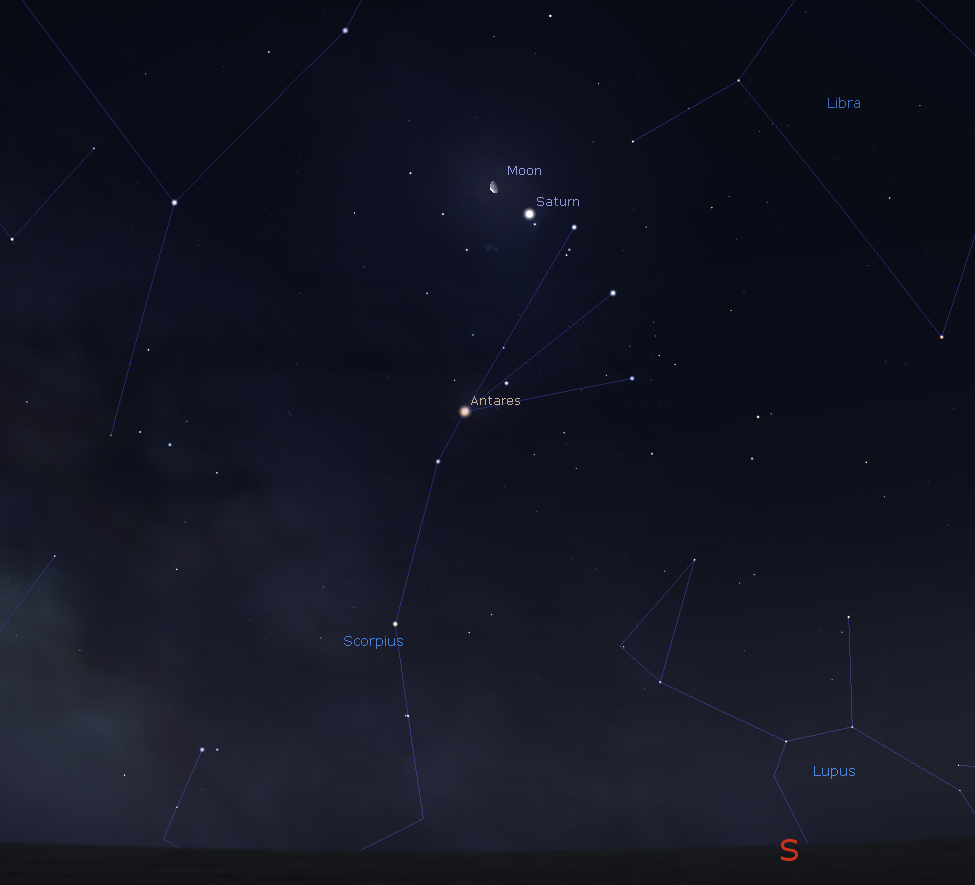
Saturn and the Moon in Scorpius in the south at 6 a.m. March 12, 2015. Created using Stellarium.
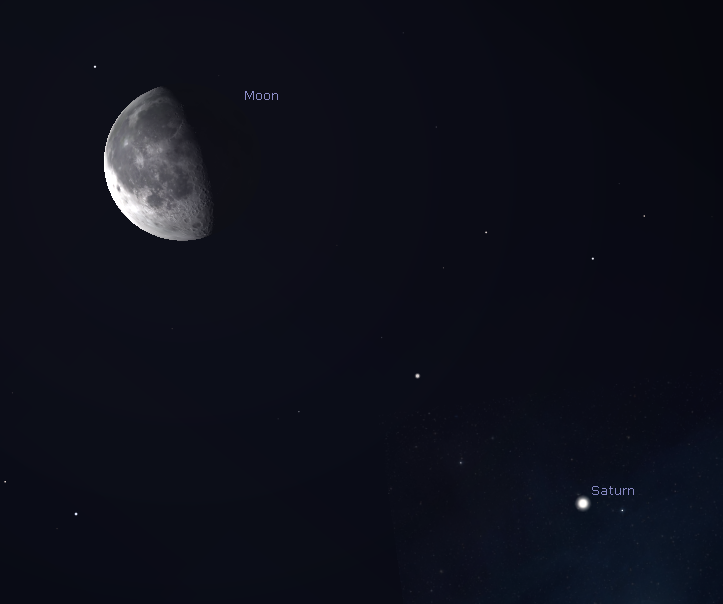
Closeup of Saturn and the Moon at 6 a.m. March 12, 2015. Created using Stellarium.
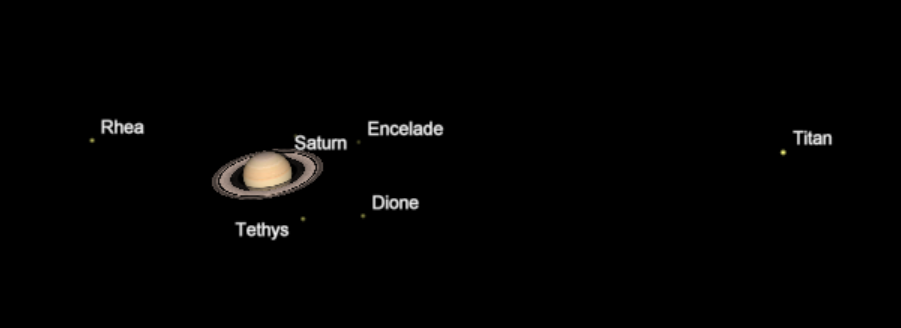
What Saturn and its moons might appear like in a telescope at 6 a.m., March 12, 2015. Small telescopes will show only the moon Titan. Created using Cartes du Ceil (Sky Charts).
02/20/2015 – Ephemeris – The Moon joins Venus and Mars in the west tonight
Ephemeris for Friday, February 20th. The sun will rise at 7:35. It’ll be up for 10 hours and 42 minutes, setting at 6:17. The moon, 2 days past new, will set at 8:49 this evening.
Tonight the two day old moon will be seen in the west in a tight triangle with Venus and Mars. They will become visible about 7 o’clock. The planets will be to the left of the Moon with much dimmer Mars above Venus. The formation is tight enough that the motion of the moon will be evident between 7 and when the Moon sets at 8:49. The moon moves its own diameter in about an hour. The moon will also exhibit earthshine, the reflection of the bright earth in the moon’s sky on the night side of the Moon itself. The earthshine lit part of the moon shows a ghostly man in the moon image we are familiar with at full moon. This earthshine is visible on the Moon for a few days before new moon to a few days after new moon.
Times are for the Traverse City/Interlochen area of Michigan. They may be different for your location.
Addendum
Views of the Venus, Mars, Moon grouping from three locations.
Appearance of the grouping from northern Michigan, US
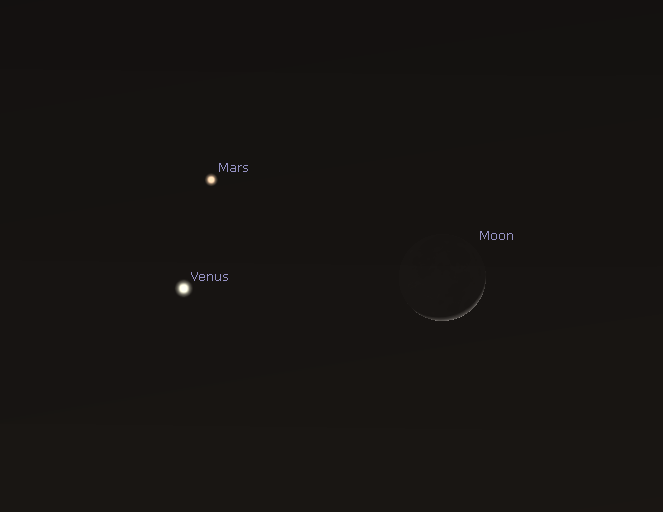
Venus and Mars with the Moon at 7 p.m. EST on February 20, 2015. This is for northern Michigan. Created using Stellarium.
Appearance of the grouping from Los Angeles, CA
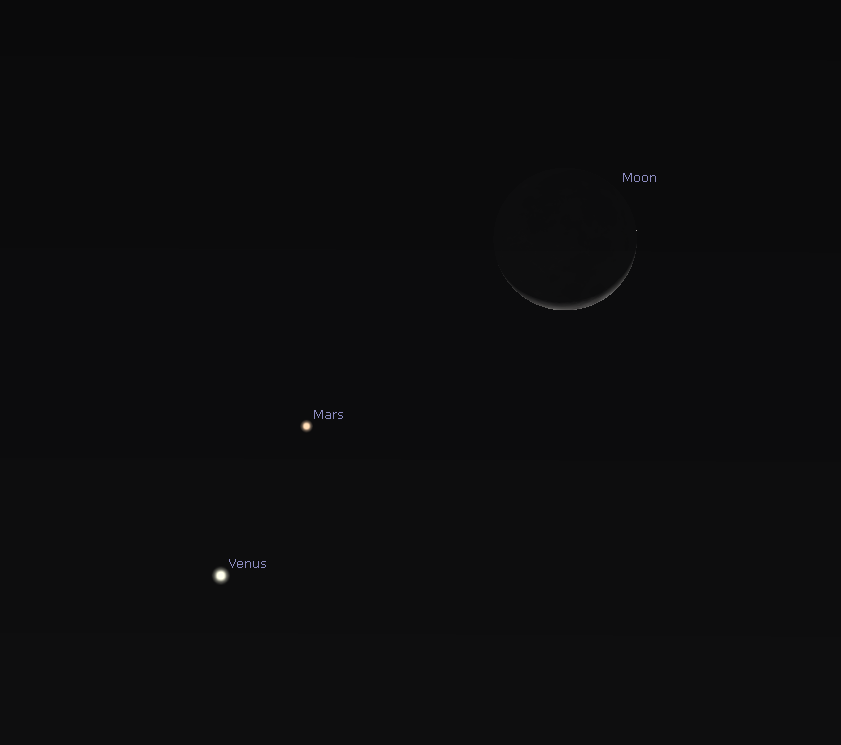
Venus and Mars with the Moon at 8 p.m. PST on February 20, 2015. This is for Los Angeles, CA. Created using Stellarium.
Appearance of the grouping from London, UK
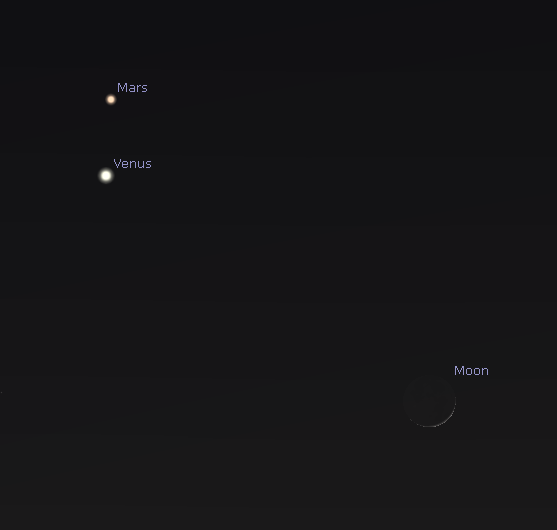
Venus and Mars with the Moon at 20:28 GMT on February 20, 2015. This is for London, UK. Created using Stellarium.
02/18/2015 – Ephemeris – Wednesday is bright planet day (or night) on Ephemeris
Ephemeris for Ash Wednesday, Wednesday, February 18th. The sun will rise at 7:38. It’ll be up for 10 hours and 36 minutes, setting at 6:15. The moon is new today, and won’t be visible.
Lets take a look at the bright planets and a fading binocular comet for this week. Brilliant Venus is in the west-southwest by 7 p.m. It will set at 8:37 p.m. It’s nearing Mars which appears above and left of it. They will be at their closest on the 22nd. The Red Planet will set tonight at 8:45 p.m. Jupiter will appear In the southeastern sky in the evening. It will be up all night, and will set at 7:14 a.m. It’s near the sickle-shaped head of Leo the lion, and it’s the brightest star-like object in the sky. Early risers will be able to spot Saturn which will rise in the east-southeast at 2:15 a.m. Comet Lovejoy, visible in binoculars, is about half way from the star at the end of Andromeda, called Almaak and the “W” of Cassiopeia.
Times are for the Traverse City/Interlochen area of Michigan. They may be different for your location.
Addendum
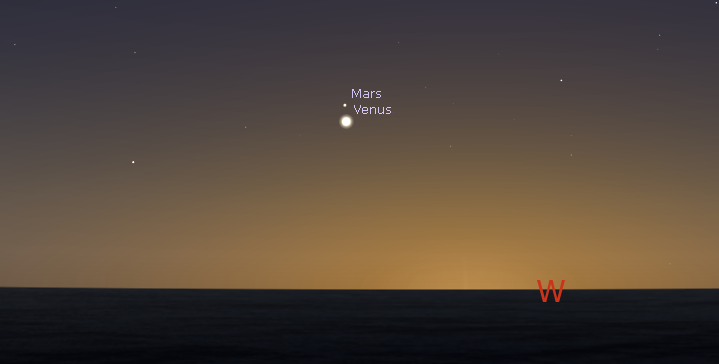
Venus and Mars low in the west after sunset. This is 7 p.m., February 18, 2015. Created using Stellarium.
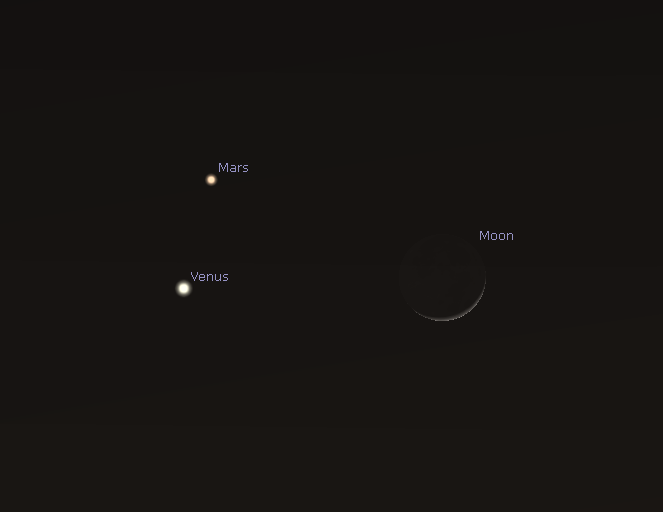
Venus, Mars and the moon on Friday night at 7 p.m. (2/20/15). Created using Stellarium.
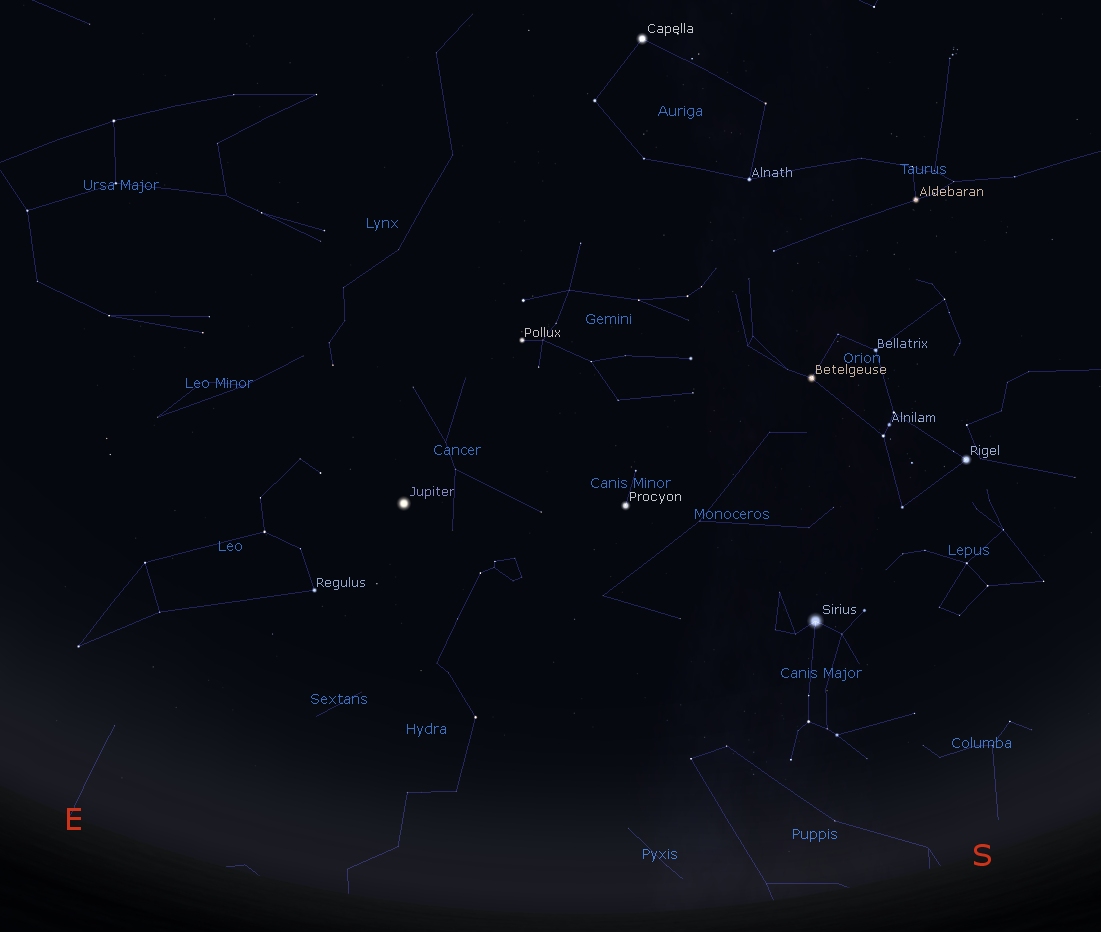
Jupiter with the winter constellations at 9 p.m., February 18, 2015. Created using Stellarium.
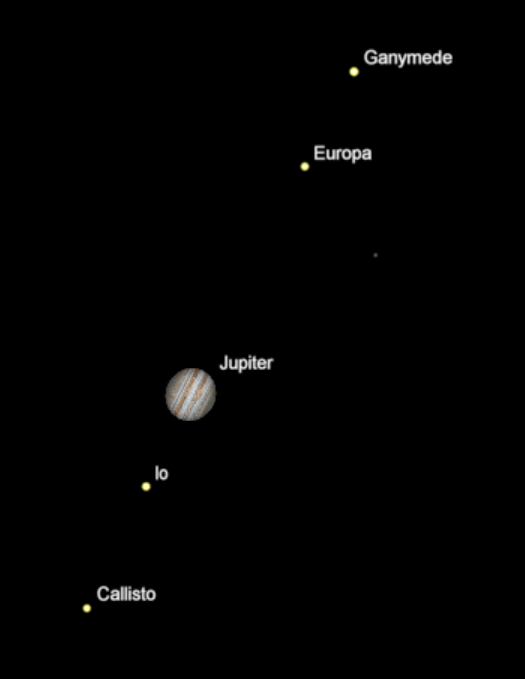
Jupiter and it’s moons at 9 p.m. February 18, 2015. Note that at this time the Great Red Spot is on the face if Jupiter. Created using Cartes du Ciel (Sky Charts).
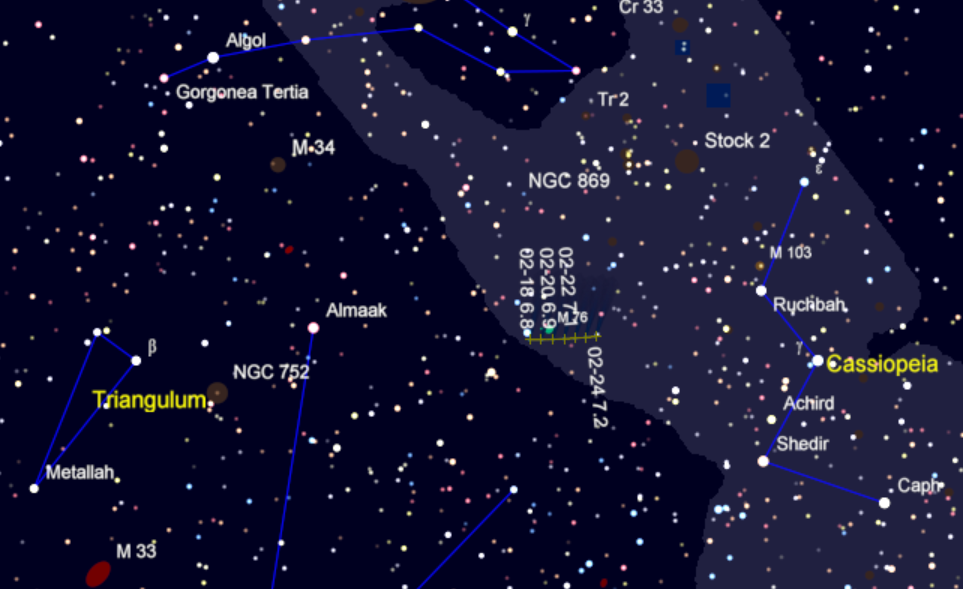
The track of Comet 2014 Q2 (Lovejoy) from 2/18/15 to 02/24/15 which will appear high in the west at 9 p.m. On the 20th the comet will pass near M76, a 10th magnitude planetary nebula. It will be much dimmer than the comet. Created using Cartes du Ceil (Sky Charts).
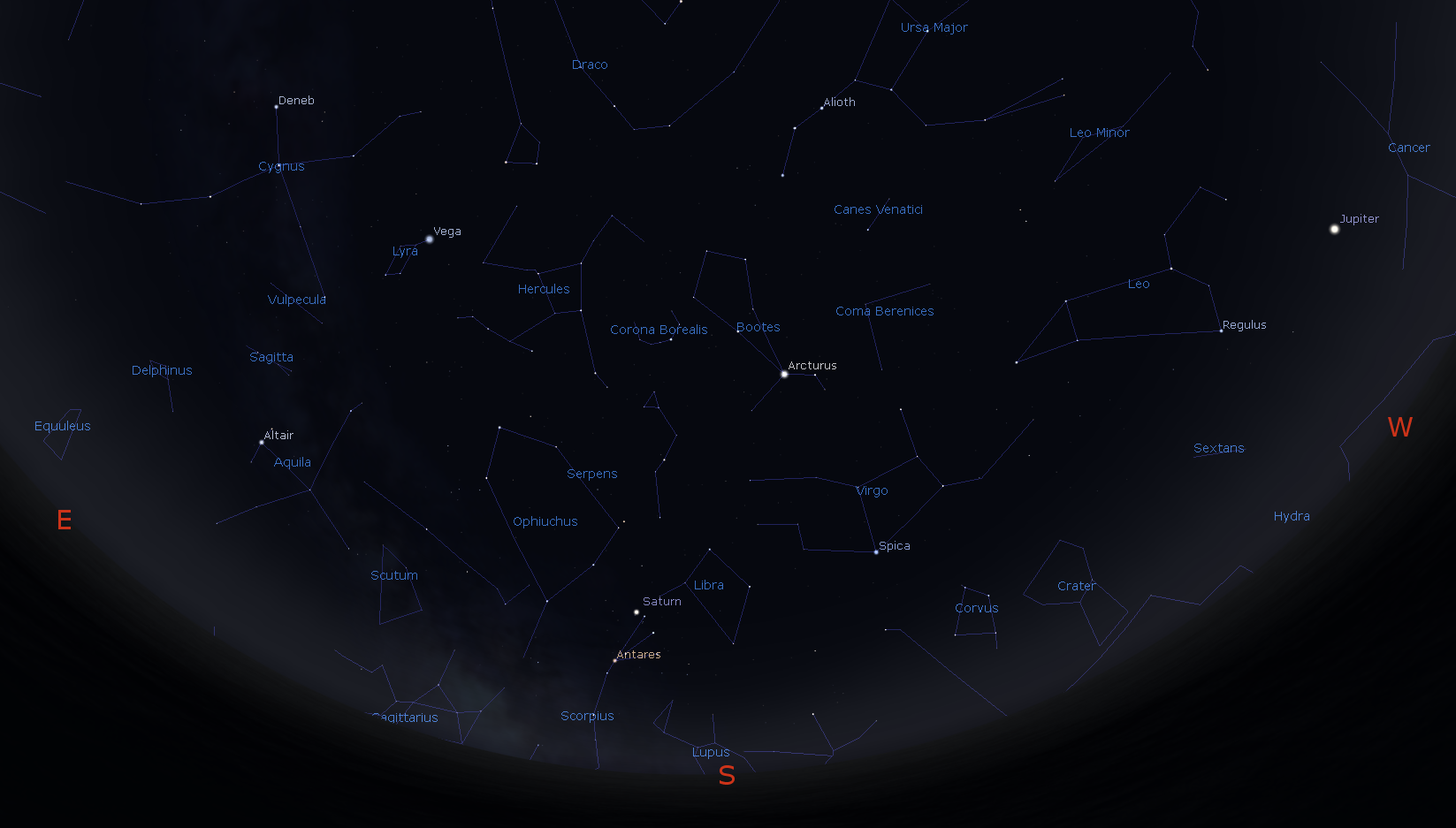
Looking southward at 6 a.m. February 19, 2015 to a preview of the constellations of summer with Saturn in the south and Jupiter setting in the west. Click to enlarge.
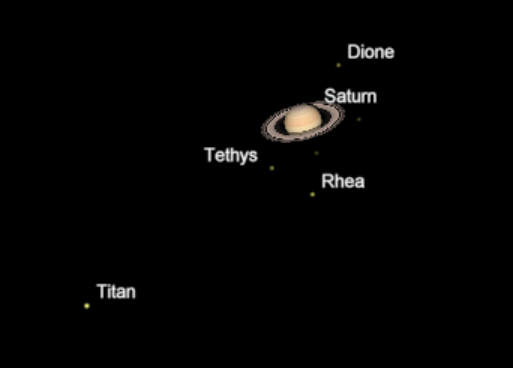
What Saturn and its moons might appear like in a telescope at 6 a.m., February 19, 2015. Small telescopes will show only the moon Titan. Created using Cartes du Ceil (Sky Charts).
02/11/2015 – Ephemeris – Wednesday is bright planet day around here
Ephemeris for Wednesday, February 11th. The sun will rise at 7:49. It’ll be up for 10 hours and 16 minutes, setting at 6:05. The moon, at last quarter today, will rise at 1:52 tomorrow morning.
Lets take a look at the bright planets and a binocular comet for this week. Brilliant Venus is in the west-southwest by 7 p.m. It will set at 8:19 p.m. Mars appears above and left of Venus in the southwest. Venus is approaching Mars and they will be at their closest on the 22nd. The Red Planet will set tonight at 8:44 p.m. Jupiter will appear In the southeastern sky in the evening. It will be up all night, and will set just before sunrise. It’s near the sickle-shaped head of Leo the lion, and it’s the brightest star-like object in the sky. Early risers will be able to spot Saturn which will rise in the east-southeast at 2:41a.m. Comet Lovejoy, visible in binoculars, is about the width of a binocular field to the right of the star at the end of Andromeda, called Almaak.
Times are for the Traverse City/Interlochen area of Michigan. They may be different for your location.
Addendum
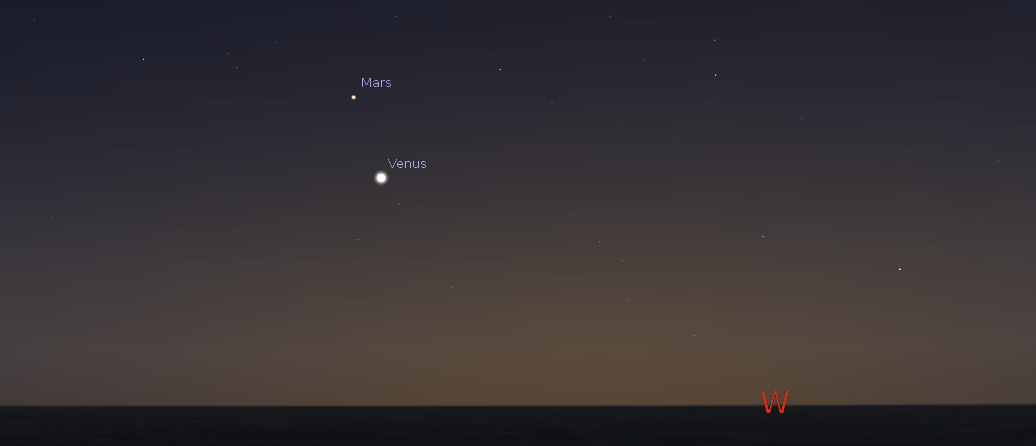
Venus and Mars low in the west at 7 p.m. on February 11, 2015. The crescent moon will be seen with the two planets on the evening of the 20th, and they will be in conjunction on the 22nd. Created using Stellarium.
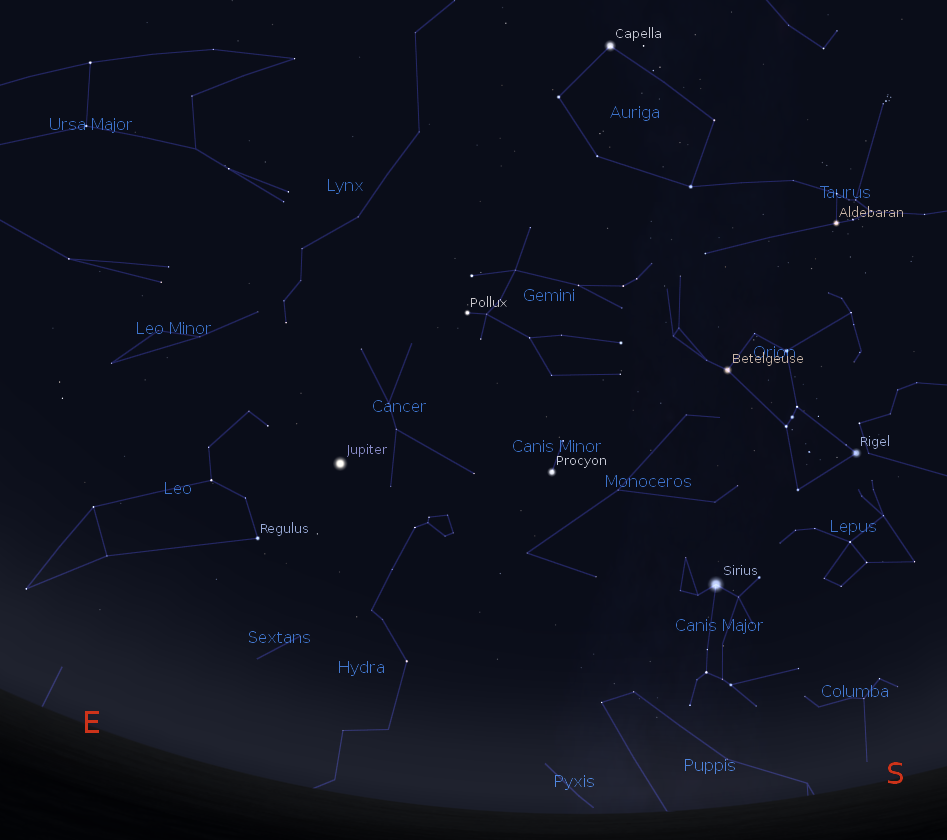
Jupiter and the bright winter stars at 9 p.m. on February 11, 2015. Created using Stellarium.
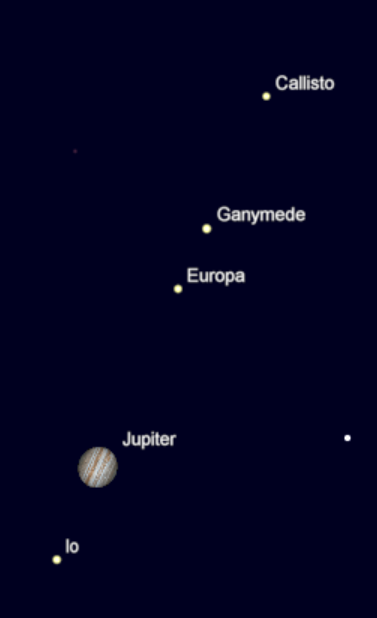
Jupiter and its moons as they might appear in a telescope tonight. Created using Cartes du Ceil (Sky Charts).
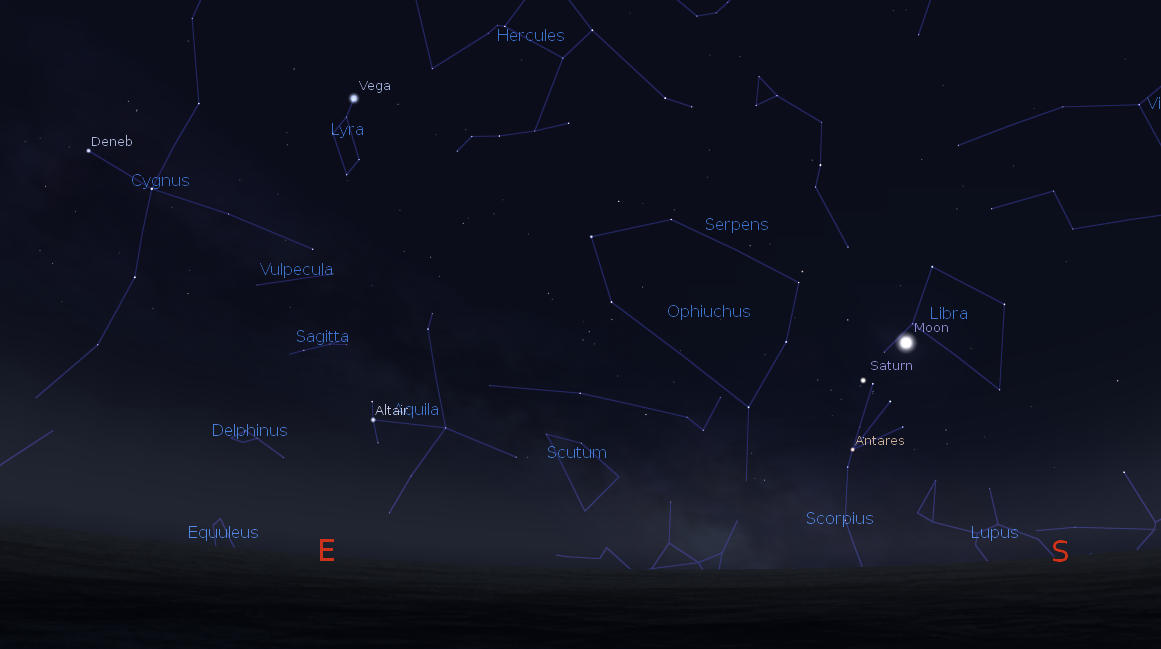
The Moon will appear near Saturn at 6 a.m. February 12, 2015. Created using Stellarium.
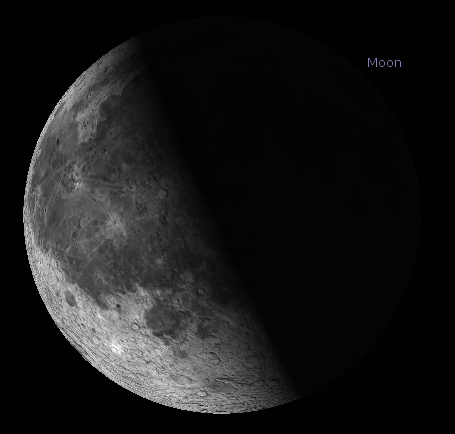
The Moon as it might appear in binoculars at 6 a.m. on February 12, 2015. Created using Stellarium.
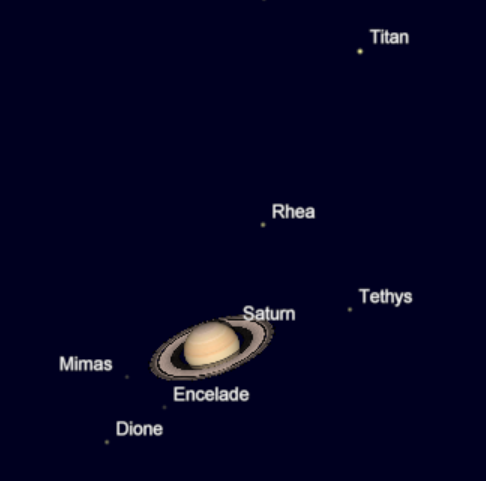
What Saturn and its moons might appear like in a telescope at 6 a.m., February 12, 2015. Small telescopes will show only the moon Titan. Created using Cartes du Ceil (Sky Charts).
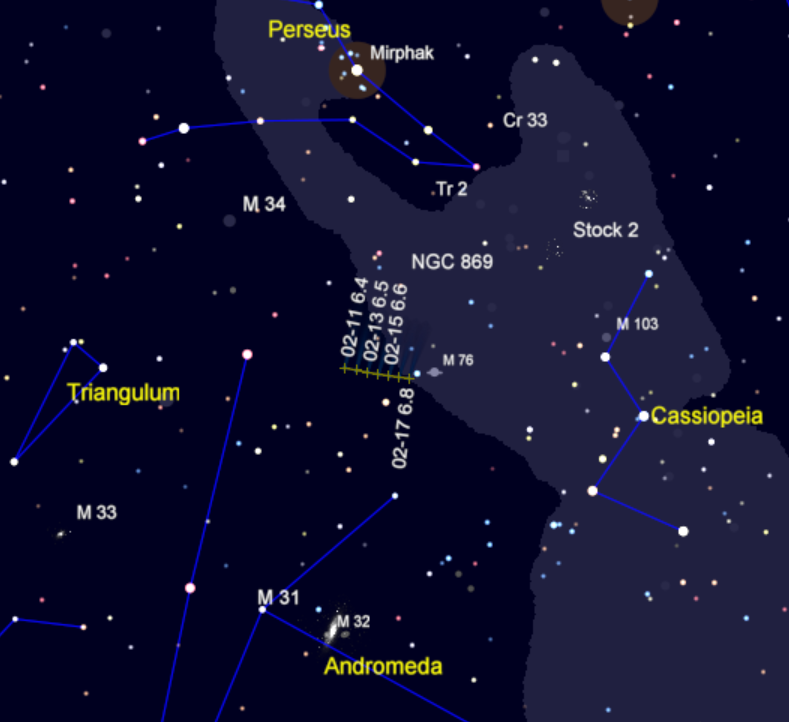
The track of Comet 2014 Q2 (Lovejoy) from 2/11/15 to 02/17/15 which will appear high in the west at 9 p.m. Toward the end of the period the comet will pass near M76, a 10th magnitude planetary nebula. It will be much dimmer than the comet. Created using Cartes du Ceil (Sky Charts).
02/06/2015 – Ephemeris – The GTAS will entertain the NMC Students in a Star Bowl Quiz tonight
Ephemeris for Friday, February 6th. The sun will rise at 7:56. It’ll be up for 10 hours and 2 minutes, setting at 5:58. The moon, 3 days past full, will rise at 8:55 this evening.
Tonight the Grand Traverse Astronomical Society will have for its meeting at 8 p.m. at Northwestern Michigan College’s Rogers Observatory its nearly annual Star Bowl contest with The Northwestern Michigan College astronomy students, and NMC Astronomy Club members facing the returning champions, the GTAS. This Jeopardy style game will be hosted by NMC Professor Jerry Dobek. Come and watch or even take part if you’d like. At 9 p.m. the society will host a star party at the observatory with the Moon and Jupiter as featured objects. Folks can still bring in their telescopes for help during this time. The observatory is located south of Traverse City on Birmley Road between Garfield and Keystone roads.
Times are for the Traverse City/Interlochen area of Michigan. They may be different for your location.
Addendum
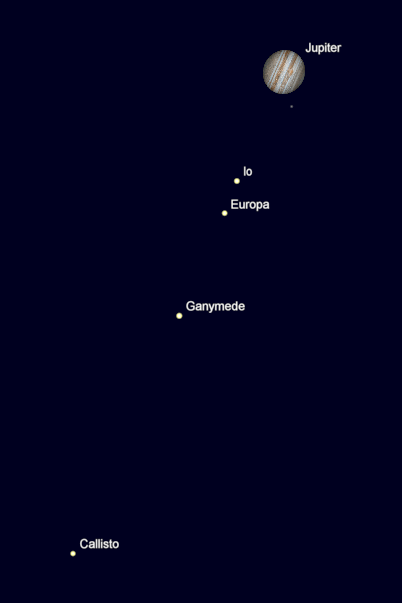
Jupiter through a telescope at 9 p.m. (EST), on February 6, 2015. The four Galilean moon will be stretched out on one side of Jupiter in order of their actual distances from the planet. Created using Cartes du Ceil (Sky Charts).
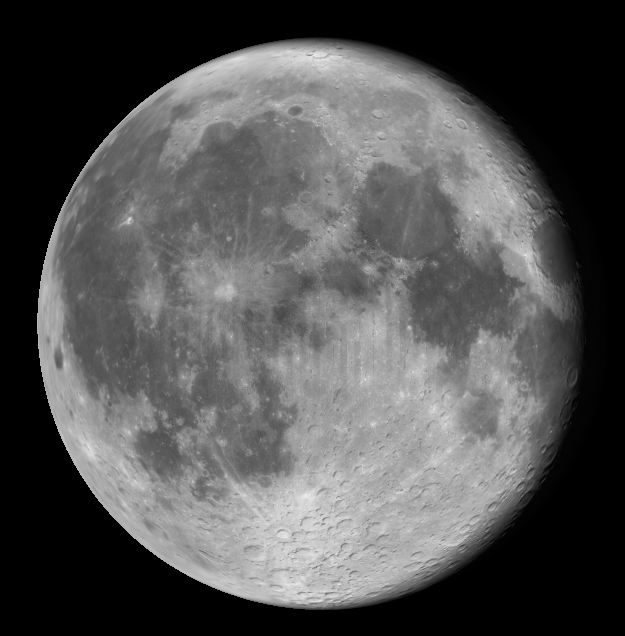
The Moon tonight (February 6, 2015). The Moon will rise shortly before the start of the Star Party. Created using Virtual Moon Atlas.
02/04/2015 – Ephemeris – We have 4 bright planets and a fading comet
Ephemeris for Wednesday, February 4th. The sun will rise at 7:58. It’ll be up for 9 hours and 56 minutes, setting at 5:55. The moon, 1 day past full, will rise at 6:59 this evening.
Lets take a look at the bright planets and a reasonably bright comet for this week. Brilliant Venus is in the west-southwest by 6:30 p.m. It will set at 8 p.m. Mars appears above and left of Venus in the southwest. Both of them are in the constellation of Aquarius. The Red Planet will set tonight at 8:43 p.m. Jupiter, 2 days from being in opposition from the sun, and opposite the sun in the sky, when it will be rising at sunset and setting at sunrise will rise tonight in the east at 5:49 p.m. It’s near the sickle-shaped head of Leo the lion. It will be seen above the Moon at 9 p.m. Early risers will be able to spot Saturn which will rise in the east-southeast at 3:06 a.m. Comet Lovejoy, visible in binoculars, is near the star at the end of Andromeda, called Almaak.
Times are for the Traverse City/Interlochen area of Michigan. They may be different for your location.
Addendum
Evening
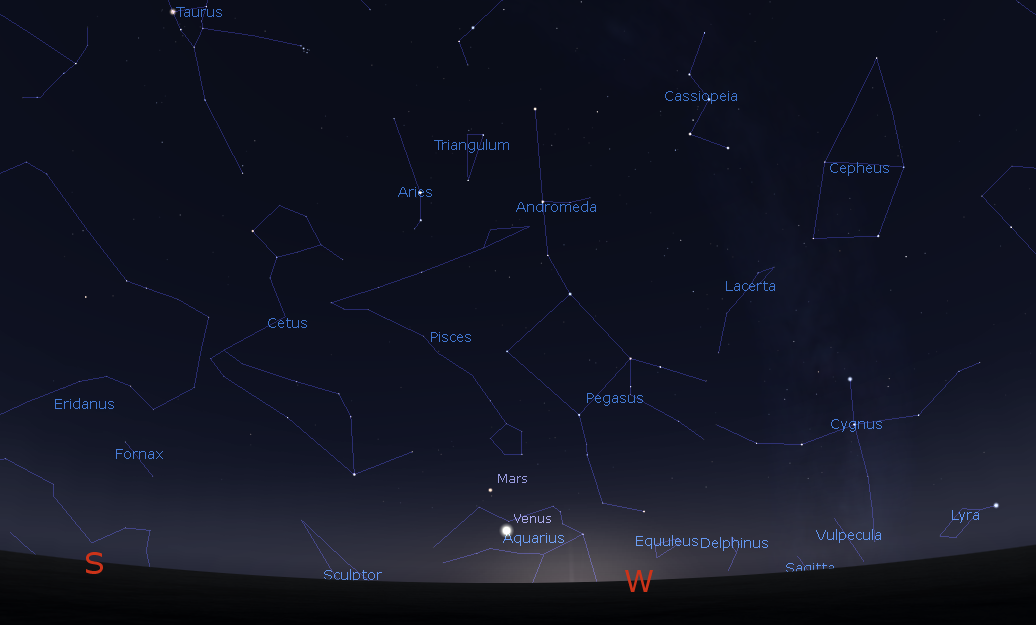
Venus and Mars low in the west with the setting autumn constellations and a few northern summer stars at 7 p.m. on February 4, 2015. Created using Stellarium.
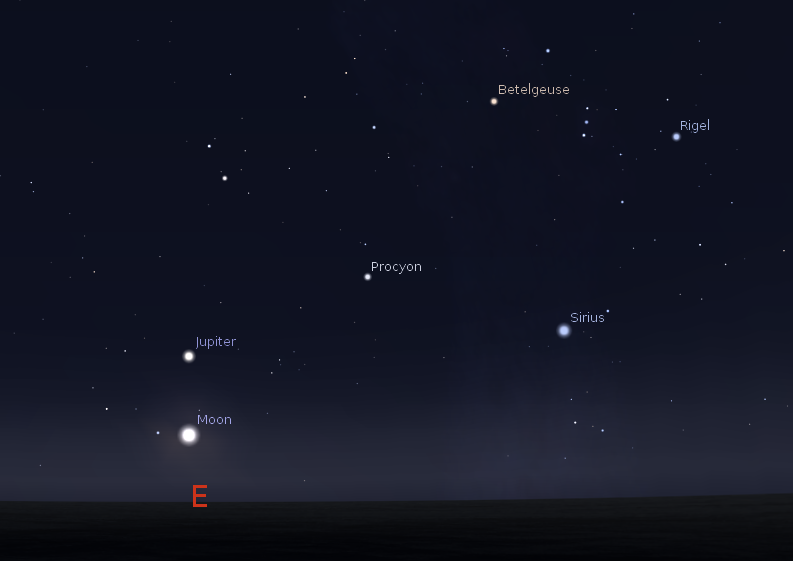
Jupiter the Moon and the bright winter stars at 8 p.m. on February 4, 2015. Created using Stellarium.
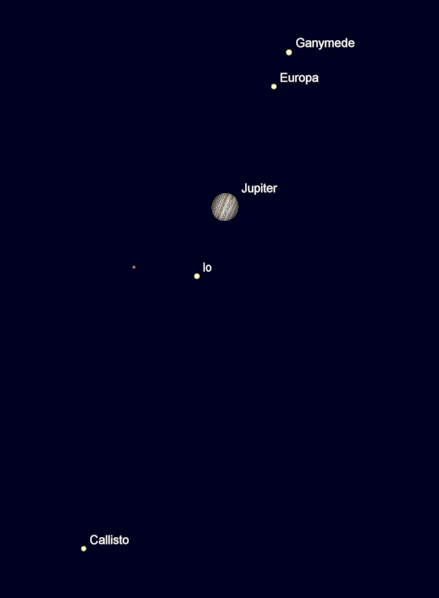
Jupiter and its Galilean moons as they might appear in a telescope. Created using Cartes du Ceil (Sky Charts).
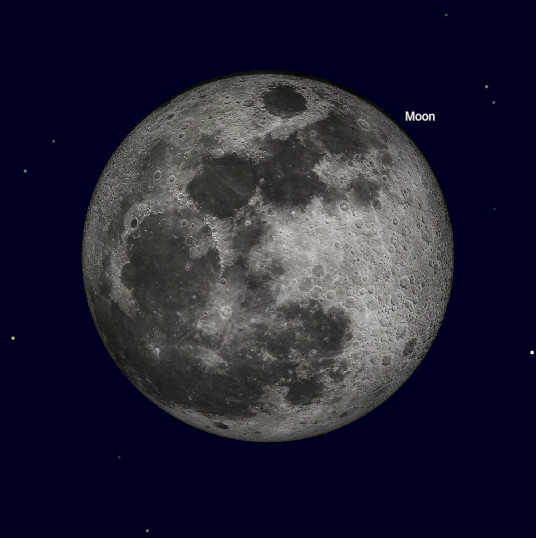
The Moon as it might appear in binoculars at 8 p.m. on February 4, 2015. Created using Cartes du Ceil (Sky Charts).
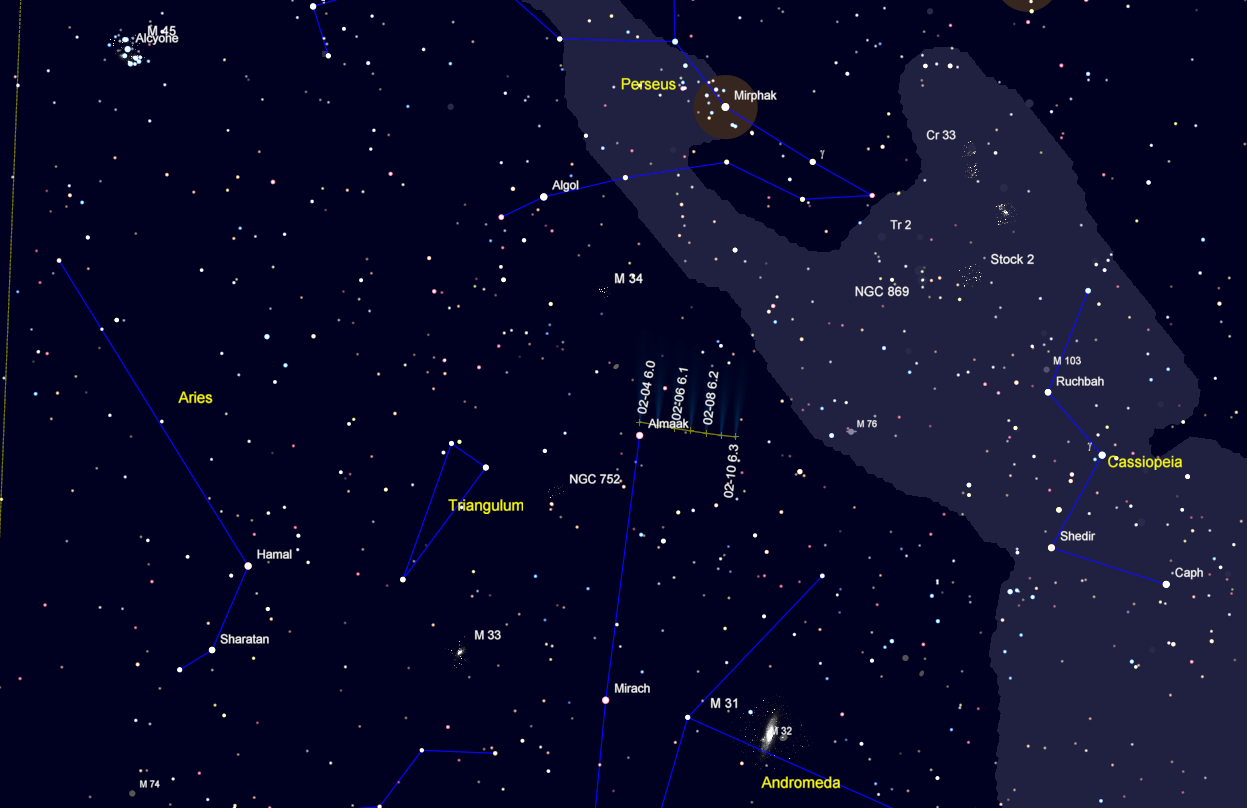
The track of Comet 2014 Q2 (Lovejoy) from 2/04/15 to 02/10/15 which will appear high in the west at 9 p.m. Created using Cartes du Ceil (Sky Charts).
Morning
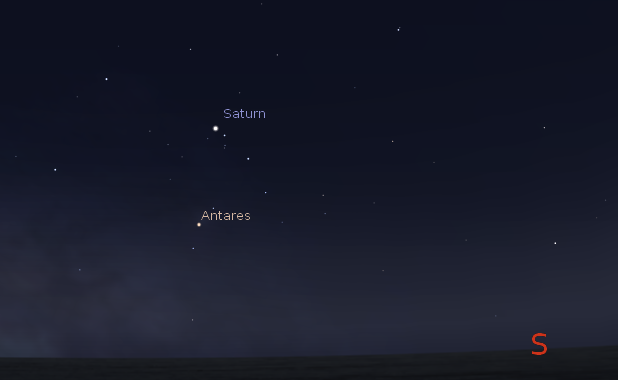
Saturn will appear above the red giant star Antares at 6 a.m. February 5, 2015. At this time Jupiter and the Moon will appear above the western horizon. Created using Cartes du Ceil (Sky Charts).
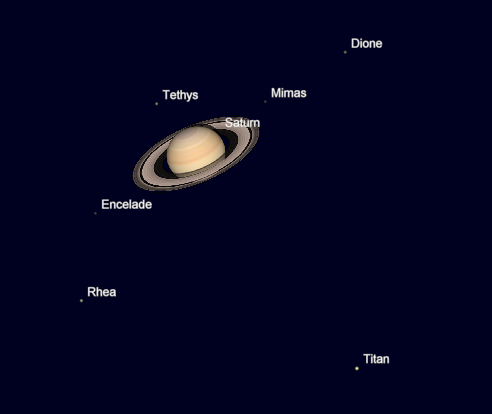
What Saturn and its moons might appear like in a telescope at 6 a.m., February 5, 2015. Small telescopes will show only the moon Titan. Created using Cartes du Ceil (Sky Charts).
01/27/2015 – Ephemeris – Looking at a valley on the Moon
Ephemeris for Tuesday, January 27th. The sun will rise at 8:07. It’ll be up for 9 hours and 36 minutes, setting at 5:44. The moon, 1 day past first quarter, will set at 2:36 tomorrow morning.
If it’s clear tonight drag out that telescope to look at the Moon. Your telescope may flip the moon around, viewing the Moon in different orientations. What I’m describing will be north is up, south is down. Your telescope may flop the image, so check your telescopic view with how it appears to the naked eye. I will use the north-south terminology. And we’ll stick close to the terminator, the sunrise line on the Moon. One of the striking linear features of the moon is the Alpine Valley, about 2/3rds the way from the center of the moon to the north pole. It is a fault valley through the lunar Alps. About half way from the center of the Moon to the north pole. It’s the largest of three craters in a nearly right triangle. It’s named after Archimedes.
Times are for the Traverse City/Interlochen area of Michigan. They may be different for your location.
Addendum
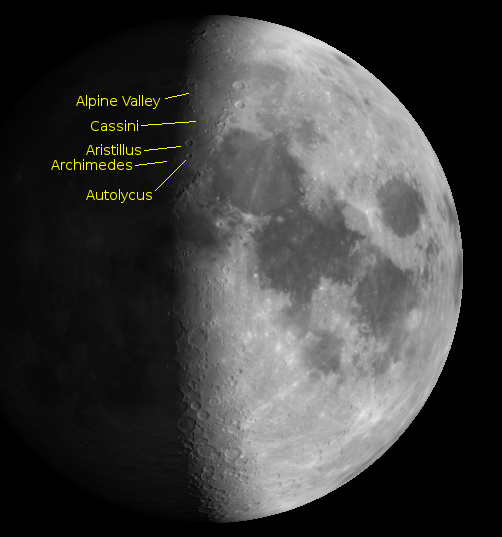
The Moon at 9 p.m. EST (UT -5h) January 27, 2015. Created using Virtual Moon Atlas.
I notice that I have quite a few followers to this blog from the UK. Unfortunately for you folks the crater Archimedes will not yet be visible tonight. I’ve labeled some extra craters that I didn’t discuss in the program, plus I’m adding the Lunar Reconnaissance Orbiter mosaic that’s mapped onto the Virtual Moon Atlas globe.
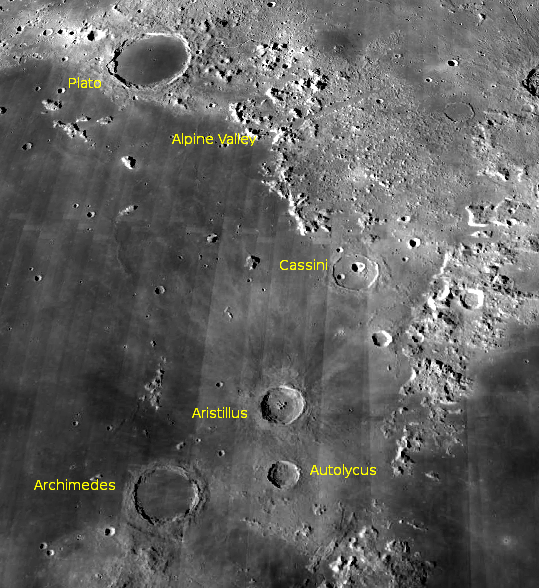
Lunar Reconnaissance Orbiter mosaic of the region at the eastern shore of Mare Imbrium. Credit NASA/GSFC/LRO, Virtual Moon Atlas
01/26/2015 – Ephemeris – First quarter Moon, a telescopic asteroid misses the Earth tonight and a Jupiter shadow recap
Note: Ephemeris program generally features objects in the sky that are visible to the naked eye or binoculars. However in the blog, with the ability to expand in both content and illustrations I can add information for telescopic observers and expand postings.
Ephemeris for Monday, January 26th. The sun will rise at 8:08. It’ll be up for 9 hours and 34 minutes, setting at 5:42. The moon, at first quarter today, will set at 1:30 tomorrow morning.
The Moon will be perfectly half illuminated by the sun at 11:48 p.m. The gray patches that appear on the Moon’s surface were called by early telescopic astronomers: seas; because they thought they were bodies of water. The Moon is pretty much bone dry, except for some eternally shadowed craters at the poles, which still aren’t wet because the water is frozen. Anyway the seas or maria on the moon are indeed low spots. The seas, from the top center of the moon down to the lower right are Serenity, Tranquility, Nectar and Fertility. To the upper right all by itself is the Sea of Crises. From Serenity to Fertility some can imagine an upside down rabbit, with ears of unequal sizes. In a few more days we’ll see the face of the man in the Moon.
Times are for the Traverse City/Interlochen area of Michigan. They may be different for your location.
Addenda
First Quarter Moon
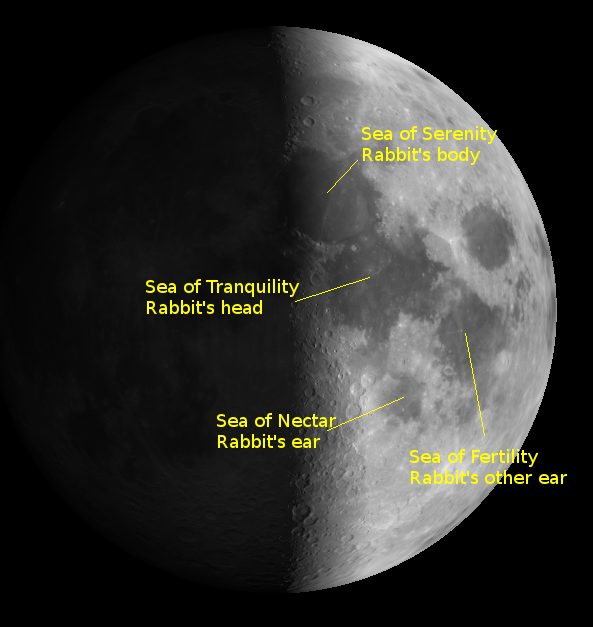
Rabbit in the first quarter Moon. Created using Virtual Moon Atlas.
Tonight Asteroid 2004 BL86 will pass three times the Moon’s distance from the Earth
This evening a rather large asteroid for a Near Earth Object or NEO will pass three-quarters of a million miles from the Earth. The asteroid has the designation 2004 BL86. The cool thing is that this asteroid is half a kilometer or so meters across, that’s 5 soccer or football fields in diameter. Radar from this close passage should nail down the size and shape. Between Goldstone Tracking Station and Arecibo Observatory in Puerto Rico the asteroid should be mapped down to 2 to 4 meters. It would be definitely not cool if this asteroid ever hit the Earth. It will be 9th magnitude, and so will be visible in small telescopes, and it will cross the east or left side of the Beehive star cluster also designated M44 starting about midnight tonight.
If you want to observe the event and don’t have the equipment head on over to www.slooh.com. This is the site for Slooh (pronounced “slew”) Community Observatory which has observatories in the Canary Islands and Chile, and partners with others. Besides these events, members can schedule time and use the telescopes via the internet. Check the above link for more information.
The chart below is from NASA/JPL’s Near Earth Object Program: Updated Charts for Asteroid 2004 BL86 Earth Flyby on Jan 26, 2015
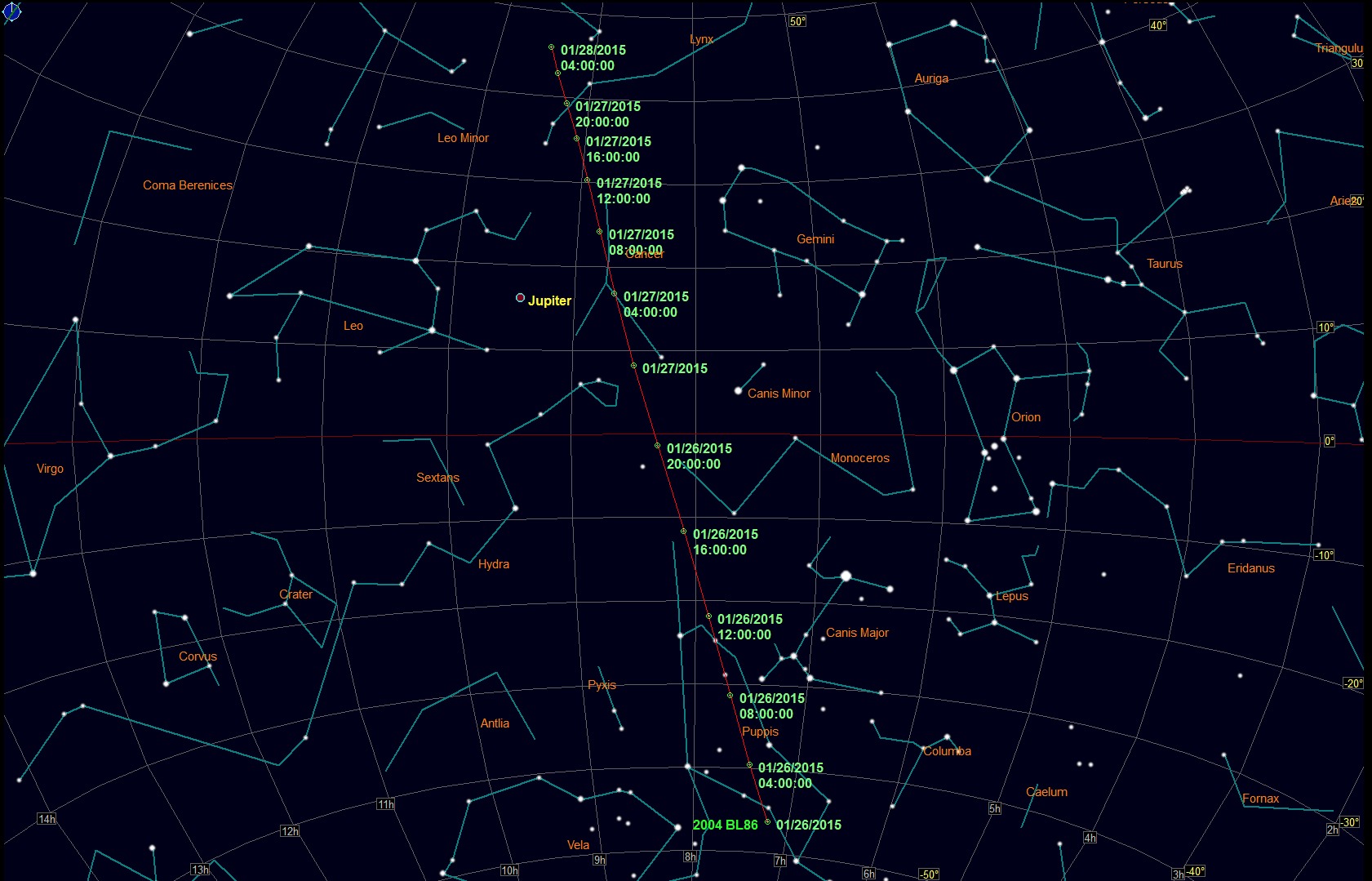
The track of asteroid 2004 BL86 as viewed from the Earth, plotted on a star chart with an equatorial coordinate grid. The asteroid location is shown at four-hour intervals from January 26 to 28. The indicated times are Universal Time; subtract 5 hours for Eastern Standard Time (EST), 6 hours for CST, and 8 hours for PST. On January 26, the asteroid will pass within 11 degrees of Jupiter, now shining brightly in the east in the evening sky. Image and caption credit: NASA/JPL-Caltech. JPL orbit solution #43, with star chart graphics produced using C2A. Click to enlarge.
Below is a chart from Universe Today. Here’s a link to their web page.
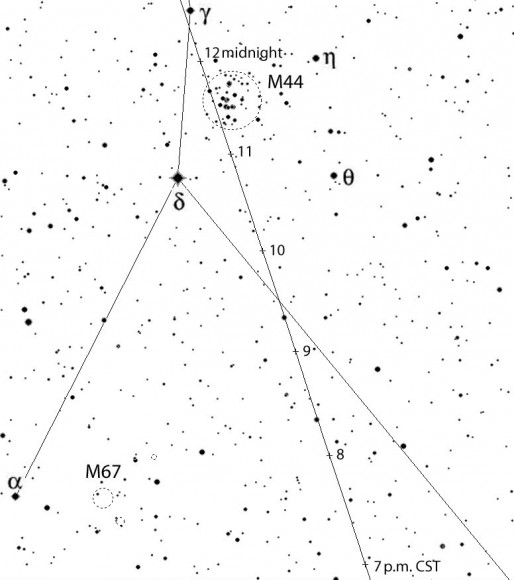
A Black on white chart of asteroid 2004 BL86 crossing to the right of M44. Note that the actual path depends on your location since the chart is based on the center of the Earth. The closer to your horizon the greatest deviation from the path shown. Time Ticks are for CST. Add one hour to them for EST. The Midnight tick mark is 0 h UT or GMT the 27th. Credit Universe Today and created with Chris Marriott’s SkyMap software.
Sky and Telescope has charts that have BL86’s track plotted about 15 minutes ahead of the track above. It is a newer chart, so the asteroid’s position may have been updated. The Sky and Telescope narrative and charts are here.
Results from Jupiter’s early Saturday satellite shadow play
The video live feed from the Griffith Planetarium in Los Angeles was a bust. It suffered from what astronomers call bad seeing. I mean really horrible seeing. Astronomers ascribe at least two qualities to the sky, other than brightness due to the moon or light pollution. That is transparency and seeing. Seeing is the steadiness of the sky. What Jupiter looked like was looking at a small disk at the bottom of a swimming pool while the kids are still playing in it. At first I ascribed it to Jupiter being low in the LA sky, being 3 hours west of here. But it didn’t get better as the night progressed. I could occasionally make out Callisto’s shadow, just because I knew where it’s supposed to be. But that’s it.
However my friend from the Detroit area, Scott Anttila, blessed at least for a while with clearer and calmer skies got some wonderful pictures of the first part of the multiple shadow event.
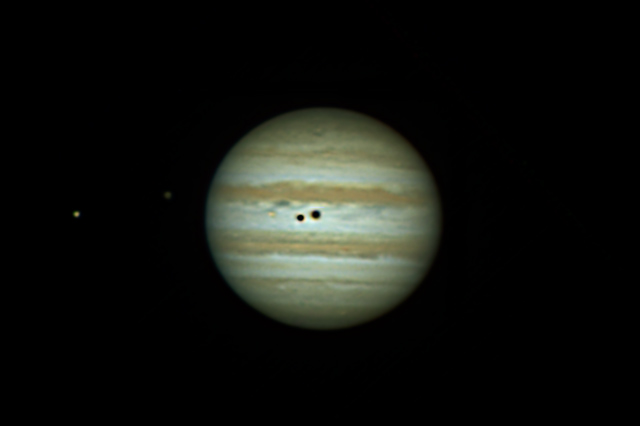
Left to right the shadows of Io and Callisto crossing the face of Jupiter at 12:52 a.m. January 24, 2015. Credit Scott Anttila.
Note that Callisto has a larger shadow than Io. That’s mainly due to it’s greater distance from Jupiter that makes its shadow larger and fuzzier than the closer Io.
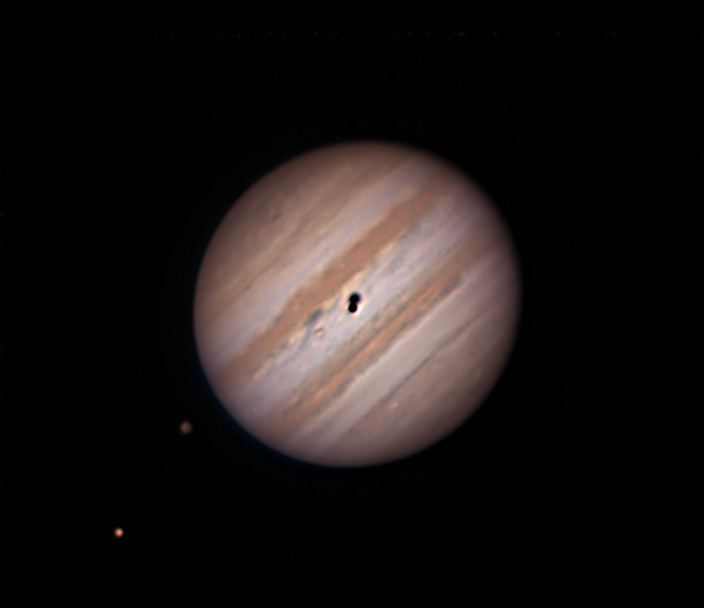
In this picture Io’s shadow has just caught up with Callisto’s shadow. Credit: Scott Anttila.
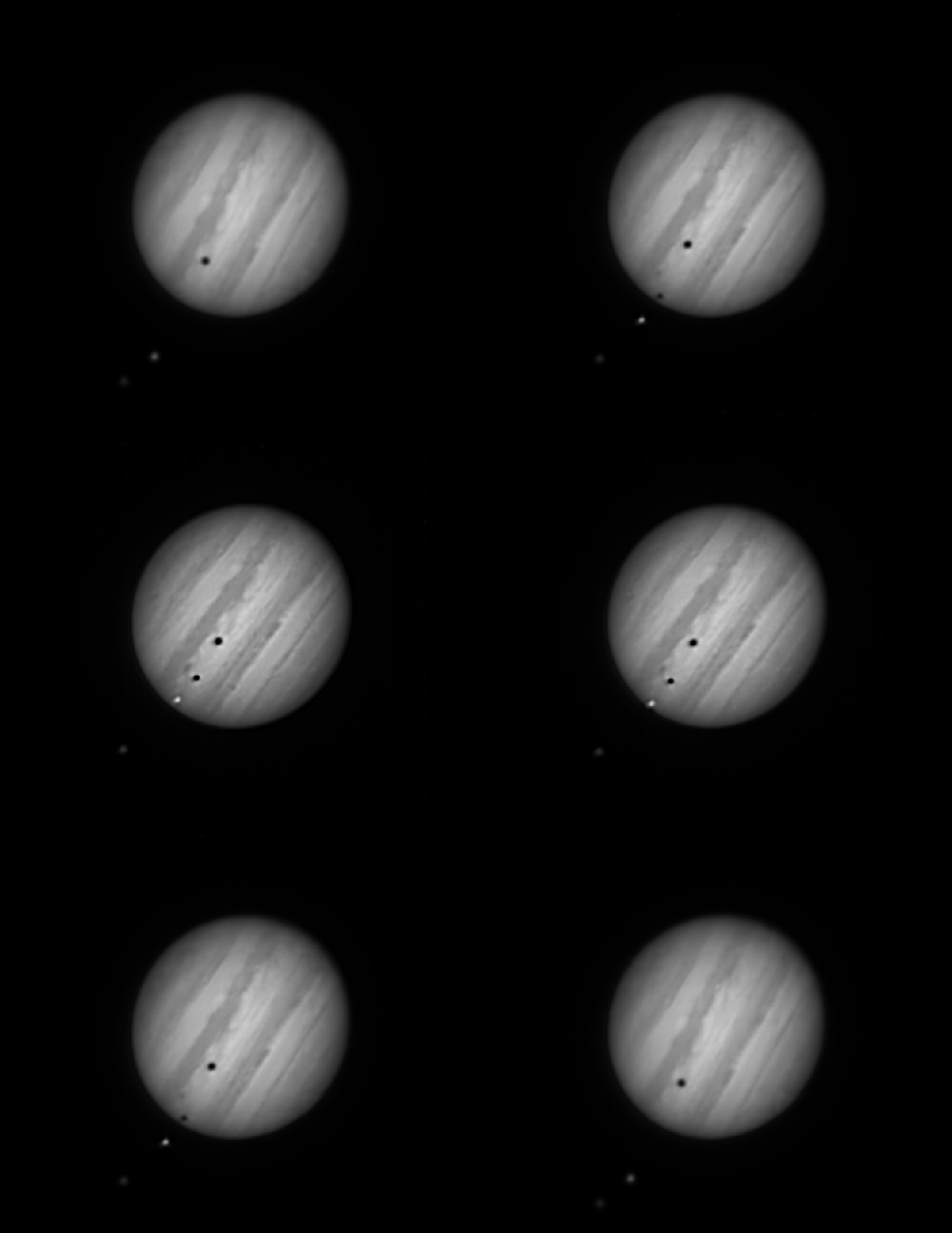
Rocking animation of the early stages of the shadow show on Jupiter. Callisto’s shadow already on the planet while Io’s shadow is just entering. Also Io’s transit is starting, following its shadow on the planet. Credit: Scott Anttila
01/23/2015 – Ephemeris – Checking on Comet Lovejoy and the Moon.
Ephemeris for Friday, January 23rd. The sun will rise at 8:11. It’ll be up for 9 hours and 27 minutes, setting at 5:38. The moon, half way from new to first quarter, will set at 9:59 this evening.
The crescent moon is growing brighter but shouldn’t bother binocular views of Comet Lovejoy, now between the Pleiades and the small constellation of Triangulum, a narrow pointy triangle. Tonight only it’s above the crescent Moon. The Moon in binoculars or a small telescope is revealing more of its surface nightly. The Sea of Crises or Mare Crisium is now fully in sunlight and The Sea of Fertility Or Mare Fecunditatis is now half in sunlight, with the odd pair of craters Messier and Messier A right at the terminator near the center of the sea. Check these craters after a few days and an odd ray pattern will appear. Apparently the body or bodies that created them came in at a very low angle and threw material forward in a couple of streaks.
Times are for the Traverse City/Interlochen area of Michigan. They may be different for your location.
Addendum
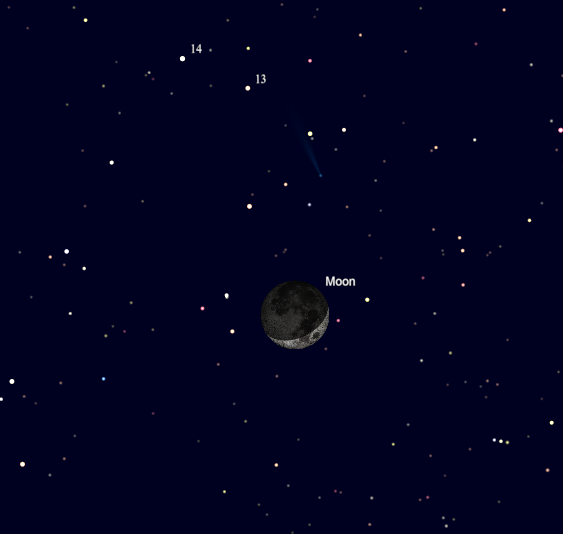
Comet Lovejoy appearing tonight only above the Moon. This is for 8 p.m. January 23, 2015. Created using Cartes du Ceil (Sky Charts)
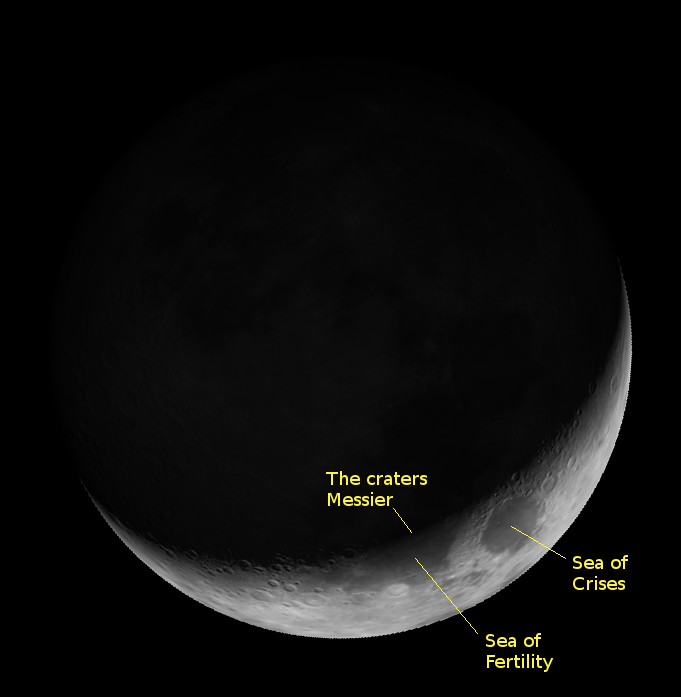
The Moon through a telescope at low power. 8 p.m., January 23, 2015. Created using Virtual Moon Atlas and Gimp.
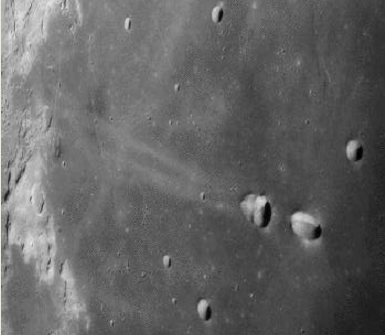
The Craters Messier A and B from Apollo 11. NASA
 Bob Moler's Ephemeris Blog