Archive
06/23/2015 – Ephemeris – What can you tell about the appearance of the Moon to the naked eye?
Ephemeris for Tuesday, June 23rd. Today the Sun will be up for 15 hours and 34 minutes, setting at 9:32. The Moon, 1 day before first quarter, will set at 1:31 tomorrow morning and tomorrow the Sun will rise at 5:57.
The Moon is at nearly half phase or first quarter. The unaided eye can see that the Moon has darker and lighter areas. The Greeks, who thought the objects in the heavens were perfect thought that the Moon was a silvery sphere. They never quite figured out why the moon had this mottled appearance. So why are the bright parts different from the darker parts? The bright parts are called the highlands and are the oldest part of the Moon’s surface. It’s saturated with craters from impacts since the Moon formed. The dark areas are roughly circular, and are really vast craters that penetrated through the Moon’s crust to bring up molten lava that repaved the surface of the Moon some 500 million years after it formed.
Times are for the Traverse City/Interlochen area of Michigan. They may be different for your location.
Addendum
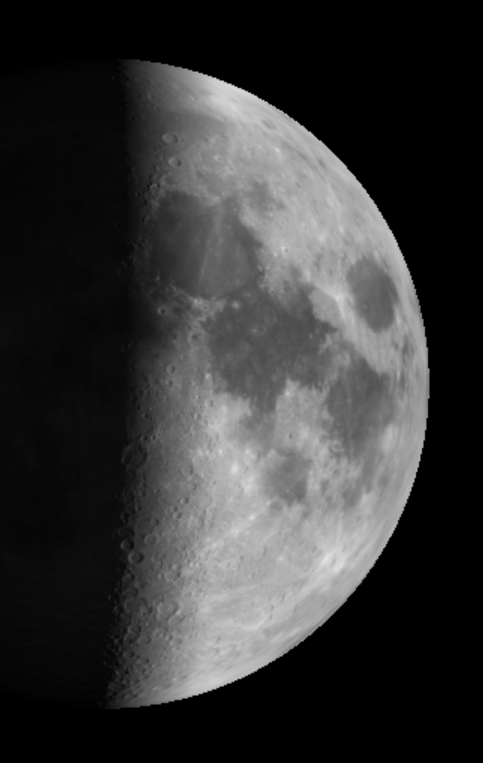
The Moon tonight (June 23, 2015). Look at the difference in the surface albedo (reflectance) between the light and dark areas and wonder about their origins. Created using Virtual Moon Atlas.
06/22/2015 – Ephemeris – The summer full moon and the winter Sun trade places
Ephemeris for Monday, June 22nd. Today the Sun will be up for 15 hours and 34 minutes, setting at 9:32. The Moon, 2 days before first quarter, will set at 1:04 tomorrow morning. Tomorrow the Sun will rise at 5:57.
Summer’s here, and it’s a few days before the latest sunset and latest end of twilight. It might be instructive to check out the height of the moon over the next two weeks or so. The moon is heading south in front of the Sun. The Sun besides its apparent westward motion during the day caused by the Earth’s rotation also moves about twice its diameter each day eastward against the stars caused by the earth’s motion in its orbit of the Sun. Around July 1st, the moon will be about where the Sun will be next winter solstice, 4 days before Christmas. Actually it will be about 8 moon widths above where the Sun will be because its orbit is tilted a bit to the Earth’s. But it will serve as an illustration of the seasonal difference.
Times are for the Traverse City/Interlochen area of Michigan. They may be different for your location.
Addendum
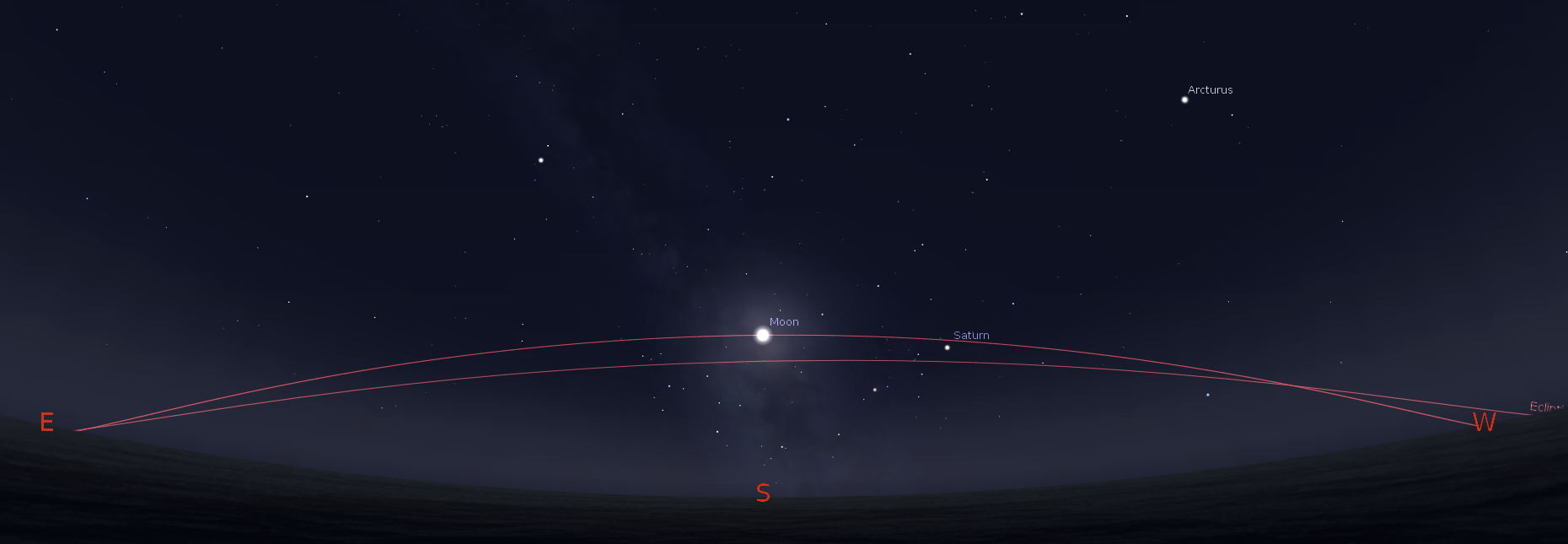
The full moon nearest the summer solstice. The full moon appears near where the sun would appear low in the south at the winter solstice. The bottom red line is the ecliptic, the path of the Sun. Created using Stellarium.
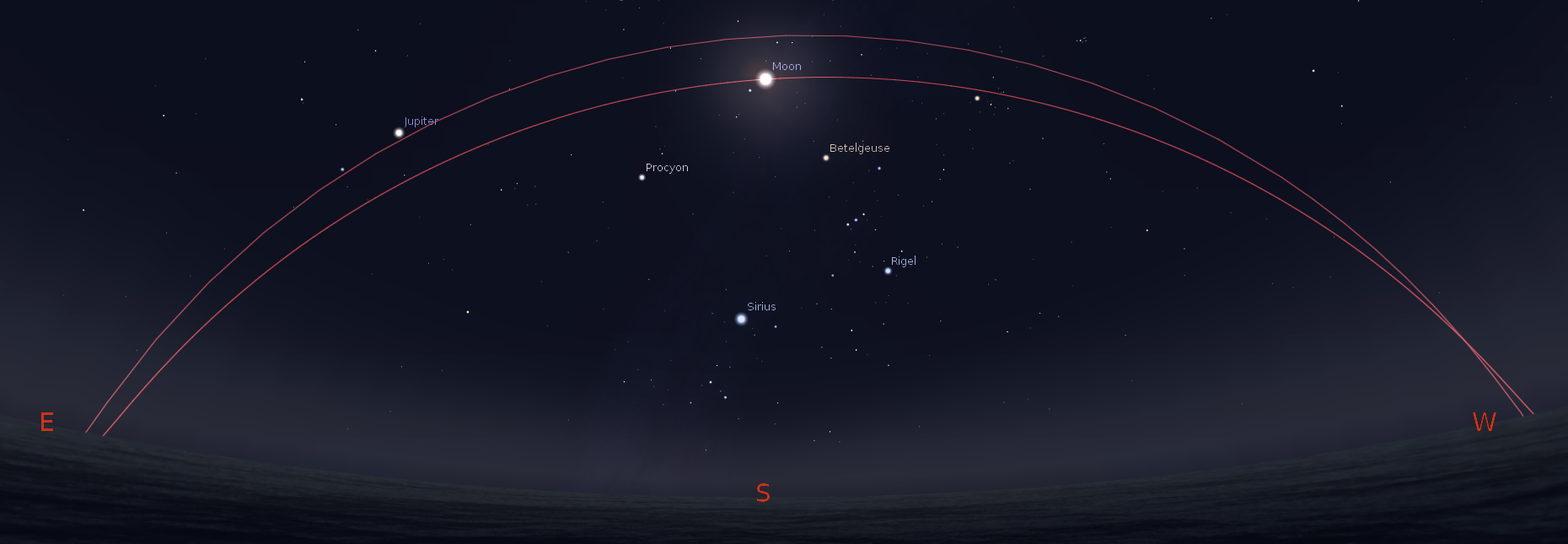
The full moon nearest the winter solstice. The full moon appears near where the sun would appear high in the south at the summer solstice. The top red line is the ecliptic, the path of the Sun. Created using Stellarium.
The Moon’s orbit has a slight tilt of a bit more than 5 degrees from the ecliptic, or plane of the Earth’s orbit of the sun. The crossing point is called a node. In the bottom image the node near the western horizon is called the descending node due to the fact that the Moon is heading south of the ecliptic. When the Sun and Moon are near the same node the Moon will be new and we have a chance for a solar eclipse. When at opposite nodes, a lunar eclipse. The nodes slowly slide westward slowly one revolution in about 18.6 years, which causes eclipse seasons, about 6 months apart to occur a bit earlier each year.
06/03/2015 – Ephemeris – The visible bright planets are hanging on in the evening
Ephemeris for Wednesday, June 3rd. Today the Sun will be up for 15 hours and 23 minutes, setting at 9:22. The Moon, 1 day past full, will rise at 10:15 this evening and tomorrow the Sun will rise at 5:59.
Lets take a look at the bright planets for this week. Our brilliant evening star Venus is in the west by 9:45 p.m. It will set at 12:40 a.m. As Venus is reaching its greatest eastern elongation or separation from the Sun it is now setting earlier. Venus apparent orbit of the Sun is also tilting to a lower angle with the horizon, since though east, it is now south of the Sun. Jupiter will appear high in the west-southwestern sky about 10 p.m. It will set at 1:23 a.m. It’s near the sickle-shaped head of Leo the lion, and it’s the second brightest star-like object in the sky after Venus, which is approaching it. Saturn is in the southeast as evening twilight fades. It will set at 5:37 a.m. in the southwest.
Times are for the Traverse City/Interlochen area of Michigan. They may be different for your location.
Addendum
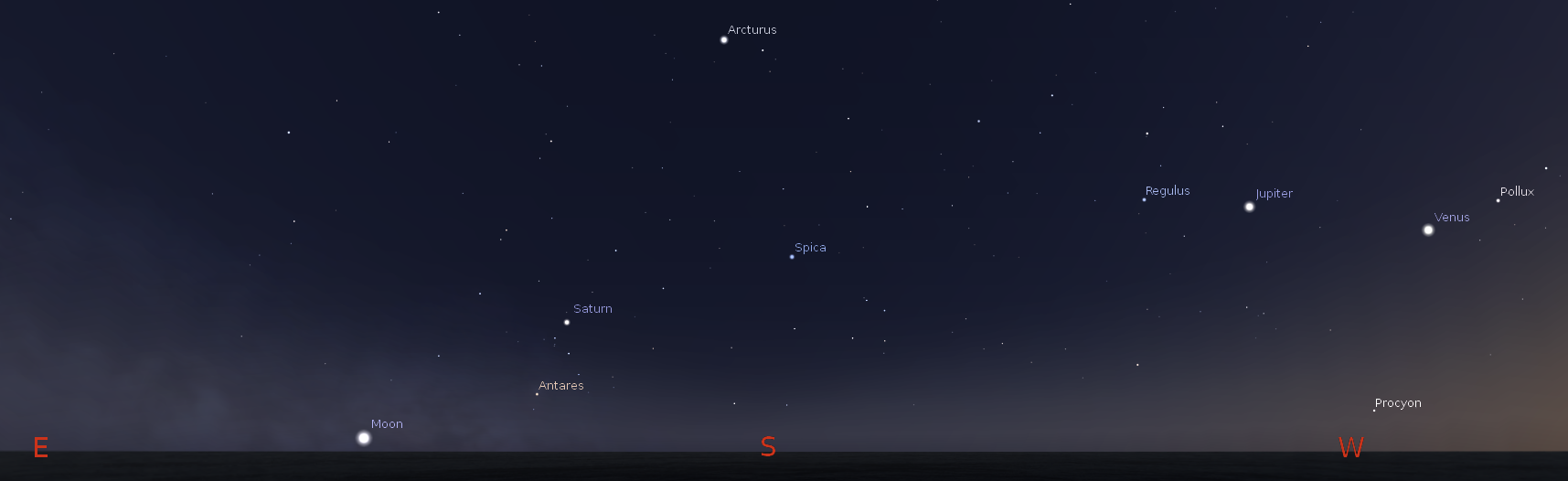
The evening planets and bright stars, including the Moon, at 10:30 p.m. June 3, 2015. Created using Stellarium. Click on Image to enlarge.
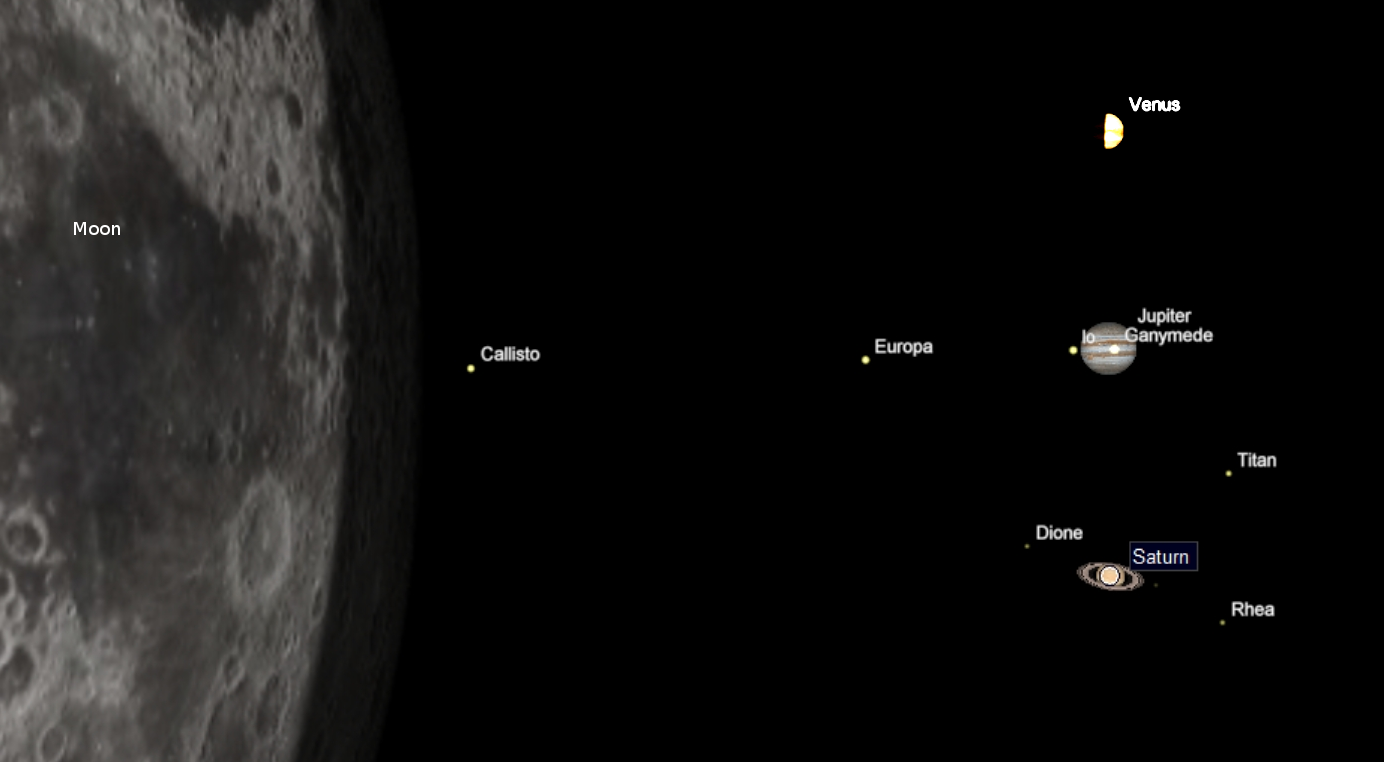
Comparison of the apparent sizes and satellite locations of the bright planets and the Moon at 10:30 p.m. June 3, 2015. Created using Cartes du Ciel (Sky Charts) and GIMP.
Jupiter’s satellites Io and Ganymede have a busy night tonight
Satellite  Event           UT            EDT
Ganymede   Transit Start   June 4  0:17  June 3  8:17 p.m.
Io         Transit Start   June 4  2:46  June 3 10:46 p.m.
Io         Shadow Start    June 4  3:56  June 3 11:56 p.m.
Ganymede   Transit End     June 4  3:56  June 3 11:56 p.m.
Ganymede   Shadow Start    June 4  4:57  June 4 12:57 a.m.
Io         Transit End     June 4  5:04  June 4  1:04 a.m.
Io         Shadow End      June 4  6:13  *
Ganymede   Shadow End      June 4  8:35  *

* Not visible from the Traverse City/Interlochen are, Jupiter has set.
Satellite data was taken from www.projectpluto.com/jevent.htm
05/27/2015 – Ephemeris – Let’s look at the bright planets for this week
Ephemeris for Wednesday, May 27th. Today the Sun will be up for 15 hours and 12 minutes, setting at 9:16. The Moon, 2 days past first quarter, will set at 3:28 tomorrow morning and tomorrow the Sun will rise at 6:03.
Lets take a look at the bright planets for this week. Our brilliant evening star Venus is seen in the west by 9:30 p.m. In telescopes it will appear as a dazzling orb somewhat over half illuminated by the sun. It will set at 12:46 a.m. Finally it’s beginning to set earlier. The Sun is catching up with it. Venus will reach its greatest angular separation from the Sun on June 6th. Venus is seen below the stars Castor and Pollux in Gemini. Jupiter will appear high in the west-southwestern sky before 10 p.m. It will set at 1:48 a.m. It’s near the sickle-shaped head of Leo the lion. Saturn will be seen in the east southeastern sky as evening twilight deepens. It’s in Scorpius this year.
Times are for the Traverse City/Interlochen area of Michigan. They may be different for your location.
Addendum
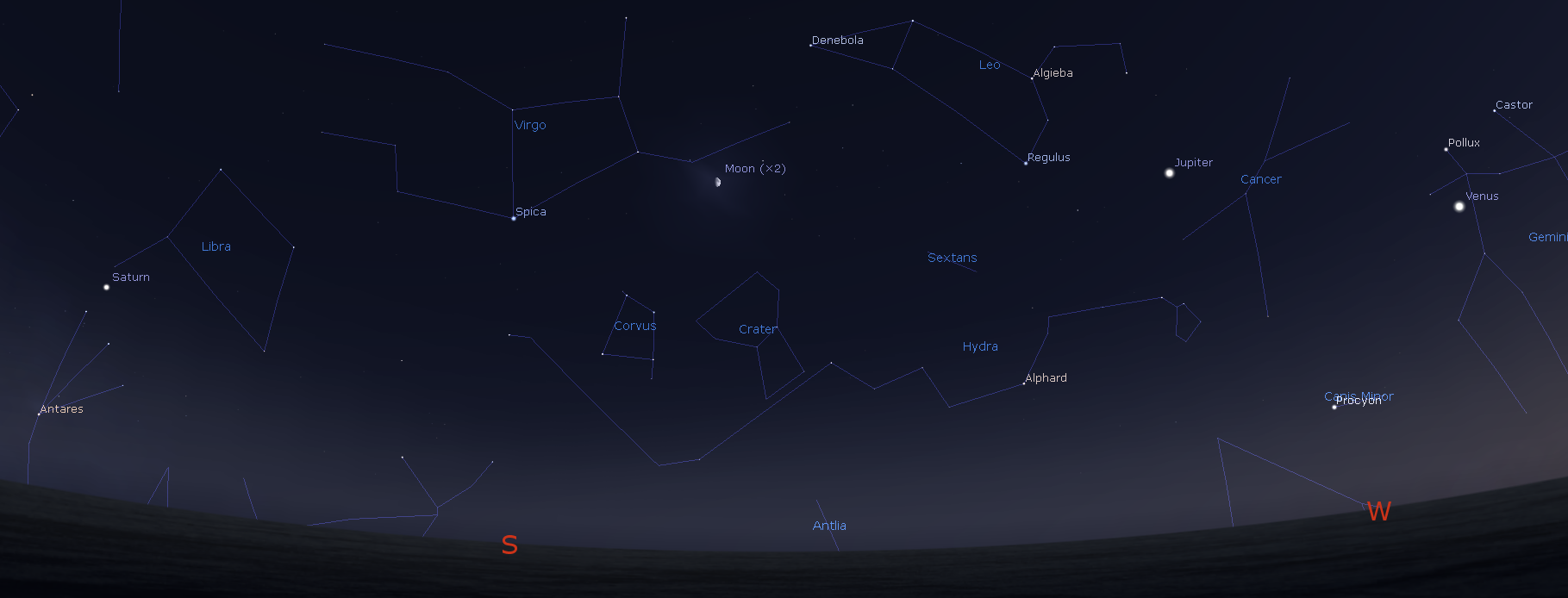
The evening planets and the Moon from west to east at 10:30 p.m. on May 27, 2015. Created using Stellarium.
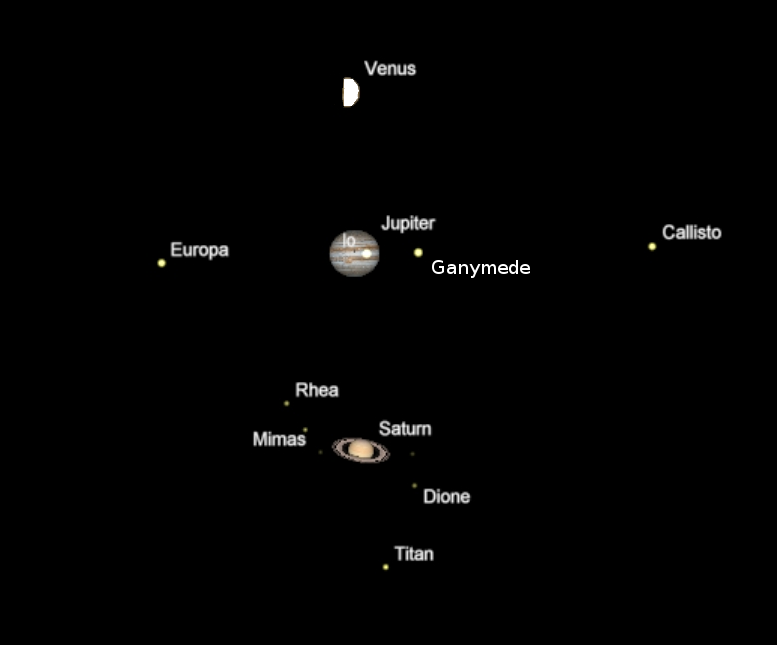
Apparent sizes of the planets Venus, Jupiter and Saturn compared for 10:30 p.m. on May 27, 2015. Created using Cartes du Ceil (Sky Charts).
Note above that the moon Io will be transiting Jupiter at 10:30 p.m. It’s shadow is also projected on the planet. Io will move off the planet at 11:06 p.m., and the shadow event will end at 12:18 a.m.
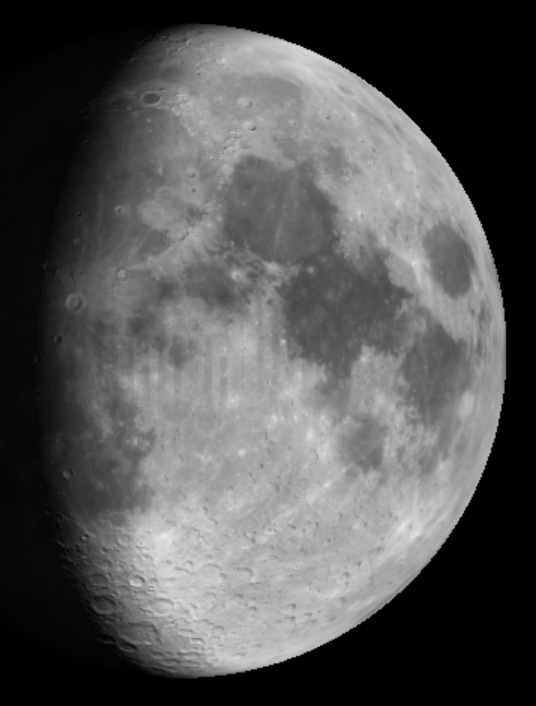
Telescopic view of the Moon at 10:30 p.m. on May 27,2015. Created using Virtual Moon Atlas.
04/29/2015 – Ephemeris – Last look at the bright planets for April
Ephemeris for Wednesday, April 29th. Today the Sun will be up for 14 hours and 8 minutes, setting at 8:45. The Moon, half way from first quarter to full, will set at 4:59 tomorrow morning. Tomorrow the Sun will rise at 6:34.
Lets take a look at the bright planets for this week. Mercury is low in the western sky after sunset. It’s 19 degrees angle from the sun and will set at 10:32. Our brilliant evening star Venus is high in the west by 9:30 p.m. It will set at 12:27 a.m. Jupiter will appear high in the southwestern sky in the evening. It will set at 3:31 a.m. It’s near the sickle-shaped head of Leo the lion, and it’s the second brightest star-like object in the sky after Venus. In telescopes, Jupiter’s moon Europa will pass in front of Jupiter starting at 11:07 p.m. and its shadow will start across at 1:40 a.m.Saturn will rise in the east-southeast at 10:33 p.m. It will be low in the south as morning twilight brightens.
Times are for the Traverse City/Interlochen area of Michigan. They may be different for your location.
Addendum
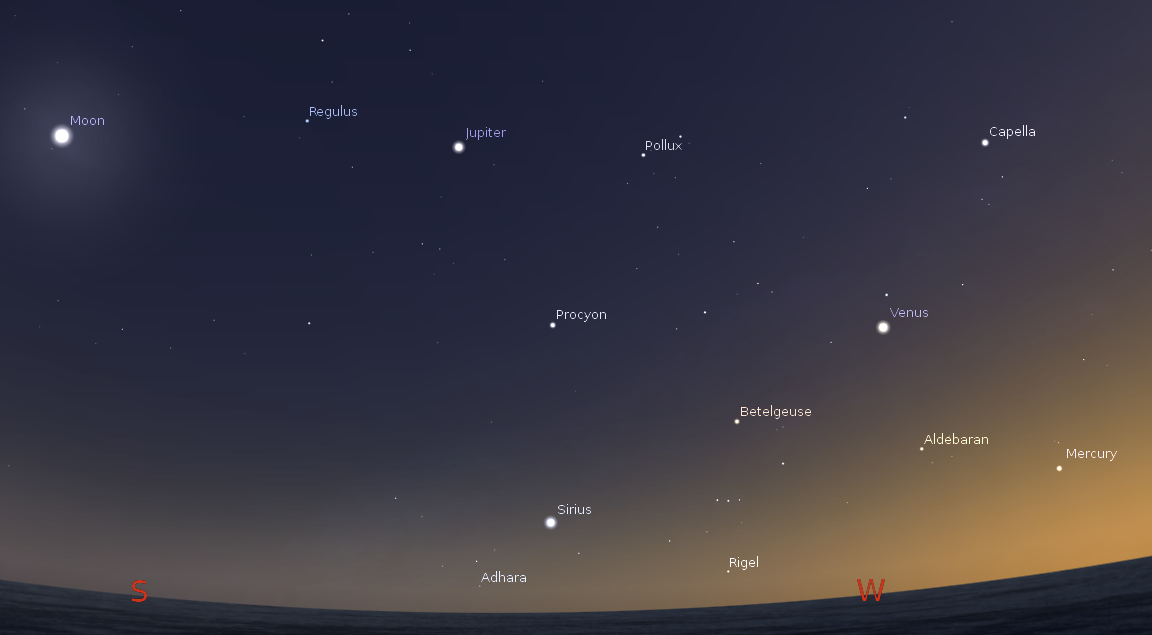
Mercury, Venus, Jupiter and the Moon at 9:30 p.m. April 29, 2015. Created using Stellarium.
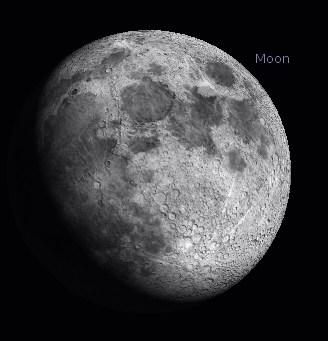
The Moon as it might be seen in binoculars at 10 p.m., April 29, 2015. Created using Stellarium.
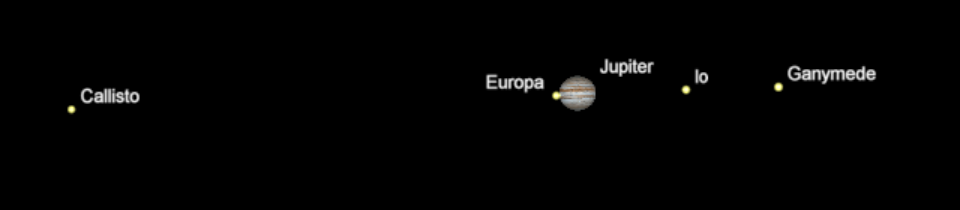
Jupiter at 10:58 p.m. April 29, 2015 with Europa about to transit the planet. Created using Cartes du Ciel (Sky Charts).
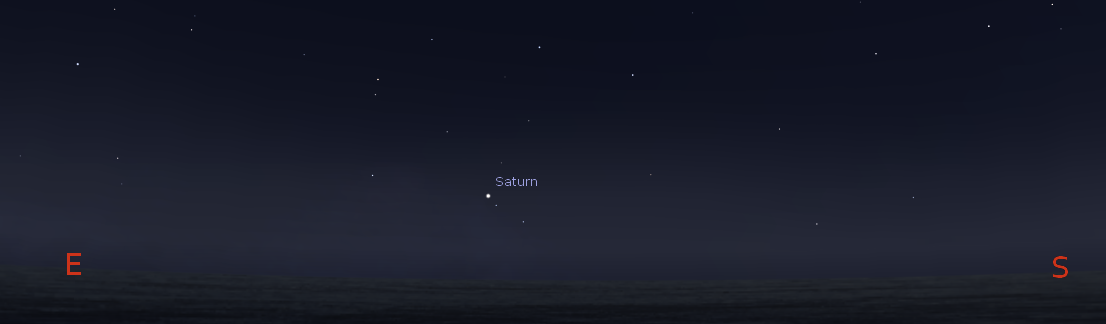
Saturn alone above the southeastern horizon at 11:30 p.m. April 29, 2015. Created using Stellarium.
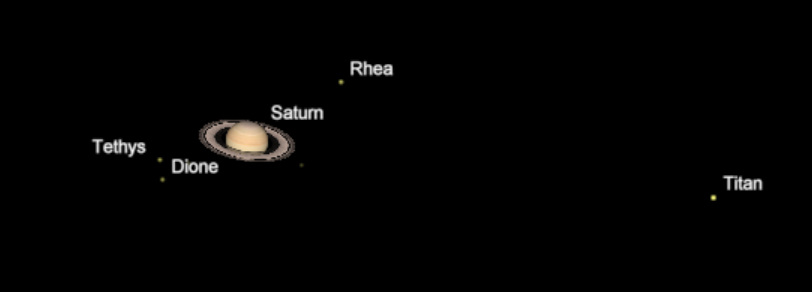
What Saturn and its moons might appear like in a telescope the night of April 29-30, 2015. Small telescopes will show only the moon Titan. Created using Cartes du Ceil (Sky Charts).
04/21/2015 – Ephemeris – The Moon will pass the Hyades star cluster today to pass near Venus tonight
Apr 21. This is Bob Moler with Ephemeris for Tuesday, April 21st. Today the Sun will be up for 13 hours and 46 minutes, setting at 8:35. The Moon, 3 days past new, will set at midnight. Tomorrow the Sun will rise at 6:47.
The moon, which was new last Saturday passed the face of the constellation Taurus the bull earlier today. The face of Taurus is a letter V shape of stars which is the star cluster called the Hyades. There’s a bright orange star that appears at the left tip of the V called Aldebaran, which actually doesn’t belong to the cluster. At 9:30 the crescent Moon will have also just passed the brilliant planet Venus. By then they will be nearly 8 degrees apart, which is a bit less than the width of a fist held at arm’s length. The Moon, Venus and all the planets move very close along the path of the Sun in the sky, called the ecliptic. Even so the Moon is now about 5 degrees south of the ecliptic and Venus about 2 degrees north of it.
Times are for the Traverse City/Interlochen area of Michigan. They may be different for your location.
Addendum
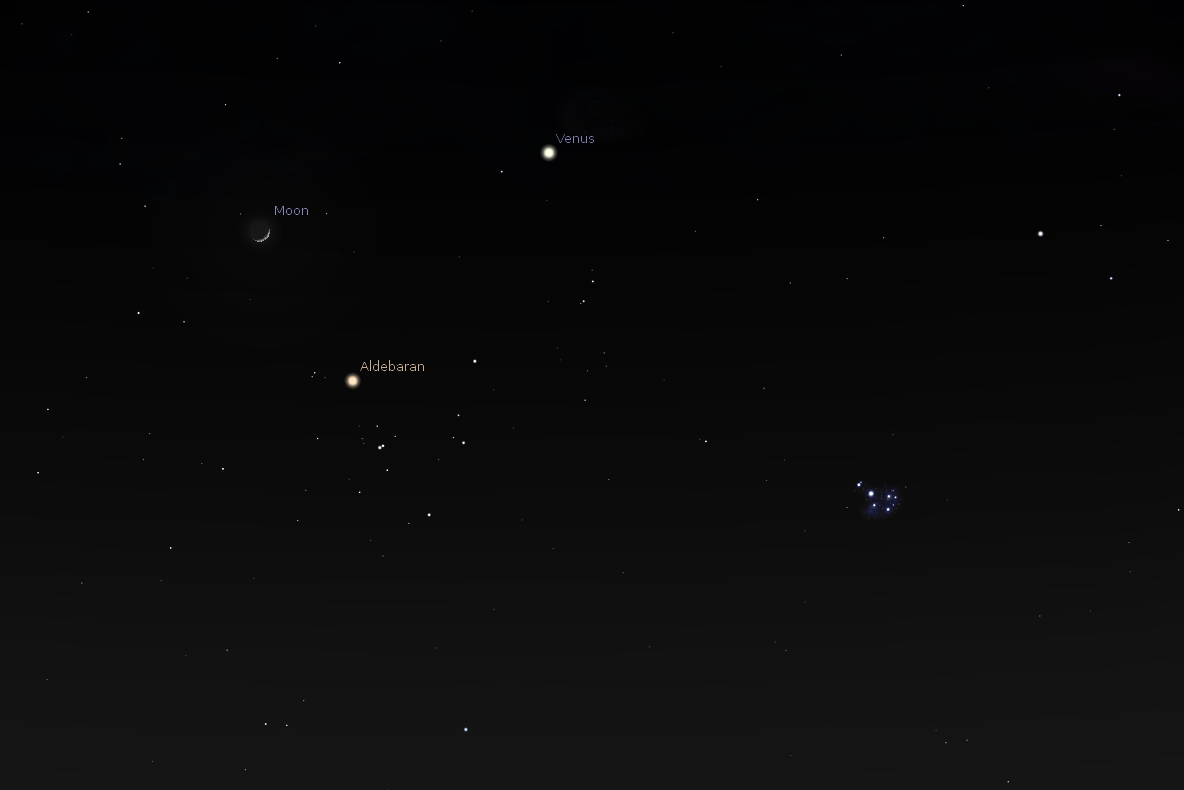
The Moon with Venus and the Hyades at 9:30 p.m. April 21, 2015. Note the Pleiades on the right. Created using Stellarium.
04/08/2015 – Ephemeris – It’s bright planet night on Ephemeris
Ephemeris for Wednesday, April 8th. The Sun will rise at 7:11. It’ll be up for 13 hours and 7 minutes, setting at 8:18. The Moon, 3 days before last quarter, will rise at 12:34 tomorrow morning.
Lets take a look at the bright planets for this week. Our brilliant evening star Venus is high in the west by 9 p.m. It will set at 11:43 p.m. Mars appears much lower and to the right of it. The Red Planet will set tonight at 9:48. Jupiter will appear high in the southeastern sky in the evening. It will set at 4:52 a.m. It’s near the sickle-shaped head of Leo the lion, and it’s the second brightest star-like object in the sky after Venus. Three of the four moons will be visible in telescopes tonight, Callisto is behind Jupiter and will reappear at 4:42 a.m., shortly before Jupiter sets. Early risers will be able to spot Saturn which will rise in the east-southeast at 12:01 a.m. It will be low in the south at 5 to 6 a.m.
Times are for the Traverse City/Interlochen area of Michigan. They may be different for your location.
Addendum
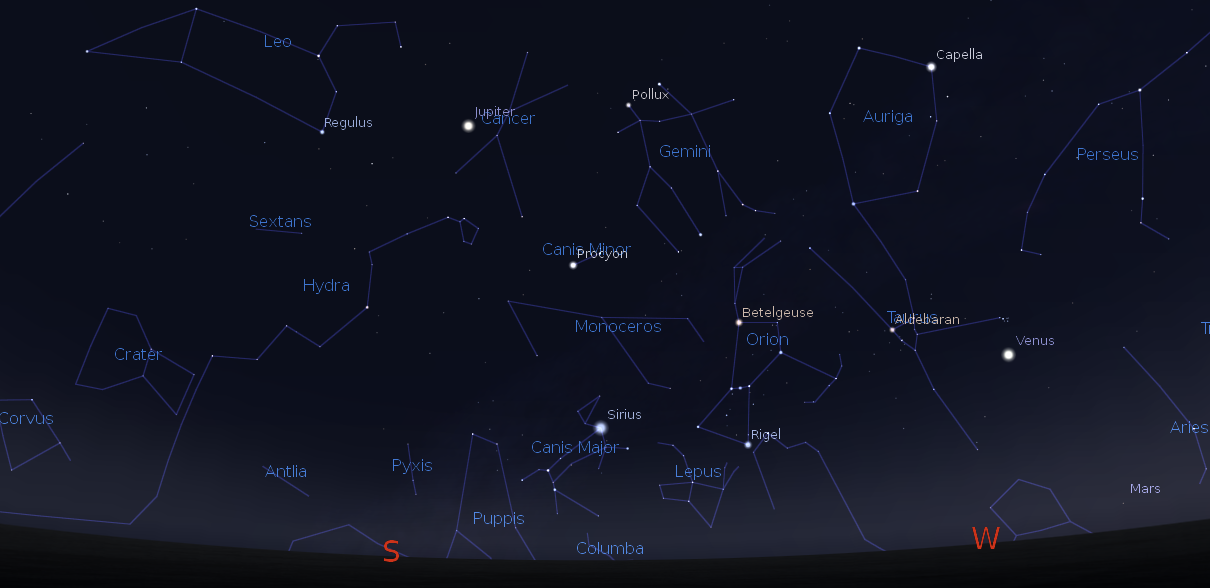
The Moon, Jupiter, Venus and Mars and remaining winter constellations at 9:30 p.m. April 8, 2015. Created using Stellarium.
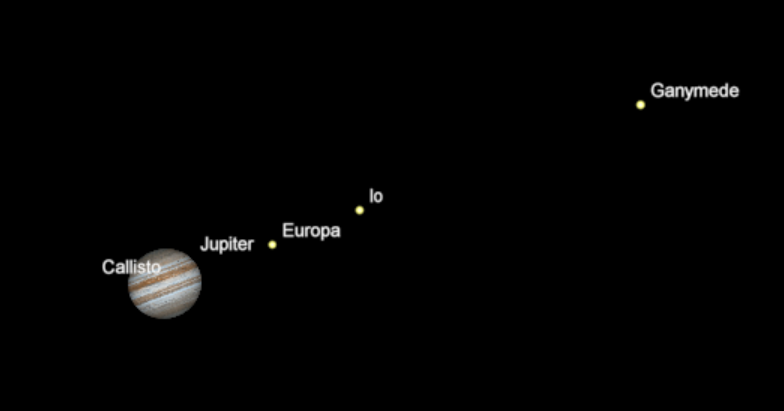
Jupiter and three of its moons. Callisto is tagged, but is behind the planet at 9:30 p.m. April 8, 2015. Created using Cartes du Ceil (Sky Charts).
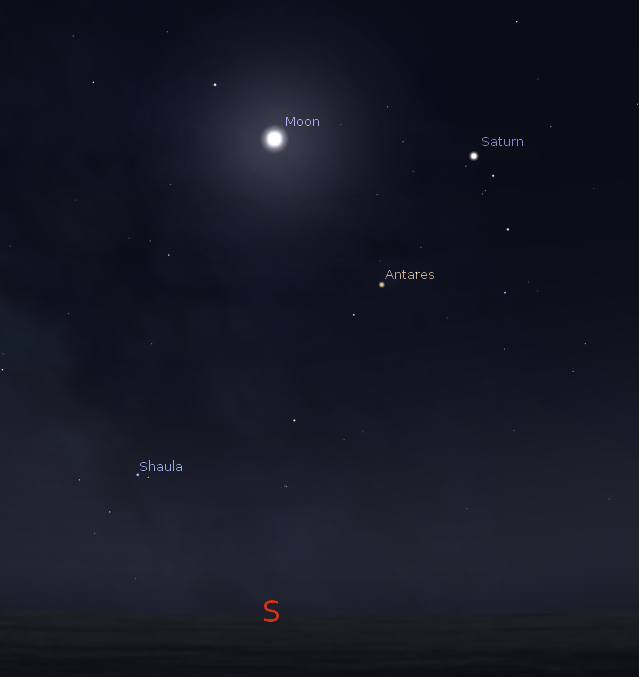
Saturn and the Moon above Scorpius at 5:30 a.m. April 9, 2015. Created using Stellarium.
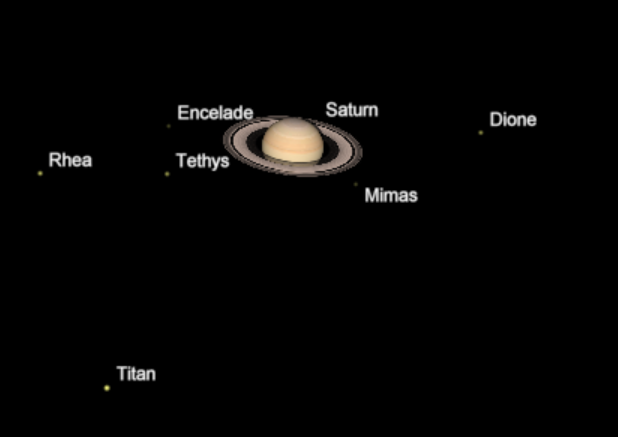
What Saturn and its moons might appear like in a telescope at 5:30 a.m., April 9, 2015. Small telescopes will show only the moon Titan. Created using Cartes du Ceil (Sky Charts).
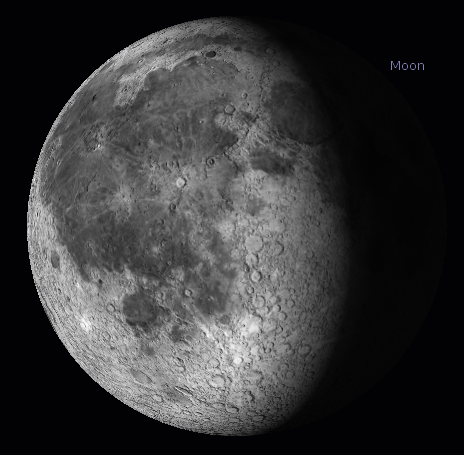
The Moon at 5:30 a.m. April 9, 2015. Created using Cartes du Ceil (Sky Charts).
04/07/2015 – Ephemeris – The Moon will pass Saturn tomorrow morning
Ephemeris for Tuesday, April 7th. The Sun will rise at 7:13. It’ll be up for 13 hours and 4 minutes, setting at 8:17. The Moon, 3 days past full, will rise at 11:36 this evening.
The planet Saturn is now rising shortly after midnight. However it is still best seen in the early morning. The Moon will be near Saturn when it rises and will get closer as the morning progresses. By 6 a.m. the Moon will be about four of its widths above and right of Saturn. The Moon will get its closest about 10 a.m., but by then it will be daylight and both will have set. Every week Saturn will rise, and set about a half hour earlier. That’s about an hour every two weeks, and two hours a month. This works for the stars and is pretty close for slow-moving planets like Jupiter and Saturn. So next month at this time Saturn will rise about 10 p.m., and in another month 9 p.m. By then it will be in the sky at sunset, and visible all night.
Times are for the Traverse City/Interlochen area of Michigan. They may be different for your location.
Addendum
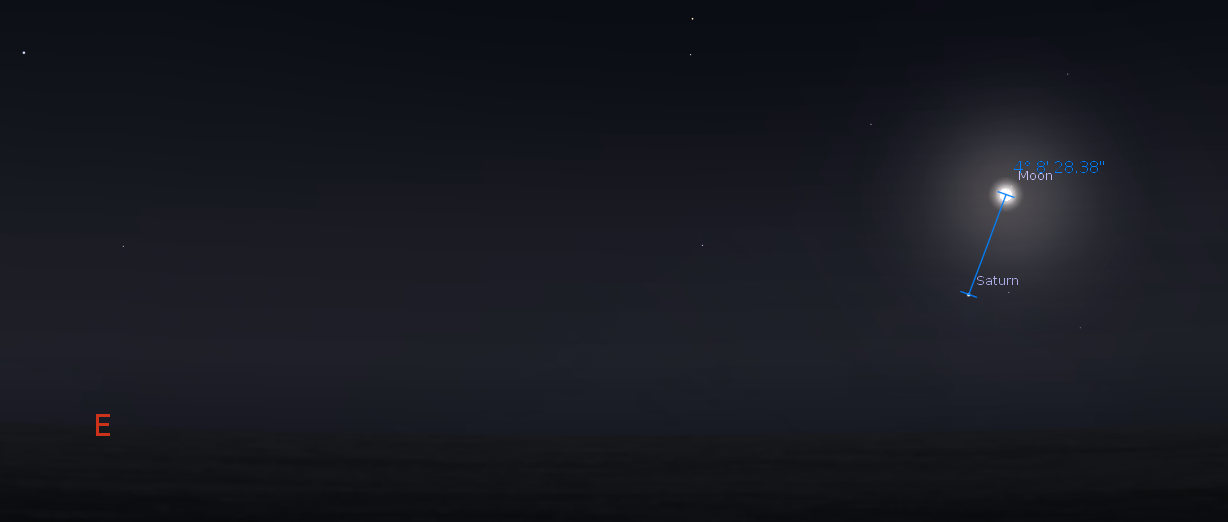
Saturn and the Moon shortly after rising. 12:44 a.m., April 8, 2015. Created using Stellarium.
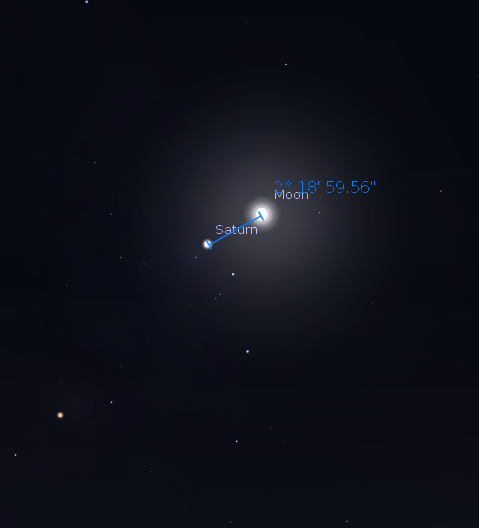
Saturn and the Moon shortly after twilight starts. 5:30 a.m., April 8, 2015. Created using Stellarium.
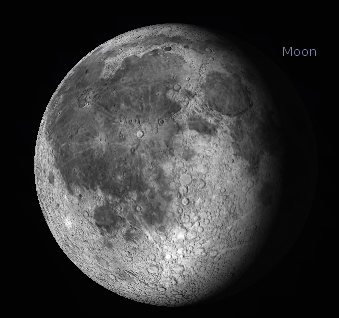
The Moon as it might appear in binoculars at 5:30 a.m. April 8, 2015. Created using Stellarium.
Some Rules of Thumb about the rotation of the earth and its revolution around the Sun.
These are approximate:
Stars rise or set 4 minutes earlier each night.
That’s about a half hour every week, and
It’s about 2 hours every month.
2 hours times 12 months = 24h hours, one rotation of the Earth
As far as viewing the stars and Constellations goes, that’s why we see the constellations in the same positions every year at the same time.
04/01/2015 – Ephemeris – No fooling, it’s time to look at the bright planets for this week
Ephemeris for April Fools Day, Wednesday, April 1st. The Sun will rise at 7:24. It’ll be up for 12 hours and 45 minutes, setting at 8:10. The Moon, 3 days before full, will set at 6:29 tomorrow morning.
Lets take a look at the bright planets for this week. Brilliant Venus is in the west by 8:40 p.m. It will set at 11:23 p.m. Mars appears much lower and to the right of it. The Red Planet will set tonight at 9:48. Jupiter will appear In the southeastern sky in the evening. It will set at 5:20 a.m. It’s near the sickle-shaped head of Leo the lion, and it’s the second brightest star-like object in the sky after Venus. All four moons will be visible in telescopes tonight, but tomorrow morning the moon Io will duck behind Jupiter at 2:55, but will not pop into sunlight until after Jupiter sets. Early risers will be able to spot Saturn which will rise in the east-southeast at 12:30 a.m. It will be low in the south at 5 to 6 a.m.
Times are for the Traverse City/Interlochen area of Michigan. They may be different for your location.
Addendum
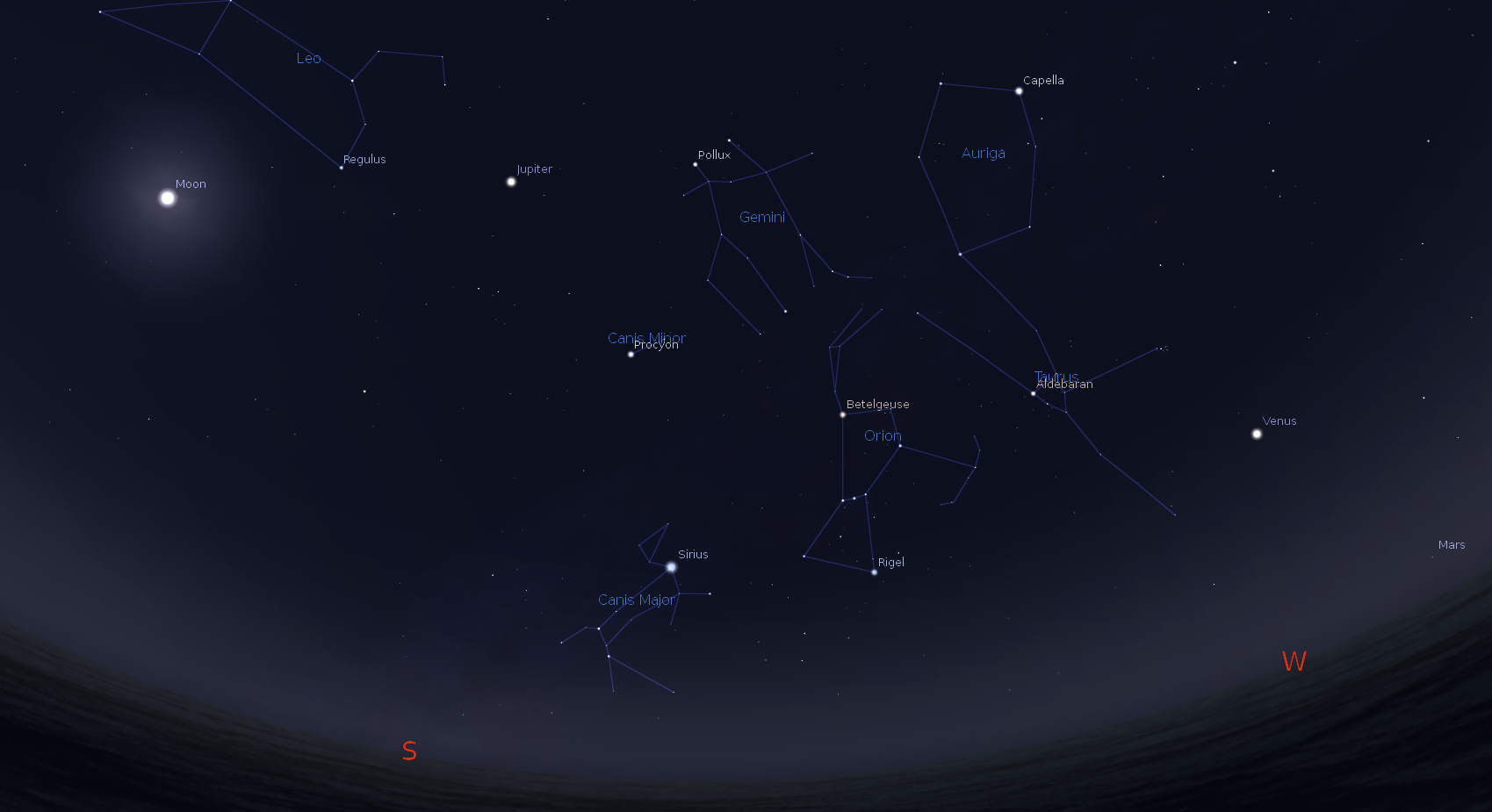
The Moon, evening planets and bright constellations at 9:30 p.m. April 1, 2015. Created using Stellarium.
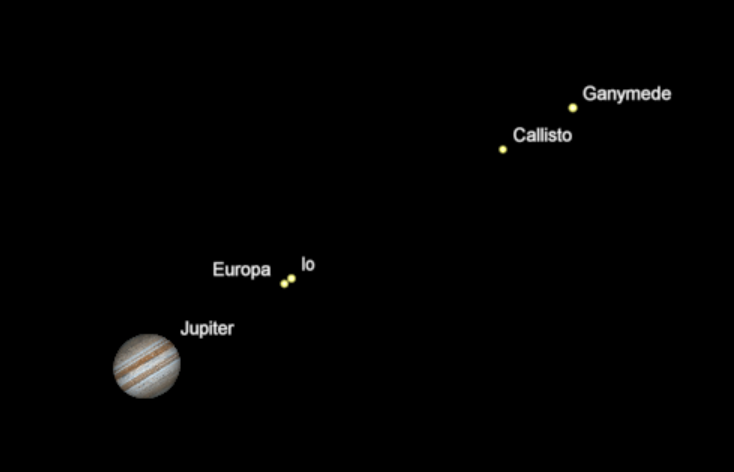
Jupiter as seen in a telescope at 9:30 p.m. April 1, 2014. Europa will partially occult Io starting at 9:41 p.m. for 4 minutes. They will appear to merge. Later at 11:21 p.m. Io will be partially eclipsed in Europa’s shadow for about 4 minutes. Europa will dim slightly. Created using Cartes du Ceil (Sky Charts).
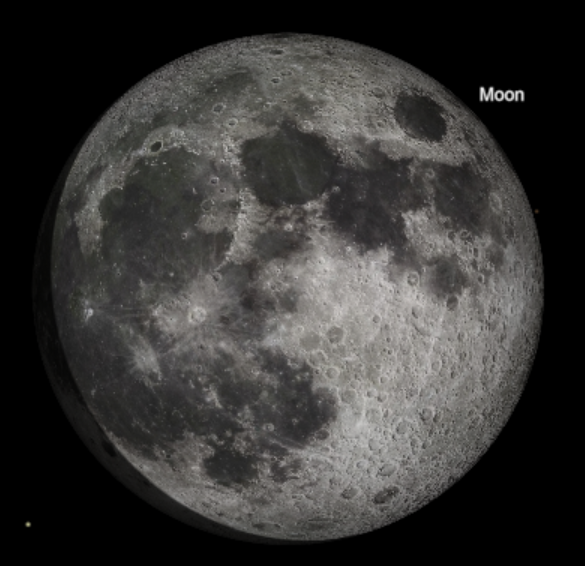
The Moon at 9:30 p.m. April 1, 2015. Created using Cartes du Ceil (Sky Charts).
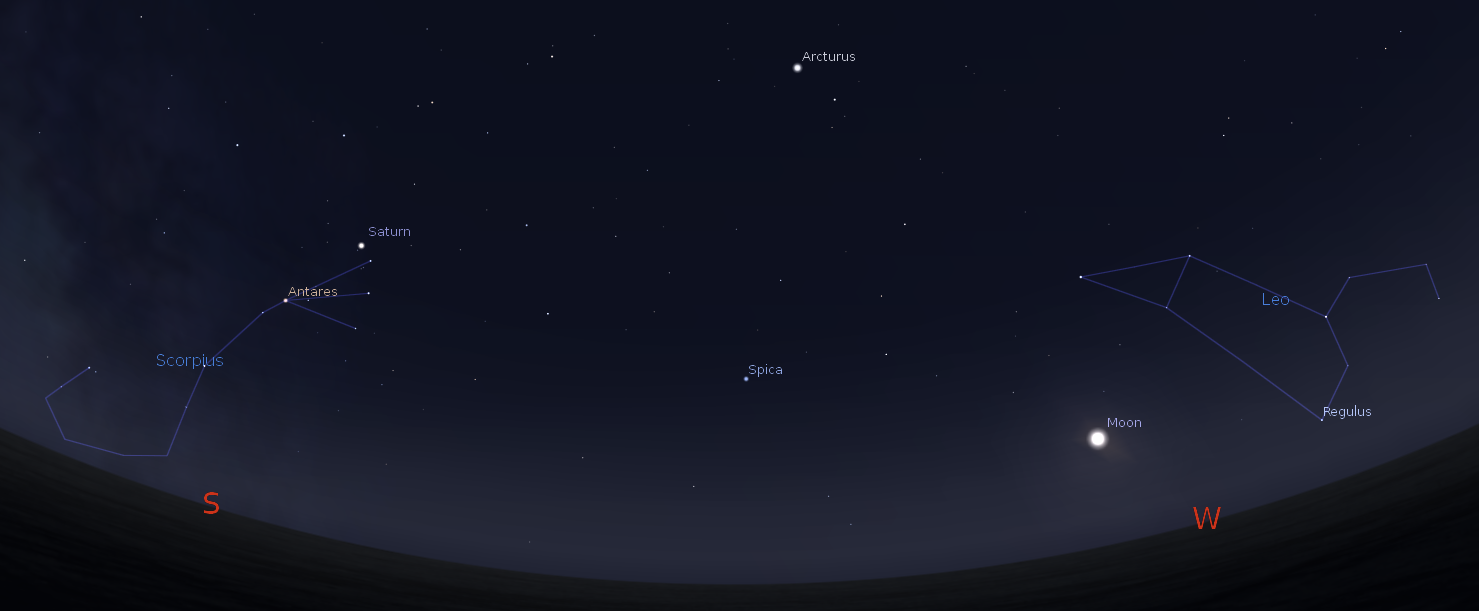
Saturn, the Moon with Scorpius and Leo at 5:30 a.m. April 2, 2015. Created using Stellarium.
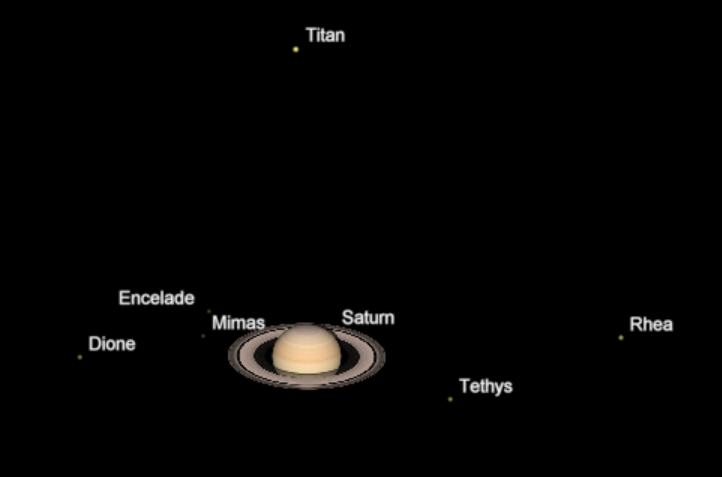
What Saturn and its moons might appear like in a telescope at 5:30 a.m., April 2, 2015. Small telescopes will show only the moon Titan. Created using Cartes du Ceil (Sky Charts).
03/25/2015 – Ephemeris – Where are the bright planets tonight?
Ephemeris for Wednesday, March 25th. The Sun will rise at 7:37. It’ll be up for 12 hours and 24 minutes, setting at 8:01. The Moon, 2 days before first quarter, will set at 2:13 tomorrow morning.
Lets take a look at the bright planets for this week. Brilliant Venus is in the west by 8:30 p.m. It will set at 11:07 p.m. Mars appears much lower and to the right of it. The Red Planet will set tonight at 9:48. Jupiter will appear In the southeastern sky in the evening. It will set at 5:48 a.m. It’s near the sickle-shaped head of Leo the lion, and it’s the second brightest star-like object in the sky after Venus. In telescopes tomorrow morning the moon Io will duck behind Jupiter at 1:05, but will pop into sunlight a bit away from the planet on the other side at 4:23 a.m. because it also will be hidden in Jupiter’s shadow. Early risers will be able to spot Saturn which will rise in the east-southeast at 12:59 a.m. It will be low in the south at 6 to 7 a.m.
Times are for the Traverse City/Interlochen area of Michigan. They may be different for your location.
Addendum
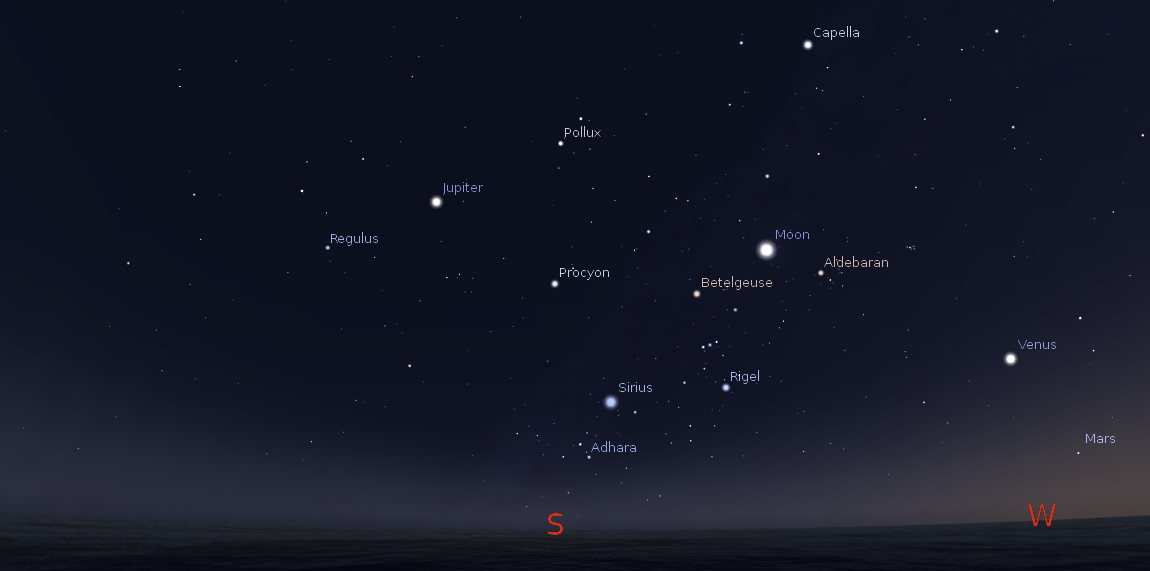
The evening planets of Mars, Venus and Jupiter with the Moon and winter stars. Created using Stellarium.
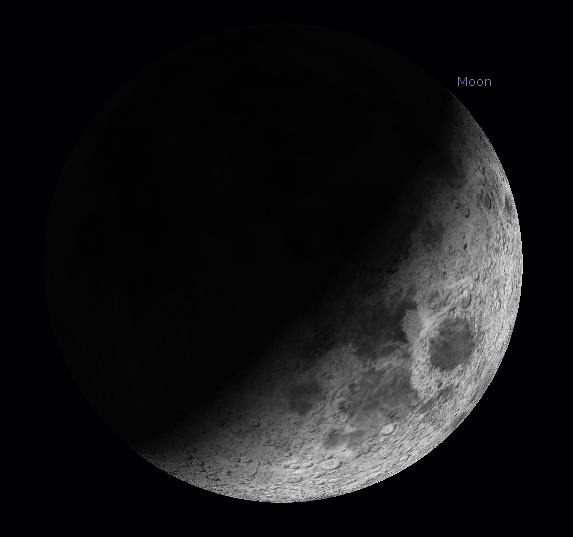
The Moon as it would appear in binoculars at 9 p.m. March 25, 2015. Created using Stellarium.
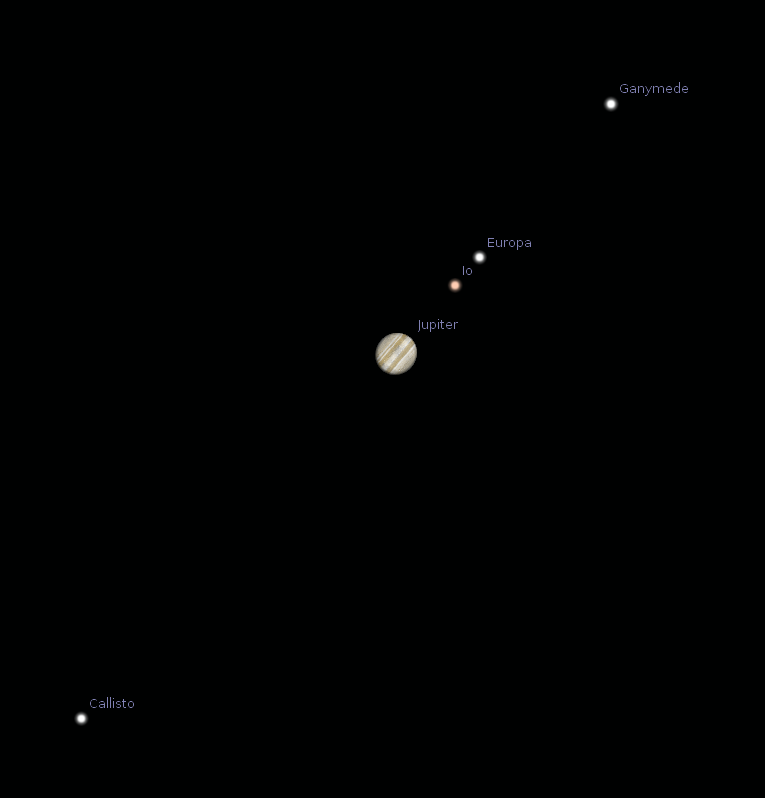
Jupiter and its moons at 9 p.m. March 25, 2015. Created using Stellarium.
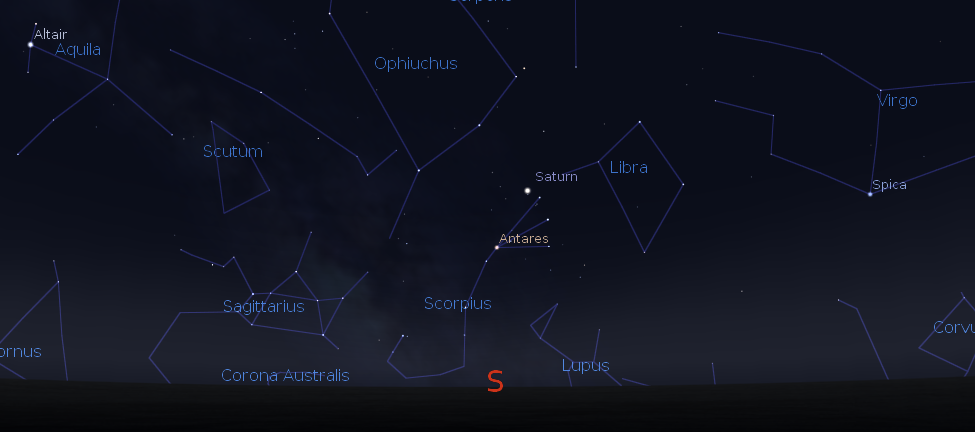
Saturn and the southern summer constellations at 6 a.m. on March 26, 2015. Created using Stellarium.
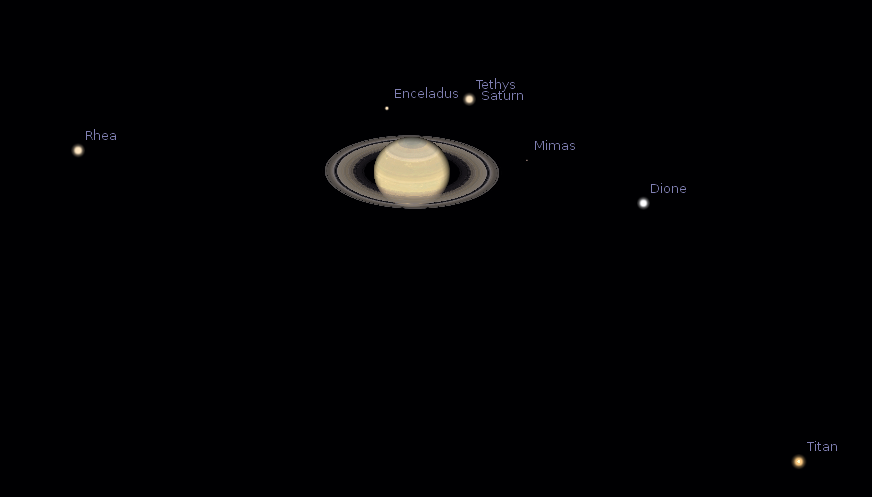
What Saturn and its moons might appear like in a telescope at 6 a.m., March 26, 2015. Small telescopes will show only the moon Titan. Created using Stellarium.
 Bob Moler's Ephemeris Blog