Archive
10/25/2012 – Ephemeris – Exploring the bright gibbous moon
Ephemeris for Thursday, October 25th. The sun will rise at 8:11. It’ll be up for 10 hours and 29 minutes, setting at 6:40. The moon, half way from first quarter to full, will set at 5:02 tomorrow morning.
The moon tonight is very bright, so looking at it with a telescope can be almost painful. There are moon filters sold at telescope stores for standard sized eyepieces that will alleviate that problem. Remember it’s daytime on the moon and the sunlight is as strong on the moon as it is on the earth. Concentrate the telescope on the left edge of the moon, the sunrise line where the shadows are. The small crater Kepler, named for the astronomer who gave us the laws the govern the motion of the planets is located near the terminator near the moon’s equator. The Crater Gassendi, to the lower left, is a ringed plain with low walls and a flat floor that has a rille or crack in it. Another distinctive crater is Schiller lower to the south and very elongated.
Times are for the Traverse City/Interlochen area of Michigan. They may be different for your location.
Addendum
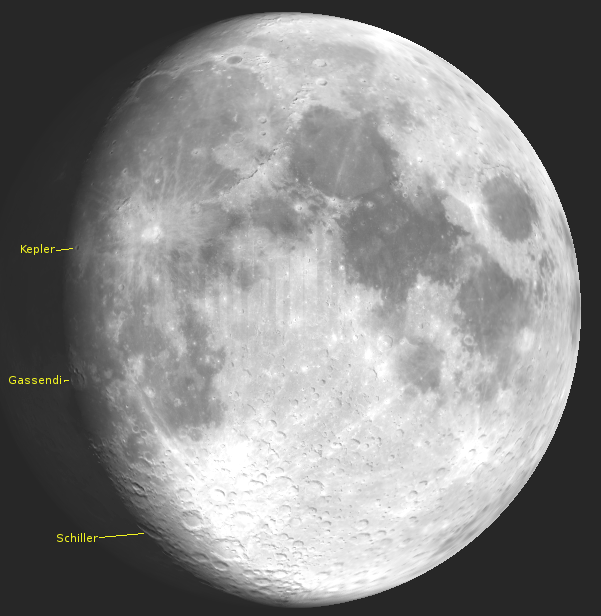
The bright gibbous moon highlighting three craters, Kepler, Gassendi, and Schiller. Created using the Virtual Moon Atlas.
Gassendi is named for Pierre Gassend, 17th French astronomer and pioneer in the use of a refractor telescope. Schiller is named for Julius Schiller a 17th century monk who came out with a Christian themed star atlas. These and other crater facts were obtained for the open source lunar program Virtual Moon Atlas.
10/05/2012 – Ephemeris – Tonight’s astronomical events in Traverse City
Ephemeris for Wednesday, October 3rd. The sun will rise at 7:43. It’ll be up for 11 hours and 35 minutes, setting at 7:18. The moon, 4 days past full, will rise at 8:59 this evening.
Let’s see how many bright planets we can find this week. Mars and Saturn now set too close to the sun to be easily seen in the evening sky. Both are in the west southwestern sky and very low in twilight. Saturn sets at 8:10 p.m., while Mars sets at 9:08. The planetary action moves to later in the evening and the morning. Jupiter, will rise at 10:09 p.m. in the east northeast. It is located in the constellation of Taurus. The last bright planet of the night is the morning star Venus which will rise at 4:13 a.m. also in the east northeast. Venus is now in Leo outshining the star Regulus next to it. The planets Venus and Jupiter and the winter constellations are a great sight for early risers. You can enjoy them without danger of frost bite.
Times are for the Traverse City/Interlochen area of Michigan. They may be different for your location.
Addendum
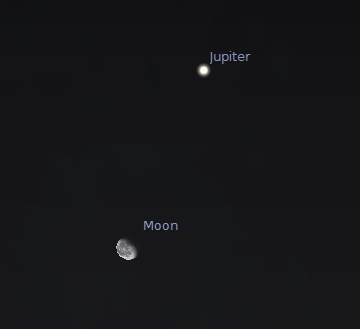
Jupiter and the waning gibbous moon at 11 p.m. October 5, 2012. Created using Stellarium.
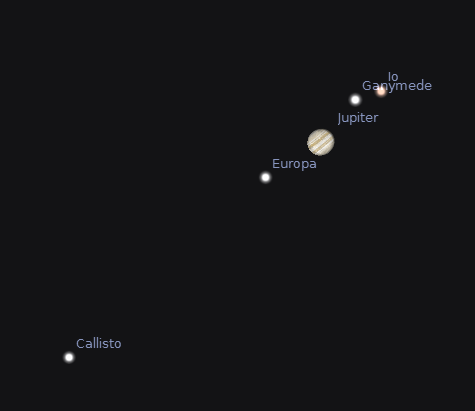
Jupiter with its moons at 11 p.m. October 5, 2012. Created using Stellarium. Stellarium shows the moons much brighter than they actually appear. compared to Jupiter.
07/26/2012 – Ephemeris – Why is a half illuminated moon called a quarter moon?
Ephemeris for Thursday, July 26th. The sun rises at 6:22. It’ll be up for 14 hours and 51 minutes, setting at 9:14. The moon, at first quarter today, will set at 12:56 tomorrow morning.
The moon was at the exact first quarter a few hours ago. By tonight the sunlit side of the moon will be a bit fuller, but might be at the half moon phase to the casual eye. So why do we call the half illuminated moon a quarter moon? The moon is a quarter the way around the earth from new moon. When it goes half way around the earth from new, we ave a fully illuminated moon from our vantage point, Another quarter the way around we have a half illuminated moon from our vantage point, but the moon is at third quarter position or last quarter. Another quarter way around and the moon is new again. The ancients unlike astronomers today called the first sighting of the moon’s crescent in the west after sunset new moon.
Times are for the Traverse City/Interlochen area of Michigan. They may be different for your location.
Addendum
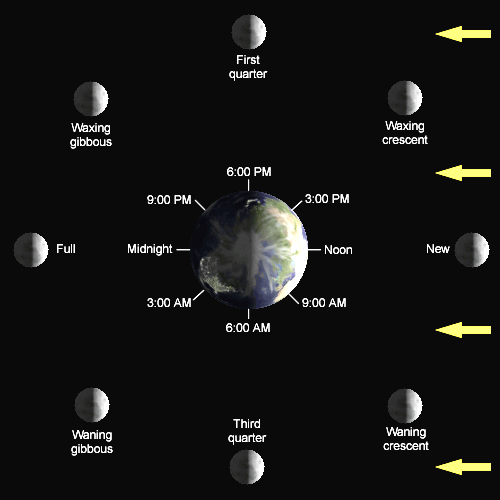
Lunar phase diagram. From Wikimedia Commons.
The arrows in the diagram is light from the sun far off to the distant right.
07/13/2012 – Ephemeris – The moon will join Venus and Jupiter Sunday morning
Ephemeris for Friday, July 13th. Today the sun will be up for 15 hours and 15 minutes, setting at 9:25. The moon, 3 days past last quarter, will rise at 2:26 tomorrow morning. Tomorrow the sun will rise at 6:11.
Sunday Morning maybe isn’t the most convenient time to get up early, but this Sunday it may be worth it. At 5 a.m. or so Jupiter will appear above Venus, as they have for the last few weeks. But Sunday morning the crescent moon will appear right between the two. For other parts of the world the moon will actually pass in front of Jupiter, an event called an occultation. This will occur before sunrise for us. But still the planet and moon group should be a beautiful sight in the twilit sky. Venus and Jupiter will soon separate, Venus to stay near the sun, while Jupiter due to the earth’s orbital motion moves away to rise earlier and earlier by somewhat less than a half hour a week. Jupiter lies in the constellation Taurus now.
Times are for the Traverse City/Interlochen area of Michigan. They may be different for your location.
Addendum
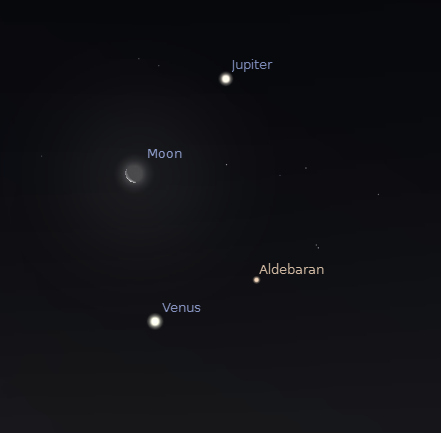
Jupiter, Venus and the moon on July 15, 2012 at 5 a,m, Created using Stellarium.
05/29/2012 – Ephemeris – The moon tonight
Ephemeris for Tuesday, May 29th. Today the sun will be up for 15 hours and 16 minutes, setting at 9:18. The moon, 1 day past first quarter, will set at 2:38 tomorrow morning. Tomorrow the sun will rise at 6:01.
The moon tonight is a wonderful sight for binoculars or a small telescope. There are some very nice craters now revealed near the terminator, the line between day and night on the moon. The terminator in the two weeks between new and full is the sunrise line on the moon. From the top or north on the moon is the flat floored crater Plato Then about midway down the moon and right on the terminator is the beautiful crater Copernicus. Then to the south end of the moon is the bright and crisp crater Tycho. Its splash marks called rays will be better revealed at full moon. At the bottom of the moon, just coming into light is the huge crater Clavius. A telescope will reveal smaller craters within.
Times are for the Traverse City/Interlochen area of Michigan. They may be different for your location.
Addendum
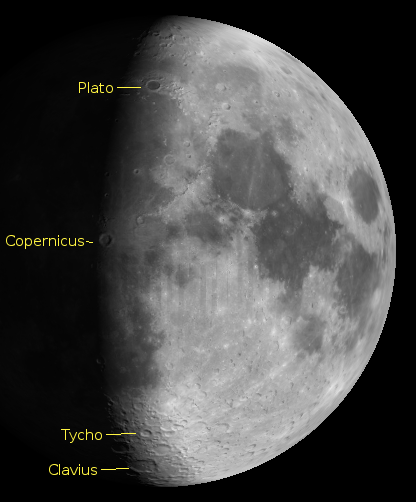
The moon on 5/29/2012 showing large craters on the terminator. Created using Virtual Moon Atlas.
05/24/2012 – Ephemeris – Phases and shadows on the moon
Ephemeris for Thursday, May 24th. Today the sun will be up for 15 hours and 8 minutes, setting at 9:13. The moon, half way from new to first quarter, will set at 12:11 tomorrow morning. Tomorrow the sun will rise at 6:04.
The fat crescent moon tonight is like the crescent Venus, with the sun shining on mostly the far side. I notice that some folks think that the earth is casting its shadow on the moon to cause the crescent. That isn’t correct. The earth does cast its shadow on the moon sometimes, but only at full moon, but only about one in 6 full moons, and we usually don’t see many of these. The phases of the moon are simply the light and shadow of a ball in the sunlight. In fact, if before sunset you can see the moon, and you are in sunlight also. Hold the ball up next to the moon. You will see that the ball will have the same phase as the moon. This is because the moon is close to the earth.
05/22/2012 – Ephemeris – The moon appears near Venus tonight
Ephemeris for Tuesday, May 22nd. Today the sun will be up for 15 hours and 4 minutes, setting at 9:11. The moon, 2 days past new, will set at 10:50 this evening. Tomorrow the sun will rise at 6:06.
Tonight the extremely thin crescent moon will appear below and left of the planet Venus. Venus itself is an extremely thin crescent, just two weeks from passing directly in front of the sun in a rare transit part of which will be visible from here. Venus is a crescent because we are looking mostly on its night side, with just a sliver of light on its sunlit edge. Even though Venus shows such a small sunlit sliver, it’s still very bright, since its nearness to us makes it appear larger in our sky. You can even see the crescent in binoculars. Venus is so bright because it’s close to us, just slightly smaller than the earth, but socked in by while sulfuric acid clouds that reflect most of the suns light covering a runaway green house effect beneath.
Times are for the Traverse City/Interlochen area of Michigan. They may be different for your location.
Addendum
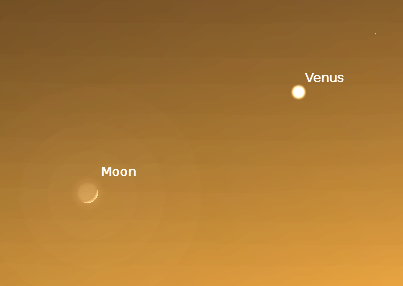
Venus with the moon on the evening of May 22, 2012. Created using Stellarium.
04/24/2012 – Ephemeris – The moon appears near Venus tonight
Ephemeris for Tuesday, April 24th. The sun rises at 6:42. It’ll be up for 13 hours and 56 minutes, setting at 8:39. The moon, 3 days past new, will set at 12:05 tomorrow morning.
This evening the moon will appear near Venus with the brilliant planet above and right of the moon. The moon should still exhibit earthshine. On the 30th Venus will attain its greatest brightness of -4.6 magnitude. Only the moon and sun are brighter. In a telescope Venus has a crescent phase and as you view Venus for the next month its phase will get thinner and its size gets larger. This is as it approaches us as it moved more closely between us and the sun. It’s quite a show to watch for. Folks with a low western horizon and clear skies should be able to follow Venus to within a few days of its transit across the face of the sun. Then in bright twilight Venus will have the thinnest of crescents, and appear larger than Jupiter.
Times are for the Traverse City/Interlochen area of Michigan. They may be different for your location.
Addendum
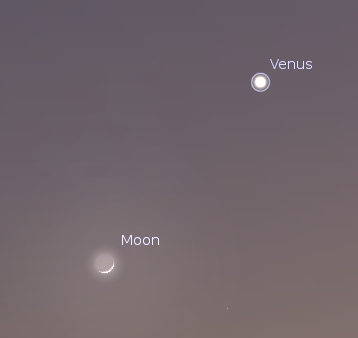
Venus and the moon at 9 p.m. April 24, 2012. Created using Stellarium.
04/23/2012 – Ephemeris – The moon will appear near the Pleiades tonight
Ephemeris for Monday, April 23rd. The sun rises at 6:44. It’ll be up for 13 hours and 53 minutes, setting at 8:37. The moon, 2 days past new, will set at 11:13 this evening.
This evening the thin crescent moon will appear near the Pleiades, or Seven Sisters. They will appear just to the right of the thin sliver of the moon. If you look closely at the moon the entire Moon will be visible. That’s because the nearly full Earth is shining on it. The phase of the earth in the moon’s sky is exactly the opposite of the moon’s phase in the earth’s sky. The effect is called earth shine and was first explained by Leonardo DaVinci. For future astronauts spending a two week night on the moon’s near side, the full earth in its skies will be much brighter than the full moon looks in our skies. The earth covers 16 times the sky as the moon and is more than twice as reflective as the moon. The moon will continue to move eastward and will be near Venus tomorrow.
Times are for the Traverse City/Interlochen area of Michigan. They may be different for your location.
Addendum
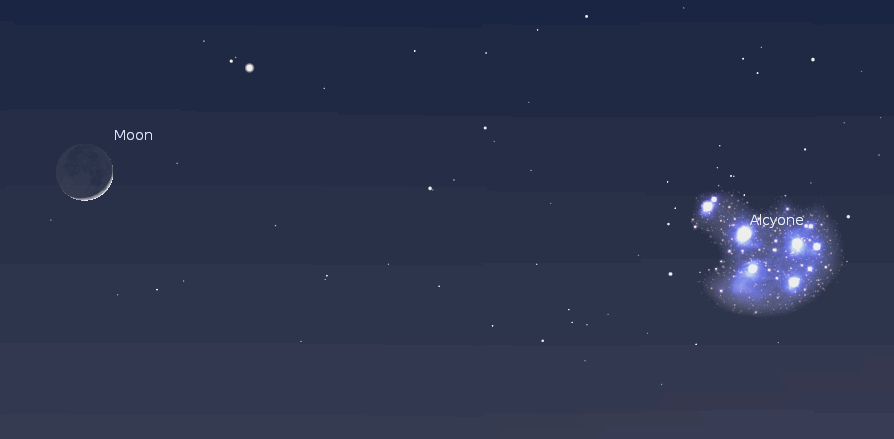
The moon and the Pleiades on April 23rd at 10 p.m. Created using Stellarium.
Note that Stellarium shows a photograph for the Pleiades. The blue reflection nebula is not visible to the eye, and the stars of the Pleiades aren’t that bright in comparison to the moon.
03/29/2012 – Ephemeris – The moon tonight
Ephemeris for Thursday, March 29th. The sun will rise at 7:28. It’ll be up for 12 hours and 38 minutes, setting at 8:06. The moon, 1 day before first quarter, will set at 2:55 tomorrow morning.
Tonight’s moon will be nearly half full. The gray patches on the moon are from the upper right the sea of Crises, Below it is the sea of fertility, centered on the moon’s equator is the sea of Tranquility. Above that is the scallop shaped sea of Serenity. One of the interesting craters in viwe for a telescope now is the ruined crater Julius Caesar. It’s on the edge of Tranquility near Serenity. This is an ancient crater whose crater walls were breached by the impact that created the sea of Tranquility, so it kind of looks like the letter C. So how did this crater become named for a Roman Emperor? My only guess is that it was for his calendar reform giving us the 365 day year with a leap year every 4th. This is also a good time to check out the rest of the moon.
* Times are for the Traverse City/Interlochen area of Michigan. They may be different for your location.
Addendum
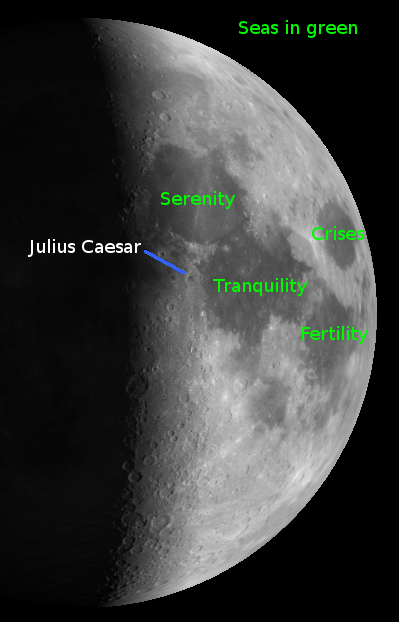
The moon at 10 p.m. 3/29/2012. Created using Virtual Moon Atlas.
 Bob Moler's Ephemeris Blog