Archive
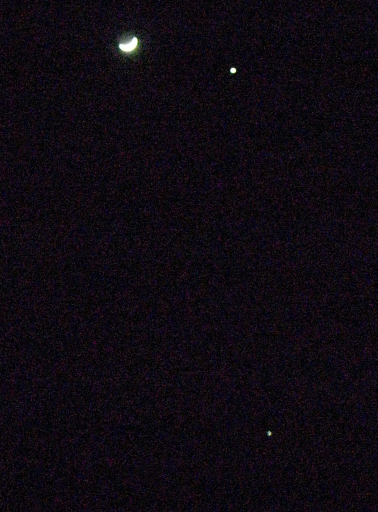
My photo of the moon, Venus and Jupiter last night
This was taken shortly after 9 p.m. with my Canon point &shoot type camera in manual mode. The moon is over exposed to get Jupiter at the bottom, but does show some earthshine.
03/26/2012 – Ephemeris – The moon will pass Venus today
Ephemeris for Monday, March 26th. The sun will rise at 7:33. It’ll be up for 12 hours and 29 minutes, setting at 8:03. The moon, half way from new to first quarter, will set at 12:25 tomorrow morning.
Yesterday the moon moved past Jupiter in the sky. Today the moon will pass Venus, the brightest planet. Check them out in the west southwest in the evening after sunset. Venus is going to be at greatest elongation from the sun tomorrow. Venus is at an angle of 46 degrees from the sun, and it will soon diminish. As it does, this is the best time to view Venus in a telescope. 400 years ago Galileo observed Venus with his small telescope and observed that Venus had phases like the moon, and its size changed proving that Venus orbited the sun and not the earth. You can repeat his observations this spring. Venus now appears about half illuminated by the sun, like the quarter moon. Its phase will thin and it will grow in size.
* Times are for the Traverse City/Interlochen area of Michigan. They may be different for your location.
Addendum
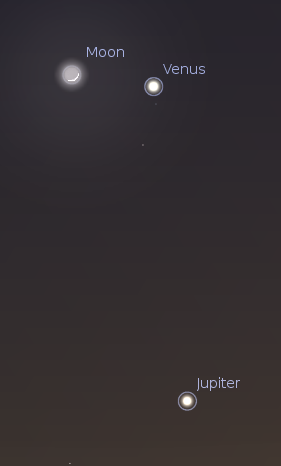
The Moon passing Venus with Jupiter below. Created using Stellarium.
03/09/2012 – Ephemeris – The moon will pass Spica and Saturn tomorrow
Ephemeris for Friday, March 9th. The sun will rise at 7:04. It’ll be up for 11 hours and 36 minutes, setting at 6:41. The moon, 1 day past full, will rise at 8:47 this evening.
The moon will be passing by the bright star Spica and the planet Saturn tomorrow evening. They will make a neat triangle with the moon at the point below. I should remind everyone that the moon will only pass these object from our point of view. We are lining up the nearby moon, only a quarter million miles away with Saturn, nearly a billion miles away, and Spica trillion and trillions of miles away. Though the heavens appear as a sphere overhead, it is unimaginably deep. The ancients called the heavens the firmament, meaning that it was literally solid. It was, according to Genesis, placed there to divide the waters above from that below. We find now that time is as deep into the past as space is deep, some 13.7 billion years.
Not mentioned in the program: Daylight Time will start at 2 a.m. Sunday March 11th at 2 a.m.
* Times are for the Traverse City/Interlochen area of Michigan. They may be different for your location.
Addendum
Below is The moon below Spica and Saturn at 11 p.m. on Saturday, march 10, 2012.
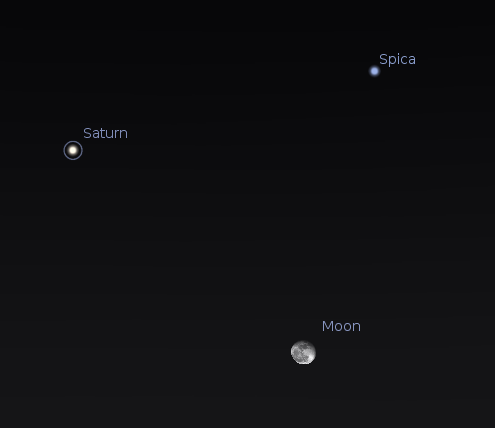
The Moon, Spica and Saturn at 11 p.m March 10, 2012. Chart created using Stellarium.
03/08/2012 – Ephemeris – The full moon
Ephemeris for Thursday, March 8th. The sun will rise at 7:06. It’ll be up for 11 hours and 33 minutes, setting at 6:40. The moon, at full today, will rise at 7:30 this evening.
The full moon, contrary to what you’d think is a poor time to observe it. The moon is essentially gray on gray. And at full moon we are looking at the moon from about the same perspective as the sun, so there are no shadows to delineate its fine features. Since the actual instant of full moon occurred at 5 this morning, some shadows will be creeping in on the moon’s upper right face as it is seen in the evening. Full moon is the best time to see the maria or lunar seas, the dark areas that make up the man in the moon. In binoculars can be seen the bright rays emanating from the crater Tycho near the south end of the moon. Other craters have rays too, but none so long and distinctive. Night by night for the next two weeks the moon’s illuminated landscape will wane.
* Times are for the Traverse City/Interlochen area of Michigan. They may be different for your location.
Addendum
The image below is of the waxing gibbous moon presumably from last Sunday night. The phase fits Virtual Moon Atlas for that date. And I received the photo Monday. many of the full moon features including the maria and the crater Tycho can be seen on it. Click on it to see the larger version.
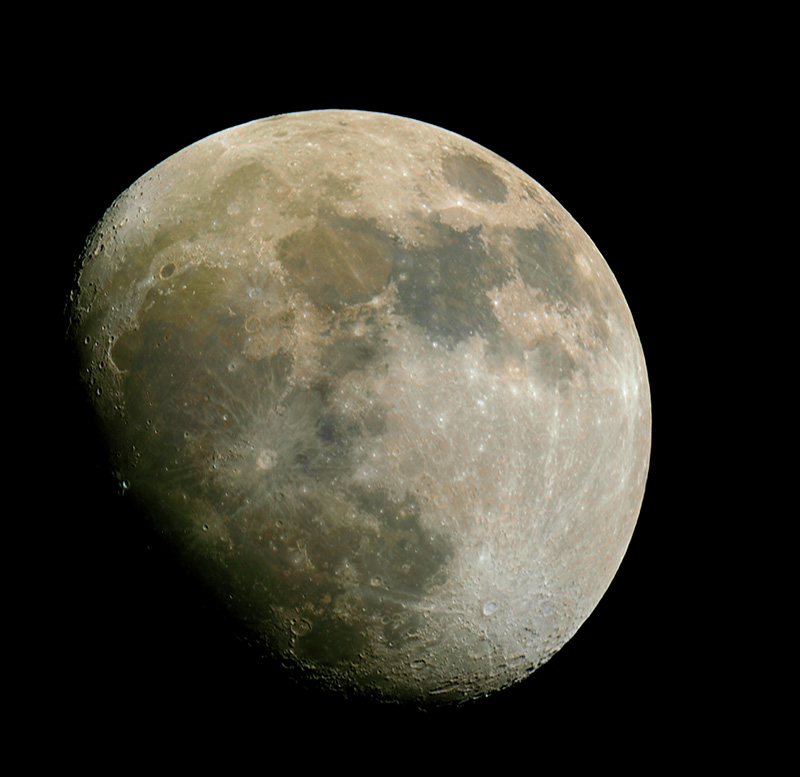
The gibbous moon 03/04/2012 by Scott Anttila
This is from Scott: “The full-size image is huge, a 6 panel mosaic by my DSLR in the (Celestron) C11. It has had the saturation boosted to show detail in the seas that otherwise is difficult if not impossible to detect. You can also see where different minerals are located in the highland areas. Not many people like this view of the moon, I’m fairly fond of it.”
03/06/2012 – Ephemeris – Comparing Mercury with the moon
Ephemeris for Tuesday, March 6th. The sun will rise at 7:10. It’ll be up for 11 hours and 27 minutes, setting at 6:37. The moon, 2 days before full, will set at 6:18 tomorrow morning.
The planet Mercury, which is visible shortly after sunset, is the smallest planet and the one closest to the sun. Its diameter of about 3,030 miles is 50 percent larger than the moon. At first glance Mercury looks like the moon. However to the spacecraft now orbiting Mercury, it appears as a much different place. Mercury is very dense with a large iron core. The moon in contrast is a lightweight. There are no dark lava plains called seas on Mercury, as there are on the near face of the moon. The largest impact basin on Mercury is the Caloris basin, some 650 miles in diameter. At the antipodal point from the Caloris Basin, there is a patch of jumbled terrain actually called Weird Terrain where the impact forces were focused.
* Times are for the Traverse City/Interlochen area of Michigan. They may be different for your location.
02/28/2012 – Ephemeris – The moon will pass south of the Pleiades tonight
Ephemeris for Tuesday, February 28th. The sun will rise at 7:22. It’ll be up for 11 hours and 5 minutes, setting at 6:28. The moon, 1 day before first quarter, will set at 1:34 tomorrow morning.
The fat crescent moon will appear below the Pleiades star cluster tonight. The Pleiades is also known as the Seven Sisters. With the moon as bright as it is the stars of the Pleiades may not be easily spotted, so a pair of binoculars might be needed. The Pleiades will appear nearly 8 moon diameters above the moon, so they might escape the moon’s glare somewhat. The moon will pass the Pleiades every 28 and a fraction days. Sometimes it passes south of the cluster, and sometimes north of it, and occasionally it passes in front of the stars of the cluster. The moon’s orbit of the earth wobbles or precesses once every 18.6 years. It’s why eclipses occur at different times of the year, and generally earlier one year to the next.
* Times are for the Traverse City/Interlochen area of Michigan. They may be different for your location.
Addendum
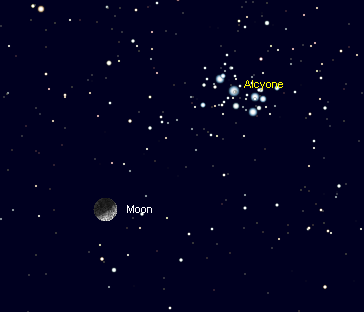
The moon south of the Pleiades at 10:19 p.m. February 28, 2012 from Michigan . Chart created using Cartes du Ciel (Sky Charts)
02/24/2012 – Ephemeris – The moon will pass Venus and Jupiter this weekend
Friday, February 24th. The sun will rise at 7:29. It’ll be up for 10 hours and 53 minutes, setting at 6:22. The moon, 3 days past new, will set at 9:36 this evening.
This weekend we will be able to spot appearances of the moon passing two planets. Tomorrow night Venus will appear below the moon. It should be a spectacular sight with Jupiter nearby to the upper left. Then Sunday night the moon will have moved near Jupiter. This time Jupiter will appear to the left of the moon, their closest apparent approach being after they set Monday morning. Even though the moon will leave these planets, keep watching them. As Venus slowly approaches Jupiter. They will be their closest, called a conjunction on the Ides of March. That’s March 15th using our calendar. These two planet will still be with us for the next few months, with Mars and Saturn appearing later in the evening now.
* Times are for the Traverse City/Interlochen area of Michigan. They may be different for your location.
Addendum
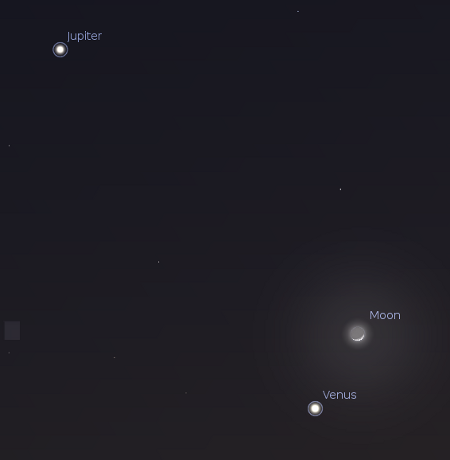
The moon will pass above Venus at 7 p.m. Saturday February 25, 2012. Created using Stellarium.
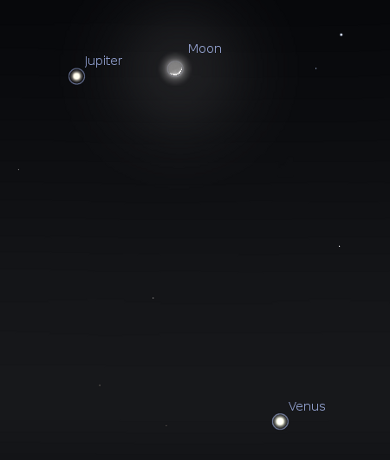
The moon will pass Jupiter, seen at 10 p.m. February 26, 2012. Created using Stellarium.
02/10/2011 – Ephemeris – The moon will be near Saturn Sunday morning
Ephemeris for Friday, February 10th. The sun will rise at 7:50. It’ll be up for 10 hours and 12 minutes, setting at 6:03. The moon, 3 days past full, will rise at 9:52 this evening.
Sunday morning the moon will pass Saturn in our sky. The ringed planet is just to the left of the bright blue-white star Spica in the constellation of Virgo. Saturn and Spica rise around midnight now. Saturn will be best seen in the evening this spring and early summer. Its rings are still opening up from their edge on passage in 2009. Saturn’s rings can be seen in any telescope with 20 power or over. In fact in sturdily mounted binoculars, Saturn will appear not point-like as stars do but may appear somewhat oblong, due to its rings. The rings are not solid, a fact that’s been known for a few centuries. A solid disk would be tour asunder by the tidal forces on it by the difference in the gravitational forces across the rings.
* Times are for the Traverse City/Interlochen area of Michigan. They may be different for your location.
Addendum
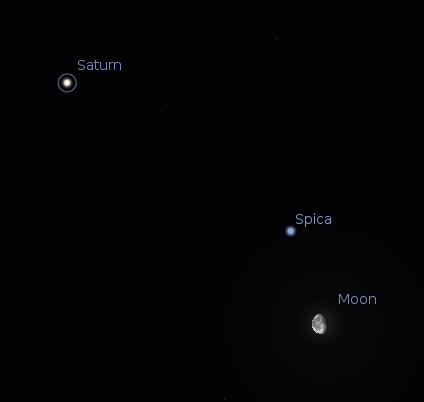
Saturn, Spica and the moon at 6 a.m. February 12, 2012. Created using Stellarium.
02/07/2012 – Ephemeris – The Dark Side of the moon
Ephemeris for Tuesday, February 7th. The sun will rise at 7:54. It’ll be up for 10 hours and 4 minutes, setting at 5:59. The moon, at full today, will rise at 6:11 this evening.
What is the dark side of the moon? If you said it was the part of the moon we don’t see, you are right, but only for today only. The proper name for the part of the moon that doesn’t face the earth is the far side. Every part of the moon has a chance to be on the dark side, which is just the night side, just as any solar system body illuminated by the sun has a day side and a night or dark side. The reason we can see only one side of the moon from the earth is that it’s tidally locked to the earth. The moon is trying to do the same to the earth and is slowing the earth’s rotation down. This is shown by the occasional leap second that’s added to our time. The moon does rotate, but it rotates once as it revolves about the earth once.
* Times are for the Traverse City/Interlochen area of Michigan. They may be different for your location.
01/19/2012 – Ephemeris – The moon will pass the bright star Antares this morning
Ephemeris for Thursday, January 19th. The sun will rise at 8:13. It’ll be up for 9 hours and 19 minutes, setting at 5:32. The moon, 3 days past last quarter, will rise at 5:52 tomorrow morning.
This morning, you might want to take a quick peek outside to the southeast and see, if you can spot the crescent moon. If you can below and a bit right of it is a bright red star. That star is Antares in the constellation Scorpius, one of the first constellations of summer to appear in the evening sky. I thought you’d like the encouragement that summer is coming now that winter has finally come in earnest. The moon passes Antares every month, but this morning it appears especially close, since their actual closest approach was about 2 this morning. The entire moon may be faintly visible this morning as earthshine. Antares itself may be twinkling merrily due to earth’s atmosphere. It sometimes looks like a sparkler in binoculars.
* Times, as always are for the Traverse City/Interlochen area of Michigan.
Addendum
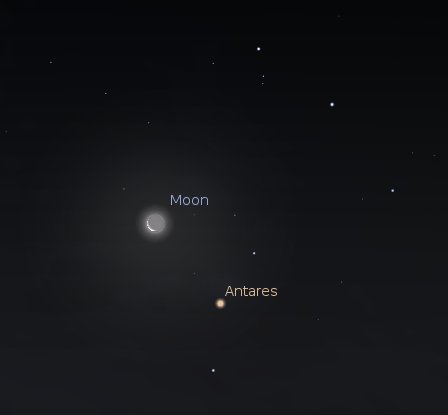
The Moon passes Antares in the morning hours of January 19, 2012. Created using Stellarium.
 Bob Moler's Ephemeris Blog