Archive
01/16/2012 – Ephemeris – The moon will appear below Saturn and Spica this morning
Ephemeris for Martin Luther King Day, Monday, January 16th. The sun will rise at 8:15. It’ll be up for 9 hours and 13 minutes, setting at 5:29. The moon, at last quarter today, will rise at 2:31 tomorrow morning. | This morning the crescent moon will appear below Saturn and the bright blue-white star Spica in the southeast before twilight brightens too much. When seen together Saturn and Spica really show the difference in their colors. Saturn reflects the light of our yellow sun, and that’s accentuated by it’s cream colored clouds. Only Saturn’s rings reflect the sun’s light pretty much unaltered because they’re made mostly of ice. Spica has the hottest surface temperature of any first magnitude star and shines with a blue tinge. This came home to me a long time ago, when I photographed a lunar eclipse with color film when the moon was next to Spica. Spica came out looking very blue indeed.
* Times, as always are for the Traverse City/Interlochen area of Michigan.
Addendum
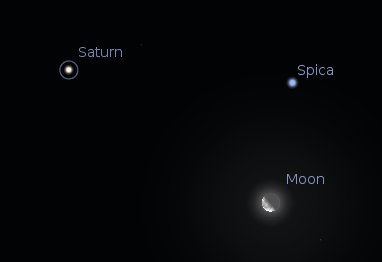
Saturn, Spica and the Moon on the morning of January 16, 2012. Created using Stellarium.
01/13/2012 – Ephemeris – The moon passes Mars tonight
Friday, January 13th. The sun will rise at 8:17. It’ll be up for 9 hours and 8 minutes, setting at 5:25. The moon, 3 days before last quarter, will rise at 10:52 this evening.
This evening the moon will pass below the planet Mars after the moon rises near 11 p.m. Mars is rather distant now, and it won’t be really near in its next close approach to us on March 5th when it will be slightly under 63 million miles away. In telescopes Mars is and will remain a tiny disk with a hint of a white polar cap on one end. Photographers with large telescopes and CCD cameras can capture Mars even better and show some surface detail. We have even closer views of Mars. Of course there is an operating rover called Opportunity still active on the planet and the Curiosity rover on its way plus three orbiting satellites, two US and one European. The satellites will be cruising overhead as Curiosity lands August 5th.
* Times, as always are for the Traverse City/Interlochen area of Michigan.
Addendum
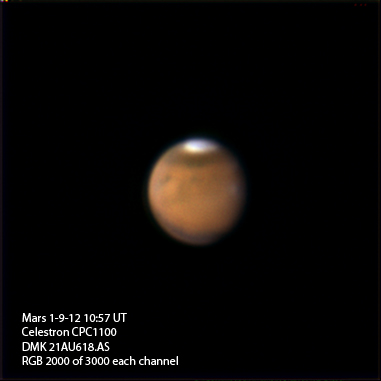
Mars on the morning of January 9, 2012. By Scott Anttila
Here’s Scott Anttila’a image of Mars from Monday morning, the 9th. Note Mar’s gibbous phase. Mars will become full when it’s at opposition from the sun March 3rd. It is only 9.7 seconds of arc in diameter. Also note, beside the northern polar cap that’s quite obvious, there is a hazy patch near the right edge of Mars. It is what telescopic astronomers of a hundred years ago called Nix Olympica, the Snows of Olympus. When the Mariner 9 spacecraft reached Mars in 1971 it found that there was a real mountain there. So the feature was renamed Olympus Mons or Mount Olympus. The white haze isn’t snow but water ice clouds that condense over the mountain peak. Mount Olympus is 14 miles high, three times taller than Mt Everest. The closest earth analog to it is the volcanic peak Mauna Kea on the island of Hawaii. Actually you’d have to throw in the entire island of Hawaii itself from the sea floor on up.
01/06/2012 – Ephemeris – GTAS meeting and viewing night tonight
Friday, January 6th. The sun will rise at 8:19. It’ll be up for 8 hours and 58 minutes, setting at 5:17. The moon, 3 days before full, will set at 6:50 tomorrow morning.
The Grand Traverse Astronomical Society will have its first meeting of the year tonight at 8 p.m. at the Northwestern Michigan College’s Rogers Observatory. Following will be a public viewing night featuring the moon and Jupiter. This year the first viewing night of the month will come at the end of the society meeting at 9 o’clock. Come for both. The presentation for the meeting will be NMC Astronomy Club member Storm Strausheim and her topic will be those mysterious stellar cannibals – Black Holes. The observatory is located on Birmley Road between Keystone and Garfield roads. April through October this year there will be a second viewing night at the observatory later in the month.
* Times, as always are for the Traverse City/Interlochen area of Michigan.
01/02/2012 – Ephemeris – The moon and Jupiter and telescope tips
Monday, January 2nd 2012. The sun will rise at 8:19. It’ll be up for 8 hours and 54 minutes, setting at 5:13. The moon, 1 day past first quarter, will set at 3:04 tomorrow morning.
Tonight the bright planet Jupiter will appear below the moon. This is a great time to try out that new telescope or binoculars, or dig that old one out of the closet or attic. With a telescope use the lowest power to locate the moon and get an overview. The bright southern part of the moon, which may appear at the top of the image, because telescopes normally invert the image is heavily cratered. The other part has several dark nearly flat structures called seas. These are really huge craters that caused the internal lava to well up, making the smooth floors. Recently some astronomers hypothesized that a second moon was created with ours and that it crashed into our moon creating the lunar seas.
* Times, as always are for the Traverse City/Interlochen area of Michigan.
Addendum
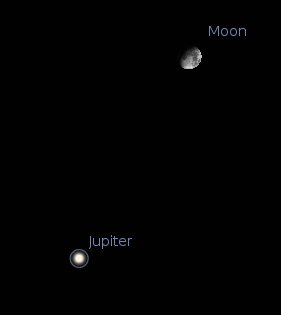
Jupiter appears below moon Jan 2, 2012 9 p.m. Created using Stellarium.
12/06/11 – Ephemeris – Jupiter will appear close to the moon tonight
Tuesday, December 6th. The sun will rise at 8:04. It’ll be up for 8 hours and 58 minutes, setting at 5:02. The moon, half way from first quarter to full, will set at 5:16 tomorrow morning.
This evening the planet Jupiter will appear to the lower right of the moon. They will appear at their closest at 2 p.m., but that’s before they rise. Jupiter is the largest of the planets and three of its four largest moons that we can see in small telescopes, are larger than our moon. Last month I spent a day at the National Radio Astronomy Observatory in Green Bank West Virginia. One of the studies they were doing was a radar study of the Jovian moon Europa to see if the suspected ocean that separates the moon’s core from its surface would cause the surface to slip a bit and show that Europa’s not completely solid. Radar pulses would be sent from Aricebo in Puerto Rico to be received by their GBT 100 meter telescope.
* Times, as always are for the Traverse City/Interlochen area of Michigan.
Addendum
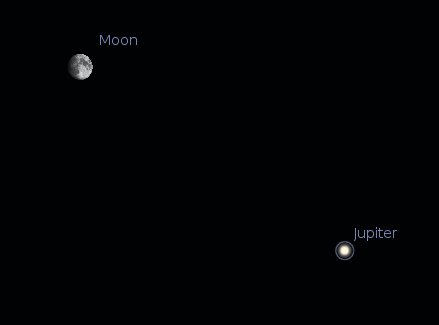
Jupiter and the moon the evening of December 6, 2011. Created using Stellarium
11/14/11 – Ephemeris – The moon tonight
Monday, November 14th. The sun will rise at 7:37. It’ll be up for 9 hours and 38 minutes, setting at 5:15. The moon, half way from full to last quarter, will rise at 8:19 this evening.
The moon will be a waning gibbous phase tonight. The terminator is now the sunset line sweeping slowly across the moon. To the unaided eye or binoculars darkness will be falling across the Sea of Tranquility on the moon’s equator and will start to cross the Sea of Serenity above it. Below Tranquility is of my favorite craters Theophilus with its central peak will again stand out in shadows. It won’t be very close to the terminator tonight, but by tomorrow night it will be in the moon’s night and gone from our sight. The moon’s days and nights last nearly 15 days each. We are lucky to have a large satellite orbiting the earth. We may never know how important the role it had to play in establishing life on the earth.
* Times, as always are for the Traverse City/Interlochen area of Michigan.
Addendum
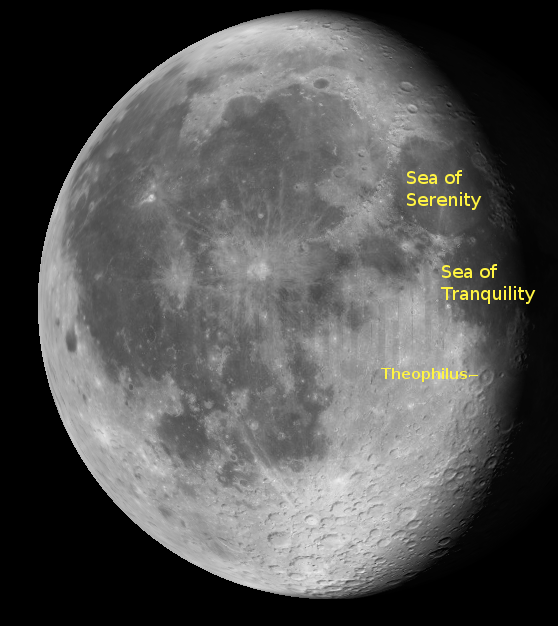
Waning Gibbous Moon 11/14/11 9 p.m. Created with Virtial Moon Atlas.
10/11/11 – Ephemeris – The Hunters Moon and libration
Tuesday, October 11th. The sun will rise at 7:52. It’ll be up for 11 hours and 13 minutes, setting at 7:05. The moon, at full today, will rise at 6:34 this evening.
Tonight’s full moon is the hunter’s moon, and it has some of the characteristics of last month’s Harvest Moon. That is the moon rises less than the average 50 minutes later each night. Tomorrow the moon will rose 26 minutes later than tonight. The moon rotates in the same time that it orbits the earth. Only the moon’s rotation is constant, but its orbit around the earth is elliptical, and is not at a constant speed. That causes the moon to wobble a bit. Tonight the south end of the moon is tilted a bit toward is as is the east or left edge. This tilt is called libration. I usually track libration by checking out the position of the small gray sea at the moon’s upper right quadrant called the Sea of Crises. It’s distance from the moon’s limb or edge is a good indicator of this libration.
* Times are for the Traverse City/Interlochen area of Michigan. They may be different for your location.
10/07/11 – Ephemeris – International Observe the Moon Night
Friday, October 7th. The sun will rise at 7:47. It’ll be up for 11 hours and 25 minutes, setting at 7:12. The moon, half way from first quarter to full, will set at 4:28 tomorrow morning. | Tomorrow night is International Observe the Moon Night the Grand Traverse Astronomical Society will be out, if it’s clear, on the north side of Front Street in Traverse City, near the Martinek Clock. The moon will be bright and a fat gibbous phase. Later on in the evening Jupiter will appear to the east, and will provide even more moons to view. Also that night the Draconid meteor shower will be active, if we happen to pass through a cloud of comet debris from past passages of the Comet Giacobini-Zinner near this part of earth’s orbit. The Draconids have been spectacular at rare occasions in the past. We don’t expect a super shower this time, but it may be more active than it usually is. The bright moon will only allow the brightest to be seen.
* Times are for the Traverse City/Interlochen area of Michigan. They may be different for your location.
09/08/11 – Ephemeris – The moon tonight
Thursday, September 8th. The sun will rise at 7:12. It’ll be up for 12 hours and 53 minutes, setting at 8:06. The moon, half way from first quarter to full, will set at 4:28 tomorrow morning.
The moon tonight is very bright, so looking at it with a telescope can be almost painful. There are moon filters sold at telescope stores for standard sized eyepieces that will alleviate that problem. Remember it’s daytime on the moon and the sunlight is as strong on the moon as it is on the earth. Concentrate the telescope on the left edge of the moon, the sunrise line where the shadows are. The bright crater Aristarchus is just coming into sunlight now on the upper left. It’s the brightest spot on the moon when the moon is full. The Crater Gassendi to the lower left is a ringed plain with low walls and a flat floor that has a rille or crack in it. Another distinctive crater is Schiller lower to the south and distinctively elongated.
* Times are for the Traverse City/Interlochen area of Michigan. They may be different for your location.
Addendum
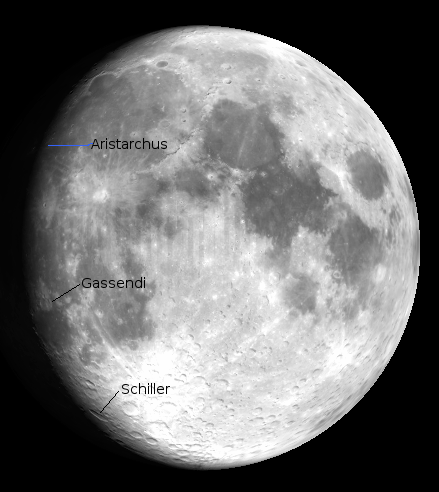
The moon with craters Aristarchus, Gassendi and Schiller. Image from Virtual Moon Atlas.
Closeup of the crater Gassendi
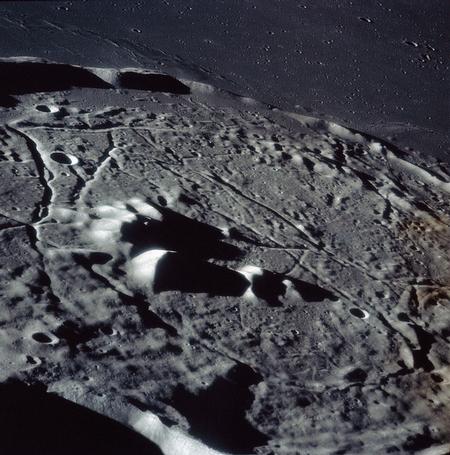
The crater Gassendi from Apollo 16 - NASA
08/09/11 – Ephemeris – The moon tonight – musings
Tuesday, August 9th. The sun rises at 6:37. It’ll be up for 14 hours and 19 minutes, setting at 8:57. The moon, 3 days past first quarter, will set at 3:19 tomorrow morning.
The moon tonight is in its gibbous phase, as it has been since first quarter last weekend. This Saturday it will be full. So now most of the moon’s face is in sunlight. Besides the dark, lava filled dry seas of the moon, which give us the dark spots that some of us imagine as the face of the man in the moon, we can spot many craters and other formations in a telescope. Even as the moon has been accumulating spacecraft, rocket parts, rovers and Hasselblad cameras for the last 50 years none can be seen from the earth. The Lunar Reconnaissance Orbiter is taking photographs of the moon in unprecedented detail. They’ve already located the Apollo landing sites, and discovered a lost Soviet lunar rover. Who knows what else they’ll find.
* Times are for the Traverse City/Interlochen area of Michigan. They may be different for your location.
 Bob Moler's Ephemeris Blog