Archive
Ephemeris: 09/19/25 – A different take on Cygnus the swan
This is Ephemeris for Friday, September 19th. Today the Sun will be up for 12 hours and 18 minutes, setting at 7:45, and it will rise tomorrow at 7:27. The Moon, 2 days before new, will rise at 6:06 tomorrow morning.
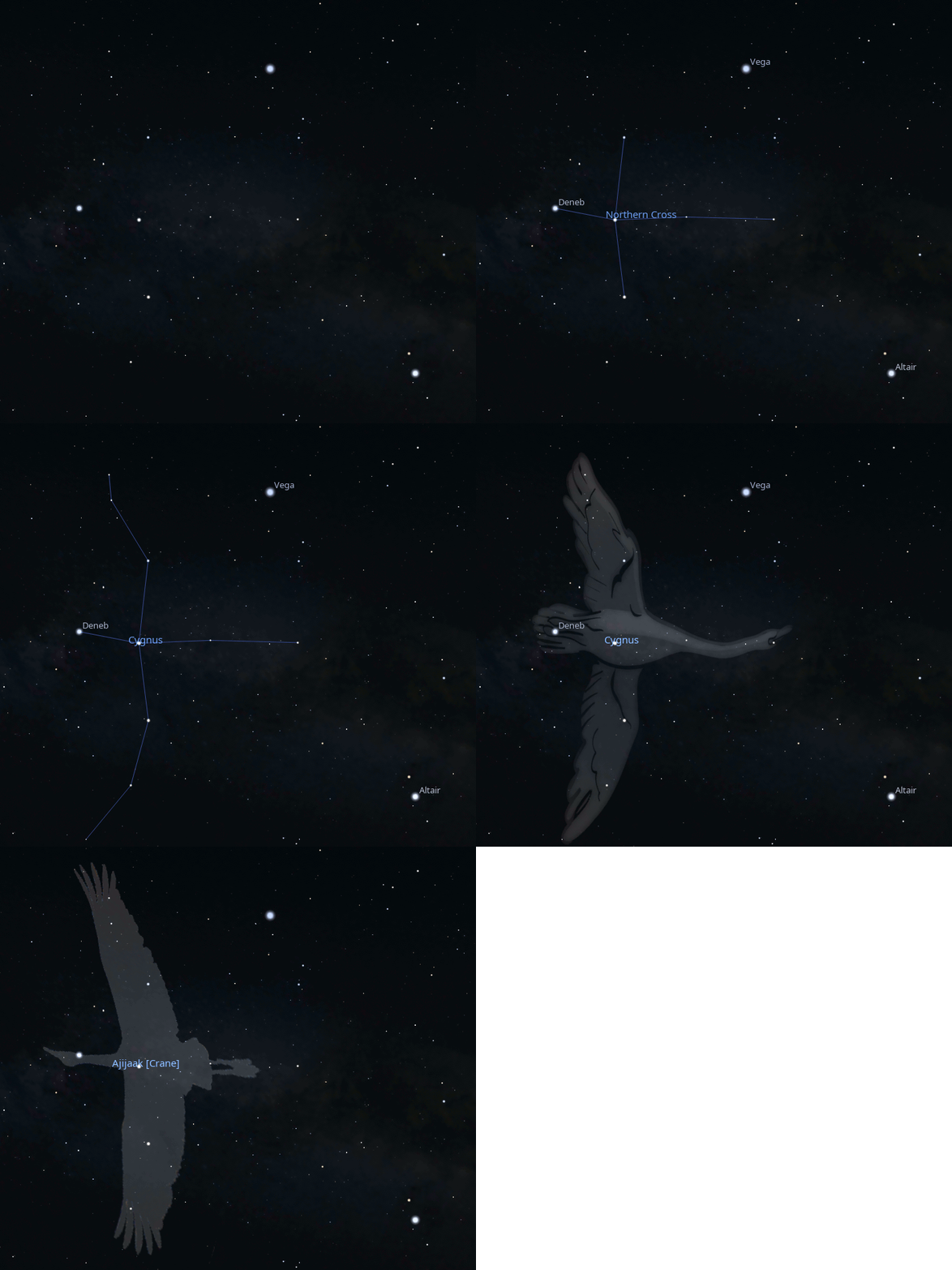
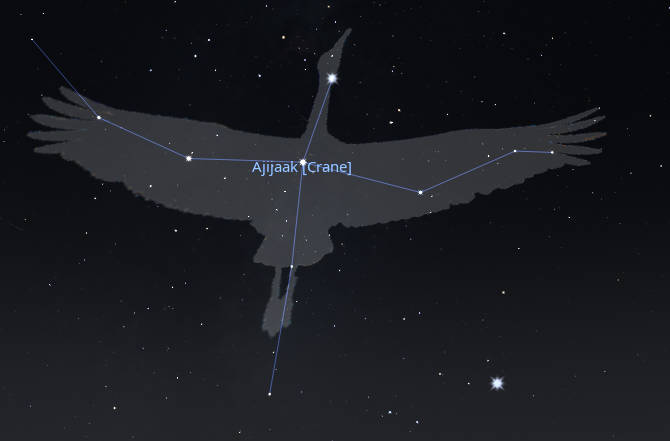
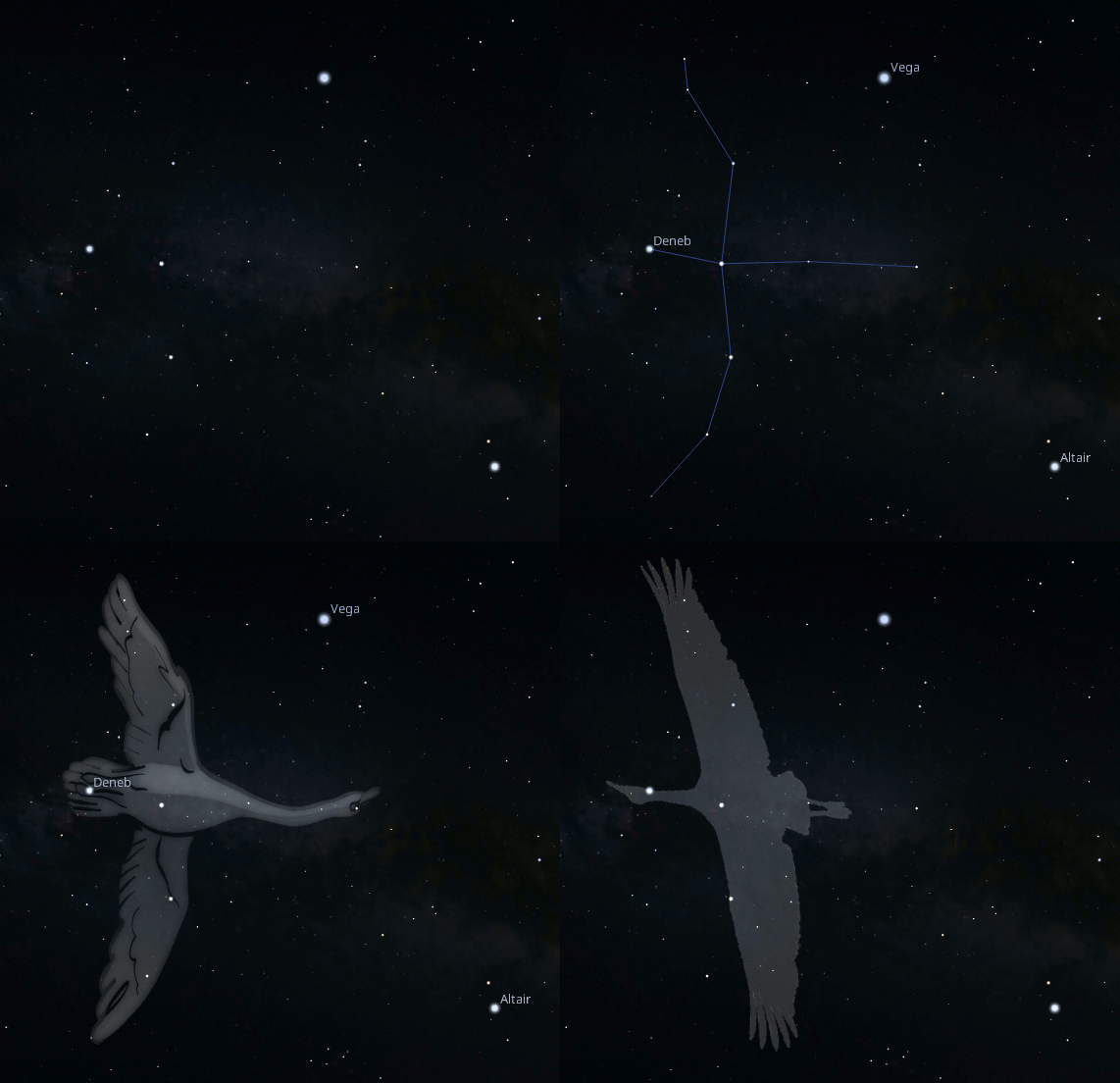
Yesterday I looked the star in the beak of the constellation of Cygnus the swan and the informal constellation or asterism made from most of its stars the Northern Cross. Cygnus is the official International Astronomical Union constellation name. However, the indigenous Anishinaabe people of our area had another bird in mind when seeing these stars, which are now fairly high in the east in the evening: Ajijaak, (pronounced a-ji-jock) a Sand Hill crane. While the swan is flying, neck outstretched to the south through the Milky Way, the crane is flying northward with its long legs trailing behind. The bright star Deneb is at his head. Where I live I see more cranes than swans these days and hear their creaking-door-like calls, and see a pair from time to time in a field south of where I live.
The astronomical event times given in this blog are for the Traverse City/Interlochen area of Michigan (Lat 44.7° N, Long 85.7° W; EDT, UT – 4 hours) unless stated otherwise. Times will be different for other locations.
Addendum
Ephemeris: 07/15/2025 – Finding Cygnus the swan
This is Ephemeris for Tuesday, July 15th. Today the Sun will be up for 15 hours and 13 minutes, setting at 9:25, and it will rise tomorrow at 6:12. The Moon, 2 days before last quarter, will rise at 12:01 tomorrow morning.
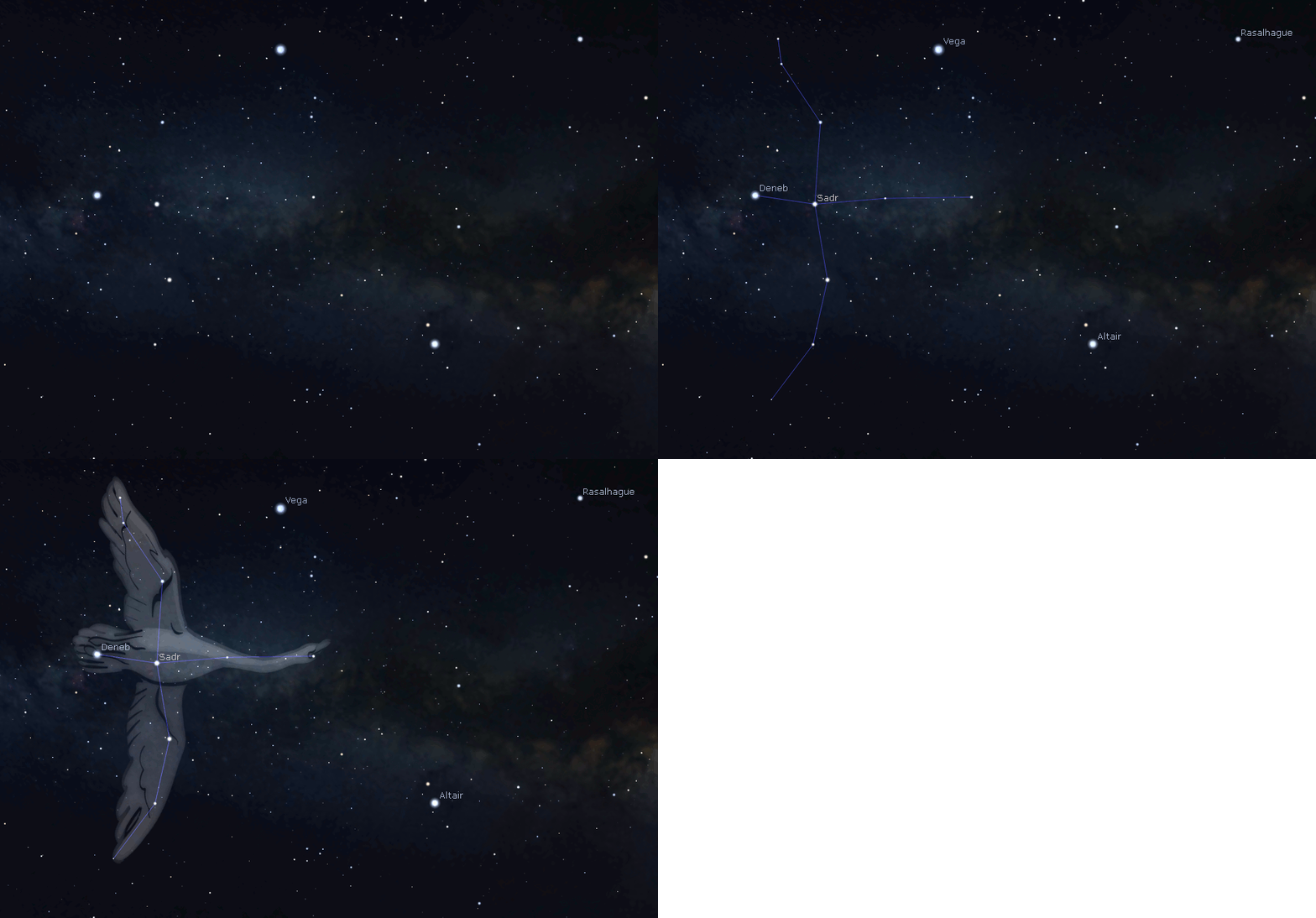
Located fairly high in the east at 11 p.m. is the constellation of Cygnus the swan, flying south through the Milky Way. It is also called the Northern Cross, an asterism or informal constellation. At the left, the tail of the swan or the head of the cross is the bright star Deneb, one of the stars of the Summer Triangle. The next star right is Sadr the intersection of the body and the wings of the swan seen in flight, or the intersection of the two pieces of the cross. There are two or three stars farther to the right that delineate the swan’s long neck or upright of the cross, that ends with the star Alberio in the beak of the swan or foot of the cross. The crosspiece of the cross extends to the stars on either side of the intersection star Sadr, while the swan’s wings extend to a couple more stars each.
The astronomical event times given in this blog are for the Traverse City/Interlochen area of Michigan (Lat 44.7° N, Long 85.7° W; EDT, UT – 4 hours) unless stated otherwise. Times will be different for other locations.
Addendum
Ephemeris: 11/04/2024 – The Milky Way in Autumn
This is Ephemeris for Monday, November 4th. Today the Sun will be up for 10 hours and 1 minute, setting at 5:26, and it will rise tomorrow at 7:26. The Moon, 4 days past new, will set at 6:58 this evening.
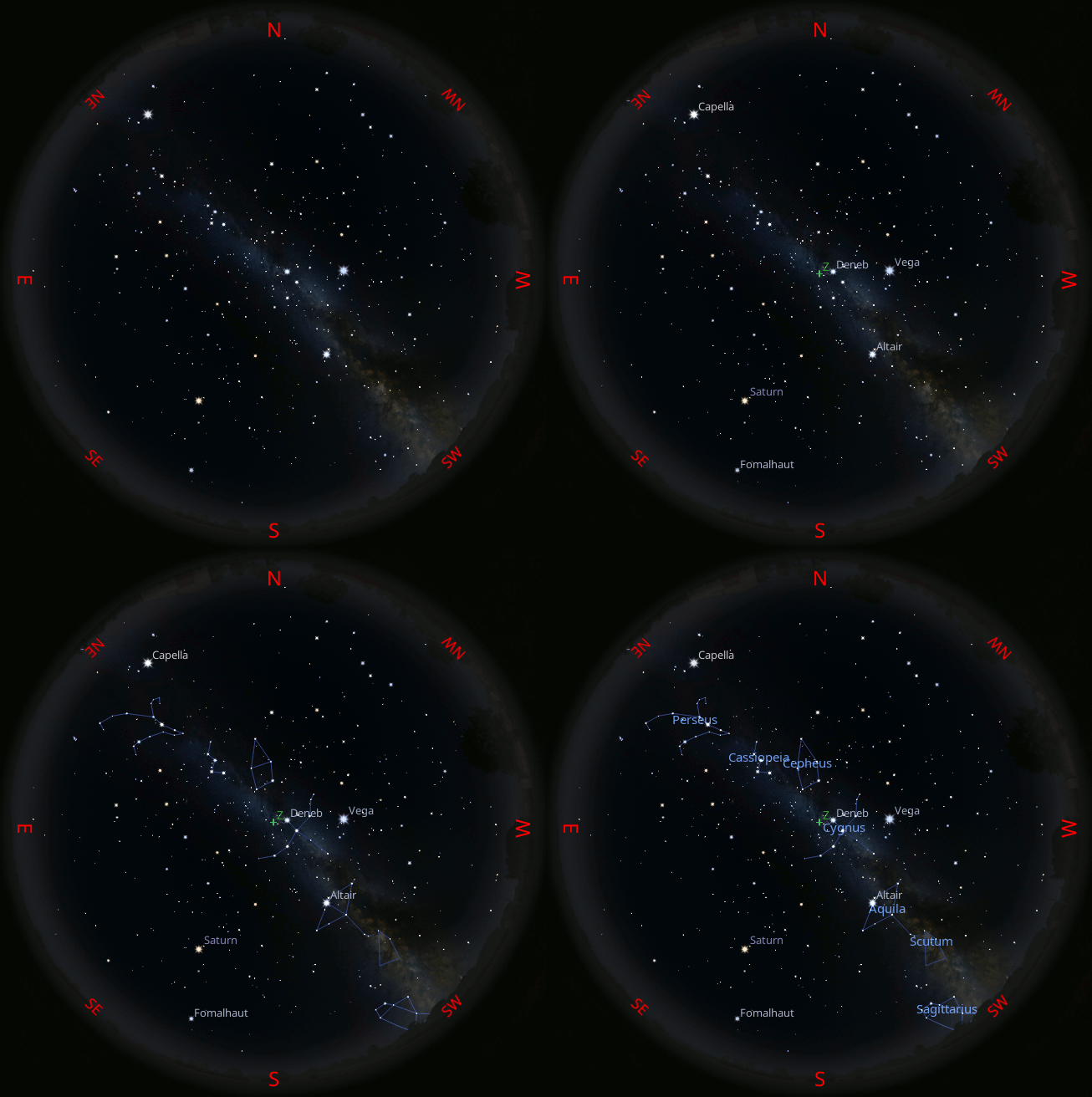
As of yesterday the sunsets and sunrises have slipped back an hour so we have darker evenings and brighter mornings, as we came back to Standard Time. It seems odd that we spend less time of the year under Standard Time than we do under Daylight Time. Anyway, looking at the evening sky we see that Venus tonight will be above the four-day-old crescent Moon in the southwest after sunset. By 7 PM the northernmost star of the Summer Triangle, Deneb in Cygnus the swan or the Northern Cross, will be almost directly overhead. And the Milky Way at that time will run from northeast, overhead to the southwestern horizon. Remember tomorrow is Election Day. Make sure you cast your ballot before the end of voting tomorrow, if you haven’t already.
The astronomical event times given are for the Traverse City/Interlochen area of Michigan (EST, UT – 5 hours). Times will be different for other locations.
Addendum
Ephemeris: 08/02/2024 – The Northern Cross
This is Ephemeris for Friday, August 2nd. Today the Sun will be up for 14 hours and 35 minutes, setting at 9:06, and it will rise tomorrow at 6:31. The Moon, 2 days before new, will rise at 5:12 tomorrow morning.
The star Deneb is high in the east-northeast. It is the dimmest of the three stars of the Summer Triangle. It is at the head of the Northern Cross, an informal constellation or asterism. The upright extends to the South. The crossbeam can be seen crossing the star just south of Deneb. There’s also a constellation there. It’s actually Cygnus the swan flying southward along the Milky Way with its neck outstretched. The Anishinaabe natives peoples of our area see Ajijaak the crane, also with a long neck flying north, but also long legs trailing to the south, its wings outstretched. In Greek mythology Cygnus was the guise of the god Zeus when he seduced Leda, whose offspring was Pollux, one of the Gemini twins.
The astronomical event times given are for the Traverse City/Interlochen area of Michigan (EDT, UT–4 hours). They may be different for your location.
Addendum
Ephemeris: 11/24/2023 – Thoughts on Native American Heritage Day
This is Ephemeris for Native American Heritage Day, Friday, November 24th. Today the Sun will be up for 9 hours and 16 minutes, setting at 5:07, and it will rise tomorrow at 7:52. The Moon, 3 days before full, will set at 5:51 tomorrow morning.
My Heritage is from Northern and Eastern Europe, not one particular country. I have no desire to go or to learn too much more about The Old Countries. And growing up, I grew up in a white neighborhood went to white schools because people of other ethnicities didn’t live in our part of town so we had no mixing of cultures. So I grew up as an American with American cultural values, whatever that is. It was rather late in life, actually doing this program, that I got very interested in the culture of the Native Americans in our area the Anishinaabe, whose groups around here are the Chippewa, or Ojibwe and the Odawa, or Ottawa and learned of their stories and legends, especially those involving sky lore. I find it very interesting and just as rich as the culture we got from the Romans and Greeks. So from time to time on this program I’ll talk about various constellations and stories of our Native American neighbors.
The astronomical event times given are for the Traverse City/Interlochen area of Michigan (EST, UT –5 hours). They may be different for your location.
Addendum
Ephemeris: 09/14/2023 – The stars of Cygnus the swan represent a few different figures
This is Ephemeris for Thursday, September 14th. Today the Sun will be up for 12 hours and 35 minutes, setting at 7:55, and it will rise tomorrow at 7:21. The Moon is new today, and won’t be visible.
Nearly directly overhead in the evening is the bright star Deneb, part of the Summer Triangle of bright stars It’s at the top of the Northern Cross, an informal constellation or asterism. It makes a perfectly proportioned Christian cross. Deneb is also the tail of Cygnus the swan, seen flying southward through the Milky Way with its neck outstretched. Extra stars added to the Northern Cross extend the wings nicely. To the Anishinaabe native peoples of our area the stars here also represent two constellations, both are birds. The first is Ajijaak, the Sand Hill crane, The other is Bineshi Okanin, the Skeleton Bird, so named probably because the stars make a stick figure of a bird rather than an outline of one.
The astronomical event times given are for the Traverse City/Interlochen area of Michigan (EDT, UT –4 hours). They may be different for your location.
Addendum
01/09/2023 – Ephemeris – The Summer Triangle is still with us in the early evening
This is Ephemeris for Monday, January 9th. Today the Sun will be up for 9 hours and 1 minute, setting at 5:21, and it will rise tomorrow at 8:18. The Moon, 3 days past full, will rise at 7:56 this evening.
The bright Moon is now slowly leaving the evening sky tonight, giving us nearly an hour of dark skies after 7 pm. At 7pm, Orion is holding forth in the east-southeast. At that time, also, the Summer Triangle is still in the sky, west and northwest. The Northern Cross, which is also the constellation of Cygnus the swan, is standing upright in the west northwestern sky. Its top star Deneb, dimmest of the three Summer Triangle stars, will not set for observers north of Traverse City, though it will take a flat northern horizon and exceptionally clear skies to spot it at its lowest in the north. Altair, the southernmost of the triangle stars will set first in the west at 7:57 pm, Vega, the brightest will set in the northwest at 9:41 pm.
The astronomical event times given are for the Traverse City/Interlochen area of Michigan (EST, UT –5 hours). They may be different for your location.
Addendum
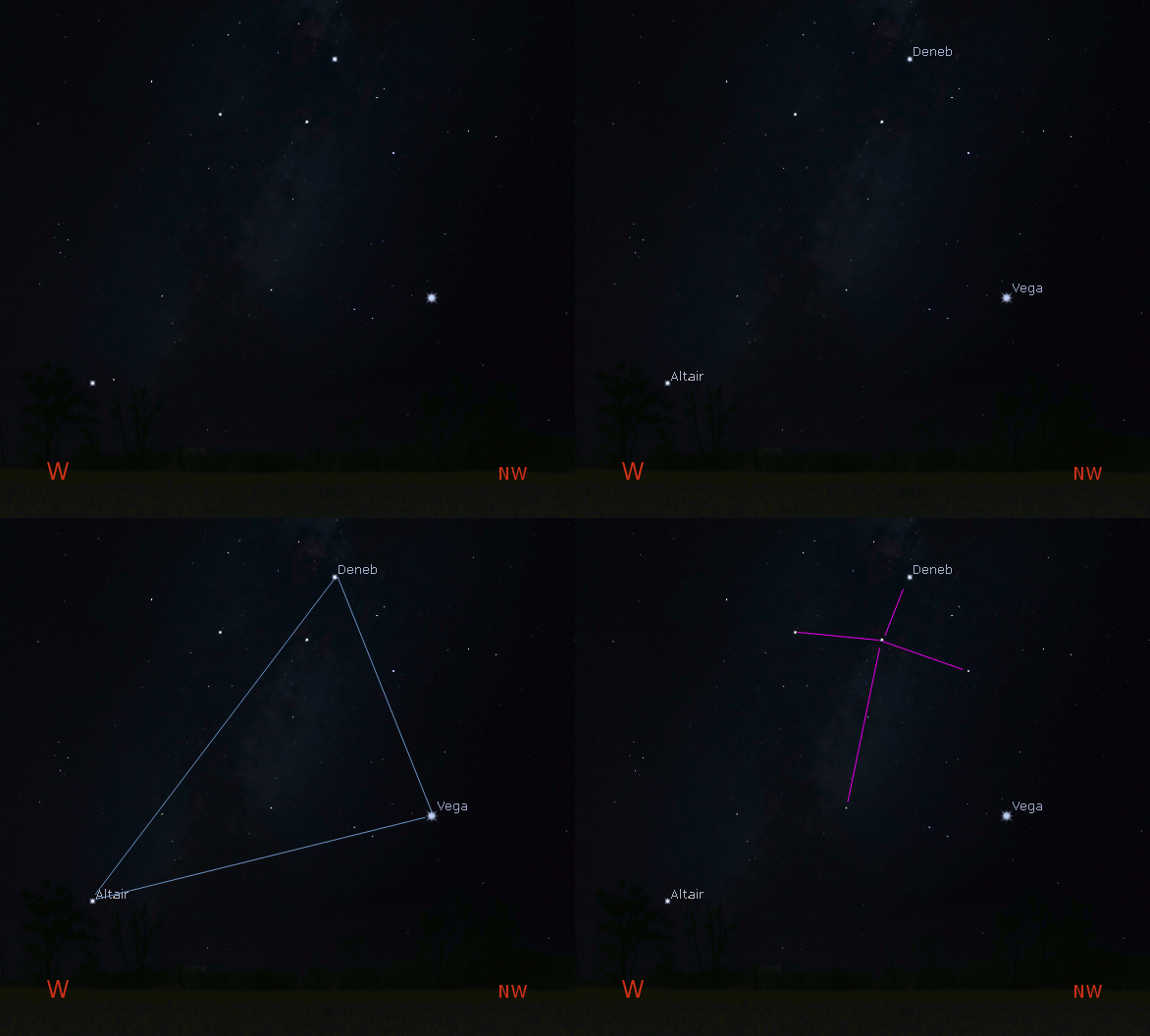
The setting Summer Triangle and Northern Cross in the west and northwestern sky at 7 pm tonight, January 9th.
07/29/2022 – Ephemeris – The celestial Sand Hill Crane
This is Ephemeris for Friday, July 29th. Today the Sun will be up for 14 hours and 46 minutes, setting at 9:12, and it will rise tomorrow at 6:26. The Moon, 1 day past new, will set at 10:14 this evening.
Let’s look again at the constellation called Cygnus the swan and the informal constellation or asterism made from most of its stars, the Northern Cross. Cygnus is the official International Astronomical Union constellation name. However, the indigenous Anishinaabe people of our area had another bird in mind when seeing these stars, which are now fairly high in the east in the evening: Ajijaak, (pronounced a-ji-jock) a Sand Hill crane. While the swan is flying, neck outstretched to the south through the Milky Way, the crane is flying northward with its long legs trailing behind. The bright star Deneb is at his head. Where I live, I see and hear the cranes with their creaking-door-like calls, and see a pair from time to time in a field south of where I live.
The astronomical event times given are for the Traverse City/Interlochen area of Michigan (EDT, UT – 4 hours). They may be different for your location.
Addendum
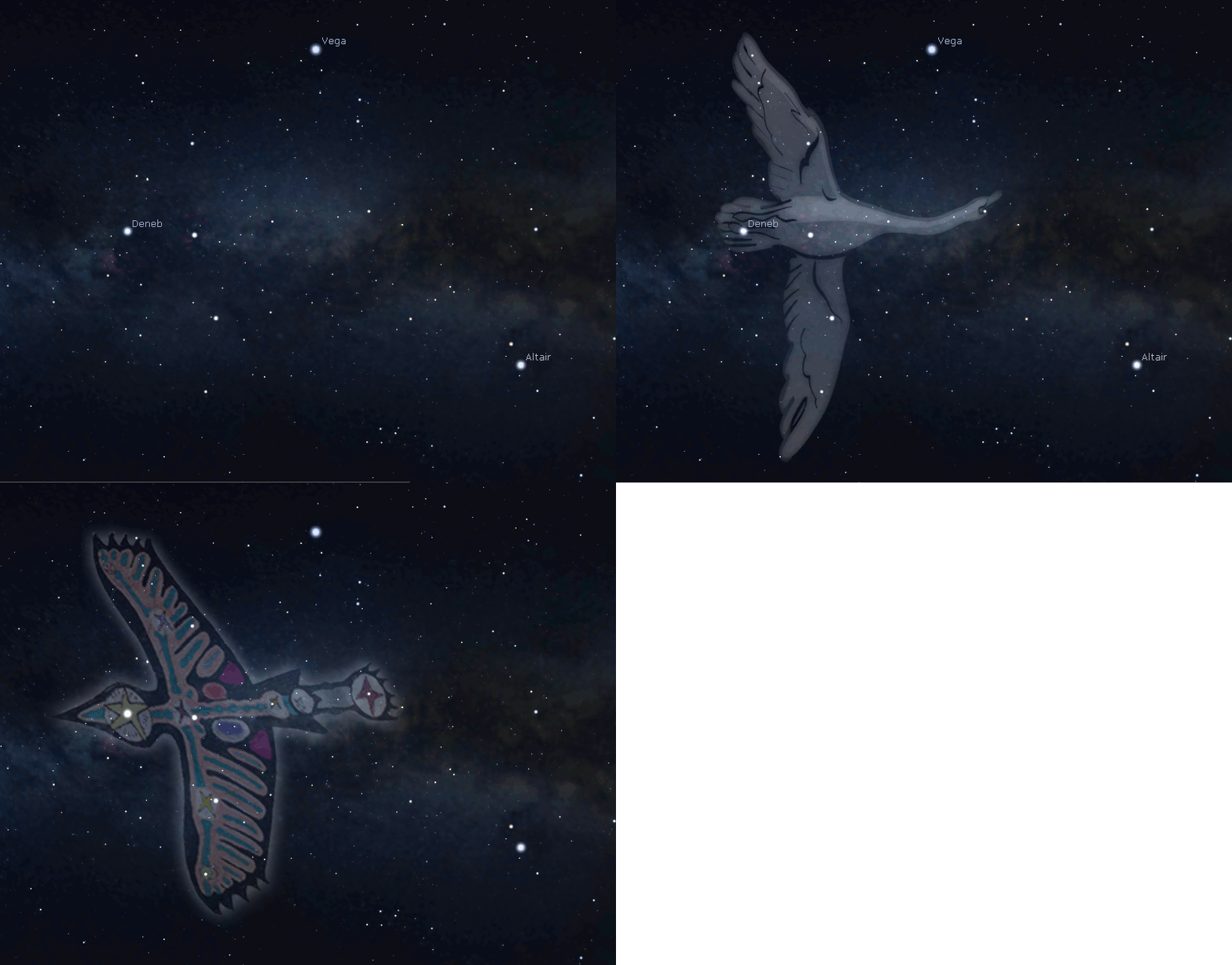
The IAU Cygnus the swan and the Anishinaabe Ajijaak the Sand Hill crane constellations demonstrated via an animated GIF image. Credit Stellarium (both star lore images are embedded in Stellarium). The Anishinaabe image is from Ojibwe Giizhig Anung Masinaaigan – Ojibiwe Sky Star Map created by A. Lee, W. Wilson, and C. Gawboy.
10/05/2021 – Ephemeris – Can you spot the North American Nebula?
This is Bob Moler with Ephemeris for Tuesday, October 5th. Today the Sun will be up for 11 hours and 29 minutes, setting at 7:15, and it will rise tomorrow at 7:47. The Moon, 1 day before new, will rise at 7:46 tomorrow morning.
Most of what we see in the Milky Way are just masses of stars, but there are bright clouds of gas, or to name them properly: emission nebulae. These bright clouds are areas of star formation. It is the ultraviolet light from young massive stars that light up the clouds they were formed from. A bright one, easily visible in binoculars, is just about overhead at 9 p.m. Called the North American Nebula, a glow, that in photographs is shaped much like our continent, is just east of the star Deneb which is practically overhead in the evening. Deneb is the northernmost star of the Summer Triangle, and brightest star in Cygnus the swan or Northern Cross. There are many other nebulae in the Milky Way, visible in binoculars and small telescopes. Many enjoyable hours can be spent sweeping the Milky Way for nebulae and star clusters.
The astronomical event times given are for the Traverse City/Interlochen area of Michigan (EDT, UT-4 hours). They may be different for your location.
Addendum
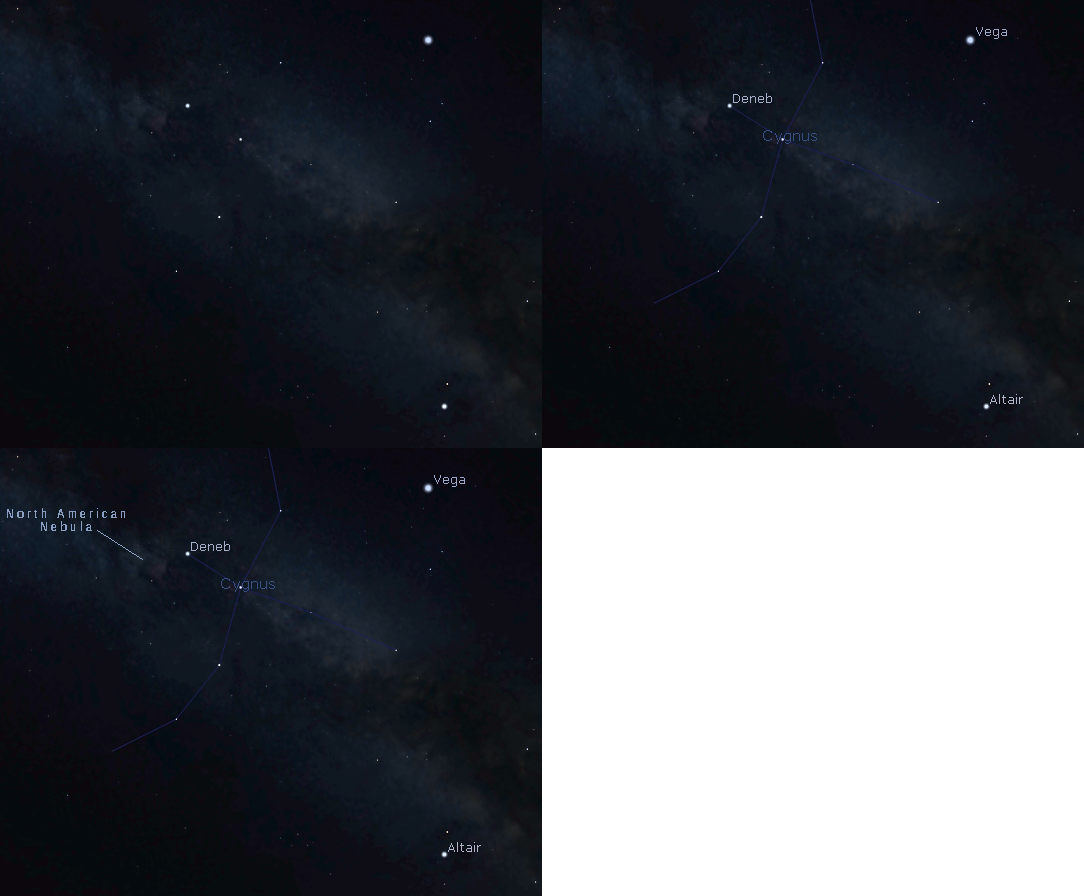
North American Nebula finder animation. I’ve dimmed down the stars a bit and increased the brightness of the Milky Way to aid in spotting the nebula. It requires dark skies to see it. I believe I can make it out with the naked eye too. Click on the image to enlarge it. Created using Stellarium and GIMP.
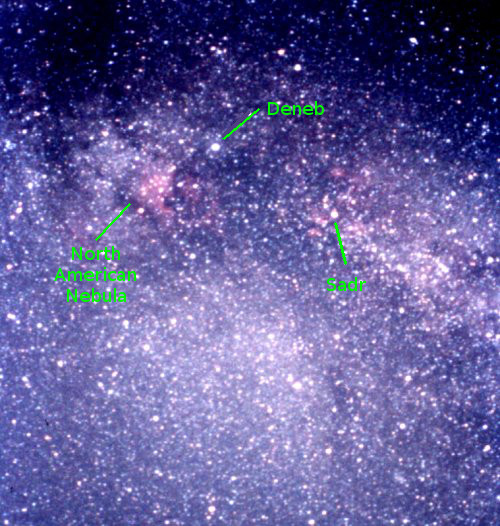
One of my old photographs of Deneb and the North American Nebula, digitized from a slide.
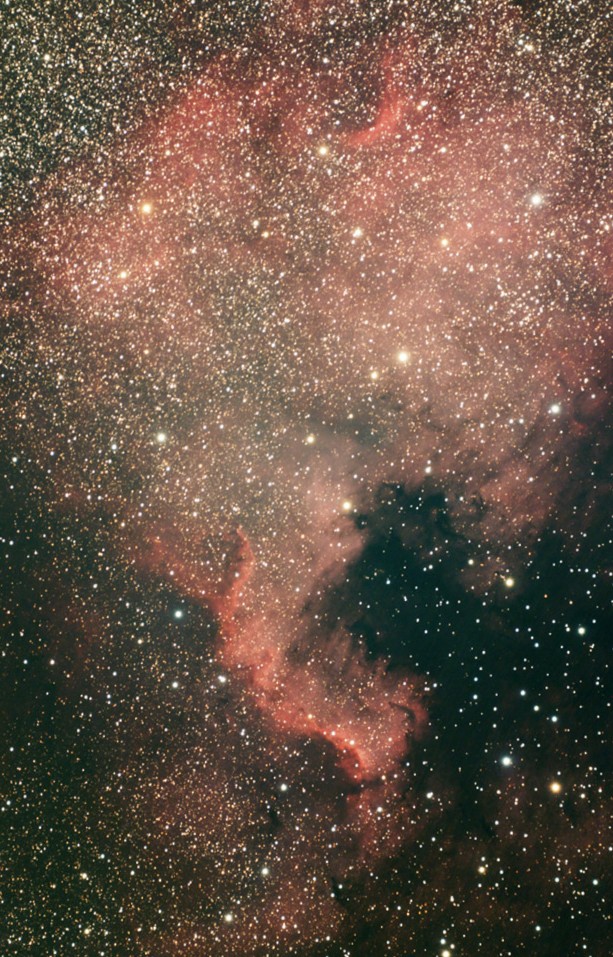
Better view of the North American Nebula taken by Scott Anttila.
07/26/2021 – Ephemeris – Albireo, a colorful double star in Cygnus the swan
This is Ephemeris for Monday, July 26th. Today the Sun will be up for 14 hours and 52 minutes, setting at 9:15, and it will rise tomorrow at 6:23. The Moon, 3 days past full, will rise at 11:15 this evening.
Alberio is the name given to the star that is in the beak of the constellation of Cygnus the swan, which is high in the east these evenings. It is also at the foot of the asterism or informal constellation of the Northern Cross. To the naked eye Alberio looks like a single star, however even in small telescopes* its true nature is revealed. It is a double star whose individual star colors are strikingly different Its brightest star is yellow, and the dimmer star is blue. While star colors are subtle, these two, due to their apparent closeness, make an obvious color contrast. Unlike what your interior decorator says: In stars blue is hot, yellow, orange and red are cool. Also, it turns out that Alberio’s component stars don’t orbit each other. It is what is called an optical double. The blue star is a bit farther away than the yellow one, though they’re both around 430 light years away.
The astronomical event times given are for the Traverse City/Interlochen area of Michigan (EDT, UT – 4 hr). They may be different for your location.
* It will take at least about 20 power magnification to split. Binoculars won’t do it.
Addendum
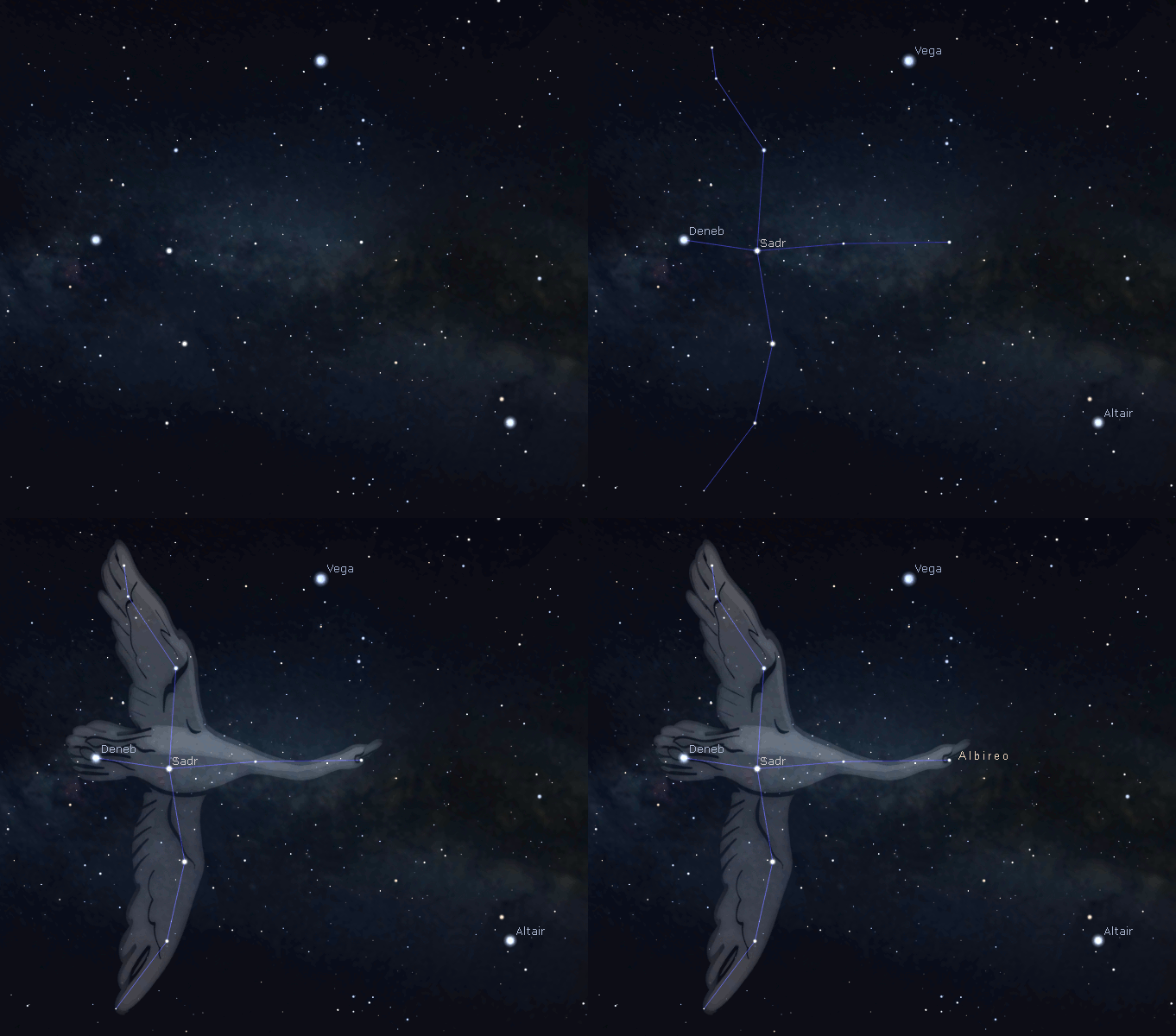
Animated Albireo finder chart. Albireo is located in the head of Cygnus the swan, or at the base of the Northern Cross. Tagged stars are, beside Albireo, the stars of the Summer Triangle: Deneb, Vega and Altair plus the star at the junction of the upright and crosspiece of the cross, Sadr. Created using Stellarium.
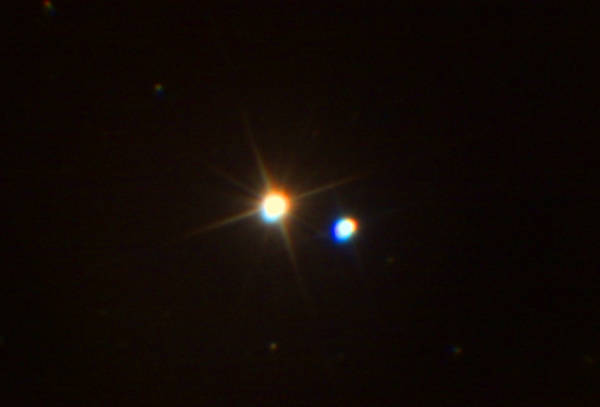
Albireo, captured at high magnification by the staff of the Smithsonian Institution.
 Bob Moler's Ephemeris Blog