Archive
01/07/2019 – Ephemeris – The stars of Orion
Ephemeris for Monday, January 7th. The Sun will rise at 8:19. It’ll be up for 8 hours and 59 minutes, setting at 5:18. The Moon, 2 days past new, will set at 6:57 this evening.
The seven bright stars of Orion now shine in the southeastern sky in the evening. Two shoulder stars, Betelgeuse, and Bellatrix, Two knee stars Saiph, and Rigel, In between are the three belt stars in a row, Alnitak, Alnilam, and Mintaka. Betelgeuse and Rigel are first magnitude stars, among the brightest in the sky, while the others are second magnitude. As far as brightness goes it puts the Big Dipper to shame with its six second magnitude and one third magnitude stars. Of course we in northern Michigan have the Big Dipper always, because it never sets. Orion, only about six months. Due to its position straddling the equator of the sky, Orion is seen by all the people of the world. Parts of him are even seen at the north and south poles.
The times given are for the Traverse City/Interlochen area of Michigan. They may be different for your location.
Addendum
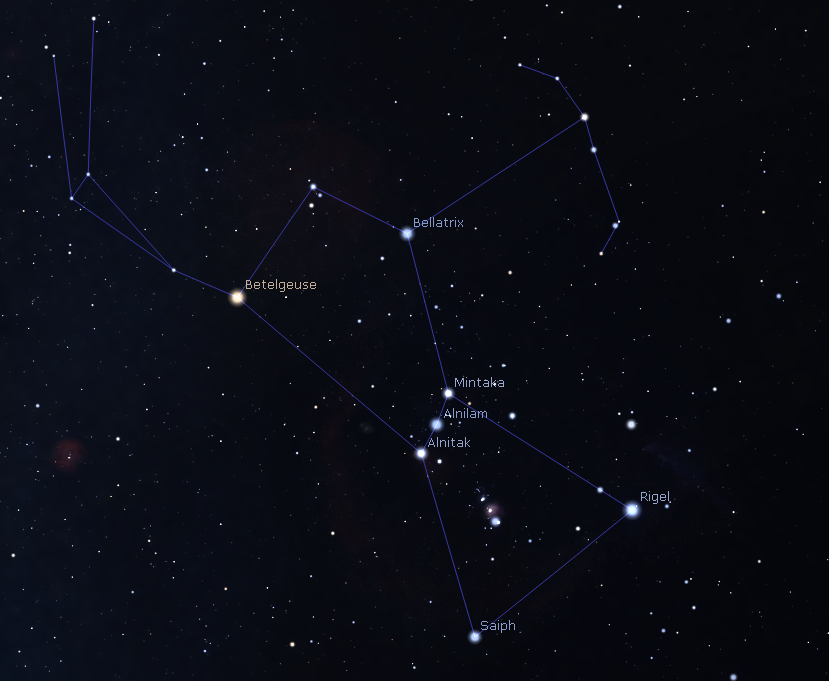
Orion’s brightest stars with their names for 9 p.m. January 7, 2019. Click on the image to make Orion a giant hunter. Created using Stellarium..
11/12/2018 – Ephemeris – Orion is rising
Ephemeris for Veterans Day Observed, Monday, November 12th. The Sun will rise at 7:35. It’ll be up for 9 hours and 41 minutes, setting at 5:17. The Moon, 3 days before first quarter, will set at 9:25 this evening.
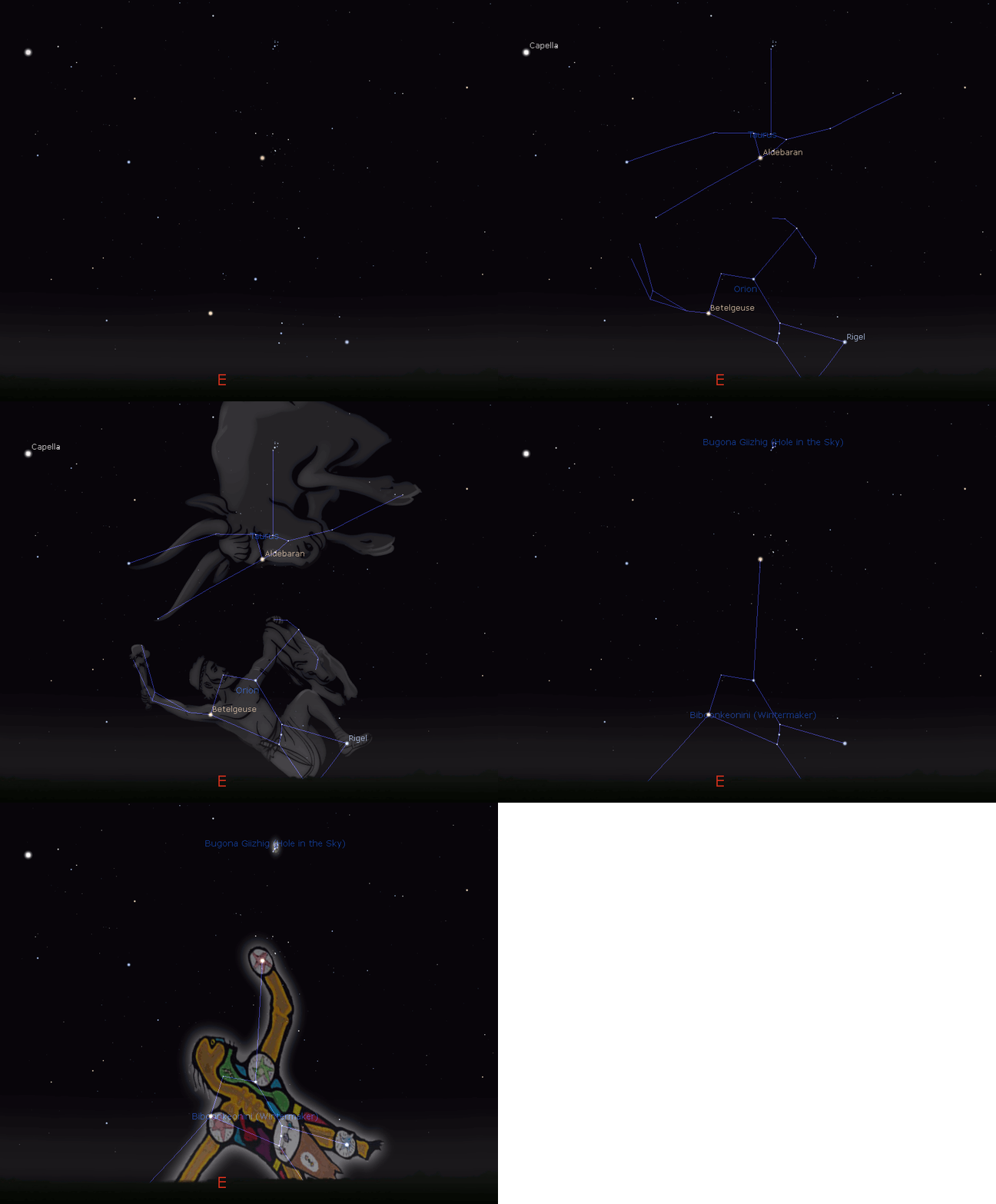
Just after the Moon sets tonight winter’s most dazzling constellation will be rising, Orion the hunter of Greek myth. The stars of his torso are in a rectangle leaning to the left. Orion’s belt of three stars in a straight line in the center of the rectangle is nearly vertical. The Anishinaabe peoples whose region we live in see the constellation of the Wintermaker rather than Orion. It uses Orion’s torso and belt stars, but his arms are spread wide from Aldebaran in the face of Taurus the bull to the west to Procyon in Canis Minor, which won’t rise until 11 p.m. to the east. The Wintermaker’s arms are wide enough to embrace the entire winter sky. Its name in Anishinaabemowin, which is Biboonikeonini, means “North Wind”.
The times given are for the Traverse City/Interlochen area of Michigan. They may be different for your location.
06/14/2018 – Ephemeris – The mighty hero Hercules in the sky
Ephemeris for Flag Day, Thursday, June 14th. Today the Sun will be up for 15 hours and 33 minutes, setting at 9:29, and it will rise tomorrow at 5:56. The Moon, 1 day past new, will set at 10:27 this evening.
Orion, the hard luck Greek hunter gets a splashy constellation in the winter sky, but the greatest hero of all, Hercules, gets a dim group of stars on the border between the spring and summer stars. At 11 p.m. Hercules is high in the southeast. It is located above and right of the bright star, Vega in the east. Hercules’ central feature is a keystone shaped box of stars, called the Keystone, which represents the old boy’s shorts. From each top corner extend lines of stars that are his legs, from the bottom stars, the rest of his torso and arms extend. So in one final indignity he’s upside down in our sky. Some see him crouched down, club upraised holding the Hydra about to throttle it. For those with a telescope it contains the beautiful globular star cluster M13.
The times given are for the Traverse City/Interlochen area of Michigan. They may be different for your location.
Addendum
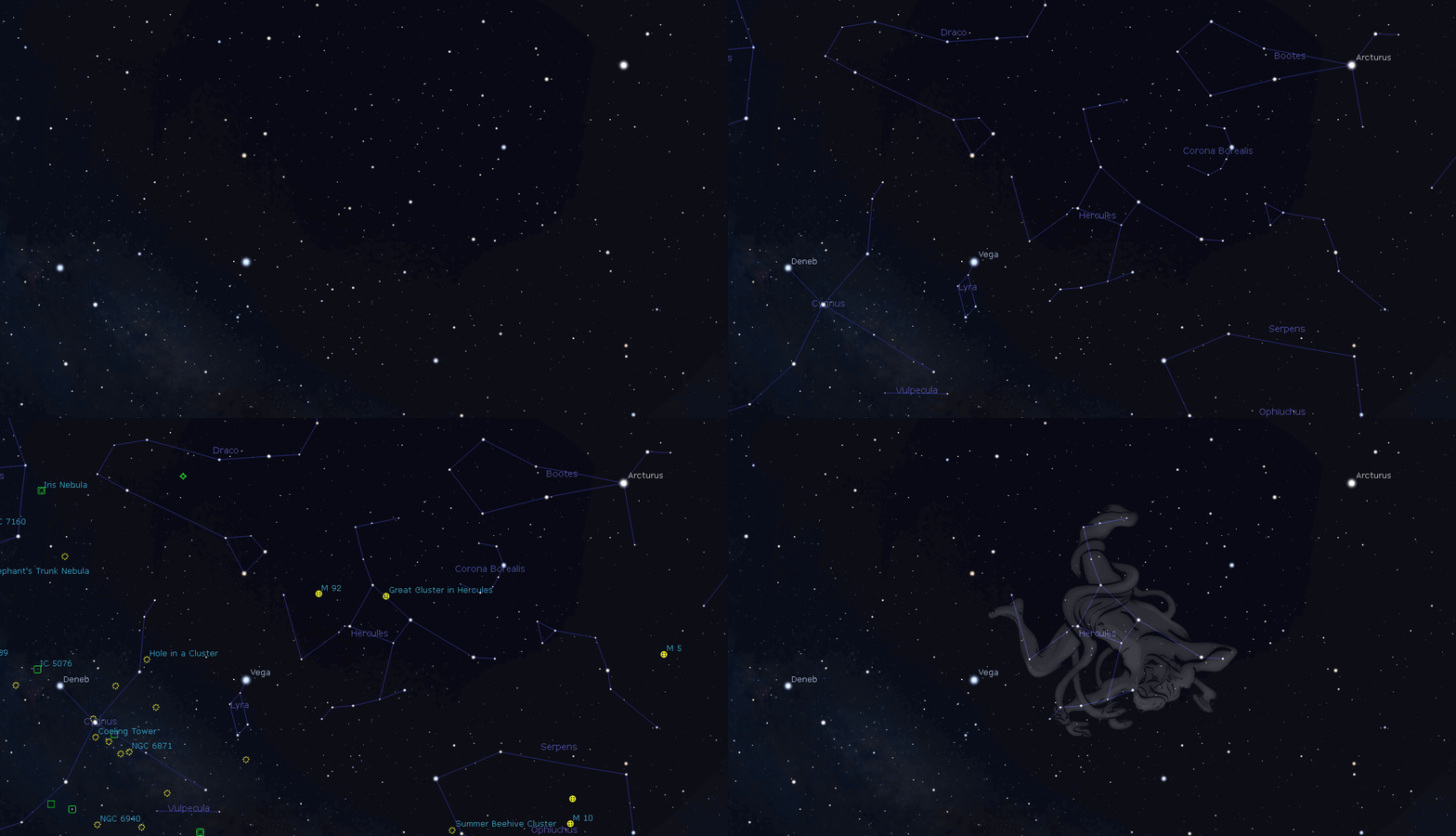
Hercules animation showing neighboring stars, constellation outlines, deep sky objects, and constellation art for Hercules. Created using Stellarium. Click on image to enlarge.
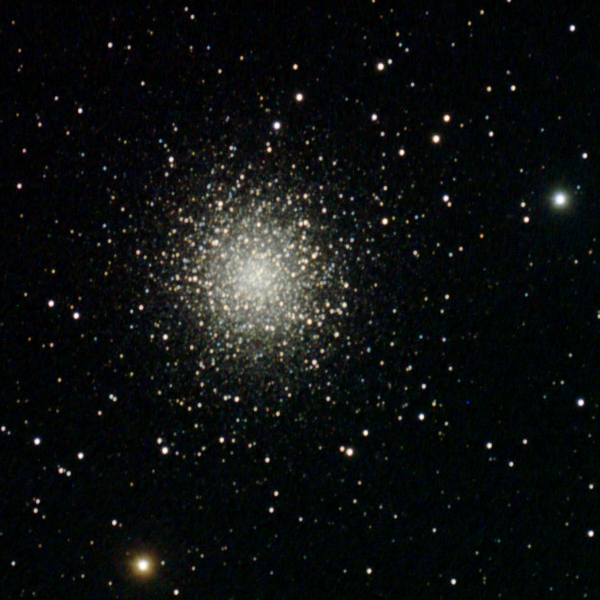
M13, the Great Globular Star Cluster in Hercules. Credit: Scott Anttila
5/15/2018 – Ephemeris – Two thirds thru spring
Ephemeris for Tuesday, May 15th. Today the Sun will be up for 14 hours and 49 minutes, setting at 9:04, and it will rise tomorrow at 6:13. The Moon is new today, and won’t be visible.
Here we are at the middle of May, nearly two-thirds through spring and in the west only a few winter stars remain. Castor and Pollux of Gemini are horizontal in the west, Procyon the Little Dog Star is below and left of them, Capella in Auriga is in the northwest, but for most of the IPR listening area it will never quite set. At 10:30 Betelgeuse in Orion the hunter will be setting, chased from the skies by Scorpius the scorpion, which is rising in the southeast. In one story it is the sting of this scorpion that killed him. Already at that time two-thirds of the stars of the summer Triangle are up. Bright Vega in Lyra the harp, and Deneb in Cygnus the swan. The Big Dipper reigns overhead as spring is in full bloom.
The times given are for the Traverse City/Interlochen area of Michigan. They may be different for your location.
Addendum
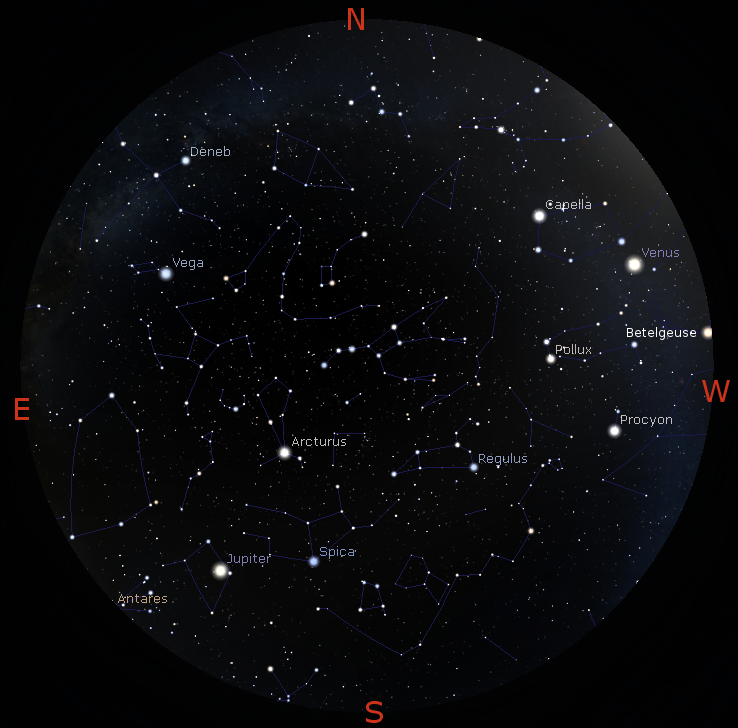
The sky dome for 10:30 p.m. May 15, 2018 showing the stars and constellations. It may not work for any latitude or time, but it works for our location, near 45 degrees north. Created using Stellarium.
04/24/2018 – Ephemeris – Venus will be south of the Pleiades tonight
Ephemeris for Tuesday, April 24th. The Sun rises at 6:43. It’ll be up for 13 hours and 55 minutes, setting at 8:39. The Moon, 2 days past first quarter, will set at 4:51 tomorrow morning.
Tonight the brilliant planet Venus will be just south of the Pleiades, also known as the Seven Sisters star cluster. From our cockeyed position on the Earth about half way from the equator and the North Pole. The sky in the east and west, low in the sky, is tilted about the same angle, namely about 45 degrees. If you’re listening to this program from other than Northern Michigan the angle will be the same as your latitude. So instead of south being down, as one would expect when looking to the south, south is to the lower left when looking to the west. On this program Thursday, Friday and Monday I’ll be talking about Venus and what the ancients found out about the planet in the days before the telescope was invented.
The times given are for the Traverse City/Interlochen area of Michigan. They may be different for your location.
Addendum
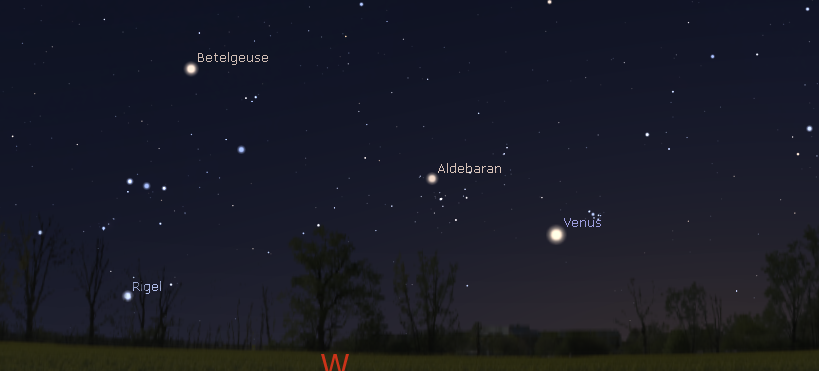
Venus, Pleiades, Aldebaran with the Hyades star cluster and Orion are seen in the west at 9:45 p.m. April 24, 2018. Venus is south of the Pleiades. Created using Stellarium.
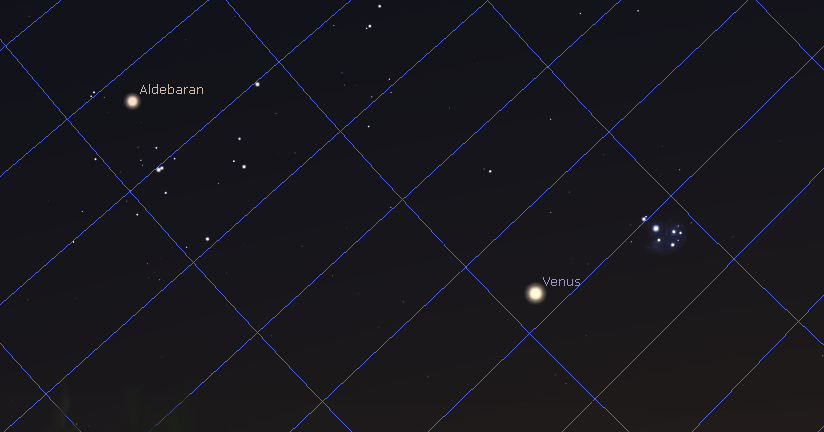
A closer look at Venus and the Pleiades with the coordinate grid added. The lines that run from upper right to lower left are lines of right ascension, analogous to longitude lines on the Earth. To the upper right is north and lower left is south. The other lines are those of declination. Like latitude lines on the Earth, they run east and west. Created using Stellarium.
03/09/2018 – Ephemeris – The good ship Argo
Ephemeris for Friday, March 9th. The Sun will rise at 7:06. It’ll be up for 11 hours and 35 minutes, setting at 6:41. The Moon, at last quarter today, will rise at 2:50 tomorrow morning.
Located south and east of Canis Major, the great hunting dog of Orion and it brilliant star Sirius in the south is a dim constellation of Puppis, the poop deck of the old constellation Argo Navis, the constellation that depicts the ship Jason and the Argonauts used in their search for the Golden Fleece. This huge constellation has been subdivided. Only Puppis and Pyxis the ship’s compass are visible from Michigan. The other parts of the ship are Carina the keel, and Vela the sails require traveling south at least to the southern most of the United States. Three other constellations also related to this expedition are Gemini with Castor, who died on the expedition and Pollux. Hercules was also aboard as was the physician of the constellation Ophiuchus.
The times given are for the Traverse City/Interlochen area of Michigan. They may be different for your location.
Addendum
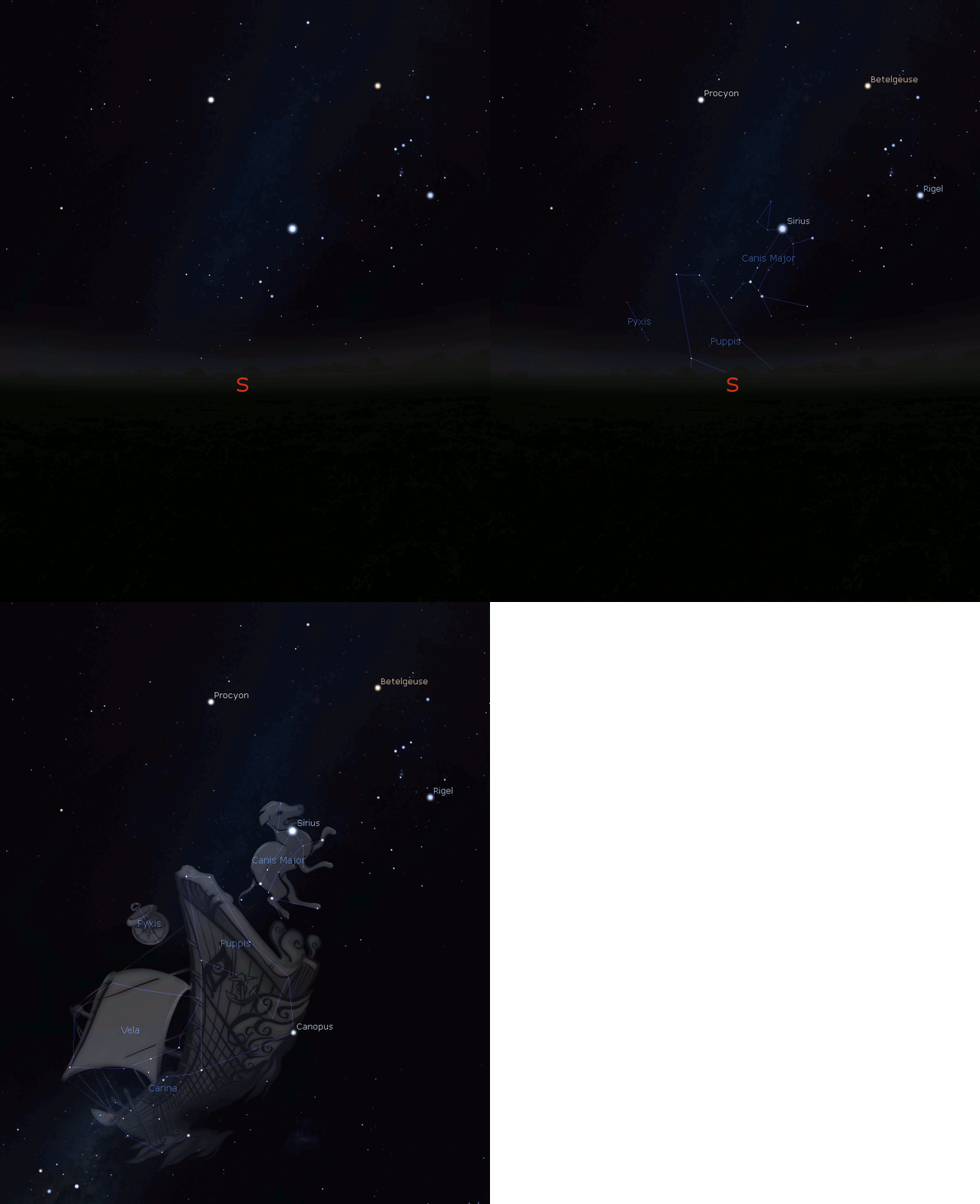
Puppis ans Pyxis; what we can see from Michigan, plus the rest of Argo Navis at 9 p.m., March 9, 2018. The Stellarium artist has the ship reversed. Puppis is the rear end, not the bow. Note that the Crux, the Southern Cross is below the ship. Click on the image to enlarge. Created using Stellarium and GIMP.
03/08/2018 – Ephemeris – Beware the Great Underwater Panther
Ephemeris for Thursday, March 8th. The Sun will rise at 7:07. It’ll be up for 11 hours and 31 minutes, setting at 6:39. The Moon, 1 day before last quarter, will rise at 1:56 tomorrow morning.
The Anishinaabek people of the Great Lakes Region, which includes the Ottawa or Odawa, Chippewa and Ojibwe Indians have two constellations of winter that I know of. The first is The Winter Maker which uses many of Orion’s stars plus Aldebaran and Procyon. It rises in the eastern skies in the evening as winter is beginning. The second, of late winter and early spring is Curly Tail, the Great Underwater Panther. Which uses the stars of Leo the lion’s backward question mark as its tail and the small knot of stars that are the head of Hydra the water snake below Cancer as its head. I imagine this constellation was a warning to youngsters to keep off the thinning ice of spring, lest they fall in and be snatched by the great underwater panther that lives beneath the ice.
The times given are for the Traverse City/Interlochen area of Michigan. They may be different for your location.
Addendum
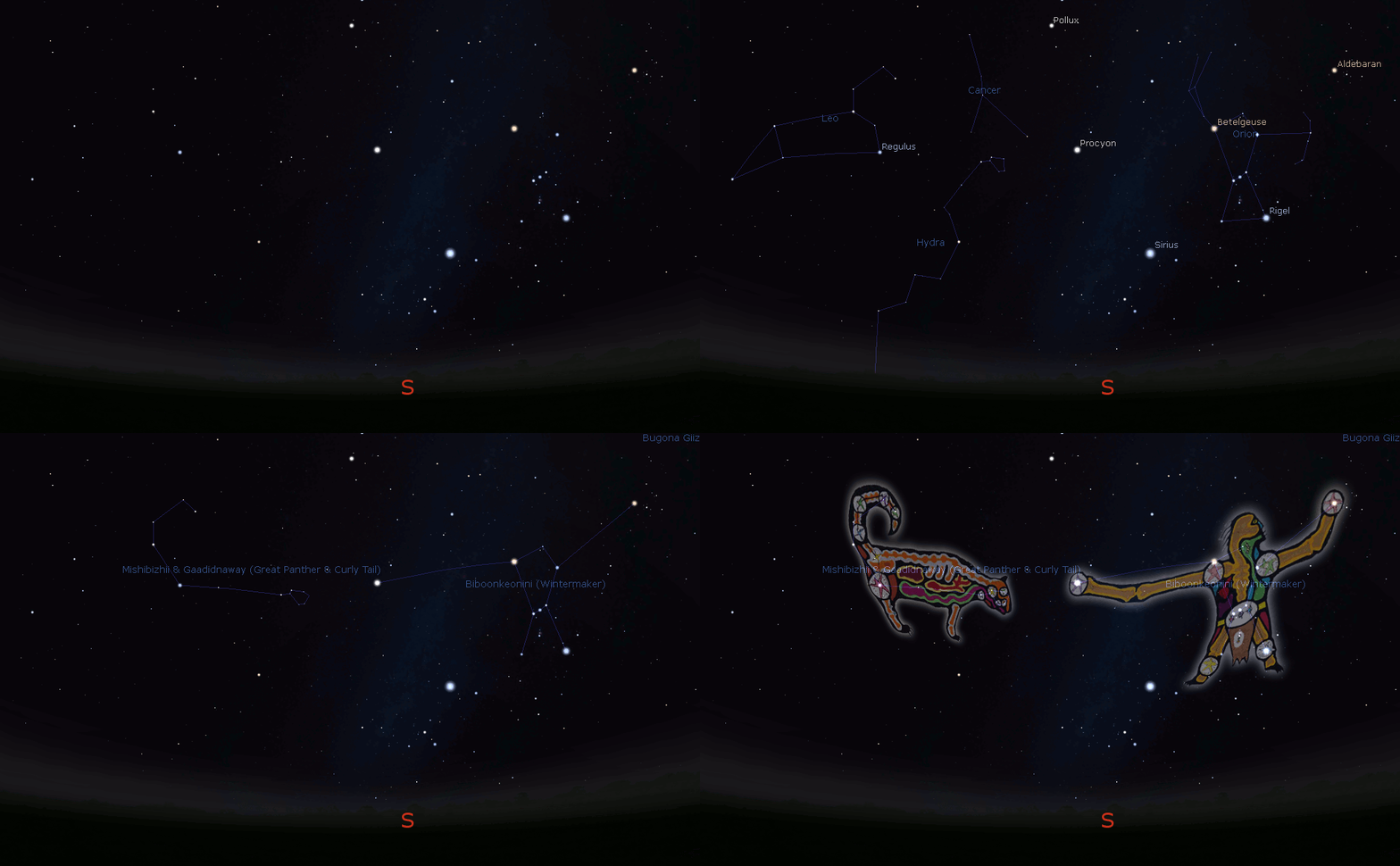
Finder animation for western and Anishinaabek constellations for March 8, 2018 at 9 p.m. Click on image to enlarge. Created using Stellarium and GIMP.
The Anishinaabek constellation drawings are from Ojibwe Sky Star Map Constellation Guide by Annette S. Lee, William Wilson, Jeffrey Tibbets and Carl Gawboy available locally and online. They are part of the latest editions of Stellarium, a free planetarium program. Links to it are on the left. Other information and links are available within the Sky Lore tab.
Here’s one of the links: http://www.nativeskywatchers.com/. It also contains links to Lakota star maps and lore.
02/22/2018 – Ephemeris – The blue-white star at Orion’s knee
Ephemeris for Thursday, February 22nd. The Sun will rise at 7:32. It’ll be up for 10 hours and 49 minutes, setting at 6:21. The Moon, 1 day before first quarter, will set at 1:46 tomorrow morning.
The bright star at the bottom right corner of the big upright rectangle that is the giant hunter Orion’s body in the south-southeast is Rigel. It is a white star with a bluish tinge. It compares in brightness with Betelgeuse at the opposite end of Orion’s rectangle, though it’s usually a bit brighter. The mismatch in color makes brightness comparisons difficult. Rigel is about 860 light years away, It’s 23 times the mass of the Sun, 120 thousand the times brighter than the Sun, and a diameter almost the size of the orbit of Mercury. It’s age is thought to be about 8 million years. It has a visual companion star that can be seen in amateur telescopes. It’s not that dim, but suffers by being close to the arc light brightness of Rigel.
The times given are for the Traverse City/Interlochen area of Michigan. They may be different for your location.
Addendum
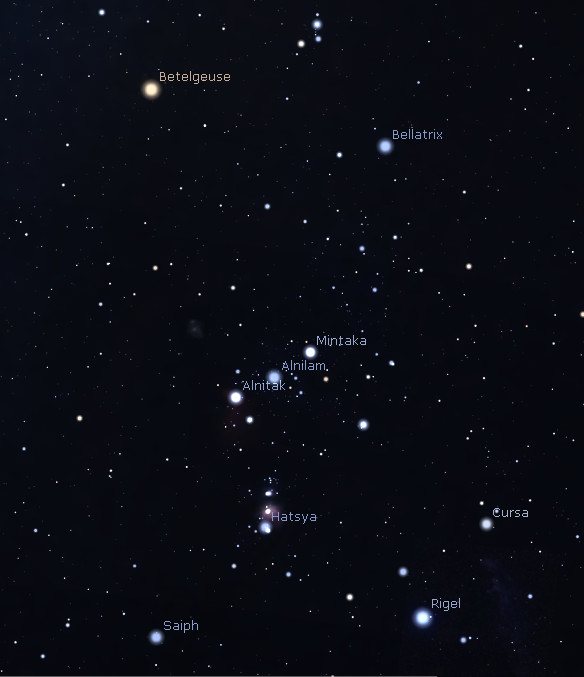
Orion’s named stars including the belt stars. Created using Stellarium.
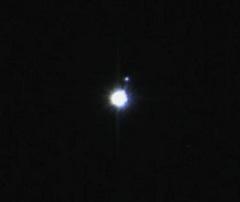
Rigel with its companion star as photographed through a telescope. No attribution. Source: http://washedoutastronomy.com/content/urban-orion?page=1
02/08/2018 – Ephemeris – The wonderfully named stars of Orion
Ephemeris for Thursday, February 8th. The Sun will rise at 7:53. It’ll be up for 10 hours and 8 minutes, setting at 6:01. The Moon, 1 day past last quarter, will rise at 3:09 tomorrow morning.
The constellation of Orion the hunter is visible in the south at 9 p.m. The stars of Orion are interesting in themselves. Starting at the top left of the seven bright stars of Orion’s torso is Betelgeuse the bright red star, whose name means something like “Armpit of the Giant”. The star in Orion’s other shoulder is Bellatrix the “Amazon Star”. Below are the three stars of Orion’s belt, from left to right; Alnitak, Alnilam and Mintaka. Their names mean “Girdle”, “Belt of Pearls”, and “Belt” respectively. Down to Orion’s knees we look on the left to the star Saiph pronounced ‘safe’ which means “Sword”, though it is some ways from the stars of Orion’s sword. Finally there’s the bright blue-white star Rigel whose name means “Left Leg of the Giant”.
The times given are for the Traverse City/Interlochen area of Michigan. They may be different for your location.
Addendum
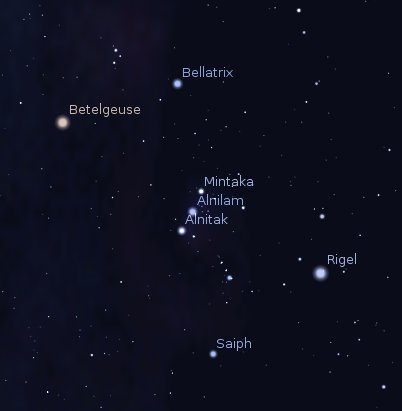
The named stars of Orion. Created using Stellarium.
Betelgeuse, pronounced Beetlejuice is the name of a 1988 movie, where Betelgeuse (spelled properly) is a particularly mischievous demon. Don’t say his name three times, or he’ll come and ‘help’ you. Oops, I did. It is a red giant star near the end of its life.
Bellatrix, is now known to most of us now as the first name as the first name of Bellatrix Lestrange from J. K. Rowling’s Harry Potter book and movie series. Other members of the Black family have astronomical names, such as Regulus (Leo) Black, and Sirius (Canis Major) Black.
The names of the belt stars were taught to me by Evelyn Grebel of the Grand Rapids Public Museum in the late 1950s. She was one of the founders of the Grand Rapids Amateur Astronomical Association. The names Alnitak, Alnilam and Mintaka have stuck with me ever since. It was through her that I was able to worm my way into working at the museum’s new then unnamed planetarium. I also remember being in her office with her, listening to the radio as Alan Shepard made his historic suborbital flight on May 5th, 1961.
Rigel is a hot blue-white star, and will probably become a red giant star like Betelgeuse. There is another bright star named Rigel, but most don’t know it. It’s Rigel Kentaurus, the leg of the centaur of Centaurus. It’s better known as Alpha Centauri, a catalog designation, and the nearest star to the solar system.
02/05/2018 – Ephemeris – The rabbit that got away
Ephemeris for Monday, February 5th. The Sun will rise at 7:57. It’ll be up for 10 hours even, setting at 5:57. The Moon, 2 days before last quarter, will rise at 12:06 tomorrow morning.
Orion, the central winter constellation is seen in the south at 9 p.m. He is a hunter, but he’s preoccupied with the charge of Taurus the bull from the upper right. At Orion’s feet, and unnoticed by him is the small constellation of Lepus the hare. It’s very hard to see a rabbit in its dim stars: however, I do see a rabbit’s head ears and shoulders. A misshapen box is the head and face of this critter facing to the left. His ears extend upwards from the upper right star of the box, and the bend forward a bit. Two stars to the right of the box and a bit farther apart hint at the front part of the body. Some see a whole rabbit facing the other way. In Lepus telescopes can find M79, a distant globular star cluster, one of the few in the winter sky.
The times given are for the Traverse City/Interlochen area of Michigan. They may be different for your location.
Addendum
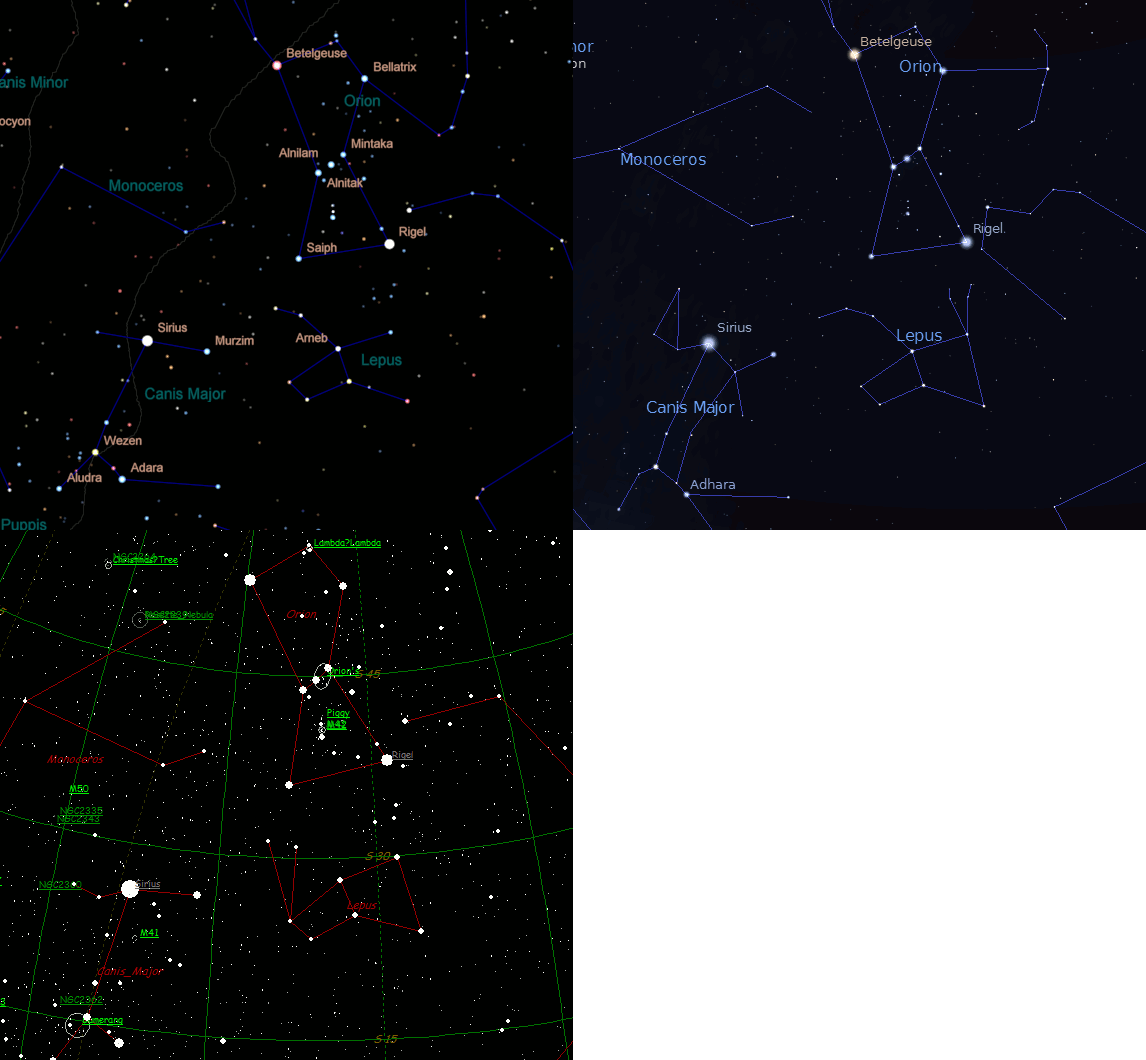
Pick your favorite Lepus outline. Cartes du Ciel, Stellarium, or Hallo Northern SKY (with grid lines).
 Bob Moler's Ephemeris Blog