Archive
03/03/2021 – Ephemeris – Let’s search for the naked-eye planets for this week
This is Bob Moler with Ephemeris for Wednesday, March 3rd. Today the Sun will be up for 11 hours and 17 minutes, setting at 6:33, and it will rise tomorrow at 7:14. The Moon, 2 days before last quarter, will rise at 12:09 tomorrow morning.
Let’s search for the naked-eye planets for this week. Unfortunately the only one you’ll find is Mars. The other four are hanging out in the direction of the Sun and won’t be seen for a week or so. Mars can be found high in the west-southwest and below left of the Pleiades at 8 pm tonight. Mars will be due south of the Pleiades tonight, which from our cockeyed view of the heavens, from north of the equator, places Mars below and left of the Pleiades. The Red Planet will set at 1:20 am. Of the outer planets Mars is the fastest, being the nearest to the Sun, and to the Earth. So unlike Jupiter, Saturn, and the stars which rise and set about four minutes earlier each night, Mars sets about a minute earlier each night now.
The astronomical event times given are for the Traverse City/Interlochen area of Michigan. They may be different for your location.
Addendum
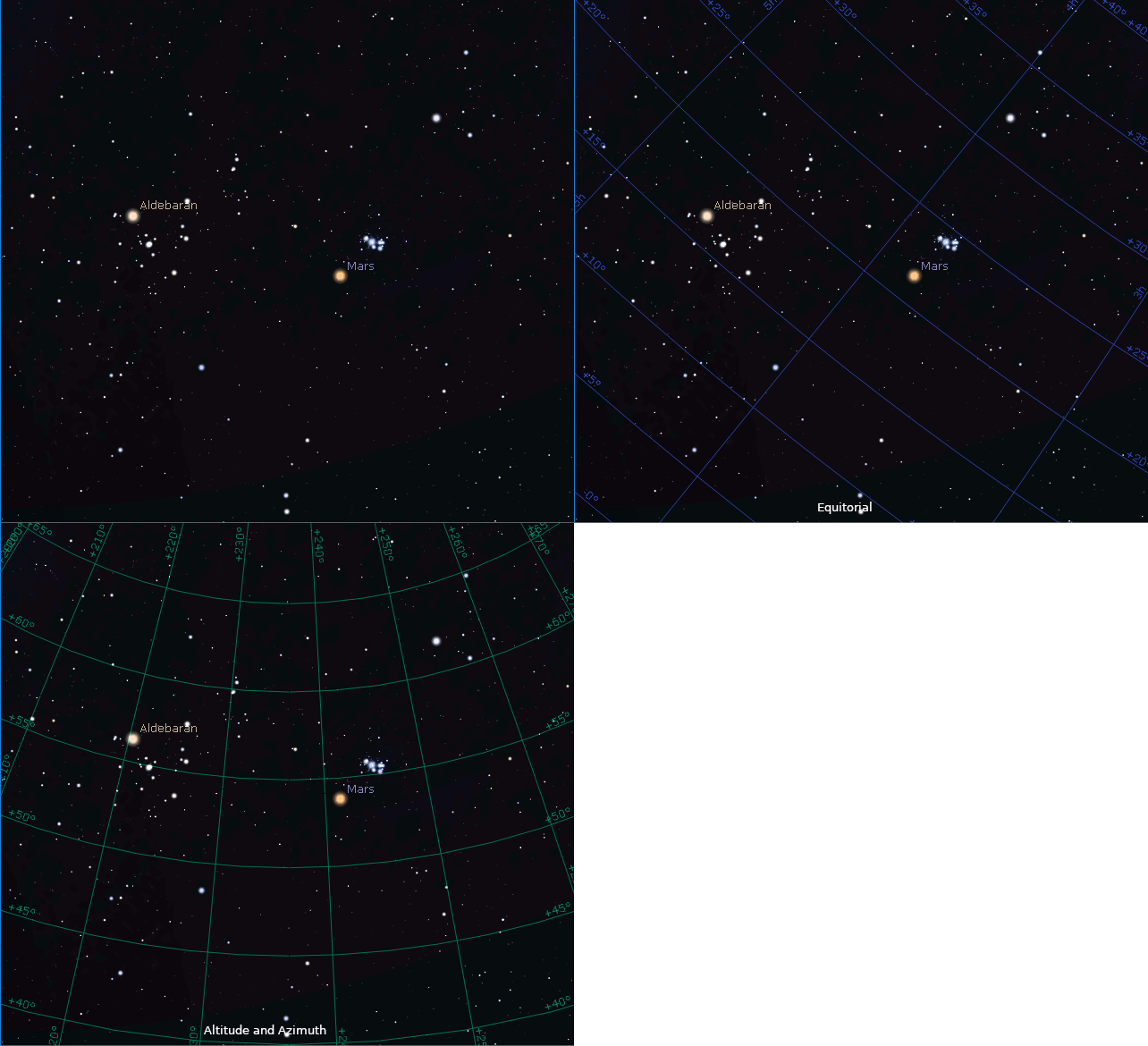
Here’s an animation showing why Mars being south of the Pleiades doesn’t look like it in the sky. This is all about directions on the celestial sphere. This will be the position of Mars at 8 pm on March 3rd, 2021, seen in the west-southwest. It is a three frame animation. The first is without coordinate grids as one would see it from about 45 degrees north latitude. The second frame contains the equatorial grid. The lines to the upper right point to the North Pole of the sky near Polaris, so that’s north. The third frame has an alt-azimuth grid. Its lines run vertically and horizontally. Created using Stellarium and GIMP.
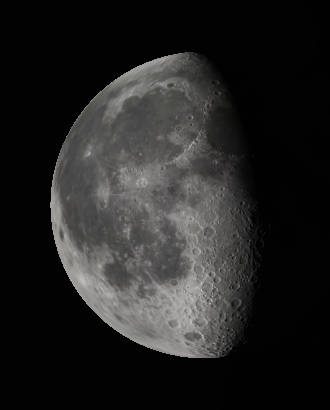
The moon as it might appear in binoculars at 6 am tomorrow morning March 4, 2021. Created using Stellarium.
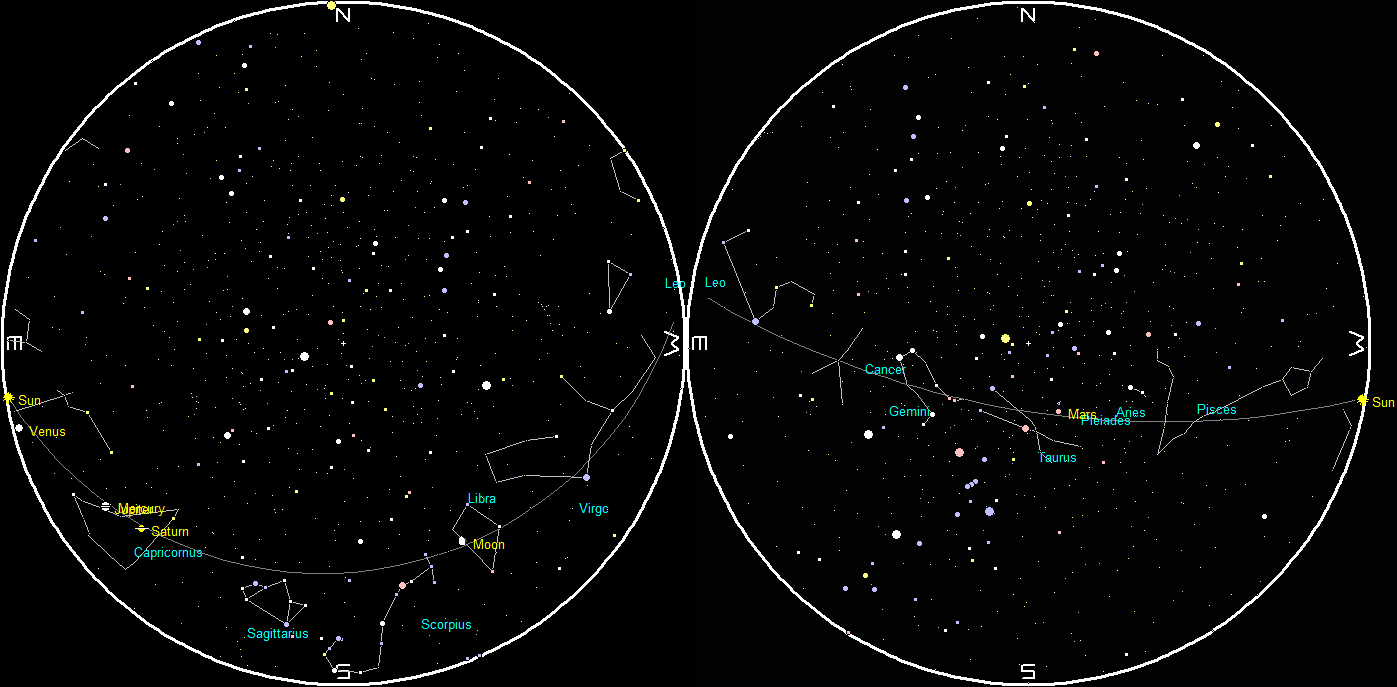
Planets and the Moon at sunset and sunrise of a single night starting with sunset on the right on March 3, 2021. The night ends on the left with sunrise on the 4th. There is a planet traffic jam in the morning and the symbols and labels for Jupiter and Mercury overlap. Unfortunately these planets rise too soon before the Sun to be seen for us up north. It is a great sight for Southern Hemisphere observers. Click on the image to enlarge. Created using my LookingUp program.
12/08/2020 – Ephemeris – Finding Taurus the bull
This is Ephemeris for Tuesday, December 8th. Today the Sun will be up for 8 hours and 54 minutes, setting at 5:02, and it will rise tomorrow at 8:08. The Moon, 1 day past last quarter, will rise at 1:39 tomorrow morning.
Orion is the big splashy constellation in the east southeast by 9 in the evening. Above it is another famous constellation Taurus the bull. Its face is a letter V shape of stars on its side with the open end of the V to the left. The bright star at the lower left end of the sideways V is the ruddy star Aldebaran, the Bull’s angry bloodshot eye. The bull is charging down at Orion. The Pleiades, also known as the seven sisters, is the cluster of stars in his shoulder, above the V. The stars in the face of Taurus, except for Aldebaran belong to a star cluster like the Pleiades, but closer and older, called the Hyades. In Greek mythology the Hyades are half sisters to the Pleiades, all fathered by the god Atlas.
The event times given are for the Traverse City/Interlochen area of Michigan. They may be different for your location.
Addendum
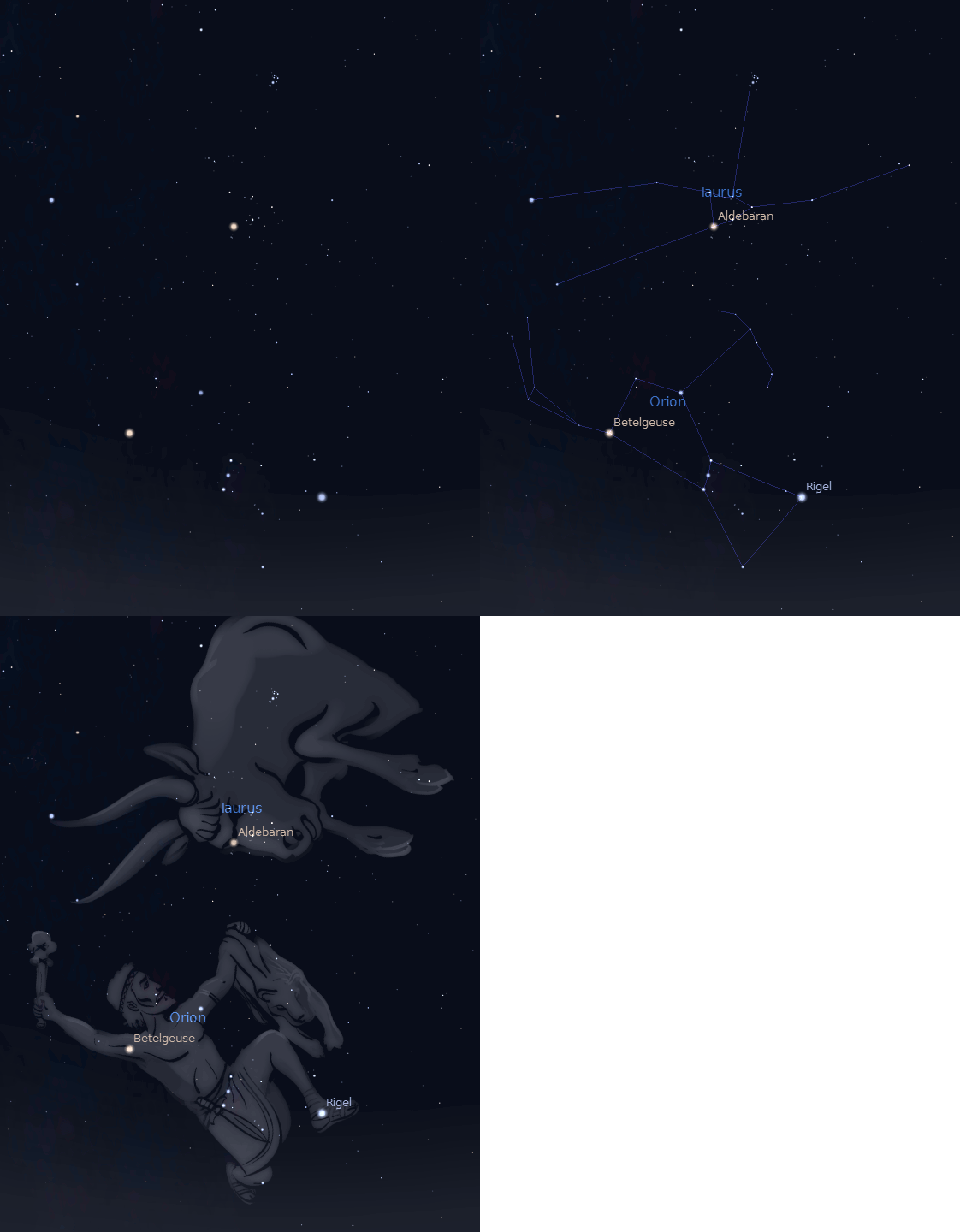
Three views of Taurus the bull and Orion the hunter for 9 p.m. on December 8th. Created using Stellarium and GIMP.
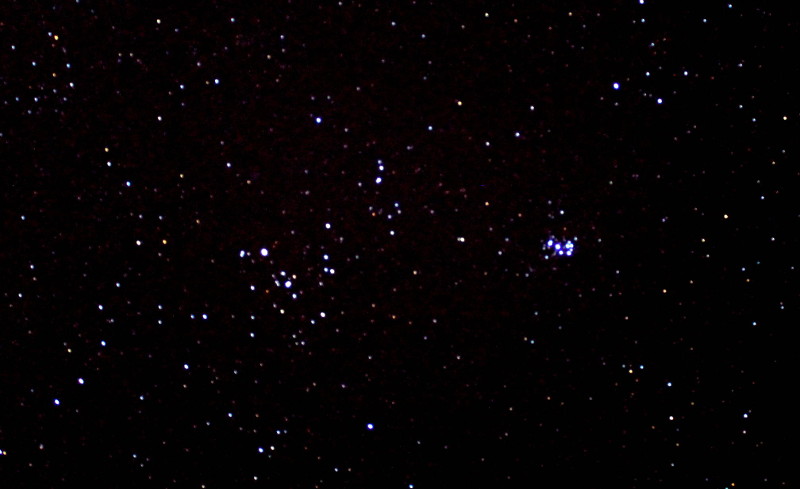
The Pleiades (right) and the Hyades (left) in this photograph I took January 4, 2016. The orientation is a bit different from how it appears in early December.
11/17/2020 – Ephemeris – The Pleiades in legends from different cultures
This is Ephemeris for Tuesday, November 17th. Today the Sun will be up for 9 hours and 29 minutes, setting at 5:12, and it will rise tomorrow at 7:44. The Moon, 2 days past new, will set at 7:23 this evening.
Let’s look at how some other cultures saw the Pleiades, the star cluster that is seen in the eastern sky these evenings. To the Anishinaabe native peoples around here the Pleiades is the “Hole in the Sky” or the seven stones that are heated for the sweat lodge ceremony. To the Kiowa these were sister stars that had been whisked into the sky from the top of Devils Tower in Wyoming where they were threatened by a huge bear. In Norse mythology these were the goddess Freya’s hens. The name we know them by has rather misty origins. Some think the Greek name is from the mother of the seven sisters, Pleione. The Greek word for sail is similar to Pleiades, and it seems the appearance of the Pleiades in the morning sky saw the best sailing weather in the Mediterranean.
The event times given are for the Traverse City/Interlochen area of Michigan. They may be different for your location.
Addendum

Seven maidens being attacked by a giant bear, having fled to the top of Devil’s Tower in Wyoming. Painting by Herbert Collins, https://www.nps.gov/deto.
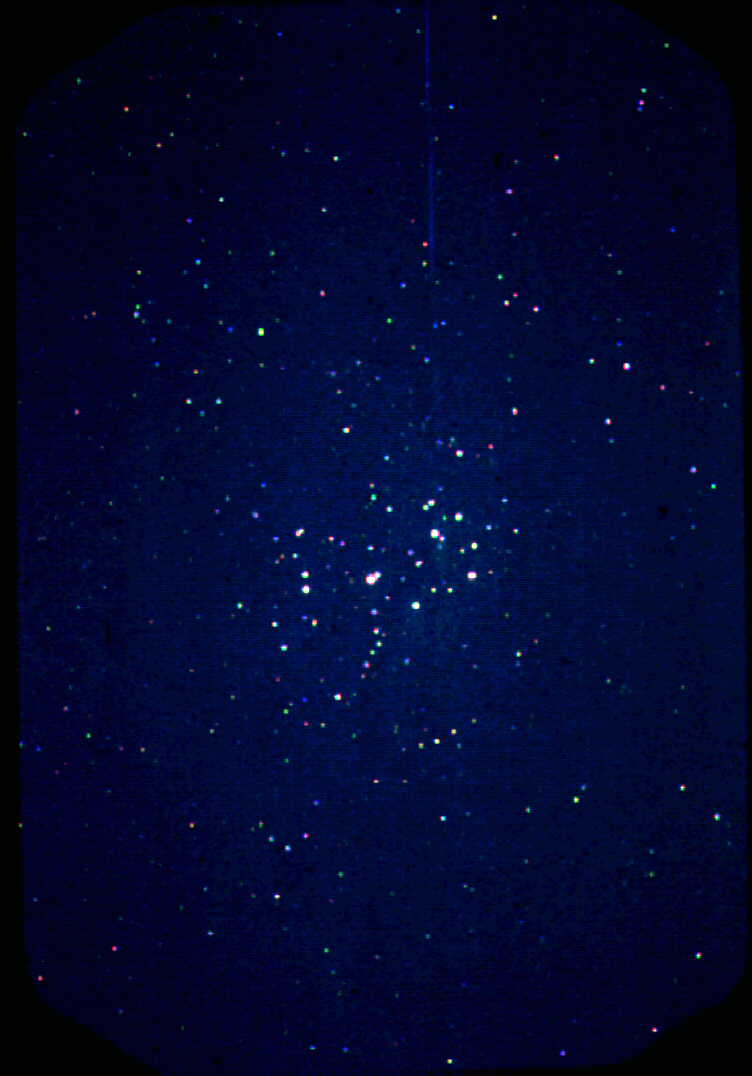
The Pleiades, about what you’d see in binoculars, more than the 6 or 7 stars visible to the naked eye. The brighter stars are Freya’s Hens and also the Seven Sisters and Indian maidens. Credit Bob Moler.
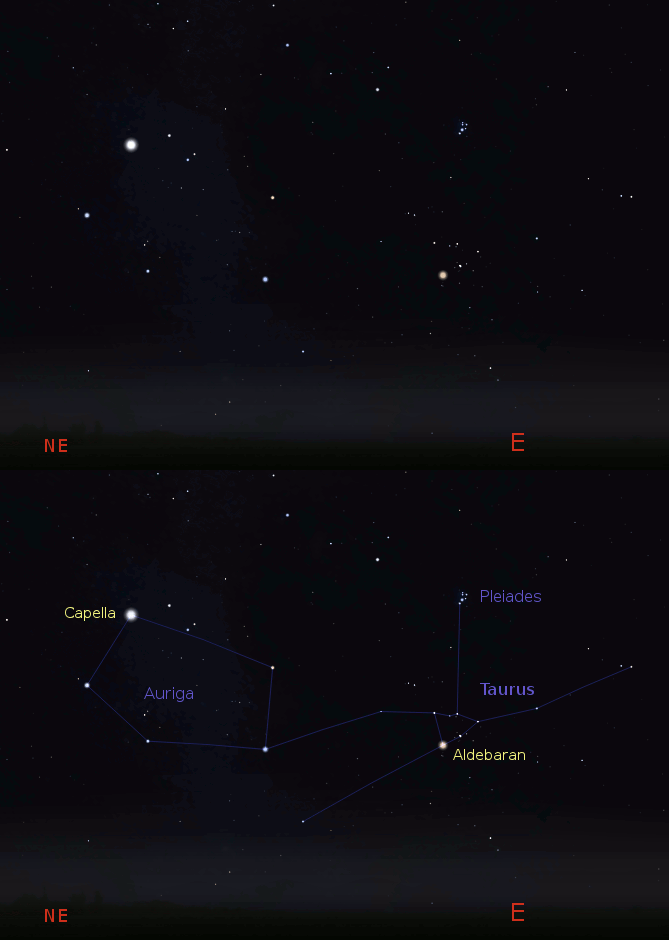
Pleiades finder animation looking east about 8 pm in mid-November. Created using Stellarium.
11/16/2020 – Ephemeris – How to find the Pleiades or Seven Sisters
This is Ephemeris for Monday, November 16th. Today the Sun will be up for 9 hours and 31 minutes, setting at 5:13, and it will rise tomorrow at 7:43. The Moon, 1 day past new, will set at 6:31 this evening.
A marvelous member of the autumn skies can be found low in the east after 8 in the evening. It is the famous star cluster called the Pleiades or the Seven Sisters. I might also add the ‘Tiny Dipper’. Many people can spot a tiny dipper shape in its six or seven stars, and mistake it for the Little Dipper. When I was nearsighted*, though corrected, I never had been able to see more than a few stars and a bit of fuzz. However, with binoculars, even I could see over a hundred stars appear along with the dipper shape of the brightest. The fuzz I saw was unresolved stars, but in photographs the Pleiades actually contain wisps of the gas and dust they are currently passing through. In Greek mythology the sisters were daughters of the god Atlas. I’ll be revisiting the Pleiades several times this autumn, winter, and as they disappear in the west in evening twilight next spring.
The event times given are for the Traverse City/Interlochen area of Michigan. They may be different for your location.
*My vision was corrected with cataract surgery a few years ago. The Pleiades now have a granular appearance now.
Addendum
Pleiades finder animation looking east at 8 pm, November 16th. Click on the image to enlarge. Created using Stellarium.
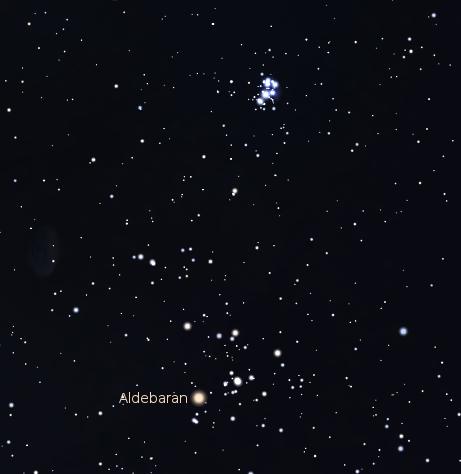
Aldebaran in the ‘V’ shape of the Hyades (The face of Taurus the bull) with the Pleiades above. Created using Stellarium.
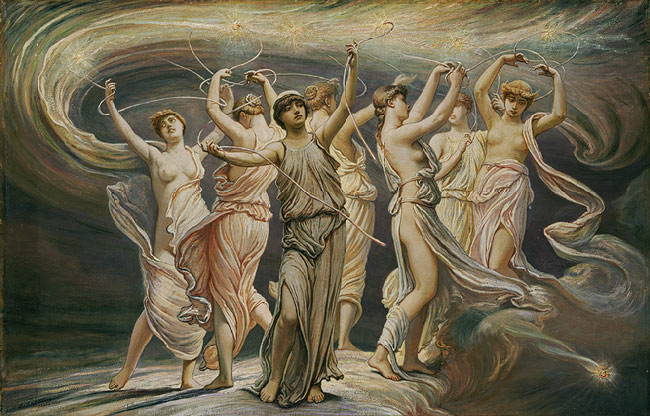
The Greek Pleiades a painting by Elihu Vedder in the Metropolitan Museum of Art, New York City. Public Domain.
4/03/2020 – Ephemeris – Tonight Venus appears among the stars of the Pleiades
This is Bob Moler with Ephemeris for Friday, April 3rd. Today the Sun will be up for 12 hours and 54 minutes, setting at 8:13, and it will rise tomorrow at 7:17. The Moon, 2 days past first quarter, will set at 5:48 tomorrow morning.
This evening the brilliant evening star, the planet Venus will appear within the Pleiades or Seven Sisters star cluster. Venus will slowly pass the Pleiades for the next few days. By the end of the month the Pleiades will be pretty much lost in the twilight. Evening star gazers will again pick it up late on September evenings, rising in the northeast. Venus, itself appears as a tiny crescent in small telescopes, and in May the tiny crescent will even be visible in binoculars. Venus reflects about 77 percent of the sunlight it receives because it is completely socked in by clouds. Clouds of a sulfuric acid mist. It is not a nice place. Surface temperature averages 867 degrees, and the atmospheric pressure is 90 times that of Earth.
The event times given are for the Traverse City/Interlochen area of Michigan. They may be different for your location.
Addendum
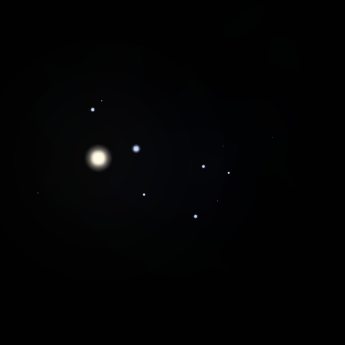
binocular view of Venus and the Pleiades tonight at 10 p.m. EDT April 3, 2020. (2 hr UT April 4) Created using Stellarium. Note: More stars may be visible. There will be a bright Moon out masking the dimmer members of the cluster. Your results may vary.
Update 04/03/2020 10:10 p.m. EDT
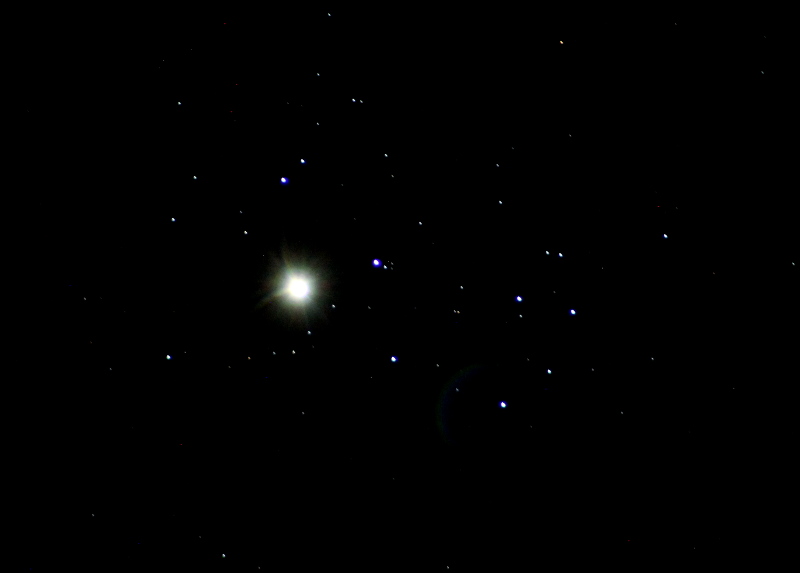
Photo of Venus and Pleiades taken at 9:37 p.m. EDT with Canon EOS Rebel T5, 300mm fl. f/5.6, 2 sec, ISO 3200, unguided. by myself.
12/16/2019 – Ephemeris – Taurus Treasures
Ephemeris for Monday, December 16th. Today the Sun will be up for 8 hours and 49 minutes, setting at 5:03, and it will rise tomorrow at 8:14. The Moon, 3 days before last quarter, will rise at 9:59 this evening.
Rising in the east-southeast now is the bright star Aldebaran an orange star that’s at one end of the sideways letter V of stars that is the head of Taurus the bull. Above it is the jewel-like Pleiades or Seven Sisters star cluster. There’s more to Taurus, like it’s freakishly long horns and front part of its body. But you can say you’ve seem Taurus, if you can spot his face. That V of stars is actually a star cluster called the Hyades, the closest to the Earth, and in Greek Myth were the half-sisters of the Pleiades, also fathered by the god Atlas. Both the Hyades and Pleiades are being pursued by Orion, which is below it. He isn’t the only one following the Pleiades, the name Aldebaran means “The Follower”.
The times given are for the Traverse City/Interlochen area of Michigan. They may be different for your location.
Addendum
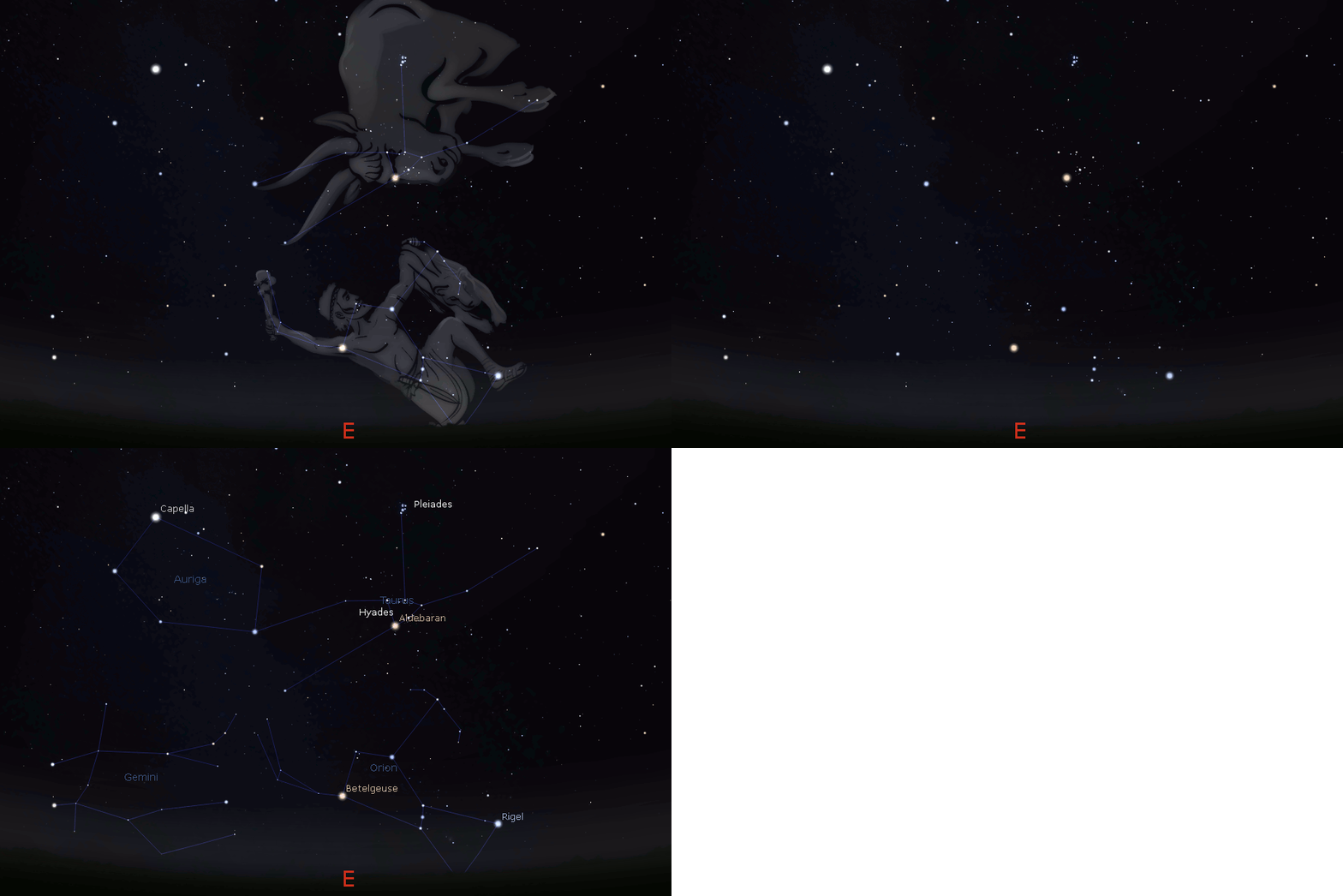
An animation showing the Hyades, Taurus, Orion and the Pleiades. Click on the image to enlarge. Created using Stellarium and GIMP.
The Pleiades (right) and the Hyades (left) in this photograph I took January 4, 2016.
11/26/2019 – Ephemeris – The Pleiades in mythology
Ephemeris for Tuesday, November 26th. Today the Sun will be up for 9 hours and 12 minutes, setting at 5:06, and it will rise tomorrow at 7:54. The Moon is new today, and won’t be visible.
Let’s look at how some other cultures saw the Pleiades, the star cluster that is seen in the eastern sky these evenings. To the Anishinaabe native peoples around here the Pleiades is the “Hole in the Sky” or the seven stones that are heated for the sweat lodge ceremony. To the Kiowa these were sister stars that had been whisked into the sky from the top of Devils Tower in Wyoming where they were threatened by a huge bear. In Norse mythology these were the goddess Freya’s hens. The name we know them by has rather misty origins. Some think the Greek name is from the mother of the seven sisters, Pleione. The Greek word for sail is similar to Pleiades, and some suggested that the appearance of the Pleiades in the morning sky signaled the best sailing weather in the Mediterranean region. (12/16/2016 – Ephemeris – The Pleiades in the mythology of many cultures)
The times given are for the Traverse City/Interlochen area of Michigan. They may be different for your location.
Addendum
The Pleiades, about what you’d see in binoculars.
The Greek Pleiades a painting by Elihu Vedder in the Metropolitan Museum of Art, New York City. Public Domain.
Seven maidens being attacked by a giant bear, having fled to the top of Devil’s Tower in Wyoming. Painting by Herbert Collins, http://www.nps.gov/deto
10/29/2019 – Ephemeris – Finding the Pleiades or Seven Sisters
Ephemeris for Tuesday, October 29th. Today the Sun will be up for 10 hours and 19 minutes, setting at 6:36, and it will rise tomorrow at 8:17. The Moon, 2 days past new, will set at 7:57 this evening.
A marvelous member of the autumn skies can be found low in the east northeast after 9 in the evening. It is the famous star cluster called the Pleiades or the Seven Sisters. I might also add the ‘Tiny Dipper’. Many people can spot a tiny dipper shape in its six or seven stars, and mistake it for the Little Dipper. When I was nearsighted, though corrected, I never had been able to see more than a few stars and a bit of fuzz. However with binoculars, even I can see over a hundred stars appear along with the dipper shape of the brightest. The fuzz I saw was unresolved stars, but in photographs the Pleiades actually contain wisps of the gas they are passing through currently. In Greek mythology the sisters were daughters of the god Atlas.
The times given are for the Traverse City/Interlochen area of Michigan. They may be different for your location.
Addendum
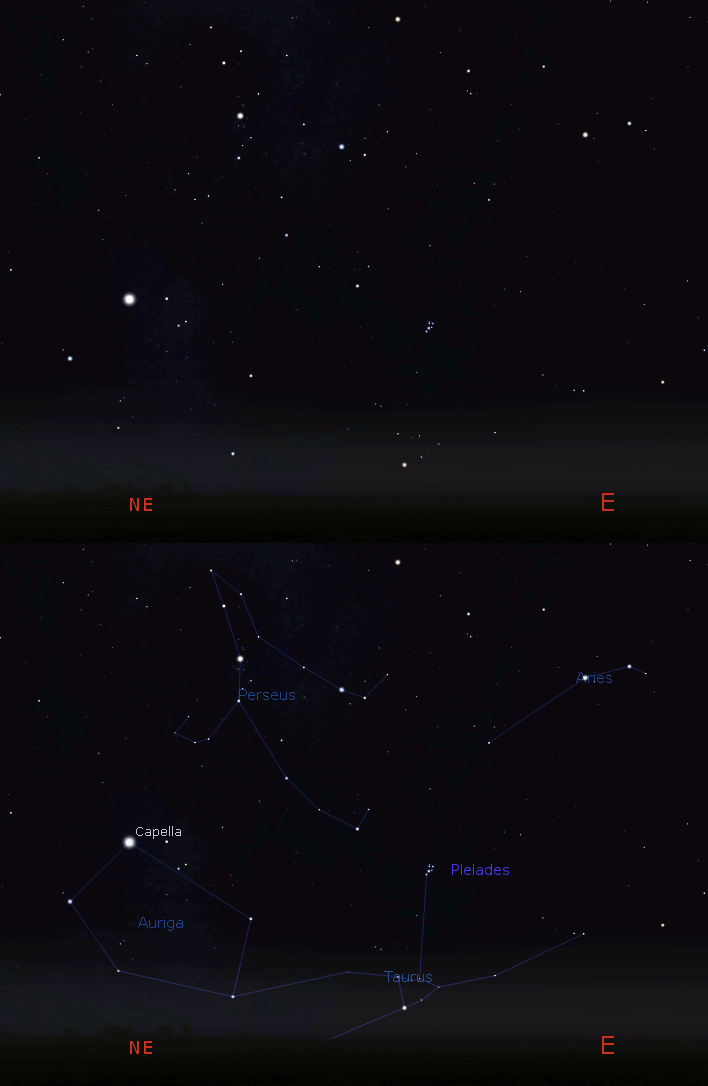
Finding the Pleiades animation for 9 p.m. October 29, 2019. The Pleiades is surrounded by constellations I’ve described earlier this year and one yet to be described, Taurus the bull of which the cluster is a part. The V of stars near the horizon is Taurus’ head and is another star cluster, the Hyades, the half sisters to the Pleiades. Created using Stellarium and GIMP.
The Pleiades, about what you’d see in binoculars, though not as brilliant. One of my old photographs. With my 11 inch f/4.5 Dobsonian using a 40mm eyepiece that gives a field of view that encompasses the Pleiades, all I can say is Wow!
The Greek Pleiades a painting by Elihu Vedder in the Metropolitan Museum of Art, New York City. Public Domain.
03/26/2019 – Ephemeris – Mars is approaching the Pleiades this week
Ephemeris for Tuesday, March 26th. Today the Sun will be up for 12 hours and 27 minutes, setting at 8:02, and it will rise tomorrow at 7:33. The Moon, 2 days before last quarter, will rise at 2:38 tomorrow morning.
Daylight time and spring time are catching up with us with the Sun setting now just after 8 p.m. By 9 p.m. tonight the brighter stars appear and most of the well known constellations will be recognizable. Looking off to the west at that time the famous star group of the Pleiades, or Seven Sisters will appear. Folks with good eyesight can see six or maybe even seven of its stars. Tonight, right below the Pleiades is a bright reddish star. It would be the 22nd of the first magnitude stars, except it’s not a star. It’s a wanderer, according to the ancient Greeks, one of seven*. They called it Ares the god of war. The Romans turned it into Mars. Over the week Mars will be closing in and passing by the Pleiades this weekend.
The times given are for the Traverse City/Interlochen area of Michigan. They may be different for your location.
Addendum
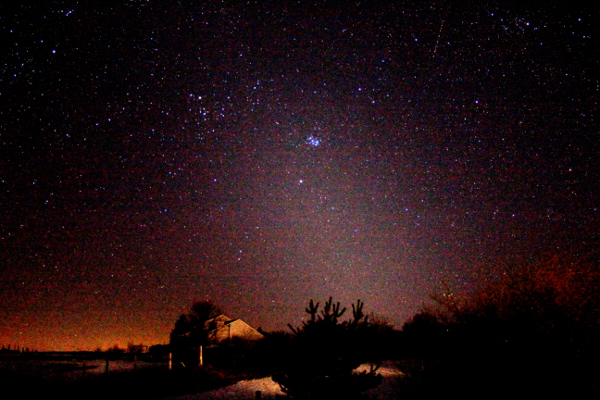
The western sky at 10:22 last night March 25, 2019. Mars appears below the Pleiades in zodiacal light. Credit, mine – Canon EOS Rebel T5 18mm f.l., f/3.5, 8 sec. ISO 12,800.
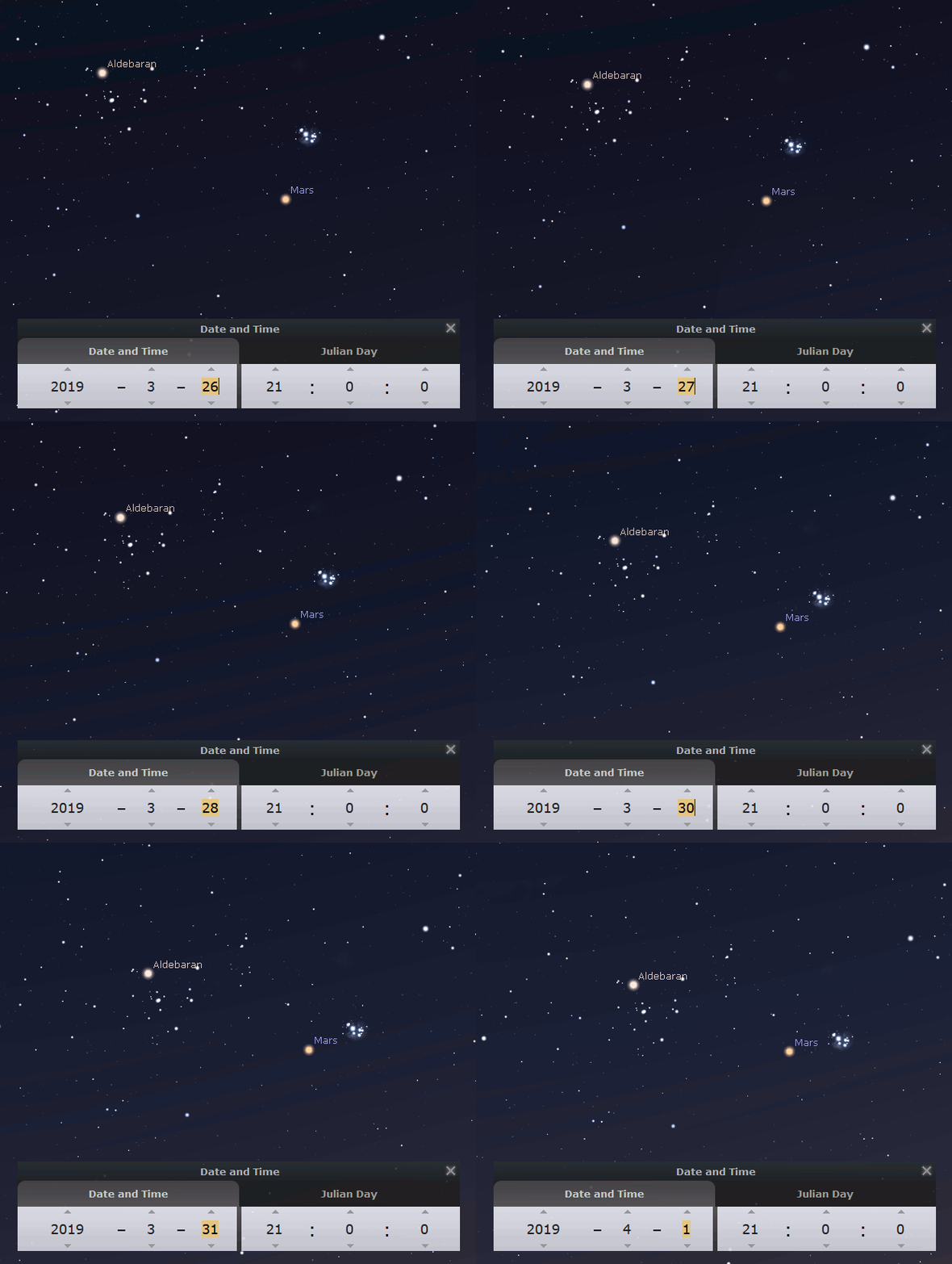
Mars tiptoeing past the Pleiades nightly from March 26th to April 1st, 2019 at 9 p.m. Looking west. Created using Stellarium and GIMP.
The letter V of stars to the left of the Pleiades is the Hyades, in mythology the half sisters to the Pleiades. It is also the face of Taurus the bull.
* We get the word planet from the Greek planētes meaning wander. Five are the classical planets, Mercury, Venus, Mars, Jupiter, and Saturn. The other two are the Sun and Moon. The other celestial objects were the fixed stars. Other things that appear in the sky, like comets, novae and meteors were thought to be in the Earth’s atmosphere.
01/24/2019 – Ephemeris – Taurus the bull
Ephemeris for Thursday, January 24th. Today the Sun will be up for 9 hours and 29 minutes, setting at 5:40, and it will rise tomorrow at 8:09. The Moon, half way from full to last quarter, will rise at 10:14 this evening.
Midway up the sky in the southeast at 8 p.m. is the constellation of the giant hunter Orion. Above him, to the right is Taurus the bull. His face is a letter V shape of stars lying on its side, the star cluster Hyades, with the bright orange-red star Aldebaran at one tip of the V as its angry blood-shot eye, but actually about half way between us and the cluster. Orion is depicted in the sky facing, with club in one hand and a shield in the other, the charging Taurus. The Pleiades star cluster is in his shoulder. Taurus in Greek mythology was the form the god Zeus when he carried off the maiden Europa. Europa’s still with him as the intriguing satellite orbiting Zeus’ Roman equivalent the planet Jupiter.
The times given are for the Traverse City/Interlochen area of Michigan. They may be different for your location.
Addendum
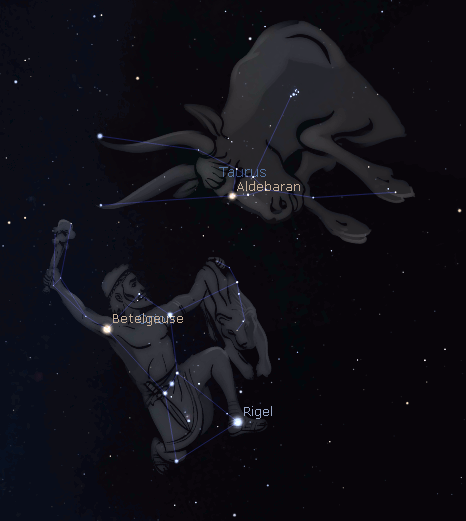
Taurus and Europa at 8 p.m. January 24, 2019. Created using Stellarium.
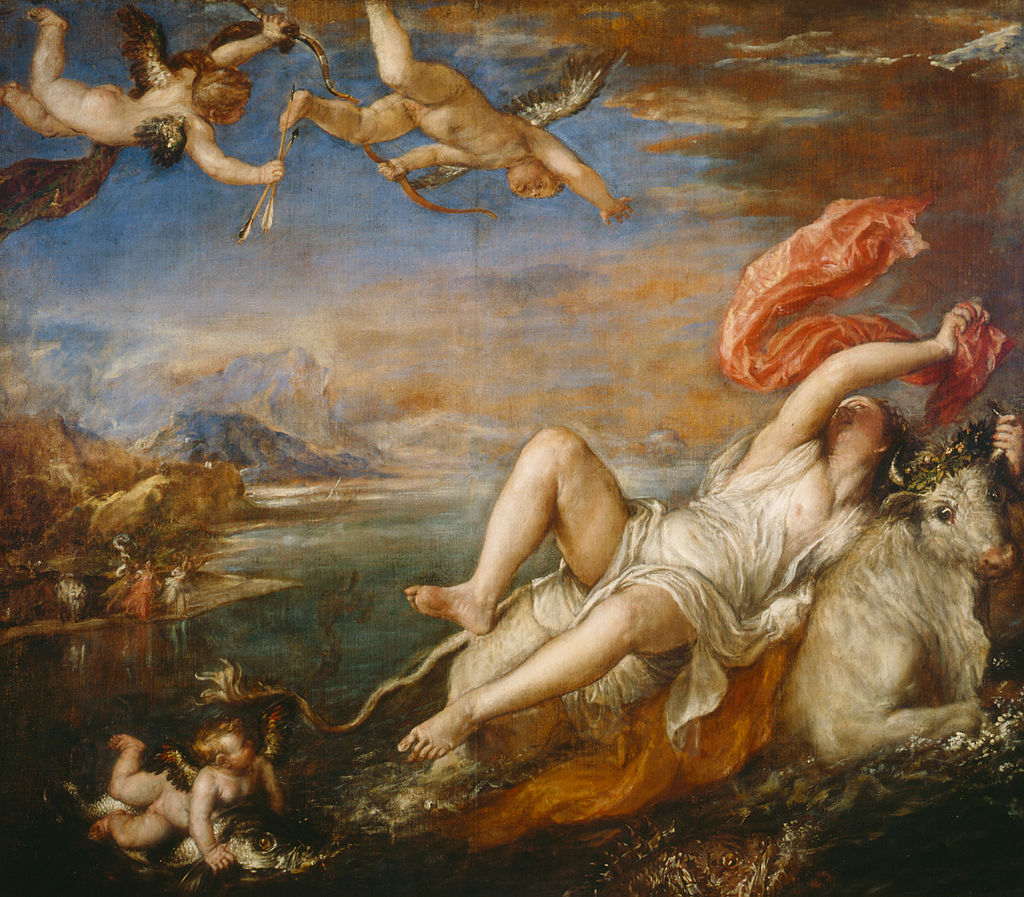
The Rape of Europa by Titian. According to the story Zeus as a bull abducted Europa and swam to Crete, where she became the first queen of that island, and bore him three sons. Other paintings of this subject are by Rembrandt and de Troy. This painting belongs to the Isabella Stewart Gardener Museum in Boston, MA. Click on the image to enlarge.
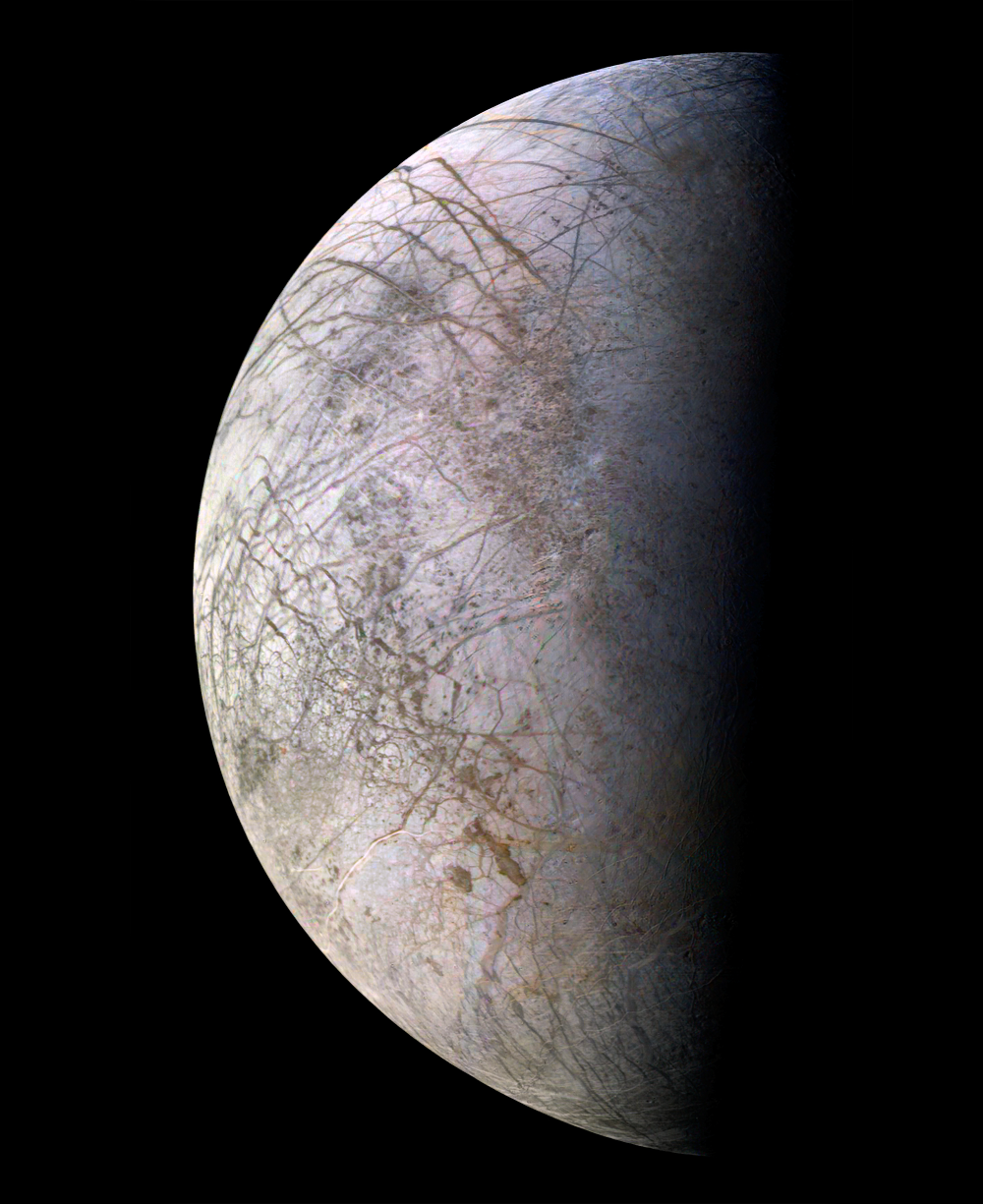
Jupiter’s satellite Europa, slightly smaller than the Earth’s moon, has a fresh ice surface with very little cratering. The ice floats on a deep water ocean supposedly containing more water than all the Earth’s oceans. Click on the image to enlarge. This is a place NASA will send a spacecraft to look for the chemistry of life. Credit NASA/JPL, Ted Stryk.
 Bob Moler's Ephemeris Blog