Archive
Ephemeris: 10/28/2024 – The Pleiades or Seven Sisters and their half sisters
This is Ephemeris for Monday, October 28th. Today the Sun will be up for 10 hours and 20 minutes, setting at 6:36, and it will rise tomorrow at 8:17. The Moon, halfway from last quarter to new, will rise at 5:22 tomorrow morning.
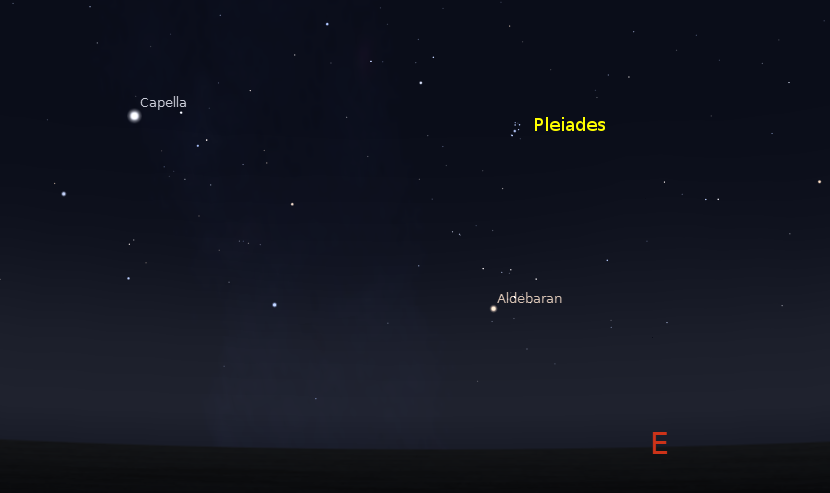
The beautiful star cluster of the Pleiades is seen low in the east northeastern sky after 9:00 PM. It is also known as the Seven Sisters. It has been known as a group of female stars in many cultures. Also, the Ancient Greeks, because they thought that the Pleiades shape looked something like a sail, Also, Pleiades is very close to the Greek name for sail, and that its appearance in the morning sky in early summer heralded the beginning of the summer sailing season on the Mediterranean Sea. According to Greek mythology the Pleiades have half sisters, also seven in number, with the same father, Atlas, but a different mother, called the Hyades which rises about an hour later, and fills out the face of Taurus the bull.
The astronomical event times given are for the Traverse City/Interlochen area of Michigan (EDT, UT – 4 hours). Times will be different for other locations.
Addendum
Ephemeris: 10/25/2024 – Finding the Pleiades or Seven Sisters
This is Ephemeris for Friday, October 25th. Today the Sun will be up for 10 hours and 28 minutes, setting at 6:40, and it will rise tomorrow at 8:13. The Moon, 1 day past last quarter, will rise at 2:09 tomorrow morning.
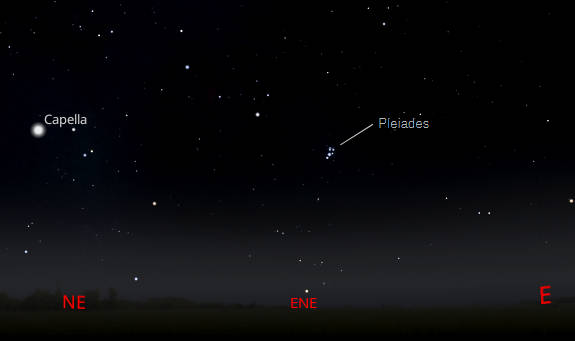
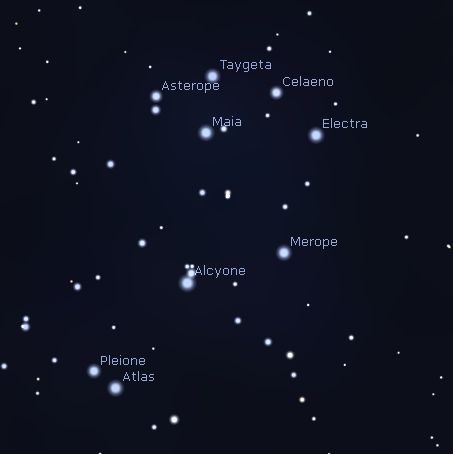
A marvelous member of the autumn skies can be found low in the east northeast after 9 in the evening. It is the famous star cluster called the Pleiades or the Seven Sisters. I might also add the ‘Tiny Dipper’. Many people can spot a tiny dipper shape in its six or seven stars, and mistake it for the Little Dipper. With binoculars, one can see over a hundred stars that appear, along with the dipper shape of the brightest. In photographs, the Pleiades actually contain wisps of the dust they are currently passing through. In Greek mythology, the sisters were daughters of the god Atlas and Pleione. The most people can see is six stars. The reason, according to mythology, is that one of the sisters married a mortal, dimming her star.
The astronomical event times given are for the Traverse City/Interlochen area of Michigan (EDT, UT – 4 hours). Times will be different for other locations.
Addendum
Ephemeris: 03/14/2024 – It’s Pi Day!
This is Ephemeris for Pi Day, Thursday, March 14th. Today the Sun will be up for 11 hours and 52 minutes, setting at 7:48, and it will rise tomorrow at 7:54. The Moon, 3 days before first quarter, will set at 1:47 tomorrow morning.
Yes, it’s Pi day that’s the Greek letter π for 3.14 approximating the ratio of the circle’s circumference to its diameter, which scientific and technical people celebrate by baking a pie P-I-E and carving the Greek letter π on the top.
Tonight around 9 or 9:30 when it gets dark, is a good time to use the Moon to find the Pleiades, the Seven Sisters star cluster. The Pleiades will appear above the crescent Moon this evening, so it’s a good time to locate them if you haven’t already. We only have about another month viewing the Pleiades in the evening. And we have one more passage of the Moon by the Pleiades next month before they disappear from the evening sky.
The astronomical event times given are for the Traverse City/Interlochen area of Michigan (EDT, UT–4 hours). They may be different for your location.
Addendum

There’s another Pi day that some celebrate. A well-known approximation of pi is the fraction 22/7ths. Europeans and others write dates in day/month order, so July 22nd is also a Pi Day: 22/7.
Ephemeris: 02/16/2024 – The Moon will appear near the Pleiades tonight
This is Ephemeris for Friday, February 16th. Today the Sun will be up for 10 hours and 29 minutes, setting at 6:12, and it will rise tomorrow at 7:40. The Moon, at first quarter today, will set at 3:03 tomorrow morning.
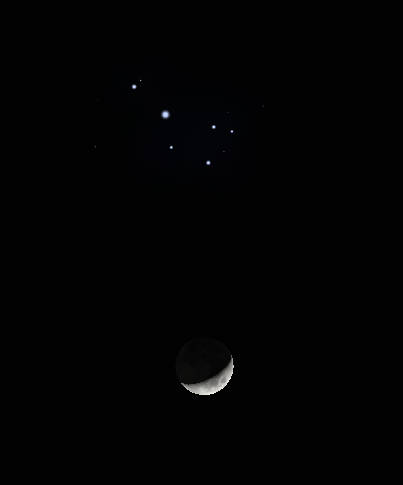
The moon will pass south, or below, the star cluster called the Pleiades, or Seven Sisters, this afternoon. By this evening the Pleiades will be seen to the lower right of the Moon. However, you will need a pair of binoculars to see them, because the first quarter Moon is quite a bit brighter than the stars of the Pleiades. The moon will again pass the Pleiades in March on the 14th, where the Pleiades will appear above and left of the Moon. And again, on April 11th, where the Moon will pass south of the Pleiades during the day, and the cluster will be to the lower right of the Moon by evening. They will appear closest together in our evening sky on May 8th. Unfortunately, they will be low in the sky in the west at sunset.
The astronomical event times given are for the Traverse City/Interlochen area of Michigan (EST, UT –5 hours). They may be different for your location.
Addendum
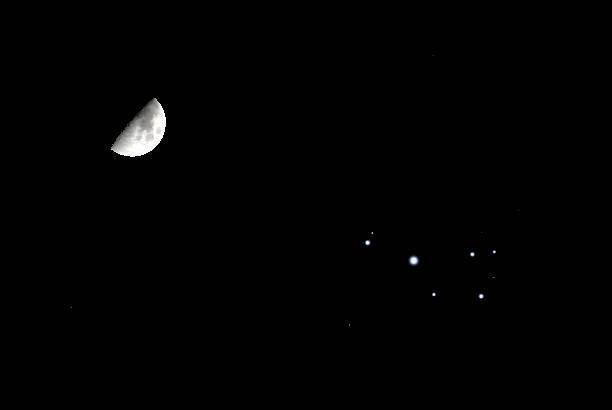
Ephemeris Extra: Taurus and its two bright star clusters
Based on an article published in the November 2023 issue of the Stellar Sentinel the newsletter of the Grand Traverse Astronomical Society.
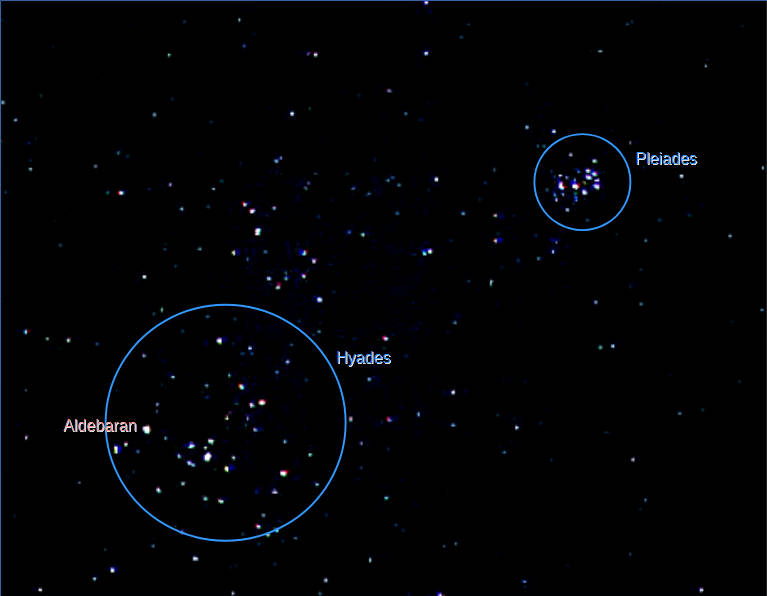
In my October presentation to the society I talked about the stars of autumn, moving generally from the constellations close to summer and ending pretty much against the constellations of winter ending with the constellation of Taurus and with the wonderful Pleiades or Seven Sisters. In this article I’ll take a little bit closer look at the Pleiades and especially the Hyades, the face of Taurus the bull.
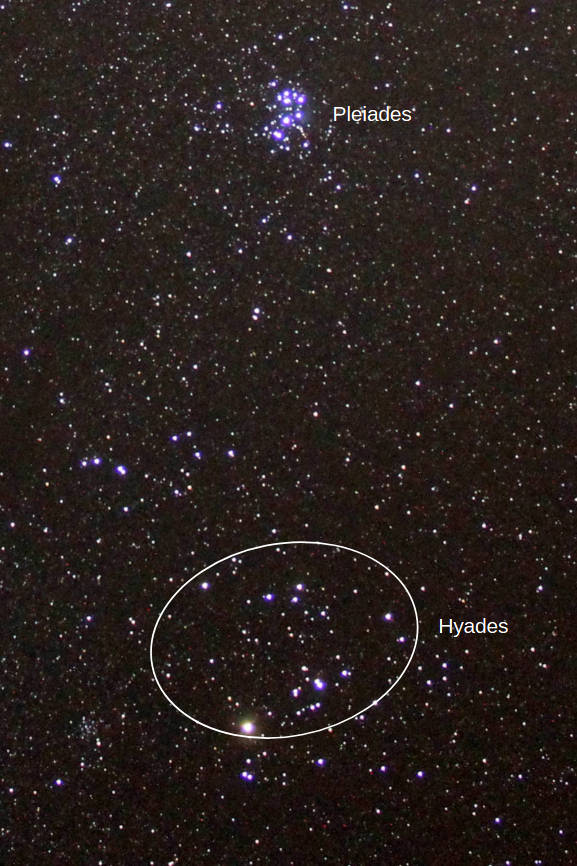
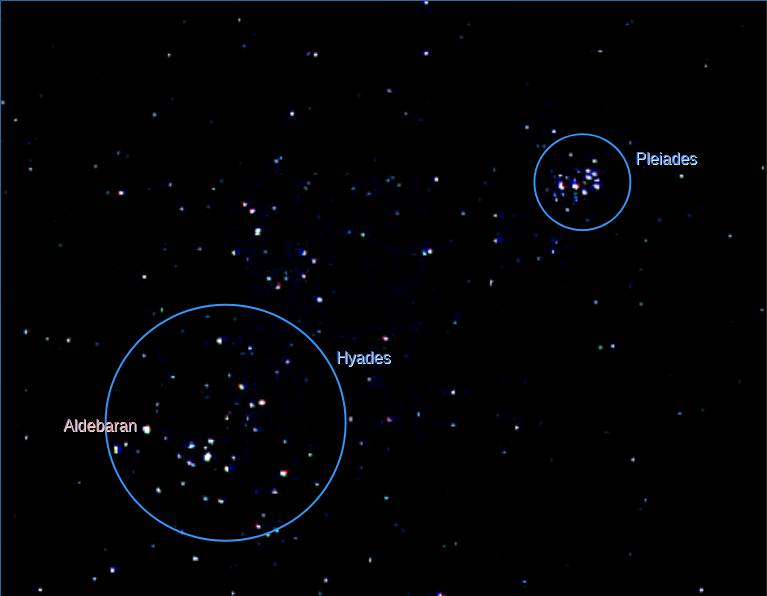
On the previous page is a family portrait of the Pleiades and Hyades. Yes, family portrait. In Greek mythology, the Hyades are the half sisters of the Pleiades. The god Atlas is their father, Pleione seems to be the mother of the Pleiades, and Aethra is the mother of the Hyades. In astronomical terms the Hyades would then be the older sisters of the Pleiades.
The Hyades is a star cluster that is 153 light years away. It is the closest star cluster to us and somewhat over 6 times the age of the Pleiades. The younger and splashier Pleiades are around 444 light years away, and only 100 million years old. Whereas the Hyades are over 600 million years old. The Pleiades still contain hot blue-white stars which have died out by the time of the age of the Hyades. The brightest star of the letter V of stars is Aldebaran, Taurus’ angry bloodshot eye. It doesn’t belong to the Hyades, being about half the distance.
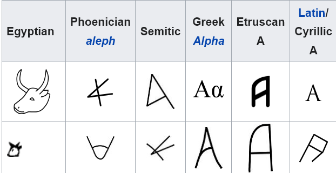
While the Hyades is not as splashy as the Pleiades are and has less of a role in mythology. However, it did play an important part in history when Taurus was the first constellation of the Zodiac some 4,000 years ago, due to precession of the equinoxes. This is because the letter A, the first letter of our alphabet is taken from the stars of the face of Taurus the bull in what looks to us like a V. But it was turned around to be the A we have today. Back then it was called Aleph the first letter of the alphabet for middle eastern cultures.
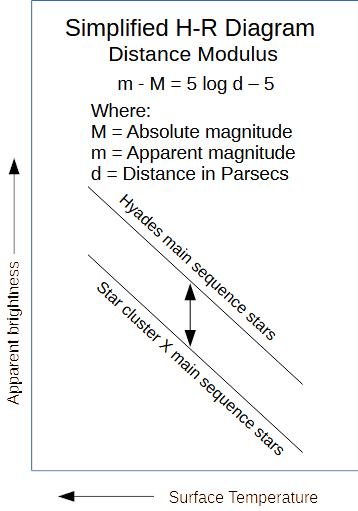
The Hyades is also important in astronomical history in that it helps us measure distances to more distant star clusters. The Hyades was the only star cluster close enough to measure its distance by the parallax method before the advent of the European Space Agency’s Hipparcos and Gaia satellites. If one matches stars on the Hertzsprung-Russell diagram of intrinsic brightness versus surface temperature with other star clusters the stars of the main sequence, where stars spend most of their lives burning hydrogen. The difference in the brightness of the main sequence stars gives the measure of how other star clusters measure up as far as distance since the main sequence is a relatively narrow distribution of stars. This works only with star clusters because there are many stars at the same distance which happen to be about the same age. And enough stars to establish the main sequence since stars at later stages of life may have the same temperature, but vastly different brightnesses.
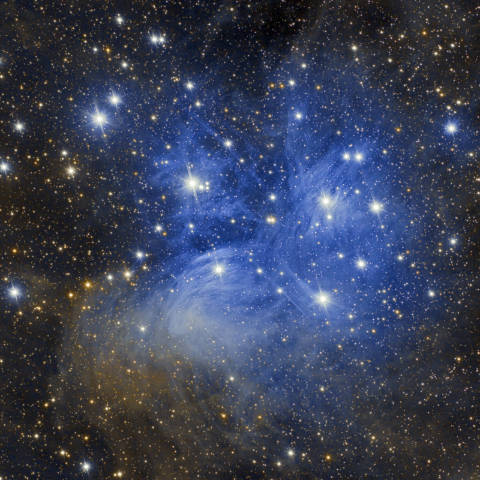
The Pleiades are so large that most telescopes will not allow one to see all the brighter stars at once, so binoculars are the best way to view them. At a dunes star party a few years ago, before COVID, I used my 11-inch (279 mm) Newtonian telescope, which has a 55 inch (1,397 mm) focal length, with a 40 millimeter eyepiece to view the Pleiades. A 40 millimeter eyepiece in that scope gives too low a magnification to use the entire diameter of the primary mirror. All the light doesn’t make it into the eye. That eyepiece gave me about 35 times magnification, so the main stars of the cluster fit into the field of view. The photograph above is nice and all that, but looking with the eye visually at the Pleiades, even with binoculars, you’ll notice something quite different from the photographs. In photographs to make a star brighter you make it bigger. But the eye has a much greater dynamic range. The stars are incredibly brilliant blue white-points of light in the case of the Pleiades. Absolutely beautiful, much more beautiful than any photograph. Not to disparage photographs, but photographs can do what the eye cannot. That is, store light to bring out very faint objects and details. So, let’s take a final look at the Pleiades in a photograph by GTAS member Dan Dall’Olmo.
Ephemeris: 11/06/2023 – The Pleiades or Seven Sisters
This is Ephemeris for Monday, November 6th. Today the Sun will be up for 9 hours and 57 minutes, setting at 5:25, and it will rise tomorrow at 7:28. The Moon, 1 day past last quarter, will rise at 1:18 tomorrow morning.
A marvelous member of the autumn skies can be found low in the east after 8 in the evening. It is the famous star cluster called the Pleiades or the Seven Sisters. I might also add the ‘Tiny Dipper’. Many people can spot a tiny dipper shape in its six or seven stars, and mistake it for the Little Dipper. With binoculars, one can see over a hundred stars appear, along with the dipper shape of the brightest. In photographs, the Pleiades actually contain wisps of the dust they are currently passing through. In Greek mythology, the sisters were daughters of the god Atlas and Pleione.
The astronomical event times given are for the Traverse City/Interlochen area of Michigan (EST, UT –5 hours). They may be different for your location.
Addendum
I’ll be coming back to the Pleiades from time to time over the autumn and winter months to cover, especially, the mythology of the Pleiades from different cultures.
02/01/2023 – Ephemeris – Let’s find where the naked-eye planets have wandered off to this week
This is Ephemeris for Wednesday, February 1st. Today the Sun will be up for 9 hours and 49 minutes, setting at 5:51, and it will rise tomorrow at 8:00. The Moon, halfway from first quarter to full, will set at 6:31 tomorrow morning.
Let’s find where the naked-eye planets have wandered off to this week. Very early after sunset. Venus can be spotted low in the southwest by 6:30 pm. Mars, and Jupiter will be visible this evening by 7 pm. Mars will be above Orion in the southeast and is pulling away from the Pleiades. Jupiter will be in the southwest. Saturn is way below Venus now, so it’s gone until it reappears in the morning sky in a few months. It will make the crossing to the morning sky with its solar conjunction on the 16th. Mercury is now in the morning sky. It has a few more days visibility around 7 am in the southeastern sky after reaching greatest western elongation from the Sun last Sunday.
The astronomical event times given are for the Traverse City/Interlochen area of Michigan (EST, UT –5 hours). They may be different for your location.
Addendum
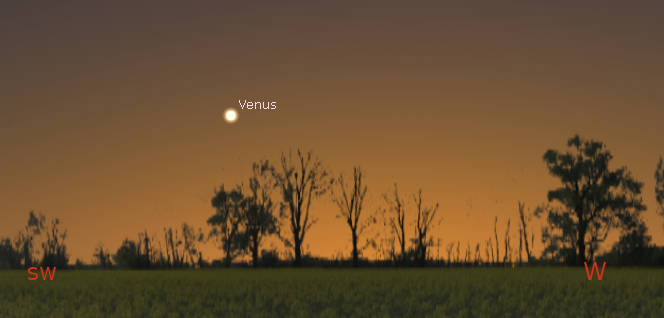
Venus low in the west-southwestern twilight at 6:30 pm tonight, February 1, 2023. Created using Stellarium.
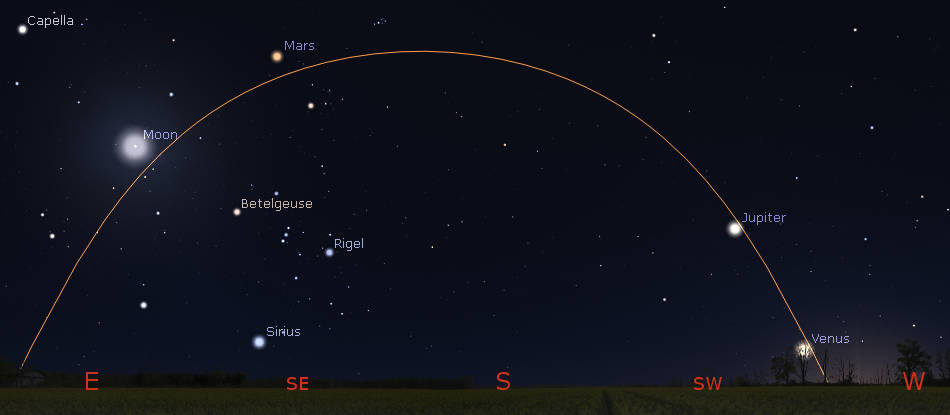
Evening planets at 7 pm tonight, February 1, 2023. The orange line is the ecliptic, which is the plane of the Earth’s orbit. The sun appears on that line throughout the year. Notice that all the other planets are very close to that line. That is an artifact of the accretion disk from which the planets formed some 4 1/2 billion years ago. The planets still maintain the nearly same plane for their existence to this day. Click on the image to enlarge it. Created using Stellarium.
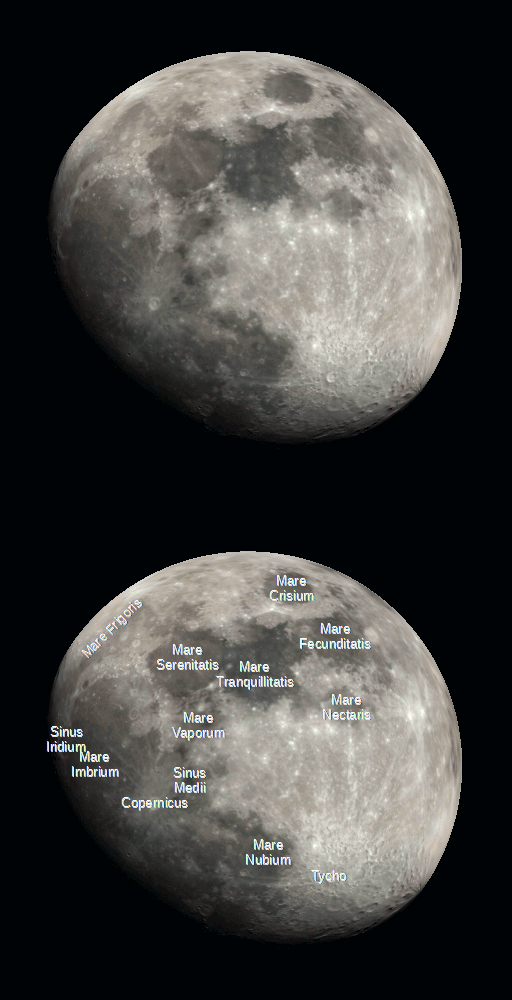
The gibbous Moon tonight at 7:00 pm, labeled. Created using Stellarium, LibreOffice Draw, and GIMP.
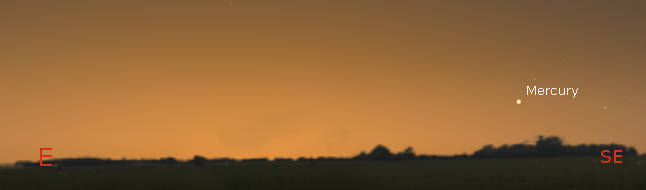
This is what Mercury might look like in the southeast around 7:20 tomorrow morning, February 2nd from Interlochen/Traverse City. At that time, it’ll be 5 degrees above a sea horizon, which is half the width of a fist held at arm’s length. Any trees of course will reduce it. Created using Stellarium.
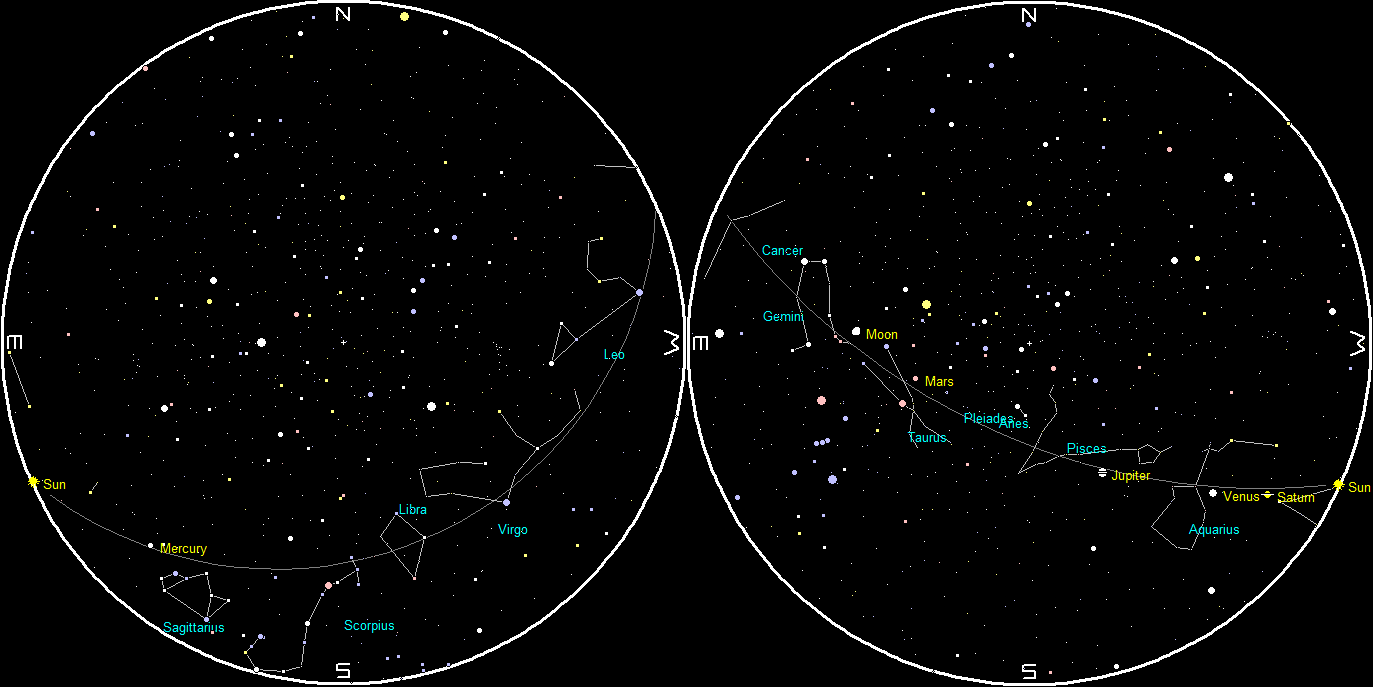
The naked-eye planets and the Moon at sunset and sunrise on a single night, starting with sunset on the right on February 1, 2023. The night ends on the left with sunrise on the 2nd. Click on the image to enlarge it. Created using my LookingUp app and GIMP.
01/18/2023 – Ephemeris – Let’s see where the naked-eye planets have wandered off to this week
This is Ephemeris for Wednesday, January 18th. Today the Sun will be up for 9 hours and 17 minutes, setting at 5:32, and it will rise tomorrow at 8:14. The Moon, 3 days before new, will rise at 6:28 tomorrow morning.
Let’s see where the naked-eye planets have wandered off to this week. Very early after sunset, Venus might be spotted very low in the southwest by 6 pm. Mars, Jupiter and Saturn will be visible this evening, in the east to southwestern sky by 6:30 or 7 pm. Mars will be above Orion in the east-southeast and near the Pleiades. Jupiter is the brightest of the three and will be in the south-southwest., while dimmer Saturn will be very low in the southwest at that time. Saturn, the westernmost of these bright planets, will set around 7:42 this evening. It’s a bit above and left of Venus. Mercury is now in the morning sky, after it passed inferior conjunction with the Sun on the 7th, that is, it passed between the Earth and the Sun. It should be briefly visible before sunrise by month’s end.
The astronomical event times given are for the Traverse City/Interlochen area of Michigan (EST, UT –5 hours). They may be different for your location.
Addendum
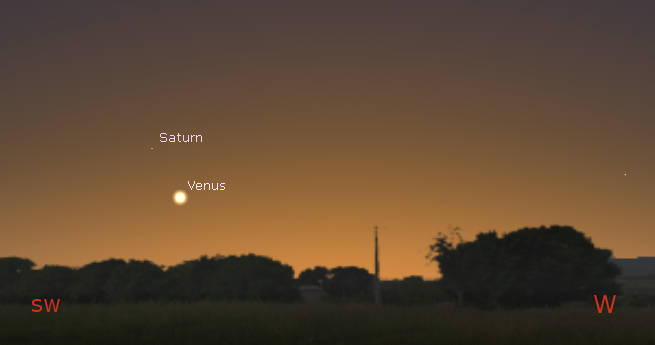
Venus and Saturn low in the southwest at 6:15 pm tonight, January 18, 2023. Saturn will probably not be visible yet, but Venus should be plenty bright enough. Created using Stellarium.
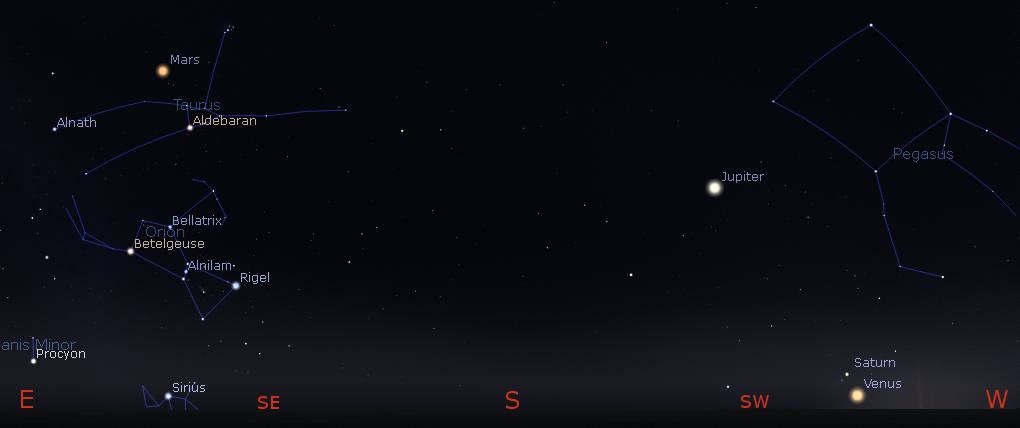
All the evening planets before Venus sets are in this panorama looking southward from east to west at 7:15 tonight, January 18, 2023. I dropped lines from some of the dimmer constellations. Click on the image to enlarge it. Created using Stellarium.
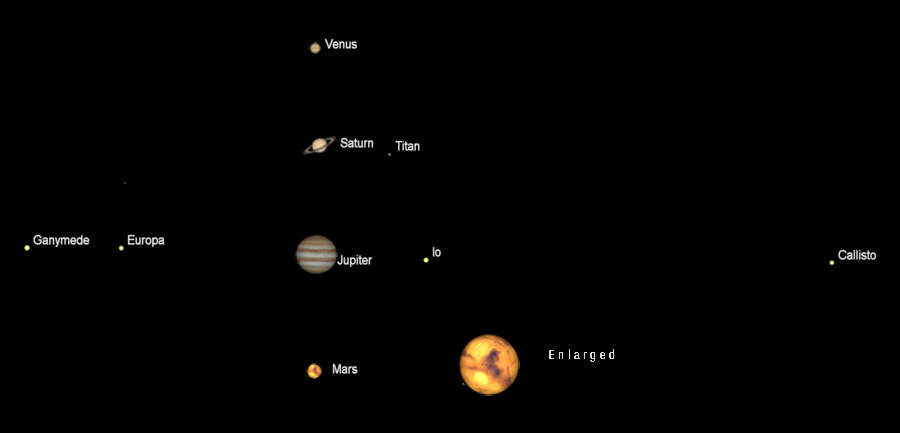
Telescopic views of Saturn Jupiter and Mars (north up) as they would be seen in a small telescope, with the same magnification. The image of Mars doesn’t show it, but the white north polar cap will appear at the top or north limb of Mars. The planets are shown at 7 pm tonight, January 18, 2023. Apparent diameters: Venus 10.77″ and is 93.5% illuminated; Saturn 15.52″, its rings 36.16″; Jupiter 37.32″. Mars 12.25″. Mars’ distance is71.6 million miles (114.4 million kilometers). The ” symbol means seconds of arc (1/3600th of a degree.) Click on the image to enlarge it. Created using Cartes du Ciel (Sky Charts).
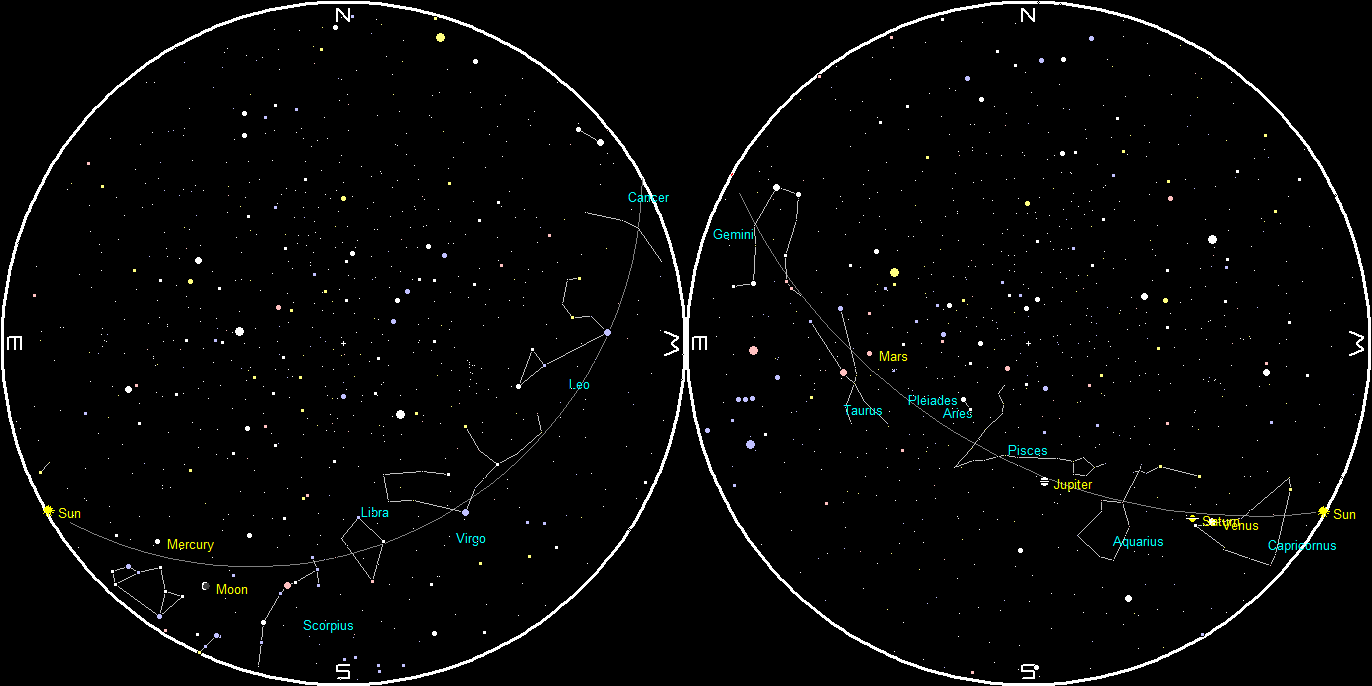
The naked-eye planets and the Moon at sunset and sunrise on a single night, starting with sunset on the right on January 18, 2023. The night ends on the left with sunrise on the 19th. Click on the image to enlarge it. Created using my LookingUp app and GIMP.
01/10/2023 – Ephemeris – The constellation of Orion the hunter, unlucky in love
This is Bob Moler with Ephemeris for Tuesday, January 10th. Today the Sun will be up for 9 hours and 3 minutes, setting at 5:22, and it will rise tomorrow at 8:18. The Moon, halfway from full to last quarter, will rise at 9:01 this evening.
Before the Moon rises tonight, we will have two hours of darkness. Winter’s central constellation, Orion the hunter, doesn’t need the Moon to be absent to see its principal stars. He’s in the southeast before the Moon rises with red Betelgeuse in one shoulder and dimmer Bellatrix on the other, Saiph at one knee and bright blue-white Rigel at the other. Between his shoulders and knees runs his belt of three stars in a line. Above Betelgeuse, he is holding a club aloft and from Bellatrix he holds a lion skin shield to defend himself from the charge of Taurus the bull, above and right of him. I consider him a hard luck hero, with three different stories on how he died. Unlucky in love, he’s consigned to chase the Seven Sisters of the Pleiades throughout eternity.
The astronomical event times given are for the Traverse City/Interlochen area of Michigan (EST, UT –5 hours). They may be different for your location.
Addendum
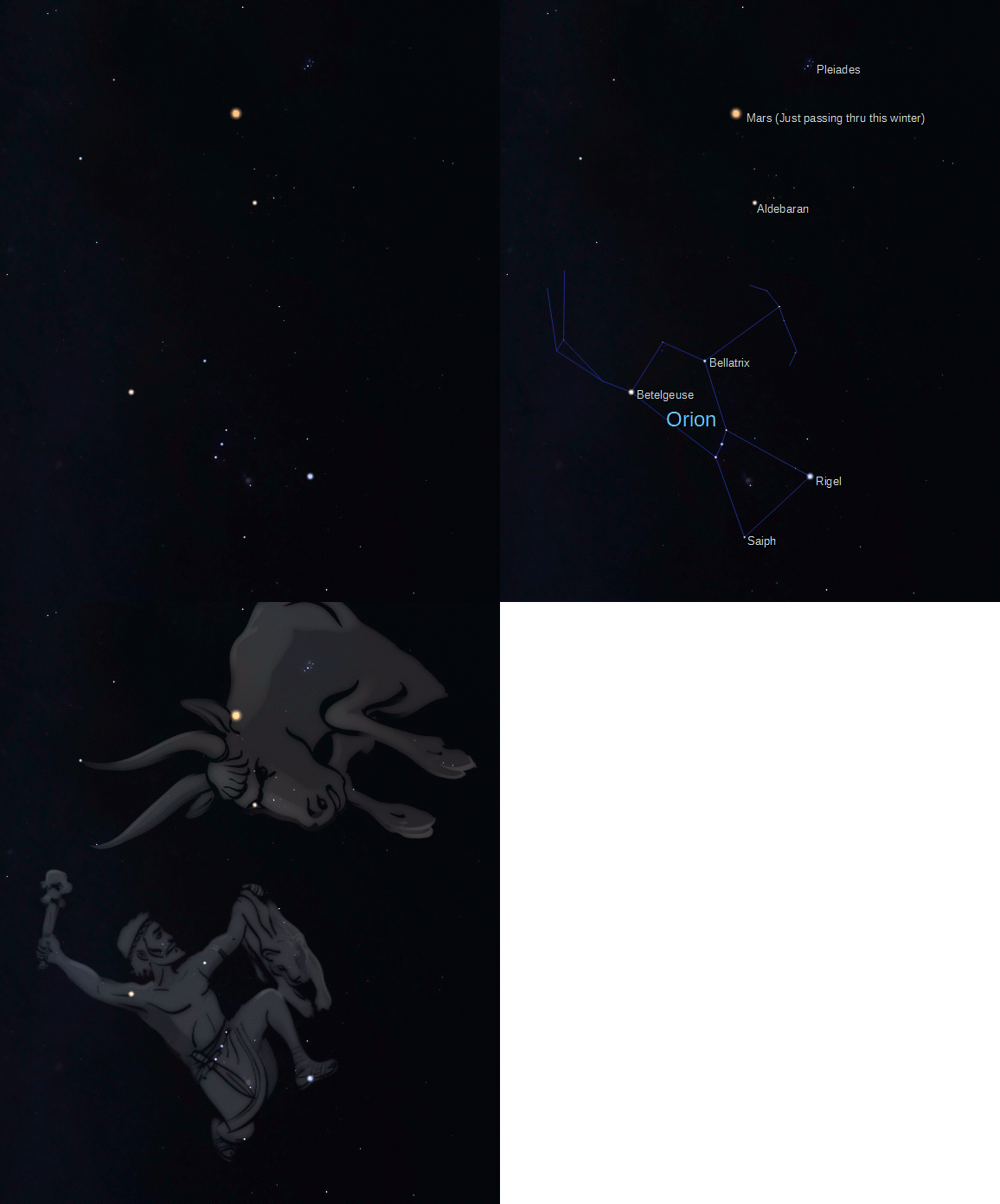
Orion finder animation with Mars. First, showing the unannotated sky looking southeast at Orion. Second, Orion with lines and labels of the stars at the corners of his body, and other bright stars in the view, plus the Pleiades and bright planet Mars, that’s just happening to be passing through this year. Third, the constellation art for Orion and Taurus the bull. Created using Stellarium, LibreOffice Draw and GIMP.
Here are the three stories of how Orion died: One: Orion raped the goddess Artemis, and so she killed him. Two: Orion was betrothed to Artemis, but her twin brother Apollo was jealous and caused her to kill him in a hunting “accident”. Three: Orion was killed by the sting of a scorpion, which is the reason Orion and Scorpius are never in the sky at the same time.
12/15/2022 – Ephemeris – Stories of the Pleiades from many lands
This is Ephemeris for Thursday, December 15th. Today the Sun will be up for 8 hours and 49 minutes, setting at 5:02, and it will rise tomorrow at 8:13. The Moon, 1 day before last quarter, will rise at 12:16 tomorrow morning.
Let’s look at how some ancient cultures saw the Pleiades, the star cluster that is seen high in the eastern sky these evenings. To the Anishinaabe native peoples around here, the Pleiades is the “Hole in the Sky” or the seven stones that are heated for the sweat lodge ceremony. To the Kiowa, these were sister stars that had been whisked into the sky from the top of Devil’s Tower in Wyoming, where they were threatened by a huge bear. In Norse mythology, these were the goddess Freya’s* hens. The name we know them by has rather misty origins. Some think the Greek name is from the mother of the seven sisters, Pleione. The Greek word for sail is similar to Pleiades, and the appearance of the Pleiades in the morning sky saw the best sailing weather in the Mediterranean.
The astronomical event times given are for the Traverse City/Interlochen area of Michigan (EST, UT –5 hours). They may be different for your location.
* Freya is the Norse goddess from which we get the name of the day of the week Friday from. In Latin, the day is named after the goddess Venus.
Addendum
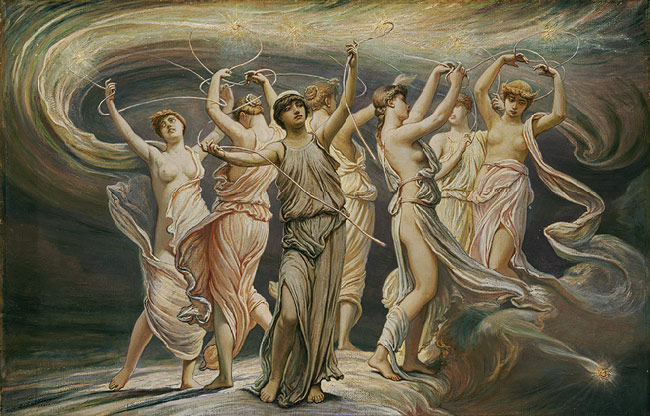
The Greek Pleiades, a painting by Elihu Vedder in the Metropolitan Museum of Art, New York City. Public Domain.

Seven maidens being attacked by a giant bear, having fled to the top of Devil’s Tower in Wyoming. Painting by Herbert Collins, http://www.nps.gov/deto

They are also the Seven Daughters of the Moon and Sun. They loved to dance and play, and when their father, the Moon was low in the sky, would descend to the Earth in a basket to do their thing. On one of their trips to the earth, one of them was captured by a human, and she ended up falling in love with him, and married him. When father Moon found out, he permanently dimmed her star, so now most people now only can spot 6 of the stars. This last bit seems to parallel the Greek story of the lost Pleiad.

