Archive
04/21/2017 – Ephemeris – Mars is passing south of the Pleiades today
Ephemeris for Friday, April 21st. The Sun rises at 6:47. It’ll be up for 13 hours and 47 minutes, setting at 8:35. The Moon, 2 days past last quarter, will rise at 4:54 tomorrow morning.
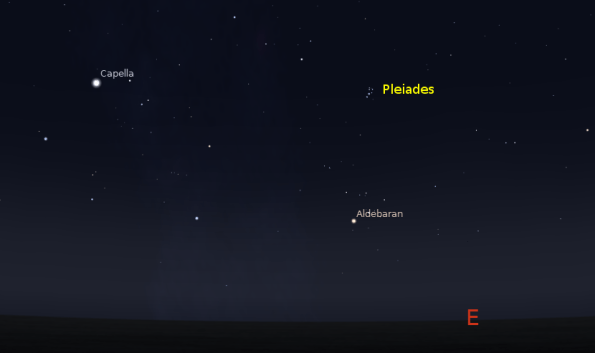
Mars in its ever eastward trek through the constellations of the Zodiac is now just south of the Pleiades or Seven Sisters star cluster in the western evening twilight. By 10 p.m. Mars will be 10 degrees above the western horizon. That’s the width of a fist held at arm’s length. Because of our location on the Earth, the setting sky is tilted, so Mars being south of the Pleiades is to the lower left of it. The bright star Aldebaran, now brighter than Mars is to the left of it with the V-shaped star cluster called the Hyades, in mythology, half sisters of the Pleiades, filling out the face of Taurus the bull. Mars will finally be overtaken by the Sun on July 26th. After that it will spend more than a year to come closer to us than at any time since August 2003.
First star party of the year at the Sleeping Bear Dunes National Lakeshore
Tomorrow night the Rangers of the Sleeping Bear Dunes National Lakeshore and the Grand Traverse Astronomical Society will host a Star Party at the Dune Climb featuring the planet Jupiter, and the stars of spring. It starts at 9 p.m.
The times given are for the Traverse City/Interlochen area of Michigan. They may be different for your location.
Addendum
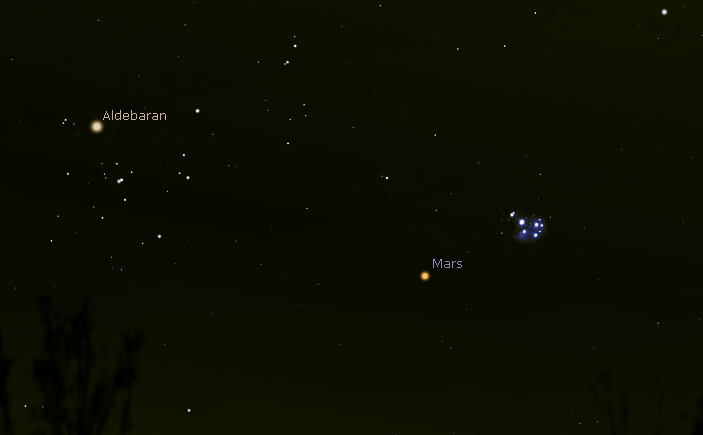
Mars and the Pleiades at 10 p.m. April 21, 2017. Aldebaran and the Hyades which is the face of Taurus the bull is to the left of them. Created using Stellarium.
Note that the nebulosity in the Pleiades exists, but is not visible to the naked eye.
03/16/2017 – Ephemeris – Curly Tail, The Great Underwater Panther
Ephemeris for Thursday, March 16th. The Sun will rise at 7:52. It’ll be up for 11 hours and 57 minutes, setting at 7:50. The Moon, half way from full to last quarter, will rise at 12:03 tomorrow morning.
The Anishinabek people of the Great Lakes Region, which includes the Ottawa, Chippewa and Ojibwe Indians have two constellations of winter that I know of. The first is The Winter Maker which uses many of Orion’s stars plus Procyon the Little Dog Star. It rises in the eastern skies in the evening as winter is beginning. The second is the Curly Tail, the Great Underwater Panther. Which uses the stars of Leo the lion’s backward question mark as its tail and the small knot of stars that are the head of Hydra the water snake below Cancer as its head. I imagine this constellation was a warning to youngsters to keep off the thinning ice of spring, lest they fall in and be snatched by the great underwater panther that lives beneath the ice.
Times are for the Traverse City/Interlochen area of Michigan. They may be different for your location.
Addendum
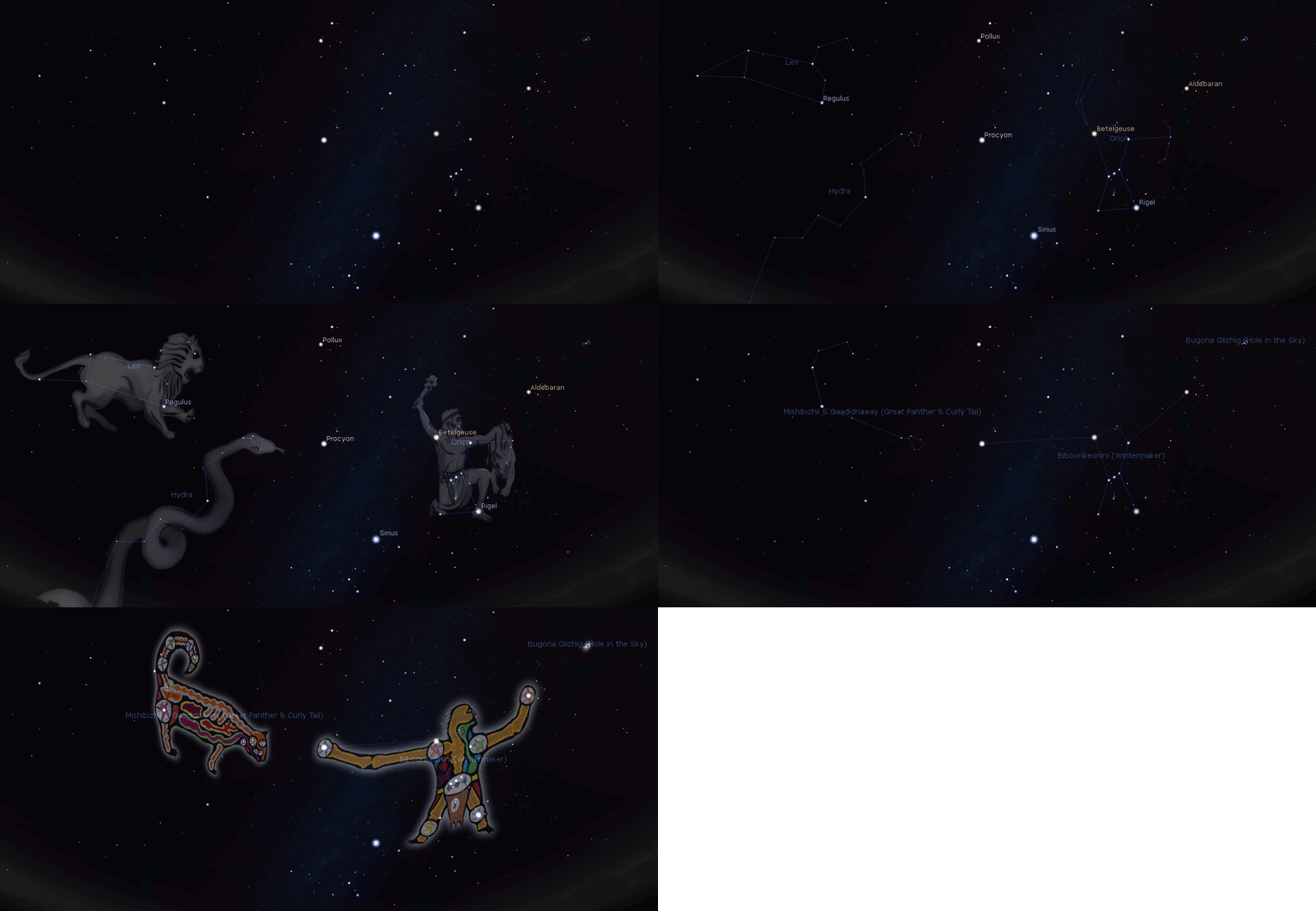
An animated GIF rotating between an unannotated star field facing south at 10 p.m. March 16th.; Western constellation names and lines for Orion, Hydra, and Leo; Western constellation art, Ojibwe constellation names and lines; and Ojibwe constellation art. Created using Stellarium. The Ojibwe constellation art is supplied as part of the latest version of Stellarium. Click on the image to enlarge.
The source for the Ojibwe constellation art is from Ojibwe Sky Star Map Constellation Guide (An introduction to Ojibwe Star Knowledge) by Annette S. Lee, William Wilson, Jeffrey Tibbetts, and Carl Gawboy, ISBN 978-0-615-98678-4. The illustrations are by Annette S. Lee and William Wilson. There is also a poster sized star map available. It should be available in book stores locally, or at Amazon. I found my copy at Enerdyne in Suttons Bay.
Also shown is the Pleiades, which to the Ojibwe is Hole in the Sky, which has to do with the Shaking Tent Ceremony. The Pleiades is also known as the Sweating Stones, the heated stones used in the Sweat Lodge Ceremony. In the later spring sky the Sweat Lodge itself is seen in the stars of the Western Corona Borealis.
Note: As far as tribe names go: Ottawa = Odawa, and Chippewa = Ojibwe.
02/24/2017 – Ephemeris – Winter star party at the Sleeping Near Dunes tomorrow night
Ephemeris for Friday, February 24th. The Sun will rise at 7:27. It’ll be up for 10 hours and 56 minutes, setting at 6:23. The Moon, 2 days before new, will rise at 6:53 tomorrow morning.
Tomorrow night the Grand Traverse Astronomical Society and the Rangers of the Sleeping Bear Dunes National Lakeshore will hold a star party at the Dune Climb parking lot from 7 to 9 p.m. but only if it is clear. Last Saturday night it happened to be clear, so I went out there to do some photography of the heavens, and the sky was spectacular with the brilliant constellation Orion dominating the southern sky. Its great star forming region, the Great Orion Nebula displaying its bright heart and wispy outer tendrils of gas and dust heading away from that nest of bright baby stars that are illuminating it. Venus is a shining beacon in the west until it sets into the dune. We might even be able to spot the faint Zodiacal Light in the west.
Times are for the Traverse City/Interlochen area of Michigan. They may be different for your location.
Addendum
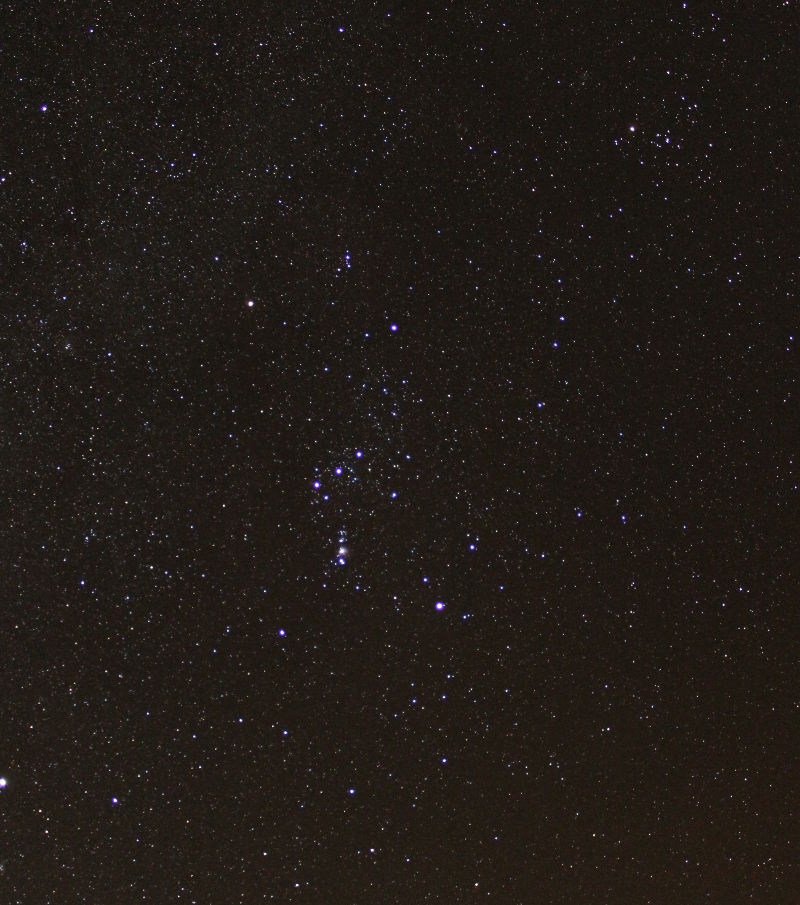
Orion in a 30 second exposure taken at the Sleeping Bear Dunes National Lakeshore Dune Climb February, 18, 2017 by Bob Moler. Click on image to enlarge a bit.
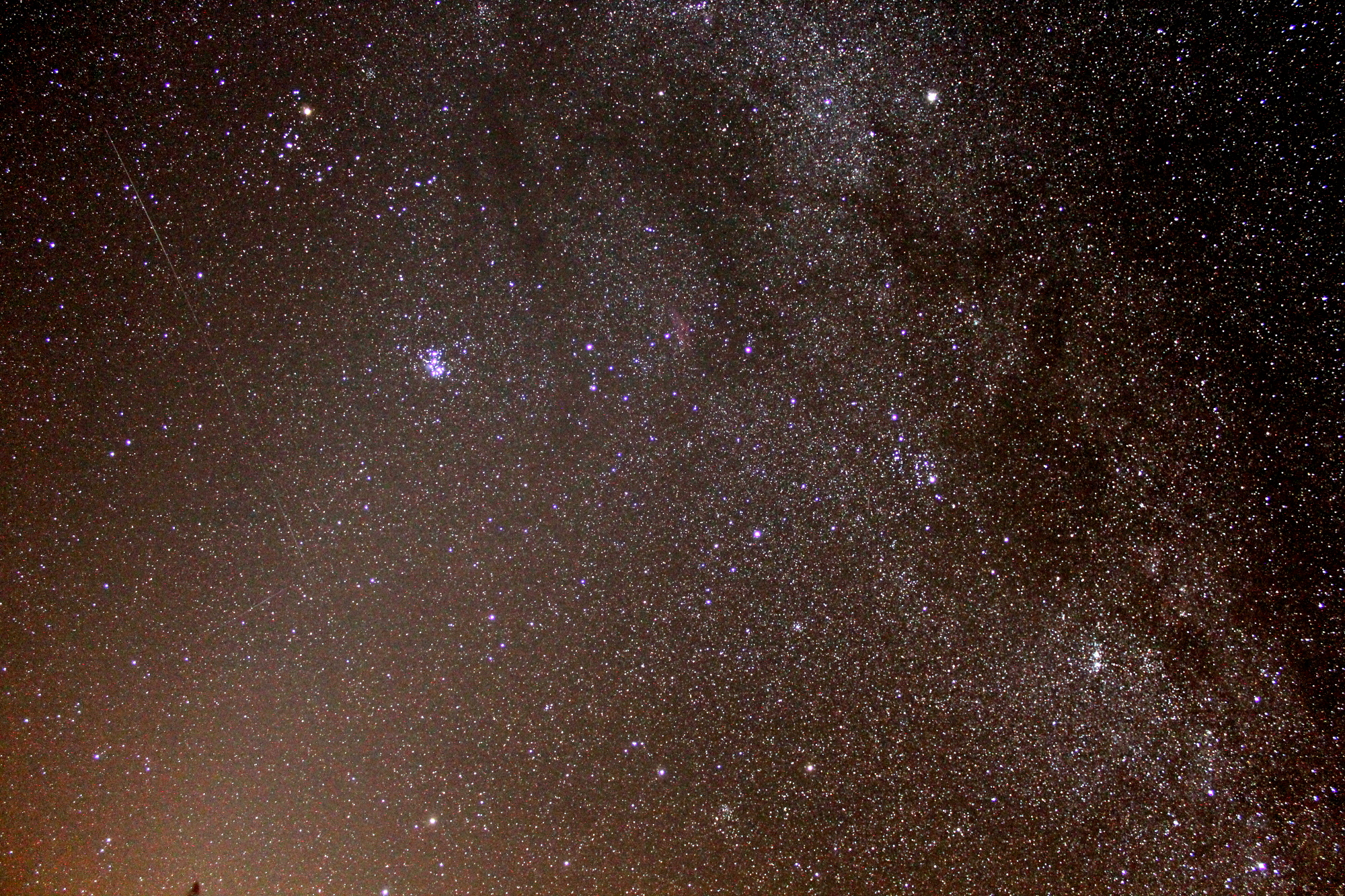
Area of the sky from the Hyades and Pleiades on the left to the Double Cluster on the right. While processing the image for this post I discovered two possible meteor trails on the left and below center. A 2 minute exposure taken at the Sleeping Bear Dunes National Lakeshore Dune Climb February, 18, 2017 by Bob Moler. Click on image to enlarge and see all the deep sky goodies in it..
12/16/2016 – Ephemeris – The Pleiades in the mythology of many cultures
Ephemeris for Friday, December 16th. The Sun will rise at 8:14. It’ll be up for 8 hours and 48 minutes, setting at 5:03. The Moon, 3 days past full, will rise at 8:28 this evening.
Let’s look at how some other cultures saw the Pleiades. To the Anishinabek native peoples around here the Pleiades is the “Hole in the Sky” or the seven stones that are heated for the sweat lodge ceremony. To the Kiowa* these were sister stars that had been whisked into the sky from the top of Devils Tower in Wyoming where they were threatened by a huge bear. In Norse mythology these were the goddess Freya’s hens. The name we know them by has rather misty origins. Some think the Greek name is from the mother of the seven sisters, Pleione. The Greek word for sail is similar to Pleiades, and some suggested that the appearance of the Pleiades in the morning sky signaled the best sailing weather in the Mediterranean region.
Times are for the Traverse City/Interlochen area of Michigan. They may be different for your location.
* I originally reported it as Lakota on the program, and earlier as the Sioux.
Addendum
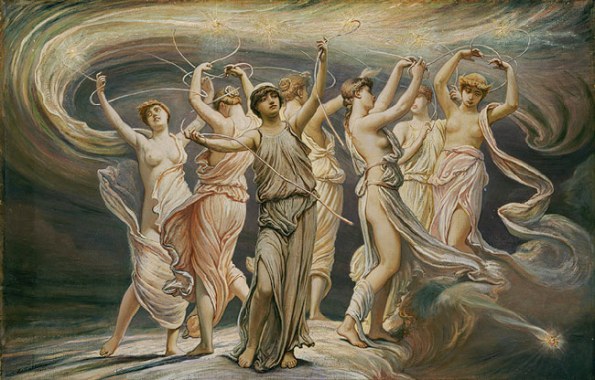
The Greek Pleiades a painting by Elihu Vedder in the Metropolitan Museum of Art, New York City. Public Domain.
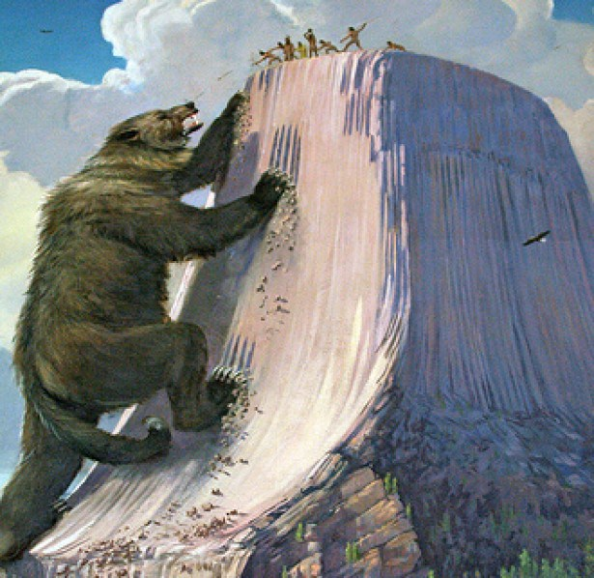
Seven maidens being attacked by a giant bear, having fled to the top of Devil’s Tower in Wyoming. Painting by Herbert Collins, www.nps.gov/deto
12/15/2015 – Ephemeris – The Seven Sisters of the Pleiades
Ephemeris for Thursday, December 15th. The Sun will rise at 8:13. It’ll be up for 8 hours and 49 minutes, setting at 5:02. The Moon, 2 days past full, will rise at 7:21 this evening.
While I’ve mentioned the Pleiades with regard to its neighboring stars and constellations several times this autumn I haven’t looked at this beautiful star cluster itself. The Pleiades appears as a group of six or seven stars visible to the naked eye, of over a hundred stars, and is also known as the Seven Sisters. Some also mistake it for the Little Dipper, due to the little bowl shape in the center of the cluster. I call it the “tiny dipper”. The real Little Dipper is now hanging off Polaris in the north. There are a lot of stories about the Pleiades from many different cultures. From the Greek and Roman cultures we get our best known stories of them, that the seven sisters were the daughters of the god Atlas and Pleione. The 9 brightest stars bear the names of the sisters and their parents.
Times are for the Traverse City/Interlochen area of Michigan. They may be different for your location.
Addendum
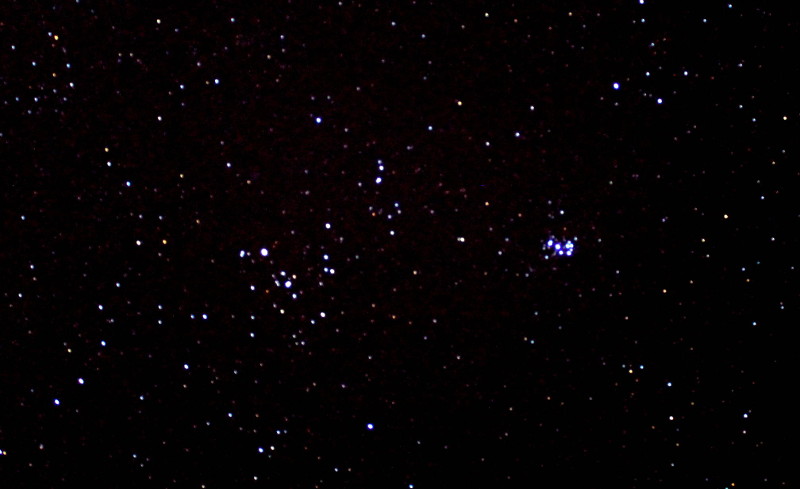
The Pleiades (right) and the Hyades, the face of Taurus the bull (left) in this photograph I took 11:23 p.m. January 4, 2016.
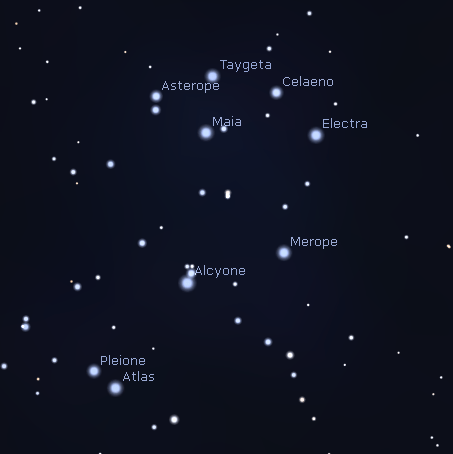
The named stars of the Pleiades. This is also showing more stars than can be seen with the naked eye. This is the number of stars that can be seen in binoculars, which is the best way to observe them. Most telescopes offer too much magnification to fit all the stars in. A thirty power wide angle eyepiece can just fit all the stars in. Created using Stellarium. Note that this view is the orientation of the cluster at 8p.m. tonight.
12/08/2016 – Ephemeris – Aldebaran, the follower
Ephemeris for Thursday, December 8th. The Sun will rise at 8:07. It’ll be up for 8 hours and 54 minutes, setting at 5:02. The Moon, 1 day past first quarter, will set at 2:26 tomorrow morning.
The central constellation of winter, Orion, is low in the east-southeast at 9 p.m. Above it is Taurus the bull. The bright orange star in Taurus is Aldebaran. Aldebaran appears at the bottom left tip of a letter V group of stars lying on its side that is the face of the bull. Aldebaran isn’t actually part of the group, called the Hyades star cluster. The cluster is about 151 light years away, while Aldebaran is a bit less than half that. The star has an orange hue because its surface is cooler than the Sun’s. However Aldebaran is 44 times larger in diameter, and shines 350 times brighter than the Sun. Next Monday night the 12th, the Moon will pass in front of Aldebaran in an event called an occultation I’ll have more information on it then. The name Aldebaran means The Follower, since it follows the Pleiades across the sky as the Earth rotates.
Times are for the Traverse City/Interlochen area of Michigan. They may be different for your location.
Addendum
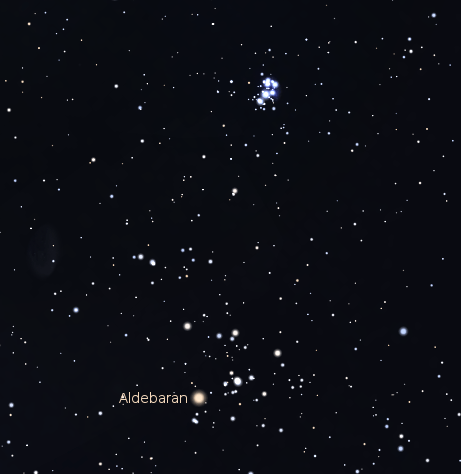
Aldebaran in the ‘V’ shape of the Hyades (The face of Taurus the bull) with the Pleiades above. Created using Stellarium.
11/28/2016 – Ephemeris – The Hyades the star cluster in the face of Taurus the bull
Ephemeris for Monday, November 28th. The Sun will rise at 7:57. It’ll be up for 9 hours and 7 minutes, setting at 5:04. The Moon, 1 day before new, will rise at 7:45 tomorrow morning.
Rising in the east now is the bright star Aldebaran an orange star that’s at one end of the sideways letter V of stars that is the head of Taurus the bull. Above it is the jewel-like Pleiades or Seven Sisters star cluster. There’s more to Taurus, like it’s freakishly long horns and front part of its body. But you can say you’ve seem Taurus, if you can spot his face. That V of stars is actually a star cluster called the Hyades, and in Greek Myth were the half-sisters of the Pleiades, also fathered by the god Atlas. Both the Hyades and Pleiades are being pursued by Orion, which as Robert Frost put it is throwing a leg over the eastern horizon at 8 to 9 pm. He isn’t the only one following the Pleiades, the name Aldebaran means “The Follower”.
Times are for the Traverse City/Interlochen area of Michigan. They may be different for your location.
Addendum
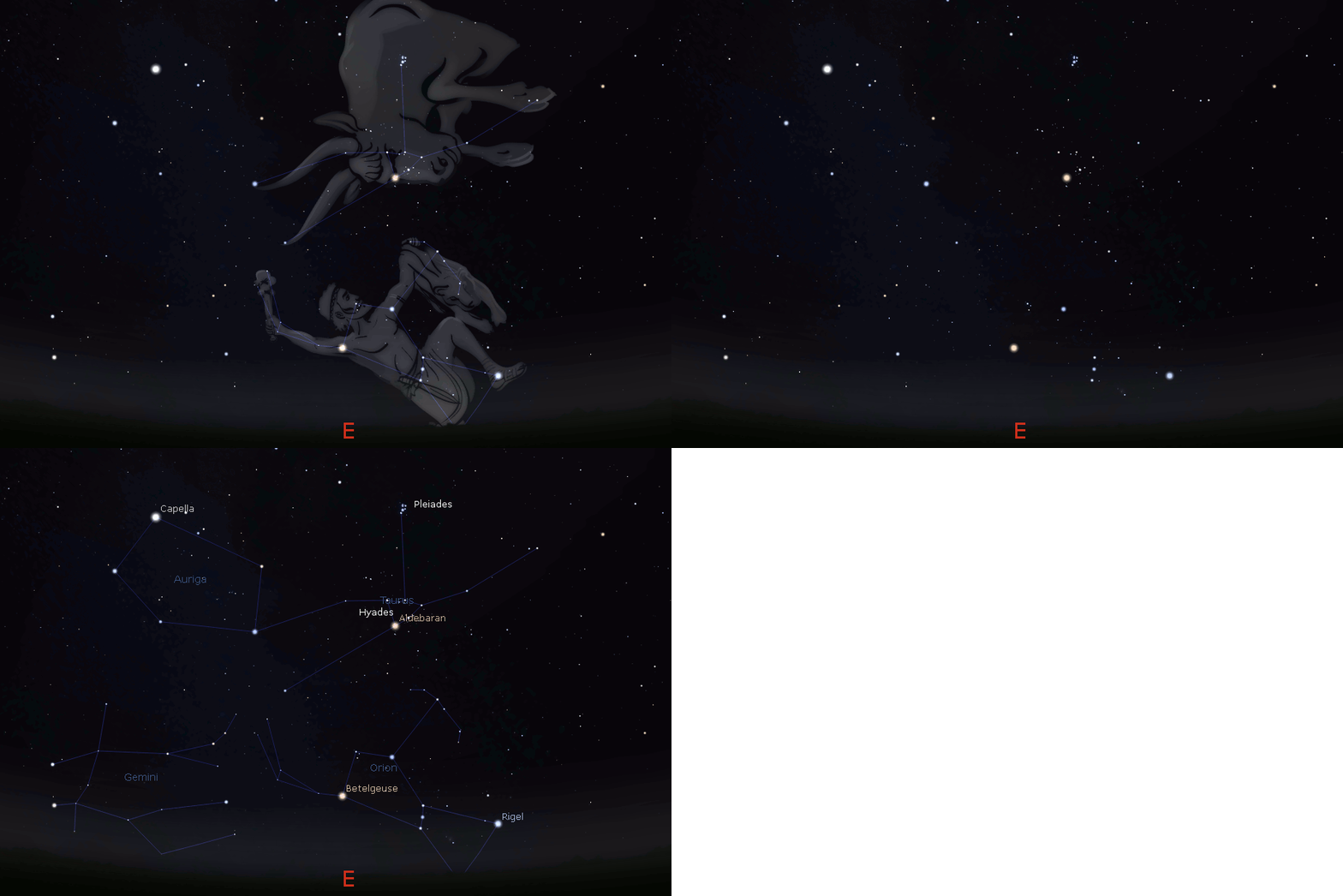
An animation showing the Hyades, Taurus, Orion and the Pleiades. Created using Stellarium and GIMP. Click on image to enlarge.
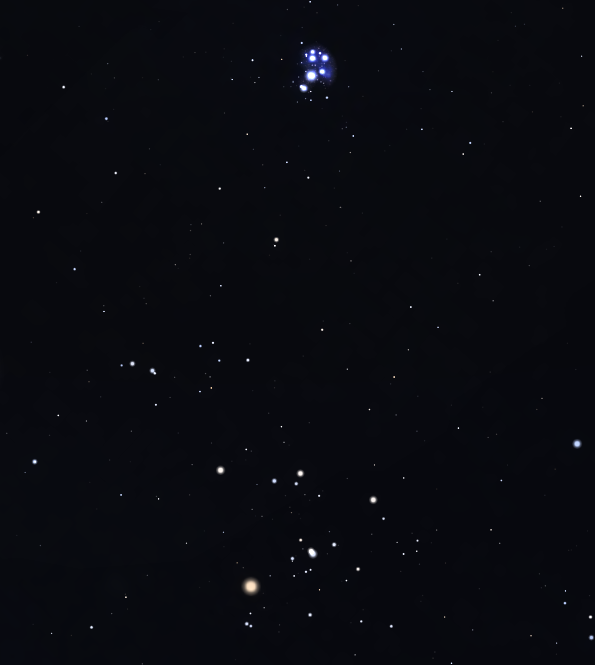
Closeup of the Hyades and the Pleiades. Created using Stellarium.
11/24/2016 – Ephemeris – The little constellation that used to start the seasonal year
Ephemeris for Thanksgiving Day, Thursday, November 24th. The Sun will rise at 7:52. It’ll be up for 9 hours and 14 minutes, setting at 5:06. The Moon, 3 days past last quarter, will rise at 3:54 tomorrow morning.
From antiquity, the first constellation of the Zodiac has been Aries the ram. That’s the constellation the Sun entered on the first day of spring, or the vernal equinox. Well that was a couple of thousand years ago. Currently the vernal equinox point is in western Pisces. This is due to the wobbling of the Earth’s axis called precession. The spinning Earth like and top or gyroscope wobbles when force is applied to it. In this case the Sun and Moon. One wobble takes 26,000 years to complete. Anyway, Aries is a small constellation of four stars in a bent line, below the triangular constellation of Triangulum, which is itself below Andromeda. It’s a bit west or right of the Pleiades or Seven Sisters star cluster.
Times are for the Traverse City/Interlochen area of Michigan. They may be different for your location.
Addendum
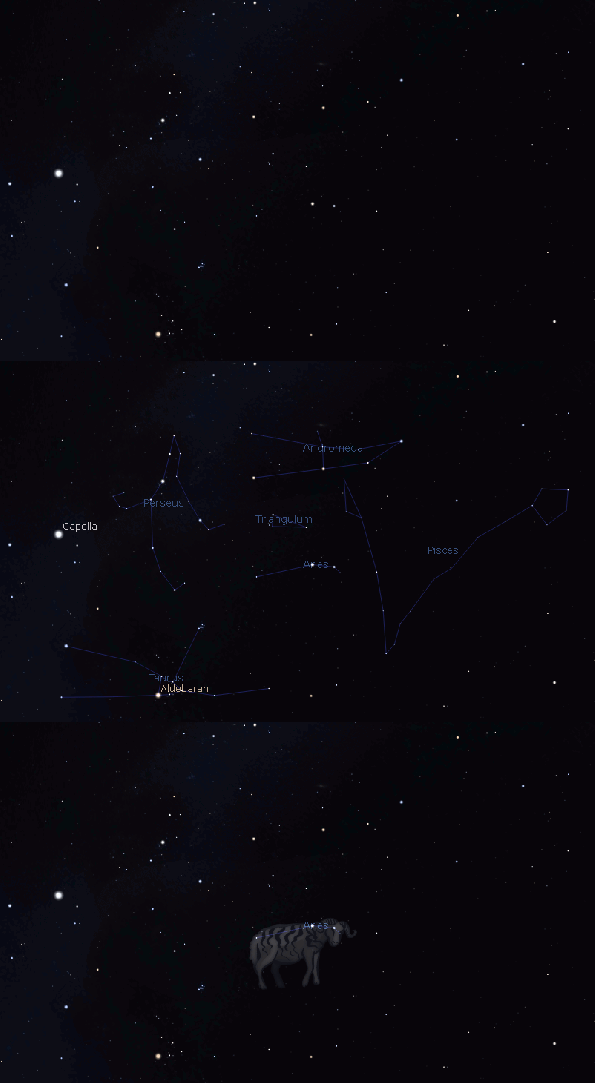
Aries the ram animated finder chart for 9 p.m. November 24, 2016. Created using Stellarium and GIMP.
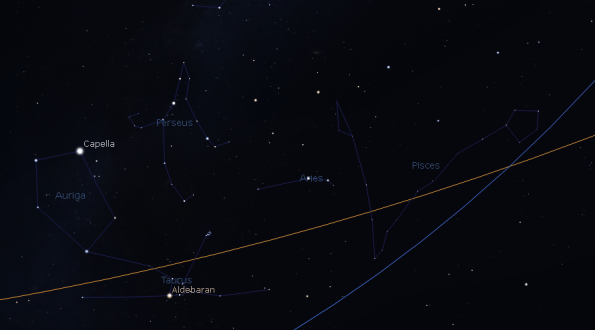
The vernal equinox today, where the blue line, the celestial equator and the orange line, the ecliptic or path of the Sun cross. The Sun is where these lines cross on the first day of spring (March 20th around here). Note that the vernal equinox is now in western Pisces. Created using Stellarium.
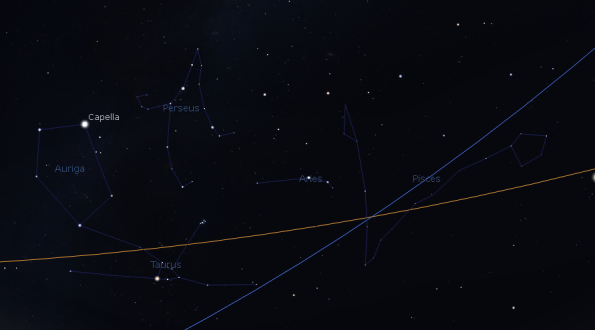
The vernal equinox back in AD 100, where the blue line, the celestial equator and the orange line, the ecliptic or path of the Sun cross. The Sun is where these lines cross on the first day of spring. Note that the vernal equinox was at the east edge of Pisces. Created using Stellarium.
12/17/2015 – Ephemeris – The bright star Aldebaran the “follower”
Ephemeris for Thursday, December 17th. The Sun will rise at 8:14. It’ll be up for 8 hours and 48 minutes, setting at 5:03. The Moon, 1 day before first quarter, will set at 12:07 tomorrow morning.
The central constellation of winter Orion, will be rising the east-southeast at 9 p.m. Above it is Taurus the bull. The bright orange star in Taurus is Aldebaran. Aldebaran appears at the lower left tip of a letter V group of stars that is the face of the bull. Aldebaran isn’t actually part of the group, called the Hyades star cluster. The cluster is about 151 light years away, while Aldebaran is 65. The star has an orange hue because its surface is cooler than the sun’s. However Aldebaran is 44 times larger in diameter, and shines 425 times brighter than the sun, if you include the infrared which our eyes can’t detect, or 150 times brighter in visible light. The name Aldebaran means “Follower” because it follows the Pleiades star cluster above through the night.
Times are for the Traverse City/Interlochen area of Michigan. They may be different for your location.
Addendum
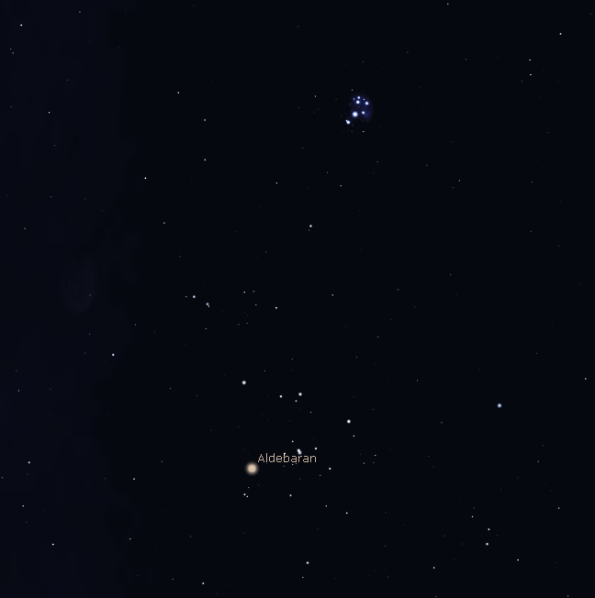
Aldebaran, the Hyades and Pleiades star clusters. Created using Stellarium.
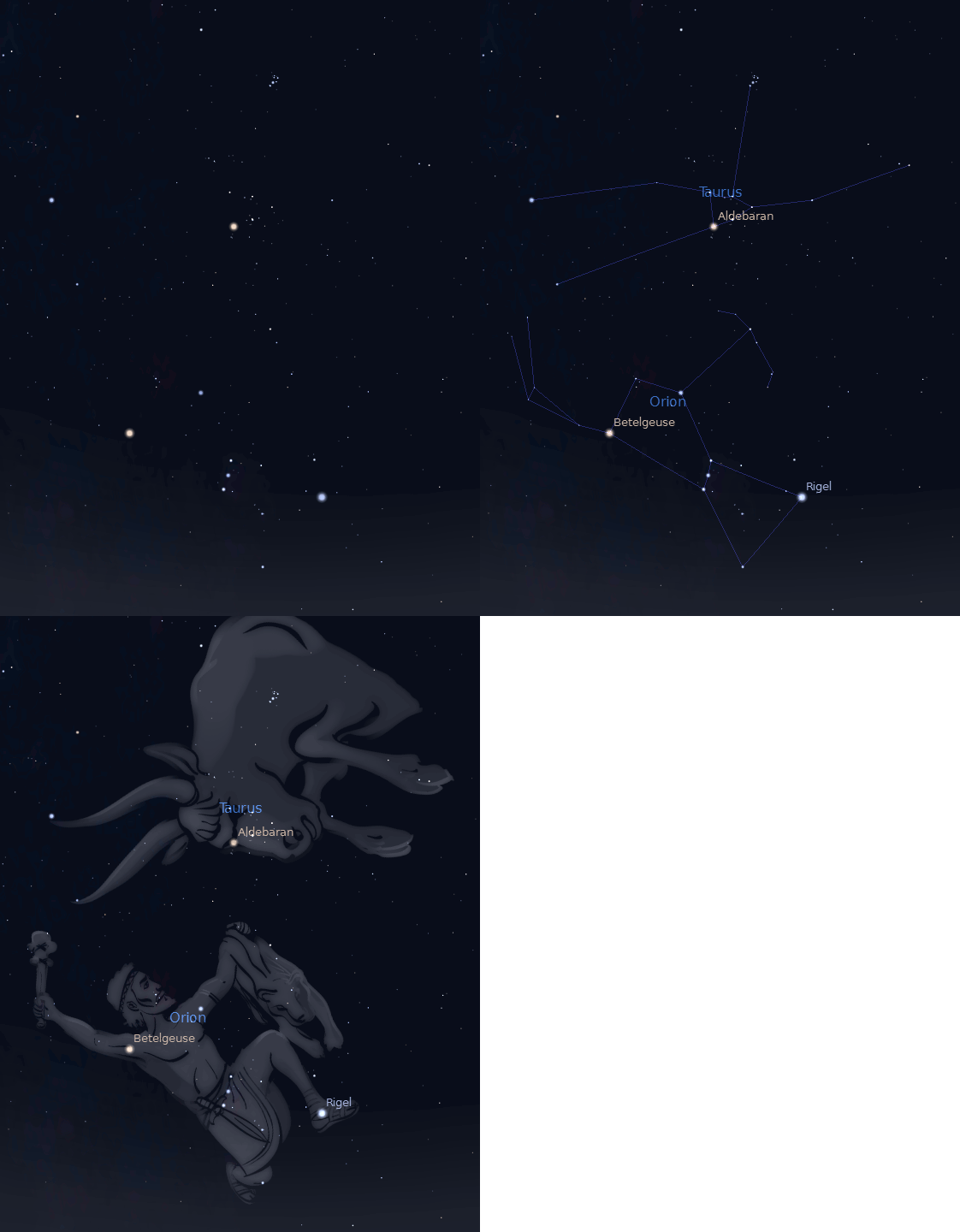
Three views of Taurus the bull and Orion the hunter for 9 p.m. on December 8, 2015. Created using Stellarium and GIMP.
11/09/2015 – Ephemeris – The celestial sisters
Ephemeris for Monday, November 9th. The Sun will rise at 7:31. It’ll be up for 9 hours and 50 minutes, setting at 5:21. The Moon, 2 days before new, will rise at 6:15 tomorrow morning.
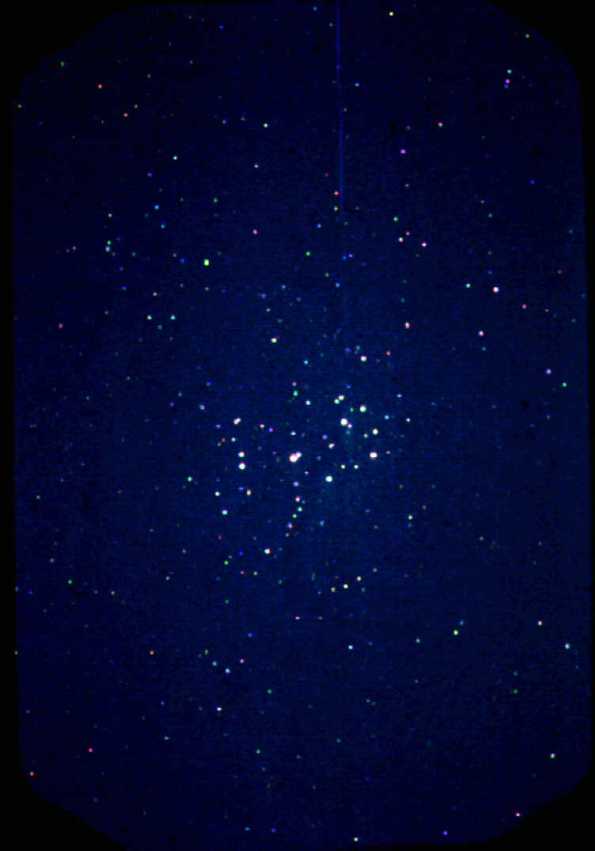
A marvelous member of the autumn skies can be found rising in the east at 8 in the evening. It is the famous star cluster called the Pleiades or the Seven Sisters. I might also add the ‘Tiny Dipper’. Many people can spot a tiny dipper shape in its six or seven stars, and mistake it for the Little Dipper. As nearsighted as I am, though corrected, I’ve never been able to see more than a few stars and a bit of fuzz. However with binoculars, over a hundred stars appear along with the dipper shape of the brightest. The fuzz I saw was unresolved stars, but in photographs the Pleiades actually contains wisps of dust that reflect the star’s blue light which the cluster is passing through. In Greek and Plains Indian mythology the sisters were young maidens.
Times are for the Traverse City/Interlochen area of Michigan. They may be different for your location.
Addenda
The Pleiades rising at 8 p.m. November 9th. Created using Stellarium.
The Pleiades, about what you’d see in binoculars.
I’ll be in Cadillac tonight
I’ll be giving an illustrated talk tonight to the Cadillac Garden Club at St. Ann’s Parish in Cadillac at 7 p.m. I’ll be talking about all the ways the Sun affects the Earth. At 8 p.m., if it’s clear, I and other members of the Grand Traverse Astronomical Society will have some telescopes set up in the parking lot to view the wonders of the heavens. The meeting appears to be open to the public and the viewing after definitely is.
 Bob Moler's Ephemeris Blog