Archive
04/23/2012 – Ephemeris – The moon will appear near the Pleiades tonight
Ephemeris for Monday, April 23rd. The sun rises at 6:44. It’ll be up for 13 hours and 53 minutes, setting at 8:37. The moon, 2 days past new, will set at 11:13 this evening.
This evening the thin crescent moon will appear near the Pleiades, or Seven Sisters. They will appear just to the right of the thin sliver of the moon. If you look closely at the moon the entire Moon will be visible. That’s because the nearly full Earth is shining on it. The phase of the earth in the moon’s sky is exactly the opposite of the moon’s phase in the earth’s sky. The effect is called earth shine and was first explained by Leonardo DaVinci. For future astronauts spending a two week night on the moon’s near side, the full earth in its skies will be much brighter than the full moon looks in our skies. The earth covers 16 times the sky as the moon and is more than twice as reflective as the moon. The moon will continue to move eastward and will be near Venus tomorrow.
Times are for the Traverse City/Interlochen area of Michigan. They may be different for your location.
Addendum
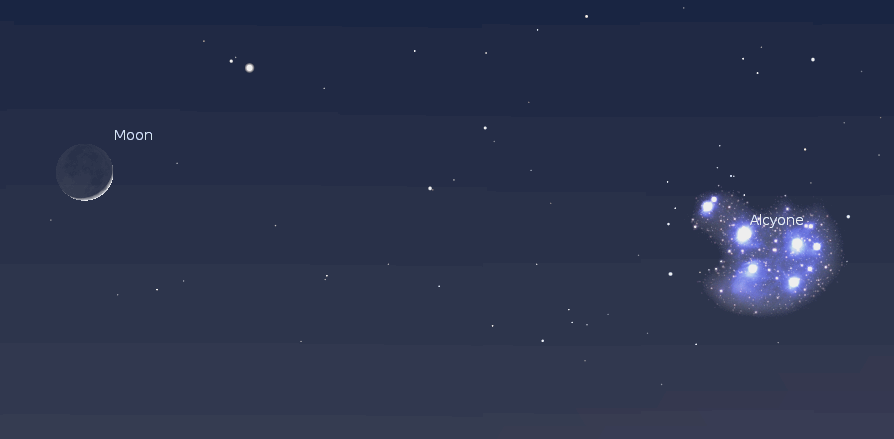
The moon and the Pleiades on April 23rd at 10 p.m. Created using Stellarium.
Note that Stellarium shows a photograph for the Pleiades. The blue reflection nebula is not visible to the eye, and the stars of the Pleiades aren’t that bright in comparison to the moon.
04/03/2012 – Ephemeris – Venus passes the Pleiades part 2.
Ephemeris for Tuesday, April 3rd. The sun will rise at 7:18. It’ll be up for 12 hours and 54 minutes, setting at 8:13. The moon, 3 days before full, will set at 5:43 tomorrow morning.
The brilliant planet Venus is passing by the Pleiades star cluster. It will be a great sight in the west in the evening. Binoculars will help in picking out the Pleiads, as the individual stars of the Pleiades are called. The celestial sphere is the ultimate reference frame for objects in the heavens. It used to be the stars, but the stars move, the sun moves and the earth moves. Now the standard for an unmoving frame of reference is distance quasars, the nearly stellar in size active cores of distant galaxies. While they’re moving too, they are so far away we cannot detect any motion on the celestial sphere. Our earth centered frame of reference rotates within that at once in 26 thousand years as the earth’s axis precesses due to the gravitational pull of the moon.
* Times are for the Traverse City/Interlochen area of Michigan. They may be different for your location.
Addendum
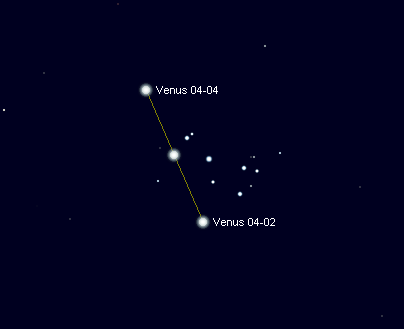
Venus passing the Pleiades April 2 - 4, 2012. Created using Cartes du Ciel.
Click here for a Space.com write up on how quasars are being used as a reference for the GPS system.
04/02/2012 – Ephemeris – Venus will pass the Pleiades tonight
Ephemeris for Monday, April 2nd. The sun will rise at 7:20. It’ll be up for 12 hours and 51 minutes, setting at 8:11. The moon, 3 days past first quarter, will set at 5:14 tomorrow morning.
This evening Venus starts a pass by the Pleiades star cluster. The Pleiades is also known as the Seven Sisters and soon it will disappear in the twilight glow. The next time it will be seen in the evening is in next October. Venus will head back toward the sun, which it will pass directly in front of on June 5th. The sun will pass the Pleiades in mid May, so Venus will never quite make it back to the Pleiades this go around anyway. Though Venus is beginning to head back to the sun, it is still moving eastward against the stars, though a little slower than the sun. Right now Venus is mostly heading toward us. Around the 16th of May Venus will finally stop its eastward motion with respect with the stars and will head westward.
* Times are for the Traverse City/Interlochen area of Michigan. They may be different for your location.
Addendum
Venus passing the Pleiades April 2 - 4, 2012. Created using Cartes du Ciel.
In the real sky Venus is a heck of a lot brighter than you see here. And with binoculars, you’ll see a lot more stars in the Pleiades.
02/28/2012 – Ephemeris – The moon will pass south of the Pleiades tonight
Ephemeris for Tuesday, February 28th. The sun will rise at 7:22. It’ll be up for 11 hours and 5 minutes, setting at 6:28. The moon, 1 day before first quarter, will set at 1:34 tomorrow morning.
The fat crescent moon will appear below the Pleiades star cluster tonight. The Pleiades is also known as the Seven Sisters. With the moon as bright as it is the stars of the Pleiades may not be easily spotted, so a pair of binoculars might be needed. The Pleiades will appear nearly 8 moon diameters above the moon, so they might escape the moon’s glare somewhat. The moon will pass the Pleiades every 28 and a fraction days. Sometimes it passes south of the cluster, and sometimes north of it, and occasionally it passes in front of the stars of the cluster. The moon’s orbit of the earth wobbles or precesses once every 18.6 years. It’s why eclipses occur at different times of the year, and generally earlier one year to the next.
* Times are for the Traverse City/Interlochen area of Michigan. They may be different for your location.
Addendum
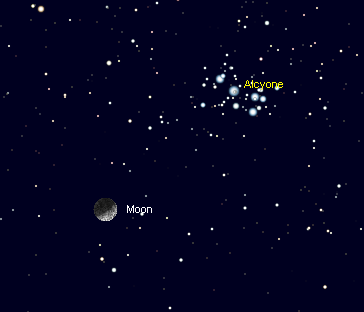
The moon south of the Pleiades at 10:19 p.m. February 28, 2012 from Michigan . Chart created using Cartes du Ciel (Sky Charts)
01/24/2012 – Ephemeris – The face of the constellation Taurus – The Hyades
Ephemeris for Tuesday, January 24th. The sun will rise at 8:09. It’ll be up for 9 hours and 29 minutes, setting at 5:39. The moon, 1 day past new, will set at 7:36 this evening.
To the upper right of the constellation Orion in the south in the evening is a letter V of stars with a bright orange star at one tip. This is the face of Taurus the bull. In some constellation depictions the bull is charging Orion who is turned to face him. The V of stars isn’t very bright and are outshone by the Pleiades star cluster to the right in Taurus’ shoulder. In Greek mythology the V of stars are the Hyades, half sisters of the Pleiades. It is a star cluster like the Pleiades and very important, because it is the closest star cluster to us at 153 light years distant. It helped determine the scale of the universe. The bright star at the tip is Aldebaran the follower (of the Pleiades). It is not part of the Hyades and is less than half way to it at 65 light years.
* Times, as always are for the Traverse City/Interlochen area of Michigan.
Addendum
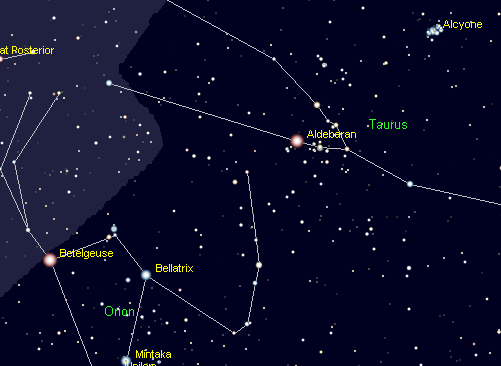
The Hyades, Orion and the Pleiades. Created using Cartes du Ciel
11/25/11 – Ephemeris – The mythology of Taurus the bull
Friday, November 25th. The sun will rise at 7:51. It’ll be up for 9 hours and 15 minutes, setting at 5:06. The moon is new today, and won’t be visible.
Low in the east at 9 p.m. is the constellation of Orion the giant hunter. Above him is Taurus the bull. His face is a letter V shape of stars lying on its side with the bright orange-red star Aldebaran at the bottom tip of the V as its angry blood-shot eye. Orion is depicted in the sky facing with club in one hand and a shield in the other the approaching and in some depictions charging Taurus. The V of stars is a star cluster called the Hyades. The Pleiades are in his shoulder above. Taurus in Greek mythology was the guise the god Zeus when he carried off the maiden Europa. Europa’s still with him, sort of, as the intriguing satellite orbiting Zeus’ Roman equivalent Jupiter. In fact the moons around the planet Jupiter are generally named for Jupiter’s lovers and friends.
* Times, as always are for the Traverse City/Interlochen area of Michigan.
Addendum
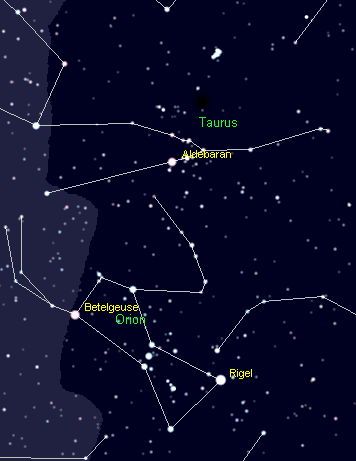
The constellations Taurus and Orion and the Pleiades. Created using Cartes du Ciel.
11/18/11 – Ephemeris – Pleiades, Hyades and Orion
Friday, November 18th. The sun will rise at 7:42. It’ll be up for 9 hours and 29 minutes, setting at 5:12. The moon, at last quarter today, will rise at 12:48 tomorrow morning.
The Pleiades or Seven Sisters star cluster is now quite high in the east at 9 p.m. To the Greeks they were the daughters of the god Atlas. Their half sisters, the Hyades is seen below them as the letter V shape of stars that form the face of Taurus the bull, with the bright orange star Aldebaran at one corner. Both are being chased by the giant hunter Orion, now mostly risen in the east. His three belt stars in a row are now oriented vertically. The reddish star Betelgeuse is to their upper left, while blue-white Rigel to the lower right. Rigel may suffer some by being very close to the horizon at the time, but it will come into its own as it rises higher. [Here is our preview of the glories of the winter sky. There is more to come as the night wears on.]
* Times, as always are for the Traverse City/Interlochen area of Michigan. Bracketed passage was omitted from the audio program due to time constraints.
Addendum
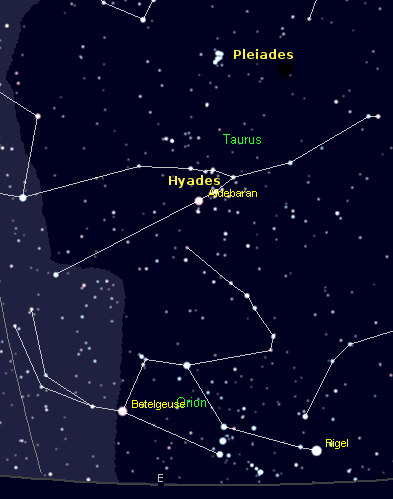
The eastern sky at 9 p.m.
10/18/11 – Ephemeris – The Pleiades or Seven Sisters
Tuesday, October 18th. The sun will rise at 8:01. It’ll be up for 10 hours and 52 minutes, setting at 6:53. The moon, 1 day before last quarter, will rise at 11:25 this evening. | A marvelous member of the autumn skies can be found rising in the east at 9 in the evening. It is the famous star cluster called the Pleiades or the Seven Sisters. I might also add the ‘Tiny Dipper’. Many people can spot a tiny dipper shape in its six or seven stars, and mistake it for the Little Dipper. As nearsighted as I am, though corrected, I’ve never been able to see more than a few stars and a bit of fuzz. However with binoculars, even I can see over a hundred stars appear along with the dipper shape of the brightest. The fuzz I saw was unresolved stars, but in photographs the Pleiades actually contains remnant wisps of the gaseous cocoon they were born from a hundred million years ago. In Greek mythology the sisters were daughters of the god Atlas.
* Times are for the Traverse City/Interlochen area of Michigan. They may be different for your location.
Addendum
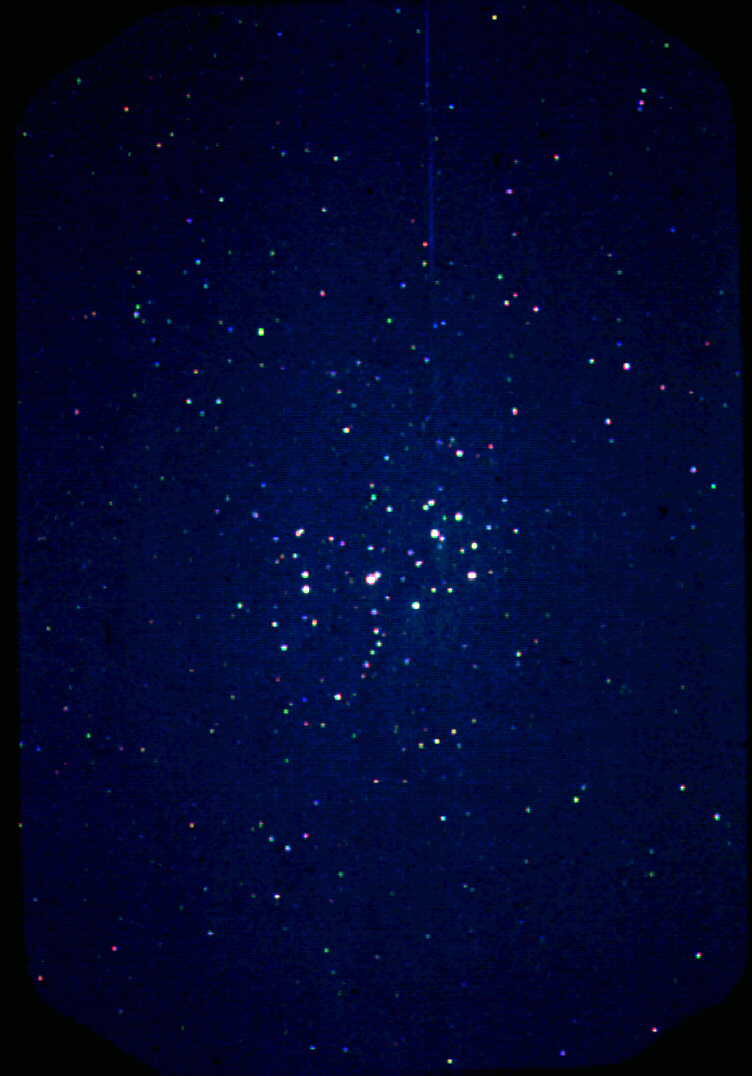
The Pleiades, about what you'd see in binoculars.
03/10/11 – Ephemeris – The moon will appear near the Pleiades tonight
Thursday, March 10th. The sun will rise at 7:04. It’ll be up for 11 hours and 37 minutes, setting at 6:41. The moon, 2 days before first quarter, will set at 12:54 tomorrow morning.
The fat crescent moon tonight will be near the Pleiades or Seven Sisters star cluster. The Pleiades can be seen above the moon. They will make a very beautiful sight in binoculars. They will be closest together near 2 in the morning. Some years the moon will even pass in front of the stars of the Pleiades. On the moon itself tonight, in binoculars, we can see the dark lunar seas of Crises, Fertility, Nectar, and Tranquility. With a telescope the crater Theophilus is visible near the terminator, the sunrise line a bit below center of the moon. It is a perfect circular crater with a central peak. The best crater visible now. That will change as the moons phase becomes fuller. It will appear washed out and indistinct. The moon needs shadows to delineate its features.
* Times are for the Traverse City/Interlochen area of Michigan. They may be different for your location.
Blog addendum:
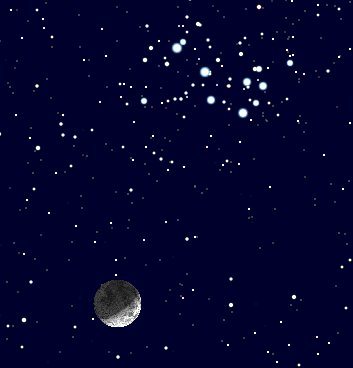
Pleiades and the moon 03/10/11, created using Cartes du Ciel.
Here’s a closer look at the moon courtesy of Virtual Moon Atlas.
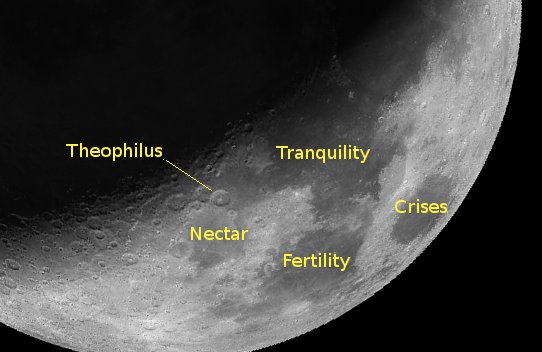
Young moon with the crater Theophilus and four seas. From Virtual Moon Atlas

