Archive
Ephemeris: 10/03/2023 – How to find Cassiopeia the queen
This is Bob Moler with Ephemeris for Tuesday, October 3rd. Today the Sun will be up for 11 hours and 36 minutes, setting at 7:19, and it will rise tomorrow at 7:44. The Moon, 3 days before last quarter, will rise at 9:35 this evening.
The stars of the autumn skies are slowly replacing the summer stars from the east. By 9 pm Scorpius the scorpion is gone, The Teapot asterism of Sagittarius is pouring its tea on the southwestern horizon. Looking halfway up in the northeastern sky these autumn the evenings one can find the letter W shaped constellation of Cassiopeia the queen. Cassiopeia is so far north that it never sets for us in Michigan. It is opposite the pole star Polaris from the handle of Big Dipper. Above and left of Cassiopeia is a dim upside down church steeple shaped constellation of Cepheus the king, her husband.
The astronomical event times given are for the Traverse City/Interlochen area of Michigan (EDT, UT –4 hours). They may be different for your location.
Addendum
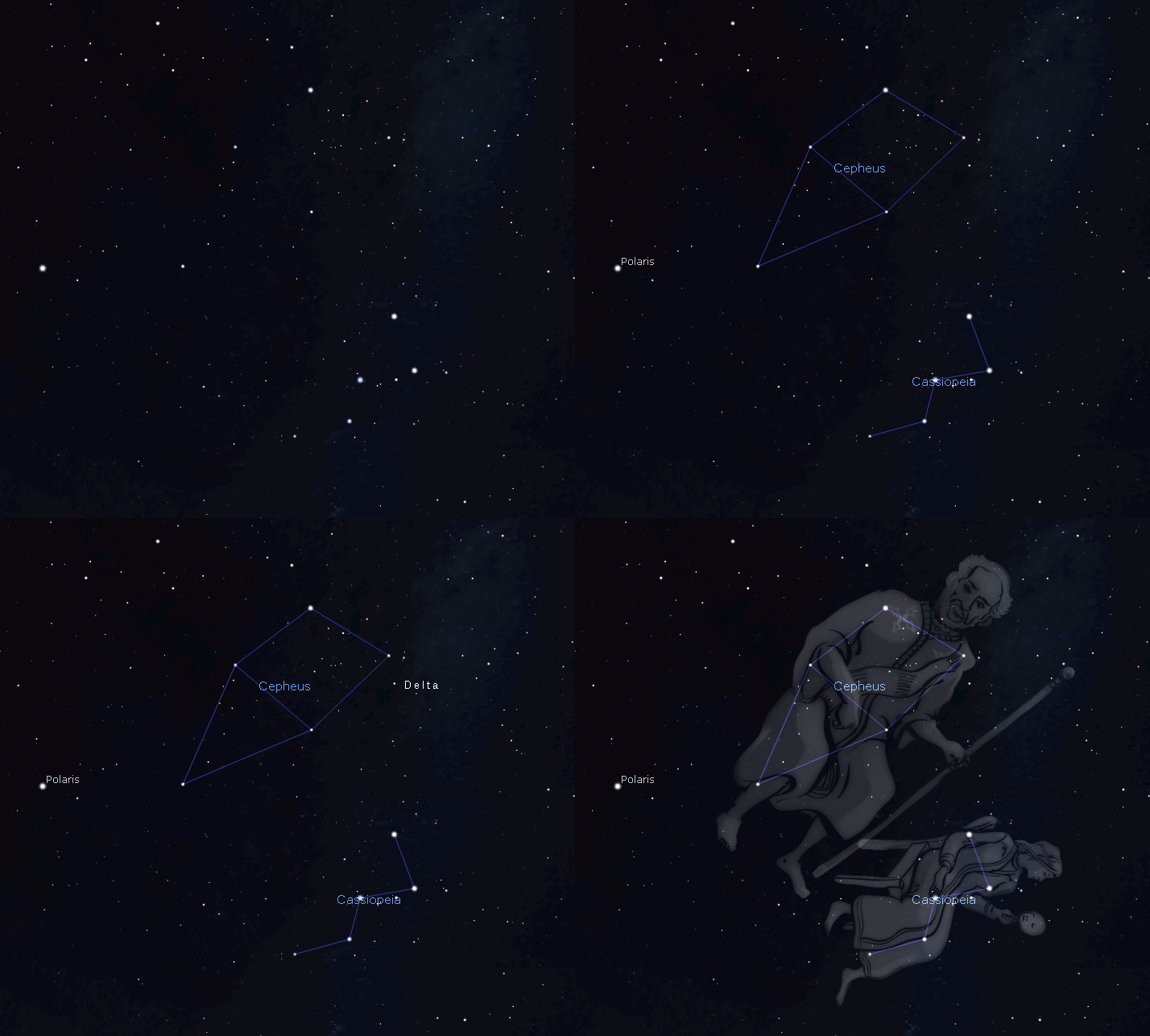
Delta Cephei is the archetype for the important Cepheid variable stars that are used in distance measurement as far as the nearest galaxies. Delta itself varies its brightness from magnitude 4.37 up to 3.48. In astronomy the lower the magnitude the brighter the star. The difference of 0.89 magnitude equals a difference in brightness of 2.27 times. Delta has a pulsation period of 5.367 days. For Cepheids, the longer the period the brighter the star.
07/14/2023 – Ephemeris – Finding Polaris and why it’s important
This is Bob Moler with Ephemeris for Friday, July 14th. Today the Sun will be up for 15 hours and 16 minutes, setting at 9:26, and it will rise tomorrow at 6:11. The Moon, 3 days before new, will rise at 3:46 tomorrow morning.
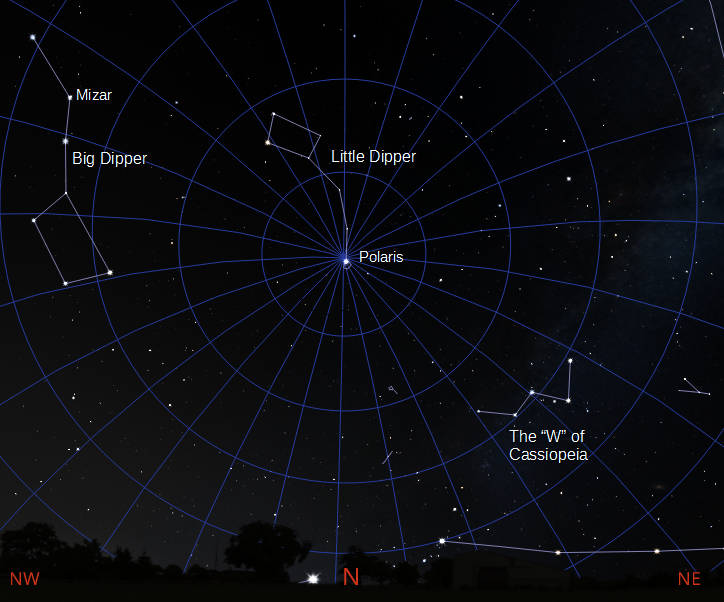
The most important star in the night sky, especially if you are lost, is Polaris, also called the North Star or Pole Star. Face Polaris and North is in front of you, East is to the right, west to the left and south will be behind you. To find Polaris, first find the Big Dipper. In the evening. This time of year, it’s hanging by its handle in the northwest, the direction that the sun set at. The two stars at the front of the bowl point to Polaris, which is to the right of it, now. Throughout the night, as the Earth rotates. Polaris will hold its position as all the other stars go around it in a counterclockwise direction. Polaris is at the end of the handle of the Little Dipper. That handle start’s vertically but curves to the left and is made of faint stars.
The astronomical event times given are for the Traverse City/Interlochen area of Michigan (EDT, UT –4 hours). They may be different for your location.
Addendum
06/19/2023 – Ephemeris – Juneteenth and the flight to freedom
This is Bob Moler with Ephemeris for Juneteenth, Monday, June 19th. Today the Sun will be up for 15 hours and 34 minutes, setting at 9:31, and it will rise tomorrow at 5:56. The Moon, 1 day past new, will set at 11:22 this evening.
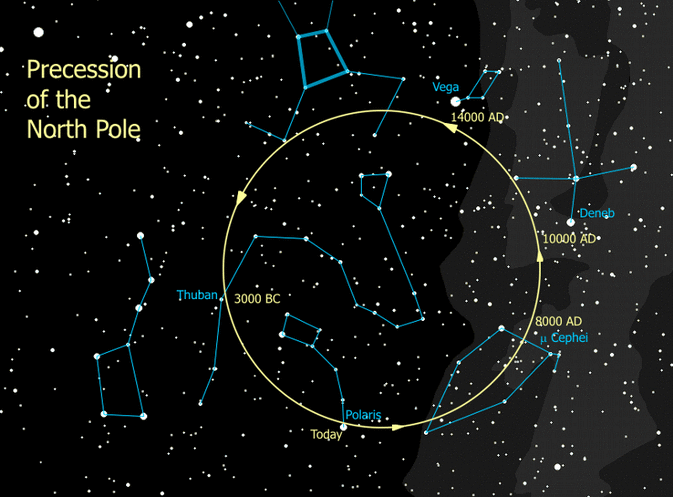
In 1865, it was on June 19th that the Union soldiers, led by Major General Gordon Granger, landed at Galveston, Texas with news that the war had ended and that the slaves were now free. Until then about the only path to freedom for the slaves was “To follow the Drinking Gourd”, or the Big Dipper, northward. The Big Dipper and the Great Bear, Ursa Major, has, for the last few millennia been the constellation of the north, being closer to the North Pole of the sky than it is now. The Earth’s axis has a slow wobble, called precession, caused by the gravitational pull of the Moon and Sun on Earth’s slight equatorial bulge of 30 miles wider than the pole to pole distance. That wobble period is nearly 26 thousand years.
The astronomical event times given are for the Traverse City/Interlochen area of Michigan (EDT, UT –4 hours). They may be different for your location.
Addendum

07/08/2022 – Ephemeris – Polaris the North Star
This is Ephemeris for Friday, July 8th. Today the Sun will be up for 15 hours and 24 minutes, setting at 9:29, and it will rise tomorrow at 6:06. The Moon, 2 days past first quarter, will set at 2:17 tomorrow morning.
The bright star Polaris is a very important star. It is also known as the North Star and the Pole Star. Its unique position is nearly directly at the zenith at the Earth’s North Pole, making it a very important navigational star. It’s about 40 minutes of arc, or about one and a third Moon diameters away from the extension of the Earth’s axis into the sky. As a rule of thumb, its angular altitude above the northern horizon is approximately one’s latitude, and it stands about at the due north compass point. Polaris is found using the Big Dipper, using the two stars at the front of the dipper bowl to point to it. It’s located at the tip of the handle of the very dim Little Dipper which, this time of year in the evening, appears to be standing on its handle.
The astronomical event times given are for the Traverse City/Interlochen area of Michigan (EDT, UT – 4 hours). They may be different for your location.
Addendum

Polaris finder and location animation. Three frames: visual appearance in the sky, lines of the asterisms of the Big and Little Dippers, addition of the equatorial grid of celestial coordinates analogous to longitude and latitude on the Earth. The right ascension (like longitude) lines converge over the Earth’s North Pole, with Polaris close by. Created using Stellarium and GIMP.
The two stars at the front of the Big Dipper’s bowl, at the bottom of the dipper as it appears now in the evening, point to Polaris near the 11-hour right ascension line. Right ascension, though the same as earthly longitude, is measured in hours, rather than degrees. An hour equals 15 degrees, making 24 hours equal 360 degrees.
08/30/2021 – Ephemeris – “W”
This is Bob Moler with Ephemeris for Monday, August 30th. Today the Sun will be up for 13 hours and 19 minutes, setting at 8:22, and it will rise tomorrow at 7:04. The Moon, at last quarter today, will rise at 12:26 tomorrow morning.
Rising higher each evening in the northeastern sky is a group of stars that make the pattern of the letter W. It is the constellation of Cassiopeia the queen. It is one of the more recognizable star patterns. From our latitude here in Northern Michigan, it is circumpolar, meaning that it never sets. Though, the best time to see it is in the autumn and winter, when it’s highest in the sky. It is opposite the Big Dipper from Polaris, the north star. In fact, a line drawn from any of the handle stars of the Big Dipper through Polaris will reach Cassiopeia. So as the Big Dipper descends in the northwestern sky now, Cassiopeia ascends in the northeast. They change places in winter and spring as the Big Dipper ascends in the northeast.
The astronomical event times given are for the Traverse City/Interlochen area of Michigan (EDT, UT – 4 hr). They may be different for your location.
Addendum
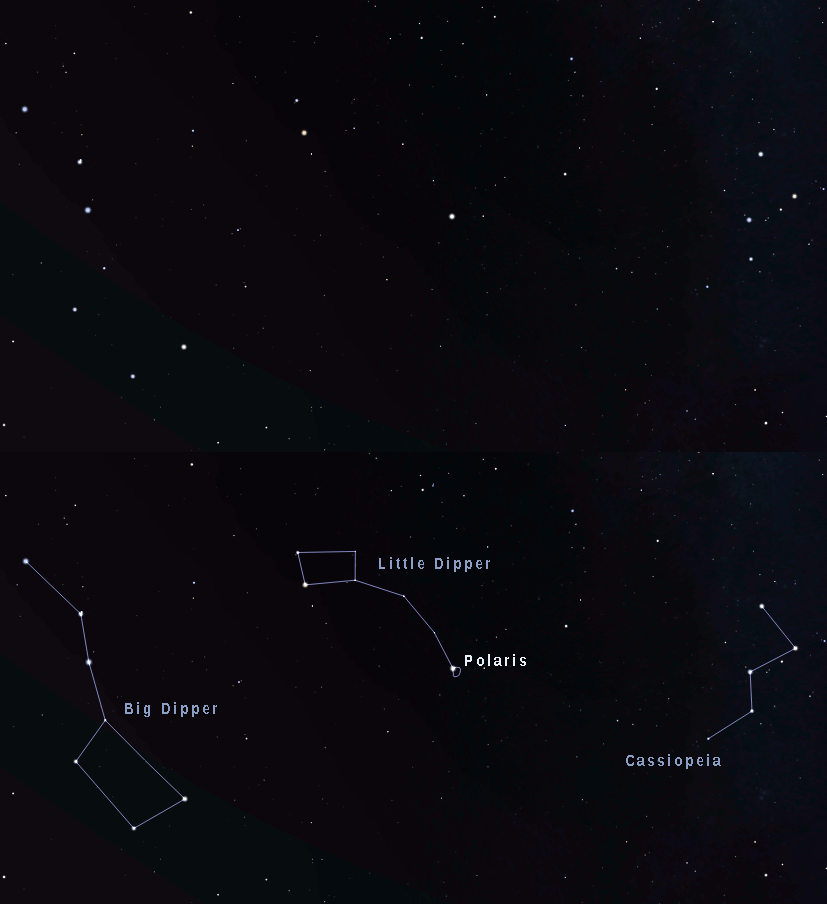
Animation showing the juxtaposition of Cassiopeia and the Big Dipper from Polaris, the North Star. Click on the image to enlarge it. Created using Stellarium and GIMP.
01/18/2021 – Ephemeris – The Drinking Gourd
This is Bob Moler with Ephemeris for Martin Luther King Jr. Day, Monday, January 18th. Today the Sun will be up for 9 hours and 18 minutes, setting at 5:32, and it will rise tomorrow at 8:13. The Moon, 2 days before first quarter, will set at 11:34 this evening.
This day is set aside to honor the Reverend Dr. Martin Luther King Jr. who gave his life for the struggle for equality for blacks and other minorities and to end segregation. A struggle that continues to this day. In the decades before the Civil War runaway slaves would travel, often at night, northward from the slave states of the south to the northern free states and Canada over the metaphorical Underground Railroad following the Drinking Gourd, the Big Dipper as their compass. Over the last several millennia the Great Bear, Ursa Major has been that northward pointer. For much of that time the North Pole of the sky had been passing near the handle of the Big Dipper or bear’s tail.
The event times given are for the Traverse City/Interlochen area of Michigan. They may be different for your location.
Addendum
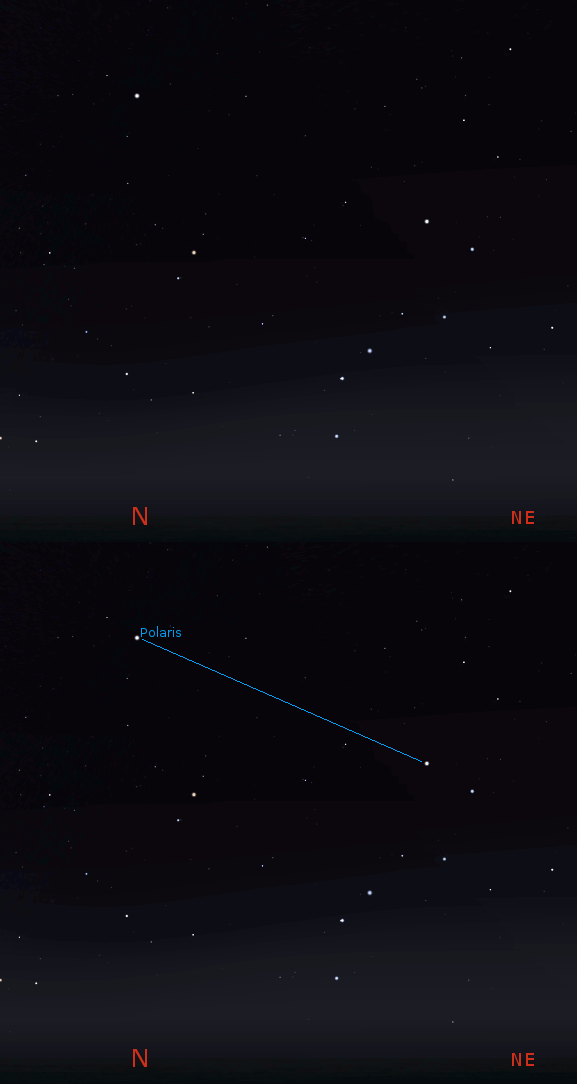
An animation showing the Big Dipper, also known as the Drinking Gourd pointing to Polaris, the North Star which is just about due north. This is for 9 pm January 18th, about 3 1/2 hours after sunset. Created using Stellarium with additional annotations.
04/24/2020 – Ephemeris – The Big Dipper can be used to point to other stars and constellations
This is Bob Moler with Ephemeris for Arbor Day, Friday, April 24th. Today the Sun will be up for 13 hours and 57 minutes, setting at 8:39, and it will rise tomorrow at 6:41. The Moon, 2 days past new, will set at 10:21 this evening.
The Big Dipper can be used to point to other stars and constellations. Right now the Big Dipper is nearly overhead. The front bowl stars point to Polaris, the North Star which never seems to move in the sky. The handle can be used to find two stars. First follow the arc of the handle away from the bowl to find the fourth brightest night-time star Arcturus in the base of the kite shaped constellation of Boötes. Straighten the arc to a spike and continue to the south and you will come to the bright blue-white star Spica in Virgo the virgin. You can remember these stars with the phrase “Follow the arc of the handle to Arcturus and then spike to Spica” or if you prefer the alternate pronunciation of the latter star “Speak to Speeka”.
The event times given are for the Traverse City/Interlochen area of Michigan. They may be different for your location.
Addendum
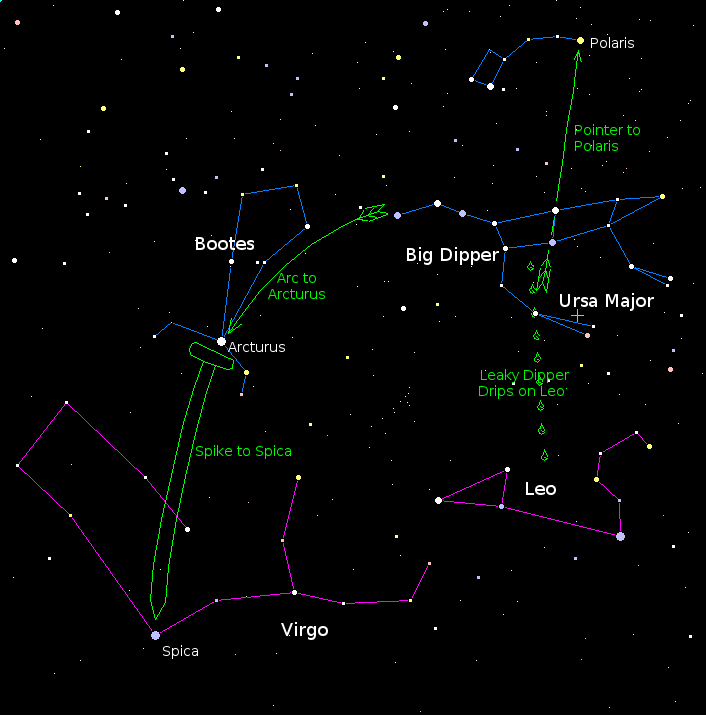
Finding stars and constellations using the Big Dipper. Click on the image to enlarge. Created using my LookingUp program for Windows.
09/24/2019 – Ephemeris – Cassiopeia the “W” shaped constellation
Ephemeris for Tuesday, September 24th. Today the Sun will be up for 12 hours and 4 minutes, setting at 7:36, and it will rise tomorrow at 7:33. The Moon, 3 days past last quarter, will rise at 3:13 tomorrow morning.
The stars of the autumn skies slowly are replacing the summer stars from the east. Look in the northeastern sky by 9 p.m. and you can find the W shaped constellation of Cassiopeia the queen. Cassiopeia is so far north that it never sets for us in Michigan. It is opposite the pole star Polaris from the Big Dipper. There’s a dim star that appears above the middle star of the W which turns the W into a very crooked backed chair. Cassiopeia, in Greek mythology, represents a queen of ancient Ethiopia, the W represents the profile of her throne. She enters in to the great autumn story whose other characters are also seen in the stars as the constellations Andromeda, Pegasus, Perseus, Cetus and her husband Cepheus.
For my retelling of the Greek myth that links these autumn constellations click here.
The times given are for the Traverse City/Interlochen area of Michigan. They may be different for your location.
Addendum
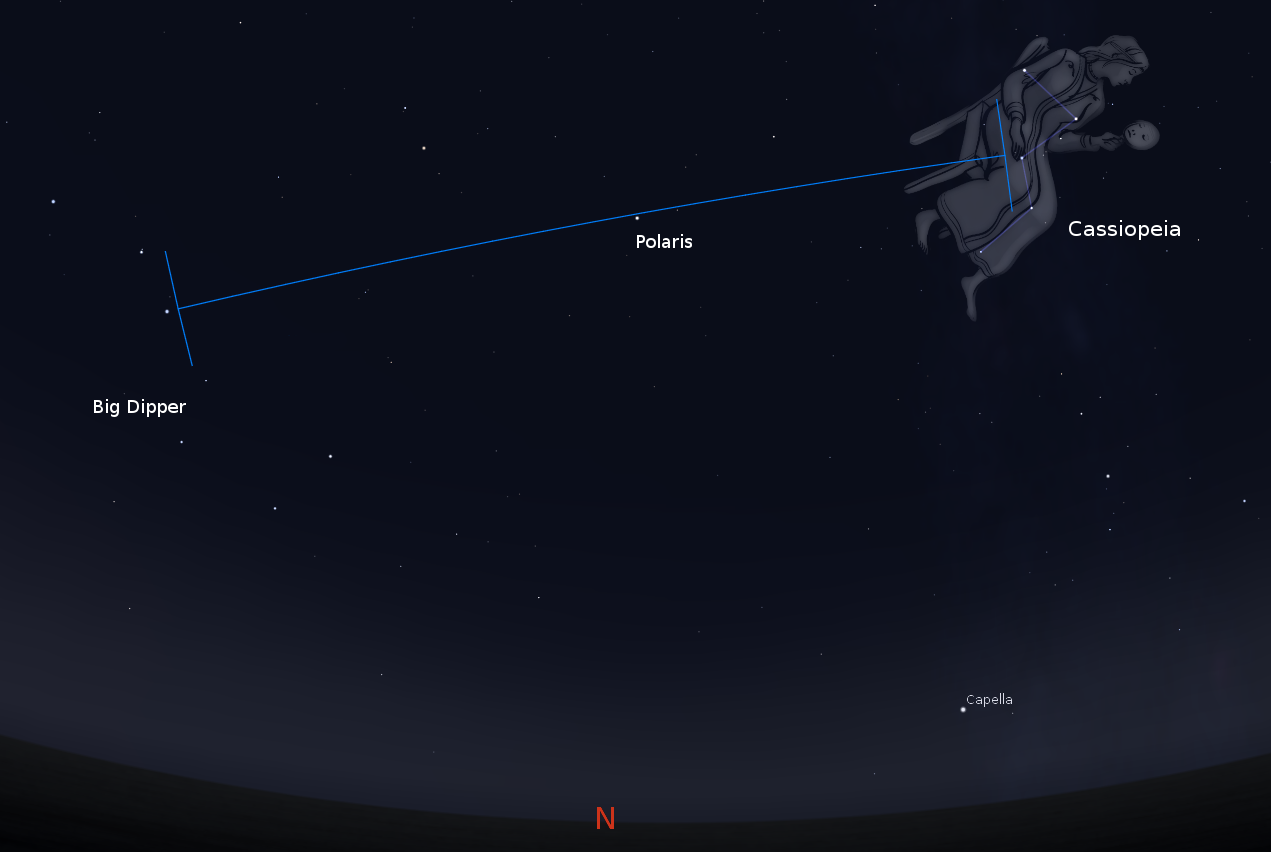
Cassiopeia, in the northeast is opposite Polaris from the Big Dipper. For 9 p.m. in late September. Created using Stellarium. Artistic credit: Johan Meuris.
04/08/2019 – Ephemeris – How to find Polaris, the North Star
Ephemeris for Monday, April 8th. Today the Sun will be up for 13 hours and 7 minutes, setting at 8:18, and it will rise tomorrow at 7:09. The Moon, 3 days past new, will set at 11:54 this evening.
The most useful of the navigation stars for the average person is Polaris, the North Star or Pole Star. It is very close to the point in the sky that the Earth’s axis points to in the north. Currently it is about three-quarters of a degree from the pole, about one and a half moon diameters. In 2110 or thereabouts it will approach to slightly less than a moon diameter from the pole before slowly heading away. Polaris is always closer to true north than a magnetic compass in Michigan. To find it use the two stars in front of the Big Dipper’s bowl to point to it. This time of year the Big Dipper is above Polaris, so the pointer stars, that’s what they are called, point down to it. Polaris is at the end of the handle of the faint Little Dipper. The reason for Polaris’ motion is the slow 26,000 year wobbling of the Earth’s axis, called precession.
The times given are for the Traverse City/Interlochen area of Michigan. They may be different for your location.
Addendum
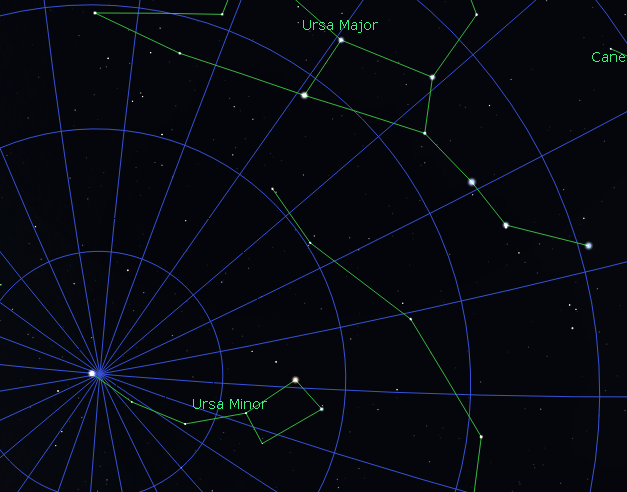
Ursa Major and Minor, the Big and Little Dippers. See how the two stars at the front of the bowl point to Polaris. It happens that the pointer stars are close to the 11th hour of right ascension (longitude in the sky). The right ascension lines converge at the north celestial pole, just as the longitude lines converge at the Earth’s north pole. Created using Stellarium.
The year I was born, 1941, Polaris was a whole degree from the celestial north pole.
If you’ve ever wondered why right ascension is in hours instead of degrees it’s because the Earth rotates within the celestial sphere, so it’s easier to keep track of the east-west position in the sky by using a clock that set to gain 3 minutes and 56 seconds a day. Such a clock keeps sidereal (star) time rather than solar (sun) time. One hour equals 15 angular degrees or 4 minutes a degree.
05/14/2018 – Ephemeris – Big Dipper: Pointer to the Stars
Ephemeris for Monday, May 14th. Today the Sun will be up for 14 hours and 47 minutes, setting at 9:03, and it will rise tomorrow at 6:14. The Moon, 1 day before new, will rise at 6:45 tomorrow morning.
The Big Dipper points to other stars and constellations. Right now the Big Dipper is nearly overhead. The front bowl stars point to Polaris, the North Star which never seems to move in the sky. The handle can be used to find two stars. First follow the arc of the handle away from the bowl to find the fourth brightest night-time star Arcturus in the base of the kite shaped constellation of Boötes. Straighten the arc to a spike and continue to the south and you will come to the bright blue-white star Spica in Virgo the virgin. You can remember these stars with the phrase “Follow the arc of the handle to Arcturus and then spike to Spica” or if you prefer the alternate pronunciation of the latter star “Speak to Speeka”.
The times given are for the Traverse City/Interlochen area of Michigan. They may be different for your location.
Addendum
As can be seen below, there was one pointer function that didn’t make it into the program: A leaky dipper drips on Leo.
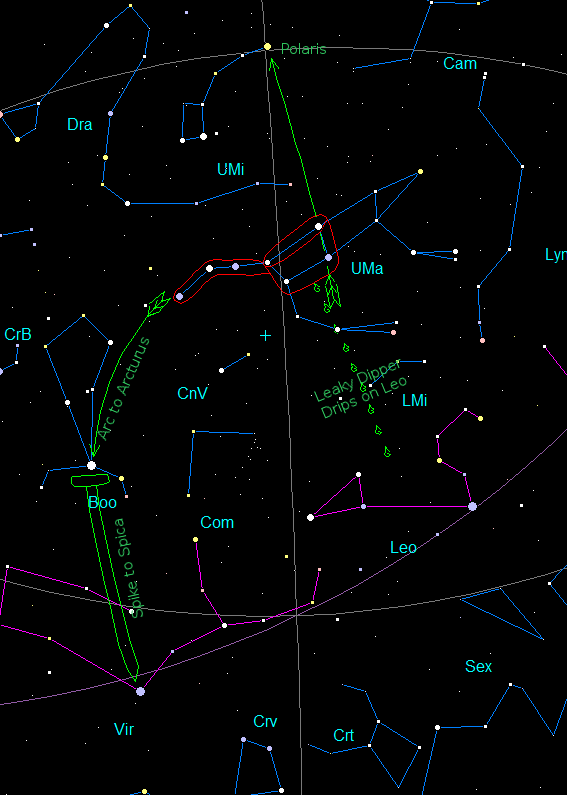
Using the Big Dipper as a pointer to other stars. The pointers to Polaris could be life saving, since it is always north. The view is southward. The cross displayed near the center is the zenith. One might want to lay down to take all this in. Created using my LookingUp program.
 Bob Moler's Ephemeris Blog